seduction plan
pp. 20-22 · Read in the full issue
the month
Sweetening N-Tests
French socialist seduction plan
Hhen the socialists came to power in France five years ago we predicted in these columns that the welcome winds of change generated by this event would not reach the nuclear colony of French Polynesia (PIM, June 1982 p. 28). Today, when their time is up, our prediction has been shown to be almost 100 per cent correct.
Not that there’s the slightest occasion for bragging: anyone who watches French politics with even half an eye would have known the outcome from as far back as 1978. For it was in that year that the French Socialist Party, largely at the
urging of the future (and now former) Defence Minister Charles Hernu, adopted Gen eral de Gaulle’s impossible dream of building an indepen dent, credible, French nuclear strike force. That unfortunate decision made it as imperative for the new socialist govern ment as it had been for the previous conservative ones to hang on to the remote Polyne sian islands, sole testing site for all French nuclear weapons, including the neutron bomb.
So, the socialists have kept the lid on demands by the elected local politicians either for independence or authentic self-government on the Cook Islands model demands sup
ported nowadays by the whole bunch, including the most pro- French of them all, Gaston Flosse. The end result of three years of intense wrangling over this issue was that the Polyne sians, in September 1984, were presented with yet another muddled rewrite of the same colonial-style constitution which has been in force in one version or another since 1885.
The socialists have also left the doors of the colony as wide open as ever before to new French immigrants: from 1965 to ’B5 inclusive, the annual intake has never fallen below 1000. To say the very least, the prospect of a repetition in Polynesia of the New Caledo
nian situation, where the Kanaks have long since be come a minority in their own land, does not seem to have worried the socialists in the slightest.
Nor have the socialists held back from classical means of repression against more militant advocates of independence.
Here we shall mention only the most recent misadventures of two well-known Tahitian inde pendence leaders, Charlie Ching and Oscar Temaru. The experiences of both men are unquestionably linked to the Rainbow Warrior affair.
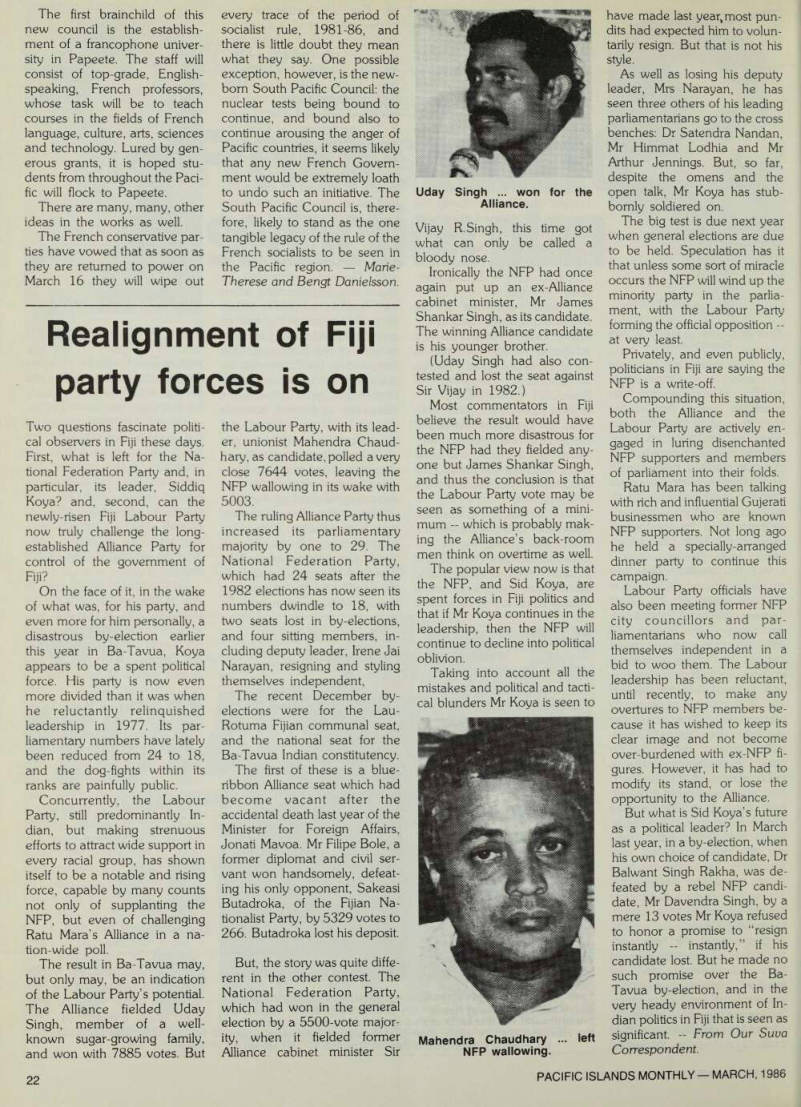
Charlie Ching, inheritor of an indomitable spirit from his uncle, the legendary Tahitian freedom frighter Pouvanaa a Oopa, was an early and en thusiastic supporter of the 1985 Greenpeace plan to send a protest vessel to Moruroa to the extent that he went to New Zealand in February 1985, offering to embark on the Rain bow Warrior with a sizable group of his followers. The insufferable prospect of having Tahitian “activists” thrust in this way into the international spot light in this way more than anything else, in our view, provoked such rage in Paris that the ship was sunk on government orders by a still unidentified colleague of In spector Clouseau . . .
Back in Papeete, Charlie Ching called out members of his Taata Tahiti Tiama party to demonstrate against the arms race in a local park as political parties here have been doing every year on or around Bikini Day, March 1. The up shot was that he was promptly seized by police, along with a
few of his associates, and held in preventive custody for five months. When his trial was eventually held in August, the charges as so often happens here were based on a law nobody had ever heard of. In this case it was a 1935 French law directed against “economic crimes”! Such were the “legal grounds” on which Ching was sentenced to two-and-a-half years in jail, later reduced on appeal to two years.
But the freedom flag thus struck from Charlie’s hand was at once taken up by Oscar Temaru, mayor of Tahiti’s big gest town, Faaa. Temaru had early on come out in support both of the FLNKS provisional government in New Caledonia, and of the Greenpeace initia tive. With great courage, not to say temerity, Oscar chose the moment when the tug Green peace entered the Pacific in early September to make a public statement of welcome to her captain and crew. A month later the tug, suffering engine trouble, had to sail for Tahiti.
Oscar then did something bol der still: though suffering from bronchitis, he sailed out in a small boat into international waters (the French authorities having refused to allow Green peace into Papeete for repair), and presented the crew with traditional Polynesian gifts of fruit. This gesture, and the hospitality he was later to offer some of the tug’s crew mem bers when they were eventually allowed to come ashore in small craft, won him an interesting
invitation from one of the visi tors, Dorothee Piermont, a Ger man ecologist deputy to the European Parliament. She in vited him to pay an early visit to Bonn and Strasbourg.
This he did in December, speaking at various meetings organised by the German “Greens” party, and appealing to all peace-loving Germans to help the Polynesians in their struggle for an independent and nuclear-free Pacific. Along the way he complained about the tight French control of the mass media in Tahiti. The result was a promise from his hosts to raise funds to start a Tahitian-lan guage newspaper.
“Traitor” was one of the milder expressions used to de scribe Oscar Temaru in the infuriated media coverage in Tahiti of his doings and sayings in Germany, hated foe of France in World War II . . .
Gaston Flosse went so far as to write to President Mitterrand demanding “exemplary punish ment” of the traitor, and some critics lamented that the socialist government had abolished the death penalty.
Whether reacting to this local hysteria or not, the representa tive of the republic, High Com missioner Bernard Gerard, held a press conference to announce that he was taking legal action against Temaru. Not because of
his German connections France is, after all, a democra tic country with complete free dom of expression” but because he had committed a most fearful offence; as High Commissioner Gerard had be latedly discovered, Oscar, who is by profession a Customs inspector, had been on the sick list on that fateful day when he had gone out to the Green peace instead of staying in bed, as required by regulations.
On his return, Oscar sent off a spirited reply to his detractors, asking them pointblank why they condemned his dealings with Germans dedicated to peace and disarmament, when they had never raised a breath of protest against the use of armed and uniformed Germans in units of the Foreign Legion stationed in his Polynesian is lands for 20 years or more?
One small snippet from Oscar’s statement appeared towards the back of one of the local newspapers, and that was all.
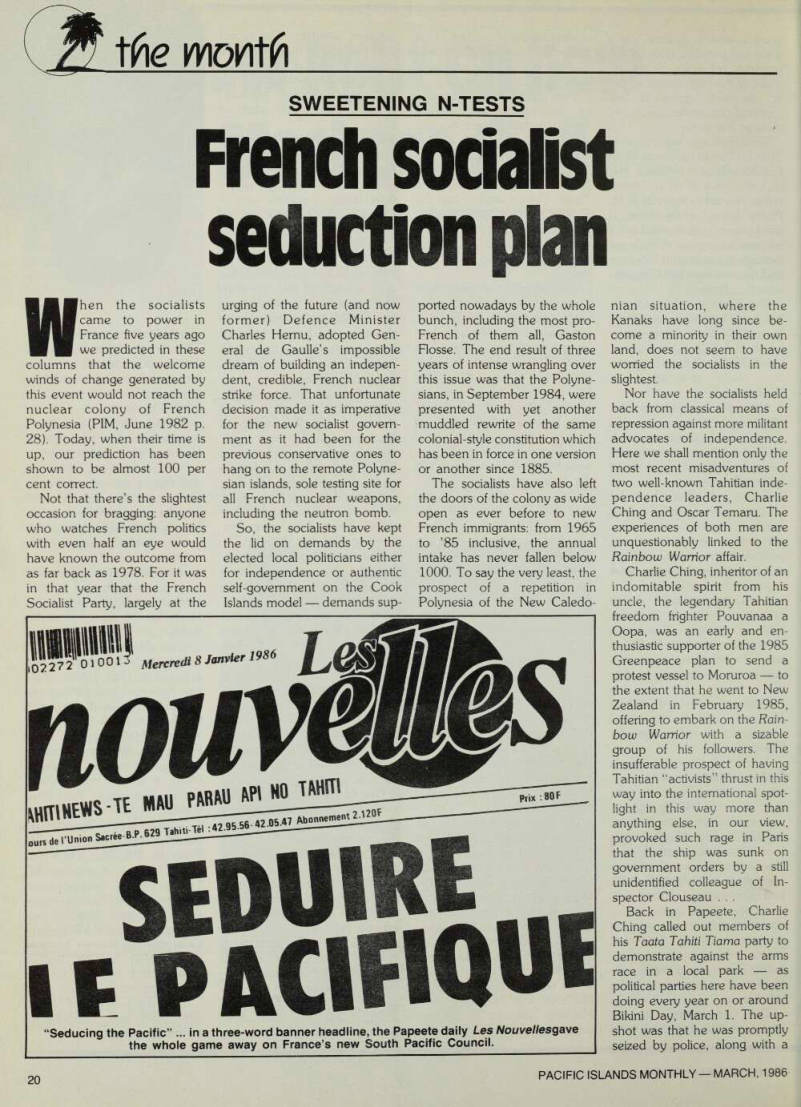
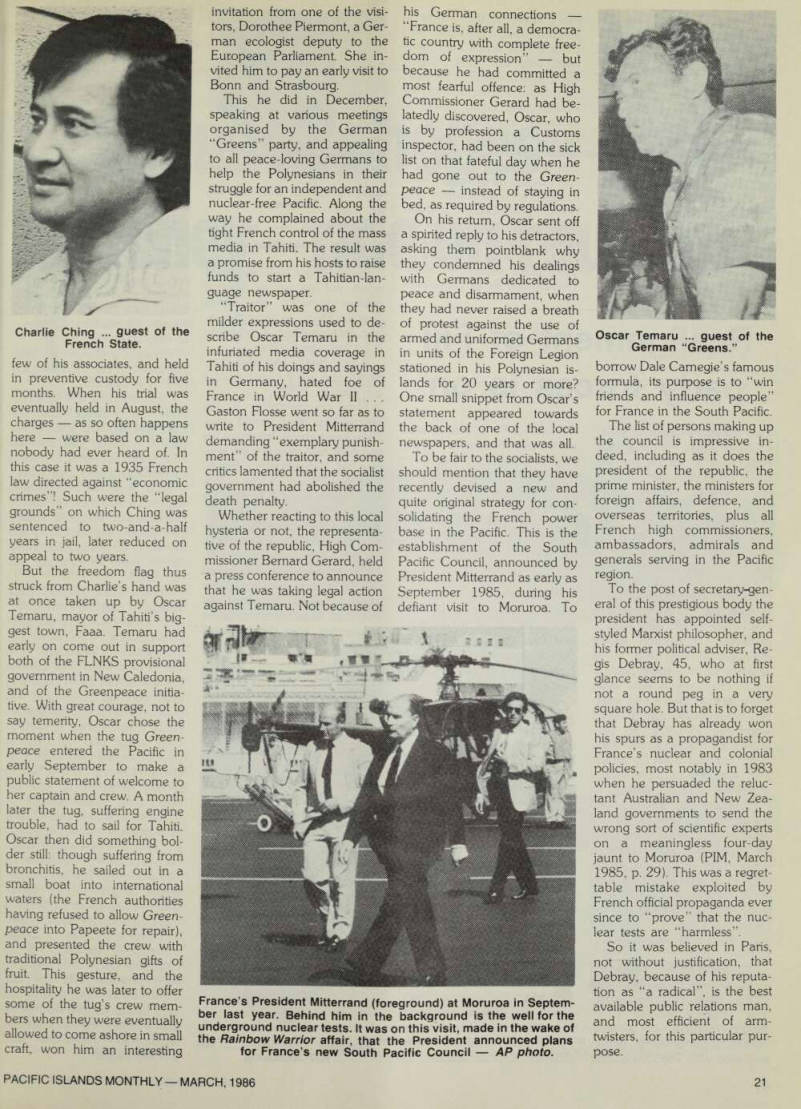
To be fair to the socialists, we should mention that they have recently devised a new and quite original strategy for con solidating the French power base in the Pacific. This is the establishment of the South Pacific Council, announced by President Mitterrand as early as September 1985, during his defiant visit to Moruroa. To
borrow Dale Carnegie’s famous formula, its purpose is to “win friends and influence people” for France in the South Pacific.
The list of persons making up the council is impressive in deed, including as it does the president of the republic, the prime minister, the ministers for foreign affairs, defence, and overseas territories, plus all French high commissioners, ambassadors, admirals and generals serving in the Pacific region.
To the post of secretary-gen eral of this prestigious body the president has appointed self styled Marxist philosopher, and his former political adviser, Re gis Debray, 45, who at first glance seems to be nothing if not a round peg in a very square hole. But that is to forget that Debray has already won his spurs as a propagandist for France’s nuclear and colonial policies, most notably in 1983 when he persuaded the reluc tant Australian and New Zea land governments to send the wrong sort of scientific experts on a meaningless four-day jaunt to Moruroa (PIM, March 1985, p. 29). This was a regret table mistake exploited by French official propaganda ever since to “prove” that the nuc lear tests are “harmless”.
So it was believed in Paris, not without justification, that Debray, because of his reputa tion as “a radical”, is the best available public relations man, and most efficient of arm twisters, for this particular pur pose.
Charlie Ching ... guest of the French State.
France’s President Mitterrand (foreground) at Moruroa in Septem ber last year. Behind him in the background is the well for the underground nuclear tests. It was on this visit, made in the wake of the Rainbow Warrior affair, that the President announced plans for France’s new South Pacific Council - AP photo.
Oscar Temaru ... guest of the German “Greens.”
The first brainchild of this new council is the establish ment of a francophone univer sity in Papeete. The staff will consist of top-grade, English speaking, French professors, whose task will be to teach courses in the fields of French language, culture, arts, sciences and technology. Lured by gen erous grants, it is hoped stu dents from throughout the Paci fic will flock to Papeete.
There are many, many, other ideas in the works as well.
The French conservative par ties have vowed that as soon as they are returned to power on March 16 they will wipe out
every trace of the period of socialist rule, 1981-86, and there is little doubt they mean what they say. One possible exception, however, is the new born South Pacific Council: the nuclear tests being bound to continue, and bound also to continue arousing the anger of Pacific countries, it seems likely that any new French Govern ment would be extremely loath to undo such an initiative. The South Pacific Council is, there fore, likely to stand as the one tangible legacy of the rule of the French socialists to be seen in the Pacific region. Marie- Therese and Bengt Danielsson.