Machoro died
pp. 18-19 · Read in the full issue
New light on how Machoro died
New evidence has emerged which sug gests that Kanak inde pendence leader. Eloi Machoro, was shot by French gendarmes on their own initia tive.
Mr Machoro, 40, a senior member of the Union Caledo nienne (the largest of the inde pendence parties in New Cale donia) was the mastermind of the more militant and violent of FLNKS actions during the early part of last year. He was killed by a French police marksman on January 12 during a seige at a farmhouse.
Union Caledonienne last month took legal action which enabled them to have access to the ballistic reports which are part of the investigation into the shootings of Machoro and an other FLNKS militant, Marcel Nonnaro.
The reports suggest that the police sharpshooters who claim to have attempted under orders to "neutralise” but not kill the men used weapons unsuited to the task. According to lawyers for the Machoro family and Union Caledonienne there is no trace of an order to "neutral ise,” either from special French envoy, Edgard Pisani, or from police superiors of the marks men.
Machoro. who was styled Minister for Security in the provisional government of Kanaky. and Marcel Nonnaro died at 6.10 am on January 12 after being held under siege by gendarmes on a Kanak-owned property near La Foa on the west coast. The preceding evening the worst rioting ever seen in New Caledonia had broken out in the capital.
Former RIM correspondent in New Caledonia. HELEN FRASER, recently returned to Australia after a stay of several months in France. While there she gathered fresh information on the background to the death in January 1985 of FLNKS leader Eloi Machoro.
Noumea, after the shooting of a white farmer's son by FLNKS militants. Anti-independence rioters fought for 24 hours with riot police and set fire to many buildings in the town.
At the same time as the rioting broke out in Noumea, Mr Pisani received information that a European property was surrounded by about 40 armed
FLNKS militants, with Machoro said to be in charge.
The FLNKS say the group, which included women and children, were meeting on the Kanak-owned land, and had at no stage surrounded the Euro pean farm further down the road. Indeed, the siting of the two properties makes it im possible for the assertion of a
Kanak siege to be true.
By early Friday evening the first platoons of gendarmes had arrived at the Kanak property.
Lengthy discussions were held between Machoro and the commander of the La Foa gendarme station. About 300 gendarmes were deployed around the Kanak area and armored personnel carriers were brought in.
By 10 pm the situation was stable, according to both Kanak and French accounts, with the militants inside the house.
However, the general in charge of the operation. General Dei ber, who was still in Noumea, received a call from the scene asking for elite marksmen to be sent in by helicopter. At the time the men. members of the GIGN. a crack para-military unit, were protecting the French High Commissioner’s resi dence, centre of attention dur ing the heavy rioting then occurring.
The assumption in Noumea and elsewhere is that the deci sion to transfer a section of this group from the guard on the High Commissioner to La Foa indicates reception of a crisis message from the officer in charge on the scene at the siege.
Yet, the FLNKS insists that Machoro and his men did not perceive a crisis. A decision was taken to send the women and children away from the group, and the gendarmes allowed them to leave unhindered.
The FLNKS says orders were given to all remaining militants that no shots were to be fired unless the gendarmes fired first.
Meanwhile, Machoro sent a messenger to a nearby FLNKS member's house where there was a telephone to ask Mr Pisani urgently for a truce.
Machoro appears to have had
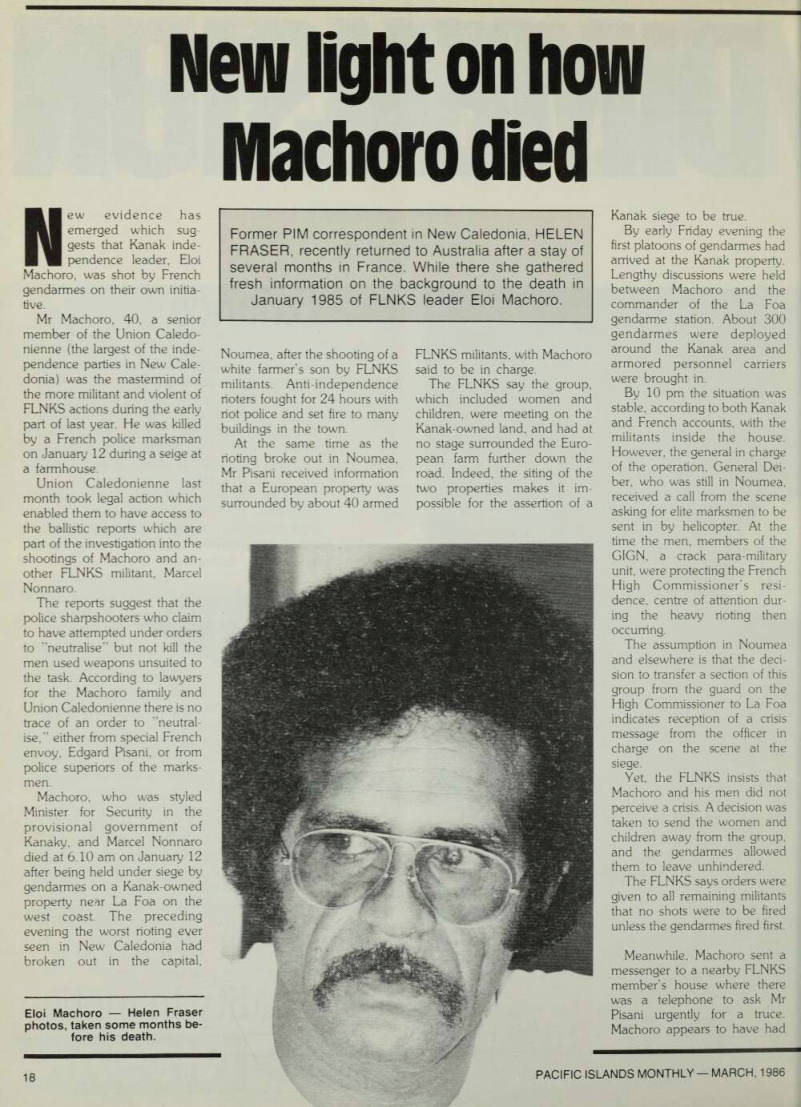
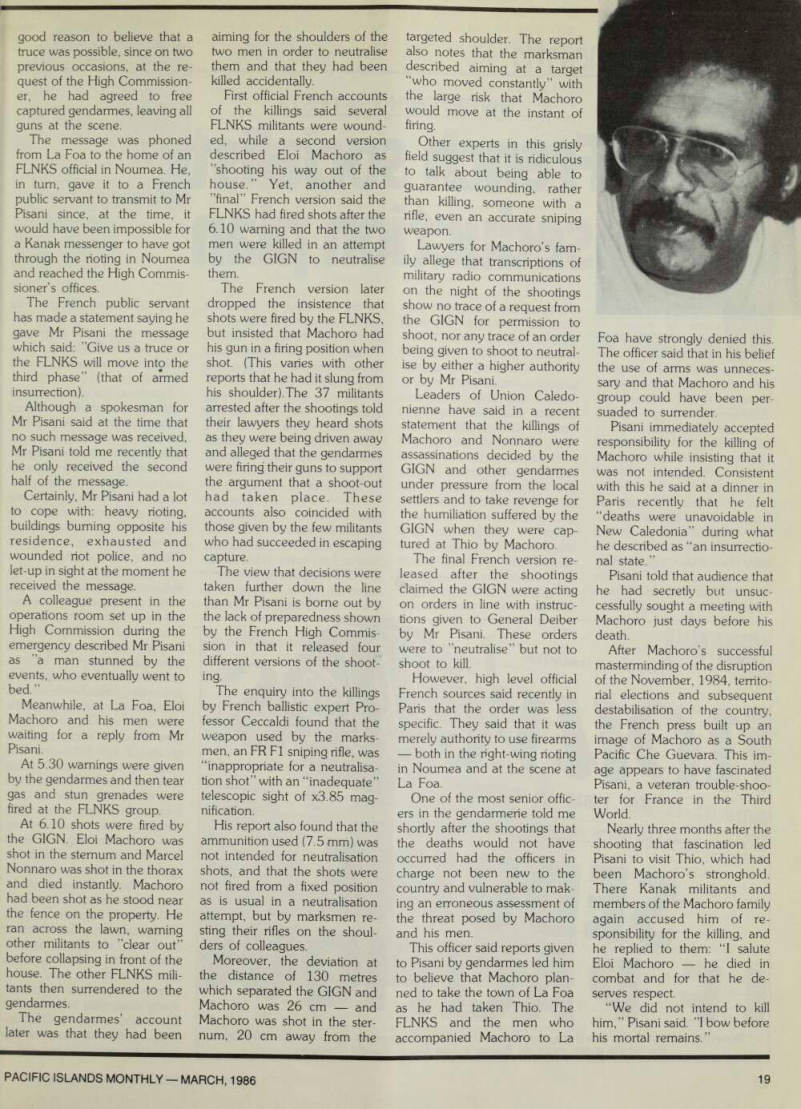
Eloi Machoro - Helen Fraser photos, taken some months be fore his death.
good reason to believe that a truce was possible, since on two previous occasions, at the re quest of the High Commission er, he had agreed to free captured gendarmes, leaving all guns at the scene.
The message was phoned from La Foa to the home of an FLNKS official in Noumea. He, in turn, gave it to a French public servant to transmit to Mr Pisani since, at the time, it would have been impossible for a Kanak messenger to have got through the rioting in Noumea and reached the High Commis sioner’s offices.
The French public servant has made a statement saying he gave Mr Pisani the message which said: ’’Give us a truce or the FLNKS will move into the third phase” (that of armed insurrection).
Although a spokesman for Mr Pisani said at the time that no such message was received, Mr Pisani told me recently that he only received the second half of the message.
Certainly, Mr Pisani had a lot to cope with: heavy rioting, buildings burning opposite his residence, exhausted and wounded riot police, and no let-up in sight at the moment he received the message.
A colleague present in the operations room set up in the High Commission during the emergency described Mr Pisani as ”a man stunned by the events, who eventually went to bed.”
Meanwhile, at La Foa, Eloi Machoro and his men were waiting for a reply from Mr Pisani.
At 5.30 warnings were given by the gendarmes and then tear gas and stun grenades were fired at the FLNKS group.
At 6.10 shots were fired by the GIGN. Eloi Machoro was shot in the sternum and Marcel Nonnaro was shot in the thorax and died instantly. Machoro had been shot as he stood near the fence on the property. He ran across the lawn, warning other militants to ’’clear out” before collapsing in front of the house. The other FLNKS mili tants then surrendered to the gendarmes.
The gendarmes’ account later was that they had been
aiming for the shoulders of the two men in order to neutralise them and that they had been killed accidentally.
First official French accounts of the killings said several FLNKS militants were wound ed, while a second version described Eloi Machoro as ’’shooting his way out of the house.” Yet, another and ’’final” French version said the FLNKS had fired shots after the 6.10 warning and that the two men were killed in an attempt by the GIGN to neutralise them.
The French version later dropped the insistence that shots were fired by the FLNKS, but insisted that Machoro had his gun in a firing position when shot. (This varies with other reports that he had it slung from his shoulder).The 37 militants arrested after the shootings told their lawyers they heard shots as they were being driven away and alleged that the gendarmes were firing their guns to support the argument that a shoot-out had taken place. These accounts also coincided with those given by the few militants who had succeeded in escaping capture.
The view that decisions were taken further down the line than Mr Pisani is borne out by the lack of preparedness shown by the French High Commis sion in that it released four different versions of the shoot ing.
The enquiry into the killings by French ballistic expert Pro fessor Ceccaldi found that the weapon used by the marks men, an FR FI sniping rifle, was “inappropriate for a neutralisa tion shot” with an “inadequate” telescopic sight of x 3.85 mag nification.
His report also found that the ammunition used (7.5 mm) was not intended for neutralisation shots, and that the shots were not fired from a fixed position as is usual in a neutralisation attempt, but by marksmen re sting their rifles on the shoul ders of colleagues.
Moreover, the deviation at the distance of 130 metres which separated the GIGN and Machoro was 26 cm and Machoro was shot in the ster num, 20 cm away from the
targeted shoulder. The report also notes that the marksman described aiming at a target “who moved constantly” with the large risk that Machoro would move at the instant of firing.
Other experts in this grisly field suggest that it is ridiculous to talk about being able to guarantee wounding, rather than killing, someone with a rifle, even an accurate sniping weapon.
Lawyers for Machoro’s fam ily allege that transcriptions of military radio communications on the night of the shootings show no trace of a request from the GIGN for permission to shoot, nor any trace of an order being given to shoot to neutral ise by either a higher authority or by Mr Pisani.
Leaders of Union Caledo nienne have said in a recent statement that the killings of Machoro and Nonnaro were assassinations decided by the GIGN and other gendarmes under pressure from the local settlers and to take revenge for the humiliation suffered by the GIGN when they were cap tured at Thio by Machoro.
The final French version re leased after the shootings claimed the GIGN were acting on orders in line with instruc tions given to General Deiber by Mr Pisani. These orders were to ’’neutralise” but not to shoot to kill.
However, high level official French sources said recently in Paris that the order was less specific. They said that it was merely authority to use firearms both in the right-wing rioting in Noumea and at the scene at La Foa.
One of the most senior offic ers in the gendarmerie told me shortly after the shootings that the deaths would not have occurred had the officers in charge not been new to the country and vulnerable to mak ing an erroneous assessment of the threat posed by Machoro and his men.
This officer said reports given to Pisani by gendarmes led him to believe that Machoro plan ned to take the town of La Foa as he had taken Thio. The FLNKS and the men who accompanied Machoro to La
Foa have strongly denied this.
The officer said that in his belief the use of arms was unneces sary and that Machoro and his group could have been per suaded to surrender.
Pisani immediately accepted responsibility for the killing of Machoro while insisting that it was not intended. Consistent with this he said at a dinner in Paris recently that he felt “deaths were unavoidable in New Caledonia” during what he described as “an insurrectio nal state.”
Pisani told that audience that he had secretly but unsuc cessfully sought a meeting with Machoro just days before his death.
After Machoro’s successful masterminding of the disruption of the November, 1984, territo rial elections and subsequent destabilisation of the country, the French press built up an image of Machoro as a South Pacific Che Guevara. This im age appears to have fascinated Pisani, a veteran trouble-shoo ter for France in the Third World.
Nearly three months after the shooting that fascination led Pisani to visit Thio, which had been Machoro’s stronghold.
There Kanak militants and members of the Machoro family again accused him of re sponsibility for the killing, and he replied to them: “1 salute Eloi Machoro he died in combat and for that he de serves respect.
“We did not intend to kill him,” Pisani said. ”1 bow before his mortal remains.”