people
pp. 48-49 · Read in the full issue
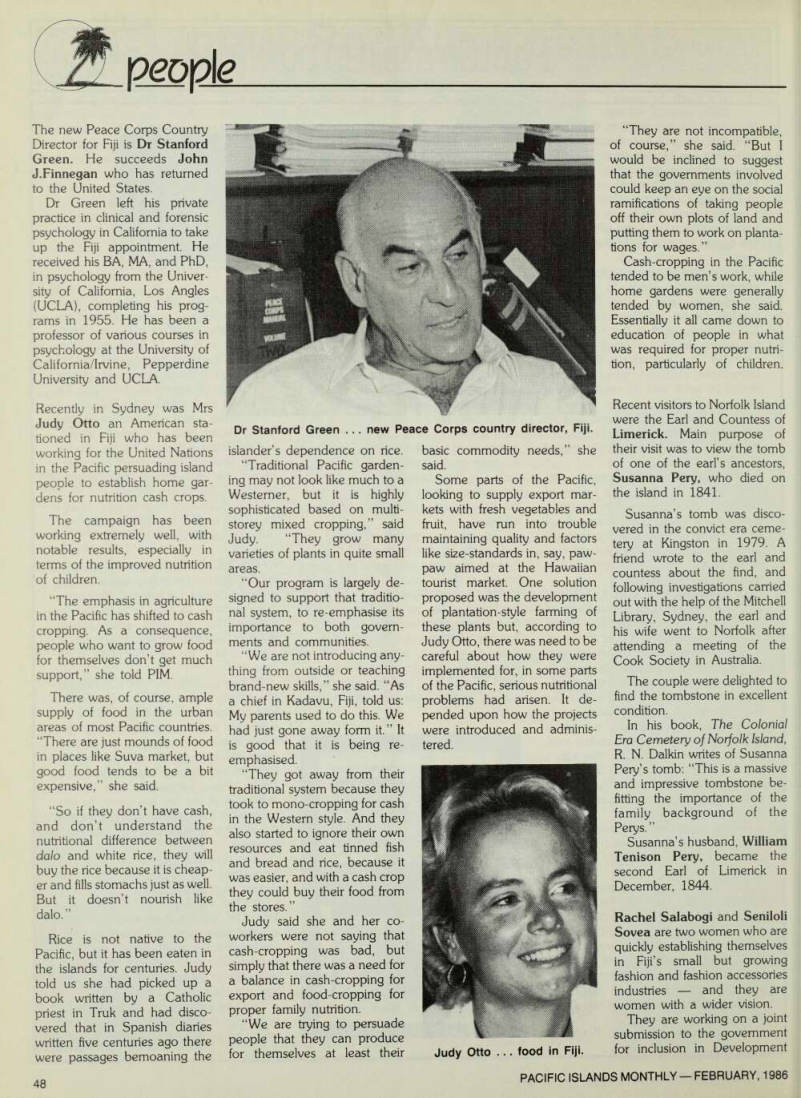
The new Peace Corps Country Director for Fiji is Dr Stanford Green. He succeeds John J.Finnegan who has returned to the United States.
Dr Green left his private practice in clinical and forensic psychology in California to take up the Fiji appointment. He received his BA, MA, and PhD, in psychology from the Univer sity of California, Los Angles (UCLA), completing his prog rams in 1955. He has been a professor of various courses in psychology at the University of California/Irvine, Pepperdine University and UCLA.
Recently in Sydney was Mrs Judy Otto an American sta tioned in Fiji who has been working for the United Nations in the Pacific persuading island people to establish home gar dens for nutrition cash crops.
The campaign has been working extremely well, with notable results, especially in terms of the improved nutrition of children.
“The emphasis in agriculture in the Pacific has shifted to cash cropping. As a consequence, people who want to grow food for themselves don’t get much support,” she told PIM.
There was, of course, ample supply of food in the urban areas of most Pacific countries.
“There are just mounds of food in places like Suva market, but good food tends to be a bit expensive,” she said.
“So if they don’t have cash, and don’t understand the nutritional difference between dalo and white rice, they will buy the rice because it is cheap er and fills stomachs just as well.
But it doesn’t nourish like dalo.”
Rice is not native to the Pacific, but it has been eaten in the islands for centuries. Judy told us she had picked up a book written by a Catholic priest in Truk and had disco vered that in Spanish diaries written five centuries ago there were passages bemoaning the
islander’s dependence on rice.
“Traditional Pacific garden ing may not look like much to a Westerner, but it is highly sophisticated based on multi storey mixed cropping,” said Judy. “They grow many varieties of plants in quite small areas.
“Our program is largely de signed to support that traditio nal system, to re-emphasise its importance to both govern ments and communities.
“We are not introducing any thing from outside or teaching brand-new skills,” she said. “As a chief in Kadavu, Fiji, told us: My parents used to do this. We had just gone away form it. ” It is good that it is being re emphasised.
“They got away from their traditional system because they took to mono-cropping for cash in the Western style. And they also started to ignore their own resources and eat tinned fish and bread and rice, because it was easier, and with a cash crop they could buy their food from the stores.”
Judy said she and her co workers were not saying that cash-cropping was bad, but simply that there was a need for a balance in cash-cropping for export and food-cropping for proper family nutrition.
“We are trying to persuade people that they can produce for themselves at least their
basic commodity needs,” she said.
Some parts of the Pacific, looking to supply export mar kets with fresh vegetables and fruit, have run into trouble maintaining quality and factors like size-standards in, say, paw paw aimed at the Hawaiian tourist market. One solution proposed was the development of plantation-style farming of these plants but, according to Judy Otto, there was need to be careful about how they were implemented for, in some parts of the Pacific, serious nutritional problems had arisen. It de pended upon how the projects were introduced and adminis tered.
“They are not incompatible, of course,” she said. “But I would be inclined to suggest that the governments involved could keep an eye on the social ramifications of taking people off their own plots of land and putting them to work on planta tions for wages.”
Cash-cropping in the Pacific tended to be men’s work, while home gardens were generally tended by women, she said.
Essentially it all came down to education of people in what was required for proper nutri tion, particularly of children.
Recent visitors to Norfolk Island were the Earl and Countess of Limerick. Main purpose of their visit was to view the tomb of one of the earl’s ancestors, Susanna Pcry, who died on the island in 1841.
Susanna’s tomb was disco vered in the convict era ceme tery at Kingston in 1979. A friend wrote to the earl and countess about the find, and following investigations carried out with the help of the Mitchell Library, Sydney, the earl and his wife went to Norfolk after attending a meeting of the Cook Society in Australia.
The couple were delighted to find the tombstone in excellent condition.
In his book, The Colonial Era Cemetery of Norfolk Island, R. N. Dalkin writes of Susanna Pery’s tomb: “This is a massive and impressive tombstone be fitting the importance of the family background of the Perys. ”
Susanna’s husband, William Tenison Fery, became the second Earl of Limerick in December, 1844.
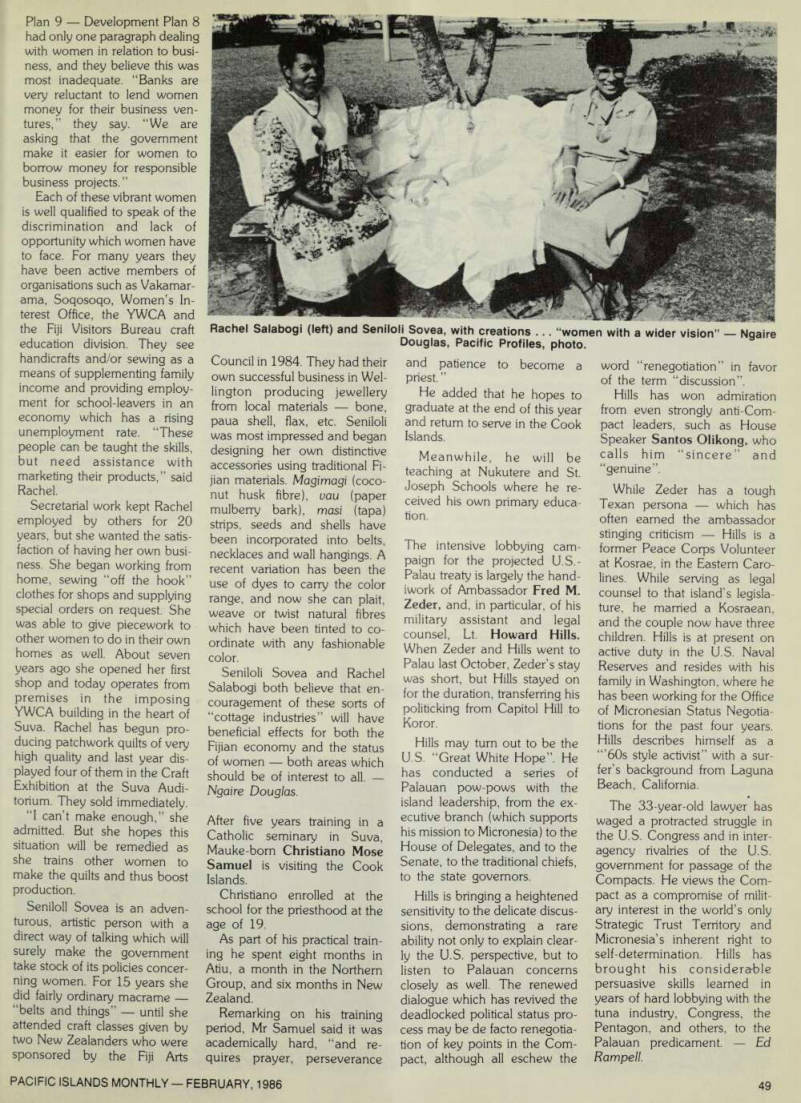
Rachel Salabogi and Seniloli Sovea are two women who are quickly establishing themselves in Fiji’s small but growing fashion and fashion accessories industries and they are women with a wider vision.
They are working on a joint submission to the government for inclusion in Development
Dr Stanford Green ... new Peace Corps country director, Fiji.
Judy Otto ... food in Fiji.
Plan 9 Development Plan 8 had only one paragraph dealing with women in relation to busi ness, and they believe this was most inadequate. “Banks are very reluctant to lend women money for their business ven tures,” they say. “We are asking that the government make it easier for women to borrow money for responsible business projects.”
Each of these vibrant women is well qualified to speak of the discrimination and lack of opportunity which women have to face. For many years they have been active members of organisations such as Vakamar ama, Soqosoqo, Women’s In terest Office, the YWCA and the Fiji Visitors Bureau craft education division. They see handicrafts and/or sewing as a means of supplementing family income and providing employ ment for school-leavers in an economy which has a rising unemployment rate. “These people can be taught the skills, but need assistance with marketing their products,” said Rachel.
Secretarial work kept Rachel employed by others for 20 years, but she wanted the satis faction of having her own busi ness. She began working from home, sewing “off the hook” clothes for shops and supplying special orders on request. She was able to give piecework to other women to do in their own homes as well. About seven years ago she opened her first shop and today operates from premises in the imposing YWCA building in the heart of Suva. Rachel has begun pro ducing patchwork quilts of very high quality and last year dis played four of them in the Craft Exhibition at the Suva Audi torium. They sold immediately.
“I can’t make enough,” she admitted. But she hopes this situation will be remedied as she trains other women to make the quilts and thus boost production.
Seniloli Sovea is an adven turous, artistic person with a direct way of talking which will surely make the government take stock of its policies concer ning women. For 15 years she did fairly ordinary macrame “belts and things” until she attended craft classes given by two New Zealanders who were sponsored by the Fiji Arts
Council in 1984. They had their own successful business in Wel lington producing jewellery from local materials bone, paua shell, flax, etc. Seniloli was most impressed and began designing her own distinctive accessories using traditional Fi jian materials. Magimagi (coco nut husk fibre), uau (paper mulberry bark), masi (tapa) strips, seeds and shells have been incorporated into belts, necklaces and wall hangings. A recent variation has been the use of dyes to carry the color range, and now she can plait, weave or twist natural fibres which have been tinted to co ordinate with any fashionable color.
Seniloli Sovea and Rachel Salabogi both believe that en couragement of these sorts of “cottage industries” will have beneficial effects for both the Fijian economy and the status of women both areas which should be of interest to all.
Ngaire Douglas.
After five years training in a Catholic seminary in Suva, Mauke-born Christiano Mose Samuel is visiting the Cook Islands.
Christiano enrolled at the school for the priesthood at the age of 19.
As part of his practical train ing he spent eight months in Atiu, a month in the Northern Group, and six months in New Zealand.
Remarking on his training period, Mr Samuel said it was academically hard, “and re quires prayer, perseverance
and patience to become a priest. ”
He added that he hopes to graduate at the end of this year and return to serve in the Cook Islands.
Meanwhile, he will be teaching at Nukutere and St.
Joseph Schools where he re ceived his own primary educa tion.
The intensive lobbying cam paign for the projected U.S.- Palau treaty is largely the hand iwork of Ambassador Fred M.
Zeder, and, in particular, of his military assistant and legal counsel, Lt. Howard Hills.
When Zeder and Hills went to Palau last October, Zeder’s stay was short, but Hills stayed on for the duration, transferring his politicking from Capitol Hill to Koror.
Hills may turn out to be the U.S. “Great White Hope”. He has conducted a series of Palauan pow-pows with the island leadership, from the ex ecutive branch (which supports his mission to Micronesia) to the House of Delegates, and to the Senate, to the traditional chiefs, to the state governors.
Hills is bringing a heightened sensitivity to the delicate discus sions, demonstrating a rare ability not only to explain clear ly the U.S. perspective, but to listen to Palauan concerns closely as well. The renewed dialogue which has revived the deadlocked political status pro cess may be de facto renegotia tion of key points in the Com pact, although all eschew the
word “renegotiation” in favor of the term “discussion”.
Hills has won admiration from even strongly anti-Com pact leaders, such as House Speaker Santos Olikong, who calls him “sincere” and “genuine”.
While Zeder has a tough Texan persona which has often earned the ambassador stinging criticism Hills is a former Peace Corps Volunteer at Kosrae, in the Eastern Caro lines. While serving as legal counsel to that island’s legisla ture, he married a Kosraean, and the couple now have three children. Hills is at present on active duty in the U.S. Naval Reserves and resides with his family in Washington, where he has been working for the Office of Micronesian Status Negotia tions for the past four years.
Hills describes himself as a “’6os style activist” with a sur fer’s background from Laguna Beach, California.
The 33-year-old lawyer has waged a protracted struggle in the U.S. Congress and in inter agency rivalries of the U.S. government for passage of the Compacts. He views the Com pact as a compromise of milit ary interest in the world’s only Strategic Trust Territory and Micronesia’s inherent right to self-determination. Hills has brought his considera-ble persuasive skills learned in years of hard lobbying with the tuna industry, Congress, the Pentagon, and others, to the Palauan predicament. Ed Rampell.
Rachel Salabogi (left) and Seniloli Sovea, with creations ... “women with a wider vision” Ngaire Douglas, Pacific Profiles, photo.