Pacific stamp box
p. 47 · Read in the full issue
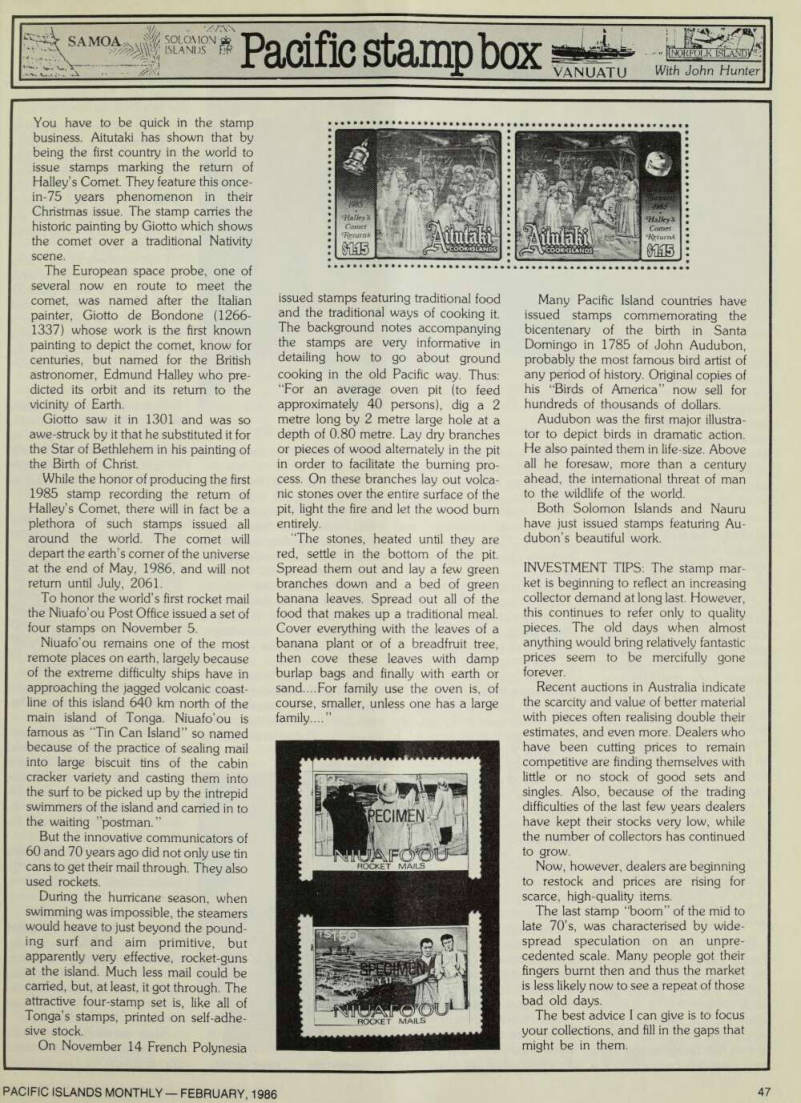
You have to be quick in the stamp business. Aitutaki has shown that by being the first country in the world to issue stamps marking the return of Halley’s Comet. They feature this once in-75 years phenomenon in their Christmas issue. The stamp carries the historic painting by Giotto which shows the comet over a traditional Nativity scene.
The European space probe, one of several now en route to meet the comet, was named after the Italian painter, Giotto de Bondone (1266- 1337) whose work is the first known painting to depict the comet, know for centuries, but named for the British astronomer, Edmund Halley who pre dicted its orbit and its return to the vicinity of Earth.
Giotto saw it in 1301 and was so awe-struck by it that he substituted it for the Star of Bethlehem in his painting of the Birth of Christ.
While the honor of producing the first 1985 stamp recording the return of Halley’s Comet, there will in fact be a plethora of such stamps issued all around the world. The comet will depart the earth’s corner of the universe at the end of May, 1986, and will not return until July, 2061.
To honor the world’s first rocket mail the Niuafo’ou Post Office issued a set of four stamps on November 5.
Niuafo’ou remains one of the most remote places on earth, largely because of the extreme difficulty ships have in approaching the jagged volcanic coast line of this island 640 km north of the main island of Tonga. Niuafo’ou is famous as “Tin Can Island” so named because of the practice of sealing mail into large biscuit tins of the cabin cracker variety and casting them into the surf to be picked up by the intrepid swimmers of the island and carried in to the waiting ’’postman.”
But the innovative communicators of 60 and 70 years ago did not only use tin cans to get their mail through. They also used rockets.
During the hurricane season, when swimming was impossible, the steamers would heave to just beyond the pound ing surf and aim primitive, but apparently very effective, rocket-guns at the island. Much less mail could be carried, but, at least, it got through. The attractive four-stamp set is, like all of Tonga’s stamps, printed on self-adhe sive stock.
On November 14 French Polynesia
issued stamps featuring traditional food and the traditional ways of cooking it.
The background notes accompanying the stamps are very informative in detailing how to go about ground cooking in the old Pacific way. Thus: “For an average oven pit (to feed approximately 40 persons), dig a 2 metre long by 2 metre large hole at a depth of 0.80 metre. Lay dry branches or pieces of wood alternately in the pit in order to facilitate the burning pro cess. On these branches lay out volca nic stones over the entire surface of the pit, light the fire and let the wood burn entirely.
“The stones, heated until they are red, settle in the bottom of the pit.
Spread them out and lay a few green branches down and a bed of green banana leaves. Spread out all of the food that makes up a traditional meal.
Cover everything with the leaves of a banana plant or of a breadfruit tree, then cove these leaves with damp burlap bags and finally with earth or sand... For family use the oven is, of course, smaller, unless one has a large family...”
Many Pacific Island countries have issued stamps commemorating the bicentenary of the birth in Santa Domingo in 1785 of John Audubon, probably the most famous bird artist of any period of history. Original copies of his “Birds of America” now sell for hundreds of thousands of dollars.
Audubon was the first major illustra tor to depict birds in dramatic action.
He also painted them in life-size. Above all he foresaw, more than a century ahead, the international threat of man to the wildlife of the world.
Both Solomon Islands and Nauru have just issued stamps featuring Au dubon’s beautiful work.
INVESTMENT TIPS; The stamp mar ket is beginning to reflect an increasing collector demand at long last. However, this continues to refer only to quality pieces. The old days when almost anything would bring relatively fantastic prices seem to be mercifully gone forever.
Recent auctions in Australia indicate the scarcity and value of better material with pieces often realising double their estimates, and even more. Dealers who have been cutting prices to remain competitive are finding themselves with little or no stock of good sets and singles. Also, because of the trading difficulties of the last few years dealers have kept their stocks very low, while the number of collectors has continued to grow.
Now, however, dealers are beginning to restock and prices are rising for scarce, high-quality items.
The last stamp “boom” of the mid to late 70’s, was characterised by wide spread speculation on an unpre cedented scale. Many people got their fingers burnt then and thus the market is less likely now to see a repeat of those bad old days.
The best advice I can give is to focus your collections, and fill in the gaps that might be in them.