yacht
pp. 50-52 · Read in the full issue
Lan G. Menzies Re
ports from Darwin ,
Australia:
• ANNA. Colin Archer designs have always captured my fancy and Anna was no exception. But Anna is decidely different, for she is a frameless construction, clinker built, steel vessel.
Outward appearances suggest a classic “redningkoite” style, wooden, clinker hull, but inside the immaculate welds testify to her steel construction and resultant high in tegral strength.
Anna's vital statistics are a LOA of 10.7 m, a beam of 3.0 m, and a displacement of 11 tonnes. With her long keel, ketch rig, and very traditional lines, she looks every inch a Colin Archer.
Pelle Ivarson, the owner/skipper of Anna, purchased her as a “hull only” in 1980 and completed the fitting-out himself. Launched two years later at Varberg in Sweden, Anna was soon to test her strength against the vagaries of the North Atlantic.
Pelle sailed his new vessel to Iceland, and then followed the Greenland coast to Labrador. He summed it up as a voyage of constant wind shifts and cold, but also of superbly beautiful, remote and turbulent landscapes of frozen sea and ice.
The journey down the U.S. east coast and on to the Bahamas proved far more agreeable. Follow ing a Panama Canal transit, Anna sailed southwest to the Galapagos and then on to the Gambier Islands in the southernmost part of the Tuamotu Archipelago. It was here, eating fish caught from within the reef, that the crew went down with what was possibly a mild dose of ciguatera poisoning. They voted it a most unpleasant and painful experi ence.
Passage westward brought Anna to the Tubuai Is. (Austral Is.) and some of the finest coral atolls they had yet encountered. Safe anchor ages, crystal clear waters, and su perb coral reefs, made their visit most memorable.
Tahiti, Rarotonga, and Tonga were brief stopovers on their way to New Zealand, where they stayed about six months in both the Bay of Islands and Auckland. From NZ, Anna headed north to New Cale donia and then made her Australian landfall at Bundaberg on the mid north Queensland coast.
Bundaberg, with its safe river anchorage and proximity to all facilities, proved so hospitable that Pelle and his crew stayed eight
months. (Or could it be that they pay extremely well for enthusiastic tomato pickers in that part of the world . . .) At the end of the cyclone season, and with the cmis ing purse replenished, Anna work ed her way up the Queensland coast and then on to Darwin.
Despite the fact that Pelle Ivarson has cruised many thousands of miles, he has relied only on the most basic of navigation tools his charts and a quality sextant by Frieberger of Germany. Later addi tions have been an Aqua Meter 702 RDF, and a VHF radio set.
The original 45 kW Volvo diesel which Pelle fitted was discarded in Queensland and a secondhand 19 kW Perkins was installed. Pelle found that the Volvo was actually a marinised Peugeot diesel and that parts were extremely difficult and expensive to procure. The Perkins has proved far more reliable, with greater accessibility (and adaptabil ity) to spares.
Unlike many other cruising yachts, Anna does not have a plethora of ground tackle, but a simple 35 kg Admiralty pattern anchor and lots of chain. As Pelle said “it is hard to handle, but it sure holds. ”
From Darwin, Anna , with skipper Pelle Ivarson and crew members Hans Elkjaer and Ami Sallen on board sailed westward to Christmas Island. On departure they had yet to decide whether it will be South Africa or the Mediterranean that beckons.
• Ocean Onyx Iv. For New
Zealander Rick Crandall, cruising has become a lifestyle that includes all the creature comforts and high technology that one can comfort ably cram into a 14 m yacht. Rick even has his favorite rocking chair on board . . .
It is mainly in Ocean Onyx’s design and fabrication, however, that Rick Crandall has built a yacht that combines both traditional styl ing with the latest in construction technology.
No newcomer to the cmising scene, Rick’s previous yacht was Epaminondas’ a Herreshoff that he sold in Hawaii in ’7B. Epaminondas recently featured on the cover of US. Cruising World’s 1985 Sail boat Show Annual.
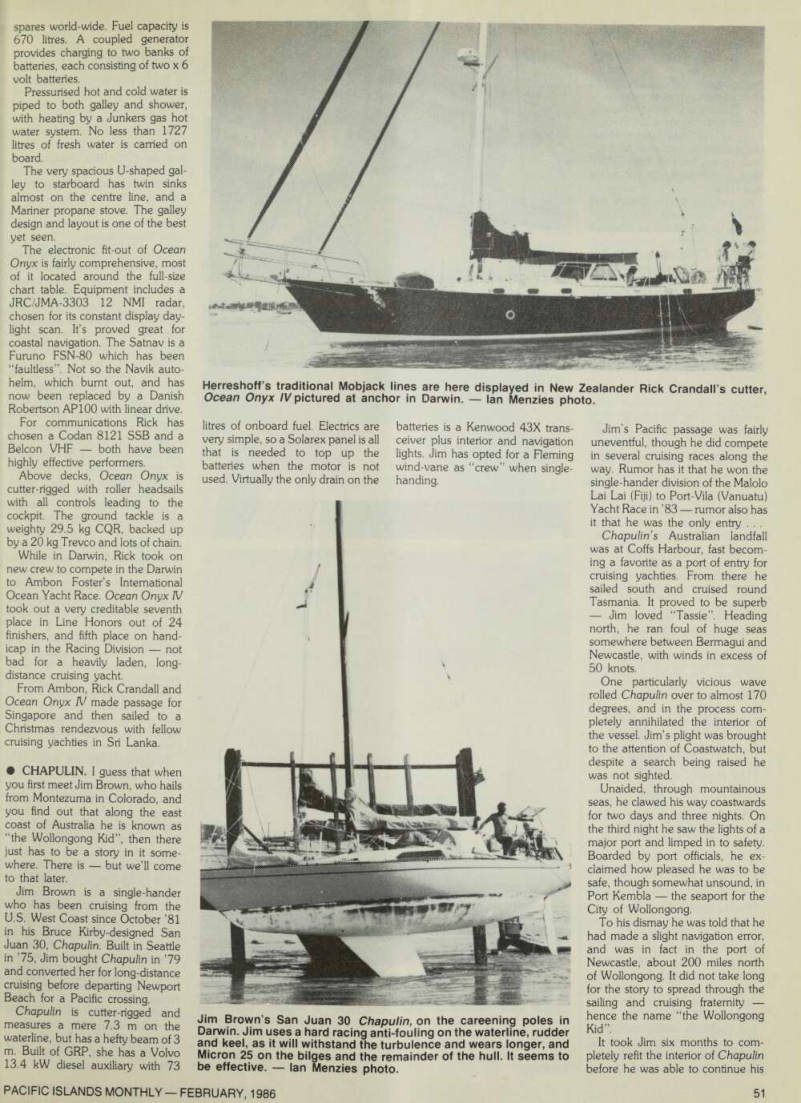
Enamored with Herreshoff s de signs, Rick decided to build the Mobjack highlighted in his book, Sensible Cruising Designs. Using offsets from the actual drawings shown in Herreshoff s book, Rick crafted a hull of Klegecell core laid up with seven layers of glass cloth and kevlar. The vinylastic exterior coating, Rick hopes, will put paid to any future chance of osmosis.
In consultation with Alan Ourams, a most respected New Zealand designer and boat-builder, Rick altered the original design by cutting away the keel behind the lead and increasing the draught by 22.8 cm to 1.75 m. The broken sheer was deleted to give a straight run through and increase head room by 10.1 cm. Flushing the
deck created even more interior volume.
After about three and a half years in the building, Ocean Onyx was launched in April ’B4. Six weeks later Rick made passage for Noumea on the first leg of his planned circumnavigation. For the next six months he cruised through Vanuatu, the Solomons, to Samarai in Papua New Guinea, the Louisiades and thence to Caims.
Rick then made Mooloolaba, on the south Queensland coast, his base for the cyclone season.
The new year saw Ocean Onyx heading north again, through the Barrier Reef and across the Gulf to Darwin. Rick was impressed with the prevailing southeast trades that pushed him along he logged 198 miles in one day while transiting the Gulf of Carpentaria.
As mentioned, Rick has gone to great efforts to equip Ocean Onyx with a wide range of creature comforts and technology. His latest acquisition is a Trailblaza refrigera tor/freezer which was installed at Mooloolaba. Manufactured at near by Caloundra, these units are pro ving extremely popular with cruis ing yachties because of their low power drain. This particular unit is powered almost entirely by a Solarex 42-Watt solar panel, swing mounted on the stem of the vessel.
Auxiliary power is provided by a marinised six-cylinder Ford Dagenham 200 scries diesel, rated at 134 kW. The unit was chosen because of the availability of Ford
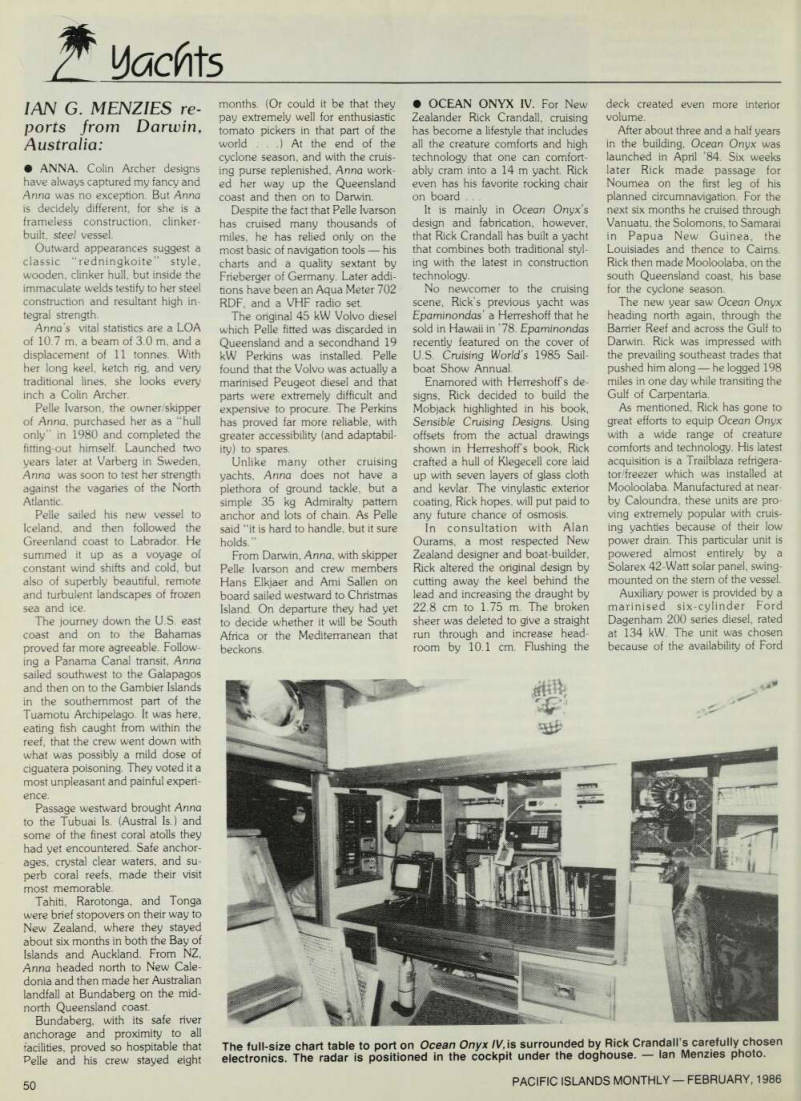
The full-size chart table to port on Ocean Onyx IV, is surrounded by Rick Crandall’s carefully chosen electronics. The radar is positioned in the cockpit under the doghouse. - lan Menzies photo.
spares world-wide. Fuel capacity is 670 litres. A coupled generator provides charging to two banks of batteries, each consisting of two x 6 volt batteries.
Pressurised hot and cold water is piped to both galley and shower, with heating by a Junkers gas hot water system. No less than 1727 litres of fresh water is carried on board.
The very spacious U-shaped gal ley to starboard has twin sinks almost on the centre line, and a Mariner propane stove. The galley design and layout is one of the best yet seen.
The electronic fit-out of Ocean Onyx is fairly comprehensive, most of it located around the full-size chart table. Equipment includes a JRC/JMA-3303 12 NMI radar, chosen for its constant display day light scan. It’s proved great for coastal navigation. The Satnav is a Furuno FSN-80 which has been “faultless”. Not so the Navik auto helm, which burnt out, and has now been replaced by a Danish Robertson APIOO with linear drive.
For communications Rick has chosen a Codan 8121 SSB and a Belcon VHF both have been highly effective performers.
Above decks, Ocean Onyx is cutter-rigged with roller headsails with all controls leading to the cockpit. The ground tackle is a weighty 29.5 kg CQR, backed up by a 20 kg Trevco and lots of chain.
While in Darwin, Rick took on new crew to compete in the Darwin to Ambon Foster’s International Ocean Yacht Race. Ocean Onyx IV took out a very creditable seventh place in Line Honors out of 24 finishers, and fifth place on hand icap in the Racing Division not bad for a heavily laden, long distance cruising yacht.
From Ambon, Rick Crandall and Ocean Onyx IV made passage for Singapore and then sailed to a Christmas rendezvous with fellow cruising yachties in Sri Lanka. • CHAPULIN. I guess that when you first meet Jim Brown, who hails from Montezuma in Colorado, and you find out that along the east coast of Australia he is known as “the Wollongong Kid”, then there just has to be a story in it some where. There is but we’ll come to that later.
Jim Brown is a single-hander who has been cruising from the U.S. West Coast since October ’Bl in his Bruce Kirby-designed San Juan 30, Chapulin. Built in Seattle in ’75, Jim bought Chapulin in ’79 and converted her for long-distance cruising before departing Newport Beach for a Pacific crossing.
Chapulin is cutter-rigged and measures a mere 7.3 m on the waterline, but has a hefty beam of 3 m. Built of GRP, she has a Volvo 13.4 kW diesel auxiliary with 73
litres of onboard fuel. Electrics are very simple, so a Solarex panel is all that is needed to top up the batteries when the motor is not used. Virtually the only drain on the
batteries is a Kenwood 43X trans ceiver plus interior and navigation lights. Jim has opted for a Fleming wind-vane as “crew” when single handing.
Jim’s Pacific passage was fairly uneventful, though he did compete in several cruising races along the way. Rumor has it that he won the single-hander division of the Malolo Lai Lai (Fiji) to Port-Vila (Vanuatu) Yacht Race in ’B3 rumor also has it that he was the only entry . . .
Chapulin’s Australian landfall was at Coffs Harbour, fast becom ing a favorite as a port of entry for cruising yachties. From there he sailed south and cruised round Tasmania. It proved to be superb Jim loved “lassie”. Heading north, he ran foul of huge seas somewhere between Bermagui and Newcastle, with winds in excess of 50 knots.
One particularly vicious wave rolled Chapulin over to almost 170 degrees, and in the process com pletely annihilated the interior of the vessel. Jim’s plight was brought to the attention of Coastwatch, but despite a search being raised he was not sighted.
Unaided, through mountainous seas, he clawed his way coastwards for two days and three nights. On the third night he saw the lights of a major port and limped in to safety.
Boarded by port officials, he ex claimed how pleased he was to be safe, though somewhat unsound, in Port Kembla the seaport for the City of Wollongong.
To his dismay he was told that he had made a slight navigation error, and was in fact in the port of Newcastle, about 200 miles north of Wollongong. It did not take long for the story to spread through the sailing and cruising fraternity hence the name “the Wollongong Kid”.
It took Jim six months to com pletely refit the interior of Chapulin before he was able to continue his
Jim Brown’s San Juan 30 Chapulin, on the careening poles in Darwin. Jim uses a hard racing anti-fouling on the waterline, rudder and keel, as it will withstand the turbulence and wears longer, and Micron 25 on the bilges and the remainder of the hull. It seems to
be effective. - lan Menzies photo.
Herreshoff’s traditional Mobjack lines are here displayed in New Zealander Rick Crandall’s cutter, Ocean Onyx IV pictured at anchor in Darwin. - lan Menzies photo.
northward passage. Cruising through the Barrier Reef he was able to catch up with many friends from the previous two years of Pacific passage-making. It was then on to Darwin in time to compete in the ’B5 Darwin to Ambon Foster’s International Ocean Yacht Race.
Under the race rules, single handers are not allowed to com pete, so Jim took on board Peter Hays, from Alberta, Canada, as his race crew.
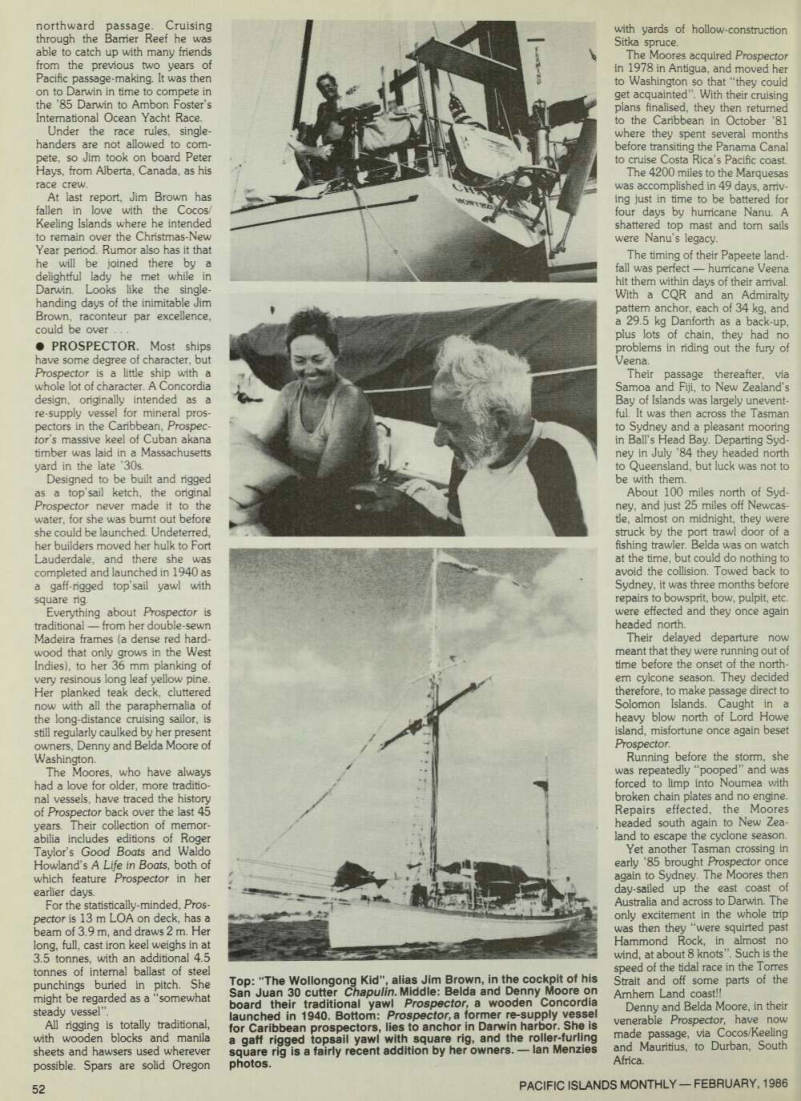
At last report, Jim Brown has fallen in love with the Cocos/ Keeling Islands where he intended to remain over the Christmas-New Year period. Rumor also has it that he will be joined there by a delightful lady he met while in Darwin. Looks like the single handing days of the inimitable Jim Brown, raconteur par excellence, could be over . . . • PROSPECTOR. Most ships have some degree of character, but Prospector is a little ship with a whole lot of character. A Concordia design, originally intended as a re-supply vessel for mineral pros pectors in the Caribbean, Prospec tor’s massive keel of Cuban akana timber was laid in a Massachusetts yard in the late ’3os.
Designed to be built and rigged as a top’sail ketch, the original Prospector never made it to the water, for she was burnt out before she could be launched. Undeterred, her builders moved her hulk to Fort Lauderdale, and there she was completed and launched in 1940 as a gaff-rigged top’sail yawl with square rig.
Everything about Prospector is traditional from her double-sewn Madeira frames (a dense red hard wood that only grows in the West Indies), to her 36 mm planking of very resinous long leaf yellow pine.
Her planked teak deck, cluttered now with all the paraphernalia of the long-distance cruising sailor, is still regularly caulked by her present owners, Denny and Belda Moore of Washington.
The Moores, who have always had a love for older, more traditio nal vessels, have traced the history of Prospector back over the last 45 years. Their collection of memor abilia includes editions of Roger Taylor’s Good Boats and Waldo Howland’s A Life in Boats, both of which feature Prospector in her earlier days.
For the statistically-minded, Pros pector is 13 m LOA on deck, has a beam of 3.9 m, and draws 2 m. Her long, full, cast iron keel weighs in at 3.5 tonnes, with an additional 4.5 tonnes of internal ballast of steel punchings buried in pitch. She might be regarded as a “somewhat steady vessel”.
All rigging is totally traditional, with wooden blocks and manila sheets and hawsers used wherever possible. Spars are solid Oregon
with yards of hollow-construction Sitka spruce.
The Moores acquired Prospector in 1978 in Antigua, and moved her to Washington so that “they could get acquainted”. With their cruising plans finalised, they then returned to the Caribbean in October ’Bl where they spent several months before transiting the Panama Canal to cruise Costa Rica’s Pacific coast.
The 4200 miles to the Marquesas was accomplished in 49 days, arriv ing just in time to be battered for four days by hurricane Nanu. A shattered top mast and tom sails were Nanu’s legacy.
The timing of their Papeete land fall was perfect hurricane Veena hit them within days of their arrival.
With a CQR and an Admiralty pattern anchor, each of 34 kg, and a 29.5 kg Danforth as a back-up, plus lots of chain, they had no problems in riding out the fury of Veena.
Their passage thereafter, via Samoa and Fiji, to New Zealand’s Bay of Islands was largely unevent ful. It was then across the Tasman to Sydney and a pleasant mooring in Ball’s Head Bay. Departing Syd ney in July ’B4 they headed north to Queensland, but luck was not to be with them.
About 100 miles north of Syd ney, and just 25 miles off Newcas tle, almost on midnight, they were struck by the port trawl door of a fishing trawler. Belda was on watch at the time, but could do nothing to avoid the collision. Towed back to Sydney, it was three months before repairs to bowsprit, bow, pulpit, etc. were effected and they once again headed north.
Their delayed departure now meant that they were running out of time before the onset of the north ern cylcone season. They decided therefore, to make passage direct to Solomon Islands. Caught in a heavy blow north of Lord Howe island, misfortune once again beset Prospector.
Running before the storm, she was repeatedly “pooped” and was forced to limp into Noumea with broken chain plates and no engine.
Repairs effected, the Moores headed south again to New Zea land to escape the cyclone season.
Yet another Tasman crossing in early ’B5 brought Prospector once again to Sydney. The Moores then day-sailed up the east coast of Australia and across to Darwin. The only excitement in the whole trip was then they “were squirted past Hammond Rock, in almost no wind, at about 8 knots”. Such is the speed of the tidal race in the Torres Strait and off some parts of the Arnhem Land coast!!
Denny and Belda Moore, in their venerable Prospector, have now made passage, via Cocos/Keeling and Mauritius, to Durban, South Africa.
Top: “The Wollongong Kid”, alias Jim Brown, in the cockpit of his San Juan 30 cutter Chapulin. Middle: Belda and Denny Moore on board their traditional yawl Prospector, a wooden Concordia launched in 1940. Bottom: Prospector, a former re-supply vessel for Caribbean prospectors, lies to anchor in Darwin harbor. She is a gaff rigged topsail yawl with square rig, and the roller-furling square rig is a fairly recent addition by her owners. - lan Menzies photos.