and PT109
pp. 24-26 · Read in the full issue
New light on JFK and PT109
Much has been written about John Fitzgerald Kennedy’s genuine acts of bravery during his wartime service as a torpedo boat skipper in Solomon Is lands, especially after the young lieutenant had become a U.S. senator, destined to occupy the highest office in his country.
Few of the authors of the numerous highly colored accounts which still appear reg ularly in popular magazines and newspapers have ever been to the Pacific however, and there fore as a rule rely heavily on the same official war bulletins and on their own imaginations.
A brilliant exception was the long-time chief of the Washing ton bureau of the New York Herald-Tribune, Robert J.
Donovan, who with perfect tim ing produced a well researched book with the title PT 109, John F. Kennedy in World War 11, shortly after his hero was installed as president of the USA. His fine book, which was endorsed by President Ken nedy, became an immediate best-seller, and has been consi
dered ever since to be the definitive version of the drama tic sinking of skipper Kennedy’s torpedo boat by the Japanese destroyer. Amagiri in Blacket Strait in the early hours of August 2, 1943.
As the book’s dust-jacket blurb announces in bold type, Robert J. Donovan “travelled more than 30,000 miles and interviewed hundreds of people to get the story ... In the Solomons he found all 10 of the natives who participated in the rescue, and with them he went from island to island, even swimming over the coral reefs and following the route Lt.
Kennedy and his men took to hide from the Japanese.”
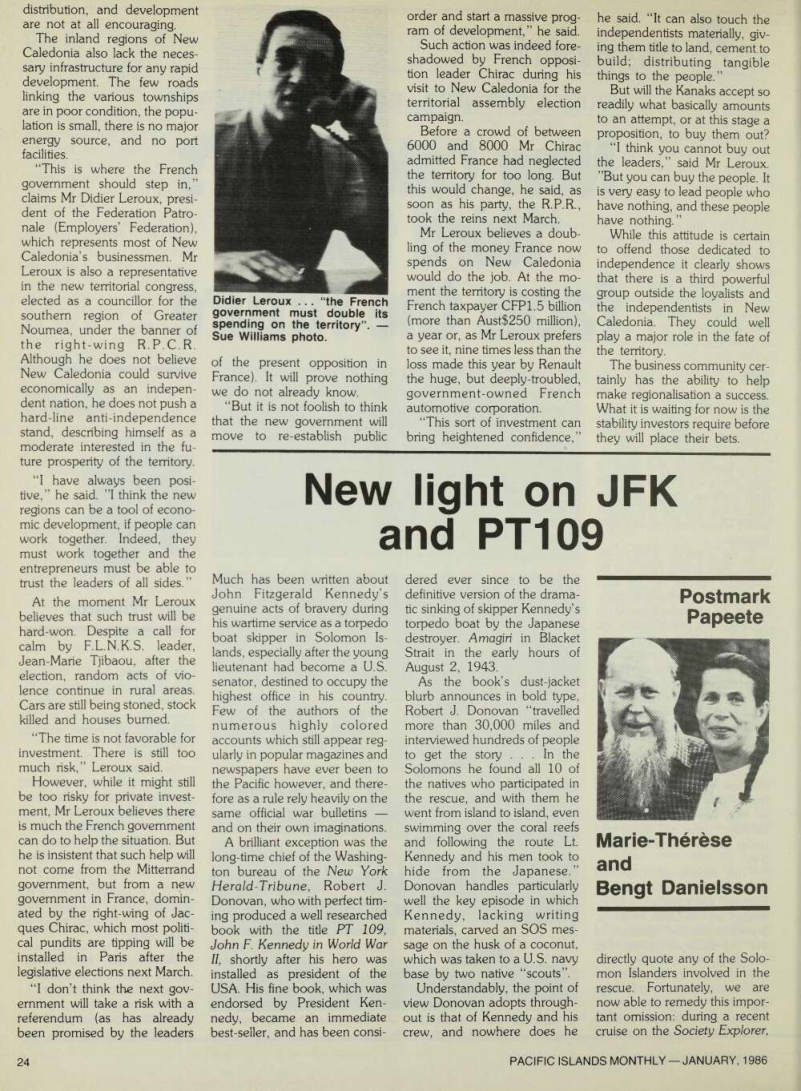
Donovan handles particularly well the key episode in which Kennedy, lacking writing materials, carved an SOS mes sage on the husk of a coconut, which was taken to a U.S. navy base by two native “scouts”.
Understandably, the point of view Donovan adopts through out is that of Kennedy and his crew, and nowhere does he
Postmark Papeete
directly quote any of the Solo mon Islanders involved in the rescue. Fortunately, we are now able to remedy this impor tant omission: during a recent cruise on the Society Explorer,
Marie-Therese and Bengt Danielsson
we paid a visit to the site of the wartime American PT base on Lumberi Island, off Rendova.
In an effort to attract some of the approximately 10,000 tour ists who each year visit the Guadalcanal battlefields of whom, incidentally, the major ity are Japanese war veterans the largely autonomous gov ernment of the Western S.I.
Provinces has encouraged the owners of Lumberi Island to build a small hotel there. In an adjacent “museum” visitors so far there are extremely few of them can admire a rather disparate collection of war re lics, including some old Coca- Cola bottles.
Under a paperweight a rusty, bullet-pierced helmet by pure chance we discovered a typewritten document which turned out to be by far the most interesting item on display. It was nothing less than the full account of the PT 109 affair by the Solomon Islands “scout”, Biuku Nebuchadnezar Gasa, who together with his compan ion Aaron Kuman found the survivors of the PT 109 five days after their boat had been rammed. The story, as told in his native Roviana language, was recorded by a U.S. Peace Corps Volunteer, Robert King, and translated into English by government interpreter Nelson Boso.
To understand Biuku’s story it must be recalled that the 11 survivors of the 13-man crew managed to swim over to Kaso lo reef islet, mostly called Plum Pudding Island on European charts. Kennedy undoubtedly saved the life of the worst injured of his men by towing him for several hours sus pended in a harness strap which he held between his teeth, an act of heroism for which he was awarded the Navy and Marine Corps Medal.
Setting out alone from Plum Pudding Island again the same night, Kennedy explored the neighboring reef islet of Naru, and eventually brought his men over to the slightly bigger island of Olosana. It was not until August 5, that Biuku and Aaron, who were paddling through the Japanese-control led archipelago on a dangerous reconnaissance mission, de cided to land on Naru, because they had spotted a wreck there, which they thought might con
tain valuable articles. Mistaking Kennedy for a Japanese, they jumped back into their canoe and paddled on, but on reaching Olosana they felt thirs ty and stepped ashore to pick a few green coconuts. This is what happened next in Biuku’s own words: As I was going ashore, I saw a White man crawling out of the bushes near the shore. I said; “Aaron, a Japanese here!”
Then we pushed the canoe out to get away. We were heading out, when he stood up and waved, shouting “Come”. I said: “Nomoa, iu Japan.” I think he understood me, be cause he said: “I am an Amer ican, not a Japanese.” At that time, I did not understand Eng lish, except for a few words.
He showed me his arm and said: “Look at my skin, it’s white. Japan skin red.” I re plied: “No matter skin white or skin red, you Japan.” He in sisted that we come, but I still said no, because we were afraid . . . Then the man told us about the wrecking of the PT 109, but we did not understand everything he said. So in order to be sure, I asked him what the mark was on an American plane. He said that if you see a white star, it is an American plane, but if you see a red circle, it is a Japanese plane.
I still did not believe him, so I thought of the Tommy gun we had found in the wreck on Naru. But the bullets we had did not fit, so we put the gun back into the canoe. When we were still talking, some big planes came, the four-propeller ones. They went and bombed Gizo. As they came by, I stood up and gave the signal. Then the white man stood up and said; “That’s our signal, British and American. Don’t be afraid, come up.”
Then we felt good and forgot our worries. We went ashore and pulled up our canoe, and went to see the rest of the men.
We were told not to shake hands with some of the men who were badly burnt from the collision. The first thing these men asked for was cigarettes, they wanted to smoke. I used a very rough kind of pidgin, and they tried their best in broken English.
I took out a tin of cigarettes and told Aaron to ino, that is to make fire from rubbing sticks
together. They were very happy to smoke. We had some kumara (sweet potatoes), but smoke was the big thing.
Although these men did not really understand pidgin, I managed to pick up that they were men from the PT 109.
Then I told them that we had met a Japanese on Naru. They
laughed and said that it was not a Japanese, but their captain, Kennedy, We stayed with them until midnight. Then two of them asked us to take them to the PT boat base near Rendova. I told Aaron: “You stay with the rest, while I take these two men to Rendova. “ They tied lifejackets
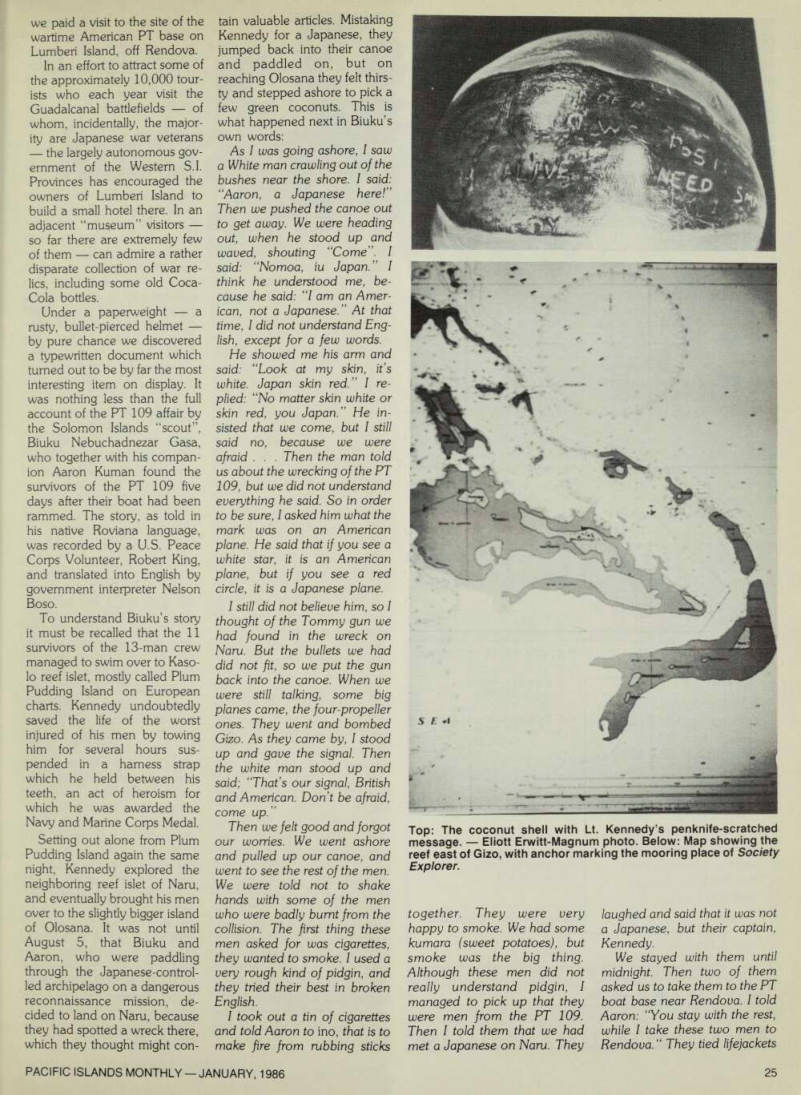
Top: The coconut shell with Lt. Kennedy’s penknife-scratched message. Eliott Erwitt-Magnum photo. Below: Map showing the reef east of Gizo, with anchor marking the mooring place of Society Explorer.
around them, and we left, me paddling. We got to the middle of Ferguson Passage, but the wind was too strong, so we turned back.
We laid down to sleep and did therefore not realise that Kennedy was swimming back to us on Olosona from Naru.
He was bringing drinking water. He had it in a tin can, which he had put into a broken canoe, which he was towing, while swimming. When he ar rived he made a pre-arranged signal. They all told him: “We are saved, two locals have found us.”
When Kennedy saw us, he put the water can down and ran over and embraced us. He asked if it was us who had come to the wreck on Naru the previous day, and we said: “Yes”. He then asked why we had not come forward when he had waved. We answered that we thought he was a Japanese.
He told us he was going to swim back to Naru to go out into the Ferguson Passage to attract the attention of passing American ships. We suggested that we paddle him to that island. He agreed but asked us
to cover him with coconut fronds.
It was night. As we were paddling across, we heard the sound of a man swimming in the water nearby. We turned the canoe towards him, but he swam away. We figured that it must be Barney Ross, one of the survivors, and that he was being afraid that we were ene mies. Kennedy told me to give his name to the swimming man.
So I said three times: “Captain Kennedy stop inside kinu.”
That reassured him. We told him to get into the canoe but he preferred to stay in the water
hanging behind. He was heavy, and it was therefore not until dawn that we made the point at Naru.
Kennedy said: “Biuku, Tm sorry for my crew. There is no paper. ” After a while I guessed that he wanted to write a message. So I thought of a leaf we use for that. In our lan guage, it’s called poroporo.
Then I thought that if we do get caught by the Japanese, even if we tore up the leaf, they could join the pieces back and read the message. So I told Aaron to climb a palm tree and pick a few coconuts. After we had drunk them I asked Aaron to dehusk one.
Then I said to Kennedy: “We natives have plenty of paper.
Like this coconut husk. You can write a message on it. ” He took out his pocket knife and scratched a message with it, which he could not rub out with his hand, when he tried.
He looked at me and said: “Jesus Christ, Biuku how did you think of this?” Whereupon he came over and took my hand between his two hands and looked into my face. The message on the half husk said:
These 2 Natives Know
Where We 11 Are. Ken
Nedy.
Kennedy told us to paddle over to Rendova with this mes sage, stopping first at Olosana to tell his men what he had decided. He also wanted to know when we would be back with help. I said: “Maybe tomorrow night.” So we stop ped at Olosana and showed his men our husk-inscribed mes sage. I left my axe with them and told them that if they were hungry and thirsty they should use it to cut down one of the palm trees, as they could not climb them.
Before we left, the men asked: “What if the coconut message falls into enemy hands?” I told them that Ken nedy had given me his pocket knife, and that I was to scratch off the message, throw away the husk and make myself ready to die.
Luckily for us, it rained, which made it very difficult to see us, as we paddled across the Ferguson Passage. We got to Rarumana and met Ben Kevu. He was the scout for Vona Vona Lagoon with headquarters at Boeboe. He was getting ready to return there, when we arrived. Ben told his men to take matches, cigarettes, food and other things and return with all these things to Olosana. As for us, we walked over to Madou, where we picked up another canoe to contine our voyage to Rendo va. This is where Ben Kevu took over the rescue operation. • • • When John Kennedy be came president of the USA 20 years later, he invited his princi pal rescuers, Biuku and Aaron, to come and spend some time as his guests in the White House, where, incidentally he had placed the now plastic encased coconut husk bearing his SOS message as a memento on his desk. (The exact inscrip tion is, in fact, a little bit longer than what Biuku remembered, for it reads: NAURU ISL NA
Tive Knows Posit He Can
Pilot 11 Alive Need
Small Boat Kennedy.
The British Resident Commis sioner at Gizo at the time decided, however, that it would be more appropriate to send the chief scout Ben Kevu, be cause he spoke better English and knew more about the white men’s world. Biuku is still very disappointed but not bitter.
What has happened to the encased coconut husk? No body seems to know for certain, but there is every reason to suppose that it is still in the possession of the Kennedy fam ily. If so, is it too much to hope that they will one day bequeath it to the Lumberi Resort War Museum, in recognition of the valiant aid given the American troops during World War II by Biuku, Aaron and countless other Solomon Islanders?
Marie-Therese and Bengt Danielsson.
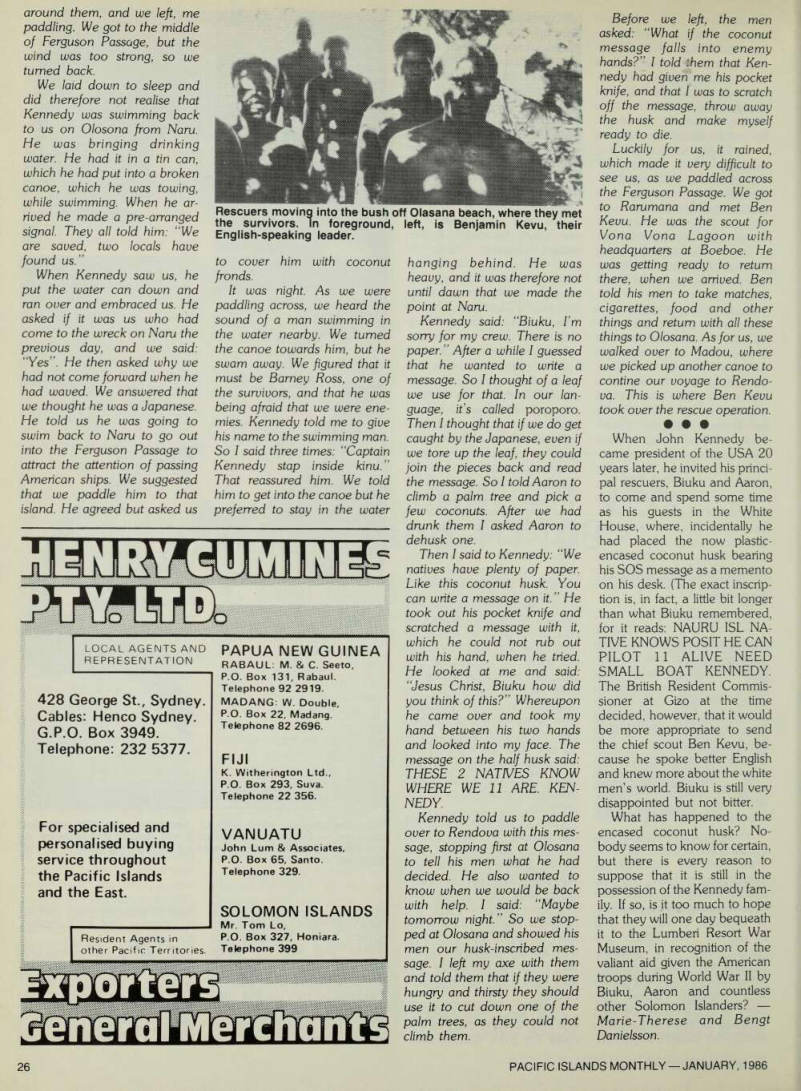
Rescuers moving into the bush off Olasana beach, where they met the survivors. In foreground, left, is Benjamin Kevu, their
English-speaking leader.