New Caledonians
pp. 23-24 · Read in the full issue
the month
Noumea Business Leaders Interviewed
New Caledonians 'third force' faces the future
Economic growth and development, not political power strug gles, will solve New Caledonia’s problems. Such is the view of leading business men throughout the territory who are more concerned with their balance sheets than the flag or the color of the people under whom they conduct their business.
If the balance sheets are good, they argue, jobs can be provided, bellies can be kept full and living standards main tained. By the same argument if development opportunities are not created and investment is kept to a minimum because of the high risk involved in an unpredictable climate, the so cial unrest will continue, pro voked by such problems as climbing unemployment rates and a big drop in the quality of life.
Consequently, much of the business community here is prepared to accept the powers of the new regions of the territory, three of which are under Kanak F.L.N.K.S. con trol. ’The recent elections and subsequent regionalisation are political. We have another in terest,” says Mr Louis Ballande, president-director general of the big Ballande group. His company has extensive busi ness interests in New Caledo nia, from nickel mining through agriculture to retailing and in ternational transport. The group also operates in several
Most attention in New Caledonia centres on the political aspects of the inexorable approach of independence from France. But, behind the rattle of stones on settlers’ cars, away from the emotional speeches, inside the calm of air-conditioned offices where decisions are made according to facts rather than rhetoric, there is another assessment of the situation. RIM correspondent, SUE WILLIAMS, has been talking to the territory’s businessmen about their view of the future.
Noumea Notebook
other Pacific Island countries including Vanuatu where it has continued to invest, despite in dependence and the socialist leadership of prime minister Father Walter Lini.
“Caledonia is the same,” says Louis Ballande. “We are continuing to improve and ex pand all the time, updating our stores, upgrading mining facili ties we have not changed be cause of the current political climate.
“The political problem is not essential for us. The main thing is that the economy must re main viable.”
Despite this, Mr Ballande agrees there is a problem for investors mainly because, he says, the new laws proposed by France for the management of the territory, such as taxes, land
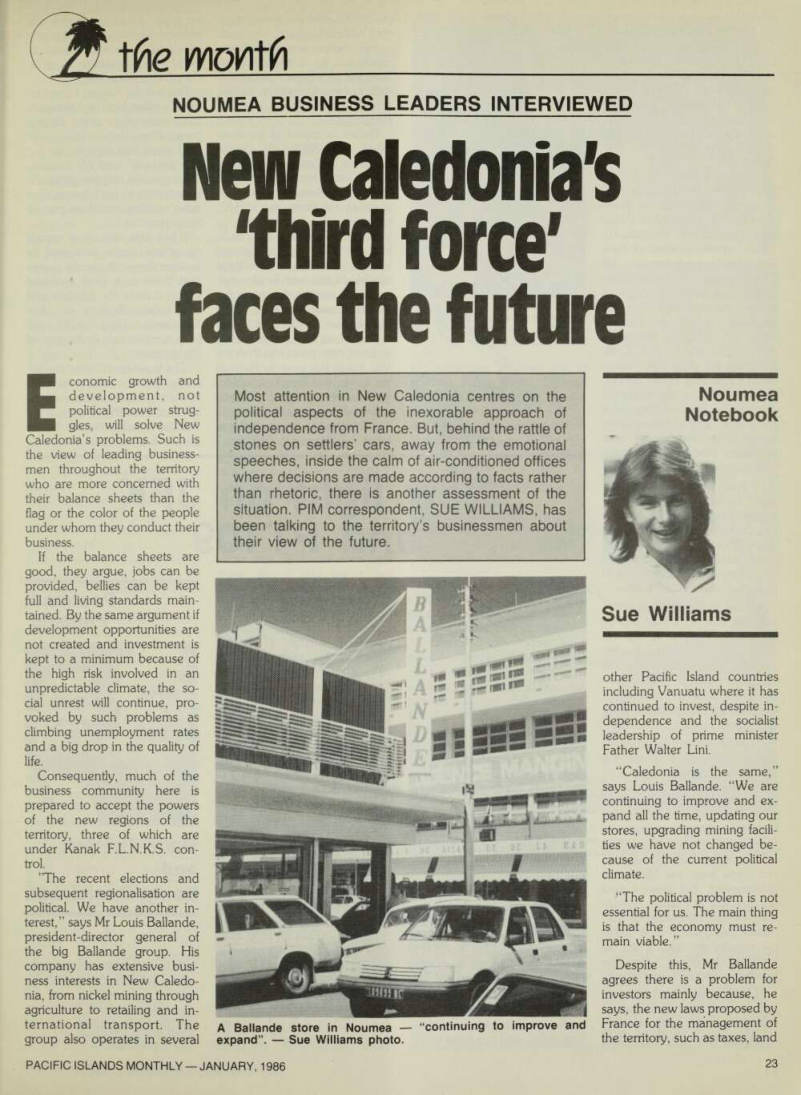
A Ballande store in Noumea “continuing to improve and expand”. - Sue Williams photo.
Sue Williams
distribution, and development are not at all encouraging.
The inland regions of New Caledonia also lack the neces sary infrastructure for any rapid development. The few roads linking the various townships are in poor condition, the popu lation is small, there is no major energy source, and no port facilities.
“This is where the French government should step in,” claims Mr Didier Leroux, presi dent of the Federation Patro nale (Employers’ Federation), which represents most of New Caledonia’s businessmen. Mr Leroux is also a representative in the new territorial congress, elected as a councillor for the southern region of Greater Noumea, under the banner of the right-wing R.P.C.R.
Although he does not believe New Caledonia could survive economically as an indepen dent nation, he does not push a hard-line anti-independence stand, describing himself as a moderate interested in the fu ture prosperity of the territory.
“I have always been posi tive,” he said. ”1 think the new regions can be a tool of econo mic development, if people can work together. Indeed, they must work together and the entrepreneurs must be able to trust the leaders of all sides.”
At the moment Mr Leroux believes that such trust will be hard-won. Despite a call for calm by F.L.N.K.S. leader, Jean-Marie Tjibaou, after the election, random acts of vio lence continue in rural areas.
Cars are still being stoned, stock killed and houses burned.
“The time is not favorable for investment. There is still too much risk,” Leroux said.
However, while it might still be too risky for private invest ment, Mr Leroux believes there is much the French government can do to help the situation. But he is insistent that such help will not come from the Mitterrand government, but from a new government in France, domin ated by the right-wing of Jac ques Chirac, which most politi cal pundits are tipping will be installed in Paris after the legislative elections next March.
“I don’t think the next gov ernment will take a risk with a referendum (as has already been promised by the leaders
of the present opposition in France). It will prove nothing we do not already know.
“But it is not foolish to think that the new government will move to re-establish public
order and start a massive prog ram of development,” he said.
Such action was indeed fore shadowed by French opposi tion leader Chirac during his visit to New Caledonia for the territorial assembly election campaign.
Before a crowd of between 6000 and 8000 Mr Chirac admitted France had neglected the territory for too long. But this would change, he said, as soon as his party, the R.P.R., took the reins next March.
Mr Leroux believes a doub ling of the money France now spends on New Caledonia would do the job. At the mo ment the territory is costing the French taxpayer CFPI.S billion (more than Austs2so million), a year or, as Mr Leroux prefers to see it, nine times less than the loss made this year by Renault the huge, but deeply-troubled, government-owned French automotive corporation.
“This sort of investment can bring heightened confidence,”
he said. “It can also touch the independentists materially, giv ing them title to land, cement to build; distributing tangible things to the people.”
But will the Kanaks accept so readily what basically amounts to an attempt, or at this stage a proposition, to buy them out?
“I think you cannot buy out the leaders,” said Mr Leroux. ’’But you can buy the people. It is very easy to lead people who have nothing, and these people have nothing.”
While this attitude is certain to offend those dedicated to independence it clearly shows that there is a third powerful group outside the loyalists and the independentists in New Caledonia. They could well play a major role in the fate of the territory.
The business community cer tainly has the ability to help make regionalisation a success.
What it is waiting for now is the stability investors require before they will place their bets.
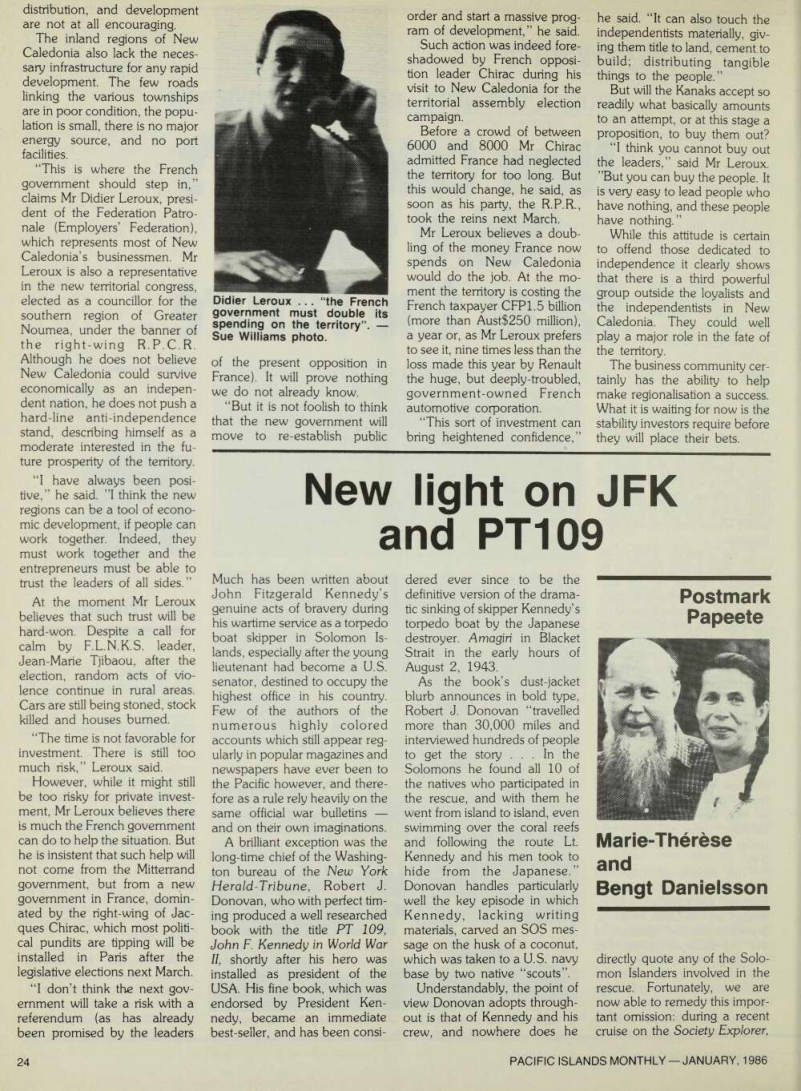
Didier Leroux ... “the French government must double its spending on the territory”.
Sue Williams photo.