okay, on Rapanui
pp. 20-22 · Read in the full issue
Life On Easter Island
'Haka nehe-nehe' rules, okay, on Rapanui
GRANT McCALL, who usually teaches anthropology at the University of New South Wales, in Sydney, Australia, went to Easter Island (Rapanui) for nine months, with his family, to carry out new fieldwork in a community with which he has been involved for many years. He has filed this report for us, offering vignettes of daily life on one of the most remote and fascinating islands in the world.
Haka nehe-nehe is a phrase that has been heard a lot around Rapanui over the last few months, as the festive month of September came to a close and a sort of calm de scended upon the islands.
Haka nehe-nehe means to make nice, to make present able, to fix up, even to do things properly, as in producing a good job of work. Haka nehe nehe is what happens when the rain falls, too, and brown Rapa nui becomes green again, for water is a scarce and valuable commodity here. Expensive, too: the usual household monthly water bill is around SA3O, which is about one-sixth of the average income of an Islander salary earner in the public service.
Haka nehe-nehe was run ning through the minds of both Islanders and resident Chilean public servants, in preparation for the highlight of the last 30 days which was the visit of the Intendente, retired admiral Pablo Wunderlich, who like his name, was a mixture of Ger man efficiency and Chilean casualness. His program was exhaustive and exhausting, for every one of the 21 public services had to be visited, and inspected.
Public service heads ex pended buckets of paint, boxes of paper and dozens of spools of typewriter ribbon to haka
nehe-nehe their offices and affairs.
Though donations specifical ly to the Easter Island Museum, the Xerox 1020 photo-copier given last year by Rank Xerox (Australia), and the micro computer from the Australian Museum Society (TAMS), were both called into service. The photo-copier (there are two others only on the island), produced over 4000 copies, whilst the computer was called in to organise data on project expenditure and public service employment.
Administratively, Rapanui occupies an odd place in Chile.
Including the uninhabited Sala y Gomez, some 200 sea miles distant, it constitutes the pro vince of Easter Island which, as a province of Chile, is part of the Fifth Region, whose capital is the port of Valparaiso.
Chilean provinces vary in size, most having tens of thousands of persons, while Rapanui has only a little over 2000 inhabitants.
The creation of Rapanui as a province is justified on two grounds. Firstly, it is regarded as a border zone and, therefore, of especial military importance.
Secondly, with the complex bureaucratic system in Chile, modelled on that of the French republic, in order for the Island to have its own hospital, school and other public services, it must have also contingents of
police, the Navy, Air Force and, even, the Army.
But, this is an Air Force without aircraft, a Navy without ships, or even boats, and a police force with little to do but apprehend the occasional adolescent thief.
The Army’s guns remain under strict surveillance after a tragic accident in May of 1982 when one recruit shot another through the head. They were both young Islanders.
At the same time as the Intendente arrived, the Bishop of Valparaiso turned up to offer a special Mass, not knowing that his uncle, at the turn of the century, had also come here.
“Ha/ca nehe-nehe” was the response, too, of the Inten dente, who, in a dramatic public ceremony, gave out sports uniforms to local teams, promised more public services, and, with a final flourish, signed cheques for various projects, including a commitment to re pair the dilapidated school buil dings, at a cost of $A500,000, which is big money in Chile.
As a province, Rapanui re ceives one of the highest per capita investments by the cen tral government, a fact that is rarely objected to in the Chilean press. Rapanui is a kind of showcase for Chile, therefore, it is perhaps not so costly after all.
One of the reasons for my current fieldwork on Rapanui is the question of land use and
how this resource, still almost entirely owned by the Islanders, is conceived locally.
When I did my first work here in 1972-74, there were offers of land titles from the (then) socialist government of Dr Sal vador Allende. These were uni versally rejected by the popula tion, for a variety of reasons, including the emotional point that if they did ask for land titles, they would be admitting that Chileans were the legiti-
mate owners of Rapanui.
There were also other reasons for not applying for land title, including also the fear of taxes. Elders worried that if they assigned their lands legally to their offspring, they would lose their authority.
Rapanui were concerned also that if they agreed to the land (only 10 per cent of the total) that was on offer for title (mainly residential), the rest would be lost.
When the current president of Chile came to Rapanui, in January, 1975, (the first Chi lean head of state to do so), nearly 200 ’’titles” were pre sented to the Islanders, though they proved to be more for show, they being rejected even by other government institu tions.
Since then, various govern ment institutions have been trying to Haka nehe-nehe the land situation, by offering loans,
for which land titles become collateral, or requiring that in order to receive housing assist ance, one must obtain a land title.
By now, nearly 300 persons have applied for land titles, for both residential and agricultural land, and the number is in creasing every day.
The local Lands Office, which closed down in 1978 for two years, due to lack of any Islander interest in its activities, is now one of the principal institutions used by Rapanui.
One of the reasons for this increase in activity was the announcement by the Inten dente that over 100 housing subsidies were to be offered to Rapanui. To obtain the sub sidies, of course, one had to have a proper land title.
The subsidies are particularly attractive to couples where one of the spouses is a non-islander, usually from the mainland.
Such people have difficulty commanding the family re sources needed to erect a dwelling. Most of the 200 appli cants for the subsidy, which can amount to SAIO,OOO, at current values, are in this condition.
When the Intendente left the Governor, and the Mayor, left with him to make certain that what had been promised on the Island would be delivered, and delivered in time to uphold the credibility of the local politi cians.
With their own kind of haka nehe-nehe was an American Air Force plane that turned up in mid-October, on an undisc losed mission, though many think it is not unrelated to the now fully-approved NASA proposal for an airport exten sion to accommodate an emergency landing place for the space shuttle, from March of next year. Coming from Lima, Peru, the little plane carried on to the rest of the Pacific the next day with its crew of 18. It was due back in December to continue whatev er mission it is on.
The rains had started with the Intendente’s visit, continued for the Americans, frustrating tour ists, but bringing broad smiles to agriculturalists.
The Chilean Air Line, LAN- Chile, sponsored a three-day ’’Festival of Easter Island Song” to which were brought several mainland ’’stars.” This occu pied some nights near the end of October, though it was an Island artist who received the first prize.
A very active sports director filled out the rest of the week with sports games, based on the School, until the grade books were stolen from the headmas ter’s office,and the games were cancelled, with a threat of clas ses being held over the summer if the crucial registers were not returned.
In the event the culprit dramatically telephoned the school and told the teachers in which cave the registers were to be found.
If September ended with a curious whale tracking of the coast, October came to a close with the news that a submarine was moving along that part of the island where the future port is being planned. The nation ality of the craft was never disclosed, though it is presumed by officials to be Soviet.
In contrast to my first field work, today’s Rapanui seems to be over-crowded with official cocktails, full of celebrations (mainly imported ones), and subject to outsider institutions on a scale far exceeding my previous experience.
In spite of, or perhaps be cause of, this, the Governor after many years is at last an Islander, Serio Rapu (See FIM May, 1984).
Since 1966, when Rapanui became a civil territory, and the Islanders began to enjoy real Chilean citizenship rights, the mayor of Hangaroa, the only town on the Island, has been an Islander.
Because the municipality and the Island are almost one, in
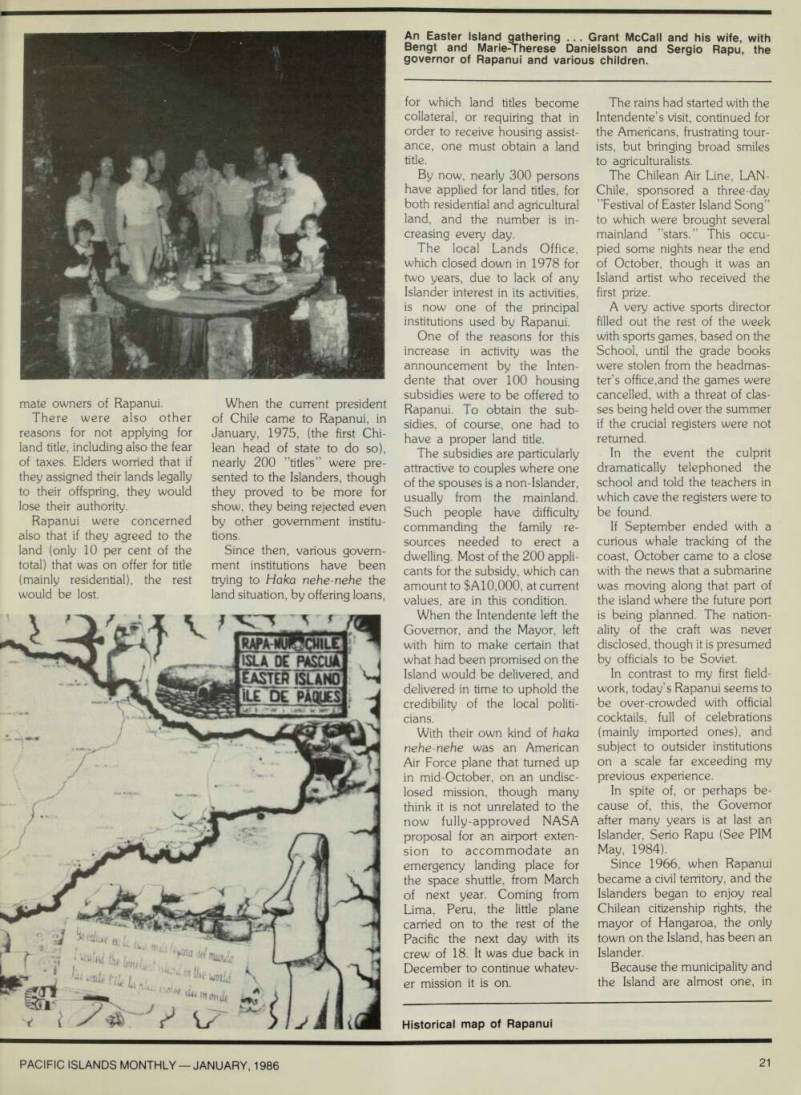
An Easter Island gathering ... Grant McCall and his wife, with Bengt and Marie-Therese Danielsson and Sergio Rapu, the governor of Rapanui and various children.
Historical map of Rapanui
terms of inhabited parts, the Mayor has served as a counter point to the Governor’s office, and a more intimate contact point with officialdom for Islan ders.
Until about six years ago, the municipality had been the poor cousin of the Governor’s office, existing in a rundown wooden house, rotted by termites, there being often not even enough money for wages.
The most recent mayor, Samuel Cardinal! (a Rapanui, with an Italian grandfather, seconded from the Air Force), changed all that and took advantage of government largesse to build a modern town hall and to purchase heavy equipment for local services.
Wages are no longer a prob lem, as the municipality draws its income from central sources instead of as before when it was to have been a percentage of the income from the gambling at the Casino at Vina del Mar, Chile.
Cardinali’s six years and six months came to an end on Australia’s Melbourne Cup Day (November 5), when he publicly resigned his office.
Search for a Successor Women on Rapanui occupy roles com posed both of the influence from Polynesia and from the macho-ridden Chilean culture.
Proper Chilean housewives speak in diminutive phrases in high voices, attend to their husbands and families and gen erally behave in a way that would outrage an Anglo-Saxon feminist.
In contrast, Rapanui women often complain that they must support their husbands, and worry where the family is going, since the men are so irresponsi ble. Women plant the fields, and clean the house, until their children take over the task; older daughters raise younger brothers and sisters.
In ancient times, most of the megalithic figures, for which Rapanui is internationally fam ous, were of male ancestors, but there are about a dozen that are identified as having been of female ones - female Ariki, or chiefs.
In the politics of Rapanui, women strongly speak their minds in public meetings and
are not at all shy about approaching outsiders, even authorities, with their com plaints and petitions.
Missionaries in the last cen tury established a Tahitian-style monarchy on the island in the 1870 s, naming the founding pair ’’Adam” and ”Eve.” Adam lived to see his island move from being a near colony of France to being an actual one of Chile, in 1888. When he died in 1892, the next king was an elected one, and a Chilean naval captain remarked that the winner of the contest, Riro, owed his success to the support
(claimed from the company) and other trappings of such movements, more usually associated with Melanesia.
Though Angata did not suc ceed in her immediate goals, her movement prompted a thorough (and sympathetic), Chilean investigation of the Rapanui complaints, which re sulted in a proper representa tive of the government being brought to the Island in 1915, singularly tempering the foreign domination of the place.
In what was perhaps the most serious confrontation be tween Rapanui and Chileans,
of the women.
Riro fell victim to Chilean business interests, who arranged for him to travel to Chile, where he was poisoned, thus ending the indigenous government.
The next serious challenge to outsider rule came from Anga ta, a Rapanui woman who had been trained in the last century in Mangareva to be a teacher in the church. In 1914, she led an unsuccessful ’’cargo cult” against the English Williamson, Balfour Company that ran the Island at the time, complete with mysterious voices, huge feasts of lamb and beef
the so-called ’’revolt” of 1965, women played a central part in protecting the young school teacher, Alfonso Rapu (brother of the current governor), from Chilean authorities and, later, armed marines.
That was over the summer of 1965 and 1966, when the Canadian Medical Expedition to Easter Island was encamped near the town, and served once as a refuge for Rapu, as well as chroniclers of the event.
Cardinali’s resignation as mayor required a new appoint ment, since the current Chilean regime has banned elections
(local as well as national), until 1988. There was not incon siderable lobbying for a main lander to be appointed, perhaps to counter-balance Governor Rapu. But that plan did not succeed and the tradi tion of a Rapanui mayor con tinued, but with the difference that this, the seventh mayor of Easter Island is an Ariki vi’e (female Ariki).
Lucia Tuki, whose family is the largest on the Island, her own section of it consisting of a dozen brothers and sisters, was bom in 1940. In 1961 she became the first Rapanui school teacher with professional train ing. In addition to her school duties, and raising her own three children, she has been the compere of the local school program on television for some months.
She is, to be sure, the first female mayor, but that is not so unusual in terms of Chile in general, though the majority of officials are still male. Her most important distinguishing feature is that she has no military connections, which does make her one of the first in Chile as a whole.
Coincidentally, her brothers and sisters gave a feast on All Souls Day the weekend after the public announcement, to which the entire Island was invited, and she spent much of that Friday serving food and keeping flies off the hundreds of kilos of meat, fish and veget ables that were given away.
At the school auditorium, the formal handing over of the municipality produced displays of flowers, garlands thrown by enthusiastic Tukis and a lot of kisses and best wishes.
Some sour-faced Chileans grimaced as the governor re minded them with a broad grin that in spite of all, a Rapanui had triumphed.
Haka nehe-nehe, as the is land veers towards the busy summer, when relatives from Tahiti, Europe and the main land are expected to visit; when the flagging tourist traffic will increase; and, January, when the Australian Museum Society arrives, along with Thor Heyer dahl (to make a movie), without even considering two passenger ships and ’’Rapanui Week”...
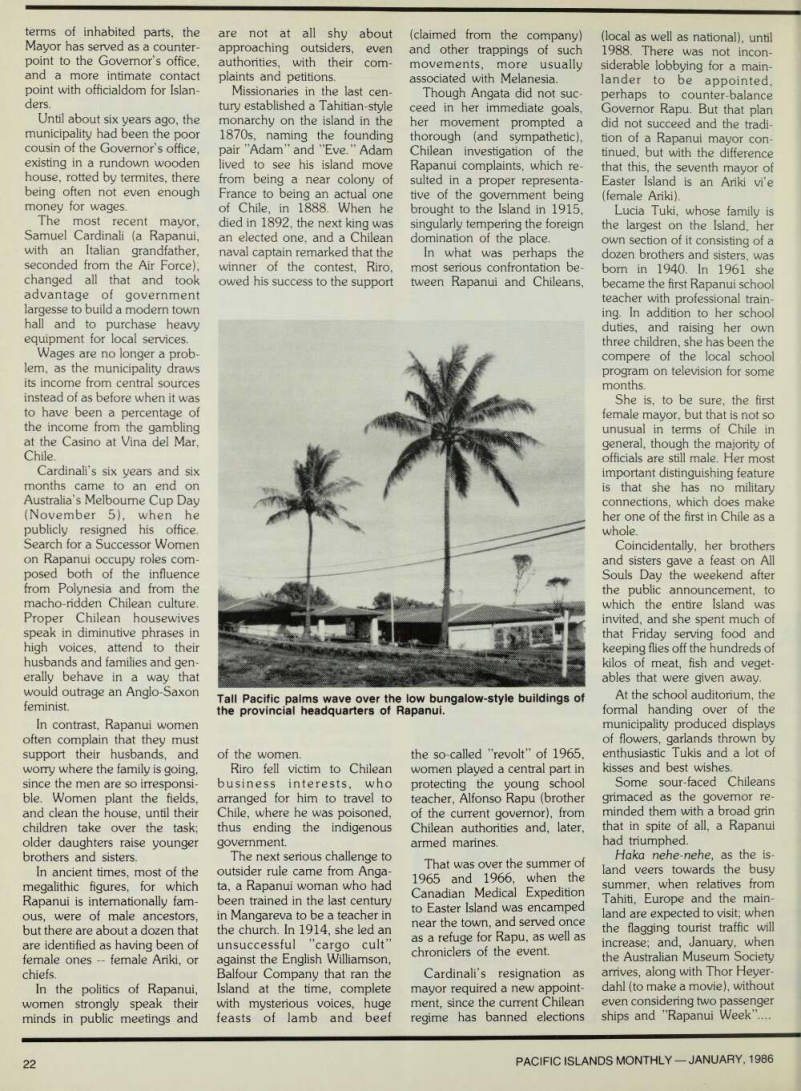
Tall Pacific palms wave over the low bungalow-style buildings of the provincial headquarters of Rapanui.