on islands' rights
p. 19 · Read in the full issue
US close to deal on islands' rights
Of all the topics concer ning the multitude of tiny nations dotting the vast Pacific Ocean, none is so universally important as the exploitation of their fisheries. It has been a vexed issue for several decades with, perhaps surprisingly, the US seen as the major culprit.
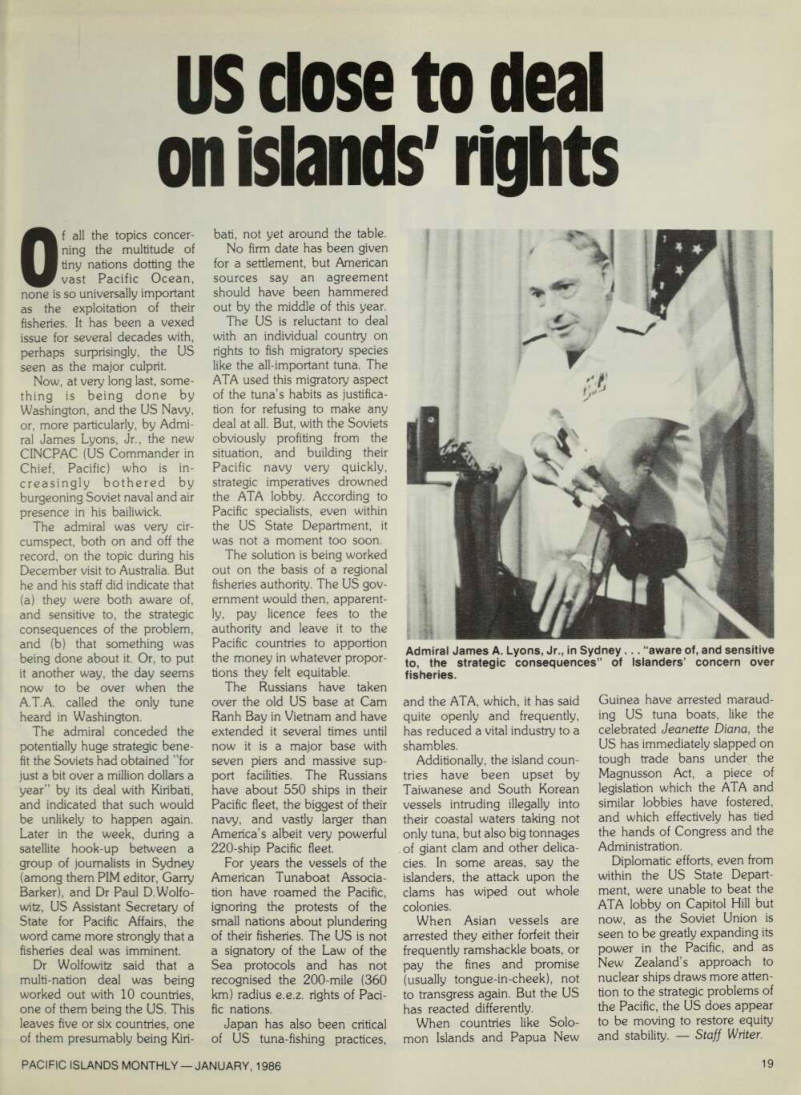
Now, at very long last, some thing is being done by Washington, and the US Navy, or, more particularly, by Admi ral James Lyons, Jr., the new CINCPAC (US Commander in Chief, Pacific) who is in creasingly bothered by burgeoning Soviet naval and air presence in his bailiwick.
The admiral was very cir cumspect, both on and off the record, on the topic during his December visit to Australia. But he and his staff did indicate that (a) they were both aware of, and sensitive to, the strategic consequences of the problem, and (b) that something was being done about it. Or, to put it another way, the day seems now to be over when the A.T.A. called the only tune heard in Washington.
The admiral conceded the potentially huge strategic bene fit the Soviets had obtained ’’for just a bit over a million dollars a year” by its deal with Kiribati, and indicated that such would be unlikely to happen again.
Later in the week, during a satellite hook-up between a group of journalists in Sydney (among them PIM editor, Garry Barker), and Dr Paul D.Wolfo witz, US Assistant Secretary of State for Pacific Affairs, the word came more strongly that a fisheries deal was imminent.
Dr Wolfowitz said that a multi-nation deal was being worked out with 10 countries, one of them being the US. This leaves five or six countries, one of them presumably being Kiri
bati, not yet around the table.
No firm date has been given for a settlement, but American sources say an agreement should have been hammered out by the middle of this year.
The US is reluctant to deal with an individual country on rights to fish migratory species like the all-important tuna. The ATA used this migratory aspect of the tuna’s habits as justifica tion for refusing to make any deal at all. But, with the Soviets obviously profiting from the situation, and building their Pacific navy very quickly, strategic imperatives drowned the ATA lobby. According to Pacific specialists, even within the US State Department, it was not a moment too soon.
The solution is being worked out on the basis of a regional fisheries authority. The US gov ernment would then, apparent ly, pay licence fees to the authority and leave it to the Pacific countries to apportion the money in whatever propor tions they felt equitable.
The Russians have taken over the old US base at Cam Ranh Bay in Vietnam and have extended it several times until now it is a major base with seven piers and massive sup port facilities. The Russians have about 550 ships in their Pacific fleet, the biggest of their navy, and vastly larger than America’s albeit very powerful 220-ship Pacific fleet.
For years the vessels of the American Tunaboat Associa tion have roamed the Pacific, ignoring the protests of the small nations about plundering of their fisheries. The US is not a signatory of the Law of the Sea protocols and has not recognised the 200-mile (360 km) radius e.e.z. rights of Paci fic nations.
Japan has also been critical of US tuna-fishing practices,
and the ATA, which, it has said quite openly and frequently, has reduced a vital industry to a shambles.
Additionally, the island coun tries have been upset by Taiwanese and South Korean vessels intruding illegally into their coastal waters taking not only tuna, but also big tonnages of giant clam and other delica cies. In some areas, say the islanders, the attack upon the clams has wiped out whole colonies.
When Asian vessels are arrested they either forfeit their frequently ramshackle boats, or pay the fines and promise (usually tongue-in-cheek), not to transgress again. But the US has reacted differently.
When countries like Solo mon Islands and Papua New
Guinea have arrested maraud ing US tuna boats, like the celebrated Jeanette Diana, the US has immediately slapped on tough trade bans under the Magnusson Act, a piece of legislation which the ATA and similar lobbies have fostered, and which effectively has tied the hands of Congress and the Administration.
Diplomatic efforts, even from within the US State Depart ment, were unable to beat the ATA lobby on Capitol Hill but now, as the Soviet Union is seen to be greatly expanding its power in the Pacific, and as New Zealand’s approach to nuclear ships draws more atten tion to the strategic problems of the Pacific, the US does appear to be moving to restore equity
and stability.
Staff Writer.
Admiral James A. Lyons, Jr., in Sydney . .. “aware of, and sensitive to, the strategic consequences” of Islanders’ concern over fisheries.