opportunities
pp. 27-29 · Read in the full issue

trade winds
Australia Ignoring Pacific opportunities
The English-speaking
Pacific construction market from New Zea land up to Hawaii is worth an annual Auss7soo mil lion. Of this, New Zealand accounts for some Auss3ooo million, Hawaii about Auss2B6s million, and 26 American territories and inde pendent island countries a ball park combined Ausslsoo mil lion.
Australia rates very poorly as an export construction supplier.
Allowing for the French territor ies and Australian overseas areas, total Pacific off-shore turnover is equivalent to 25 per cent of the Australian domestic construction market. Even the United States fails currently to hold its own in the American Pacific territories. The two countries to take advantage of this substantial market opportunity are New Zealand and Japan.
Failure to participate in this business potential largely sourced externally to the island markets results from negative thinking, inadequate marketing and lack of forward informa tion.
The Australian construction industry argued in 1984/85 that it could not compete with New Zealand-sourced building services and materials; this obviously no longer applies.
It also claimed that bids (ten der prices) were discounted by low New Zealand wage-rates just as Honolulu contractors currently complain of low wages paid on Japanese con tracts in off-shore markets.
But the answer lies in the ”skeleton-crew” approach: basically sending five or six
member teams comprising a project manager, estimator and/ or clerk of works, on-site en gineer, purchasing and person nel officrs, to develop a bid and over-see the contract award.
Together the crew can make on-the-spot decisions as well as hire and buy locally.
The Americans try to com pete with own-labor and US prices for materials and wonder why they miss out. Likewise, Australian sub-contractors and suppliers estimate for their prime contractors as lead bid ders, with the result that if the lead bid fails, the sub-bids lose out. Instead, sub-bids should be submitted to lead bidders from all Pacific Rim countries accor ding to comparative cost and project location.
This is not widely done be cause the Australian and Amer ican contractors are not market ing their activities. Too often they do nothing about a job until it goes out for bid, then they make a short-term scram ble for it and fail. The mathematical odds of suc cessfully obtaining business this way are minimal and nowhere near the true potential.
Basically contributing to the problem is that many industry participants (viz design consul tants, sub-contractors and sup pliers as well as prime, general, contractors), in both Australia and the Unied States rely on inadequate government in formation flows for advance information on construction jobs, especially for the private sector, although such details are readily available commercially at economic cost and are util ised by their competitors from New Zealand, Japan, South
Korea and elsewhere. Obvious ly construction service and sup ply companies that don’t have forward information are unable to market themselves.
Furthermore, the construc tion industry both in Australia and America badly needs to be taught to ’’think export” as, with exceptions, it approaches off-shore work as being sup plementary rather than com plementary to current order books.
The present paranoia in Honolulu towards Japanese contractors appears unreason able because in recent months the Hawaiian contractors have proved inept on home ground in face of mainland competi tion, namely the US$75.B mil lion Tripler Army Medical Cen ter additions/alternations in Honolulu, the US$9.3 million chemical storage upgrade on Johnston Island and the US$3.9 million improvements to Runway 6-24 on Midway.
An outcry in Guam to a 1983 contract award of US$l9 mil lion defence package to Japan resulted in 20 per cent Amer ican preference on defence work over US$5 million. De spite this, the U 514.4 million ammunition wharf at Adotgan Point was awarded to Japan with a differential of 19.7 per cent below the second bidder.
The recent defence contract protection on Guam is the only barrier on overseas contractors in the entire American Pacific, including Hawaii, save for re stricted access of non-nationals to installations on Johnston, Midway, Wake and the like.
Otherwise, Australia, New Zea land and other Pacific Rim
contractors can compete in Honolulu on a parity with those from the mainland.
As an indicator of apathy, when the U 5549.2 million con tract for the Nauru-funded hotel on Guam was awarded early 1985 there were no US bidders despite American design input and its location on US territory.
Neither were there any Austra lian bidders.
The F 516.5 million hotel re cently awarded to a New Zea land-Fiji joint venture attracted Australian, but no American, bids, although the project was
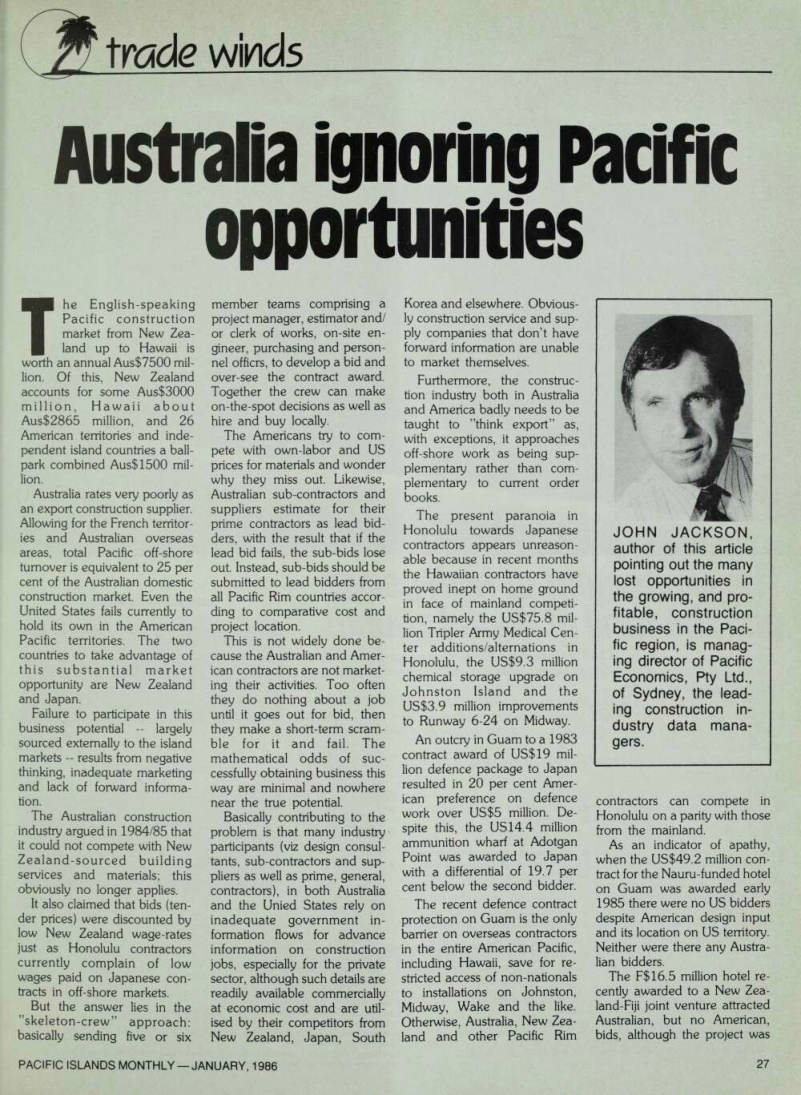
John Jackson,
author of this article pointing out the many lost opportunities in the growing, and pro fitable, construction business in the Paci fic region, is manag ing director of Pacific Economics, Pty Ltd., of Sydney, the lead ing construction in dustry data mana gers.
designed in Honolulu and funded from the mainland.
A US$56 million (all-up) hotel currently out to bid in Western Samoa was designed in Seattle and funded from Honolulu. As yet there are no clear indications whether US contractors will bid, but, in recent months, they have been beaten by a New Zealand con tractor on both the US$2.l million Army Reserve Center and the US$4.5 million Nazareth House in nearby American Samoa.
One comment suffices on Australian construction performance off-shore. On PNG’s independence in 1975, Australia largely held the local construction market sup plemented by indigenous house builders. Now the Aus tralia share has been eroded by half to contractors from New Zealand, Japan and elsewhere.
At this stage there is little evidence of New Zealand penetration north of Fiji and PNG, save in American Samoa and Guam. Likewise, despite a very strong presence in Guam, followed by substantial activity in Belau and the Northern Marianas, there is no evidence of Japanese construction penetration on a commercial
basis elsewhere save for electri cal contracting in PNG, although Japanese aid projects are tied such as recent hospital construction in Western Samoa.
The growth market in the late ’Bos will be the former US Trust territories, the Federated States of Micronesia (Pohnpei, Kos rae, Truk and Yap), the Repub lic of the Marshall Islands, and, once the nuclear storage con troversy is resolved, the Repub lic of Belau. Compact of Free Association funding by the Un ited States is likely to provide an annual infrastructure construc tion expenditure of upwards of US$l5O million and maybe US$2OO million.
Currently Japan, South Korea, and New Zealand are jockeying to take advantage of this business. Bids closed early in December, 1985, for the first such job, the Federated States of Micronesia National Capitol at Palikir, Pohnpei, with the base bids estimated at US$lO million to US$l5 million and the additive alternate bids at US$6 million to US$9 million.
It is still not too late for Australia and the United States to win a reasonable share of construction activity in the South and Central Pacific.
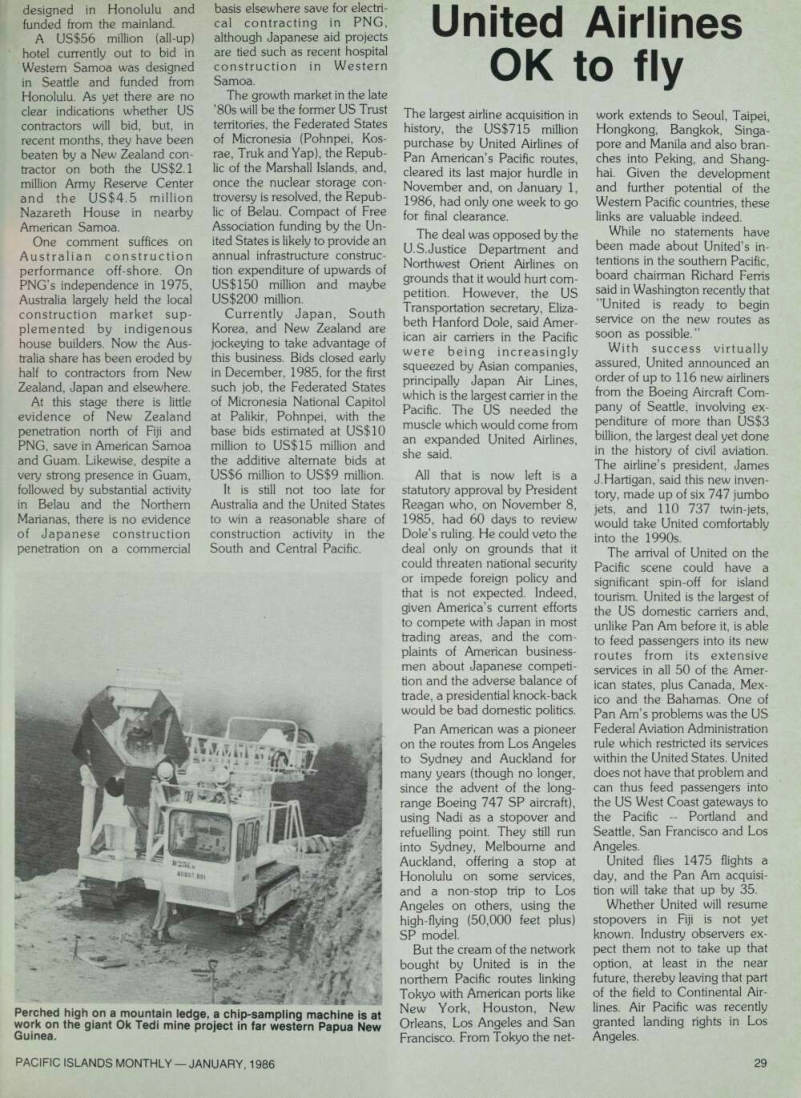
Perched high on a mountain ledge, a chip-sampling machine is at work on the giant Ok Tedi mine project in far western Papua New Guinea.