“Independence -
p. 52 · Read in the full issue
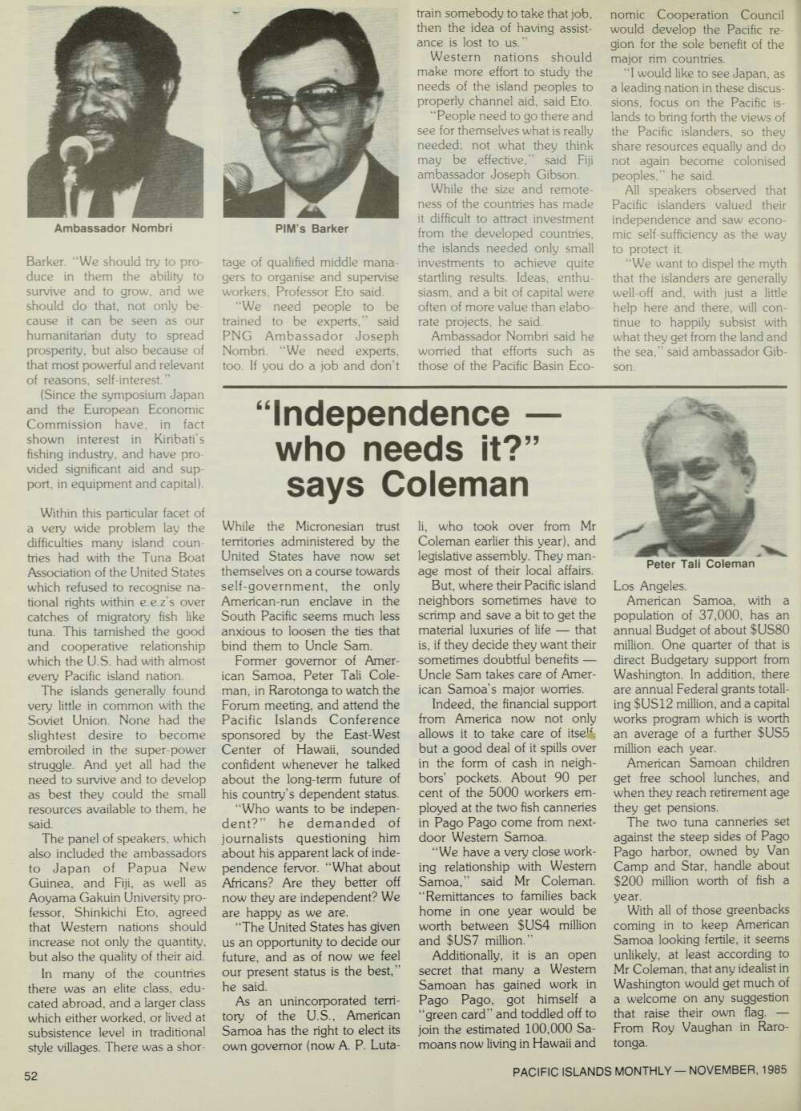
“Independence who needs it?” says Coleman
While the Micronesian trust territories administered by the United States have now set themselves on a course towards self-government, the only American-run enclave in the South Pacific seems much less anxious to loosen the ties that bind them to Uncle Sam.
Former governor of Amer ican Samoa, Peter Tali Cole man, in Rarotonga to watch the Forum meeting, and attend the Pacific Islands Conference sponsored by the East-West Center of Hawaii, sounded confident whenever he talked about the long-term future of his country’s dependent status.
“Who wants to be indepen dent?” he demanded of journalists questioning him about his apparent lack of inde pendence fervor. “What about Africans? Are they better off now they are independent? We are happy as we are.
“The United States has given us an opportunity to decide our future, and as of now we feel our present status is the best,” he said.
As an unincorporated terri tory of the U.S., American Samoa has the right to elect its own governor (now A. P. Luta
li, who took over from Mr Coleman earlier this year), and legislative assembly. They man age most of their local affairs.
But, where their Pacific island neighbors sometimes have to scrimp and save a bit to get the material luxuries of life that is, if they decide they want their sometimes doubtful benefits Uncle Sam takes care of Amer ican Samoa’s major worries.
Indeed, the financial support from America now not only allows it to take care of itsei but a good deal of it spills over in the form of cash in neigh bors’ pockets. About 90 per cent of the 5000 workers em ployed at the two fish canneries in Pago Pago come from next door Western Samoa.
“We have a very close work ing relationship with Western Samoa,” said Mr Coleman.
“Remittances to families back home in one year would be worth between SUS 4 million and SUS 7 million.”
Additionally, it is an open secret that many a Western Samoan has gained work in Pago Pago, got himself a “green card” and toddled off to join the estimated 100,000 Sa moans now living in Hawaii and
Los Angeles.
American Samoa, with a population of 37,000, has an annual Budget of about S(JSBO million. One quarter of that is direct Budgetary support from Washington. In addition, there are annual Federal grants totall ing SUSI 2 million, and a capital works program which is worth an average of a further SUSS million each year.
American Samoan children get free school lunches, and when they reach retirement age they get pensions.
The two tuna canneries set against the steep sides of Pago Pago harbor, owned by Van Camp and Star, handle about $2OO million worth of fish a year.
With all of those greenbacks coming in to keep American Samoa looking fertile, it seems unlikely, at least according to Mr Coleman, that any idealist in Washington would get much of a welcome on any suggestion that raise their own flag.
From Roy Vaughan in Raro tonga.
Peter Tali Coleman