people
pp. 53-54 · Read in the full issue
The University of Papua New Guinea Council has announced approval of the appointment of Professor Timothy Beaglehole of New Zealand as the next UPNG vice-chancellor.
Until his appointment Profes sor Beaglehole was deputy vice-chancellor of Victoria Uni versity, Wellington.
The retiring UPNG vice chancellor, Dr Elton Brash, leaves Port Moresby this month for a post in Canberra.
Max Gaylard is Australia’s new high commissioner to Solomon Islands.
Mr Gaylard joined the De partment of Foreign Affairs in 1968, and has served in Mexico City, Rangoon and Singapore.
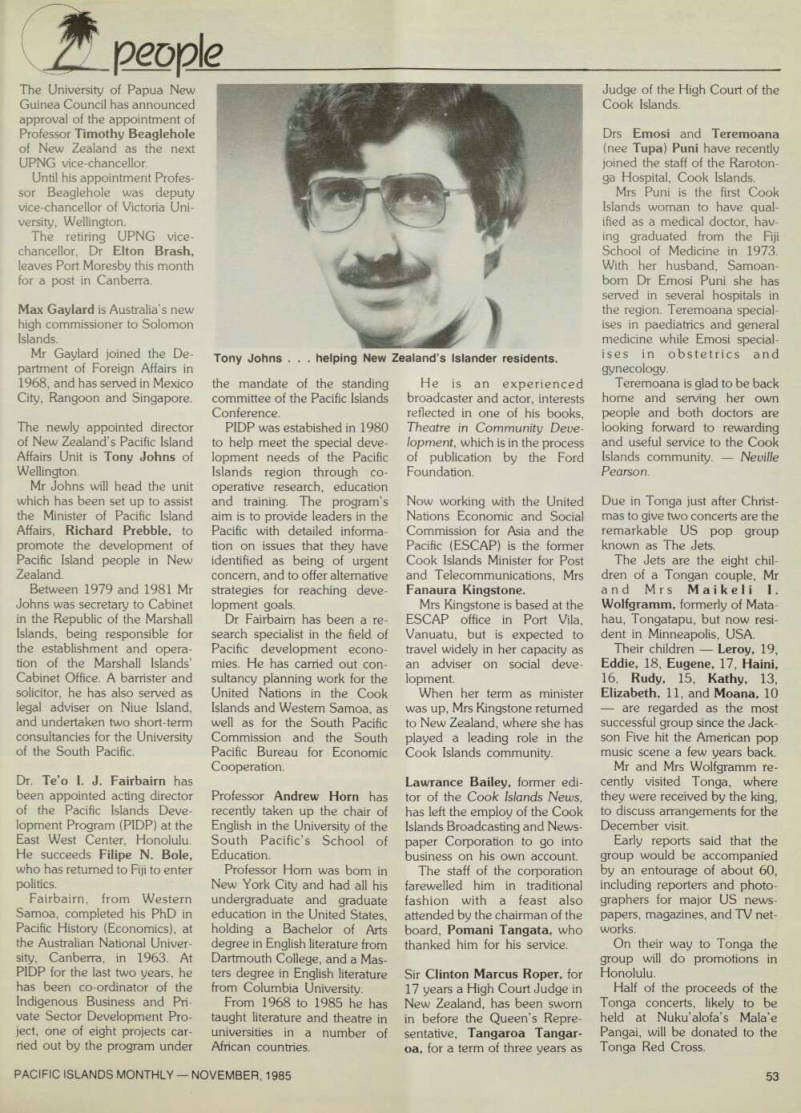
The newly appointed director of New Zealand’s Pacific Island Affairs Unit is Tony Johns of Wellington.
Mr Johns will head the unit which has been set up to assist the Minister of Pacific Island Affairs, Richard Prebble, to promote the development of Pacific Island people in New Zealand.
Between 1979 and 1981 Mr Johns was secretary to Cabinet in the Republic of the Marshall Islands, being responsible for the establishment and opera tion of the Marshall Islands’
Cabinet Office. A barrister and solicitor, he has also served as legal adviser on Niue Island, and undertaken two short-term consultancies for the University of the South Pacific.
Dr. Te’o I. J. Fairbaim has been appointed acting director of the Pacific Islands Deve lopment Program (PIDP) at the East West Center, Honolulu.
He succeeds Filipe N, Bole, who has returned to Fiji to enter politics.
Fairbaim, from Western Samoa, completed his PhD in Pacific History (Economics), at the Australian National Univer sity, Canberra, in 1963. At PIDP for the last two years, he has been co-ordinator of the Indigenous Business and Pri vate Sector Development Pro ject, one of eight projects car ried out by the program under
the mandate of the standing committee of the Pacific Islands Conference.
PIDP was estabished in 1980 to help meet the special deve lopment needs of the Pacific Islands region through co operative research, education and training. The program’s aim is to provide leaders in the Pacific with detailed informa tion on issues that they have identified as being of urgent concern, and to offer alternative strategies for reaching deve lopment goals.
Dr Fairbaim has been a re search specialist in the field of Pacific development econo mies. He has carried out con sultancy planning work for the United Nations in the Cook Islands and Western Samoa, as well as for the South Pacific Commission and the South Pacific Bureau for Economic Cooperation.
Professor Andrew Horn has recently taken up the chair of English in the University of the South Pacific’s School of Education.
Professor Horn was bom in New York City and had all his undergraduate and graduate education in the United States, holding a Bachelor of Arts degree in English literature from Dartmouth College, and a Mas ters degree in English literature from Columbia University.
From 1968 to 1985 he has taught literature and theatre in universities in a number of African countries.
He is an experienced broadcaster and actor, interests reflected in one of his books, Theatre in Community Deve lopment, which is in the process of publication by the Ford Foundation.
Now working with the United Nations Economic and Social Commission for Asia and the Pacific (ESCAP) is the former Cook Islands Minister for Post and Telecommunications, Mrs Fanaura Kingstone.
Mrs Kingstone is based at the ESCAP office in Port Vila, Vanuatu, but is expected to travel widely in her capacity as an adviser on social deve lopment.
When her term as minister was up, Mrs Kingstone returned to New Zealand, where she has played a leading role in the Cook Islands community.
Lawrance Bailey, former edi tor of the Cook Islands News, has left the employ of the Cook Islands Broadcasting and News paper Corporation to go into business on his own account.
The staff of the corporation farewelled him in traditional fashion with a feast also attended by the chairman of the board, Pomani Tangata, who thanked him for his service.
Sir Clinton Marcus Roper, for 17 years a High Court Judge in New Zealand, has been sworn in before the Queen’s Repre sentative, Tangaroa Tangar oa, for a term of three years as
Judge of the High Court of the Cook Islands.
Drs Emosi and Teremoana (nee Tupa) Puni have recently joined the staff of the Raroton ga Hospital, Cook Islands.
Mrs Puni is the first Cook Islands woman to have qual ified as a medical doctor, hav ing graduated from the Fiji School of Medicine in 1973.
With her husband, Samoan born Dr Emosi Puni she has served in several hospitals in the region. Teremoana special ises in paediatrics and general medicine while Emosi special ises in obstetrics and gynecology.
Teremoana is glad to be back home and serving her own people and both doctors are looking forward to rewarding and useful service to the Cook Islands community. Neville Pearson.
Due in Tonga just after Christ mas to give two concerts are the remarkable US pop group known as The Jets.
The Jets are the eight chil dren of a Tongan couple, Mr and Mrs Maikeli I.
Wolfgramm, formerly of Mata hau, Tongatapu, but now resi dent in Minneapolis, USA.
Their children Leroy, 19, Eddie, 18, Eugene, 17, Haini, 16, Rudy, 15, Kathy, 13, Elizabeth, 11, and Moana, 10 are regarded as the most successful group since the Jack son Five hit the American pop music scene a few years back.
Mr and Mrs Wolfgramm re cently visited Tonga, where they were received by the king, to discuss arrangements for the December visit.
Early reports said that the group would be accompanied by an entourage of about 60, including reporters and photo graphers for major US news papers, magazines, and TV net works.
On their way to Tonga the group will do promotions in Honolulu.
Half of the proceeds of the Tonga concerts, likely to be held at Nukualofa’s Mala’e Pangai, will be donated to the Tonga Red Cross.
Tony Johns . . . helping New Zealand’s Islander residents.
Francis Narayan, financial controller of the Fiji Electricity Authority, is to join the Asian Development Bank as a finan cial analyst.
Mr Narayan, who will be responsible for assessing pro jects submitted by borrowing countries, will take up his appointment in Manila in De cember.
Ratu Mosese Duilomaloma, the first local port engineer of the Ports Authority of Fiji, has retired.
Ratu Mosese joined the PAF in February 1981 as port en gineer. He had spent his work ing life with the Public Works Department.
Jack Pidik, president of the Papua New Guinea Softball Federation, was in Sydney for
competition matches for the Michael and Mrs Somare Cup as part of the country’s 10th independence anniversary celebrations in September.
“Softball is a very, very popular game back home,” he told a Sydney newspaper.
“In Fort Moresby, for exam ple, there are nearly 50 men’s and women’s clubs, and when you play matches you get thousands of people to watch, sitting up in trees, on the back of trucks . . . everywhere. They are very vocal.” Mr Pidik said that softball was also becoming popular in the mountains, where rain definitely did not stop play. “They play on the airstrips and run off when the planes arrive,” he said. “But they always pray for rain be cause the airstrip has to close and they can play without in terruption.”
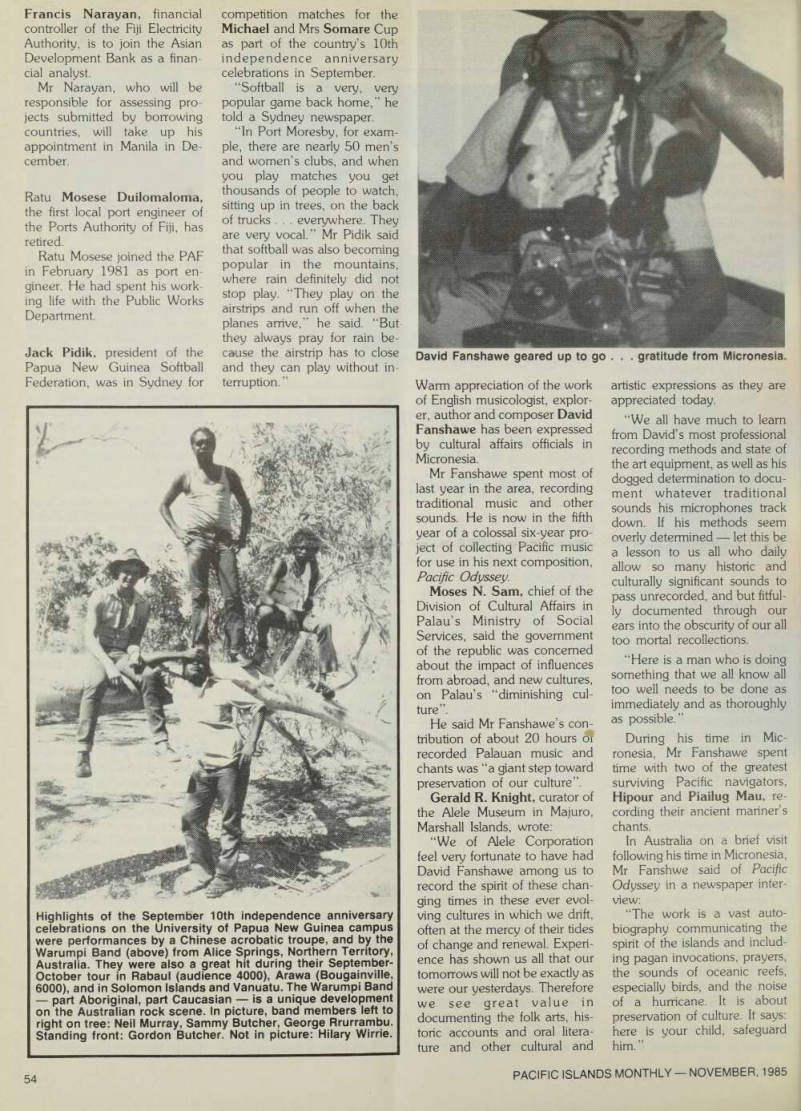
Warm appreciation of the work of English musicologist, explor er, author and composer David Fanshawe has been expressed by cultural affairs officials in Micronesia.
Mr Fanshawe spent most of last year in the area, recording traditional music and other sounds. He is now in the fifth year of a colossal six-year pro ject of collecting Pacific music for use in his next composition, Pacific Odyssey.
Moses N. Sam, chief of the Division of Cultural Affairs in Palau’s Ministry of Social Services, said the government of the republic was concerned about the impact of influences from abroad, and new cultures, on Palau’s “diminishing cul ture”.
He said Mr Fanshawe’s con tribution of about 20 hours or recorded Palauan music and chants was “a giant step toward preservation of our culture”.
Gerald R. Knight, curator of the Alele Museum in Majuro, Marshall Islands, wrote: “We of Alele Corporation feel very fortunate to have had David Fanshawe among us to record the spirit of these chan ging times in these ever evol ving cultures in which we drift, often at the mercy of their tides of change and renewal. Experi ence has shown us all that our tomorrows will not be exactly as were our yesterdays. Therefore we see great value in documenting the folk arts, his toric accounts and oral litera ture and other cultural and
artistic expressions as they are appreciated today.
“We all have much to learn from David’s most professional recording methods and state of the art equipment, as well as his dogged determination to docu ment whatever traditional sounds his microphones track down. If his methods seem overly determined let this be a lesson to us all who daily allow so many historic and culturally significant sounds to pass unrecorded, and but fitful ly documented through our ears into the obscurity of our all too mortal recollections.
“Here is a man who is doing something that we all know all too well needs to be done as immediately and as thoroughly as possible.”
During his time in Mic ronesia, Mr Fanshawe spent time with two of the greatest surviving Pacific navigators, Hipour and Piailug Mau, re cording their ancient mariner’s chants.
In Australia on a brief visit following his time in Micronesia, Mr Fanshwe said of Pacific Odyssey in a newspaper inter view: “The work is a vast auto biography communicating the spirit of the islands and includ ing pagan invocations, prayers, the sounds of oceanic reefs, especially birds, and the noise of a hurricane. It is about preservation of culture. It says: here is your child, safeguard him.”
Highlights of the September 10th independence anniversary celebrations on the University of Papua New Guinea campus were performances by a Chinese acrobatic troupe, and by the Warumpi Band (above) from Alice Springs, Northern Territory, Australia. They were also a great hit during their September- October tour in Rabaul (audience 4000), Arawa (Bougainville, 6000), and in Solomon Islands and Vanuatu. The Warumpi Band - part Aboriginal, part Caucasian - is a unique development on the Australian rock scene. In picture, band members left to right on tree: Neil Murray, Sammy Butcher, George Rrurrambu.
Standing front: Gordon Butcher. Not in picture: Hilary Wirrie.
David Fanshawe geared up to go . . . gratitude from Micronesia.