Pacific

Islands
Monthly
® n 4SP. *\/ 1 I rmmri
Hi tourism: in troublJ?
American Samoa US$l,75 Australia ‘51.50 Cook Islands NZ$2.5O Fiji F 51.50 Hawaii US$l.95 Kiribati A 51.75 .Nauru A 51.75 New Caledonia CFPI9O
New Zealand NZ$2.5O Niue NZ$l.75 Norfolk Island A 51.50 Papua New Guinea K 51.50 Solomon Islands 551.50 Tahiti CFP22O Tonga P 1.50 Tuvalu A 51.75
Usa U 552.25
USTTand Guam US$l.95 Vanuatu VT1.50 Western Samoa T 2.10 'Recommended retail price only Registered by Australia Post Publication No. NBPI2IO
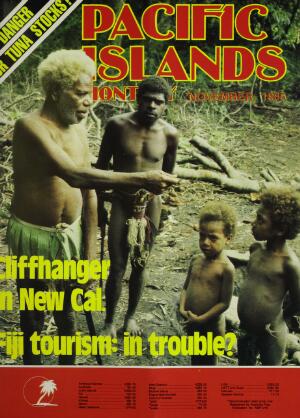
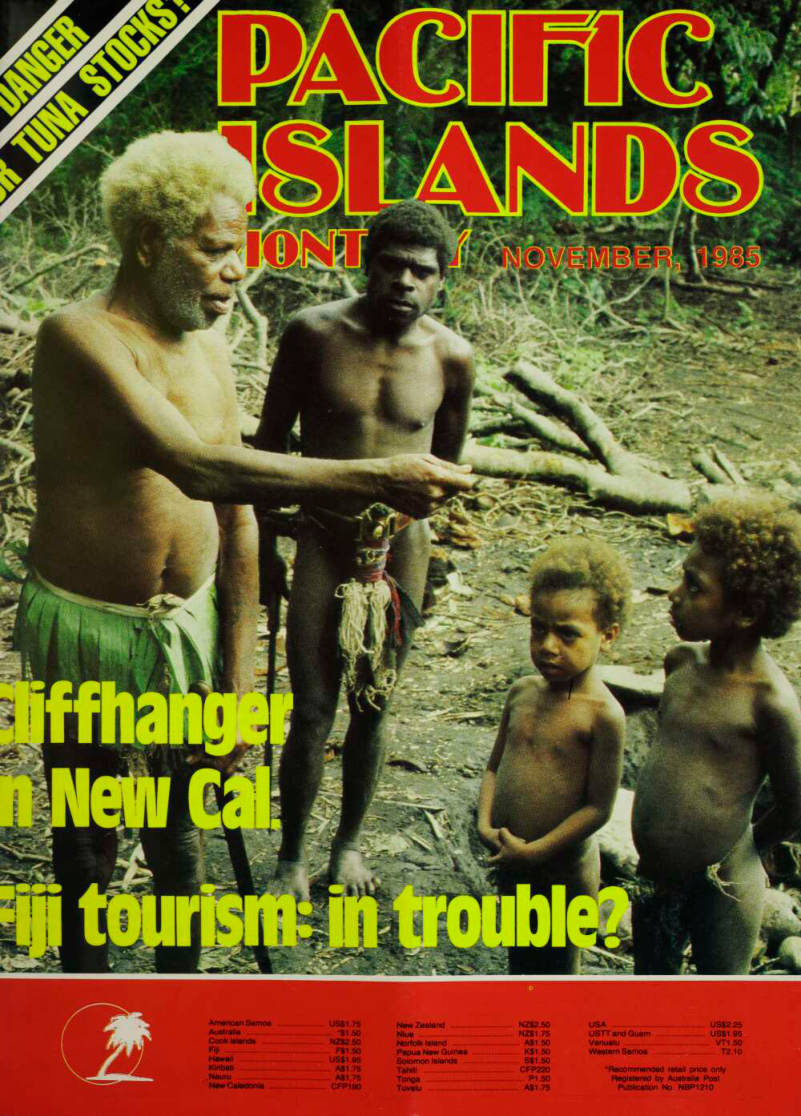
The Cover
Men and recently-circum cised boys of lohnanen vil lage, Tanna, Republic of Vanuatu. Circumcision ceremonies remain an im portant part of life in the traditional ’’custom” vil lages which still flourish in Vanuatu. Photograph is by Norman Douglas, author of VANUATU A Guide, soon to be published by Pacific Publications.
Advertisements & other items, pp. 2-3 (2 items)
0 Hitachi
VMS VT-640E
PAL
Simply the most advanced in home entertainmeni Hitachi’s VT-640E VTR. Its simpletooperate slim design conceals some of today’s most advanced features. £uch as Hitachi’s exclusive “keyboard” innovation. It not only gives you larger, easier-to-use control buttons, but puts them at a more convenient angle: under your fingers instead of in front of them. • 13-function wireless remote control • 2-system compatibility
(B/G-PAL/MESECANp
• Instant Recording Timer • Freeze frame
CMT2OB3
When it comes to total home entertainment the Cineramic AV 20"
TV, CMT2OB3 combines the very best in sight and sound technology. • 8-system compatibility • 23-function remote control • VTR/video disc ready Hitachi’s VT-640E and Cineramic
AV 20" TV, CMT2OB3.
Simply wonderful.
0 HITACHI
• AUSTRALIA: Hitachi Sales Australia Pty.. Ltd.. 153 Keys Road. Moorabbin. Victoria 3189; Phone: (555) 8722 • NEW ZEALAND: AWA New Zealand Limited, Wi-neera Drive.
P.O. Box 50-248, Porirua; Phone: PRO 75-069 • PAPUA NEW GUINEA: S.O. Svensson (N.G.) Ltd., P.O. Box 705, Port Moresby ; Phone. 21-2111 • FIJI ISLANDS: AWA New Zealand Limited, 47 Foster Road (P.O. Box 858), Suva, Fiji; Phone: 312070 • NEW CALEDONIA: Caldis, B.R M 1 Noumea 26. 23. 50 • TAHITI: Ets Chene Alain, P.O. Box 272, Papeete; Phone: 2. 88. 68 • SOLOMON ISLANDS: Technique Radios Centre Ltd., P.O. Box 465, Honiara; Phone: 416
Pacific
ISLANDS
MONTHLY
Vol. 56 No. 11 November 1985
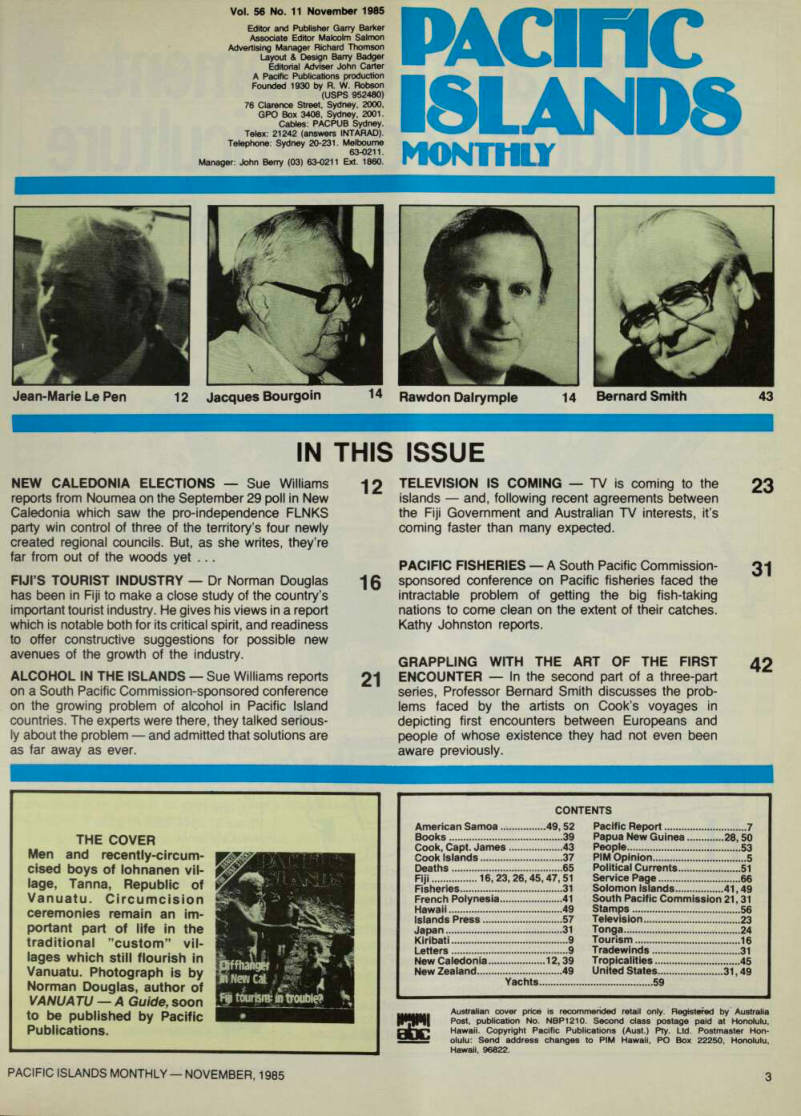
Jean-Marie Le Pen 12
Jacques Bourgoin 14
Rawdon Dairympie 14
Bernard Smith 43
In This Issue
NEW CALEDONIA ELECTIONS Sue Williams -| 2 reports from Noumea on the September 29 poll in New Caledonia which saw the pro-independence FLNKS party win control of three of the territory’s four newly created regional councils. But, as she writes, they’re far from out of the woods yet ...
FIJI’S TOURIST INDUSTRY Dr Norman Douglas -| g has been in Fiji to make a close study of the country’s important tourist industry. He gives his views in a report which is notable both for its critical spirit, and readiness to offer constructive suggestions for possible new avenues of the growth of the industry.
ALCOHOL IN THE ISLANDS Sue Williams reports 21 on a South Pacific Commission-sponsored conference on the growing problem of alcohol in Pacific Island countries. The experts were there, they talked serious ly about the problem and admitted that solutions are as far away as ever.
TELEVISION IS COMING TV is coming to the 23 islands and, following recent agreements between the Fiji Government and Australian TV interests, it’s coming faster than many expected.
PACIFIC FISHERIES A South Pacific Commission- 3*] sponsored conference on Pacific fisheries faced the intractable problem of getting the big fish-taking nations to come clean on the extent of their catches.
Kathy Johnston reports.
GRAPPLING WITH THE ART OF THE FIRST 42 ENCOUNTER In the second part of a three-part series, Professor Bernard Smith discusses the prob lems faced by the artists on Cook’s voyages in depicting first encounters between Europeans and people of whose existence they had not even been aware previously.
Contents
American Samoa 49, 52 Books 39 Cook, Capt. James 43 Cook Islands 37 Deaths 65 Fiji 16, 23, 26, 45,47, 51 Fisheries 31 French Polynesia 41 Hawaii 49 Islands Press 57 Japan 31 Kiribati 9 Letters 9 New Caledonia 12,39 New Zealand 49
Pacific Report 7 Papua New Guinea 28,50 People 53 PIM Opinion 5 Political Currents 51 Service Page 66 Solomon Islands 41,49 South Pacific Commission 21,31 Stamps 56 Television 23 Tonga 24 Tourism 16 Tradewinds 31 Tropicalities 45 United States 31,49
Yachts 59
Australian cover price is recommended retail only. Registered by Australia Post, publication No. NBPI2IO. Second class postage paid at Honolulu, Hawaii. Copyright Pacific Publications (Aust.) Pty. Ltd. Postmaster Hon olulu: Send address changes to PIM Hawaii, PO Box 22250, Honolulu.
Hawaii, 96822.
Advertisements & other items, pp. 3-4 (2 items)
3
PACIFIC ISLANDS MONTHLY NOVEMBER, 1985
Editor and Publisher Garry Barker Associate Editor Malcolm Salmon Advertising Manager Richard Thomson Layout & Design Barry Badger Editorial Adviser John Carter A Pacific Publications production Founded 1930 by R. W. Robson
(USPS 952480)
76 Clarence Street, Sydney, 2000, GPO Box 3408, Sydney. 2001.
Cables: PACPUB Sydney.
Telex: 21242 (answers INTARAD).
Telephone; Sydney 20-231. Melbourne 63-0211.
Manager: John Berry (03) 63-0211 Ext. 1860.
Australian equipment
for industry or agriculture
lifts production, lifts profits
m * a I i High performance Australian industrial equipment is available for a wide range of manufacturing, processing and servicing needs. Australia also makes innovative agricultural equipment that has helped her become one of the world’s major food producing countries.
Australian equipment is also operating efficiently and reliably in many other countries.
Australia can supply equipment ideal for most industrial and farming purposes in the Pacific Islands. Welding equipment.
Generating sets. Lathes and woodworking equipment. Sawmilling equipment. Refrigeration. Air conditioning. Mining equipment.
Safety equipment. Pumps including solar pumps. Ploughs. Cultivators.
Slashers. TVactors.
Irrigation equipment. Lubricators.
Planters. Gates and fencing. Cattle handling equipment. Agricultural seed and chemicals.
You can also obtain advice and expertise from experienced Australian consultants. But in the first instance contact the Australian TVade Commissioner about your particular requirements.
Ask the expert who knows Australia For details of suppliers phone or telex the Australian TVade Commissioner at: Fiji P.O. Box 1252 Phone 31 2844 Telex FJ 2126 New Caledonia P.O. Box 22 Noumea Phone 27 2414 Telex 087 Papua New Guinea P.O Box 9129 Hohola Phone 25 9333 Telex NE 22109 Hawaii Australian Consulate 1000 Bishop Street Honolulu 96813 Phone (808) 524 5050 Telex 63 3128 W ( Ask the Australian Trade Commissioner
Whoa back, Shultz
Pim Opinion
The vexing row which persists over New Zealand’s desire to become the non-nuclear Switzerland of the Pacific has reached the point where all participants should stop and take stock of themselves, and of what they are about to wreak upon the region.
Mr Lange, particularly, might ask himself if, perchance, he has been temporarily blinded, by the glow of his Greenpeace halo, to the long-term consequences of New Zealand’s approaching ejection from ANZUS, and too haughty in rebuffing the obviously genuine concerns of many of his countrymen, some of them defence experts. How much of his undoubtedly widespread support in New Zealand comes from considered thought in the electorate, and how much from the euphoria of discomforting giants?
But is the United States not also guilty of ignoring the lantern while it slaps at the moth? Speaking to journalists late last month, U.S.Defence Secretary, Caspar Weinberger, was adamant that there was no way the U.S. could accept the N.Z. position, or alter its rules on disclosure of the weaponry aboard its ships. His position can be understood. But it is the more aggressive tone of the Secretary of State, George Shultz, who is seen as seeking to punish Mr Lange for his “defection” from ANZUS, which is worrying the nations of the South Pacific.
While there is no current, or foreseeable actual threat of aggression in the Pacific, an ANZUS weakened, or, rather, a New Zealand rejected, damages Pacific confidence. Many Pacific Island countries might be worried by Mr Lange’s nuclear policies, but they are similarly wary of insensitive behavior by the U.S.administra tion.
Australia, particularly, is embarrassed by being made to appear to have to choose between the U.S. and a life-time friend and cousin next door.
Canberra decided to air its anxieties publicly. Their ambassador to the U.S., Mr F.Rawdon Dalrymple, in a speech on September 24 to the Asia Society of America, set out, with great clarity, Australian policy on the Pacific, and warned Washington of the consequences of some of its attitudes. It was a speech cleared at the highest levels in Canberra.
The ambassador sought to tell Washington, and the White House, that things are changing in the Pacific. He spoke of the closeness between Australia and New Zealand, and the growing ties with both the Islands and the swiftly-prospering countries of South East Asia; of the immense commercial and political importance of Japan, and the huge potential of China. In all of this he constantly referred to the many powerful and vital links with the United States.
But America was ignoring, perilously, the growing importance of the South Pacific, he said. It had not thought through the consequences of some policies among them, although he did not specify it, undoubtedly the matter of chopping New Zealand off at its defence socks.
Political independence in the region had attracted new political
presences, he said. Some were within the western alliance, and some were not. So far, intrusions by the Soviet bloc had been limited, primarily because of the pro-western orientation of the island countries, but, he said, that comfortable situation was now threatened.
The two major causes of friction, he said, were nuclear testing and tuna fishing, and this magazine can do nothing but welcome such recognition of warnings we have sounded for years.
France is the main culprit on the first issue, and America on the second. Neither country has given the slightest indication that South Pacific anxieties bother them in any important way.
“The United States is seen as being less than helpful by giving credence to French arguments that the testing does no particular harm,” Mr Dalrymple said. “It is precisely that French testing which has been a major influence in the formation of the climate of opinion in New Zealand which is now causing such anxiety to both the United States and Australia over the future of ANZUS. ”It will be an act of folly if we in our alliance context continue to countenance and permit nuclear testing in the South Pacific and it would be even worse if we were, in addition, to countenance and permit the dumping of nuclear waste in the Pacific...”
Mr Dalrymple’s warning was both calm and very clear. The United States must stop stomping around the South Pacific like a heedless hippopotamus, following damaging policies dictated by North Atlantic interests.
That his words fell on deliberately deaf ears was bluntly marked by the gravel-voiced former U.S. ambassador to the United Nations, Jeane Kirkpatrick, who retorted that the French had a right to test, and if the site happened to be on a piece of France 20,000 kilometres from the rest of it, that was no reason for the neighbors to complain. It was a singularly unnecessary and ignorant statement.
The U.S. is clearly unwilling to upset the French because of Atlantic considerations. Yet it is precisely because of this that America’s position in the Pacific has been damaged.
But, for most island countries, the nuclear matter is not nearly so immediately irritating as the buccaneering behavior of the American Tunaboat Assocation. It would be easy enough, one suggests, to have that angry boil eased if there was even moderate will in the U.S. administration to do so. Clearly there is not.
Mr Dalrymple proposed that some kind of South Pacific office be set up by the State Department to make higher officialdom more aware of regional opinion. Another bit of bureaucracy is quite unnecessary. All Washington needs to do is open its ears to its very own people in the region.
Washington may think it can damage Mr Lange by heaving him out of ANZUS, and by making a bilateral defence agreement with Australia, and so they might They may think they can ignore the region’s concerns over French nuclear testing. They may think the domestic political pressure exerted by the A.T.A. more important than the anger of the little island nations over what they regard as the plundering of their fisheries. Yet in the end it may be the U.S. itself which will lose and that would be very bad for all of us.
Advertisements & other items, p. 6 (1 item)
National’s VHS Movie
sets you free!
Free from cables . connectors and complications VHS Movie model NV-M1 is a lightweight camera-with-recorder you can grab with one hand and take wherever the action leads you.
It weighs only 2.5 kg excluding battery pack.
There’s nothing to get tangled in—no additional components to carry around.
Free from frequent cassette changes The NV-M1 can record up to 240 minutes on a standard VHS video cassette. Think of all the great moments you can capture without interrupting the action.
Free from troublesome accessories Connects directly to TV for playback with Cue & Review and Still modes; requires no cassette adaptor. All you need is VHS Movie and good times!
Care-free The NV-M1 has a variety of special features that make operation carefree and simple: an electronic viewfinder that displays instant playback, a Date Recording Function, and a yj* Newvicon pick-up tube for rich colour recording and low light sensitivity to 10 lux.
National’s VHS Movie NV-Ml. Find out how it feels to be free. /Ml ishs maisii
VHS
National
National, Panasonic and Technics are the brandnames of Matsushita Electric.
Pacific Report
Caledonia Councils Elect Leaders
New Caledonia’s four new regional councils met for the first time on October 6 to elect their presidents, who will sit on the executive committee heading the new Territorial Congress. As expected, the leader of the Kanak Socialist Liberation Front (FLNKS), Jean- Marie Tjibaou, was elected president of the northern regional council. His colleagues, Yeweine Yeweine and Leopold Joredie, were elected as president by the Loyalty Islands and the central regional council respectively. Jean Leques, of the right-wing anti-independence party RCPR, was elected president of the southern council. At a meeting in Noumea on October 8, RCPR man Dick Ukeiwe was elected president of the overall Territorial Congress. He received 29 votes, against 13 for Mr Tjibaou.
Electors were the members of the four new councils. (See earlier report, p. 12).
Port Moresby's Crime Rate Down
Port Moresby’s state of emergency has inflicted lasting damage on the city’s raskol gangs, according to a parliamentary committee which has been overseeing its implementation since the beginning of July. The committee reported to the Papua New Guinean Parliament that the emergency, which includes a late-night curfew, had only ever been intended as a temporary measure against crime and should be lifted on November 4. It recommended a gradual easing of emergency provisions, but suggested that road blocks and police patrols continue. Parliament was told there should be a tightening of security at corrective institutions, that an emergency provision prohibiting demonstrations and protest marches be lifted and that juveniles be separated from older prisoners in jails. The government will seek changes to the constitution to provide for the introduction of vagrancy laws aimed at stemming rural drift to the towns, which it believes exacerbates unemployment and lawless ness. The Prime Minister, Michael Somare told Parliament that critics who had doomed the state of emergency before it even began had been proved wrong. He said in the 15 weeks before the emergency there were 523 break and enters reported in Port Moresby, while in the 15 weeks since there had been only 91.
Robberies were down from 182 to 36, sexual assaults from 60 to 30, motor vehicle thefts from 194 to 26 and the weekly average of serious offences down from 64 to 12. Mr Somare said the average reduction of serious offences since the emergency began was 80 per cent. The incidence of pack rape, which had been escalating, had virtually been eliminated and there had been no crimes of violence reported during the nightly curfew hours. He said the government intended to introduce bills to allow householders to purchase tear gas, to prevent the sale of ammunition to people not holding a firearm licence, to define offensive weapons more strictly, and to give extra search powers to police operating in a declared curfew. The government also intended to introduce legislation to allow Cabinet to impose a curfew where and when necessary without having to declare a state of emergency. Mr Somare said that one of the great achievements of the state of emergency had been the capture of 100 prison escapees. Australian Associated Press.
Mara Balks At U.S. Aid Terms
Fiji’s Prime Minister Ratu Sir Kamisese Mara said in October he might regret some of the provisions of a proposed agreement for American aid to his country, and refuse to sign it. Ratu Mara was due to visit Washington later in the month to open the embassy being established there by Fiji. During the visit, it had been expected that he would sign an agreement making Fiji the first South Pacific country to receive direct American aid, amounting initially to about SUS 3 million a year. However, Ratu Mara said he did not like some provisions of the proposed agreement, adding that they would not be manageable if they were applied to other countries which gave aid to Fiji. Observers in Suva noted that under one clause in the proposed agreement with the U.S., Fiji would have to confer full diplomatic status as missions on American aid organisations.
Polynesian Church Slams N-Tests
The 1985 Synod of the Evangelical Church of French Polynesia
has reaffirmed its “extreme opposition” to continued French nuclear testing at Moruroa Atoll. The Synod declared in a resolution that since President Mitterrand had not replied to a letter on this subject sent by last year’s Synod, another letter would be sent, reiterating the church’s opposition to nuclear tests, and also its long-standing demand for a popular referendum on the matter to be held throughout French Polynesia. The church, the largest and most influential in the French territory, also expressed its concern about continued unrestricted immigration into the territory, the dispossession of the Maohi people of their lands through the tax regulations governing land sales, and the rising cost of living.
Islanders For Conference Games?
South Pacific Island countries may become a part of the Pacific Conference Games under a proposal being studied by conference officials following a meeting in Canberra. The Pacific Conference Games have been held every four years since 1969, most recently at Berkeley, California, last June. They comprise a full Olympic style track and field program, except the marathon, the walks, and the decathlon and heptathlon. The Canberra meeting was critical to the future of the five-nation track and field games following the announced withdrawal in August of the United States, which lost interest in them in the light of the nowadays packed international program; however, conversion of the games to a junior (under-20) competition lured the U.S. back and ensured their immediate future. The Pacific Conference Federation accepted an offer from the West Nally International Sports Promotion group to hold the next three games every two years at a huge new complex being constructed at Waikoloa on the Kohola coast of Hawaii’s “big island” starting in 1987. Not only are the Americans still in, along with Australia, New Zealand, Japan and Canada, but China was also admitted to the conference during the Canberra meeting.
South Pacific Island participation is a suggestion from Australia.
The idea would be to invite two athletes from each island group to take part in half-a-dozen events run in conjunction with the games.
They would not compete against the strong teams from the six conference member countries, just among themselves. Proponents of the idea argue that it would be entirely appropriate for the island athletes to join in what should be, granted the surroundings, one of the more colorful events on the international athletics calendar.
Details of this, and other proposals on marketing and television rights for the new-look games, will be worked out over the next few months. The multi-million dollar “Sports World” project is being financed by the giant Transcontinental Development Corporation of Santa Barbara, California. The 34-ha complex will include a stadium for athletics, cycling and football seating 35,000 specta tors, plus an indoor sports centre, four baseball diamonds, two new
golf courses, and a Grand Prix motor-racing track.
James
Shrimpton.
New Cuts In Png Public Service?
A cut of about 4000 in Papua New Guinea’s 50,000-strong public service has been called for by Public Service Minister Father John Momis. Fr Momis said on a radio program that the cuts were necessary because of the country’s difficult economic situation.
The service was last reduced in 1983, when almost 2000 public servants were retrenched, and another 400 moved to other government departments. A Radio Australia report said the idea in 1983 was to remove public servants who weren’t doing their jobs effectively.
Yale , Princeton Promote Islands Travel
A new twist to Pacific Islands travel promotion has come from an unlikely source America’s prestigious Ivy League universities.
Both Yale and Princeton Universities, arch-rivals to each other, have scheduled education-plus-travel programs in 1986 for their well-to-do alumni. The Yale program, in March, 1986, takes the alumni from San Francisco to Sydney to Port Moresby and then by cruise ship through Indonesia; the Princeton program takes place on the Hawaiian island of Maui. The Princeton program is called “An Alumni College in Hawaii” and is scheduled for January 21-29, 1986. It stresses substance rather than island-hopping,
being a colloquium on “The United States and the Pacific Powers; Partnership or Rivalry?” Seven Princeton professors, headed by Donald Stokes, dean of the Woodrow Wilson School, will give lectures and lead seminars during an intensive, five-day schedule of activities. The location of the alumni college is the Hyatt Regency Maui on Kaanapali Beach. Yale’s program will take place on the cruise ship Illiria which Yale says has . .85 officers and crew serving only 135 guests ... a higher ratio of personnel to passengers than any other cruise vessel. .. ” The Illiria leaves Port Moresby on March 16, stopping the next day at Thursday Island in Torres Strait, then cruises along the coast of Papua New Guinea without stopping. The long Indonesian part of the journey, 11 days and numerous stops, concludes with the inevitable Bali. The alumni are then flown to a weekend in Hong Kong before returning to the States. The Yale tour also features a couple of professors, J. Joseph Errington, a Yale anthropologist, and Gerald Larue, an emeritus professor of archaeology at the University of Southern California. This program is one of 18 being mounted in 1986 by the Association of Yale Alumni. These outings are not cheap. The shorter Princeton session costs $ U 51595, double occupancy, and $5lO more if one travels alone. Air fare from New York would add another S7OO per individual. This is a bargain compared to the range of costs (including airfare from San Francisco) quoted by Yale; from $4695 per person to $7695 depending on the nature of the accommodation on the Illiria and on whether one was travelling alone or with a companion. The Princeton fee includes a presumably tax-deductible S2OO contribu tion to the university, while Yale’s fee includes a contribution of S3OO. The ingredients for putting together such an outing seem to be: a prestigious tour promoter (the university), one or more persons who can speak with authority about the area (the professors), and, most important, a mailing list of reasonably well-to-do likely customers (the alumni). America’s private colleges and universities pay a remarkable amount of attention to their graduates (as sources of funds, among other things) and maintain a steady pattern of mailings to the alumni. Princeton, for example, publishes a slick, well-edited 32-page publication for its graduates every week of the academic year. While neither of these programs emphasised the independent nations of the Pacific, there is always another year, and with Yale, anyway, a long list of university sponsored trips. Maybe it would be mutually helpful if Fiji chatted with the Harvard Alumni Council, and if Stanford University rang
up the Solomon Islands?
David S. North in Washington.
Rainbow Warrior: The View From Europe
When visiting Europe in the past, the only Pacific news items I have seen in the local papers have been short notices, rarely more than five lines, announcing in a matter of fact way the detonation of still another nuclear device at Moruroa. It has therefore been an unusual experience during my recent European trip (early September until well into October) to find in all French, British, German and Scandinavian newspapers, day after day, front-page stories about events taking place in such well-known Pacific places as Moruroa, Papeete, Auckland, Wellington and Canberra. The reason, of course, is the Rainbow Warrior affair. On the other hand, I cannot find anywhere in the two-foot-high pile of newspaper cuttings about the various aspects of this tragi-comic affair which has accumulated on my hotel room table a single reference to the problems, sufferings and aspirations of the people most deeply involved, i.e. the Polynesians in whose islands 112 nuclear bombs have been detonated during the short space of 20 years. Reading these articles, it is almost as if the 118 islands of French Polynesia were uninhabited except perhaps by a few lovely hula girls stretching out welcoming arms to French bigwigs, usually in gold-braided uniforms, in an occasional press photo graph. The numerous French radio, TV and newspaper reporters who were despatched to the Pacific to cover the presidential trip to Moruroa in early September continued to meet the popular demand for a good, real-life spy yarn, in never-ending instalments, and therefore paid scant attention to native problems and politics. (Well, a few of them praised the Polynesians in general terms, contrasting their friendliness and hospitality with the dourness and hostility of the Kanaka in New Caledonia, so unhappily misguided by a handful of agitators.) A feature of the coverage in the French press has been the fuss made of the two agents imprisoned in New Zealand, the so-called “Turenges”, who seem to be seen by government and public alike as valiant soldiers deserving of high decorations because “all they did was obey orders”. There is also
general agreement in France about the Greenpeace activists. They are, according to this particular “national consensus”, wittingly or unwittingly doing the work of the Russians with American money! Blithe indifference to the effects on islanders of events associated with the Rainbow Warrior was well to the fore when at the end of September the prestigious SOFRES Institute conducted a public opinion poll to find out what the French people actually thought of the whole affair. None of the questions concerned its implications for the Polynesian people. The closest the pollsters got was in the question: “Are you in favor of or opposed to France continuing its underground testing in the Pacific?” Not less than 60 per cent approved, only 24 per cent were opposed, and 16 per cent had no opinion. This represents a “national consensus”, we are told, which should be respected by all peoples in the Pacific. So far no French politician or editorialist has cared to mention the embarrassing fact that all political, civic and church leaders who count in French Polynesia have for several years now been asking the Paris government to organise a local referendum in French Polynesia to allow the people most concerned, i.e. the islanders
themselves, to decide the issue.
Bengt Danielsson in
Stockholm.
OZ WARNS U.S. ON FRENCH TESTS , TUNA Australia’s Ambassador to the United States, Rawdon Dalrymple, has highlighted the dangers to U.S. and Australian interests in the South Pacific from the perceived tolerance of the U.S. for French nuclear testing at Moruroa, and from U.S. policy on tuna fishing in the region. Speaking at a meeting of the Asia Society in New York on September 24, Mr Dalrymple said of the South Pacific: “Now in this situation where you have this huge sweep of the world’s surface containing only a number of scattered mini-states it should be possible for us as allies and with the accumulation of goodwill there is towards us, and the resources at our disposal it should be possible for us to ensure the continuing friendship and goodwill of the island states. But difficulties have emerged and I want to mention the two principal sources of difficulties. The two problem areas are nuclear issues and fear of nuclear damage of one sort or another, and secondly concern about fishing stocks and the need to exploit the one major resource the region has namely fish. Now in those two problem areas, areas of discontent and concern in the South Pacific, the two agents about which there is the most concern are respectively the Republic of France and the United States tuna fishermen’s activities in the region. There are in fact two problems to do with France in the South Pacific. One relates to their handling of the political crisis in their colony of New Caledonia and the problems which face them in what is I think an inevitable process of decolonisation. I don’t propose to discuss that and the other is the one to which I just referred, namely French policy on nuclear testing in the South Pacific. Now on that issue it seems to me the United States is seen as being less than helpful by the states of the South Pacific. And that is because the United States has tended, is seen anyway, to have tended, to side with France on the issue of nuclear testing in the South Pacific. It is considered in the region that the United States could, if it wanted to do so, exert strong influence on France to cease testing on Moruroa Atoll. 1 might say in parenthesis that it is precisely that French testing which has been a major influence in the formation of the climate of opinion in New Zealand which is now causing such anxiety to both the United States and the Australian governments in relation to the future of Anzus.” On the tuna problem, Mr Dalrymple said: “It seems to me that it is an urgent matter from the point of view of our interests in the South Pacific that the United States in consultation, I would hope, with Australia and New Zealand, presses ahead either with making changes to your current legislation governing the activities of your tuna fishermen and/or that you make haste to get into place the multilateral agreement on fishing in the South Pacific which along with some new aid measures would result in benefits to the South Pacific countries from United States fishing involvement in the South Pacific which would quite clearly exceed any potential benefits from the involvement of the Soviet Union.
Now that is something which you could do at very small financial cost. We are talking about small amounts of money. But it is something which no one else can do for you or cannot do completely for you. Certainly Auxtralia can’t, if only because we are not a major high-seas fishing country. We don’t have ships like the Jeanette Diana with all the modern technology and we aren t in that league; we’re not experts and we can’t give these countries the sort of technology which you and the Japanese can.”
letters
Local lore and the Earhart case
I am very interested in Julian Putney’s account of Flying Lady’s voyage in search of Amelia Earhart’s landing place (June PIM).
The old people of Marakei and Butaritari atolls in the Kiri bati group have a legend of the lost land of Bikenikarakara.
This land, vouched for by many, is said to lie some 60 miles to the eastward of a line bisecting Marakei and Butar itari, but has not been seen by anyone now living. The Kiribati word “bikenikarakara” denotes a low sandy cay, without palms, inhabited by birds. The islands of Howland and Baker fit this description but are some 600 miles away. As canoe voyages were measured in days sailing and not distance I have always assumed that one of these islands could be Bikenikarakara and that the distance was wrongly judged, or more likely wrongly relayed in the voyage history. A canoe blown away in a “westerly” would fetch up in this area within a week, well within the staying power of a Kiribati fisherman. Those famil iar with life on the low atolls would survive on either of these islands, and sail back down wind when the normal trade wind resumed. City-bred Euro peans would be unable to sur vive for long, although the means of survival would be all around them.
In the 1950 s I was talking to the old sailorman Beatau, at Matang Village, Nonouti. He had been around a bit, aboard sailing vessels repatriating labor from the Queensland cane fields, and could spin an in teresting yam. In the course of conversation I asked him about Bikenikarakara. He said: “It used to be there but has now gone.” Then right out of the blue, with no prompting, he said; “That is where that Amer ican aeroplane woman land ed”. When questioned further, he said: “Yes she thought she saw an island but it had sunk. ”
If satellite references show an island northwest of Howland it could well be Bikenikarakara. I have sailed over this area on voyages between the Line, Phoenix and Tarawa on many occasions, often diverting to sight Howland or Baker, and circling them to fish for the larder. (The fishing off uninha bited islands is really some
thing!) I have never sighted any other land, which is probably just as well, if a cay or reef exists.
This area of the central Paci fic abounds with vigias, mirages and large fish shoals. Some vigias arise out of gin bottles, but by no means all. On several occasions I, and the watch on deck, have sighted definite land
and even taken bearings, at eight to 15 miles, that has disappeared on closing. At night or in rain, the first sighting of a treeless cay can be the surf under the bow. They do not even show up on radar (although the birds do!) One has to be very sure of one’s navigation, when in this area.
Difficult in small craft. Would a scientifically designed and orientated satellite “see” a vigia? I don’t know, but I have carried many scientists aboard in this area, and most of them were “nuts”!
While on this subject I heard from a Gardner Island settler that when the island was reset tled in 1938, they found the skeleton of a European woman, a handbag and shoe, etc. It was thought that this could be Earhart and the remains were taken away for analysis, and the surmise disproved. I would be very interested if anyone else has heard of this story and/or its outcome. What a tragic story.
Some poor yachtie survivor wandering around an uninha bited, and to her, inhospitable island!
I would like to know the position of the Flying Lady island if confirmed.
Capt.
E. V. Ward
Limassol Cyprus
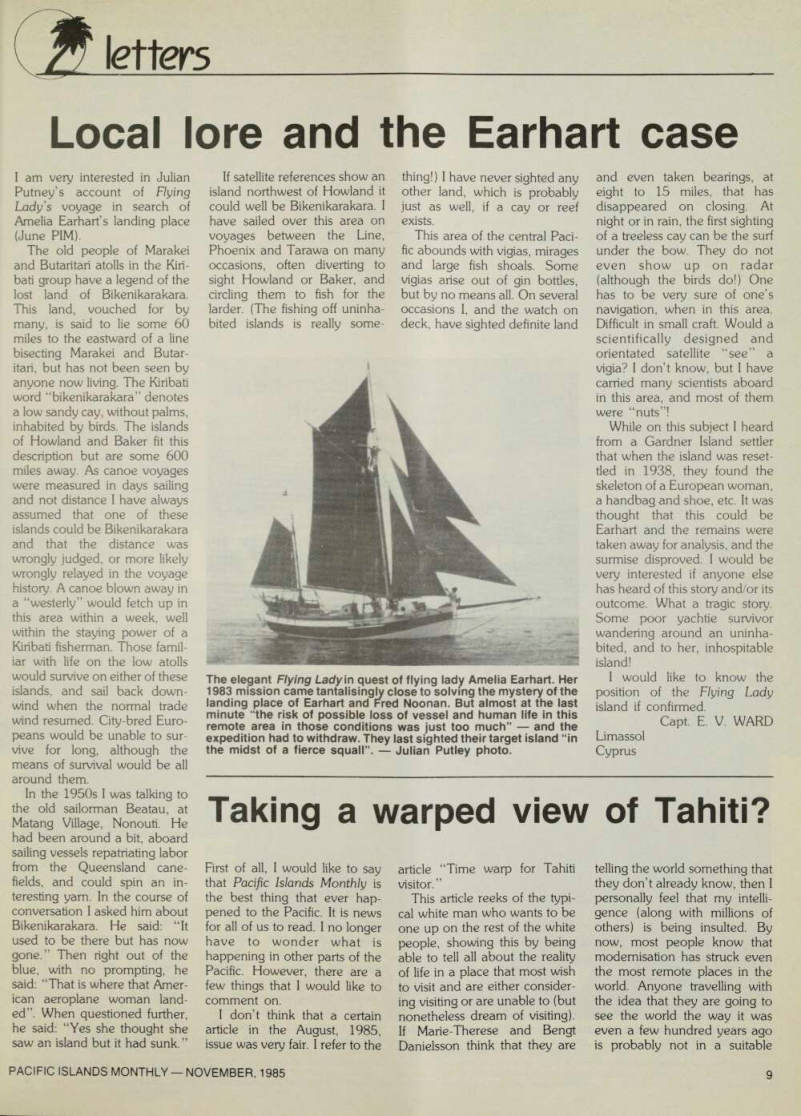
The elegant Flying Lady in quest of flying lady Amelia Earhart. Her 1983 mission came tantalisingly close to solving the mystery of the landing place of Earhart and Fred Noonan. But almost at the last minute “the risk of possible loss of vessel and human life in this remote area in those conditions was just too much” - and the expedition had to withdraw. They last sighted their target island “in the midst of a fierce squall”. - Julian Putley photo.
Taking a warped view of Tahiti?
First of all, I would like to say that Pacific Islands Monthly is the best thing that ever hap pened to the Pacific. It is news for all of us to read. I no longer have to wonder what is happening in other parts of the Pacific. However, there are a few things that I would like to comment on.
I don’t think that a certain article in the August, 1985, issue was very fair. I refer to the
article “Time warp for Tahiti visitor. ”
This article reeks of the typi cal white man who wants to be one up on the rest of the white people, showing this by being able to tell all about the reality of life in a place that most wish to visit and are either consider ing visiting or are unable to (but nonetheless dream of visiting).
If Marie-Therese and Bengt Danielsson think that they are
telling the world something that they don’t already know, then I personally feel that my intelli gence (along with millions of others) is being insulted. By now, most people know that modernisation has struck even the most remote places in the world. Anyone travelling with the idea that they are going to see the world the way it was even a few hundred years ago is probably not in a suitable
state to travel. And most people realise that in the name of tourism, people will tend to overstate the qualities that lure tourists and visitors to their countries.
I also strongly resent this blatant discrediting of Tahiti. I know it is outrageously expen sive. So is my home Hawaii.
Yet people (not necessarily naive ones, at that) are still flocking there year round. The fact is, there are hardly any places that one could label a tropical paradise in Hawaii any more, but it is up to the individual to decide what does and doesn’t appeal to them. I strongly feel that Marie-Therese and Bengt Danielsson are pushing their personal likes and dislikes on the readers, and what they say about what you should imagine if you are in old Tahiti may be just what they have found through research, but not necessarily what any one else would have found in
old Tahiti. Especially in view of the living conditions of the less fortunate people in Tahiti (of whom I hear there are many), I think that more constructive (though honest) articles could be written about a place which though modernisation has changed it somewhat, is still quite a paradise.
There is always the financial ly well-off Westerner who would like to buy with his money his own personal para dise on his own terms, and become a local person, and tries to show the rest of the world how much he has adapted. I hope, though I am sure they disagree with everything I have mentioned, that the Danielssons might give some thought to this.
I’ll never forget a few years back when a terrible hurricane hit Tahiti and Gabilou was appealing to us in Hawaii for help and he didn’t overstate
or understate anything. This kind of attitude should be shared by people writing articles in your magazine.
There are those of us who had our own experiences in Tahiti as well as other places, and have found what Marie- Therese and Bengt Danielsson have to say to be quite untrue as far as our own personal opinions are concerned. ( You see? Personal opinions).
Thank you for your time in reading this letter. In spite of the article, I am madly in love with Pacific Islands Monthly, as it has made me feel at home, no matter where I may be.
Gale Faataualofalele
Afasio
Suva Fiji
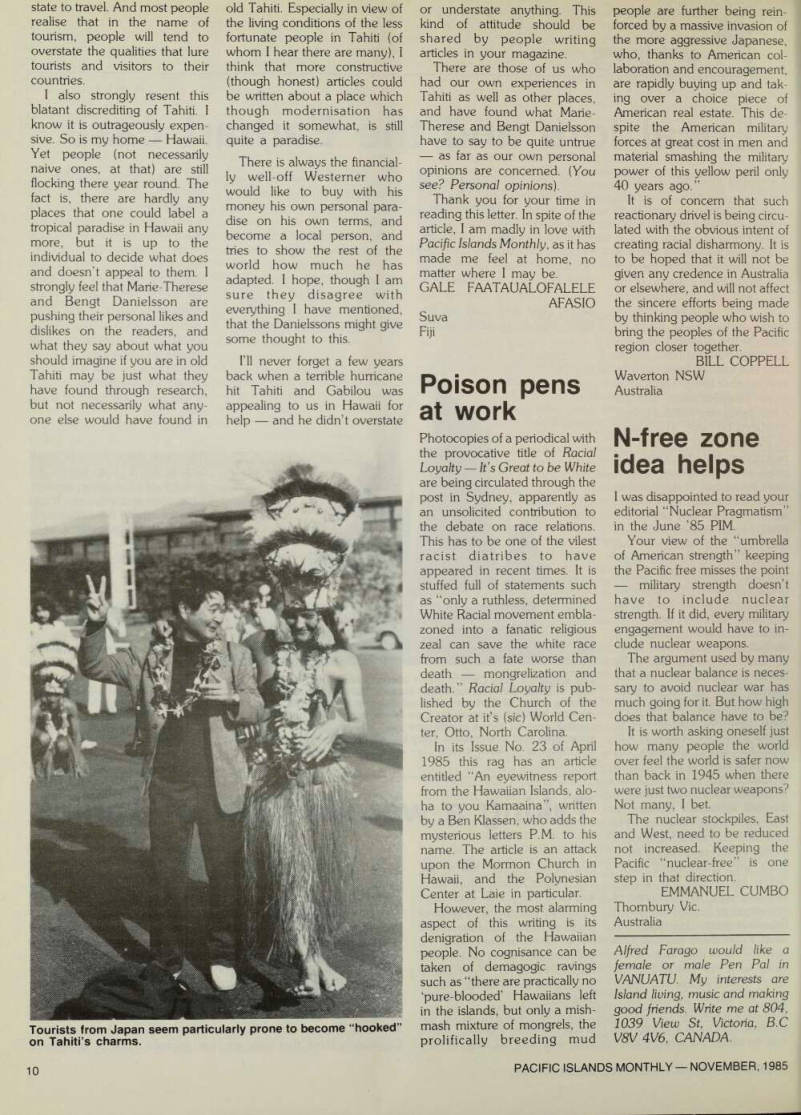
Tourists from Japan seem particularly prone to become “hooked” on Tahiti’s charms.
Poison pens
at work
Photocopies of a periodical with the provocative title of Racial Loyalty It’s Great to be White are being circulated through the post in Sydney, apparently as an unsolicited contribution to the debate on race relations.
This has to be one of the vilest racist diatribes to have appeared in recent times. It is stuffed full of statements such as “only a ruthless, determined White Racial movement embla zoned into a fanatic religious zeal can save the white race from such a fate worse than death mongrelization and death.” Racial Loyalty is pub lished by the Church of the Creator at it’s (sic) World Cen ter, Otto, North Carolina.
In its Issue No. 23 of April 1985 this rag has an article entitled “An eyewitness report from the Hawaiian Islands, alo ha to you Kamaaina”, written by a Ben Klassen, who adds the mysterious letters P.M. to his name. The article is an attack upon the Mormon Church in Hawaii, and the Polynesian Center at Laie in particular.
However, the most alarming aspect of this writing is its denigration of the Hawaiian people. No cognisance can be taken of demagogic ravings such as “there are practically no ‘pure-blooded’ Hawaiians left in the islands, but only a mish mash mixture of mongrels, the prolifically breeding mud
people are further being rein forced by a massive invasion of the more aggressive Japanese, who, thanks to American col laboration and encouragement, are rapidly buying up and tak ing over a choice piece of American real estate. This de spite the American military forces at great cost in men and material smashing the military power of this yellow peril only 40 years ago.”
It is of concern that such reactionary drivel is being circu lated with the obvious intent of creating racial disharmony. It is to be hoped that it will not be given any credence in Australia or elsewhere, and will not affect the sincere efforts being made by thinking people who wish to bring the peoples of the Pacific region closer together.
Bill Coppell
Waverton NSW
Australia
idea helps
N-free zone idea helps
I was disappointed to read your editorial “Nuclear Pragmatism” in the June ’B5 PIM.
Your view of the “umbrella of American strength” keeping the Pacific free misses the point military strength doesn’t have to include nuclear strength. If it did, every military engagement would have to in clude nuclear weapons.
The argument used by many that a nuclear balance is neces sary to avoid nuclear war has much going for it. But how high does that balance have to be?
It is worth asking oneself just how many people the world over feel the world is safer now than back in 1945 when there were just two nuclear weapons?
Not many, I bet.
The nuclear stockpiles, East and West, need to be reduced not increased. Keeping the Pacific “nuclear-free” is one step in that direction.
Emmanuel Gumbo
Thornbury Vic.
Australia
Alfred Farago would like a female or male Pen Pal in VANUATU. My interests are Island living, music and making good friends. Write me at 804, 1039 View St, Victoria, B.C
Vbv 4V6, Canada.
Advertisements & other items, pp. 11-14 (2 items)
Aiwa*
Every system in AlWA’s S.P.A.N. lineup delivers the dynamic impact and delicate sound expression of digital audio.
That’s because every system is equipped with AlWA’s DX-770 digital audio Compact Disc player. From the top-of-the-line V-1200 series to simple systems that please budgetminded music lovers.
And, synchro-recording from the CD player or any other source, wireless remote control, auto function selection, double speed dubbing from tape to tape, and programmable record, tape, and CD playback are just a few of the many features available in AlWA’s S.P.A.N. lineup. So why wait for the future in audio? Enjoy it today with AIWA. f
DIGITAL AUDIO
AIL SYSTEMS DIGITAL!
High-performance S.P.A.N. component system High-performance midi component system High-performance S.P.A.N. component system
mux
AIWA*
AIWA Australia Pty., Ltd 14 Gertrude St., Arncliffe. N.S.W. Australia 2205 AUSTRALIA PHONE: (597) 2388/Oceania Indent Agency (P.N.G.) Pty., Ltd Ago St., Gordon Box 5518, Boroko. Papua New Guinea PHONE: 256411/The Sound Centre Ltd P.O. Box 434 Port Vila, Vanuatu PHONE; 2035/P. Hargovlnd Bros 190 Renwick Road P.O. Box 490 Suva Fiji PHONE: 24350/Makanjee & Sons Limited P.O. box 91 Sigatoka Fiji PHONE; 50158/Milaw Trading Co., Ltd 224-236 Hobson Street, P.O. Box 5919, Auckland, New Zealand Phone; (09) 399-175/hifivox 79, rue de Sebastopol Noumea, New Caledonia PHONE; 27.24.66/Harvest Pacific Limited P.O. Box 517. Honiara. Solomon Islands PHONE; 131/Fare Hi-Fi Stereo Rue du Marechal Foch-P.O. Box 269, Papeete!
Tahiti Phone; 2-4814/Micropac Audio, Inc. P.O. Box 3478 Agana, Guam 96910 PHONE; 472-8091,472-8297/Rarotonga Duty Free Shop Private Bag P.O. Box 92. Rarotonga. Cook Island/Nauru Co-Operative Society Republic of Nauru
Page 12
VITAL WIN FOR KANAKS
...but will "fortress Noumea" open its doors?
The first stage of the French government’s plan for New Caledo nia’s independence has gone like clockwork.
As predicted, the elections of September 29 have given the F.L.N.K.S. legitimate control of three of the four new regions in the territory, the North, the Centre and the Islands. The fourth region of Greater Noumea remains the enclave of the loyalist French.
Polling day passed virtually without incident, much to everyone’s relief, despite a jit tery election lead-up which saw barricades again going up across the main inland roads and bomb attacks in Noumea.
The incident which created the most domestic headlines, and drew the attention of the international press, was a bomb blast in the capital in the final days of the campaign. This devastated the Land Office and the Office for the Development of the Interior and the Islands.
Police say the explosive was the most powerful used in any bomb attack in the territory since the troubles began last November.
No-one has claimed re-
After shooting themselves in both feet over the ’’Rainbow Warrior” affair, and running into renewed international opposition to their nuclear testing program at Moruroa, fuelled by indignation over President Mitterrand’s visit to the atoll, the French have finally done something right ... the territorial elections in New Caledonia. Anti-Mitterrand political elements in France have done their best to bolster loyalist resolve in the islands, and a peaceful transition to independence remains very much at risk but, as SUE WILLIAMS reports from Noumea, the vital framework may now be in place for sensible negotiation by both sides.
sponsibility, however the motivation behind the attack was obviously political. The Land Office is responsible for buying back land for the Kanak people while the development office is responsible for promot ing growth outside Noumea, particularly Kanak projects.
The campaign also saw a massive effort by the right-wing parties, the R.P.C.R. and the Front National, to maintain control with visits to the territory by French Opposition heavy weights, Jacques Chirac, presi
dent of the R.P.R., Francois Leotard, secretary-general of the Republican Party, and Jean-Marie Le Pen, head of the Front National, along with a host of deputies from the French parliament and even the president of French Polynesia, Gaston Flosse.
All played on the fervent patriotism of the loyalist French in New Caledonia, urging them to ’’continue your resistance” and to hold out for just another six months until the legislative elections are held in France next March. After that, said the visiting politicians, the faithful French in the territory would be rewarded by the new, right wing, government in Paris which would ’’respect the wishes of the overwhelming majority to keep the Tricolor flying over our Pacific territory. ”
The French polls could cer tainly pose a problem for the F.L.N.K.S. It has now become clear that if the right wins power, as is very much on the cards, one of its first moves could be to hold a referendum on the independence question with a very clear-cut question: ”Do you want to stay French?”
Under the guidelines prop osed by the Opposition leaders the F.L.N.K.S. would clearly lose as is shown by a break down of the votes for the regional New Caledonia elec tion of September 29. Even though the F.L.N.K.S. has won control of three of the four regions, the anti-independence parties, the R.P.C.R. and the Front National, polled by far the biggest vote — 61 per cent, compared with 34.8 per cent polled by the independence parties, the F.L.N.K.S. and
L.K.S.
Consequently the loyalist parties also have a 12-seat majority in the new 46-seat Territorial Congress. However, this does not detract from the F.L.N.K.S. victory as most of these seats are in Noumea and the Congress is being seen as nothing more than a paper tiger, with all of the major decisions on the territory being made in Paris.
In the final break-down the R.P.C.R. has won 17 seats in Noumea, the Front National three and the F.L.N.K.S. one.
In the Northern region the R.P.C.R. holds two seats, its
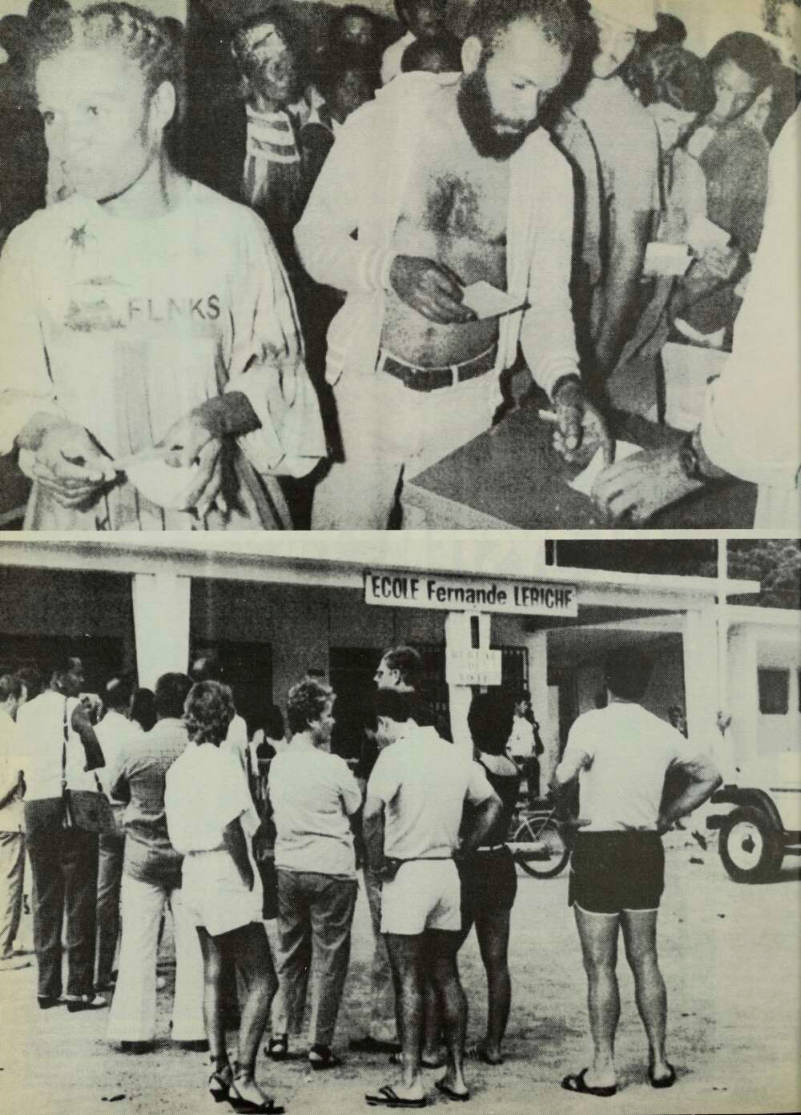
Facing page: The “two sides of the argument” in New Caledonia pro and anti-independence - are well expressed in these two pictures. Top: Melanesians, in the east coast mining town of Thio, vote in the September 29 elections - needless to say, the FLNKS swept the poll. Below: French residents wait outside a school-cum polling-booth in a middle-class area of Noumea to cast their votes - the anti-independence RPCR party romped in in the capital. AAP photos.
brother party, the R.P.C. has one seat and the F.L.N.K.S. six.
The Centre region, which was the most hotly-contested, sees the F.L.N.K.S. with five seats, and the R.P.C.R. with four.
In the Loyalty Islands the F.L.N.K.S. has four seats, the L.K.S. one and the R.P.C.R. two seats.
The result clearly shows the polarisation of the population on the independence question.
Those parties such as the L.K.S. and Caledonie Nouvel le, which had been promoting a middle line have been effective ly smashed in the result.
The contradiction between the most popular overall party (the R.P.C.R.), and the group
which will have overall control of the new Congress (F.L.N.K.S.), has stung the loyalists. The local newspaper, Les Nouuelles, speaking of the result the day after the poll, dubbed it ’’the birth of a monster”.
R.P.C.R. president, Jacques Lafleur, warned that Edgard Pisani, the French minister in charge of New Caledonia, and principal author of the inde pendence plan, did not realise the consequences of his action.
He pointed out that two-thirds of the inhabitants had voted for France. These people, he said, should ’’hold on to their cour age and hope.”
As for the F.L.N.K.S., their leader, Jean-Marie Tjibaou, is happy, convinced that 80 per
cent of the Kanak people have now shown their desire for independence.
Mr Tjibaou has reason for his satisfaction. In winning the three regions his people have also effectively won control of much of the territory’s wealth the nickel and prime agricultu ral land in the north and the centre, and Noumea’s vital power and water supply, also based in the centre.
This is exactly according to the French government’s plan.
During Edgard Pisani’s reign in New Caledonia as High Com missioner and special envoy of the French government, he stressed that one of his main goals was to break the strangle hold the people of Noumea had over the territory’s riches - to
share the wealth.
This election result allows that to happen. Fortress Noumea will have to negotiate and recognise the F.L.N.K.S. as a legitimate political power.
Likewise the F.L.N.K.S. will need to deal with the business leaders and entrepreneurial re sources of Noumea.
In fact one of the most important opportunities this election result presents, once the rhetoric has died, could be that it finally brings both sides of the independence argument to the negotiating table and starts the difficult task of healing the bitter rift between them caused by several years of uncertainty and more recently violence throughout the territory. Sue Williams, in Noumea.
the 'Rainbow Warrior' onion

Peeling more skins from the 'Rainbow Warrior' onion
For the French govern ment of President Fran cois Mitterrand, the Pacific has become a sort of watery equivalent of Napoleon’s Moscow, and may yet be its Waterloo.
On the one hand Paris faces the further ignominy this month of what is bound to become something of an international ’’show trial” of its two secret service agents charged in New Zealand with murder, arson and the sabotage bombing of the Greenpeace ship Rainbow Warrior.
On the other hand there is the festering sore of New Cale donia and the burgeoning cam paign of the Kanaks for their independence from colonial rule. The Mitterrand govern ment had won points for its handling of that problem, but not at home where the votes are.
Few ordinary Frenchmen, berets akimbo, sucking on their
As the judge, jury, lawyers and the world’s press settle for the trial, in Auckland, of two French spies charged with sabotaging the Greenpeace ship Rainbow Warrior speculation grows that the govern ment of President Francois Mitterrand will founder upon a distant, palm-fringed, Pacific shore. For not only is his government on the defensive over the Greenpeace scandal, but it is under siege by French conservative politicians condemning the Socialists’ ’’betrayal of French patriots” in New Caledonia. The first round in Noumea is over, with others still to come. But there is no interim peace for Mitterrand.
French credibility hangs by a thread from the Greenpeace affair.
forthcoming French metropoli tan elections. (See Sue Wil liams’s report, this issue).
Mitterrand is being accused by his Republican party and Front National opponents of having “betrayed” stalwart Frenchmen living in what is legally, if illogically, a part of France.
Gitanes and complaining about the price of uin ordinaire could probably care a jot about New Caledonia. And yet the right wing of French politics, in hot pursuit of what blood has not already leaked from Mitter rand’s sorely-battered govern ment, has gone far towards making it a central issue for the
In fact, and despite the furore stirred by Jacques Chirac and Jean-Marie Le Pen, and their supporters, the result of the territorial assembly election in New Caledonia looked to be one of the few things which had gone right for President Mitter rand in recent months. It was no more than a good start, for opposition would undoubtedly grow, regardless of the true logic on the ground.
But, even with the election successfully, and fairly peacefully, completed, there can be no respite. The Green peace trial looms, and French reputation, in the hands of Mitterrand, is very much on the line.
Confronting this embattled modern-day Napoleon, New Zealand’s prime minister, David Lange, also a socialist, makes an unlikely sort of Iron Duke, although he lives in Wellington.
Yet there is obviously plenty of iron in his soul over the Green peace bombing. Despite attempts, albeit half-hearted, to persuade him that the trial of the individual agents should not go ahead now that the Defence ministry in Paris has admitted ordering the attack, he remains
utterly determined to rub French noses in the merde.
That he aims to do thoroughly, but, of course, with dignity and the full weight of British-type justice. Indeed, it might be that last bit which hurts the French most of all. That, and the fact that the rest of the world seems to agree with Lange, the angry bumble-bee so far away in a land which, up to this point, the French had always viewed with considerable disdain.
Auckland police, whose masterly piece of steady, methodical detective work led to the capture of the hapless agents on July 12, (see PIM, October), say that they have more than 200 witnesses and 1000 pieces of evidence. It should be quite a trial.
Meantime, the damage wrought both inside and out side France is considerable.
The Rainbow Warrior bom bing gave Greenpeace enor mous publicity - far more than it would have managed from the confrontation it originally sought with the French navy at Moruroa and continued to in vite with its enlarged, post bombing, flotilla.
Greenpeace was, of course, only one of several matters over which nations had swung angri ly against the French.
On September 25 Australian prime minister, Bob Hawke, threw his gauntlet into several faces by not only reiterating his government’s displeasure over continued nuclear testing at Moruroa,but challenging the U.S. to join the condemnation of French actions inthe South Pacific. ”It does seem to me to be a matter of logic that, if the U.S. does not express its concern about ... the French, then there will be a reaction of disappoint ment amongst South Pacific countries,” Mr Hawke said.
This statement followed by only a few hours the particularly tough speech in New York by Australian ambassador, Raw don Dalrymple, in which he warned the U.S.: ”If you want the South Pacific to become an
area where the Soviet Union, Cuba and others of that stripe can find fertile ground for anti- United States, anti-West prop aganda and activity and in which they can develop activi ties directly prejudicial to our interest, then continue with a policy of indifference to what the French are doing there.” ’’Continued French use of Moruroa atoll for nuclear testing is absolutely certain to prejudice the South Pacific people against the West against the United States and Australian interests in a way that will quite possibly prove very costly. ”1 would urge you to use your enormous influence to persuade the French to stop nuclear testing in the South Pacific. ”1 think the future of your relationship with France can withstand the pressures of such a policy but I am not sure ...that the future of your relationship with the South Pacific can be assured if you turn a deaf ear to their concerns.”
While the ambassador’s speech was apparently not cleared with Canberra there has been no criticism of it in Austra lia and definite support of it by prime minister Hawke. It all added up to the strongest public criticism Australia has so far made of U.S. policy in the Pacific. So far, the Reagan administration has seemed a good deal less than moved.
Criticism of the French has been weak, and some influen tial people have even defended both the nuclear testing and the sabotage of Rainbow Warrior.
A U.S. State Department spokesman carefully conceded that America was ’’aware” of Australian concern, but said France had an independent nuclear force and the testing was a matter for French deci sion. The U.S. ’’noted” French statements that underground testing was ’’essential to the modernisation of the French nuclear deterrent,” the spokes man said. Australia was official
continued on page 29
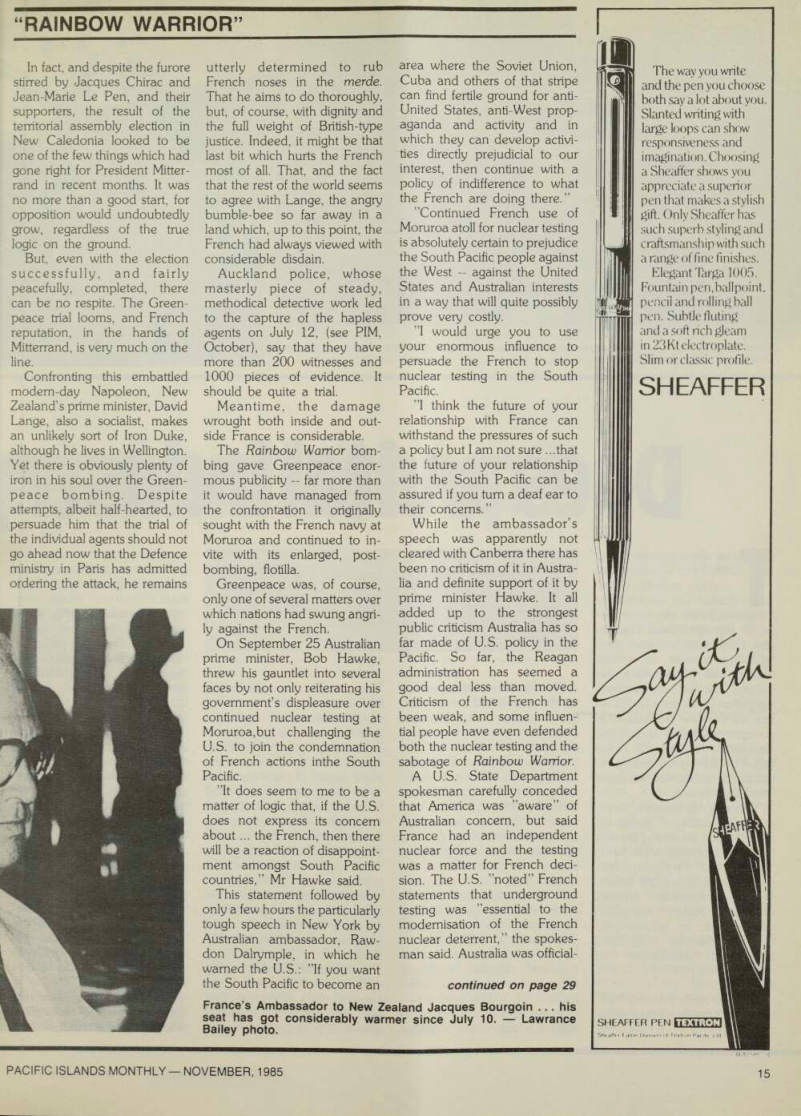
France’s Ambassador to New Zealand Jacques Bourgoin ... his seat has got considerably warmer since July 10. - Lawrance Bailey photo.
ly snubbed.
U.S. reaction on the Green peace affair was also luke warm, possibly because of Washington’s annoyance with New Zealand over the nuclear ships and ANZUS row, but also, it appeared to most observers, because it was determined not to be critical of France, even over a piece of state-sponsored terrorism which, normally, in the case of Europe, Africa, or the Middle East it is swift to condemn.
Former U.S. ambassador to the U.N., Jeane Kirkpatrick, went astonishingly further by asserting in public interviews that there was ”an important difference” between internatio nal terrorism and the sabotage of the Rainbow Warrior.
Thus, nobody seriously ex pects even their present acute embarrassment to persuade the French to give up their nuclear testing program on Moruroa, at least not in the immediate fu ture. Rather, their determina tion is likely to increase, says David Lange. The protests of Australia and New Zealand had simply entrenched the French to the point where ’’they will continue their tests, even if there is no strategic, scientific or military imperative for them,” he said.
Indeed, it is not opposition to the testing which is causing their present embarrassment, but rather the fact that, by the Greenpeace bombing, they have been made to look arro gant, and inept to the point of stupidity. The idiotic Inspector Clouseau is seen to be alive and well and running things in Paris.
France’s allies have been made to wonder about her judgment.
Her enemies have been given comfort.
Even the normally pro-estab lishment Paris newspaper, Le Monde, was moved to warn that the Mitterrand government was losing credibility over the Greenpeace affair. ’’French in fluence is directly at stake,” said the paper.
The big crack in the Mitter rand facade came with the resignation on September 20, of the Minister of Defence, Mr
Charles Hernu, and the sacking of Admiral Pierre Lacoste from his post as director of the French external espionage service, the DGSE. Hernu, who had run French defence affairs since 1981 was replaced by Paul Quiles (pronounced Key less), whose nickname in the Socialist Party is ’’Robespaul,” (piquantly adding to the Napoleonic flavor of it all). This is a reference to the infamous Robespierre, the French re volutionary responsible for the terror of 1793 and 1794 in which thousands of ’’enemies of the people” were executed.
Mr Quiles won his ’’Robes paul” sobriquet when, at the Socialist Party Congress of 1981 he called for ’’heads to roll” in a purge of civil servants who were, in his eyes, impeding implementation of socialist programs.
Quiles is 43, the son of a former artillery officer, was him self a paratrooper and remains a captain in the air force re serve. He is thus believed to have more in common with the military than the bureaucrats and is expected to make a tough defence minister. Green peace should expect firm re sponse to their efforts. ’’When I make a decision I see it through,” he said in a recent interview.
One of his first decisions was to close the Instruction Centre for Underwater Combat Swim mers at Aspretto, Corsica, the school at which the DGSE teams trained for their attack upon Rainbow Warrior.
Heads have also rolled in the DGSE. Admiral Lacoste has been replaced as director by the tough General Rene Imbot, formerly chief of staff of the
French army. He moved swiftly to ’’stop the rot” of political infighting inside the agency.
Within hours of Imbot’s appointment four French sol diers, a colonel, a captain and two senior n.c.o.’s, had been arrested for leaking secrets of the Greenpeace affair to the Paris press.
The colonel, Joseph Fourrier, was deputy head of DGSE counter-espionage. The cap tain, Alain Bourasse, was said to be the man who leaked to Le Monde details of a third team of frogmen in Auckland and the allegation that it was they who planted the limpet mines on Rainbow IVarrior.The Le Monde story led to the resigna tion of defence minister Hemu.
General Imbot is said still to be seeking a fifth man whom he wishes to question about leaks to the press.
This man, Captain Paul Bar ril, was formerly head of the National Gendarmerie In tervention Group (GIGN), a crack anti-terrorist unit. He had become a sort of James Bond figure in the popular French press until he was in effect dismissed in 1983.
Barril had been seconded from the GIGN to a special anti-terrorist co-ordination office at the presidential Elysee Palace in Paris. This unit was dissolved after a series of politi cal scandals and conflicts be tween the Defence and Interior ministries. Barril was caught in the middle of the fight and suspended at his own request.
The GIGN also made the news in the Pacific earlier this year when one of its marksmen shot and killed the militant Kanak leader Eloi Machoro during an F.L.N.K.S. siege in
The victim vessel Rainbow Warrior. .. the name will not go away
New Caledonia.
By implication there is much still to embarrass the French in the Auckland trial, set to begin on November 4, of DGSE agents Captain Dominique Prieur and Major Alain Mafart.
Indeed the flames of French ire have licked even at Presi dent Mitterrand himself, and his prime minister, Laurent Fabius.
At the end of September the French newspaper, Le Figaro said president Mitterrand ’’knew about the involvement of French agents,” knew that his defence minister, Hemu, had ordered the Rainbow War rior to be ’’neutralised,” and knew that the equivalent of US$6OO,OOO had been granted from secret funds administered by the office of prime minister Fabius. All of this was conveyed to the president by the prime minister on July 17, said the newspaper.
This was after the bombing had occurred, but well before
the French government stop ped denying any knowledge of the affair.
As late as September 27 Fabius was saying in television interviews that it was Septem ber 21 before he learned the truth of official French involve ment.
On October 1 the indepen dent French news magazine Le Point ran a story linking senior aides of President Mitterrand with the Rainbow Warrior bom bing. The article said that three of the president’s senior people met with the then DGSE chief, Admiral Lacoste, several weeks before the July 10 bombing in Auckland harbor.
The magazine said the meet ing took place about mid-May in the office in the Elysee Palace of the president’s secretary generakl, Jean-Louis Bianco, and was attended by diplomatic adviser, Hubert Vedrine and military counsellor, General Jean Saulnier. Admiral Lacoste
allegedly told them he had an agent inside the Greenpeace organisation. This operative, Christine Gabon, had described the extent of the confrontation Greenpeace planned. ”It was decided then to study measures appropriate to the new situation,” said Le Point.
Several French, British and other newspapers had run stories linking French official dom with the planning of the sabotage ... indeed several re ported that Defence Minister Hemu had angrily ordered that Rainbow Warrior be ’’neutral ised” and it was this which the over-reacting DGSE had inter preted as a clearance for a bombing.
But Le Point’s story was the first alleging that the presi dential office was in on this planning.
Nobody knows how accurate these stories might be, but there is a growing body of opinion that while some French minis
ters and bureaucrats were un doubtedly guilty of plotting the destruction of Rainbow War rior, much of the continuing furore may be aimed more at undermining President Mitter rand than at digging out the truth.
The French government con tinued to limit official comment on the affair.lt has admitted that DGSE agents planted the bombs which ripped the Rain bow Warrior’s hull and killed the Greenpeace photographer, Fernando Pereira. Prime Minis ter Fabius hoj blamed Charles Hemu and Admiral Lacoste for ordering the attack. But that is as far as the government will go. They say the matter is closed. But, in the intensity of French politics in the lead-up to the next elections, very obvious efforts are being made to keep the debate going, assisted, in evitably, by the spies’ trial in
Auckland this month.
Staff
Writer.
Advertisements & other items, p. 15 (1 item)
Sheaffer
The way you write and the pen you choose both say a lot about you.
Slanted writing with large loops can show responsiveness and imagination. Choosing a Sheaffer shows you appreciate a superior pen that makes a stylish gift. Only Sheaffer has such superb styling and craftsmanship with such a range of fine finishes.
Elegant lOO5.
Fountain pen, ballpoint, pencil and rolling ball pen. Subtle fluting and a soft rich gleam in 23 Kt electroplate.
Slim or classic profile.
SHEAFFER
SHEAFFER PEN
Does a vital industry need a shake-up?
Dr NORMAN DOUGLAS attended the 1985 Fiji Tourism Convention. In this article he takes a hard look at tourism in Fiji, and offers ideas on possible ways out of its present difficulties.
The signs heralding the 1985 Fiji Tourism Con vention were not auspi cious. The week before the event Jonati Mavoa, minis ter for Foreign Affairs, Tourism and Civil Aviation, had died, following injuries in a fall.
Mavoa had been widely re garded as an enthusiastic supporter of tourism in Fiji one of the few enthusiasts in government, it was said. A few days later, the daily Fiji Times and Fiji Sun gave failings in tourism’s consumer relations front-page priority.
“Rip-offs hit tourism; com plaints increasing ...” headlined the Fiji Sun , informing readers that more tourists were being “mistreated” by duty-free dealers and handicraft sellers.
The 49 complainants referred to probably received scant con solation from an assurance by the Fiji National Duty Free Merchants Association that such complaints were “normal”.
“Are we really Friendly Fiji?” wondered the Sun’s brief edito rial.
The Fiji Times left its assault for the morning of the conven tion’s opening. “FVB Hears of Profiteering,” it heralded, elevating a report by the bureau’s Sydney marketing manager, Bill Whiting, to head line status. Whiting had in formed a meeting in Suva, with some justification, that visitors to Fiji were complaining about the high cost of food and poor rate of exchange offered by hotels. FVB board members, John Birch, president of the Fiji Hotel Association, and Mahen dra Patel, Fiji’s leading duty free merchant, neither of whom evidently eats or cashes travellers’ cheques at hotels, expressed surprise, even disbe lief.
In the light of these happen ings, the convention’s theme:
’’We’re out to win you over” had more of the sound of struggle than may have been intended, and its location - Suva’s big, but bleak, Civic Auditorium hardly invited the same degree of warm response from delegates as many pre vious convention venues at re sort hotels, where the bar and the pool were only seconds away. Convention regulars were quick to admit that it seemed a much more sober, constrained, serious affair than usual; some went so far as to suggest it was symptomatic of a low point, even a malaise, in Fiji tourism.
If this is so, what is wrong with Fiji’s first (or second, de pending upon whose account you read and what additional arithmetic is required), revenue
earner?
There are some quick and obvious responses to this ques tion: The weather. Fiji, where according to most of its publicity, the sun smiles as habitually as do the people, has experienced nine cyclones in the past five years - four of them in the first few months of 1985.
The shortage, say tourism entrepreneurs, of ’’international standard” hotel rooms an estimated 500 more per year until 1990 are needed to boost declining visitor numbers and enhance the package tour mar ket, they say.
The absence, say some guarded critics, of a real com mitment on the part of the government to tourism and a tourism policy. ’’You know,” one leading hotelier told me, ’’the prime minister has only once mentioned tourism publicly, and that was to criti cise it.”
The dubious value, say some promoters, of recommen ding places like Nadi with its
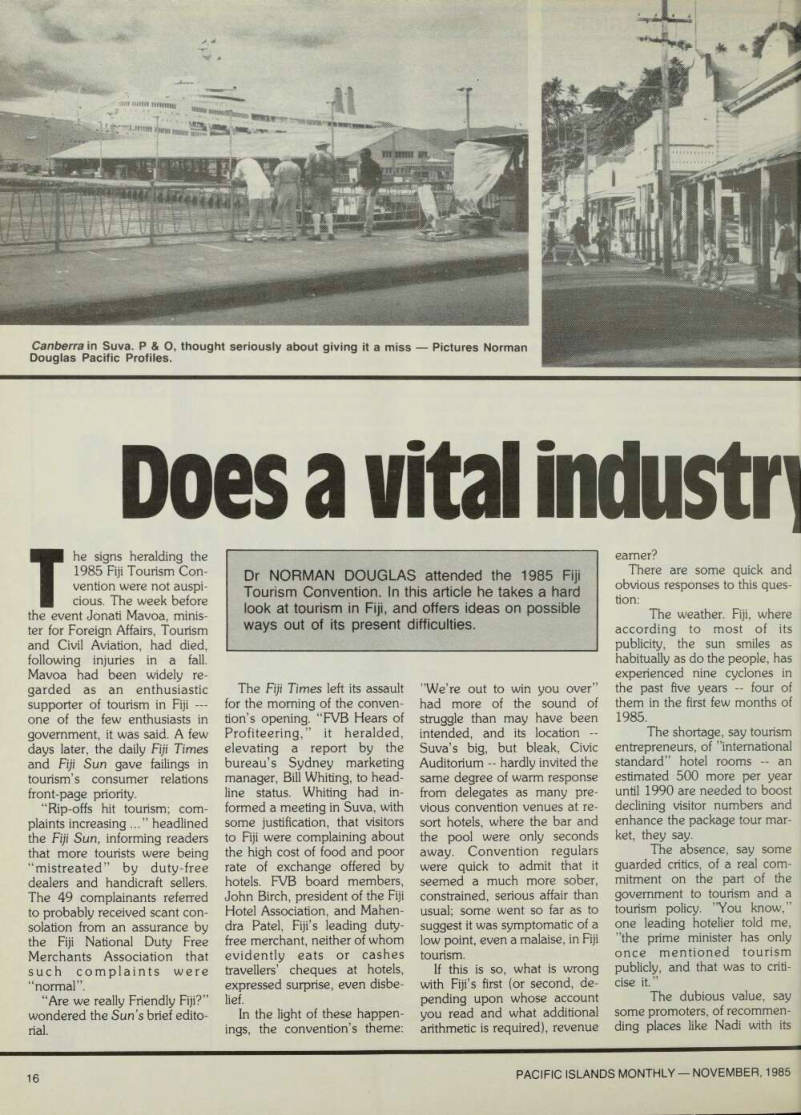
Canberra in Suva. P & O, thought seriously about giving it a miss Pictures Norman Douglas Pacific Profiles.
predatory duty-free salesmen, or Suva with its intimidating sword-sellers (’’what’s your name, mate?”), to tourists seeking a ’’new cultural expertence.”
The decline of the Australian dollar, says everyone, which effectively means (at least in mid-1985), that visitors from Fiji’s largest market are paying between 20 per cent and 30 per cent more for every good or service that they buy, depending, of course, upon both daily fluctuations in the floating Australian currency, and where the luckless tourist cashes his money.
Whatever the reasons, and there are more than these, visitor numbers are down. May and June of this year saw, respectively 2000 and 1786 fewer visitors than those months in 1984 - and 1984 had given much ground for optimism. Visitor figures, over 235,000 for the year, had suggested that the quarter million mark might soon be achieved, Perhaps it might, but not yet: visitor numbers for the first
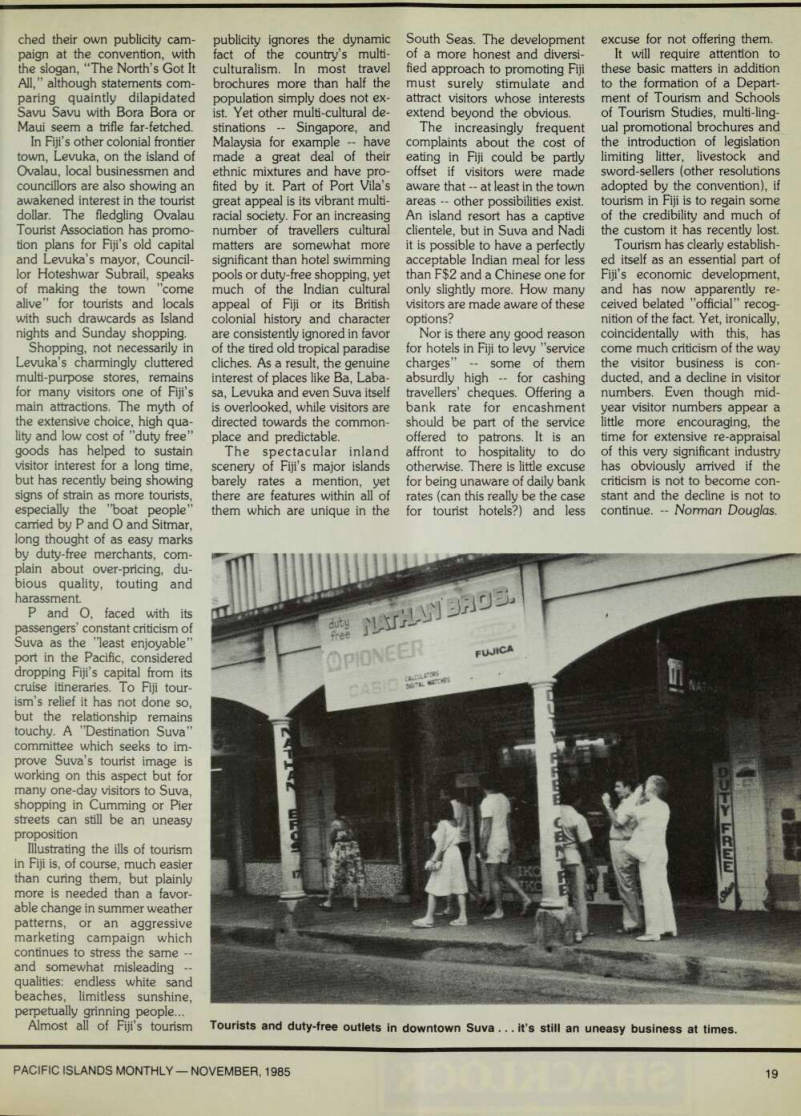
quarter of 1985 were lower than for any period since early 1983 the time of Cyclone Oscar low enough for the usually intractable airlines to introduce a special limited sea son fare of SA3SO from Sydney to Nadi and return. This was probably the best of indications that all was not well, The cyclone factor in Fiji tourism is indisputable, additio nal evidence for the cynics who claim that an economy which gives prominence to such an erratic industry is bound to be precarious, but no less bistres sing for that. The locations of Fiji’s major resorts - the Coral Coast, Nadi and the Mananu cas are both their strength and their weakness. In the latter area several resorts were obliged to close for repairs after extensive damage early this year, and those that didn’t probably should have. Some months after the last cyclone, Hina, had passed over Cast away Island, one resort which remained open, the place still looked like a disaster area, with two large piles of debris iden
tifying the limits of the beach and another greeting visitors at their landing point. Untidiness and wear were evident throughout the resort’s facilities. ’’What a dump,” observed one disappointed tourist. ’’The only thing that’s not run down here is the price.”
The plight of the resorts has been exacerbated by the in creasing reluctance of in ternational insurance com panies to involve themselves in underwriting all too frequent disasters (see PIM, May, 1985), and the tendency of overseas media (read Australian in this case), to report only the worst news. A benevolent Providence would be the most valuable asset to Fiji tourism over the next few years, but industry people are of the view that more vigorous promotion of the ’’look, we’re still going strong” kind should be mounted in the wake of every cyclone to offset the adverse reports. The FVB’s Bill Whiting puts especially strong emphasis on the import ance of such publicity, and with Australia low value currency
or not still providing up to 40 per cent of Fiji’s tourists it’s hard not to agree.
Most sections of the industry also agree on the urgent need for more (and more, and more) hotel rooms. At the Suva con vention this issue was particu larly addressed by the bureau’s research consultant, Alastair Mclntyre, a man whose vocabulary consists almost ex clusively of statistics.
For the “more rooms the more tourists” enthusiasts the most heartening sign for some years was the ceremonial ground-breaking in late June at the site of the proposed Sher aton Fiji hotel, a $3O million, 300-room complex on Denarau Island which also houses the Regent of Fiji. Few people were happier about it than the Tui Nadi, Senator Ratu Napolioni Dawai, who, by virtue of his connection with the land for both hotels has probably bene fited more from tourism than most Fijians, though Ratu Napolioni was quick to point out that such development was good for Fiji as a whole.
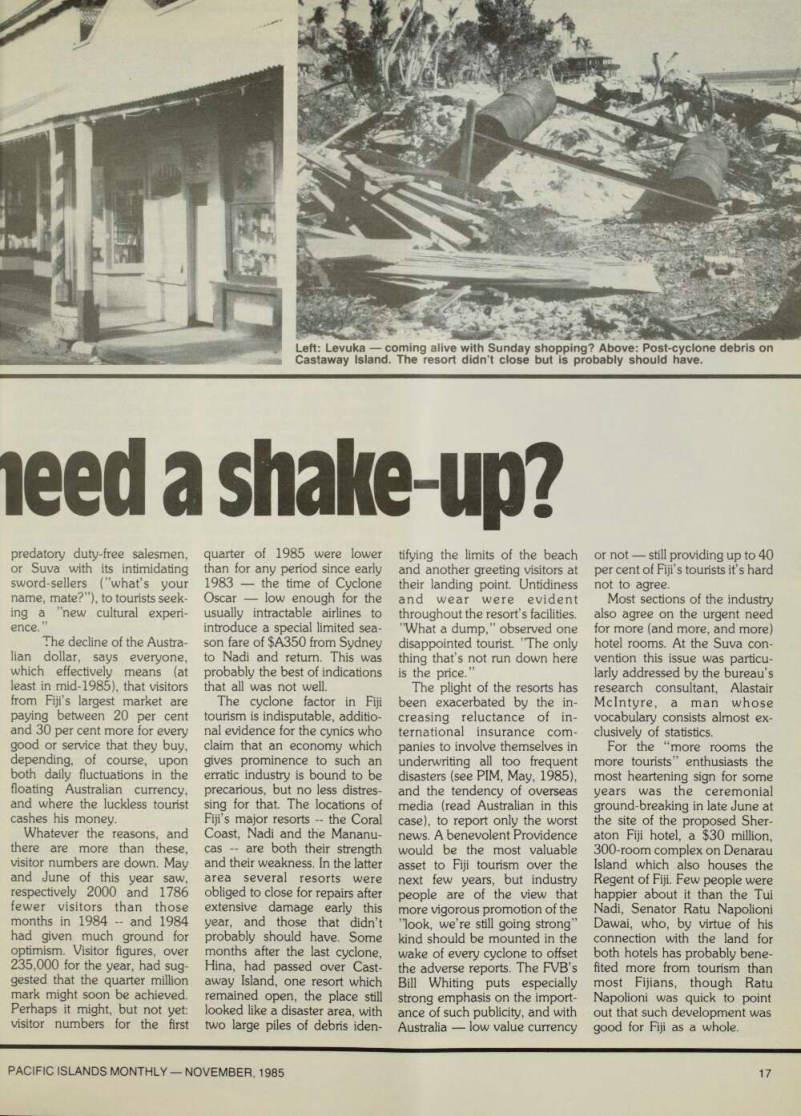
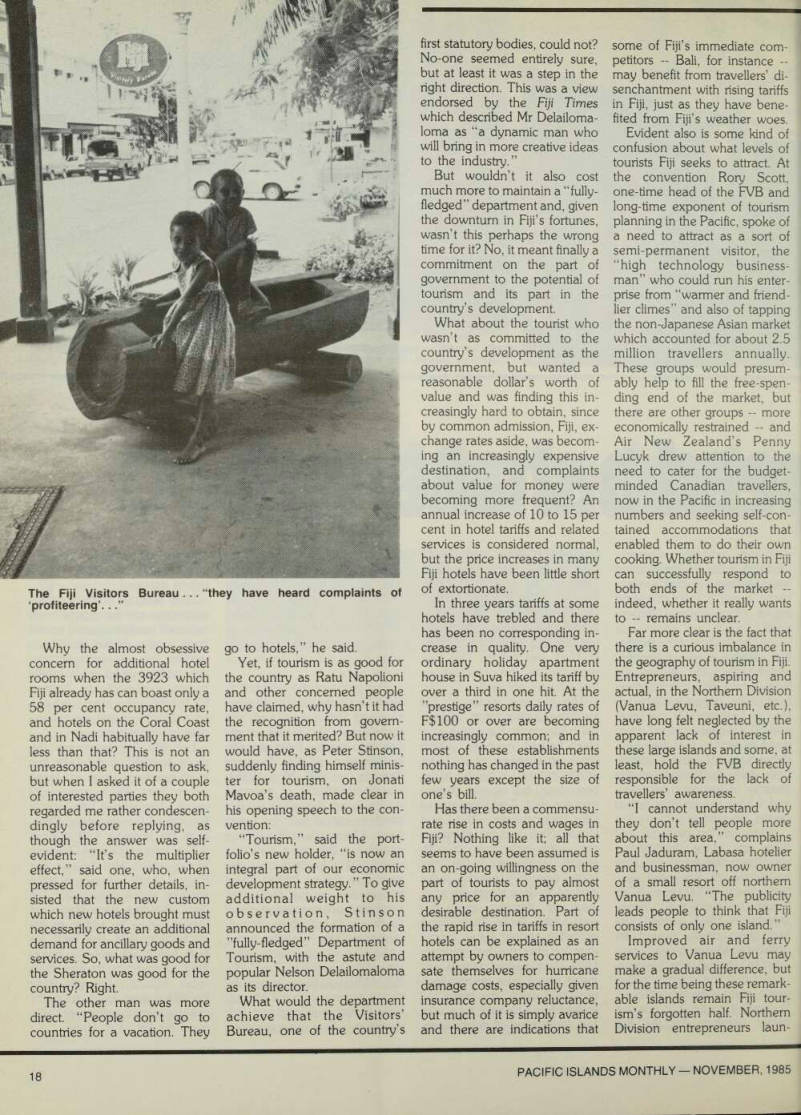
Left: Levuka - coming alive with Sunday shopping? Above: Post-cyclone debris on Castaway Island. The resort didn’t close but is probably should have.
Why the almost obsessive concern for additional hotel rooms when the 3923 which Fiji already has can boast only a 58 per cent occupancy rate, and hotels on the Coral Coast and in Nadi habitually have far less than that? This is not an unreasonable question to ask, but when I asked it of a couple of interested parties they both regarded me rather condescendingly before replying, as though the answer was selfevident: “It’s the multiplier effect,” said one, who, when pressed for further details, insisted that the new custom which new hotels brought must necessarily create an additional demand for ancillary goods and services. So, what was good for the Sheraton was good for the country? Right.
The other man was more direct. “People don’t go to countries for a vacation. They
go to hotels,” he said, Yet, if tourism is as good for the country as Ratu Napolioni and other concerned people have claimed, why hasn’t it had the recognition from govern ment that it merited? But now it would have, as Peter Stinson, suddenly finding himself minis ter for tourism, on Jonati Mavoa’s death, made clear in his opening speech to the con vention: “Tourism,” said the port folio’s new holder, “is now an integral part of our economic development strategy. ” To give additional weight to his observation, Stinson announced the formation of a ’’fully-fledged” Department of Tourism, with the astute and popular Nelson Delailomaloma as its director.
What would the department achieve that the Visitors’
Bureau, one of the country’s
first statutory bodies, could not?
No-one seemed entirely sure, but at least it was a step in the right direction. This was a view endorsed by the Fiji Times which described Mr Delailoma loma as “a dynamic man who will bring in more creative ideas to the industry.”
But wouldn’t it also cost much more to maintain a “fully fledged” department and, given the downturn in Fiji’s fortunes, wasn’t this perhaps the wrong time for it? No, it meant finally a commitment on the part of government to the potential of tourism and its part in the country’s development.
What about the tourist who wasn’t as committed to the country’s development as the government, but wanted a reasonable dollar’s worth of value and was finding this in creasingly hard to obtain, since by common admission, Fiji, ex change rates aside, was becom ing an increasingly expensive destination, and complaints about value for money were becoming more frequent? An annual increase of 10 to 15 per cent in hotel tariffs and related services is considered normal, but the price increases in many Fiji hotels have been little short of extortionate.
In three years tariffs at some hotels have trebled and there has been no corresponding in crease in quality. One very ordinary holiday apartment house in Suva hiked its tariff by over a third in one hit. At the ’’prestige” resorts daily rates of Fsloo or over are becoming increasingly common; and in most of these establishments nothing has changed in the past few years except the size of one’s bill.
Has there been a commensu rate rise in costs and wages in Fiji? Nothing like it; all that seems to have been assumed is an on-going willingness on the part of tourists to pay almost any price for an apparently desirable destination. Part of the rapid rise in tariffs in resort hotels can be explained as an attempt by owners to compen sate themselves for hurricane damage costs, especially given insurance company reluctance, but much of it is simply avarice and there are indications that
some of Fiji’s immediate com petitors - Bali, for instance may benefit from travellers’ di senchantment with rising tariffs in Fiji, just as they have bene fited from Fiji’s weather woes.
Evident also is some kind of confusion about what levels of tourists Fiji seeks to attract. At the convention Rory Scott, one-time head of the FVB and long-time exponent of tourism planning in the Pacific, spoke of a need to attract as a sort of semi-permanent visitor, the “high technology business man” who could run his enter prise from “warmer and friend lier climes” and also of tapping the non-Japanese Asian market which accounted for about 2.5 million travellers annually.
These groups would presum ably help to fill the free-spen ding end of the market, but there are other groups - more economically restrained - and Air New Zealand’s Penny Lucyk drew attention to the need to cater for the budget minded Canadian travellers, now in the Pacific in increasing numbers and seeking self-con tained accommodations that enabled them to do their own cooking. Whether tourism in Fiji can successfully respond to both ends of the market indeed, whether it really wants to - remains unclear.
Far more clear is the fact that there is a curious imbalance in the geography of tourism in Fiji.
Entrepreneurs, aspiring and actual, in the Northern Division (Vanua Levu, Taveuni, etc.), have long felt neglected by the apparent lack of interest in these large islands and some, at least, hold the FVB directly responsible for the lack of travellers’ awareness.
“I cannot understand why they don’t tell people more about this area,” complains Paul Jaduram, Labasa hotelier and businessman, now owner of a small resort off northern Vanua Levu. “The publicity leads people to think that Fiji consists of only one island.”
Improved air and ferry services to Vanua Levu may make a gradual difference, but for the time being these remark able islands remain Fiji tour ism’s forgotten half. Northern Division entrepreneurs laun
The Fiji Visitors Bureau ... “they have heard complaints of 'profiteering’..."
ched their own publicity cam paign at the convention, with the slogan, “The North’s Got It All,” although statements com paring quaintly dilapidated Savu Savu with Bora Bora or Maui seem a trifle far-fetched.
In Fiji’s other colonial frontier town, Levuka, on the island of Ovalau, local businessmen and councillors are also showing an awakened interest in the tourist dollar. The fledgling Ovalau Tourist Association has promo tion plans for Fiji’s old capital and Levuka’s mayor, Council lor Hoteshwar Subrail, speaks of making the town ’’come alive” for tourists and locals with such drawcards as Island nights and Sunday shopping.
Shopping, not necessarily in Levuka’s charmingly cluttered multi-purpose stores, remains for many visitors one of Fiji’s main attractions. The myth of the extensive choice, high qua lity and low cost of ’’duty free” goods has helped to sustain visitor interest for a long time, but has recently being showing signs of strain as more tourists, especially the ’’boat people” carried by F and O and Sitmar, long thought of as easy marks by duty-free merchants, com plain about over-pricing, du bious quality, touting and harassment.
P and O, faced with its passengers’ constant criticism of Suva as the ’’least enjoyable” port in the Pacific, considered dropping Fiji’s capital from its cruise itineraries. To Fiji tour ism’s relief it has not done so, but the relationship remains touchy. A ’’Destination Suva” committee which seeks to im prove Suva’s tourist image is working on this aspect but for many one-day visitors to Suva, shopping in Gumming or Pier streets can still be an uneasy proposition Illustrating the ills of tourism in Fiji is, of course, much easier than curing them, but plainly more is needed than a favor able change in summer weather patterns, or an aggressive marketing campaign which continues to stress the same and somewhat misleading qualities: endless white sand beaches, limitless sunshine, perpetually grinning people...
Almost all of Fiji’s tourism
publicity ignores the dynamic fact of the country’s multi culturalism. In most travel brochures more than half the population simply does not ex ist. Yet other multi-cultural de stinations - Singapore, and Malaysia for example -- have made a great deal of their ethnic mixtures and have pro fited by it. Part of Fort Vila’s great appeal is its vibrant multi racial society. For an increasing number of travellers cultural matters are somewhat more significant than hotel swimming pools or duty-free shopping, yet much of the Indian cultural appeal of Fiji or its British colonial history and character are consistently ignored in favor of the tired old tropical paradise cliches. As a result, the genuine interest of places like Ba, Laba sa, Levuka and even Suva itself is overlooked, while visitors are directed towards the common place and predictable.
The spectacular inland scenery of Fiji’s major islands barely rates a mention, yet there are features within all of them which are unique in the
South Seas. The development of a more honest and diversi fied approach to promoting Fiji must surely stimulate and attract visitors whose interests extend beyond the obvious.
The increasingly frequent complaints about the cost of eating in Fiji could be partly offset if visitors were made aware that - at least in the town areas - other possibilities exist.
An island resort has a captive clientele, but in Suva and Nadi it is possible to have a perfectly acceptable Indian meal for less than Fs2 and a Chinese one for only slightly more. How many visitors are made aware of these options?
Nor is there any good reason for hotels in Fiji to levy ’’service charges” - some of them absurdly high - for cashing travellers’ cheques. Offering a bank rate for encashment should be part of the service offered to patrons. It is an affront to hospitality to do otherwise. There is little excuse for being unaware of daily bank rates (can this really be the case for tourist hotels?) and less
excuse for not offering them.
It will require attention to these basic matters in addition to the formation of a Depart ment of Tourism and Schools of Tourism Studies, multi-ling ual promotional brochures and the introduction of legislation limiting litter, livestock and sword-sellers (other resolutions adopted by the convention), if tourism in Fiji is to regain some of the credibility and much of the custom it has recently lost.
Tourism has clearly establish ed itself as an essential part of Fiji’s economic development, and has now apparently re ceived belated ’’official” recog nition of the fact. Yet, ironically, coincidentally with this, has come much criticism of the way the visitor business is con ducted, and a decline in visitor numbers. Even though mid year visitor numbers appear a little more encouraging, the time for extensive re-appraisal of this very significant industry has obviously arrived if the criticism is not to become con stant and the decline is not to
continue.
Norman Douglas.
Tourists and duty-free outlets In downtown Suva ... it’s still an uneasy business at times.
Advertisements & other items, p. 20 (1 item)
discovered
In 1966 Since 1966 Shaddock has gone from exploring a new market to being a major supplier of electrical appliances to the Pacific. Shaddock discovered the Pacific. And the Pacific discovered Shaddock. The Shaddock range of domestic and commercial appliances has established a reputation for dependability and performance throughout the region. Today Shaddock is still exploring. Exploring new ideas, new technology, new products. It is the type of exploration that keeps Fisher and Paykel, the New Zealand manufacturer of Shaddock, the southern hemisphere's largest "exporter of major appliances.
the Ihdfic
SHACKLOCK
"Deadly demon booze
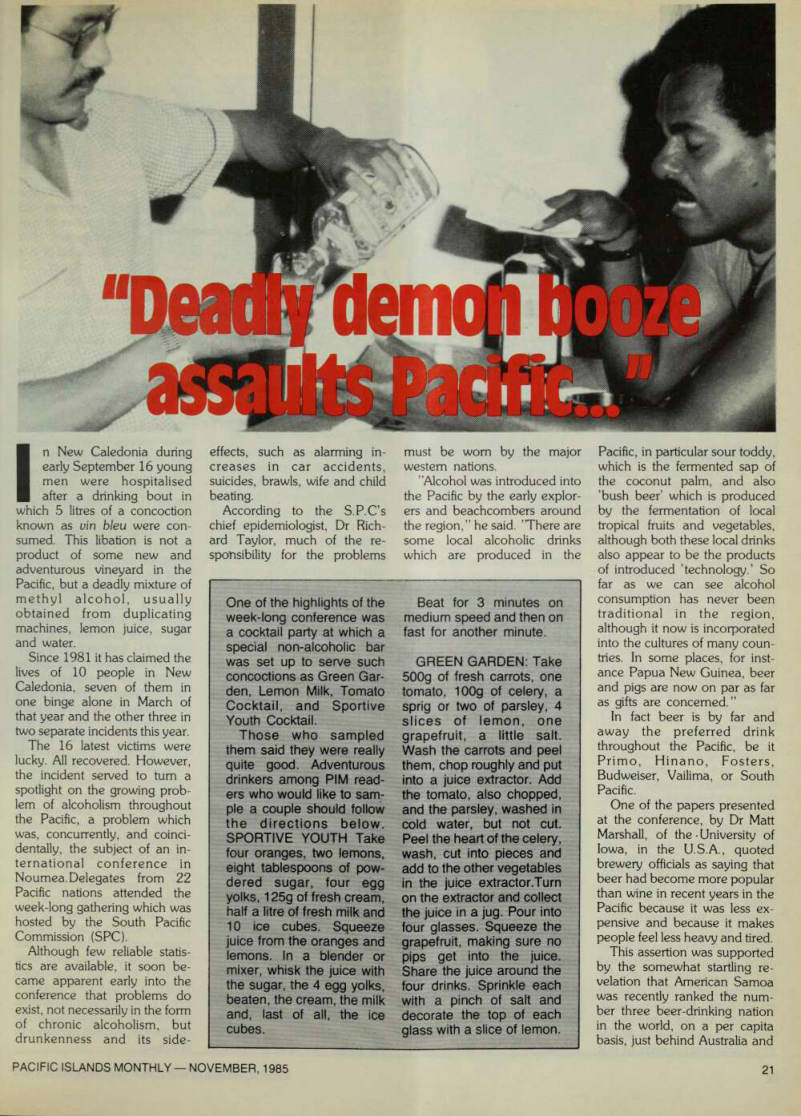
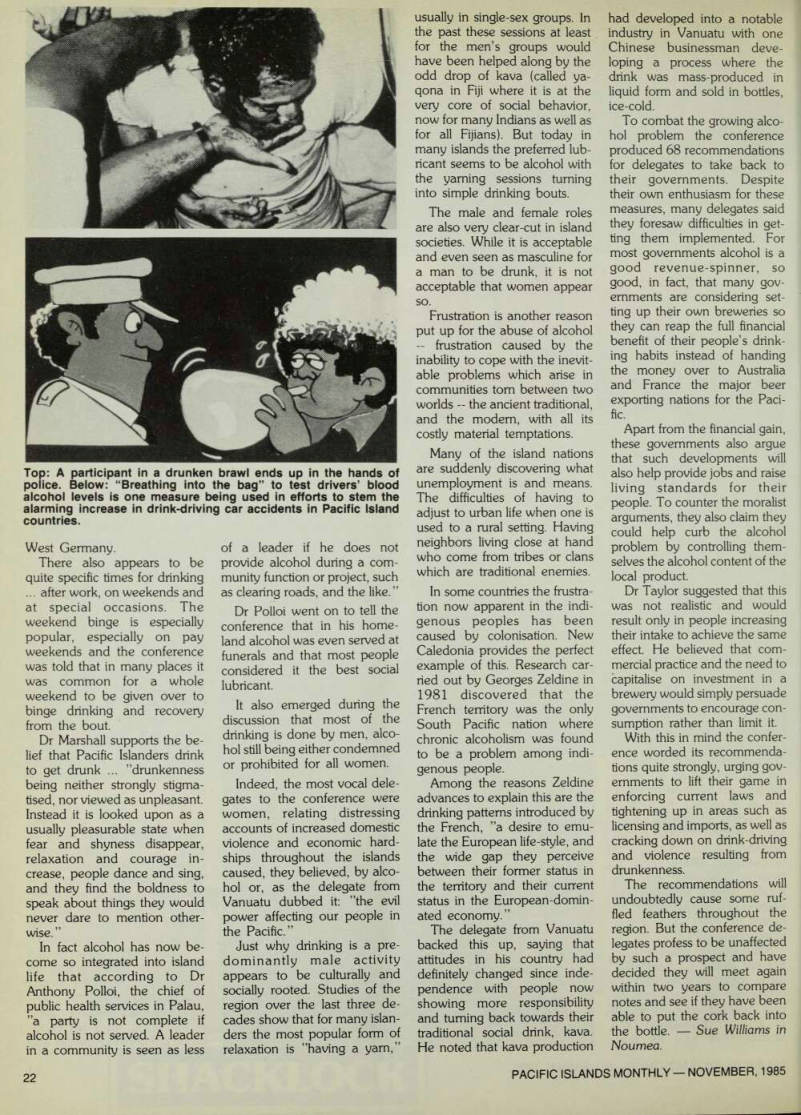
assaults pacific..."
In New Caledonia during early September 16 young men were hospitalised after a drinking bout in which 5 litres of a concoction known as uin bleu were con sumed. This libation is not a product of some new and adventurous vineyard in the Pacific, but a deadly mixture of methyl alcohol, usually obtained from duplicating machines, lemon juice, sugar and water.
Since 1981 it has claimed the lives of 10 people in New Caledonia, seven of them in one binge alone in March of that year and the other three in two separate incidents this year.
The 16 latest victims were lucky. All recovered. However, the incident served to turn a spotlight on the growing prob lem of alcoholism throughout the Pacific, a problem which was, concurrently, and coinci dentally, the subject of an in ternational conference in Noumea. Delegates from 22 Pacific nations attended the week-long gathering which was hosted by the South Pacific Commission (SPC).
Although few reliable statis tics are available, it soon be came apparent early into the conference that problems do exist, not necessarily in the form of chronic alcoholism, but drunkenness and its side
effects, such as alarming in creases in car accidents, suicides, brawls, wife and child beating, According to the S.P.C’s chief epidemiologist, Dr Rich ard Taylor, much of the re sponsibility for the problems
must be worn by the major western nations. ’’Alcohol was introduced into the Pacific by the early explor ers and beachcombers around the region,” he said. ’There are some local alcoholic drinks which are produced in the
Pacific, in particular sour toddy, which is the fermented sap of the coconut palm, and also ’bush beer’ which is produced by the fermentation of local tropical fruits and vegetables, although both these local drinks also appear to be the products of introduced ’technology.’ So far as we can see alcohol consumption has never been traditional in the region, although it now is incorporated into the cultures of many coun tries. In some places, for inst ance Papua New Guinea, beer and pigs are now on par as far as gifts are concerned.”
In fact beer is by far and away the preferred drink throughout the Pacific, be it Prime, Hinano, Fosters, Budweiser, Vailima, or South Pacific.
One of the papers presented at the conference, by Dr Matt Marshall, of the • University of lowa, in the U.S.A., quoted brewery officials as saying that beer had become more popular than wine in recent years in the Pacific because it was less ex pensive and because it makes people feel less heavy and tired.
This assertion was supported by the somewhat startling re velation that American Samoa was recently ranked the num ber three beer-drinking nation in the world, on a per capita basis, just behind Australia and
One of the highlights of the week-long conference was a cocktail party at which a special non-alcoholic bar was set up to serve such concoctions as Green Gar den, Lemon Milk, Tomato Cocktail, and Sportive Youth Cocktail.
Those who sampled them said they were really quite good. Adventurous drinkers among PIM read ers who would like to sam ple a couple should follow the directions below.
Sportive Youth Take
four oranges, two lemons, eight tablespoons of pow dered sugar, four egg yolks, 125 g of fresh cream, half a litre of fresh milk and 10 ice cubes. Squeeze juice from the oranges and lemons. In a blender or mixer, whisk the juice with the sugar, the 4 egg yolks, beaten, the cream, the milk and, last of all, the ice cubes.
Beat for 3 minutes on medium speed and then on fast for another minute.
Green Garden: Take
500 g of fresh carrots, one tomato, 100 g of celery, a sprig or two of parsley, 4 slices of lemon, one grapefruit, a little salt.
Wash the carrots and peel them, chop roughly and put into a juice extractor. Add the tomato, also chopped, and the parsley, washed in cold water, but not cut.
Peel the heart of the celery, wash, cut into pieces and add to the other vegetables in the juice extractor. Turn on the extractor and collect the juice in a jug. Pour into four glasses. Squeeze the grapefruit, making sure no pips get into the juice.
Share the juice around the four drinks. Sprinkle each with a pinch of salt and decorate the top of each glass with a slice of lemon.
West Germany.
There also appears to be quite specific times for drinking ... after work, on weekends and at special occasions. The weekend binge is especially popular, especially on pay weekends and the conference was told that in many places it was common for a whole weekend to be given over to binge drinking and recovery from the bout.
Dr Marshall supports the be lief that Pacific Islanders drink to get drunk ... ’’drunkenness being neither strongly stigma tised, nor viewed as unpleasant.
Instead it is looked upon as a usually pleasurable state when fear and shyness disappear, relaxation and courage in crease, people dance and sing, and they find the boldness to speak about things they would never dare to mention other wise. ”
In fact alcohol has now be come so integrated into island life that according to Dr Anthony Polloi, the chief of public health services in Palau, ”a party is not complete if alcohol is not served. A leader in a community is seen as less
of a leader if he does not provide alcohol during a com munity function or project, such as clearing roads, and the like. ”
Dr Polloi went on to tell the conference that in his home land alcohol was even served at funerals and that most people considered it the best social lubricant.
It also emerged during the discussion that most of the drinking is done by men, alco hol still being either condemned or prohibited for all women.
Indeed, the most vocal dele gates to the conference were women, relating distressing accounts of increased domestic violence and economic hard ships throughout the islands caused, they believed, by alco hol or, as the delegate from Vanuatu dubbed it: ’’the evil power affecting our people in the Pacific.”
Just why drinking is a pre dominantly male activity appears to be culturally and socially rooted. Studies of the region over the last three de cades show that for many islan ders the most popular form of relaxation is ’’having a yarn,”
usually in single-sex groups. In the past these sessions at least for the men’s groups would have been helped along by the odd drop of kava (called ya qona in Fiji where it is at the very core of social behavior, now for many Indians as well as for all Fijians). But today in many islands the preferred lub ricant seems to be alcohol with the yarning sessions turning into simple drinking bouts.
The male and female roles are also very clear-cut in island societies. While it is acceptable and even seen as masculine for a man to be drunk, it is not acceptable that women appear so.
Frustration is another reason put up for the abuse of alcohol frustration caused by the inability to cope with the inevit able problems which arise in communities tom between two worlds the ancient traditional, and the modem, with all its costly material temptations.
Many of the island nations are suddenly discovering what unemployment is and means.
The difficulties of having to adjust to urban life when one is used to a rural setting. Having neighbors living close at hand who come from tribes or clans which are traditional enemies.
In some countries the frustra tion now apparent in the indi genous peoples has been caused by colonisation. New Caledonia provides the perfect example of this. Research car ried out by Georges Zeldine in 1981 discovered that the French territory was the only South Pacific nation where chronic alcoholism was found to be a problem among indi genous people.
Among the reasons Zeldine advances to explain this are the drinking patterns introduced by the French, ”a desire to emu late the European life-style, and the wide gap they perceive between their former status in the territory and their current status in the European-domin ated economy.”
The delegate from Vanuatu backed this up, saying that attitudes in his country had definitely changed since inde pendence with people now showing more responsibility and turning back towards their traditional social drink, kava.
He noted that kava production
had developed into a notable industry in Vanuatu with one Chinese businessman deve loping a process where the drink was mass-produced in liquid form and sold in bottles, ice-cold.
To combat the growing alco hol problem the conference produced 68 recommendations for delegates to take back to their governments. Despite their own enthusiasm for these measures, many delegates said they foresaw difficulties in get ting them implemented. For most governments alcohol is a good revenue-spinner, so good, in fact, that many gov ernments are considering set ting up their own breweries so they can reap the full financial benefit of their people’s drink ing habits instead of handing the money over to Australia and France the major beer exporting nations for the Paci fic.
Apart from the financial gain, these governments also argue that such developments will also help provide jobs and raise living standards for their people. To counter the moralist arguments, they also claim they could help curb the alcohol problem by controlling them selves the alcohol content of the local product.
Dr Taylor suggested that this was not realistic and would result only in people increasing their intake to achieve the same effect. He believed that com mercial practice and the need to capitalise on investment in a brewery would simply persuade governments to encourage con sumption rather than limit it.
With this in mind the confer ence worded its recommenda tions quite strongly, urging gov ernments to lift their game in enforcing current laws and tightening up in areas such as licensing and imports, as well as cracking down on drink-driving and violence resulting from drunkenness.
The recommendations will undoubtedly cause some ruf fled feathers throughout the region. But the conference de legates profess to be unaffected by such a prospect and have decided they will meet again within two years to compare notes and see if they have been able to put the cork back into
the bottle.
Sue Williams in
Noumea.
Top: A participant in a drunken brawl ends up in the hands of police. Below: “Breathing into the bag” to test drivers’ blood alcohol levels is one measure being used in efforts to stem the alarming increase in drink-driving car accidents in Pacific Island countries.
Fiji opts for space
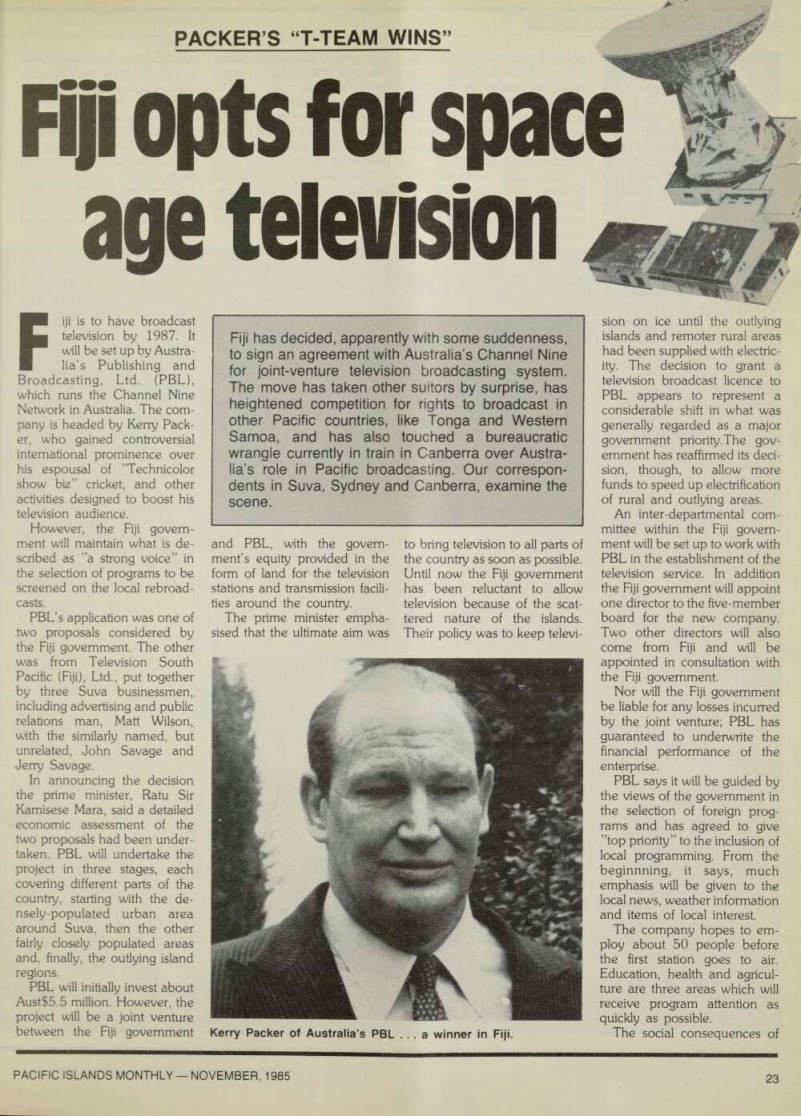
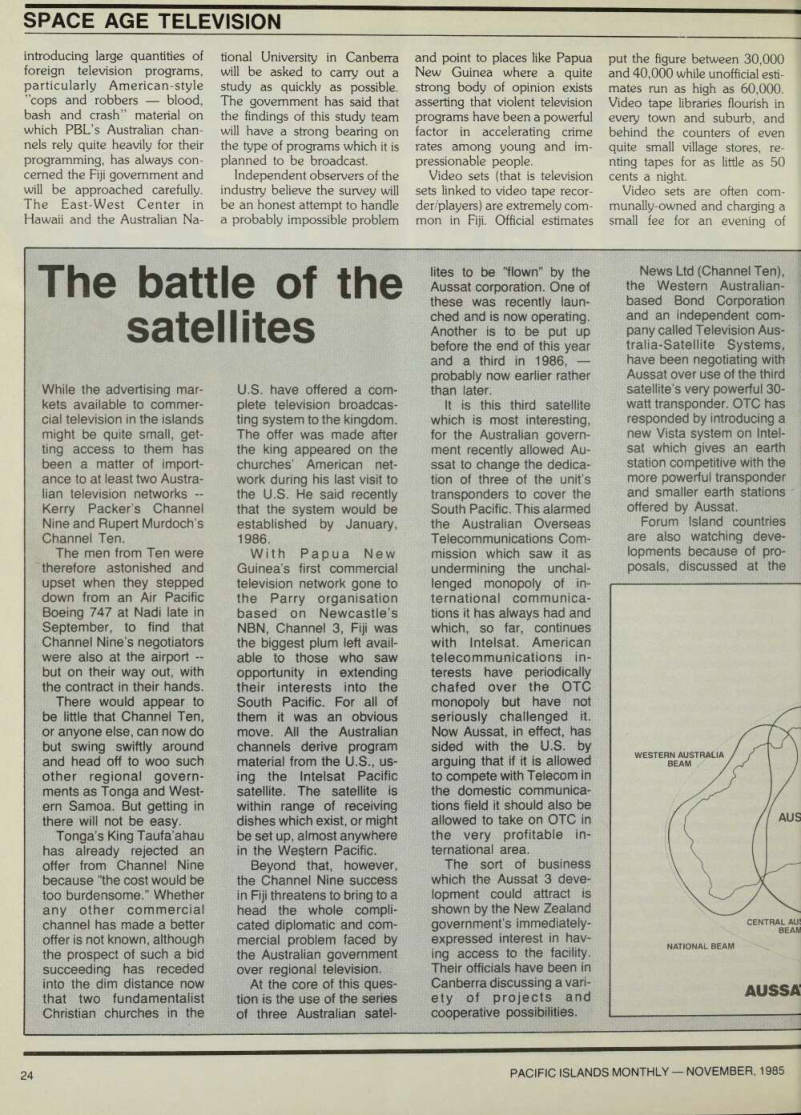
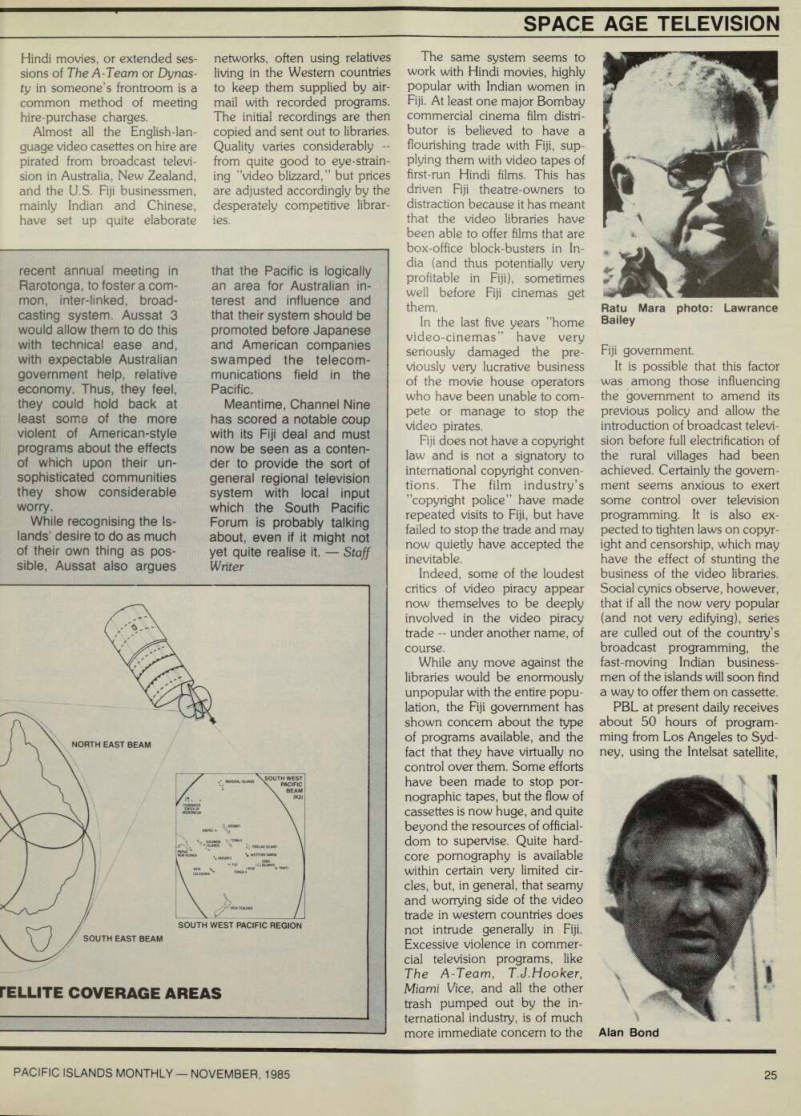
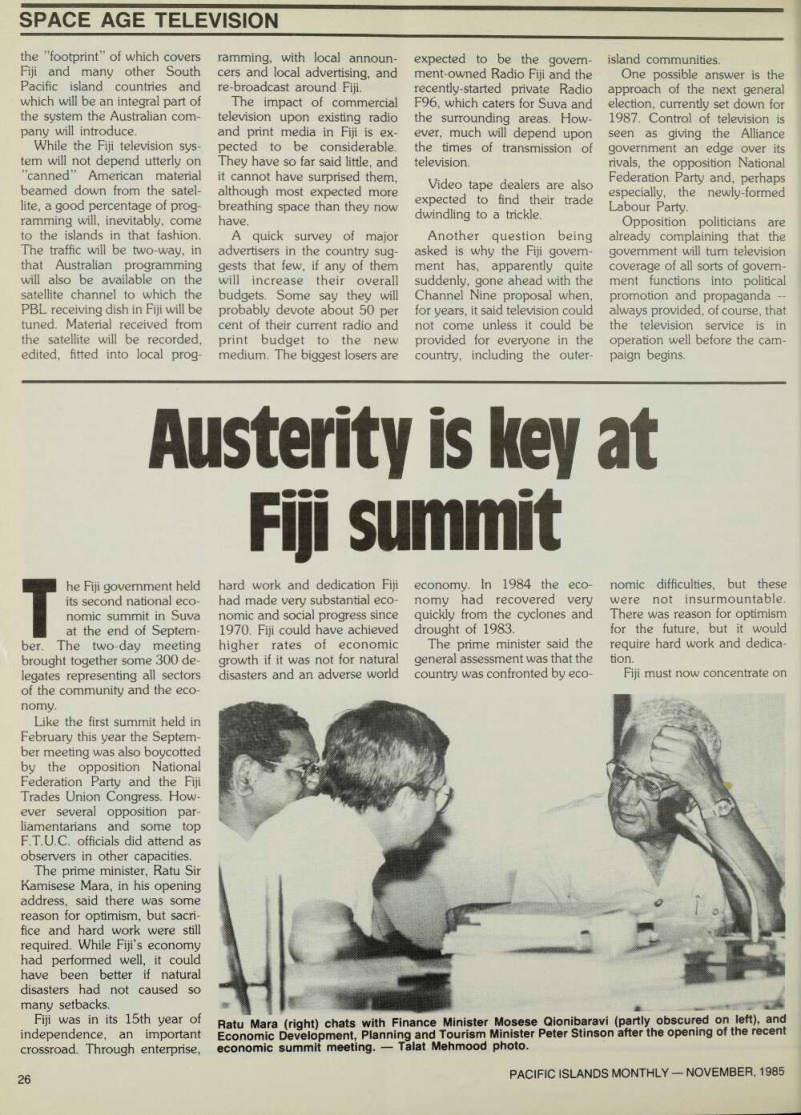
Packer’S “T-Team Wins”
Fiji opts for space age television
Fiji is to have broadcast television by 1987. It will be set up by Austra lia’s Publishing and Broadcasting, Ltd. (PBL), which runs the Channel Nine Network in Australia. The com pany is headed by Kerry Pack er, who gained controversial international prominence over his espousal of ’’Technicolor show biz” cricket, and other activities designed to boost his television audience.
However, the Fiji govern ment will maintain what is de scribed as ”a strong voice” in the selection of programs to be screened on the local rebroad casts.
PBL’s application was one of two proposals considered by the Fiji government. The other was from Television South Pacific (Fiji), Ltd., put together by three Suva businessmen, including advertising and public relations man, Matt Wilson, with the similarly named, but unrelated, John Savage and Jerry Savage.
In announcing the decision the prime minister, Ratu Sir Kamisese Mara, said a detailed economic assessment of the two proposals had been under taken. PBL will undertake the project in three stages, each covering different parts of the country, starting with the de nsely-populated urban area around Suva, then the other fairly closely populated areas and, finally, the outlying island regions.
PBL will initially invest about Austss.s million. However, the project will be a joint venture between the Fiji government
Fiji has decided, apparently with some suddenness, to sign an agreement with Australia’s Channel Nine for joint-venture television broadcasting system.
The move has taken other suitors by surprise, has heightened competition for rights to broadcast in other Pacific countries, like Tonga and Western Samoa, and has also touched a bureaucratic wrangle currently in train in Canberra over Austra lia’s role in Pacific broadcasting. Our correspon dents in Suva, Sydney and Canberra, examine the scene.
and PBL, with the govern ment’s equity provided in the form of land for the television stations and transmission facili ties around the country.
The prime minister empha sised that the ultimate aim was
to bring television to all parts of the country as soon as possible.
Until now the Fiji government has been reluctant to allow television because of the scat tered nature of the islands.
Their policy was to keep televi-
sion on ice until the outlying islands and remoter rural areas had been supplied with electric ity. The decision to grant a television broadcast licence to PBL appears to represent a considerable shift in what was generally regarded as a major government priority. The gov ernment has reaffirmed its deci sion, though, to allow more funds to speed up electrification of rural and outlying areas.
An inter-departmental com mittee within the Fiji govern ment will be set up to work with FBL in the establishment of the television service. In addition the Fiji government will appoint one director to the five-member board for the new company.
Two other directors will also come from Fiji and will be appointed in consultation with the Fiji government.
Nor will the Fiji government be liable for any losses incurred by the joint venture; PBL has guaranteed to underwrite the financial performance of the enterprise.
PBL says it will be guided by the views of the government in the selection of foreign prog rams and has agreed to give ’’top priority” to the inclusion of local programming. From the beginnning, it says, much emphasis will be given to the local news, weather information and items of local interest.
The company hopes to em ploy about 50 people before the first station goes to air.
Education, health and agricul ture are three areas which will receive program attention as quickly as possible.
The social consequences of
Kerry Packer of Australia’s PBL ... a winner in Fiji.
introducing large quantities of foreign television programs, particularly American-style ’’cops and robbers blood, bash and crash” material on which PBL’s Australian channels rely quite heavily for their programming, has always concemed the Fiji government and will be approached carefully, The East-West Center in Hawaii and the Australian Na-
tional University in Canberra will be asked to carry out a study as quickly as possible, The government has said that the findings of this study team will have a strong bearing on the type of programs which it is planned to be broadcast, Independent observers of the industry believe the survey will be an honest attempt to handle a probably impossible problem
and point to places like Papua New Guinea where a quite strong body of opinion exists asserting that violent television programs have been a powerful factor in accelerating crime rates among young and impressionable people.
Video sets (that is television sets linked to video tape recorder/players) are extremely common in Fiji. Official estimates
put the figure between 30,000 and 40,000 while unofficial esti mates run as high as 60,000.
Video tape libraries flourish in every town and suburb, and behind the counters of even quite small village stores, re nting tapes for as little as 50 cents a night, Video sets are often com munally-owned and charging a small fee for an evening of
Hindi movies, or extended sessions of TheA-Team or Dynasty in someone’s frontroom is a common method of meeting hire-purchase charges.
Almost all the English-language video casettes on hire are pirated from broadcast television in Australia, New Zealand, arid the U.S. Fiji businessmen, mainly Indian and Chinese, have set up quite elaborate
networks, often using relatives living in the Western countries to keep them supplied by air mail with recorded programs, The initial recordings are then copied and sent out to libraries, Quality varies considerably -from quite good to eye-strain ing ’’video blizzard,” but prices are adjusted accordingly by the desperately competitive librar ies.
The same system seems to work with Hindi movies, highly popular with Indian women in Fiji. At least one major Bombay commercial cinema film distri butor is believed to have a flourishing trade with Fiji, sup plying them with video tapes of first-run Hindi films. This has driven Fiji theatre-owners to distraction because it has meant that the video libraries have been able to offer films that are box-office block-busters in In dia (and thus potentially very profitable in Fiji), sometimes well before Fiji cinemas get them.
In the last five years ’’home video-cinemas” have very seriously damaged the pre viously very lucrative business of the movie house operators who have been unable to com pete or manage to stop the video pirates.
Fiji does not have a copyright law and is not a signatory to international copyright conven tions. The film industry’s ’’copyright police” have made repeated visits to Fiji, but have failed to stop the trade and may now quietly have accepted the inevitable.
Indeed, some of the loudest critics of video piracy appear now themselves to be deeply involved in the video piracy trade under another name, of course.
While any move against the libraries would be enormously unpopular with the entire popu lation, the Fiji government has shown concern about the type of programs available, and the fact that they have virtually no control over them. Some efforts have been made to stop por nographic tapes, but the flow of cassettes is now huge, and quite beyond the resources of official dom to supervise. Quite hard core pornography is available within certain very limited cir cles, but, in general, that seamy and worrying side of the video trade in western countries does not intrude generally in Fiji.
Excessive violence in commer cial television programs, like The A-Team, T.J.Hooker, Miami Vice , and all the other trash pumped out by the in ternational industry, is of much more immediate concern to the
Fiji government.
It is possible that this factor was among those influencing the government to amend its previous policy and allow the introduction of broadcast televi sion before full electrification of the rural villages had been achieved. Certainly the govern ment seems anxious to exert some control over television programming. It is also ex pected to tighten laws on copyr ight and censorship, which may have the effect of stunting the business of the video libraries.
Social cynics observe, however, that if all the now very popular (and not very edifying), series are culled out of the country’s broadcast programming, the fast-moving Indian business men of the islands will soon find a way to offer them on cassette.
PBL at present daily receives about 50 hours of program ming from Los Angeles to Syd ney, using the Intelsat satellite,
Ratu Mara photo: Lawrance Bailey
Alan Bond
the ’’footprint” of which covers Fiji and many other South Pacific island countries and which will be an integral part of the system the Australian company will introduce.
While the Fiji television systern will not depend utterly on ’’canned” American material beamed down from the satellite, a good percentage of programming will, inevitably, come to the islands in that fashion.
The traffic will be two-way, in that Australian programming will also be available on the satellite channel to which the PBL receiving dish in Fiji will be tuned. Material received from the satellite will be recorded, edited, fitted into local prog-
ramming, with local announ cers and local advertising, and re-broadcast around Fiji, The impact of commercial television upon existing radio and print media in Fiji is ex pected to be considerable, They have so far said little, and it cannot have surprised them, although most expected more breathing space than they now have.
A quick survey of major advertisers in the country sug gests that few, if any of them will increase their overall budgets. Some say they will probably devote about 50 per cent of their current radio and print budget to the new medium. The biggest losers are
expected to be the government-owned Radio Fiji and the recently-started private Radio F 96, which caters for Suva and the surrounding areas. However, much will depend upon the times of transmission of television.
Video tape dealers are also expected to find their trade , . , win mg o a c e.
Another question being asked is why the Fiji government has, apparently quite suddenly, gone ahead with the Channel Nine proposal when, for years, it said television could not come unless it could be provided for everyone in the country, including the outer-
island communities.
One possible answer is the approach of the next general election, currently set down for 1987. Control of television is seen as giving the Alliance government an edge over its rivals, the opposition National Federation Party and, perhaps especially, the newly-formed Labour Party.
Opposition politicians are already complaining that the government will turn television coverage of all sorts of govern ment functions into political promotion and propaganda always provided, of course, that the television service is in operation well before the cam paign begins.
The battle of the satellites
satellites
While the advertising mar kets available to commer cial television in the islands might be quite small, get ting access to them has been a matter of import ance to at least two Austra lian television networks -- Kerry Packer’s Channel Nine and Rupert Murdoch’s Channel Ten.
The men from Ten were therefore astonished and upset when they stepped down from an Air Pacific Boeing 747 at Nadi late in September, to find that Channel Nine’s negotiators were also at the airport but on their way out, with the contract in their hands.
There would appear to be little that Channel Ten, or anyone else, can now do but swing swiftly around and head off to woo such other regional govern ments as Tonga and West ern Samoa. But getting in there will not be easy.
Tonga’s King Taufa’ahau has already rejected an offer from Channel Nine because ’’the cost would be too burdensome.” Whether any other commercial channel has made a better offer is not known, although the prospect of such a bid succeeding has receded into the dim distance now that two fundamentalist Christian churches in the
U.S. have offered a com plete television broadcas ting system to the kingdom.
The offer was made after the king appeared on the churches’ American net work during his last visit to the U.S. He said recently that the system would be established by January, 1986.
With Papua New Guinea’s first commercial television network gone to the Parry organisation based on Newcastle’s NBN, Channel 3, Fiji was the biggest plum left avail able to those who saw opportunity in extending their interests into the South Pacific. For all of them it was an obvious move. All the Australian channels derive program material from the U.S., us ing the Intelsat Pacific satellite. The satellite is within range of receiving dishes which exist, or might be set up, almost anywhere in the Western Pacific.
Beyond that, however, the Channel Nine success in Fiji threatens to bring to a head the whole compli cated diplomatic and com mercial problem faced by the Australian government over regional television.
At the core of this ques tion is the use of the series of three Australian satel
lites to be ’’flown” by the Aussat corporation. One of these was recently laun ched and is now operating.
Another is to be put up before the end of this year and a third in 1986, probably now earlier rather than later.
It is this third satellite which is most interesting, for the Australian govern ment recently allowed Au ssat to change the dedica tion of three of the unit’s transponders to cover the South Pacific. This alarmed the Australian Overseas Telecommunications Com mission which saw it as undermining the unchal lenged monopoly of in ternational communica tions it has always had and which, so far, continues with Intelsat. American telecommunications in terests have periodically chafed over the OTC monopoly but have not seriously challenged it.
Now Aussat, in effect, has sided with the U.S. by arguing that if it is allowed to compete with Telecom in the domestic communica tions field it should also be allowed to take on OTC in the very profitable in ternational area.
The sort of business which the Aussat 3 deve lopment could attract is shown by the New Zealand government’s immediately expressed interest in hav ing access to the facility.
Their officials have been in Canberra discussing a vari ety of projects and cooperative possibilities.
News Ltd (Channel Ten), the Western Australian based Bond Corporation and an independent com pany called Television Aus tralia-Satellite Systems, have been negotiating with Aussat over use of the third satellite’s very powerful 30watt transponder. OTC has responded by introducing a new Vista system on Intel sat which gives an earth station competitive with the more powerful transponder and smaller earth stations offered by Aussat.
Forum Island countries are also watching deve lopments because of pro posals, discussed at the
Aussa
recent annual meeting in Rarotonga, to foster a com mon, inter-linked, broad casting system. Aussat 3 would allow them to do this with technical ease and, with expectable Australian government help, relative economy. Thus, they feel, they could hold back at least some of the more violent of American-style programs about the effects of which upon their un sophisticated communities they show considerable worry.
While recognising the Is lands’ desire to do as much of their own thing as pos sible, Aussat also argues
that the Pacific is logically an area for Australian in terest and influence and that their system should be promoted before Japanese and American companies swamped the telecom munications field in the Pacific.
Meantime, Channel Nine has scored a notable coup with its Fiji deal and must now be seen as a conten der to provide the sort of general regional television system with local input which the South Pacific Forum is probably talking about, even if it might not
yet quite realise it.
Staff
Writer
Tellite Coverage Areas
Advertisements & other items, p. 25 (1 item)
Space Age Television
Austerity is key at Fiji summit
Fiji summit
The Fiji government held its second national eco nomic summit in Suva at the end of Septem ber. The two-day meeting brought together some 300 de legates representing all sectors of the community and the eco nomy.
Like the first summit held in February this year the Septem ber meeting was also boycotted by the opposition National Federation Party and the Fiji Trades Union Congress. How ever several opposition par liamentarians and some top F.T.U.C. officials did attend as observers in other capacities.
The prime minister, Ratu Sir Kamisese Mara, in his opening address, said there was some reason for optimism, but sacri fice and hard work were still required. While Fiji’s economy had performed well, it could have been better if natural disasters had not caused so many setbacks.
Fiji was in its 15th year of independence, an important crossroad. Through enterprise,
hard work and dedication Fiji had made very substantial eco nomic and social progress since 1970. Fiji could have achieved higher rates of economic growth if it was not for natural disasters and an adverse world
economy. In 1984 the eco nomy had recovered very quickly from the cyclones and drought of 1983.
The prime minister said the general assessment was that the country was confronted by eco
nomic difficulties, but these were not insurmountable.
There was reason for optimism for the future, but it would require hard work and dedica tion.
Fiji must now concentrate on
Ratu Mara (right) chats with Finance Minister Mosese Qionibaravi (partly obscured on left), and Economic Development, Planning and Tourism Minister Peter Stinson after the opening of the recent economic summit meeting. - Talat Mehmood photo.
accelerating economic growth, generating more employment opportunities, broadening its economic base through con tinuing efforts to diversify, and maintaining a stable balance of payments position, Ratu Mara said. ”In very simple terms, it means that everyone must work hard, increase productiv ity and continue to share the burden of adjustment a bit longer. ”
Referring to the wage freeze imposed last year the prime minister said it was better to adopt “mild unpleasant poli cies” than to be faced with very unpalatable adjustments later on.
The summit produced a communique listing 41 points sent for discussion by seven special economic task forces set up by the first summit last February to examine Fiji’s financial future.
This communique will form the basis of the next Five-Year Development Plan, to run from 1986 to 1990. Subjects co vered range from agriculture to education,and from youth to the role played by the judiciary.
It noted that the nation could not continue to live with its current budgetary deficit.
It was agreed that the Tri partite Forum, through which government, employers and trades unions negotiate national wage rates, be retained in its present form. However, the Wages Guidelines Committee of the Forum is to have four members and continue to fix the annual wage rise limit (which, lately, has been zero).
The original Tripartite Forum was made up of delegates from the Fiji Trades Union Congress, the Fiji Employers’ Consultative Association, and the govern ment. The new, fourth, delega tion will represent interests out side the main employer-em ployee bodies.
Far from all of Fiji’s businessmen participate in F.E.C.A. Indeed the association has seemed to be supported to any extent only by major com panies, among them such as Burns Philp, Carpenters, Fiji Gas, and Fiji Sugar Corpora tion. Equally, far from all of Fiji’s workers are unionised. In general union organisers are welcomed only in the bigger
firms, again many of them expatriate. Smaller companies have fairly actively discouraged unionism - even to the point of waiting out a strike. And no strike in Fiji has gone longer than about three weeks and in such cases has seldom gone in favor of the workers.
The committee’s main func tion will be to discuss and propose a new national wage guideline. Political imperatives indicate some kind of increase; financial ones dictate that it should be very small.
The prime minister said a national economic council would also be set up under the
chairmanship of deputy prime minister, Mr Mosese Qionibar avi, thus providing direct, high level government contact with the main elements of trade, commerce and industry. This national economic council will be made up of delegates from government, unions, em ployers, rural bodies, women’s organisations, youth and voluntary groups, industrial associations and local govern ments.
By this possibly somewhat unwieldy body the Fiji govern ment hopes to be able to tune its delicate economy rather more accurately and with the
full support of most sectors of the economy. For instance, the national wage guidelines com mittee will be told regularly, by the N.E.C., of the state of the country’s economy, and what wage increases it can (or can not) afford to grant.
But, said Ratu Mara, the government would also submit its own assessment of the eco nomy, in addition to that pro vided by the N.E.C.
Thus, Ratu Mara clearly hopes, the austerity which most believe must continue in Fiji will be supported by general na tional consensus. From Our Suva Correspondent.
Advertisements & other items, p. 27 (1 item)
50 years
* % eW p*
P&O have been cruising
the Pacific for over
50 years
Every few days or so a big P&O cruise liner docks at one of the South Pacific’s most enchanting and popular islands. Some people have even suggested we are the Pacific!
“Take me
awav _RO
of a'rough diamond'
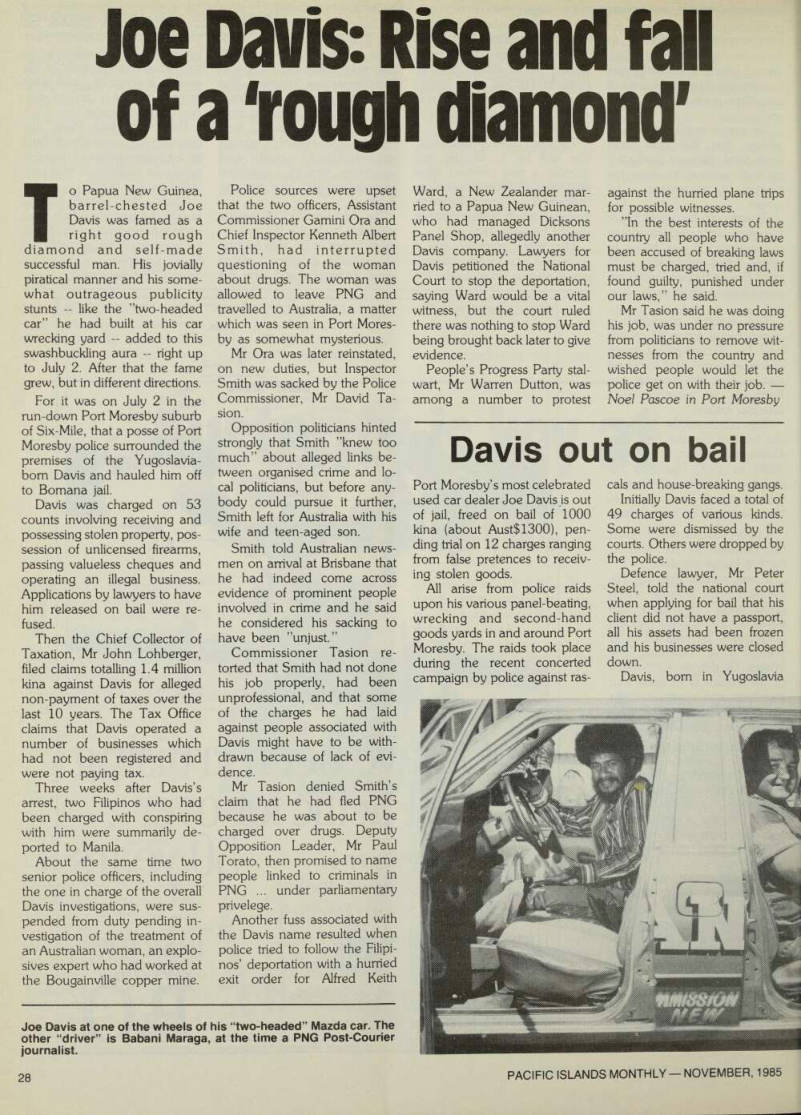
Joe Davis: Rise and fall of a'rough diamond'
To Papua New Guinea, barrel-chested Joe Davis was famed as a right good rough diamond and self-made successful man. His jovially piratical manner and his some what outrageous publicity stunts like the ’’two-headed car” he had built at his car wrecking yard - added to this swashbucWing aura - right up to July 2. After that the fame grew, but in different directions.
For it was on July 2 in the run-down Port Moresby suburb of Six-Mile, that a posse of Port Moresby police surrounded the premises of the Yugoslavia born Davis and hauled him off to Bomana jail.
Davis was charged on 53 counts involving receiving and possessing stolen property, pos session of unlicensed firearms, passing valueless cheques and operating an illegal business.
Applications by lawyers to have him released on bail were re fused.
Then the Chief Collector of Taxation, Mr John Lohberger, filed claims totalling 1.4 million kina against Davis for alleged non-payment of taxes over the last 10 years. The Tax Office claims that Davis operated a number of businesses which had not been registered and were not paying tax.
Three weeks after Davis’s arrest, two Filipinos who had been charged with conspiring with him were summarily de ported to Manila.
About the same time two senior police officers, including the one in charge of the overall Davis investigations, were sus pended from duty pending in vestigation of the treatment of an Australian woman, an explo sives expert who had worked at the Bougainville copper mine.
Police sources were upset that the two officers, Assistant Commissioner Gamini Ora and Chief Inspector Kenneth Albert Smith, had interrupted questioning of the woman about drugs. The woman was allowed to leave PNG and travelled to Australia, a matter which was seen in Port Mores by as somewhat mysterious.
Mr Ora was later reinstated, on new duties, but Inspector Smith was sacked by the Police Commissioner, Mr David Ta sion.
Opposition politicians hinted strongly that Smith ’’knew too much” about alleged links be tween organised crime and lo cal politicians, but before any body could pursue it further, Smith left for Australia with his wife and teen-aged son.
Smith told Australian news men on arrival at Brisbane that he had indeed come across evidence of prominent people involved in crime and he said he considered his sacking to have been ’’unjust.”
Commissioner Tasion re torted that Smith had not done his job properly, had been unprofessional, and that some of the charges he had laid against people associated with Davis might have to be with drawn because of lack of evi dence.
Mr Tasion denied Smith’s claim that he had fled PNG because he was about to be charged over drugs. Deputy Opposition Leader, Mr Paul Torato, then promised to name people linked to criminals in PNG ... under parliamentary privelege.
Another fuss associated with the Davis name resulted when police tried to follow the Filipi nos’ deportation with a hurried exit order for Alfred Keith
Ward, a New Zealander married to a Papua New Guinean, who had managed Dicksons Panel Shop, allegedly another Davis company. Lawyers for Davis petitioned the National Court to stop the deportation, saying Ward would be a vital witness, but the court ruled there was nothing to stop Ward being brought back later to give evidence.
People’s Progress Party stalwart, Mr Warren Dutton, was among a number to protest
against the hurried plane trips for possible witnesses, ”In the best interests of the country all people who have been accused of breaking laws must be charged, tried and, if found guilty, punished under our laws,” he said, Mr Tasion said he was doing his job, was under no pressure from politicians to remove wit nesses from the country and wished people would let the police get on with their job.
Noel Pascoe in Port Moresby
Davis out on bail
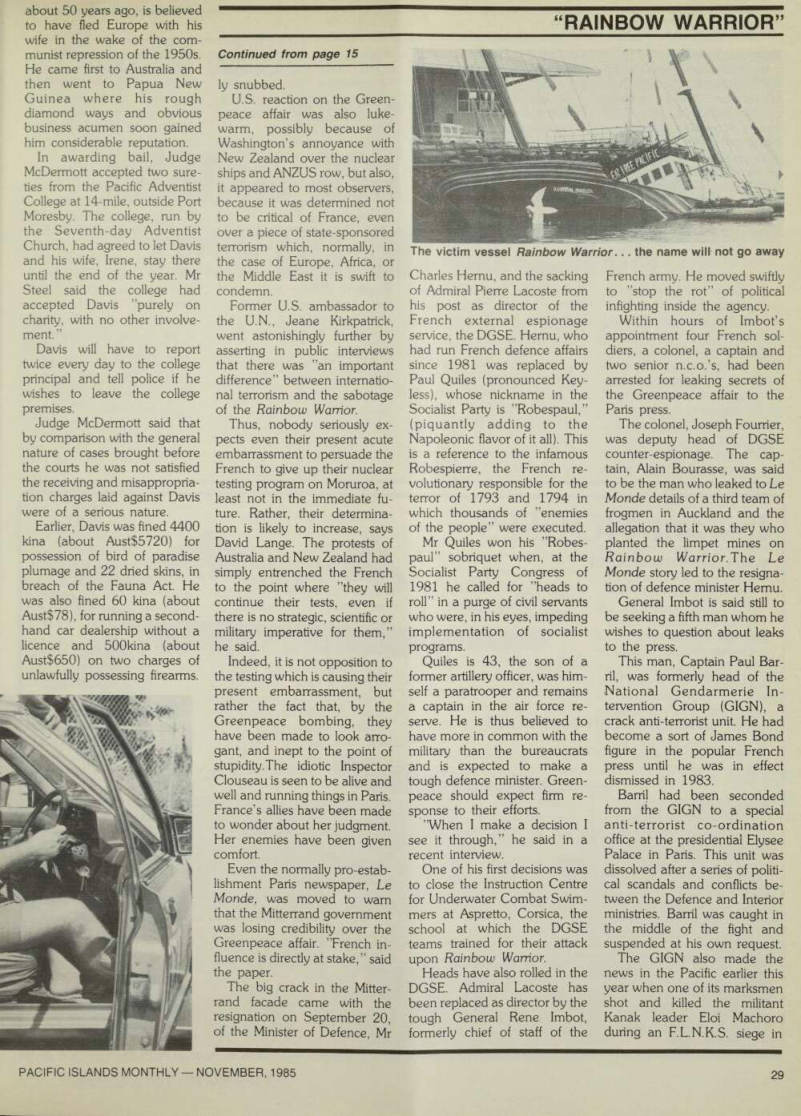
Port Moresby’s most celebrated used car dealer Joe Davis is out of jail, freed on bail of 1000 kina (about Austsl3oo), pen ding trial on 12 charges ranging from false pretences to receiv ing stolen goods.
All arise from police raids upon his various panel-beating, wrecking and second-hand goods yards in and around Port Moresby. The raids took place during the recent concerted campaign by police against ras
cals and house-breaking gangs.
Initially Davis faced a total of 49 charges of various kinds.
Some were dismissed by the courts. Others were dropped by the police.
Defence lawyer, Mr Peter Steel, told the national court when applying for bail that his client did not have a passport, all his assets had been frozen and his businesses were closed down.
Davis, bom in Yugoslavia
Joe Davis at one of the wheels of his “two-headed” Mazda car. The other “driver” is Babani Maraga, at the time a PNG Post-Courier
journalist.
about 50 years ago, is believed to have fled Europe with his wife in the wake of the com munist repression of the 19505.
He came first to Australia and then went to Papua New Guinea where his rough diamond ways and obvious business acumen soon gained him considerable reputation.
In awarding bail, Judge McDermott accepted two sure ties from the Pacific Adventist College at 14-mile, outside Port Moresby. The college, run by the Seventh-day Adventist Church, had agreed to let Davis and his wife, Irene, stay there until the end of the year. Mr Steel said the college had accepted Davis ’’purely on charity, with no other involve ment. ”
Davis will have to report twice every day to the college principal and tell police if he wishes to leave the college premises.
Judge McDermott said that by comparison with the general nature of cases brought before the courts he was not satisfied the receiving and misappropria tion charges laid against Davis were of a serious nature.
Earlier, Davis was fined 4400 kina (about Austss72o) for possession of bird of paradise plumage and 22 dried skins, in breach of the Fauna Act. He was also fined 60 kina (about Austs7B), for running a second hand car dealership without a licence and SOOkina (about Austs6so) on two charges of unlawfully possessing firearms.
Advertisements & other items, pp. 29-30 (2 items)
“Rainbow Warrior”
29
Continued from page 15
PACIFIC ISLANDS MONTHLY NOVEMBER, 1985
Instant HOUSES
fn
with Therma-Panel®
s:
George Hudson,
'the name' in home building for 100 years' - The established name with new ideas!
The home you can assemble!
• Economical fast and simple George Hudson have supplied to: • Tonga
• PNG
• Solomon Islands • Tuvalu and • American Samoa m We can also supply to your designs and specifications George Hudson Homes (Austa Ptv Ltd 4- GH TC
mmm
in-I
Islands ask fishers to
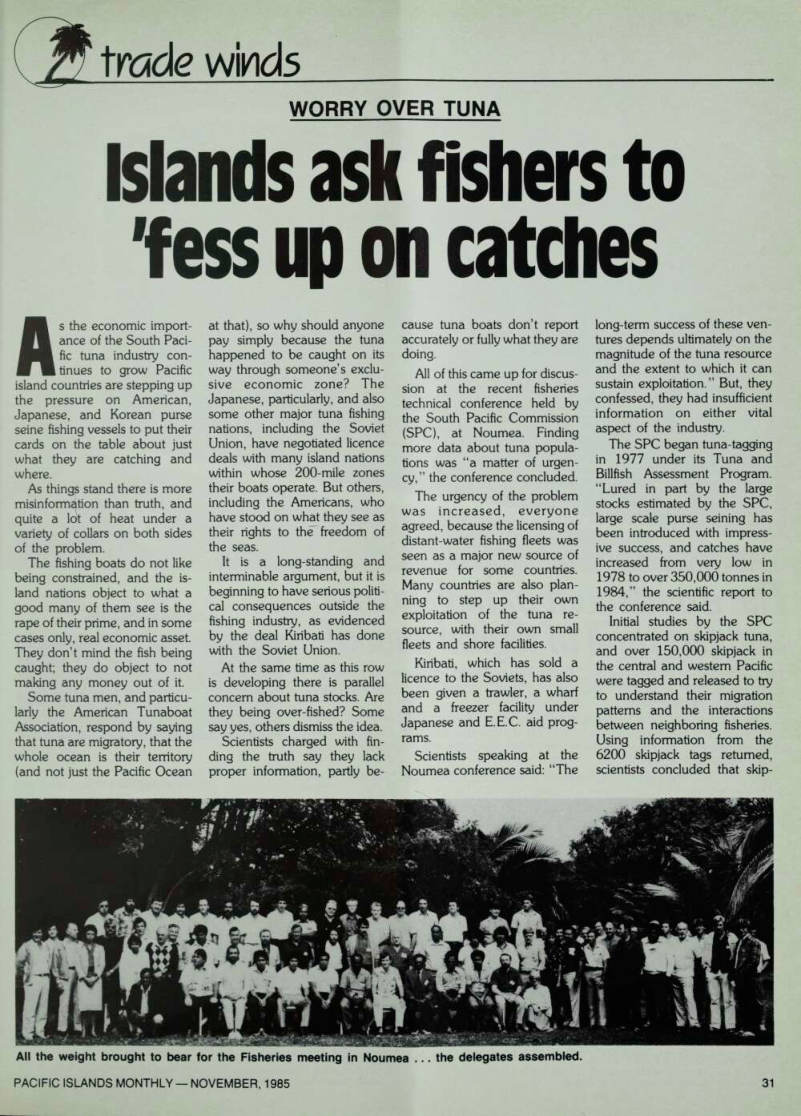

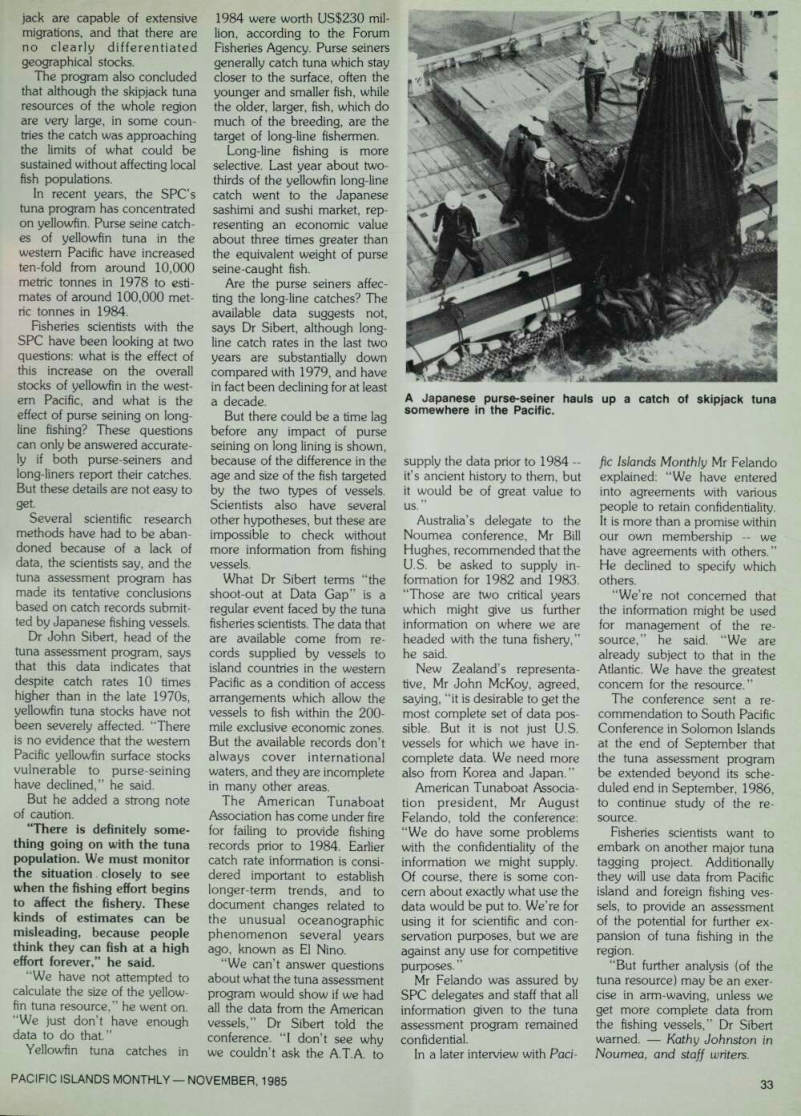
trade winds
Worry Over Tuna
Islands ask fishers to 'fess up on catches
As the economic import ance of the South Paci fic tuna industry con tinues to grow Pacific island countries are stepping up the pressure on American, Japanese, and Korean purse seine fishing vessels to put their cards on the table about just what they are catching and where.
As things stand there is more misinformation than truth, and quite a lot of heat under a variety of collars on both sides of the problem.
The fishing boats do not like being constrained, and the is land nations object to what a good many of them see is the rape of their prime, and in some cases only, real economic asset.
They don’t mind the fish being caught; they do object to not making any money out of it.
Some tuna men, and particu larly the American Tunaboat Association, respond by saying that tuna are migratory, that the whole ocean is their territory (and not just the Pacific Ocean
at that), so why should anyone pay simply because the tuna happened to be caught on its way through someone’s exclu sive economic zone? The Japanese, particularly, and also some other major tuna fishing nations, including the Soviet Union, have negotiated licence deals with many island nations within whose 200-mile zones their boats operate. But others, including the Americans, who have stood on what they see as their rights to the freedom of the seas.
It is a long-standing and interminable argument, but it is beginning to have serious politi cal consequences outside the fishing industry, as evidenced by the deal Kiribati has done with the Soviet Union.
At the same time as this row is developing there is parallel concern about tuna stocks. Are they being over-fished? Some say yes, others dismiss the idea.
Scientists charged with fin ding the truth say they lack proper information, partly be
cause tuna boats don’t report accurately or fully what they are doing.
All of this came up for discus sion at the recent fisheries technical conference held by the South Pacific Commission (SPC), at Noumea. Finding more data about tuna popula tions was “a matter of urgen cy,” the conference concluded.
The urgency of the problem was increased, everyone agreed, because the licensing of distant-water fishing fleets was seen as a major new source of revenue for some countries.
Many countries are also plan ning to step up their own exploitation of the tuna re source, with their own small fleets and shore facilities.
Kiribati, which has sold a licence to the Soviets, has also been given a trawler, a wharf and a freezer facility under Japanese and E.E.C. aid prog rams.
Scientists speaking at the Noumea conference said: “The
long-term success of these ven tures depends ultimately on the magnitude of the tuna resource and the extent to which it can sustain exploitation.” But, they confessed, they had insufficient information on either vital aspect of the industry.
The SPC began tuna-tagging in 1977 under its Tuna and Billfish Assessment Program.
“Lured in part by the large stocks estimated by the SPC, large scale purse seining has been introduced with impress ive success, and catches have increased from very low in 1978 to over 350,000 tonnes in 1984,” the scientific report to the conference said.
Initial studies by the SPC concentrated on skipjack tuna, and over 150,000 skipjack in the central and western Pacific were tagged and released to try to understand their migration patterns and the interactions between neighboring fisheries.
Using information from the 6200 skipjack tags returned, scientists concluded that skip-
All the weight brought to bear for the Fisheries meeting in Noumea ... the delegates assembled.
jack are capable of extensive migrations, and that there are no clearly differentiated geographical stocks.
The program also concluded that although the skipjack tuna resources of the whole region are very large, in some coun tries the catch was approaching the limits of what could be sustained without affecting local fish populations.
In recent years, the SPC’s tuna program has concentrated on yellowfin. Purse seine catch es of yellowfin tuna in the western Pacific have increased ten-fold from around 10,000 metric tonnes in 1978 to esti mates of around 100,000 met ric tonnes in 1984.
Fisheries scientists with the SPC have been looking at two questions; what is the effect of this increase on the overall stocks of yellowfin in the west ern Pacific, and what is the effect of purse seining on long line fishing? These questions can only be answered accurate ly if both purse-seiners and long-liners report their catches.
But these details are not easy to get.
Several scientific research methods have had to be aban doned because of a lack of data, the scientists say, and the tuna assessment program has made its tentative conclusions based on catch records submit ted by Japanese fishing vessels.
Dr John Sibert, head of the tuna assessment program, says that this data indicates that despite catch rates 10 times higher than in the late 19705, yellowfin tuna stocks have not been severely affected. “There is no evidence that the western Pacific yellowfin surface stocks vulnerable to purse-seining have declined,” he said.
But he added a strong note of caution.
“There is definitely some thing going on with the tuna population. We must monitor the situation closely to see when the fishing effort begins to affect the fishery. These kinds of estimates can be misleading, because people think they can fish at a high effort forever,” he said.
“We have not attempted to calculate the size of the yellow fin tuna resource,” he went on.
“We just don’t have enough data to do that.”
Yellowfin tuna catches in
1984 were worth US$23O mil lion, according to the Forum Fisheries Agency. Purse seiners generally catch tuna which stay closer to the surface, often the younger and smaller fish, while the older, larger, fish, which do much of the breeding, are the target of long-line fishermen.
Long-line fishing is more selective. Last year about two thirds of the yellowfin long-line catch went to the Japanese sashimi and sushi market, rep resenting an economic value about three times greater than the equivalent weight of purse seine-caught fish.
Are the purse seiners affec ting the long-line catches? The available data suggests not, says Dr Sibert, although long line catch rates in the last two years are substantially down compared with 1979, and have in fact been declining for at least a decade.
But there could be a time lag before any impact of purse seining on long lining is shown, because of the difference in the age and size of the fish targeted by the two types of vessels.
Scientists also have several other hypotheses, but these are impossible to check without more information from fishing vessels.
What Dr Sibert terms “the shoot-out at Data Gap” is a regular event faced by the tuna fisheries scientists. The data that are available come from re cords supplied by vessels to island countries in the western Pacific as a condition of access arrangements which allow the vessels to fish within the 200mile exclusive economic zones.
But the available records don’t always cover international waters, and they are incomplete in many other areas.
The American Tunaboat Association has come under fire for failing to provide fishing records prior to 1984. Earlier catch rate information is consi dered important to establish longer-term trends, and to document changes related to the unusual oceanographic phenomenon several years ago, known as El Nino.
“We can’t answer questions about what the tuna assessment program would show if we had all the data from the American vessels,” Dr Sibert told the conference. “I don’t see why we couldn’t ask the A.T.A. to
supply the data prior to 1984 it’s ancient history to them, but it would be of great value to us.”
Australia’s delegate to the Noumea conference, Mr Bill Hughes, recommended that the U.S. be asked to supply in formation for 1982 and 1983.
“Those are two critical years which might give us further information on where we are headed with the tuna fishery,” he said.
New Zealand’s representa tive, Mr John McKoy, agreed, saying, “it is desirable to get the most complete set of data pos sible. But it is not just U.S. vessels for which we have in complete data. We need more also from Korea and Japan.”
American Tunaboat Associa tion president, Mr August Felando, told the conference: “We do have some problems with the confidentiality of the information we might supply.
Of course, there is some con cern about exactly what use the data would be put to. We’re for using it for scientific and con servation purposes, but we are against any use for competitive purposes. ”
Mr Felando was assured by SPC delegates and staff that all information given to the tuna assessment program remained confidential.
In a later interview with Paci
fic Islands Monthly Mr Felando explained: “We have entered into agreements with various people to retain confidentiality.
It is more than a promise within our own membership we have agreements with others.”
He declined to specify which others.
“We’re not concerned that the information might be used for management of the re source,” he said. “We are already subject to that in the Atlantic. We have the greatest concern for the resource.”
The conference sent a re commendation to South Pacific Conference in Solomon Islands at the end of September that the tuna assessment program be extended beyond its sche duled end in September, 1986, to continue study of the re source.
Fisheries scientists want to embark on another major tuna tagging project. Additionally they will use data from Pacific island and foreign fishing ves sels, to provide an assessment of the potential for further ex pansion of tuna fishing in the region.
“But further analysis (of the tuna resource) may be an exer cise in arm-waving, unless we get more complete data from the fishing vessels,” Dr Sibert
warned.
Kathy Johnston in
Noumea, and staff writers.
A Japanese purse-seiner hauls up a catch of skipjack tuna somewhere in the Pacific.
Advertisements & other items, pp. 32-36 (1 item)
(M) Pioneer
mm . m m A I
The excitement of high-power
and the thrill of digital sound!
It’s here, thanks to Pioneer—a 200 W Peak Music Power Output portable sound system! A system so sophisticated you can team it up with Pioneer’s detachable
PD-C 7 Compact Disc player.
Yes, you can enter the Digital Age with the revolutionary “CD” Carry Com, while broadening your hi-fi horizons with Stereo Wide expanded acoustic ambience. Then feast your ears on the beauty of Dynamic Expander: outstanding definition, natural vocals, full-bodied sound.
So check out the portable that checks you into the Digital Age: “CD” Carry Com, only from Pioneer.
CK-W7OO
CK-W7OO, CK-R 500:
■ Detachable PD-C 7 Compact Disc
player (optional)
■ Dynamic Expander and Stereo Wide circuits ■ Mic-mixing for Karaoke "Sing-Along” ■ 4-Band Tuner (FM stereo/MW/SWi/ SW2) ■ 4-Band Graphic Equalizer ■ Dolby* B NR, Music Search, REC Mute and auto metal/normal tape selector
CK-W7OO
■ 200 W Peak Music Power Output ■ Full-logic Double Auto-Reverse cassette deck (for playback and
record/playback)
■ High-speed dubbing for sides A and B ■ Relay playback from deck 1 to deck 2 ■ Detachable 2-way speaker system with square cone woofer
CK-R5OO
■ 70W Peak Music Power Output ■ Full-logic Auto- Reverse cassette deck ■ Detachable fullrange speaker system with square cone
CK-R5OO
‘Dolby’ and the double-D symbol are trademarks of Dolby Laboratories Licensing Corporation.
(M) PIONEER
For further information, please contact: Australia: Pioneer Electronics Australia Pty. Ltd. (Incorporated in Victoria), P.O. Box 295, Mordialloc, Victoria, 3195 Tel: 580-9911 Fiji Islands; Brijlal & Company, G.P.O. Box No. 362, Suva, Fiji Islands Tel: 22258 New Zealand; Monaco Distributors Ltd., 2 Poland Road, Glenfield, Auckland, New Zealand Tel: (09) 444-9144 Norfolk Island: Burns Philp (Norfolk Island) Ltd., P.O. Box 21, Norfolk Island Vanuatu: Burns Philp (Vanuatu) Ltd., Vila, Vanuatu Nauru Island: Jacob Enterprises, P.O. Box N 0.4,.4, Republic of Nauru Tahiti; Tahiti Hi-Fi, P.O. Box 848, Papeete, Tahiti New Caledonia: Menard Pacifique Sari, B.P. 3899, Noumea, New Caledonia Tel: 27-62.23 American Samoa; Transpac Corporation, P.O. Box 1477, Pago Pago, American Samoa 96799 Tel: 633-5224 Rarotonga: South Seas International Ltd., P.O. Box 49, Rarotonga, Cook Islands Tel. 2327 Papua New Guinea: Bali Merchants Pty. Ltd., P.O. Box 6103, Boroko Tel: 254887
TOYOTA
QUALITY SERVICE
AMERICAN SAMOA; BURNS PHILP (SOUTH SEA) CO., LTD., P.O. Box 129, Pago Pago.
COOK ISLANDS: COOK ISLANDS TRADING
CORPORATION LTD., Private Bag, Rarotonga.
FIJI: AUTOMOTIVE SUPPLIES COMPANY, A Division of Burns Philp (South Sea) Co., Ltd., G.P.O. Box 355, Suva.
GUAM & MICRONESIA: ATKINS KROLL, INC., 443 South Marine Drive, Tamuning.
KIRIBATI: TARAWA MOTORS, P.O. Box 36, Bairiki, Tarawa.
NAURU: NAURU COOPERATIVE SOCIETY, Centra
Pacific.
NEW CALEDONIA: SERVICE IMPORTATION
AUTOMOBILE DU PACIFIQUE, Rond-Point du Pad! (Station Total) B.P. 438, Noumea.
NORFOLK ISLAND: BORRYS LIMITED, P.O. Box
PAPUA NEW GUINEA; ELA MOTORS, A Divide Burns Philp (PNG) Ltd., P.O. Box 75, Port Moresb SAIPAN: MICROL CORPORATION, P.O. Box 267, S
* ■ % . r%. * f* 67- V* **
The tradition of power and ruggedness
Toyota’s new Land Cruiser has been entirely edesigned from the road up. But it still etains the traditional toughness icquired from over thirty years jf road experience.
But no matter how rough it gets a roomy new cabin with improved occupant comforts, easy instrumentation and an optional 4-speed automatic transmission add up to passenger car comfort with Land Cruiser ruggedness. on.
Pickup
fj More power in hand and fuel efficiency have been gained with a new brawny 4.0-litre gasoline engine.
And to control all that power a new rigid chassis assures stable driving performance and mobility over the roughest terrain. .
And you can choose from a wide variety of models and an array of heavy-duty features.
Take the wheel and feel Toyota quality in Land Cruiser’s styling, power and comfort. A quality that stays with you on or off the road.
Step into a new generation of toughness today.
SOLOMON: SOLOMON ISLANDS INVESTMENTS LTD.,
3.P.0. Box 174, Honiara.
FAHITI; NIPPON AUTOMOTO, B.P. 342, Papeete.
FONGA: BURNS PHILP (SOUTH SEA) CO., LTD., P.O.
Sox 55, Nuku’alofa.
VANUATU: VANUATU MOTORS, A Division of Burns 3 hilp (Vanuatu) Ltd., P.O. Box 18, Port Vila.
WESTERN SAMOA: BURNS PHILP (SOUTH SEA) CO., LTD., P.O. Box 188, Apia.
TOYOTA
6
coilins
OLYMPIC
The Stationery and Diary People.
i
SYSTEM
. 001 l ln*
CARDS
/,. V ss.
Commercial, School, Household
Stationery and Diaries.
Fast and efficient export service.
COLLINS OLYMPIC LIMITED
/IAT TTM C P.O. BOX 476, AUCKLAND, 1
11111 I II \ NEW ZEALAND.
PHONE: (9) 484-009
DT IM PTC TELEX: N.Z. 21293 (EDUNLOP)
CABLES: GRAPHICOL
aviating
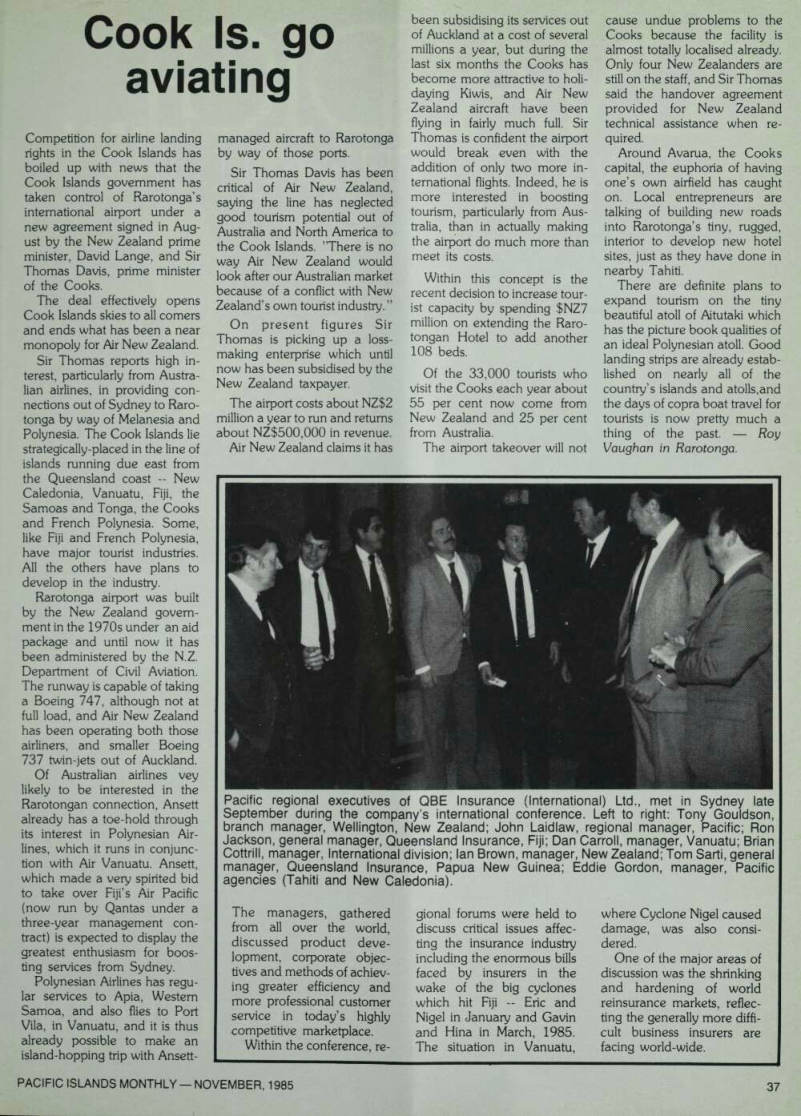
Cook Is. go aviating
Competition for airline landing rights in the Cook Islands has boiled up with news that the Cook Islands government has taken control of Rarotonga’s international airport under a new agreement signed in Aug ust by the New Zealand prime minister, David Lange, and Sir Thomas Davis, prime minister of the Cooks.
The deal effectively opens Cook Islands skies to all comers and ends what has been a near monopoly for Air New Zealand.
Sir Thomas reports high in terest, particularly from Austra lian airlines, in providing con nections out of Sydney to Raro tonga by way of Melanesia and Polynesia. The Cook Islands lie strategically-placed in the line of islands running due east from the Queensland coast - New Caledonia, Vanuatu, Fiji, the Samoas and Tonga, the Cooks and French Polynesia. Some, like Fiji and French Polynesia, have major tourist industries.
All the others have plans to develop in the industry.
Rarotonga airport was built by the New Zealand govern ment in the 1970 s under an aid package and until now it has been administered by the N.Z.
Department of Civil Aviation.
The runway is capable of taking a Boeing 747, although not at full load, and Air New Zealand has been operating both those airliners, and smaller Boeing 737 twin-jets out of Auckland.
Of Australian airlines vey likely to be interested in the Rarotongan connection, Ansett already has a toe-hold through its interest in Polynesian Air lines, which it runs in conjunc tion with Air Vanuatu. Ansett, which made a very spirited bid to take over Fiji’s Air Pacific (now run by Qantas under a three-year management con tract) is expected to display the greatest enthusiasm for boos ting services from Sydney.
Polynesian Airlines has regu lar services to Apia, Western Samoa, and also flies to Port Vila, in Vanuatu, and it is thus already possible to make an island-hopping trip with Ansett
managed aircraft to Rarotonga by way of those ports.
Sir Thomas Davis has been critical of Air New Zealand, saying the line has neglected good tourism potential out of Australia and North America to the Cook Islands. ’’There is no way Air New Zealand would look after our Australian market because of a conflict with New Zealand’s own tourist industry. ”
On present figures Sir Thomas is picking up a loss making enterprise which until now has been subsidised by the New Zealand taxpayer.
The airport costs about NZ$2 million a year to run and returns about NZ$5OO,OOO in revenue.
Air New Zealand claims it has
been subsidising its services out of Auckland at a cost of several millions a year, but during the last six months the Cooks has become more attractive to holi daying Kiwis, and Air New Zealand aircraft have been flying in fairly much full. Sir Thomas is confident the airport would break even with the addition of only two more in ternational flights. Indeed, he is more interested in boosting tourism, particularly from Aus tralia, than in actually making the airport do much more than meet its costs.
Within this concept is the recent decision to increase tour ist capacity by spending SNZ7 million on extending the Raro tongan Hotel to add another 108 beds.
Of the 33,000 tourists who visit the Cooks each year about 55 per cent now come from New Zealand and 25 per cent from Australia.
The airport takeover will not
cause undue problems to the Cooks because the facility is almost totally localised already.
Only four New Zealanders are still on the staff, and Sir Thomas said the handover agreement provided for New Zealand technical assistance when re quired.
Around Avarua, the Cooks capital, the euphoria of having one’s own airfield has caught on. Local entrepreneurs are talking of building new roads into Rarotonga’s tiny, rugged, interior to develop new hotel sites, just as they have done in nearby Tahiti.
There are definite plans to expand tourism on the tiny beautiful atoll of Aitutaki which has the picture book qualities of an ideal Polynesian atoll. Good landing strips are already estab lished on nearly all of the country’s islands and atolls,and the days of copra boat travel for tourists is now pretty much a
thing of the past.
Roy
Vaughan in Rarotonga.
The managers, gathered from all over the world, discussed product deve lopment, corporate objec tives and methods of achiev ing greater efficiency and more professional customer service in today’s highly competitive marketplace.
Within the conference, re
gional forums were held to discuss critical issues affec ting the insurance industry including the enormous bills faced by insurers in the wake of the big cyclones which hit Fiji Eric and Nigel in January and Gavin and Hina in March, 1985.
The situation in Vanuatu,
where Cyclone Nigel caused damage, was also consi dered.
One of the major areas of discussion was the shrinking and hardening of world reinsurance markets, reflec ting the generally more diffi cult business insurers are facing world-wide.
Pacific regional executives of QBE Insurance (International) Ltd., met in Sydney late September during the company’s international conference. Left to right: Tony Gouldson, branch manager, Wellington, New Zealand; John Laidlaw, regional manager, Pacific; Ron Jackson, general manager, Queensland Insurance, Fiji; Dan Carroll, manager, Vanuatu; Brian Cottrill, manager, International division; lan Brown, manager, New Zealand; Tom Sarti, general manager, Queensland Insurance, Papua New Guinea; Eddie Gordon, manager, Pacific agencies (Tahiti and New Caledonia).
Advertisements & other items, p. 38 (1 item)
Citizen
EWAY TO TH
Multifunctionalism is the
watchword for timepieces
in this information age.
Citizen technology meets
the challenge with two
revolutionary teas in PC
watches. m . ££
m m Hv & » 1 % > • / /»
AMA-DIGI
TEMP
Citizen Quartz Ana-Digi Temp. 59.9° to 9.9°C temperature readout, one-touch Fahrenheit conversion. Analog/Digital time indication with automatic calendar and dual (one other time zone) time. 24-hour alarm, hourly chime. 1/1000-sec. accurate stopwatch.
Citizen Watches Australia Ply Ltd 122 Old
AMA-DIGI
OomboFl
Citizen Quartz Ana-Digi Combo FI.
Analog/Digital time indication with 1-sec. and 10-sec. increment LCD trackers. Permanently adjusted monthday-date calendar, 24-hour alarm, * i 12-hour countdown timer; hourly chime. Dual time. And a 1/100-sec, counter lap-timing stopwatch.
Fittwater Rd Brook vale. NSW 2100. Telephone 939 7077. Cable; Citizen Sydney. Telex: AA26633.
CITIZEN
AHEAD OF THEIR TIME
A “first” in the study of
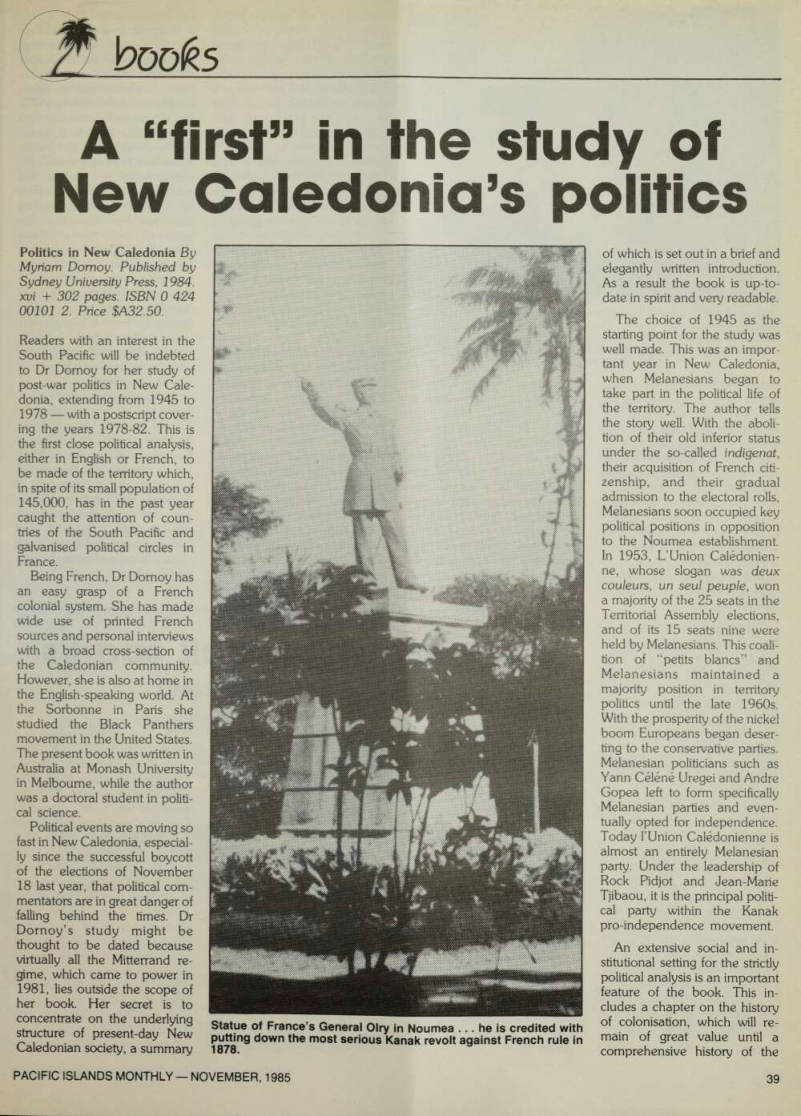
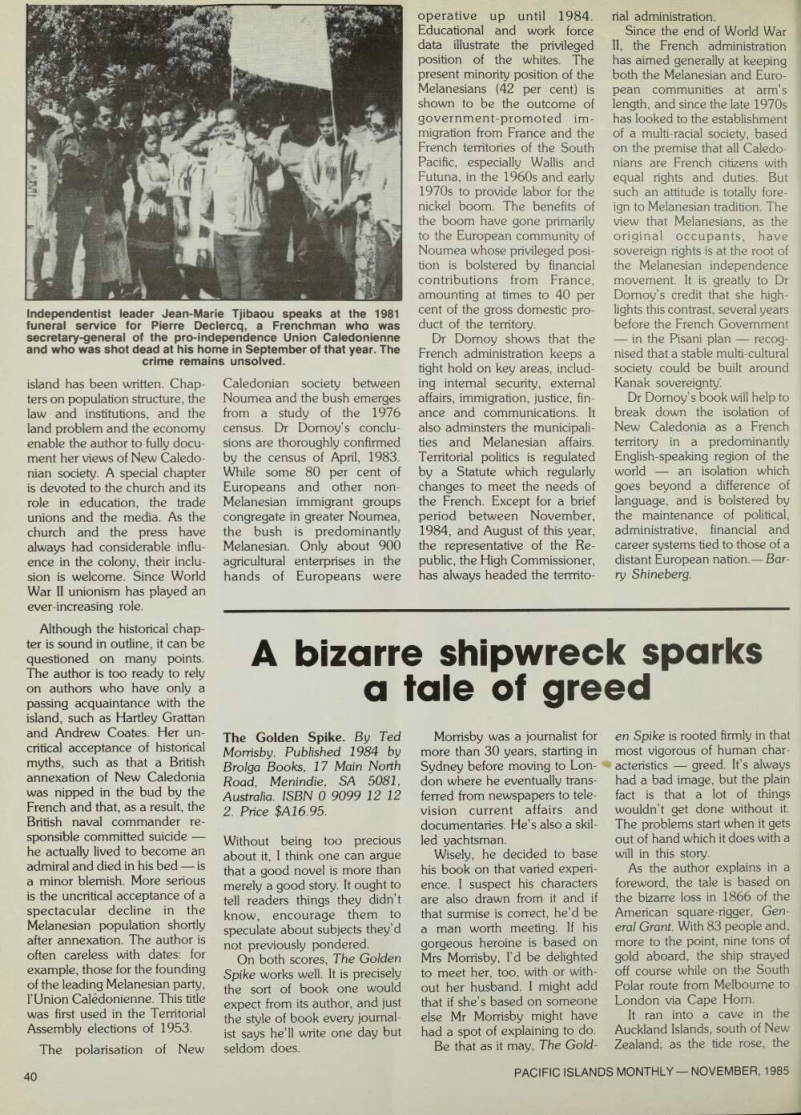
books
A “first” in the study of New Caledonia’s politics
Politics in New Caledonia By Myriam Domoy. Published by Sydney University Press, 1984. xvi + 302 pages. ISBN 0 424 00101 2. Price $A32.50.
Readers with an interest in the South Pacific will be indebted to Dr Domoy for her study of post-war politics in New Cale donia, extending from 1945 to 1978 with a postscript cover ing the years 1978-82. This is the first close political analysis, either in English or French, to be made of the territory which, in spite of its small population of 145,000, has in the past year caught the attention of coun tries of the South Pacific and galvanised political circles in France.
Being French, Dr Domoy has an easy grasp of a French colonial system. She has made wide use of printed French sources and personal interviews with a broad cross-section of the Caledonian community.
However, she is also at home in the English-speaking world. At the Sorbonne in Paris she studied the Black Panthers movement in the United States.
The present book was written in Australia at Monash University in Melbourne, while the author was a doctoral student in politi cal science.
Political events are moving so fast in New Caledonia, especial ly since the successful boycott of the elections of November 18 last year, that political com mentators are in great danger of falling behind the times. Dr Dornoy’s study might be thought to be dated because virtually all the Mitterrand re gime, which came to power in 1981, lies outside the scope of her book. Her secret is to concentrate on the underlying structure of present-day New Caledonian society, a summary
of which is set out in a brief and elegantly written introduction.
As a result the book is up-to date in spirit and very readable.
The choice of 1945 as the starting point for the study was well made. This was an impor tant year in New Caledonia, when Melanesians began to take part in the political life of the territory. The author tells the story well. With the aboli tion of their old inferior status under the so-called indigenat, their acquisition of French citi zenship, and their gradual admission to the electoral rolls, Melanesians soon occupied key political positions in opposition to the Noumea establishment.
In 1953, L’Union Caledonien ne, whose slogan was deux couleurs, un seal peuple, won a majority of the 25 seats in the Territorial Assembly elections, and of its 15 seats nine were held by Melanesians. This coali tion of “petits blancs” and Melanesians maintained a majority position in territory politics until the late 19605.
With the prosperity of the nickel boom Europeans began deser ting to the conservative parties.
Melanesian politicians such as Yann Celene Uregei and Andre Gopea left to form specifically Melanesian parties and even tually opted for independence.
Today 1’ Union Caledonienne is almost an entirely Melanesian party. Under the leadership of Rock Pidjot and Jean-Marie Tjibaou, it is the principal politi cal party within the Kanak pro-independence movement.
An extensive social and in stitutional setting for the strictly political analysis is an important feature of the book. This in cludes a chapter on the history of colonisation, which will re main of great value until a comprehensive history of the
Statue of France’s General Olry in Noumea ... he is credited with putting down the most serious Kanak revolt against French rule in 1878.
island has been written. Chap ters on population structure, the law and institutions, and the land problem and the economy enable the author to fully docu ment her views of New Caledo nian society. A special chapter is devoted to the church and its role in education, the trade unions and the media. As the church and the press have always had considerable influ ence in the colony, their inclu sion is welcome. Since World War II unionism has played an ever-increasing role.
Although the historical chap ter is sound in outline, it can be questioned on many points.
The author is too ready to rely on authors who have only a passing acquaintance with the island, such as Hartley Grattan and Andrew Coates. Her un critical acceptance of historical myths, such as that a British annexation of New Caledonia was nipped in the bud by the French and that, as a result, the British naval commander re sponsible committed suicide he actually lived to become an admiral and died in his bed is a minor blemish. More serious is the uncritical acceptance of a spectacular decline in the Melanesian population shortly after annexation. The author is often careless with dates: for example, those for the founding of the leading Melanesian party, I’Union Caledonienne. This title was first used in the Territorial Assembly elections of 1953.
The polarisation of New
Caledonian society between Noumea and the bush emerges from a study of the 1976 census. Dr Domoy’s conclu sions are thoroughly confirmed by the census of April, 1983.
While some 80 per cent of Europeans and other non- Melanesian immigrant groups congregate in greater Noumea, the bush is predominantly Melanesian. Only about 900 agricultural enterprises in the hands of Europeans were
operative up until 1984.
Educational and work force data illustrate the privileged position of the whites. The present minority position of the Melanesians (42 per cent) is shown to be the outcome of government-promoted im migration from France and the French territories of the South Pacific, especially Wallis and Futuna, in the 1960 s and early 1970 s to provide labor for the nickel boom. The benefits of the boom have gone primarily to the European community of Noumea whose privileged posi tion is bolstered by financial contributions from France, amounting at times to 40 per cent of the gross domestic pro duct of the territory.
Dr Dornoy shows that the French administration keeps a tight hold on key areas, includ ing internal security, external affairs, immigration, justice, fin ance and communications. It also adminsters the municipali ties and Melanesian affairs.
Territorial politics is regulated by a Statute which regularly changes to meet the needs of the French. Except for a brief period between November, 1984, and August of this year, the representative of the Re public, the High Commissioner, has always headed the terrrito
rial administration.
Since the end of World War 11, the French administration has aimed generally at keeping both the Melanesian and Euro pean communities at arm’s length, and since the late 1970 s has looked to the establishment of a multi-racial society, based on the premise that all Caledo nians are French citizens with equal rights and duties. But such an attitude is totally fore ign to Melanesian tradition. The view that Melanesians, as the original occupants, have sovereign rights is at the root of the Melanesian independence movement. It is greatly to Dr Domoy’s credit that she high lights this contrast, several years before the French Government in the Pisani plan recog nised that a stable multi-cultural society could be built around Kanak sovereignty'.
Dr Dornoy’s book will help to break down the isolation of New Caledonia as a French territory in a predominantly English-speaking region of the world an isolation which goes beyond a difference of language, and is bolstered by the maintenance of political, administrative, financial and career systems tied to those of a
distant European nation.
Bar-
ry Shineberg.
Independentist leader Jean-Marie Tjibaou speaks at the 1981 funeral service for Pierre Declercq, a Frenchman who was secretary-general of the pro-independence Union Caledonienne and who was shot dead at his home in September of that year. The crime remains unsolved.
A bizarre shipwreck sparks
a tale of greed
The Golden Spike. By Ted Morrisby. Published 1984 by Brolga Books, 17 Main North Road, Menindie, SA 5081, Australia. ISBN 0 9099 12 12 2. Price $A16.95.
Without being too precious about it, I think one can argue that a good novel is more than merely a good story. It ought to tell readers things they didn’t know, encourage them to speculate about subjects they’d not previously pondered.
On both scores, The Golden Spike works well. It is precisely the sort of book one would expect from its author, and just the style of book every journal ist says he’ll write one day but seldom does.
Morrisby was a journalist for more than 30 years, starting in Sydney before moving to Lon don where he eventually trans ferred from newspapers to tele vision current affairs and documentaries. He’s also a skil led yachtsman.
Wisely, he decided to base his book on that varied experi ence. I suspect his characters are also drawn from it and if that surmise is correct, he’d be a man worth meeting. If his gorgeous heroine is based on Mrs Morrisby, I’d be delighted to meet her, too, with or with out her husband. I might add that if she’s based on someone else Mr Morrisby might have had a spot of explaining to do.
Be that as it may, The Gold
en Spike is rooted firmly in that most vigorous of human char acteristics greed. It’s always had a bad image, but the plain fact is that a lot of things wouldn’t get done without it.
The problems start when it gets out of hand which it does with a will in this story.
As the author explains in a foreword, the tale is based on the bizarre loss in 1866 of the American square-rigger, Gen eral Grant. With 83 people and, more to the point, nine tons of gold aboard, the ship strayed off course while on the South Polar route from Melbourne to London via Cape Horn.
It ran into a cave in the Auckland Islands, south of New Zealand; as the tide rose, the
ship was forced to the roof and its masts speared through its bottom. Since then, no fewer than 19 expeditions have been mounted to find the ship and its gold; all have failed.
Enter John Barr, maker of TV documentaries. He is assigned to make a doco on an expedition mounted by a Pom my Polls millionaire to find the ship and its precious cargo.
Barr quickly finds himself en tranced by the whole thing; his research takes on a life of its own as his reporter’s nose, aided by a dollop of luck, sniffs out information other treasure hunters had missed in the pre ceding decades.
Part of his luck is Wikitoria (Wiki) McFee, a gorgeous Maori green eyes, purple black hair, creamy skin, breasts “fit for a cavalier’s hand”, etc. etc.
It’s not wrecking the story for intending readers to report that Mr Barr and Miss Wiki find the gold. The question then posed, and one I won’t answer, is whether they can keep it.
I’ll certainly say that it’s in this area that the book develops some weaknesses. When the
General Grant went to the bottom, 15 of the 83 people aboard survived. Ten were res cued 18 months later, largely due to the indomitable spirit of one James Teer, an Irishman who had lusted for gold all his life.
The author has the spirit of Teer return to John Barr, even to the point of dictating Barr’s actions. It doesn’t work at all well. Why does a hard-nosed reporter suddenly allow himself to be put to fright by a ghost? I found the frequent references to Teer’s bewitching of Barr annoying, the more so because it’s all so unnecessary. As men tioned above, honest greed would seem to me to be quite sufficient a spur for Barr’s ac tions.
Having said that, it would be churlish not to recognise three strengths of the book.
The first is dialogue, the skill which most first novelists lack.
Mr Morrisby doesn’t always get it right so that Barr often comes across as being too pompous to be totally believable. But for the most part the dialogue flows easily and credibly.
The other two areas where
the book works well are in its background and in the sailing sequences (I use the word advisedly; the author has clear hopes of his story being filmed).
The landscape, of course, lends itself admirably to good descriptive writing the deso late Auckland Islands, New Zealand itself and the endless open space of the Pacific.
As to sailing, the blurb prom ises “one of the most graphic descriptions of a storm at sea since Conrad’s Typhoon”. It’s not in that class but it’s not at all bad, the reader having been painlessly educated in the ways of the sea in less testing epi sodes aboard a variety of craft.
At the end of the book, one feels comfortable with the key characters (or at least those of them that are still alive) and interested in their future. 1 doubt there’s a better way of commending a book than that.
As for Mr Morrisby’s future, one hopes he’ll be back with another story. He could do worse than tell the tale of those 15 survivors of the General Grant. Eighteen dreadful months on one of the more desolate islands the world has to offer? And just one of the 15 a woman? There’s got to be a
good yarn there.
Ian Hicks.
134 years on,
Tahitian
dictionary
republished
A Tahitian and English dictionary, with introductory remarks on the Polynesian language, and a short gram mar of the Tahitian dialect: with an appendix containing a list of foreign words used in the Tahitian bible, in com merce, etc., with the sources from whence they have been derived. Tahiti: printed at the London Missionary Society’s Press. 1851. ui, 314, 7 pp.
Republished in facsimile, with 17 pp. of addenda, by Haere Po No Tahiti. 1984. Price not given.
This dictionary has for some time been regarded by linguists and historians as a valuable source of information on the language and culture of Tahiti for the period of around 1810- 40. As such a source, and as
one of the best examples of 19th century missionary lex icography in the Pacific region, its republication is a most wel come event.
No compiler credit appears on the original title page, but the introductory remarks of 1851 indicate (p. vi) that the dictionary “was arranged by the Rev. John Davies, of Papara”, and was actually substantially ready for printing by around 1839. However, logistic and other problems delayed publication until 1851.
The addenda in this re publication include a brief account of Davies’ endeavors as missionary, historian and lexicographer between his arri val in Tahiti in 1801 and his death there in 1855, and a bibliography of his works.
David Walsh.
Story
of a grand
old Solomon
Islander
Kanaka Boy. An autobiogra phy by Sir Frederick Osifelo.
Published by The Institute of Pacific Studies and the Solo mon Islands Extension Centre of the University of the South Pacific. No price announced.
Sir Frederick Osifelo, a former Speaker of Solomon Islands Legislative Assembly, a leading light in the making of the country’s constitution, and the first Solomon Islander to re ceive a knighthood, made a light-hearted comment on his award of Knight Bachelor con ferred in 1977 when he told the Legislative Assembly that his KB “really meant Kanaka Boy. ” His witticism has made it as the title of his slim volume of autobiography.
He touches lightly on many things, including the Japanese invasion, which merits a page and a half. But he underlines his profound religiosity, and there are many holy highlights in his book.
It also affords invaluable in sights into the mind of a Solo mon Islander, a mind without prejudice as he relates his role under “British Protection”, and the transition when Solomon Islands became independent on
July 7, 1978.
John Carter.
Grappling with the art
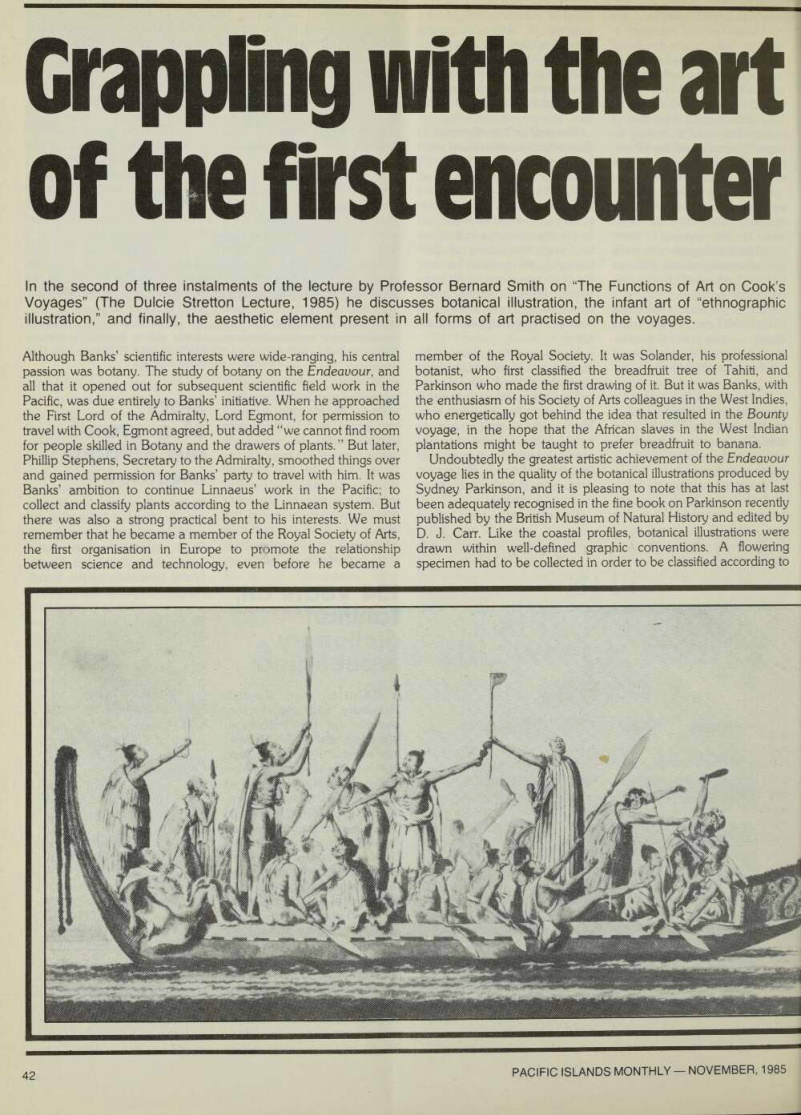
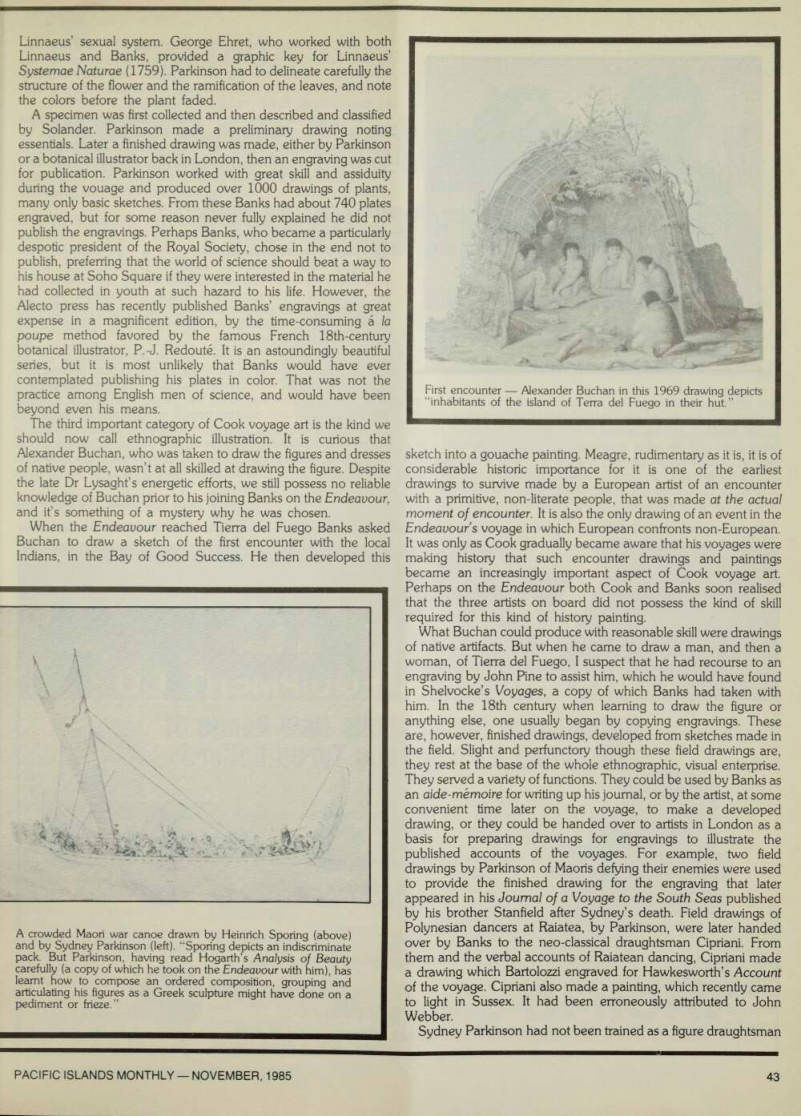

of the first encounter
In the second of three instalments of the lecture by Professor Bernard Smith on “The Functions of Art on Cook’s Voyages” (The Dulcie Stretton Lecture, 1985) he discusses botanical illustration, the infant art of “ethnographic illustration,” and finally, the aesthetic element present in all forms of art practised on the voyages.
Although Banks’ scientific interests were wide-ranging, his central passion was botany. The study of botany on the Endeavour , and all that it opened out for subsequent scientific field work in the Pacific, was due entirely to Banks’ initiative. When he approached the First Lord of the Admiralty, Lord Egmont, for permission to travel with Cook, Egmont agreed, but added “we cannot find room for people skilled in Botany and the drawers of plants. ” But later, Phillip Stephens, Secretary to the Admiralty, smoothed things over and gained permission for Banks’ party to travel with him. It was Banks’ ambition to continue Linnaeus’ work in the Pacific; to collect and classify plants according to the Linnaean system. But there was also a strong practical bent to his interests. We must remember that he became a member of the Royal Society of Arts, the first organisation in Europe to promote the relationship between science and technology, even before he became a
member of the Royal Society. It was Solander, his professional botanist, who first classified the breadfruit tree of Tahiti, and Parkinson who made the first drawing of it. But it was Banks, with the enthusiasm of his Society of Arts colleagues in the West Indies, who energetically got behind the idea that resulted in the Bounty voyage, in the hope that the African slaves in the West Indian plantations might be taught to prefer breadfruit to banana.
Undoubtedly the greatest artistic achievement of the Endeavour voyage lies in the quality of the botanical illustrations produced by Sydney Parkinson, and it is pleasing to note that this has at last been adequately recognised in the fine book on Parkinson recently published by the British Museum of Natural History and edited by D. J. Carr. Like the coastal profiles, botanical illustrations were drawn within well-defined graphic conventions. A flowering specimen had to be collected in order to be classified according to
Linnaeus’ sexual system. George Ehret, who worked with both Linnaeus and Banks, provided a graphic key for Linnaeus’
Systemae Naturae (1759). Parkinson had to delineate carefully the structure of the flower and the ramification of the leaves, and note the colors before the plant faded.
A specimen was first collected and then described and classified by Solander. Parkinson made a preliminary drawing noting essentials. Later a finished drawing was made, either by Parkinson or a botanical illustrator back in London, then an engraving was cut for publication. Parkinson worked with great skill and assiduity during the vouage and produced over 1000 drawings of plants, many only basic sketches. From these Banks had about 740 plates engraved, but for some reason never fully explained he did not publish the engravings. Perhaps Banks, who became a particularly despotic president of the Royal Society, chose in the end not to publish, preferring that the world of science should beat a way to his house at Soho Square if they were interested in the material he had collected in youth at such hazard to his life. However, the Alecto press has recently published Banks’ engravings at great expense in a magnificent edition, by the time-consuming a la poupe method favored by the famous French 18th-century botanical illustrator, P.-J. Redoute. It is an astoundingly beautiful series, but it is most unlikely that Banks would have ever contemplated publishing his plates in color. That was not the practice among English men of science, and would have been beyond even his means.
The third important category of Cook voyage art is the kind we should now call ethnographic illustration. It is curious that Alexander Buchan, who was taken to draw the figures and dresses of native people, wasn’t at all skilled at drawing the figure. Despite the late Dr Lysaght’s energetic efforts, we still possess no reliable knowledge of Buchan prior to his joining Banks on the Endeavour, and it’s something of a mystery why he was chosen.
When the Endeavour reached Tierra del Fuego Banks asked Buchan to draw a sketch of the first encounter with the local Indians, in the Bay of Good Success. He then developed this
sketch into a gouache painting. Meagre, rudimentary as it is, it is of considerable historic importance for it is one of the earliest drawings to survive made by a European artist of an encounter with a primitive, non-literate people, that was made at the actual moment of encounter. It is also the only drawing of an event in the Endeavours voyage in which European confronts non-European.
It was only as Cook gradually became aware that his voyages were making history that such encounter drawings and paintings became an increasingly important aspect of Cook voyage art.
Perhaps on the Endeavour both Cook and Banks soon realised that the three artists on board did not possess the kind of skill required for this kind of history painting.
What Buchan could produce with reasonable skill were drawings of native artifacts. But when he came to draw a man, and then a woman, of Tierra del Fuego, I suspect that he had recourse to an engraving by John Pine to assist him, which he would have found in Shelvocke’s Voyages, a copy of which Banks had taken with him. In the 18th century when learning to draw the figure or anything else, one usually began by copying engravings. These are, however, finished drawings, developed from sketches made in the field. Slight and perfunctory though these field drawings are, they rest at the base of the whole ethnographic, visual enterprise.
They served a variety of functions. They could be used by Banks as an aide-memoire for writing up his journal, or by the artist, at some convenient time later on the voyage, to make a developed drawing, or they could be handed over to artists in London as a basis for preparing drawings for engravings to illustrate the published accounts of the voyages. For example, two field drawings by Parkinson of Maoris defying their enemies were used to provide the finished drawing for the engraving that later appeared in his Journal of a Voyage to the South Seas published by his brother Stanfield after Sydney’s death. Field drawings of Polynesian dancers at Raiatea, by Parkinson, were later handed over by Banks to the neo-classical draughtsman Cipriani. From them and the verbal accounts of Raiatean dancing, Cipriani made a drawing which Bartolozzi engraved for Hawkesworth’s Account of the voyage. Cipriani also made a painting, which recently came to light in Sussex. It had been erroneously attributed to John Webber.
Sydney Parkinson had not been trained as a figure draughtsman
A crowded Maori war canoe drawn by Heinrich Sporing (above) and by Sydney Parkinson (left). “Sporing depicts an indiscriminate pack. But Parkinson, having read Hogarth’s Analysis of Beauty carefully (a copy of which he took on the Endeavour with him), has learnt how to compose an ordered composition, grouping and articulating his figures as a Greek sculpture might have done on a pediment or frieze.”
First encounter - Alexander Buchan in this 1969 drawing depicts “inhabitants of the island of Terra del Fuego in their hut.”
and although he drew some figures for Banks at Banks’ special request, I am convinced that he considered that his responsibility to Banks stopped with his natural history drawing for which he was being paid; and his other drawings were made for himself with a view to publication in his own journal. This was Stanfield’s view and I think that it is the correct one, and dealt with it in some detail in Volume I of the Art of Captain Cook’s Voyages. Most historians tend to favor or exonerate Banks in his quarrel with Stanfield
Parkinson and thus obscure the independent contribution that Sydney Parkinson made to the voyage. In a parallel fashion, but for different reasons, the important scientific work of the Forsters, father and son, on the second voyage, has tended to be obscured by over-patriotic British or imperial historians.
Although all the categories of art practised on Cook’s voyages were primarily of a documentary and informational character, an aesthetic element is everywhere present, and it may be seen at work tending to combine the documentary categories into a new kind of landscape and figure painting, the kind which I have called typical landscape, and becomes common in Europe and elsewhere during the first half of the 19th century.
Consider Parkinson. Though trained as a botanical illustrator he clearly possessed aspirations to become an artist in the Royal Academy sense of the word. Many of his wash drawings were obviously made entirely for aesthetic pleasure, such as his picturesque View up the (Matauai) River among Rocks. More often he combined a sense of picturesque composition with the requirements of documentary art as in his drawing of a Marae in Raiatea. Here he is already foreshadowing the kind of landscape I have called typical landscape.
We may notice Parkinson’s feeling for aesthetic form by comparing the drawing by Heinrich Sporing (whom Banks called in to draw for him after Buchan’s death Sporing was Banks’s secretary) of a crowded Maori war canoe, with one of a similar subject by Parkinson. Sporing depicts an indiscriminate pack. But Parkinson, having read Hogarth’s Analysis of Beauty carefully (a copy of which he took on the Endeavour with him), has leamt how to compose an ordered composition, grouping and articulating his figures as a Greek sculptor might have done on a pediment or frieze. • To be concluded, PIM December
Engraving by Thomas Chambers, 1773, based on Parkinson: “A Man, Woman & Child, Natives of Terra del Feugo in the Dress of that Country.”
Advertisements & other items, p. 44 (1 item)
Pacific
CONSTRUCTION EQUIPMENT CO
introducing the Dynamic Hew Range ot
Vibrating & Pneumatic Tyred Rollers
THE RANGE
• Pacific Self-Propelled Vibrating Rollers • Single and Double Drum Types • 1.5 tonne to 16 tonne • Pacific Self-Propelled Pneumatic Type Compactors • 3 Models 16. 21. 38 tonne Ballast Weights • Pacific Landfill and Sanitary Landfill Compactors • Pacific Pneumatic Earth Borers • Pacific Road Brooms • Pacific Railway Maintenance Vehicles
DISTRIBUTORS REQUIRED
THROUGHOUT THE PACIFIC
Construction Equipment Co. 24 Salisbury Road, Hornsby NSW 2077, Australia. Phone (02) 476 2666
SAL
&FLSTS3E
the experience
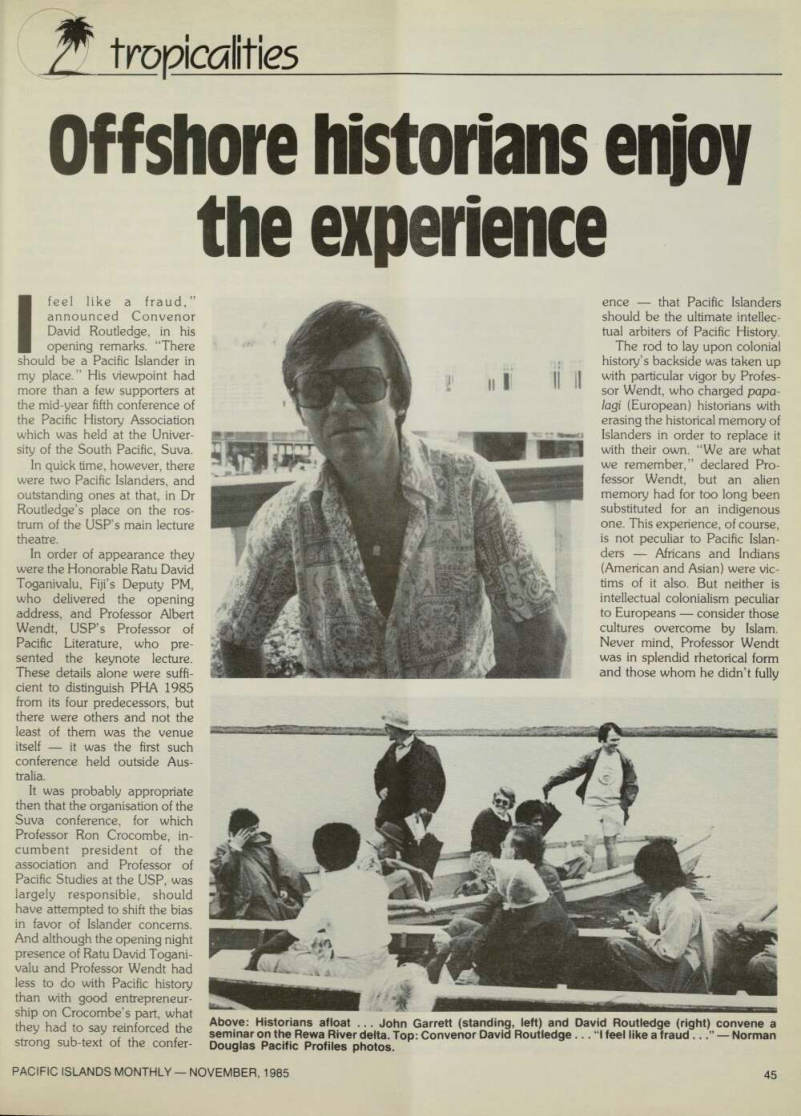
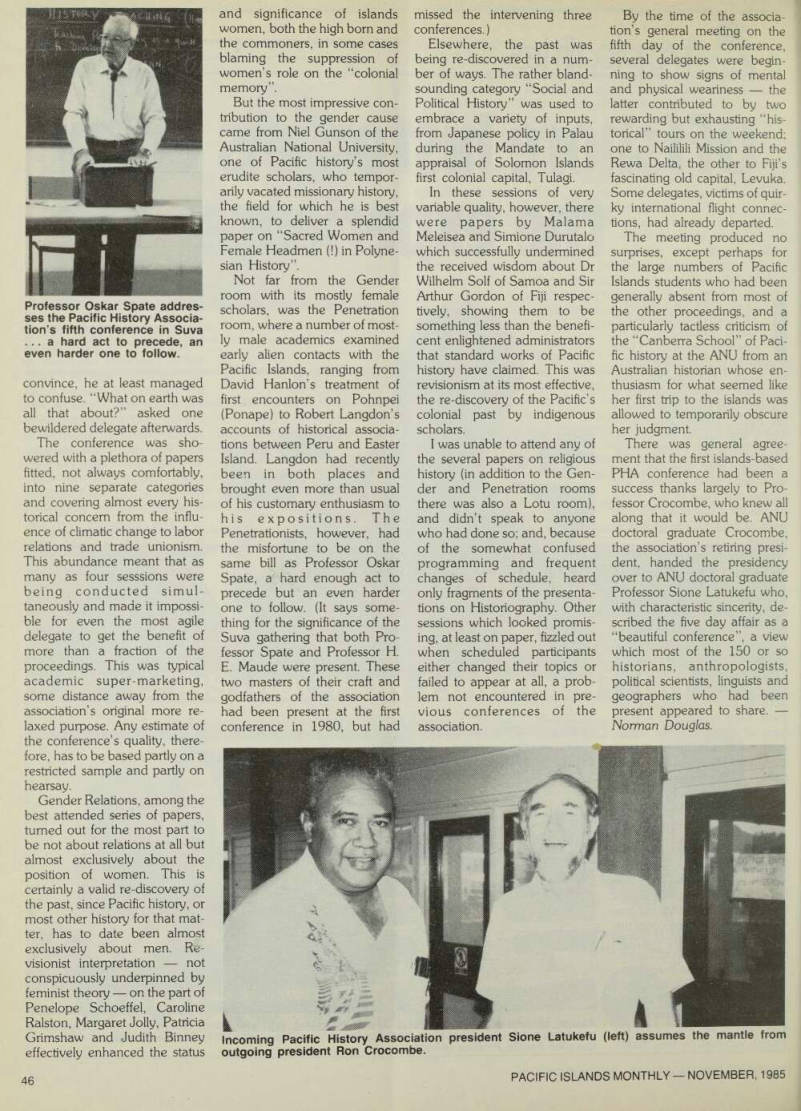
tropicalities
Offshore historians enjoy the experience
I feel like a fraud,” announced Convenor David Routledge, in his opening remarks. “There should be a Pacific Islander in my place.” His viewpoint had more than a few supporters at the mid-year fifth conference of the Pacific History Association which was held at the Univer sity of the South Pacific, Suva.
In quick time, however, there were two Pacific Islanders, and outstanding ones at that, in Dr Routledge’s place on the ros trum of the USP’s main lecture theatre.
In order of appearance they were the Honorable Ratu David Toganivalu, Fiji’s Deputy PM, who delivered the opening address, and Professor Albert Wendt, USP’s Professor of Pacific Literature, who pre sented the keynote lecture.
These details alone were suffi cient to distinguish PHA 1985 from its four predecessors, but there were others and not the least of them was the venue itself it was the first such conference held outside Aus tralia.
It was probably appropriate then that the organisation of the Suva conference, for which Professor Ron Crocombe, in cumbent president of the association and Professor of Pacific Studies at the USP, was largely responsible, should have attempted to shift the bias in favor of Islander concerns.
And although the opening night presence of Ratu David Togani valu and Professor Wendt had less to do with Pacific history than with good entrepreneur ship on Crocombe’s part, what they had to say reinforced the strong sub-text of the confer-
ence that Pacific Islanders should be the ultimate intellec tual arbiters of Pacific History.
The rod to lay upon colonial history’s backside was taken up with particular vigor by Profes sor Wendt, who charged papa lagi (European) historians with erasing the historical memory of Islanders in order to replace it with their own. “We are what we remember,” declared Pro fessor Wendt, but an alien memory had for too long been substituted for an indigenous one. This experience, of course, is not peculiar to Pacific Islan ders Africans and Indians (American and Asian) were vic tims of it also. But neither is intellectual colonialism peculiar to Europeans consider those cultures overcome by Islam.
Never mind, Professor Wendt was in splendid rhetorical form and those whom he didn’t fully
Above: Historians afloat ... John Garrett (standing, left) and David Routledge (right) convene a seminar on the Rewa River delta. Top: Convenor David Routledge... “I feel like a fraud ...” - Norman Douglas Pacific Profiles photos.
convince, he at least managed to confuse. “What on earth was all that about?” asked one bewildered delegate afterwards.
The conference was sho wered with a plethora of papers fitted, not always comfortably, into nine separate categories and covering almost every his torical concern from the influ ence of climatic change to labor relations and trade unionism.
This abundance meant that as many as four sesssions were being conducted simul taneously and made it impossi ble for even the most agile delegate to get the benefit of more than a fraction of the proceedings. This was typical academic super-marketing, some distance away from the association’s original more re laxed purpose. Any estimate of the conference’s quality, there fore, has to be based partly on a restricted sample and partly on hearsay.
Gender Relations, among the best attended series of papers, turned out for the most part to be not about relations at all but almost exclusively about the position of women. This is certainly a valid re-discovery of the past, since Pacific history, or most other history for that mat ter, has to date been almost exclusively about men. Re visionist interpretation not conspicuously underpinned by feminist theory on the part of Penelope Schoeffel, Caroline Ralston, Margaret Jolly, Patricia Grimshaw and Judith Binney effectively enhanced the status
and significance of islands women, both the high born and the commoners, in some cases blaming the suppression of women’s role on the “colonial memory”.
But the most impressive con tribution to the gender cause came from Niel Gunson of the Australian National University, one of Pacific history’s most erudite scholars, who tempor arily vacated missionary history, the field for which he is best known, to deliver a splendid paper on “Sacred Women and Female Headmen (!) in Polyne sian History”.
Not far from the Gender room with its mostly female scholars, was the Penetration room, where a number of most ly male academics examined early alien contacts with the Pacific Islands, ranging from David Hanlon’s treatment of first encounters on Pohnpei (Ponape) to Robert Langdon’s accounts of historical associa tions between Peru and Easter Island. Langdon had recently been in both places and brought even more than usual of his customary enthusiasm to his expositions. The Penetrationists, however, had the misfortune to be on the same bill as Professor Oskar Spate, a hard enough act to precede but an even harder one to follow. (It says some thing for the significance of the Suva gathering that both Pro fessor Spate and Professor H.
E. Maude were present. These two masters of their craft and godfathers of the association had been present at the first conference in 1980, but had
missed the intervening three conferences.) Elsewhere, the past was being re-discovered in a num ber of ways. The rather bland sounding category “Social and Political History” was used to embrace a variety of inputs, from Japanese policy in Palau during the Mandate to an appraisal of Solomon Islands first colonial capital, Tulagi.
In these sessions of very variable quality, however, there were papers by Malama Meleisea and Simione Durutalo which successfully undermined the received wisdom about Dr Wilhelm Solf of Samoa and Sir Arthur Gordon of Fiji respec tively, showing them to be something less than the benefi cent enlightened administrators that standard works of Pacific history have claimed. This was revisionism at its most effective, the re-discovery of the Pacific’s colonial past by indigenous scholars.
I was unable to attend any of the several papers on religious history (in addition to the Gen der and Penetration rooms there was also a Lotu room), and didn’t speak to anyone who had done so; and, because of the somewhat confused programming and frequent changes of schedule, heard only fragments of the presenta tions on Historiography. Other sessions which looked promis ing, at least on paper, fizzled out when scheduled participants either changed their topics or failed to appear at all, a prob lem not encountered in pre vious conferences of the association.
By the time of the associa tion’s general meeting on the fifth day of the conference, several delegates were begin ning to show signs of mental and physical weariness the latter contributed to by two rewarding but exhausting “his torical” tours on the weekend; one to Naililili Mission and the Rewa Delta, the other to Fiji’s fascinating old capital, Levuka.
Some delegates, victims of quir ky international flight connec tions, had already departed.
The meeting produced no surprises, except perhaps for the large numbers of Pacific Islands students who had been generally absent from most of the other proceedings, and a particularly tactless criticism of the “Canberra School” of Paci fic history at the AND from an Australian historian whose en thusiasm for what seemed like her first trip to the islands was allowed to temporarily obscure her judgment.
There was general agree ment that the first islands-based PHA conference had been a success thanks largely to Pro fessor Crocombe, who knew all along that it would be. ANU doctoral graduate Crocombe, the association’s retiring presi dent, handed the presidency over to ANU doctoral graduate Professor Sionc Latukefu who, with characteristic sincerity, de scribed the five day affair as a “beautiful conference”, a view which most of the 150 or so historians, anthropologists, political scientists, linguists and geographers who had been present appeared to share.
Norman Douglas.
Professor Oskar Spate addres ses the Pacific History Associa tion’s fifth conference in Suva ... a hard act to precede, an even harder one to follow.
Incoming Pacific History Association president Sione Latukefu (left) assumes the mantle from outgoing president Ron Crocombe.
Fiji’s Fabulous
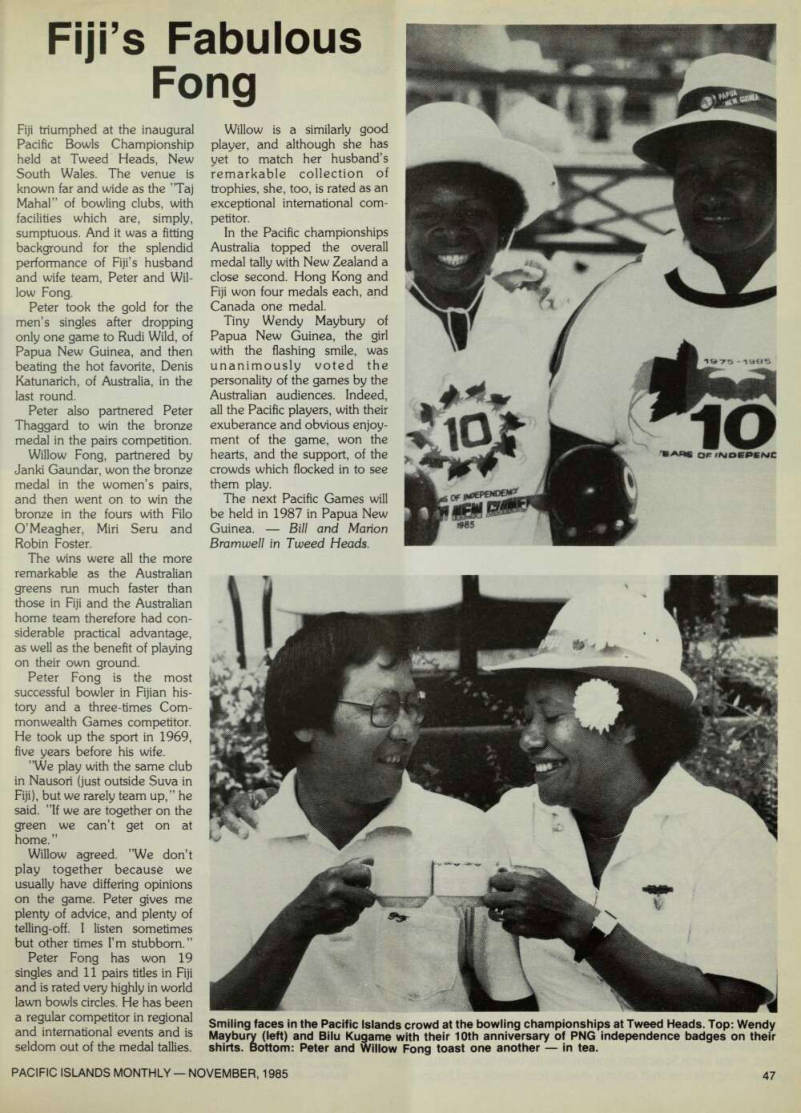
Fong
Fiji triumphed at the inaugural Pacific Bowls Championship held at Tweed Heads, New South Wales. The venue is known far and wide as the ”Taj Mahal” of bowling clubs, with facilities which are, simply, sumptuous. And it was a fitting background for the splendid performance of Fiji’s husband and wife team, Peter and Wil low Fong.
Peter took the gold for the men’s singles after dropping only one game to Rudi Wild, of Papua New Guinea, and then beating the hot favorite, Denis Katunarich, of Australia, in the last round.
Peter also partnered Peter Thaggard to win the bronze medal in the pairs competition.
Willow Fong, partnered by Janki Gaundar, won the bronze medal in the women’s pairs, and then went on to win the bronze in the fours with Filo O’Meagher, Miri Seru and Robin Foster.
The wins were all the more remarkable as the Australian greens run much faster than those in Fiji and the Australian home team therefore had con siderable practical advantage, as well as the benefit of playing on their own ground.
Peter Fong is the most successful bowler in Fijian his tory and a three-times Com monwealth Games competitor.
He took up the sport in 1969, five years before his wife. ”We play with the same club in Nausori (just outside Suva in Fiji), but we rarely team up,” he said. ”If we are together on the green we can’t get on at home.”
Willow agreed. ”We don’t play together because we usually have differing opinions on the game. Peter gives me plenty of advice, and plenty of telling-off. I listen sometimes but other times I’m stubborn.”
Peter Fong has won 19 singles and 11 pairs titles in Fiji and is rated very highly in world lawn bowls circles. He has been a regular competitor in regional and international events and is seldom out of the medal tallies.
Willow is a similarly good player, and although she has yet to match her husband’s remarkable collection of trophies, she, too, is rated as an exceptional international com petitor.
In the Pacific championships Australia topped the overall medal tally with New Zealand a close second. Hong Kong and Fiji won four medals each, and Canada one medal.
Tiny Wendy Maybury of Papua New Guinea, the girl with the flashing smile, was unanimously voted the personality of the games by the Australian audiences. Indeed, all the Pacific players, with their exuberance and obvious enjoy ment of the game, won the hearts, and the support, of the crowds which flocked in to see them play.
The next Pacific Games will be held in 1987 in Papua New
Guinea.
Bill and Marion
Bramwell in Tweed Heads.
Smiling faces in the Pacific Islands crowd at the bowling championships at Tweed Heads. Top: Wendy Maybury (left) and Bilu Kugame with their 10th anniversary of PNG independence badges on their shirts. Bottom: Peter and Willow Fong toast one another - in tea.
Advertisements & other items, p. 48 (1 item)
Kenwood
I Highlights of Spectrum 94W8 shown; ■ CD, video, 2 tape inputs ■ 125W/channel RMS (8 ohms, 20Hz-20kHz) 0.05% THD ■opripc P Direct access synthesizer tuning itro B io-station random preset memory ■ Double auto-reverse cassette deck ■ Double-speed Rubbing ■ Continuous tape relay play ■ Programmable linear tracking turntable ■ Recording from turntable ■ Graphic equalizer (option) ■CD player wifh Bch memory (option) ■ Audio timer (option) ■ 130 W bass'reflex speaker system For the true colors of music —
Kenwood Spectrum stereo systems.
When you look at what Kenwood Spectrum stereo systems offer,
you’ll wonder why you delayed.
They have computerized and electronic functions to make operation easy for you. And they’re highly versatile, too.
But in these days of electronic wizardry, it’s easy to forget what hi-fi stereo is really all about: music reproduction, pure and simple.
You’ll find that Kenwood Spectrum systems, designed by some of the world’s most uncompromising audio specialists, are performers
of outstanding ability.
And, since each Spectrum system has its own special character, you can find the one that exactly meets your needs and budget.
TRIO-KENWOOD CORPORATION
Shionogi Shibuya Building. 17-5, 2-chome Shibuya. Shibuya-ku, Tokyo 150, Japan TRIO-KENWOOD (AUSTRALIA) PTY, LTD. (incorporated in n.s.w.) 4E Woodcock Place, Lane Cove, N S W. 2066, Australia NEW ZEALAND JOHN GILBERT & CO., LTD. Auckland Tel. 0011-64-9-30839 FUJI PEPE’S DUTY FREE CENTRE LTD. Tel. 25496, 25497 PAPUA NEW GUINEA SO. SVENSSON (N.G.) LTD. Port Moresby Tel. 212158, 212111 SOLOMON ISLANDS TECHNIQUE RADIOS CENTRE LTD. Honiara Tel. 416 NEW CALEDONIA HI-FI VOX Noumea Tel. 27-2466, 28-2931 VANUATU FUNG CHOI LUEN. Port-Vila Tel. 2556
TAHITI MAISON AURORE Papeete Tel. 29703
AMERICAN SAMOA ISLAND PACIFIC AGENCIES, INC. Pago Pago Tel. 633-4687
REPUBLIC OF NAURU NAURU CO-OPERATIVE SOCIETY
MARIANA ISLANDS J.C. TENORIO ENTERPRISES Saipan Tel. 6445
Maori-Hawaiian ties
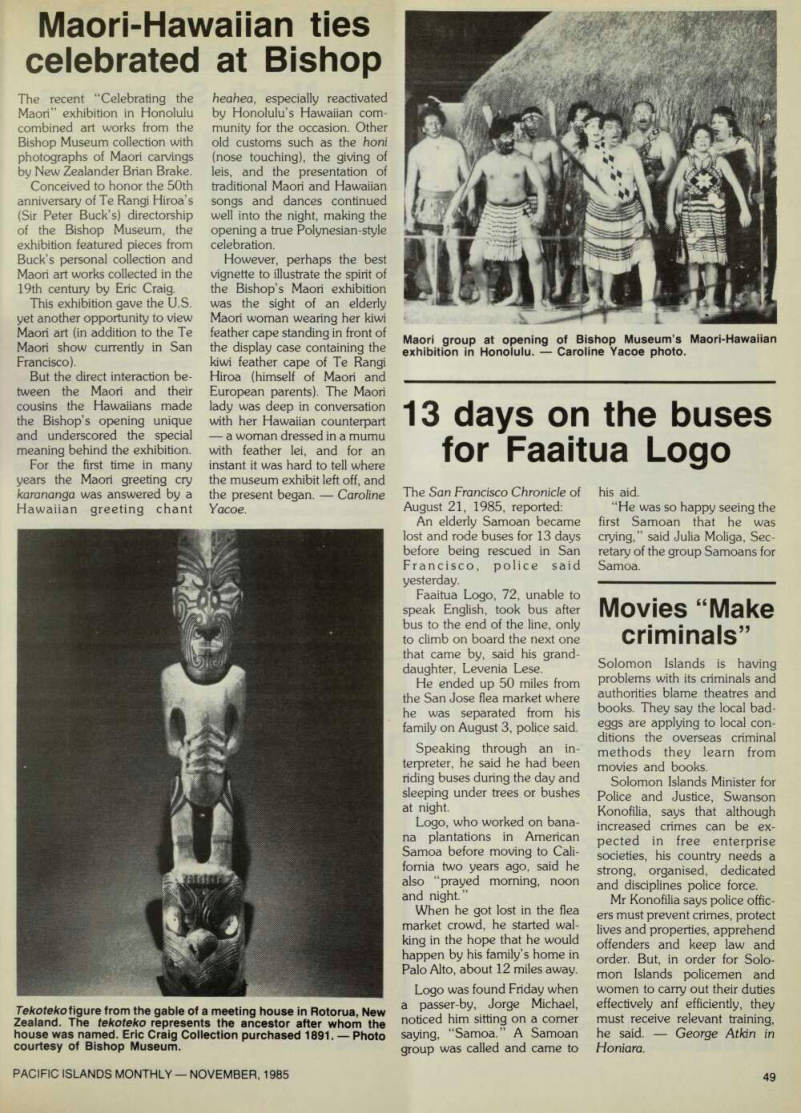
celebrated at Bishop
The recent “Celebrating the Maori” exhibition in Honolulu combined art works from the Bishop Museum collection with photographs of Maori carvings by New Zealander Brian Brake.
Conceived to honor the 50th anniversary of Te Rangi Hiroa’s (Sir Peter Buck’s) directorship of the Bishop Museum, the exhibition featured pieces from Buck’s personal collection and Maori art works collected in the 19th century by Eric Craig.
This exhibition gave the U.S. yet another opportunity to view Maori art (in addition to the Te Maori show currently in San Francisco).
But the direct interaction be tween the Maori and their cousins the Hawaiians made the Bishop’s opening unique and underscored the special meaning behind the exhibition.
For the first time in many years the Maori greeting cry karananga was answered by a Hawaiian greeting chant
heahea , especially reactivated by Honolulu’s Hawaiian com munity for the occasion. Other old customs such as the honi (nose touching), the giving of leis, and the presentation of traditional Maori and Hawaiian songs and dances continued well into the night, making the opening a true Polynesian-style celebration.
However, perhaps the best vignette to illustrate the spirit of the Bishop’s Maori exhibition was the sight of an elderly Maori woman wearing her kiwi feather cape standing in front of the display case containing the kiwi feather cape of Te Rangi Hiroa (himself of Maori and European parents). The Maori lady was deep in conversation with her Hawaiian counterpart a woman dressed in a mumu with feather lei, and for an instant it was hard to tell where the museum exhibit left off, and
the present began.
Caroline
Yacoe.
Tekoteko figure from the gable of a meeting house in Rotorua, New Zealand. The tekoteko represents the ancestor after whom the house was named. Eric Craig Collection purchased 1891. - Photo courtesy of Bishop Museum.
Maori group at opening of Bishop Museum’s Maori-Hawaiian exhibition in Honolulu. - Caroline Yacoe photo.
13 days on the buses
for Faaitua Logo
The San Francisco Chronicle of August 21, 1985, reported: An elderly Samoan became lost and rode buses for 13 days before being rescued in San Francisco, police said yesterday.
Faaitua Logo, 72, unable to speak English, took bus after bus to the end of the line, only to climb on board the next one that came by, said his grand daughter, Levenia Lese.
He ended up 50 miles from the San Jose flea market where he was separated from his family on August 3, police said.
Speaking through an in terpreter, he said he had been riding buses during the day and sleeping under trees or bushes at night.
Logo, who worked on bana na plantations in American Samoa before moving to Cali fornia two years ago, said he also “prayed morning, noon and night.”
When he got lost in the flea market crowd, he started wal king in the hope that he would happen by his family’s home in Palo Alto, about 12 miles away.
Logo was found Friday when a passer-by, Jorge Michael, noticed him sitting on a comer saying, “Samoa.” A Samoan group was called and came to
his aid.
“He was so happy seeing the first Samoan that he was crying,” said Julia Moliga, Sec retary of the group Samoans for Samoa.
Movies “Make
criminals”
Solomon Islands is having problems with its criminals and authorities blame theatres and books. They say the local bad eggs are applying to local con ditions the overseas criminal methods they learn from movies and books.
Solomon Islands Minister for Police and Justice, Swanson Konofilia, says that although increased crimes can be ex pected in free enterprise societies, his country needs a strong, organised, dedicated and disciplines police force.
Mr Konofilia says police offic ers must prevent crimes, protect lives and properties, apprehend offenders and keep law and order. But, in order for Solo mon Islands policemen and women to carry out their duties effectively anf efficiently, they must receive relevant training,
he said.
George Atkin in
Honiara.
Viles Tok Ples Skul
is up and running in North Solomons
Ruth Saovana
SPRIGGS, co-ordinator of the Viles Tok Pies Skul (VTPS) project in Papua New Guinea’s North Solo mons Province, explains how the project works. She wants to make educators in other South Pacific coun tries “aware that there are ways of maintaining local languages and traditional customs and cultures.”
If modem civilisation, educa tion, money, training in English and such things cannot afford an average person in the North Solomons Province of Papua New Guinea equal opportunity for the benefits and privileges of modem life such as higher education and a secure place in the job-sector of the economy what is there to offer them?
Babies draw their strength from mothers. The Viles Tok Pies Skul (VTPS) is like the “Mother of Resources.” Viles (village) Tok (talk) Pies (place) Skul (school) the VTPS are Schools of the Mother Tongue.
In these schools the children are taught to read, write and count in their local languages together with traditional history, culture and customs, traditional children’s games, songs and dances, with the addition of some Western pre-school skills some elements of science for example. It is a program de signed for the two years before the child enters community school.
About five years ago the VTPS were established in the North Solomons Province. The project was born purely out of the constant demands for such schools by local people in the North Solomons Province. The high demand for education of this kind arose from the unmis takable fact of the rapid loss of local languages, customs and culture, traditional lore, and the like. It arose from loss of pride, but also from love of the local languages and traditional ways of living.
Earlier this year an ethnomu sicologist from Australia, Mr B.
Lobban, had an encounter with a lad who has had VTPS education, and is now in grade two in community (elementary) school. Mr Lobban wrote: “The old saying, the proof of the pudding is in the eating, came immediately to my mind when I was travelling recently in the Haku language area of Buka. This area is one of the first to have a Viles Tok Pies Skul, with the program now in its fourth year.
“A colleague and I were staying with a local family whose nine-year-old grandson, Albert, had had two years train ing at VTPS before moving to the local community school. Of an evening while I was writing up my journal he would share the lantern light, beg paper and a pen, and then write sent ences, only occasionally asking the spelling of a word.
“Often during our stay Albert said he wanted his photograph taken and finally I suggested that he and a small friend come down to the beach for a series of action pictures. They were both very pleased with this and were very vocal during the event.
“Walking back from the beach, and as we climbed the cliff, Albert talked non-stop in English. He chatted generally about the plants, wild life and village life. He was obviously thinking in English and his use of the language was much more sophisticated than what one normally hears in rural areas from nine-year-old boys. Com paring ALbert’s English lan guage use with boys of his age from other parts of both PNG and other countries in the southwest Pacific showed he had a much better grasp of the structure of the language. His only real difference from these other boys was in his VTPS education program. He had first learnt formal language and writ ing skills in his own language at VTPS schools before having to cope with the new language.”
Advertisements & other items, p. 50 (1 item)
jwsna
n IN I I 11 I4^
LOCAL AGENTS AND
REPRESENTATION
428 George St., Sydney.
Cables: Henco Sydney.
G.P.O. Box 3949.
Telephone: 232 5377.
PAPUA NEW GUINEA
RABAUL: M. & C. Seeto, P.O. Box 131, Rabaul.
Telephone 92 2919.
MADANG; W. Double.
P.O. Box 22, Madang.
Telephone 82 2696.
FIJI
K. Witherington Ltd., P.O. Box 293, Suva.
Telephone 22 356.
For specialised and
personalised buying
service throughout
the Pacific Islands and the East.
Resident Agents in other Pacific Territories.
VANUATU
John Lum & Associates, P.O. Box 65, Santo.
Telephone 329.
SOLOMON ISLANDS
Mr. Tom Lo, P.O. Box 327, Honiara.
Telephone 399
Ipoirrers
FORESTMIL
PORTABLE
SAWMILL
A Self Contained Sawmill complete
with Diesel Engine or Electric Motor.
L
frr
Forestmil produces any size ready to use accurate timber up to 12" x 9” x 24'.
Purchase price and operating cost is less than other sawing machines with similar production capacity.
Design features in latest models is result of 23 years' Forestmil manufacturing experience.
Forestmil reduces timber waste and log transport cost. Timber is sawn direct from the log in the forest.
Forestmil can be moved to a new area in one hour.
Forestmil will saw hardwood or softwood logs of any diameter.
Large number of Forestmils are operating in many countries.
For literature and prices please contact the manufacturers.
Mac Quarrie Industries Pty.Ltd.
P.O Box 20, Coburg 3058, Victoria, Australia.
Ph: (03) 353 0666 Tlx: AA33729 Cables: Macbound, Melbourne.
stampede?
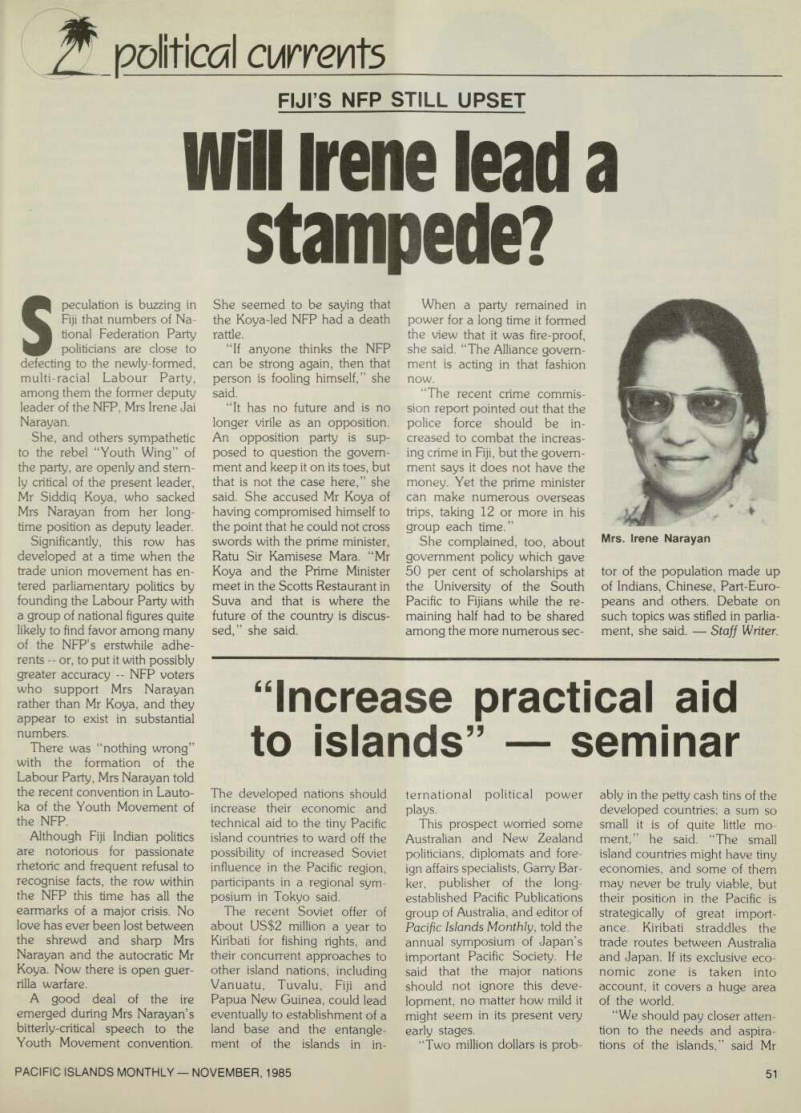
political currents
Fiji’S Nfp Still Upset
Will Irene lead a stampede?
Speculation is buzzing in Fiji that numbers of Na tional Federation Party politicians are close to defecting to the newly-formed, multi-racial Labour Party, among them the former deputy leader of the NFP, Mrs Irene Jai Narayan.
She, and others sympathetic to the rebel “Youth Wing” of the party, are openly and stern ly critical of the present leader, Mr Siddiq Koya, who sacked Mrs Narayan from her long time position as deputy leader.
Significantly, this row has developed at a time when the trade union movement has en tered parliamentary politics by founding the Labour Party with a group of national figures quite likely to find favor among many of the NFP’s erstwhile adhe rents or, to put it with possibly greater accuracy - NFP voters who support Mrs Narayan rather than Mr Koya, and they appear to exist in substantial numbers.
There was “nothing wrong” with the formation of the Labour Party, Mrs Narayan told the recent convention in Lauto ka of the Youth Movement of the NFP.
Although Fiji Indian politics are notorious for passionate rhetoric and frequent refusal to recognise facts, the row within the NFP this time has all the earmarks of a major crisis. No love has ever been lost between the shrewd and sharp Mrs Narayan and the autocratic Mr Koya. Now there is open guer rilla warfare.
A good deal of the ire emerged during Mrs Narayan’s bitterly-critical speech to the Youth Movement convention.
She seemed to be saying that the Koya-led NFP had a death rattle.
“If anyone thinks the NFP can be strong again, then that person is fooling himself,” she said.
“It has no future and is no longer virile as an opposition.
An opposition party is sup posed to question the govern ment and keep it on its toes, but that is not the case here,” she said. She accused Mr Koya of having compromised himself to the point that he could not cross swords with the prime minister, Ratu Sir Kamisese Mara. “Mr Koya and the Prime Minister meet in the Scotts Restaurant in Suva and that is where the future of the country is discus sed,” she said.
When a party remained in power for a long time it formed the view that it was fire-proof, she said. “The Alliance govern ment is acting in that fashion now.
“The recent crime commis sion report pointed out that the police force should be in creased to combat the increas ing crime in Fiji, but the govern ment says it does not have the money. Yet the prime minister can make numerous overseas trips, taking 12 or more in his group each time.”
She complained, too, about government policy which gave 50 per cent of scholarships at the University of the South Pacific to Fijians while the re maining half had to be shared among the more numerous sec-
tor of the population made up of Indians, Chinese, Part-Euro peans and others. Debate on such topics was stifled in parlia
ment, she said.
Staff Writer.
Mrs. Irene Narayan
“Increase practical aid
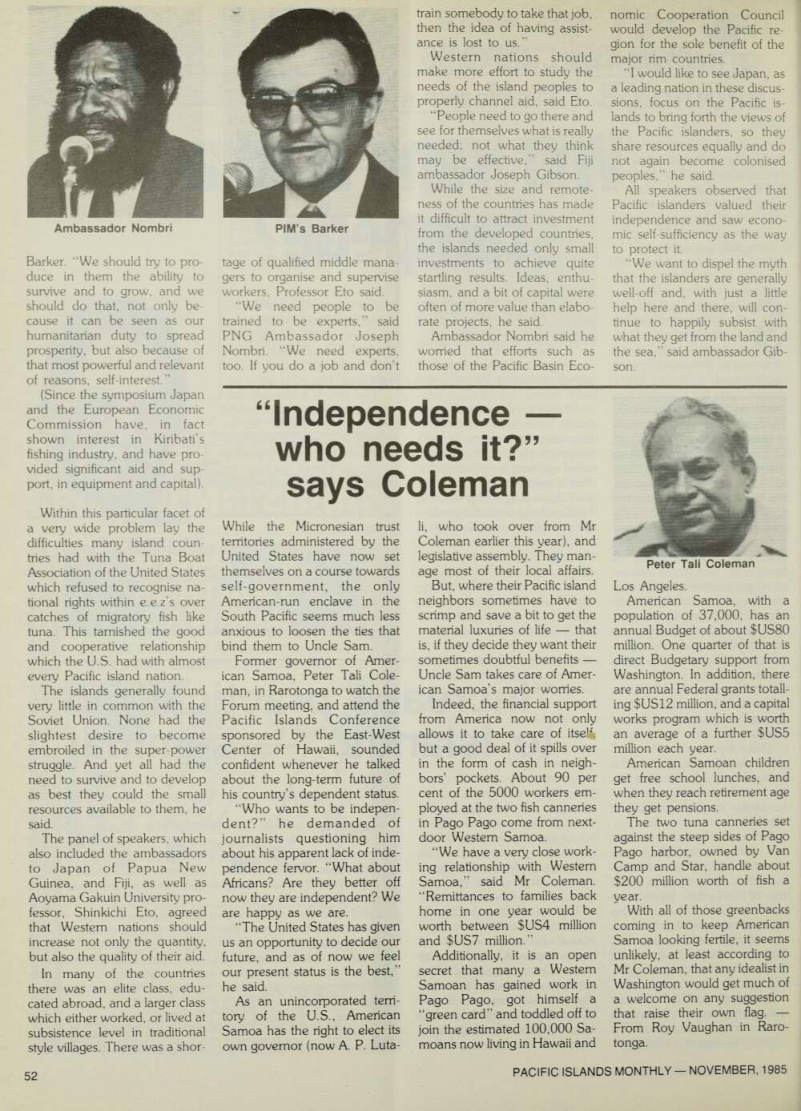
to islands” - seminar
The developed nations should increase their economic and technical aid to the tiny Pacific island countries to ward off the possibility of increased Soviet influence in the Pacific region, participants in a regional sym posium in Tokyo said.
The recent Soviet offer of about US$2 million a year to Kiribati for fishing rights, and their concurrent approaches to other island nations, including Vanuatu, Tuvalu, Fiji and Papua New Guinea, could lead eventually to establishment of a land base and the entangle ment of the islands in in
ternational political power plays.
This prospect worried some Australian and New Zealand politicians, diplomats and fore ign affairs specialists, Garry Bar ker, publisher of the long established Pacific Publications group of Australia, and editor of Pacific Islands Monthly , told the annual symposium of Japan’s important Pacific Society. He said that the major nations should not ignore this deve lopment, no matter how mild it might seem in its present very early stages.
“Two million dollars is prob
ably in the petty cash tins of the developed countries; a sum so small it is of quite little mo ment,” he said. ‘The small island countries might have tiny economies, and some of them may never be truly viable, but their position in the Pacific is strategically of great import ance. Kiribati straddles the trade routes between Australia and Japan. If its exclusive eco nomic zone is taken into account, it covers a huge area of the world. ‘‘We should pay closer atten tion to the needs and aspira tions of the islands,” said Mr
Barker. “We should try to pro duce in them the ability to survive and to grow, and we should do that, not only be cause it can be seen as our humanitarian duty to spread prosperity, but also because of that most powerful and relevant of reasons, self-interest.” (Since the symposium Japan and the European Economic Commission have, in fact shown interest in Kiribati's fishing industry, and have pro vided significant aid and sup port, in equipment and capital).
Within this particular facet of a very wide problem lay the difficulties many island coun tries had with the Tuna Boat Association of the United States which refused to recognise na tional rights within e.e.z’s over catches of migratory fish like tuna. This tarnished the good and cooperative relationship which the U.S. had with almost every Pacific island nation.
The islands generally found very little in common with the Soviet Union. None had the slightest desire to become embroiled in the super-power struggle. And yet all had the need to survive and to develop as best they could the small resources available to them, he said.
The panel of speakers, which also included the ambassadors to Japan of Papua New Guinea, and Fiji, as well as Aoyama Gakuin University pro fessor, Shinkichi Eto, agreed that Western nations should increase not only the quantity, but also the quality of their aid.
In many of the countries there was an elite class, edu cated abroad, and a larger class which either worked, or lived at subsistence level in traditional style villages. There was a shor
tage of qualified middle mana gers to organise and supervise workers. Professor Eto said.
“We need people to be trained to be experts.” said PNG Ambassador Joseph Nombri. "We need experts, too. If you do a job and don’t
train somebody to take that job. then the idea of having assist ance is lost to us.”
Western nations should make more effort to study the needs of the island peoples to properly channel aid, said Eto.
“People need to go there and see for themselves what is really needed; not what they think may be effective,” said Fiji ambassador Joseph Gibson.
While the size and remote ness of the countries has made it difficult to attract investment from the developed countries, the islands needed only small investments to achieve quite startling results. Ideas, enthu siasm, and a bit of capital were often of more value than elabo rate projects, he said.
Ambassador Nombri said he worried that efforts such as those of the Pacific Basin Eco
nomic Cooperation Council would develop the Pacific re gion for the sole benefit of the major rim countries.
“1 would like to see Japan, as a leading nation in these discus sions. focus on the Pacific is lands to bring forth the views of the Pacific islanders, so they share resources equally and do not again become colonised peoples.” he said.
All speakers observed that Pacific islanders valued their independence and saw econo mic self-sufficiency as the way to protect it.
“We want to dispel the myth that the islanders are generally well-off and, with just a little help here and there, will con tinue to happily subsist with what they get from the land and the sea.” said ambassador Gib son.
PIM’s Barker
Ambassador Nombri
“Independence -
“Independence who needs it?” says Coleman
While the Micronesian trust territories administered by the United States have now set themselves on a course towards self-government, the only American-run enclave in the South Pacific seems much less anxious to loosen the ties that bind them to Uncle Sam.
Former governor of Amer ican Samoa, Peter Tali Cole man, in Rarotonga to watch the Forum meeting, and attend the Pacific Islands Conference sponsored by the East-West Center of Hawaii, sounded confident whenever he talked about the long-term future of his country’s dependent status.
“Who wants to be indepen dent?” he demanded of journalists questioning him about his apparent lack of inde pendence fervor. “What about Africans? Are they better off now they are independent? We are happy as we are.
“The United States has given us an opportunity to decide our future, and as of now we feel our present status is the best,” he said.
As an unincorporated terri tory of the U.S., American Samoa has the right to elect its own governor (now A. P. Luta
li, who took over from Mr Coleman earlier this year), and legislative assembly. They man age most of their local affairs.
But, where their Pacific island neighbors sometimes have to scrimp and save a bit to get the material luxuries of life that is, if they decide they want their sometimes doubtful benefits Uncle Sam takes care of Amer ican Samoa’s major worries.
Indeed, the financial support from America now not only allows it to take care of itsei but a good deal of it spills over in the form of cash in neigh bors’ pockets. About 90 per cent of the 5000 workers em ployed at the two fish canneries in Pago Pago come from next door Western Samoa.
“We have a very close work ing relationship with Western Samoa,” said Mr Coleman.
“Remittances to families back home in one year would be worth between SUS 4 million and SUS 7 million.”
Additionally, it is an open secret that many a Western Samoan has gained work in Pago Pago, got himself a “green card” and toddled off to join the estimated 100,000 Sa moans now living in Hawaii and
Los Angeles.
American Samoa, with a population of 37,000, has an annual Budget of about S(JSBO million. One quarter of that is direct Budgetary support from Washington. In addition, there are annual Federal grants totall ing SUSI 2 million, and a capital works program which is worth an average of a further SUSS million each year.
American Samoan children get free school lunches, and when they reach retirement age they get pensions.
The two tuna canneries set against the steep sides of Pago Pago harbor, owned by Van Camp and Star, handle about $2OO million worth of fish a year.
With all of those greenbacks coming in to keep American Samoa looking fertile, it seems unlikely, at least according to Mr Coleman, that any idealist in Washington would get much of a welcome on any suggestion that raise their own flag.
From Roy Vaughan in Raro tonga.
Peter Tali Coleman
people
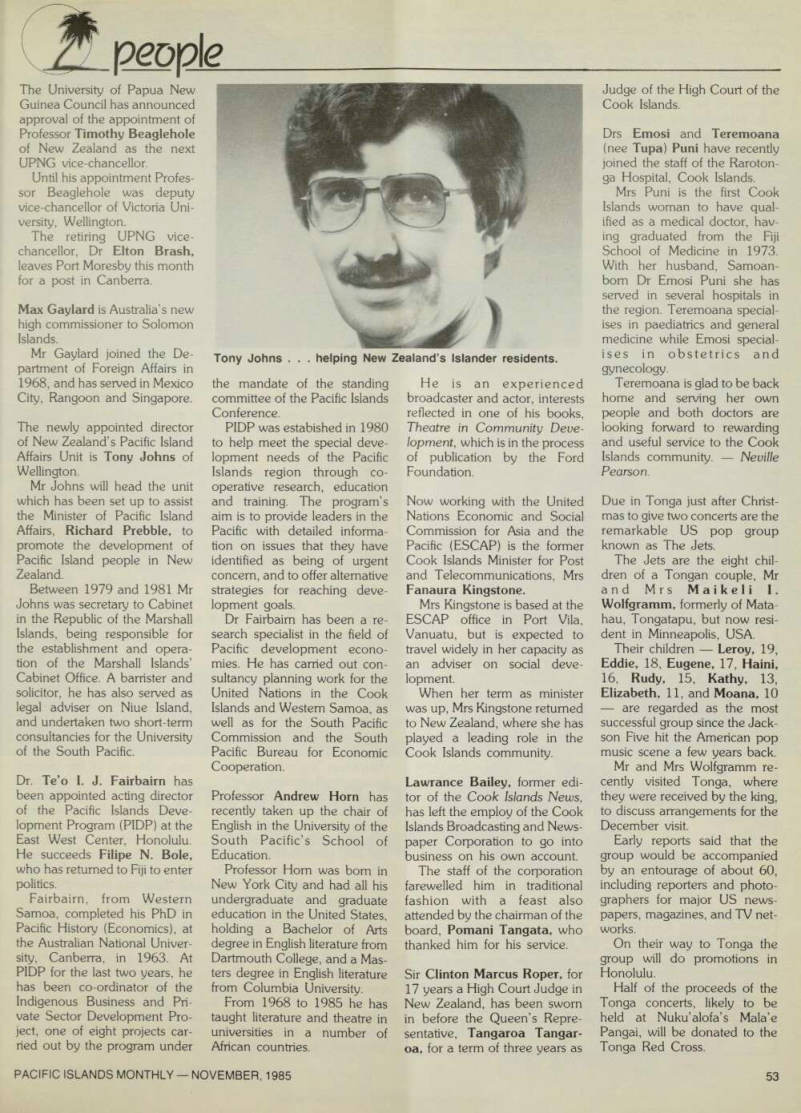
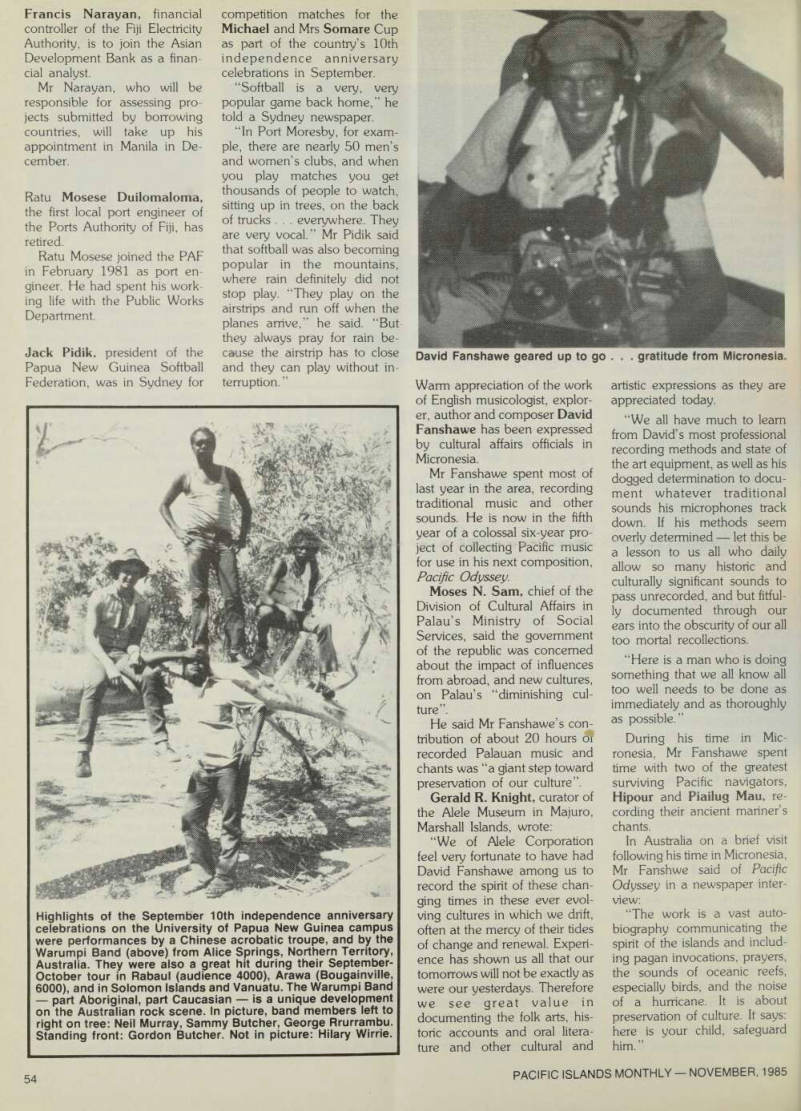
The University of Papua New Guinea Council has announced approval of the appointment of Professor Timothy Beaglehole of New Zealand as the next UPNG vice-chancellor.
Until his appointment Profes sor Beaglehole was deputy vice-chancellor of Victoria Uni versity, Wellington.
The retiring UPNG vice chancellor, Dr Elton Brash, leaves Port Moresby this month for a post in Canberra.
Max Gaylard is Australia’s new high commissioner to Solomon Islands.
Mr Gaylard joined the De partment of Foreign Affairs in 1968, and has served in Mexico City, Rangoon and Singapore.
The newly appointed director of New Zealand’s Pacific Island Affairs Unit is Tony Johns of Wellington.
Mr Johns will head the unit which has been set up to assist the Minister of Pacific Island Affairs, Richard Prebble, to promote the development of Pacific Island people in New Zealand.
Between 1979 and 1981 Mr Johns was secretary to Cabinet in the Republic of the Marshall Islands, being responsible for the establishment and opera tion of the Marshall Islands’
Cabinet Office. A barrister and solicitor, he has also served as legal adviser on Niue Island, and undertaken two short-term consultancies for the University of the South Pacific.
Dr. Te’o I. J. Fairbaim has been appointed acting director of the Pacific Islands Deve lopment Program (PIDP) at the East West Center, Honolulu.
He succeeds Filipe N, Bole, who has returned to Fiji to enter politics.
Fairbaim, from Western Samoa, completed his PhD in Pacific History (Economics), at the Australian National Univer sity, Canberra, in 1963. At PIDP for the last two years, he has been co-ordinator of the Indigenous Business and Pri vate Sector Development Pro ject, one of eight projects car ried out by the program under
the mandate of the standing committee of the Pacific Islands Conference.
PIDP was estabished in 1980 to help meet the special deve lopment needs of the Pacific Islands region through co operative research, education and training. The program’s aim is to provide leaders in the Pacific with detailed informa tion on issues that they have identified as being of urgent concern, and to offer alternative strategies for reaching deve lopment goals.
Dr Fairbaim has been a re search specialist in the field of Pacific development econo mies. He has carried out con sultancy planning work for the United Nations in the Cook Islands and Western Samoa, as well as for the South Pacific Commission and the South Pacific Bureau for Economic Cooperation.
Professor Andrew Horn has recently taken up the chair of English in the University of the South Pacific’s School of Education.
Professor Horn was bom in New York City and had all his undergraduate and graduate education in the United States, holding a Bachelor of Arts degree in English literature from Dartmouth College, and a Mas ters degree in English literature from Columbia University.
From 1968 to 1985 he has taught literature and theatre in universities in a number of African countries.
He is an experienced broadcaster and actor, interests reflected in one of his books, Theatre in Community Deve lopment, which is in the process of publication by the Ford Foundation.
Now working with the United Nations Economic and Social Commission for Asia and the Pacific (ESCAP) is the former Cook Islands Minister for Post and Telecommunications, Mrs Fanaura Kingstone.
Mrs Kingstone is based at the ESCAP office in Port Vila, Vanuatu, but is expected to travel widely in her capacity as an adviser on social deve lopment.
When her term as minister was up, Mrs Kingstone returned to New Zealand, where she has played a leading role in the Cook Islands community.
Lawrance Bailey, former edi tor of the Cook Islands News, has left the employ of the Cook Islands Broadcasting and News paper Corporation to go into business on his own account.
The staff of the corporation farewelled him in traditional fashion with a feast also attended by the chairman of the board, Pomani Tangata, who thanked him for his service.
Sir Clinton Marcus Roper, for 17 years a High Court Judge in New Zealand, has been sworn in before the Queen’s Repre sentative, Tangaroa Tangar oa, for a term of three years as
Judge of the High Court of the Cook Islands.
Drs Emosi and Teremoana (nee Tupa) Puni have recently joined the staff of the Raroton ga Hospital, Cook Islands.
Mrs Puni is the first Cook Islands woman to have qual ified as a medical doctor, hav ing graduated from the Fiji School of Medicine in 1973.
With her husband, Samoan born Dr Emosi Puni she has served in several hospitals in the region. Teremoana special ises in paediatrics and general medicine while Emosi special ises in obstetrics and gynecology.
Teremoana is glad to be back home and serving her own people and both doctors are looking forward to rewarding and useful service to the Cook Islands community. Neville Pearson.
Due in Tonga just after Christ mas to give two concerts are the remarkable US pop group known as The Jets.
The Jets are the eight chil dren of a Tongan couple, Mr and Mrs Maikeli I.
Wolfgramm, formerly of Mata hau, Tongatapu, but now resi dent in Minneapolis, USA.
Their children Leroy, 19, Eddie, 18, Eugene, 17, Haini, 16, Rudy, 15, Kathy, 13, Elizabeth, 11, and Moana, 10 are regarded as the most successful group since the Jack son Five hit the American pop music scene a few years back.
Mr and Mrs Wolfgramm re cently visited Tonga, where they were received by the king, to discuss arrangements for the December visit.
Early reports said that the group would be accompanied by an entourage of about 60, including reporters and photo graphers for major US news papers, magazines, and TV net works.
On their way to Tonga the group will do promotions in Honolulu.
Half of the proceeds of the Tonga concerts, likely to be held at Nukualofa’s Mala’e Pangai, will be donated to the Tonga Red Cross.
Tony Johns . . . helping New Zealand’s Islander residents.
Francis Narayan, financial controller of the Fiji Electricity Authority, is to join the Asian Development Bank as a finan cial analyst.
Mr Narayan, who will be responsible for assessing pro jects submitted by borrowing countries, will take up his appointment in Manila in De cember.
Ratu Mosese Duilomaloma, the first local port engineer of the Ports Authority of Fiji, has retired.
Ratu Mosese joined the PAF in February 1981 as port en gineer. He had spent his work ing life with the Public Works Department.
Jack Pidik, president of the Papua New Guinea Softball Federation, was in Sydney for
competition matches for the Michael and Mrs Somare Cup as part of the country’s 10th independence anniversary celebrations in September.
“Softball is a very, very popular game back home,” he told a Sydney newspaper.
“In Fort Moresby, for exam ple, there are nearly 50 men’s and women’s clubs, and when you play matches you get thousands of people to watch, sitting up in trees, on the back of trucks . . . everywhere. They are very vocal.” Mr Pidik said that softball was also becoming popular in the mountains, where rain definitely did not stop play. “They play on the airstrips and run off when the planes arrive,” he said. “But they always pray for rain be cause the airstrip has to close and they can play without in terruption.”
Warm appreciation of the work of English musicologist, explor er, author and composer David Fanshawe has been expressed by cultural affairs officials in Micronesia.
Mr Fanshawe spent most of last year in the area, recording traditional music and other sounds. He is now in the fifth year of a colossal six-year pro ject of collecting Pacific music for use in his next composition, Pacific Odyssey.
Moses N. Sam, chief of the Division of Cultural Affairs in Palau’s Ministry of Social Services, said the government of the republic was concerned about the impact of influences from abroad, and new cultures, on Palau’s “diminishing cul ture”.
He said Mr Fanshawe’s con tribution of about 20 hours or recorded Palauan music and chants was “a giant step toward preservation of our culture”.
Gerald R. Knight, curator of the Alele Museum in Majuro, Marshall Islands, wrote: “We of Alele Corporation feel very fortunate to have had David Fanshawe among us to record the spirit of these chan ging times in these ever evol ving cultures in which we drift, often at the mercy of their tides of change and renewal. Experi ence has shown us all that our tomorrows will not be exactly as were our yesterdays. Therefore we see great value in documenting the folk arts, his toric accounts and oral litera ture and other cultural and
artistic expressions as they are appreciated today.
“We all have much to learn from David’s most professional recording methods and state of the art equipment, as well as his dogged determination to docu ment whatever traditional sounds his microphones track down. If his methods seem overly determined let this be a lesson to us all who daily allow so many historic and culturally significant sounds to pass unrecorded, and but fitful ly documented through our ears into the obscurity of our all too mortal recollections.
“Here is a man who is doing something that we all know all too well needs to be done as immediately and as thoroughly as possible.”
During his time in Mic ronesia, Mr Fanshawe spent time with two of the greatest surviving Pacific navigators, Hipour and Piailug Mau, re cording their ancient mariner’s chants.
In Australia on a brief visit following his time in Micronesia, Mr Fanshwe said of Pacific Odyssey in a newspaper inter view: “The work is a vast auto biography communicating the spirit of the islands and includ ing pagan invocations, prayers, the sounds of oceanic reefs, especially birds, and the noise of a hurricane. It is about preservation of culture. It says: here is your child, safeguard him.”
Highlights of the September 10th independence anniversary celebrations on the University of Papua New Guinea campus were performances by a Chinese acrobatic troupe, and by the Warumpi Band (above) from Alice Springs, Northern Territory, Australia. They were also a great hit during their September- October tour in Rabaul (audience 4000), Arawa (Bougainville, 6000), and in Solomon Islands and Vanuatu. The Warumpi Band - part Aboriginal, part Caucasian - is a unique development on the Australian rock scene. In picture, band members left to right on tree: Neil Murray, Sammy Butcher, George Rrurrambu.
Standing front: Gordon Butcher. Not in picture: Hilary Wirrie.
David Fanshawe geared up to go . . . gratitude from Micronesia.
Advertisements & other items, p. 55 (1 item)
...upwbere
We’ve gone to
considerable lengths
seats Available now seats Available now Available soon seats
to meet the growing needs
of the South Pacific
For further information contact British Aerospace, Hatfield, Herts, England on (07072) 62345 Telex: 22411 or British Aerospace Australia Ltd., I Cl House, 61-69 Macquarie Street, Sydney, NSW2000 on 27-4622 Telex: 20448
...upwbere
we belong
British Aerospace pic, 100 Pall Mall, London.
Pacific stamp box
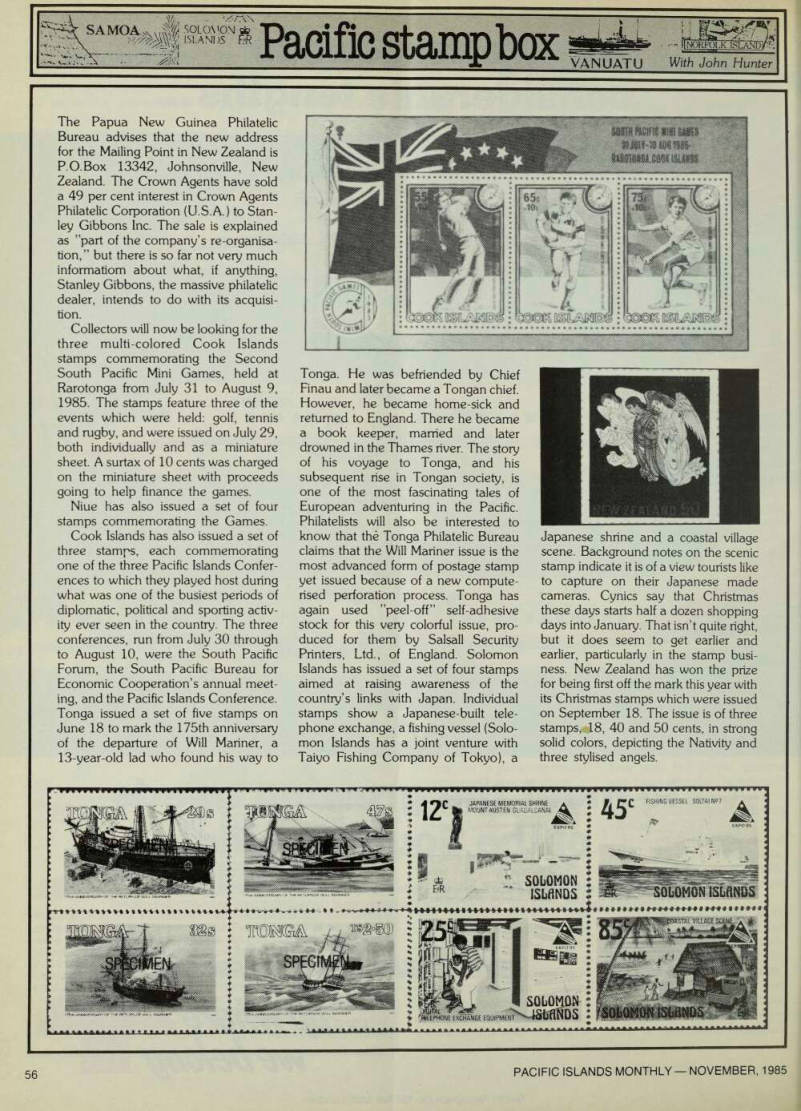
The Papua New Guinea Philatelic Bureau advises that the new address for the Mailing Point in New Zealand is P.0.80x 13342, Johnsonville, New Zealand. The Crown Agents have sold a 49 per cent interest in Crown Agents Philatelic Corporation (U.S.A.) to Stan ley Gibbons Inc. The sale is explained as ’’part of the company’s re-organisa tion,” but there is so far not very much informatiom about what, if anything, Stanley Gibbons, the massive philatelic dealer, intends to do with its acquisi tion.
Collectors will now be looking for the three multi-colored Cook Islands stamps commemorating the Second South Pacific Mini Games, held at Rarotonga from July 31 to August 9, 1985. The stamps feature three of the events which were held: golf, tennis and rugby, and were issued on July 29, both individually and as a miniature sheet. A surtax of 10 cents was charged on the miniature sheet with proceeds going to help finance the games.
Niue has also issued a set of four stamps commemorating the Games.
Cook Islands has also issued a set of three stamps, each commemorating one of the three Pacific Islands Confer ences to which they played host during what was one of the busiest periods of diplomatic, political and sporting activ ity ever seen in the country. The three conferences, run from July 30 through to August 10, were the South Pacific Forum, the South Pacific Bureau for Economic Cooperation’s annual meet ing, and the Pacific Islands Conference.
Tonga issued a set of five stamps on June 18 to mark the 175th anniversary of the departure of Will Mariner, a 13-year-old lad who found his way to
Tonga. He was befriended by Chief Finau and later became a Tongan chief.
However, he became home-sick and returned to England. There he became a book keeper, married and later drowned in the Thames river. The story of his voyage to Tonga, and his subsequent rise in Tongan society, is one of the most fascinating tales of European adventuring in the Pacific.
Philatelists will also be interested to know that the Tonga Philatelic Bureau claims that the Will Mariner issue is the most advanced form of postage stamp yet issued because of a new compute rised perforation process. Tonga has again used ”peel-off” self-adhesive stock for this very colorful issue, pro duced for them by Salsall Security Printers, Ltd., of England. Solomon Islands has issued a set of four stamps aimed at raising awareness of the country’s links with Japan. Individual stamps show a Japanese-built tele phone exchange, a fishing vessel (Solo mon Islands has a joint venture with Taiyo Fishing Company of Tokyo), a
Japanese shrine and a coastal village scene. Background notes on the scenic stamp indicate it is of a view tourists like to capture on their Japanese made cameras. Cynics say that Christmas these days starts half a dozen shopping days into January. That isn’t quite right, but it does seem to get earlier and earlier, particularly in the stamp busi ness. New Zealand has won the prize for being first off the mark this year with its Christmas stamps which were issued on September 18. The issue is of three stamps, 18, 40 and 50 cents, in strong solid colors, depicting the Nativity and three stylised angels.
from the islands press
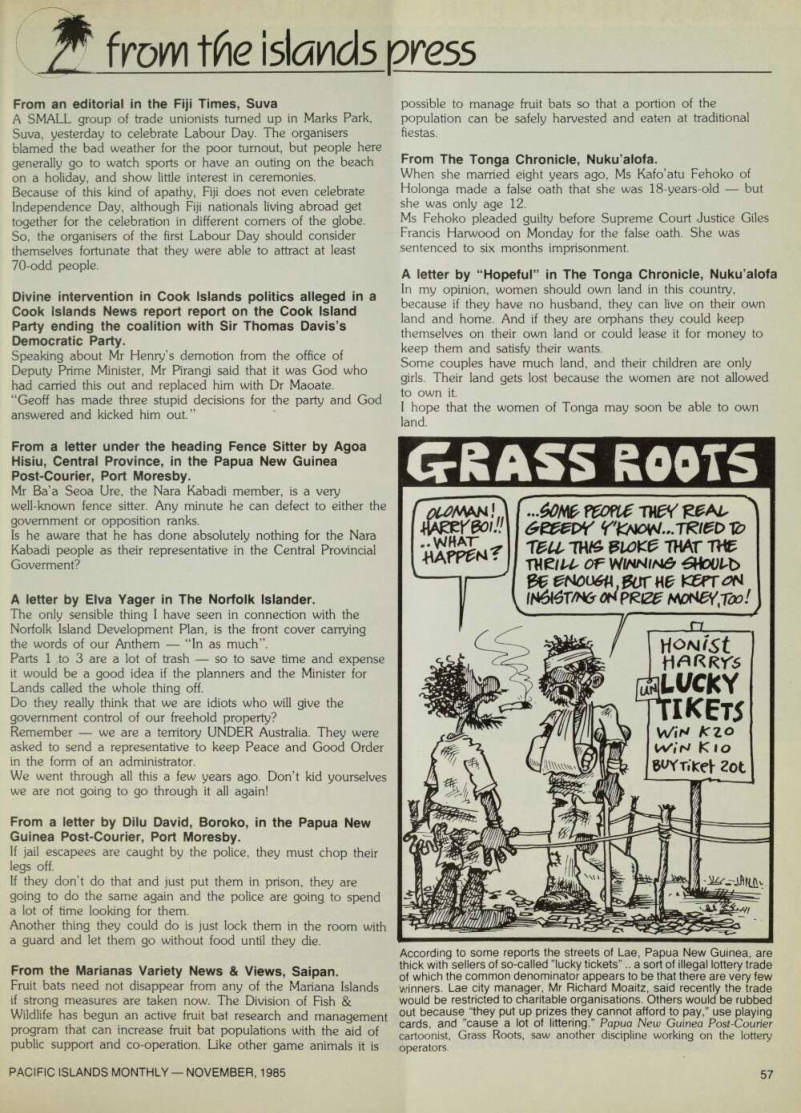
From an editorial in the Fiji Times, Suva A SMALL group of trade unionists turned up in Marks Park, Suva, yesterday to celebrate Labour Day. The organisers blamed the bad weather for the poor turnout, but people here generally go to watch sports or have an outing on the beach on a holiday, and show little interest in ceremonies.
Because of this kind of apathy, Fiji does not even celebrate Independence Day, although Fiji nationals living abroad get together for the celebration in different comers of the globe.
So, the organisers of the first Labour Day should consider themselves fortunate that they were able to attract at least 70-odd people.
Divine intervention in Cook Islands politics alleged in a Cook Islands News report report on the Cook Island Party ending the coalition with Sir Thomas Davis’s Democratic Party.
Speaking about Mr Henry’s demotion from the office of Deputy Prime Minister, Mr Pirangi said that it was God who had carried this out and replaced him with Dr Maoate.
“Geoff has made three stupid decisions for the party and God answered and kicked him out.”
From a letter under the heading Fence Sitter by Agoa Hisiu, Central Province, in the Papua New Guinea Post-Courier, Port Moresby.
Mr Ba’a Seoa Ure, the Nara Kabadi member, is a very well-known fence sitter. Any minute he can defect to either the government or opposition ranks.
Is he aware that he has done absolutely nothing for the Nara Kabadi people as their representative in the Central Provincial Goverment?
A letter by Elva Yager in The Norfolk Islander.
The only sensible thing I have seen in connection with the Norfolk Island Development Plan, is the front cover carrying the words of our Anthem “In as much”.
Parts 1 to 3 are a lot of trash so to save time and expense it would be a good idea if the planners and the Minister for Lands called the whole thing off.
Do they really think that we are idiots who will give the government control of our freehold property?
Remember we are a territory UNDER Australia. They were asked to send a representative to keep Peace and Good Order in the form of an administrator.
We went through all this a few years ago. Don’t kid yourselves we are not going to go through it all again!
From a letter by Dilu David, Boroko, in the Papua New Guinea Post-Courier, Port Moresby.
If jail escapees are caught by the police, they must chop their legs off.
If they don’t do that and just put them in prison, they are going to do the same again and the police are going to spend a lot of time looking for them.
Another thing they could do is just lock them in the room with a guard and let them go without food until they die.
From the Marianas Variety News & Views, Saipan.
Fruit bats need not disappear from any of the Mariana Islands if strong measures are taken now. The Division of Fish & Wildlife has begun an active fruit bat research and management program that can increase fruit bat populations with the aid of public support and co-operation. Like other game animals it is
possible to manage fruit bats so that a portion of the population can be safely harvested and eaten at traditional fiestas.
From The Tonga Chronicle, Nukualofa.
When she married eight years ago, Ms Kafo’atu Fehoko of Holonga made a false oath that she was 18-years-old but she was only age 12.
Ms Fehoko pleaded guilty before Supreme Court Justice Giles Francis Harwood on Monday for the false oath. She was sentenced to six months imprisonment.
A letter by “Hopeful” in The Tonga Chronicle, Nukualofa In my opinion, women should own land in this country, because if they have no husband, they can live on their own land and home. And if they are orphans they could keep themselves on their own land or could lease it for money to keep them and satisfy their wants.
Some couples have much land, and their children are only girls. Their land gets lost because the women are not allowed to own it.
I hope that the women of Tonga may soon be able to own land.
According to some reports the streets of Lae, Papua New Guinea, are thick with sellers of so-called" lucky tickets”.. a sort of illegal lottery trade of which the common denominator appears to be that there are very few winners. Lae city manager, Mr Richard Moaitz, said recently the trade would be restricted to charitable organisations. Others would be rubbed out because “they put up prizes they cannot afford to pay,” use playing cards, and ’’cause a lot of littering.” Papua New Guinea Post-Courier cartoonist, Grass Roots, saw another discipline working on the lottery operators.
Advertisements & other items, p. 58 (1 item)
Europe-South Pacific Joint Service
lUUKUIKLLI ILUKUrMiN
!9HMBa*|iini
£»*&&&««? £ £***
isHI
■■■ ■ u *’
VisfiiitePpc
EUROPE-SOUTH PACIFIC JOINT SERVICE
The South Pacific Specialists offer facilities for shipment of: Containers (FCL/LCL) and Breakbulk Cargo plus reefer space and deeptanks for carriage of vegetable oils and other liquid bulk cargo.
Carriers also accept heavy lifts, overlength and cumbersome parcels.
Ports of Service: Loading: Papeete, Apia, Suva, Lautoka, Noumea, Port Vila, Santo, Honiara, Port Moresby, Lae,Madang Kimbe, Rabaul, Kieta, Darwin.
For: Rotterdam, Antwerp, Hamburg, Hull, Dunkirk, Le Havre.
Please contact our regional offices for further information: The Bank Line (Australasia) Pty. Ltd.
Suite 801,51 Pitt Street Sydney N.SW. 2000 Phone: 27 2041 Telex: 24063 Additional ports on enquiry.
Columbus Line Reederei GmbH P.O. Box 1667 irvTi i-i Lae/Papua New Guinea - ROUND THE WORLD Phone; 42 3466/42 3287.5 A.H. 42 2481 Telex: Colline NE 44 171
THE BANK LINE LTD LONDON
COLUMBUS LINE REEDEREI GMBH HAMBURG
C0L0024
yachts
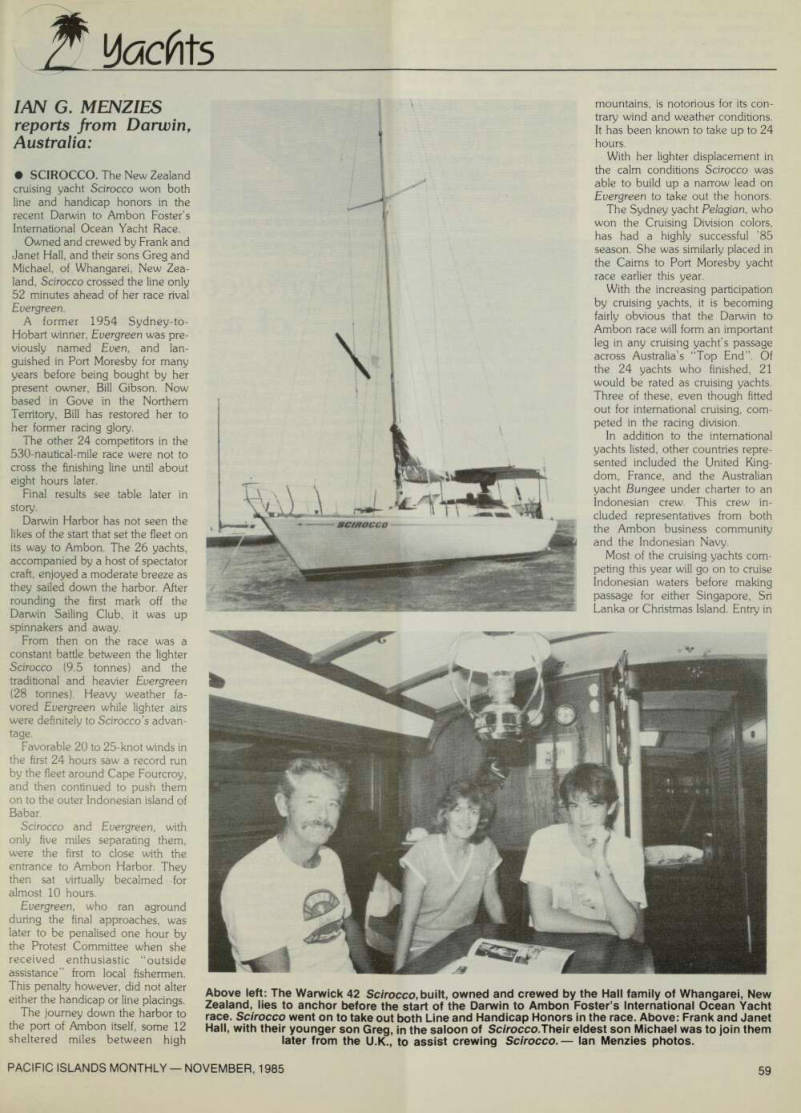
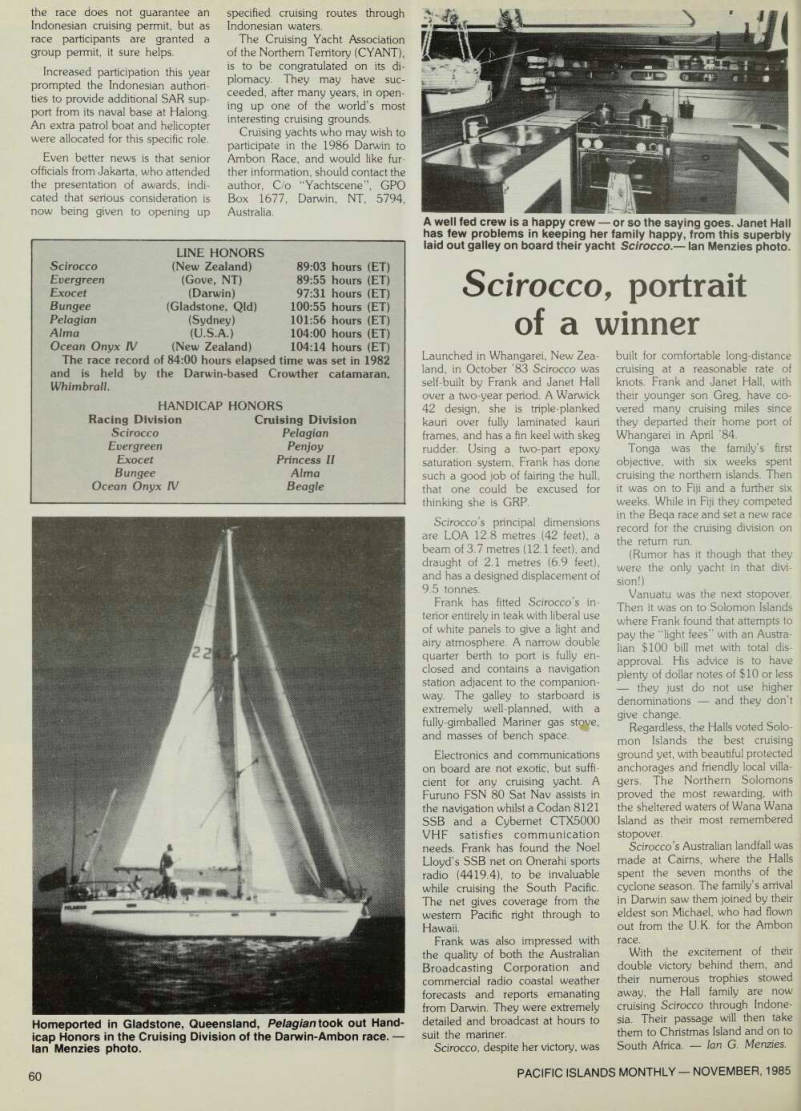
Lan G. Menzies
reports from Darwin ,
Australia:
• SCIROCCO. The New Zealand cruising yacht Scirocco won both line and handicap honors in the recent Darwin to Ambon Foster’s International Ocean Yacht Race.
Owned and crewed by Frank and Janet Hall, and their sons Greg and Michael, of Whangarei, New Zea land, Scirocco crossed the line only 52 minutes ahead of her race rival Evergreen.
A former 1954 Sydney-to- Hobart winner, Evergreen was pre viously named Even, and lan guished in Port Moresby for many years before being bought by her present owner, Bill Gibson. Now based in Gove in the Northern Territory, Bill has restored her to her former racing glory.
The other 24 competitors in the 530-nautical-mile race were not to cross the finishing line until about eight hours later.
Final results see table later in story.
Darwin Harbor has not seen the likes of the start that set the fleet on its way to Ambon. The 26 yachts, accompanied by a host of spectator craft, enjoyed a moderate breeze as they sailed down the harbor. After rounding the first mark off the Darwin Sailing Club, it was up spinnakers and away.
From then on the race was a constant battle between the lighter Scirocco (9.5 tonnes) and the traditional and heavier Evergreen (28 tonnes). Heavy weather fa vored Evergreen while lighter airs were definitely to Scirocco’s advan tage.
Favorable 20 to 25-knot winds in the first 24 hours saw a record run by the fleet around Cape Fourcroy, and then continued to push them on to the outer Indonesian island of Babar.
Scirocco and Evergreen, with only five miles separating them, were the first to close with the entrance to Ambon Harbor. They then sat virtually becalmed for almost 10 hours.
Evergreen, who ran aground during the final approaches, was later to be penalised one hour by the Protest Committee when she received enthusiastic “outside assistance” from local fishermen.
This penalty however, did not alter either the handicap or line placings.
The journey down the harbor to the port of Ambon itself, some 12 sheltered miles between high
mountains, is notorious for its con trary wind and weather conditions.
It has been known to take up to 24 hours.
With her lighter displacement in the calm conditions Scirocco was able to build up a narrow lead on Evergreen to take out the honors.
The Sydney yacht Pelagian, who won the Cruising Division colors, has had a highly successful ’B5 season. She was similarly placed in the Cairns to Port Moresby yacht race earlier this year.
With the increasing participation by cruising yachts, it is becoming fairly obvious that the Darwin to Ambon race will form an important leg in any cruising yacht’s passage across Australia’s “Top End”. Of the 24 yachts who finished, 21 would be rated as cruising yachts.
Three of these, even though fitted out for international cruising, com peted in the racing division.
In addition to the international yachts listed, other countries repre sented included the United King dom, France, and the Australian yacht Bungee under charter to an Indonesian crew. This crew in cluded representatives from both the Ambon business community and the Indonesian Navy.
Most of the cruising yachts com peting this year will go on to cruise Indonesian waters before making passage for either Singapore, Sri Lanka or Christmas Island. Entry in
Above left: The Warwick 42 Scirocco, built, owned and crewed by the Hall family of Whangarei, New Zealand, lies to anchor before the start of the Darwin to Ambon Foster’s International Ocean Yacht race. Scirocco went on to take out both Line and Handicap Honors in the race. Above: Frank and Janet Hall, with their younger son Greg, in the saloon of Scirocco. Their eldest son Michael was to join them later from the U.K., to assist crewing Scirocco. — lan Menzies photos.
the race does not guarantee an Indonesian cruising permit, but as race participants are granted a group permit, it sure helps.
Increased participation this year prompted the Indonesian authori ties to provide additional SAR sup port from its naval base at Halong.
An extra patrol boat and helicopter were allocated for this specific role.
Even better news is that senior officials from Jakarta, who attended the presentation of awards, indi cated that serious consideration is now being given to opening up
specified cruising routes through Indonesian waters.
The Cruising Yacht Association of the Northern Territory (CYANT), is to be congratulated on its di plomacy. They may have suc ceeded, after many years, in open ing up one of the world’s most interesting cruising grounds.
Cruising yachts who may wish to participate in the 1986 Darwin to Ambon Race, and would like fur ther information, should contact the author, C/o “Yachtscene”, GPO Box 1677, Darwin, NT, 5794, Australia.
Homeported in Gladstone, Queensland, Pelagian took out Hand icap Honors in the Cruising Division of the Darwin-Ambon race. lan Menzies photo.
A well fed crew is a happy crew - or so the saying goes. Janet Hall has few problems in keeping her family happy, from this superbly laid out galley on board their yacht Scirocco. - Ian Menzies photo.
Line Honors
Scirocco (New Zealand) 89:03 hours (ET) Evergreen (Gove, NT) 89:55 hours (ET) Exocet (Darwin) 97:31 hours (ET) Bungee (Gladstone, Qld) 100:55 hours (ET) Pelagian (Sydney) 101:56 hours (ET) Alma
(U.S.A.)
104:00 hours (ET) Ocean Onyx IV (New Zealand) 104:14 hours (ET) The race record of 84:00 hours elapsed time was set in 1982 and is held by the Darwin-based Crowther catamaran.
Whimbrall.
Handicap Honors
Racing Division Cruising Division Scirocco Pelagian Evergreen P enjoy Exocet Princess II Bungee Alma Ocean Onyx IV Beagle
Scirocco, portrait
of a winner
Launched in Whangarei, New Zea land, in October ’B3 Scirocco was self-built by Frank and Janet Hall over a two-year period. A Warwick 42 design, she is triple-planked kauri over fully laminated kauri frames, and has a fin keel with skeg rudder. Using a two-part epoxy saturation system, Frank has done such a good job of fairing the hull, that one could be excused for thinking she is GRP.
Scirocco’s principal dimensions are LOA 12.8 metres (42 feet), a beam of 3.7 metres (12.1 feet), and draught of 2.1 metres (6.9 feet), and has a designed displacement of 9.5 tonnes.
Frank has fitted Scirocco’s in terior entirely in teak with liberal use of white panels to give a light and airy atmosphere. A narrow double quarter berth to port is fully en closed and contains a navigation station adjacent to the companion way. The galley to starboard is extremely well-planned, with a fully-gimballed Mariner gas and masses of bench space.
Electronics and communications on board are not exotic, but suffi cient for any cruising yacht. A Furuno FSN 80 Sat Nav assists in the navigation whilst a Codan 8121 SSB and a Cybernet CTXSOOO VHF satisfies communication needs. Frank has found the Noel Lloyd’s SSB net on Onerahi sports radio (4419.4), to be invaluable while cruising the South Pacific.
The net gives coverage from the western Pacific right through to Hawaii.
Frank was also impressed with the quality of both the Australian Broadcasting Corporation and commercial radio coastal weather forecasts and reports emanating from Darwin. They were extremely detailed and broadcast at hours to suit the mariner.
Scirocco, despite her victory, was
built for comfortable long-distance cruising at a reasonable rate of knots. Frank and Janet Hall, with their younger son Greg, have co vered many cruising miles since they departed their home port of Whangarei in April ’B4.
Tonga was the family’s first objective, with six weeks spent cruising the northern islands. Then it was on to Fiji and a further six weeks. While in Fiji they competed in the Beqa race and set a new race record for the cruising division on the return run. (Rumor has it though that they were the only yacht in that divi sion!) Vanuatu was the next stopover.
Then it was on to Solomon Islands where Frank found that attempts to pay the “light fees” with an Austra lian $lOO bill met with total dis approval. His advice is to have plenty of dollar notes of $lO or less they just do not use higher denominations and they don’t give change.
Regardless, the Halls voted Solo mon Islands the best cruising ground yet, with beautiful protected anchorages and friendly local villa gers. The Northern Solomons proved the most rewarding, with the sheltered waters of Wana Wana Island as their most remembered stopover.
Scirocco’s Australian landfall was made at Cairns, where the Halls spent the seven months of the cyclone season. The family’s arrival in Darwin saw them joined by their eldest son Michael, who had flown out from the U.K. for the Ambon race.
With the excitement of their double victory behind them, and their numerous trophies stowed away, the Hall family are now cruising Scirocco through Indone sia. Their passage will then take them to Christmas Island and on to
South Africa.
Ian G. Menzies.
Shipping schedules
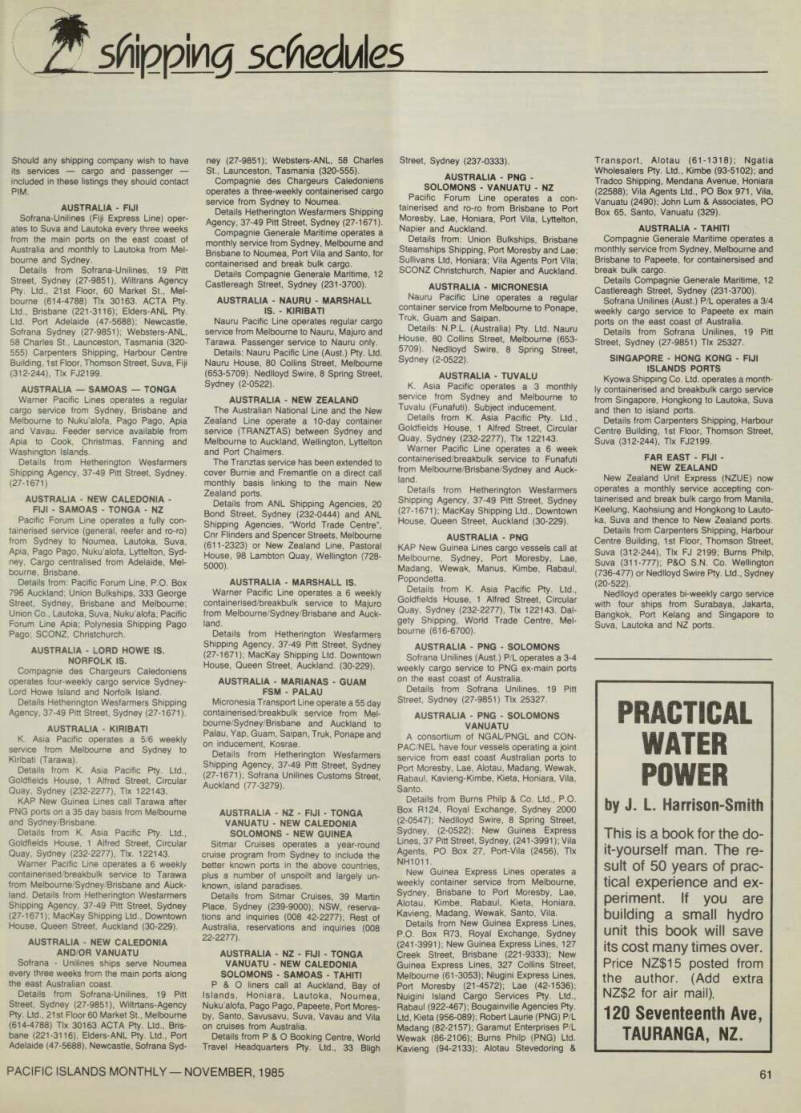
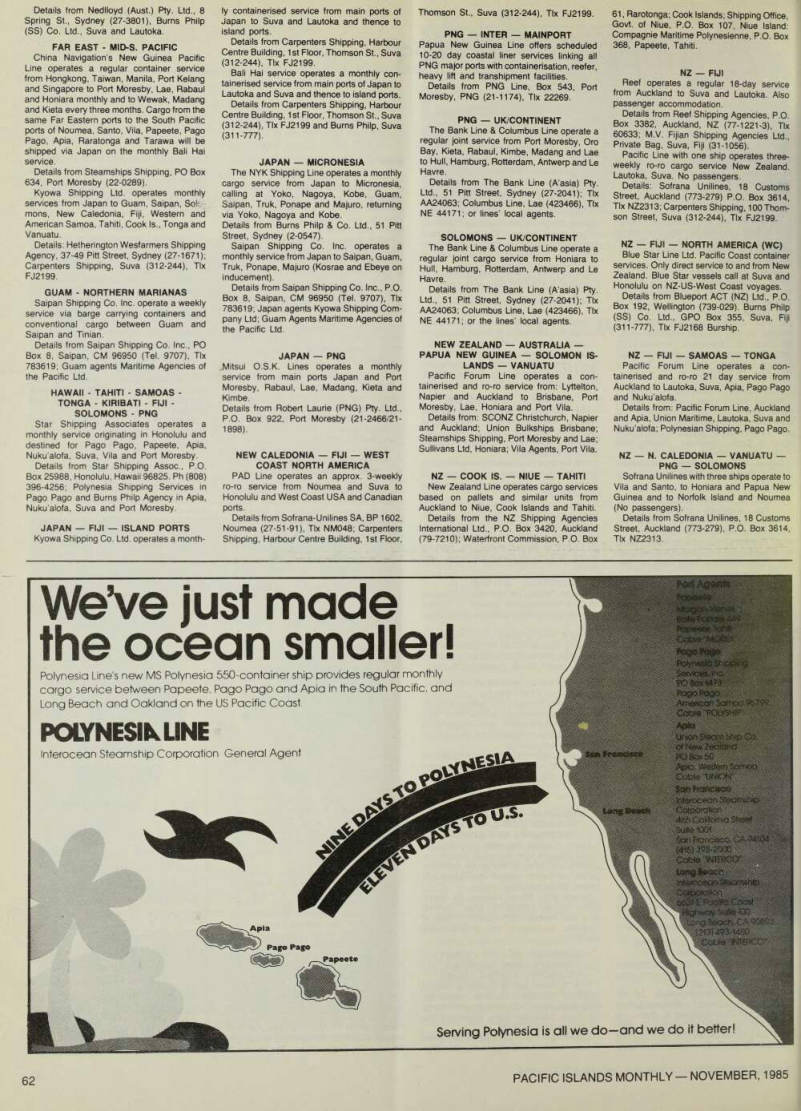
Should any shipping company wish to have its services cargo and passenger included in these listings they should contact
Pim.
Australia - Fiji
Sofrana-Unilines (Fiji Express Line) oper ates to Suva and Lautoka every three weeks from the main ports on the east coast of Australia and monthly to Lautoka from Mel bourne and Sydney.
Details from Sofrana-Unilines, 19 Pitt Street, Sydney (27-9851), Wiltrans Agency Pty. Ltd., 21st Floor, 60 Market St., Mel bourne (614-4788) Tlx 30163. ACTA Pty.
Ltd., Brisbane (221-3116); Elders-ANL Pty.
Ltd. Port Adelaide (47-5688); Newcastle, Sofrana Sydney (27-9851); Websters-ANL, 58 Charles St., Launceston, Tasmania (320- 555) Carpenters Shipping, Harbour Centre Building, Ist Floor, Thomson Street, Suva, Fiji (312-244), Tlx FJ2199.
Australia Samoas Tonga
Warner Pacific Lines operates a regular cargo service from Sydney, Brisbane and Melbourne to Nukualofa, Pago Pago, Apia and Vavau. Feeder service available from Apia to Cook, Christmas, Fanning and
Washington Islands.
Details from Hetherington Wesfarmers Shipping Agency, 37-49 Pitt Street, Sydney. (27-1671)
Australia - New Caledonia -
FIJI - SAMOAS - TONGA - NZ Pacific Forum Line operates a fully con tainerised service (general, reefer and ro-ro) from Sydney to Noumea, Lautoka, Suva, Apia, Pago Pago, Nuku’alofa, Lyttelton, Syd ney, Cargo centralised from Adelaide, Mel bourne, Brisbane.
Details from: Pacific Forum Line, P.O. Box 796 Auckland; Union Bulkships, 333 George Street, Sydney, Brisbane and Melbourne; Union Co., Lautoka, Suva, Nuku’alofa; Pacific Forum Line Apia; Polynesia Shipping Pago Pago; SCONZ, Christchurch.
Australia - Lord Howe Is.
Norfolk Is.
Compagnie des Chargeurs Caledoniens operates four-weekly cargo service Sydney- Lord Howe Island and Norfolk Island.
Details Hetherington Wesfarmers Shipping Agency, 37-49 Pitt Street, Sydney (27-1671).
Australia - Kiribati
K. Asia Pacific operates a 5/6 weekly service from Melbourne and Sydney to Kiribati (Tarawa).
Details from K. Asia Pacific Pty. Ltd., Goldfields House, 1 Alfred Street, Circular Quay, Sydney (232-2277), Tlx 122143.
KAP New Guinea Lines call Tarawa after PNG ports on a 35 day basis from Melbourne and Sydney/Brisbane.
Details from K. Asia Pacific Pty. Ltd., Goldfields House, 1 Alfred Street, Circular Quay, Sydney (232-2277), Tlx. 122143.
Warner Pacific Line operates a 6 weekly containerised/breakbulk service to Tarawa from Melbourne/Sydney/Brisbane and Auck land. Details from Hetherington Wesfarmers Shipping Agency, 37-49 Pitt Street, Sydney (27-1671); Mac Kay Shipping Ltd., Downtown House, Queen Street, Auckland (30-229).
Australia - New Caledonia
And/Or Vanuatu
Sofrana - Unilines ships serve Noumea every three weeks from the main ports along the east Australian coast.
Details from Sofrana-Unilines, 19 Pitt Street, Sydney (27-9851), Wiltrtans-Agency Pty. Ltd., 21st Floor 60 Market St., Melbourne (614-4788) Tlx 30163 ACTA Pty. Ltd., Bris bane (221-3116), Elders-ANL Pty. Ltd., Port Adelaide (47-5688), Newcastle, Sofrana Syd
ney (27-9851); Websters-ANL, 58 Charles St., Launceston, Tasmania (320-555).
Compagnie des Chargeurs Caledoniens operates a three-weekly containerised cargo service from Sydney to Noumea.
Details Hetherington Wesfarmers Shipping Agency, 37-49 Pitt Street, Sydney (27-1671).
Compagnie Generale Maritime operates a monthly service from Sydney, Melbourne and Brisbane to Noumea, Port Vila and Santo, for containerised and break bulk cargo.
Details Compagnie Generale Maritime, 12 Castlereagh Street, Sydney (231-3700).
Australia - Nauru - Marshall
Is. - Kiribati
Nauru Pacific Line operates regular cargo service from Melbourne to Nauru, Majuro and Tarawa. Passenger service to Nauru only.
Details: Nauru Pacific Line (Aust.) Pty. Ltd.
Nauru House, 80 Collins Street, Melbourne (653-5709). Nedlloyd Swire, 8 Spring Street, Sydney (2-0522).
Australia • New Zealand
The Australian National Line and the New Zealand Line operate a 10-day container service (TRANZTAS) between Sydney and Melbourne to Auckland, Wellington, Lyttelton and Port Chalmers.
The Tranztas service has been extended to cover Burnie and Fremantle on a direct call monthly basis linking to the main New Zealand ports.
Details from ANL Shipping Agencies, 20 Bond Street, Sydney (232-0444) and ANL Shipping Agencies, “World Trade Centre", Cnr Flinders and Spencer Streets, Melbourne (611-2323) or New Zealand Line, Pastoral House, 98 Lambton Quay, Wellington (728- 5000).
Australia - Marshall Is.
Warner Pacific Line operates a 6 weekly containerised/breakbulk service to Majuro from Melbourne/Sydney/Brisbane and Auck land.
Details from Hetherington Wesfarmers Shipping Agency, 37-49 Pitt Street, Sydney (27-1671); Mac Kay Shipping Ltd. Downtown House, Queen Street, Auckland. (30-229).
Australia - Marianas - Guam
Fsm - Palau
Micronesia Transport Line operate a 55 day containerised/breakbulk service from Mel bourne/Sydney/Brisbane and Auckland to Palau, Yap, Guam, Saipan, Truk, Ponape and on inducement, Kosrae.
Details from Hetherington Wesfarmers Shipping Agency, 37-49 Pitt Street, Sydney (27-1671); Sofrana Unilines Customs Street, Auckland (77-3279).
AUSTRALIA - NZ - FIJI - TONGA
Vanuatu - New Caledonia
Solomons - New Guinea
Sitmar Cruises operates a year-round cruise program from Sydney to include the better known ports in the above countries, plus a number of unspoilt and largely un known, island paradises.
Details from Sitmar Cruises, 39 Martin Place, Sydney (239-9000); NSW, reserva tions and inquiries (008 42-2277); Rest of Australia, reservations and inquiries (008 22-2277).
AUSTRALIA - NZ - FIJI - TONGA
Vanuatu - New Caledonia
Solomons - Samoas - Tahiti
P&O liners call at Auckland, Bay of Islands, Honiara, Lautoka, Noumea, Nukualofa, Pago Pago, Papeete, Port Mores by, Santo, Savusavu, Suva, Vavau and Vila on cruises from Australia.
Details from P&O Booking Centre, World Travel Headquarters Pty. Ltd., 33 Bligh
Street, Sydney (237-0333).
Australia - Png -
Solomons - Vanuatu - Nz
Pacific Forum Line operates a con tainerised and ro-ro from Brisbane to Port Moresby, Lae, Honiara, Port Vila, Lyttelton, Napier and Auckland.
Details from; Union Bulkships, Brisbane Steamships Shipping, Port Moresby and Lae; Sullivans Ltd, Honiara; Vila Agents Port Vila; SCONZ Christchurch, Napier and Auckland.
Australia - Micronesia
Nauru Pacific Line operates a regular container service from Melbourne to Ponape, Truk, Guam and Saipan.
Details: N.P.L. (Australia) Pty. Ltd. Nauru House, 80 Collins Street, Melbourne (653- 5709). Nedlloyd Swire, 8 Spring Street, Sydney (2-0522).
Australia - Tuvalu
K. Asia Pacific operates a 3 monthly service from Sydney and Melbourne to Tuvalu (Funafuti). Subject inducement.
Details from K. Asia Pacific Pty. Ltd., Goldfields House, 1 Alfred Street, Circular Quay, Sydney (232-2277), Tlx 122143.
Warner Pacific Line operates a 6 week containerised/breakbulk service to Funafuti from Melbourne/Brisbane/Sydney and Auck land.
Details from Hetherington Wesfarmers Shipping Agency, 37-49 Pitt Street, Sydney (27-1671); Mac Kay Shipping Ltd., Downtown House, Queen Street, Auckland (30-229).
Australia - Png
KAP New Guinea Lines cargo vessels call at Melbourne, Sydney, Port Moresby, Lae, Madang, Wewak, Manus, Kimbe, Rabaul, Popondetta.
Details from K. Asia Pacific Pty. Ltd., Goldfields House, 1 Alfred Street, Circular Quay, Sydney (232-2277), Tlx 122143. Dal gety Shipping, World Trade Centre, Mel bourne (616-6700).
Australia - Png - Solomons
Sofrana Unilines (Aust.) P/L operates a 3-4 weekly cargo service to PNG ex-main ports on the east coast of Australia.
Details from Sofrana Unilines, 19 Pitt Street, Sydney (27-9851) Tlx 25327.
Australia - Png - Solomons
Vanuatu
A consortium of NGAL7PNGL and CON PAC/NEL have four vessels operating a joint service from east coast Australian ports to Port Moresby, Lae, Alotau, Madang, Wewak, Rabaul, Kavieng-Kimbe, Kieta, Honiara, Vila, Santo.
Details from Burns Philp & Co. Ltd., P.O.
Box R 124, Royal Exchange, Sydney 2000 (2-0547); Nedlloyd Swire, 8 Spring Street, Sydney, (2-0522); New Guinea Express Lines, 37 Pitt Street, Sydney, (241-3991); Vila Agents, PO Box 27, Port-Vila (2456), Tlx
Nhioii.
New Guinea Express Lines operates a weekly container service from Melbourne, Sydney, Brisbane to Port Moresby, Lae, Alotau. Kimbe, Rabaul, Kieta, Honiara, Kavieng, Madang, Wewak, Santo, Vila.
Details from New Guinea Express Lines, P.O. Box R 73, Royal Exchange, Sydney (241-3991); New Guinea Express Lines, 127 Creek Street, Brisbane (221-9333); New Guinea Express Lines, 327 Collins Street, Melbourne (61-3053); Niugini Express Lines, Port Moresby (21-4572); Lae (42-1536); Nuigini Island Cargo Services Pty. Ltd., Rabaul (922-467); Bougainville Agencies Pty.
Ltd, Kieta (956-089): Robert Laurie (PNG) P/L Madang (82-2157); Garamut Enterprises P/L Wewak (86-2106); Burns Philp (PNG) Ltd.
Kavieng (94-2133); Alotau Stevedoring &
Transport, Alotau (61-1318); Ngatia Wholesalers Pty. Ltd., Kimbe (93-5102); and Tradco Shipping, Mendana Avenue, Honiara (22588); Vila Agents Ltd., PO Box 971, Vila, Vanuatu (2490); John Lum & Associates, PO Box 65, Santo, Vanuatu (329).
Australia - Tahiti
Compagnie Generale Maritime operates a monthly service from Sydney, Melbourne and Brisbane to Papeete, for containersised and break bulk cargo.
Details Compagnie Generale Maritime, 12 Castlereagh Street, Sydney (231-3700).
Sofrana Unilines (Aust.) P/L operates a 3/4 weekly cargo service to Papeete ex main ports on the east coast of Australia.
Details from Sofrana Unilines, 19 Pitt Street, Sydney (27-9851) Tlx 25327.
Singapore - Hong Kong - Fiji
Islands Ports
Kyowa Shipping Co. Ltd. operates a month ly containerised and breakbulk cargo service from Singapore, Hongkong to Lautoka, Suva and then to island ports.
Details from Carpenters Shipping, Harbour Centre Building, Ist Floor, Thomson Street, Suva (312-244), Tlx FJ2199.
Far East - Fiji -
New Zealand
New Zealand Unit Express (NZUE) now operates a monthly service accepting con tainerised and break bulk cargo from Manila, Keelung, Kaohsiung and Hongkong to Lauto ka, Suva and thence to New Zealand ports.
Details from Carpenters Shipping, Harbour Centre Building, Ist Floor, Thomson Street, Suva (312-244), Tlx FJ 2199; Burns Philp, Suva (311-777); P&O S.N. Co. Wellington (736-477) or Nedlloyd Swire Pty. Ltd., Sydney (20-522).
Nedlloyd operates bi-weekly cargo service with four ships from Surabaya, Jakarta, Bangkok, Port Kelang and Singapore to Suva, Lautoka and NZ ports.
Details from Nedlloyd (Aust.) Pty. Ltd., 8 Spring St., Sydney (27-3801), Burns Philp (SS) Co. Ltd., Suva and Lautoka.
Far East - Mid-S. Pacific
China Navigation's New Guinea Pacific Line operates a regular container service from Hongkong, Taiwan, Manila, Port Keiang and Singapore to Port Moresby, Lae, Rabaul and Honiara monthly and to Wewak, Madang and Kieta every three months. Cargo from the same Far Eastern ports to the South Pacific ports of Noumea, Santo, Vila, Papeete, Pago Pago, Apia, Raratonga and Tarawa will be shipped via Japan on the monthly Bali Hai service.
Details from Steamships Shipping, PO Box 634, Port Moresby (22-0289).
Kyowa Shipping Ltd. operates monthly services from Japan to Guam, Saipan, Sol* mons, New Caledonia, Fiji, Western and American Samoa, Tahiti, Cook Is., Tonga and Vanuatu.
Details; Hetherington Wesfarmers Shipping Agency, 37-49 Pitt Street, Sydney (27-1671); Carpenters Shipping, Suva (312-244), Tlx FJ2199.
Guam - Northern Marianas
Saipan Shipping Co. Inc. operate a weekly service via barge carrying containers and conventional cargo between Guam and Saipan and Tinian.
Details from Saipan Shipping Co. Inc., PO Box 8, Saipan, CM 96950 (Tel. 9707), Tlx 783619; Guam agents Maritime Agencies of the Pacific Ltd.
Hawaii - Tahiti - Samoas -
Tonga - Kiribati - Fiji -
Solomons - Png
Star Shipping Associates operates a monthly service originating in Honolulu and destined for Pago Pago, Papeete, Apia, Nukualofa, Suva, Vila and Port Moresby.
Details from Star Shipping Assoc., P.O.
Box 25988, Honolulu, Hawaii 96825. Ph (808) 396-4256; Polynesia Shipping Services in Pago Pago and Burns Philp Agency in Apia, Nukualofa, Suva and Port Moresby.
Japan Fiji Island Ports
Kyowa Shipping Co. Ltd. operates a month
ly containerised service from main ports of Japan to Suva and Lautoka and thence to island ports.
Details from Carpenters Shipping, Harbour Centre Building, Ist Floor, Thomson St., Suva (312-244), Tlx FJ2199.
Bali Hai service operates a monthly con tainerised service from main ports of Japan to Lautoka and Suva and thence to island ports.
Details from Carpenters Shipping, Harbour Centre Building, Ist Floor, Thomson St., Suva (312-244), Tlx FJ2199 and Burns Philp, Suva (311-777).
Japan Micronesia
The NYK Shipping Line operates a monthly cargo service from Japan to Micronesia, calling at Yoko, Nagoya, Kobe, Guam, Saipan, Truk, Ponape and Majuro, returning via Yoko, Nagoya and Kobe.
Details from Burns Philp & Co. Ltd., 51 Pitt Street, Sydney (2-0547).
Saipan Shipping Co. Inc. operates a monthly service from Japan to Saipan, Guam, Truk, Ponape, Majuro (Kosrae and Ebeye on inducement).
Details from Saipan Shipping Co. Inc., P.O.
Box 8. Saipan, CM 96950 (Tel. 9707), Tlx 783619; Japan agents Kyowa Shipping Com pany Ltd; Guam Agents Maritime Agencies of the Pacific Ltd.
Japan Png
.Mitsui O.S.K. Lines operates a monthly service from main ports Japan and Port Moresby, Rabaul, Lae, Madang, Kieta and Kimbe.
Details from Robert Laurie (PNG) Pty. Ltd., P.O. Box 922, Port Moresby (21-2466/21- 1898).
New Caledonia Fiji West
Coast North America
PAD Line operates an approx. 3-weekly ro-ro service from Noumea and Suva to Honolulu and West Coast USA and Canadian ports.
Details from Sofrana-Unilines SA, BP 1602, Noumea (27-51-91), Tlx NMO4B; Carpenters Shipping, Harbour Centre Building, Ist Floor,
Thomson St., Suva (312-244), Tlx FJ2199.
Png Inter Mainport
Papua New Guinea Line offers scheduled 10-20 day coastal liner services linking all PNG major ports with containerisation, reefer, heavy lift and transhipment facilities.
Details from PNG Line, Box 543, Port Moresby, PNG (21-1174), Tlx 22269.
Png Uk/Continent
The Bank Line & Columbus Line operate a regular joint service from Port Moresby, Oro Bay, Kieta, Rabaul, Kimbe, Madang and Lae to Hull, Hamburg, Rotterdam, Antwerp and Le Havre.
Details from The Bank Line (A’asia) Pty.
Ltd., 51 Pitt Street, Sydney (27-2041); Tlx AA24063; Columbus Line, Lae (423466), Tlx NE 44171; or lines’ local agents.
Solomons Uk/Continent
The Bank Line & Columbus Line operate a regular joint cargo service from Honiara to Hull, Hamburg, Rotterdam, Antwerp and Le Havre.
Details from The Bank Line (A’asia) Pty.
Ltd., 51 Pitt Street, Sydney (27-2041); Tlx AA24063; Columbus Line, Lae (423466), Tlx NE 44171; or the lines' local agents.
New Zealand Australia
Papua New Guinea Solomon Is
Lands Vanuatu
Pacific Forum Line operates a con tainerised and ro-ro service from: Lyttelton, Napier and Auckland to Brisbane, Port Moresby, Lae, Honiara and Port Vila.
Details from; SCONZ Christchurch, Napier and Auckland: Union Bulkships Brisbane; Steamships Shipping, Port Moresby and Lae; Sullivans Ltd, Honiara; Vila Agents, Port Vila.
Nz Cook Is. Niue Tahiti
New Zealand Line operates cargo services based on pallets and similar units from Auckland to Niue, Cook Islands and Tahiti.
Details from the NZ Shipping Agencies International Ltd., P.O. Box 3420, Auckland (79-7210); Waterfront Commission, P.O. Box
61, Rarotonga; Cook Islands; Shipping Office, Govt, of Niue, P.O. Box 107, Niue Island: Compagnie Maritime Polynesienne, P.O. Box 368, Papeete, Tahiti.
Nz Fiji
Reef operates a regular 18-day service from Auckland to Suva and Lautoka. Also passenger accommodation.
Details from Reef Shipping Agencies, P.O.
Box 3382, Auckland, NZ (77-1221-3), Tlx 60633; M.V. Fijian Shipping Agencies Ltd., Private Bag, Suva, Fiji (31-1056).
Pacific Line with one ship operates three weekly ro-ro cargo service New Zealand.
Lautoka, Suva. No passengers.
Details: Sofrana Unilines, 18 Customs Street, Auckland (773-279) P.O. Box 3614, Tlx NZ2313; Carpenters Shipping, 100 Thom son Street, Suva (312-244), Tlx FJ2199.
Nz Fiji North America (Wc)
Blue Star Line Ltd. Pacific Coast container services. Only direct service to and from New Zealand. Blue Star vessels call at Suva and Honolulu on NZ-US-West Coast voyages.
Details from Blueport ACT (NZ) Ltd., P.O.
Box 192, Wellington (739-029). Burns Philp (SS) Co. Ltd., GPO Box 355, Suva, Fiji (311-777), Tlx FJ2168 Burship.
Nz Fiji Samoas Tonga
Pacific Forum Line operates a con tainerised and ro-ro 21 day service from Auckland to Lautoka, Suva, Apia, Pago Pago and Nuku’alofa.
Details from: Pacific Forum Line, Auckland and Apia, Union Maritime, Lautoka, Suva and Nuku’alofa; Polynesian Shipping, Pago Pago.
Nz N. Caledonia Vanuatu
Png Solomons
Sofrana Unilines with three ships operate to Vila and Santo, to Honiara and Papua New Guinea and to Norfolk Island and Noumea (No passengers).
Details from Sofrana Unilines, 18 Customs Street, Auckland (773-279), P.O. Box 3614, Tlx NZ2313.
Nz Tahiti
Compagnie Tahitienne Maritime SA (as CTM-Tahiti Line) operates one ship, MV Bounty 111, monthly Papeete New Zea land. (No passengers).
Details from Sofrana Unilines, P.O. Box 3614,18 Customs St.. Auckland, Tlx NZ2313; CTM-Tahiti Line, P.O. Box 9012, Papeete (39042), Tlx Tahitlin 322 FP Tahiti.
Nz Tonga Samoas
Warner Pacific Line services Auckland, Nuku’alofa, Vavau, Apia, Pago Pago fort nightly carrying general and freezer cargoes.
Details from McKay Shipping Ltd., Down town House, 21 Queen St., Auckland, P.O Box 1372 (30-299). Cables MACSHIP, Telex NZ2554, Warner Pacific Line, Box 93, Nuku'alofa, Tonga; Mealelei (Western Samoa,) Ltd. Private Bag, Apia, Western Samoa, Pacific Maritime Services, P.O. Box 2617, Pago Pago, American Samoa (633- 2728) cables; Pacmar SX2OS.
Tahiti New Caledonia Vanuatu
Solomon Is. New Zealand
Png Singapore Europe
Polish Ocean Lines operate in a semi container type vessel to the following ports, from Papeete, Noumea, Santo, Vila, Yandina, Honiara, Auckland, Rabaul, Lae, Singapore, Port Kelang, Penang then to Mediterranean ports and Europe via the Suez Canal. (Other New Zealand ports subject to inducement).
Details from Universal Shipping Agencies Ltd., 6th Floor, 38 Fort Street, Auckland 1, New Zealand (30931), Tlx 21517.
Europe Tahiti
New Caledonia
Compagnie Generale Maritime operates services from Europe and Mediterranean ports to Papeete and Noumea using three ro-ro and multi-purpose vessels thus ensuring a bi-monthly sailing to and from.
Details Compagnie Generale Maritime, 12 Castlereagh Street, Sydney (231-3700).
Europe Tahiti
New Caledonia New Zealand
Vanuatu Solomons Png
Europe
Polish Ocean Lines offers regular monthly sailings for containerised and break bulk cargo, also conventional reefer space and reefer containers, from Hamburg, Rotterdam, Dunkirk, Rouen to Papeete, Noumea, Auck land, Santo, Honiara, Rabaul, Lae, Singa pore, returning to Europe via Suez, other ports in South Pacific can be served directly with inducement or otherwise via tranship ment.
Details from Sotama, BP 9170, Papeete, Tel 427805 Tlx 373 PF / SATO; BP C 2, Noumea Cedex Tel 272094 Tlx 163 NM / Universal Shipping Agencies P.O. Box 2282 Auckland Tel 30930 Tlx 21517 / Vanua Navigation P.O. Box 44 Vila Tel 2027 Tlx 1033 / Melan Chine Shipping Co. P.O.
Box 71 Honiara Tel 21678 Tlx 66335 / Steamships Trading Co. Ltd P.O. Box 89 Rabaul Tel 922952 Tlx 92929 / Steamships Trading Co. Ltd P.O. Box 85 Lae Tel 424666 Tlx 42423 / Union Steam ship Co. of NZ Ltd P.O. Box 50 Apia Tel 21781 Tlx 225 / Warner Pacific Line P.O.
Box 93 Nukualofa Tel 22088 Tlx 66219 / Fiji Agents T.B.A.
Europe Tahiti W. Samoa
Fiji N. Caledonia
Nedlloyd offers regular cargo services from Continental ports to Papeete, Apia, Fiji and New Caledonia.
Details Nedlloyd (Aust.) Pty. Ltd., 8 Spring Street, Sydney (27-3801); Carpenters Ship ping, Ist Floor, Harbour Centre Bldg., 100 Thomson St., Suva (312-244), Tlx 2199 FJ and Vetari Street, Lautoka (63988), Tlx 5215FJ.
Uk N. Continent W. Samoa
Tonga, Fiji
The Bank Line & Columbus Line operate a regular joint cargo service from Hull, Ham
burg, Bremen, Antwerp, Rotterdam and Le Havre to Apia, Nukualofa, Suva and Lautoka.
Details from The Bank Line (A’asia) Pty.
Ltd., 51 Pitt Street, Sydney (27-2041), Tlx AA 24063; Columbus Line, Lae (423-466), Tlx NE 44171; or lines’ local agents.
Uk N. Continent Png
Solomons
The Bank Line & Columbus Line operate a regular joint cargo service from Hull, Ham burg, Bremen, Antwerp, Rotterdam and Le Havre to Port Moresby, Lae, Madang, Kimbe, Rabaul, Kieta and Honiara and on induce ment to Yandina.
Details from The Bank Line (A’asia) Pty.
Ltd., 51 Pitt Street, Sydney (27-2041), Tlx AA 24063; Columbus Line. Lae (42-3466), Tlx NE 44171; or lines' local agents.
Uk/N. Continent Tahiti
N. Caledonia Vanuatu
The Bank Line & Columbus Line operate a regular joint cargo service from Hull, Ham burg, Bremen, Antwerp, Rotterdam and Le Havre to Papeete, Noumea, Porl-Vila and Santo.
Details from The Bank Line (A’asia) Pty.
Ltd., 51 Pitt Street. Sydney (27-2041), Tlx AA 24063; Columbus Line, Lae (42-3466), Tlx NE 44171; Ets. A M. Fare UTE, Papeete; Ets.
Ballande, Noumea and other local agents.
Us Hawaii Micronesia
E. Malaysia Brunei Papua New
Guinea Philippines
PM&O Lines operates three fully self-sus tained container vessels on a sailing frequen cy of every 28 days from the San Francisco Bay area, Los Angeles, and Honolulu to Majuro, Ebeye, Kosrae, Ponape, Truk, Saipan, Yap, Koror, Kota Kinabalu, Brunei, Lae, Kieta and Rabaul.
Service is also offered utilising the same vessels on the same 28-day frequency from the Philippine ports of Manila, Cebu, and Davao and General Santos and the Papua New Guinea ports of Rabaul, Lae and Kieta to
Hawaii, San Francisco and Los Angeles.
Finally service is available from Davao, Cebu, Manila, Hong Kong, Keelung and Kaohsiung to Saipan, Guam, Honolulu, Lae, Rabaul and Kieta.
Details from PM&O Lines, 181 Fremont Street, San Francisco, California, 94105, U.S.A. (415) 543-7430, Tlx 278016; Cable PMONAV SFO; PM&O Owners representa tive, P.O. Box 803, Saipan, N.M.I. 96950.
Cable Commontime Saipan. Tlx
783605; Anscor Transport and Terminals Inc., P.O. Box 7023-5, Metro Manila, Philip pines (521-8074) Tlx 65021 ATTI PN.
Us Hawaii Samoas
Kiribati Nauru
Nauru Pacific Line operates regular con ventional and container services from San Francisco and Honolulu to Christmas Island, Pago Pago, Apia, Tarawa and Nauru.
Details from N.P.L. (Australia) Pty. Ltd., Nauru House, 80 Collins Street, Melbourne (653-5709); Nauru Air and Shipping Agency, Suite 2803, 185 Berry Street, San Francisco, California 94107 (415-543-4517); Nauru Air and Shipping Agency, Suite 506, 841 Bishop St.. Honolulu, HI 96813 (808-523-0441).
Us. Noumea Fiji
PAD Line operates an approx. 3-weekly ro-ro service from west coast USA and Canada to Noumea, Suva and Lautoka.
Details from Sofrana Unilines BP 1602, Noumea (27-51-91), Tlx NMO4B; Carpenters Shipping, Harbour Centre Building, Ist Floor, 100 Thomson Street, Suva (312-244), Tlx FJ2199; Trans-Austral Shipping Pty. Ltd., P.O. Box R 232, Royal Exchange, 2000 (231-8411), Tlx AA21204.
Us Tahiti Samoa
Polynesia Line operates container and general cargo service from US west coast ports to Papeete and Pago Pago.
Details from Polynesia Shipping Services Inc., P.O. Box 1478, Pago Pago 96799.
Advertisements & other items, pp. 61-64 (1 item)
Practical
WATER
POWER
by J. L. Harrison-Smith This is a book for the doit-yourself man. The result of 50 years of practical experience and experiment. If you are building a small hydro unit this book will save its cost many times over.
Price NZ$l5 posted from the author. (Add extra NZ$2 for air mail). 120 Seventeenth Ave,
TAURANGA, NZ.
WeVe just made
the ocean smaller!
Polynesia Line's new MS Polynesia 550-container ship provides regular monthly cargo service between Papeete, Pago Pago and Apia in the South Pacific, and Long Beach and Oakland on the US Pacific Coast.
POLYKESIM.INE
Interocean Steamship Corporation General Agent
Olsi
AS u Q =tO £ is & * V Apia Pago Pago Papeete * m Serving Polynesia is all we do-and we do it better!
POLISH OCEAN LINES
General Management, 10 Lutego 24,81-364 GDYNIA, POLAND, Phone: 20-19-01, Cables: POLOCEAN Telex: 054-231 Q © -K & fir LA y V m % & A.' K>-v 8 .’•V
SOUTH PACIFIC SERVICE
We offer monthly service to and from: GDYNIA, HAMBURG, ROTTERDAM, MIDDLESBOROUGH/IMMINGHAM, ANTWERP, DUNKIRK, ROUEN, PAPEETE (via PANAMA), NOUMEA, AUCKLAND, HONIARA, RABAUL, LAE, SINGAPORE, by our multipurpose vessels carrying dry and reefer containers, reefer chambers, heavy lifts, breakbulk or palletized, bulk liquids.
POLISH OCEAN LINES Representatives AUCKLAND Mr. A. Sieradzki. Telex 21517 NZ “UNISHIP”. SYDNEY Mr. Walenciak. Telex 20428 AA “SLEIGH”
POLISH OCEAN LINES Agents
TAHITI SOTAMA Telex 296 FP “COUTIMEX”. NEW CALEDONIA SATO Telex 163 NM “SATO”. AUCKLAND UNIVERSAL SHIPPING AGENCIES LTD., Telex 21517 NZ “UNISHIP". SOLOMONS MELAN CHINE SHIPPING CO., LTD Telex 66335 HO “SYMECO”. PNG STEAMSHIPS TRADING CO., LTD Telex 42423 NE “STEAM”.
YOUR BUSINESS PARTNER
Japan S. Korea Taiwan Singapore Hong Kong To: Solomon Is., New Caledonia, Fiji, W. Samoa, A. Samoa, Tahiti, Cook Is., Tonga, Vanuatu, Tuvalu. Nauru To: Guam, Saipan, Truk, Ponape, Majuro, Yap, Koror
Taiwan Hong Kong Singapore Philippines
To: Papua New Guinea, Pacific Islands.
J* {* s. r
KYOWA
KYOWA SHIPPING CO., LTD.
HEAD OFFICE:
6th Floor., Kikushima Bldg., 2-3, Hamamatsucho 2-chome, Minato-ku, Tokyo 105, Japan Phone: 03(437)2885 (Rep.) Cables: “MARIQUEEN" Tokyo Telex: 242-4651 Kyowa J.
OSAKA OFFICE:
7th Floor., Okajima Bldg., 2-14, Nishihonmachi 1-chome, Nishi-ku, Osaka, Japan Phone: 06(533)5821 (Rep.) Cables: “MARIQUEEN" Osaka Telex: 525-6271 Ssiosa J.
deaths
Charles Dunford Rowley In Canberra on August 18, aged 79.
Professor Rowley was the founding professor of political studies at the University of Papua New Guinea.
Professor Jim Griffin, former ly of UPNG, said Rowley’s study, The New Guinea Villa ger (1965), was still “the most sensitive and thoughtful intro duction” to Papua New Gui nean society written by a Euro pean.
“Professor Rowley had in tended to follow this up one day with a sequel, The Papua New Guinean Citizen, which would portray both villagers and urban dwellers coming to terms with their own indepen dent nation state,” he said.
“But this was never written because Rowley turned his attention to the Aboriginals, who had been even more un happily colonised by the white Australians. ”
Before his UPNG appoint ment, Rowley had been princi pal of the Australian School of Pacific Administration (ASPOA) in Sydney.
He received many honors for a monumental trilogy, The De struction of Aboriginal Society, Outcasts in White Society, and The Remote Aboriginals.
“However, he did not lose interest in Papua New Guinea, and visited Port Moresby last November to sum up at the colonial centenary history semi nar,” said Mr Griffin.
“He did his work with an appropriately scathing but calm view of white Australian racism both at home and on its Melanesian frontier.”
One of Professor Rowley’s early students, Paulias Matane, who is now PNG’s secretary for foreign affairs and trade, said he was deeply saddened by his death.
“He was one of the best expatriates ever to work in Papua New Guinea.
“He was selfless, dedicated and a very level-headed person.
“My family and I are sad dened by the death of this man who did so much for Papua
New Guineans and the Aborigi nals,” Mr Matane said.
Professor Rowley died within a week of being told informally that the University of PNG had decided to award him an hon orary doctorate of philosophy.
Edwin H. Bryan Jr.
In Honolulu on July 24, aged 87.
Edwin H. Bryan Jr. was one of Hawaii’s outstanding scien tists, and a fixture at the Bishop Museum since 1919.
The Honolulu Advertiser said in an editorial tribute: “Edwin H. Bryan Jr. some times complained that his mind was used as a library by those who wanted to know about the geography and natural history of the Pacific. Yet he was always glad to answer the ques tions of anyone from leading scientists to students with school assignments.
“What he could not instantly recall from his encyclopedic memory of the Pacific Islands he could probably find in the books he wrote and the note books of original manuscripts of his over 2000 published articles and shorter works which he kept near his desk at the Bishop Museum.
“Bryan was associated with the museum for almost his entire career. In 1960 he estab lished the museum’s Pacific Sci entific Information Center. In 1968 he was named the first Brigham Fellow after the museum’s first director.
“During World War 11, how ever, Bryan left his job as curator of the museum’s collections to serve in the U.S.
Army. His intimate knowledge of the islands of the Pacific, gained during numerous field trips and constant study, was an invaluable resource for Amer ican forces.
“Today, he is best known for Bryan’s Sectional Maps of Oahu which has been the standard street guide reference for years. The royalties from that book, and at times Bryan’s own pension, have often gone to support the Bishop Museum in hard financial times.
“Edwin Bryan was a unique
figure, a real museum ‘old timer’ with a computer-like mind that collected data in a variety of disciplines and an all-round ability to do the things that needed doing. His con tribution to the world’s know ledge of the Pacific is im measurable. ”
John Bell Kerr Taylor At Kaiata, New Zealand, on August 6, aged 90.
Colonel John Bell Kerr Taylor was the commander of the Ist Battalion, Fiji Infantry Regiment in World War II and coach of the Fiji rugby team which toured New Zealand without loss in 1939.
Colonel Taylor, known fami liarly as JBK, has been given much of the credit for estab lishing the skill of Fiji soldiers as jungle fighters and the reputa tion of Fiji in international rugby.
In June 1940 Colonel Taylor was seconded to the army and later was placed in command of the First Battalion.
The battalion trained at Nata bua, near Lautoka, and Colonel Taylor’s reputation as a disciplinarian is reflected in a battalion song “Natabua that’s where the Colonel broke us in”.
Johnny Halafihi In Yorkshire, United Kingdom, recently, aged 52.
Described by Wellington Evening Post sports writer Nicolaas Venter as “arguably the best boxer to come out of the Pacific Islands”, Johnny Halafihi, a short, muscular Ton gan, fought most of the world’s top light heavyweights in a professional career which be gan in 1950 and ended in Europe in the early 19605.
Venter wrote; “New Zealand fans remember him as a skilful, exciting boxer who knocked out many of his opponents. He fought here from 1953-56, win ning the New Zealand title from Charlie Beaton in Wellington, and then headed for Europe.
“There he beat Jamaican Yolande Pompey on a foul, drew twice with the world num ber five Mike Holt, and lost to
Empire champion Chick Cal derwood.
“In 1961 he returned to New Zealand, and a record Auck land crowd of 15,500 people saw him lose on points to top American Eddie Cotton.
“Mr Halafihi returned to Europe after fighting Cotton.
He married an English girl and settled in the UK, continuing to fight all over Europe.
“In all he had 58 professional fights, winning 37, drawing six, and losing 15.”
Su’a Fritz Thomsen In Western Samoa on Septem ber 11, aged 60.
One of Western Samoa’s leading magistrates, Su’a Fritz Thomsen had a long and distinguished career in his country’s public service.
He was secretary for justice before his appointment as a magistrate in 1977.
In 1953 he took the title of Sua Leituposa, from Salelavalu in Savaii. He was accordingly best known to his countrymen as Sua Leitupose Thomsen.
Taraariki Pitomaki On Rarotonga, Cook Islands, on September 15, aged 57.
A former school teacher, the Rev Taraariki Pitomaki was ordained as a minister of the Cook Islands Christian Church in 1958 and became its general secretary in 1976, having a hand in the drafting of the church’s new constitution.
He preached his last sermon at Nikao, Rarotonga, on the day he died.
The Cook Islands News said in a tribute: “He was a most outstanding minister of the church, a man who had faith in his own people, who had confi dence in the ability of Cook Islands ministers of the church, and who, during his days as general secretary, strongly advocated that the church be governed by local ministers.”
Advertisements & other items, pp. 65-68 (1 item)
All The News
IN A FLASH
THE SOUTH SEA DIGEST
See insert for Subscription details
SERVICE PAGE
ADVERTISING
Aggie Grey 66 Air New Zealand 68
AIWA 11
British Aerospace 55 Citizen Watches 38 Collins Olympic 36 Columbus Line 58 Dept of Trade 4 Fisher & Paykel 20 J.L. Harrison-Smith 61 Henry Cumines 50 Hitachi ...2 Kyowa Shipping 64 Macquarie Corp 50 Matsushita Electric 6 Papua Hotel 66 Pioneer Electric 32 P & O Cruises 27 Polish Shipping 63 Polynesian Shipping Lines 62 Sheaffer Pen-Textron 15 Toyota Motor 34,35,67 Trio-Kenwood 48 Tutt Bryant... 44
KfUMr®
jmMjtmr
AUSTRALIA: Distribution: The Herald and Weekly Times Ltd., 44-74 Flinders St., Melbourne, Vic., 3000. Advertising Rsps Brisbane D. Wood, Anday Agency, CCA Centre, Dayboro Road. Closebum 4520; Box 1918, GPO Brisbane, 4001; telephone (07) 289-4128 Adelaide Hastwell Williamson Rouse Pty Ltd., PO Box 419, Norwood, SA. 5067; 59 Kensington Road. Norwood; telephone (08) 332-3322, telex 87113; Perth Allen 4 Associates, Suite 2. 284 Stirling St., Perth, WA. 6000, telephone (09) 328-9593 or (09) 328-9363 FIJI: Distribution and subscriptions Desai Bookshops. P.O. Box 160, Suva, Fiji, telephone Suva 23036.
Advertising Fiji Times 4 Herald Ltd., 20 Gordon St..
Suva, telephone 31-4111, telex FJ2124.
FRENCH POLYNESIA: Distribution Hachette Padfique, 10 Avo Bruat, Papeete, telephone 25610.
HAWAII, UNITED STATES: Distribution PIM, Hawaii.
PO Box 22250, Honolulu, Hawaii, 96822 Advertising Brian C Asgill, Apt. 1308, 1676 Ala Moana Blvd., Honolulu, Hawaii, 96815, telephone (808) 955-9718.
JAPAN: Advertising and subscriptions Universal Media Corporation. GPO Box 46, Tokyo, telephone 666- 3036, cables UNIMEDIA Tokyo, telex 2524665 KOREA: Advertising and subscriptions World Marketing, Inc, Box 4010, Seoul; phone 776-5291-3, telex K 23232 MALAYSIA: Advertising and subscriptions Worldwide Media Services, 57-B Komplex Damai. Jin Dato Haji Eusotf, Kuala Lumpur, telephone 63-9340, cables WORLDMEDIA Kuala Lumpur, telex 31533.
VANUATU: Distribution Maropa Bookshop, HQ Box 210, Port Vila Advertising Bill Penthand, Norman Bros Bookshop, Port Vila, telephone 2232.
NEW CALEDONIA: Distribution Depot Centre de Presse Michel Pentecost, CBP2, Noumea, telephone 27- 2434. 27-4729 NEW ZEALAND; Distribution Gordon 4 Gotch, PO Box 584, 2 Carr Road, Mt. Roskill, Auckland 4 Advertising International Media Representatives Ltd., PO Box 10259, Balmoral, Auckland 4, telephone 605-909, 792-370. telex NZ21404
PAPUA NEW GUINEA: Distribution Gordon & Gotch, PO Box 3395. Port Moresby, telephone 25-4551.25-4855.
Advertising Ken Head, PNG Post-Courier, PO Box 85, Port Moresby, telephone 21-2577, telex 22120.
SOLOMON ISLANDS: Distribution and Advertising The Bookshop, (Norman Bros.) PO Box 503, Honiara.
PHILIPPINES: Advertising The GF Group, 12 San Ignacio St , Uroaneta Village, Makati, Metro Manila, telephone 817-7299, telex 45950 and 4233.
UNITED KINGDOM: The Herald & Weekly Times Ltd., No 1 Maltravers Street. London WC2R 3DZ, England, telephone 01 836 5162, telex London 21989 UNITED STATES MAINLAND: Advertising Joshua B.
Powers Jr.. Powers International Inc., 551 Fifth Ave., New York, New York 10 017, telephone 867-9580, telex 236514.
Subscriptions PIM, Hawaii. PO Box 22250, Honolulu.
Hawaii. 96822.
SUBSCRIPTIONS
American Samoa SUS2I Australia AustslB Canada SUS 27 Cook Islands NZ$3O Fiji Austsl9 French Polynesia SUS 22 Guam SUS 23 Hawaii SUS 23 Japan SUS 22 Kiribati Austsl9 Micronesia SUS 23 Nauru Austs2l New Caledonia SUS 22 New Zealand NZ$3O Niue NZ$3O Norfolk Island AustslB Northern Marianas SUS 23 Papua New Guinea Austs23 Solomon Islands Austsl9
Tonga Austsl9
Tuvalu Austsl9 United Kingdom Stgsls U. S. Mainland SUS 27 Vanuatu Austsl9 Western Samoa Austsl9 Elsewhere Austs2s Payments by personal cheque are only acceptable in Australian (from a branch in Australia), U.S. and New Zealand currency. For all other remittances please send an international bank draft in Australian dollars.
Published monthly by Pacific Publications (Aust.) Pty.
Ltd. and printed in Australia by Quadricolor Industries Pty. Ltd., Mulgrave, Vic.
Stay at Aggie Grey’s . . . the South Pacific’s
legendary hotel.
Situated right in the heart of Western Samoa - . F.njoy Polynesian style friendliness and setvire. in cool surroundings, superb enteriainmeni and food.
Magnificent white sand beac hes only a shott drive away. Airconditioned looms, swimming |K)ol and lull bar facilities.
Bookings through I’nion Steamship Company Of N'Z. Pan Am. Air New Zealand or direc t to Aggie Grey 's. Apia. Western Samoa. Cables; AGGIKS' Apia..
NOW AVAILABLE! 15 th Edition
PACIFIC ISLANDS YEAR BOOK
Contains over 550 pages crammed with all the facts you want to know on all the island groups of the Pacific.
See insert for further details and price.
w business centre llion for comfort fine food M roois airconditioned Restaurant • Bars • Banquet half
H. E. BER6HUSER
General Manager Phone 21 2622 Cable: PAPTEL Telex: NE22353 PAPTEL
ALL THE NEWS IN A FLASH
The South Sea Digest tells you what you want to know about the Pacific Islands in a few words. All the leading firms and diplomatic missions read it. You can ’phone or write or call for a follow up.
See insert for subscription details;
THE SOUTH SEA DIGEST
TOYOTA PRESENTS
THE “MORE” MACHINE.
Toyota believe in giving you more for your money. And that’s just what our new three-wheeled electric forklift does. Look it over closely. Compare. You’ll see that no matter how you measure it, the new Toyota electric forklift challenges the very best of its class. And best of all, it offers you world-famous Toyota reliability. We build more quality in, so you get more value out. 66 kW (all 48V models)
MORE LOAD HANDLING
POWER A powerful 6.6 kW load handling motor takes on the biggest jobs with ease something that can’t be said for most electrics.
320 /sec
(2FBEIO 48V model)
MOR EFFICIENCY-
QUICKER LIFT SPEED
Wasted time is wasted money. So Toyota help you get the job done.
Fast. Its 320 mm/sec. lift speed is among the quickest in this class.
mm /s
TOYOTACI
I ■* 1350 mm (minimum turning radius, 2FBEIO model)
MORi MANOEUVRABILITY
With a remarkably small 1350 mm turning radius, and rugged, compact body, this new Toyota is at home in cramped quarters.
THREE-WHEELER
(2FBEIO 48V model with cushion tyres)
MORE DRIVE SPEED
You can zip from one work area to another at a brisk 12.5 km/h top speed among the best in this class. kW.,, 48V models)
MORE DRIVE POWER Twin 2.7 kW
drive motors deliver torque and power that rival even engine-powered forklifts. And overpower most other electrics in this class.
%(tano)
(5-minute ratings, 2FBEIO 48V model)
MORE GRADEABILITY
With front-wheel drive traction and powerful twin drive motors, it can haul a full load up the steepest of inclines even up to 18% tano!
MORE OPERATING EASE
All controls, including power steering, are designed to help the operator do his job quickly and easily.
MORE ECONOMY Toyota build in the kind of reliability and durability that result in long-term economy. • A Toyota forklift. See for yourself one day soon. • Options and standard features differ according to region. • Specifications are subject to change without notice.
TOYOTA
■ AMERICAN SAMOA: BURNS PHILP (S.S.) CO., LTD. TEL: 633-4281 ■ AUSTRALIA: THIESS TOYOTA PTY, LTD. TEL: 526-0333
■ FIJI: AUTOMOTIVE SUPPLIES CO.,
A DIVISION OF BURNS PHILP (S.S.) CO., LTD. TEL; 383444 ■ GUAM: ATKINS, KROLL, INC. TEL; 646-1876 ■ NEW CALEDONIA: SERVICE IMPORTATION AUTOMOBILE DU PACIFIQUE
TEL; 27-41-44
■ NEW ZEALAND: ANDREWS & BEAVEN INDUSTRIAL EQUIPMENT LTD. TEL; 2780940
■ PAPUA NEW GUINEA: ELA MOTORS,
BURNS PHILP (P.N.G.), LTD. AUTOMOTIVE DIVISION TEL: 217036 ■ VANUATU/VANUATU MOTORS, A DIVISION OF BURNS PHILP (VANUATU) LTD.
TEL: VILA 2341
■ WESTERN SAMOA: BURNS PHILP (S.S.) CO., LTD. TEL: 22611 And distributors around the world.
Surprising New Zealand
T :r *5? £ \ 4m. * ■:’■ 13 £ N - Stay on a farm or go skiing, big game fishing, jet-boating, or enjoy ski-plane flights.
See more, save more More to do. more to see m Now you can plan a wonderful holiday in New Zealand with the Air New Zealand "Holiday Planner’ with over 173 different activities from which to choose. It’s available from any Air New Zealand travel office or travel agent.
Travel around, or stay put There are city coach tours, self-drive freewheeling holidays in both the North Island and South Island, and Maui Campervan holidays By planning and booking in advance you can enjoy price advantages on many of these activities.
Call into Air New Zealand or your travel agent for a free copy of the Air New Zealand "Holiday Planner".
Once you’ve seen it, you won’t be able to wait to see New Zealand.
air new zeaLann W
The Pacific’s Number One