Pacific
Islands
Monthly October. 1785
Biatober. 1985
KSpuiet
• t „ I i V r a« f ' 4
. ; Em I ' Ml
v - k ( ■ :
i i ill Tl I? l if. Til TC
zczxcxcxzcz
zczcxzczxz
zczxczxcxzcxzcxz
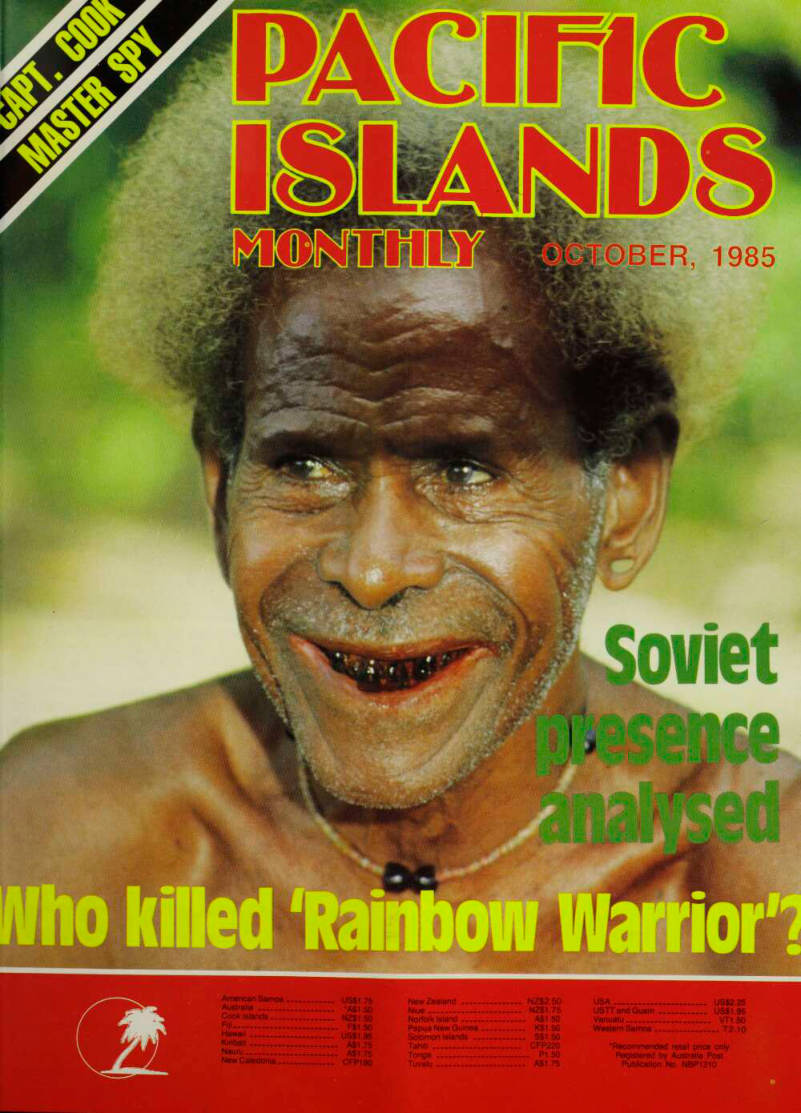
The Cover
An old man of Papua New Guinea’s Milne Bay area.
With proceeds of the sale of fruit and cone shells he is able to buy his beloved betel nut. Carl Bayer photo.
Advertisements & other items, pp. 2-3 (2 items)
A spirited departure from the norm.
» •Engine type: Water-cooled 4-stroke OHC 12-valve in-line 4-cylinder transversely mounted •Displacement: 1,955 cm 3 »Max. horsepower; I22ps/s,soorpm* •Max. torque: 16.9kg-m/s,ooorpm* •Suspension system; 4-wheel double wishbone *EX model Specifications and equipment may vary in some countries.
Now Honda achieves the full potential of the contemporary sedan with the interplay of its most advanced technologies.
Presenting the daringly low and wide Accord Sedan.
Elegance, refinement and aerodynamic finesse teamed together in an ideal combination.
Matched only by the superior performance of a silk-smooth double wishbone suspension, added 2.0-liter engine power and countless other refinements.
Truly an exhilarating motoring experience.
Yours, compliments of Honda and the razor edge of technology
/ICCORD
U.S. TRUST TERRITORY:
Kwok Kuen & Co., Ltd. PO. Box 537, Honiara/NEW HONDA MOTOR CO., LTD. i UMU, jnrnii ■' „ m r n ,^ n ni/ Id AKinC-lclanrl<s U.S. TRUST TERRITORY: United Micronesia Development Association P.O. Box 235, CHRB Saipan CM K Mark’s Motor Co., Inc. PC. Box DV, Agana/WESTERN SAMOA: Motor Distributors (Samoa) Motora Ltd Robertson Road, Suva, Fiji/AMERICAN CALEDONIA: Socibte Du ChalandageB, Ruedelasomme-8.P.97, Noumea/NAURUrlNauru Cooperation Repub^c of Nau /FIJI.C 11 1 d * American Samoa 96799/TONGA: Tonga
Islands
PACIFIC
MONTHLY
Vol. 56 No. 10 October 1985
“Frederique” 12
Bernard Tricot 12
Dirk A. Ballendorf 51
Trevor Sofield 53
In This Issue
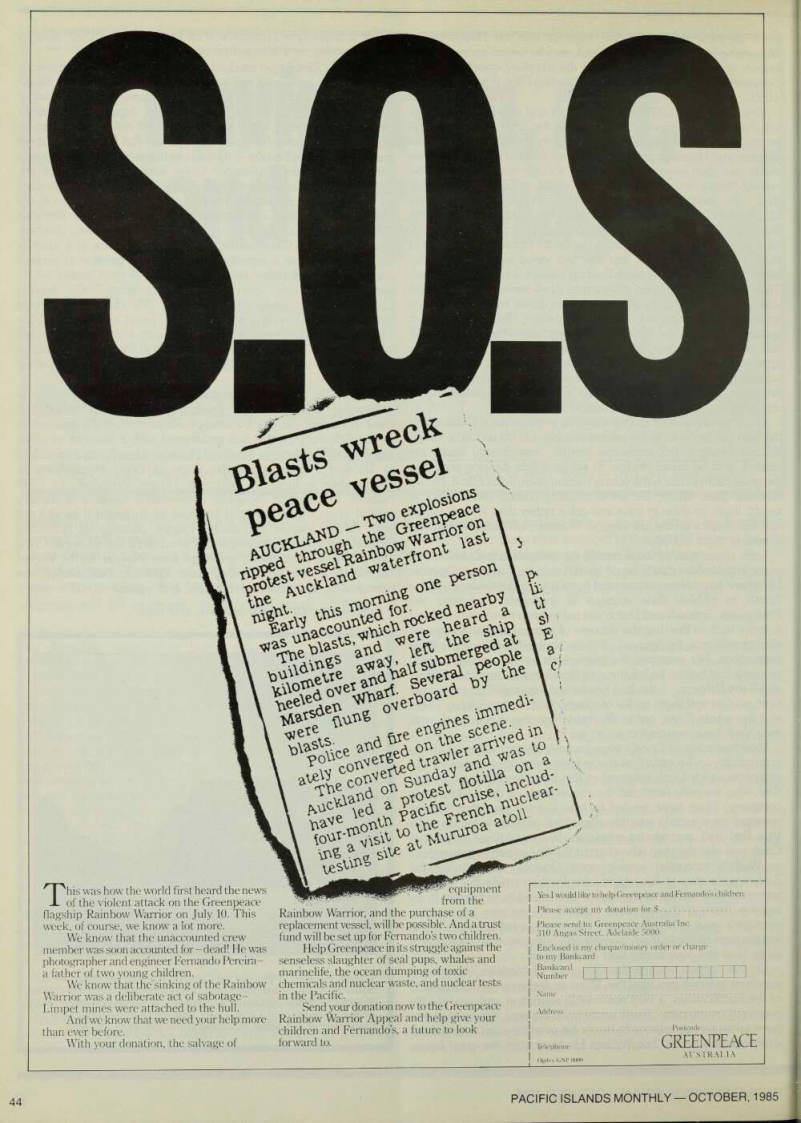
THE RAINBOW WARRIOR SCANDAL Karen -| 2 Mangnall in Auckland, Marie-Therese and Bengt Danielsson in Papeete, and Sue Williams in Noumea, report on the ever-widening consequences of the bombing in Auckland Harbor on July 10 of the Greenpeace vessel, Rainbow Warrior. Two agents of the French external intelligence bureau, DGSE, Domi nique Prieur and Alain Mafart, face trial in Auckland early next month in connection with the affair, in which Greenpeace photographer Fernando Pereira lost his life.
PNG ATHLETES SHINE AT MINI GAMES Lawr- 24 ance Bailey writes from Rarotonga on the South Pacific Mini Games held in the Cook Islands at which for the first time Papua New Guinea emerged as the pre-eminent regional athletic power.
NEW CALEDONIA READIES FOR POLL Sue 27 Williams in Noumea reviews the scene as the French territory prepares for its second election in less than 12 months, due on September 29.
CARING FOR THE HANDICAPPED Lee Anderson 29 in Apia profiles a determined young Australian, Jeff Heath, who, though a paraplegic, is barnstorming the South Pacific trying to improve the lot of the handicapped in Island countries.
AUSSAT ENTERS THE SCENE Communications 31 writer Greg Knudsen reviews the likely regional impact of Australia’s new domestic satellite.
Captain Cook: Navigation, Art, And 42
ESPIONAGE First eye-opening instalment in a three-part reproduction of a recent lecture by Professor Bernard Smith on the functions of art on Captain Cook’s voyages.
THE SOVIET PRESENCE Dirk Anthony Ballendorf, 5-) of Guam’s Micronesian Area Research Center, takes a considered look at the shadow and the substance of talk about the Soviet threat to Pacific Island countries.
Stamps 56
Contents
Australia 31 Books 39 Cook, Captain James 42 Cook Islands 24,46,47 Deaths 65
Fiji 10,49,52
France 12, 27 French Polynesia 49 Hawaii 29 Islands Press 57 Kiribati 7 Letters 9 Micronesia 41,45 New Caledonia 27 Niue 9
Pacific Report 7 Papua New Guinea 23, 24, 50 People 53 PIM Opinion 5 Political Currents 51 Service Page 66 Shipping Schedules 61 Soviet Union 7, 51
Stamps 56
The Month 27 Tradewinds 31 Tropicalities 45 United States 9, 29 Western Samoa 10, 29 Yachts 59
Australian cover price is recommended retail only. Registered by Australia Post, publication No. NBPI2IO. Second class postage paid at Honolulu.
Hawaii. Copyright Pacific Publications (Aust.) Pty, Ltd. Postmaster Hon olulu: Send address changes to PIM Hawaii, PO Box 22250, Honolulu Hawaii, 96822.
Advertisements & other items, pp. 3-4 (2 items)
3
PACIFIC ISLANDS MONTHLY —OCTOBER, 1985
Editor and Publisher Garry Barker Associate Editor Malcolm Salmon Advertising Manager Richard Thomson Layout & Design Barry Badger Editorial Adviser John Carter A Pacific Publications production Founded 1930 by R. W. Robson
(USPS 952480)
76 Clarence Street, Sydney, 2000, GPO Box 3408, Sydney. 2001.
Cables: PACPUB Sydney.
Telex: 21242 (answers INTARAD).
Telephone: Sydney 20-231. Melbourne 63-0211.
Manager: John Berry (03) 63-0211 Ext. 1860.
for industry or agriculture
Australian equipment
lifts production, lifts profits
$ m i* i % i igh performance Australian industrial equipment is available for a wide range of manufacturing, processing and servicing needs. Australia also makes innovative agricultural equipment that has helped her become one of the world’s major food producing countries.
Australian equipment is also operating efficiently and reliably in many other countries.
Australia can supply equipment ideal for most industrial and farming purposes in the Pacific Islands. Welding equipment.
Generating sets. Lathes and woodworking equipment. Sawmilling equipment. Refrigeration. Air conditioning. Mining equipment.
Safety equipment. Pumps including solar pumps. Ploughs. Cultivators.
Slashers. Tractors.
Irrigation equipment. Lubricators.
Planters. Gates and fencing. Cattle handling equipment. Agricultural seed and chemicals.
You can also obtain advice and expertise from experienced Australian consultants. But in the first instance contact the Australian Trade Commissioner about your particular requirements.
Ask the expert who knows Australia For details of suppliers phone or telex the Australian Trade Commissioner at: Fiji P.O. Box 1252 Phone 31 2844 Telex FJ 2126 New Caledonia P.O. Box 22 Noumea Phone 27 2414 Telex 087 Papua New Guinea P.O Box 9129 Hohola Phone 25 9333 Telex NE 22109 Hawaii Australian Consulate 1000 Bishop Street Honolulu 96813 Phone (808) 524 5050 Telex 63 3128 W i Ask the Australian Trade Commissioner
Of ships and bombs and tuna fish ...
Pim Opinion
At first thought there is not much connection between nuclear testing and tuna fish and yet there are similarities to be seen in the attitudes displayed towards the people, and the environment, of the Pacific by the American Tunaboat Association, and the French government. Arrogance is a word one might choose to use; insensitive is another and pig-headedly selfish a portmanteau third.
In this issue we devote considerable space to the extraordinary saga of the bombing of Rainbow Warrior, the little Greenpeace ship due to lead a protest flotilla to gadfly the French nuclear test site on Moruroa atoll, in French Polynesia. We also publish a letter from the president of the American Tunaboat Association objecting to our long-standing criticism of the attitudes and fishing methods of some of his members. While the A.T.A. isn’t yet into testing neutron bombs, nor the French extensively into violating Pacific exclusive economic zones, we think the two items display in common an alarmingly callous attitude of mind towards little countries largely unable to resist these intrusions.
The Greenpeace affair heaped egg on the French face, caused great chortling, even in their own country, over the ineptitude of their spies, and has had precisely the opposite result to that which the French initially sought when first they decided upon their incredible, hare-brained scheme.
Far from damaging Greenpeace, the affair has given their protest priceless international publicity.
Equally, one might propose, the refusal of the American tuna trawlermen to recognise the exclusive economic zones which the rest of the world honors, and the crude manner in which they, and the government they so effectively lobby in Washington, respond when the little island nations protest, cannot do the United States much good. It is worth considering how much the A.T.A. attitude contributed to the decision of Kiribati to cock a snook at the U.S. and sign a fishing agreement with the Soviet Union. Or, to put it rather more constructively, whether President Tabai would have been quite so keen to do business with Moscow had the American tuna men possessed a better reputation in the Pacific. As it is, Kiribati has done the locally logical thing and played one super-power off against the other to their own benefit, but the
region is discomforted to the extent that the already extensive, largely clandestine, Soviet presence in the ocean has been made a little more respectable and, upon that, will extend in the future.
The French political situation in the area, notwithstanding the Greenpeace affair, is similarly curious. Their current approach to the future of New Caledonia may be applauded. Given the background upon which they are trying to glue a solution, the temper and style of the more extreme whites (and also of some of the Kanak elements) and their own external policies, they have so far done much better than many expected of them.
In French Polynesia they are also instituting some constitutional changes which will give that territory a status very similar to that of the Cook Islands’ good and constructive relationship with New Zealand. Gaston Flosse thus benefits from the efforts of the Caledonian Kanaks he professes to condemn.
But the nuclear testing program to which all Pacific nations, including Australia and New Zealand, so strongly object continues on Moruroa and Fangataufa, which uninhabited atolls have now been ceded in perpetuity to France; legally they are not now part of French Polynesia. Indeed, President Mitterrand decided to hold a court of his officials and administrators on Moruroa, presumably just to show that whatever ludicruous antics his spies might perpetrate, France remained determined to continue testing in other people’s backyards. In this he is quite secure enough, even in French Polynesia, for while there will be in Papeete demonstrations against it, they will be small, for the program is less an issue inside that territory than outside it. That the rest of the Pacific was outraged by the visit appeared to bother the French leader not at all.
Yet, both the American trawlermen, and the supporters of France’s Force de Frappe, must realise that the Pacific is no longer a remote region. It is growing rapidly in political and economic importance. The little island countries might not ever have much in the way of economic strength, but they have positions of considerable strategic value, and, today, governments perfectly capable of throwing spanners in quite large international works.
And the more they feel insulted, ignored, or down-trodden, the quicker they will be to reach for the spanners.
Advertisements & other items, p. 6 (1 item)
National’sVHS Movie
sets you free!
Free from cables, connectors and complications VHS Movie model NV-M1 is a lightweight camera-with-recorder you can grab with one hand and take wherever the action leads you.
It weighs only 2.5 kg excluding battery pack.
There’s nothing to get tangled in—no additional components to carry around.
Free from frequent cassette changes The NV-M1 can record up to 240 minutes on a standard VHS video cassette. Think of all the great moments you can capture without interrupting the action.
Free from troublesome accessories Connects directly to TV for playback with Cue & Review and Still modes; requires no cassette adaptor. All you need is VHS Movie and good times!
Care-free The NV-M1 has a variety of special features that make operation carefree and simple: an electronic viewfinder that displays instant playback, a Date Recording Function, and a V 2” Newvicon pick-up tube for rich colour recording and low light sensitivity to 10 lux.
National’s VHS Movie NV-Ml. Find out k how it feels to be free.
I /H /Ml max/11
VHS
National
National, Panasonic and Technics are the brandnames of Matsushita Electric.
Pacific Report
Kiribati-Soviet Deal Goes Through
The vexed issue of the signing by Kiribati of a fisheries agreement with the Soviet Union was apparently resolved with a vote of the Kiribati Parliament late in August rejecting a no confidence motion against the government for its handling of the affair. The parliamentary vote effectively ratified the agreement signed shortly before with the Russians in Manila. Under the agreement the Soviet fishing company Sovrybflot has rights to operate 16 fishing vessels withing Kiribati’s 200-mile fisheries zone for a year for a fee of about SUSI.S million. Soviet vessels, however, will not be allowed to enter the 12-mile territorial limit. Nineteen MPs voted against the motion of no confidence, 15 voted for it, and there were two abstentions and one absentee. Speaking against the motion, President leremia Tabai said the government had the support of most Kirabati people, and there was no firm ground for the motion. He said the only reason the government had signed the agreement with the Russians was because the American Tunaboat Association had refused to do so. Referring obliquely to expressions of concern about the agreement by countries such as the U.S. and Australia, Mr Tabai had said in an earlier statement that his country of 56,000 people was deeply insulted by the attitudes of some nations in the affair. He said he did not accept that the presence of Soviet fishing boats represented a threat to Western security in the region. Rejection of the no confidence motion led immediately to the announcement of the formation of a new political party in Kiribati. Called the Christian Democratic Party, it consists of the 15 Opposition MPs, who say they will campaign for a referendum on the Soviet fishing issue, and that the result of the referendum should be binding on the government. If the govenment refuses a referendum, a petition would be taken up throughout the country. As a last resort, they say they would consider possible secession from Kiribati. Vanuatu has also been approached by the Soviet Union for a similar agreement, and its offer is being studied by an inter-departmental committee. But a Vanuatu Foreign Ministry spokesman said that Vanuatu would wait to see how the Soviet-Kiribati agreement works out before making a decision.
U.S. Urged To Sign Fishery Accords
An American specialist on the South Pacific says the U.S. must end its neglect of the area in order to keep an eager Soviet Union out.
In a report to the Heritage Foundation, a conservative group with close links to the U.S. Government, Mrs Dora Alves recommends that the U.S. reach regional fishing agreements with the South Pacific nations, provide help in developing their all-important fishing industry, and increase America’s diplomatic presence in the region. Mrs Alves, a former specialist at Georgetown University’s Centre for Strategic and International Studies, said the younger generation of Pacific island leaders now taking power were concerned with economic development. They were angered over what they saw as U.S. insensitivity, and were therefore prepared to consider Soviet offers of economic assistance. Mrs Alves said that following the Kiribati fishing agreement with the Soviet Union, the U.S. must make its top priority in the region the conclusion of a fisheries agreement.
Salii Is New Palau President
Senator Lazarus Salii, who, as head of the Micronesian Political Status Commission, played a large part in the negotiations with the United States over the political and economic future of the Micronesians when the Trust Territory agreement ends, is the new President of Palau. He defeated acting President and former Deputy President Alfonso Oiterong by 608 votes in the election which followed the murder on June 30 of President Haruo Remeliik. Senator Salii has 4040 votes and Mr Oiterong 3432.
Four men arrested in connection with the Remeliik killing have been released for lack of evidence.
Somare Dodges No Confidence Move
A parliamentary adjournment, a week earlier than expected, saved Papua New Guinea Prime Minister Michael Somare in early September from facing a no confidence motion tabled by former
Prime Minister Sir Julius Chan, leader of the opposition People’s Progress Party. The motion was to have been seconded by National Party leader Mr lambakey Okuk, who left the coalition government because, he said, his party was not given its fair share of ministries. Sir Julius said he was obliged to move a motion of no confidence because the management of the country was in a mess.
During a debate a few days before the adjournment, the government failed in an attempt to have parliament dissolved and fresh elections called, the motion being defeated twice on the voices. Mr Somare survived a no confidence motion tabled in March by Sir Julius, but he faces strong criticism for the government’s moves in combating the crime wave by imposing a curfew in Port Moresby, the capital, and accusations by former Deputy Prime Minister Mr Paias Wingti that he had associated himself for several years with an Australian airline, Pelair, formerly Wings Australia Ltd., “mentioned” in inquiries in Australia into the drug trade. A commission of inquiry, instigated by Mr Somare to probe allegations made against him, has been appointed. National Court Judge, Mr Justice Bredmeyer heads the commission which includes Silas Samual and Martin Loi, two senior magistrates.
Announcing the inquiry, Deputy Prime Minister Father Momis said the inquiry would also cover the sale of the government executive jet and the purchase of three Israeli-made Arava aircraft for the PNG Defence Force. Father Momis said allegations against the government and the Prime Minister were serious and it was proper that they should be investigated.
Greenpeace Garners Big Bucks In Nz.
A third Greenpeace vessel left Auckland early in September to join the vessels Vega and Alliance which set sail in August for the nuclear protests cruise to Moruroa which was to have been led by the bombed former North Sea cod boat, Rainbow Warrior. It was the yacht Breeze. In a telegram to its skipper, Jim Cottier, New Zealand Prime Minister David Lange wished him well and described the action in joining the flotilla as courageous. He said the voyage stated clearly to French authorities the opposition of the people of the South Pacific to French nuclear testing. A new ship to lead the flotilla, a former sea-going tug bearing the name Greenpeace, was at the time on its way from Europe to lead the flotilla. Reports from Papeete said a French naval vessel would leave there in mid-September to prevent Greenpeace and the other craft from entering French territorial waters. Meanwhile demonstrations were held in Auckland on September 7 against French N-tests. About 100 demonstrators gathered outside the office of the French airline UTA. They also marched to the entrance of a store selling French products, in support of a proclaimed 30-day boycott of French goods. The French newsagency, AFP, reporting from Wellington, said the boycott had received little support. But the newsagency reported that in two months following the Rainbow Warrior sinking on July 10, the Greenpeace organisation had received almost SNZ2OO,OOO in donations from the New Zealand public.
Barricades In Caledonia After Girl Shot
An uneasy calm had been restored by mid-September in the east coast region of New Caledonia following two days of trouble caused by the shooting of a young Melanesian girl. Sue Williams reports from Noumea that gendarmes had dismantled barricades blocking the main east coast road. The barricades were set up by Kanak independence supporters near the town of Ponerihouen.
However, the region was still not considered safe, and residents were being advised to stay off the roads. The trouble began on September 4 when the 15-year-old girl was shot and seriously wounded. A 22-year-old man has been charged over the incident.
However, the Kanak independence movement, the FLNKS, gave the authorities until September 9 to expel the man’s family from the area, along with the head of the gendarmes in the Ponerihouen area. The independence movement has also directed that non-Kanaks will not be allowed to circulate among the tribes of the region. If these conditions were not met, local FLNKS members said they would boycott the September 29 regional election.
Warrior: French ‘ Stinginess 9 Factor
Nancy Wake, Australian-born heroine of the World War II French Resistance George Medal, Croix de Guerre with Palm and Bar, Croix de Guerre with Star, Medaille de Resistance, American Medal of Freedom, member of the Legion d’Honneur knows her way around the world of French intelligence organisations better than most. In comments made to interviewer John Hallows in The Weekend Australian of September 7-8 she showed (a) that she had not the slightest doubt that French agents wer responsible for the sinking of the Rainbow Warrior in Auckland on July 10, and (b) that she thought the action entirely justified. Her one point of criticism of the operation centred on what she called French “stinginess” the delay in getting out of the country by the now jailed “Turenge” couple (read Prieur/Mafart) who stayed around so they could collect the deposit on the campervan they had hired.
Ms Wake, now 73 and living in Sydney, told Hallows; “If I’d been blowing it up, I’d have got straight out of the country. Within half an hour, if possible but before the search started. And if I’d been in their position, I would indeed have blown up the ship; it’s a tragedy someone got killed, but I can understand why the attack was made. I’d have more sympathy for peace groups if they paid more attention to Russian nuclear weapons. I don’t see why it’s all right for Russia to test her bombs but somehow immoral for the West to be able to defend itself. But once I had blown up the ship I’d have been out of New Zealand before anyone started to look for me. But where the French went wrong was to submit to a typical piece of Gallic stinginess. The French always have to have the paperwork accounted for. So they went back to Whangarei or wherever it was to get the deposit back on the campervan. ” The interview took place on the occasion of the forthcoming publication of Nancy Wake’s autobiography, The White Mouse the Germans’ code name for her during her wartime activities.
Anti-Communists Slam Kiribati Deal
A communique from the 31st general conference of the Asian-Pacific Anti-Communist League has criticised the granting of fishing rights to the Soviet Union by Kiribati. It said the fishing deal was a warning that the small nations of the Pacific needed greater economic support if communist expansion by Russia and China was to be stopped. The communique, which was released from the conference in Tonga’s capital Nuku’alofa, said international communists were vying with each other for influence over the Pacific region. The league urged New Zealand not to withdraw from the ANZUS defence alliance with Australia and the United States, and also called for mutually beneficial investment among free nations of Asia and the Pacific. Over 100 delegates from 38 countries took part in the conference.
Kenilorea Survives No Confidence Vote
Solomon Islands Prime Minister Sir Peter Kenilorea survived a no confidence motion in parliament on September 6. On the same day a settlement was announced to a damaging five-day-old strike by public employees. The no confidence motion tabled by Opposition Leader Solomon Mamaloni charged Sir Peter with displaying a general lack of co-ordinated leadership, an inexplic able delay by the coalition government in presenting a national development plan, inefficient government financial management, and a deterioration in the country’s economy. A walk-out by five government members the previous week resulted in parliament being suspended until September 2, thus preventing a debate on the no confidence motion. To add to Sir Peter’s troubles, the whole of the Public Service went on strike in protest at the government’s handling of the sale of government houses.
Cook Islands Party Disowns Rebels
The Cook Islands Party has disowned four of its MPs who have remained with the government of Sir Thomas Davis. A coalition government between the CIP and Sir Thomas’s Democratic Party broke up late in August The CIP moved to the Opposition benches, and its September central committee meeting ruled that the four remaining on the government benches had, by their actions, deserted the party. However, the four MPs concerned, including Deputy Prime Minister Dr Terepai Maoate, said they still regarded themselves as CIP members, and the government as a coalition between the CIP and DP.
Fiji G.-G. Visits Malaysia
Fiji’s Governor-General Ratu Sir Penaia Ganilau was due to visit Malaysia in mid-September. His first official visit to the country was
seen as part of Fiji’s effort to strengthen links with the countries of the Association of South East Asian Nations (ASEAN). Ratu Sir Penaia was expected to meet Malaysia’s king and prime minister, among other dignitaries.
AT LAST , A NEW PANAMA CANAL?
The decades-long speculation about a “new” Panama canal took on a new lease of life in September with a Japanese press suggestion that before the month was out an agreement for a feasibility study on the problem would be signed in New York by U.S. Secretary of State George Shultz, and Japanese and Panamanian Foreign Ministers Shintaro Abe and Jorge Abadia Arias. Reporting from Tokyo, Clyde Haberman of The New York Times writes: The present canal, completed in 1914, is too narrow and shallow to accommodate modem bulk-cargo carriers and supertankers. Ships are limited to a maximum of 65,000 tons, and it usually takes them 20 hours or more to make the crossing. Three basic possibilities will be examined enlarging the existing canal; building a new one; or improving rail, highway and pipeline links across the Panamanian isthmus. The late president of the Japan Chamber of Commerce and Industry, Shigeo Nagano, vigorously advocated a project which would enable fully loaded 300,000-ton tankers to pass through. His plan called for a waterway roughly parallel to the present canal and five kilometres to the west. It would be about 96 kilometres long and 215 metres wide, most of it dug inland with a section cutting across Gatun Lake. Mr Nagano, who died last year, said the proposal would reduce ocean travel time between Japan and the LJ.S’s east coast by one-third. It would also give the U.S. more flexibility in moving aircraft carriers and other huge naval ships, he argued. His plan is taken seriously enough here to have drawn support from large construction companies such as Mitsubishi and Kashima and from the Industrial Bank of Japan and the Bank of Tokyo. However, the sheer expense of such a project has raised questions about its practicability. There also are long-standing disagreements about the probability of overcoming engineering problems caused by the fact that Pacific Ocean tides reach far greater heights than those of the Atlantic.
Ccop/Sopac Meets In Honiara
About 70 representatives were to attend a two-week meeting beginning in Honiara, Solomon Islands, on September 10 of a regional organisation assisting South Pacific countries to evaluate their mineral resources on or beneath the seabed. It was the 14th meeting of the Committee for co-ordination of Joint Prospecting for Mineral Resources in South Pacific Offshore Areas (CCOP/ SOPAC). Member countries include Papua New Guinea, Fiji, Kiribati, Guam, Tonga, Cook Islands, Tuvalu, Western Samoa, Vanuatu, Solomon Islands and New Zealand. Technical advisers at the meeting were expected to come from a number of countries, including Australia, France, Japan, the United States, Britain, the Soviet Union, West Germany, the Netherlands and Norway. There were also observers from United Nations agencies. Included on the agenda were discussions on manned submersibles and remotely operated vehicles in the Pacific. There were also reports from groups studying resources and tectonics in the South Pacific.
South Pacific Rugby Team Formed
The South Pacific Rugby Confederation is to form a rugby team made up of players from the six countries that took part in the last South Pacific Mini Games held in the Cook Islands. A rugby official in Honiara, Solomon Islands, said the name of the team would be C.0.P.R.A., which stands for “Countries of the Pacific Rugby Association”.
New Poll In French Polynesia
The head of the local government in French Polynesia, Premier Gaston Flosse, in late August proposed to ask the Paris government to dissolve the Territorial Assembly and organise new elections two years ahead of the due date. An overwhelming majority of assemblymen endorsed his proposal which put Flosse in a strong bargaining position when he was received in Paris on September 5 by French Prime Minister Laurent Fabius.
A smiling Flosse emerged from the meeting and announced that Fabius had accepted not only the dissolution of the assembly but also an increase in the number of seats from 30 to about 40.
Furthermore, according to Flosse, Fabius is also willing to scrap the brand-new statute, or consitution, which was celebrated with much fanfare during the recent Festival of Pacific Arts (PIM Sept, p. 22), and replace it with a genuine system of self-government on the Cook Islands model. Marie-Therese and Bengt Danielsson.
T unaboat
letters
U.S. tuna men have their say
Concerning your PIM Opinion entitled “Sharks Among the Tuna” published June 1985: to charge that the United States and the American Tunaboat Association (ATA) “pay no re gard to ecological or political consequences of fishing” is without factual foundation. The existing conservation treaties on tuna in the Atlantic and eastern tropical Pacific entered into and implemented by the United States with other countries, along with the recently signed tuna regional licence treaty signed by the United States and four Central American coun tries, attest to the intent and actions of the United States and ATA. The Eastern Tropical Pacific Treaty (lATTC) was en tered into in 1949, the Atlantic Treaty (ICCAT) in 1966, and the San Jose (Costa Rica) Trea ty in 1983.
Your Opinion in proposing that each government has the unilateral power to impose a direct charge on anyone who wants to search for tuna beyond the 12-mile territorial sea, or to deny anyone such opportunity, completely ignores the tuna consumer’s interest in having an ocean protein re source available at an inexpen sive price. The United States and ATA argue that if such charge is to be imposed on tuna fishermen, regardless of flag, that such action can only be justified if done by treaty on a multi-national basis within a particular ocean region. This is why ATA, in 1980, helped to introduce the concept of regio nal tuna licensing to the coun tries in the Central, Western and South Pacific.
With respect to your com ment that a licence charge of five per cent on tuna fishermen on the value of the licence is fair, and that it would generate $2OO million annually for the Island governments, demons trates complete ignorance of the economics and other data
American T unaboat Association
regarding the fishery. Your proposal is fiction. Your dream land proposal totally misleads your readers about the econo mic reality of fishing for tuna.
Since 1980, our vessels have sustained an average price per
ton decline of over 30 per cent.
Today, U.S. tuna fishermen leave port with no price on departure or guarantee. Price is determined by date of arrival, type and size of fish, and quality standards established by the
buyers. About 1.2 million tons of tuna are annually processed in the world for the canned tuna market. Another 500,000 tons is consumed raw, fresh or smoked. The distribution of tuna is worldwide and not, as suggested by your Opinion, restricted to the Pacific.
Finally, with respect to your view that catching tuna by net is bad, while catching by hook is good: we suggest that this gear conflict rages today within Japan, and you have forgotten that this competition between fishermen is as old as the history of men. Therefore, you are unfair in selecting Amer icans only as this issue, espe cially when the facts establish the actions of the United States to control its citizens on the matter of conservation, whether such citizens use the hook or the net to catch tuna.
August Felando,
President, American Tunaboat Association San Diego, Calif.,
Usa.
Niue’s top postie
posts a letter
I would like to comment on what was written in your PIM, May issue, Pacific Report, about the Niue Post Office.
You are quite correct with your heading “Niue Post Office Busy”, but the rest of the information is incorrect. For the record: (i) The Niue Post Office is not a branch of the New Zea land Post Office. It is part of the Niue Public Service. The NZPO Savings Bank services are pro vided on an agency basis; (ii) The report you referred to was not that of the last financial year. It was for the previous financial year, the
period from April 1, 1983, to March 31, 1984; (iii) The figure of $1,979,808.00 is not the finan cial support the island received from Niueans living in New Zealand. The figure was for cheques, either deposited into Savings Accounts or payments for money orders sent by businessmen to NZ to pay their accounts. In 1983/84 the Island received only $282,900 from NZ by Money Orders.
Sir, I do believe that your readers are entitled to know the facts.
Alofi Niue
F. K. Ikimotu,
Postmaster.
The paragraph was based on an item in the March 15, 1985, issue of Tohi Tala Niue which began: “The Niue branch of the New Zealand Post Office trans actions in the last financial year showed steady trade ...” No mention was made of the post office being part of the Niue Public Service. The figure of $1,979,808.00 was a mistake, the writer of the paragraph having looked at the entry under Receipts of Money Orders. Instead of writing $1,864,297.35, which was the amount shown under Receipts, he took the figure $1,979,808.00, which was the entry under Payments for Che ques. He assumed, wrongly, as the Postmaster points out, that the Money Orders had been received in Niue from expatri ates in New Zealand. The PIM report described the amount as
“an indication of the financial support the island gets from Niueans living in New Zea land”, not that the figure given was the actual amount sent by Niueans to their relatives.
Editor.
“No” to nuclear
ship visits
In the June, 1985, issue of PIM a particular article caught my eye. This article was titled: Nuclear Cruiser Visits W.
Samoa and it told of the Amer ican nuclear-powered guided missile cruiser the U.S.S. Texas being received into Apia Har bor on May 4 for a “goodwill visit”.
Western Samoa’s Prime Minister Tofilau Eti Alesana said that he “did not believe that this visit will cause any danger to Samoa.” With all due respect, I’m afraid the prime minister was very wrong.
Between the Soviet Union and the United States there are over 50,000 nuclear weapons targeted at spots throughout the world and, rest assured, even American Samoa, as an Amer ican territory, is surely targeted, not because it is of any real military importance, but simply because there are so many of these weapons that the biggest problem is where to target all of them. The total power of these weapons is over 18,000 mega tonnes, or the firepower of about 6000 World War lls.
Now, what can Western Samoa do about this? Very simple. Instead of welcoming any of these nuclear ships from any nation with open arms, the government and country need to make a strong stand against such insanity by refusing to allow these ships into Western Samoan waters. Western Samoa would then be uniting with New Zealand in a plea for peace and sanity for our earth.
Sam Burris
Hilo Hawaii
Usa
That duruka is far
from “wild”
Pacific vegetables and fruits aren’t mentioned often in the press or in popular publications, and when they are, the reader often gets the impression that they are either “wild” or were introduced into the Pacific fully domesticated from Southeast Asia. A “wild” case concerns your Tradewinds re port (June 1985) on the cook book, A Taste of the Tropics and its associated promotion of fresh tropical products into Aus tralia and New Zealand. Com menting on the book and its “complete guide to tropical fruits and vegetables,” your re porter is impressed by the inclu sion of duruka (Fiji asparagus) “which is, in fact, a wild sugar cane species.”
The reporter perhaps cannot be faulted, for this misinforma tion appears right in the cook book. But the authors of the book should know better. This plant is actually Saccharum edule, related to the sugar canes. The edible part is the
undeveloped flower (the reader should not surmise that it tastes sugary it doesn’t). The point I want to make is that that the flower never develops fully and the plant itself is therefore com pletely dependent upon hu mans for its propagation. It’s hard to find another example of a plant less wild. Its deve lopment is due to careful selec tion of one or more sterile sports by tens of generations of careful, observant Melanesian farmers. In pre-European times it had been spread as far west as the Malay peninsula.
Duruka is just one of the large roster of plants, including breadfruit and sugar-cane, ori ginally developed by Melane sians.
Nevertheless 1 wish well to all involved in the promotion of fresh Pacific foods in Australia and New Zealand especially to the growers! Your Tradewinds reporter added the useful information that duruka (known as pitpit in Papua New
Guinea) is “delicious when braised in coconut milk.” I would also add that it’s excel lent for a barbecue. Best to put the stems on, with leaves intact, before the fire is hot enough to cook the meat.
But we may have to wait a while to taste duruka here. In Fiji, the main crop is harvested in April and May.
N. Bowers
Senior Lecturer, Department of Anthropology University of Auckland Auckland, New Zealand Our reporter writes: As our correspondent will know, duru ka, unfortunately, has a very short season. You gorge on it for a couple of weeks and then it’s over. CSR’s agronomists worked hard and long in their laboratory in Lautoka in the 1960 s trying to cross the duru ka with a cane species which flowered later than the duruka, the idea being to produce a duruka strain to give the gour met a “repeat” season, some weeks after the original duruka season had ended. Sad to relate, they had no success.
Editor.
Lautoka sugar mills . . . scientists labored long and hard for a “repeat” duruka season.
Advertisements & other items, pp. 10-11 (2 items)
All The News
IN A FLASH
THE SOUTH SEA DIGEST
See insert for Subscription details
Kenwood
Highlights of Spectrum 94W8 shown: I ■ CD, video, 2 tape inputs ■ 125W/channel PMS (8 ohms, 20Hz—20kHz) 0.05% THD 'eries Direct access synthesizer tuning co a 10-station random preset memory ■ Double auto-reverse cassette deck ■ Double-speed jdubbing ■ Continuous tape relay play ■ Programmable linear tracking turntable ■ Recording from turntable ■ Graphic equalizer (option) ■ CD player with Bch memory (option) ■ Audio timer (option) ■ 130 W bass reflex speaker system For the true colors of music —
Kenwood Spectrum stereo systems.
When you look at what Kenwood Spectrum stereo systems offer,
you’ll wonder why you delayed.
They have computerized and electronic functions to make operation easy for you. And they’re highly versatile, too.
But in these days of electronic wizardry, it’s easy to forget what hi-fi stereo is really all about: music reproduction, pure and simple.
You’ll find that Kenwood Spectrum systems, designed by some of the world’s most uncompromising audio specialists, are performers
of outstanding ability.
And, since each Spectrum system has its own special character, you can find the one that exactly meets your needs and budget.
TRIO-KENWOOD CORPORATION
Shionogi Shibuya Building, 17-5, 2-chome Shibuya, Shibuya-ku, Tokyo 150, Japan TRIO-KENWOOD (AUSTRALIA) PTY. LTD. (incorporated in n.s.w.) 4E Woodcock Place, Lane Cove, N.S.W. 2066, Australia NEW ZEALAND JOHN GILBERT & CO., LTD. Auckland Tel. 0011-64-9-30839 FUJI PEPE’S DUTY FREE CENTRE LTD. Tel. 25496, 25497 PAPUA NEW GUINEA S.O. SVENSSON (N.G.) LTD. Port Moresby Tel. 212158, 212111 SOLOMON ISLANDS TECHNIQUE RADIOS CENTRE LTD. Honiara Tel. 416 NEW CALEDONIA HI-FI VOX Noumea Tel. 27-2466, 28-2931 VANUATU FUNG CHOI LUEN. Port-Vila Tel. 2556
TAHITI MAISON AURORE Papeete Tel. 29703
AMERICAN SAMOA ISLAND PACIFIC AGENCIES, INC. Pago Pago Tel. 633-4687
REPUBLIC OF NAURU NAURU CO-OPERATIVE SOCIETY
MARIANA ISLANDS JC. TENORIO ENTERPRISES Saipan Tel. 6445
worm-wide shame

“Rainbow Warrior” Scandal
Saboteurs hoist France worm-wide shame
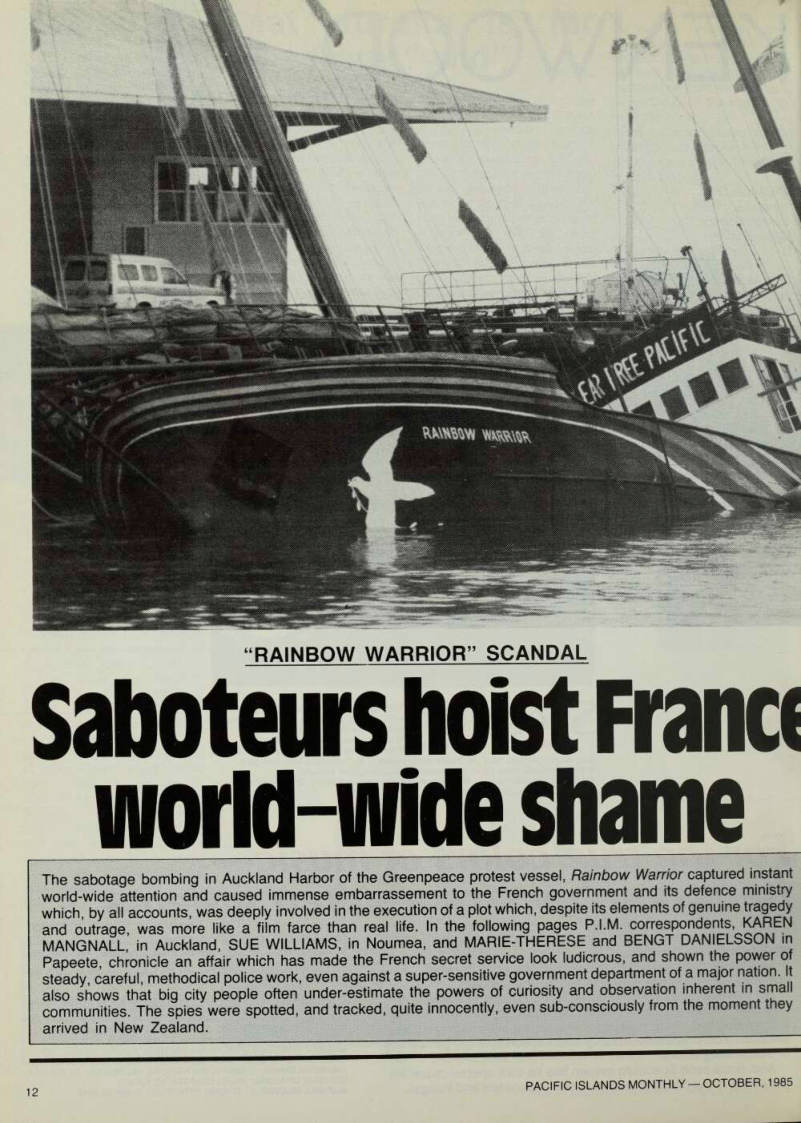
The sabotage bombing in Auckland Harbor of the Greenpeace protest vessel, Rainbow Warrior captured instant world-wide attention and caused immense embarrassement to the French government and its defence ministry which, by all accounts, was deeply involved in the execution of a plot which, despite its elements of genuine tragedy and outrage, was more like a film farce than real life. In the following pages P.I.M. correspondents, KAREN MANGNALL, in Auckland, SUE WILLIAMS, in Noumea, and MARIE-THERESE and BENGT DANIELSSON in Papeete, chronicle an affair which has made the French secret service look ludicrous, and shown the power of steady, careful, methodical police work, even against a super-sensitive government department of a major nation. It also shows that big city people often under-estimate the powers of curiosity and observation inherent in small communities. The spies were spotted, and tracked, quite innocently, even sub-consciously from the moment they arrived in New Zealand.
On November 4, the doors of Auckland’s District Court will open on New Zealand’s most celebrated espionage trial. Its ripples have spread to France, implicating the French overseas secret service, the Direction Generale de la Securite Ex terieure (D.G.S.E.), Defence Minister, Charles Hernu, and the wavelets have begun lap ping at the door of President Mitterrand’s office in the Elysee Palace.
In the dock will be two D.G.S.E. agents, Alain Mafart and Dominique Prieur. They are charged with murder, arson by use of explosives, and con spiracy to commit arson. Also charged with the same crimes, but in absentia, are three other D.G.S.E. agents, all highly skilled underwater sabotage frogmen: Roland Verge, Gerald Andries and Jean-Michel Barte lo.
Also on trial will be French nuclear tests at Moruroa and France’s conduct of its foreign and defence policies.
The first police witness is expected to be Greenpeace New Zealand anti-nuclear cam paign coordinator, Elaine Shaw, who will set the scene of the Greenpeace protest cam paign which brought the 40metre Rainbow Warrior into Auckland harbor on July 7, 1985.
At ten minutes to midnight on July 10 two huge explosions ripped through the Greenpeace flagship as it was moored at Marsden wharf. The Rainbow Warrior’s inhabitants jumped for the wharf or dived into the water as the ship sank in less than four minutes.
But Greenpeace photo grapher, Fernando Pereira, ducked below after the first blast to collect his beloved camera gear. He was trapped in his cabin by the second explo sion and later discovered to have drowned.
Within minutes of the blasts the largest police (and press) investigation in New Zealand’s history had been launched and was in the weeks following to reveal a sabotage operation flawed by French arrogance towards New Zealanders’ pow ers of observation and deduc tion.
At about 9.30 pm on the night of the bombing Auckland police had received calls from an outboard boating club fur ther along Auckland’s waterfront. According to a police evidence document later obtained by the New Zealand Herald the witnesses saw a man in diving gear and wearing a red wool cap get out of a Zodiac inflatable dinghy. He was met by two persons - later identi fied as the Turenges (real names Prieur and Mafart) who helped load some gear into a Newmans rental com pany campervan. Before com ing ashore the man dumped a Yamaha outboard motor into Hobsons Bay, and also a small two-litre canister subsequently identified as a re-breather bottle used predominantly by the world’s naval sabotage units to prevent air bubbles from break ing on the water’s surface. All of these mysterious people vanished, but not before the witnesses noted the camper van’s licence plate number.
By the morning of July 11a police alert was carried throughout Newmans to be on the lookout for the campervan and its two occupants.
Meanwhile, as Royal New Zealand Navy divers scoured the explosion area and tried to discover the extent of the Rain bow Warriors damage, the public was flooding Green peace’s offices with donations of money and help.
At this point the police had recovered the Zodiac which had been abandoned on rocks near Hobsons Bay, but with its identity tag ripped off.
At 7 am on July 12 the staff of Newmans at an Auckland suburban office arrived at work to find the missing campervan and its two occupants, Prieur and Mafart, calmly waiting on the doorstep to return their vehicle early and collect their deposit money. Police were called and took them into cus tody where they were later charged with passport irregular ities.
Interpol and foreign police agencies had already been cal led for help and Tahiti police questioned briefly a French man, Francois Verlon, who had been briefly on board the Rain bow Warrior at 8 pm on the
night of the explosion.
New Zealand police later flew to Tahiti to question the man further and although they could not charge him with anything, they are still interested in talking to him again.
A public appeal for informa tion on the campervan’s move ments in the North Island early in July brought a flood of witnesses from all around the area. One of these witnesses apparently gave such startling information that nine New Zea land detectives leaped aboard a Royal New Zealand Air Force plane on the afternoon of July 15 to fly to the Australian territory of Norfolk Island.
There they questioned for seve ral hours the crew of a Noumea-based charter yacht, Ouuea.
The yacht had set sail from the northern port of Whangarei on the morning of July 9. But evidence piled up in later weeks showing that the crew of the Ouuea the French frogmen and Dr Maniguet - had met and entertained French agents Prieur and Mafart in the days preceding the bombing. Dr Maniguet had evaded the Nor folk questioning by flying to Sydney. He was later ques tioned there by New Zealand police, but was not held on any charge. He later flew to Singa pore and then to his home in Dieppe, always protesting his innocence.
But, at Norfolk, forensic tests made of the bilges of the Ouuea revealed traces of plastic explo sive. Police also found a docu ment belonging to the yacht’s skipper, Verge, which con tained the cover name of Mafart, Alain Turenge. Photo graphs were recovered showing Andries and Bartelo in diving equipment, Bartelo wearing a red woollen cap.
But the police could not hold the Ouuea at that stage and her crew set sail for Noumea and disappeared somewhere in the Pacific ocean several days later.
The last item found on board the Ouuea, a map of Auckland with a private address handwrit ten on one corner, eventually led the police to Greenpeace headquarters. They put their heads together and came up with another D.G.S.E. agent, known as Frederique Bonlieu,
who had infiltrated Auckland Greenpeace during April and May of this year.
With detailed accounts from these Greenpeace people it be came obvious that Bonlieu, later revealed as Lieut Christine Gabon, had fed back informa tion to Paris, including the map, to help the bombers prepare their New Zealand itinerary.
On July 16 the French agents, under the names of Sophie and Alain Turenge, were charged on five counts of using false passports.
In the days following the evidence piled up. It emerged that the Ouvea’s crew hired several cars, one with a big carrying capacity, which totted up huge mileages. Dr Maniguet travelled to Auckland and then to the South Island, ostensibly for ski-ing. Witnesses continued to come forward to place the Zodiac dinghy inside the cam pervan at various stages, linking the “Turenges” with the Ouvea crew and providing pieces to fit into the puzzle on everyone’s movements during the crucial week in early July, before the bombing.
It turned out that Ouvea arrived in New Zealand on June 22 at a deserted northern har bor called Parengarenga. The crew hired the yacht from Noumea Yacht Charters, through a Paris-based travel office called Odyssee Travel.
Odyssee turned out to be a D.G.S.E. “front” operation.
After nearly capsizing at Parengarenga, the yacht travelled south via Whangaroa and Opua (where they cleared customs for the first time, seve ral days after first reaching land), to Whangarei.
As well as travelling around in cars the Ouvea crew pro ceeded to “live it up” in re staurants, inviting a steady stream of women on board the yacht and to their Whangarei motel.
On July 21, New Zealand detectives flew to Noumea to wait, in vain, for the arrival of the Ouvea and to check out whether the Zodiac, Yamaha outboard motor or the oxygen bottle could have been purch ased there.
Only on July 23 were the
Turenges arrested again and faced with the major charges of murder, arson and conspiracy.
On July 26 arrest warrants were issued for the same charges against three of the Ouuea crew, excluding Dr Man iguet whose role could not be identified.
On July 27, in Israel, the Greenpeace infiltrator, Gabon, received an urgent telegram saying, in effect, “father sick, come home.” Bonlieu left im mediately, catching a T.W.A. flight from Tel Aviv to Paris. It later emerged that her father had died many years ago. On the day she disappeared Auck land newspapers published for
the first time details of her involvement in the sabotage.
During this time the police had begun collecting records of internal and overseas telephone calls placed by all the French agents now identified as being involved in the investigation into the Rainbow Warrior bom bing. A second oxygen re breather bottle was found, quite a distance away from the first one, apparently carried there by tides.
Police started talks with their French counterparts to enable New Zealand detectives to go into France to further investi gate the background of the suspects. Other detectives went to Switzerland to trace the background of the false pass ports used by the couple calling themselves Turenge.
Suddenly information began leaking from the D.G.S.E. in Paris that some of the saboteurs were French agents. Almost simultaneously President Mit terrand went public and or dered a full inquiry to be headed by a counsellor of state, Bernard Tricot.
By August 13, French and Auckland newspapers had be gun revealing a D.G.S.E. plot to blow up the Rainbow Warrior, but the story was sidetracked by claims that the dirty work was actually done by right-wing mercenaries financed on “mate’s rates” by New Caledo nian Caldoches helping out the
D.G.S.E. Then the Zodiac and the Yamaha outboard engine were traced to a London shop, Barnet Marine. The shop manager identified the purchas er as a Frenchman, perhaps Mafart.
Later information revealed that five D.G.S.E. agents, in cluding the crew of the Ouuea, were in London at the time.
The French government had by then begun to strike back against the news revelations by claiming that the sabotage was done by Greenpeace itself, or by “an enemy of France” such as Great Britain, or the Soviet Union.
Inquiries made by the New Zealand Herald suggested that what could have panicked the French into the sabotage was the possibility that the Rainbow Warrior crew could have ad vanced close enough into Moruroa to see large scale destruction of the atoll and also do anecdotal health sur veys of nearby islands. The newspaper also said that this information was prob ably gained by intercep ting Greenpeace correspondence discus sing the possibilities with anti-nuclear activ ist in Tahiti, Bengt Danielsson, and from Gabon’s searching of files in Green peace’s Auckland office.
A joint scien tific report by Auckland geothermal experts and Greenpeace shows that, based on the recent Tazieff and - *
Atkinson reports on Moruroa, the atoll is substantially dam aged and probably beginning to leak increasing amounts ol radio-active nucleides into the surrounding ocean. (This claim was subsequently rejected bv, other New Zealand scientists and a brisk academic argumenl was stirred alongside the majoi story). Simultaneously Neu Zealand newspaper articles alsc recorded the fairly widely-re ported belief that the French will shift their nuclear tests tc Fangataufa.
By August 14 the New Zea land police had asked the French to arrest anc detain all those sus iyt pects wanted in Neu Jp Zealand for the JR Rainbow Warrioi sabotage. Then the I trial of th e Turenges was se for November 4 By this stage press report; all around the world had re vealed theii true identi ties, Mafar and
I Prieur.
I On . Augus 22 the 1 Rain-
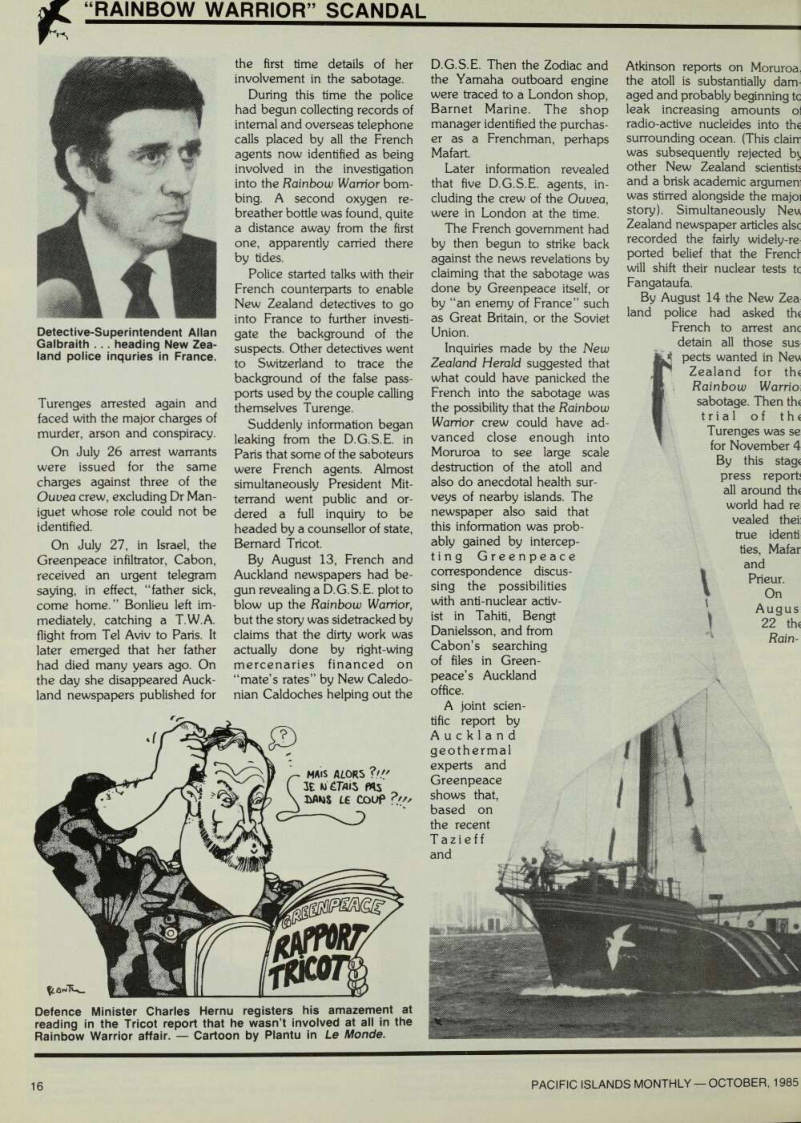
Detective-Superintendent Allan Galbraith ... heading New Zea land police inquries in France.
Defence Minister Charles Hernu registers his amazement at reading in the Tricot report that he wasn’t involved at all in the Rainbow Warrior affair. Cartoon by Plantu in Le Monde.
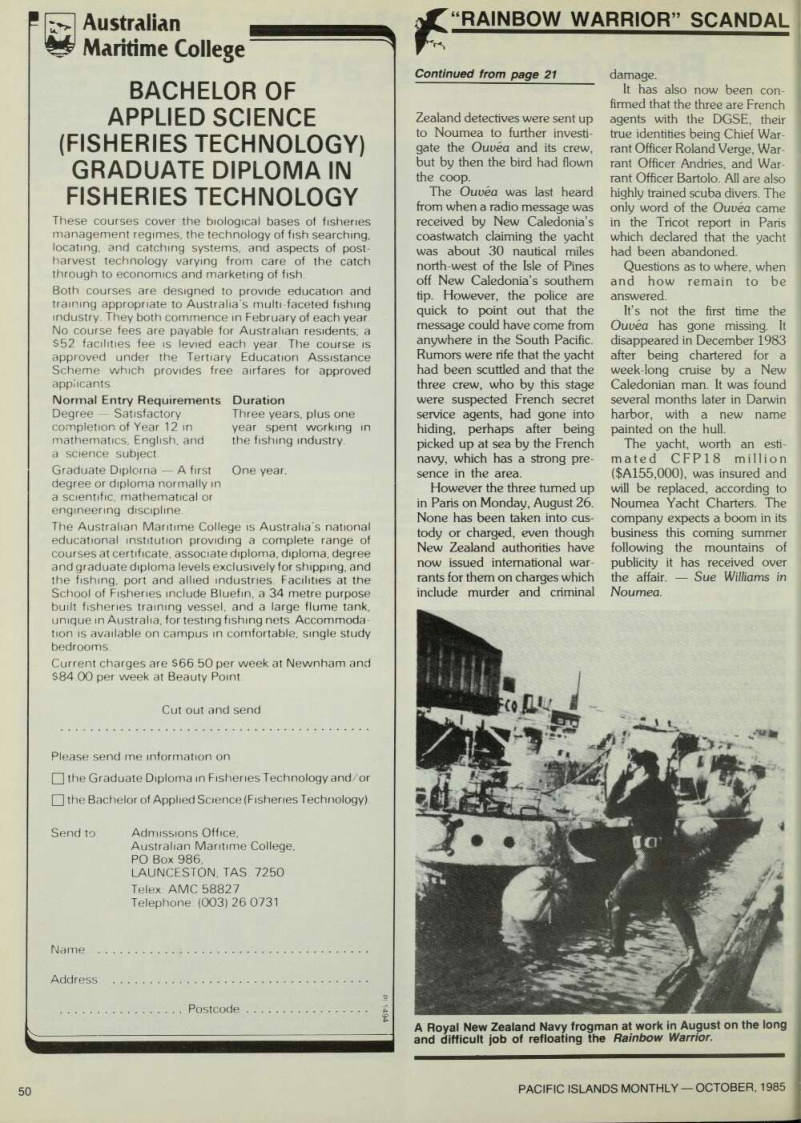
bow Warrior was finally raised from its watery grave, refloat ing and, leaking badly, was taken slowly across Auck #land Harbor to a naval dry dock where the extent of the bomb damage was seen.
A week later Vice-Admiral Rene Hugues was recalled to Paris
from the nuclear testing centre in French Polynesia to discuss plans to repel the revamped Greenpeace flotilla.
On August 26 the Tricot report was made public in Paris and, barely an hour before hand, the three missing Ouvea crew members gave themselves up at a Paris police station but were quickly released. They have not been seen since.
The Tricot report exonerated the D.G.S.E. and the French government but called for a fuller investigation. The French justice authorities indicated at the same time they would re fuse any extradition requests from New Zealand of any French nationals suspected of having been involved in the sabotage.
The Tricot report did, how ever, reveal the correct identi ties of all the French agents in New Zealand at the time, and
that they had been in the country on a legitimate surveill ance operation sanctioned as high as President Mitterrand’s office.
The Tricot report did not mention the role of a Philippe Dubast, who accompanied the Ouvea frogmen to Noumea. He had been tentatively identified as the commander of France’s secret frogman saboteurs’ school in Aspretto, Corsica.
The American Federal Bureau of Investigation had meanwhile staked out a Califor nia apartment belonging to a supposed friend of the Green peace infiltrator, Bonlieu (Gabon). The normal occupant, a Greek woman called Anti gone Zoumatzis, later returned from the same archaeological dig in Israel where she had accompanied Gabon.
Tahiti reports also suggested that the three Ouvea crew had
been picked up in mid-ocean by the French nuclear sub marine, Rubis and dropped off in Papeete on July 22. The French Navy has denied this consistently.
By late August the revela tions had tailed off. The French and New Zealand governments had settled into a war of nerves.
Prieur and Mafart were shifted to separate prisons Mafart in Auckland and Prieur in Christchurch after reports
that French mercenaries were going to break them out of gaol.
The whole episode had cast a black pall over French-New Zealand relations. New Zealand prime minister, David Lange, all but ordered the French ambas sador, Jacques Bourgoin, to go back to Paris in the tense days following the Tricot report.
Mr Lange displayed anger over the assertions in the re port, which he claimed was derisory in some of its aspects.
He made clear he was con vinced of D.G.S.E. and perhaps French government involve ment in the bombing and he reacted with outrage to the report’s admission that France had five agents on a sanctioned intelligence mission in New Zealand. He described this as a violation of New Zealand’s sovereignty.
No doubt more information will become public between now and November 4 when the trial opens, but New Zealand police, while careful in anything they have so far said, appear confident that they can show the depth of French involve ment in the bombing.
French officials have accused the New Zealand police of lacking, or of having fabricated, evidence aganist the couple.
The French have promised instant and stern reaction against the new Greenpeace vessel, the ocean-going tug, Greenpeace and any of the other New Zealand protest flo tilla vessels if they poke their bows into the French territorial waters of Moruroa or Fanga taufa. Another series of neutron bomb tests is apparently due to start at Moruroa in the weeks ahead.
For the French the irony must be that the bombing of Rainbow Warrior, and the “Pink Panther” style farce of the D.G.S.E. operation, has focused wider international attention upon Greenpeace’s protests, and upon their own nuclear test program, than if they had simply ignored the protesters. World-wide cover age of the trial of their agents can only compound that embarrassment. Karen Man gnall in Auckland.
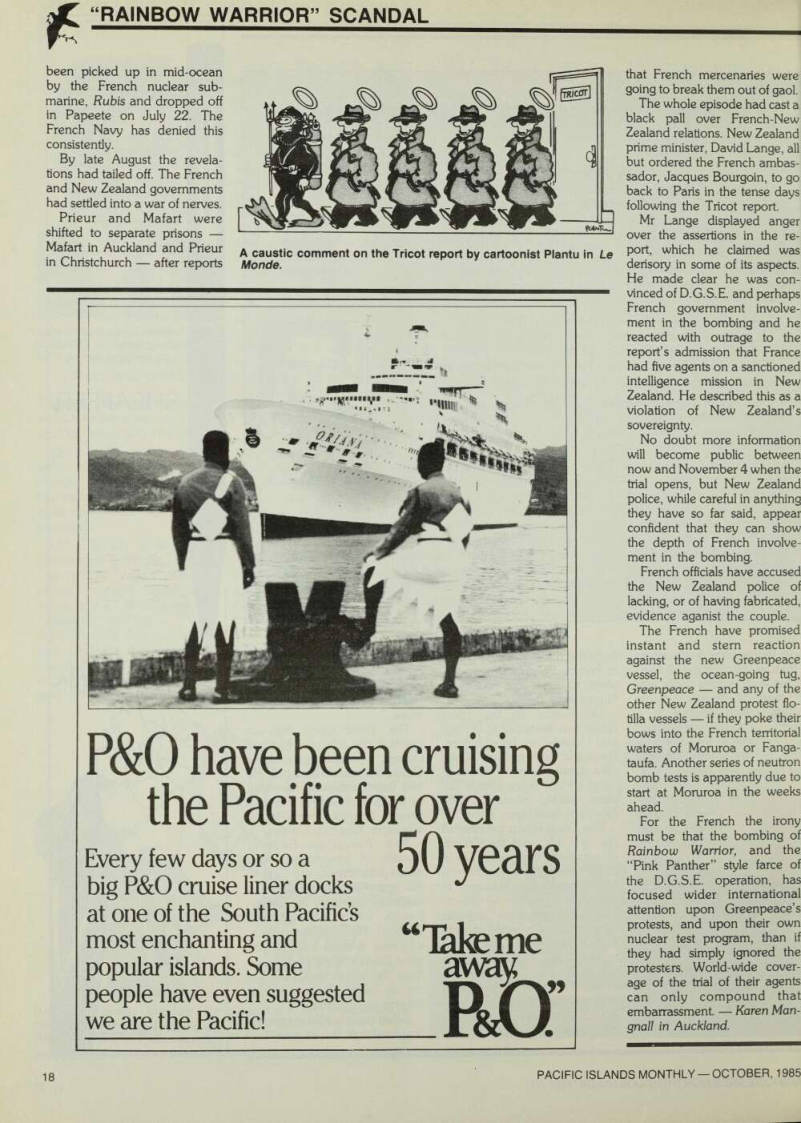
A caustic comment on the Tricot report by cartoonist Plantu in Le Monde.
Advertisements & other items, p. 14 (1 item)
Ob Pioneer*
Pioneer breaks new ground
in digital sound.
lo modern audio technology can compare with digital audio, le laser beam-tracking technology revolutionizing the industry.
Digital audio’s dynamic range is literally peerless. Its signal- )-noise ratio is strictly unparalleled. And every digital audio ignal is absolutely free of wow and flutter.
Still, sound quality and “playability” can vary significantly om one Compact Disc system to another. The fact is it’s question of error correction circuitry.
Pioneer’s PD-5010(BK) Compact Disc Player represents breakthrough in this area, with revolutionary Pure Signal ransmission —a network of technologies for outstanding acking, laser pickup, and sound quality.
One of these technologies is a Disc Stabilizer. It dramatically nproves signal readout accuracy for sharper, clearer sound because it prevents disc vibration, which can adversely affect sound quality.
Another is a Linear Servo System. It assures you of pinpoint focusing, accurate tracking, and constant linear velocity even when a disc is dirty or scratched.
Then there’s Focus Parallel Drive for responsive control of the servo system. Plus Parallel Suspension for flawless tracking of even grossly warped discs.
Taken from a practical perspective, the PD-5010(BK) is equally impressive. With Random Access Programming of up to 27 tracks, Track Search, Manual Search, and Repeat.
After all, the PD-5010(BK) is from Pioneer, the first word in audio. And breaking ground at Pioneer is an established tradition.
Ob PIONEER*
For further information, please contact: Australia: Pioneer Electronics Australia Pty. Ltd. (Incorporated in Victoria), P.O. Box 295, Mordialloc, Victoria, 3195 Tel: 580-9911 Fuji Islands: Brijlal & Company, G.P.O. Box No. 362, Suva, Fiji Islands Tel: 22258 New Zealand: Monaco Distributors Ltd., 2 Poland Road, Glenfield, Auckland, New Zealand Tel; (09) 444-9144 Norfolk Island: Burns Philp (Norfolk Island) Ltd., P.O. Box 21, Norfolk Island Vanuatu: Burns Philp (Vanuatu) Ltd., Vila, Vanuatu Nauru Island: Jacob Enterprises, P.O. Box N 0.4, Republic of Nauru Tahiti: Tahiti Hi-Fi, P.O. Box 848, Papeete, Tahiti New Caledonia: Menard Pacifique Sari, B.P. 3899, Noumea, New Caledonia Tel: 27-62.23 American Samoa: Transpac Corporation, P.O. Box 1477, Pago Pago, American Samoa 96799 Tel: 633-5224 Rarotonga; South Seas International Ltd., P.O. Box 49, Rarotonga, Cook Islands Tel: 2327 Papua New Guinea: Bali Merchants Pty. Ltd., P.O. Box 6103, Boroko Tel: 254887
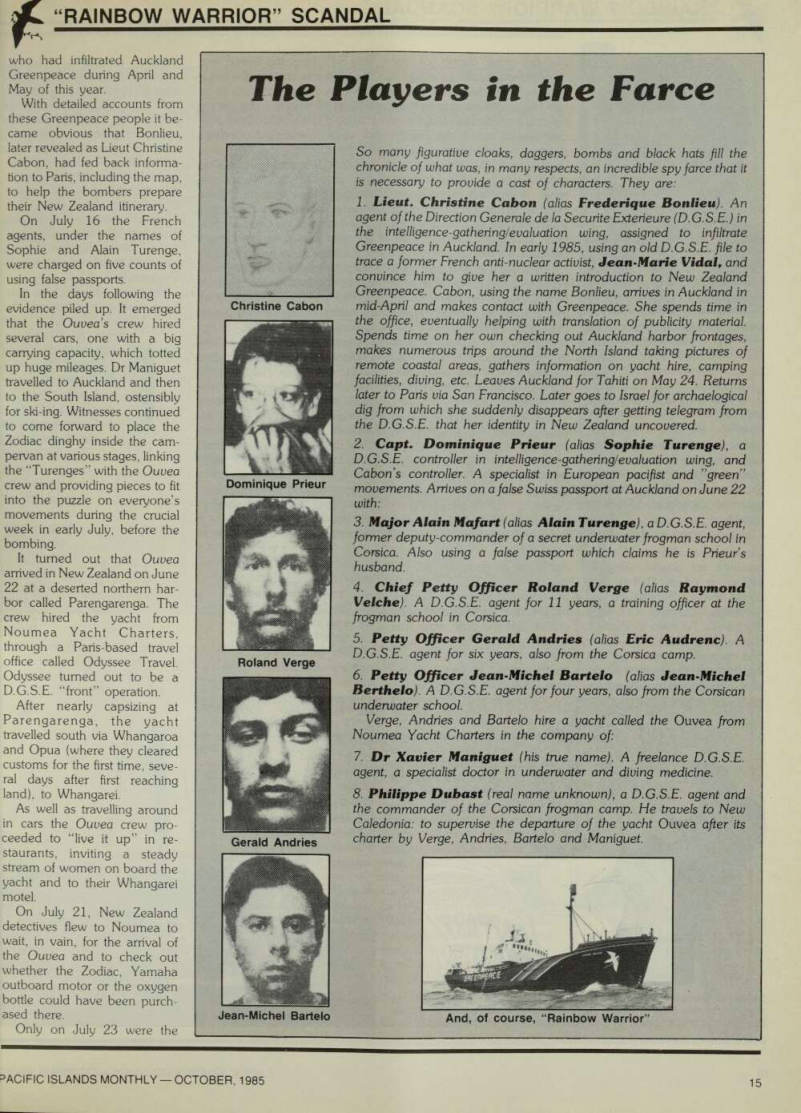
The Players in the Farce
So many figurative cloaks, daggers, bombs and black hats fill the chronicle of what was, in many respects, an incredible spy farce that it is necessary to provide a cast of characters. They are: 1. Lieut. Christine Gabon (alias Frederique Bonlieu). An agent of the Direction Generate de la Securite Exterieure (D.G.S.E.) in the intelligence-gathering/evaluation wing, assigned to infiltrate Greenpeace in Auckland. In early 1985, using an old D.G.S.E. file to trace a former French anti-nuclear activist, Jean-Marie Vidal , and convince him to give her a written introduction to New Zealand Greenpeace. Gabon, using the name Bonlieu, arrives in Auckland in mid-April and makes contact with Greenpeace. She spends time in the office, eventually helping with translation of publicity material.
Spends time on her own checking out Auckland harbor frontages, makes numerous trips around the North Island taking pictures of remote coastal areas, gathers information on yacht hire, camping facilities, diving, etc. Leaves Auckland for Tahiti on May 24. Returns later to Paris via San Francisco. Later goes to Israel for archaelogical dig from which she suddenly disappears after getting telegram from the D.G.S.E. that her identity in New Zealand uncovered. 2. Capt. Dominique Prieur (alias Sophie Turenge), a D.G.S.E. controller in intelligence-gathering/evaluation wing, and Gabon’s controller. A specialist in European pacifist and ’’green” movements. Arrives on a false Swiss passport at Auckland on June 22 with: 3. Major Alain Mafart (alias Alain Turenge), a D.G.S.E. agent, former deputy-commander of a secret underwater frogman school in Corsica. Also using a false passport which claims he is Prieur’s husband. 4. Chief Petty Officer Roland Verge (alias Raymond Velche) A D.G.S.E. agent for 11 years, a training officer at the frogman school in Corsica. 5. Petty Officer Gerald Andries (alias Eric Audrenc) A D.G.S.E. agent for six years, also from the Corsica camp. 6. Petty Officer Jean-Michel Bartelo (alias Jean-Michel Berthelo) A D.G.S.E. agent for four years, also from the Corsican underwater school.
Verge, Andries and Bartelo hire a yacht called the Ouvea from Noumea Yacht Charters in the company of: 7. Dr Xavier Maniguet (his true name). A freelance D.G.S.E. agent, a specialist doctor in underwater and diving medicine. 8. Philippe Dubast (real name unknown), a D.G.S.E. agent and the commander of the Corsican frogman camp. He travels to New Caledonia: to supervise the departure of the yacht Ouvea after its charter by Verge, Andries, Bartelo and Maniguet.
Christine Gabon
Dominique Prieur
Roland Verge
Gerald Andries
Jean-Michel Bartelo
And, of course, “Rainbow Warrior”
Advertisements & other items, p. 15 (1 item)
“Rainbow Warrior” Scandal
15
ACIFIC ISLANDS MONTHLY —OCTOBER, 1985
Top brass in the wings
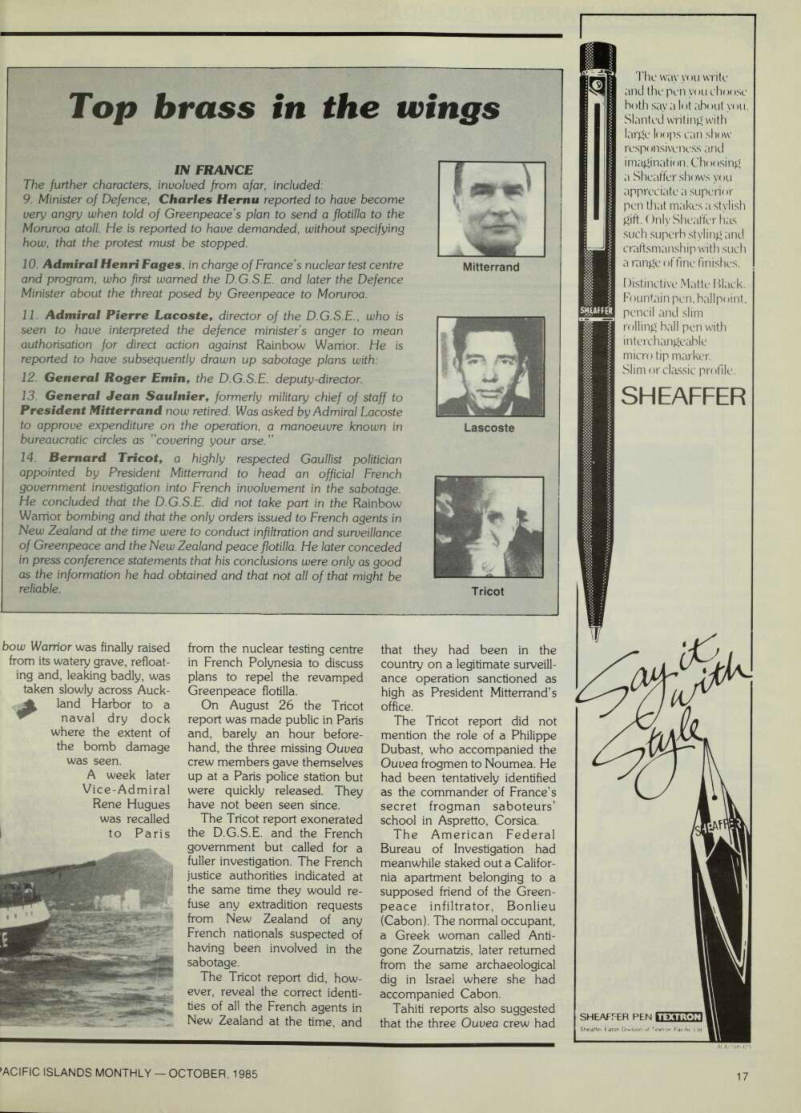
In France
The further characters, involved from afar, included: 9. Minister of Defence, Charles Hemu reported to have become very angry when told of Greenpeace's plan to send a flotilla to the Moruroa atoll. He is reported to have demanded, without specifying how, that the protest must be stopped. 10. Admiral Henri Pages, in charge of France’s nuclear test centre and program, who first warned the D.G.S.E. and later the Defence Minister about the threat posed by Greenpeace to Moruroa. 11. Admiral Pierre Lacoste , director of the D.G.S.E., who is seen to have interpreted the defence minister’s anger to mean authorisation for direct action against Rainbow Warrior. He is reported to have subsequently drawn up sabotage plans with: 12. General Roger Emin, the D.G.S.E. deputy-director. 13. General Jean Saulnier f formerly military chief of staff to President Mitterrand now retired. Was asked by Admiral Lacoste to approve expenditure on the operation, a manoeuvre known in bureaucratic circles as ”covering your arse.” 14. Bernard Tricot, a highly respected Gaullist politician appointed by President Mitterrand to head an official French government investigation into French involvement in the sabotage.
He concluded that the D.G.S.E. did not take part in the Rainbow Warrior bombing and that the only orders issued to French agents in Hew Zealand at the time were to conduct infiltration and surveillance of Greenpeace and the Hew Zealand peace flotilla. He later conceded in press conference statements that his conclusions were only as good as the information he had obtained and that not all of that might be reliable.
Mitterrand
Lascoste
Tricot
Advertisements & other items, pp. 17-18 (2 items)
17
ACIFIC ISLANDS MONTHLY —OCTOBER, 1985
Sheaffer
The way you write and the pen you choose both say a lot iibout you.
Slanted writing with large loops can show responsiveness and imagination. Choosing a Sheaffer shows you appreciate a superior pen that makes a stylish gift. ()nly Sheaffer has such superb styling and craftsmanship with such a range of fine finishes.
Distinctive Matte Black.
Fountain pen. ballpoint, pencil and slim rolling ball pen with interchangeable micro tip marker.
Slim or classic profile.
SHEAFFER
k iAi
SHEAFFER PEN
Sheaffer Eaton Division of Textron Pacific I to
P&O have been cruising
the Pacific for over
50 years
Every few days or so a big P&O cruise liner docks at one of the South Pacific’s most enchanting and popular islands. Some people have even suggested we are the Pacific!
“Take me
awav _MX
in the Greenpeace affair
Shades of a Greene piece in the Greenpeace affair
We have always felt that Graham Greene’s hilarious novel, Our Man in Havana, about a British vacuum cleaner sales man who was mistaken for a master spy, strains the reader’s credulity with some of its more improbable episodes. How ever, having recently been caught up in a completely for tuitous manner in the fancy spy net being woven around the bombed Greenpeace ship, Rainbow Warrior, we feel in clined to apologise to Mr Greene for our scepticism.
As this short account will show, it is indeed possible, in the real world, to be allotted a key role in a grotesque adven ture fantasy properly belonging in the realm of political fiction.
As we sit here at our desk in our Tahitian home, we have in front of us the freshly released report of the official French investigator of the affair, Ber nard Tricot, which surely rep resents the biggest job of politi cal whitewashing since the Watergate scandal. To all people in their right minds (and to judge from the newspaper
reports on our desk, they are happily in the majority), it is obvious that the French intelli gence service did not send a squad of husky army frogmen and expert bomb handlers with only a rudimentary knowledge of English to New Zealand simply to observe and make notes, as the French defence ministry pretends. The big question, still unanswered at the time of writing, is therefore not who did it, but why French agents committed this act of sabotage which can only stiffen opposition in the Pacific region to the nuclear tests at Moruroa.
After the many revelations, both intentional and otherwise, made in the French media this last month, there is no doubt in our minds that the explanation can be found in the alarm felt in government and military circles in Paris at the announcement, at the beginning of the year, of the new twist the Greenpeace directors planned to give their 1985 anti-nuclear cruises in the Pacific. To begin with, the crew was to include not only the usual bunch of “long-haired pacifists”, deemed harmless, but also several medical doctors
with the necessary equipment to examine the Marshall and Tuamotu islanders likely to have been contaminated.
Moreover, several wellknown Tahitian independence fighters and and-nuclear church leaders were ready and willing to join the Rainbow Warrior in Auckland to take part in the protest cruise in the direction of Moruroa. Since they were French citizens it would not have been legally possible to deny them access and toss them out of French Polynesia which had been the usual fate of foreign anti-nuclear intruders in the past. So any attempt to stop the Rainbow Warrior from reaching Moruroa had to be made in Auckland.
Although the undercover agents of the French DGSE intelligence service are widely known as barbouzes. due to their theatrical habit of growing beards, or hiding behind false ones, the advance scout dispatched to Auckland in April was a quite beardless woman in her early 30s, posing as a geographer, and armed with a false passport in the name of
Frederique Bonlieu. Her main tasks were to infiltrate the NZ Greenpeace movement, map the harbor area, and find suit able 1 , 0d 9 in 9 s for the more masculine and muscular beav ers who were to follow, On her way back to France, Frederique stopped over in Tahiti in the last week of May to do a little snooping among us local opponents of the French tests. To give credence to her disguise as a scientist, she regis tered at the Coral Reef Con gress which was then being held here (PIM Aug., p 7), although it soon became clear to us and to other participants that she knew next to nothing about the scientific problems under discussion. She must have . been particularly dis apP°mted wlth ‘he most compromising documents we handed over to her ’ when she , Came D to , see , us ' w f e co P'“ of our Postm3rk 3rt,cles ,n PIM On the other hand, there is every reason to believe that she was more cordially received by the numerous local barbouzes, and the snoopers from the Thought Police (Renseigne-
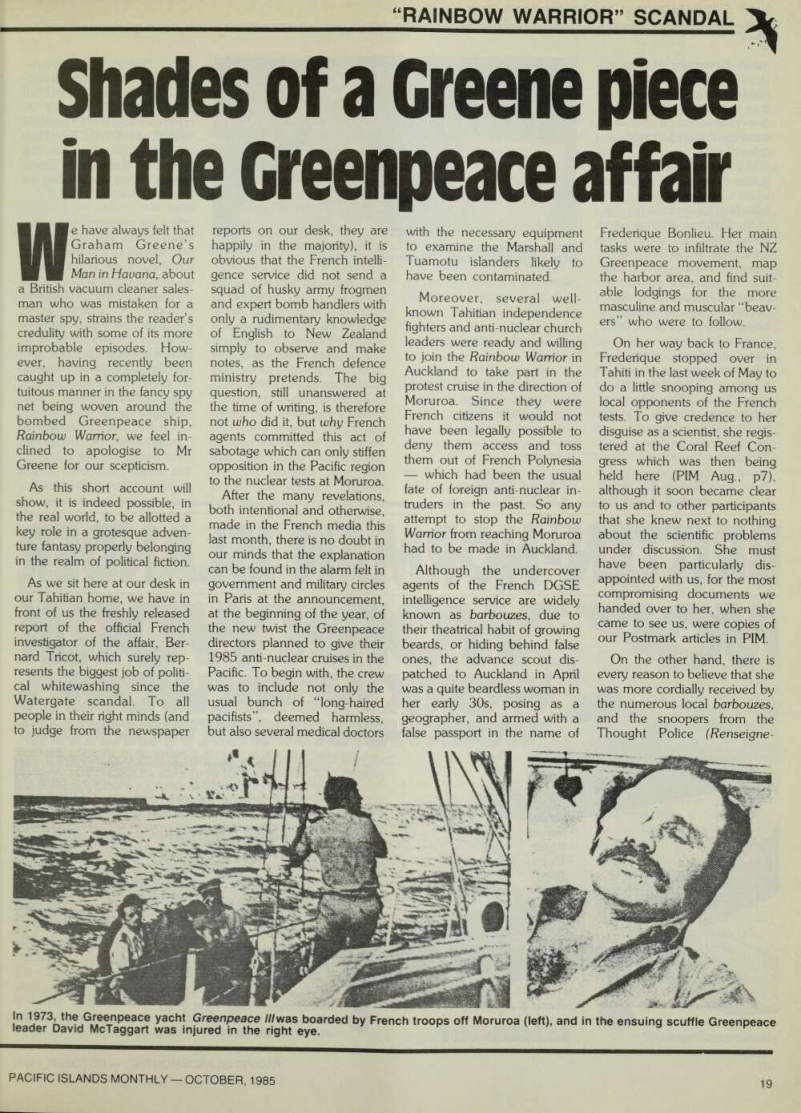
In 1973, the Greenpeace yacht Greenpeace /// was boarded by French troops off Moruroa (left), and in the ensuing scuffle Greenpeace leader David McTaggart was injured in the right eye.
ments Generaux) who keep a close watch and a file on all residents who dare to exercise their constitutional right to criti cise government policies for instance, the nuclear tests, and colonial rule.
We had already almost for gotten the visit of “Frederique” when we heard on July 10 the incredible news of the bombing of the Rainbow Warrior, which immediately sent shock waves around the world. The promin ent part played by “Frederi que” as mole and co-ordinator of the sabotage was confirmed by her sudden disappearance.
Gone also were her DGSE frogmen colleagues, who had sailed to New Zealand from Noumea on the chartered yacht Ouvea. This officially announced “disappearance” meant only, of course, that they had been told by their superiors to go into smoke. While “Frederique” had flown straight home to her headquarters in Paris from Tahiti, the yachts-
men were probably picked up at sea by the French nuclear powered submarine Rubis, taken to Moruroa, and flown from there by military aircraft to France.
At any rate this is where they were interviewed by the special investigator, General de Gaul le’s old offsider, Bernard Tricot, who was so struck by their honest air that he completely exonerated them in his short, 29-page, report on the affair. As for poor “Frederique”, whose
real name turned out to be Christine Cabon, all Monsieur Tricot has to say about her is that she was still so shaken and fearful following all her danger ous undercover activities that, out of compassion, he decided not to interrogate her at all.
By this time the French mass media were full of the wildest spy stories, most of them con cocted in Paris on the basis of the flimsiest imaginable data.
The most popular one “re vealed” that the real culprits
were British agents-pro vocateurs, who had cleverly strewn the beaches around Au ckland with all sorts of in criminating stuff marked
“Made In France”. Their
motive: to get even with the French for their sale of Exocet rockets to Argentina during the Falklands war!
But we were still somewhat taken aback when the widely read weekly Le Point let out the long-kept secret that the great est foreign pirate of all was “the Swedish ecologist and longtime resident of Tahiti, Bengt Danielsson, who had organised an invasion of Moruroa, to be carried out by the inhabitants of neighboring atolls with the help of small paddle canoes and dinghies. ” How had the not so intelligent French secret service, which had never been able to discover what its own agents were doing, managed to unveil this terrific plot? Very simple, said the author of this sensatio
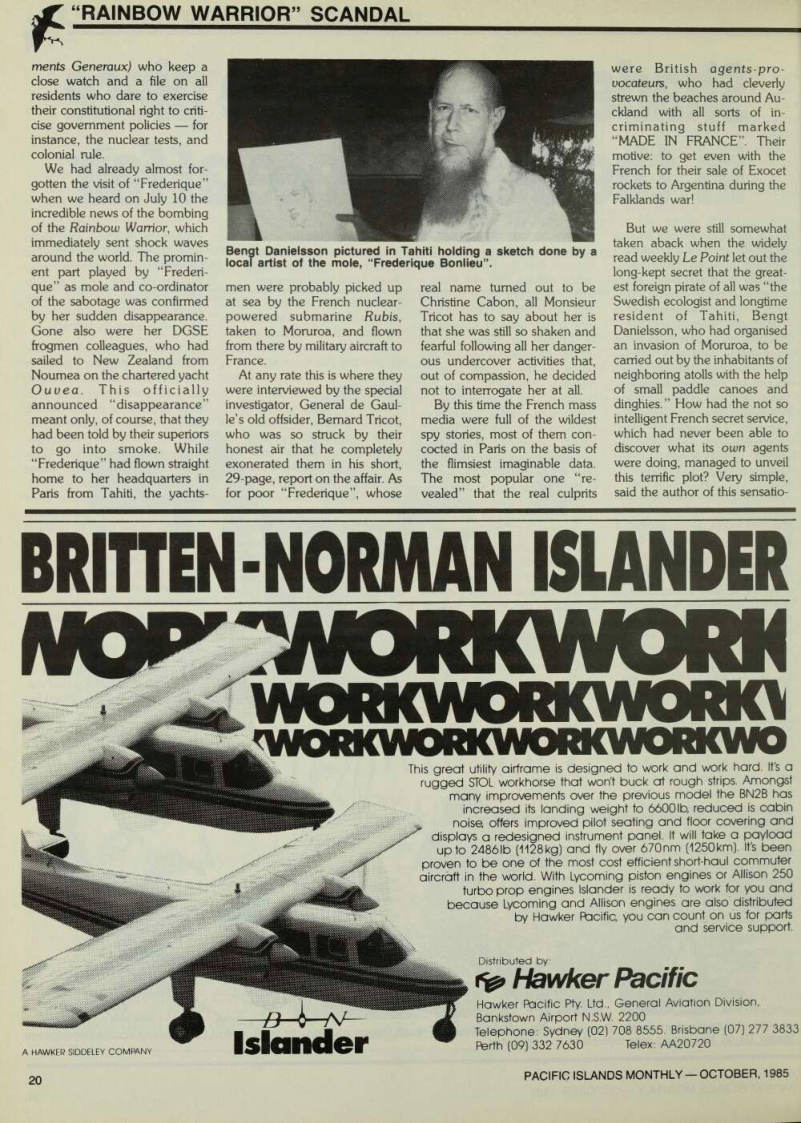
Bengt Danielsson pictured in Tahiti holding a sketch done by a local artist of the mole, “Frederique Bonlieu”.
nal story. “Frederique’s” bar bouze colleagues in Tahiti had been opening our mail, a very common and praiseworthy practice when national security is at stake. The obvious conclu sion was that they had also leaked the story to the gullible journalist who wrote the story.
A few days later the local TV channel provided additional evidence of how fear of Polyne sian participation in the Green peace protest cruises had grown to obsessive proportions among French officials. It screened a film which, accor ding to the commentary, showed “Polynesians from the atolls around Moruroa embar king on the Rainbow Warrior to take part in an invasion of the nuclear base”.
Although we realised how impossible it is to destroy a legend in the grand Arthurian tradition, we sent a spirited rebuttal of the whole story to Le Point, in which we pointed out: 1) that the “documentary” film shown on TV had been shot in May in the Marshall Islands by a French cameraman who had (perhaps unwisely) been allowed to participate in the first leg of the Rainbow Warrior cruise; 2) that consequently the islanders involved were not Polynesians from the atolls sur rounding Moruroa, but Micronesians from Rongelap; 3) that the only Polynesians who had been planning to embark on the Rainbow War rior cruise to Moruroa, which came to nothing because of the sabotage, had all been locked up in a Tahitian jail since March 2; 4) that there are 3000 men on Moruroa, among them 1000 well-armed foreign legion naires, spoiling for a fight, plus numerous warships, aircraft and helicopters, all of which made it highly unlikely that an invasion by a handful of Polynesians, trying to land from paddle canoes and dinghies, would ever succeed.
However, intermingled with the numerous Graham Greene style political fiction pieces, we also find in the French news papers and magazines which keep piling up on our desk
many serious, not to say severe, pieces of writing. The theme common to them all is the absolute necessity for France to maintain and strengthen her nuclear strike force which is supposedly making her a world power and acting as a deterrent to nuclear war. Consequently, France’s tests must go on fore ver in her Pacific Islands, which are an integral part of France.
As often as not, New Zealand and Australia come in for sca thing attacks and are told not to meddle in “the internal affairs” of France i.e., what is happening in New Caledonia and Tahiti. Instead of hypocri tically assuming an anti-nuclear and anti-colonial stance, when their true aim is economic domination of the whole area, Australia and New Zealand should be grateful to France for defending the Pacific region against Russian encroach ments. Now and then it is also hinted that the Greenpeace movement is being manipu lated by the communists, or at least serves communist causes.
True enough, some French politicians have strongly criti cised their intelligence service, but only because the undercov er agents dispatched to New Zealand have been so inept.
They rallied behind Mitterrand to a man, however, when the president and supreme com mander, in true Napoleonic style, declared the armed forces would repulse any attempt by the remaining Greenpeace ves sels to get closer to Moruroa than 72 miles. Why this unusual extent of the forbidden zone?
Because the French Govern ment, of its sovereign will, had decided to add a new security zone extending in a 60-mile radius beyond the 12-mile territorial waters limit.
Coupled with Monsieur Tri cot’s attempt to hide the truth, this firm determination to con tinue to use violent means will, of course, only lead to in creased difficulties for the pre sent and future French govern ments, and eventually make France’s position in the Pacific untenable. The wisest course for Paris to follow would there fore be at long last to listen to the friendly advice offered by a
succession of Polynesian politi cal, civic and church leaders to transfer the whole nuclear tes ting program to French soil.
Yes, we are very well aware of the objections usually raised by French Government officials and ambassadors that, alas, it is impossible to find a site in France where the tests could be staged without destroying some immensely valuable old historic buildings . . .
We are happy to report that we have made a serious topographical survey of this matter, and that we have disco vered dozens of suitable, unin habited regions, where the sub soil is infinitely more solid than the porous sub-stratum of Moruroa and Fangataufa.
Even better, 13 of these tracts of land are already tank or artillery training grounds belonging to the ministry for
defence. Whichever is chosen, it can thus be handed over right away to the bomb technicians, without any red tape and at no cost. We especially recommend the following five which are all much larger in area than the Polynesian atolls actually being used; Canjuers 34,600 hectares Suippes 14,800 hectares Mailly 12,000 hectares Mourmelon 11,700 hectares Larzac 10,000 hectares Last but not least, there is the 35,000-hectare Albion plateau in southern France, where only a small fraction 18 of the originally planned missile silos have been or ever will be dug, and where there is consequent ly plenty of room for drilling atomic test pits. Marie-There se and Bengt Danielsson
Advertisements & other items, p. 20 (1 item)
Britten-Norman Islander
SWORKWORKWORKV
Ar— B This great utility airframe is designed to work and work hard. It's a rugged STOL workhorse that won't buck at rough strips. Amongst many improvements over the previous model the BN2B has increased its landing weight to 66001 b, reduced is cabin noise, offers improved pilot seating and floor covering and displays a redesigned instrument panel. It will take a payload up to 24861 b (1128 kg) and fly over 670 nm (1250 km). It's been proven to be one of the most cost efficient short-haul commuter aircraft in the world. With Lycoming piston engines or Allison 250 turbo prop engines Islander is ready to work for you and because Lycoming and Allison engines are also distributed by Hawker Pacific, you can count on us for parts and service support.
Distributed by:
Hawker Pacific
A HAWKER SIDDELEY COMPANY
Islander
Hawker Pacific Pty. Ltd., General Aviation Division, Bankstown Airport N.S.W. 2200 Telephone: Sydney (02) 708 8555. Brisbane (07) 277 3833 Perth (09) 332 7630 Telex: AA20720
Four spies

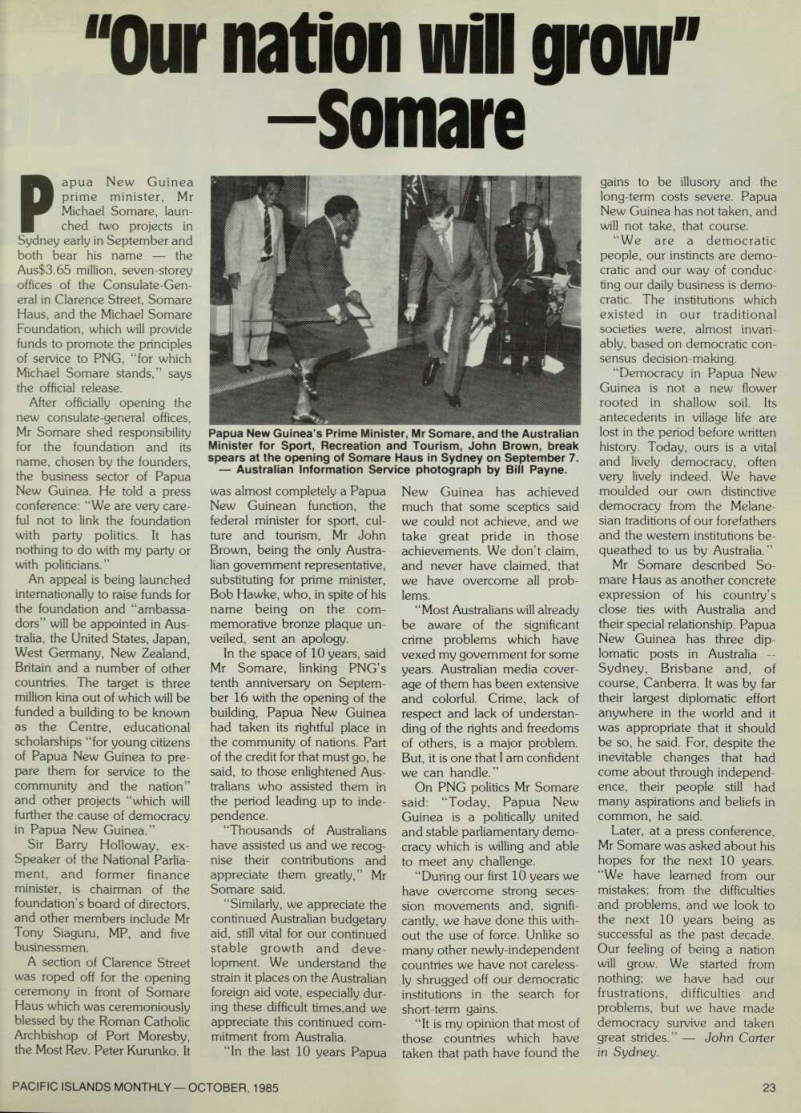
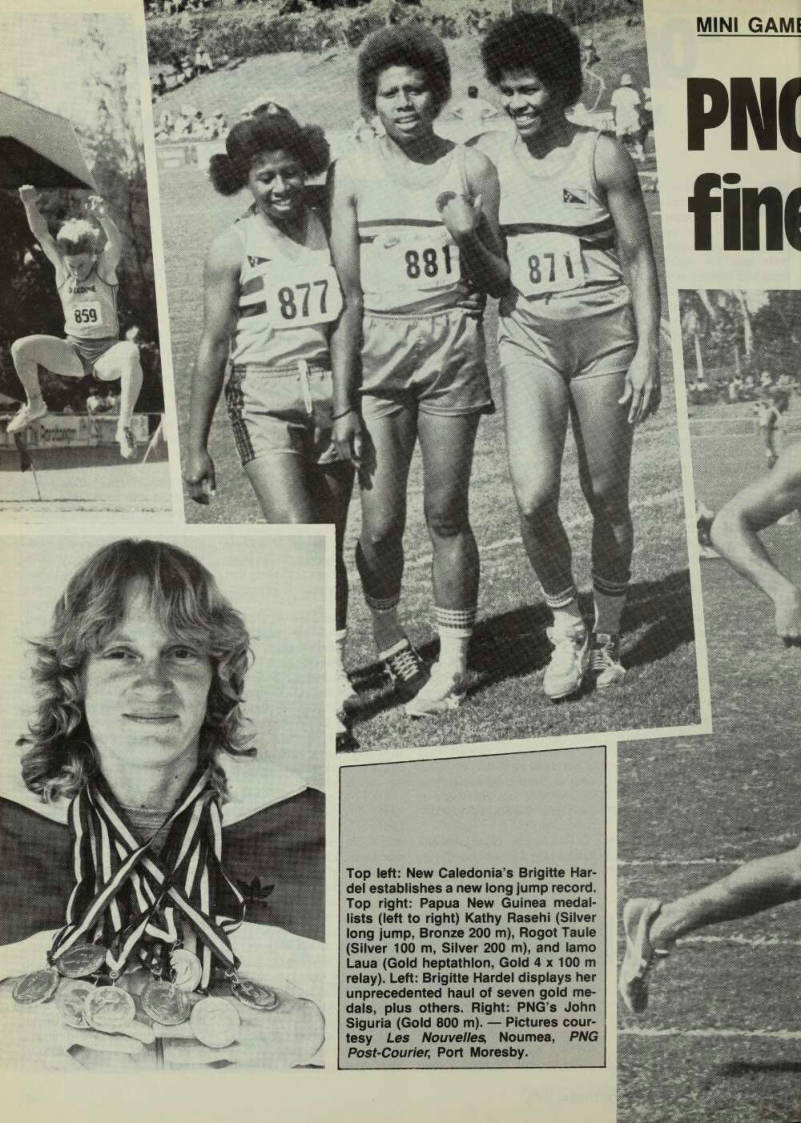
at sea in a boat
The New Caledonian link with the Rainbow Warrior drama began on May 28, when a man calling himself Raymond Vel che and claiming to be a pro fessional yacht skipper arrived in Noumea to inspect a yacht he wished to charter. The yacht was the 11.6 m Ouuea, owned by Noumea Yacht Charters.
Velche, who had been put on to the Noumea company by the Odyssey Travel Agency in Paris, signed a contract worth CFP2 million (about $A17,250) to rent the Ouuea from June 8 for a cruise of 50 days. He returned to New Caledonia the following week along with two other crew members known at that stage as Jean-Michael Berthelo and Eric Audrenc, and the client they were taking on the holiday cruise, a Dr Xavier Maniguet.
The Ouuea finally left Noumea on June 13, sailing first to Norfolk Island and then to Whangarei in New Zealand,
about an hour-and-a-half from Auckland, before returning to Norfolk Island.
During the time the Ouuea was in New Zealand the Rain bow Warrior had been sunk and the couple known as Alain and Sophie Turenge had been arrested.
Police interest in the Ouuea and its crew was sparked by a report of a sighting of a meeting at which cars belonging to the Turenges and a hire vehicle rented in the name of the people from the Ouuea were seen together.
New Zealand detectives flew to Norfolk Island to question the people on board the lux uriously appointed yacht, but did not have sufficient evidence to hold them. Dr Maniguet left the cruise to return to Paris, claiming seasickness.
As further evidence came to light in New Zealand, two New
Continued on page 50
Zealand detectives were sent up to Noumea to further investi gate the Ouuea and its crew, but by then the bird had flown the coop.
The Ouuea was last heard from when a radio message was received by New Caledonia’s coastwatch claiming the yacht was about 30 nautical miles north-west of the Isle of Pines off New Caledonia’s southern tip. However, the police are quick to point out that the message could have come from anywhere in the South Pacific.
Rumors were rife that the yacht had been scuttled and that the three crew, who by this stage were suspected French secret service agents, had gone into hiding, perhaps after being picked up at sea by the French navy, which has a strong pre sence in the area.
However the three turned up in Paris on Monday, August 26.
None has been taken into cus tody or charged, even though New Zealand authorities have now issued international war rants for them on charges which include murder and criminal
damage.
It has also now been con firmed that the three are French agents with the DGSE, their true identities being Chief War rant Officer Roland Verge, War rant Officer Andries, and War rant Officer Bartolo. All are also highly trained scuba divers. The only word of the Ouuea came in the Tricot report in Paris which declared that the yacht had been abandoned.
Questions as to where, when and how remain to be answered.
It’s not the first time the Ouuea has gone missing. It disappeared in December 1983 after being chartered for a week-long cruise by a New Caledonian man. It was found several months later in Darwin harbor, with a new name painted on the hull.
The yacht, worth an esti mated CFPIB million ($A155,000), was insured and will be replaced, according to Noumea Yacht Charters. The company expects a boom in its business this coming summer following the mountains of publicity it has received over the affair. Sue Williams in Noumea.
A Royal New Zealand Navy frogman at work in August on the long and difficult job of refloating the Rainbow Warrior.
Advertisements & other items, p. 22 (1 item)
Notice
TRADE MARK
CAUTIONARY
IN NAURU
Notice is hereby given that Matsushita Electric Industrial Co. Ltd., a corporation duly organised and existing under the laws of Japan, of 1006 Oaza Kadoma, Kadoma-shi, Osaka Prefecture, Japan, Manufacturers, is the sole proprietor in Nauru and elsewhere of the following trade mark.
Panasonic
used in respect of:— Catalyst, oxidation catalyst, catalyst for exhaust gas purification, plastic molding materials, ceramic materials, rodent repeller, toner, developer for copier, absorbent Class 1.
Machines and machine tools; motors (except for land vehicles); machine couplings and belting (except for land vehicles); large size agricultural implements: incubators Class 7.
Hand tools and instruments; cutlery, forks and spoons; side arms Class 8.
Scientific, nautical, surveying and electrical apparatus and instruments (including wireless), weighing, measuring, signalling, checking (supervision), life-saving and teaching apparatus and instruments; coin or counter-freed apparatus; talking machines: cash registers; calculating machines: fireextinguishing apparatus, but excluding optical, photographic and cinematographic apparatus and instruments, their parts and accessories Class 9.
Surgical, medical, dental and veterinary instruments and apparatus (including artificial limbs, eyes and teeth) Class 10.
Installations for lighting, heating, steam generating, cooking, refrigerating, drying, ventilating, water supply and sanitary purposes Class II Vehicles; apparatus for locomotion by land air or water Class 12.
Precious metals and their alloys and goods in precious metals or coated therewith (except cutlery, forks and spoons); jewellery, precious stones, horological and other chronometric instruments Class 14.
Musical instruments (other than talking machines and wireless apparatus) Class 15.
Paper, cardboard articles of paper or of cardboard (not included in other classes): printed matter, newspapers and periodicals, books; book-binding material; stationery, adhesive materials (stationery); artists’ materials; paint brushes; typewriters and office requisites (other than furniture): instructional and teaching material (other than apparatus): playing cards; printers’ type and cliches (stereotype), but excluding optical, photographic and cinematographic paper Class 16.
Building materials, natural and artificial stone, cement, lime, mortar, plaster and gravel; pipes of earthenware or cement; road-making materials; asphalt, pitch and bitumen; portable buildings: stone monuments: chimney pots Class 19.
Furniture, mirrors, picture frames; artricles (not included in other classes) of wood, cork, reeds, cane, wicker, horn, bone, ivory, whalebone, shell, amber, mother-of-pearl, meerschaum, celluloid, substitutes for all these materials, or of plastics Class 20.
The said proprietor claims all rights in respect of the above trade mark and will take all necessary legal steps against any person or company infringing their said rights.
DAVIES & COLLISON
Patent Attorneys
One Little Collins Street
Melbourne, Victoria, 3000.
AUSTRALIA.
"Our nation will grow”
Somare
Papua New Guinea prime minister, Mr Michael Somare, laun ched two projects in Sydney early in September and both bear his name the Auss3.6s million, seven-storey offices of the Consulate-Gen eral in Clarence Street, Somare Haus, and the Michael Somare Foundation, which will provide funds to promote the principles of service to PNG, “for which Michael Somare stands,” says the official release.
After officially opening the new consulate-general offices, Mr Somare shed responsibility for the foundation and its name, chosen by the founders, the business sector of Papua New Guinea. He told a press conference: “We are very care ful not to link the foundation with party politics. It has nothing to do with my party or with politicians.”
An appeal is being launched internationally to raise funds for the foundation and “ambassa dors” will be appointed in Aus tralia, the United States, Japan, West Germany, New Zealand, Britain and a number of other countries. The target is three million kina out of which will be funded a building to be known as the Centre, educational scholarships “for young citizens of Papua New Guinea to pre pare them for service to the community and the nation” and other projects “which will further the cause of democracy in Papua New Guinea.”
Sir Barry Holloway, ex- Speaker of the National Parlia ment, and former finance minister, is chairman of the foundation’s board of directors, and other members include Mr Tony Siaguru, MP, and five businessmen.
A section of Clarence Street was roped off for the opening ceremony in front of Somare Haus which was ceremoniously blessed by the Roman Catholic Archbishop of Port Moresby, the Most Rev. Peter Kurunko. It
was almost completely a Papua New Guinean function, the federal minister for sport, cul ture and tourism, Mr John Brown, being the only Austra lian government representative, substituting for prime minister, Bob Hawke, who, in spite of his name being on the com memorative bronze plaque un veiled, sent an apology.
In the space of 10 years, said Mr Somare, linking PNG’s tenth anniversary on Septem ber 16 with the opening of the building, Papua New Guinea had taken its rightful place in the community of nations. Part of the credit for that must go, he said, to those enlightened Aus tralians who assisted them in the period leading up to inde pendence.
“Thousands of Australians have assisted us and we recog nise their contributions and appreciate them greatly,” Mr Somare said.
“Similarly, we appreciate the continued Australian budgetary aid, still vital for our continued stable growth and deve lopment. We understand the strain it places on the Australian foreign aid vote, especially dur ing these difficult times,and we appreciate this continued com mitment from Australia.
“In the last 10 years Papua
New Guinea has achieved much that some sceptics said we could not achieve, and we take great pride in those achievements. We don’t claim, and never have claimed, that we have overcome all prob lems.
“Most Australians will already be aware of the significant crime problems which have vexed my government for some years. Australian media cover age of them has been extensive and colorful. Crime, lack of respect and lack of understan ding of the rights and freedoms of others, is a major problem.
But, it is one that I am confident we can handle.”
On PNG politics Mr Somare said: “Today, Papua New Guinea is a politically united and stable parliamentary demo cracy which is willing and able to meet any challenge.
“During our first 10 years we have overcome strong seces sion movements and, signifi cantly, we have done this with out the use of force. Unlike so many other newly-independent countries we have not careless ly shrugged off our democratic institutions in the search for short-term gains.
“It is my opinion that most of those countries which have taken that path have found the
gains to be illusory and the long-term costs severe. Papua New Guinea has not taken, and will not take, that course.
“We are a democratic people, our instincts are demo cratic and our way of conduc ting our daily business is demo cratic. The institutions which existed in our traditional societies were, almost invari ably, based on democratic con sensus decision-making.
“Democracy in Papua New Guinea is not a new flower rooted in shallow soil. Its antecedents in village life are lost in the period before written history. Today, ours is a vital and lively democracy, often very lively indeed. We have moulded our own distinctive democracy from the Melane sian traditions of our forefathers and the western institutions be queathed to us by Australia.”
Mr Somare described So mare Haus as another concrete expression of his country’s close ties with Australia and their special relationship. Papua New Guinea has three dip lomatic posts in Australia Sydney, Brisbane and, of course, Canberra. It was by far their largest diplomatic effort anywhere in the world and it was appropriate that it should be so, he said. For, despite the inevitable changes that had come about through independ ence, their people still had many aspirations and beliefs in common, he said.
Later, at a press conference, Mr Somare was asked about his hopes for the next 10 years.
“We have learned from our mistakes; from the difficulties and problems, and we look to the next 10 years being as successful as the past decade.
Our feeling of being a nation will grow. We started from nothing; we have had our frustrations, difficulties and problems, but we have made democracy survive and taken great strides.” John Carter in Sydney.
Papua New Guinea’s Prime Minister, Mr Somare, and the Australian Minister for Sport, Recreation and Tourism, John Brown, break spears at the opening of Somare Haus in Sydney on September 7.
Australian Information Service photograph by Bill Payne.
fine 10th birthday present
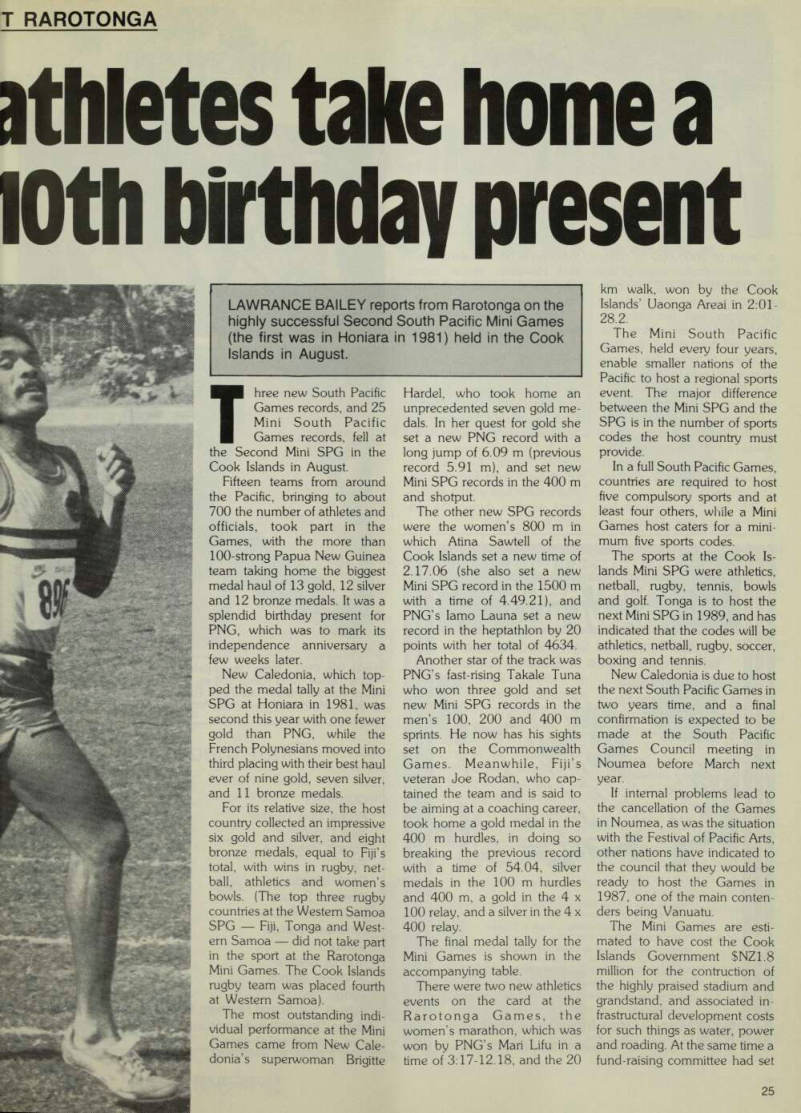
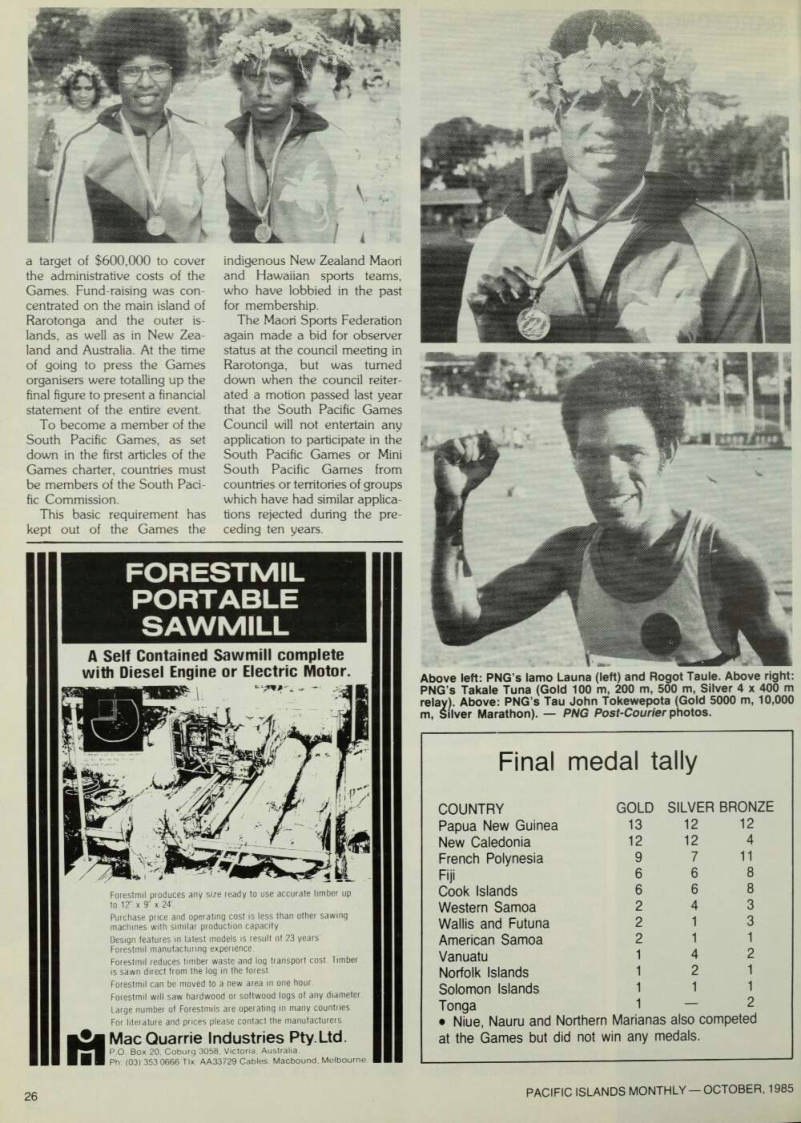
Mini Game
PNG athletes take homea a fine 10th birthday present
Top left: New Caledonia’s Brigitte Har del establishes a new long jump record.
Top right: Papua New Guinea medal lists (left to right) Kathy Rasehi (Silver long jump, Bronze 200 m), Rogot Taule (Silver 100 m, Silver 200 m), and lamo Laua (Gold heptathlon, Gold 4 x 100 m relay). Left: Brigitte Hardel displays her unprecedented haul of seven gold me dals, plus others. Right: PNG’s John Siguria (Gold 800 m). Pictures cour tesy Les Nouvelles, Noumea, PNG Post-Courier, Port Moresby.
LAWRANCE BAILEY reports from Rarotonga on the highly successful Second South Pacific Mini Games (the first was in Honiara in 1981) held in the Cook Islands in August.
Three new South Pacific Games records, and 25 Mini South Pacific Games records, fell at the Second Mini SPG in the Cook Islands in August.
Fifteen teams from around the Pacific, bringing to about 700 the number of athletes and officials, took part in the Games, with the more than 100-strong Papua New Guinea team taking home the biggest medal haul of 13 gold, 12 silver and 12 bronze medals. It was a splendid birthday present for PNG, which was to mark its independence anniversary a few weeks later.
New Caledonia, which top ped the medal tally at the Mini SPG at Honiara in 1981, was second this year with one fewer gold than PNG, while the French Polynesians moved into third placing with their best haul ever of nine gold, seven silver, and 11 bronze medals.
For its relative size, the host country collected an impressive six gold and silver, and eight bronze medals, equal to Fiji’s total, with wins in rugby, net ball, athletics and women’s bowls. (The top three rugby countries at the Western Samoa SPG Fiji, Tonga and West ern Samoa did not take part in the sport at the Rarotonga Mini Games. The Cook Islands rugby team was placed fourth at Western Samoa).
The most outstanding indi vidual performance at the Mini Games came from New Cale donia’s superwoman Brigitte
Hardel, who took home an unprecedented seven gold me dals. In her quest for gold she set a new PNG record with a long jump of 6.09 m (previous record 5.91 m), and set new Mini SPG records in the 400 m and shotput.
The other new SPG records were the women’s 800 m in which Atina Sawtell of the Cook Islands set a new time of 2.17.06 (she also set a new Mini SPG record in the 1500 m with a time of 4.49.21), and PNG’s lamo Launa set a new record in the heptathlon by 20 points with her total of 4634.
Another star of the track was PNG’s fast-rising Takale Tuna who won three gold and set new Mini SPG records in the men’s 100, 200 and 400 m sprints. He now has his sights set on the Commonwealth Games. Meanwhile, Fiji’s veteran Joe Rodan, who cap tained the team and is said to be aiming at a coaching career, took home a gold medal in the 400 m hurdles, in doing so breaking the previous record with a time of 54.04, silver medals in the 100 m hurdles and 400 m, a gold in the 4 x 100 relay, and a silver in the 4 x 400 relay.
The final medal tally for the Mini Games is shown in the accompanying table.
There were two new athletics events on the card at the Rarotonga Games, the women’s marathon, which was won by PNG’s Mari Lifu in a time of 3:17-12.18, and the 20
km walk, won by the Cook Islands’ Uaonga Areal in 2:01- 28.2.
The Mini South Pacific Games, held every four years, enable smaller nations of the Pacific to host a regional sports event. The major difference between the Mini SPG and the SPG is in the number of sports codes the host country must provide.
In a full South Pacific Games, countries are required to host five compulsory sports and at least four others, while a Mini Games host caters for a mini mum five sports codes.
The sports at the Cook Is lands Mini SPG were athletics, netball, rugby, tennis, bowls and golf. Tonga is to host the next Mini SPG in 1989, and has indicated that the codes will be athletics, netball, rugby, soccer, boxing and tennis.
New Caledonia is due to host the next South Pacific Games in two years time, and a final confirmation is expected to be made at the South Pacific Games Council meeting in Noumea before March next year.
If internal problems lead to the cancellation of the Games in Noumea, as was the situation with the Festival of Pacific Arts, other nations have indicated to the council that they would be ready to host the Games in 1987, one of the main conten ders being Vanuatu.
The Mini Games are esti mated to have cost the Cook Islands Government SNZI.B million for the contruction of the highly praised stadium and grandstand, and associated in frastructural development costs for such things as water, power and roading. At the same time a fund-raising committee had set
a target of $600,000 to cover the administrative costs of the Games. Fund-raising was con centrated on the main island of Rarotonga and the outer is lands, as well as in New Zea land and Australia. At the time of going to press the Games organisers were totalling up the final figure to present a financial statement of the entire event.
To become a member of the South Pacific Games, as set down in the first articles of the Games charter, countries must be members of the South Paci fic Commission.
This basic requirement has kept out of the Games the
indigenous New Zealand Maori and Hawaiian sports teams, who have lobbied in the past for membership.
The Maori Sports Federation again made a bid for observer status at the council meeting in Rarotonga, but was turned down when the council reiter ated a motion passed last year that the South Pacific Games Council will not entertain any application to participate in the South Pacific Games or Mini South Pacific Games from countries or territories of groups which have had similar applica tions rejected during the pre ceding ten years.
Final medal tally
Above left: PNG’s lamo Launa (left) and Rogot Taule. Above right: PNG’s Takale Tuna (Gold 100 m, 200 m, 500 m, Silver 4 x 400 m relay). Above: PNG’s Tau John Tokewepota (Gold 5000 m, 10,000 m, Silver Marathon). PNG Post-Courier photos.
Country
Gold
Silver Bronze
Papua New Guinea 13 12 12 New Caledonia 12 12 4 French Polynesia 9 7 11 Fiji 6 6 8 Cook Islands 6 6 8 Western Samoa 2 4 3 Wallis and Futuna 2 1 3 American Samoa 2 1 1 Vanuatu 1 4 2 Norfolk Islands 1 2 1 Solomon Islands 1 1 1 Tonga 1 — 2 • Niue, Nauru and Northern Marianas also competed at the Games but did not win any medals.
Advertisements & other items, pp. 25-26 (2 items)
nth birthday present
25
rthletes take home a nth birthday present
T RAROTONGA
Forestmil
PORTABLE
SAWMILL
A Self Contained Sawmill complete
with Diesel Engine or Electric Motor.
A TV cr Forestmil produces any size ready to use accurate timber up to 12" x 9" x 24'.
IH Purchase price and operating cost is less than other sawing machines with similar production capacity Design features in latest models is result of 23 years Forestmil manufacturing experience.
Forestmil reduces timber waste and log transport cost. Timber is sawn direct from the log in the forest Forestmil can be moved to a new area in one hour.
Forestmil will saw hardwood or softwood logs of any diameter Large number of Forestmils are operating in many countries For literature and prices please contact the manufacturers.
Mac Quarrie Industries Pty.Ltd.
P.O Box 20, Coburg 3058, Victoria, Australia.
Ph: (03) 353 0666 Tlx: AA33729 Cables: Macbound, Melbourne.
Independence born
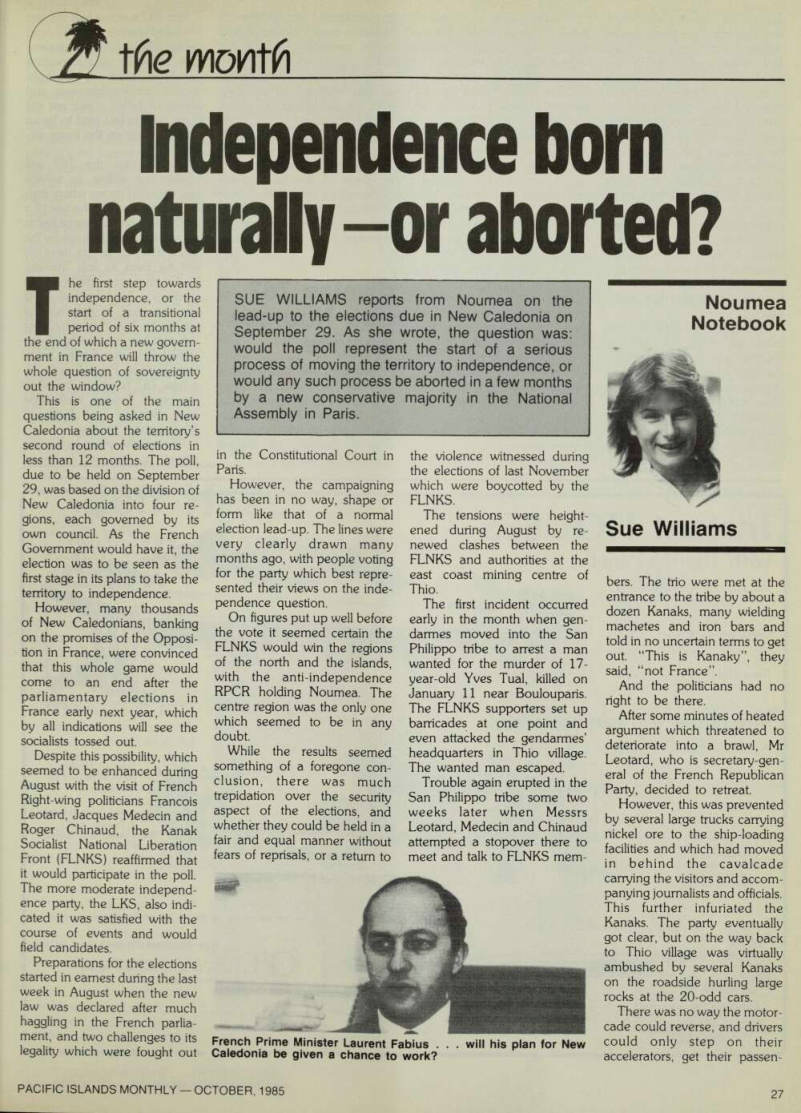
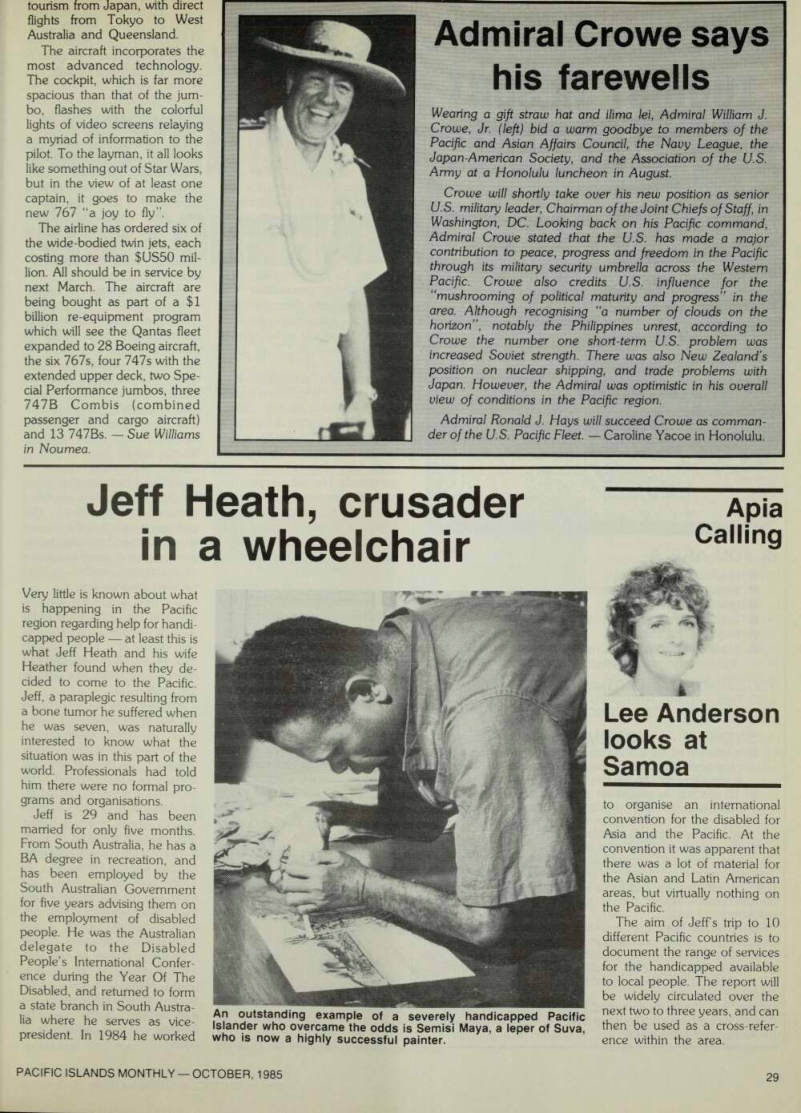
the month
Independence born naturally-or aborted?
The first step towards independence, or the start of a transitional period of six months at the end of which a new govern ment in France will throw the whole question of sovereignty out the window?
This is one of the main questions being asked in New Caledonia about the territory’s second round of elections in less than 12 months. The poll, due to be held on September 29, was based on the division of New Caledonia into four re gions, each governed by its own council. As the French Government would have it, the election was to be seen as the first stage in its plans to take the territory to independence.
However, many thousands of New Caledonians, banking on the promises of the Opposi tion in France, were convinced that this whole game would come to an end after the parliamentary elections in France early next year, which by all indications will see the socialists tossed out.
Despite this possibility, which seemed to be enhanced during August with the visit of French Right-wing politicians Francois Leotard, Jacques Medecin and Roger Chinaud, the Kanak Socialist National Liberation Front (FLNKS) reaffirmed that it would participate in the poll.
The more moderate independ ence party, the LKS, also indi cated it was satisfied with the course of events and would field candidates.
Preparations for the elections started in earnest during the last week in August when the new law was declared after much haggling in the French parlia ment, and two challenges to its legality which were fought out
SUE WILLIAMS reports from Noumea on the lead-up to the elections due in New Caledonia on September 29. As she wrote, the question was: would the poll represent the start of a serious process of moving the territory to independence, or would any such process be aborted in a few months by a new conservative majority in the National Assembly in Paris.
in the Constitutional Court in Paris.
However, the campaigning has been in no way, shape or form like that of a normal election lead-up. The lines were very clearly drawn many months ago, with people voting for the party which best repre sented their views on the inde pendence question.
On figures put up well before the vote it seemed certain the FLNKS would win the regions of the north and the islands, with the anti-independence RPCR holding Noumea. The centre region was the only one which seemed to be in any doubt.
While the results seemed something of a foregone con clusion, there was much trepidation over the security aspect of the elections, and whether they could be held in a fair and equal manner without fears of reprisals, or a return to
the violence witnessed during the elections of last November which were boycotted by the
Flnks.
The tensions were height ened during August by re newed clashes between the FLNKS and authorities at the east coast mining centre of Thio.
The first incident occurred early in the month when gen darmes moved into the San Philippo tribe to arrest a man wanted for the murder of 17year-old Yves Tual, killed on January 11 near Boulouparis.
The FLNKS supporters set up barricades at one point and even attacked the gendarmes’ headquarters in Thio village.
The wanted man escaped.
Trouble again erupted in the San Philippo tribe some two weeks later when Messrs Leotard, Medecin and Chinaud attempted a stopover there to meet and talk to FLNKS mem-
Noumea Notebook
bers. The trio were met at the entrance to the tribe by about a dozen Kanaks, many wielding machetes and iron bars and told in no uncertain terms to get out. “This is Kanaky”, they said, “not France”.
And the politicians had no right to be there.
After some minutes of heated argument which threatened to deteriorate into a brawl, Mr Leotard, who is secretary-gen eral of the French Republican Party, decided to retreat.
However, this was prevented by several large trucks carrying nickel ore to the ship-loading facilities and which had moved in behind the cavalcade carrying the visitors and accom panying journalists and officials.
This further infuriated the Kanaks. The party eventually got clear, but on the way back to Thio village was virtually ambushed by several Kanaks on the roadside hurling large rocks at the 20-odd cars.
There was no way the motor cade could reverse, and drivers could only step on their accelerators, get their passen
French Prime Minister Laurent Fabius . . . will his plan for New Caledonia be given a chance to work?
Sue Williams
gers on to the floor, and hope for the best. At least seven vehicles were badly damaged and three people slightly in jured.
As one of the journalists present I can give an assurance that the experience was very frightening, and that it was only by good luck and some adept driving that no one was serious ly hurt. FLNKS members chased the party all the way to their helicopters. Accompany ing journalists and officials who had driven to the area were given a very large military escort out. This escort was just about the only effort made by the military during the entire affair.
The three politicians certainly made the most of the trouble, rousing passions at a public meeting in Noumea the follow ing night. More than 5000 Noumeans turned out for the meeting to be urged to continue their resistance for another six months until the change of power in France next year.
“Spring comes in six months,”
Roger Chinaud assured the au diences while Jacques Medecin warned that they would not let “Moscow gold buy the strategic position in the Pacific that the people of New Caledonia re present”.
Mr Leotard also delivered a shot in the direction of Can berra with a warning “to a certain minister (Bill Hayden) who knows that in six months there will be a new majority (in France), and that we will re member certain remarks made in our regard.”
The FLNKS also used the incident to heighten emotions, threatening a “general mobilisation” of its members if there were any further provoca tions such as that seen at Thio.
All this made for a fairly dramatic election scenario, and Minister for New Caledonia Edgard Pisani signalled fairly early in the piece that everything would be done to ensure security.
Mr Leotard on his return to
Paris proposed that 130 French parliamentarians should be sent to the territory to survey the poll.
But Mr Pisani was not im pressed with the idea. How ever, he did acknowledge the need for scrutiny at the ballot boxes, and made arrangements for a magistrate to be present at each polling place along with members of the four special commissions set up in each of the regions to control the elect ions. — Sue Williams in Noumea.
Qantas 767
ups Noumea
service
A new bird has been sighted over the Pacific in recent times.
It’s the first of the new Qantas 767 Extended Range aircraft, which the airline says will change the face of regional international services.
The 767 is about half the size of its big brother, the 747, and carries about half the passen gers. However, all the creature comforts such as in-flight movies, comfortable seats, and plenty of locker space are still there, and in fact tend to be an improvement on the larger air craft.
Qantas says the 767 will enable the airline to service less-travelled routes where traf fic doesn’t warrant the use of a jumbo and provide more flights on routes currently flown by the 7475. The first of the new jets will be used to link Sydney, Melbourne and Brisbane to Wellington, New Zealand. It will also be used to improve the service to Noumea, which for the past few months has been restricted to one flight a week from Sydney. From August 29, a new 767 has been travelling the route, leaving Melbourne each Sunday and flying to Noumea via Sydney.
Qantas also plans to use the aircraft to increase in-bound
tourism from Japan, with direct flights from Tokyo to West Australia and Queensland.
The aircraft incorporates the most advanced technology.
The cockpit, which is far more spacious than that of the jum bo, flashes with the colorful lights of video screens relaying a myriad of information to the pilot. To the layman, it all looks like something out of Star Wars, but in the view of at least one captain, it goes to make the new 767 “a joy to fly”.
The airline has ordered six of the wide-bodied twin jets, each costing more than SUSSO mil lion. All should be in service by next March. The aircraft are being bought as part of a $1 billion re-equipment program which will see the Qantas fleet expanded to 28 Boeing aircraft, the six 7675, four 747 s with the extended upper deck, two Spe cial Performance jumbos, three 7478 Combis (combined passenger and cargo aircraft) and 13 74785. Sue Williams in Noumea.
Advertisements & other items, p. 28 (1 item)
Instant HOUSES
with Therma-Panel®
The fully insulated panelised building system
George Hudson,
the name in home building for i 100 years! • The established name w ith new ideas!
The home you can assemble!
• Economical fast
• Cyclone resistant • Ideal for the South Pacific regions t ;
and
pie
sim George Hudson have supplied to: • Tonga
• PNG
• Solomon Islands • Tuvalu and • American Samoa We can also supply to your designs and specifications GH 5U George Hudson Homes (Aust.) Pty 18b Hume Highway Cabramalla NSW 21bb Australia Tel: (02) 727 906 b Telex: AA25800 Post coupon for details and prices.
Admiral Crowe says
his farewells
Wearing a gift straw hat and ilima lei, Admiral William J.
Crowe, Jr. (left) bid a warm goodbye to members of the Pacific and Asian Affairs Council, the Navy League, the Japan-American Society, and the Association of the U.S.
Army at a Honolulu luncheon in August.
Crowe will shortly take over his new position as senior U.S. military leader, Chairman of the Joint Chiefs of Staff, in Washington, DC. Looking back on his Pacific command, Admiral Crowe stated that the U.S. has made a major contribution to peace, progress and freedom in the Pacific through its military security umbrella across the Western Pacific. Crowe also credits U.S. influence for the “mushrooming of political maturity and progress” in the area. Although recognising “a number of clouds on the horizon”, notably the Philippines unrest, according to Crowe the number one short-term U.S. problem was increased Soviet strength. There was also New Zealand’s position on nuclear shipping, and trade problems with Japan. However, the Admiral was optimistic in his overall view of conditions in the Pacific region.
Admiral Ronald J. Hays will succeed Crowe as comman der of the U.S. Pacific Fleet. Caroline Yacoe in Honolulu.
Jeff Heath, crusader
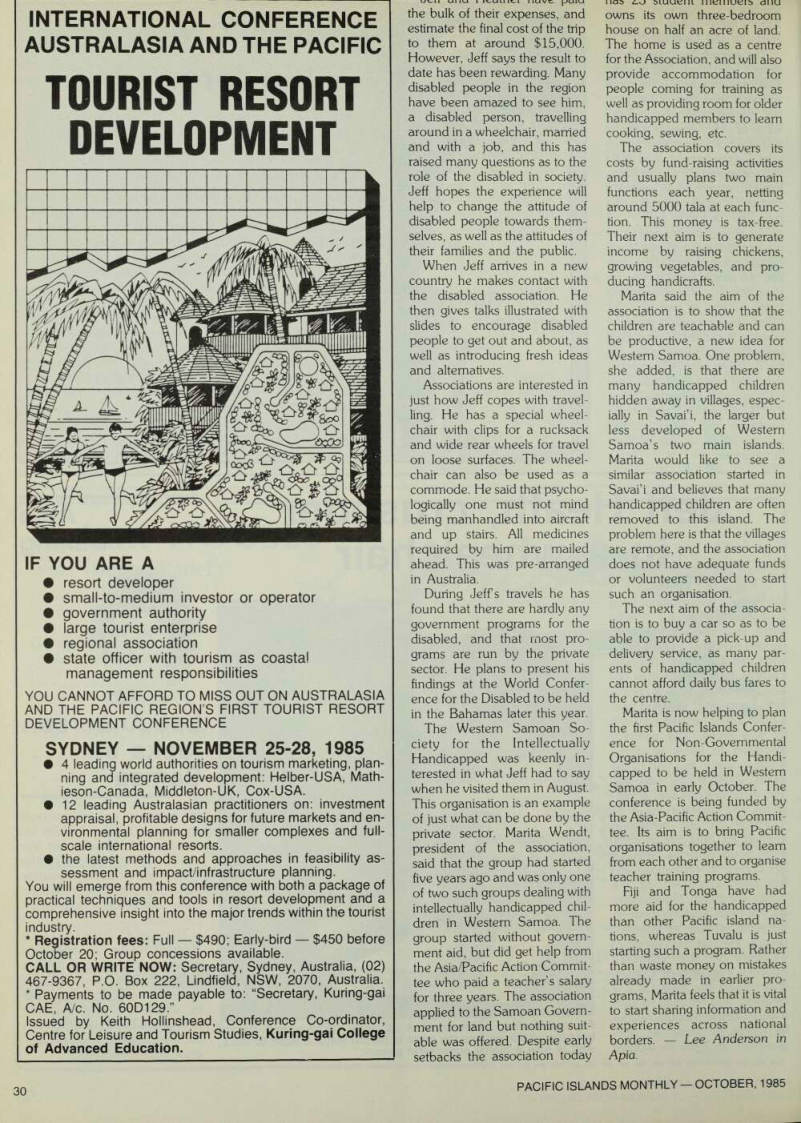
in a wheelchair
Very little is known about what is happening in the Pacific region regarding help for handi capped people at least this is what Jeff Heath and his wife Heather found when they de cided to come to the Pacific.
Jeff, a paraplegic resulting from a bone tumor he suffered when he was seven, was naturally interested to know what the situation was in this part of the world. Professionals had told him there were no formal pro grams and organisations.
Jeff is 29 and has been married for only five months.
From South Australia, he has a BA degree in recreation, and has been employed by the South Australian Government for five years advising them on the employment of disabled people. He was the Australian delegate to the Disabled People’s International Confer ence during the Year Of The Disabled, and returned to form a state branch in South Austra lia where he serves as vice president. In 1984 he worked
Apia Calling
to organise an international convention for the disabled for Asia and the Pacific. At the convention it was apparent that there was a lot of material for the Asian and Latin American areas, but virtually nothing on the Pacific.
The aim of Jeffs trip to 10 different Pacific countries is to document the range of services for the handicapped available to local people. The report will be widely circulated over the next two to three years, and can then be used as a cross-refer ence within the area.
An outstanding example of a severely handicapped Pacific Islander who overcame the odds is Semisi Maya, a leper of Suva, who is now a highly successful painter.
Lee Anderson looks at Samoa
WVll Ul A !VULI IVI 1 lUVO the bulk of their expenses, and estimate the final cost of the trip to them at around $15,000.
However, Jeff says the result to date has been rewarding. Many disabled people in the region have been amazed to see him, a disabled person, travelling around in a wheelchair, married and with a job, and this has raised many questions as to the role of the disabled in society.
Jeff hopes the experience will help to change the attitude of disabled people towards them selves, as well as the attitudes of their families and the public.
When Jeff arrives in a new country he makes contact with the disabled association. He then gives talks illustrated with slides to encourage disabled people to get out and about, as well as introducing fresh ideas and alternatives.
Associations are interested in just how Jeff copes with travel ling. He has a special wheel chair with clips for a rucksack and wide rear wheels for travel on loose surfaces. The wheel chair can also be used as a commode. He said that psycho logically one must not mind being manhandled into aircraft and up stairs. All medicines required by him are mailed ahead. This was pre-arranged in Australia.
During Jeff s travels he has found that there are hardly any government programs for the disabled, and that most pro grams are run by the private sector. He plans to present his findings at the World Confer ence for the Disabled to be held in the Bahamas later this year.
The Western Samoan So ciety for the Intellectually Handicapped was keenly in terested in what Jeff had to say when he visited them in August.
This organisation is an example of just what can be done by the private sector. Marita Wendt, president of the association, said that the group had started five years ago and was only one of two such groups dealing with intellectually handicapped chil dren in Western Samoa. The group started without govern ment aid, but did get help from the Asia/Pacific Action Commit tee who paid a teacher’s salary for three years. The association applied to the Samoan Govern ment for land but nothing suit able was offered. Despite early setbacks the association today
IIQO dliu owns its own three-bedroom house on half an acre of land.
The home is used as a centre for the Association, and will also provide accommodation for people coming for training as well as providing room for older handicapped members to learn cooking, sewing, etc.
The association covers its costs by fund-raising activities and usually plans two main functions each year, netting around 5000 tala at each func tion. This money is tax-free.
Their next aim is to generate income by raising chickens, growing vegetables, and pro ducing handicrafts.
Marita said the aim of the association is to show that the children are teachable and can be productive, a new idea for Western Samoa. One problem, she added, is that there are many handicapped children hidden away in villages, espec ially in Savai’i, the larger but less developed of Western Samoa’s two main islands.
Marita would like to see a similar association started in Savai’i and believes that many handicapped children are often removed to this island. The problem here is that the villages are remote, and the association does not have adequate funds or volunteers needed to start such an organisation.
The next aim of the associa tion is to buy a car so as to be able to provide a pick-up and delivery service, as many par ents of handicapped children cannot afford daily bus fares to the centre.
Marita is now helping to plan the first Pacific Islands Confer ence for Non-Governmental Organisations for the Handi capped to be held in Western Samoa in early October. The conference is being funded by the Asia-Pacific Action Commit tee. Its aim is to bring Pacific organisations together to leam from each other and to organise teacher training programs.
Fiji and Tonga have had more aid for the handicapped than other Pacific island na tions, whereas Tuvalu is just starting such a program. Rather than waste money on mistakes already made in earlier pro grams, Marita feels that it is vital to start sharing information and experiences across national borders. Lee Anderson in Apia.
Advertisements & other items, p. 30 (1 item)
Tourist Resort
INTERNATIONAL CONFERENCE
AUSTRALASIA AND THE PACIFIC
DEVELOPMENT
Of 85 Or «£?
Ah^o O Ocoo ood3 a o 31? o> £ 02 Or Or
IF YOU ARE A
resort developer
small-to-medium investor or operator government authority
large tourist enterprise
regional association
state officer with tourism as coastal
management responsibilities
YOU CANNOT AFFORD TO MISS OUT ON AUSTRALASIA AND THE PACIFIC REGION’S FIRST TOURIST RESORT
DEVELOPMENT CONFERENCE
SYDNEY NOVEMBER 25-28, 1985
4 leading world authorities on tourism marketing, planning and integrated development: Helber-USA, Mathieson-Canada, Middleton-UK, Cox-USA. • 12 leading Australasian practitioners on: investment appraisal, profitable designs for future markets and environmental planning for smaller complexes and fullscale international resorts. • the latest methods and approaches in feasibility assessment and impact/infrastructure planning.
You will emerge from this conference with both a package of practical techniques and tools in resort development and a comprehensive insight into the major trends within the tourist industry. * Registration fees: Full $490; Early-bird $450 before October 20; Group concessions available.
CALL OR WRITE NOW: Secretary, Sydney, Australia, (02) 467-9367, P.O. Box 222, Lindfield, NSW, 2070, Australia. * Payments to be made payable to: “Secretary, Kuring-gai
CAE, A/c. No. 60D129.”
Issued by Keith Hollinshead, Conference Co-ordinator, Centre for Leisure and Tourism Studies, Kuring-gai College of Advanced Education.
AUSSAT ingredient thickens
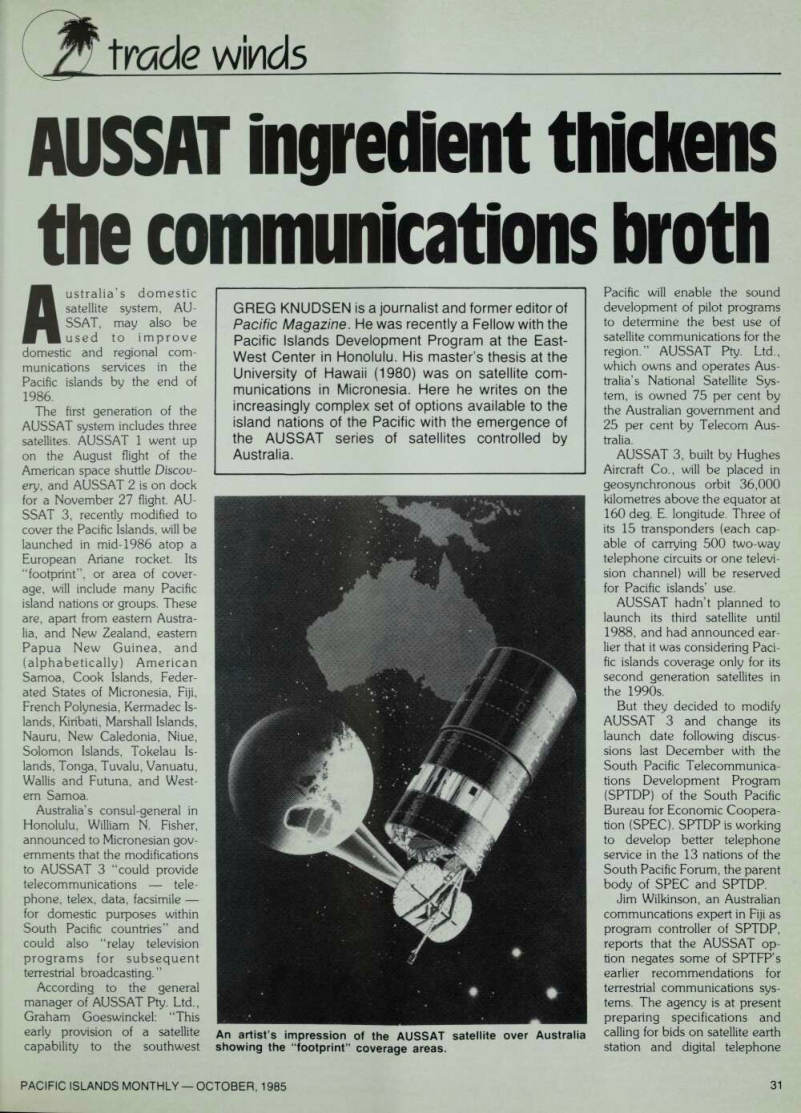
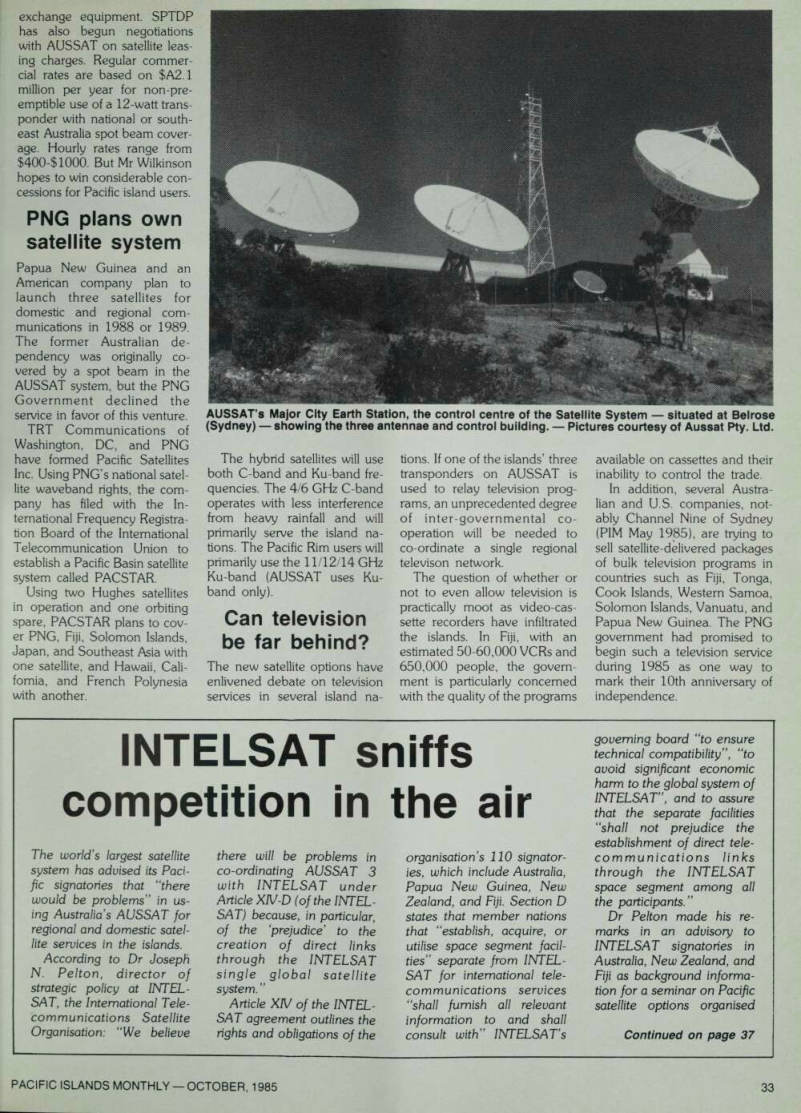
trade winds
AUSSAT ingredient thickens the communications broth
Australia’s domestic
satellite system, AU SSAT, may also be used to improve domestic and regional com munications services in the Pacific islands by the end of 1986.
The first generation of the AUSSAT system includes three satellites. AUSSAT 1 went up on the August flight of the American space shuttle Discov ery, and AUSSAT 2 is on dock for a November 27 flight. AU SSAT 3, recently modified to cover the Pacific Islands, will be launched in mid-1986 atop a European Ariane rocket. Its “footprint”, or area of cover age, will include many Pacific island nations or groups. These are, apart from eastern Austra lia, and New Zealand, eastern Papua New Guinea, and (alphabetically) American Samoa, Cook Islands, Feder ated States of Micronesia, Fiji, French Polynesia, Kermadec Is lands, Kiribati, Marshall Islands, Nauru, New Caledonia, Niue, Solomon Islands, Tokelau Is lands, Tonga, Tuvalu, Vanuatu, Wallis and Futuna, and West ern Samoa.
Australia’s consul-general in Honolulu, William N. Fisher, announced to Micronesian gov ernments that the modifications to AUSSAT 3 “could provide telecommunications tele phone, telex, data, facsimile for domestic purposes within South Pacific countries” and could also “relay television programs for subsequent terrestrial broadcasting. ”
According to the general manager of AUSSAT Pty. Ltd., Graham Goeswinckel: “This early provision of a satellite capability to the southwest
GREG KNUDSEN is a journalist and former editor of Pacific Magazine. He was recently a Fellow with the Pacific Islands Development Program at the East- West Center in Honolulu. His master’s thesis at the University of Hawaii (1980) was on satellite com munications in Micronesia. Here he writes on the increasingly complex set of options available to the island nations of the Pacific with the emergence of the AUSSAT series of satellites controlled by Australia.
Pacific will enable the sound development of pilot programs to determine the best use of satellite communications for the region.” AUSSAT Pty. Ltd., which owns and operates Aus tralia’s National Satellite Sys tem, is owned 75 per cent by the Australian government and 25 per cent by Telecom Aus tralia.
AUSSAT 3, built by Hughes Aircraft Co., will be placed in geosynchronous orbit 36,000 kilometres above the equator at 160 deg. E. longitude. Three of its 15 transponders (each cap able of carrying 500 two-way telephone circuits or one televi sion channel) will be reserved for Pacific islands’ use.
AUSSAT hadn’t planned to launch its third satellite until 1988, and had announced ear lier that it was considering Paci fic islands coverage only for its second generation satellites in the 19905.
But they decided to modify AUSSAT 3 and change its launch date following discus sions last December with the South Pacific Telecommunica tions Development Program (SPTDP) of the South Pacific Bureau for Economic Coopera tion (SPEC). SPTDP is working to develop better telephone service in the 13 nations of the South Pacific Forum, the parent body of SPEC and SPTDP.
Jim Wilkinson, an Australian communcations expert in Fiji as program controller of SPTDP, reports that the AUSSAT op tion negates some of SPTFP’s earlier recommendations for terrestrial communications sys tems. The agency is at present preparing specifications and calling for bids on satellite earth station and digital telephone
An artist’s impression of the AUSSAT satellite over Australia showing the “footprint” coverage areas.
exchange equipment. SPTDP has also begun negotiations with AUSSAT on satellite leas ing charges. Regular commer cial rates are based on SA2.I million per year for non-pre emptible use of a 12-watt trans ponder with national or south east Australia spot beam cover age. Hourly rates range from $4OO-$ 1000. But Mr Wilkinson hopes to win considerable con cessions for Pacific island users.
PNG plans own
satellite system
Papua New Guinea and an American company plan to launch three satellites for domestic and regional com munications in 1988 or 1989.
The former Australian de pendency was originally co vered by a spot beam in the AUSSAT system, but the PNG Government declined the service in favor of this venture.
TRT Communications of Washington, DC, and PNG have formed Pacific Satellites Inc. Using PNG’s national satel lite waveband rights, the com pany has filed with the In ternational Frequency Registra tion Board of the International Telecommunication Union to establish a Pacific Basin satellite system called PACSTAR.
Using two Hughes satellites in operation and one orbiting spare, PACSTAR plans to cov er PNG, Fiji, Solomon Islands, Japan, and Southeast Asia with one satellite, and Hawaii, Cali fornia, and French Polynesia with another.
The hybrid satellites will use both C-band and Ku-band fre quencies. The 4/6 GHz C-band operates with less interference from heavy rainfall and will primarily serve the island na tions. The Pacific Rim users will primarily use the 11/12/14 GHz Ku-band (AUSSAT uses Ku band only).
Can television
be far behind?
The new satellite options have enlivened debate on television services in several island na
tions. If one of the islands’ three transponders on AUSSAT is used to relay television prog rams, an unprecedented degree of inter-governmental co operation will be needed to co-ordinate a single regional televison network.
The question of whether or not to even allow television is practically moot as video-cas sette recorders have infiltrated the islands. In Fiji, with an estimated 50-60,000 VCRs and 650,000 people, the govern ment is particularly concerned with the quality of the programs
available on cassettes and their inability to control the trade.
In addition, several Austra lian and U.S. companies, not ably Channel Nine of Sydney (PIM May 1985), are trying to sell satellite-delivered packages of bulk television programs in countries such as Fiji, Tonga, Cook Islands, Western Samoa, Solomon Islands, Vanuatu, and Papua New Guinea. The PNG government had promised to begin such a television service during 1985 as one way to mark their 10th anniversary of independence.
AUSSAT’s Major City Earth Station, the control centre of the Satellite System - situated at Belrose (Sydney) - showing the three antennae and control building. - Pictures courtesy of Aussat Pty. Ltd.
Advertisements & other items, p. 32 (1 item)
Aiwa
i M V V-1200A High-performance S.P.A.N. component systems AlWA’s V-1200A System boasts 100 W +IOOW (at IkHz) sound performance.
Each component incorporates AlWA’s latest technology,
making this system “digital ready” for the sound of today!
AIWA’S AUTO SORTING SYSTEM is
a totally new concept in cassette versatility. Deck I holds up to 5 cassettes for random programmed playback.
Deck II is for quick reverse recording and playback.
Auto Sorting enables: ■Automatic programmed edit dubbing at normal or double speed. ■ Random programmed playback of up to 15 selections or entire tape sides. ■Sequential playback of 5 tapes for up to 22 continuous hours of music when C-90 tapes are used.
AIWA’S AFBS SPEAKER DESIGN makes
smaller speakers perform like much larger speakers. AFBS —Acoustic Feedback System—speakers feature: ■Small microphones mounted in front of each twin woofer pick up acoustic “energy” and send it back to the amplifier. ■ Deep, rich bass reproduction down to 25Hzfrom previous 80 100 Hz limits. ■ Flat and square aluminum honeycomb diaphragms for the precise reproduction of even digital sound sources.
AIWA
WIRELESS REMOTE CONTROL of
nearly every system function—including power ON/OFF and volume—is in your hand.
AIWA Australia Pty., Ltd 14 Gertrude St.. Arncliffe. N.S.W. Australia 2205 AUSTRALIA PHONE: (597) 2388/Ocean.a Indent Agency (P.N.G ) Pty., Ltd Ago 5 24350/Makaniee & New Guinea PHoSe: 256411/The Sound Centre Ltd P.O. Box 434 Port Vila, Vanuatu PHONE; 2035/P. Hargovlnd Bros 90 Renwick Road PO. Box, 490 Suva ft Sons Limited P.O. box 91 Sigatoka Fiji PHONE; 50158/Milaw Trading Co., Ltd 224-236 Hobson Street, P.0.80x 5919, Auckland, New Zealand Phone (09) 3^5/ h «hv« 79.' g® Noumea, New Caledonia PHONE; 27.24.66/Harvest Pacific Limited P.O. Box 517. Honiara. Solomon Islands PHONE, 131/FareHi-F. Stereo Rue du Tahiti Phone; 2-4814/Micropac Audio, Inc. P.O. Box 3478 Agana, Guam 96910 PHONE; 472-6091,472-8297/Rarotonga Duty Free Shop Private Bag P.O. Box 92. Rarotonga. Cook Island/Nauru Co-Operative Society Republic of Nauru
INTELSAT sniffs



competition in the air
The world’s largest satellite system has advised its Paci fic signatories that “there would be problems” in us ing Australia’s AUSSAT for regional and domestic satel lite services in the islands.
According to Dr Joseph N. Pelton, director of strategic policy at INTEL SAT, the International Tele communications Satellite Organisation: “We believe
there will be problems in co-ordinating AUSSAT 3 with INTELSAT under Article XIV-D (of the INTEL SAT) because, in particular, of the ‘ prejudice ’ to the creation of direct links through the INTELSAT single global satellite system.”
Article XIV of the INTEL SAT agreement outlines the rights and obligations of the
organisation’s 110 signator ies, which include Australia, Papua New Guinea, New Zealand, and Fiji. Section D states that member nations that “establish, acquire, or utilise space segment facil ties” separate from INTEL SAT for international tele communications services “shall furnish all relevant information to and shall consult with” INTELSATs
governing board “to ensure technical compatibility”, “to avoid significant economic harm to the global system of INTELSAT”, and to assure that the separate facilities “shall not prejudice the establishment of direct tele communications links through the INTELSAT space segment among all the participants.”
Dr Pelton made his re marks in an advisory to INTELSAT signatories in Australia, New Zealand, and Fiji as background informa tion for a seminar on Pacific satellite options organised
Continued on page 37
by the International PEACESAT Consortium and held in Fiji from August 19-22.
INTELSAT serves a glo bal network of 170 coun tries and territories, includ ing 24 Pacific island loca tions. Most of its business is in international telecommunciations traffic, but it also leases excess capacity on its satellites for domestic communications services in 27 countries.
The potential conflict be tween INTELSAT and AU SSAT is a result of both organisations trying to sell their communications services in the same market.
Since late 1983, INTEL SAT has promoted its “VIS TA” service as an affordable approach to making reliable communications available to the hundreds of small, sparsely-populated outlying islands that at present suffer inadequate communica tions. A VISTA system would use smaller-scale and lower-cost “Standard D” antennas and leased time on INTELSAT satellites to transmit telephone, data, and eventually television signals between various is lands. VISTA networks are currently under study in Tuvalu, Niue, Kiribati, and Fiji.
While most international communications in the Paci fic are now conducted via satellite (on the INTELSAT global network), most domestic communications between outer islands and their administrative centres are via high frequency radios.
The National Telecom munications and Informa tion Administration of the United States Department of Commerce assessed tele communications require ments in parts of Micronesia during March and April. One of NTIA’s recommenda tions, issued in July, was: “Once small, low-cost (under $40,000), mainten ance-simple earth stations operating with a suitable
satellite system become commercially available, they should be installed in place of HF radios because of their superior transmission qua lity and reliability/’
When INTELSAT officials described VISTA at the 1984 Pacific Telecommuni cations Conference (PTC ’B4) in Honolulu, cost esti mates for the smaller earth terminals ranged from $25,000-$40,000. Accor ding to Dr Pelton’s current report: ‘The original VISTA terminals, with high degrees of redundancy, have tended to range from $120,000 to $200,000. A supplier re cently quoted INTELSAT a price of $BO,OOO for a low redundancy system. Fur thermore, INTELSAT is ex ploring the idea of ‘assem bly-type kits ’ for VISTA terminals that can lower costs by a substantial amount.”
The cost of using the satellite, or space segment, would depend on the size of the VISTA system. For each VISTA channel, INTELSAT charges $265 per month for pre-emptible service and $525 per month for non pre-emptible (three months minimum). Two channels are required for each two way voice circuit.
The simplest VISTA con figuration in the Pacific would be a single voice circuit between an admi nistrative centre and each of its outer islands. The most elaborate, regional network would provide full inter connectivity between seve ral adminstrative centres and their associated outer islands. —Greg Knudsen. *INTELSAT members in the Pacific are Hawaii (United States), Australia, New Zea land, Papua New Guinea, and Fiji. INTELSAT services in the Pacific are also pro vided to American Samoa, Cook Islands, Federated States of Micronesia (Pohn pei, Truk, Yap, and Kosrae), French Polynesia, Guam, Kiribati, Marshall Islands (Majuro and Ebeye), Nauru, New Caledonia, Northern Marianas, Palau, Solomon Islands, Tonga, Vanuatu, and Western Samoa.
An AUSSAT satellite undergoing final tests in the Hughes Aircraft factory in Los Angeles prior to shipment for launch.
Advertisements & other items, pp. 34-38 (2 items)
Toyota
QUALITY SERVICE
AMERICAN SAMOA: BURNS PHILP (SOUTH SEA) CO., LTD., P.O. Box 129, Pago Pago.
COOK ISLANDS: COOK ISLANDS TRADING
CORPORATION LTD., Private Bag, Rarotonga.
FIJI: AUTOMOTIVE SUPPLIES COMPANY, A Division of Burns Philp (South Sea) Co., Ltd., G.P.O. Box 355, Suva.
GUAM & MICRONESIA: ATKINS KROLL, INC., 443 South Marine Drive, Tamuning.
KIRIBATI: TARAWA MOTORS, P.O. Box 36, Bairiki, Tarawa.
NAURU: NAURU COOPERATIVE SOCIETY, Central
Pacific.
NEW CALEDONIA; SERVICE IMPORTATION
AUTOMOBILE DU PACIFIQUE, Rond-Point du Pacifi« (Station Total) B.P. 438, Noumea.
NORFOLK ISLAND: BORRYS LIMITED, P.O. Box 1 PAPUA NEW GUINEA: ELA MOTORS, A Divisior Burns Philp (PNG) Ltd., P.O. Box 75, Port Moresby.
SAIPAN: MICROL CORPORATION, P.O. Box 267, Saif
*r> « » • V*-' fhe tradition of power and ruggedness goes on.
Toyota’s new Land Cruiser has been entirely designed from the road up. But it still tains the traditional toughness quired from over thirty years road experience.
But no matter how rough it gets a roomy new cabin with improved occupant comforts, easy instrumentation and an optional 4-speed automatic transmission add up to passenger car comfort with Land Cruiser ruggedness.
Pickup
And you can choose from a wide variety of models and an array of heavy-duty features.
Take the wheel and feel Toyota quality in Land Cruiser’s styling, power and comfort. A quality that stays with you on or off the road.
Step into a new generation of toughness today.
LOMON: SOLOMON ISLANDS INVESTMENTS LTD.,
*.O. Box 174, Honiara.
HITI: NIPPON AUTOMOTO, B.P. 342, Papeete.
NGA; BURNS PHILP (SOUTH SEA) CO., LTD., P.O. k 55, Nukualofa.
NUATU: VANUATU MOTORS, A Division of Burns ilp (Vanuatu) Ltd., P.O. Box 18, Port Vila. :STERN SAMOA: BURNS PHILP (SOUTH SEA) CO., P.O. Box 188, Apia.
TOYOTA
o □ <*> 5E C=D
comatsu,
where electronics,
nechatronics
md robotronics
ire powering
tew advances.
It’s a well known fact that we are one of le world’s largest makers of construction lachinery. Less known is our work in eleconics. Research and development in this eld has led to the use of mechatronics in ur latest series of construction machines, his in turn has resulted in considerable enefits to our customers such as better ost performance in terms of le Return on Investment.
Another surprise, unless you’re ne of the top ten auto makers, will e our long association with industrial lachinery. Chances are parts of the car Du’re now driving were made with one of ur giant industrial presses.
To increase precision and productivity i our manufacturing plants, production ngineering methods are constantly being nproved. It was natural therefore that ur accumulated electronic technology idustrial robots for example should be pplied in this field also.
The application of new technologies, nd the entry into fields such as laser quipment, silicon and other new materials re opening up an exciting new era As a jlly integrated manufacturer of construcon and industrial machines we are now acing the challenges of the future with trength and confidence.
'HE QUALITY IS STANDARD
>§• KOMATSU
ead Off ice; 2-3-6. Akasaka, MI nato-ku. Tokyo 107, Japan -lex; J 22812 Phone; (03)584-7111 Cable; KOMATSULTD
NOTICE TRADE MARK:
Notice is hereby given that Aiwa Co., Ltd., a corporation duly organised and existing under the laws of Japan of 9 Kandasudacho 2-chome, Chiyodaku, Tokyo, Japan, is the sole proprietor in Papua New Guinea and Nauru and elsewhere of the following Trade Mark:
AIWA
Used in respect of the following: Radio and television equipments; sound amplifying apparatus and instruments and parts thereof; microphones, loud-speakers, tuners, record players, turntables, pickups, tape recorders, video recorders, phonograph records, tapes and other sound and/or image recording and/or reproducing apparatus, articles and implements; cassette tape recorders, combined radio receivers and cassette tape recorders, phonometers; parts and accessories of foregoing goods.
The Proprietor claims all rights in respect of the above Trade Mark and will take all necessary legal steps against any person or company infringing those rights.
F. B. RICE & CO.
Patent Attorneys, Sydney, Australia.
Surprising New Zealand.
\ ■%. :«h m m %4
ises
dO Stay on a farm or go skiing, big game fishing, jet-boating, or enjoy ski-plane flights.
See more, save more More to do. more to see m Now you can plan a wonderful holiday in New Zealand with the Air New Zealand "Holiday Planner” with over 173 different activities from which to choose. It’s available from any Air New Zealand travel office or travel agent.
Travel around, or stay put There are city coach tours, self-drive freewheeling holidays in both the North Island and South Island, and Maui Campervan holidays By planning and booking in advance you can enjoy price advantages on many of these activities.
Call into Air New Zealand or your travel agent for a free copy of the Air New Zealand “Holiday Planner”.
Once you’ve seen it. you won’t be able to wait to see New Zealand.
air new zEatano
The Pacific’s Number One
S'
Intelsat
37
Continued from page 33
PACIFIC ISLANDS MONTHLY —OCTOBER, 1985
marvellously mapped
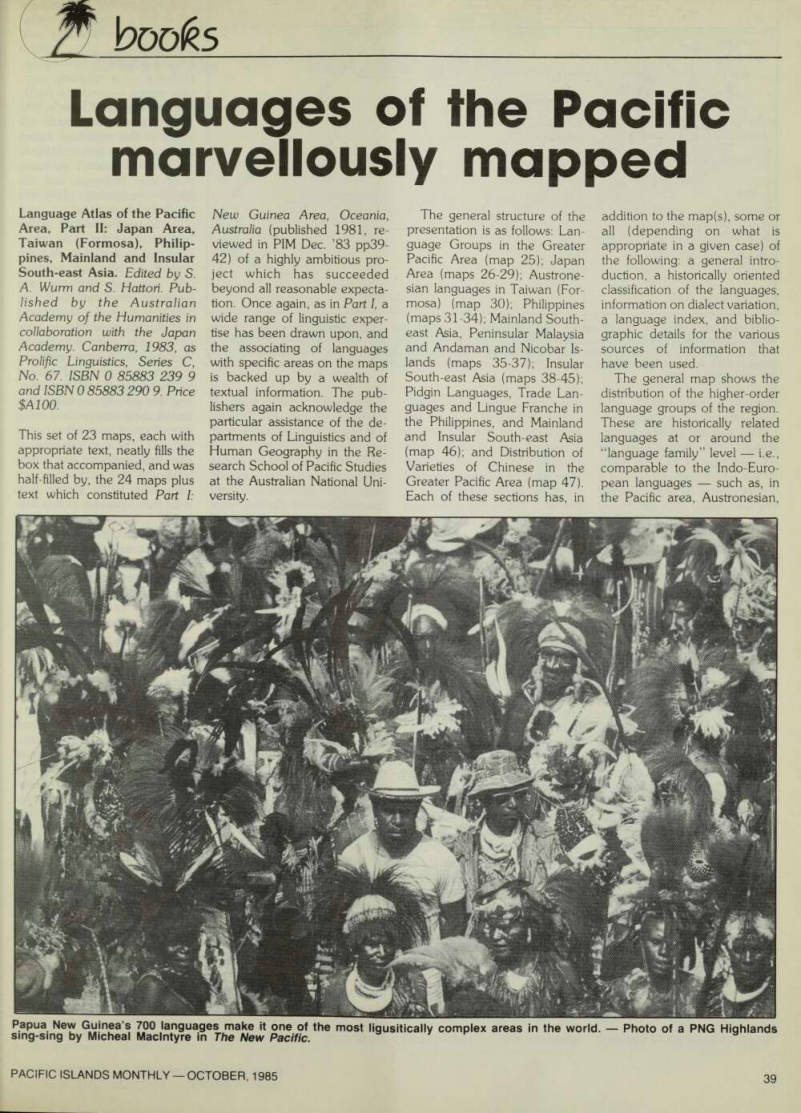
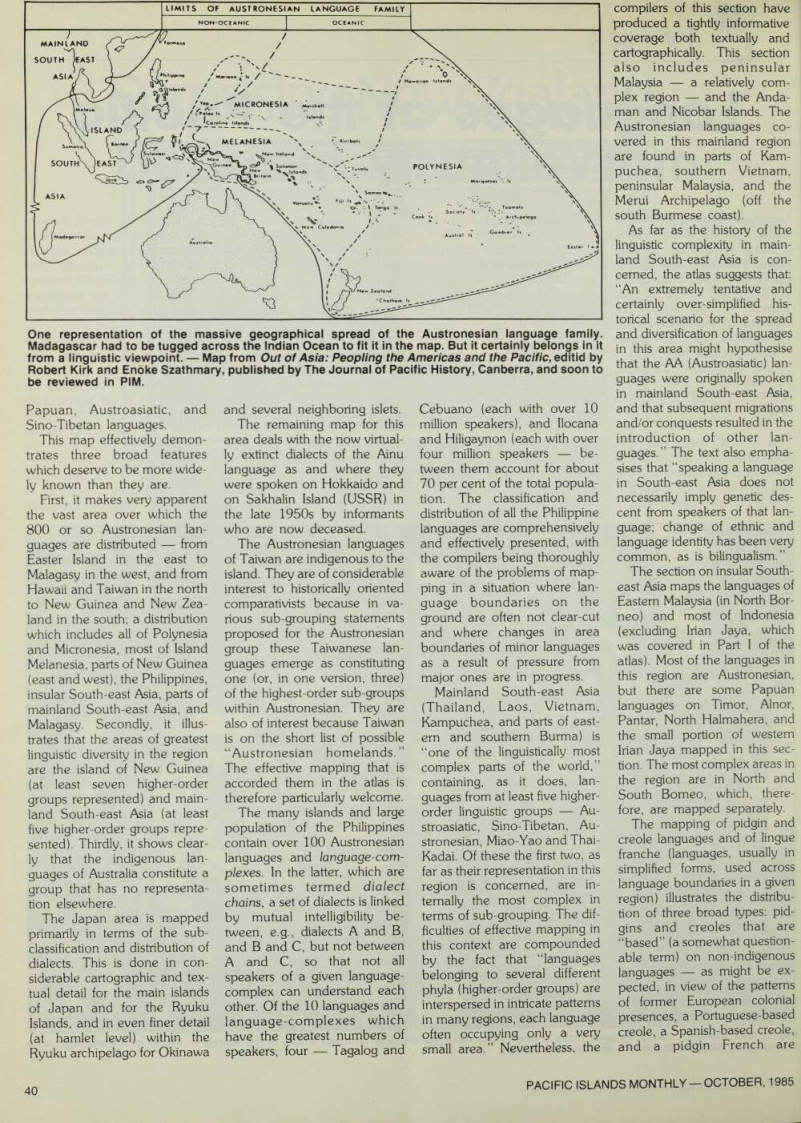
books
Languages of the Pacific marvellously mapped
Language Atlas of the Pacific Area, Part II: Japan Area, Taiwan (Formosa), Philippines. Mainland and Insular South-east Asia. Edited by S.
A. Wurm and S. Hattori. Published by the Australian Academy of the Humanities in collaboration with the Japan Academy. Canberra, 1983, as Prolific Linguistics, Series C, No. 67. ISBN 0 85883 239 9 and ISBN 0 85883 290 9. Price
Saioo.
This set of 23 maps, each with appropriate text, neatly fills the box that accompanied, and was half-filled by, the 24 maps plus text which constituted Part I:
New Guinea Area, Oceania, Australia (published 1981, re viewed in PIM Dec. ’B3 pp 39- 42) of a highly ambitious pro ject which has succeeded beyond all reasonable expecta tion. Once again, as in Part/, a wide range of linguistic exper tise has been drawn upon, and the associating of languages with specific areas on the maps is backed up by a wealth of textual information. The pub lishers again acknowledge the particular assistance of the de partments of Linguistics and of Human Geography in the Re search School of Pacific Studies at the Australian National Uni versity.
The general structure of the presentation is as follows: Lan guage Groups in the Greater Pacific Area (map 25); Japan Area (maps 26-29); Austrone sian languages in Taiwan (For mosa) (map 30); Philippines (maps 31-34); Mainland South east Asia, Peninsular Malaysia and Andaman and Nicobar Is lands (maps 35-37); Insular South-east Asia (maps 38-45); Pidgin Languages, Trade Lan guages and Lingue Franche in the Philippines, and Mainland and Insular South-east Asia (map 46); and Distribution of Varieties of Chinese in the Greater Pacific Area (map 47).
Each of these sections has, in
addition to the map(s), some or all (depending on what is appropriate in a given case) of the following: a general intro duction, a historically oriented classification of the languages, information on dialect variation, a language index, and biblio graphic details for the various sources of information that have been used.
The general map shows the distribution of the higher-order language groups of the region.
These are historically related languages at or around the “language family” level i.e., comparable to the Indo-Euro pean languages such as, in the Pacific area, Austronesian,
Papua New Guinea’s 700 languages make it one of the most ligusitically complex areas in the world. - Photo of a PNG Highlands sing-sing by Micheal Maclntyre in The New Pacific.
Papuan, Austroasiatic, and Sino-Tibetan languages.
This map effectively demon trates three broad features which deserve to be more wide ly known than they are.
First, it makes very apparent the vast area over which the 800 or so Austronesian lan guages are distributed from Easter Island in the east to Malagasy in the west, and from Hawaii and Taiwan in the north to New Guinea and New Zea land in the south; a distribution which includes all of Polynesia and Micronesia, most of Island Melanesia, parts of New Guinea (east and west), the Philippines, insular South-east Asia, parts of mainland South-east Asia, and Malagasy. Secondly, it illus trates that the areas of greatest linguistic diversity in the region are the island of New Guinea (at least seven higher-order groups represented) and main land South-east Asia (at least five higher-order groups repre sented). Thirdly, it shows clear ly that the indigenous lan guages of Australia constitute a group that has no representa tion elsewhere.
The Japan area is mapped primarily in terms of the sub classification and distribution of dialects. This is done in con siderable cartographic and tex tual detail for the main islands of Japan and for the Ryuku Islands, and in even finer detail (at hamlet level) within the Ryuku archipelago for Okinawa
and several neighboring islets.
The remaining map for this area deals with the now virtual ly extinct dialects of the Ainu language as and where they were spoken on Hokkaido and on Sakhalin Island (USSR) in the late 1950 s by informants who are now deceased.
The Austronesian languages of Taiwan are indigenous to the island. They are of considerable interest to historically oriented comparativists because in va rious sub-grouping statements proposed for the Austronesian group these Taiwanese lan guages emerge as constituting one (or, in one version, three) of the highest-order sub-groups within Austronesian. They are also of interest because Taiwan is on the short list of possible “Austronesian homelands.”
The effective mapping that is accorded them in the atlas is therefore particularly welcome.
The many islands and large population of the Philippines contain over 100 Austronesian languages and language-com plexes. In the latter, which are sometimes termed dialect chains, a set of dialects is linked by mutual intelligibility be tween, e.g., dialects A and B, and B and C, but not between A and C, so that not all speakers of a given language complex can understand each other. Of the 10 languages and language-complexes which have the greatest numbers of speakers, four Tagalog and
Cebuano (each with over 10 million speakers), and Ilocana and Hiligaynon (each with over four million speakers be tween them account for about 70 per cent of the total popula tion. The classification and distribution of all the Philippine languages are comprehensively and effectively presented, with the compilers being thoroughly aware of the problems of map ping in a situation where lan guage boundaries on the ground are often not clear-cut and where changes in area boundaries of minor languages as a result of pressure from major ones are in progress.
Mainland South-east Asia (Thailand, Laos, Vietnam, Kampuchea, and parts of east ern and southern Burma) is “one of the linguistically most complex parts of the world,” containing, as it does, lan guages from at least five higher order linguistic groups Au stroasiatic, Sino-Tibetan, Au stronesian, Miao-Yao and Thai- Kadai. Of these the first two, as far as their representation in this region is concerned, are in ternally the most complex in terms of sub-grouping. The dif ficulties of effective mapping in this context are compounded by the fact that “languages belonging to several different phyla (higher-order groups) are interspersed in intricate patterns in many regions, each language often occupying only a very small area.” Nevertheless, the
compilers of this section have produced a tightly informative coverage both textually and cartographically. This section also includes peninsular Malaysia a relatively com plex region and the Anda man and Nicobar Islands. The Austronesian languages co vered in this mainland region are found in parts of Kam puchea, southern Vietnam, peninsular Malaysia, and the Merui Archipelago (off the south Burmese coast).
As far as the history of the linguistic complexity in main land South-east Asia is con cerned, the atlas suggests that: “An extremely tentative and certainly over-simplified his torical scenario for the spread and diversification of languages in this area might hypothesise that the AA (Austroasiatic) lan guages were originally spoken in mainland South-east Asia, and that subsequent migrations and/or conquests resulted in the introduction of other lan guages. ” The text also empha sises that “speaking a language in South-east Asia does not necessarily imply genetic des cent from speakers of that lan guage; change of ethnic and language identity has been very common, as is bilingualism.”
The section on insular South east Asia maps the languages of Eastern Malaysia (in North Bor neo) and most of Indonesia (excluding Irian Jaya, which was covered in Part I of the atlas). Most of the languages in this region arc Austronesian, but there are some Papuan languages on Timor, Alnor, Pantar, North Halmahera, and the small portion of western Irian Jaya mapped in this sec tion. The most complex areas in the region are in North and South Borneo, which, there fore, are mapped separately.
The mapping of pidgin and creole languages and of lingue franche (languages, usually in simplified forms, used across language boundaries in a given region) illustrates the distribu tion of three broad types: pid gins and creoles that are “based” (a somewhat question able term) on non-indigenous languages as might be ex pected, in view of the patterns of former European colonial presences, a Portuguese-based creole, a Spanish-based creole, and a pidgin French are
One representation of the massive geographical spread of the Austronesian language family.
Madagascar had to be tugged across the Indian Ocean to fit it in the map. But it certainly belongs in it from a linguistic viewpoint. - Map from Out of Asia: Peopling the Americas and the Pacific, editid by Robert Kirk and Enoke Szathmary, published by The Journal of Pacific History, Canberra, and soon to be reviewed in PIM.
Languages
documented; pidgins and creoles “based” on indigenous languages the most notable of these is Bazaar Malay; and non-pidginised indigenous ling ue tranche.
The section of the atlas covering the distribution of 10 varieties of Chinese in the Paci fic region is a testimony to the übiquity of the Chinese com mercial and social presence, a presence which often has con siderable time-depth. The map ping shows not only where some variety of Chinese is spoken, but also, when several varieties are present in a given location, their relative degrees of importance in that location e.g., Broome, Auckland and Wellington have Standard Can tonese exclusively; Sydney and
Brisbane have Standard Can tonese predominantly, but also have Hokkien and Szeyup Cantonese (and some Man darin in Sydney only); and Melbourne has Szeyup Can tonese predominantly, but also has Standard Cantonese and Hokkien.
The general editors, the sec tion editors, and the many contributing linguists whose combined talents have pro duced this truly magnificent atlas deserve our congratula tions and thanks. As a result of their efforts the Pacfic region, which contains nearly half the languages of the world, has for the first time been definitively mapped in linguistic terms. This does not mean, however, that supplements will be unneces sary, since it is normal for languages and their distribu tions to change in the course of
time.
David Walsh.
The definitive guide to the bottom
bottom of Truk Lagoon
Hailstorm Over Truk Lagoon.
By Klaus P. Lindemann. Pub lished by Maruzen Asia Press, Singapore. 370 pp. No ISBN provided. Price SUSIS.
Following Japan’s withdrawal from the League of Nations in 1935, Truk was fitted out as a major naval base. Preparations for such use by the Japanese, however, had started years ear lier. In October 1941, two months before the outbreak of hostilities, a U.S. reconnaiss ance overflight confirmed the importance of the Truk Lagoon to Japanese naval superiority in the Pacific.
Among the American military authorities, Truk took on an awesome aspect, and during the war was sometimes referred to as “terrible Truk” or “the unsinkable aircraft carrier”.
The reality was much diffe rent, particularly after the American capture of the Mar shall Islands in February 1944.
This rapid and inexpensive suc cess changed the overall plan ning in the Central Pacific cam paign. The Japanese retreated from the eastern Carolines to the relative safety of the Philip pines-East Indies-New Guinea
barrier. Admiral Nimitz ordered Truk to be by-passed, and brought the target date for the capture of the Marianas forward by almost 20 weeks.
Once the Marshalls were se cured, Truk was continually violated by air from American bombers. When the Marianas were finally captured and the B-29 bases established there, Truk was relentlessly neutral ised. But as early as March 1944, the Japanese had virtual ly abandoned it. Most of her capital fighting ships were wise ly withdrawn in February after news of the fall of the Marshalls reached Combined Fleet Headquarters at Dublon. The ranking Japanese admiral sta tioned at Truk during the mid dle period of the war testified that he would listen to the American radio proclaim Truk “the impregnable bastion of the Pacific”, and then become apprehensive that perhaps the U.S. Navy might somehow learn the truth.
When American raids began over Truk in February 1944, the pilots found fewer targets than they expected. More than two-thirds of Japan’s 365 land based planes were destroyed,
and some 140,000 tons of shipping went to the bottoms of the lagoon.
These ships rest there today, silently and forever. Encrusted with coral, they form a beautiful undersea garden of color with schools of fish swimming about among them. With increasing frequency these days, scuba divers from all over the world join the fishes, and often their photographs appear in maga zine articles and occasional pictorial books and essays.
Now and then some of these divers come here to the Micronesian Area Research Center at the University of Guam to research the sunken ships. More than once, as director, I have wished that someone would write the de finitive work on the sunken fleet at Truk and the circumstances surrounding it. Happily, Klaus P. Lindemann has done it.
Hailstorm Over Truk Lagoon (“Hailstorm” was the American code name for the engage ments) is not only must reading for all divers and visitors going to Truk. It is something of an historical contribution as well, and could be assigned reading for students in Pacific History courses. In this book one will find everything one needs to know indeed, all that is known about Truk and World War II with regard to the background to the battle, de scriptions by eyewitnesses, and an inventory explanation of all the wrecks that have been found on the lagoon floors.
Lindemann’s work has been an organic literary effort. By this I mean that when he went to Truk to dive for the first time, he had no intentions of writing a book. But, when he found that no descriptive material was im mediately at hand, he set out to produce some. It took him nearly 10 years to complete it.
He has been very thorough, and scuba divers at Truk for years to come will thank him.
A newcomer to Truk who intends to dive will find Hail storm an indispensable hand book. It will help him find the wrecks, identify them, and, be cause of the careful accounts of
each vessel and its present condition at the lagoon’s bot tom, it will make for more efficient and safer diving.
Lindemann is not an his torian and doesn’t claim to be, but nevertheless he has put together a cogent descriptive narrative of the fateful events at Truk during February 1944, and all that went before and after. He investigated all avail able sources. He contacted both Japanese and American people and institutions who could be of assistance. Moreov er, he included the Trukese themselves. He interviewed many eyewitnesses, and has reproduced their comments in such a way as to allow them to express themselves in their own cultural context, and this is most productive and comfortable for them. This part is a special contribution because nowhere else does such testimony appear.
The physical aspects of the book are pleasing, too. There’s an excellent cover design. The body type is a bit small, but not tedious. There are pictures, both black and white and in color, which are useful as well as inspiring. There’s also an index and acknowledgments.
Author Lindemann hasn’t left a stone unturned. He deserves a lot of credit and we are grateful for his efforts. Dirk Anthony Ballendorf.
Books received
The Children Must Dance.
By Tony Maniaty. Published 1984 by Penguin Books, 487 Maroondah High way, Ringwood, Vic. 3134, Australia.
ISBN 0 14 007089 3. Price $5.95.
Culture, Youth and Suicide in the Pacific: Papers from an East-West Center Conference.
Edited by Francis X. Hezel, S.J. Pub lished 1985 by Pacific Islands Studies Program, Center for Asian and Pacific Studies, University of Hawaii at Manoa, Honolulu, Hawaii 96822. No ISBN or price provided.
Solomons; A Portrait of Traditional and Contemporary Culture in Solo mon Islands.
Edited by Julian Maka’a. A special issue of Pacific Moana Quarterly published 1985 by Outrigger Publishers, P.O. Box 13-049, Hamilton, New Zealand, ISSN
0110-3970. Snzi2.Oo.
Out of Asia: Peopling the Americas and the Pacific.
Edited by Robert Kirk and Emoke Szathmary. Published 1985 by The Journal of Pacific History. The Australian National University, GPO Box 4, Can berra, ACT 2601, Australia. ISBN 0 9595477 4 6. Price $18.50 plus p. & p.
and espionage
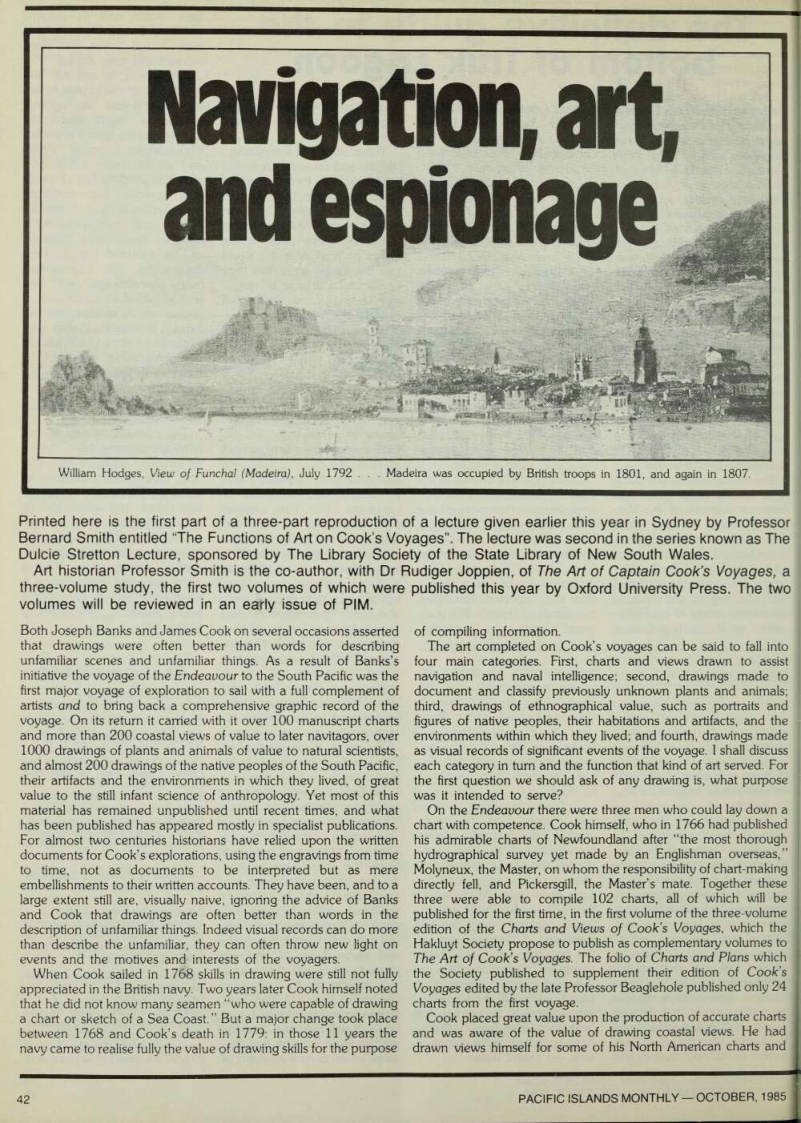
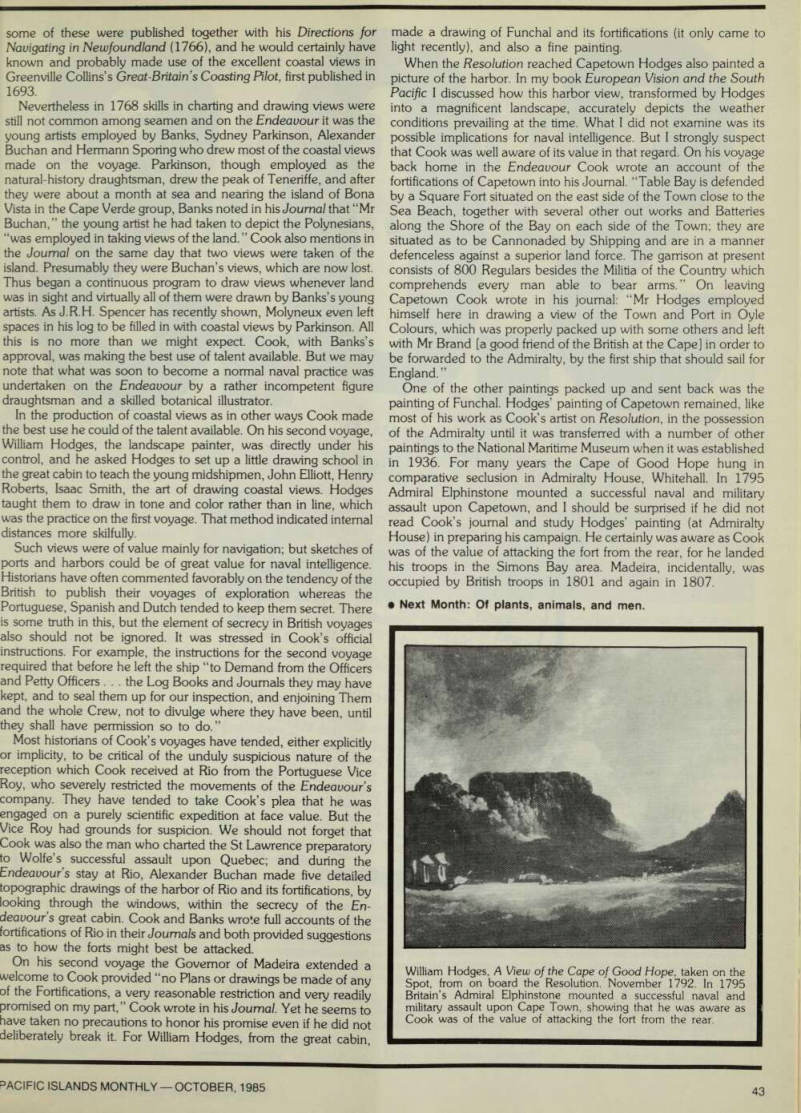
Navigation, art, and espionage
Printed here is the first part of a three-part reproduction of a lecture given earlier this year in Sydney by Professor Bernard Smith entitled “The Functions of Art on Cook’s Voyages”. The lecture was second in the series known as The Dulcie Stretton Lecture, sponsored by The Library Society of the State Library of New South Wales.
Art historian Professor Smith is the co-author, with Dr Rudiger Joppien, of The Art of Captain Cook’s Voyages, a three-volume study, the first two volumes of which were published this year by Oxford University Press. The two volumes will be reviewed in an early issue of PIM.
Both Joseph Banks and James Cook on several occasions asserted that drawings were often better than words for describing unfamiliar scenes and unfamiliar things. As a result of Banks’s initiative the voyage of the Endeavour to the South Pacific was the first major voyage of exploration to sail with a full complement of artists and to bring back a comprehensive graphic record of the voyage. On its return it carried with it over 100 manuscript charts and more than 200 coastal views of value to later navitagors, over 1000 drawings of plants and animals of value to natural scientists, and almost 200 drawings of the native peoples of the South Pacific, their artifacts and the environments in which they lived, of great value to the still infant science of anthropology. Yet most of this material has remained unpublished until recent times, and what has been published has appeared mostly in specialist publications.
For almost two centuries historians have relied upon the written documents for Cook’s explorations, using the engravings from time to time, not as documents to be interpreted but as mere embellishments to their written accounts. They have been, and to a large extent still are, visually naive, ignoring the advice of Banks and Cook that drawings are often better than words in the description of unfamiliar things. Indeed visual records can do more than describe the unfamiliar, they can often throw new light on events and the motives and interests of the voyagers.
When Cook sailed in 1768 skills in drawing were still not fully appreciated in the British navy. Two years later Cook himself noted that he did not know many seamen “who were capable of drawing a chart or sketch of a Sea Coast.” But a major change took place between 1768 and Cook’s death in 1779; in those 11 years the navy came to realise fully the value of drawing skills for the purpose
of compiling information.
The art completed on Cook’s voyages can be said to fall into four main categories. First, charts and views drawn to assist navigation and naval intelligence; second, drawings made to document and classify previously unknown plants and animals; third, drawings of ethnographical value, such as portraits and figures of native peoples, their habitations and artifacts, and the environments within which they lived; and fourth, drawings made as visual records of significant events of the voyage. I shall discuss each category in turn and the function that kind of art served. For the first question we should ask of any drawing is, what purpose was it intended to serve?
On the Endeavour there were three men who could lay down a chart with competence. Cook himself, who in 1766 had published his admirable charts of Newfoundland after “the most thorough hydrographical survey yet made by an Englishman overseas,”
Molyneux, the Master, on whom the responsibility of chart-making directly fell, and Pickersgill, the Master’s mate. Together these three were able to compile 102 charts, all of which will be published for the first time, in the first volume of the three-volume edition of the Charts and Views of Cook’s Voyages, which the Hakluyt Society propose to publish as complementary volumes to The Art of Cook’s Voyages. The folio of Charts and Plans which the Society published to supplement their edition of Cook’s Voyages edited by the late Professor Beaglehole published only 24 charts from the first voyage.
Cook placed great value upon the production of accurate charts and was aware of the value of drawing coastal views. He had drawn views himself for some of his North American charts and
William Hodges, View of Funchal (Madeira), July 1792 . . . Madeira was occupied by British troops in 1801, and again in 1807.
some of these were published together with his Directions for Navigating in Newfoundland (1766), and he would certainly have known and probably made use of the excellent coastal views in Greenville Collins’s Great-Britain’s Coasting Pilot, first published in 1693.
Nevertheless in 1768 skills in charting and drawing views were still not common among seamen and on the Endeavour it was the young artists employed by Banks, Sydney Parkinson, Alexander Buchan and Hermann Sporing who drew most of the coastal views made on the voyage. Parkinson, though employed as the natural-history draughtsman, drew the peak of Teneriffe, and after they were about a month at sea and nearing the island of Bona Vista in the Cape Verde group, Banks noted in his Journal that “Mr Buchan,” the young artist he had taken to depict the Polynesians, “was employed in taking views of the land. ” Cook also mentions in the Journal on the same day that two views were taken of the island. Presumably they were Buchan’s views, which are now lost.
Thus began a continuous program to draw views whenever land was in sight and virtually all of them were drawn by Banks’s young artists. As J.R.H. Spencer has recently shown, Molyneux even left spaces in his log to be filled in with coastal views by Parkinson. All this is no more than we might expect. Cook, with Banks’s approval, was making the best use of talent available. But we may note that what was soon to become a normal naval practice was undertaken on the Endeavour by a rather incompetent figure draughtsman and a skilled botanical illustrator.
In the production of coastal views as in other ways Cook made the best use he could of the talent available. On his second voyage, William Hodges, the landscape painter, was directly under his control, and he asked Hodges to set up a little drawing school in the great cabin to teach the young midshipmen, John Elliott, Henry Roberts, Isaac Smith, the art of drawing coastal views. Hodges taught them to draw in tone and color rather than in line, which was the practice on the first voyage. That method indicated internal distances more skilfully.
Such views were of value mainly for navigation; but sketches of ports and harbors could be of great value for naval intelligence.
Historians have often commented favorably on the tendency of the British to publish their voyages of exploration whereas the Portuguese, Spanish and Dutch tended to keep them secret. There is some truth in this, but the element of secrecy in British voyages also should not be ignored. It was stressed in Cook’s official instructions. For example, the instructions for the second voyage required that before he left the ship “to Demand from the Officers and Petty Officers ... the Log Books and Journals they may have kept, and to seal them up for our inspection, and enjoining Them and the whole Crew, not to divulge where they have been, until they shall have permission so to do.”
Most historians of Cook’s voyages have tended, either explicitly or implicity, to be critical of the unduly suspicious nature of the reception which Cook received at Rio from the Portuguese Vice Roy, who severely restricted the movements of the Endeavour s company. They have tended to take Cook’s plea that he was engaged on a purely scientific expedition at face value. But the Vice Roy had grounds for suspicion. We should not forget that Cook was also the man who charted the St Lawrence preparatory to Wolfe’s successful assault upon Quebec; and during the Endeavours stay at Rio, Alexander Buchan made five detailed topographic drawings of the harbor of Rio and its fortifications, by looking through the windows, within the secrecy of the En deavour’s great cabin. Cook and Banks wrote full accounts of the fortifications of Rio in their Journals and both provided suggestions as to how the forts might best be attacked.
On his second voyage the Governor of Madeira extended a welcome to Cook provided “no Plans or drawings be made of any of the Fortifications, a very reasonable restriction and very readily promised on my part,” Cook wrote in his Journal. Yet he seems to have taken no precautions to honor his promise even if he did not deliberately break it. For William Hodges, from the great cabin,
made a drawing of Funchal and its fortifications (it only came to light recently), and also a fine painting.
When the Resolution reached Capetown Hodges also painted a picture of the harbor. In my book European Vision and the South Pacific I discussed how this harbor view, transformed by Hodges into a magnificent landscape, accurately depicts the weather conditions prevailing at the time. What I did not examine was its possible implications for naval intelligence. But I strongly suspect that Cook was well aware of its value in that regard. On his voyage back home in the Endeavour Cook wrote an account of the fortifications of Capetown into his Journal. “Table Bay is defended by a Square Fort situated on the east side of the Town close to the Sea Beach, together with several other out works and Batteries along the Shore of the Bay on each side of the Town; they are situated as to be Cannonaded by Shipping and are in a manner defenceless against a superior land force. The garrison at present consists of 800 Regulars besides the Militia of the Country which comprehends every man able to bear arms. ” On leaving Capetown Cook wrote in his journal: “Mr Hodges employed himself here in drawing a view of the Town and Port in Oyle Colours, which was properly packed up with some others and left with Mr Brand [a good friend of the British at the Cape] in order to be forwarded to the Admiralty, by the first ship that should sail for England. ”
One of the other paintings packed up and sent back was the painting of Funchal. Hodges’ painting of Capetown remained, like most of his work as Cook’s artist on Resolution, in the possession of the Admiralty until it was transferred with a number of other paintings to the National Maritime Museum when it was established in 1936. For many years the Cape of Good Hope hung in comparative seclusion in Admiralty House, Whitehall. In 1795 Admiral Elphinstone mounted a successful naval and military assault upon Capetown, and I should be surprised if he did not read Cook’s journal and study Hodges’ painting (at Admiralty House) in preparing his campaign. He certainly was aware as Cook was of the value of attacking the fort from the rear, for he landed his troops in the Simons Bay area. Madeira, incidentally, was occupied by British troops in 1801 and again in 1807. • Next Month: Of plants, animals, and men.
William Hodges, A View of the Cape of Good Hope, taken on the Spot, from on board the Resolution. November 1792. In 1795 Britain’s Admiral Elphinstone mounted a successful naval and military assault upon Cape Town, showing that he was aware as Cook was of the value of attacking the fort from the rear.
Advertisements & other items, pp. 43-44 (2 items)
43
'ACIFIC ISLANDS MONTHLY OCTOBER, 1985
pe^ ce
V^ e
ves s
tXixo
tso^
pt6^c^ atvd .^otve^'
l *\ e & 'S.rteAS
V Vt tt
Spe ve^^et^c
2 eO- v
*“ove
1 V^
etV s ° eT ve6' n
otv °^: r a t^ v „c Vo nd a«'L to»- e rS>« d ” »<S»>S4
pt°^cT^V cXea \ :
? n \\ \ ,: » «A on e vd ,-n ? aC wave r „
? me Y^r a >
0 \jw> u^?> \#> This was how the world first heard the news of the violent attack on the Greenpeace flagship Rainbow Warrior on July 10. This week, of course, we know a lot more.
We know that the unaccounted crew member was soon accounted for-dead! He was photographer and engineer Fernando Pereiraa father of two young children.
We know that the sinking of the Rainbow Warrior was a deliberate act of sabotage- Limpet mines were attached to the hull.
And we know that we need your help more than ever before.
With your donation, the salvage of equipment from the Rainbow Warrior, and the purchase of a replacement vessel, will be possible. And a trust fund will be set up for Fernando’s two children.
Help Greenpeace in its struggle against the senseless slaughter of seal pups, whales and marinelife, the ocean dumping of toxic chemicals and nuclear waste, and nuclear tests in the Pacific.
Send your donation now to the Greenpeace Rainbow Warrior Appeal and help give your children and Fernando’s, a future to look forward to.
Yes I would like to help Greenpeace and Fernando’s children.
Please accept my donation for $ Please send to: Greenpeace Australia Inc. 310 Angas Street, Adelaide 3000.
Enclosed is my cheque/money order or charge to my Bankcard n"IIIIIII I I I II I I I Name 'telephone . . .
Ogilvy GNPOOO9 . . Postcode
GREENPEACE
AUSTRALIA
Heavy grass and Yakuza
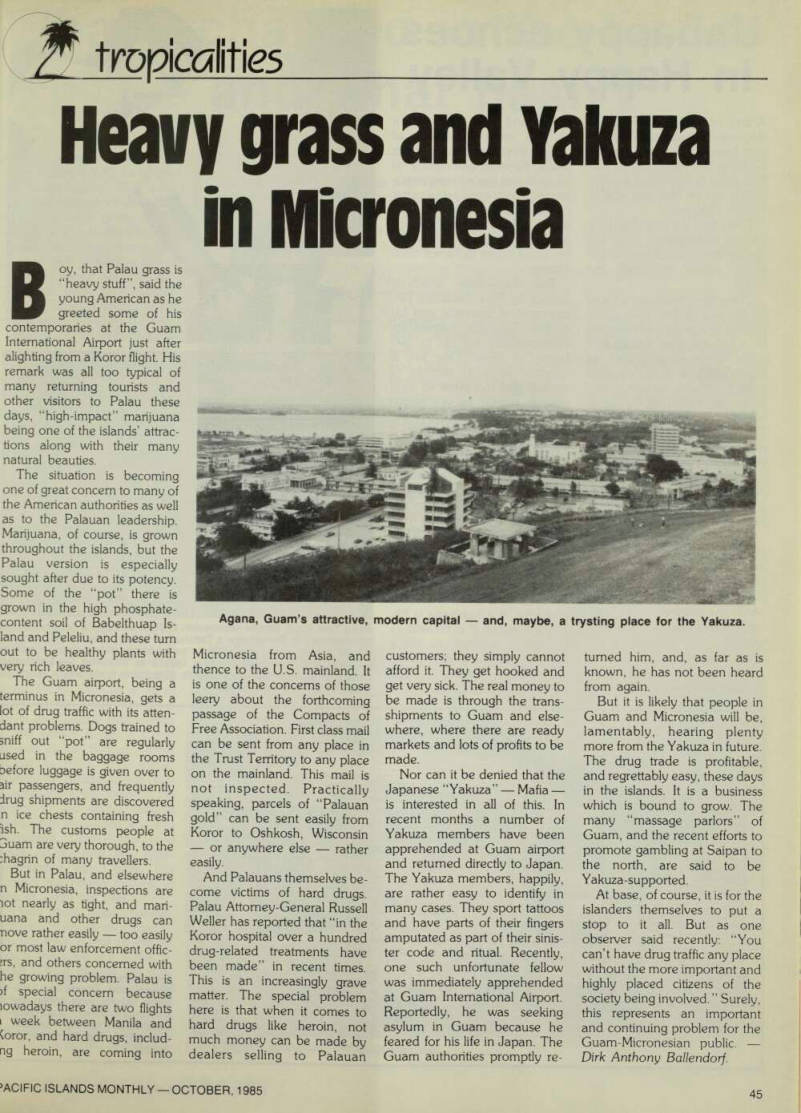
tropicalities
Heavy grass and Yakuza in Micronesia
Boy, that Palau grass is “heavy stuff”, said the young American as he greeted some of his contemporaries at the Guam International Airport just after alighting from a Koror flight. His remark was all too typical of many returning tourists and other visitors to Palau these days, “high-impact” marijuana being one of the islands’ attrac tions along with their many natural beauties.
The situation is becoming one of great concern to many of the American authorities as well as to the Palauan leadership.
Marijuana, of course, is grown throughout the islands, but the Palau version is especially sought after due to its potency.
Some of the “pot” there is grown in the high phosphate content soil of Babelthuap Is land and Peleliu, and these turn out to be healthy plants with very rich leaves.
The Guam airport, being a terminus in Micronesia, gets a lot of drug traffic with its atten dant problems. Dogs trained to sniff out “pot” are regularly used in the baggage rooms before luggage is given over to air passengers, and frequently drug shipments are discovered n ice chests containing fresh ish. The customs people at 3uam are very thorough, to the :hagrin of many travellers.
But in Palau, and elsewhere n Micronesia, inspections are lot nearly as tight, and mari uana and other drugs can nove rather easily too easily or most law enforcement offic es, and others concerned with he growing problem. Palau is )f special concern because lowadays there are two flights i week between Manila and Coror, and hard drugs, includ ng heroin, are coming into
Micronesia from Asia, and thence to the U.S. mainland. It is one of the concerns of those leery about the forthcoming passage of the Compacts of Free Association. First class mail can be sent from any place in the Trust Territory to any place on the mainland. This mail is not inspected. Practically speaking, parcels of “Palauan gold” can be sent easily from Koror to Oshkosh, Wisconsin or anywhere else rather easily.
And Palauans themselves be come victims of hard drugs.
Palau Attorney-General Russell Weller has reported that “in the Koror hospital over a hundred drug-related treatments have been made” in recent times.
This is an increasingly grave matter. The special problem here is that when it comes to hard drugs like heroin, not much money can be made by dealers selling to Palauan
customers; they simply cannot afford it. They get hooked and get very sick. The real money to be made is through the trans shipments to Guam and else where, where there are ready markets and lots of profits to be made.
Nor can it be denied that the Japanese “Yakuza” Mafia is interested in all of this. In recent months a number of Yakuza members have been apprehended at Guam airport and returned directly to Japan.
The Yakuza members, happily, are rather easy to identify in many cases. They sport tattoos and have parts of their fingers amputated as part of their sinis ter code and ritual. Recently, one such unfortunate fellow was immediately apprehended at Guam International Airport.
Reportedly, he was seeking asylum in Guam because he feared for his life in Japan. The Guam authorities promptly re
turned him, and, as far as is known, he has not been heard from again.
But it is likely that people in Guam and Micronesia will be, lamentably, hearing plenty more from the Yakuza in future.
The drug trade is profitable, and regrettably easy, these days in the islands. It is a business which is bound to grow. The many “massage parlors” of Guam, and the recent efforts to promote gambling at Saipan to the north, are said to be Yakuza-supported.
At base, of course, it is for the islanders themselves to put a stop to it all. But as one observer said recently: “You can’t have drug traffic any place without the more important and highly placed citizens of the society being involved. ” Surely, this represents an important and continuing problem for the Guam-Micronesian public.
Dirk Anthony Ba/lendorf.
Agana, Guam’s attractive, modern capital - and, maybe, a trysting place for the Yakuza.
Advertisements & other items, p. 45 (1 item)
45
ACIFIC ISLANDS MONTHLY —OCTOBER, 1985
Unhappy echoes
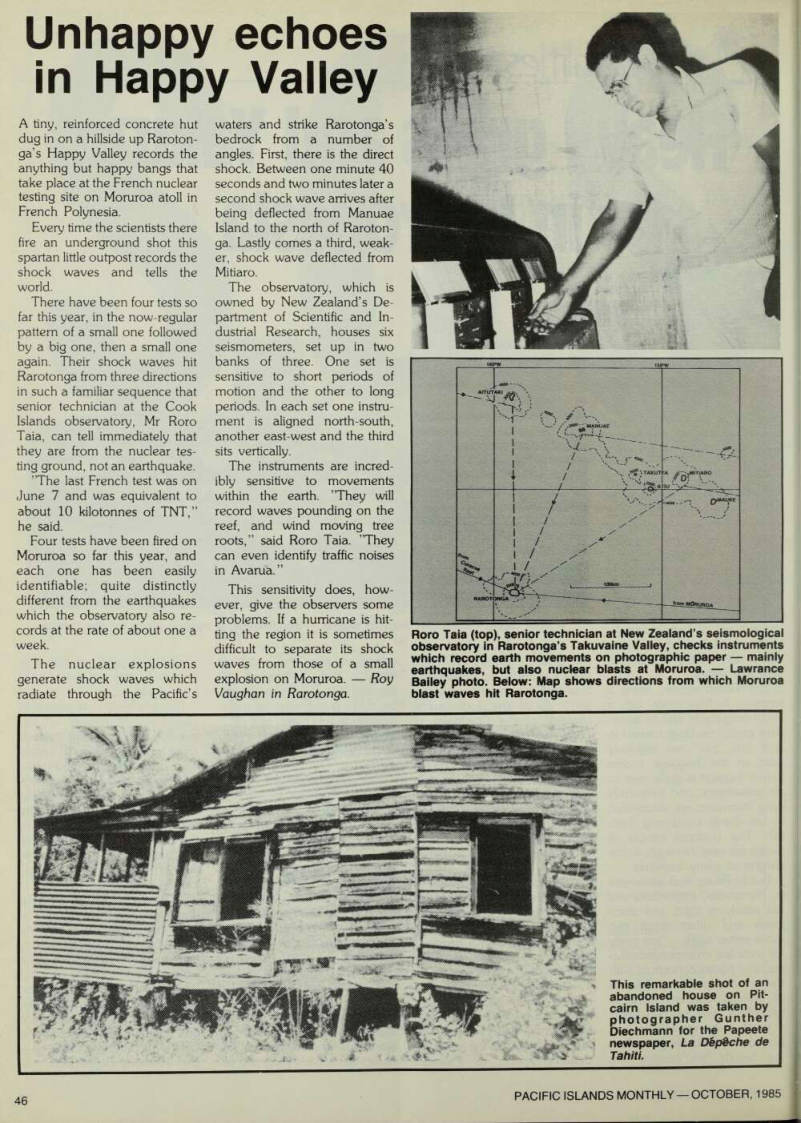
in Happy Valley
A tiny, reinforced concrete hut dug in on a hillside up Raroton ga’s Happy Valley records the anything but happy bangs that take place at the French nuclear testing site on Moruroa atoll in French Polynesia.
Every time the scientists there fire an underground shot this spartan little outpost records the shock waves and tells the world.
There have been four tests so far this year, in the now-regular pattern of a small one followed by a big one, then a small one again. Their shock waves hit Rarotonga from three directions in such a familiar sequence that senior technician at the Cook Islands observatory, Mr Roro Taia, can tell immediately that they are from the nuclear tes ting ground, not an earthquake. ’’The last French test was on June 7 and was equivalent to about 10 kilotonnes of TNT,” he said.
Four tests have been fired on Moruroa so far this year, and each one has been easily identifiable; quite distinctly different from the earthquakes which the observatory also re cords at the rate of about one a week.
The nuclear explosions generate shock waves which radiate through the Pacific’s
waters and strike Rarotonga’s bedrock from a number of angles. First, there is the direct shock. Between one minute 40 seconds and two minutes later a second shock wave arrives after being deflected from Manuae Island to the north of Raroton ga. Lastly comes a third, weak er, shock wave deflected from Mitiaro.
The observatory, which is owned by New Zealand’s De partment of Scientific and In dustrial Research, houses six seismometers, set up in two banks of three. One set is sensitive to short periods of motion and the other to long periods. In each set one instru ment is aligned north-south, another east-west and the third sits vertically.
The instruments are incred ibly sensitive to movements within the earth. ’’They will record waves pounding on the reef, and wind moving tree roots,” said Roro Taia. ’They can even identify traffic noises in Avarua.”
This sensitivity does, how ever, give the observers some problems. If a hurricane is hit ting the region it is sometimes difficult to separate its shock waves from those of a small explosion on Moruroa. Roy Vaughan in Rarotonga.
Roro Taia (top), senior technician at New Zealand’s seismological observatory in Rarotonga’s Takuvaine Valley, checks instruments which record earth movements on photographic paper — mainly earthquakes, but also nuclear blasts at Moruroa. — Lawrance Bailey photo. Below: Map shows directions from which Moruroa blast waves hit Rarotonga.
This remarkable shot of an abandoned house on Pit cairn Island was taken by
photographer Gunther
Diechmann for the Papeete
newspaper, La Depeche de
Tahiti.
- and what hasn’t
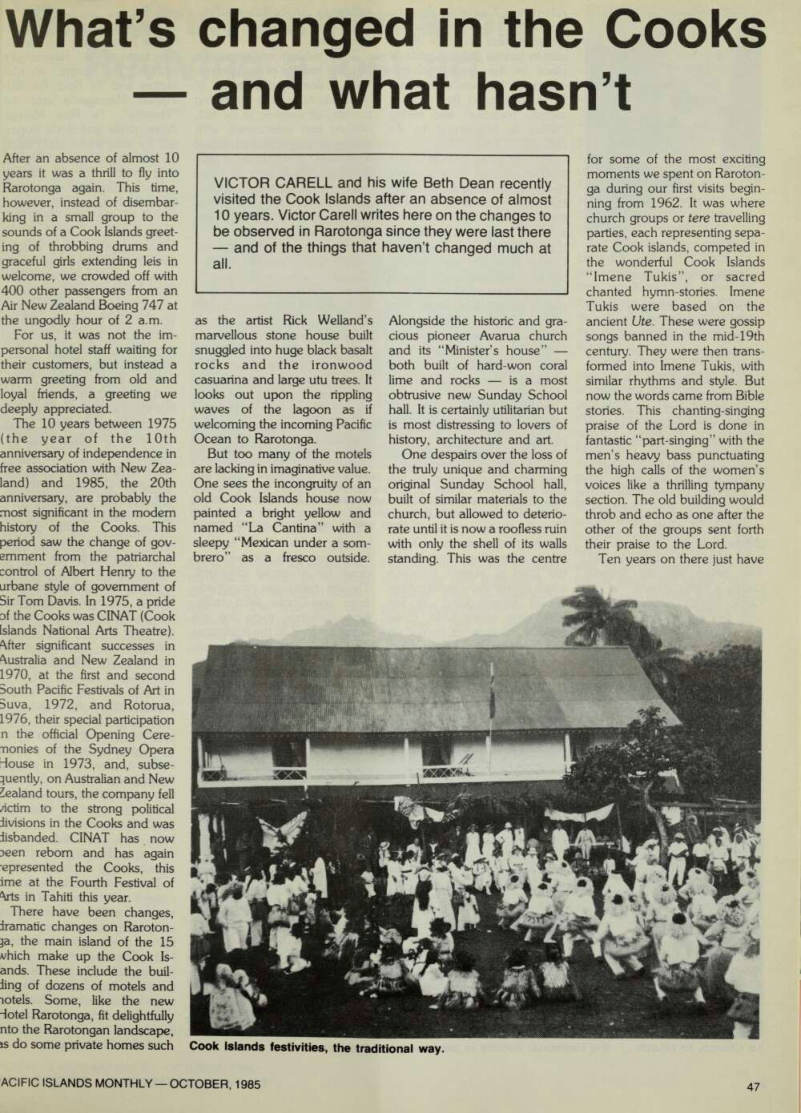
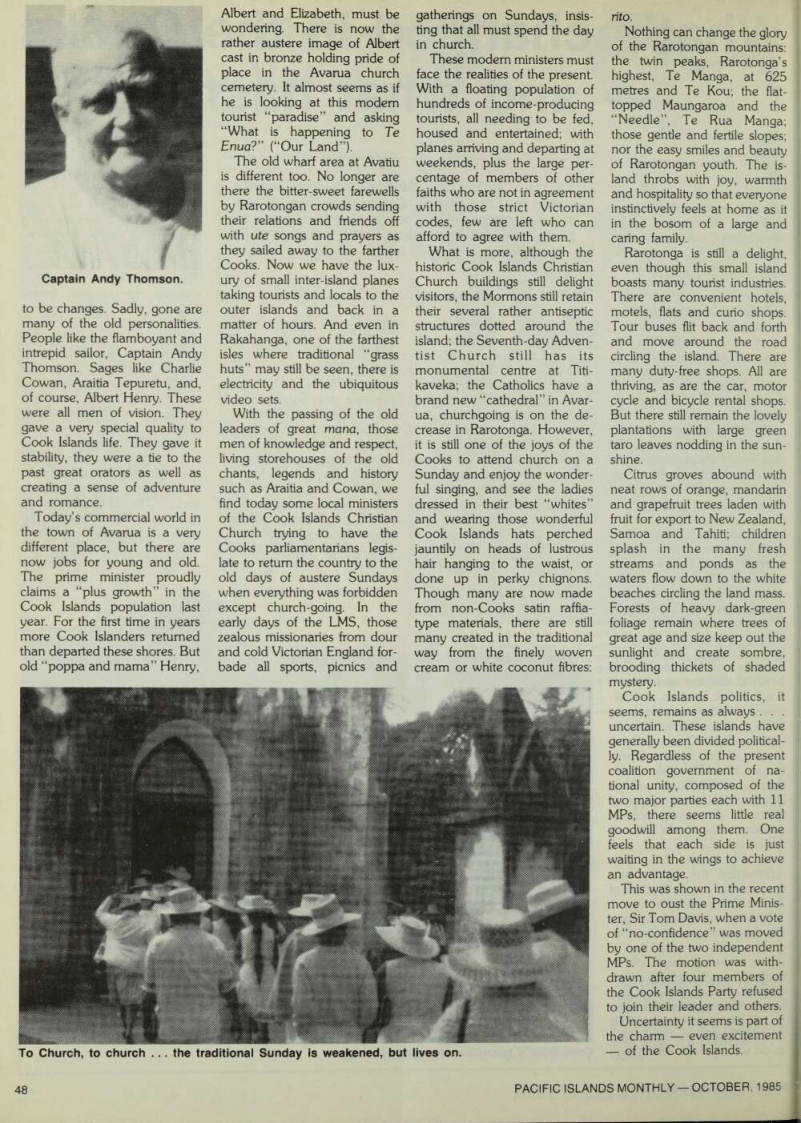
What’s changed in the Cooks - and what hasn’t
After an absence of almost 10 years it was a thrill to fly into Rarotonga again. This time, however, instead of disembar king in a small group to the sounds of a Cook Islands greet ing of throbbing drums and graceful girls extending leis in welcome, we crowded off with 400 other passengers from an Air New Zealand Boeing 747 at the ungodly hour of 2 a.m.
For us, it was not the im personal hotel staff waiting for their customers, but instead a warm greeting from old and loyal friends, a greeting we deeply appreciated.
The 10 years between 1975 (the year of the 10th anniversary of independence in free association with New Zea land) and 1985, the 20th anniversary, are probably the most significant in the modem history of the Cooks. This period saw the change of gov ernment from the patriarchal control of Albert Henry to the urbane style of government of Sir Tom Davis. In 1975, a pride af the Cooks was CINAT (Cook islands National Arts Theatre), significant successes in Australia and New Zealand in 1970, at the first and second South Pacific Festivals of Art in Suva, 1972, and Rotorua, 1976, their special participation n the official Opening Cere nonies of the Sydney Opera House in 1973, and, subse quently, on Australian and New Zealand tours, the company fell /ictim to the strong political divisions in the Cooks and was disbanded. CINAT has now Deen reborn and has again epresented the Cooks, this ime at the Fourth Festival of in Tahiti this year.
There have been changes, dramatic changes on Raroton ga, the main island of the 15 vhich make up the Cook Is ands. These include the buil ding of dozens of motels and lotels. Some, like the new Hotel Rarotonga, fit delightfully nto the Rarotongan landscape, is do some private homes such
VICTOR CARELL and his wife Beth Dean recently visited the Cook Islands after an absence of almost 10 years. Victor Carell writes here on the changes to be observed in Rarotonga since they were last there and of the things that haven’t changed much at all.
as the artist Rick Welland’s marvellous stone house built snuggled into huge black basalt rocks and the ironwood casuarina and large utu trees. It looks out upon the rippling waves of the lagoon as if welcoming the incoming Pacific Ocean to Rarotonga.
But too many of the motels are lacking in imaginative value.
One sees the incongruity of an old Cook Islands house now painted a bright yellow and named “La Cantina” with a sleepy “Mexican under a som brero” as a fresco outside.
Alongside the historic and gra cious pioneer Avarua church and its “Minister’s house” both built of hard-won coral lime and rocks is a most obtrusive new Sunday School hall. It is certainly utilitarian but is most distressing to lovers of history, architecture and art.
One despairs over the loss of the truly unique and charming original Sunday School hall, built of similar materials to the church, but allowed to deterio rate until it is now a roofless ruin with only the shell of its walls standing. This was the centre
for some of the most exciting moments we spent on Raroton ga during our first visits begin ning from 1962. It was where church groups or tere travelling parties, each representing sepa rate Cook islands, competed in the wonderful Cook Islands “Imene Tukis”, or sacred chanted hymn-stories. Imene Tukis were based on the ancient Ute. These were gossip songs banned in the mid-19th century. They were then trans formed into Imene Tukis, with similar rhythms and style. But now the words came from Bible stories. This chanting-singing praise of the Lord is done in fantastic “part-singing” with the men’s heavy bass punctuating the high calls of the women’s voices like a thrilling tympany section. The old building would throb and echo as one after the other of the groups sent forth their praise to the Lord.
Ten years on there just have
Cook Islands festivities, the traditional way.
to be changes. Sadly, gone are many of the old personalities.
People like the flamboyant and intrepid sailor, Captain Andy Thomson. Sages like Charlie Cowan, Araitia Tepuretu, and, of course, Albert Henry. These were all men of vision. They gave a very special quality to Cook Islands life. They gave it stability, they were a tie to the past great orators as well as creating a sense of adventure and romance.
Today’s commercial world in the town of Avarua is a very different place, but there are now jobs for young and old.
The prime minister proudly claims a “plus growth” in the Cook Islands population last year. For the first time in years more Cook Islanders returned than departed these shores. But old “poppa and mama” Henry,
Albert and Elizabeth, must be wondering. There is now the rather austere image of Albert cast in bronze holding pride of place in the Avarua church cemetery. It almost seems as if he is looking at this modem tourist “paradise” and asking “What is happening to Te Enua?” (“Our Land”).
The old wharf area at Avatiu is different too. No longer are there the bitter-sweet farewells by Rarotongan crowds sending their relations and friends off with ute songs and prayers as they sailed away to the farther Cooks. Now we have the lux ury of small inter-island planes taking tourists and locals to the outer islands and back in a matter of hours. And even in Rakahanga, one of the farthest isles where traditional “grass huts” may still be seen, there is electricity and the übiquitous video sets.
With the passing of the old leaders of great mana, those men of knowledge and respect, living storehouses of the old chants, legends and history such as Araitia and Cowan, we find today some local ministers of the Cook Islands Christian Church trying to have the Cooks parliamentarians legis late to return the country to the old days of austere Sundays when everything was forbidden except church-going. In the early days of the LMS, those zealous missionaries from dour and cold Victorian England for bade all sports, picnics and
gatherings on Sundays, insis ting that all must spend the day in church.
These modem ministers must face the realities of the present.
With a floating population of hundreds of income-producing tourists, all needing to be fed, housed and entertained; with planes arriving and departing at weekends, plus the large per centage of members of other faiths who are not in agreement with those strict Victorian codes, few are left who can afford to agree with them.
What is more, although the historic Cook Islands Christian Church buildings still delight visitors, the Mormons still retain their several rather antiseptic structures dotted around the island; the Seventh-day Adven tist Church still has its monumental centre at Titi kaveka; the Catholics have a brand new “cathedral” in Avar ua, churchgoing is on the de crease in Rarotonga. However, it is still one of the joys of the Cooks to attend church on a Sunday and enjoy the wonder ful singing, and see the ladies dressed in their best “whites” and wearing those wonderful Cook Islands hats perched jauntily on heads of lustrous hair hanging to the waist, or done up in perky chignons.
Though many are now made from non-Cooks satin raffia type materials, there are still many created in the traditional way from the finely woven cream or white coconut fibres:
rito.
Nothing can change the glory of the Rarotongan mountains; the twin peaks, Rarotonga’s highest, Te Manga, at 625 metres and Te Kou; the flat topped Maungaroa and the “Needle”, Te Rua Manga; those gentle and fertile slopes; nor the easy smiles and beauty of Rarotongan youth. The is land throbs with joy, warmth and hospitality so that everyone instinctively feels at home as it in the bosom of a large and caring family.
Rarotonga is still a delight, even though this small island boasts many tourist industries.
There are convenient hotels, motels, flats and curio shops.
Tour buses flit back and forth and move around the road circling the island. There are many duty-free shops. All are thriving, as are the car, motor cycle and bicycle rental shops.
But there still remain the lovely plantations with large green taro leaves nodding in the sun shine.
Citrus groves abound with neat rows of orange, mandarin and grapefruit trees laden with fruit for export to New Zealand, Samoa and Tahiti; children splash in the many fresh streams and ponds as the waters flow down to the white beaches circling the land mass.
Forests of heavy dark-green foliage remain where trees of great age and size keep out the sunlight and create sombre, brooding thickets of shaded mystery.
Cook Islands politics, it seems, remains as always . . . uncertain. These islands have generally been divided political ly. Regardless of the present coalition government of na tional unity, composed of the two major parties each with 11 MPs, there seems little real goodwill among them. One feels that each side is just waiting in the wings to achieve an advantage.
This was shown in the recent move to oust the Prime Minis ter, Sir Tom Davis, when a vote of “no-confidence” was moved by one of the two independent MPs. The motion was with drawn after four members of the Cook Islands Party refused to join their leader and others.
Uncertainty it seems is part of the charm even excitement of the Cook Islands.
Captain Andy Thomson.
To Church, to church ... the traditional Sunday is weakened, but lives on.
Advertisements & other items, p. 47 (1 item)
47
ACIFIC ISLANDS MONTHLY —OCTOBER, 1985
Breadfruit fermentation:
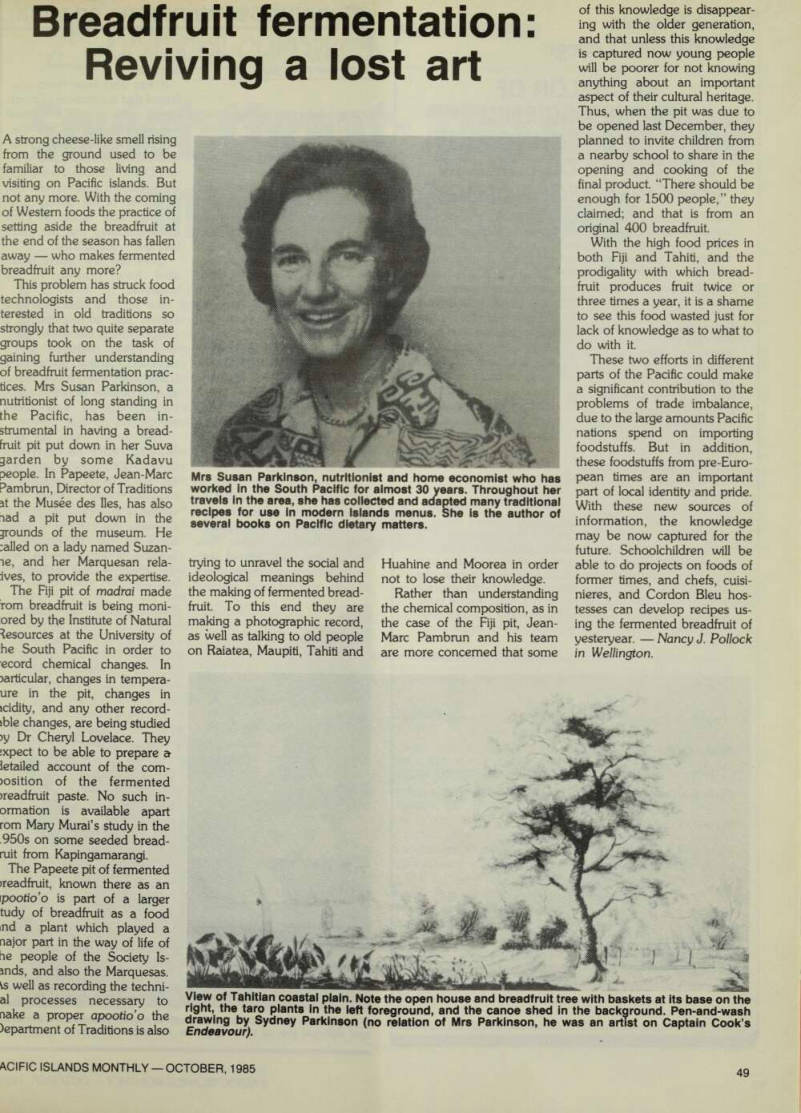
Reviving a lost art
A strong cheese-like smell rising from the ground used to be familiar to those living and visiting on Pacific islands. But not any more. With the coming of Western foods the practice of setting aside the breadfruit at the end of the season has fallen away who makes fermented breadfruit any more?
This problem has struck food technologists and those in terested in old traditions so strongly that two quite separate groups took on the task of gaining further understanding of breadfruit fermentation prac tices. Mrs Susan Parkinson, a nutritionist of long standing in the Pacific, has been in strumental in having a bread fruit pit put down in her Suva garden by some Kadavu people. In Papeete, Jean-Marc Pambrun, Director of Traditions at the Musee des lies, has also lad a pit put down in the grounds of the museum. He :alled on a lady named Suzan ie, and her Marquesan rela ives, to provide the expertise.
The Fiji pit of madrai made rom breadfruit is being moni ored by the Institute of Natural Resources at the University of he South Pacific in order to ecord chemical changes. In aarticular, changes in tempera ure in the pit, changes in acidity, and any other record ible changes, are being studied >y Dr Cheryl Lovelace. They ixpect to be able to prepare a letailed account of the com >osition of the fermented >readfruit paste. No such in ormation is available apart rom Mary Murai’s study in the ,950 s on some seeded bread
ruit from Kapingamarangi.
The Papeete pit of fermented ireadfruit, known there as an ipootio’o is part of a larger tudy of breadfruit as a food nd a plant which played a najor part in the way of life of he people of the Society Is ands, and also the Marquesas. well as recording the techni al processes necessary to nake a proper apootio’o the )epartment of Traditions is also
trying to unravel the social and ideological meanings behind the making of fermented bread fruit. To this end they are making a photographic record, as well as talking to old people on Raiatea, Maupiti, Tahiti and
Huahine and Moorea in order not to lose their knowledge.
Rather than understanding the chemical composition, as in the case of the Fiji pit, Jean- Marc Pambrun and his team are more concerned that some
of this knowledge is disappear ing with the older generation, and that unless this knowledge is captured now young people will be poorer for not knowing anything about an important aspect of their cultural heritage.
Thus, when the pit was due to be opened last December, they planned to invite children from a nearby school to share in the opening and cooking of the final product. “There should be enough for 1500 people,” they claimed; and that is from an original 400 breadfruit.
With the high food prices in both Fiji and Tahiti, and the prodigality with which bread fruit produces fruit twice or three times a year, it is a shame to see this food wasted just for lack of knowledge as to what to do with it These two efforts in different parts of the Pacific could make a significant contribution to the problems of trade imbalance, due to the large amounts Pacific nations spend on importing foodstuffs. But in addition, these foodstuffs from pre-Euro pean times arc an important part of local identity and pride.
With these new sources of information, the knowledge may be now captured for the future. Schoolchildren will be able to do projects on foods of former times, and chefs, cuisi nieres, and Cordon Bleu hos tesses can develop recipes us ing the fermented breadfruit of
yesteryear.
Nancy J. Pollock
in Wellington.
View of Tahitian coastal plain. Note the open house and breadfruit tree with baskets at its base on the right, the taro plants in the left foreground, and the canoe shed in the background. Pen-and-wash drawing by Sydney Parkinson (no relation of Mrs Parkinson, he was an artist on Captain Cook’s Endeavour).
Mrs Susan Parkinson, nutritionist and home economist who has worked in the South Pacific for almost 30 years. Throughout her travels In the area, she has collected and adapted many traditional recipes for use in modern Islands menus. She is the author of several books on Pacific dietary matters.
Advertisements & other items, p. 50 (2 items)
“Rainbow Warrior” Scandal
50
PACIFIC ISLANDS MONTHLY —OCTOBER, 1985
Continued from page 21
“RAINBOW WARRIOR” SCANDAL
;>] Australian
Maritime College
BACHELOR OF
APPLIED SCIENCE
(FISHERIES TECHNOLOGY)
GRADUATE DIPLOMA IN
FISHERIES TECHNOLOGY
These courses cover the biological bases of fisheries management regimes, the technology of fish searching, locating, and catching systems, and aspects of postharvest technology varying from care of the catch through to economics and marketing of fish Both courses are designed to provide education and training appropriate to Australia's multi-faceted fishing industry They both commence in February of each year.
No course fees are payable for Australian residents; a $52 facilities fee is levied each year. The course is approved under the Tertiary Education Assistance Scheme which provides free airfares for approved applicants Normal Entry Requirements Degree Satisfactory completion of Year 12 in mathematics, English, and a science subject Graduate Diploma A first degree or diploma normally in a scientific, mathematical or engineering discipline Duration Three years, plus one year spent working in the fishing industry One year.
The Australian Maritime College is Australia's national educational institution providing a complete range of courses at certificate, associate diploma, diploma, degree and graduate diploma levels exclusively for shipping, and the fishing, port and allied industries Facilities at the School of Fisheries include Bluefin, a 34 metre purpose built fisheries training vessel, and a large flume tank, unique in Australia, for testing fishing nets Accommodation is available on campus in comfortable, single study bedrooms.
Current charges are $66 50 per week at Newnham and $B4 00 per week at Beauty Point.
Cut out and send Please send me information on □ the Graduate Diploma in FishenesTechnology and/or □ the Bachelor of Applied Science (Fisheries Technology).
Send to: Admissions Office, Australian Maritime College, PO Box 986,
LAUNCESTON, TAS 7250
Telex AMC 58827 Telephone (003) 26 0731 Name: Address: Postcode PI 1494
and the substance
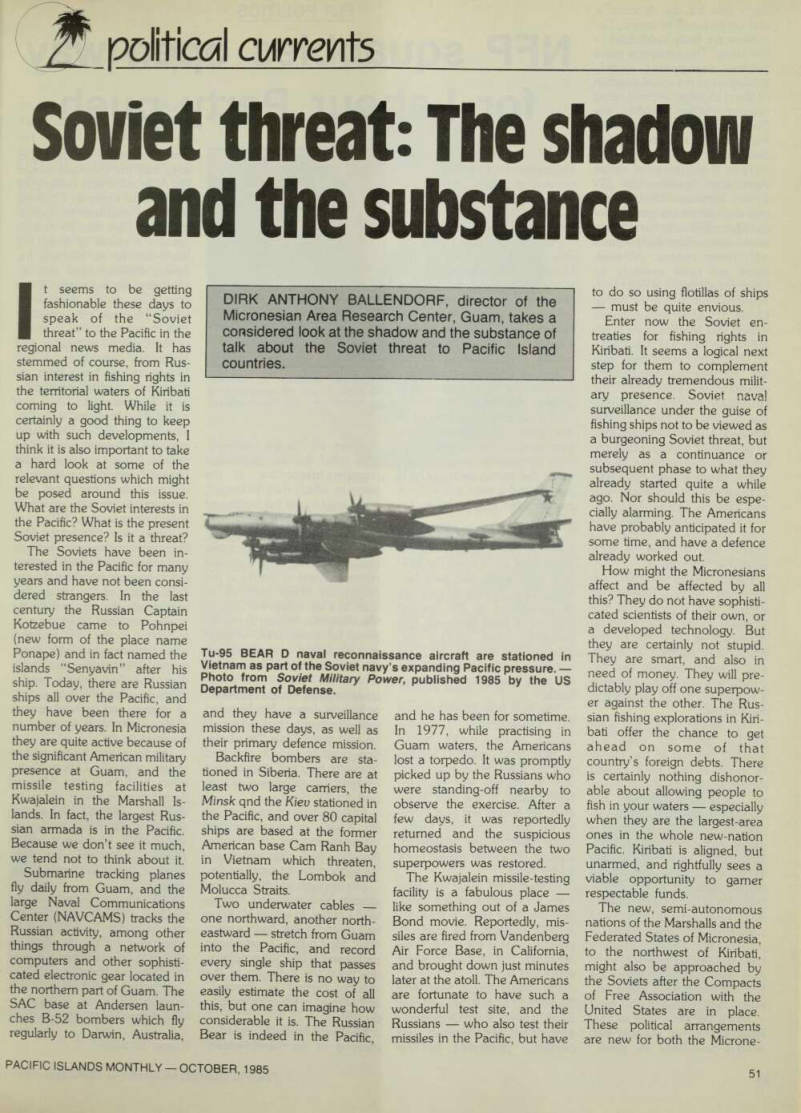
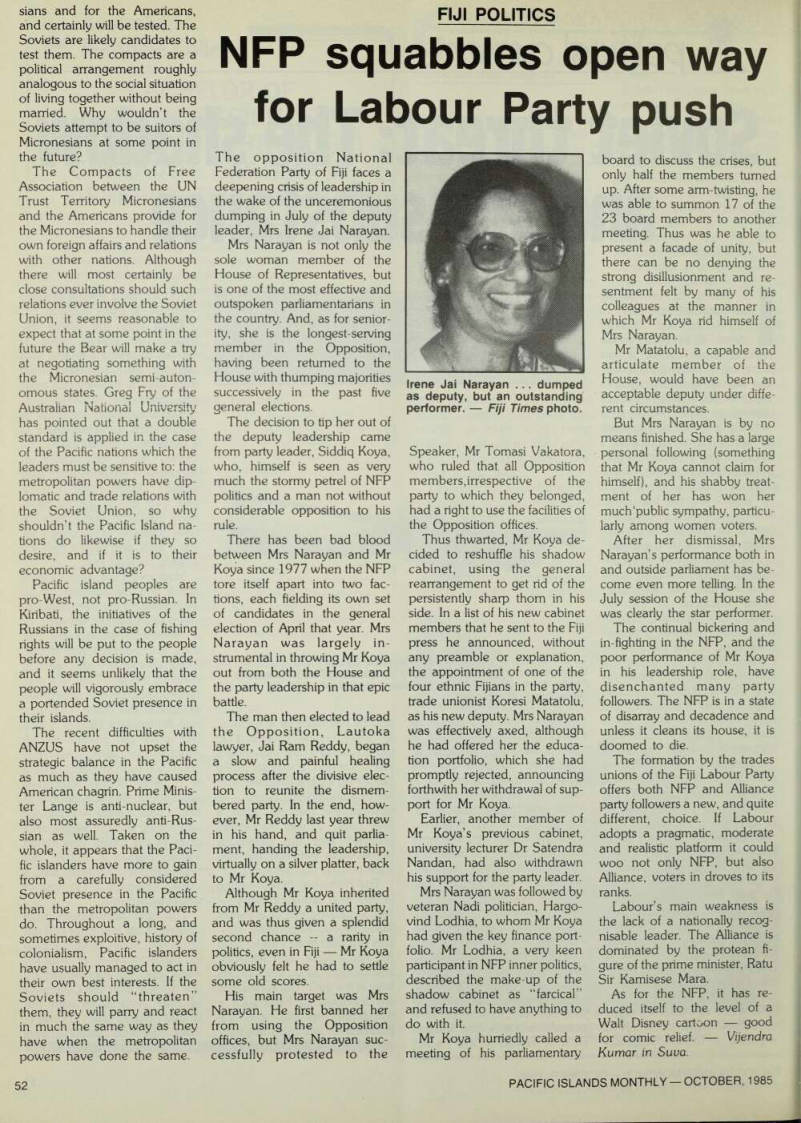
political currents
Soviet threat: The shadow and the substance
It seems to be getting fashionable these days to speak of the “Soviet threat” to the Pacific in the regional news media. It has stemmed of course, from Rus sian interest in fishing rights in the territorial waters of Kiribati coming to light. While it is certainly a good thing to keep up with such developments, I think it is also important to take a hard look at some of the relevant questions which might be posed around this issue.
What are the Soviet interests in the Pacific? What is the present Soviet presence? Is it a threat?
The Soviets have been in terested in the Pacific for many years and have not been consi dered strangers. In the last century the Russian Captain Kotzebue came to Pohnpei (new form of the place name Ponape) and in fact named the islands “Senyavin” after his ship. Today, there are Russian ships all over the Pacific, and they have been there for a number of years. In Micronesia they are quite active because of the significant American military presence at Guam, and the missile testing facilities at Kwajalein in the Marshall Is lands. In fact, the largest Rus sian armada is in the Pacific.
Because we don’t see it much, we tend not to think about it.
Submarine tracking planes fly daily from Guam, and the large Naval Communications Center (NAVCAMS) tracks the Russian activity, among other things through a network of computers and other sophisti cated electronic gear located in the northern part of Guam. The SAC base at Andersen laun ches B-52 bombers which fly regularly to Darwin, Australia,
DIRK ANTHONY BALLENDORF, director of the Micronesian Area Research Center, Guam, takes a considered look at the shadow and the substance of talk about the Soviet threat to Pacific Island countries.
and they have a surveillance mission these days, as well as their primary defence mission.
Backfire bombers are sta tioned in Siberia. There are at least two large carriers, the Minsk qnd the Kiev stationed in the Pacific, and over 80 capital ships are based at the former American base Cam Ranh Bay in Vietnam which threaten, potentially, the Lombok and Molucca Straits.
Two underwater cables one northward, another north eastward stretch from Guam into the Pacific, and record every single ship that passes over them. There is no way to easily estimate the cost of all this, but one can imagine how considerable it is. The Russian Bear is indeed in the Pacific,
and he has been for sometime.
In 1977, while practising in Guam waters, the Americans lost a torpedo. It was promptly picked up by the Russians who were standing-off nearby to observe the exercise. After a few days, it was reportedly returned and the suspicious homeostasis between the two superpowers was restored.
The Kwajalein missile-testing facility is a fabulous place like something out of a James Bond movie. Reportedly, mis siles are fired from Vandenberg Air Force Base, in California, and brought down just minutes later at the atoll. The Americans are fortunate to have such a wonderful test site, and the Russians who also test their missiles in the Pacific, but have
to do so using flotillas of ships must be quite envious.
Enter now the Soviet en treaties for fishing rights in Kiribati. It seems a logical next step for them to complement their already tremendous milit ary presence. Soviet naval surveillance under the guise of fishing ships not to be viewed as a burgeoning Soviet threat, but merely as a continuance or subsequent phase to what they already started quite a while ago. Nor should this be espe cially alarming. The Americans have probably anticipated it for some time, and have a defence already worked out.
How might the Micronesians affect and be affected by all this? They do not have sophisti cated scientists of their own, or a developed technology. But they are certainly not stupid.
They are smart, and also in need of money. They will pre dictably play off one superpow er against the other. The Rus sian fishing explorations in Kiri bati offer the chance to get ahead on some of that country’s foreign debts. There is certainly nothing dishonor able about allowing people to fish in your waters especially when they are the largest-area ones in the whole new-nation Pacific. Kiribati is aligned, but unarmed, and rightfully sees a viable opportunity to gamer respectable funds.
The new, semi-autonomous nations of the Marshalls and the Federated States of Micronesia, to the northwest of Kiribati, might also be approached by the Soviets after the Compacts of Free Association with the United States are in place.
These political arrangements are new for both the Microne
Tu-95 BEAR D naval reconnaissance aircraft are stationed in Vietnam as part of the Soviet navy’s expanding Pacific pressure.- Photo from Soviet Military Power, published 1985 by the US Department of Defense.
sians and for the Americans, and certainly will be tested. The Soviets are likely candidates to test them. The compacts are a political arrangement roughly analogous to the social situation of living together without being married. Why wouldn’t the Soviets attempt to be suitors of Micronesians at some point in the future?
The Compacts of Free Association between the UN Trust Territory Micronesians and the Americans provide for the Micronesians to handle their own foreign affairs and relations with other nations. Although there will most certainly be close consultations should such relations ever involve the Soviet Union, it seems reasonable to expect that at some point in the future the Bear will make a try at negotiating something with the Micronesian semi-auton omous states. Greg Fry of the Australian National University has pointed out that a double standard is applied in the case of the Pacific nations which the leaders must be sensitive to; the metropolitan powers have dip lomatic and trade relations with the Soviet Union, so why shouldn’t the Pacific Island na tions do likewise if they so desire, and if it is to their economic advantage?
Pacific island peoples are pro-West, not pro-Russian. In Kiribati, the initiatives of the Russians in the case of fishing rights will be put to the people before any decision is made, and it seems unlikely that the people will vigorously embrace a portended Soviet presence in their islands.
The recent difficulties with ANZUS have not upset the strategic balance in the Pacific as much as they have caused American chagrin. Prime Minis ter Lange is anti-nuclear, but also most assuredly anti-Rus sian as well. Taken on the whole, it appears that the Paci fic islanders have more to gain from a carefully considered Soviet presence in the Pacific than the metropolitan powers do. Throughout a long, and sometimes exploitive, history of colonialism, Pacific islanders have usually managed to act in their own best interests. If the Soviets should “threaten” them, they will parry and react in much the same way as they have when the metropolitan powers have done the same.
for Labour Party push
Fiji Politics
NFP squabbles open way for Labour Party push
The opposition National Federation Party of Fiji faces a deepening crisis of leadership in the wake of the unceremonious dumping in July of the deputy leader, Mrs Irene Jai Narayan.
Mrs Narayan is not only the sole woman member of the House of Representatives, but is one of the most effective and outspoken parliamentarians in the country. And, as for senior ity, she is the longest-serving member in the Opposition, having been returned to the House with thumping majorities successively in the past five general elections.
The decision to tip her out of the deputy leadership came from party leader, Siddiq Koya, who, himself is seen as very much the stormy petrel of NFP politics and a man not without considerable opposition to his rule.
There has been bad blood between Mrs Narayan and Mr Koya since 1977 when the NFP tore itself apart into two fac tions, each fielding its own set of candidates in the general election of April that year. Mrs Narayan was largely in strumental in throwing Mr Koya out from both the House and the party leadership in that epic battle.
The man then elected to lead the Opposition, Lautoka lawyer, Jai Ram Reddy, began a slow and painful healing process after the divisive elec tion to reunite the dismem bered party. In the end, how ever, Mr Reddy last year threw in his hand, and quit parlia ment, handing the leadership, virtually on a silver platter, back to Mr Koya.
Although Mr Koya inherited from Mr Reddy a united party, and was thus given a splendid second chance - a rarity in politics, even in Fiji Mr Koya obviously felt he had to settle some old scores.
His main target was Mrs Narayan. He first banned her from using the Opposition offices, but Mrs Narayan suc cessfully protested to the
Speaker, Mr Tomasi Vakatora, who ruled that all Opposition members,irrespective of the party to which they belonged, had a right to use the facilities of the Opposition offices.
Thus thwarted, Mr Koya de cided to reshuffle his shadow cabinet, using the general rearrangement to get rid of the persistently sharp thorn in his side. In a list of his new cabinet members that he sent to the Fiji press he announced, without any preamble or explanation, the appointment of one of the four ethnic Fijians in the party, trade unionist Koresi Matatolu, as his new deputy. Mrs Narayan was effectively axed, although he had offered her the educa tion portfolio, which she had promptly rejected, announcing forthwith her withdrawal of sup port for Mr Koya.
Earlier, another member of Mr Koya’s previous cabinet, university lecturer Dr Satendra Nandan, had also withdrawn his support for the party leader.
Mrs Narayan was followed by veteran Nadi politician, Hargo vind Lodhia, to whom Mr Koya had given the key finance port folio. Mr Lodhia, a very keen participant in NFP inner politics, described the make-up of the shadow cabinet as “farcical” and refused to have anything to do with it.
Mr Koya hurriedly called a meeting of his parliamentary
board to discuss the crises, but only half the members turned up. After some arm-twisting, he was able to summon 17 of the 23 board members to another meeting. Thus was he able to present a facade of unity, but there can be no denying the strong disillusionment and re sentment felt by many of his colleagues at the manner in which Mr Koya rid himself of Mrs Narayan.
Mr Matatolu, a capable and articulate member of the House, would have been an acceptable deputy under diffe rent circumstances.
But Mrs Narayan is by no means finished. She has a large personal following (something that Mr Koya cannot claim for himself), and his shabby treat ment of her has won her much‘public sympathy, particu larly among women voters.
After her dismissal, Mrs Narayan’s performance both in and outside parliament has be come even more telling. In the July session of the House she was clearly the star performer.
The continual bickering and in-fighting in the NFP, and the poor performance of Mr Koya in his leadership role, have disenchanted many party followers. The NFP is in a state of disarray and decadence and unless it cleans its house, it is doomed to die.
The formation by the trades unions of the Fiji Labour Party offers both NFP and Alliance party followers a new, and quite different, choice. If Labour adopts a pragmatic, moderate and realistic platform it could woo not only NFP, but also Alliance, voters in droves to its ranks.
Labour’s main weakness is the lack of a nationally recog nisable leader. The Alliance is dominated by the protean fi gure of the prime minister, Ratu Sir Kamisese Mara.
As for the NFP, it has re duced itself to the level of a Walt Disney cartoon good for comic relief. Vijendra Kumar in Suva.
Irene Jai Narayan ... dumped as deputy, but an outstanding performer. Fiji Times photo.
people
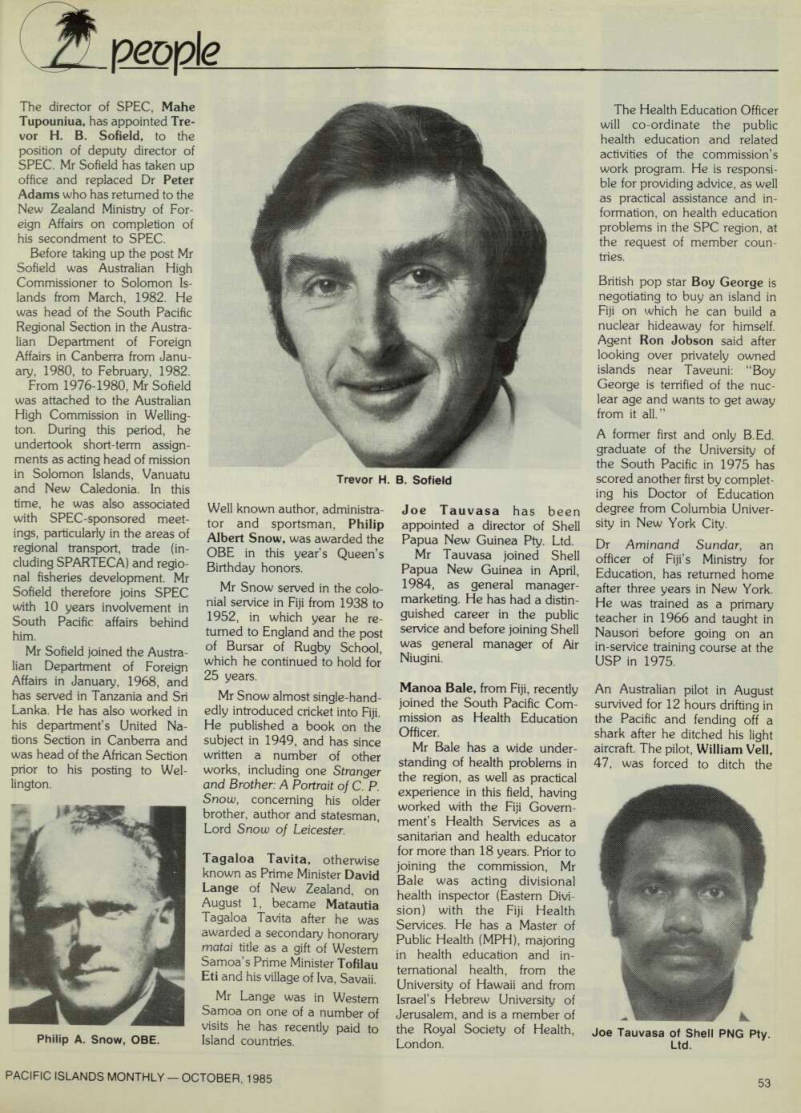

The director of SPEC, Mahe Tupouniua, has appointed Tre vor H. B. Sofield, to the position of deputy director of SPEC. Mr Sofield has taken up office and replaced Dr Peter Adams who has returned to the New Zealand Ministry of For eign Affairs on completion of his secondment to SPEC.
Before taking up the post Mr Sofield was Australian High Commissioner to Solomon Is lands from March, 1982. He was head of the South Pacific Regional Section in the Austra lian Department of Foreign Affairs in Canberra from Janu ary, 1980, to February, 1982.
From 1976-1980, Mr Sofield was attached to the Australian High Commission in Welling ton. During this period, he undertook short-term assign ments as acting head of mission in Solomon Islands, Vanuatu and New Caledonia. In this time, he was also associated with SPEC-sponsored meet ings, particularly in the areas of regional transport, trade (in cluding SPARTECA) and regio nal fisheries development. Mr Sofield therefore joins SPEC with 10 years involvement in South Pacific affairs behind him.
Mr Sofield joined the Austra lian Department of Foreign Affairs in January, 1968, and has served in Tanzania and Sri Lanka. He has also worked in his department’s United Na tions Section in Canberra and was head of the African Section prior to his posting to Wel lington.
Well known author, administra tor and sportsman, Philip Albert Snow, was awarded the OBE in this year’s Queen’s Birthday honors.
Mr Snow served in the colo nial service in Fiji from 1938 to 1952, in which year he re turned to England and the post of Bursar of Rugby School, which he continued to hold for 25 years.
Mr Snow almost single-hand edly introduced cricket into Fiji.
He published a book on the subject in 1949, and has since written a number of other works, including one Stranger and Brother: A Portrait ojC. P.
Snow, concerning his older brother, author and statesman, Lord Snow of Leicester.
Tagaloa Tavita, otherwise known as Prime Minister David Lange of New Zealand, on August 1, became Matautia Tagaloa Tavita after he was awarded a secondary honorary matai title as a gift of Western Samoa’s Prime Minister Tofilau Eti and his village of Iva, Savaii.
Mr Lange was in Western Samoa on one of a number of visits he has recently paid to Island countries.
Joe Tauvasa has been appointed a director of Shell Papua New Guinea Pty. Ltd.
Mr Tauvasa joined Shell Papua New Guinea in April, 1984, as general manager marketing. He has had a distin guished career in the public service and before joining Shell was general manager of Air Niugini.
Manoa Bale, from Fiji, recently joined the South Pacific Com mission as Health Education Officer.
Mr Bale has a wide under standing of health problems in the region, as well as practical experience in this field, having worked with the Fiji Govern ment’s Health Services as a sanitarian and health educator for more than 18 years. Prior to joining the commission, Mr Bale was acting divisional health inspector (Eastern Divi sion) with the Fiji Health Services. He has a Master of Public Health (MPH), majoring in health education and in ternational health, from the University of Hawaii and from Israel’s Hebrew University of Jerusalem, and is a member of the Royal Society of Health, London.
The Health Education Officer will co-ordinate the public health education and related activities of the commission’s work program. He is responsi ble for providing advice, as well as practical assistance and in formation, on health education problems in the SPC region, at the request of member coun tries.
British pop star Boy George is negotiating to buy an island in Fiji on which he can build a nuclear hideaway for himself.
Agent Ron Jobson said after looking over privately owned islands near Taveuni: “Boy George is terrified of the nuc lear age and wants to get away from it all.”
A former first and only B.Ed. graduate of the University of the South Pacific in 1975 has scored another first by complet ing his Doctor of Education degree from Columbia Univer sity in New York City.
Dr Aminand Sundar, an officer of Fiji’s Ministry for Education, has returned home after three years in New York.
He was trained as a primary teacher in 1966 and taught in Nausori before going on an in-service training course at the USP in 1975.
An Australian pilot in August survived for 12 hours drifting in the Pacific and fending off a shark after he ditched his light aircraft. The pilot, William Veil, 47, was forced to ditch the
Philip A. Snow, OBE.
Trevor H. B. Sofield
Joe Tauvasa of Shell PNG Pty.
Ltd.
single-engined Cessna 182 he was ferrying from the United States to Australia when it de veloped a fuel line problem just before dawn on August 17 about 450 kilometres northeast of Hawaii. After what he de scribed as “a nice landing” he inflated a life raft but was unable to scramble into it. By the time rescuers found him, the swell and current had taken him four kilometres away from the raft and the partly sub merged plane. He told rescuers that he had kicked at an attack
ing shark which stayed with him for about three hours during the ordeal. A search was launched when Mr Veil failed to make a scheduled radio check. An emergency locator radio signal was later picked up by a search and-rescue satellite. He was taken, unharmed, to Hickam air force base on Hawaii.
In Australia to pursue a career as a male model is Prince Soane Takaniua, grandson of the Lavelua (King) of Wallis Island in the French territory of Wallis and Futuna.
In 1961 tourism in Fiji was launched with the inaugural Fiji Tourism Convention. That same year Cherie Whiteside decided that “there was nothing in Fiji with a distinctive Fiji label” so she launched her own particular contribution to tour ism, the well known fashion label, Tiki Togs.
In the beginning there was just Cherie, a keen but amateur screen printer and home dressmaker, her mother, and one seamstress. Today Tiki Togs employs 80 people, has two factories in Vatuwaqa, and
six retail shops. Cherie and her daughter Tanya are the design ers, working closely with two artists, Benny Stowers and Richard Morris. As a team they work through a design from fabric selection to color co-ordination of screen print; a small, new collection will take approximately three weeks from concept to creation.
This year has been the Year of the Cyclone in Fiji. Eric, Nigel, Gavin and Hina have all attempted to redesign the Fiji landscape. Sadly their efforts have had a drastic effect upon an economy heavily dependent on cane crops and tourists.
Neither of these responds favorably to cyclonic upheaval; many people lose their jobs when these industries falter in the aftermath. Tiki Togs is proud of its record of maintain ing full employment of its staff during these trying times, a remarkable feat for an industry which, by Cherie Whiteside’s admission, is “totally reliant upon tourism”. For this reason there is a constant stream of people to their door seeking jobs.
Further expansion will be
possible if an export market can be established. Cherie’s son, Desmond, is currently working closely with SPARTECA to try to overcome various obstacles such as the quota systems. The Queensland resort area is seen as a possible market place, as is the U.S. west coast. If these can be successfully negotiated then Cherie envisages setting up a training program, particularly for younger women. The bene fits would be twofold ensur ing skilled seamstresses for the factory expansion, and provid ing initial employment and training for school leavers.
Tanya Whiteside and her ’B5 collection was the fifth whirl wind to hit Suva this year with a parade at the Suva Travelodge as part of the Fiji Tourism Convention in June. Her weeks of hard work from initial design through to co-ordination of the showing including dressing the models earned her the position of Fiji fashion’s first lady when the collection was received with admiration and enthusiasm by the 400 dele gates, wives and associates of the convention. Ngaire Douglas.
The Rev. Isikeli Hau’ofa of Ton ga, a long-serving missionary in Papua New Guinea, who recently returned to PNG for a final visit (PIM Aug, p 53) - PNG Post-Courier photo.
Advertisements & other items, pp. 54-55 (1 item)
Vacific
CONSTRUCTION EQUIPMENT CO
introducing the Dynamic new Range ot
Vibrating S Pneumatic Tyred Rollers
THE RANGE
• Pacific Self-Propelled Vibrating Rollers • Single and Double Drum Types • 1.5 tonne to 16 tonne • Pacific Self-Propelled Pneumatic Type Compactors • 3 Models 16. 21. 38 tonne Ballast Weights • Pacific Landfill and Sanitary Landfill Compactors • Pacific Pneumatic Earth Borers • Pacific Road Brooms • Pacific Railway Maintenance Vehicles
DISTRIBUTORS REQUIRED
THROUGHOUT THE PACIFIC
Construction Equipment Co. 24 Salisbury Road, Hornsby NSW 2077, Australia. Phone (02) 476 2666
SAL
tdfLiTSSE
REGULAR AS
CLOCKWORK
- WE SAIL!
T & o S' a: cc *2 Q Shipping is our business and we know that reaching markets on time is critical for exporters.
Pacific Forum won’t let you down. That’s why we have become Pacific’s No. 1 trade-link servicing more ports*, more often.
We sail on schedule which means you can rely on your cargo getting there on time.
Modern container vessels with roll on/roll off capability will ensure fast and efficient handling of your cargo.
Pacific Forum is your Pacific shipping service and regular as clockwork we sail!
Transhipment to or from anywhere in the world.
AMERICAN SAMOA:
Polynesian Shipping Services Inc., Pago Pago.
VANUATU:
Vila Agents Ltd., Vila.
PACIFIC
FORUMuhb
JjSiam cudA* e^cp^esue^tce*.
AUSTRALIA:
Union-Bulksbips, Brisbane, Melbourne and Sydney.
WESTERN SAMOA:
Pacific Forum Line Agencies.
Apia.
NEW ZEALAND:
Union Maritime Services Ltd., Auckland.
The Shipping Corporation of New Zealand Ltd., Auckland, Napier and Lyttelton.
PAPUA NEW GUINEA:
Steamships Trading Co Ltd..
Lae and Port Moresby.
TONGA:
Union Maritime Services Ltd., Nuku’alofa.
FIJI:
Union Maritime Services Ltd., Lautoka and Suva.
SOLOMON ISLANDS
Sullivans Ltd., Honiara.
NEW CALEDONIA:
5.A.T.0., Noumea.
Pacific stamp box
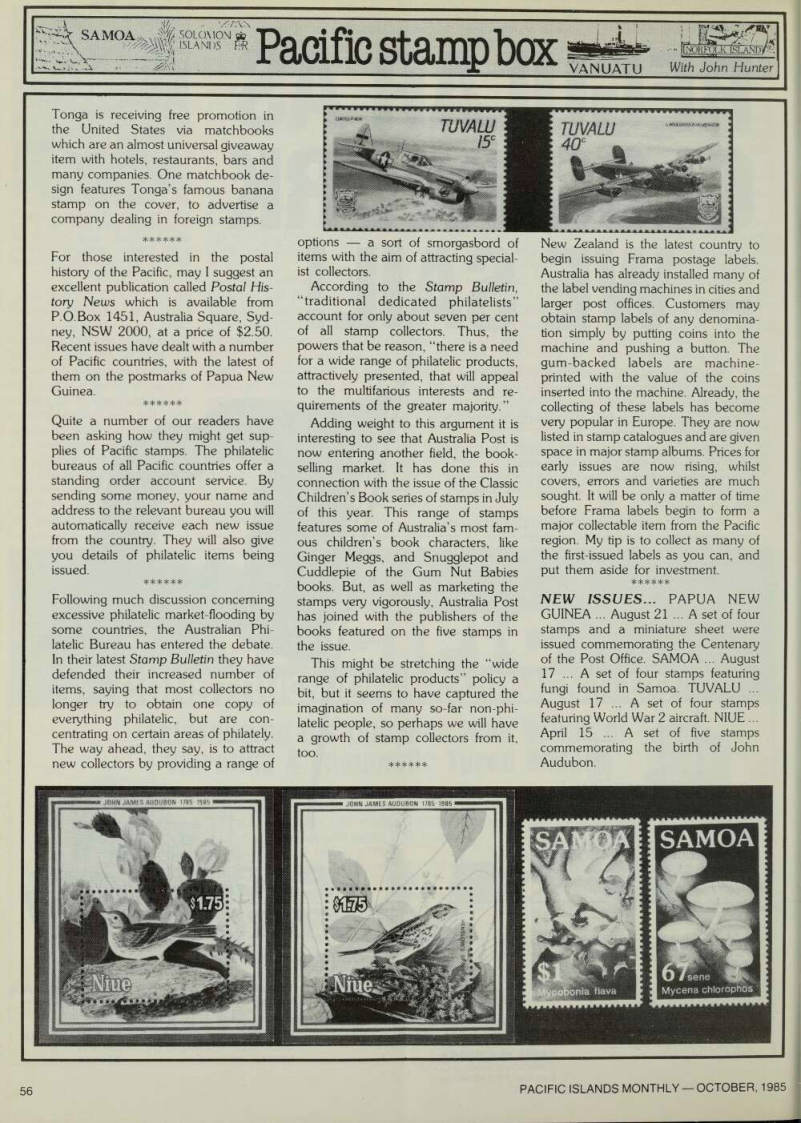
Tonga is receiving free promotion in the United States via matchbooks which are an almost universal giveaway item with hotels, restaurants, bars and many companies. One matchbook de sign features Tonga’s famous banana stamp on the cover, to advertise a company dealing in foreign stamps. *** For those interested in the postal history of the Pacific, may I suggest an excellent publication called Postal His tory News which is available from P.0.80x 1451, Australia Square, Syd ney, NSW 2000, at a price of $2.50.
Recent issues have dealt with a number of Pacific countries, with the latest of them on the postmarks of Papua New Guinea. *** Quite a number of our readers have been asking how they might get sup plies of Pacific stamps. The philatelic bureaus of all Pacific countries offer a standing order account service. By sending some money, your name and address to the relevant bureau you will automatically receive each new issue from the country. They will also give you details of philatelic items being issued.
Jfc 5|C 5jC jjC Following much discussion concerning excessive philatelic market-flooding by some countries, the Australian Phi latelic Bureau has entered the debate.
In their latest Stamp Bulletin they have defended their increased number of items, saying that most collectors no longer try to obtain one copy of everything philatelic, but are con centrating on certain areas of philately.
The way ahead, they say, is to attract new collectors by providing a range of
options a sort of smorgasbord of items with the aim of attracting special ist collectors.
According to the Stamp Bulletin , “traditional dedicated philatelists” account for only about seven per cent of all stamp collectors. Thus, the powers that be reason, “there is a need for a wide range of philatelic products, attractively presented, that will appeal to the multifarious interests and re quirements of the greater majority.”
Adding weight to this argument it is interesting to see that Australia Post is now entering another field, the book selling market. It has done this in connection with the issue of the Classic Children’s Book series of stamps in July of this year. This range of stamps features some of Australia’s most fam ous children’s book characters, like Ginger Meggs, and Snugglepot and Cuddlepie of the Gum Nut Babies books. But, as well as marketing the stamps very vigorously, Australia Post has joined with the publishers of the books featured on the five stamps in the issue.
This might be stretching the “wide range of philatelic products” policy a bit, but it seems to have captured the imagination of many so-far non-phi latelic people, so perhaps we will have a growth of stamp collectors from it, too. ***
New Zealand is the latest country to begin issuing Frama postage labels.
Australia has already installed many of the label vending machines in cities and larger post offices. Customers may obtain stamp labels of any denomina tion simply by putting coins into the machine and pushing a button. The gum-backed labels are machine printed with the value of the coins inserted into the machine. Already, the collecting of these labels has become very popular in Europe. They are now listed in stamp catalogues and are given space in major stamp albums. Prices for early issues are now rising, whilst covers, errors and varieties are much sought. It will be only a matter of time before Frama labels begin to form a major collectable item from the Pacific region. My tip is to collect as many of the first-issued labels as you can, and put them aside for investment. ***
New Issues... Papua New
GUINEA ... August 21 ... A set of four stamps and a miniature sheet were issued commemorating the Centenary of the Post Office. SAMOA ... August 17 ... A set of four stamps featuring fungi found in Samoa. TUVALU ...
August 17 ... A set of four stamps featuring World War 2 aircraft. NIUE ...
April 15 ... A set of five stamps commemorating the birth of John Audubon.
from the islands press
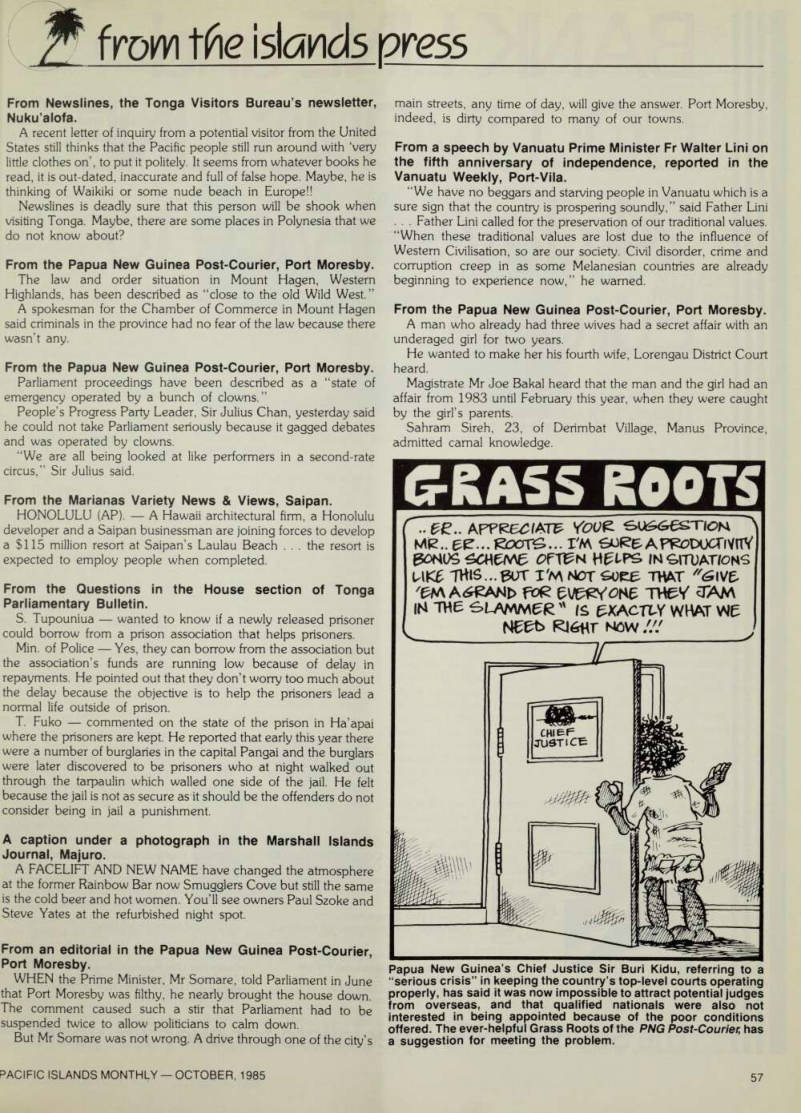
From Newslines, the Tonga Visitors Bureau’s newsletter, Nukualofa.
A recent letter of inquiry from a potential visitor from the United States still thinks that the Pacific people still run around with ‘very little clothes on’, to put it politely. It seems from whatever books he read, it is out-dated, inaccurate and full of false hope. Maybe, he is thinking of Waikiki or some nude beach in Europe!!
Newslines is deadly sure that this person will be shook when visiting Tonga. Maybe, there are some places in Polynesia that we do not know about?
From the Papua New Guinea Post-Courier, Port Moresby.
The law and order situation in Mount Hagen, Western Highlands, has been described as “close to the old Wild West.”
A spokesman for the Chamber of Commerce in Mount Hagen said criminals in the province had no fear of the law because there wasn’t any.
From the Papua New Guinea Post-Courier, Port Moresby.
Parliament proceedings have been described as a “state of emergency operated by a bunch of clowns.”
People’s Progress Party Leader, Sir Julius Chan, yesterday said he could not take Parliament seriously because it gagged debates and was operated by clowns.
“We are all being looked at like performers in a second-rate circus,” Sir Julius said.
From the Marianas Variety News & Views, Saipan.
HONOLULU (AP). A Hawaii architectural firm, a Honolulu developer and a Saipan businessman are joining forces to develop a $ll5 million resort at Saipan’s Laulau Beach ... the resort is expected to employ people when completed.
From the Questions in the House section of Tonga Parliamentary Bulletin.
S. Tupouniua wanted to know if a newly released prisoner could borrow from a prison association that helps prisoners.
Min. of Police Yes, they can borrow from the association but the association’s funds are running low because of delay in repayments. He pointed out that they don’t worry too much about the delay because the objective is to help the prisoners lead a normal life outside of prison.
T. Fuko commented on the state of the prison in Ha’apai where the prisoners are kept. He reported that early this year there were a number of burglaries in the capital Pangai and the burglars were later discovered to be prisoners who at night walked out through the tarpaulin which walled one side of the jail. He felt because the jail is not as secure as it should be the offenders do not consider being in jail a punishment.
A caption under a photograph in the Marshall Islands Journal, Majuro.
A FACELIFT AND NEW NAME have changed the atmosphere at the former Rainbow Bar now Smugglers Cove but still the same is the cold beer and hot women. You’ll see owners Paul Szoke and Steve Yates at the refurbished night spot.
From an editorial in the Papua New Guinea Post-Courier, Port Moresby.
WHEN the Prime Minister, Mr Somare, told Parliament in June that Port Moresby was filthy, he nearly brought the house down.
The comment caused such a stir that Parliament had to be suspended twice to allow politicians to calm down.
But Mr Somare was not wrong. A drive through one of the city’s
main streets, any time of day, will give the answer. Port Moresby, indeed, is dirty compared to many of our towns.
From a speech by Vanuatu Prime Minister Fr Walter Lini on the fifth anniversary of independence, reported in the Vanuatu Weekly, Port-Vila.
“We have no beggars and starving people in Vanuatu which is a sure sign that the country is prospering soundly,” said Father Lini . . . Father Lini called for the preservation of our traditional values.
“When these traditional values are lost due to the influence of Western Civilisation, so are our society. Civil disorder, crime and corruption creep in as some Melanesian countries are already beginning to experience now,” he warned.
From the Papua New Guinea Post-Courier, Port Moresby.
A man who already had three wives had a secret affair with an underaged girl for two years.
He wanted to make her his fourth wife, Lorengau District Court heard.
Magistrate Mr Joe Bakal heard that the man and the girl had an affair from 1983 until February this year, when they were caught by the girl’s parents.
Sahram Sireh, 23, of Derimbat Village, Manus Province, admitted carnal knowledge.
Papua New Guinea’s Chief Justice Sir Buri Kidu, referring to a “serious crisis” in keeping the country’s top-level courts operating properly, has said it was now impossible to attract potential judges from overseas, and that qualified nationals were also not interested in being appointed because of the poor conditions offered. The ever-helpful Grass Roots of the PNG Post-Courier, has a suggestion for meeting the problem.
Advertisements & other items, pp. 57-58 (2 items)
57
ACIFIC ISLANDS MONTHLY OCTOBER, 1985
Europe.
BANK LINE and
COLUMBUS LINE
24 day service to
Europe.
Need we say more...
D G The Joint Service Partners offer facilities for shipment of: Containers (FCL/LCL) and Break-bulk Cargo plus reefer space and deeptanks for carriage of vegetable oils and other liquid bulk cargo.
Carriers also accept heavy lifts, overlength and cumbersome parcels.
Ports of Service: Loading: Papeete, Apia, Suva, Lautoka, Noumea, Port Vila, Santo, Honiara, Port Moresby, Lae, Madang, Kimbe, Rabaul, Kieta, Darwin. For: Rotterdam, Antwerp, Hamburg, Hull, Dunkirk, Le Havre.
Additional ports on enquiry.
Please contact our regional offices for further information: The Bank Line (Australasia) Pty Ltd Columbus Line Reederei GmbH Suite 801, 51 Pitt St, P.O. Box 1 667, Lae/Papua New Guinea.
Sydney, NSW, Australia 2000 Phone: 423466/423487/AH. 422481 Phone 27 2041 Telex 24063 Telex: Colline NE 441 71 The South Pacific Specialists for over 75 years
befits
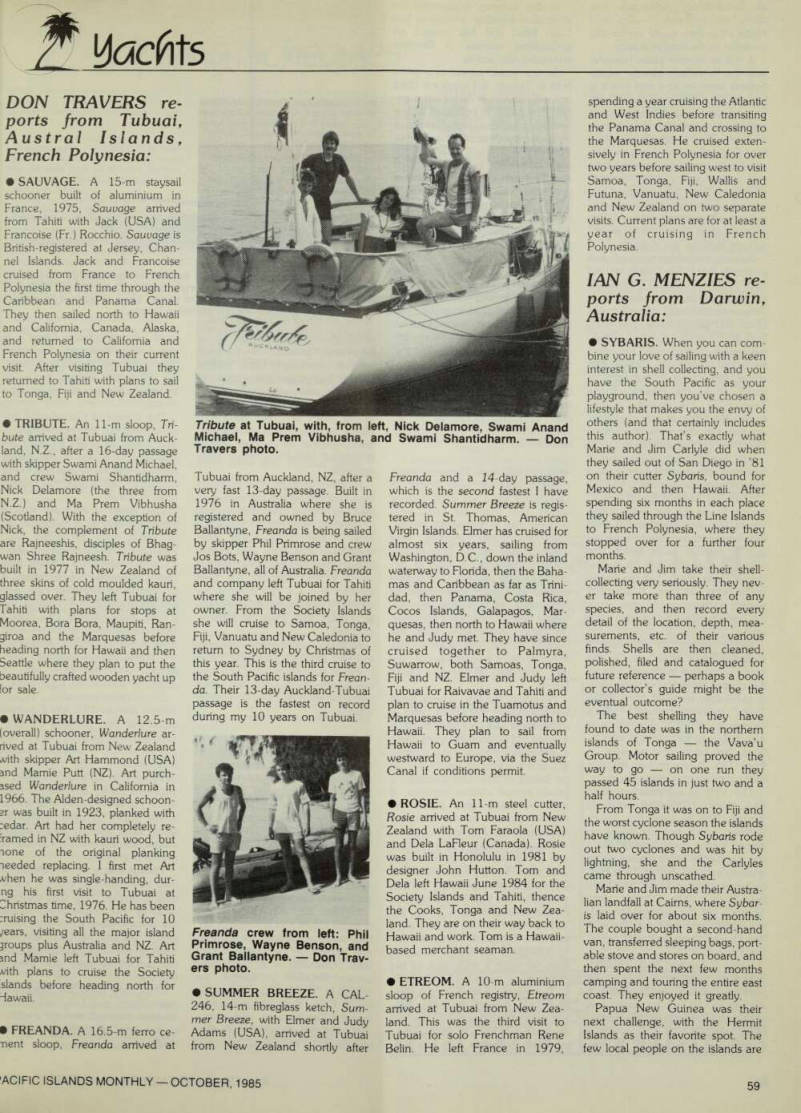
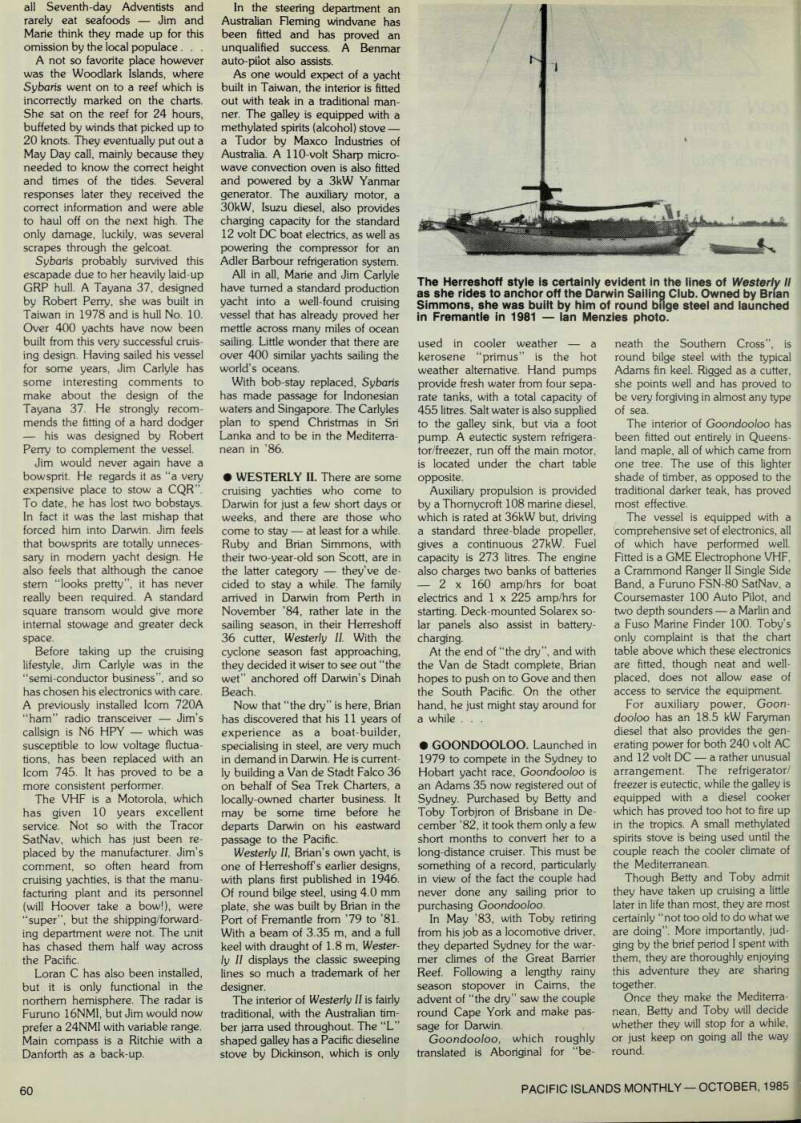
Don Travers Re
ports from Tubuai,
Austral Islands ,
French Polynesia:
• SAUVAGE. A 15-m staysail schooner built of aluminium in France, 1975, Sauuage arrived from Tahiti with Jack (USA) and Francoise (Fr.) Rocchio. Sauuage is British-registered at Jersey, Chan nel Islands. Jack and Francoise cruised from France to French Polynesia the first time through the Caribbean and Panama Canal.
They then sailed north to Hawaii and California, Canada, Alaska, and returned to California and French Polynesia on their current visit. After visiting Tubuai they returned to Tahiti with plans to sail to Tonga, Fiji and New Zealand. • TRIBUTE. An 11-m sloop, Tri bute arrived at Tubuai from Auck land, N.Z., after a 16-day passage with skipper Swami Anand Michael, and crew Swami Shantidharm, Nick Delamore (the three from N.Z.) and Ma Prem Vibhusha (Scotland). With the exception of Nick, the complement of Tribute are Rajneeshis, disciples of Bhag wan Shree Rajneesh. Tribute was built in 1977 in New Zealand of three skins of cold moulded kauri, glassed over. They left Tubuai for Tahiti with plans for stops at Moorea, Bora Bora, Maupiti, Ran giroa and the Marquesas before heading north for Hawaii and then Seattle where they plan to put the beautifully crafted wooden yacht up for sale.
• Wanderlure. A 12.5-M
(overall) schooner, Wanderlure ar rived at Tubuai from New Zealand A/ith skipper Art Hammond (USA) and Mamie Putt (NZ). Art purch ased Wanderlure in California in 1966. The Alden-designed schoon er was built in 1923, planked with :edar. Art had her completely re named in NZ with kauri wood, but aone of the original planking aeeded replacing. I first met Art A/hen he was single-handing, dur ng his first visit to Tubuai at Christmas time, 1976. He has been :ruising the South Pacific for 10 /ears, visiting all the major island groups plus Australia and NZ. Art and Mamie left Tubuai for Tahiti vith plans to cruise the Society slands before heading north for dawaii. • FREANDA. A 16.5-m ferro ce nent sloop, Freanda arrived at
Tubuai from Auckland, NZ, after a very fast 13-day passage. Built in 1976 in Australia where she is registered and owned by Bruce Ballantyne, Freanda is being sailed by skipper Phil Primrose and crew Jos Bots, Wayne Benson and Grant Ballantyne, all of Australia. Freanda and company left Tubuai for Tahiti where she will be joined by her owner. From the Society Islands she will cruise to Samoa, Tonga, Fiji, Vanuatu and New Caledonia to return to Sydney by Christmas of this year. This is the third cruise to the South Pacific islands for Frean da. Their 13-day Auckland-Tubuai passage is the fastest on record during my 10 years on Tubuai.
• Summer Breeze. A Cal
246, 14-m fibreglass ketch, Sum mer Breeze, with Elmer and Judy Adams (USA), arrived at Tubuai from New Zealand shortly after
Freanda and a 14- day passage, which is the second fastest 1 have recorded. Summer Breeze is regis tered in St. Thomas, American Virgin Islands. Elmer has cruised for almost six years, sailing from Washington, D.C., down the inland waterway to Florida, then the Baha mas and Caribbean as far as Trini dad, then Panama, Costa Rica, Cocos Islands, Galapagos, Mar quesas, then north to Hawaii where he and Judy met. They have since cruised together to Palmyra, Suwarrow, both Samoas, Tonga, Fiji and NZ. Elmer and Judy left Tubuai for Raivavae and Tahiti and plan to cruise in the Tuamotus and Marquesas before heading north to Hawaii. They plan to sail from Hawaii to Guam and eventually westward to Europe, via the Suez Canal if conditions permit. • ROSIE. An 11-m steel cutter, Rosie arrived at Tubuai from New Zealand with Tom Faraola (USA) and Dela LaFleur (Canada). Rosie was built in Honolulu in 1981 by designer John Hutton. Tom and Dela left Hawaii June 1984 for the Society Islands and Tahiti, thence the Cooks, Tonga and New Zea land. They are on their way back to Hawaii and work. Tom is a Hawaii based merchant seaman. • ETREOM. A 10-m aluminium sloop of French registry, Etreom arrived at Tubuai from New Zea land. This was the third visit to Tubuai for solo Frenchman Rene Belin. He left France in 1979,
spending a year cruising the Atlantic and West Indies before transiting the Panama Canal and crossing to the Marquesas. He cruised exten sively in French Polynesia for over two years before sailing west to visit Samoa, Tonga, Fiji, Wallis and Futuna, Vanuatu, New Caledonia and New Zealand on two separate visits. Current plans are for at least a year of cruising in French Polynesia.
Lan G. Menzies Re
ports from Darwin,
Australia:
• SYBARIS. When you can com bine your love of sailing with a keen interest in shell collecting, and you have the South Pacific as your playground, then you’ve chosen a lifestyle that makes you the envy of others (and that certainly includes this author). That’s exactly what Marie and Jim Carlyle did when they sailed out of San Diego in ’Bl on their cutter Sybaris, bound for Mexico and then Hawaii. After spending six months in each place they sailed through the Line Islands to French Polynesia, where they stopped over for a further four months.
Marie and Jim take their shell collecting very seriously. They nev er take more than three of any species, and then record every detail of the location, depth, mea surements, etc. of their various finds. Shells are then cleaned, polished, filed and catalogued for future reference perhaps a book or collector’s guide might be the eventual outcome?
The best shelling they have found to date was in the northern islands of Tonga the Vava’u Group. Motor sailing proved the way to go on one run they passed 45 islands in just two and a half hours.
From Tonga it was on to Fiji and the worst cyclone season the islands have known. Though Sybaris rode out two cyclones and was hit by lightning, she and the Carlyles came through unscathed.
Marie and Jim made their Austra lian landfall at Cairns, where Sybar is laid over for about six months.
The couple bought a second-hand van, transferred sleeping bags, port able stove and stores on board, and then spent the next few months camping and touring the entire east coast. They enjoyed it greatly.
Papua New Guinea was their next challenge, with the Hermit Islands as their favorite spot. The few local people on the islands are
Tribute at Tubuai, with, from left, Nick Delamore, Swami Anand Michael, Ma Prem Vibhusha, and Swami Shantidharm. - Don Travers photo.
Freanda crew from left: Phil Primrose, Wayne Benson, and Grant Ballantyne. Don Trav ers photo.
all Seventh-day Adventists and rarely eat seafoods Jim and Marie think they made up for this omission by the local populace . . .
A not so favorite place however was the Woodlark Islands, where Sybaris went on to a reef which is incorrectly marked on the charts.
She sat on the reef for 24 hours, buffeted by winds that picked up to 20 knots. They eventually put out a May Day call, mainly because they needed to know the correct height and times of the tides. Several responses later they received the correct information and were able to haul off on the next high. The only damage, luckily, was several scrapes through the gelcoat.
Sybaris probably survived this escapade due to her heavily laid-up GRP hull. A Tayana 37, designed by Robert Perry, she was built in Taiwan in 1978 and is hull No. 10.
Over 400 yachts have now been built from this very successful cruis ing design. Having sailed his vessel for some years, Jim Carlyle has some interesting comments to make about the design of the Tayana 37. He strongly recom mends the fitting of a hard dodger his was designed by Robert Perry to complement the vessel.
Jim would never again have a bowsprit. He regards it as “a very expensive place to stow a CQR”.
To date, he has lost two bobstays.
In fact it was the last mishap that forced him into Darwin. Jim feels that bowsprits are totally unneces sary in modem yacht design. He also feels that although the canoe stem “looks pretty”, it has never really been required. A standard square transom would give more internal stowage and greater deck space.
Before taking up the cruising lifestyle, Jim Carlyle was in the “semi-conductor business”, and so has chosen his electronics with care.
A previously installed Icom 720 A “ham” radio transceiver Jim’s callsign is N 6 HPY which was susceptible to low voltage fluctua tions, has been replaced with an Icom 745. It has proved to be a more consistent performer.
The VHF is a Motorola, which has given 10 years excellent service. Not so with the Tracer SatNav, which has just been re placed by the manufacturer. Jim’s comment, so often heard from cruising yachties, is that the manu facturing plant and its personnel (will Hoover take a bow!), were “super”, but the shipping/forward ing department were not. The unit has chased them half way across the Pacific.
Loran C has also been installed, but it is only functional in the northern hemisphere. The radar is Furuno 16NMI, but Jim would now prefer a 24NMI with variable range.
Main compass is a Ritchie with a Danforth as a back-up.
In the steering department an Australian Fleming windvane has been fitted and has proved an unqualified success. A Benmar auto-pilot also assists.
As one would expect of a yacht built in Taiwan, the interior is fitted out with teak in a traditional man ner. The galley is equipped with a methylated spirits (alcohol) stove a Tudor by Maxco Industries of Australia. A 110-volt Sharp micro wave convection oven is also fitted and powered by a 3kW Yanmar generator. The auxiliary motor, a 30kW, Isuzu diesel, also provides charging capacity for the standard 12 volt DC boat electrics, as well as powering the compressor for an Adler Barbour refrigeration system.
All in all, Marie and Jim Carlyle have turned a standard production yacht into a well-found cruising vessel that has already proved her mettle across many miles of ocean sailing. Little wonder that there are over 400 similar yachts sailing the world’s oceans.
With bob-stay replaced, Sybaris has made passage for Indonesian waters and Singapore. The Carlyles plan to spend Christmas in Sri Lanka and to be in the Mediterra nean in ’B6. • WESTERLY 11. There are some cruising yachties who come to Darwin for just a few short days or weeks, and there are those who come to stay at least for a while.
Ruby and Brian Simmons, with their two-year-old son Scott, are in the latter category they’ve de cided to stay a while. The family arrived in Darwin from Perth in November ’B4, rather late in the sailing season, in their Herreshoff 36 cutter, Westerly 11. With the cyclone season fast approaching, they decided it wiser to see out “the wet” anchored off Darwin’s Dinah Beach.
Now that “the dry” is here, Brian has discovered that his 11 years of experience as a boat-builder, specialising in steel, are very much in demand in Darwin. He is current ly building a Van de Stadt Falco 36 on behalf of Sea Trek Charters, a locally-owned charter business. It may be some time before he departs Darwin on his eastward passage to the Pacific.
Westerly 11, Brian’s own yacht, is one of Herreshoff s earlier designs, with plans first published in 1946.
Of round bilge steel, using 4.0 mm plate, she was built by Brian in the Port of Fremantle from ’79 to ’Bl.
With a beam of 3.35 m, and a full keel with draught of 1.8 m, Wester ly II displays the classic sweeping lines so much a trademark of her designer.
The interior of Westerly II is fairly traditional, with the Australian tim ber jarra used throughout. The “L” shaped galley has a Pacific dieseline stove by Dickinson, which is only
used in cooler weather a kerosene “primus” is the hot weather alternative. Hand pumps provide fresh water from four sepa rate tanks, with a total capacity of 455 litres. Salt water is also supplied to the galley sink, but via a foot pump. A eutectic system refrigera tor/freezer, run off the main motor, is located under the chart table opposite.
Auxiliary propulsion is provided by a Thomycroft 108 marine diesel, which is rated at 36kW but, driving a standard three-blade propeller, gives a continuous 27kW. Fuel capacity is 273 litres. The engine also charges two banks of batteries 2 x 160 amp/hrs for boat electrics and 1 x 225 amp/hrs for starting. Deck-mounted Solarex so lar panels also assist in battery charging.
At the end of “the dry”, and with the Van de Stadt complete, Brian hopes to push on to Gove and then the South Pacific. On the other hand, he just might stay around for a while . . . • GOONDOOLOO. Launched in 1979 to compete in the Sydney to Hobart yacht race, Goondooloo is an Adams 35 now registered out of Sydney. Purchased by Betty and Toby Torbjron of Brisbane in De cember ’B2, it took them only a few short months to convert her to a long-distance cruiser. This must be something of a record, particularly in view of the fact the couple had never done any sailing prior to purchasing Goondooloo.
In May ’B3, with Toby retiring from his job as a locomotive driver, they departed Sydney for the war mer climes of the Great Barrier Reef. Following a lengthy rainy season stopover in Cairns, the advent of “the dry” saw the couple round Cape York and make pas sage for Darwin.
Goondooloo, which roughly translated is Aboriginal for “be
neath the Southern Cross”, is round bilge steel with the typical Adams fin keel. Rigged as a cutter, she points well and has proved to be very forgiving in almost any type of sea.
The interior of Goondooloo has been fitted out entirely in Queens land maple, all of which came from one tree. The use of this lighter shade of timber, as opposed to the traditional darker teak, has proved most effective.
The vessel is equipped with a comprehensive set of electronics, all of which have performed well.
Fitted is a GME Electrophone VHF, a Crammond Ranger II Single Side Band, a Furuno FSN-80 SatNav, a Coursemaster 100 Auto Pilot, and two depth sounders a Marlin and a Fuso Marine Finder 100. Toby’s only complaint is that the chart table above which these electronics are fitted, though neat and well placed, does not allow ease of access to service the equipment.
For auxiliary power, Goon dooloo has an 18.5 kW Faryman diesel that also provides the gen erating power for both 240 volt AC and 12 volt DC a rather unusual arrangement. The refrigerator/ freezer is eutectic, while the galley is equipped with a diesel cooker which has proved too hot to fire up in the tropics. A small methylated spirits stove is being used until the couple reach the cooler climate of the Mediterranean.
Though Betty and Toby admit they have taken up cruising a little later in life than most, they are most certainly “not too old to do what we are doing”. More importantly, jud ging by the brief period 1 spent with them, they are thoroughly enjoying this adventure they are sharing together.
Once they make the Mediterra nean, Betty and Toby will decide whether they will stop for a while, or just keep on going all the way round.
The Herreshoff style is certainly evident in the lines of Westerly // as she rides to anchor off the Darwin Sailing Club. Owned by Brian Simmons, she was built by him of round bilge steel and launched in Fremantle in 1981 - lan Menzies photo.
Advertisements & other items, p. 59 (1 item)
59
ACIFIC ISLANDS MONTHLY —OCTOBER, 1985
shipping schedules
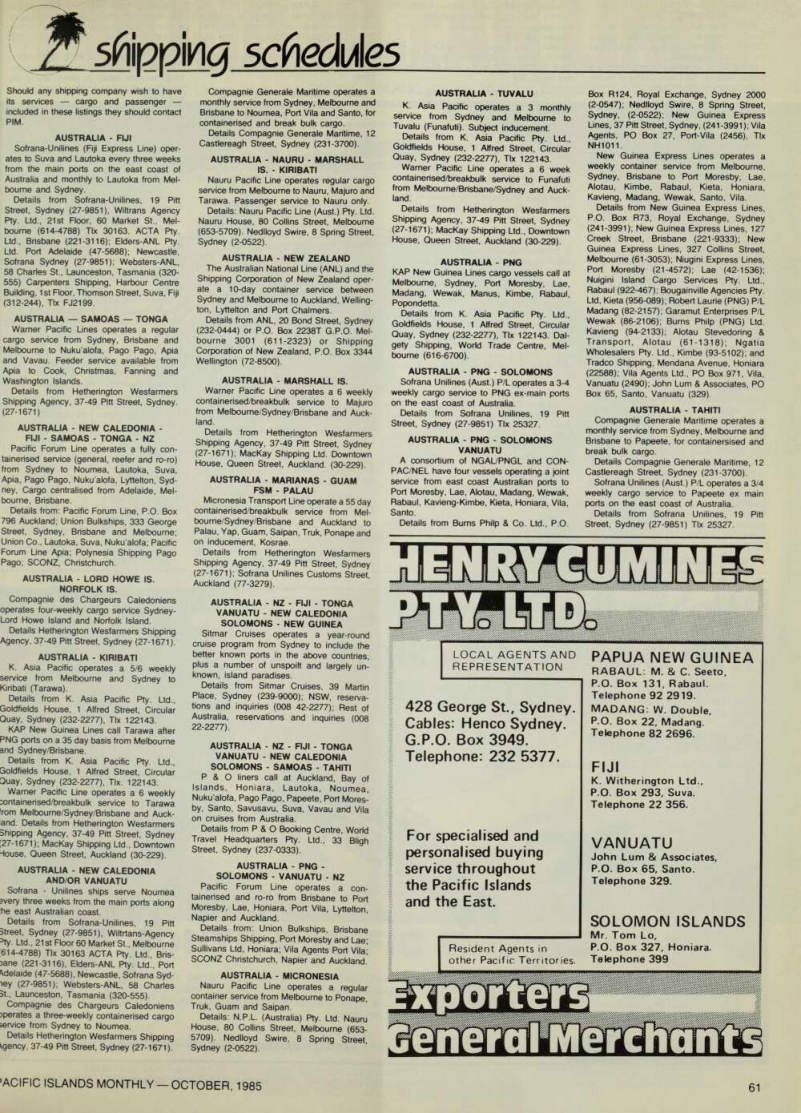
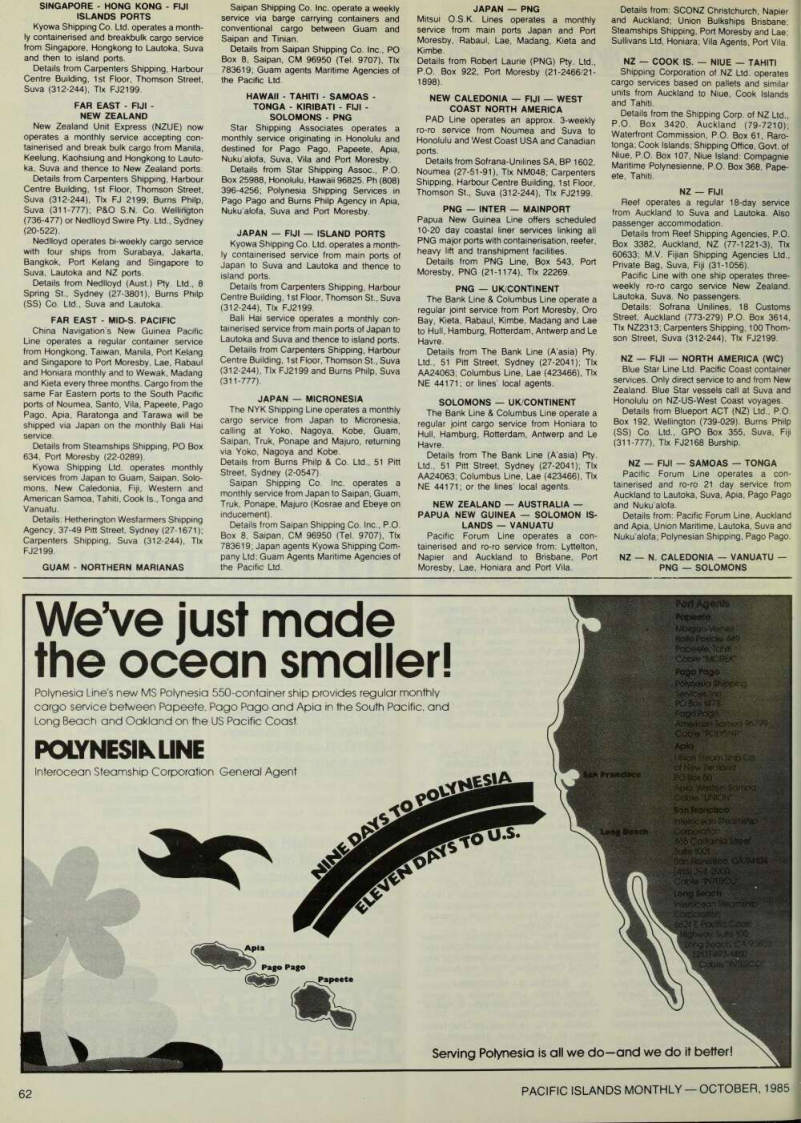
Should any shipping company wish to have its services cargo and passenger included in these listings they should contact
Pim.
Australia - Fiji
Sofrana-Unilines (Fiji Express Line) oper ates to Suva and Lautoka every three weeks from the main ports on the east coast of Australia and monthly to Lautoka from Mel bourne and Sydney.
Details from Sofrana-Unilines, 19 Pitt Street, Sydney (27-9851), Wiltrans Agency Pty. Ltd., 21st Floor, 60 Market St., Mel bourne (614-4788) Tlx 30163. ACTA Pty.
Ltd., Brisbane (221-3116); Elders-ANL Pty.
Ltd. Port Adelaide (47-5688); Newcastle, Sofrana Sydney (27-9851); Websters-ANL, 58 Charles St., Launceston, Tasmania (320- 555) Carpenters Shipping, Harbour Centre Building, Ist Floor, Thomson Street, Suva, Fiji (312-244), Tlx FJ2199.
Australia Samoas Tonga
Warner Pacific Lines operates a regular cargo service from Sydney, Brisbane and Melbourne to Nukualofa, Pago Pago, Apia and Vavau. Feeder service available from Apia to Cook, Christmas, Fanning and Washington Islands.
Details from Hetherington Wesfarmers Shipping Agency, 37-49 Pitt Street, Sydney. (27-1671)
Australia - New Caledonia -
FIJI - SAMOAS - TONGA - NZ Pacific Forum Line operates a fully con tainerised service (general, reefer and ro-ro) from Sydney to Noumea, Lautoka, Suva, Apia, Pago Pago, Nukualofa, Lyttelton, Syd ney, Cargo centralised from Adelaide, Mel bourne, Brisbane.
Details from: Pacific Forum Line, P.O. Box 796 Auckland; Union Bulkships, 333 George Street, Sydney. Brisbane and Melbourne; Union Co.. Lautoka, Suva, Nukualofa; Pacific Forum Line Apia; Polynesia Shipping Pago Pago; SCONZ, Christchurch.
Australia - Lord Howe Is.
Norfolk Is.
Compagnie des Chargeurs Caledoniens operates four-weekly cargo service Sydney- Lord Howe Island and Norfolk Island.
Details Hetherington Wesfarmers Shipping Agency, 37-49 Pitt Street, Sydney (27-1671).
Australia - Kiribati
K. Asia Pacific operates a 5/6 weekly service from Melbourne and Sydney to Kiribati (Tarawa).
Details from K. Asia Pacific Pty. Ltd., Goldfields House, 1 Alfred Street, Circular Quay, Sydney (232-2277), Tlx 122143.
KAP New Guinea Lines call Tarawa after PNG ports on a 35 day basis from Melbourne and Sydney/Brisbane.
Details from K. Asia Pacific Pty, Ltd., Goldfields House, 1 Alfred Street, Circular Quay, Sydney (232-2277), Tlx. 122143.
Warner Pacific Line operates a 6 weekly containerised/breakbulk service to Tarawa rom Melbourne/Sydney/Brisbane and Auck and. Details from Hetherington Wesfarmers Shipping Agency, 37-49 Pitt Street, Sydney 127-1671); Mac Kay Shipping Ltd., Downtown House, Queen Street, Auckland (30-229).
Australia - New Caledonia
And/Or Vanuatu
Sofrana - Unilines ships serve Noumea every three weeks from the main ports along he east Australian coast.
Details from Sofrana-Unilines, 19 Pitt
Street, Sydney (27-9851), Wiltrtans-Agency
*ty- Ltd., 21st Floor 60 Market St., Melbourne 614-4788) Tlx 30163 ACTA Pty. Ltd., Bris bane (221-3116), Elders-ANL Pty. Ltd., Port \delaide (47-5688), Newcastle, Sofrana Syd ney (27-9851); Websters-ANL. 58 Charles St., Launceston, Tasmania (320-555).
Compagnie des Chargeurs Caledoniens
jperates a three-weekly containerised cargo service from Sydney to Noumea.
Details Hetherington Wesfarmers Shipping kgency, 37-49 Pitt Street. Sydney (27-1671).
Compagnie Generate Maritime operates a monthly service from Sydney, Melbourne and Brisbane to Noumea, Port Vila and Santo, for containerised and break bulk cargo.
Details Compagnie Generate Maritime, 12 Castlereagh Street, Sydney (231-3700).
Australia - Nauru - Marshall
Is. - Kiribati
Nauru Pacific Line operates regular cargo service from Melbourne to Nauru, Majuro and Tarawa. Passenger service to Nauru only.
Details: Nauru Pacific Line (Aust.) Pty. Ltd.
Nauru House. 80 Collins Street, Melbourne (653-5709). Nedlloyd Swire, 8 Spring Street, Sydney (2-0522).
Australia - New Zealand
The Australian National Line (ANL) and the Shipping Corporation of New Zealand oper ate a 10-day container service between Sydney and Melbourne to Auckland, Welling ton, Lyttelton and Port Chalmers.
Details from ANL, 20 Bond Street, Sydney (232-0444) or P.O. Box 2238 T G.P.O. Mel bourne 3001 (611-2323) or Shipping Corporation of New Zealand, P.O. Box 3344
Wellington (72-8500).
Australia - Marshall Is.
Warner Pacific Line operates a 6 weekly containerised/breakbulk service to Majuro from Melbourne/Sydney/Brisbane and Auck land.
Details from Hetherington Wesfarmers Shipping Agency, 37-49 Pitt Street, Sydney (27-1671); Mac Kay Shipping Ltd. Downtown House, Queen Street, Auckland. (30-229).
Australia - Marianas - Guam
Fsm - Palau
Micronesia Transport Line operate a 55 day containerised/breakbulk service from Mel bourne/Sydney/Brisbane and Auckland to Palau. Yap, Guam, Saipan, Truk, Ponape and on inducement, Kosrae.
Details from Hetherington Wesfarmers Shipping Agency, 37-49 Pitt Street. Sydney (27-1671); Sofrana Unilines Customs Street, Auckland (77-3279), AUSTRALIA - NZ - FIJI - TONGA
Vanuatu - New Caledonia
Solomons - New Guinea
Sitmar Cruises operates a year-round cruise program from Sydney to include the better known ports in the above countries, plus a number of unspoilt and largely un known, island paradises.
Details from Sitmar Cruises. 39 Martin Place, Sydney (239-9000); NSW. reserva tions and inquiries (008 42-2277); Rest of Australia, reservations and inquiries (008 22-2277).
AUSTRALIA - NZ - FIJI - TONGA
Vanuatu - New Caledonia
Solomons - Samoas - Tahiti
P & O liners call at Auckland, Bay of Islands, Honiara, Lautoka, Noumea, Nukualofa. Pago Pago, Papeete, Port Mores by, Santo, Savusavu, Suva, Vavau and Vila on cruises from Australia.
Details from P & O Booking Centre, World Travel Headquarters Pty. Ltd., 33 Bligh Street, Sydney (237-0333).
Australia - Png -
Solomons - Vanuatu - Nz
Pacific Forum Line operates a con tainerised and ro-ro from Brisbane to Port Moresby, Lae, Honiara, Port Vila, Lyttelton.
Napier and Auckland.
Details from: Union Bulkships, Brisbane Steamships Shipping, Port Moresby and Lae; Sullivans Ltd, Honiara; Vila Agents Port Vila; SCONZ Christchurch, Napier and Auckland.
Australia - Micronesia
Nauru Pacific Line operates a regular container service from Melbourne to Ponape, Truk, Guam and Saipan.
Details: N.P.L. (Australia) Pty. Ltd. Nauru House, 80 Collins Street, Melbourne (653- 5709). Nedlloyd Swire, 8 Spring Street Sydney (2-0522).
Australia - Tuvalu
K. Asia Pacific operates a 3 monthly service from Sydney and Melbourne to Tuvalu (Funafuti). Subject inducement.
Details from K. Asia Pacific Pty. Ltd., Goldfields House, 1 Alfred Street, Circular Quay, Sydney (232-2277), Tlx 122143.
Warner Pacific Line operates a 6 week containerised/breakbulk service to Funafuti from Melboume/Brisbane/Sydney and Auck land.
Details from Hetherington Wesfarmers Shipping Agency, 37-49 Pitt Street, Sydney (27-1671); Mac Kay Shipping Ltd., Downtown House. Queen Street, Auckland (30-229).
Australia - Png
KAP New Guinea Lines cargo vessels call at Melbourne, Sydney, Port Moresby. Lae, Madang, Wewak, Manus, Kimbe, Rabaul, Popondetta.
Details from K. Asia Pacific Pty. Ltd., Goldfields House. 1 Alfred Street, Circular Quay, Sydney (232-2277), Tlx 122143. Dal gety Shipping, World Trade Centre, Mel bourne (616-6700).
Australia - Png - Solomons
Sofrana Unilines (Aust.) P/L operates a 3-4 weekly cargo service to PNG ex-main ports on the east coast of Australia.
Details from Sofrana Unilines, 19 Pitt Street, Sydney (27-9851) Tlx 25327.
Australia - Png - Solomons
Vanuatu
A consortium of NGAUPNGL and CON PAC/NEL have four vessels operating a joint service from east coast Australian ports to Port Moresby, Lae, Alotau. Madang, Wewak, Rabaul, Kavieng-Kimbe, Kieta, Honiara, Vila, Santo.
Details from Bums Philp & Co. Ltd., P.O.
Box R 124, Royal Exchange, Sydney 2000 (2-0547); Nedlloyd Swire. 8 Spring Street, Sydney, (2-0522); New Guinea Express Lines, 37 Pitt Street. Sydney, (241-3991); Vila Agents. PO Box 27. Port-Vila (2456), Tlx
Nhioii.
New Guinea Express Lines operates a weekly container service from Melbourne, Sydney, Brisbane to Port Moresby. Lae, Alotau, Kimbe, Rabaul, Kieta, Honiara, Kavieng, Madang, Wewak, Santo, Vila.
Details from New Guinea Express Lines, P.O. Box R 73, Royal Exchange, Sydney (241-3991); New Guinea Express Lines, 127 Creek Street, Brisbane (221-9333); New Guinea Express Lines, 327 Collins Street, Melbourne (61-3053); Niugini Express Lines.
Pori Moresby (21-4572); Lae (42-1536); Nuigini Island Cargo Services Pty. Ltd., Rabaul (922-467); Bougainville Agencies Pty.
Ltd. Kieta (956-089); Robert Laurie (PNG) P/L Madang (82-2157); Garamut Enterprises P/L Wewak (86-2106); Burns Philp (PNG) Ltd.
Kavieng (94-2133); Alotau Stevedoring & Transport, Alotau (61-1318); Ngatia Wholesalers Pty. Ltd., Kimbe (93-5102); and Tradco Shipping, Mendana Avenue, Honiara (22588); Vila Agents Ltd., PO Box 971, Vila.
Vanuatu (2490); John Lum & Associates, PO Box 65, Santo, Vanuatu (329).
Australia - Tahiti
Compagnie Generate Maritime operates a monthly service from Sydney, Melbourne and Brisbane to Papeete, for containersised and break bulk cargo.
Details Compagnie Generate Maritime, 12 Castlereagh Street, Sydney (231-3700).
Sofrana Unilines (Aust.) P/L operates a 3/4 weekly cargo service to Papeete ex main ports on the east coast of Australia.
Details from Sofrana Unilines, 19 Pitt Street. Sydney (27-9851) Tlx 25327.
Singapore - Hong Kong - Fiji
Islands Ports
Kyowa Shipping Co. Ltd. operates a month ly containerised and breakbulk cargo service from Singapore, Hongkong to Lautoka. Suva and then to island ports.
Details from Carpenters Shipping, Harbour Centre Building, Ist Floor, Thomson Street, Suva (312-244), Tlx FJ2199.
Far East - Fiji -
New Zealand
New Zealand Unit Express (NZUE) now operates a monthly service accepting con tainerised and break bulk cargo from Manila, Keelung, Kaohsiung and Hongkong to Lauto ka, Suva and thence to New Zealand ports.
Details from Carpenters Shipping. Harbour Centre Building, Ist Floor, Thomson Street, Suva (312-244), Tlx FJ 2199; Burns Philp, Suva (311-777); P&O S.N. Co. Wellirtgton (736-477) or Nedlloyd Swire Pty. Ltd., Sydney (20-522).
Nedlloyd operates bi-weekly cargo service with four ships from Surabaya, Jakarta, Bangkok, Port Kelang and Singapore to Suva, Lautoka and NZ ports.
Details from Nedlloyd (Aust.) Pty. Ltd., 8 Spring St., Sydney (27-3801), Burns Philp (SS) Co. Ltd., Suva and Lautoka.
Far East - Mid-S. Pacific
China Navigation’s New Guinea Pacific Line operates a regular container service from Hongkong, Taiwan, Manila. Port Kelang and Singapore to Port Moresby, Lae, Rabaul and Honiara monthly and to Wewak, Madang and Kieta every three months. Cargo from the same Far Eastern ports to the South Pacific ports of Noumea, Santo, Vila, Papeete. Pago Pago, Apia, Raratonga and Tarawa will be shipped via Japan on the monthly Bali Hai service.
Details from Steamships Shipping. PO Box 634, Port Moresby (22-0289).
Kyowa Shipping Ltd. operates monthly services from Japan to Guam, Saipan, Solo mons, New Caledonia, Fiji, Western and American Samoa, Tahiti, Cook Is., Tonga and Vanuatu.
Details: Hetherington Wesfarmers Shipping Agency, 37-49 Pitt Street, Sydney (27-1671); Carpenters Shipping, Suva (312-244), Tlx FJ2199.
Guam - Northern Marianas
Saipan Shipping Co. Inc. operate a weekly service via barge carrying containers and conventional cargo between Guam and Saipan and Tinian.
Details from Saipan Shipping Co. Inc., PO Box 8. Saipan, CM 96950 (Tel. 9707), Tlx 783619; Guam agents Maritime Agencies of the Pacific Ltd.
Hawaii - Tahiti - Samoas -
Tonga - Kiribati - Fiji -
Solomons - Png
Star Shipping Associates operates a monthly service originating in Honolulu and destined for Pago Pago, Papeete, Apia, Nukualofa, Suva, Vila and Port Moresby.
Details from Star Shipping Assoc., P.O.
Box 25988, Honolulu, Hawaii 96825. Ph (808) 396-4256; Polynesia Shipping Services in Pago Pago and Burns Philp Agency in Apia, Nukualofa, Suva and Port Moresby.
Japan Fiji Island Ports
Kyowa Shipping Co. Ltd. operates a month ly containerised service from main ports of Japan to Suva and Lautoka and thence to island ports.
Details from Carpenters Shipping, Harbour Centre Building, Ist Floor, Thomson St., Suva (312-244), Tlx FJ2199.
Bali Hai service operates a monthly con tainerised service from main ports of Japan to Lautoka and Suva and thence to island ports.
Details from Carpenters Shipping, Harbour Centre Building, Ist Floor, Thomson St., Suva (312-244), Tlx FJ2199 and Burns Philp. Suva (311-777).
Japan Micronesia
The NYK Shipping Line operates a monthly cargo service from Japan to Micronesia, calling at Yoko, Nagoya, Kobe, Guam, Saipan, Truk, Ponape and Majuro, returning via Yoko, Nagoya and Kobe.
Details from Burns Philp & Co. Ltd., 51 Pitt Street, Sydney (2-0547).
Saipan Shipping Co. Inc. operates a monthly service from Japan to Saipan, Guam, Truk, Ponape. Majuro (Kosrae and Ebeye on inducement).
Details from Saipan Shipping Co. Inc., P.O.
Box 8, Saipan, CM 96950 (Tel. 9707), Tlx 783619; Japan agents Kyowa Shipping Com pany Ltd; Guam Agents Maritime Agencies of the Pacific Ltd.
Japan Png
Mitsui O.S.K. Lines operates a monthly service from main ports Japan and Port Moresby, Rabaul, Lae, Madang, Kieta and Kimbe.
Details from Robert Laurie (PNG) Pty. Ltd., P.O. Box 922, Port Moresby (21-2466/21- 1898).
New Caledonia Fiji West
Coast North America
PAD Line operates an approx. 3-weekly ro-ro service from Noumea and Suva to Honolulu and West Coast USA and Canadian ports.
Details from Sofrana-Unilines SA, BP 1602, Noumea (27-51-91), Tlx NMO4B; Carpenters Shipping, Harbour Centre Building, Ist Floor, Thomson St., Suva (312-244), Tlx FJ2199.
Png Inter Mainport
Papua New Guinea Line offers scheduled 10-20 day coastal liner services linking all PNG major ports with containerisation, reefer, heavy lift and transhipment facilities.
Details from PNG Line. Box 543, Port Moresby. PNG (21-1174), Tlx 22269.
Png Uk/Continent
The Bank Line & Columbus Line operate a regular joint service from Port Moresby, Oro Bay, Kieta, Rabaul, Kimbe, Madang and Lae to Hull, Hamburg, Rotterdam, Antwerp and Le Havre.
Details from The Bank Line (A’asia) Pty.
Ltd., 51 Pitt Street, Sydney (27-2041); Tlx AA24063; Columbus Line, Lae (423466), Tlx NE 44171; or lines’ local agents.
Solomons Uk/Continent
The Bank Line & Columbus Line operate a regular joint cargo service from Honiara to Hull, Hamburg, Rotterdam, Antwerp and Le Havre.
Details from The Bank Line (A’asia) Pty.
Ltd., 51 Pitt Street, Sydney (27-2041); Tlx AA24063; Columbus Line, Lae (423466), Tlx NE 44171; or the lines' local agents.
New Zealand Australia
Papua New Guinea Solomon Is
Lands Vanuatu
Pacific Forum Line operates a con tainerised and ro-ro service from; Lyttelton, Napier and Auckland to Brisbane, Port Moresby, Lae, Honiara and Port Vila.
Details from: SCONZ Christchurch, Napier and Auckland; Union Bulkships Brisbane; Steamships Shipping, Port Moresby and Lae; Sullivans Ltd, Honiara; Vila Agents, Port Vila.
Nz Cook Is. Niue Tahiti
Shipping Corporation of NZ Ltd. operates cargo services based on pallets and similar units from Auckland to Niue, Cook Islands and Tahiti.
Details from the Shipping Corp. of NZ Ltd., P-O. Box 3420, Auckland (79-7210); Waterfront Commission, P.O. Box 61, Raro tonga; Cook Islands; Shipping Office, Govt, of Niue, P.O. Box 107, Niue Island: Compagnie Maritime Polynesienne, P.O. Box 368, Pape ete, Tahiti.
Nz Fiji
Reef operates a regular 18-day service from Auckland to Suva and Lautoka. Also passenger accommodation.
Details from Reef Shipping Agencies, P.O.
Box 3382, Auckland, NZ (77-1221-3), Tlx 60633; M.V. Fijian Shipping Agencies Ltd., Private Bag, Suva, Fiji (31-1056).
Pacific Line with one ship operates three weekly ro-ro cargo service New Zealand.
Lautoka, Suva. No passengers.
Details: Sofrana Unilines, 18 Customs Street, Auckland (773-279) P.O. Box 3614, Tlx NZ2313; Carpenters Shipping, 100 Thom son Street, Suva (312-244), Tlx FJ2199.
Nz Fiji North America (Wc)
Blue Star Line Ltd. Pacific Coast container services. Only direct service to and from New Zealand. Blue Star vessels call at Suva and Honolulu on NZ-US-West Coast voyages.
Details from Blueport ACT (NZ) Ltd., P.O.
Box 192, Wellington (739-029). Burns Philp (SS) Co. Ltd., GPO Box 355, Suva, Fiji (311-777), Tlx FJ2168 Burship.
Nz Fiji Samoas Tonga
Pacific Forum Line operates a con tainerised and ro-ro 21 day service from Auckland to Lautoka, Suva, Apia, Pago Pago and Nukualofa.
Details from; Pacific Forum Line, Auckland and Apia, Union Maritime, Lautoka, Suva and Nukualofa; Polynesian Shipping, Pago Pago.
Nz N. Caledonia Vanuatu
Png Solomons
Sofrana Unilines with three ships operate to Vila and Santo, to Honiara and Papua New Guinea and to Norfolk Island and Noumea (No passengers).
Details from Sofrana Unilines, 18 Customs Street, Auckland (773-279), P.O. Box 3614, Tlx NZ2313.
Nz Tahiti
Compagnie Tahitienne Maritime SA (as CTM-Tahiti Line) operates one ship, MV Bounty 111, monthly Papeete New Zea land. (No passengers).
Details from Sofrana Unilines, P.O. Box 3614, 18 Customs St., Auckland, Tlx NZ2313; CTM-Tahiti Line, P.O. Box 9012, Papeete (39042), Tlx Tahitlin 322 FP Tahiti.
Nz Tonga Samoas
Warner Pacific Line services Auckland.
Nukualofa, Vavau, Apia, Pago Pago fort nightly carrying general and freezer cargoes.
Details from McKay Shipping Ltd., Down town House, 21 Queen St., Auckland, P.O Box 1372 (30-299). Cables MACSHIP, Telex NZ2554, Warner Pacific Line, Box 93, Nuku’alofa, Tonga; Mealelei (Western Samoa,) Ltd. Private Bag, Apia, Western Samoa, Pacific Maritime Services, P.O. Box 2617, Pago Pago, American Samoa (633- 2728) cables: Pacmar SX2OS.
Tahiti New Caledonia Vanuatu
Solomon Is. New Zealand
Png Singapore Europe
Polish Ocean Lines operate in a semi container type vessel to the following ports, from Papeete, Noumea, Santo, Vila, Yandina, Honiara, Auckland, Rabaul, Lae, Singapore, Port Kelang, Penang then to Mediterranean ports and Europe via the Suez Canal. (Other New Zealand ports subject to inducement).
Details from Universal Shipping Agencies Ltd., 6th Floor, 38 Fort Street, Auckland 1, New Zealand (30931), Tlx 21517.
Europe Tahiti
New Caledonia
Compagnie Generate Maritime operates services from Europe and Mediterranean ports to Papeete and Noumea using three ro-ro and multi-purpose vessels thus ensuring a bi-monthly sailing to and from.
Details Compagnie Generate Maritime, 12 Castlereagh Street, Sydney (231-3700).
Europe Tahiti
New Caledonia New Zealand
Vanuatu Solomons— Png
Europe
Polish Ocean Lines offers regular monthly sailings for containerised and break bulk cargo, also conventional reefer space and reefer containers, from Hamburg, Rotterdam, Dunkirk, Rouen to Papeete, Noumea, Auck land, Santo, Honiara, Rabaul, Lae, Singa pore, returning to Europe via Suez, other ports in South Pacific can be served directly with inducement or otherwise via tranship ment.
Details from Sotama, BP 9170, Papeete, Tel 427805 Tlx 373 PF / SATO; BP C 2, Noumea Cedex Tel 272094 Tlx 163 NM / Universal Shipping Agencies P.O. Box 2282 Auckland Tel 30930 Tlx 21517 / Vanua Navigation P.O. Box 44 Vila Tel 2027 Tlx 1033 / Melan Chine Shipping Co. P.O.
Box 71 Honiara Tel 21678 Tlx 66335 / Steamships Trading Co. Ltd P.O. Box 89 Rabaul Tel 922952 Tlx 92929 / Steamships Trading Co. Ltd P.O. Box 85 Lae Tel 424666 Tlx 42423 / Union Steam ship Co. of NZ Ltd P.O. Box 50 Apia Tel 21781 Tlx 225 / Warner Pacific Line P.O.
Box 93 Nuku’alofa Tel 22088 Tlx 66219 / Fiji Agents T.B.A.
Europe Tahiti W. Samoa
Fiji N. Caledonia
Nedlloyd offers regular cargo services from Continental ports to Papeete, Apia, Fiji and New Caledonia.
Details Nedlloyd (Aust.) Pty. Ltd., 8 Spring Street, Sydney (27-3801); Carpenters Ship ping, Ist Floor, Harbour Centre Bldg., 100 Thomson St., Suva (312-244), Tlx 2199 FJ and Vetari Street, Lautoka (63988), Tlx 5215FJ.
Uk N. Continent W. Samoa
Tonga, Fiji
The Bank Line & Columbus Line operate a
regular joint cargo service from Hull, Ham burg, Bremen, Antwerp, Rotterdam and Le Havre to Apia, Nukualofa, Suva and Lautoka.
Details from The Bank Line (A’asia) Pty.
Ltd., 51 Pitt Street, Sydney (27-2041), Tlx AA 24063; Columbus Line. Lae (423-466), Tlx NE 44171; or lines' local agents.
Uk N. Continent Png
Solomons
The Bank Line & Columbus Line operate a regular joint cargo service from Hull, Ham burg, Bremen, Antwerp, Rotterdam and Le Havre to Port Moresby, Lae, Madang, Kimbe, Rabaul, Kieta and Honiara and on induce ment to Yandina.
Details from The Bank Line (A’asia) Pty.
Ltd., 51 Pitt Street. Sydney (27-2041), Tlx AA 24063; Columbus Line, Lae (42-3466), Tlx NE 44171; or lines’ local agents.
Uk/N. Continent Tahiti
N. Caledonia Vanuatu
The Bank Line & Columbus Line operate a regular joint cargo service from Hull, Ham burg, Bremen, Antwerp, Rotterdam and Le Havre to Papeete, Noumea, Port-Vila and Santo.
Details from The Bank Line (A’asia) Pty.
Ltd., 51 Pitt Street, Sydney (27-2041), Tlx AA 24063; Columbus Line, Lae (42-3466), Tlx NE 44171; Ets. AM. Fare UTE, Papeete; Ets.
Ballande, Noumea and other local agents.
Us Hawaii Micronesia
E. Malaysia Brunei Papua New
Guinea Philippines
PM&O Lines operates three fully self-sus tained container vessels on a sailing frequen cy of every 28 days from the San Francisco Bay area, Los Angeles, and Honolulu to Majuro, Ebeye, Kosrae, Ponape, Truk, Saipan, Yap, Koror, Kota Kinabalu, Brunei, Lae, Kieta and Rabaul.
Service is also offered utilising the same vessels on the same 28-day frequency from the Philippine ports of Manila, Cebu, and Davao and General Santos and the Papua New Guinea ports of Rabaul, Lae and Kieta to Hawaii, San Francisco and Los Angeles.
Finally service is available from Davao, Cebu, Manila, Hong Kong, Keelung and Kaohsiung to Saipan, Guam, Honolulu, Lae, Rabaul and Kieta.
Details from PM&O Lines, 181 Fremont Street, San Francisco, California, 94105, U.S.A. (415) 543-7430, Tlx 278016; Cable PMONAV SFO; PM&O Owner’s representa tive, P.O. Box 803, Saipan, N.M.I. 96950.
Cable Commontime Saipan, Tlx
783605; Anscor Transport and Terminals Inc., P.O. Box 7023-5, Metro Manila, Philip pines (521-8074) Tlx 65021 ATTI PN.
Us Hawaii Samoas
Kiribati Nauru
Nauru Pacific Line operates regular con ventional and container services from San Francisco and Honolulu to Christmas Island, Pago Pago, Apia, Tarawa and Nauru.
Details from N.P.L. (Australia) Pty. Ltd., Nauru House, 80 Collins Street, Melbourne (653-5709); Nauru Air and Shipping Agency, Suite 2803, 185 Berry Street, San Francisco, California 94107 (415-543-4517); Nauru Air and Shipping Agency, Suite 506, 841 Bishop St.. Honolulu, HI 96813 (808-523-0441).
Us. Noumea Fiji
PAD Line operates an approx. 3-weekly ro-ro service from west coast USA and Canada to Noumea, Suva and Lautoka.
Details from Sofrana Unilines BP 1602, Noumea (27-51-91), Tlx NMO4B; Carpenters Shipping, Harbour Centre Building, Ist Floor, 100 Thomson Street, Suva (312-244), Tlx FJ2199; Trans-Austral Shipping Pty. Ltd., P.O. Box R 232, Royal Exchange, 2000 (231-8411), Tlx AA21204.
Us Tahiti Samoa
Pacific Islands Transport operates a five weekly cargo service from North America west coast ports to Papeete, Pago Pago, Apia.
Details from Polynesia Shipping Services Inc. P.O. Box 1478, Pago Pago 96799.
Polynesia Line operates container and general cargo service from US west coast ports to Papeete and Pago Pago.
Details from Polynesia Shipping Services Inc., P.O. Box 1478. Pago Pago 96799,
Advertisements & other items, pp. 61-64 (2 items)
61
'ACIFIC ISLANDS MONTHLY —OCTOBER, 1985
jWIiM
LOCAL AGENTS AND
REPRESENTATION
428 George St., Sydney.
Cables: Henco Sydney.
G.P.O. Box 3949.
Telephone: 232 5377.
For specialised and
personalised buying
service throughout
the Pacific Islands and the East.
Resident Agents in other Pacific Territories.
PAPUA NEW GUINEA
RABAUL; M. & C. Seeto, P.O. Box 131, Rabaul.
Telephone 92 2919.
MADANG: W. Double, P.O. Box 22, Madang.
Telephone 82 2696.
FIJI
K. Witherington Ltd., P.O. Box 293, Suva.
Telephone 22 356.
VANUATU
John Lum & Associates, P.O. Box 65, Santo.
Telephone 329.
SOLOMON ISLANDS
Mr. Tom Lo, P.O. Box 327, Honiara.
Telephone 399
xpdrters
We’ve just made
the ocean smaller!
Polynesia Line's new MS Polynesia 550-container ship provides regular monthly cargo service between Papeete, Pago Pago and Apia rn the South Pacific, and Long Beach and Oakland on the US Pacific Coast.
POLYNESIM.INE
Interocean Steamship Corporation General Agent Vi 9 Ps & 5* S, V Apia Pago Page Papeete
PULISII UlitAN LINKS
General Management, 10 Lutego 24,81-364 GDYNIA, POLAND, Phone: 20-19-01, Cables: POLOCEAN Telex: 054-231 & © St? 7a ■ ... jn VI ass i ’.vvv is
SOUTH PACIFIC SERVICE
We offer monthly service to and from: GDYNIA, HAMBURG, ROTTERDAM, MIDDLESBOROUGH/IMMINGHAM, ANTWERP, DUNKIRK, ROUEN, PAPEETE (via PANAMA), NOUMEA, AUCKLAND, HONIARA, RABAUL, LAE, SINGAPORE, by our multipurpose vessels carrying dry and reefer containers, reefer chambers, heavy lifts, breakbulk or palletized, bulk liquids.
Ai POLISH OCEAN LINES Representatives AUCKLAND Mr. A. Sieradzki. Telex 21517 NZ “UNISHIP”. SYDNEY Mr. Walenciak. Telex 20428 AA “SLEIGH”
SOTAMA Telex 296 FP “COUTIMEX”. NEW CALEDONIA SATO^elexNM “SATO". AUCKLAND UNIVERSAL SHIPPING AGENCIES LTD., Telex 21517 NZ “UNISHIP”. SOLOMONS MELAN CHINE SHIPPING CO., LTD Telex 66335 HO “SYMECO”. PNG STEAMSHIPS TRADING CO.. LTD Telex 42423 NE “STEAM”.
YOU’LL FIND IT.
WHERE THE SKY MEETS
THE SEA.
NEW CALEDONIA
SOLOMON ISLAND
KIRI B ATI
VANUATU
W. S A M O A
1 1
A. S A M O A
▼ A
SERVICE
JOINTLY OPERATED BY
The China Navigation Co., Ltd. e Mitsui O.S.K. Lines. Lid.
NIPPON YUSEN KAISHA
deaths
John Te Herekiekie Grace In Wanganui, New Zealand, on August 11.
Sir John Te Herekekie Grace was New Zealand’s first high commissioner to Fiji, in the period 1970-73.
He worked in the New Zea land public service before tak ing up the Fiji post, serving as a private secretary to the Minister of Maori Affairs from 1947-58.
In World War II he rose to the rank of squadron-leader in the RNZAF, and was awarded the Efficiency Decoration.
In 1926 he represented Southern Hawke’s Bay and Auckland “B” at rugby, and in 1936 was both east coast and Wairoa golf champion.
His book, Tuwharetoa, is an authoritative record of the tribe of his Maori ancestors.
Sione Mulikiha’amea Ma’asi In Tonga in August, aged 63.
Captain Ma’asi was a third cousin of King Taufa’ahau Tupou IV, the king’s great grandfather, Tungi Halatuituia, and Ma’asi’s great grand mother, Tupou ’Ahau, being brother and sister.
Captain Ma’asi served the Tonga Defence Services in war and peace. He was mentioned in despatches while serving with the Second Tonga Commando Detachment in the Solomon Islands campaign in World War 11.
Captain Ma’asi enlisted with the then Tonga Defence Force in May, 1941, and was posted to the reserve in January, 1944.
In 1952, when the force was reactivated, he re-enlisted, ser ving continuously until his re tirement in 1967.
In more recent times he served as manager of His Majesty’s farming projects, con tinuing in this capacity until his death.
Richard Gordon McCloskey [n Bothell, Washington, USA, on May 14, aged 71.
Mr McCloskey’s love of the sea and those who sailed single handed led him to form the Slocum Society in 1955. The □rganisation continues to thrive, and is a signal monu ment to him. It will celebrate its
30th anniversary in Annapolis, Maryland, on October 25, amid special tributes to its founder.
The Slocum Society, which encourages the making of long distance voyages on small yachts and the careful keeping of records of such voyages, honors the memory of Captain Joshua Slocum, who made the first single-handed circum navigation from 1895-98.
Ailap Nampim Nweleun At Lodonwe, South Malakula, Vanuatu, in July.
Chief Ailap Nampim Nwe leun was one of the few chiefs in Malakula to have reached the highest level of Namanki (pig killing graded society).
The chief, whose territory lay in the small Nambas area of Malakula, was renowned for his wisdom and power in preven ting the spread of Western civilisation into his community during the colonial era.
In September, 1984, Prime Minister Father Walter Lini and other Cabinet ministers attended the pig-killing cere mony in which Chief Nweleun achieved the highest Namanki rank.
Prime Minister Lini said in a tribute: “We are sad to lose one of our greatest chiefs. Chief Nweleun’s work to promote custom, tradition and culture in our society will always be re membered. ”
Ashik All In Suva on June 25, aged 36.
Bom in Sigatoka, Mr Ali attended the St. Joan of Arc Primary School in Sigatoka and later went to Marist Brothers High School in Suva.
After graduating from Auck land University in 1977 with an LLB, Mr Ali started working for Scott and Company in Suva.
In 1978, he joned Vijay Par manandam and Co. and left last year to form his own law firm in Suva.
Mr Ali had been a legal adviser to the Muslim League in Sigatoka since 1981.
Bill Forgan-Smith On the Gold Coast, Queens land, on June 29, aged 73.
One of the best known fi
gures in Papua New Guinea aviation, Captain Bill Forgan- Smith was affectionately known to generations of PNG pilots and air travellers as “Forgie”.
Born in South Australia in 1912, Forgie learned to fly at the Newcastle Aero Club in 1935, and as a sideline built his own aeroplane, a tiny machine powered with a 35 hp Anzani engine. He went on to obtain his commercial pilot’s licence, and along the way qualified for A, C and D aircraft engineer’s licences, which allowed him to fully overhaul aeroplanes and engines an unusual qualifica tion for a pilot.
During the later years of the Depression, Forgie earned a meagre living giving joy-flights in an ancient Klemm Swallow monoplane. “Five bob for five minutes”, he used to say. In 1939, he was offered a job by the grand New Guinea pioneer aviator, Ray Parer, and was unlucky enough to crash into the treetops at the head of the Bitoi River in a Fox Moth. It took him five days to walk out to Salamaua.
During World War 11, Forgie flew Empire flying-boats for Qantas on the Sydney-Karachi run, and took part in the Singa pore evacuations. Later, he served as personal pilot to the American General Yeager.
After the war, Qantas entered PNG, taking over the dominat ing role that Guinea Airways had filled in aviation in the pre-war years. New Guinea In ternal began on June 1, 1948, at Lae. Bill Forgan-Smith was the obvious person for the job of chief pilot. He held the position for five years, thor oughly establishing the Qantas presence in PNG, and doing an enormous amount of flying himself, principally in the DC3, which he considered the great est aeroplane of all time. Retur ning to Australia, Forgie flew Super Constellations on Qantas international routes, and then served as operations manager in Queensland before taking early retirement in 1961.
Flying was in Forgie’s blood, and he wasn’t ready to sit on the sidelines yet. When Cliff Jackson offered him the job of chief pilot of Papuan Air Trans port in Port Moresby, Forgie jumped at it. Patair had just been granted an airline licence, and urgently required a pilot of Forgie’s qualifications and wide experience. He continued to fly throughout his years with Patair, and played a full part in the development of that very successful company. He stayed on the job after Ansett Trans port Industries bought out Patair, retiring at the age of 60, with 25,000 hours up.
Forgie was not an admirer of the civil aviation authorities, either in PNG or Australia. His candid opinion of aviation officialdom was blistering. His principal charge was of over regulation, and he told me with satisfaction: “DCA was very glad when I left New Guinea Forgie had a rich fund of aviation stories, and a unique way of telling them. He was a man of robust, vivid speech. On one famous occasion, he “dropped his tweeds”, on the main tarmac at Jacksons, in full view of the terminal buildings. It was after Ansett took over.
Patair men had always prided themselves on keeping flights rigidly to schedule, but during the early days after the takeover, flights were often late, as new schedules were intro duced. Forgie was enraged. “If you bastards ever get me out on schedule,” he threatened, “I’ll drop my dacks on the tarmac at midday, right in front of the Customs building.” The despatchers rose to the chal lenge, and next day Forgie’s DCS was on the line, right on time. Forgie was as good as his word, dropping his trousers and presenting his backside to a cheering multitude.
Aviation is the poorer for the passing of Bill Forgan-Smith.
They don’t make them like Forgie any more they’ve broken the mould. James Sinclair.
Advertisements & other items, pp. 65-68 (2 items)
65
ACIFIC ISLANDS MONTHLY —OCTOBER, 1985
Pacific Islands Year Book
SERVICE PAGE
ADVERTISING
Aggie Grey 66 Air New Zealand 38
AIWA 32
Amatil 68 Australian Maritime College 50 Bali Hai Service 64 Bank Line 58 Davies & Collison 22 Dept, of Trade 4 Philip Emanuel Productions 66
Greenpeace 44
Hawker Pacific 20 Henry Cumines 61 Honda Motors 2 Hudson Homes 28 Komatsu 36
Kuring-gai College 30
MacQuarrie Industries 26 Matsushita 6 Pacific Forum Line 55 Papua Hotel 66 Pioneer Electric 14 P&OCruises 18 Polish Shipping 63 Polynesian Lines 62 F.B. Rice & Co 37 Sheaffer Pen-Textron 17 R. K. Swaby 66 Toyota Motor 34,35,67 Trio-Kenwood 11 Tutt Bryant 54
mm
yOl'fOTDir
AUSTRALIA: Distribution: The Herald and Weekly Times Ltd., 44-74 Flinders St., Melbourne, Vic., 3000. Advertising Reps Brisbane D. Wood. Anday Agency, CCA Centre, Dayboro Road, Closebum 4520; Box 1918, GPO Brisbane, 4001; telephone (07) 289-4128 Adelaide Haatwell Williamson Rouse Pty Ltd., PO Box 419, Norwood, SA. 5067; 59 Kensington Road. Norwood; telephone (08) 332-3322, telex 87113; Perth Allen & Associates, Suite 2, 284 Stirling St.. Perth, WA. 6000, telephone (09) 328-9593 or (09) 328-9363 FUI: Distribution and subscriptions Desai Bookshops. P.O. Box 160, Suva, Fiji, telephone Suva 23036 Advertising Fiji Times & Herald Ltd., 20 Gordon St., Suva, telephone 31-4111, telex FJ2124 FRENCH POLYNESIA: Distribution Hachette Padfique, 10 Ave Bruat, Papeete, telephone 25610.
HAWAII. UNITED STATES: Distribution PIM, Hawaii, PO Box 22250, Honolulu. Hawaii, 96822. Advertising Bn an C Asgill, Apt. 1308, 1676 Ala Moana Blvd., Honolulu, Hawaii, 96815, telephone (808) 955-9718 JAPAN: Advertising and subscriptions Universal Media Corporation, GPO Box 46. Tokyo, telephone 666- 3036, cables UNIMEDIA Tokyo, telex 2524665 KOREA: Advertising snd subscriptions Work) Marketing. Inc, Box 4010, Seoul; phone 776-5291-3, telex K 23232 MALAYSIA: Advertising and subscriptions Worldwide Media Services, 57-B Komplex Damai, Jin Dato Haji Eusoff, Kuala Lumpur, telephone 63-9340, cables WORLDMEDIA Kuala Lumpur, telex 31533.
VANUATU; Distribution Maropa Bookshop, HQ Box 210. Port Vila Advertising Bill Penthand, Norman Bros Bookshop. Port Vila, telephone 2232.
NEW CALEDONIA; Distribution Depot Centre de Presse Michel Pentecost, CBP2, Noumea, telephone 27- 2434, 27-4729 NEW ZEALAND: Distribution Gordon & Gotch, PO Box 584, 2 Carr Road, Mt. Roskill, Auckland 4 Advertising International Media Representatives Ltd . PO Box 10259, Balmoral, Auckland 4, telephone 605-909, 792-370. telex NZ21404
PAPUA NEW GUINEA; Distribution Gordon & Gotch.
PO Box 3396, Port Moresby, telephone 25-4551.25-4855 Advertising Ken Head, PNG Post-Courier, PO Box 85, Port Moresby, telephone 21-2577, telex 22120.
SOLOMON ISLANDS: Distribution and Advertising The Bookshop, (Norman Bros.) PO Box 503, Honiara.
PHILIPPINES: Advertising The GF Group, 12 San Ignacio St.. Uroaneta Village, Makati, Metro Manila, telephone 817-7299, telex 45950 and 4233.
UNITED KINGDOM: The Herald & Weekly Times Ltd., No 1 Maltravers Street. London WC2R 3DZ, England, telephone 01 836 5162, telex London 21989 UNITED STATES MAINLAND: Advertising Joshua B Powers Jr., Powers International Inc., 551 Fifth Ave., New York, New York 10 017, telephone 867-9580, telex 236514.
Subscriptions PIM, Hawaii. PO Box 22250, Honolulu.
Hawaii, 96822
SUBSCRIPTIONS
American Samoa SUS2I Australia AustslB Canada SUS 27 Cook Islands . . NZ$3O Fiji Austsl9 French Polynesia SUS 22 Guam SUS 23 Hawaii SUS 23 Japan SUS 22 Kiribati Austsl9 Micronesia SUS 23 Nauru Austs2l New Caledonia SUS 22 New Zealand NZ$3O Niue NZ$3O Norfolk Island AustslB Northern Marianas SUS 23 Papua New Guinea Austs23 Solomon Islands Austsl9 Tonga Austsl9 Tuvalu Austsl9 United Kingdom Stgsls U. S, Mainland SUS 27 Vanuatu Austsl9 Western Samoa Austsl9 Elsewhere Austs2s Payments by personal cheque are only acceptable in Australian (from a branch in Australia). U.S. and New Zealand currency. For all other remittances please send an international bank draft in Australian dollars Published monthly by Pacific Publications (Aust.) Pty Ltd. and printed in Australia by Quadricolor Industries Pty. Ltd., Mulgrave, Vic.
TROUBLESHOOTER
AVAILABLE
Qualified Accountant/ Administrator/ Management Consultant with many yrs. Island experience seeks long and short term assignments.
Please reply Box 437, Townsville 4810, Australia
NOW AVAILABLE! 15th Edition
PACIFIC ISLANDS YEAR BOOK
Contains over 550 pages crammed with all the facts you want to know on all the island groups of the Pacific.
See insert for further details and pr
JOSHUA SLOCUM
Anyone who has any memories, information, photos, memorabilia and anecdotes regarding JOSHUA SLOCUM, the first man to sail single-handed around the world; anyone who has information regarding replicas of his famous yacht, SPRAY: Please contact; Phillip Emanuel Productions Limited, 81 Alexander Street,
CROWS NEST, N.S.W. 2065
AUSTRALIA
Phone:(o2) 43-2322 We are producing a television documentary about this remarkable voyage.
Stay at Aggie Grey’s . .
the South Pacific’s
legendary hotel.
Situated right in the heart of Western Samoa. Enjoy Polynesian Style friendliness and service, in cool surroundings, superb entertainment and food.
Magnificent while sand beaches only a short drive away. Airconditioned rooms, swimming pool and full bar facilities.
Bookings through Union Steamship Company of NZ, Pan * Am, Air New Zealand or direct to Aggie Grey’s, Apia. Western Samoa. Cables: ‘AGGIES’ Apia.
business centre ption for comfort r* fine food rooms airconditioned Restaurant • Bars • Banquet hall
H. E. BERGHUSER
General Manager Phone 21 2622 Cable: PAPTEL Telex; NE22353 PAPTEL
TOYOTA PRESENTS
THE “MORE” MACHINE
Toyota believe in giving you more for your money. And that’s just what our new three-wheeled electric forklift does. Look it over closely. Compare. You’ll see that no matter how you measure it, the new Toyota electric forklift challenges the very best of its class. And best of all, it offers you world-famous Toyota reliability. We build more quality in, so you get more value out. 66 (all 48V models)
MORE LOAD HANDLING
POWER A powerful 6.6 kW load handling motor takes on the biggest jobs with ease something that can’t be said for most electrics. 320 - (2FBEIO 48V model)
MORE EFFICIENCY -
QUICKER LIFT SPEED
Wasted time is wasted money. So Toyota help you get the job done.
Fast. Its 320 mm/sec. lift speed is among the quickest in this class.
mm /s
TOYOTAO
2x27 fcWfc.fkW (all 48V models) MORE DRIVE POWER Twin 2 7 kW drive motors deliver torque and power that rival even engine-powered forklifts. And overpower most other electrics in this class. (2FBEIO 48V model with cushion tyres)
MORE DRIVE SPEED
You can zip from one work area to another at a brisk 12.5 km/h top speed - among the best in this class. 1350 mm (minimum turning radius, 2FBEIO model)
MORi MANOEUVRABILITY
With a remarkably small 1350 mm turning radius, and rugged, compact body, this new Toyota is at home in cramped quarters.
THREE-WHEELER
IQ%( tan e)
■ 1 5-mmute ratings. 2FBEIO 48V model)
MORE GRADEABILITY
With front-wheel drive traction and powerful twin drive motors, it can haul a full load up the steepest of inclines even up to 18% tan 6!
MORE OPERATING EASE
All controls, including power steering, are designed to help the operator do his job quickly and easily. . , Lril • A Toyota forklift. See for yourself one day soon.
MORE ECONOMY Toyota build in the kind of reliability and durability that result in long-term economy. • Options and standard features differ according to region. • Specifications are subject to change without notice.
TOYOTA
■ AMERICAN SAMOA: BURNS PHILP (S.S.) CO., LTD. TEL; 633-4281 ■ AUSTRALIA; THIESS TOYOTA PTY, LTD. TEL: 526-0333
■ FIJI: AUTOMOTIVE SUPPLIES CO.,
A DIVISION OF BURNS PHILP (S.S.) do., LTD. TEL; 383444 ■ GUAM; ATKINS, KROLL, INC. TEL: 646-1876 ■ NEW CALEDONIA: SERVICE IMPORTATION AUTOMOBILE DU PACIFIQUE
TEL: 27-41-44
■ NEW ZEALAND: ANDREWS & BEAVEN INDUSTRIAL EQUIPMENT LTD. TEL; 2780940
■ PAPUA NEW GUINEA; ELA MOTORS,
BURNS PHILP (P.N.G.), LTD. AUTOMOTIVE DIVISION TEL; 217036 ■ VANUATU/VANUATU MOTORS, A DIVISION OF BURNS PHILP (VANUATU) LTD.
TEL; VILA 2341
■ WESTERN SAMOA: BURNS PHILP (S.S.) CO., LTD. TEL: 22611 And distributors around the world.
tj 9'?^ MU i t • > 20 mep i r
BEmoMmd Hedges
1
WARNING-SMOKING IS A HEALTH HAZARD
r A
ONLY THE BEST WILL DO.
IThe Benson and Hedges Company Pty. Ltd. 1983 CC1426/83 JWT016.P351 mi