Islands

Pacific
Monthly
September, Ill
tig 10 For PNG Flosses French Festival
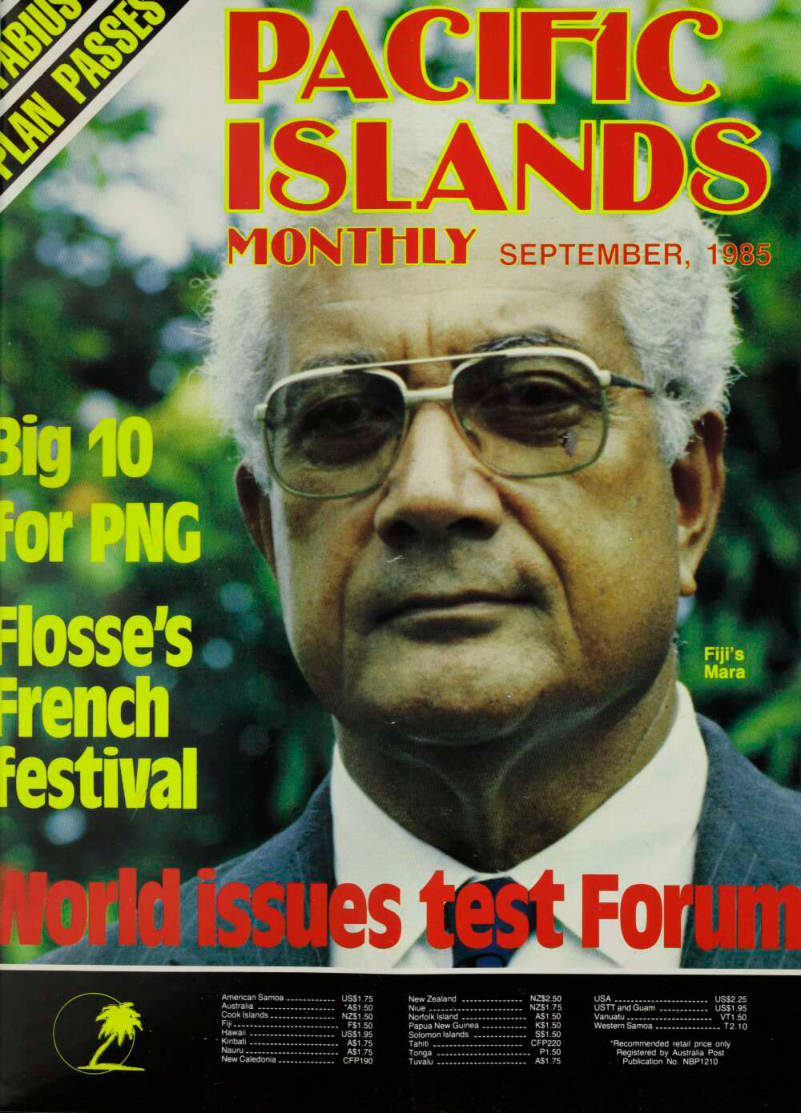
Fiji’s Mara
gthdf
American Samoa USsl.7s Australia *A$l.5O Cook Islands NZ$l.5O Fiji - F 51.50 Hawaii USsl.9s ' Kiribati A 51.75 Nauru A 51.75 New Caledonia CFPI9O
New Zealand NZS2.SO Niue NZsl.7s Norfolk Island A 51.50 Papua New Guinea K 51.50 Solomon Islands SSI .50 Tahiti CFP22O Tonga Pi .50 Tuvalu A 51.75
Usa U 552.25
USTT and Guam USSI.9S Vanuatu VT1.50 Western Samoa T 2.10 ■Recommended retail price only Registered by Australia Post Publication No. NBPI2IO
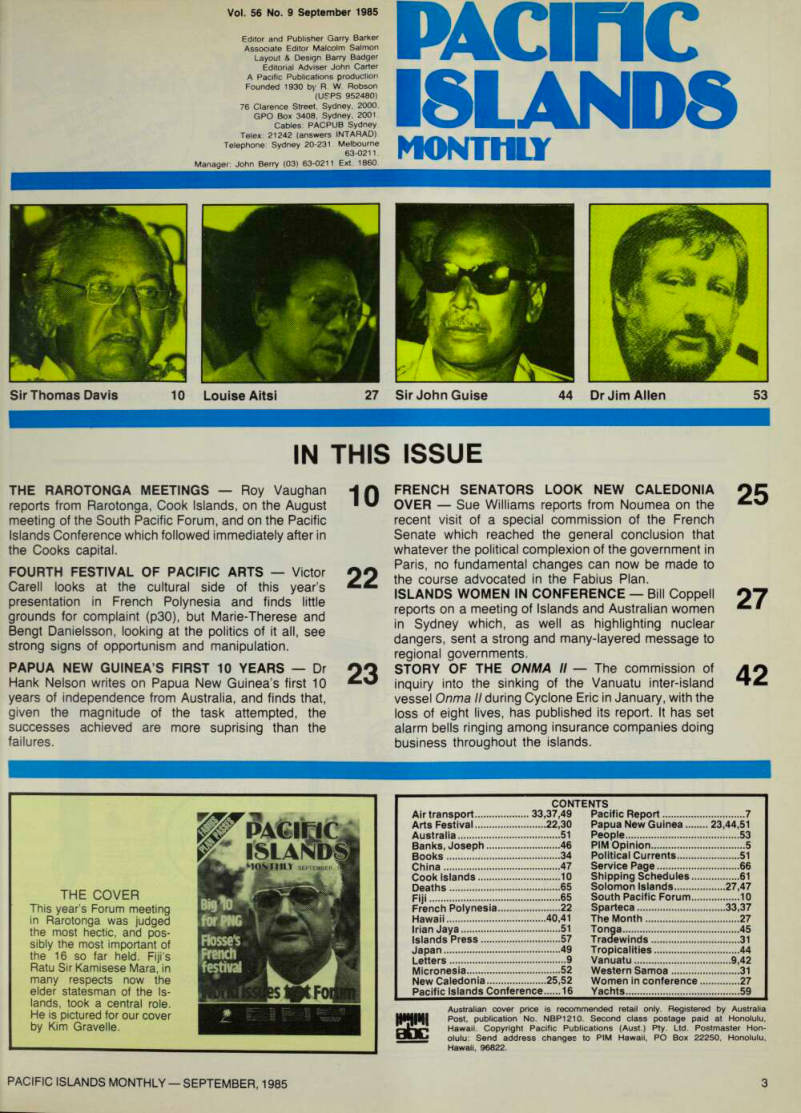
The Cover
This year’s Forum meeting in Rarotonga was judged the most hectic, and pos sibly the most important of the 16 so far held. Fiji’s Ratu Sir Kamisese Mara, in many respects now the elder statesman of the Is lands, took a central role.
He is pictured for our cover by Kim Gravelle.
Advertisements & other items, pp. 2-3 (2 items)
0 Hitachi
1 m A
VMS
VMS VT-640E
Simply the most advanced in home entertainmer Hitachi’s VT-640E VTR. Its simpleto-operate slim design conceals some of today’s most advanced features.
Such as Hitachi’s exclusive “keyboard” innovation. It not only gives you larger, easier-to-use control buttons, but puts them at a more convenient angle: under your fingers instead of in front of them. • 13-function wireless remote control • 2-system compatibility
(B/G-PAI7MESECAM)
• Instant Recording Timer • Freeze frame a-
CMT2OB3
When it comes to total home entertainment the Cineramic AV 20"
TV, CMT2OB3 combines the very best in sight and sound technology. • 8-system compatibility • 23-fnnction remote control • VTR/video disc ready Hitachi’s VT-640E and Cineramic
AV 20" TV, CMT2OB3.
Simply wonderful.
0 HITACHI
. AUSTRALIA: Hitachi Sales Australia Fly.. Ltd, 153 Keys Road, Moorabbin, Victoria 3189; Phone: (555) 8722 . NEW ZEALAND: AWA New Zealand Limited, Wi-neera Drirr pn Rm< sn 94fi Porirua Phone PRO 75-069 • PAPUA NEW GUINEA: S O. Svensson (N.G.) Ltd., P.O. Box 705, Port Moresby, Phone. 21-2111 • FIJI ISLANDS:' AWA New Zealand Limited, 47 Foster Road (P.O. Box 858), Suva. Fiji; Phone: 312070 • NEW CALEDONIA: CaIdis B . P g M1 ’o^ar^Pho^e^l6 • TAHITI- Ets Chene Alain PO. Box 272, Papeete; Phone: 2. 88 68 • SOLOMON ISLANDS: Technique Radios Centre Ltd., P.O. Box 465, Honiara, Phone. 416
Pacific
ISLANDS
MONTHLY
Vol. 56 No. 9 September 1985
Sir Thomas Davis 10
Louise Aitsi 27
Sir John Guise 44
Dr Jim Allen 53
In This Issue
THE RAROTONGA MEETINGS Roy Vaughan -J /> reports from Rarotonga, Cook Islands, on the August * " meeting of the South Pacific Forum, and on the Pacific Islands Conference which followed immediately after in the Cooks capital.
FOURTH FESTIVAL OF PACIFIC ARTS Victor OO Carell looks at the cultural side of this year’s presentation in French Polynesia and finds little grounds for complaint (p3O), but Marie-Therese and Bengt Danielsson, looking at the politics of it all, see strong signs of opportunism and manipulation.
PAPUA NEW GUINEA S FIRST 10 YEARS Dr OO Hank Nelson writes on Papua New Guinea’s first 10 years of independence from Australia, and finds that, given the magnitude of the task attempted, the successes achieved are more suprising than the failures.
French Senators Look New Caledonia Oc
OVER Sue Williams reports from Noumea on the recent visit of a special commission of the French Senate which reached the general conclusion that whatever the political complexion of the government in Paris, no fundamental changes can now be made to the course advocated in the Fabius Plan.
ISLANDS WOMEN IN CONFERENCE Bill Coppell Oy reports on a meeting of Islands and Australian women ■ in Sydney which, as well as highlighting nuclear dangers, sent a strong and many-layered message to regional governments.
STORY OF THE ONMA II The commission of A*\ inquiry into the sinking of the Vanuatu inter-island ***vessel Onma II during Cyclone Eric in January, with the loss of eight lives, has published its report. It has set alarm bells ringing among insurance companies doing business throughout the islands.
Contents
Airtransport 33,37,49 Arts Festival 22,30 Australia 51 Banks, Joseph 46 Books 34 China 47 Cook Islands 10 Deaths 65 Fiji 65 French Polynesia 22 Hawaii 40,41 Irian Jaya 51 Islands Press 57 Japan 49 Letters 9 Micronesia 52 New Caledonia 25,52 Pacific Islands Conference 16
Pacific Report 7 Papua New Guinea 23,44,51 People 53 PIM Opinion 5 Political Currents 51 Service Page 66 Shipping Schedules 61 Solomon Islands 27,47 South Pacific Forum 10 Sparteca 33,37 The Month 27 Tonga 45 Tradewinds 31 Tropicalities 44 Vanuatu 9,42 Western Samoa 31 Women in conference 27 Yachts 59
Australian cover price is recommended retail only. Registered by Australia Post, publication No. NBP1210. Second class postage paid at Honolulu, Hawaii. Copyright Pacific Publications (Aust.) Pty. Ltd. Postmaster Hon olulu; Send address changes to PIM Hawaii, PO Box 22250, Honolulu, Hawaii. 96822.
Advertisements & other items, pp. 3-4 (2 items)
Pacific Islands Monthly —September, 1985
3
Editor and Publisher Garry Barker Associate Editor Malcolm Salmon Layout & Design Barry Badger Editorial Adviser John Carter A Pacific Publications production Founded 1930 by R W Robson
(USPS 952480)
76 Clarence Street, Sydney, 2000, GPO Box 3408, Sydney, 2001.
Cables: PACPUB Sydney Telex: 21242 (answers INTARAD) Telephone: Sydney 20-231. Melbourne 63-0211.
Manager: John Berry (03) 63-0211 Ext. 1860
Why go further?
Australia can supply
most industry needs.
'&//■ o $/ The buyers of Australian industrial equipment find it works well and is reliable. Because of its quality the manufacturer’s agents find it also sells well. Then there is its competitive price.
And with Australia not so far away, delivery and service are swift and sure. So if you need industrial equipment, check out the following.
It’s typical of the great range Australia offers.
Machine tools • Carbon machine components • Industrial clutches and brakes • Valves • Gearboxes and gearing • Cutting tools • Welders and compressors • Kilns and furnaces • Specialised rubber products • Webbing • Industrial insulation • Power transmission products • Airjacks and torque multipliers • Lubricating oils and greases • Lube and servicing equipment • High pressure cleaners • Vacuum cleaners • Tube benders • Chemicals • Printing equipment • Auto servicing and electrical equipment • Hardware • Electrical equipment • Safety equipment • Office equipment • Computer hardware and software □ ir~ r ran Q r o o o o nr i For details of suppliers phone or telex the Australian Trade Commissioner at: Fiji New Caledonia Papua New Guinea PO. Box 1252, Suva PO. Box 22, Noumea PO. Box 9129, Hohola Phone 31 2844. Telex FJ2126 Phone 27 2414. Telex 087 Phone 25 9333. Telex NE22109 m Hawaii Australian Consulate, 1000 Bishop Street, Honolulu 96813 Phone (808) 524 5050. Telex 63 3128
Ask the Australian Trade Commissioner
Pim Opinion
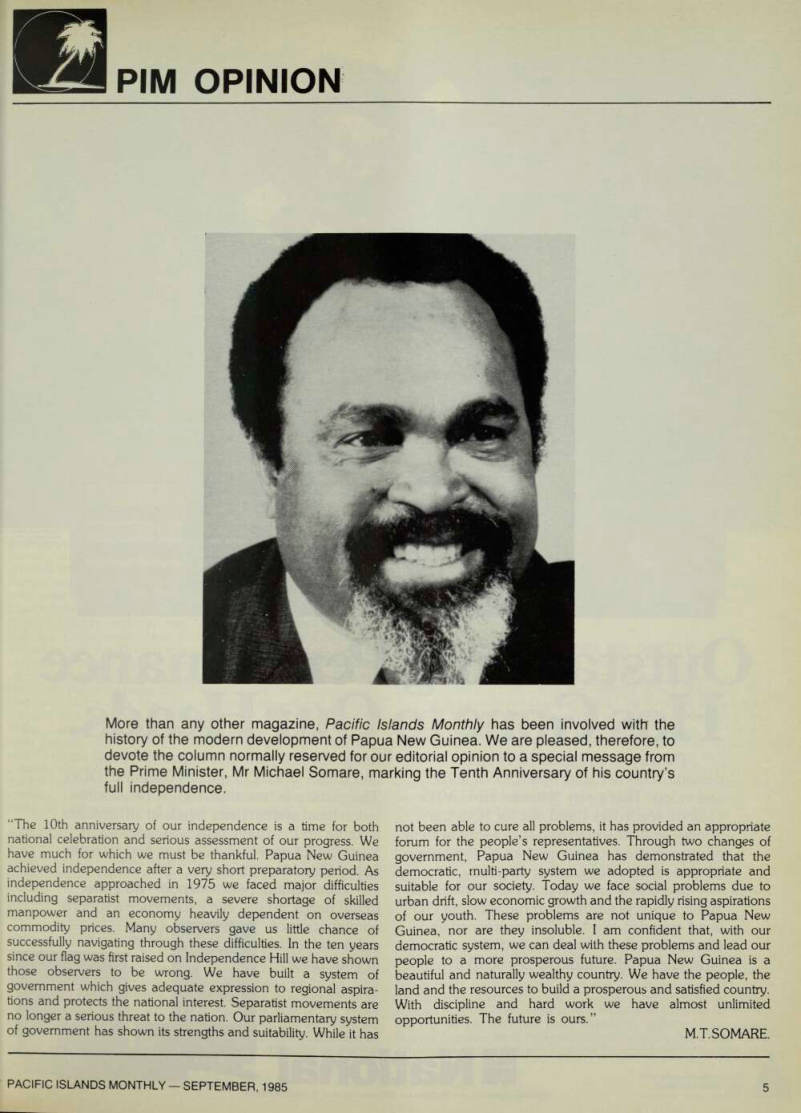
More than any other magazine, Pacific Islands Monthly has been involved with the history of the modern development of Papua New Guinea. We are pleased, therefore, to devote the column normally reserved for our editorial opinion to a special message from the Prime Minister, Mr Michael Somare, marking the Tenth Anniversary of his country’s full independence.
“The 10th anniversary of our independence is a time for both national celebration and serious assessment of our progress. We have much for which we must be thankful. Papua New Guinea achieved independence after a very short preparatory period. As independence approached in 1975 we faced major difficulties including separatist movements, a severe shortage of skilled manpower and an economy heavily dependent on overseas commodity prices. Many observers gave us little chance of successfully navigating through these difficulties. In the ten years since our flag was first raised on Independence Hill we have shown those observers to be wrong. We have built a system of government which gives adequate expression to regional aspira tions and protects the national interest. Separatist movements are no longer a serious threat to the nation. Our parliamentary system of government has shown its strengths and suitability. While it has
not been able to cure all problems, it has provided an appropriate forum for the people’s representatives. Through two changes of government, Papua New Guinea has demonstrated that the democratic, multi-party system we adopted is appropriate and suitable for our society. Today we face social problems due to urban drift, slow economic growth and the rapidly rising aspirations of our youth. These problems are not unique to Papua New Guinea, nor are they insoluble. I am confident that, with our democratic system, we can deal with these problems and lead our people to a more prosperous future. Papua New Guinea is a beautiful and naturally wealthy country. We have the people, the land and the resources to build a prosperous and satisfied country.
With discipline and hard work we have almost unlimited opportunities. The future is ours.”
M.T. Somare.
Advertisements & other items, p. 6 (1 item)
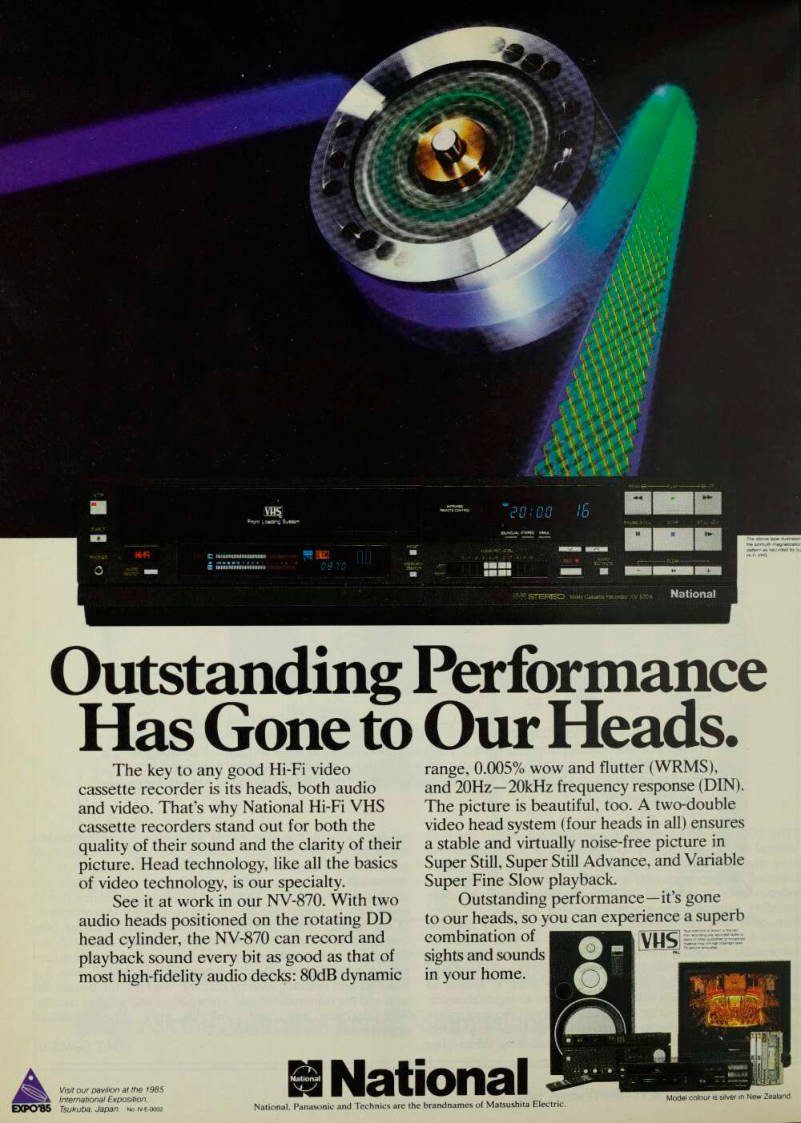
Outstanding Performance
Has Gone to Our Heads.
The key to any good Hi-Fi video cassette recorder is its heads, both audio and video. That’s why National Hi-Fi VHS cassette recorders stand out for both the quality of their sound and the clarity of their picture. Head technology, like all the basics of video technology, is our specialty.
See it at work in our NV-870. With two audio heads positioned on the rotating DD head cylinder, the NV-870 can record and playback sound every bit as good as that of most high-fidelity audio decks: 80dB dynamic range, 0.005% wow and flutter (WRMS), and 20Hz—20kHz frequency response (DIN).
The picture is beautiful, too. A two-double video head system (four heads in all) ensures a stable and virtually noise-free picture in Super Still, Super Still Advance, and Variable
Super Fine Slow playback.
Outstanding performance—it’s gone to our heads, so you can experience a superb combination of sights and sounds in your home.
Visit our pavilion at the 1985 International Exposition.
EXPO’SS Tsukuba, Japan no iv-e-0002
National
National, Panasonic and Technics are the brandnames of Matsushita Electric.
VHS
Model colour is silver in New Zealand.
Pacific Report
Caledonia Plan Hits Snag
President Mitterrand on August 9 recalled the French Parliament to deal with delays in creating a new transitional authority in New Caledonia. The snag came with the ruling by France’s Constitutio nal Council that an important provision of the government’s bill to create the authority was unconstitutional. The case was brought to the council by right-wing opposition parties in a last-ditch attempt to block the bill. They said disparities in the number of councillors per head of population in each of the four regions gave disproportionate weight to pro-independence Melanesians. The Constitutional Council uphqld their claim saying that the fact that a councillor in predominantly anti-independence Noumea would represent 4700 electors, whereas councillors in the three other regions would represent between 2200 and 2600, constituted an imbalance, and was therefore unconstitutional. The government’s counter-claim was that it had introduced such an inequality in an effort to compensate for demographic, economic and political disparities between the Noumea area and the rural regions. Most observers believed that the council’s ruling and the recall of parliament will force a postponement of the elections, originally scheduled for September.
Mitterrand Orders Greenpeace Bomb Probe
President Mitterrand has ordered a top-level inquiry into claims by two French weekly magazines that France’s external intelligence arm, the General Directorate of External Security (DGSE), was involved in the sinking of the Greenpeace vessel Rainbow Warrior in Auckland harbor on July 10. Greenpeace photographer, Portuguese-born Fernando Pereira, died when two limpet bombs fixed to the ship’s hull exploded just before midnight. The Rainbow Warrior was to have led a protest flotilla of small ships to the French nuclear testing base at Moruroa, in anticipation of new tests believed to be planned for August. Meanwhile, a report on the French national radio, France-Inter, says a man and a woman arrested in New Zealand in connection with the bombing are French army officers involved with security at nuclear sites. The two were arrested while travelling on false Swiss passports.
France-Inter said the woman, Sophie-Claire Turenge, held the rank of captain, and the man, Alain-Jacques Turenge, that of Battalion Commander. New Zealand police believe that the two served as base support and scouts for the actual bombers, who are believed to be among the crew members of the Noumea-based yacht Ouuea which was in Auckland harbor shortly before the bombing. The three being sought by police are the yacht’s skipper, Raymond Velche, 35, and crew members Jean-Michel Berthelo, 33, and Eric Audrenc, 32. They were last seen leaving Norfolk Island, ostensibly heading for Noumea, on July 16. In a letter to the New Zealand prime minister, David Lange, president Mitterrand said: ”1 intend that this matter should be handled with the greatest possible severity, and that your country should be able to count on the full collaboration of France. ” In his instruction to French prime minister, Laurent Fabius, the president said that “those guilty, however high ranking, will be severely punished.”
Kenilorea To Make Luv. Speech
Solomon Islands Prime Minister Sir Peter Kenilorea will address the United Nations General Assembly on October 11, according to a spokesman for his office. He will leave for the United States on October 7, and make the U.N. visit before attending the Commonwealth Heads of Government meeting in the Bahamas.
He will be accompanied by Minister for Foreign Affairs Paul Tuvuh.
Png, Australia, Agree On Aid
After two days of talks in Port Moresby on July 30-31, Australia and Papua New Guinea reached agreement on Australia’s new five-year aid program, worth SAIOOO million, to Papua New Guinea. Under the program, Australian aid will be reduced from its present level of more than $3OO million a year. PNG Prime Minister Michael Somare had earlier acceptecf the fact that aid would have to be reduced and Australia proposed a reduction of about $l5 million a year, but agreed after the talks to smaller
reductions. Direct budgetary aid will be cut according to Australia’s wishes, but aid for special projects will be increased. Australian Minister for Foreign Affairs Bill Hayden and PNG Minister for Foreign Affaits John Giheno agreed the new program was fair and reasonable and provided a solid basis for the continued development of PNG. However, Mr Giheno warned that the PNG Government would have to make some hard economic decisions in coming years.
Kiribati: Church Petition On Fish Deal
The Protestant and Roman Catholic Churches in Kiribati have petitioned President leremia Tabai to delay signing an agreement with Russia for the licensing of Russian fishing boats to fish in Kiribati waters until the people of Kiribati have had time to consider it. The petition said church leaders had noticed wariness and fear among the people over the proposed agreement. No one is prepared to say there is a connection between Kiribati’s negotiations with Russia over fishing licences and the new offers of financial help for Kiribati from the developed nations. New Zealand has told the Kiribati Government that it will double bilateral aid to Kiribati this year. Under a new agreement, New Zealand will give Kiribati long-term technical assistance. Aid is also coming from the United States, which will provide development aid worth $U5453,000 through non-government agencies such as the Save the Children Federation. The People’s Republic of China has also entered the arena and will provide grant aid worth about $U5350,000, and make available interest-free loans if required.
Following a request from MPs, the Kiribati House of Assembly was to discuss the proposed fisheries agreement with Russia on August 28. Representatives of most of the islands in the northern group have told the government that the islanders oppose any agreement allowing the Russians to fish in Kiribati’s fisheries zone. And a senior fisheries officer in Kiribati reported seeing at least 17 foreign fishing vessels operating in waters around the Phoenix Islands. The officer sighted the ships from a Royal New Zealand Air Force aircraft which the NZ Government had provided to help Kiribati to police its 200-mile zone. He took the numbers of the vessels in order to check if they were fishing illegally.
Cooks: Sir Thomas Dumps His Deputy
Cook Islands Prime Minister Sir Thomas Davis, whose coalition government was threatened with a “no confidence” motion tabled in Parliament and then withdrawn because of lack of support (PIM Aug. p 33), has relieved Geoffrey Henry, leader of the Cook Islands Party, (CIP) of the deputy prime ministership. Mr Henry had declared his support for the “no confidence” motion. Mr Henry’s successor is Dr Terepai Maoate, MP for Ngatangiia, one of four CIP members who refused to accept the party’s central committee’s unanimous decision to support the motion tabled in the House by Vincent Ingram, who is a member of Sir Thomas’s party, the Democratic Party. The CIP has notified Sir Thomas that the coalition is now at an end. But Sir Thomas is adamant that he still has a coalition government and that Geoffrey Henry and his supporters do not represent the bulk of CIP opinion. The affair blew up, right on the eve of the Cooks hosting the 16th South Pacific Forum. It could hardly have been designed to cause more publicity and Mr Henry claimed it was done deliberately so that Sir Thomas could “rub my nose in the dirt before all the Pacific leaders who are my friends.” Mr Henry was to have led the Cook Islands delegation at the Forum. Sir Thomas said he had to make the move when he did because he could not rely on Mr Henry honestly representing the Cook Islands Government after he had been co-author of the no-confidence motion. Sir Thomas may not be as secure as he seems, for Vincent Ingram claims his Democratic government lacks anything like the full support of the non parliamentary Democratic Party. Last year Sir Thomas decided to appoint his own non-parliamentary executives because he did not like the people who had been elected by grassroots supporters.
Vincent Ingram claims Sir Thomas dare not call a Democratic Party conference at the moment because he would get no support from
it. Questioned, Sir Thomas admitted there would probably be no Democratic conference this year, and said he saw no need for it.
Vincent Ingram has been beavering around trying to build up as much non-parliamentary support as possible for his Democratic faction, and is claiming great success. If he is correct, then Sir Thomas has a problem in mustering support for his leadership at the next election Roy Vaughan in Rarotonga.
Palau: Four Charged In Remeliik Case
Three men were arrested and a fourth charged in Palau in late July over the July 1 murder of the republic’s first president, Haruo I.
Remeliik (PIM, Aug., p 25). The four include the son of the governor of Palau’s Airai State, Roman Tmetuchl. The four are; Melwert Tmetuchl, who worked for his father, Leslie Tewid, Anghenio Sabino, and Francisco Gibbon. The three first-named were arrested in Palau, while a warrant was issued for the arrest of Gibbon, the owner of a small grocery, who was hospitalised in Guam for heart problems, according to officials. Roman Tmetuchl, who unsuccessfully stood for president against Remeliik, was not considered a suspect in the case, according to Palau’s assistant attorney-general, Philip Isaac. Mr Isaac told the press he believed the motive for the murder was political. “It was low-level discontent with the administration of President Remeliik,” he said, but would not comment further. He also refused to say what led authorities to suspect the four, or who was considered the gunman. Bail for the younger Tmetuchl, Tewid, and Sabino was set at SUSI million each, Mr Isaac said. Each was charged with two counts of first-degree murder, and one count of conspiracy to commit murder.
Marshalls Govt. Rejects Compact Draft
The U.S. House of Representatives has approved revised draft compacts of Free Association between the U.S. as trustee and the Micronesian political entities, the Republic of the Marshall Islands, the Republic of Palau, and the Federated States of Micronesia, but the Marshall Islands almost immediately rejected the amendments.
The three entities have already approved the draft compacts, but the U.S. House of Representatives introduced several new amendments. The Marshall Islands Government has said it rejects the amendments as they drastically alter the nature of the proposed relationship between the United States and the Marshall Islands, and amount to a perpetuation of territorial status. If the amendments became law, the Marshall Islands Government said, they would be left with full independence as the only viable alternative to pursue under an agreement with the United Nations.
Palau has still to resolve the problem of its constitutional ban on the entry and storage of nuclear materials. Negotiations with Palau were suspended pending the result of the presidential election set for August 28, following the murder of President Haruo Remeliik, who favored moves to circumvent the ban. Acting President Alfonso Oiterong is reported to be of like mind. He has nominated as a candidate for the presidency, as has Lazarus Salii, who is believed to be opposed to removing the ban. A mission from the United Nations Trusteeship Council visited all the Micronesian states towards the end of July. The mission included Sir Richard Stratton of the United Kingdom, formerly British High Commis sioner to New Zealand, Andre Roche of France and Jeffrey Bader of the United States.
Png: Australians Feel Heat Of Crackdown
One of Papua New Guinea’s most colorful characters, second hand dealer Joe Davis, a Hungarian-born Australian, is in custody in Port Moresby pending hearing of more than 50 criminal charges ranging from cheque fraud, false pretences, stealing and conspiring to steal, to possessing stolen property. He has also been summonsed on charges of failing to pay taxes amounting to K 1.4 million (about SA2 million). The charges arise from the PNG Government’s clampdown on crime, and have to do with allegations that Davis master-minded rings of car thieves and house-breakers to maintain a flourishing export business of goods and vehicles to Australia, Taiwan, and other countries. The Port Moresby court was told during remand proceedings that Davis organised gangs to steal cars, strip them down, and sell the parts to his yard at Six-Mile, Port Moresby. The prosecutor said Davis would then buy the vehicle shells from insurance companies, rebuild them at his Four-Mile panel shop, using the stolen parts, repaint them, and then sell them through his used car yard at Waigani. Police said investigation of the extent of Davis’ businesses
was still in train. Other events in the case included the sacking of expatriate police officer Chief Inspector Kenneth Smith. PNG Police Commissioner David Tasion said Smith had done shoddy work which prevented prosecution of two Filipino men, alleged to be associated with Davis. They were deported after charges were dropped for lack of evidence. In Brisbane Mr Smith alleged he was sacked because he “knew too much” about the extent of the Davis connections. Meantime three other Australians prominent in Port Moresby business have been charged, and bailed, over allegations that they illegally purchased foreign currency and sent it out of the country. Those charged were John Woodward, managing director of the Davara hotel company, Leonard O’Mara of Brisbane, and Janet Fitzgerald of Sydney. O’Mara and Fitzgerald were employees of the Islander hotel. Sums in excess of $A500,000 are involved in the charges.
Vanuatu Steers Clear Of Moscow Show
Vanuatu decided in July that it would not be represented at the 12th World Festival of Youth and Students held in Moscow in August. The country had been offered five places by festival organisers, and it is understood two trade union officials and two government officials attended in an individual capacity. Prime Minister Father Walter Lini said he felt that sending an official delegation would cause division within Vanuatu’s youth groups.
He said; “There may be groups within and without the country working against the aims and unity of the youth organisation.
However, the government is determined to ensure that the youth groups are not manipulated. ” Fr Lini said that while Vanuatu youth should be encouraged to participate in national and international youth activities, at the same time they must be aware of the East-West ideological conflicts which could easily destroy the unity and strength of the national youth organisation in the country.
U.S. Bans Kava Imports
The US Food and Drug Administration (FDA) has prohibited the import of kava (piper methysticum) for human consumption under the US Food and Additive Amendment of 1958, according to the South Pacific Bureau for Economic Co-operation Newsletter. The FDA ruled that kava is not safe or suitable as a food or food additive due to its “narcotic effect”, which depresses the central nervous and respiratory systems, and affects the heart. Kava imports for use in scientific research and as an ingredient in medicinal drugs by pharmaceutical manufacturers are not affected by the ban. Pacific traders are warned that kava shipments for human consumption, if seized by FDA agents, would be returned to the country of origin at the exporter’s expense. Meanwhile the US Agency for International Development (USAID) is trying to collect evidence for the safety of kava through laboratory tests on export quality samples, and examination of scientific literature, with a view to persuading the FDA to lift the ban of kava imports. The Regional Export Marketing Advisor, Dr H. K. Naidu, recently held ' discussions with the US Economic/Commercial Specialist in Suva, Mrs D. Surber, to clarify the situation.
Pamela Dunlop’S Cruel Dilemma
Somewhere in the South Pacific, between Tahiti and Australia, Bill Dunlop, a sailor from Maine, USA, disappeared a year ago in his three-metre yacht (last referred to in PIM, Aug., p 8). His wife, Pamela, believes her husband is still alive, shipwrecked on a remote reef or island, but she now faces a cruel dilemma. Only if she convinces a probate court that Dunlop is dead can she collect the life insurance money she needs to search for him. Mrs Dunlop has already made four trips to the Pacific, exhausting her own funds and SUS3O,OOO raised by supporters around the USA.
Dunlop, 44, was last seen leaving Aitutaki,Cook Islands, in June, 1984. He had embarked on a globe-circling adventure in his tiny craft, Wind’s Will, in July, 1983. A year earlier Dunlop had sailed his boat from Portland, Maine, to Falmouth, England. Under Maine law, a death certificate may be issued after a person is missing for five years, or if survivors can show evidence of probable death. The problem is that neither Mrs Dunlop nor Edward Heath, a lawyer and friend of the Dunlops in Mechanic Falls, Maine, believe he is really dead. “Mrs Dunlop and I don’t agree with the conclusion that Bill is dead,” Heath said. “But that is the evidence we would present to a court. ” Fox Butterfield of The New York Times through AAP.
letters
How Tongoa’s airstrip was born
I much enjoyed the story of Air Melanesiae (PIM, May ’85) and, having been heavily in volved in it, can expand the epic of the construction of Ton goa airfield — it deserves it.
Tongoa airfield was built by a Condominium public works team and the people of the island on the initiative of the Island Council, led by its presi dent, Tom Tipoloamata, New Hebrides Airways, the French District Agent, Fred Lamodiere, and the British District Agent, myself.
When Fred and I first approached the Condominium (in the persons of two Resident Commissioners), for assistance in the construction of the strip, we received no noticeable en couragement, so we set about finding a different route to our goal.
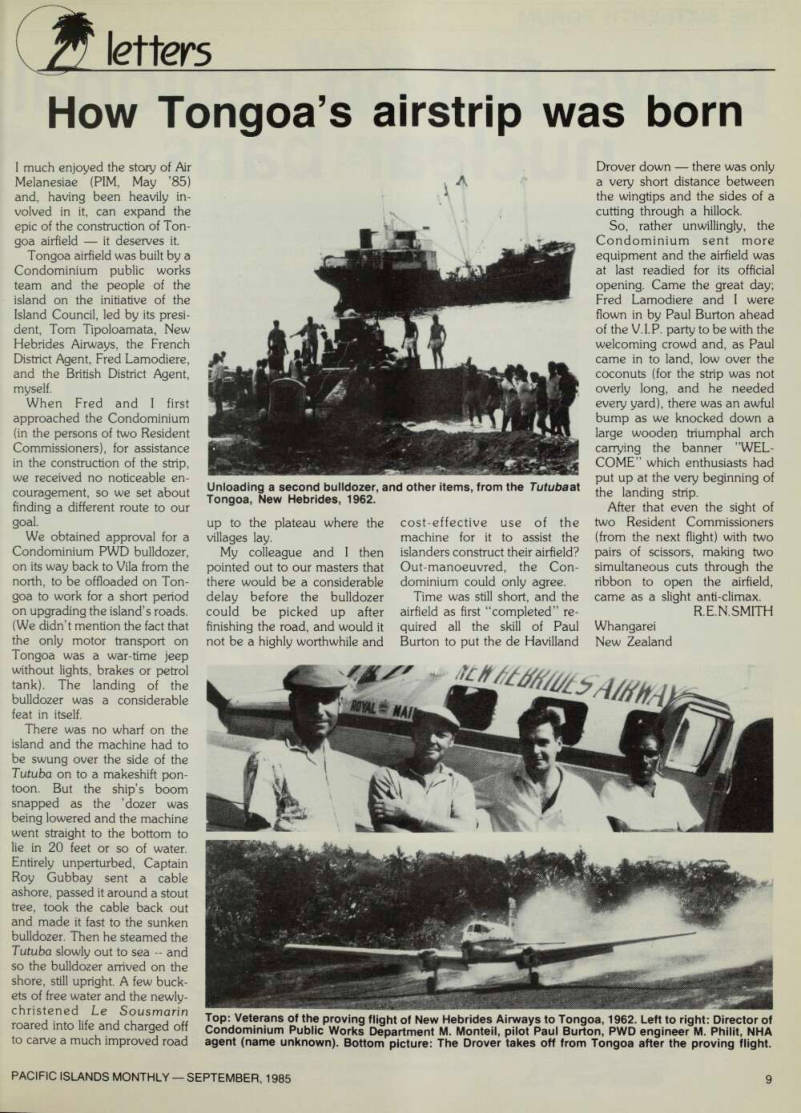
We obtained approval for a Condominium PWD bulldozer, on its way back to Vila from the north, to be offloaded on Ton goa to work for a short period on upgrading the island’s roads. (We didn’t mention the fact that the only motor transport on Tongoa was a war-time jeep without lights, brakes or petrol tank). The landing of the bulldozer was a considerable feat in itself.
There was no wharf on the island and the machine had to be swung over the side of the Tutuba on to a makeshift pon toon. But the ship’s boom snapped as the ’dozer was being lowered and the machine went straight to the bottom to lie in 20 feet or so of water.
Entirely unperturbed, Captain Roy Gubbay sent a cable ashore, passed it around a stout tree, took the cable back out and made it fast to the sunken bulldozer. Then he steamed the Tutuba slowly out to sea — and so the bulldozer arrived on the shore, still upright. A few buck ets of free water and the newly christened Le Sousmarin roared into life and charged off to carve a much improved road
up to the plateau where the villages lay.
My colleague and I then pointed out to our masters that there would be a considerable delay before the bulldozer could be picked up after finishing the road, and would it not be a highly worthwhile and
cost-effective use of the machine for it to assist the islanders construct their airfield?
Out-manoeuvred, the Con dominium could only agree.
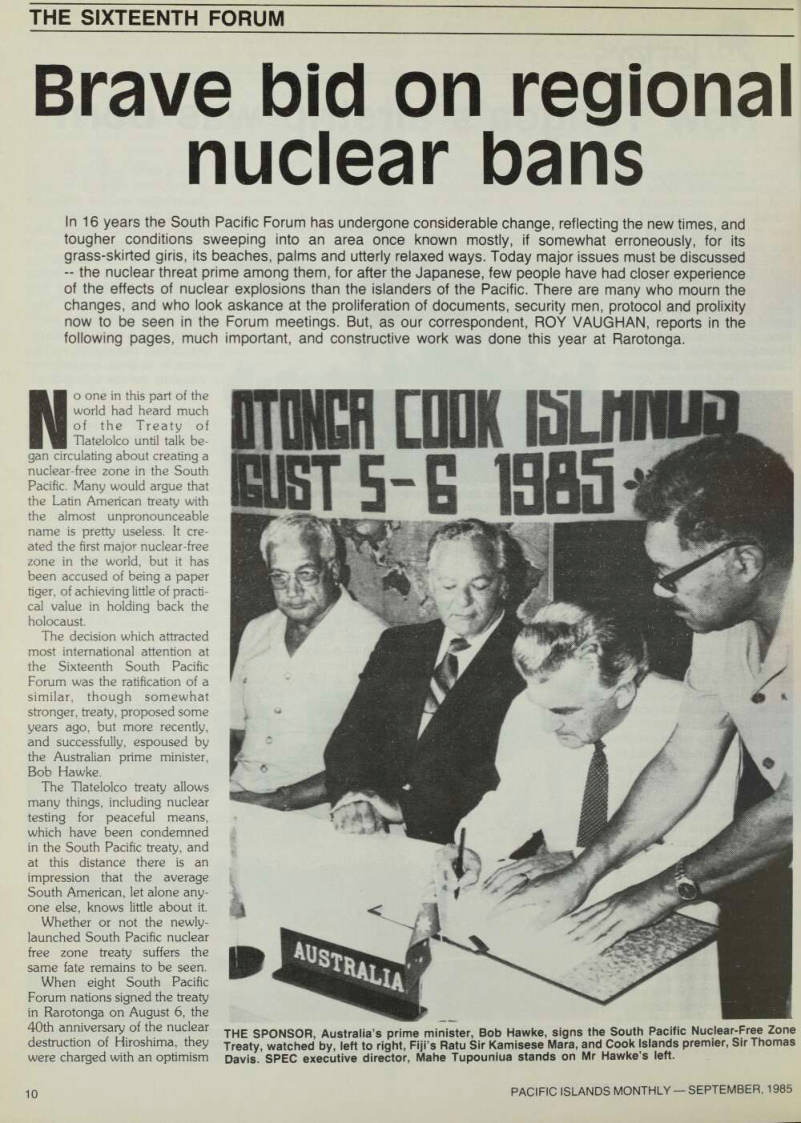
Time was still short, and the airfield as first “completed” re quired all the skill of Paul Burton to put the de Havilland
Drover down there was only a very short distance between the wingtips and the sides of a cutting through a hillock.
So, rather unwillingly, the Condominium sent more equipment and the airfield was at last readied for its official opening. Came the great day; Fred Lamodiere and I were flown in by Paul Burton ahead of the V.I.P. party to be with the welcoming crowd and, as Paul came in to land, low over the coconuts (for the strip was not overly long, and he needed every yard), there was an awful bump as we knocked down a large wooden triumphal arch carrying the banner ’’WEL COME” which enthusiasts had put up at the very beginning of the landing strip.
After that even the sight of two Resident Commissioners (from the next flight) with two pairs of scissors, making two simultaneous cuts through the ribbon to open the airfield, came as a slight anti-climax.
R.E.N.Smith
Whangarei New Zealand
Top: Veterans of the proving flight of New Hebrides Airways to Tongoa, 1962. Left to right: Director of Condominium Public Works Department M. Monteil, pilot Paul Burton, PWD engineer M. Philit, NHA agent (name unknown). Bottom picture: The Drover takes off from Tongoa after the proving flight.
Unloading a second bulldozer, and other items, from the Tutuba at Tongoa, New Hebrides, 1962.
Brave bid on regional

The Sixteenth Forum
Brave bid on regional nuclear bans
In 16 years the South Pacific Forum has undergone considerable change, reflecting the new times, and tougher conditions sweeping into an area once known mostly, if somewhat erroneously, for its grass-skirted giris, its beaches, palms and utterly relaxed ways. Today major issues must be discussed - the nuclear threat prime among them, for after the Japanese, few people have had closer experience of the effects of nuclear explosions than the islanders of the Pacific. There are many who mourn the changes, and who look askance at the proliferation of documents, security men, protocol and prolixity now to be seen in the Forum meetings. But, as our correspondent, ROY VAUGHAN, reports in the following pages, much important, and constructive work was done this year at Rarotonga.
No one in this part of the world had heard much of the Treaty of Tlatelolco until talk be gan circulating about creating a nuclear-free zone in the South Pacific. Many would argue that the Latin American treaty with the almost unpronounceable name is pretty useless. It cre ated the first major nuclear-free zone in the world, but it has been accused of being a paper tiger, of achieving little of practi cal value in holding back the holocaust.
The decision which attracted most international attention at the Sixteenth South Pacific Forum was the ratification of a similar, though somewhat stronger, treaty, proposed some years ago, but more recently, and successfully, espoused by the Australian prime minister, Bob Hawke.
The Tlatelolco treaty allows many things, including nuclear testing for peaceful means, which have been condemned in the South Pacific treaty, and at this distance there is an impression that the average South American, let alone any one else, knows little about it.
Whether or not the newly launched South Pacific nuclear free zone treaty suffers the same fate remains to be seen.
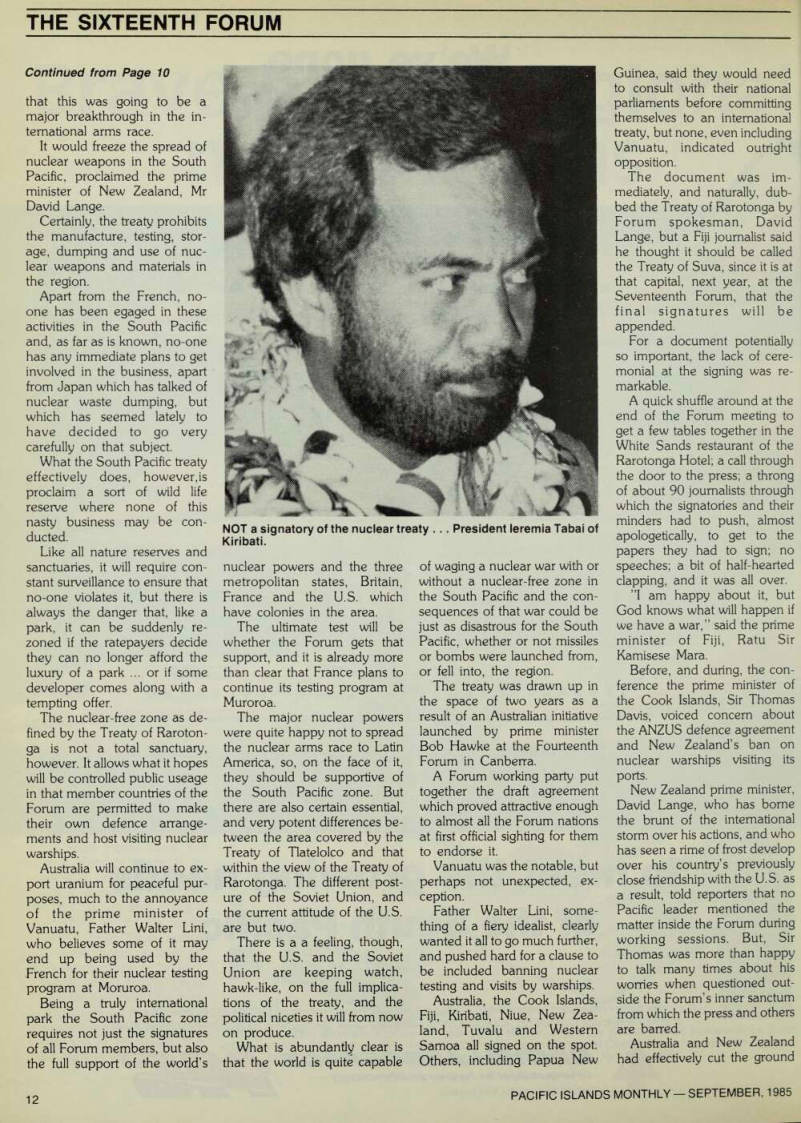
When eight South Pacific Forum nations signed the treaty in Rarotonga on August 6, the 40th anniversary of the nuclear destruction of Hiroshima, they were charged with an optimism
THE SPONSOR, Australia’s prime minister, Bob Hawke, signs the South Pacific Nuclear-Free Zone Treaty, watched by, left to right, Fiji’s Ratu Sir Kamisese Mara, and Cook Islands premier, Sir Thomas Davis. SPEC executive director, Mahe Tupouniua stands on Mr Hawke’s left.
that this was going to be a major breakthrough in the in ternational arms race.
It would freeze the spread of nuclear weapons in the South Pacific, proclaimed the prime minister of New Zealand, Mr David Lange.
Certainly, the treaty prohibits the manufacture, testing, stor age, dumping and use of nuc lear weapons and materials in the region.
Apart from the French, no one has been egaged in these activities in the South Pacific and, as far as is known, no-one has any immediate plans to get involved in the business, apart from Japan which has talked of nuclear waste dumping, but which has seemed lately to have decided to go very carefully on that subject.
What the South Pacific treaty effectively does, however,is proclaim a sort of wild life reserve where none of this nasty business may be con ducted.
Like all nature reserves and sanctuaries, it will require con stant surveillance to ensure that no-one violates it, but there is always the danger that, like a park, it can be suddenly re zoned if the ratepayers decide they can no longer afford the luxury of a park ... or if some developer comes along with a tempting offer.
The nuclear-free zone as de fined by the Treaty of Raroton ga is not a total sanctuary, however. It allows what it hopes will be controlled public useage in that member countries of the Forum are permitted to make their own defence arrange ments and host visiting nuclear warships.
Australia will continue to ex port uranium for peaceful pur poses, much to the annoyance of the prime minister of Vanuatu, Father Walter Lini, who believes some of it may end up being used by the French for their nuclear testing program at Moruroa.
Being a truly international park the South Pacific zone requires not just the signatures of all Forum members, but also the full support of the world’s
nuclear powers and the three metropolitan states, Britain, France and the U.S. which have colonies in the area.
The ultimate test will be whether the Forum gets that support, and it is already more than clear that France plans to continue its testing program at Muroroa.
The major nuclear powers were quite happy not to spread the nuclear arms race to Latin America, so, on the face of it, they should be supportive of the South Pacific zone. But there are also certain essential, and very potent differences be tween the area covered by the Treaty of Tlatelolco and that within the view of the Treaty of Rarotonga. The different post ure of the Soviet Union, and the current attitude of the U.S. are but two.
There is a a feeling, though, that the U.S. and the Soviet Union are keeping watch, hawk-like, on the full implica tions of the treaty, and the political niceties it will from now on produce.
What is abundantly clear is that the world is quite capable
of waging a nuclear war with or without a nuclear-free zone in the South Pacific and the con sequences of that war could be just as disastrous for the South Pacific, whether or not missiles or bombs were launched from, or fell into, the region.
The treaty was drawn up in the space of two years as a result of an Australian initiative launched by prime minister Bob Hawke at the Fourteenth Forum in Canberra.
A Forum working party put together the draft agreement which proved attractive enough to almost all the Forum nations at first official sighting for them to endorse it.
Vanuatu was the notable, but perhaps not unexpected, ex ception.
Father Walter Lini, some thing of a fiery idealist, clearly wanted it all to go much further, and pushed hard for a clause to be included banning nuclear testing and visits by warships.
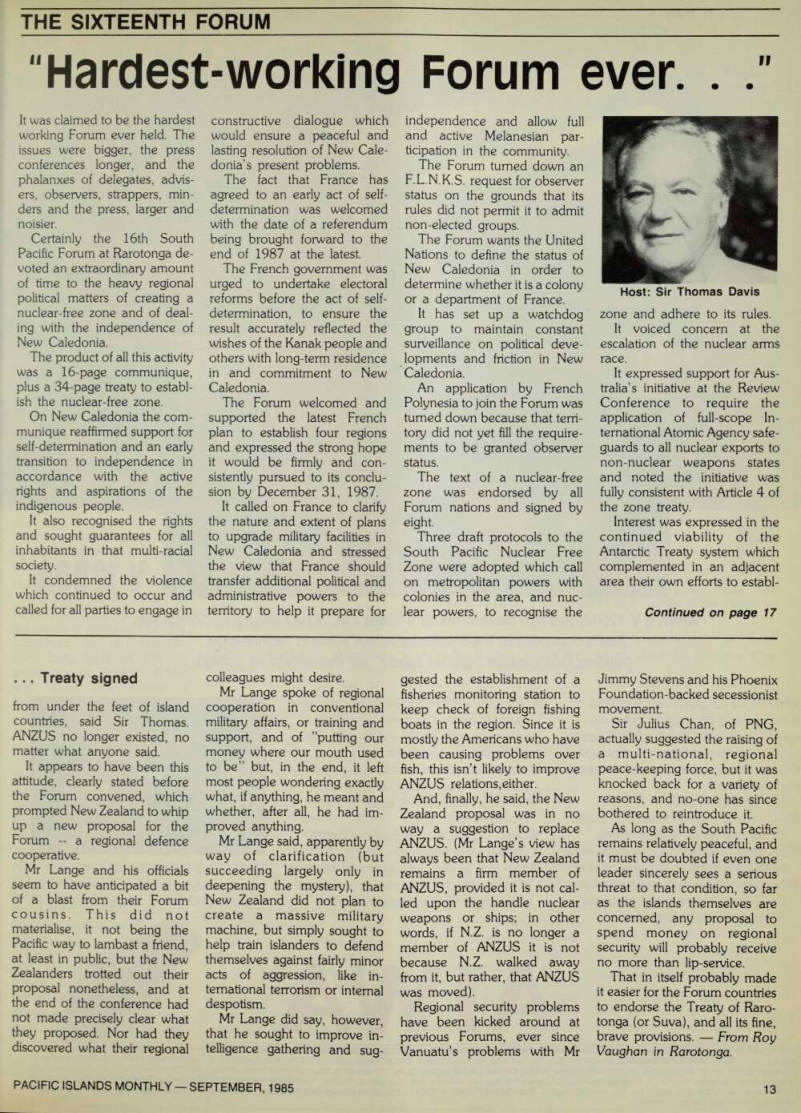
Australia, the Cook Islands, Fiji, Kiribati, Niue, New Zea land, Tuvalu and Western Samoa all signed on the spot.
Others, including Papua New
Guinea, said they would need to consult with their national parliaments before committing themselves to an international treaty, but none, even including Vanuatu, indicated outright opposition.
The document was im mediately, and naturally, dub bed the Treaty of Rarotonga by Forum spokesman, David Lange, but a Fiji journalist said he thought it should be called the Treaty of Suva, since it is at that capital, next year, at the Seventeenth Forum, that the final signatures will be appended.
For a document potentially so important, the lack of cere monial at the signing was re markable.
A quick shuffle around at the end of the Forum meeting to get a few tables together in the White Sands restaurant of the Rarotonga Hotel; a call through the door to the press; a throng of about 90 journalists through which the signatories and their minders had to push, almost apologetically, to get to the papers they had to sign; no speeches; a bit of half-hearted clapping, and it was all over. ”1 am happy about it, but God knows what will happen if we have a war,” said the prime minister of Fiji, Ratu Sir Kamisese Mara.
Before, and during, the con ference the prime minister of the Cook Islands, Sir Thomas Davis, voiced concern about the ANZUS defence agreement and New Zealand’s ban on nuclear warships visiting its ports.
New Zealand prime minister, David Lange, who has borne the brunt of the international storm over his actions, and who has seen a rime of frost develop over his country’s previously close friendship with the U.S. as a result, told reporters that no Pacific leader mentioned the matter inside the Forum during working sessions. But, Sir Thomas was more than happy to talk many times about his worries when questioned out side the Forum’s inner sanctum from which the press and others are barred.
Australia and New Zealand had effectively cut the ground
NOT a signatory of the nuclear treaty ... President leremia Tabai of Kiribati.
... Treaty signed
from under the feet of island countries, said Sir Thomas.
ANZUS no longer existed, no matter what anyone said.
It appears to have been this attitude, clearly stated before the Forum convened, which prompted New Zealand to whip up a new proposal for the Forum - a regional defence cooperative.
Mr Lange and his officials seem to have anticipated a bit of a blast from their Forum cousins. This did not materialise, it not being the Pacific way to lambast a friend, at least in public, but the New Zealanders trotted out their proposal nonetheless, and at the end of the conference had not made precisely clear what they proposed. Nor had they discovered what their regional
colleagues might desire.
Mr Lange spoke of regional cooperation in conventional military affairs, or training and support, and of ’’putting our money where our mouth used to be” but, in the end, it left most people wondering exactly what, if anything, he meant and whether, after all, he had im proved anything.
Mr Lange said, apparently by way of clarification (but succeeding largely only in deepening the mystery), that New Zealand did not plan to create a massive military machine, but simply sought to help train islanders to defend themselves against fairly minor acts of aggression, like in ternational terrorism or internal despotism.
Mr Lange did say, however, that he sought to improve in telligence gathering and sug
gested the establishment of a fisheries monitoring station to keep check of foreign fishing boats in the region. Since it is mostly the Americans who have been causing problems over fish, this isn’t likely to improve ANZUS relations,either.
And, finally, he said, the New Zealand proposal was in no way a suggestion to replace ANZUS. (Mr Lange’s view has always been that New Zealand remains a firm member of ANZUS, provided it is not cal led upon the handle nuclear weapons or ships; in other words, if N.Z. is no longer a member of ANZUS it is not because N.Z. walked away from it, but rather, that ANZUS was moved).
Regional security problems have been kicked around at previous Forums, ever since Vanuatu’s problems with Mr
Jimmy Stevens and his Phoenix Foundation-backed secessionist movement.
Sir Julius Chan, of PNG, actually suggested the raising of a multi-national, regional peace-keeping force, but it was knocked back for a variety of reasons, and no-one has since bothered to reintroduce it.
As long as the South Pacific remains relatively peaceful, and it must be doubted if even one leader sincerely sees a serious threat to that condition, so far as the islands themselves are concerned, any proposal to spend money on regional security will probably receive no more than lip-service.
That in itself probably made it easier for the Forum countries to endorse the Treaty of Raro tonga (or Suva), and all its fine, brave provisions. From Roy Vaughan in Rarotonga.
Advertisements & other items, pp. 11-12 (2 items)
lengths...
We’ve gone
to considerable
• • ■ • seats Available now seats Available now rot. r seats Available soon
to meet the growing needs
of the South Pacific
For further information contact British Aerospace, Hatfield, Herts, England on (07072) 62345 Telex: 22411 or British Aerospace Australia Ltd., ICI House, 61-69 Macquarie Street, Sydney, NSW2OOO on 27-4622 Telex: 20448 A un&€?uall&ci in toyrpGntecfinn/os/y 100 Pall Mall, London SWI, England
The Sixteenth Forum
12
PACIFIC ISLANDS MONTHLY —SEPTEMBER, 1985
Continued from Page 10
THE SIXTEENTH FORUM
"Hardest-working Forum ever. . ."
It was claimed to be the hardest working Forum ever held. The issues were bigger, the press conferences longer, and the phalanxes of delegates, advis ers, observers, strappers, min ders and the press, larger and noisier.
Certainly the 16th South Pacific Forum at Rarotonga de voted an extraordinary amount of time to the heavy regional political matters of creating a nuclear-free zone and of deal ing with the independence of New Caledonia.
The product of all this activity was a 16-page communique, plus a 34-page treaty to establ ish the nuclear-free zone.
On New Caledonia the com munique reaffirmed support for self-determination and an early transition to independence in accordance with the active rights and aspirations of the indigenous people.
It also recognised the rights and sought guarantees for all inhabitants in that multi-racial society.
It condemned the violence which continued to occur and called for all parties to engage in
constructive dialogue which would ensure a peaceful and lasting resolution of New Cale donia’s present problems.
The fact that France has agreed to an early act of self determination was welcomed with the date of a referendum being brought forward to the end of 1987 at the latest.
The French government was urged to undertake electoral reforms before the act of self determination, to ensure the result accurately reflected the wishes of the Kanak people and others with long-term residence in and commitment to New Caledonia.
The Forum welcomed and supported the latest French plan to establish four regions and expressed the strong hope it would be firmly and con sistently pursued to its conclu sion by December 31, 1987.
It called on France to clarify the nature and extent of plans to upgrade military facilities in New Caledonia and stressed the view that France should transfer additional political and administrative powers to the territory to help it prepare for
independence and allow full and active Melanesian par ticipation in the community.
The Forum turned down an F.L.N.K.S. request for observer status on the grounds that its rules did not permit it to admit non-elected groups.
The Forum wants the United Nations to define the status of New Caledonia in order to determine whether it is a colony or a department of France.
It has set up a watchdog group to maintain constant surveillance on political deve lopments and friction in New Caledonia.
An application by French Polynesia to join the Forum was turned down because that terri tory did not yet fill the require ments to be granted observer status.
The text of a nuclear-free zone was endorsed by all Forum nations and signed by eight.
Three draft protocols to the South Pacific Nuclear Free Zone were adopted which call on metropolitan powers with colonies in the area, and nuc lear powers, to recognise the
zone and adhere to its rules.
It voiced concern at the escalation of the nuclear arms race.
It expressed support for Aus tralia’s initiative at the Review Conference to require the application of full-scope In ternational Atomic Agency safe guards to all nuclear exports to non-nuclear weapons states and noted the initiative was fully consistent with Article 4 of the zone treaty.
Interest was expressed in the continued viability of the Antarctic Treaty system which complemented in an adjacent area their own efforts to establ-
Continued on page 17
Host: Sir Thomas Davis
Continued from page 13
ish a South Pacific nuclear-free zone.
Total opposition to French testing was again voiced and support given for the early conclusion of a comprehensive test ban treaty which would ban all tests in all environments.
There was strong opposition to nuclear waste dumping in the oceans of the region and the Forum welcomed a statement by the prime minister of Japan, Yasuhiro Nakasone, that Japan had mo intention of dumping radio-active waste in the region.
Forum countries were urged to sign the London Dumping Convention which would then give them a greater say on nuclear and other waste dum ping at sea.
Regular dialogue between the Forum secretariat and the Association of South- east Asian Nations’ secretariat will be maintained: The review of creating a single regional organisation is to be continued and New Zealand proposed an increase in inter parliamentary contact.
Further discussions on regio nal trade will be held in the near future with the aim of trying to iron out problems some nations are experiencing in exporting to Australia under the South Paci fic Area Regional Trade and Economic Co-operation Agreement. (SPARTECA).
That discussion will take a look at the possibility of island countries being included in the Closer Economic Relationship agreement between Australia and New Zealand.
New Zealand has agreed to extend its Pacific Islands Indust
rial Development Scheme.
The Forum noted with plea sure that the Pacific Forum Line had made very real progress in its development as an econo mically viable service and it endorsed a pre-feasibility study of a proposed extension of the PFL feeder service from Fiji- Tuvalu-Kiribati to Micronesia.
The Forum expressed satis faction that the Forum Fisheries Agency is now fully recognised by the foreign fishing nations and called for the speedy con clusion of a multilateral treaty with the United States.
It looks forward to the early approval of the termination of the trusteeship agreement of the American Pacific Trust Territory in accordance with the expressed wishes of the Micronesian peoples.
It welcomes the decision which allows Palau to become a full member of the Forum Fisheries Agency.
Sincere condolences were expressed to the family, people and government of Palau over the death of its late president, Haruo I.Remeliik.
The Forum noted Australia’s offer to facilitate productive contacts between China and Forum Island Countries which might wish to develop relations with China.
The South Pacific Bureau for Economic Cooperation (SPEC) was requested to explore the establishment of a dialogue with Japan with a view to obtaining further assistance for smaller island countries in particular.
It unanimously welcomed Fi ji’s offer to host the 17th South Pacific Forum next year at Suva.
Advertisements & other items, p. 14 (1 item)
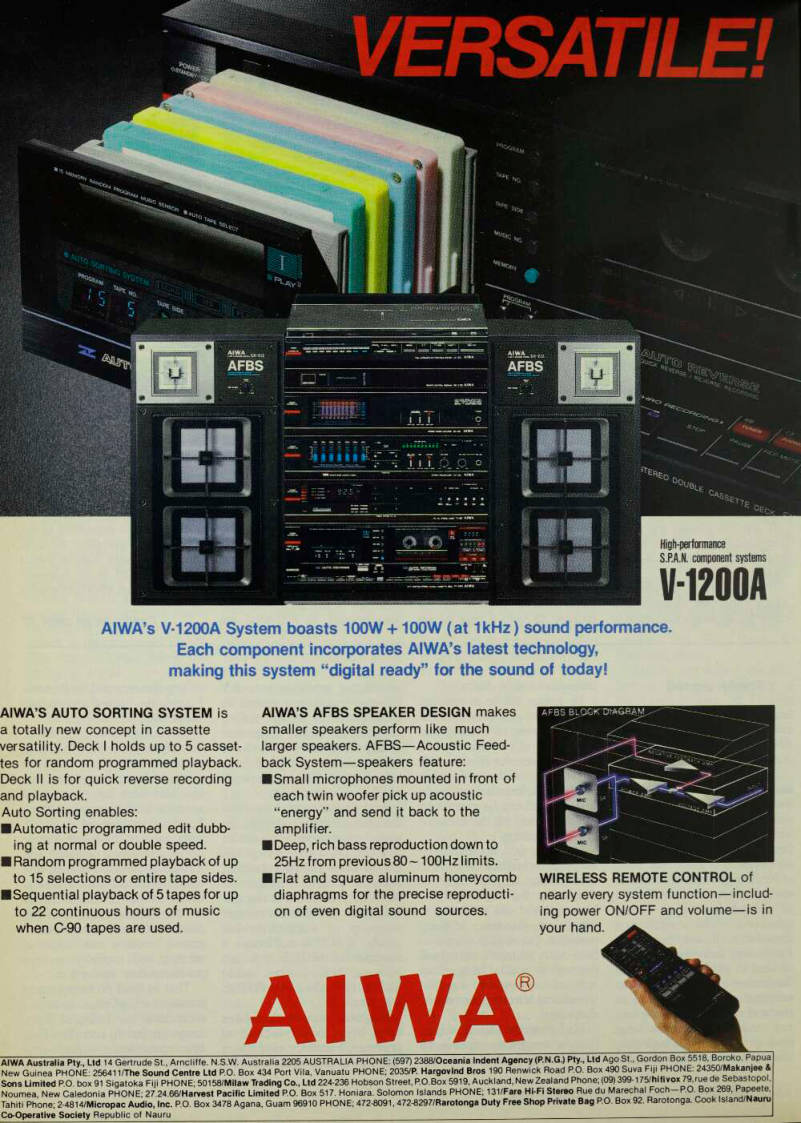
Aiwa
$ M V High-performance S.P.A.N. component systems V-1200A AlWA’s V-1200A System boasts 100 W +IOOW (at IkHz) sound performance.
Each component incorporates AlWA’s latest technology,
making this system “digital ready” for the sound of today!
AIWA’S AUTO SORTING SYSTEM is
a totally new concept in cassette versatility. Deck I holds up to 5 cassettes for random programmed playback.
Deck II is for quick reverse recording and playback.
Auto Sorting enables: ■Automatic programmed edit dubbing at normal or double speed. ■ Random programmed playback of up to 15 selections or entire tape sides. ■Sequential playback of 5 tapes for up to 22 continuous hours of music when 090 tapes are used.
AIWA’S AFBS SPEAKER DESIGN makes
smaller speakers perform like much larger speakers. AFBS—Acoustic Feedback System—speakers feature: ■ Small microphones mounted in front of each twin woofer pick up acoustic “energy” and send it back to the amplifier. ■ Deep, rich bass reproduction down to 25Hzfrom previous 80~100Hz limits. ■ Flat and square aluminum honeycomb diaphragms for the precise reproduction of even digital sound sources.
AIWA
WIRELESS REMOTE CONTROL of
nearly every system function—including power ON/OFF and volume —is in your hand.
AIWA Australia Pty., Ltd 14 Gertrude St., Arncliffe. N.S.W. Australia 2205 AUSTRALIA PHONE: (597) 2388/Oceania Indent Agency (P.N.G.) Pty., Ltd Ago St., Cordoni 80x ,5518, Boroko. Papua New Guinea PHONE: 256411/The Sound Centre Ltd P.O. Box 434 Port Vila, Vanuatu PHONE; 2035/P. Hargovind Bros 190 Renwick Road PO. Box 490 Suva Fiji PHONE. 24350/Makanjee & Sons Limited P.O. box 91 Sigatoka Fiji PHONE; 50158/Milaw Trading Co., Ltd 224-236 Hobson Street, P.0.80x 5919, Auckland, New Zealand Phone; (09)399-175/hifivox 79,rue de Sebastopol, Noumea, New Caledonia PHONE; 27.24.66/Harvest Pacific Limited P.O. Box 517. Honiara. Solomon Islands PHONE; 131/Fare Hi-Fi Stereo Rue du Marechal Foch-PO. Box 269, Papeete, Tahiti Phone; 2-4814/Micropac Audio, Inc. P.O. Box 3478 Agana, Guam 96910 PHONE; 472-8091,472-8297/Rarotonga Duty Free Shop Private Bag P.O. Box 92. Rarotonga. Cook Island/Nauru Co-Operative Society Republic of Nauru
New trade concessions
spur SPARTECA
Australia’s prime minis ter, Bob Hawke, went much further, perhaps beyond his own advis ers’ recommendation, in announcing at the Forum meet ing in Rarotonga liberalisation of Pacific regional trade under
Sparteca.
New Zealand, which had operated a somewhat more generous system previously, also announced improvements to its SPARTECA conditions by lowering duty on Fiji vodka and gin and reducing liquor matura tion requirements. Mr Lange also said New Zealand would liberalise investment incentive schemes to make launching of joint ventures easier.
Australia’s new terms will come into effect on January 1, 1987, a date determined mostly by the time required by bureaucrats to make their changes.
Officials concede that the concessions from Australia are the result of pressure from Fiji, supported by recommenda tions from the Australian de partments of Foreign Affairs and Trade. The minister of Industry and Commerce, Sena tor Button, who has a different set of fish to fry, is said to be less pleased.
Nor is there any secret that the concessions had a good deal to do with the signing of the South Pacific Nuclear-Free Zone Treaty, sponsored by Australia and supported by New Zealand. Eight nations have signed and the treaty is a fact, needing only ratification in Suva next year before its pro tocols set off on the rounds of the metropolitan and nuclear powers.
Predictably, Vanuatu did not sign, and nor did either Papua New Guinea or the Solomons.
Some say PNG delayed to demonstrate their displeasure over the recent three per cent cut in Australian aid. The
Federated States of Micronesia, now a full member of the Forum, offered to sign but, apparently, was advised to tarry until things were clearer on the status of the Compact of Free Association with the U.S.
Although the nuclear-free zone treaty, nuclear testing and the independence of New Cale donia looked to be the items of chief concern at the Forum, it was the liberalisation of SPAR TECA which was the main achievement of the meeting.
Under the new rules Australia will lift all duty and quotas on Forum Island products, except for five. These are garments, steel, footwear, sugar and cars.
Nobody cares very much about steel and cars. Sugar is the subject of a very sensible bilate ral understanding between Fiji and Australia. But textiles, clo thing and footwear are impor tant.
Fiji has great hopes of deve loping its current garment trade into a major industry, sup plying, principally, Australia and New Zealand. For a variety of reasons Australia has de clined to remove the present quota system and, indeed, may never do so officially. However, Mr Hawke did announce in Rarotonga extension of the pre sent Fiji quota and its mainten ance at a minimum 66,000 units a year, with annual negotiations on greater quanti ties until 1988 when Fiji’s re quest for a quota of at least 500,000 garments a year will be considered.
In effect the changes mean that Australia has all but totally adopted the New Zealand ’’negative listing” system of de ciding what items should be duty-free under the agreement and has thus made trade very much more free.
Beyond these changes Aus tralia and New Zealand have agreed to examine the possibil-
ity of including the Pacific countries in the Closer Economic Relationship (CER) which operates across the Tasman. But, say some trade experts, what the islands now have under the liberalised SPARTECA may well prove to be better for them
than membership of CER which demands two-way con cessions, However, Ratu Mara sug gested, and the Forum agreed, that a committee be set up to examine the CER idea. Staff Writer.
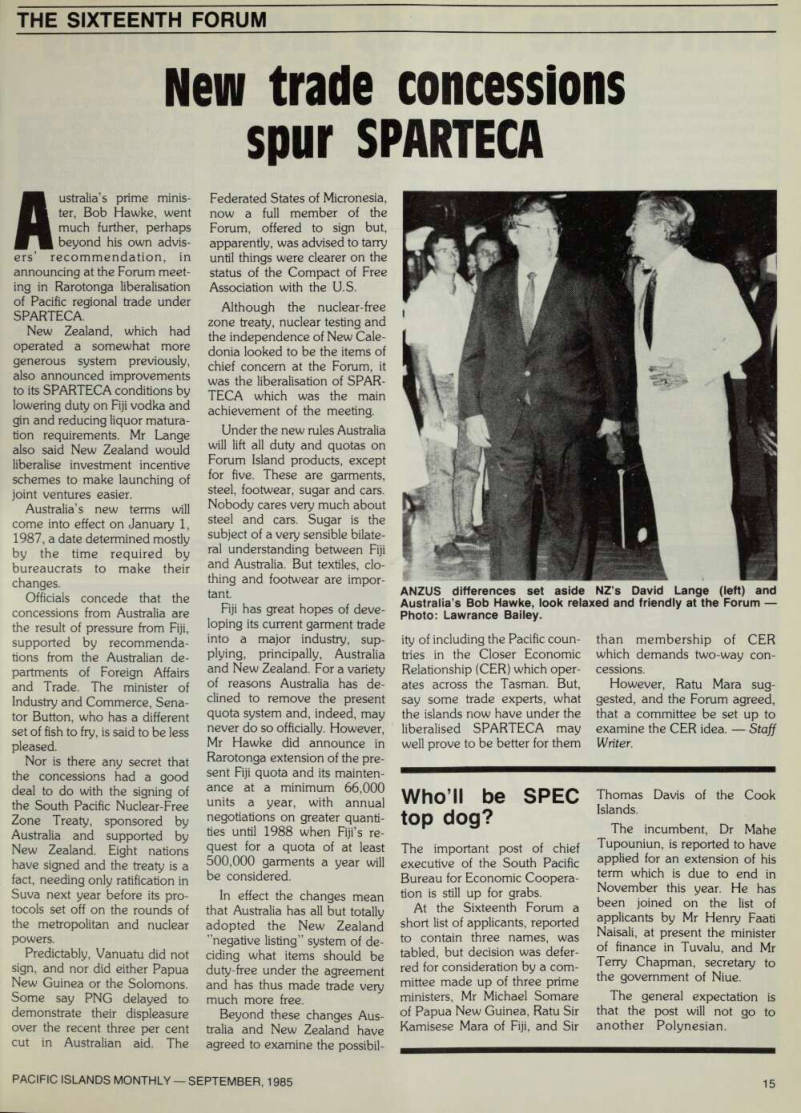
ANZUS differences set aside NZ’s David Lange (left) and Australia’s Bob Hawke, look relaxed and friendly at the Forum - Photo: Lawrance Bailey.
top dog?
Who’ll be SPEC top dog?
The important post of chief executive of the South Pacific Bureau for Economic Coopera tion is still up for grabs.
At the Sixteenth Forum a short list of applicants, reported to contain three names, was tabled, but decision was defer red for consideration by a com mittee made up of three prime ministers, Mr Michael Somare of Papua New Guinea, Ratu Sir Kamisese Mara of Fiji, and Sir
Thomas Davis of the Cook Islands.
The incumbent, Dr Mahe Tupouniun, is reported to have applied for an extension of his term which is due to end in November this year. He has been joined on the list of applicants by Mr Henry Faati Naisali, at present the minister of finance in Tuvalu, and Mr Terry Chapman, secretary to the government of Niue.
The general expectation is that the post will not go to another Polynesian.
Conference “needs more honing”
While the Micronesian trust ter ritories administered by the Un ited States have now set them selves on a course towards self-government, the only American-run enclave in the South Pacific seems much less anxious to loosen the ties that bind them to Uncle Sam.
Former governor of Amer ican Samoa, Peter Tali Cole man, in Rarotonga to watch the Forum meeting, and attend the Pacific Islands Conference sponsored by the East-West Center of Hawaii, sounded confident whenever he talked about the long-term future of his country’s dependent status.
“Who wants to be indepen dent?” he demanded of journalists questioning him about his apparent lack of inde pendence fervor. “What about Africans? Are they better off now they are independent? We are happy as we are.
“The United States has given
us an opportunity to decide our future, and as of now we feel our present status is the best,” he said.
As an unincorporated terri tory of the U.S., American Samoa has the right to elect its own governor (now A.P.Lutali, who took over from Mr Cole man earlier this year), and legislative assembly. They man age most of their local affairs.
But, where their Pacific island neighbors sometimes have to scrimp and save a bit to get the material luxuries of life that is, if they decide they want their sometimes doubtful benefits - Uncle Sam takes care of Amer ican Samoa’s major worries.
Indeed, the financial support from America now not only allows it to take care of itself, but a good deal of it spills over in the form of cash in neigh bors’ pockets. About 90 per cent of the 5000 workers em ployed at the two fish canneries
in Pago Pago come from next door Western Samoa.
“We have a very close work ing relationship with Western Samoa,” said Mr Coleman.
“Remittances to families back home in one year would be worth between SUS 4 million and US$7 million.”
Additionally, it is an open secret that many a Western Samoan has gained work in Pago Pago, got himself a “green card” and toddled off to join the estimated 100,000 Sa moans now living in Hawaii and Los Angeles.
American Samoa, with a population of 37,000, has an annual budget of about SUSBO million. One quarter of that is direct budgetary support from Washington. In addition, there are annual Federal grants totall ing SUSI 2 million, and a capital works program which is worth an average of a further US$5 million each year.
“We are building a big dock and ship repair facility, expan ding our airport, and we have some funds for a new adminis tration block (apparently to add to the already quite substantial concrete edifice in the centre of Pago Pago.”
American Samoan children get free school lunches, and when they reach retirement age they get pensions.
The two tuna canneries set against the steep sides of Pago Pago harbor, owned by Van Camp and Star Kist, handle about $2OO million worth of fish a year.
With all of those greenbacks coming in to keep American Samoa looking fertile, it seems unlikely, at least according to Mr Coleman, that any idealist in Washington would get much of a welcome on any suggestion that they raise their own flag.
From Roy Vaughan in Raro tonga.
Uregei Seeks Status
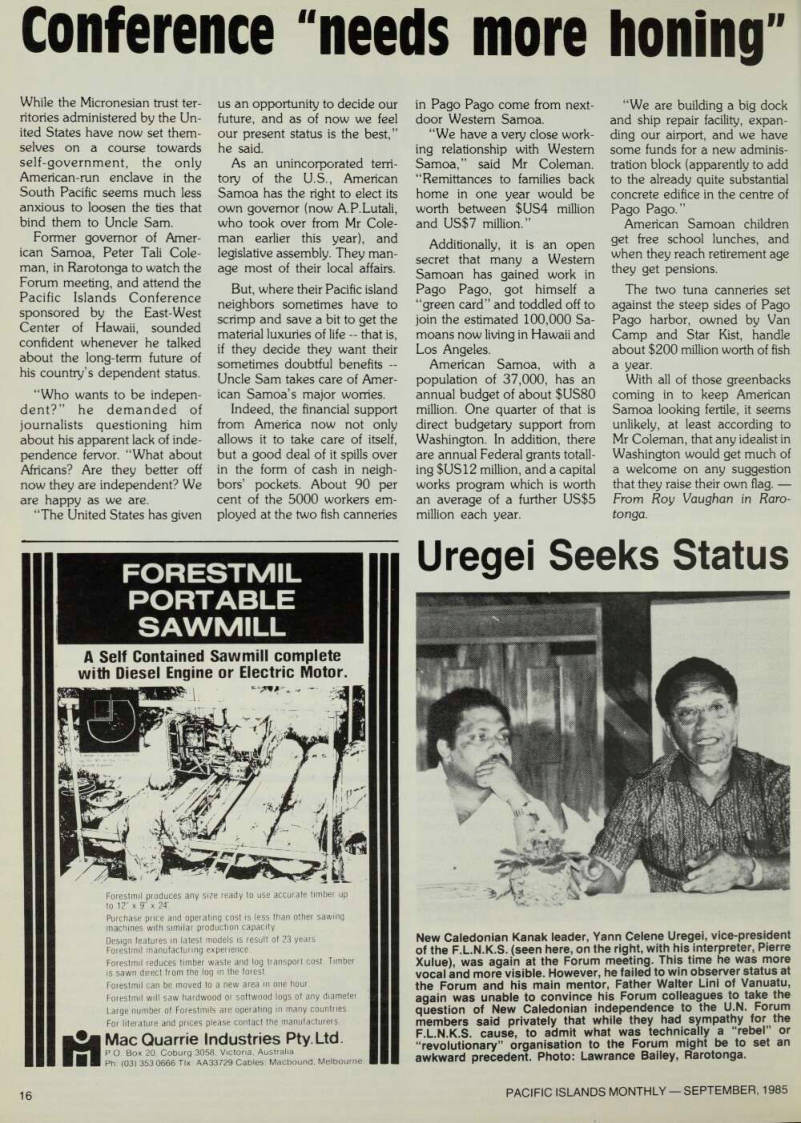
New Caledonian Kanak leader, Yann Celene Uregei, vice-president of the F.L.N.K.S. (seen here, on the right, with his interpreter, Pierre Xulue), was again at the Forum meeting. This time he was more vocal and more visible. However, he failed to win observer status at the Forum and his main mentor, Father Walter Lini of Vanuatu, again was unable to convince his Forum colleagues to take the question of New Caledonian independence to the U.N. Forum members said privately that while they had sympathy for the F.L.N.K.S. cause, to admit what was technically a “rebel” or “revolutionary” organisation to the Forum might be to set an awkward precedent. Photo: Lawrance Bailey, Rarotonga.
Advertisements & other items, p. 16 (1 item)
Forestmil
PORTABLE
SAWMILL
A Self Contained Sawmill complete
with Diesel Engine or Electric Motor.
m Forestmil produces any size ready to use accurate timber up to 12" x 9" x 24'.
Purchase price and operating cost is less than other sawing machines with similar production capacity.
Design features in latest models is result of 23 years' Forestmil manufacturing experience.
Forestmil reduces timber waste and log transport cost. Timber is sawn direct from the log in the forest.
Forestmil can be moved to a new area in one hour.
Forestmil will saw hardwood or softwood logs of any diameter.
Large number of Forestmils are operating in many countries.
For literature and prices please contact the manufacturers.
Mac Quarrie Industries Pty.Ltd.
P.O. Box 20, Coburg 3058, Victoria, Australia.
Ph: (03) 353 0666 Tlx: AA33729 Cables; Macbound, Melbourne.
“Soviet deal is On.."
Kiribati is determined to develop its own fishing industry one way or the other, and it is the ways it may do it which have raised concern among friendly Pacific Rim nations.
Whilst at Rarotonga for the Sixteenth South Pacific Forum, president Tabai of Kiribati said the deal to license up to 16 Russian fishing boats would go ahead and at the time of going to press his minister of natural resources, Mr Babera Kirata, was on his way to Manila to negotiate the final details.
If all 16 Russians boats are licensed it will give Kiribati a revenue of about Auss2.4 mil lion a year. ’’America has expressed con cern, verbally,” said president Tabai.
The prime minister of Austra lia, Bob Hawke, has written to Tabai asking if Kiribati plans to allow the establishment of Rus sian bases. ’There are no plans for bases,” president Tabai told me.
Mr Hawke told him Australia was ready to assist Kiribati in developing its fishing industry and this would be a topic for further discussion, according to the president.
The Honiara-based Forum Fisheries Agency has been in volved in all Kiribati’s fisheries negotiations, acting as an advis er.
But Kiribati will not get rich through the Russian deal, says Tabai. The Russian money rep resents only a small portion of the country’s $16.2 million annual budget.
Kiribati plans to have four more pole and line boats of its own, financed through an aid package sponsored by the European Economic Commun ity at a cost of about Aussl million per boat.
He said the first two of these could be built in Fiji. (This suggestion is good news for regional industrial cooperation, and helpful, also, to the somewhat under-utilised Fiji ship-building and repair
establishment. Fiji recently turned down an Australian offer of ready-made patrol boats and said it would build them for itself- Ed.) ”We have a marine training school and plan to link it with the fisheries thing,” said presi dent Tabai.
Last month the Royal New Zealand Navy’s survey ship,
HMNZS Monowai completed a survey of Kiribati’s Line Islands and some islands in the north ern Cooks Group. That work will help Kiribati define the precise boundaries of its plan ned 200-mile exclusive econo mic zone.
Kiribati has already bought a
Continued on page 18
Continued from page 17
refrigerated mother ship to handle its tuna catches and it is due for delivery in September.
While the Russian catches are likely to be unloaded and processed in South-East Asian ports, Kiribati plans to ship its catches to American Samoa where they will be processed at the Star Kist cannery.
That is about the only contact the Americans will have with Kiribati for there have been no further moves by the American Tuna Boat Association to negotiate licence fees for their boats. ATBA operators still re fuse to recognise e.e.z. bound aries applying to migratory fish and, to that extent, the fisheries situation in the Pacific remains in dispute, disarray and disor ganisation.
More than 140 U.S.-based ’’super-seiners” now operate across the Pacific. This, coupled with the increased number of patrol boats about to go into service under the flags of seve ral Pacific island countries, and the Tuna Boat Association’s adherence to their ”free-pur suit” policy on tuna, indicates a vigorous time in the fisheries area for some time to come.
From Roy Vaughan, in Raro tonga.
Advertisements & other items, pp. 17-18 (1 item)
Sheaffer
The way you write and the pen you choose both say a lot about you.
Slanted writing with large loops can show responsiveness and imagination. Choosing a Sheaffer shows you appreciate a superior pen that makes a stylish gift. Only Sheaffer has such superb styling and craftsmanship with such a range of fine finishes.
Elegant lOO5.
Fountain pen,ballpoint, pencil and rolling ball pen. Subtle fluting and a soft rich gleam in 23 Kt electroplate.
Slim or classic profile.
SHEAFFER
SHEAFFER PEN CSHHII'
Sheatfw t a lon Division ol Toalron Panin
Commonwealth Secretariat
COmmonWea,th Y ° Uth Pro 9 ramme (CYP)
REGIONAL DIRECTOR
CYP SOUTH PACIFIC CENTRE
Applications are invited from Commonwealth citizens for the post of Regional Director, CYP South Pacific Centre, based in Suva, Fiji.
CYP is concerned with the involvement of youth in national development. It supports Commonwealth governments in the area of youth policies and programmes, and trains youth workers and youth affairs personnel.
The Regional Director will lead the professional team of the Centre and provide expert advice and assistance to governments. S/he will be responsible for guiding a complex of training programmes and other services in response to regional needs and for advising CYP headquarters in London on the development of CYP as a whole.
The Regional Director will have a relevant academic qualification and wide management experience in youth work, particularly training. Experience in consultancy, applied research and project management will be expected.
The ability to communicate effectively in cross-cultural settings will be essential. Preference will be given to candidates from the region.
The appointment will be for two years in the first instance.
The salary will be in the range Fiji $19,525 $22,815 per annum plus a 10% gratuity, an expatriation allowance if appropriate, plus other benefits.
Applications (with cv) must be received by October 15,1985.
To apply, or for further details, write to: Chief Personnel Officer, Commonwealth Secretariat, Marlborough House, Pall Mall, London SWIY SHX.
sgsfgs
Airlines co-op
mooted
Apart from Pacific Forum Line matters, delegates attending the Sixteenth South Pacific Forum meeting in Rarotonga did not get the chance to discuss any matters of the recently com pleted Regional Transport Study.
This recommends the estab lishment of a regional equip ment pool - principally of air craft - which South Pacific flag carriers could lease for their own operations.
The study has also looked at the feasibility of rationalising some services, and it is prob ably that aspect of the reports, touching as it does on such matters as national image-buil ding, which adds to the com plexity of an already difficult issue.
The Regional Transport Study was circulated to Forum ministers of transport some months ago, but it is still official ly under wraps.
Many believe it is long over due because of the heightened interest on the part of island nations in extending runways, taking over airports and bring ing in more tourists from places like Australia, Japan and Hawaii.
The commercial operators, like Ansett Transport Industries of Australia, have already laid much groundwork for expan sion in the Pacific through link ages with Air Vanuatu, Polyne sian Airways, and with hotel ventures, actual or projected, in a variety of places.
The big question industry pundits believe the Pacific Is lands face is whether they want to join forces and do their own aviation thing by cooperation, or stand alone and get picked off one at a time by the bigger Pacific Rim-based airlines.
Cooperative regional airlines do not have a very good history around the world but, accor ding to some experts, it may be the best, or possibly the only viable, way for the small Pacific Islands to go.
Delaying consideration of the Regional Transport Study in full
and in public is seen as unlikely to help resolution of the issue.
Air Pacific, which might be seen as a key element in any regional cooperative, is now reporting an operating profit under Qan tas management, and the Cook Islands, now in control of its big Rarotonga airstrip, is now actively wooing more in ternationals to call at their door.
Prime minister Tofilau Eti Ale sana of Western Samoa wasted no time in putting the bite on the prime minister of New Zea land, David Lange, for help in extending the runway near Apia so that it could take Boeing 747 jumbos. Australian aid, and some other locally voted funds, have just gone into extending it to allow tri-engined Boeing 727 jets to take off.
watchdogs to keep
eyes on France
France will find itself on the back foot during the next 12 months, trying to define the status of its South Pacific territories, and justify its policies in relation to them.
The Sixteenth South Pacific Forum at Rarotonga charges its executive with the task of obtaining precise definitions of the legal status of New Caledo nia and French Polynesia.
At one time New Caledonia was inscribed on the list of the United Nations’ Decolonisation Committee of 24 but, years ago, France declared New Caledonia a department of metropolitan France and suc ceeded in having the listing removed.
A very few countries have since made rumblings about having New Caledonia re-in scribed; Vanuatu attempted to win support for such a move at the 1984 Forum meeting at Funafuti, Tuvalu, but could not raise the numbers. Instead, in a public statement rather sharply critical of his Forum colleagues.
After some tough debating among Forum delegates it was decided again not to try to get New Caledonia re-inscribed. In stead, the U.N. will be asked to give a legal international defini tion of the territory’s status so that Forum countries may be guided on whether they are dealing with a piece of France, or a most suspect chunk of the South Pacific.
The Forum had a “sleeper” from the United Nations at its last conference who kept out of the public eye, but who was on hand to take notes and offer advice on tactics.
He was Mr Renagi Lohia, Papua New Guinea’s perma nent representative to the U.N., who is also chairman of the U.N. committee which handles decolonisation matters as they are handed up to them from the Committee of 24.
Commenting on this Forum attitude, official conference spokesman, and New Zealand prime minister, David Lange, said he did not think countries like Russia, which are members of that U.N., committee, could tell the world very much about personal liberty and independ ence.
Father Lini’s re-inscription camp said it would be holding its fire until after the referendum in New Caledonia which was expected to be held in Septem ber. (Events in the French Na tional Assembly may since have changed that date, although at press time full clarification was lacking from Paris.). However, Father Lini seems to have by no means given up the idea of
proceeding unilaterally.
His position is interesting par ticularly when it is remembered that he got Cuba to put Vanuatu’s case for independ ence before the United Nations some years ago when he found he could not get regional sup port. He has since recognised Cuba diplomatically, which continues to raise eyebrows in larger capitals which did not fully appreciate his rationale.
Clearly he feels somewhat cyni cal about the likelihood of win ning support from his neigh bors. Equally, say regional observers, if Father Lini should try to use Cuba again, the cost might be somewhat higher, par ticularly in view of the Soviet Union’s growing interest in the Pacific.
But, while the Forum awaits the U.N.’s definition of the status of New Caledonia, it will have a watchdog group running about to keep an eye on deve lopments in the territory. By this continuous monitoring the Forum hopes to respond more rapidly if the situation should worsen.
The president of French Polynesia’s council of govern ment, Mr Gaston Flosse, turned
up at the Forum along with two of his cabinet ministers to pre sent a case for giving his terri tory observer status.
This application was turned down, but not thrown right out of court. Apart from Flosse one of the most disappointed dele gates was the prime minister of the Cook Islands, and host of the Forum, Sir Thomas Davis, who had been Flosse’s sponsor.
“This is just a country club,”
Sir Thomas said scornfully.
“They are obsessed with the French. These people are Polynesians. They are our cousins. ”
The Forum will keep an open door for French Polynesia, but meanwhile has asked the French government to define the status of that territory and what its long-term plans are.
Flosse is convinced he has a self-governing country under his control, with an association with France similar to the Cook Islands’ relationship with New Zealand.
It would take a referendum in French Polynesia to make a break from France, but at Raro tonga the government there need only tell Wellington it wants to end the relationship for the Cook Islands to be set adrift.
Admission of the French territory to the Forum is, of course, not just a matter of form. There are some ideologi cal and political difficulties for the Forum’s strong anti-nuclear camp to digest. How, they ask, can the Forum admit, even as an observer, a territory which allows France to test its nuclear devices within its boundaries?
But, French Polynesia is by no means without friends in the region.
Apart from Sir Tom the gov ernor of American Samoa, A.P.Lutali, offered a friendly arm when Flosse got the bad news and threatened to leave immediately for Tahiti. Flosse was advised that flouncing out of meetings was seen as the French way of doing things.
Sitting it out, even when the outlook is gloomy, is the Pacific way.
What also appeared clear during the Rarotonga sessions was that if anyone else should be feeling uneasy about Forum interest in anti-colonial matters it was the United States. Dele gates have telegraphed that they will in future take a more active interest in the progress of changes to the status of the Micronesian trust territory.
The Forum has taken the view that the sooner they get independence, the better.
The U.S. has yet to clear the compacts of free association for the Federated States of Mic ronesia, the Marshalls and Palau. All the documents must go through the U.S. Congress, and the Senate,and then to the U.N. Trusteeship Council by September.
The Forum is, however, an xious to have new members, provided they are fully and genuinely independent. How ever, delegates said they would review the qualifications for observer status; publication of a definite target date for inde pendence would be a help.
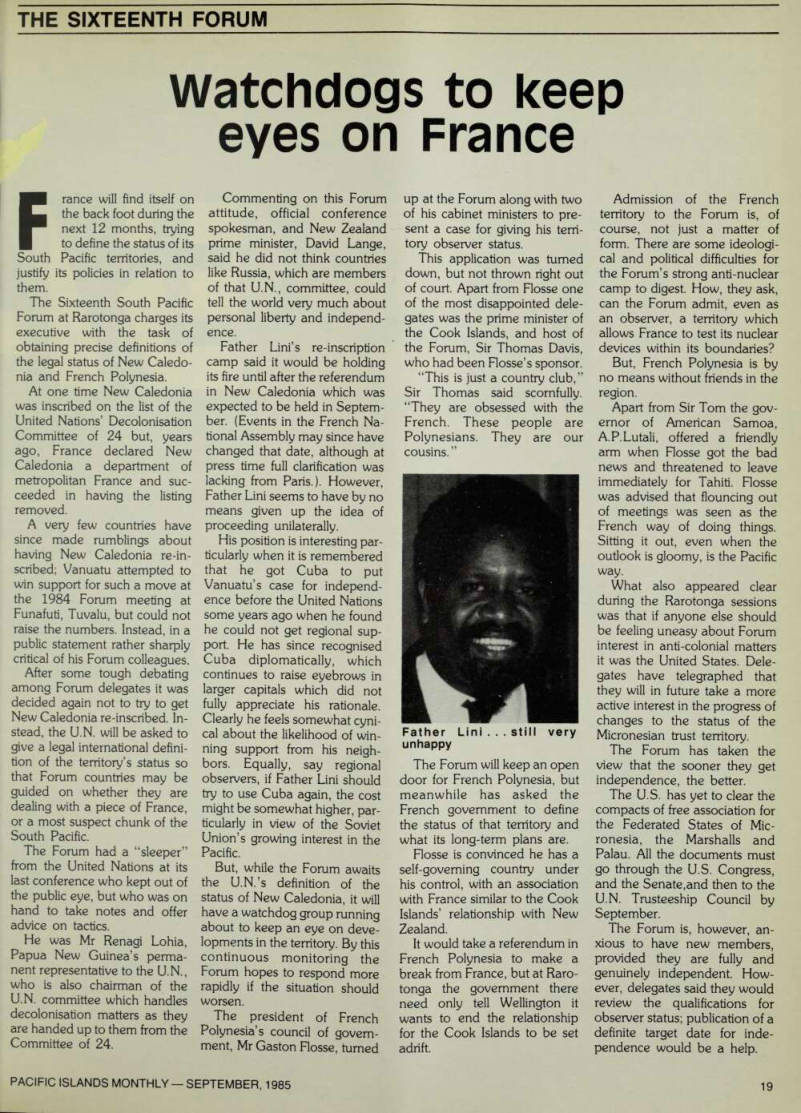
Father Lini . . . still very unhappy
Advertisements & other items, pp. 20-21 (1 item)
aSg&»sSs3
* IBBIM
11 *ll
Pa9H««
Car of the future: A ■ -_- , ;;.
Discover a new dimension to the quality that made Datsun a trusted name around the world.
At Nissan, the Datsun tradition is alive and well and better than ever.
Our international manufacturing and service network gives us the capacity to respond to your needs quickly and efficiently. Our technology is one in of the world’s most advanced, and tal it’s backed by an attitude that Ar welcomes challenges. Besides, you’ll find the same innovative technology and quality in every car we make. mm: ••• m jp
*mmssssm
aSg&»sSs3
mm ■ - gS* - aSS - *!3SS T
V ,• ■i : v.’" ’*' ' **' -v v , ••“,! ?*% i|B . : ■ ■ : ■■■:>.■:■:< , ■ ;;■. VKv.,;,; ■•■ ;■; ;* v%;4k-- > nsts.f{-:-H ■' -■- K .'■■* ■ ■■■ . ’ ;:. £%v.fl ■' ' 4 i '/■■ ... ■ ' ; WSk I
Wmm
WmwP&f
i 1 ,
|f* ■ ■’■fe« e
VKV ■ ' •'" ’ -‘4 ••*. * i &
tv#** i ■#•
Sr ■At-
• v-# * • 'U' * rv v »V ' ‘ V I •■„’ 4#‘t' : L
m,.* v «-‘M
1, c' M ;, ,-a
**■« *£a»lr
4f- .>^.t
IgPj. v:|i6
it »•! lister I j
Flosse's French Festival
The character of the Fourth Festival of Paci fic Arts held in Tahiti in the first two weeks of July was determined back in February. For that was when a majority of Pacific governments accepted an offer by French Polynesia’s . Premier Gaston Flosse to take over the festival after the French Government at the last minute had taken it away from the original organ isers, the New Caledonian Cultural Office, headed by in dependence leader Jean-Marie Tjibaou.
From the beginning, Flosse made no bones about what he had in mind it was to polish up France’s image in a region where, in his opinion, too many government heads and political leaders had a regrettable tendency to side with the FLNKS “terrorists” (as he con sistently labelled Tjibaou and company) instead of supporting the law-and-order government of the White settlers. In other
words, by staging the festival in Tahiti, Flosse was sure he would be able to show the world what a happy and prosperous place a French col ony is in “normal” circum stances.
This manoeuvre succeeded surprisingly well mainly due to the generosity of the French Government in picking up the tab for the air fares of all foreign delegations who balked at the cost of getting their troupes to far-off Tahiti.
Only five Pacific countries Vanuatu, Kiribati, Palau, Mar shall Islands and Niue re fused to participate out of solidarity with the FLNKS. Not even the fact that Tjibaou’s bitter opponent, Dick Ukeiwe, was invited to send an anti independence delegation from New Caledonia to Tahiti, pro duced a murmur of protest.
In fact the only serious opposition Flosse encountered came from other political and civic leaders in Tahiti. What
they contested most hotly was Flosse’s plan to combine the festival with the annual Tahitian July 14, or Tiurai, celebrations.
Not only was the time too short for the complex preparations, they argued, but in such circumstances the Festival of Pacific Arts would lose its speci fic and independent character.
Flosse’s reason for proceeding in this hasty manner was even less acceptable, for it was his firm intention to open the festi val on June 29, a date of special significance to him and his Tahoeraa party.
The foreign governments who accepted this date when it was put to them in February were told that it is our glorious local “Cession Day”.
The simple truth is that it was only through deceit and trickery that on that date in 1880 Tahiti and Moorea became a French colony. Once celebrated as a great historic anniversary, June 29 fell into complete oblivion in the 19505, with the emergence
Postmark Papeete
of Polynesian leaders and par ties strongly in favor of inde pendence. If June 29 was re membered at all, it was as a day of shame. Nobody cared, for instance, to celebrate the centenary of the French take over when it fell in 1980 (PIM
Continued on page 25
Marie-Therese and Bengt Danielsson
Aug. ’BO pi 08). Last year, when Flosse tried to revive it with a parade to the greater glory of the French Gaullist party and himself, not only the Opposition parties but also the two major churches refused to take part (PIM Sep. ’B4 p 27).
Flosse’s stubborn insistence on June 29 as opening day so infuriated Papeete’s pro-inde pendence Mayor Jean Juventin that he declared all parks and public buildings in the capital off-limits to the organisers for the duration of the festival. This was a serious blow to Flosse who now had to stage the festival in the adjacent, smaller town of Pirae, where he is mayor.
His biggest problem was that Pirae lacked a theatre of the international dimensions re quired for the occasion. Flosse’s solution was to build a whole new theatre, or rather conven tion hall, for 2000 spectators.
With three huge teams working round the clock, the contractors completed it in two months
at the staggering cost of CFP4OO million (about $A3.5 million), or three times as much as it would have cost in normal circumstances.
Oscar Temaru, the even more strongly pro-independ ence mayor of Tahiti’s second biggest town of Faaa, found an even more pointed way of expressing his disagreement with Flosse.
He had just discovered, he announced, that June 29 was indeed an historic date. For on that day in 1844 the guerrilla fighters of Faaa had won a great victory over French troops at the beginning of the war of conquest which lasted until the end of 1846. So he had de cided to erect a monument commemorating this glorious event which, of course, he planned to inaugurate on June 29, 1985. Demonstrating splen did impartiality, Mr Temaru in vited the French high commis sioner and the CEP (nuclear tests) admiral along for the occasion, as well as FLNKS delegates Yeiwene Yeiwene and Marie-Francoise Machoro.
Only the latter two turned up.
Attacked from all sides, Flos
se finally resorted to a desper ate stratagem. In April he suddenly let it be known that what he planned to commemo rate on June 29 was not the French take-over in 1880 at all, but the first anniversary of the granting of the new statute, or constitution, supposedly giving French Polynesia internal self government. In fact the new document is nothing but a muddled rewrite of the 1977 colonial-type statute. Flosse himself is so dissatisfied with it that he has already asked Presi dent Mitterrand to amend it (PIM July p 24). On top of all that, his opponents pointed out to him that the new statute had come into effect on September 6, 1984, so that the first anniversary was still some months away. Hopelessly out manoeuvred, Flosse decided there was nothing for it but to stick to his poorly aimed guns.
Thus it came to pass that in Tahiti this year All Fools Day fell not on April 1 but on June 29.
Those most thoroughly fooled were the foreign partici pants in the festival. Coming largely from countries whose governments support Kanak in-
dependence and oppose French nuclear tests, by mar ching past the grandstand to a tune played by the band of the French Foreign Legion they unwittingly paid homage to Flosse’s guests of honor, all neatly dressed in most un- Pacific dark flannel suits and ties. As was to be expected, they included such Caledonian anti-independence leaders as
Continued on page 56
Tri-lingual commemorative pla que at Faaa erected by Oscar Temaru.
Jacques Lafleur and Dick Ukeiwe. More surprising was the unannounced presence of former French prime minister Pierre Messmer, who as de Gaulle’s minister for defence back in the 1960 s supervised the installation of the nuclear test base at Moruroa, and is therefore often referred as the “father” of the French atomic bomb.
The opening ceremony glar ingly demonstrated the spiritual gulf separating Flosse and his aides all of whom wore European attire and the barefoot, lavalava-clad island ers from all over the Pacific.
After some dancing by local schoolchildren, proceedings were dominated by two long winded speeches in French which the organisers did not deem it necessary to translate into English for the sake of visitors. But, considering the paralysing dullness of what was said, perhaps that was the most charitable course to adopt.
This gulf persisted through out the two weeks of the festival. The basic trouble was that visitors to festival events mostly French settlers, officials and military personnel loved the foreign islanders for the wrong reasons, i.e., their exotic appearance and entertainment skills. Consequently nobody cared much about what hap pened to them in between the shows, and there were no spe cial gatherings for them except a few dinners for selected VIPs at the high com missioner’s residence.
Lodged in widely separated schools, the delegations were entirely dependent on transport supplied by the organisers.
True enough, buses punctually took them to the show venues and back. But none were avail able for visits to other delega tions, or to locals, in their spare time.
More egalitarian was the poli cy on food all delegations were fed European dishes. But this only led to a chorus of voices clamoring for taro, yams, bananas and fish. What the majority of the “little guys” resented most, however, was that they had to pay the regula tion, steep admission prices of
$lO to $l5 if, in their leisure time, they wanted to see a show put on by other islanders. Only after the Samoan, Papua New Guinean and Solomon Islands delegations threatened to take over ticket-selling to their own shows and keep the money for themselves did the organisers graciously consent to distribute a number of free tickets to each show.
Last but not least, the local mass media deserve strong criticism for their abject failure to provide the local population with the necessary background information on the various visit ing groups. The reason for this is easy to find: the reporters covering the festival for the two local daily newspapers and the government-owned radio and TV are all expatriate French men, who do not possess even the most elementary know ledge of the Pacific peoples and cultures. One TV commentator repeatedly referred to “plaited tapas”, and took the solemn kaua ceremony enacted by a group of Samoan chiefs in fono, for a friendly neighbor hood gathering at which a few mates gulp down cups of home brew. It was also obvious that he had never heard of Margaret Mead for, like all his colleagues, he kept referring throughout the festival to the famous taupou village maid as a “fian cee”, or a “princess”.
To mask their ignorance, the
journalists resorted to a slightly different trick; they filled the columns of their papers with pseudo-literary, pseudo-phi losophical balderdash about the “spirit” of the festival and the “soul” of this or that “tribe”.
The worst offender was the new editor of Les Nouuelles, who day after day proudly printed his totally unintelligible “meditations”.
On radio and TV, the favored method was to quote snippets from the Pacific Islands Year book about the countries of origin of the performers which was all very well but had nothing whatsoever to do with what was happening on stage.
The shining exception was a Tahitian, hired only after the festival began, probably on the assumption that a native must possess a better knowledge of island customs than an expat.
This assumption is, of course, totally wrong, as present-day Tahitians are highly accultu rated, and have never been taught anything at school or anywhere else about Pacific, or even Tahitian, customs and traditions. To our great relief this fellow, acting with more intelligence and dignity than his French colleagues, simply announced the program and then shut up, leaving the im ages to speak for themselves.
It still remains a mystery to us why the organising committee,
with about CFP3OO million ($A2.6 million) in the kitty, didn’t see fit to hire an anthropologist with a special ised knowledge of Pacific cul tures to explain and comment on the various shows and demonstrations, both in the theatres and on radio and TV.
In the end as many critics had foreseen the festival simply petered out, engulfed by the boisterous Tiurai celebra tions, which began several days before Bastille Day and lasted throughout July. Among the events drowned by the aval anche of dance and song con tests for local teams, canoe races, military parades, exhibi tions, and so on, was the festival’s closing ceremony.
This took place after many delegations, including the French and New Caledonian guests of honor, had left for home. It was held in a half empty stadium although by now admission was free for all.
By that time, the mass media, echoing the opinions of high ranking officials, had neatly summed up the political signif icance of Flosse’s French Festi val. This was that, by attending in such great numbers, the Pacific nations had clearly de monstrated that they no longer have any serious objections to French rule, or to French nuc lear tests. Marie-Therese and Bengt Danielsson.
The 2000-seat festival hall at Pirae, built for Arts Festival in less than two months.
Advertisements & other items, p. 22 (1 item)
iiioojonajWM
BRITTEN-NORMAN ISLANDER
5J WORKWORKWORKV
i—yv—
O This great utility airframe is designed to work and work hard. It's c rugged STOL workhorse that won't buck at rough strips. Amongs many improvements over the previous model the BN2B ha increased its landing weight to 66001 b reduced is cabii noise offers improved pilot seating and floor covering an< displays a redesigned instrument panel. It will take a payloac up to 24861 b (1128 kg) and fly over 670 nm (1250 km). It's beer proven to be one of the most cost efficient short-haul commute aircraft in the world. With Lycoming piston engines or Allison 25( turbo prop engines Islander is ready to work for you anc because Lycoming and Allison engines are also distributee by Hawker Pacific, you can count on us for part and service suppor Distributed by:
Hawker Pacific
A HAWKER SIDDELEV COMPANY
Iskander
Hawker Pacific Pty. Ltd., General Aviation Division, Bankstown Airport N.S.W. 2200 Telephone: Sydney (02) 708 8555. Brisbane (07) 277 38.
Perth (09) 332 7630 Telex: AA20720
Picking up Australia's
Png’S 10 Years Of Independence
Picking up Australia's Burden
In the deluge of con gratulatory statements on September 16, 1975, the Australian prime minister and the Australian governor general both chose to speak of their personal roles in the pre cipitating events and of their confidence in the foundations of the new nation. It was a final overseas harmony between Mr Gough Whitlam and Sir John Kerr before massive Canberra discord.
In a day of public euphoria, praise and optimism were ex pected; and there was much to applaud. The Australians had taken their political leave quick ly, peacefully and generously.
There were no political prison ers to be released; no freedom fighters to emerge from the hills and take their uniforms, guns and anger into office; and no smoke from the burning of the outgoing government’s files to drift among the celebrating crowds.
But 10 years have revealed defects and rigidity in the legacy left by the Australians in Papua New Guinea. The easy asser tions about finding anew way and Sir Julius Chan’s simple statement, “Now it’s up to us,” seem to have been too optimis tic.
The weight of the past has been heavy on Waigani and village. And the gentle transi tion in which Australians changed their nominal image from paternity to fraternity did not provoke the fire and cohe sion in Papua New Guineans which might have enabled them to be more efficient and innovative. Australia was right to move with and ahead of demand in the early 19705: the defects in Australia’s legacy have other and deeper roots.
Proximity confused Austra lians about whether deve lopment in Papua New Guinea should be any different from that in the other great Com monwealth land, the Northern
On September 16 Papua New Guinea celebrates the 10th anniversary of its independence from colonial rule. By most standards, the run-up to self-rule was smooth, the transition friendly, and the aftermath stable and responsible. But, as DR HANK NELSON, Senior Fellow at the Australian National University’s Research School of Pacific Studies, argues in this article, while much was good, and dedication notable particularly among Australians charged with administering the territory out in the bush, a lot was also lacking in that which Australia gave to the incoming leaders.
Territory. Perhaps both were to be made Australian. From annexation many of the basic institutions of British New Guinea were deliberately Aus tralian. Where in Fiji Dr (later Sir) William MacGregor had worked with Sir Arthur Gordon to integrate Fijian custom and organisation into the colonial order, in British New Guinea he imposed Australian laws and practices wherever practicable.
The same assumption about Papua’s constitutional destiny was accepted by the committee enquiring in 1939 into the possibility of amalgamating Papua with Mandated New Guinea (Eggleston, 1939). If Australia’s policy then was to prepare Papua to become an Australian state it follows that those charged with im plementing that policy should be judged on how well they prepared Papua for integration in the Australian federation rather than on the extent to which they built for an indepen dent nation. But, in fact, Austra lia was always uncertain of its purpose in Papua.
Uncertainty As the day when Papua might make the transition to state seemed so far away, Aus tralians did not have to think about the contradictions inhe rent in the notion of adding half a million black people to a white Australia. They continued
to avoid the problem, and the uncertainty persisted.
Australians in Papua were not colonists: they were still in Australian territory. But the Pa puans were not Australians, although they lived in the same place. The Australians in Papua were on the Australian frontier.
They expected the credit that Australians had given other pioneers,and were hurt when they were regarded as adventurers and exploiters in “the islands.” Yet they were likely at other times to see themselves as builders of points of civilisation in what was clear ly another and different part of the vast British Empire. The Union Jack, rather than the Australian flag, was flown out side Government House, Port Moresby, until the 19505.
In the Mandated Territory the uncertainty took a different form. New Guinea was part of the compensation paid for 60,000 Australians killed in World War I; and those ex servicemen who took up posi tions in the government and on plantations did not expect their reward to be temporary. But, at the same time, Australians were conscious of obligations that they had accepted under the Treaty of Versailles; and they did not doubt that they would be more benevolent than the departing Germans. There were gross inconsistencies be tween the “sacred trust” and a
prize of war; but they, too, could be left to that misty future that clouded Australian policy in Papua.
The lack of a clearly defined policy coupled with the mis leading belief that Papua New Guinea would somehow con tinue to have a formal associa tion with Australia, stopped Australians from developing or allowing to develop institu tions and procedures in law, politics, education and adminis tration that were appropriate to a separate nation. The policy adopted by MacGregor con tinued; it was desirable if the territories were to become part of Australia or even just “run parallel.” That confusion of policy sprang easily from the contradiction contained in Aus tralia’s perception of New Guinea - it was their frontier and where overseas began. The perception and policy in turn help explain why Papua New Guineans came so suddenly to power and at the same time struggled to define the basic institutions of government. It was a fundamental deficit of Australian rule that they allowed Papua New Guineans to take office so inexperienced in executive government and with some organs of govern ment either breaking down or being changed.
Orderly The self-congratulations of Australians about the orderly transfer of power and the appa rent rationality of the con stitutional steps disguised the reality. In 1951 the Legislative Council was established with three nominated Papua New Guineans; in 1961 its member ship was increased to include six elected Papua New Gui neans; in 1964 the House of Assembly first met with full adult franchise for 44 open electorates; in 1968 the House of Assembly was expanded and Papua New Guineans with the
required educational qualifica tions could stand for regional electorates; and in 1972 the House was again enlarged. At the same time members were apparently being given experi ence in the executive as Under secretaries, then Ministerial Members, and as members of the Administrator’s Council (later the Administrator’s ex ecutive council).
But, in fact, when the So mare coalition government was formed in 1972 only three members (Lapun, Guise and Diria) had had any experience of nominal executive govern ment, and within 20 months the coalition ministry ruled a self governing Papua New Guinea.
The constitutional changes of 20 years effectively had been compressed into less than two.
During the three years of Papua New Guinean initiation into national government, the executive faced successive crises while the Constitutional Planning Committee, and the parliament as a whole, consi dered the form of government to be adopted by an indepen dent Papua New Guinea. The results of those deliberations came into force with independ ence. The new nation then came into existence under an untried constitution with its new definitions of relations between the various levels, offices and arms of government, and its new procedures, for example, on how to secure a vote of no confidence in a prime minister.
Although there was obvious continuity between the central governments of pre- and post independence, the provincial governments bore little re semblance to the old District Advisory Councils. It could be said that Papua New Guineans, having made the decision to establish the provincial assemb lies, should accept responsibility for their creation and perform ance; but provincial assemblies arose in part from regional feelings stimulated by Austra lian administration and they were established to contain secessionist forces that the Aus tralians had been unable to moderate.
Great hope At the third level of govern ment that of the local coun cils Papua New Guineans
inherited a system that had partly broken down. The coun cils had once been the great hope of Australians in their endeavors to implant traditions of orderly western-styled gov ernment. In 1962, after a de cade as minister, Hasluck wrote a minute stressing that each council was to be “a school of political advancement.” Fifteen years after the war, 39 councils had been formed and they covered only 14 per cent of the total population. From 1960 growth was rapid, with the number of people in councils tripling in the next three years so that just under half the population were formally under council rule by 1964. Asa result, most people voted in the first general election for the House of Assembly before they had a local council, and another 30 per cent had only recently been included in council boundaries. Rather than the councils being training grounds, most people were initiated into the mechanics of voting at national elections before they had participated in formal local government.
In the early 19605, when the councils were being spread rapidly, disillusioned villagers in the older council areas were already turning away. The councils did not give them what they wanted: the dignity that went with understanding and controlling their own affairs, an entry into bisnis and a means of settling disputes. In the 19605, too, the councils were enlarged so that some 40 or 50 council lors might be elected to administer 30,000 people: it was no longer a village govern ment and no effective village institution had been created to replace it.
This was the situation inher ited by a self-governing Papua New Guinea in 1973: a minor ity of the people were within the authority of vigorous local gov ernment councils, and the rest were in areas where either the council worked fitfully to carry out minor public works and welfare projects or it had vir tually ceased all effective opera tions. Even where the councils worked they tended to operate at a level that left many villages with no formal institutional ties to the national system. In the main towns local governments
that covered squatters, suburbs, business districts and traditional villages were new and in flux.
To put the worst case: Australia relinquished power to inexperi enced Papua New Guineans, and at neither the local, provin cial nor national levels did they move into systems of govern ment which were efficient, tested and doing what Papua New Guineans wanted.
Another major, and related, deficiency was that Papua New Guineans did not inherit an effective formal method of set tling disputes at the village level.
For over 20 years of Australia’s postwar administration there was sustained debate between those who as Sir Paul Hasluck has said wanted “a single system of courts administering a single body of law” following procedures identical across the Territory and all presided over by “pro fessional” appointees, and those who made the pragmatic case that as 75 per cent of all causes were currently being heard by unofficial tribunals there was an immediate need to bring them within the formal judicial system.
Stewardship At the end of Australia’s stewardship it was still probably true that most disputes were being settled and most trans gressors of locally accepted law were being punished by indi viduals and groups beyond the supervision of official courts.
When considering postwar political change in Papua New Guinea the 1950 s seem the period of inactivity. The same sense of a lost decade can be illustrated sharply by looking at education. Unlike the haze that clouded their constitutional goals, Australians expressed a precise educational target.
J.K.Murray said in 1946: “The first requirement is universal literacy ... ” Changes in the ministry and at the top of the public service brought slight redirection. There was also no doubt that this was one Austra lian policy in accord with Papua New Guinean aspirations. Yet Australians maintained a policy in terms of teacher training, school curricula and buildings that made it impossible for them to come close to reaching their goal of universal literacy.
Twenty-five years after the end
of the war and on the eve of self-government, about half of all children of primary school age still had no school to go to; and while opportunities even within small areas were grossly unequal, in Port Moresby over 1000 children between five and 15 could not get into any school and about three-quarters of the potential school population in the Highlands had no place in a classroom. Those lucky ones entering the system had little chance of staying long enough to acquire a qualification to obtain jobs demanding literacy in English. About one-third of the students who began pri mary school could find a place in higher education.
Clearly Australia ought to have either changed the aim or adopted radically different means of reaching it. The in coming Papua New Guinea government still faced fun damental questions of how to distribute limited resources to achieve the best and fairest return. Had more Papua New Guineans entered the schools in the first 15 years after the war, and had higher education developed correspondingly ear lier, Papua New Guinea might now have a few men and women over 45 holding higher degrees. It is impossible to say what influence they would have had in the late 19605, and what they would be doing now, but Papua New Guinea would be the richer had they been around.
Violence One of the most pressing and publicised problems faced by the post-independence govern ment has been that of violence in the Highlands. Two myths are gathering about the antece dents to the present waves of turmoil. Firstly, it is said that in the days before Australian in tervention tribal warfare was marked by ceremony and re straint. Traditional leaders could, according to this view, control the “hotheads” so that once an aggrieved clan had secured a token of redress peace would be obtained through exchanges of wealth.
No doubt that did happen sometimes; but warfare in the Highlands was also as unre strained and ruthless as it has
Continued on page 54
once worked as the First Lord.
A pleasant, middle-aged Brit ish woman thumbs through her pencilled FCO telephone book, maintained in an alphabetically tabbed journal (no computers here); the receptionist dials him and he appears a few minutes later, tall, serious and apologe tic for the brief delay. He suggests we avoid the lifts and we walk up several flights of steps in an open-air stairwell, the kind that have long been banned in the States as fire traps.
Paul O’Connor is not an empire-builder, his task is main tenance. Although the popula tion of Pitcairn is small, everything that needs to be done by and for the residents is labor-intensive and awkward.
There is no harbor, and long boats must come alongside ships standing offshore. Medical and dental care and post primary education must be se cured hundreds-to-thousands of miles away, often in New Zealand. If a piece of equip ment needs to be delivered, O’Connor must try to persuade some shipping company to go out of its way to take it to the island. “It is much harder now than it used to be,” O’Connor explains, “the tramp steamers of the South Pacific used to have cranes and carry mixed cargo but now most of them are container vessels.”
One of O’Connor’s (and the government’s) current projects is the new £2,000,000 jetty being constructed in the island’s Bounty Bay. The contract has been let and work is proceed ing, but the logistics are difficult.
At one point in the not-too distant past a bulldozer was needed on the island and it was parachuted in; O’Connor was not sure whether it was dam aged in the course of delivery.
The island, for internal pur poses, is largely self-governing.
The residents elect an Island Council and a Magistrate, who apparently has both executive and judicial functions. Next up the ladder is the island’s Com missioner, in the British Consu late-General in Auckland. He arranges for shipping, for medi cal evacuations, and raises most of the island’s public funds by presiding over the relationship with the world’s stamp collec
tors. Then there is the Gov ernor of the island who lives in Wellington; he is a career diplo mat who also serves as High Commissioner to New Zealand and Western Samoa. The Gov ernor, unlike O’Connor, visits the island occasionally; both of them read the island’s monthly newsletter often months after it appears on Pitcairn.
One of O’Connor’s most re cent issues of Pitcairn Miscel lany was that of October, 1984, which told of the “Historic Visit by Norfolk Islanders,” a group of 28 members of families that had left Pitcairn for Norfolk Island some 128 years ago (PIM Apr., p 47). It was the “first” ever mass visit by that branch of the descendants of the Bounty mutineers. The Mis cellany’s readership is so small that people are rarely identified by more than their first names.
The October issue reported, for instance, that the Magistrate, IVAN, had to be evacuated to Dunedin for treatment.
The Nadi-based United Touring Fiji Ltd. has announced the appointment of former em ployee MACK IKEDA, as its tours manager.
Mr Ikeda rejoined the com pany after a three-year break and assumed responsibility for the active promotion of visitor arrivals from major markets in the United States, Canada, Australia, New Zealand and Europe.
Mr Ikeda stated with UTC in 1972, when he successfully pioneered Fiji as a destination for the Japanese market. The subsequent ground operation of most Japan Airlines charter flights fo Fiji was also his pri mary responsibility for a num ber of years.
Continued from page 24
been in other parts of the world.
Andrew Strathem has recorded Ongka’s account of fighting near Mt Hagen when an alliance of clans caught an enemy group in boggy ground and slaughtered them. Ongka listed 20 of the most important men of the Tipuka and Kawelka clans who were killed and then asked how could anyone recall the names of the less important dead.
Secondly, it is said that the present violence has broken out with the transfer of control to Papua New Guineans. The truth is that the resurgence in tribal fighting began before in ternal self-government. In the year from July 1, 1972, 31 people were killed in inter-clan conflict in the Highlands, 489 were injured, 4709 arrested, and cash crops, food gardens, trade stores and houses de stroyed.
Beyond the particular faults of misdirection or omission, Australia’s intervention in Papua New Guinea has bound former subsistence villagers in the same net that holds so much of the world’s population.
Inequalities between groups and individuals have increased enormously. People have be come dependent on cash, and most can obtain it only by unskilled labor, selling com modites that the poor in other parts of the world are also trying to sell, or by trading away finite resources. Many have become town dwellers.
Ambush All this would have hap pened whichever western pow er had administered the area.
What was surprising was the rush in the final months of Australian control, and during the early period of self-govern ment, to engage selected Papua New Guineans in the world of expense accounts, hire cars, directorships, consultancies, franchise, shares, dividends, and foreign bank accounts.
There was no subtle entangling, but an ambush. (It is also true that some Papua New Gui neans have long resented their relative poverty and impotence and were eager to grasp the spoils. They wanted the style of life enjoyed by those foreigners who are now among their
strongest critics). 1 have no idea whether the process was as rapid, or as blatant, in other parts of the world. Only the scouts of the Papua New Guinea ambush were Austra lian; the main assault force was international. The result was that whereas in 1970 few Papua New Guineans had much financial stake in maintaining the current distribution of wealth this was not the case in 1980. There was still not much ideology; but there was certainly economic interest.
Australia left a daunting list of problems to Papua New Guineas, and gave them few efficient tools to use. But Papua New Guineans do have political and material advantages over many peoples made subser vient at the height of western imperialism. Most natural re sources remain to be exploited by Papua New Guineans; there was almost no tradition of politi cal harassment; there was little corruption; there were no in ternational enemies; a reserve of mutual goodwill remained in both Australia and Papua New Guinea; there was a tradition of frank, direct and generally be nign contact between govern ment officers and villagers; there was a record of getting benefits “to the bush”; the health service was innovative and appropriate; and Australia was served by many officers who were more talented and dedicated than their salaries or public estimation required.
Their attitudes have yet to be analysed and placed in the context of other Australian and other imperial racial values of the time. (Strangely, many of the best bushmen seem to have been born in the suburbs.) If we assume that the feckless and self-indulgent Australians had an influence, then we must accept that the behavior of these other Australians was also of lasting significance.
And those most ready to find fault with Australia’s record in Papua New Guinea rarely re cord the enormous size of the task. With few resources a small number of Australians tried to bring about massive social, political and economic revolu tion. The degree of success is more surprising than the fail ures.
Mack Ikeda ... back with Un ited Touring Fiji. Ramesh Studios photo.
now possible”
French Senate Study
"No change of course now possible”
Three months after it was first proposed in the French parliament, the Fabius Plan for the fu ture of New Caledonia has finally been made law. The bill, allowing for the division of the Pacific territory into four re gions, and a referendum on the independence question no later than the end of 1987, was finally passed by the National Assembly in Paris late in July. It had suffered a lengthy delay caused mainly by the decision of the French Senate to send a special commission to New Caledonia to conduct an on-site investigation of the Plan.
One of the side-effects of this delay was to bring an end to the state of emergency which was declared in the territory in Janu ary and then extended to June
Quiet, if not permanent peace, has now reigned in New Caledonia for several weeks, giving some optimism that the Fabius Plan, now passed by the National Assembly in Paris, will lead to a solution to the independence problem. Meantime, as our cor respondent, SUE WILLIAMS, reports here, even right-wing Paris senators believe the processes now begun cannot now be held back.
30. Under the Fabius Plan it was to have been further ex tended until April, 1986. How ever, because the Fabius Plan had not been passed by June 30, the state of emergency literally ran out.
Not that it made much differ ence; the military presence was as strongly felt as ever, but the territory has been relatively quiet for several weeks, anyway.
However, the calm did not impress the seven-member sen ate commission which arrived from Paris on July 2 for a first-hand survey of whether the Fabius Plan was a fair and equitable proposal for all the people of New Caledonia.
During its week-long stay the commission, made up of five right-wing Opposition senators, and two from the Socialist
government camp, met with representatives from all sides.
First cab off the rank was the anti-independence R.P.C.R. which rules the Territorial Assembly and ’’owns” local government president and New Caledonian representative in the French Senate, Mr Dick Ukeiwe. However, the commis sion also heard from the pro independence L.K.S., and the
Sue Williams
more militant F.L.N.K.S. as well as business and industry lead ers, the grand chief, and even religious authorities.
The commissioners also spent some time travelling around the territory to get a more graphic picture of the situation, visiting several inland centres, including the east coast mining town of Thio, scene of much trouble earlier in the year, and making the trip out to Lifu, one of the Loyalty Islands, and the birthplace of Mr Ukeiwe, who has since been barred from the island by the
F.L.N.K.S.
In fact, to push the anti independence argument, and “show the commissioners the true colors of the F.L.N.K.S.”, Mr Ukeiwe staged a special show for the commission by attempting a visit to the island on the same day as the senators had been due to arrive.
The presidential visit lasted less than 20 minutes and ended with Mr Ukeiwe being forced back into his plane and off the island after F.L.N.K.S. suppor ters who had ringed the airport became violent and had to be held back by gendarmes using
teargas.
Whether the senators were influenced by the display is difficult to say. However, they certainly distanced themselves from the incident, saying Mr Ukeiwe’s visit had nothing to do with theirs.
While certainly presenting a moderate approach, the sena tors to a man agreed that the calm which has reigned in New Caledonia in recent weeks is certainly very fragile. They showed they were also acutely aware that while the situation had to be handled delicately a decision had to come soon if more violence were to be pre vented.
At a final session with journalists before their depar ture from New Caledonia it became apparent that the com mission would not oppose the Fabius Plan, although it would push for some modifications.
The senators were also not convinced that the upcoming regional elections could be held freely. One commissioner, Senator Francois Collet, said he, at least, believed there was much fear among the Melane sian population of reprisals if
they did not vote for the F.L.N.K.S. He said the commis sion also had to look at ways of ensuring a truly democratic poll and cutting the risks involved in the election by either using the police and military forces, or organising the ballot to prevent pressures on the voters.
The senators have also, clearly, taken into account dur ing their visit next year’s legisla tive elections in France which are expected to give the present Opposition the majority in the National Assembly.
Senator Collet said he had found many of the anti-inde pendence people in New Cale donia believed these elections would resolve the problem in the territory, but, he stressed, this was not the case.
He warned that while there would certainly be a change of policy in New Caledonia if the right took power in Paris, “the actions of the socialist govern ment over the last four years could make it very difficult for any new government to change the course of events.”
Senator Collet also took a swipe at the Australian media.
He said he believed most Aus
tralian journalists had sen sationalised the story of New Caledonia and presented only the arguments put up by the Kanak Socialist National Liberation Front (F.L.N.K.S.), and painted those against inde pendence as white settlers on the rampage.
He admitted, however, that much of this impression had come about because the F.L.N.K.S. had made some effort in Australia, with regular visits and appeals to the federal government for support, whereas the other side, the anti-independence movement, had not put its case at all to the Australian public.
He said that some considera tion had been given to sending territorial assembly president Ukeiwe to Australia for this purpose, but this was even tually decided against because of the aggressive approach taken by the Australian press.
Mr Collet said that Mr Ukeiwe was “a gentle man who speaks from the heart, and to present him to Australian journalists would be like leading a lamb to slaughter.” Sue Williams in Noumea.
Advertisements & other items, pp. 25-26 (2 items)
25
PACIFIC ISLANDS MONTHLY SEPTEMBER, 1985
Flosse s Festival Continued from page 22
You Get What You Pot For!
Making Dollars ... and Sense Gardner engines achieve better specific fuel consumption rates than any of their competitors, of output, size or country of origin. An independent analysis has shown that Gardner engines in service consistently record the lowest maintenance and parts costs, up to five times less than some of their rivals.
Getting the Facts Economy of operation, and less time on the slips, make Gardner a logical choice. If you would like to know more, send for our free brochure and specifications.
The initial price of an engine is a pittance compared to it's operating costs over it's working life, and its efficiency in your business.
Payload ... Not Deadweight Gardner diesel engines have strength designed into them where it's needed, and lightness where its not. That means less deadweight, and more cargo.
MARINE DIESEL ENGINES
HAWKER SIDDELEY ENGINEERING PTY LIMITED
* Head Office: 262-284 Heidelberg Rd., Fairfield, Vic 3078. Tel. 489 2511. Branches: Sydney ■ Brisbane ■ Perth ■ Auckland Agents- Diesel Equipment Pty. Ltd., Lot 1 Frankston Rd., Dandenong, Vic 3175. Tel. No. (03)791 7756 ■ Foden (Distributors) Pty. Ltd., 353 Newbridge Rd., Moorebank, NSW. 2170. Tel. No. (02) 602 9211 - Glasgow Engineering Co. Pty Ltd 6C> William Tas 7250 Tel No (003) 31 3499 ■ Diesel Contract Services Pty. Ltd., Coonawarra Rd., Winnelhe, N T 5789. Tel. No. (089) 84 Bbb4 ■ G.A.F. Veith., 18 Nile St Port Adelaide, S A 5015, Tel. No. (08) 47 7886 ■ Local call charge enquiry line (008) 33 4858
Stratagem HS 4042/ PI
message to governments
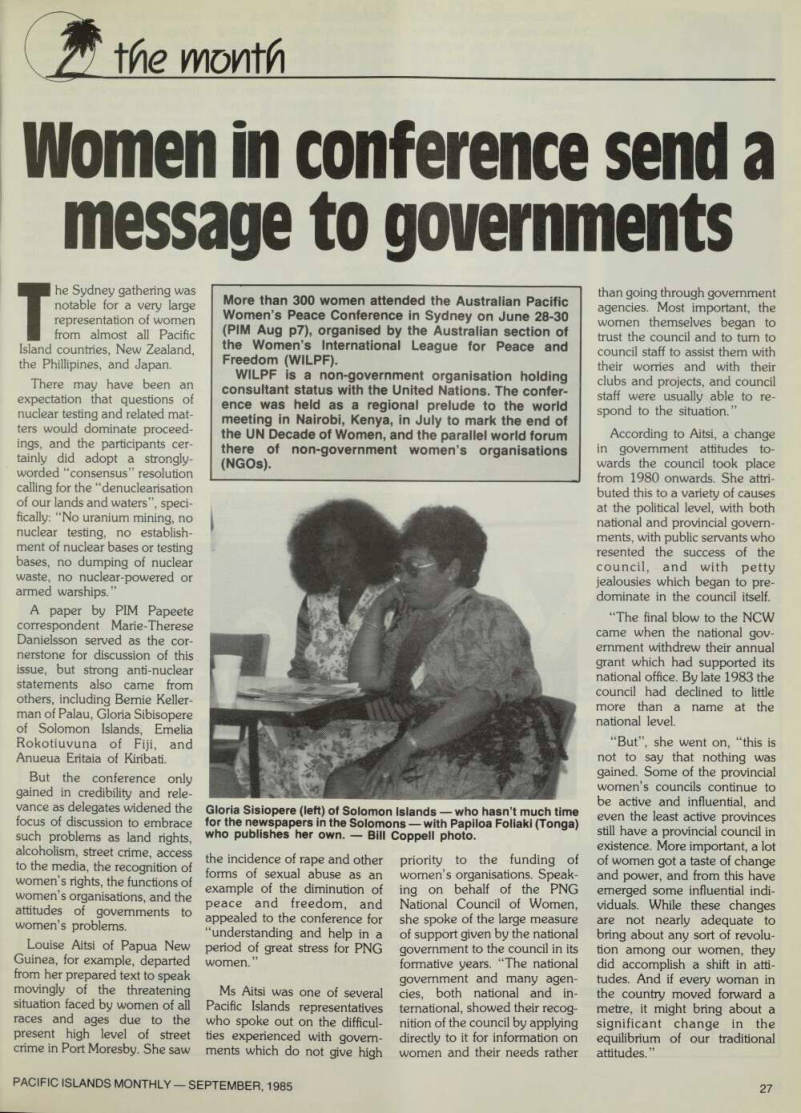

the month
women in conference send a message to governments
The Sydney gathering was notable for a very large representation of women from almost all Pacific Island countries, New Zealand, the Phillipines, and Japan.
There may have been an expectation that questions of nuclear testing and related mat ters would dominate proceed ings, and the participants cer tainly did adopt a strongly worded “consensus” resolution calling for the “denuclearisation of our lands and waters”, speci fically: “No uranium mining, no nuclear testing, no establish ment of nuclear bases or testing bases, no dumping of nuclear waste, no nuclear-powered or armed warships.”
A paper by PIM Papeete correspondent Marie-Therese Danielsson served as the cor nerstone for discussion of this issue, but strong anti-nuclear statements also came from others, including Bemie Keller man of Palau, Gloria Sibisopere of Solomon Islands, Emelia Rokotiuvuna of Fiji, and Anueua Eritaia of Kiribati.
But the conference only gained in credibility and rele vance as delegates widened the focus of discussion to embrace such problems as land rights, alcoholism, street crime, access to the media, the recognition of women’s rights, the functions of women’s organisations, and the attitudes of governments to women’s problems.
Louise Aitsi of Papua New Guinea, for example, departed from her prepared text to speak movingly of the threatening situation faced by women of all races and ages due to the present high level of street crime in Port Moresby. She saw
More than 300 women attended the Australian Pacific Women’s Peace Conference in Sydney on June 28-30 (PIM Aug p 7), organised by the Australian section of the Women’s International League for Peace and Freedom (WILPF).
WILPF is a non-government organisation holding consultant status with the United Nations. The confer ence was held as a regional prelude to the world meeting in Nairobi, Kenya, in July to mark the end of the UN Decade of Women, and the parallel world forum there of non-government women’s organisations
(Ngos).
the incidence of rape and other forms of sexual abuse as an example of the diminution of peace and freedom, and appealed to the conference for “understanding and help in a period of great stress for PNG women. ”
Ms Aitsi was one of several Pacific Islands representatives who spoke out on the difficul ties experienced with govern ments which do not give high
priority to the funding of women’s organisations. Speak ing on behalf of the PNG National Council of Women, she spoke of the large measure of support given by the national government to the council in its formative years. “The national government and many agen cies, both national and in ternational, showed their recog nition of the council by applying directly to it for information on women and their needs rather
than going through government agencies. Most important, the women themselves began to trust the council and to turn to council staff to assist them with their worries and with their clubs and projects, and council staff were usually able to re spond to the situation.”
According to Aitsi, a change in government attitudes to wards the council took place from 1980 onwards. She attri buted this to a variety of causes at the political level, with both national and provincial govern ments, with public servants who resented the success of the council, and with petty jealousies which began to pre dominate in the council itself.
“The final blow to the NCW came when the national gov ernment withdrew their annual grant which had supported its national office. By late 1983 the council had declined to little more than a name at the national level.
“But”, she went on, “this is not to say that nothing was gained. Some of the provincial women’s councils continue to be active and influential, and even the least active provinces still have a provincial council in existence. More important, a lot of women got a taste of change and power, and from this have emerged some influential indi viduals. While these changes are not nearly adequate to bring about any sort of revolu tion among our women, they did accomplish a shift in atti tudes. And if every woman in the country moved forward a metre, it might bring about a significant change in the equilibrium of our traditional attitudes.”
Gloria Sisiopere (left) of Solomon Islands who hasn’t much time for the newspapers in the Solomons with Papiloa Foliaki (Tonga) who publishes her own. Bill Coppell photo.
The conference, in one of its 24 resolutions, urged the Nairo bi forum of NGOs to “urge their governments to let the PNG Government know that they wish funding of the NCW to be restored. ”
Kathleen Solomons of Vanuatu spoke of the establish ment and growth of the Vanuatu National Council of Women, which was “not formed at one sitting of a conference, but was an idea that was accepted and is still being developed very slowly, according to the pace of the majority of Vanuatu women who live very traditional lives.”
Flo Kennedy spoke as a Torres Strait Islander, and illus trated the complexity of the origins of many islanders by referring to her “Torres Strait, Polynesian, and Australian Aboriginal” background. She spoke both as a representative of the Pacific peoples and as a member of a community seek ing redress from Australia by way of the recognition of land rights in the Torres Strait Is lands.
A New Zealand Maori perspective was added to the
debates on land rights and self-determination by Denise Messiter. She told the confer ence: “We, the indigenous people of Aotearoa, stress that striving for peace, freedom and nuclear disarmament is at pre sent only an ideal, for the same system which by its nature and design seeks to exploit our natural resources, locks the Maori people of Aotearoa into the mechanics of possible glo bal destruction. Nuclear dis armament, peace and freedom will only be a reality when we, the indigenous people of Aotearoa, one of the indi genous peoples of Te Moana Nui a Kiwa, have the right to political self-determination. ”
The conference devoted sig nificant time to problems associated with the dissemina tion of information. Problems arising from government or multi-national control of the media were fully canvassed, and the role of grassroots publications analysed.
Papiloa Foliaki, a Tongan businesswoman, spoke about the need to have access to a form of media not controlled by government, although she
stressed that in the case of Tonga she did not encounter a great measure of opposition from the Tongan Government when she set up her tourist and general newspapers. She rather rejoiced in the fact that the government printer was prin ting her publications.
Gloria Sibisopere, represen ting the YWCA and the Na tional Council of Women in Solomon Islands, took up the problems experienced in the Solomons in providing informa tion for women. She said: “The general aim is to help with the sharing of relevant information, both locally and internationally, especially aimed at women, for women, by women. Our local papers display a total lack of interest in anything related to any women’s issues, and are useless as an educational or communication medium. They will occasionally print a letter to the editor from an outraged male who is offended personal ly by some issue for exam ple, the question of women attending overseas training courses, or why there are so many unmarried mothers.”
Bill Coppell
Marie-Therese Danielsson (French Polynesia) a keynote address. Bill Coppell photo.
Advertisements & other items, p. 28 (1 item)
Acific
CONSTRUCTION EQUIPMENT CO
introducing the Dynamic Hew Range of
vibrating S Pneumatic Tyred Rollers
THE RANGE
• Pacific Self-Propelled Vibrating Rollers • Single and Double Drum Types • 1.5 tonne to 16 tonne • Pacific Self-Propelled Pneumatic Type Compactors • 3 Models 16. 21. 38 tonne Ballast Weights • Pacific Landfill and Sanitary Landfill Compactors • Pacific Pneumatic Earth Borers • Pacific Road Brooms • Pacific Railway Maintenance Vehicles
DISTRIBUTORS REQUIRED
THROUGHOUT THE PACIFIC
Construction Equipment Co. 24 Salisbury Road, Hornsby NSW 2077, Australia. Phone (02) 476 2666
SAL
y?LiTS?3E
long time..."
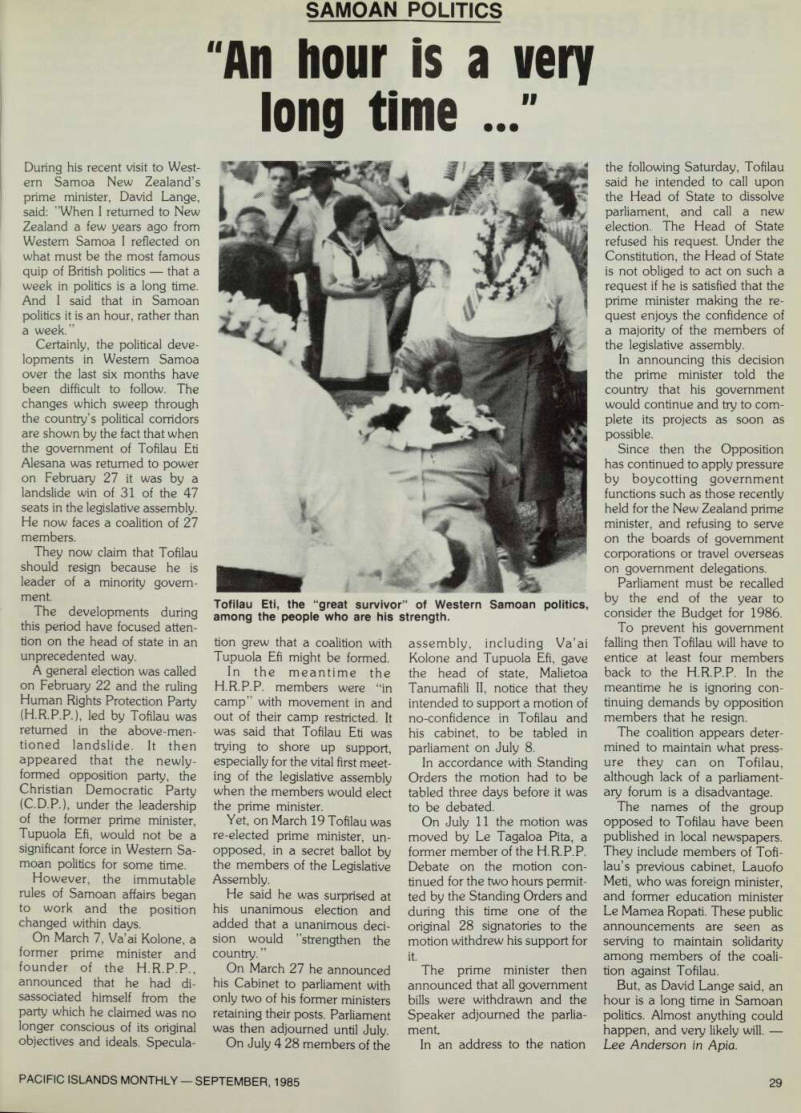
Samoan Politics
"An hour is a very long time..."
During his recent visit to West ern Samoa New Zealand’s prime minister, David Lange, said: ’’When I returned to New Zealand a few years ago from Western Samoa I reflected on what must be the most famous quip of British politics that a week in politics is a long time.
And I said that in Samoan politics it is an hour, rather than a week.”
Certainly, the political deve lopments in Western Samoa over the last six months have been difficult to follow. The changes which sweep through the country’s political corridors are shown by the fact that when the government of Tofilau Eti Alesana was returned to power on February 27 it was by a landslide win of 31 of the 47 seats in the legislative assembly.
He now faces a coalition of 27 members.
They now claim that Tofilau should resign because he is leader of a minority govern ment.
The developments during this period have focused atten tion on the head of state in an unprecedented way.
A general election was called on February 22 and the ruling Human Rights Protection Party (H.R.P.P.), led by Tofilau was returned in the above-men tioned landslide. It then appeared that the newly formed opposition party, the Christian Democratic Party (C.D.P.), under the leadership of the former prime minister, Tupuola Efi, would not be a significant force in Western Sa moan politics for some time.
However, the immutable rules of Samoan affairs began to work and the position changed within days.
On March 7, Va’ai Kolone, a former prime minister and founder of the H.R.P.P., announced that he had di sassociated himself from the party which he claimed was no longer conscious of its original objectives and ideals. Specula-
tion grew that a coalition with Tupuola Efi might be formed.
In the meantime the H.R.P.P. members were “in camp” with movement in and out of their camp restricted. It was said that Tofilau Eti was trying to shore up support, especially for the vital first meet ing of the legislative assembly when the members would elect the prime minister.
Yet, on March 19 Tofilau was re-elected prime minister, un opposed, in a secret ballot by the members of the Legislative Assembly.
He said he was surprised at his unanimous election and added that a unanimous deci sion would ’’strengthen the country. ”
On March 27 he announced his Cabinet to parliament with only two of his former ministers retaining their posts. Parliament was then adjourned until July.
On July 4 28 members of the
assembly, including Va’ai Kolone and Tupuola Efi, gave the head of state, Malietoa Tanumafili 11, notice that they intended to support a motion of no-confidence in Tofilau and his cabinet, to be tabled in parliament on July 8.
In accordance with Standing Orders the motion had to be tabled three days before it was to be debated.
On July 11 the motion was moved by Le Tagaloa Pita, a former member of the H.R.P.P.
Debate on the motion con tinued for the two hours permit ted by the Standing Orders and during this time one of the original 28 signatories to the motion withdrew his support for it.
The prime minister then announced that all government bills were withdrawn and the Speaker adjourned the parlia ment In an address to the nation
the following Saturday, Tofilau said he intended to call upon the Head of State to dissolve parliament, and call a new election. The Head of State refused his request. Under the Constitution, the Head of State is not obliged to act on such a request if he is satisfied that the prime minister making the re quest enjoys the confidence of a majority of the members of the legislative assembly.
In announcing this decision the prime minister told the country that his government would continue and try to com plete its projects as soon as possible.
Since then the Opposition has continued to apply pressure by boycotting government functions such as those recently held for the New Zealand prime minister, and refusing to serve on the boards of government corporations or travel overseas on government delegations.
Parliament must be recalled by the end of the year to consider the Budget for 1986.
To prevent his government falling then Tofilau will have to entice at least four members back to the H.R.P.P. In the meantime he is ignoring con tinuing demands by opposition members that he resign.
The coalition appears deter mined to maintain what press ure they can on Tofilau, although lack of a parliament ary forum is a disadvantage.
The names of the group opposed to Tofilau have been published in local newspapers.
They include members of Tofi lau’s previous cabinet, Lauofo Meti, who was foreign minister, and former education minister Le Mamea Ropati. These public announcements are seen as serving to maintain solidarity among members of the coali tion against Tofilau.
But, as David Lange said, an hour is a long time in Samoan politics. Almost anything could happen, and very likely will.
Lee Anderson in Apia.
Tofilau Eti, the “great survivor” of Western Samoan politics, among the people who are his strength.
Tahiti carries it off with a successful culturefest
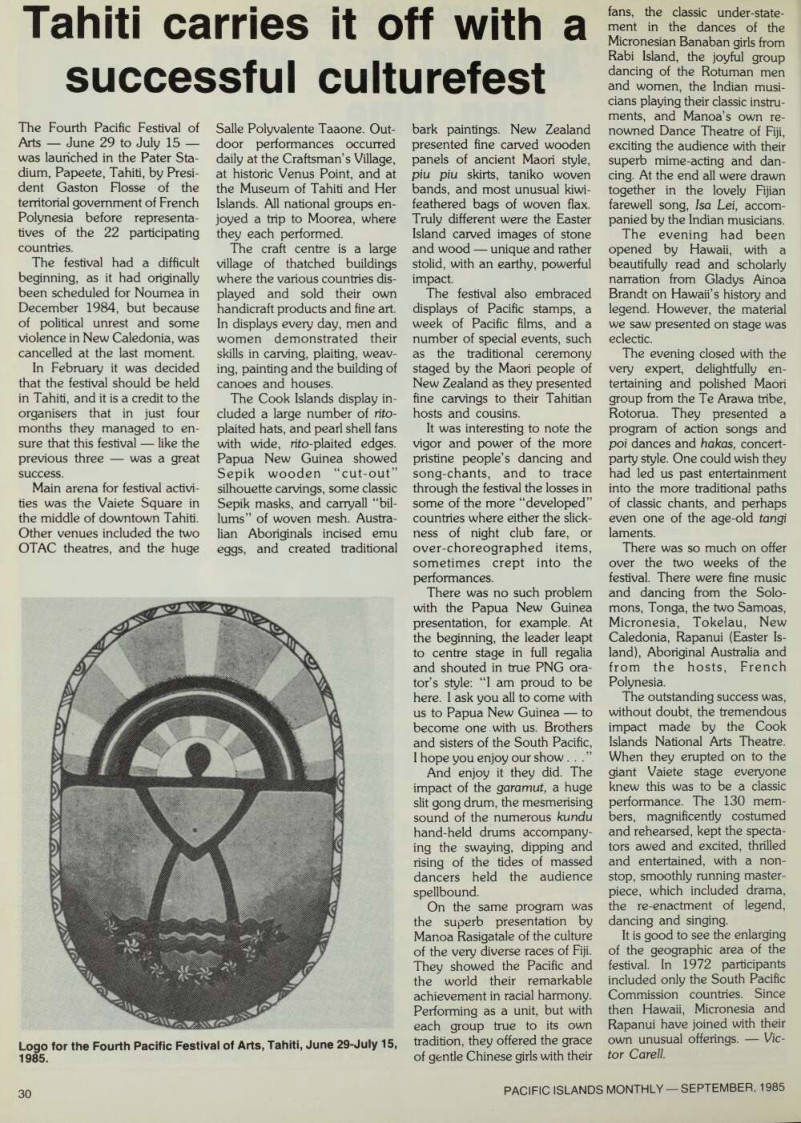
successful culturefest
The Fourth Pacific Festival of Arts June 29 to July 15 was launched in the Pater Sta dium, Papeete, Tahiti, by Presi dent Gaston Flosse of the territorial government of French Polynesia before representa tives of the 22 participating countries.
The festival had a difficult beginning, as it had originally been scheduled for Noumea in December 1984, but because of political unrest and some violence in New Caledonia, was cancelled at the last moment.
In February it was decided that the festival should be held in Tahiti, and it is a credit to the organisers that in just four months they managed to en sure that this festival like the previous three was a great success.
Main arena for festival activi ties was the Vaiete Square in the middle of downtown Tahiti.
Other venues included the two OTAC theatres, and the huge
Salle Polyvalente Taaone. Out door performances occurred daily at the Craftsman’s Village, at historic Venus Point, and at the Museum of Tahiti and Her Islands. All national groups en joyed a trip to Moorea, where they each performed.
The craft centre is a large village of thatched buildings where the various countries dis played and sold their own handicraft products and fine art.
In displays every day, men and women demonstrated their skills in carving, plaiting, weav ing, painting and the building of canoes and houses.
The Cook Islands display in cluded a large number of rito plaited hats, and pearl shell fans with wide, rite-plaited edges.
Papua New Guinea showed Scpik wooden “cut-out” silhouette carvings, some classic Sepik masks, and carryall “bil lums” of woven mesh. Austra lian Aboriginals incised emu eggs, and created traditional
bark paintings. New Zealand presented fine carved wooden panels of ancient Maori style, piu piu skirts, taniko woven bands, and most unusual kiwi feathered bags of woven flax.
Truly different were the Easter Island carved images of stone and wood unique and rather stolid, with an earthy, powerful impact.
The festival also embraced displays of Pacific stamps, a week of Pacific films, and a number of special events, such as the traditional ceremony staged by the Maori people of New Zealand as they presented fine carvings to their Tahitian hosts and cousins.
It was interesting to note the vigor and power of the more pristine people’s dancing and song-chants, and to trace through the festival the losses in some of the more “developed” countries where either the slick ness of night club fare, or over-choreographed items, sometimes crept into the performances.
There was no such problem with the Papua New Guinea presentation, for example. At the beginning, the leader leapt to centre stage in full regalia and shouted in true PNG ora tor’s style: “I am proud to be here. I ask you all to come with us to Papua New Guinea to become one with us. Brothers and sisters of the South Pacific, I hope you enjoy our show...”
And enjoy it they did. The impact of the garamut, a huge slit gong drum, the mesmerising sound of the numerous kundu hand-held drums accompany ing the swaying, dipping and rising of the tides of massed dancers held the audience spellbound.
On the same program was the superb presentation by Manoa Rasigatale of the culture of the very diverse races of Fiji.
They showed the Pacific and the world their remarkable achievement in racial harmony.
Performing as a unit, but with each group true to its own tradition, they offered the grace of gentle Chinese girls with their
fans, the classic under-state ment in the dances of the Micronesian Banaban girls from Rabi Island, the joyful group dancing of the Rotuman men and women, the Indian musi cians playing their classic instru ments, and Manoa’s own re nowned Dance Theatre of Fiji, exciting the audience with their superb mime-acting and dan cing. At the end all were drawn together in the lovely Fijian farewell song, Isa Lei, accom panied by the Indian musicians.
The evening had been opened by Hawaii, with a beautifully read and scholarly narration from Gladys Ainoa Brandt on Hawaii’s history and legend. However, the material we saw presented on stage was eclectic.
The evening closed with the very expert, delightfully en tertaining and polished Maori group from the Te Arawa tribe, Rotorua. They presented a program of action songs and poi dances and hakas, concert party style. One could wish they had led us past entertainment into the more traditional paths of classic chants, and perhaps even one of the age-old tangi laments.
There was so much on offer over the two weeks of the festival. There were fine music and dancing from the Solo mons, Tonga, the two Samoas, Micronesia, Tokelau, New Caledonia, Rapanui (Easter Is land), Aboriginal Australia and from the hosts, French Polynesia.
The outstanding success was, without doubt, the tremendous impact made by the Cook Islands National Arts Theatre.
When they erupted on to the giant Vaiete stage everyone knew this was to be a classic performance. The 130 mem bers, magnificently costumed and rehearsed, kept the specta tors awed and excited, thrilled and entertained, with a non stop, smoothly running master piece, which included drama, the re-enactment of legend, dancing and singing.
It is good to see the enlarging of the geographic area of the festival. In 1972 participants included only the South Pacific Commission countries. Since then Hawaii, Micronesia and Rapanui have joined with their own unusual offerings. Vic tor Carell.
Logo for the Fourth Pacific Festival of Arts, Tahiti, June 29-July 15, 1985.
Financiers see good future
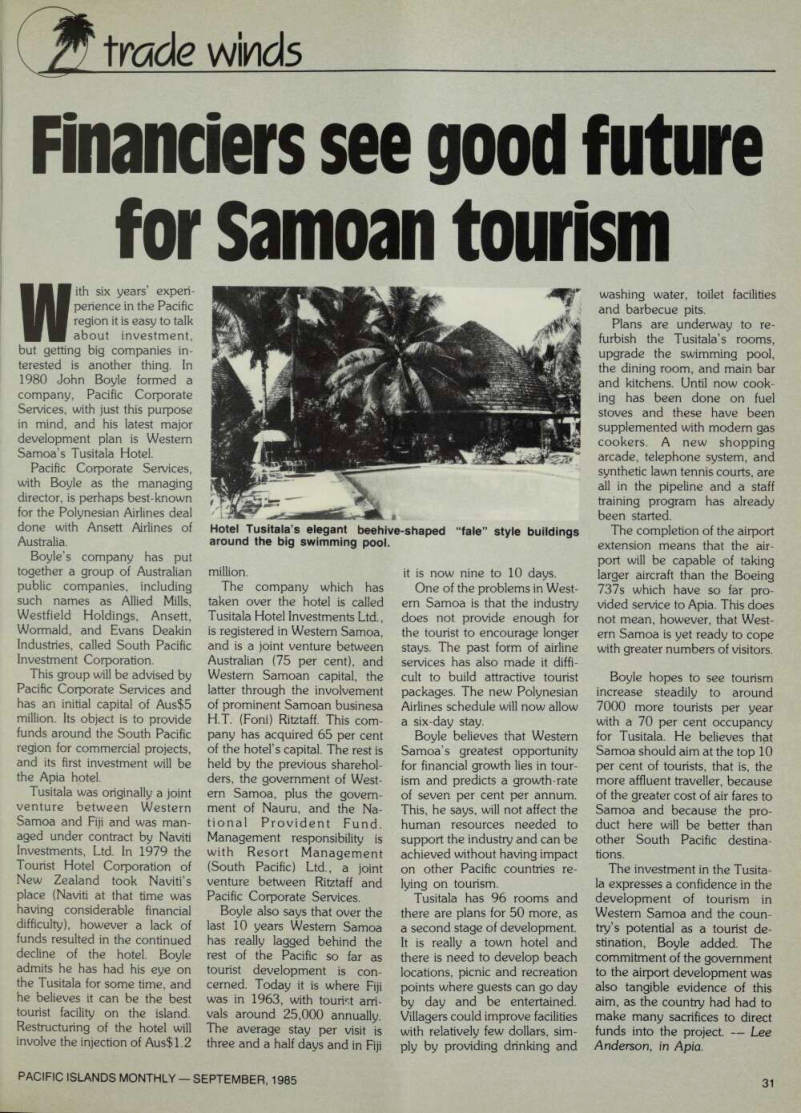
trade winds
Financiers see good future for Samoan tourism
With six years’ experi perience in the Pacific region it is easy to talk about investment, but getting big companies in terested is another thing. In 1980 John Boyle formed a company, Pacific Corporate Services, with just this purpose in mind, and his latest major development plan is Western Samoa’s Tusitala Hotel.
Pacific Corporate Services, with Boyle as the managing director, is perhaps best-known for the Polynesian Airlines deal done with Ansett Airlines of Australia.
Boyle’s company has put together a group of Australian public companies, including such names as Allied Mills, Westfield Holdings, Ansett, Wormald, and Evans Deakin Industries, called South Pacific Investment Corporation.
This group will be advised by Pacific Corporate Services and has an initial capital of Ausss million. Its object is to provide funds around the South Pacific region for commercial projects, and its first investment will be the Apia hotel.
Tusitala was originally a joint venture between Western Samoa and Fiji and was man aged under contract by Naviti Investments, Ltd. In 1979 the Tourist Hotel Corporation of New Zealand took Naviti’s place (Naviti at that time was having considerable financial difficulty), however a lack of funds resulted in the continued decline of the hotel. Boyle admits he has had his eye on the Tusitala for some time, and he believes it can be the best tourist facility on the island.
Restructuring of the hotel will involve the injection of Aussl.2
million.
The company which has taken over the hotel is called Tusitala Hotel Investments Ltd., is registered in Western Samoa, and is a joint venture between Australian (75 per cent), and Western Samoan capital, the latter through the involvement of prominent Samoan businesa H.T. (Foni) Ritztaff. This com pany has acquired 65 per cent of the hotel’s capital. The rest is held by the previous sharehol ders, the government of West ern Samoa, plus the govern ment of Nauru, and the Na tional Provident Fund.
Management responsibility is with Resort Management (South Pacific) Ltd., a joint venture between Ritztaff and Pacific Corporate Services.
Boyle also says that over the last 10 years Western Samoa has really lagged behind the rest of the Pacific so far as tourist development is con cerned. Today it is where Fiji was in 1963, with tourist arri vals around 25,000 annually.
The average stay per visit is three and a half days and in Fiji
it is now nine to 10 days.
One of the problems in West ern Samoa is that the industry does not provide enough for the tourist to encourage longer stays. The past form of airline services has also made it diffi cult to build attractive tourist packages. The new Polynesian Airlines schedule will now allow a six-day stay.
Boyle believes that Western Samoa’s greatest opportunity for financial growth lies in tour ism and predicts a growth -rate of seven per cent per annum.
This, he says, will not affect the human resources needed to support the industry and can be achieved without having impact on other Pacific countries re lying on tourism.
Tusitala has 96 rooms and there are plans for 50 more, as a second stage of development.
It is really a town hotel and there is need to develop beach locations, picnic and recreation points where guests can go day by day and be entertained.
Villagers could improve facilities with relatively few dollars, sim ply by providing drinking and
washing water, toilet facilities and barbecue pits.
Plans are underway to re furbish the Tusitala’s rooms, upgrade the swimming pool, the dining room, and main bar and kitchens. Until now cook ing has been done on fuel stoves and these have been supplemented with modern gas cookers. A new shopping arcade, telephone system, and synthetic lawn tennis courts, are all in the pipeline and a staff training program has already been started.
The completion of the airport extension means that the air port will be capable of taking larger aircraft than the Boeing 737s which have so far pro vided service to Apia. This does not mean, however, that West ern Samoa is yet ready to cope with greater numbers of visitors.
Boyle hopes to see tourism increase steadily to around 7000 more tourists per year with a 70 per cent occupancy for Tusitala. He believes that Samoa should aim at the top 10 per cent of tourists, that is, the more affluent traveller, because of the greater cost of air fares to Samoa and because the pro duct here will be better than other South Pacific destina tions.
The investment in the Tusita la expresses a confidence in the development of tourism in Western Samoa and the coun try’s potential as a tourist de stination, Boyle added. The commitment of the government to the airport development was also tangible evidence of this aim, as the country had had to make many sacrifices to direct
funds into the project.
Lee
Anderson, in Apia.
Hotel Tusitala’s elegant beehive-shaped “tale” style buildings around the big swimming pool.
Advertisements & other items, p. 32 (1 item)
Cj) Pioneer*
Pioneer breaks new ground
in digital sound.
Jo modern audio technology can compare with digital audio, ne laser beam-tracking technology revolutionizing the industry.
Digital audio’s dynamic range is literally peerless. Its signal- D-noise ratio is strictly unparalleled. And every digital audio ignal is absolutely free of wow and flutter.
Still, sound quality and “playability” can vary significantly rom one Compact Disc system to another. The fact is it’s i question of error correction circuitry.
Pioneer’s PD-5010(BK) Compact Disc Player represents i breakthrough in this area, with revolutionary Pure Signal ransmission— a network of technologies for outstanding racking, laser pickup, and sound quality.
One of these technologies is a Disc Stabilizer. It dramatically nproves signal readout accuracy for sharper, clearer sound because it prevents disc vibration, which can adversely affect sound quality.
Another is a Linear Servo System. It assures you of pinpoint focusing, accurate tracking, and constant linear velocity even when a disc is dirty or scratched.
Then there’s Focus Parallel Drive for responsive control of the servo system. Plus Parallel Suspension for flawless tracking of even grossly warped discs.
Taken from a practical perspective, the PD-5010(BK) is equally impressive. With Random Access Programming of up to 27 tracks, Track Search, Manual Search, and Repeat.
After all, the PD-5010(BK) is from Pioneer, the first word in audio. And breaking ground at Pioneer is an established tradition.
CJ) PIONEER*
For further information, please contact: Australia: Pioneer Electronics Australia Pty. Ltd. (Incorporated in Victoria), P.O. Box 295, Mordialloc, Victoria, 3195 Tel: 580-9911 Fuji Islands: Brijlal & Company, G.P.O. Box No. 362, Suva, Fiji Islands Tel: 22258 New Zealand: Monaco Distributors Ltd., 2 Poland Road, Glenfield, Auckland, New Zealand Tel: (09) 444-9144 Norfolk Island: Burns Philp (Norfolk Island) Ltd., P.O. Box 21, Norfolk Island Vanuatu: Burns Philp (Vanuatu) Ltd., Vila, Vanuatu Nauru Island: Jacob Enterprises, P.O. Box No. 4, Republic of Nauru Tahiti: Tahiti Hi-Fi, P.O. Box 848, Papeete, Tahiti New Caledonia: Menard Pacifique Sari, B.P. 3899, Noumea, New Caledonia Tel: 27.62-23 American Samoa: Transpac Corporation, P.O. Box 1477, Pago Pago, American Samoa 96799 Tel: 633-5224 Rarotonga: South Seas International Ltd., P.O. Box 49, Rarotonga, Cook Islands Tel: 2327 Papua New Guinea; Bali Merchants Pty. Ltd, P.O. Box 6103, Boroko Tel: 254887
understand SPARTECA”
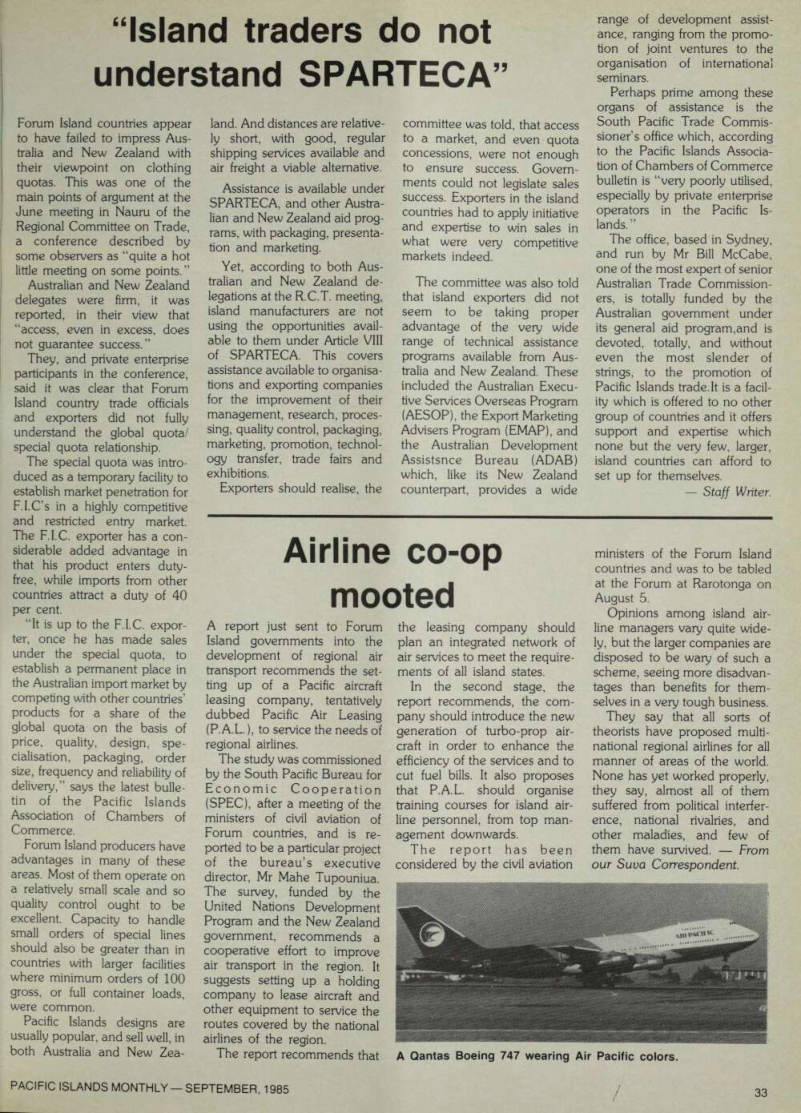
“Island traders do not understand SPARTECA”
Forum Island countries appear to have failed to impress Aus tralia and New Zealand with their viewpoint on clothing quotas. This was one of the main points of argument at the June meeting in Nauru of the Regional Committee on Trade, a conference described by some observers as “quite a hot little meeting on some points.”
Australian and New Zealand delegates were firm, it was reported, in their view that “access, even in excess, does not guarantee success.”
They, and private enterprise participants in the conference, said it was clear that Forum Island country trade officials and exporters did not fully understand the global quota/ special quota relationship.
The special quota was intro duced as a temporary facility to establish market penetration for F.l.C’s in a highly competitive and restricted entry market.
The F.I.C. exporter has a con siderable added advantage in that his product enters duty free, while imports from other countries attract a duty of 40 per cent.
“It is up to the F.I.C. expor ter, once he has made sales under the special quota, to establish a permanent place in the Australian import market by competing with other countries’ products for a share of the global quota on the basis of price, quality, design, spe cialisation, packaging, order size, frequency and reliability of delivery,” says the latest bulle tin of the Pacific Islands Association of Chambers of Commerce.
Forum Island producers have advantages in many of these areas. Most of them operate on a relatively small scale and so quality control ought to be excellent. Capacity to handle small orders of special lines should also be greater than in countries with larger facilities where minimum orders of 100 gross, or full container loads, were common.
Pacific Islands designs are usually popular, and sell well, in both Australia and New Zea
land. And distances are relative ly short, with good, regular shipping services available and air freight a viable alternative.
Assistance is available under SPARTECA, and other Austra lian and New Zealand aid prog rams, with packaging, presenta tion and marketing.
Yet, according to both Aus tralian and New Zealand de legations at the R.C.T. meeting, island manufacturers are not using the opportunities avail able to them under Article VIII of SPARTECA. This covers assistance available to organisa tions and exporting companies for the improvement of their management, research, proces sing, quality control, packaging, marketing, promotion, technol ogy transfer, trade fairs and exhibitions.
Exporters should realise, the
committee was told, that access to a market, and even quota concessions, were not enough to ensure success. Govern ments could not legislate sales success. Exporters in the island countries had to apply initiative and expertise to win sales in what were very competitive markets indeed.
The committee was also told that island exporters did not seem to be taking proper advantage of the very wide range of technical assistance programs available from Aus tralia and New Zealand. These included the Australian Execu tive Services Overseas Program (AESOP), the Export Marketing Advisers Program (EMAP), and the Australian Development Assistsnce Bureau (ADAB) which, like its New Zealand counterpart, provides a wide
range of development assist ance, ranging from the promo tion of joint ventures to the organisation of international seminars.
Perhaps prime among these organs of assistance is the South Pacific Trade Commis sioner’s office which, according to the Pacific Islands Associa tion of Chambers of Commerce bulletin is “very poorly utilised, especially by private enterprise operators in the Pacific Is lands.”
The office, based in Sydney, and run by Mr Bill McCabe, one of the most expert of senior Australian Trade Commission ers, is totally funded by the Australian government under its general aid program,and is devoted, totally, and without even the most slender of strings, to the promotion of Pacific Islands trade.lt is a facil ity which is offered to no other group of countries and it offers support and expertise which none but the very few, larger, island countries can afford to set up for themselves.
Staff Writer.
Airline co-op
mooted
A report just sent to Forum Island governments into the development of regional air transport recommends the set ting up of a Pacific aircraft leasing company, tentatively dubbed Pacific Air Leasing (P.A.L.), to service the needs of regional airlines.
The study was commissioned by the South Pacific Bureau for Economic Cooperation (SPEC), after a meeting of the ministers of civil aviation of Forum countries, and is re ported to be a particular project of the bureau’s executive director, Mr Mahe Tupouniua.
The survey, funded by the United Nations Development Program and the New Zealand government, recommends a cooperative effort to improve air transport in the region. It suggests setting up a holding company to lease aircraft and other equipment to service the routes covered by the national airlines of the region.
The report recommends that
the leasing company should plan an integrated network of air services to meet the require ments of all island states.
In the second stage, the report recommends, the com pany should introduce the new generation of turbo-prop air craft in order to enhance the efficiency of the services and to cut fuel bills. It also proposes that P.A.L. should organise training courses for island air line personnel, from top man agement downwards.
The report has been considered by the civil aviation
ministers of the Forum Island countries and was to be tabled at the Forum at Rarotonga on August 5.
Opinions among island air line managers vary quite wide ly, but the larger companies are disposed to be wary of such a scheme, seeing more disadvan tages than benefits for them selves in a very tough business.
They say that all sorts of theorists have proposed multi national regional airlines for all manner of areas of the world.
None has yet worked properly, they say, almost all of them suffered from political interfer ence, national rivalries, and other maladies, and few of them have survived. From our Suva Correspondent.
A Qantas Boeing 747 wearing Air Pacific colors.
Advertisements & other items, pp. 34-36 (1 item)
Toyota
m
m
TOYOTA
QUALITY SERVICE
AMERICAN SAMOA: BURNS PHILP (SOUTH SEA) CO., LTD., P.O. Box 129, Pago Pago.
COOK ISLANDS: COOK ISLANDS TRADING
CORPORATION LTD., Private Bag, Rarotonga.
FIJI: AUTOMOTIVE SUPPLIES COMPANY, A Division of Burns Philp (South Sea) Co., Ltd., G.P.O. Box 355, Suva.
GUAM & MICRONESIA: ATKINS KROLL, INC., 443 South Marine Drive, Tamuning.
KIRIBATI: TARAWA MOTORS, P.O. Box 36, Bairiki, Tarawa.
NAURU: NAURU COOPERATIVE SOCIETY, Centn
Pacific.
NEW CALEDONIA: SERVICE IMPORTATION
AUTOMOBILE DU PACIFIQUE, Rond-Point du Paci (Station Total) B.P. 438, Noumea.
NORFOLK ISLAND: BORRYS LIMITED, P.O. Bo>
PAPUA NEW GUINEA: ELA MOTORS, A Divisi< Burns Philp (PNG) Ltd., P.O. Box 75, Port Moresb: SAIPAN: MICROL CORPORATION, P.O. Box 267, Si
Fhe tradition of power and ruggedness
Toyota’s new Land Cruiser has been entirely from the road up. But it still stains the traditional toughness cquired from over thirty years f road experience.
But no matter how rough it gets a roomy new cabin with improved occupant comforts, easy instrumentation and an optional 4-speed automatic transmission add up to passenger car comfort with Land Cruiser ruggedness.
More power in hand and fuel efficiency have been gained with a new brawny 4.0-litre gasoline engine.
And to control all that power a new rigid chassis assures stable driving performance and mobility over the roughest terrain. on.
Pickup
And you can choose from a wide variety of models and an array of heavy-duty features.
Take the wheel and feel Toyota quality in Land Cruiser’s styling, power and comfort. A quality that stays with you on or off the road.
Step into a new generation of toughness today.
OLOMON: SOLOMON ISLANDS INVESTMENTS LTD.,
•P.O. Box 174, Honiara.
AHITI: NIPPON AUTOMOTO, B.P. 342, Papeete.
ONGA: BURNS PHILP (SOUTH SEA) CO., LTD., P.O. ox 55, Nukualofa.
AHUATU: VANUATU MOTORS, A Division of Burns hilp (Vanuatu) Ltd., P.O. Box 18, Port Vila.
FESTERN SAMOA: BURNS PHILP (SOUTH SEA) CO., FD., P.O. Box 188, Apia.
TOYOTA
ns not me iuck or a leprecnaun out me crart or Lianon mat will lead you to uncompromising stereo sound quality. Even in the compromising environment of a moving automobile. Clarion's advanced electronics makes possible a wide spectrum of convenient, easy-to-use features The Clarion choice of models is positively dazzling. And our reliability is I o r jf\r| no fairy tale. Come, listen to a Clarion Car Stereo. And drive happily ever after. 'mW I lUI THE TREASURE AT THE END OF THE RAINBOW IM® ar 900 E
mno
i u m mti
Bni
LD AFC
mm For further information Australia; Amalgamated Wireless (Australasia) Ltd., 554 Parramatta Road, Ashfield, N.S W., 2131 / New Zealand; AWA New Zealand Limited, P.O. Box 50-248, Ponrua / Fiji Islands: Bnjlal & Co., Ltd., G.P.O. Box 362, Suva Tahiti: HI FL, VAIRAATOA Avenue Chef Vairaatoa BP. 1128, Papeete I New Caledonia; Caldis, 8.P.M1, Noumea Cedex / Guam: Micropac Audio Inc, PO. Box 3478, Agana, Guam 96910, US A Tel: 472-8091, Cable Code: HIFI AUDIO AGANA / Vanuatu: The Sound Centre, PO. Box 434, Vila / Cook Islands: South Seas International Ltd., P,O. Box 49, Rarotonga / Papua New Guinea: Hagemeyer (P N G.) Pty. Ltd., P.O. Box 1428, Boroko, Port Moresby.
bankruptcy
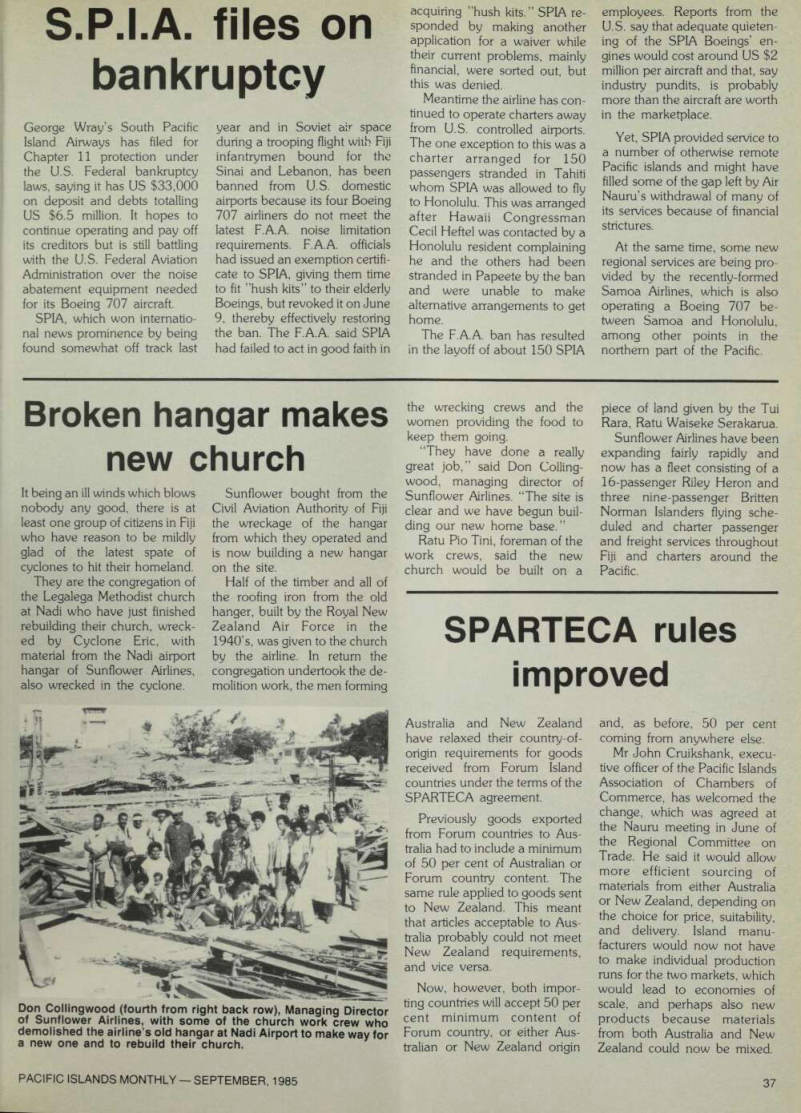
S.P.I.A. files on bankruptcy
George Wray’s South Pacific Island Airways has filed for Chapter 11 protection under the U.S. Federal bankruptcy laws, saying it has US $33,000 on deposit and debts totalling US $6.5 million. It hopes to continue operating and pay off its creditors but is still battling with the U.S. Federal Aviation Administration over the noise abatement equipment needed for its Boeing 707 aircraft.
SPIA, which won internatio nal news prominence by being found somewhat off track last
year and in Soviet air space during a trooping flight with Fiji infantrymen bound for the Sinai and Lebanon, has been banned from U.S. domestic airports because its four Boeing 707 airliners do not meet the latest F.A.A. noise limitation requirements. F.A.A. officials had issued an exemption certifi cate to SPIA, giving them time to fit ’’hush kits” to their elderly Boeings, but revoked it on June 9, thereby effectively restoring the ban. The F.A.A. said SPIA had failed to act in good faith in
acquiring ’’hush kits.” SPIA re sponded by making another application for a waiver while their current problems, mainly financial, were sorted out, but this was denied.
Meantime the airline has con tinued to operate charters away from U.S. controlled airports.
The one exception to this was a charter arranged for 150 passengers stranded in Tahiti whom SPIA was allowed to fly to Honolulu. This was arranged after Hawaii Congressman Cecil Heftel was contacted by a Honolulu resident complaining he and the others had been stranded in Papeete by the ban and were unable to make alternative arrangements to get home.
The F.A.A. ban has resulted in the layoff of about 150 SPIA
employees. Reports from the U.S. say that adequate quieten ing of the SPIA Boeings’ en gines would cost around US $2 million per aircraft and that, say industry pundits, is probably more than the aircraft are worth in the marketplace.
Yet, SPIA provided service to a number of otherwise remote Pacific islands and might have filled some of the gap left by Air Nauru’s withdrawal of many of its services because of financial strictures.
At the same time, some new regional services are being pro vided by the recently-formed Samoa Airlines, which is also operating a Boeing 707 be tween Samoa and Honolulu, among other points in the northern part of the Pacific.
Broken hangar makes
new church
It being an ill winds which blows nobody any good, there is at least one group of citizens in Fiji who have reason to be mildly glad of the latest spate of cyclones to hit their homeland.
They are the congregation of the Legalega Methodist church at Nadi who have just finished rebuilding their church, wreck ed by Cyclone Eric, with material from the Nadi airport hangar of Sunflower Airlines, also wrecked in the cyclone.
Sunflower bought from the Civil Aviation Authority of Fiji the wreckage of the hangar from which they operated and is now building a new hangar on the site.
Half of the timber and all of the roofing iron from the old hanger, built by the Royal New Zealand Air Force in the 1940’5, was given to the church by the airline. In return the congregation undertook the de molition work, the men forming
the wrecking crews and the women providing the food to keep them going.
“They have done a really great job,” said Don Colling wood, managing director of Sunflower Airlines. “The site is clear and we have begun buil ding our new home base.”
Ratu Pio Tini, foreman of the work crews, said the new church would be built on a
piece of land given by the Tui Rara, Ratu Waiseke Serakarua.
Sunflower Airlines have been expanding fairly rapidly and now has a fleet consisting of a 16-passenger Riley Heron and three nine-passenger Britten Norman Islanders flying sche duled and charter passenger and freight services throughout Fiji and charters around the Pacific.
Don Collingwood (fourth from right back row), Managing Director of Sunflower Airlines, with some of the church work crew who demolished the airline's old hangar at Nadi Airport to make way for a new one and to rebuild their church.
improved
SPARTECA rules improved
Australia and New Zealand have relaxed their country-of origin requirements for goods received from Forum Island countries under the terms of the SPARTECA agreement.
Previously goods exported from Forum countries to Aus tralia had to include a minimum of 50 per cent of Australian or Forum country content. The same rule applied to goods sent to New Zealand. This meant that articles acceptable to Aus tralia probably could not meet New Zealand requirements, and vice versa.
Now, however, both impor ting countries will accept 50 per cent minimum content of Forum country, or either Aus tralian or New Zealand origin
and, as before, 50 per cent coming from anywhere else.
Mr John Cruikshank, execu tive officer of the Pacific Islands Association of Chambers of Commerce, has welcomed the change, which was agreed at the Nauru meeting in June of the Regional Committee on Trade. He said it would allow more efficient sourcing of materials from either Australia or New Zealand, depending on the choice for price, suitability, and delivery. Island manu facturers would now not have to make individual production runs for the two markets, which would lead to economies of scale, and perhaps also new products because materials from both Australia and New Zealand could now be mixed.
Advertisements & other items, p. 38 (1 item)
.•": ■ . :
■ v 4: ■. f■" ■ ■ At Japan Air Lines we care. We care about everything. So whether it’s a coffee cup that needs refilling or a child that needs attention, we’ll be there. We’ll be there giving you something even more than good service. Good feelings.
It’s always a pleasure.
JAPAN AIR LINES
Masterly volumes
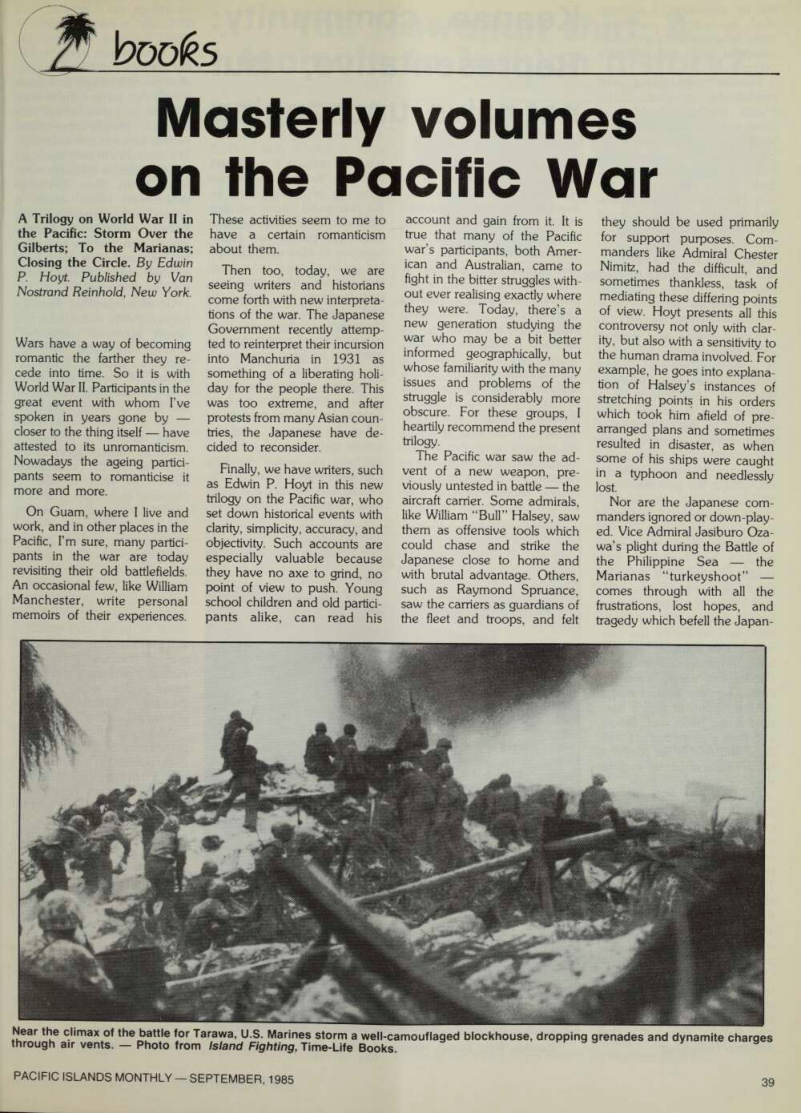
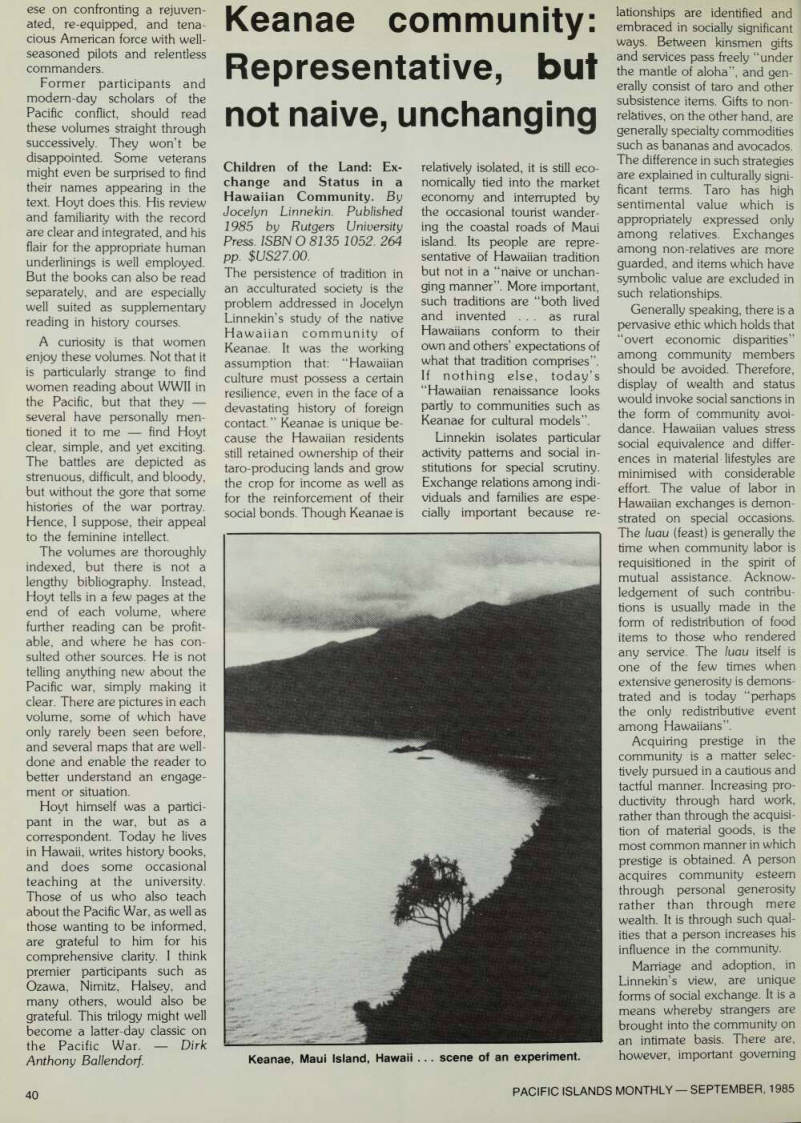
books
Masterly volumes on the Pacific War
A Trilogy on World War II in the Pacific: Storm Over the Gilberts; To the Marianas; Closing the Circle. By Edwin P. Hoyt. Published by Van Nostrand Reinhold, New York.
Wars have a way of becoming romantic the farther they re cede into time. So it is with World War 11. Participants in the great event with whom I’ve spoken in years gone by closer to the thing itself have attested to its unromanticism.
Nowadays the ageing partici pants seem to romanticise it more and more.
On Guam, where I live and work, and in other places in the Pacific, I’m sure, many partici pants in the war are today revisiting their old battlefields.
An occasional few, like William Manchester, write personal memoirs of their experiences.
These activities seem to me to have a certain romanticism about them.
Then too, today, we are seeing writers and historians come forth with new interpreta tions of the war. The Japanese Government recently attemp ted to reinterpret their incursion into Manchuria in 1931 as something of a liberating holi day for the people there. This was too extreme, and after protests from many Asian coun tries, the Japanese have de cided to reconsider.
Finally, we have writers, such as Edwin P. Hoyt in this new trilogy on the Pacific war, who set down historical events with clarity, simplicity, accuracy, and objectivity. Such accounts are especially valuable because they have no axe to grind, no point of view to push. Young school children and old partici pants alike, can read his
account and gain from it. It is true that many of the Pacific war’s participants, both American and Australian, came to fight in the bitter struggles without ever realising exactly where they were. Today, there’s a new generation studying the war who may be a bit better informed geographically, but whose familiarity with the many issues and problems of the struggle is considerably more obscure. For these groups, I heartily recommend the present tr^^0 9V- The Pacific war saw the advent of a new weapon, previously untested in battle the aircraft carrier. Some admirals, like William “Bull” Halsey, saw them as offensive tools which could chase and strike the Japanese close to home and with brutal advantage. Others, such as Raymond Spruance, saw the carriers as guardians of the fleet and troops, and felt
they should be used primarily for support purposes. Com manders like Admiral Chester Nimitz, had the difficult, and sometimes thankless, task of mediating these differing points of view. Hoyt presents all this controversy not only with clar ity, but also with a sensitivity to the human drama involved. For example, he goes into explana tion of Halsey’s instances of stretching points in his orders which took him afield of pre arranged plans and sometimes resulted in disaster, as when some of his ships were caught in a typhoon and needlessly lost.
Nor are the Japanese com manders ignored or down-play ed. Vice Admiral Jasiburo Oza wa’s plight during the Battle of the Philippine Sea the Marianas “turkeyshoot” comes through with all the frustrations, lost hopes, and tragedy which befell the Japan-
Near the climax of the battle for Tarawa, U.S. Marines storm a well-camouflaged blockhouse, dropping grenades and dynamite charges through air vents. - Photo from Island Fighting, Time-Life Books.
ese on confronting a rejuven ated, re-equipped, and tena cious American force with well seasoned pilots and relentless commanders.
Former participants and modern-day scholars of the Pacific conflict, should read these volumes straight through successively. They won’t be disappointed. Some veterans might even be surprised to find their names appearing in the text. Hoyt does this. His review and familiarity with the record are clear and integrated, and his flair for the appropriate human underlinings is well employed.
But the books can also be read separately, and are especially well suited as supplementary reading in history courses.
A curiosity is that women enjoy these volumes. Not that it is particularly strange to find women reading about WWI1 in the Pacific, but that they — several have personally men tioned it to me — find Hoyt clear, simple, and yet exciting.
The battles are depicted as strenuous, difficult, and bloody, but without the gore that some histories of the war portray.
Hence, I suppose, their appeal to the feminine intellect.
The volumes are thoroughly indexed, but there is not a lengthy bibliography. Instead, Hoyt tells in a few pages at the end of each volume, where further reading can be profit able, and where he has con sulted other sources. He is not telling anything new about the Pacific war, simply making it clear. There are pictures in each volume, some of which have only rarely been seen before, and several maps that are well done and enable the reader to better understand an engage ment or situation.
Hoyt himself was a partici pant in the war, but as a correspondent. Today he lives in Hawaii, writes history books, and does some occasional teaching at the university.
Those of us who also teach about the Pacific War, as well as those wanting to be informed, are grateful to him for his comprehensive clarity. I think premier participants such as Ozawa, Nimitz, Halsey, and many others, would also be grateful. This trilogy might well become a latter-day classic on
the Pacific War.
Dirk
Anthony Ballendorf.
Keanae community:
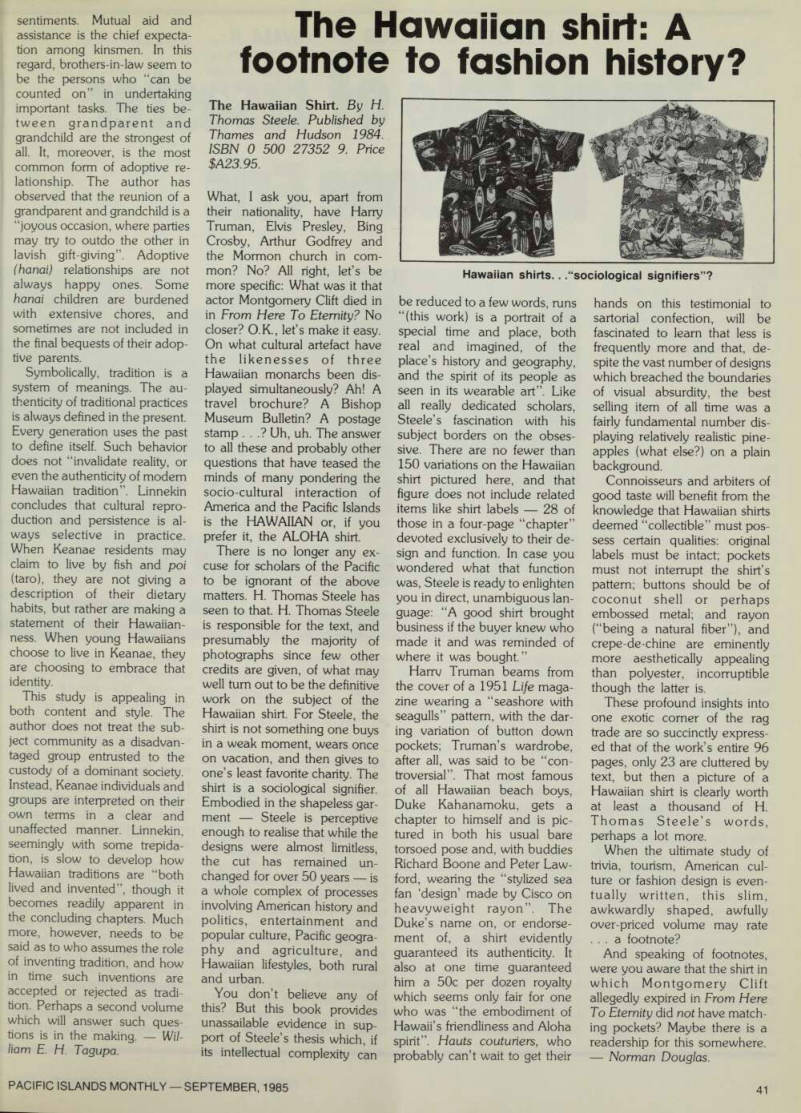
Representative, but not naive, unchanging
Children of the Land: Ex change and Status in a Hawaiian Community. By Jocelyn Linnekin. Published 1985 by Rutgers University Press. ISBN O 8135 1052. 264 pp. $U527.00.
The persistence of tradition in an acculturated society is the problem addressed in Jocelyn Linnekin’s study of the native Hawaiian community of Keanae. It was the working assumption that: “Hawaiian culture must possess a certain resilience, even in the face of a devastating history of foreign contact.” Keanae is unique be cause the Hawaiian residents still retained ownership of their taro-producing lands and grow the crop for income as well as for the reinforcement of their social bonds. Though Keanae is
relatively isolated, it is still eco nomically tied into the market economy and interrupted by the occasional tourist wander ing the coastal roads of Maui island. Its people are repre sentative of Hawaiian tradition but not in a “naive or unchan ging manner”. More important, such traditions are “both lived and invented ... as rural Hawaiians conform to their own and others’ expectations of what that tradition comprises”.
If nothing else, today’s “Hawaiian renaissance looks partly to communities such as Keanae for cultural models”.
Linnekin isolates particular activity patterns and social in stitutions for special scrutiny.
Exchange relations among indi viduals and families are espe cially important because re-
lationships are identified and embraced in socially significant ways. Between kinsmen gifts and services pass freely “under the mantle of aloha”, and gen erally consist of taro and other subsistence items. Gifts to non relatives, on the other hand, are generally specialty commodities such as bananas and avocados.
The difference in such strategies are explained in culturally signi ficant terms. Taro has high sentimental value which is appropriately expressed only among relatives. Exchanges among non-relatives are more guarded, and items which have symbolic value are excluded in such relationships.
Generally speaking, there is a pervasive ethic which holds that “overt economic disparities” among community members should be avoided. Therefore, display of wealth and status would invoke social sanctions in the form of community avoi dance. Hawaiian values stress social equivalence and differ ences in material lifestyles are minimised with considerable effort. The value of labor in Hawaiian exchanges is demon strated on special occasions.
The luau (feast) is generally the time when community labor is requisitioned in the spirit of mutual assistance. Acknow ledgement of such contribu tions is usually made in the form of redistribution of food items to those who rendered any service. The luau itself is one of the few times when extensive generosity is demons trated and is today “perhaps the only redistributive event among Hawaiians”.
Acquiring prestige in the community is a matter selec tively pursued in a cautious and tactful manner. Increasing pro ductivity through hard work, rather than through the acquisi tion of material goods, is the most common manner in which prestige is obtained. A person acquires community esteem through personal generosity rather than through mere wealth. It is through such qual ities that a person increases his influence in the community.
Marriage and adoption, in Linnekin’s view, are unique forms of social exchange. It is a means whereby strangers are brought into the community on an intimate basis. There are, however, important governing
Keanae, Maui Island, Hawaii ... scene of an experiment.
sentiments. Mutual aid and assistance is the chief expecta tion among kinsmen. In this regard, brothers-in-law seem to be the persons who “can be counted on” in undertaking important tasks. The ties be tween grandparent and grandchild are the strongest of all. It, moreover, is the most common form of adoptive re lationship. The author has observed that the reunion of a grandparent and grandchild is a “joyous occasion, where parties may try to outdo the other in lavish gift-giving”. Adoptive (hanai ) relationships are not always happy ones. Some hanai children are burdened with extensive chores, and sometimes are not included in the final bequests of their adop tive parents.
Symbolically, tradition is a system of meanings. The au thenticity of traditional practices is always defined in the present.
Every generation uses the past to define itself. Such behavior does not “invalidate reality, or even the authenticity of modem Hawaiian tradition”. Linnekin concludes that cultural repro duction and persistence is al ways selective in practice.
When Keanae residents may claim to live by fish and poi (taro), they are not giving a description of their dietary habits, but rather are making a statement of their Hawaiian ness. When young Hawaiians choose to live in Keanae, they are choosing to embrace that identity.
This study is appealing in both content and style. The author does not treat the sub ject community as a disadvan taged group entrusted to the custody of a dominant society.
Instead, Keanae individuals and groups are interpreted on their own terms in a clear and unaffected manner. Linnekin, seemingly with some trepida tion, is slow to develop how Hawaiian traditions are “both lived and invented”, though it becomes readily apparent in the concluding chapters. Much more, however, needs to be said as to who assumes the role of inventing tradition, and how in time such inventions are accepted or rejected as tradi tion. Perhaps a second volume which will answer such ques tions is in the making. Wil liam E. H. Tagupa.
footnote to fashion history?
The Hawaiian shirt: A footnote to fashion history?
The Hawaiian Shirt. By H.
Thomas Steele. Published by Thames and Hudson 1984.
ISBN 0 500 27352 9. Price $A23.95.
What, I ask you, apart from their nationality, have Harry Truman, Elvis Presley, Bing Crosby, Arthur Godfrey and the Mormon church in com mon? No? All right, let’s be more specific: What was it that actor Montgomery Clift died in in From Here To Eternity? No closer? 0.K., let’s make it easy.
On what cultural artefact have the likenesses of three Hawaiian monarchs been dis played simultaneously? Ah! A travel brochure? A Bishop Museum Bulletin? A postage stamp . . .? Uh, uh. The answer to all these and probably other questions that have teased the minds of many pondering the socio-cultural interaction of America and the Pacific Islands is the HAWAIIAN or, if you prefer it, the ALOHA shirt.
There is no longer any ex cuse for scholars of the Pacific to be ignorant of the above matters. H. Thomas Steele has seen to that. H. Thomas Steele is responsible for the text, and presumably the majority of photographs since few other credits are given, of what may well turn out to be the definitive work on the subject of the Hawaiian shirt. For Steele, the shirt is not something one buys in a weak moment, wears once on vacation, and then gives to one’s least favorite charity. The shirt is a sociological signifier.
Embodied in the shapeless gar ment Steele is perceptive enough to realise that while the designs were almost limitless, the cut has remained un changed for over 50 years is a whole complex of processes involving American history and politics, entertainment and popular culture, Pacific geogra phy and agriculture, and Hawaiian lifestyles, both rural and urban.
You don’t believe any of this? But this book provides unassailable evidence in sup port of Steele’s thesis which, if its intellectual complexity can
be reduced to a few words, runs “(this work) is a portrait of a special time and place, both real and imagined, of the place’s history and geography, and the spirit of its people as seen in its wearable art”. Like all really dedicated scholars, Steele’s fascination with his subject borders on the obses sive. There are no fewer than 150 variations on the Hawaiian shirt pictured here, and that figure does not include related items like shirt labels 28 of those in a four-page “chapter” devoted exclusively to their de sign and function. In case you wondered what that function was, Steele is ready to enlighten you in direct, unambiguous lan guage: “A good shirt brought business if the buyer knew who made it and was reminded of where it was bought.”
Harrv Truman beams from the cover of a 1951 Life maga zine wearing a “seashore with seagulls” pattern, with the dar ing variation of button down pockets; Truman’s wardrobe, after all, was said to be “con troversial”. That most famous of all Hawaiian beach boys, Duke Kahanamoku, gets a chapter to himself and is pic tured in both his usual bare torsoed pose and, with buddies Richard Boone and Peter Law ford, wearing the “stylized sea fan ‘design’ made by Cisco on heavyweight rayon”. The Duke’s name on, or endorse ment of, a shirt evidently guaranteed its authenticity. It also at one time guaranteed him a 50c per dozen royalty which seems only fair for one who was “the embodiment of Hawaii’s friendliness and Aloha spirit”. Hauts couturiers, who probably can’t wait to get their
hands on this testimonial to sartorial confection, will be fascinated to learn that less is frequently more and that, de spite the vast number of designs which breached the boundaries of visual absurdity, the best selling item of all time was a fairly fundamental number dis playing relatively realistic pine apples (what else?) on a plain background.
Connoisseurs and arbiters of good taste will benefit from the knowledge that Hawaiian shirts deemed “collectible” must pos sess certain qualities: original labels must be intact; pockets must not interrupt the shirt’s pattern; buttons should be of coconut shell or perhaps embossed metal; and rayon (“being a natural fiber”), and crepe-de-chine are eminently more aesthetically appealing than polyester, incorruptible though the latter is.
These profound insights into one exotic comer of the rag trade are so succinctly express ed that of the work’s entire 96 pages, only 23 are cluttered by text, but then a picture of a Hawaiian shirt is clearly worth at least a thousand of H.
Thomas Steele’s words, perhaps a lot more.
When the ultimate study of trivia, tourism, American cul ture or fashion design is even tually written, this slim, awkwardly shaped, awfully over-priced volume may rate ... a footnote?
And speaking of footnotes, were you aware that the shirt in which Montgomery Clift allegedly expired in From Here To Eternity did not have match ing pockets? Maybe there is a readership for this somewhere.
Norman Douglas.
Hawaiian shirts.. .“sociological signifiers”?
Tragic tale of disaster
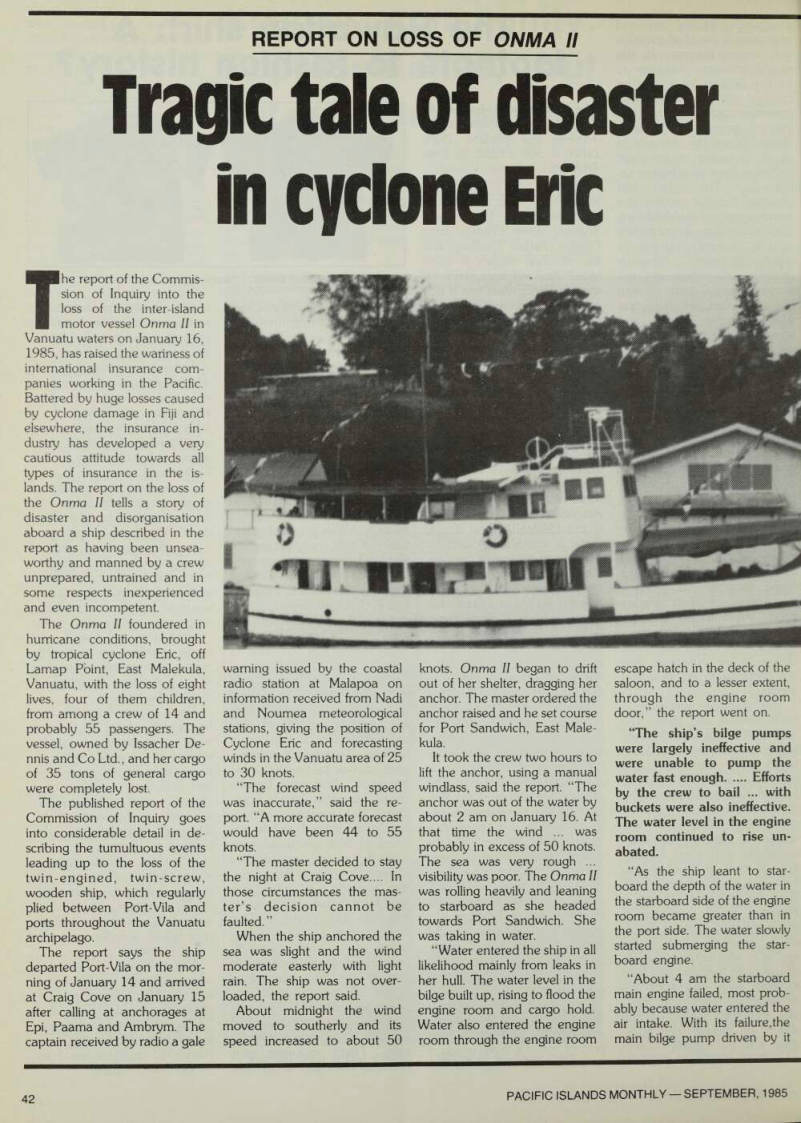
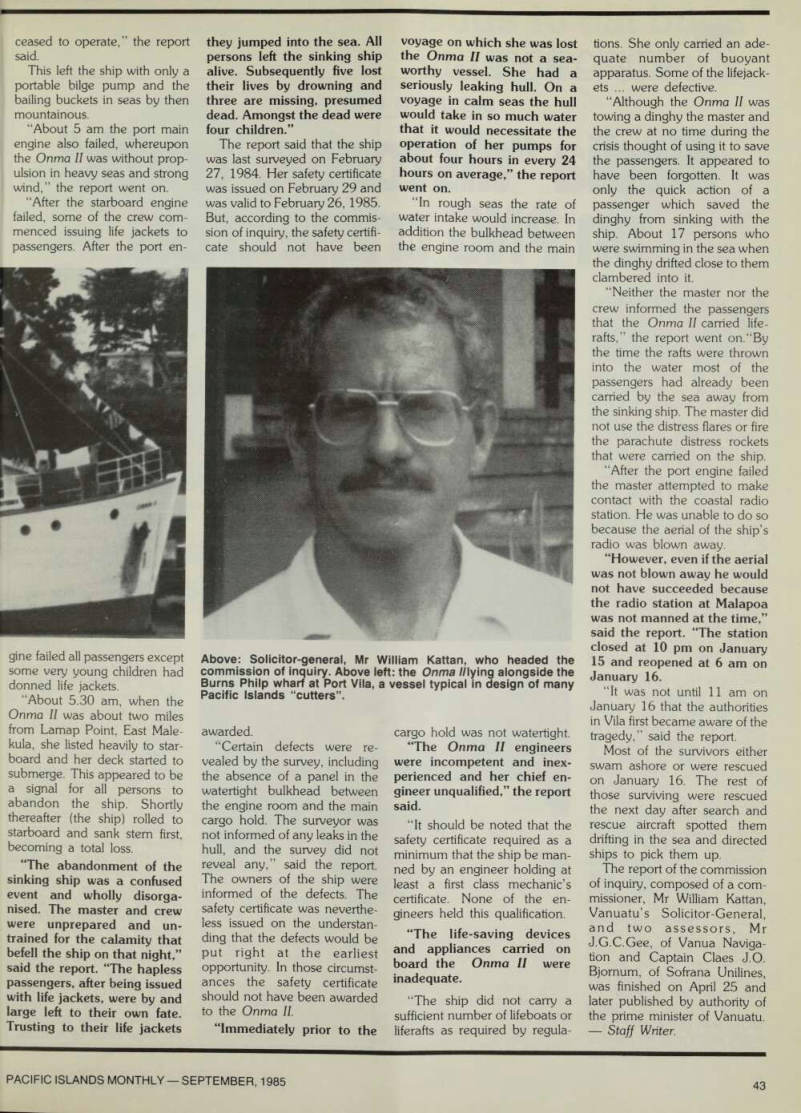
Report On Loss Of Onma Ii
Tragic tale of disaster in cyclone Eric
The report of the Commis sion of Inquiry into the loss of the inter-island motor vessel Onma II in Vanuatu waters on January 16, 1985, has raised the wariness of international insurance com panies working in the Pacific.
Battered by huge losses caused by cyclone damage in Fiji and elsewhere, the insurance in dustry has developed a very cautious attitude towards all types of insurance in the is lands. The report on the loss of the Onma II tells a story of disaster and disorganisation aboard a ship described in the report as having been unsea worthy and manned by a crew unprepared, untrained and in some respects inexperienced and even incompetent.
The Onma II foundered in hurricane conditions, brought by tropical cyclone Eric, off Lamap Point, East Malekula, Vanuatu, with the loss of eight lives, four of them children, from among a crew of 14 and probably 55 passengers. The vessel, owned by Issacher De nnis and Co Ltd., and her cargo of 35 tons of general cargo were completely lost.
The published report of the Commission of Inquiry goes into considerable detail in de scribing the tumultuous events leading up to the loss of the twin-engined, twin-screw, wooden ship, which regularly plied between Port-Vila and ports throughout the Vanuatu archipelago.
The report says the ship departed Port-Vila on the mor ning of January 14 and arrived at Craig Cove on January 15 after calling at anchorages at Epi, Paama and Ambrym. The captain received by radio a gale
warning issued by the coastal radio station at Malapoa on information received from Nadi and Noumea meteorological stations, giving the position of Cyclone Eric and forecasting winds in the Vanuatu area of 25 to 30 knots.
“The forecast wind speed was inaccurate,” said the re port. “A more accurate forecast would have been 44 to 55 knots.
“The master decided to stay the night at Craig Cove... In those circumstances the mas ter’s decision cannot be faulted. ”
When the ship anchored the sea was slight and the wind moderate easterly with light rain. The ship was not over loaded, the report said.
About midnight the wind moved to southerly and its speed increased to about 50
knots. Onma II began to drift out of her shelter, dragging her anchor. The master ordered the anchor raised and he set course for Port Sandwich, East Male kula.
It took the crew two hours to lift the anchor, using a manual windlass, said the report. “The anchor was out of the water by about 2 am on January 16. At that time the wind ... was probably in excess of 50 knots.
The sea was very rough ... visibility was poor. The Onma II was rolling heavily and leaning to starboard as she headed towards Port Sandwich. She was taking in water.
“Water entered the ship in all likelihood mainly from leaks in her hull. The water level in the bilge built up, rising to flood the engine room and cargo hold.
Water also entered the engine room through the engine room
escape hatch in the deck of the saloon, and to a lesser extent, through the engine room door,” the report went on.
“The ship’s bilge pumps were largely ineffective and were unable to pump the water fast enough Efforts by the crew to bail ... with buckets were also ineffective.
The water level in the engine room continued to rise un abated.
“As the ship leant to star board the depth of the water in the starboard side of the engine room became greater than in the port side. The water slowly started submerging the star board engine.
“About 4 am the starboard main engine failed, most prob ably because water entered the air intake. With its failure,the main bilge pump driven by it
ceased to operate,” the report said.
This left the ship with only a portable bilge pump and the bailing buckets in seas by then mountainous.
“About 5 am the port main engine also failed, whereupon the Onma II was without prop ulsion in heavy seas and strong wind,” the report went on.
“After the starboard engine failed, some of the crew com menced issuing life jackets to passengers. After the port en
gine failed all passengers except some very young children had donned life jackets.
“About 5.30 am, when the Onma II was about two miles from Lamap Point, East Male kula, she listed heavily to star board and her deck started to submerge. This appeared to be a signal for all persons to abandon the ship. Shortly thereafter (the ship) rolled to starboard and sank stern first, becoming a total loss.
“The abandonment of the sinking ship was a confused event and wholly disorga nised. The master and crew were unprepared and un trained for the calamity that befell the ship on that night,” said the report. “The hapless passengers, after being issued with life jackets, were by and large left to their own fate.
Trusting to their life jackets
they jumped into the sea, AH persons left the sinking ship alive. Subsequently five lost their lives by drowning and three are missing, presumed dead. Amongst the dead were four children.”
The report said that the ship was last surveyed on February 27, 1984. Her safety certificate was issued on February 29 and was valid to February 26, 1985.
But, according to the commis sion of inquiry, the safety certifi cate should not have been
awarded.
“Certain defects were re vealed by the survey, including the absence of a panel in the watertight bulkhead between the engine room and the main cargo hold. The surveyor was not informed of any leaks in the hull, and the survey did not reveal any,” said the report.
The owners of the ship were informed of the defects. The safety certificate was neverthe less issued on the understan ding that the defects would be put right at the earliest opportunity. In those circumst ances the safety certificate should not have been awarded to the Onma 11.
“Immediately prior to the
voyage on which she was lost the Onma II was not a sea worthy vessel. She had a seriously leaking hull. On a voyage in calm seas the hull would take in so much water that it would necessitate the operation of her pumps for about four hours in every 24 hours on average,” the report went on.
“In rough seas the rate of water intake would increase. In addition the bulkhead between the engine room and the main
cargo hold was not watertight.
“The Onma II engineers were incompetent and inex perienced and her chief en gineer unqualified,” the report said.
“It should be noted that the safety certificate required as a minimum that the ship be man ned by an engineer holding at least a first class mechanic’s certificate. None of the en gineers held this qualification.
“The life-saving devices and appliances carried on board the Onma II were inadequate.
“The ship did not carry a sufficient number of lifeboats or liferafts as required by regula
tions. She only carried an ade quate number of buoyant apparatus. Some of the lifejack ets ... were defective.
“Although the Onma II was towing a dinghy the master and the crew at no time during the crisis thought of using it to save the passengers. It appeared to have been forgotten. It was only the quick action of a passenger which saved the dinghy from sinking with the ship. About 17 persons who were swimming in the sea when the dinghy drifted close to them clambered into it.
“Neither the master nor the crew informed the passengers that the Onma II carried life rafts.” the report went on.“By the time the rafts were thrown into the water most of the passengers had already been carried by the sea away from the sinking ship. The master did not use the distress flares or fire the parachute distress rockets that were carried on the ship.
“After the port engine failed the master attempted to make contact with the coastal radio station. He was unable to do so because the aerial of the ship’s radio was blown away.
“However, even if the aerial was not blown away he would not have succeeded because the radio station at Malapoa was not manned at the time,” said the report. “The station closed at 10 pm on January 15 and reopened at 6 am on January 16.
“It was not until 11 am on January 16 that the authorities in Vila first became aware of the tragedy,” said the report.
Most of the survivors either swam ashore or were rescued on January 16. The rest of those surviving were rescued the next day after search and rescue aircraft spotted them drifting in the sea and directed ships to pick them up.
The report of the commission of inquiry, composed of a com missioner, Mr William Kattan, Vanuatu’s Solicitor-General, and two assessors, Mr J.G.C.Gee, of Vanua Naviga tion and Captain Claes J.O.
Bjornum, of Sofrana Unilines, was finished on April 25 and later published by authority of the prime minister of Vanuatu.
Staff Writer.
Above: Solicitor-general, Mr William Kattan, who headed the commission of inquiry. Above left: the Onma //lying alongside the Burns Philp wharf at Port Vila, a vessel typical in design of many Pacific Islands “cutters”.
Media “distorted truth”
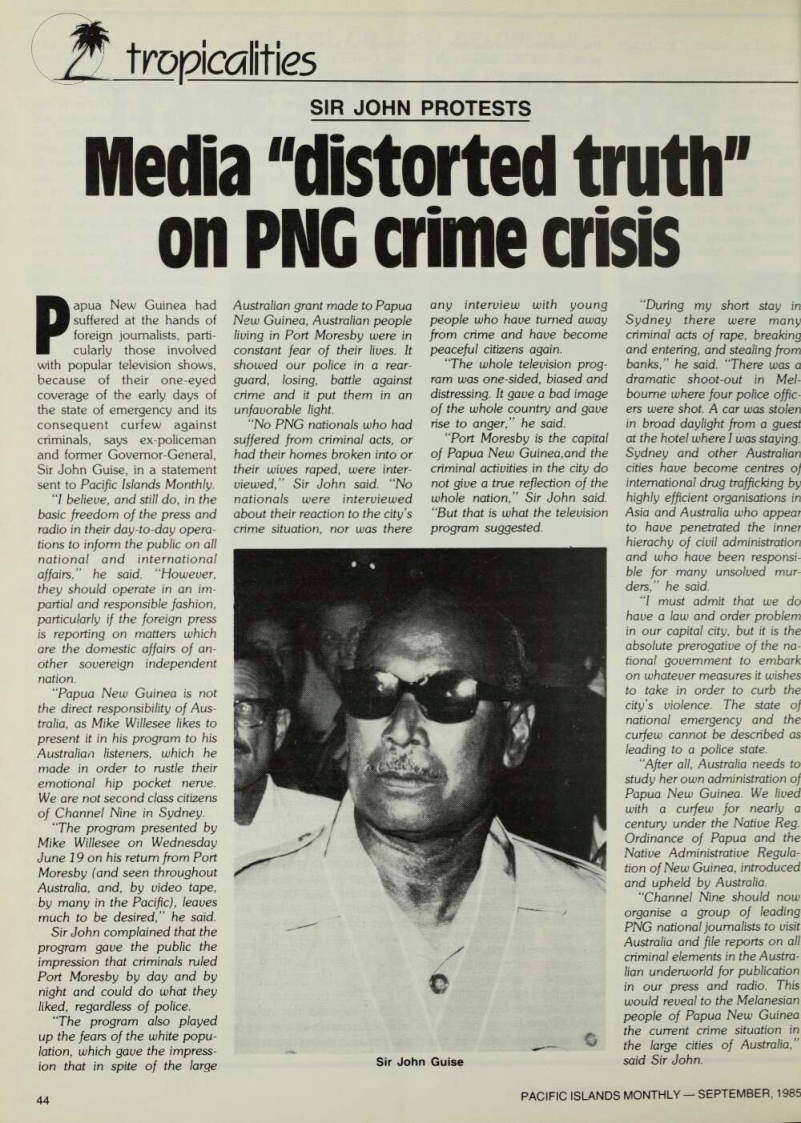
tropicalities
Sir John Protests
Media “distorted truth” on PNG crime crisis
Papua New Guinea had suffered at the hands of foreign journalists, parti cularly those involved with popular television shows, because of their one-eyed coverage of the early days of the state of emergency and its consequent curfew against criminals, says ex-policeman and former Governor-General, Sir John Guise, in a statement sent to Pacific Islands Monthly.
“I believe, and still do, in the basic freedom of the press and radio in their day-to-day opera tions to inform the public on all national and international affairs,” he said. “However, they should operate in an im partial and responsible fashion, particularly if the foreign press is reporting on matters which are the domestic affairs of an other sovereign independent nation.
“Papua New Guinea is not the direct responsibility of Aus tralia, as Mike Willesee likes to present it in his program to his Australian listeners, which he made in order to rustle their emotional hip pocket nerve.
We are not second class citizens of Channel Nine in Sydney.
“The program presented by Mike Willesee on Wednesday June 19 on his return from Port Moresby (and seen throughout Australia, and, by video tape, by many in the Pacific), leaves much to be desired,” he said.
Sir John complained that the program gave the public the impression that criminals ruled Port Moresby by day and by night and could do what they liked, regardless of police.
“The program also played up the fears of the white popu lation, which gave the impress ion that in spite of the large
Australian grant made to Papua New Guinea, Australian people living in Port Moresby were in constant fear of their lives. It showed our police in a rear guard, losing, battle against crime and it put them in an unfavorable light.
“No PNG nationals who had suffered from criminal acts, or had their homes broken into or their wives raped, were inter viewed,” Sir John said. “No nationals were interviewed about their reaction to the city’s crime situation, nor was there
any interview with young people who have turned away from crime and have become peaceful citizens again.
“The whole television prog ram was one-sided, biased and distressing. It gave a bod image of the whole country and gave rise to anger,” he said.
“Port Moresby is the capital of Papua New Guinea,and the criminal activities in the city do not give a true reflection of the whole nation,” Sir John said.
“But that is what the television program suggested.
“During my short sta\; in Sydney there were many criminal acts of rape, breaking and entering, and stealing from banks,” he said. “There was a dramatic shoot-out in Mel bourne where four police offic ers were shot. A car was stolen in broad daylight from a guest at the hotel where I was staying.
Sydney and other Australian cities have become centres oj international drug trafficking by highly efficient organisations in Asia and Australia who appear to have penetrated the inner hierachy of civil administration and who have been responsi ble for many unsolved mur ders,” he said.
“I must admit that we do have a law and order problem in our capital city, but it is the absolute prerogative of the na tional government to embark on whatever measures it wishes to take in order to curb the city’s violence. The state of national emergency and the curfew cannot be described as leading to a police state.
“After all, Australia needs to study her own administration of Papua New Guinea. We lived with a curfew for nearly a century under the Native Reg.
Ordinance of Papua and the Native Administrative Regula tion of New Guinea, introduced and upheld by Australia.
“Channel Nine should now organise a group of leading PNG national journalists to visit Australia and file reports on all criminal elements in the Austra lian underworld for publication in our press and radio. This would reveal to the Melanesian people of Papua New Guinea the current crime situation in the large cities of Australia,” said Sir John.
Sir John Guise
Bligh’s cave
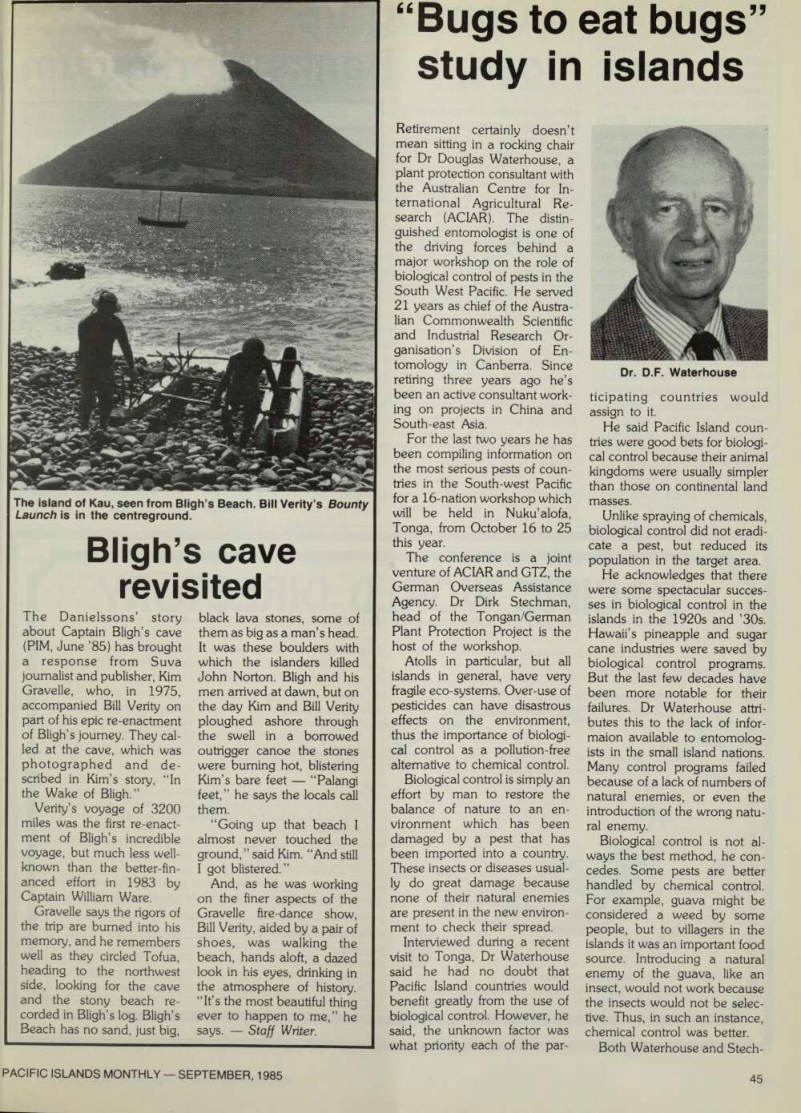
revisited
The Danielssons’ story about Captain Bligh’s cave (PIM, June ’B5) has brought a response from Suva journalist and publisher, Kim Gravelle, who, in 1975, accompanied Bill Verity on part of his epic re-enactment of Bligh’s journey. They cal led at the cave, which was photographed and de scribed in Kim’s story, “In the Wake of Bligh.”
Verity’s voyage of 3200 miles was the first re-enact ment of Bligh’s incredible voyage, but much less well known than the better-fin anced effort in 1983 by Captain William Ware.
Gravelle says the rigors of the trip are burned into his memory, and he remembers well as they circled Tofua, heading to the northwest side, looking for the cave and the stony beach re corded in Bligh’s log. Bligh’s Beach has no sand, just big,
black lava stones, some of them as big as a man’s head.
It was these boulders with which the islanders killed John Norton. Bligh and his men arrived at dawn, but on the day Kim and Bill Verity ploughed ashore through the swell in a borrowed outrigger canoe the stones were burning hot, blistering Kim’s bare feet “Palangi feet,” he says the locals call them.
“Going up that beach I almost never touched the ground,” said Kim. “And still I got blistered.”
And, as he was working on the finer aspects of the Gravelle fire-dance show, Bill Verity, aided by a pair of shoes, was walking the beach, hands aloft, a dazed look in his eyes, drinking in the atmosphere of history.
“It’s the most beautiful thing ever to happen to me,” he says. Staff Writer.
The island of Kau, seen from Bligh’s Beach. Bill Verity’s Bounty Launch is in the centreground.
“Bugs to eat bugs”
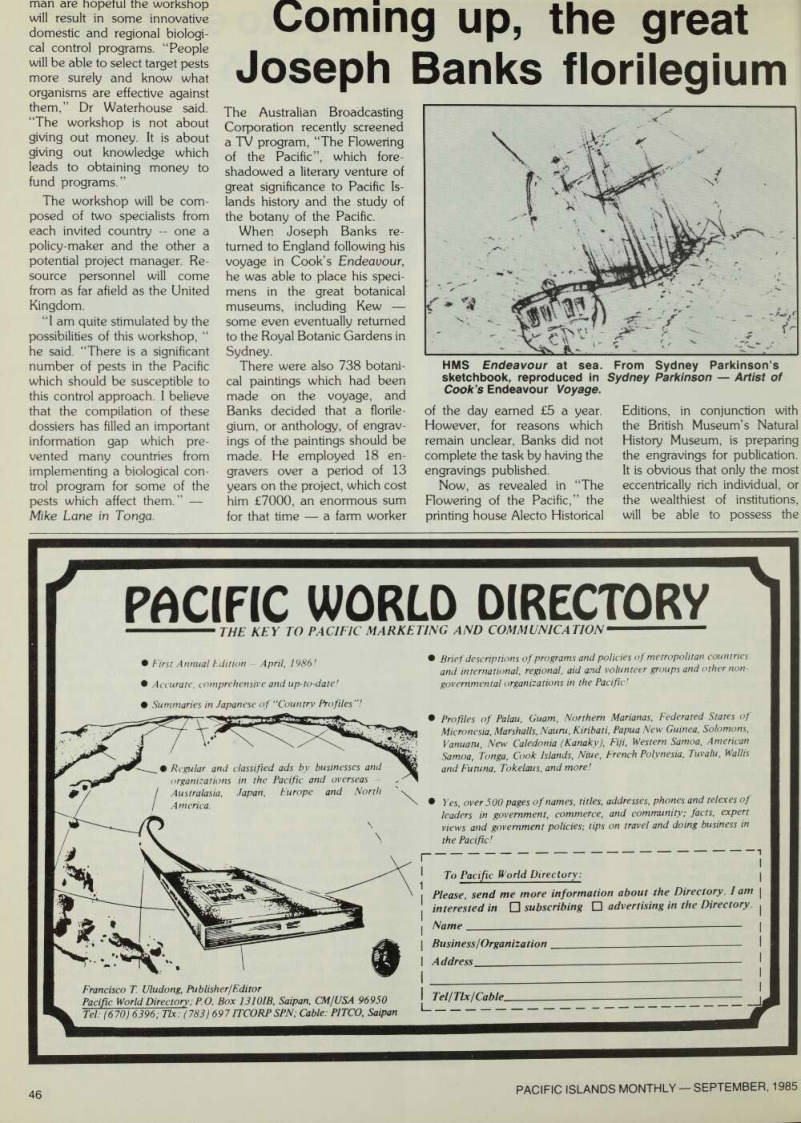
study in islands
Retirement certainly doesn’t mean sitting in a rocking chair for Dr Douglas Waterhouse, a plant protection consultant with the Australian Centre for In ternational Agricultural Re search (ACIAR). The distin guished entomologist is one of the driving forces behind a major workshop on the role of biological control of pests in the South West Pacific. He served 21 years as chief of the Austra lian Commonwealth Scientific and Industrial Research Or ganisation’s Division of En tomology in Canberra. Since retiring three years ago he’s been an active consultant work ing on projects in China and South-east Asia.
For the last two years he has been compiling information on the most serious pests of coun tries in the South-west Pacific for a 16-nation workshop which will be held in Nuku’alofa, Tonga, from October 16 to 25 this year.
The conference is a joint venture of ACIAR and GTZ, the German Overseas Assistance Agency. Dr Dirk Stechman, head of the Tongan/German Plant Protection Project is the host of the workshop.
Atolls in particular, but all islands in general, have very fragile eco-systems. Over-use of pesticides can have disastrous effects on the environment, thus the importance of biologi cal control as a pollution-free alternative to chemical control.
Biological control is simply an effort by man to restore the balance of nature to an en vironment which has been damaged by a pest that has been imported into a country.
These insects or diseases usual ly do great damage because none of their natural enemies are present in the new environ ment to check their spread.
Interviewed during a recent visit to Tonga, Dr Waterhouse said he had no doubt that Pacific Island countries would benefit greatly from the use of biological control. However, he said, the unknown factor was what priority each of the par-
ticipating countries would assign to it.
He said Pacific Island coun tries were good bets for biologi cal control because their animal kingdoms were usually simpler than those on continental land masses.
Unlike spraying of chemicals, biological control did not eradi cate a pest, but reduced its population in the target area.
He acknowledges that there were some spectacular succes ses in biological control in the islands in the 1920 s and ’3os.
Hawaii’s pineapple and sugar cane industries were saved by biological control programs.
But the last few decades have been more notable for their failures. Dr Waterhouse attri butes this to the lack of infor maion available to entomolog ists in the small island nations.
Many control programs failed because of a lack of numbers of natural enemies, or even the introduction of the wrong natu ral enemy.
Biological control is not al ways the best method, he con cedes. Some pests are better handled by chemical control.
For example, guava might be considered a weed by some people, but to villagers in the islands it was an important food source. Introducing a natural enemy of the guava, like an insect, would not work because the insects would not be selec tive. Thus, in such an instance, chemical control was better.
Both Waterhouse and Stech
Dr. D.F. Waterhouse
man are nopetul the workshop will result in some innovative domestic and regional biologi cal control programs. “People will be able to select target pests more surely and know what organisms are effective against them,” Dr Waterhouse said.
“The workshop is not about giving out money. It is about giving out knowledge which leads to obtaining money to fund programs.”
The workshop will be com posed of two specialists from each invited country one a policy-maker and the other a potential project manager. Re source personnel will come from as far afield as the United Kingdom.
“I am quite stimulated by the possibilities of this workshop, “ he said. “There is a significant number of pests in the Pacific which should be susceptible to this control approach. I believe that the compilation of these dossiers has filled an important information gap which pre vented many countries from implementing a biological con trol program for some of the pests which affect them.”
Mike Lane in Tonga.
Joseph Banks florilegium
Coming up, the great Joseph Banks florilegium
The Australian Broadcasting Corporation recently screened a TV program, “The Flowering of the Pacific”, which fore shadowed a literary venture of great significance to Pacific Is lands history and the study of the botany of the Pacific.
When Joseph Banks re turned to England following his voyage in Cook’s Endeavour, he was able to place his speci mens in the great botanical museums, including Kew some even eventually returned to the Royal Botanic Gardens in Sydney.
There were also 738 botani cal paintings which had been made on the voyage, and Banks decided that a florile gium, or anthology, of engrav ings of the paintings should be made. He employed 18 en gravers over a period of 13 years on the project, which cost him £7OOO, an enormous sum for that time a farm worker
of the day earned £5 a year.
However, for reasons which remain unclear, Banks did not complete the task by having the engravings published.
Now, as revealed in “The Flowering of the Pacific,” the printing house Alecto Historical
Editions, in conjunction with the British Museum’s Natural History Museum, is preparing the engravings for publication.
It is obvious that only the most eccentrically rich individual, or the wealthiest of institutions, will be able to possess the
HMS Endeavour at sea. From Sydney Parkinson’s sketchbook, reproduced in Sydney Parkinson Artist of Cook’s Endeavour Voyage.
collection. One hundred and ten copies are to be made of the 738 plates, and it will take 10 years to complete the project.
The British Museum holds Syd ney Parkinson’s drawings as well as the copper plates pre pared for Banks.
Alecto approached the museum in 1963 with a view to publishing the engravings, but were shown the door. In 1978 a curator drew the publisher’s attention to the copper plates, which were still wrapped in their original 18th-century paper.
In the present project, there is constant and exceedingly care ful checking of the details of drawings against specimens to ensure absolute correctness.
Restoration of the plates to allow the finest reproduction is meticulous. For the craftsmen to produce eight to 10 plates a day is regarded as a high level of production.
When each set of engravings is completed the collection will occupy 34 large boxes not an item which would fit easily into the average Pacific Islands bibliophile’s library.
The final product will be unique in that only a few black and white engravings were ever made from Parkinson’s draw ings. The new florilegium will be the first published in color. It will probably be the largest direct printing project ever com pleted in the fine arts. The plates and original drawings will remain with the British Museum, which has guaranteed that no further reproduction will be done for a minimum of 50 years. However, as the pub lisher said: “In this laborious project automation does not apply . . . Nothing else like it will ever be done again certainly not in our age of
photography. ”
It is to be hoped that in the not too distant future there will be a public display of the combined talents of Joseph Banks, Daniel Solander, Syd ney Parkinson, the forgotten engravers, the contemporary craftsmen, and Alecto Historical Editions. Then we shall all be able to see how the 18th century travellers recorded the plant life of the Pacific in the 89 plates from Tahiti, 183 from New Zealand, and more than 300 from the east coast of Australia. Bill Coppell.
Advertisements & other items, p. 46 (1 item)
R Pacific World Directory
■ ■ — the key to pacific marketing and communication 1 First Annual Edition - April, 1986!
Accurate, comprehensive and up-to-date!
Summaries in Japanese of “Country Profiles” • Regular and classified ads by businesses and organizations in the Pacific and overseas Australasia, Japan, Europe and North America. » r.- Francisco T. Uludong, Publisher/Editor Pacific World Directory; P.O. Box 131018, Saipan, CM/USA 96950 Tel: (670) 6396; Tlx: (783) 697ITCORPSPN; Cable: PITCO, Saipan • Brief descriptions of programs and policies of metropolitan countries and international, regional, aid and volunteer groups and other nongovernmental organizations in the Pacific! • Profiles of Palau, Guam, Northern Marianas, Federated States of Micronesia, Marshalls, Nauru, Kiribati, Papua New Guinea, Solomons, Vanuatu, New Caledonia (Kanaky), Fiji, Western Samoa, American Samoa, Tonga, Cook Islands, Niue, French Polynesia, Tuvalu, Wallis and Futuna, Tokelaus, and more! • Yes, over 500 pages of names, titles, addresses, phones and telexes of leaders in government, commerce, and community; facts, expert views and government policies ;• tips on travel and doing business in the Pacific!
To Pacific World Directory: Please, send me more information about the Directory. I am interested in □ subscribing □ advertising in the Directory.
Name Business/Organization A ddr ess 1_ Tel/Tlx/Cable. y
How a billion people stopped spitting
Indefatigable PIM cor respondent, Bill Coppell, lately returned from that other section of the Pacific region called China, paused in Hongkong long enough to spy the following item pub lished in the Hong kong Tiger Standard of May 26.
The story reports a scal able Chinese solution to an age-old problem which may offer inspiration to those in Papua New Guinea strug gling with the betel-nut prob lem. At least, it might help the unemployment problem and perhaps stem the blank ets of reddish-brown paint now threatening to cover everything currently vulner able to assault by betel-nut juice.
The story originates from the Beijing office of United Press International:
The Guangming Daily newspaper recently hailed Beijing city administration’s anti-spitting campaign as a success only days after the mass action began. The paper said its correspon dents had noticed “only a few traces of spit” duing a recent “inspection tour” along three busy Beijing shopping avenues.
“According to statistics issued by the Beijing En vironment Protection Bureau, there were 57 traces of spit in 100 square metres in Yongdingmen rail way station one day in March.
“Yet only two traces were found on May 22,” two days after Beijing launched the anti-spitting propaganda barrage and began fining violators 50 fen (about 15 Australian cents), per spit, said the paper.
It said 136,000 uniformed anti-spit squad members now patrolling the streets of Beijing discovered 80 per cent of public spitters were from out of town, and 90 per cent of these were peasants.
The paper did not indicate what percentage of the spit ters were intellectuals.
We thought about doub ting the accuracy of this story, despite its publication in a respected Hongkong daily newspaper, and then remembered a previous, similar, campaign in China when half a billion people were set simultaneously to the catching of flies. Those flies which were not caught are said to have died from the exhaustion of being con stantly chased. Against campaigns like that spitters haven’t a hope... Ed..
Sgt. Knott:
End of a 42 year quest
Leiut. Herman Knott, U.S. Air Force, was buried this year under a pin oak tree in the United States national cemetry at Farmingdale, New York, 42 years after his death in a B-17 bomber shot down by a Japan ese anti-aircraft gun on New Britain during World War 11. He now lies a few yards from the grave of his parents (a First World War soldier), following decades of restless mourning by the Knott family, and unrelen ting effort by Jose Holguin,a retired U.S.A.F. colonel who was the navigator and sole survivor of the World War II mission which ended in a fiery crash on June 26, 1943, in the New Britain jungle.
Holguin, commander of the mission, returned twice to New Britain, depleting his $12,000 savings, to look for his lost men. ’Today should not be a day of sadness,” Holguin told the 25 mourners grouped around the new grave sliced into the lush green of the cemetery. ”It should be a day of reflection and appreciation that one of our loved ones is now here, and we know where he is now.”
Holguin, now 64, assistant principal of a high school in Tujunga, California, has attended five funerals in all, Knott’s and those of four others lost in the crash. The Farming dale ceremony represents the end of a search that he vowed to undertake that night in the jungle. Injured and frightened of the capture (and two-year imprisonment by the Japanese) which lay ahead of him, Hol guin prayed for his nine dead crew members, but left the crash site without burying them. ”1 just knew I would be back some day to carry them home, ” he said.
Holguin went back to New Britain in 1982 and succeeded in finding the wreck of the bomber, its nickname, ’’Naugh ty, But Nice” still emblazoned on its nose. But there were no human remains. Again, in 1983, Holguin went to the island, continuing his un successful search.
Ironically, perhaps, he had been looking in the wrong place. His men were already on the way home. ”1 was about ready to give up,” he said, recalling his last fruitless visit to New Britain, ’’when the local authorities showed me records which showed that the bodies of some American fliers had been ex humed and removed to un
marked graves in Hawaii.” A military laboratory in Honolulu examined these remains and identified five of the men who had been in the crew of Hol guin’s B-17.
Apart from Knott, these were Sgt Pace Payne, of Texas, Sgt Robert Greibel, of Wyoming, Sgt Francis Peattie, of New York, and Sgt Henry Garcia, of Los Angeles. —New York Times News Service.
Plumbing for women
women
Solomon Islands men think that plumbing is a job for men only.
But a funding agency here does not agree with them.
The agency, the Solomon Islands Development Trust, has just finished a workshop in Honiara on how women can maintain piped water.
Although it did not attract many women, the trust planned to organise another workshop.
It hopes more women will participate then because more and more water supply systems are being installed in the country.
The trust feels that as women are becoming the major users of piped water they should know how to maintain the system. George Atkin in Honiara.
Advertisements & other items, p. 48 (1 item)
Guinea Is
PAPUA NEW
TEN YEARS
OLD!
‘S We also realise that we are only ten years young and still I have a long way to go!
Nevertheless we are proud of the progress we have made as an independent nation since 1975.
There have been growing pains... and there will be more, but such are the challenges of nation building. We now invite all our friends in the Pacific Forum and ASEAN Countries to join us in celebrating our first ten years of facing such challenges.
PAPUA NEW GUINEA TENTH ANNIVERSARY OF
INDEPENDENCE CELEBRATIONS SEPTEMBER 16TH
1975-1985
lIMDEPENDEI
air route hub
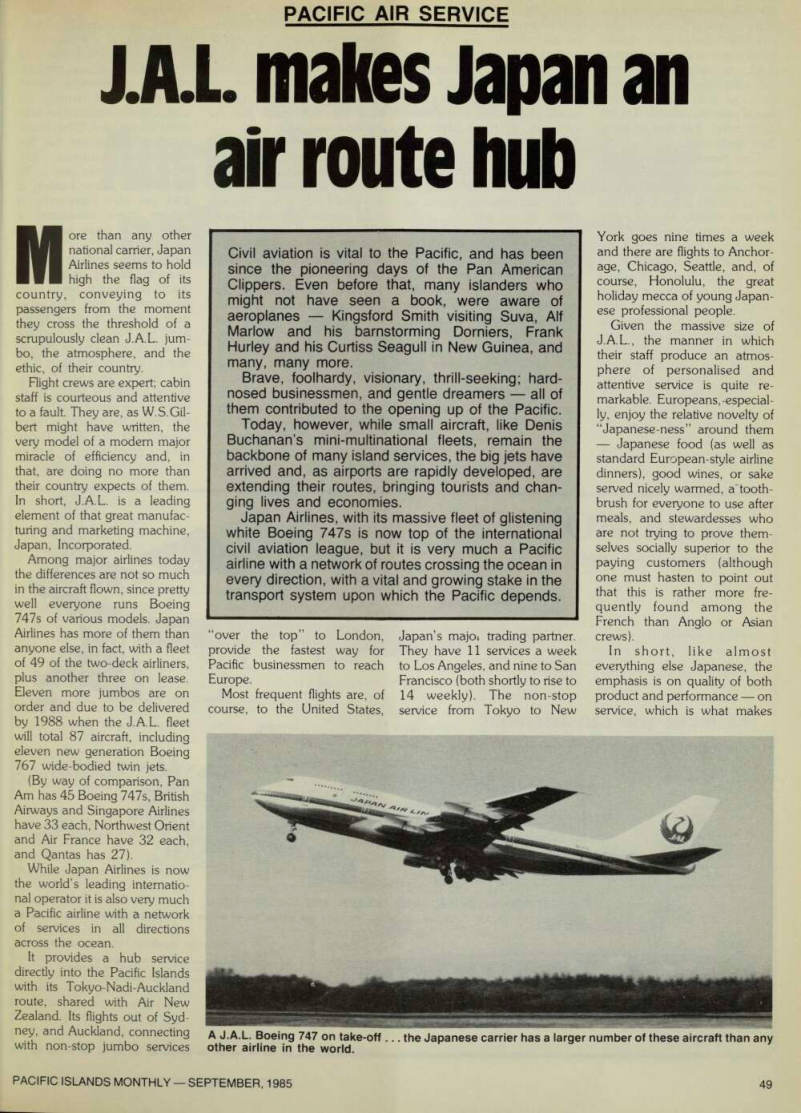
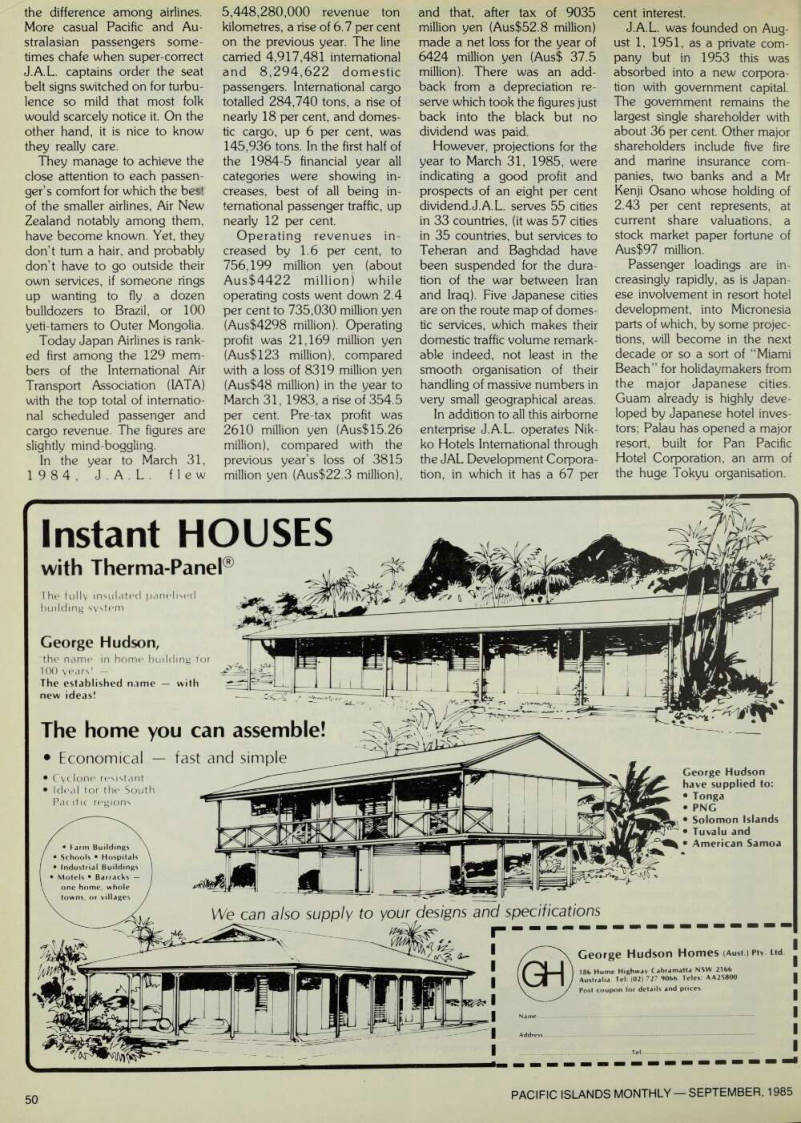
Pacific Air Service
J.A.L. makes Japan an air route hub
More than any other national carrier, Japan Airlines seems to hold high the flag of its country, conveying to its passengers from the moment they cross the threshold of a scrupulously clean J.A.L. jum bo, the atmosphere, and the ethic, of their country.
Flight crews are expert; cabin staff is courteous and attentive to a fault. They are, as W.S. Gil bert might have written, the very model of a modern major miracle of efficiency and, in that, are doing no more than their country expects of them.
In short, J.A.L. is a leading element of that great manufac turing and marketing machine, Japan, Incorporated.
Among major airlines today the differences are not so much in the aircraft flown, since pretty well everyone runs Boeing 747 s of various models. Japan Airlines has more of them than anyone else, in fact, with a fleet of 49 of the two-deck airliners, plus another three on lease.
Eleven more jumbos are on order and due to be delivered by 1988 when the J.A.L. fleet will total 87 aircraft, including eleven new generation Boeing 767 wide-bodied twin jets. (By way of comparison, Pan Am has 45 Boeing 7475, British Airways and Singapore Airlines have 33 each, Northwest Orient and Air France have 32 each, and Qantas has 27).
While Japan Airlines is now the world’s leading internatio nal operator it is also very much a Pacific airline with a network of services in all directions across the ocean.
It provides a hub service directly into the Pacific Islands with its Tokyo-Nadi-Auckland route, shared with Air New Zealand. Its flights out of Syd ney, and Auckland, connecting with non-stop jumbo services
Civil aviation is vital to the Pacific, and has been since the pioneering days of the Pan American Clippers. Even before that, many islanders who might not have seen a book, were aware of aeroplanes Kingsford Smith visiting Suva, Alf Marlow and his barnstorming Dorniers, Frank Hurley and his Curtiss Seagull in New Guinea, and many, many more.
Brave, foolhardy, visionary, thrill-seeking; hard nosed businessmen, and gentle dreamers all of them contributed to the opening up of the Pacific.
Today, however, while small aircraft, like Denis Buchanan’s mini-multinational fleets, remain the backbone of many island services, the big jets have arrived and, as airports are rapidly developed, are extending their routes, bringing tourists and chan ging lives and economies.
Japan Airlines, with its massive fleet of glistening white Boeing 747 s is now top of the international civil aviation league, but it is very much a Pacific airline with a network of routes crossing the ocean in every direction, with a vital and growing stake in the transport system upon which the Pacific depends.
“over the top” to London, provide the fastest way for Pacific businessmen to reach Europe.
Most frequent flights are, of course, to the United States,
Japan’s majoi trading partner.
They have 11 services a week to Los Angeles, and nine to San Francisco (both shortly to rise to 14 weekly). The non-stop service from Tokyo to New
York goes nine times a week and there are flights to Anchor age, Chicago, Seattle, and, of course, Honolulu, the great holiday mecca of young Japan ese professional people.
Given the massive size of J.A.L., the manner in which their staff produce an atmos phere of personalised and attentive service is quite re markable. Europeans,-especial ly, enjoy the relative novelty of “Japanese-ness” around them Japanese food (as well as standard European-style airline dinners), good wines, or sake served nicely warmed, a' tooth brush for everyone to use after meals, and stewardesses who are not trying to prove them selves socially superior to the paying customers (although one must hasten to point out that this is rather more fre quently found among the French than Anglo or Asian crews).
In short, like almost everything else Japanese, the emphasis is on quality of both product and performance on service, which is what makes
A J.A.L. Boeing 747 on take-off... the Japanese carrier has a larger number of these aircraft than any other airline in the world.
the difference among airlines.
More casual Pacific and Au stralasian passengers some times chafe when super-correct J.A.L. captains order the seat belt signs switched on for turbu lence so mild that most folk would scarcely notice it. On the other hand, it is nice to know they really care.
They manage to achieve the close attention to each passen ger’s comfort for which the best of the smaller airlines, Air New Zealand notably among them, have become known. Yet, they don’t turn a hair, and probably don’t have to go outside their own services, if someone rings up wanting to fly a dozen bulldozers to Brazil, or 100 yeti-tamers to Outer Mongolia.
Today Japan Airlines is rank ed first among the 129 mem bers of the International Air Transport Association (lATA) with the top total of internatio nal scheduled passenger and cargo revenue. The figures are slightly mind-boggling.
In the year to March 31, 1984, J.A.L. flew
5,448,280,000 revenue ton kilometres, a rise of 6.7 per cent on the previous year. The line carried 4,917,481 international and 8,294,622 domestic passengers. International cargo totalled 284,740 tons, a rise of nearly 18 per cent, and domes tic cargo, up 6 per cent, was 145,936 tons. In the first half of the 1984-5 financial year all categories were showing in creases, best of all being in ternational passenger traffic, up nearly 12 per cent.
Operating revenues in creased by 1.6 per cent, to 756,199 million yen (about Auss4422 million) while operating costs went down 2.4 per cent to 735,030 million yen (Auss429B million). Operating profit was 21,169 million yen (Aussl23 million), compared with a loss of 8319 million yen (Auss4B million) in the year to March 31, 1983, a rise of 354.5 per cent. Pre-tax profit was 2610 million yen (Aussls.26 million), compared with the previous year’s loss of 3815 million yen (Auss22.3 million),
and that, after tax of 9035 million yen (Ausss2.B million) made a net loss for the year of 6424 million yen (Auss 37.5 million). There was an add back from a depreciation re serve which took the figures just back into the black but no dividend was paid.
However, projections for the year to March 31, 1985, were indicating a good profit and prospects of an eight per cent dividend.J.A.L. serves 55 cities in 33 countries, (it was 57 cities in 35 countries, but services to Teheran and Baghdad have been suspended for the dura tion of the war between Iran and Iraq). Five Japanese cities are on the route map of domes tic services, which makes their domestic traffic volume remark able indeed, not least in the smooth organisation of their handling of massive numbers in very small geographical areas.
In addition to all this airborne enterprise J.A.L. operates Nik ko Hotels International through the JAL Development Corpora tion, in which it has a 67 per
cent interest.
J.A.L. was founded on Aug ust 1, 1951, as a private com pany but in 1953 this was absorbed into a new corpora tion with government capital.
The government remains the largest single shareholder with about 36 per cent. Other major shareholders include five fire and marine insurance com panies, two banks and a Mr Kenji Osano whose holding of 2.43 per cent represents, at current share valuations, a stock market paper fortune of Auss97 million.
Passenger loadings are in creasingly rapidly, as is Japan ese involvement in resort hotel development, into Micronesia parts of which, by some projec tions, will become in the next decade or so a sort of “Miami Beach” for holidaymakers from the major Japanese cities.
Guam already is highly deve loped by Japanese hotel inves tors; Palau has opened a major resort, built for Pan Pacific Hotel Corporation, an arm of the huge Tokyu organisation.
Advertisements & other items, p. 50 (1 item)
Instant HOUSES
with Therma-Panel®
The fully insulated panelisecl building system u
George Hudson,
the name' in home building for 100 years!
The established name with new ideas! 1 I
The home you can assemble!
• Economical fast and simple
• Cyclone resistant • Ideal for the South Pacific regions * Farm Buildings • Schools • Hospitals » Industrial Buildings Motels • Barracks one home, whole towns, or villages George Hudson have supplied to: • Tonga
• PNG
• Solomon Islands • Tuvalu and • American Samoa We can also supply to your designs and specifications
Afr
r 2) George Hudson Homes (Aust.)Pty. Ltd. 186 Hume Highway Cabramatla NSW 2166 Australia. Tel: (02) 727 9066 Tele*: AA25800 Post coupon for details and prices.
Australia “needs clear
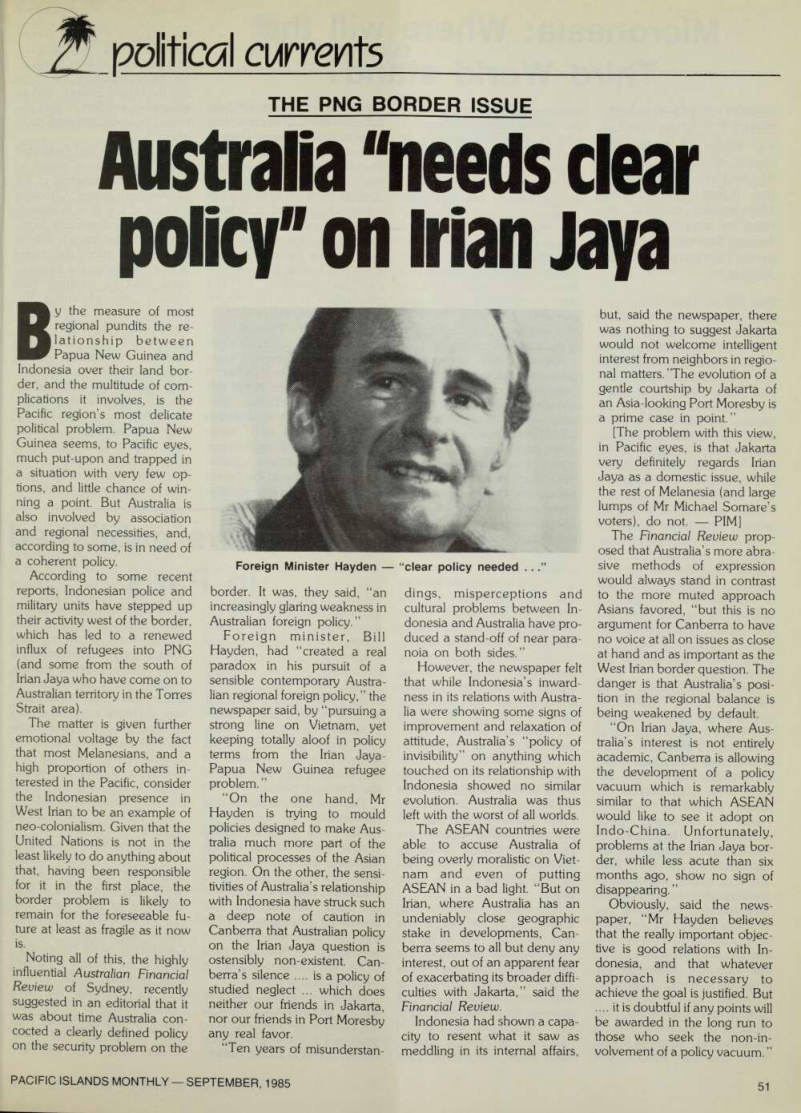
political currents
The Png Border Issue
Australia “needs clear policy" on Irina Jaya
By the measure of most regional pundits the re lationship between Papua New Guinea and Indonesia over their land bor der, and the multitude of com plications it involves, is the Pacific region’s most delicate political problem. Papua New Guinea seems, to Pacific eyes, much put-upon and trapped in a situation with very few op tions, and little chance of win ning a point. But Australia is also involved by association and regional necessities, and, according to some, is in need of a coherent policy.
According to some recent reports, Indonesian police and military units have stepped up their activity west of the border, which has led to a renewed influx of refugees into PNG (and some from the south of Irian Jaya who have come on to Australian territory in the Torres Strait area).
The matter is given further emotional voltage by the fact that most Melanesians, and a high proportion of others in terested in the Pacific, consider the Indonesian presence in West Irian to be an example of neo-colonialism. Given that the United Nations is not in the least likely to do anything about that, having been responsible for it in the first place, the border problem is likely to remain for the foreseeable fu ture at least as fragile as it now is.
Noting all of this, the highly influential Australian Financial Review of Sydney, recently suggested in an editorial that it was about time Australia con cocted a clearly defined policy on the security problem on the
border. It was, they said, “an increasingly glaring weakness in Australian foreign policy.”
Foreign minister, Bill Hayden, had “created a real paradox in his pursuit of a sensible contemporary Austra lian regional foreign policy,” the newspaper said, by “pursuing a strong line on Vietnam, yet keeping totally aloof in policy terms from the Irian Jaya- Papua New Guinea refugee problem.”
“On the one hand, Mr Hayden is trying to mould policies designed to make Aus tralia much more part of the political processes of the Asian region. On the other, the sensi tivities of Australia’s relationship with Indonesia have struck such a deep note of caution in Canberra that Australian policy on the Irian Jaya question is ostensibly non-existent. Can berra’s silence ... is a policy of studied neglect ... which does neither our friends in Jakarta, nor our friends in Port Moresby any real favor.
“Ten years of misunderstan
dings, misperceptions and cultural problems between In donesia and Australia have pro duced a stand-off of near para noia on both sides.”
However, the newspaper felt that while Indonesia’s inward ness in its relations with Austra lia were showing some signs of improvement and relaxation of attitude, Australia’s “policy of invisibility” on anything which touched on its relationship with Indonesia showed no similar evolution. Australia was thus left with the worst of all worlds.
The ASEAN countries were able to accuse Australia of being overly moralistic on Viet nam and even of putting ASEAN in a bad light. “But on Irian, where Australia has an undeniably close geographic stake in developments, Can berra seems to all but deny any interest, out of an apparent fear of exacerbating its broader diffi culties with Jakarta,” said the Financial Review.
Indonesia had shown a capa city to resent what it saw as meddling in its internal affairs,
but, said the newspaper, there was nothing to suggest Jakarta would not welcome intelligent interest from neighbors in regio nal matters. ’The evolution of a gentle courtship by Jakarta of an Asia-looking Port Moresby is a prime case in point.” [The problem with this view, in Pacific eyes, is that Jakarta very definitely regards Irian Jaya as a domestic issue, while the rest of Melanesia (and large lumps of Mr Michael Somare’s voters), do not. PIM] The Financial Review prop osed that Australia’s more abra sive methods of expression would always stand in contrast to the more muted approach Asians favored, “but this is no argument for Canberra to have no voice at all on issues as close at hand and as important as the West Irian border question. The danger is that Australia’s posi tion in the regional balance is being weakened by default.
“On Irian Jaya, where Aus tralia’s interest is not entirely academic, Canberra is allowing the development of a policy vacuum which is remarkably similar to that which ASEAN would like to see it adopt on Indo-China. Unfortunately, problems at the Irian Jaya bor der, while less acute than six months ago, show no sign of disappearing.”
Obviously, said the news paper, “Mr Hayden believes that the really important objec tive is good relations with In donesia, and that whatever approach is necessary to achieve the goal is justified. But ... it is doubtful if any points will be awarded in the long run to those who seek the non-in volvement of a policy vacuum. ”
Foreign Minister Hayden “clear policy needed ..
Micronesia; Where will the Third World stand?
Third World stand?
Henry M. Schwalben
BERG S.J., in the conclud ing article of a two-part series, discusses the role of Third World countries in the quest by the new Micronesian political en tities for international legi timacy. The first part of this article appeared in RIM,
August.
The key to Micronesian suc cess, however, will be where does the Third World stand.
The Third World nations will be confronting an issue where East and West are squarely opposed and hence will try to avoid making any commitment to the extent possible. However, when the decision needs to be made in the Security Council, they will look with particular attention to what the indepen dent nations of the Asian and Pacific region have to say. Of primary importance will be the independent Pacific Island na tions, in particular Fiji and Papua New Guinea. Next in importance will be the opinions of Australia and New Zealand followed by the ASEAN nations and Japan. There seems little doubt that most if not all of these nations will support the Micronesians.
President Nakayama of the Federated States, Chief Secre tary Deßrum of the Marshalls, and Vice-President Oiterong of Palau spent a good part of their time in New York meeting with the ambassadors of these na tions. The Micronesians re ported favorable receptions.
There are, however, three problem spots. They are Papua New Guinea, Vanuatu and In dia. India is a leader in the Third World, a strong proponent of decolonisation, and at times a close friend of the Soviet Un ion. The Indians are expected to be sceptical of a decolonisa tion process leading to a status less then full independence, especially when the super-pow er United States is involved. A particularly critical country, be cause of its leadership among Pacific island nations, is Papua New Guinea. PNG’s UN
ambassador is the chairman of the Decolonisation Committee of the UN General Assembly. In that role he has been seen supportive of those opposed to the Micronesian free association status. Yet, he has also been very outgoing and receptive to the Micronesian government representatives. It is difficult to judge his position. This may be of little importance since a PNG decision on an issue of such importance to the Pacific will probably be made in Port Moresby and not independent ly by their UN ambassador.
Although the Micronesian governments are confronted by dangerous reefs, they are, nonetheless, driven by a strong wind the freely expressed will of their people. UN mis sions, consisting of members from France, United Kingdom, PNG and Fiji, observed the plebiscites in the Federated States and the Marshall Islands.
These missions concluded that the Micronesian plebiscites approving free association were conducted by the local govern ments “so as to ensure the free and fair expression of the wishes of the people”. The American Ambassador, Harvey Feldman, argued that respect for the free decision of the Micronesian people “must be viewed as the single absolute criterion and the overriding standard and goal” in judging the legitimacy of free associa tion. The fact that the decision for free association was con firmed in free and fair popular votes is what largely validates the legitimacy of this status and is the main argument that will probably prevail against the formidable obstacles facing the Micronesians at the United Na tions as well as the U.S. Con gress.
There are two very important lessons to be learned. If free and fair votes are to be the major criterion for judging the legitimacy of free association, then the Palauan government must learn carefully from what was said about their latest Com pact referendum at this UN meeting. The Palauan govern ment must not publicly state
again that an agreement does not allow the U.S. to transit and store nuclear weapons when in fact it does. Privately, the French and the British were relieved when it became im possible for them to form a UN mission to observe this latest Palauan vote and lend it creditability. Due to haphazard planning the Palauan govern ment was unable to communi cate an invitation for UN observation in the time neces sary to organise such a mission.
Futhermore, the Palauan gov ernment must not again claim passage of an agreement when in fact it has not been passed. It is to the Americans’ credit that they opposed the Palauan gov ernment when it argued that the Compact had been approved even though it had received less than the required 75 per cent. It can be hoped that the Palauan representative
was attentive when the French delegate during the general de bate argued that now it was all the more necessary for Palau and the United States to find an acceptable solution to their im passe “by respecting legal proc edure”.
The Marshalls and Federated States also have a lesson to learn from this meeting of the Trusteeship Council. Choosing a status of less than independ ence may be financially lucra tive, but its legitimacy is difficult to defend. If during the course of free association the Microne sians elect to continue their already overwhelming de pendency on the U.S. by insis ting on a whole range of U.S. government hand-outs while avoiding the difficult task of increasing their self-reliance, then they will not only begin to lose the respect of their neigh bors, but more significantly, their own self-respect. Should that happen, then history will judge these Compacts of Free Association as nothing more than an illegitimate fraud.
in Paris
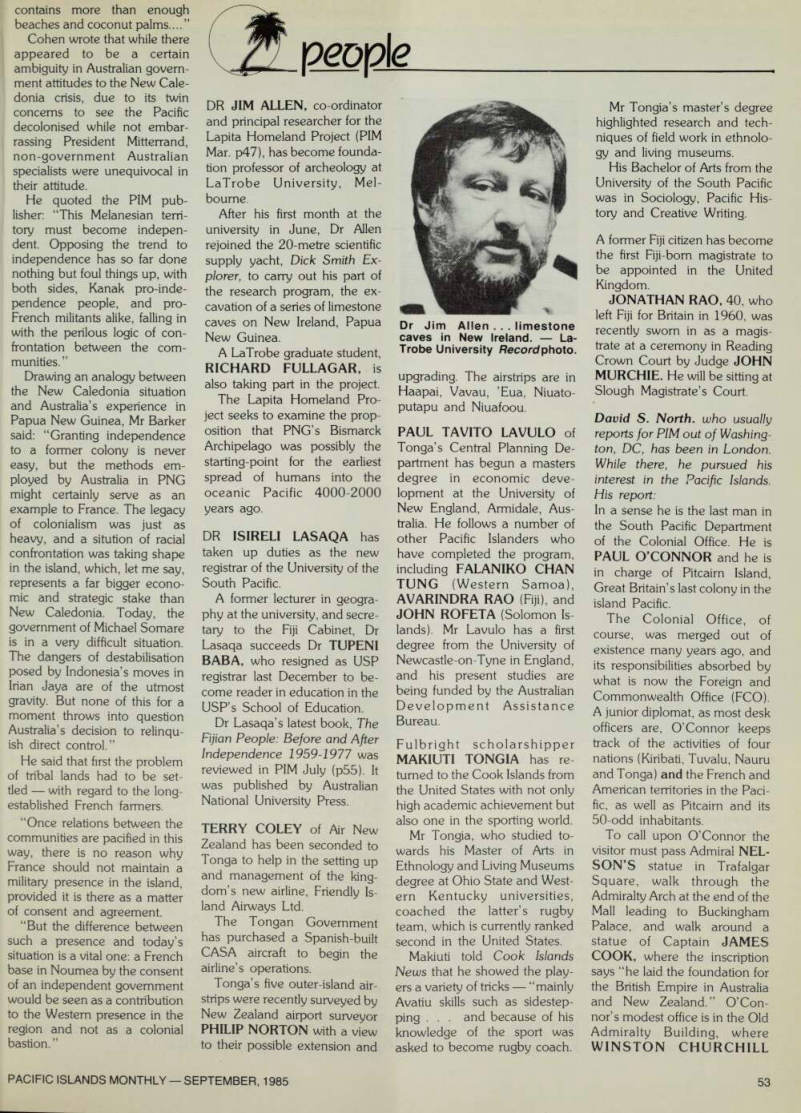
P.I.M. views published in Paris
A common theory among Frenchmen, and particularly those of them living in New Caledonia and French Polynesia, is that Australia seeks to usurp France’s position in the Pacific. Thus, Australia is accused of supporting the inde pendence movement in New Caledonia largely because it will remove French influence so that Australia may take over as the dominant power.
The question arose during conversation in Sydney be tween PlM’s publisher, Garry Barker, and a visiting French journalist, Bernard Cohen, of the Paris daily newspaper, Liberation. Barker’s rejection of the claim was fulsomely re ported by Liberation in what may be the most extensive reporting of an Australian view of the New Caledonian position yet published in France.
Barker told Cohen: “Because we are geographically close to the island it has become com monplace in anti-independence French circles to accuse Austra
lia of wanting to grab hold of New Caledonia. But, let’s be serious: there is not a single political party in Australia, not a single viable pressure group, supporting any such course of action. The decolonisation pro cess is France’s business, and the business of the local popu lation in New Caledonia. Aus tralia’s one concern is that New Caledonia should be stable, peaceful, and an active part of the free democratic world.”
He added: “The level of Australia’s overseas aid is already considered to be higher than the economy can reason ably afford. And New Caledo nia is seen as needing outside assistance for some long time.
Nor is it likely that our investors would be tempted by the Caledonian nickel mines, con sidering the present depressed state of world metal markets and the fact that we have mineral resources of our own which, incidentally, have their own problems right now.
What’s more, our continent
contains more than enough beaches and coconut palms...”
Cohen wrote that while there appeared to be a certain ambiguity in Australian govern ment attitudes to the New Cale donia crisis, due to its twin concerns to see the Pacific decolonised while not embar rassing President Mitterrand, non-government Australian specialists were unequivocal in their attitude.
He quoted the PIM pub lisher: “This Melanesian terri tory must become indepen dent. Opposing the trend to independence has so far done nothing but foul things up, with both sides, Kanak pro-inde pendence people, and pro- French militants alike, falling in with the perilous logic of con frontation between the com munities.”
Drawing an analogy between the New Caledonia situation and Australia’s experience in Papua New Guinea, Mr Barker said: “Granting independence to a former colony is never easy, but the methods em ployed by Australia in PNG might certainly serve as an example to France. The legacy of colonialism was just as heavy, and a sitution of racial confrontation was taking shape in the island, which, let me say, represents a far bigger econo mic and strategic stake than New Caledonia. Today, the government of Michael Somare is in a very difficult situation.
The dangers of destabilisation posed by Indonesia’s moves in Irian Jaya are of the utmost gravity. But none of this for a moment throws into question Australia’s decision to relinqu ish direct control.”
He said that first the problem of tribal lands had to be set tled with regard to the long established French farmers.
“Once relations between the communities are pacified in this way, there is no reason why France should not maintain a military presence in the island, provided it is there as a matter of consent and agreement.
“But the difference between such a presence and today’s situation is a vital one: a French base in Noumea by the consent of an independent government would be seen as a contribution to the Western presence in the region and not as a colonial bastion. ”
people
DR JIM ALLEN, co-ordinator and principal researcher for the Capita Homeland Project (PIM Mar. p 47), has become founda tion professor of archeology at LaTrobe University, Mel bourne, After his first month at the university in June, Dr Allen rejoined the 20-metre scientific supply yacht, Dick Smith Ex plorer, to carry out his part of the research program, the ex cavation of a series of limestone caves on New Ireland, Papua New Guinea.
A LaTrobe graduate student,
Richard Fullagar, Is
also taking part in the project.
The Capita Homeland Pro ject seeks to examine the prop osition that PNG’s Bismarck Archipelago was possibly the starting-point for the earliest spread of humans into the oceanic Pacific 4000-2000 years ago.
Dr Isireli Lasaqa Has
taken up duties as the new registrar of the University of the South Pacific.
A former lecturer in geogra phy at the university, and secre tary to the Fiji Cabinet, Dr Lasaqa succeeds Dr TUPENI BABA, who resigned as USP registrar last December to be come reader in education in the USP’s School of Education.
Dr Lasaqa’s latest book, The Fijian People: Before and After Independence 1959-1977 was reviewed in PIM July (p 55). It was published by Australian National University Press.
TERRY COLEY of Air New Zealand has been seconded to Tonga to help in the setting up and management of the king dom’s new airline, Friendly Is land Airways Ltd.
The Tongan Government has purchased a Spanish-built CASA aircraft to begin the airline’s operations.
Tonga’s five outer-island air strips were recently surveyed by New Zealand airport surveyor PHILIP NORTON with a view to their possible extension and
upgrading. The airstrips are in Haapai, Vavau, ’Eua, Niuato putapu and Niuafoou.
Paul Tavito Lavulo Of
Tonga’s Central Planning De partment has begun a masters degree in economic deve lopment at the University of New England, Armidale, Aus tralia. He follows a number of other Pacific Islanders who have completed the program, including FALANIKO CHAN TUNG (Western Samoa), AVARINDRA RAO (Fiji), and JOHN ROFETA (Solomon Is lands). Mr Lavulo has a first degree from the University of Newcastle-on-Tyne in England, and his present studies are being funded by the Australian Development Assistance Bureau.
Fulbright scholarshipper
Makiuti Tongia Has Re
turned to the Cook Islands from the United States with not only high academic achievement but also one in the sporting world.
Mr Tongia, who studied to wards his Master of Arts in Ethnology and Living Museums degree at Ohio State and West ern Kentucky universities, coached the latter’s rugby team, which is currently ranked second in the United States.
Makiuti told Cook Islands News that he showed the play ers a variety of tricks “mainly Avatiu skills such as sidestep ping . . . and because of his knowledge of the sport was asked to become rugby coach.
Mr Tongia’s master’s degree highlighted research and tech niques of field work in ethnolo gy and living museums.
His Bachelor of Arts from the University of the South Pacific was in Sociology, Pacific His tory and Creative Writing.
A former Fiji citizen has become the first Fiji-bom magistrate to be appointed in the United Kingdom.
Jonathan Rao, 40, Who
left Fiji for Britain in 1960, was recently sworn in as a magis trate at a ceremony in Reading Crown Court by Judge JOHN MURCHIE. He will be sitting at Slough Magistrate’s Court.
David S. North, who usually reports for PIM out of Washing ton, DC, has been in London.
While there, he pursued his interest in the Pacific Islands.
His report: In a sense he is the last man in the South Pacific Department of the Colonial Office. He is PAUL O’CONNOR and he is in charge of Pitcairn Island, Great Britain’s last colony in the island Pacific.
The Colonial Office, of course, was merged out of existence many years ago, and its responsibilities absorbed by what is now the Foreign and Commonwealth Office (FCO).
A junior diplomat, as most desk officers are, O’Connor keeps track of the activities of four nations (Kiribati, Tuvalu, Nauru and Tonga) and the French and American territories in the Paci fic, as well as Pitcairn and its 50-odd inhabitants.
To call upon O’Connor the visitor must pass Admiral NEL SON’S statue in Trafalgar Square, walk through the Admiralty Arch at the end of the Mall leading to Buckingham Palace, and walk around a statue of Captain JAMES COOK, where the inscription says “he laid the foundation for the British Empire in Australia and New Zealand.” O’Con nor’s modest office is in the Old Admiralty Building, where
Winston Churchill
Dr Jim Allen .. . limestone caves in New Ireland. - La- Trobe University Record photo.
Advertisements & other items, pp. 55-56 (2 items)
Europe-South Pacific Joint Service
IUUK LWKLCI CUrNINECIIUrN
ISSi
‘u a *' -r-
EUROPE-SOUTH PACIFIC JOINT SERVICE
The South Pacific Specialists offer facilities for shipment of: Containers (FCL/LCL) and Breakbulk Cargo plus reefer space and deeptanks for carriage of vegetable oils and other liquid bulk cargo.
Carriers also accept heavy lifts, overlength and cumbersome parcels.
Ports of Service: Loading: Papeete, Apia, Suva, Lautoka, Noumea, Port Vila, Santo, Honiara, Port Moresby, Lae,Madang, Kimbe, Rabaul, Kieta, Darwin.
For: Rotterdam, Antwerp, Hamburg, Hull, Dunkirk, Le Havre.
Please contact our regional offices for further information: The Bank Line (Australasia) Pty. Ltd.
Suite 801,51 Pitt Street Sydney N.S.W. 2000 Phone: 27 2041 Telex: 24063
- ROUND THE WORLD SERVICE -
Additional ports on enquiry.
P.O. Box 1667 Lae/Papua New Guinea Phone: 42 3466/42 3287.5 A.H. 42 2481 Telex: Colline NE 44 171
THE BANK LINE LTD LONDON
COLUMBUS LINE REEDEREI GMBH HAMBURG
C0L0024
56
PACIFIC ISLANDS MONTHLY —SEPTEMBER, 1985
Flosse’s Festival Continued from page 25
from the islands press
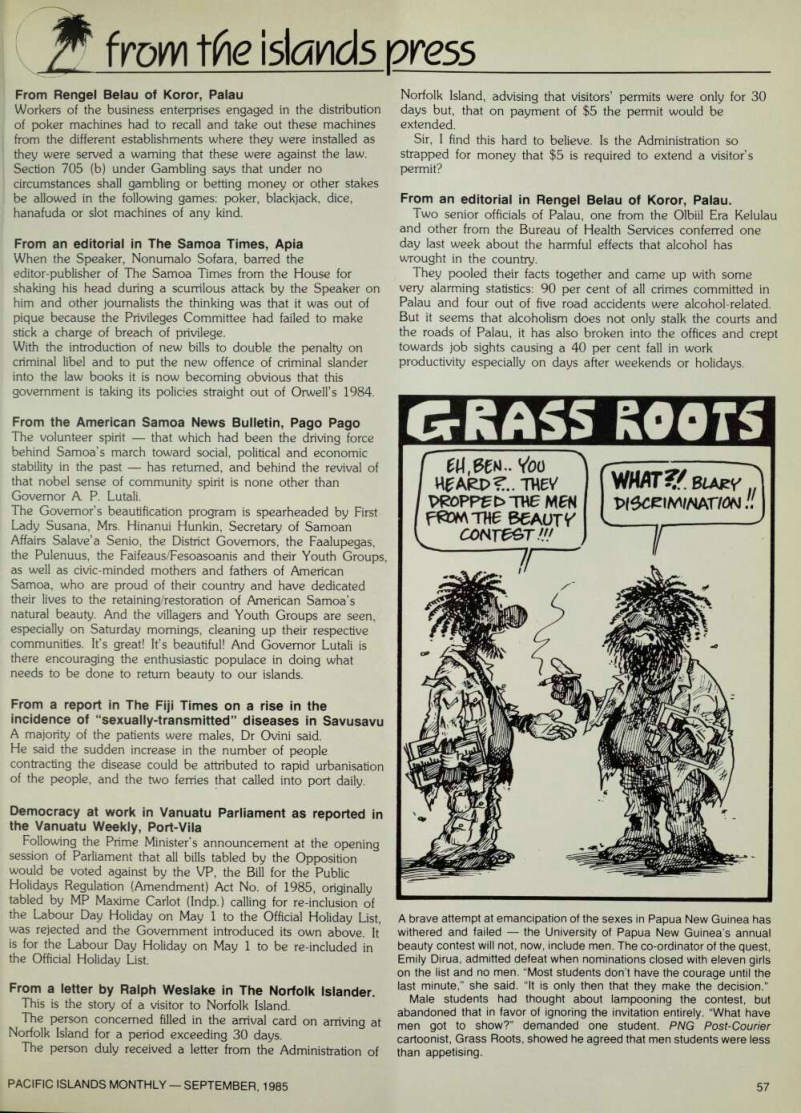
From Rengel Belau of Koror, Palau Workers of the business enterprises engaged in the distribution of poker machines had to recall and take out these machines from the different establishments where they were installed as they were served a warning that these were against the law.
Section 705 (b) under Gambling says that under no circumstances shall gambling or betting money or other stakes be allowed in the following games: poker, blackjack, dice, hanafuda or slot machines of any kind.
From an editorial in The Samoa Times, Apia When the Speaker, Nonumalo Sofara, barred the editor-publisher of The Samoa Times from the House for shaking his head during a scurrilous attack by the Speaker on him and other journalists the thinking was that it was out of pique because the Privileges Committee had failed to make stick a charge of breach of privilege.
With the introduction of new bills to double the penalty on criminal libel and to put the new offence of criminal slander into the law books it is now becoming obvious that this government is taking its policies straight out of Orwell’s 1984.
From the American Samoa News Bulletin, Pago Pago The volunteer spirit that which had been the driving force behind Samoa’s march toward social, political and economic stability in the past has returned, and behind the revival of that nobel sense of community spirit is none other than Governor A P. Lutali.
The Governor’s beautification program is spearheaded by First Lady Susana, Mrs. Hinanui Hunkin, Secretary of Samoan Affairs Salave’a Senio, the District Governors, the Faalupegas, the Pulenuus, the Faifeaus/Fesoasoanis and their Youth Groups as well as civic-minded mothers and fathers of American Samoa, who are proud of their country and have dedicated their lives to the retaining/rcstoration of American Samoa’s natural beauty. And the villagers and Youth Groups are seen, especially on Saturday mornings, cleaning up their respective communities. It’s great! It’s beautiful! And Governor Lutali is there encouraging the enthusiastic populace in doing what needs to be done to return beauty to our islands.
From a report in The Fiji Times on a rise in the incidence of “sexually-transmitted” diseases in Savusavu A majority of the patients were males, Dr Ovini said.
He said the sudden increase in the number of people contracting the disease could be attributed to rapid urbanisation of the people, and the two ferries that called into port daily.
Democracy at work in Vanuatu Parliament as reported in the Vanuatu Weekly, Port-Vila Following the Prime Minister’s announcement at the opening session of Parliament that all bills tabled by the Opposition would be voted against by the VP, the Bill for the Public Holidays Regulation (Amendment) Act No. of 1985, originally tabled by MP Maxime Carlot (Indp.) calling for re-inclusion of the Labour Day Holiday on May 1 to the Official Holiday List, was rejected and the Government introduced its own above. It is for the Labour Day Holiday on May 1 to be re-included in the Official Holiday List.
From a letter by Ralph Weslake in The Norfolk Islander.
This is the story of a visitor to Norfolk Island.
The person concerned filled in the arrival card on arriving at Norfolk Island for a period exceeding 30 days.
The person duly received a letter from the Administration of
Norfolk Island, advising that visitors’ permits were only for 30 days but, that on payment of $5 the permit would be extended.
Sir, I find this hard to believe. Is the Administration so strapped for money that $5 is required to extend a visitor’s permit?
From an editorial in Rengel Belau of Koror, Palau.
Two senior officials of Palau, one from the Olbiil Era Kelulau and other from the Bureau of Health Services conferred one day last week about the harmful effects that alcohol has w'rought in the country.
They pooled their facts together and came up with some very alarming statistics: 90 per cent of all crimes committed in Palau and four out of five road accidents were alcohol-related.
But it seems that alcoholism does not only stalk the courts and the roads of Palau, it has also broken into the offices and crept towards job sights causing a 40 per cent fall in work productivity especially on days after weekends or holidays.
A brave attempt at emancipation of the sexes in Papua New Guinea has withered and failed the University of Papua New Guinea's annual beauty contest will not, now, include men. The co-ordinator of the quest, Emily Dirua, admitted defeat when nominations closed with eleven girls on the list and no men. “Most students don’t have the courage until the last minute,” she said. “It is only then that they make the decision.”
Male students had thought about lampooning the contest, but abandoned that in favor of ignoring the invitation entirely. “What have men got to show?” demanded one student. PNG Post-Courier cartoonist, Grass Roots, showed he agreed that men students were less
than appetising.
Advertisements & other items, p. 58 (1 item)
&
\ \ \ / ■V \ / 7 We \ \ \ \ \ ,*V P&f& O^ ', <:^ o^ 1 s^ c ° *,£»«• \*■ .. s \ ss>' - <rf**V
yachts
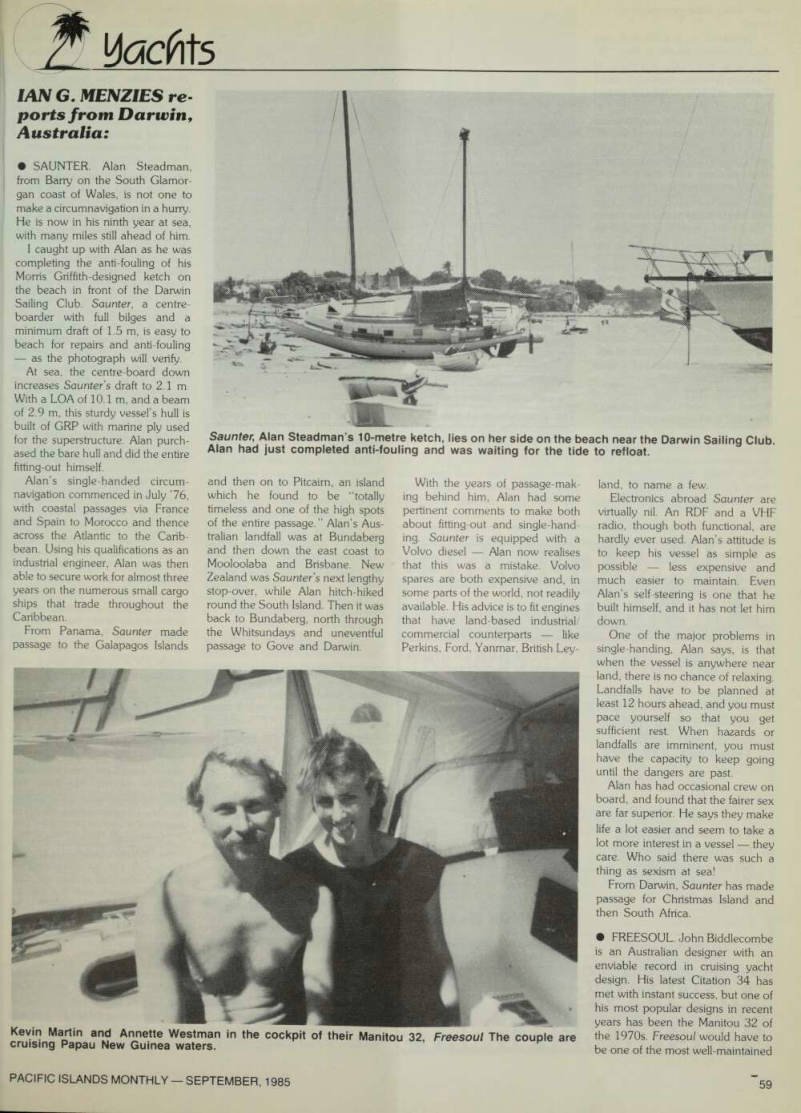
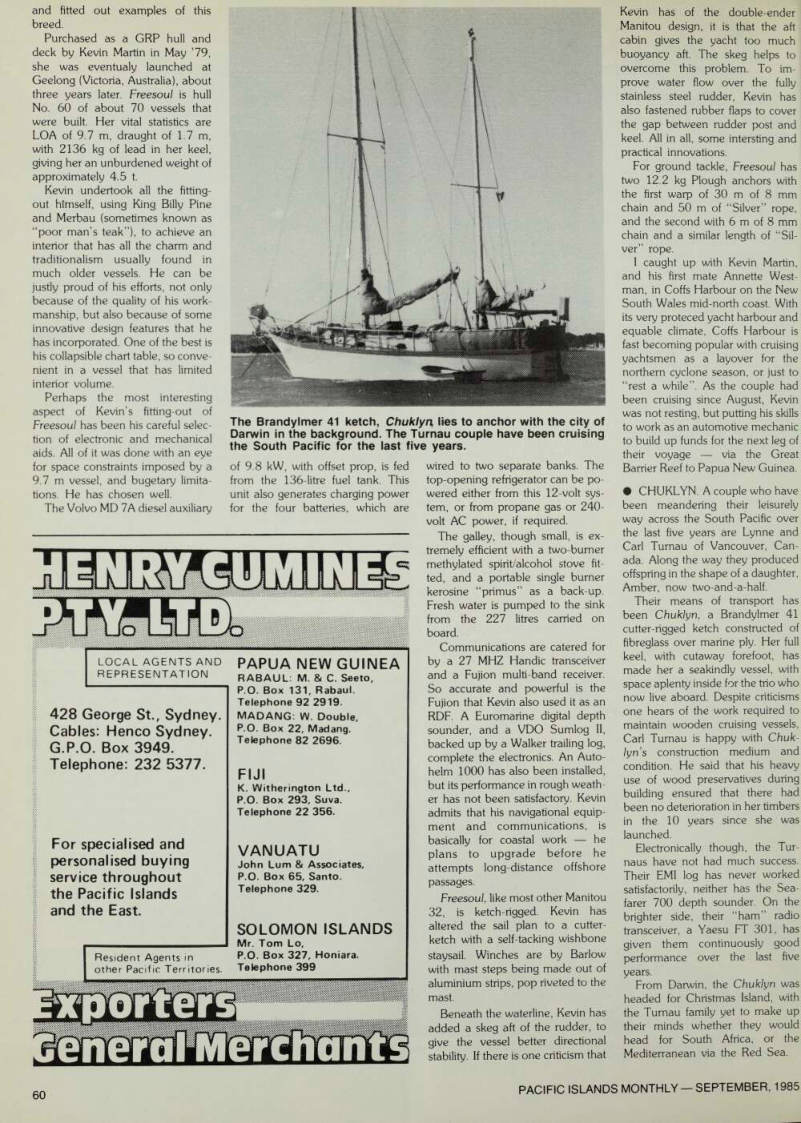
Lan G. Menzies Re
ports from Darwin,
Australia:
• SAUNTER. Alan Steadman, from Barry on the South Glamor gan coast of Wales, is not one to make a circumnavigation in a hurry.
He is now in his ninth year at sea, with many miles still ahead of him.
I caught up with Alan as he was completing the anti-fouling of his Morris Griffith-designed ketch on the beach in front of the Darwin Sailing Club. Saunter , a centre boarder with full bilges and a minimum draft of 1.5 m, is easy to beach for repairs and anti-fouling as the photograph will verify.
At sea, the centre-board down increases Saunter’s draft to 2.1 m With a LOA of 10.1 m, and a beam of 2.9 m, this sturdy vessel’s hull is built of GRP with marine ply used for the superstructure. Alan purch ased the bare hull and did the entire
fitting-out himself.
Alan’s single-handed circum navigation commenced in July ’76, with coastal passages via France and Spain to Morocco and thence across the Atlantic to the Carib bean. Using his qualifications as an industrial engineer, Alan was then able to secure work for almost three years on the numerous small cargo ships that trade throughout the Caribbean.
From Panama, Saunter made passage to the Galapagos Islands
and then on to Pitcairn, an island which he found to be “totally timeless and one of the high spots of the entire passage. ” Alan’s Aus tralian landfall was at Bundaberg and then down the east coast to Mooloolaba and Brisbane. New Zealand was Saunter’s next lengthy stop-over, while Alan hitch-hiked round the South Island. Then it was back to Bundaberg, north through the Whitsundays and uneventful passage to Gove and Darwin.
With the years of passage-mak ing behind him, Alan had some pertinent comments to make both about fitting-out and single-hand ing. Saunter is equipped with a Volvo diesel Alan now realises that this was a mistake. Volvo spares are both expensive and, in some parts of the world, not readily available. His advice is to fit engines that have land-based industrial/ commercial counterparts like Perkins, Ford, Yanmar, British Ley
land, to name a few.
Electronics abroad Saunter are virtually nil. An RDF and a VHF radio, though both functional, are hardly ever used. Alan’s attitude is to keep his vessel as simple as possible less expensive and much easier to maintain. Even Alan’s self-steering is one that he built himself, and it has not let him down.
One of the major problems in single-handing, Alan says, is that when the vessel is anywhere near land, there is no chance of relaxing.
Landfalls have to be planned at least 12 hours ahead, and you must pace yourself so that you get sufficient rest. When hazards or landfalls are imminent, you must have the capacity to keep going until the dangers are past.
Alan has had occasional crew on board, and found that the fairer sex are far superior. He says they make life a lot easier and seem to take a lot more interest in a vessel they care. Who said there was such a thing as sexism at sea!
From Darwin, Saunter has made passage for Christmas Island and then South Africa. • FREESOUL. John Biddlecombe is an Australian designer with an enviable record in cruising yacht design. His latest Citation 34 has met with instant success, but one of his most popular designs in recent years has been the Manitou 32 of the 19705. Freesoul would have to be one of the most well-maintained
Kevin Martin and Annette Westman in the cockpit of their Manitou 32, Freesoul The couple are cruising Papau New Guinea waters.
Saunter, Alan Steadman’s 10-metre ketch, lies on her side on the beach near the Darwin Sailing Club.
Alan had just completed anti-fouling and was waiting for the tide to refloat.
and fitted out examples of this breed.
Purchased as a GRP hull and deck by Kevin Martin in May ’79, she was eventualy launched at Geelong (Victoria, Australia), about three years later. Freesoul is hull No. 60 of about 70 vessels that were built. Her vital statistics are LOA of 9.7 m, draught of 1.7 m, with 2136 kg of lead in her keel, giving her an unburdened weight of approximately 4.5 t.
Kevin undertook all the fitting out himself, using King Billy Pine and Merbau (sometimes known as “poor man’s teak”), to achieve an interior that has all the charm and traditionalism usually found in much older vessels. He can be justly proud of his efforts, not only because of the quality of his work manship, but also because of some innovative design features that he has incorporated. One of the best is his collapsible chart table, so conve nient in a vessel that has limited interior volume.
Perhaps the most interesting aspect of Kevin’s fitting-out of Freesoul has been his careful selec tion of electronic and mechanical aids. All of it was done with an eye for space constraints imposed by a 9.7 m vessel, and bugetary limita tions. He has chosen well.
The Volvo MD 7 A diesel auxiliary
of 9.8 kW, with offset prop, is fed from the 136-litre fuel tank. This unit also generates charging power for the four batteries, which are
wired to two separate banks. The top-opening refrigerator can be po wered either from this 12-volt sys tem, or from propane gas or 240volt AC power, if required.
The galley, though small, is ex tremely efficient with a two-burner methylated spirit/alcohol stove fit ted, and a portable single burner kerosine “primus” as a back-up.
Fresh water is pumped to the sink from the 227 litres carried on board.
Communications are catered for by a 27 MHZ Handic transceiver and a Fujion multi-band receiver.
So accurate and powerful is the Fujion that Kevin also used it as an RDF. A Euromarine digital depth sounder, and a VDO Sumlog 11, backed up by a Walker trailing log, complete the electronics. An Auto helm 1000 has also been installed, but its performance in rough weath er has not been satisfactory. Kevin admits that his navigational equip ment and communications, is basically for coastal work he plans to upgrade before he attempts long-distance offshore passages.
Freesoul, like most other Manitou 32, is ketch-rigged. Kevin has altered the sail plan to a cutter ketch with a self-tacking wishbone staysail. Winches are by Barlow with mast steps being made out of aluminium strips, pop riveted to the mast.
Beneath the waterline, Kevin has added a skeg aft of the rudder, to give the vessel better directional stability. If there is one criticism that
Kevin has of the double-ender Manitou design, it is that the aft cabin gives the yacht too much buoyancy aft. The skeg helps to overcome this problem. To im prove water flow over the fully stainless steel rudder, Kevin has also fastened rubber flaps to cover the gap between rudder post and keel. All in all, some intersting and practical innovations.
For ground tackle, Freesoul has two 12.2 kg Plough anchors with the first warp of 30 m of 8 mm chain and 50 m of “Silver” rope, and the second with 6 m of 8 mm chain and a similar length of “Sil ver” rope.
I caught up with Kevin Martin, and his first mate Annette West man, in Coffs Harbour on the New South Wales mid-north coast. With its very proteced yacht harbour and equable climate, Coffs Harbour is fast becoming popular with cruising yachtsmen as a layover for the northern cyclone season, or just to “rest a while”. As the couple had been cruising since August, Kevin was not resting, but putting his skills to work as an automotive mechanic to build up funds for the next leg of their voyage via the Great Barrier Reef to Papua New Guinea. • CHUKLYN. A couple who have been meandering their leisurely way across the South Pacific over the last five years are Lynne and Carl Turnau of Vancouver, Can ada. Along the way they produced offspring in the shape of a daughter, Amber, now two-and-a-half.
Their means of transport has been Chuklyn, a Brandylmer 41 cutter-rigged ketch constructed of fibreglass over marine ply. Her full keel, with cutaway forefoot, has made her a seakindly vessel, with space aplenty inside for the trio who now live aboard. Despite criticisms one hears of the work required to maintain wooden cruising vessels, Carl Turnau is happy with Chuk lyn’s construction medium and condition. He said that his heavy use of wood preservatives during building ensured that there had been no deterioration in her timbers in the 10 years since she was launched.
Electronically though, the Tur naus have not had much success.
Their EMI log has never worked satisfactorily, neither has the Sea farer 700 depth sounder. On the brighter side, their “ham” radio transceiver, a Yaesu FT 301, has given them continuously good performance over the last five years.
From Darwin, the Chuklyn was headed for Christmas Island, with the Turnau family yet to make up their minds whether they would head for South Africa, or the Mediterranean via the Red Sea.
The Brandylmer 41 ketch, Chuklyn, lies to anchor with the city of Darwin in the background. The Turnau couple have been cruising the South Pacific for the last five years.
Advertisements & other items, p. 60 (1 item)
428 George St., Sydney.
c;
LOCAL AGENTS AND
REPRESENTATION
428 George St., Sydney.
Cables: Henco Sydney.
G.P.O. Box 3949.
Telephone: 232 5377.
For specialised and
personalised buying
service throughout
the Pacific Islands and the East.
PAPUA NEW GUINEA
RABAUL: M. & C. Seeto.
P.O. Box 131, Rabaul.
Telephone 92 2919.
MADANG: W. Double, P.O. Box 22, Madang.
Telephone 82 2696.
FIJI
K. Witherington Ltd., P.O. Box 293, Suva.
Telephone 22 356.
VANUATU
John Lum & Associates, P.O. Box 65, Santo.
Telephone 329.
Resident Agents in other Pacific Territories.
SOLOMON ISLANDS
Mr. Tom Lo, P.O. Box 327, Honiara.
Telephone 399 I 18
shipping schedules
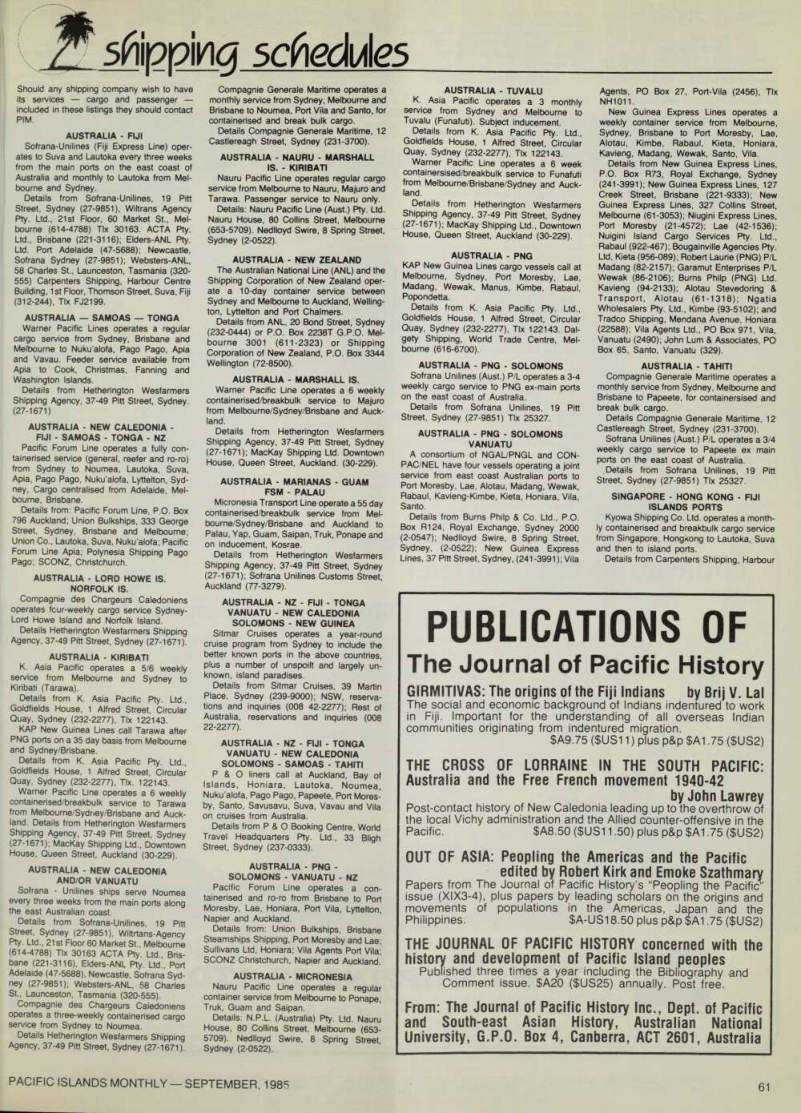
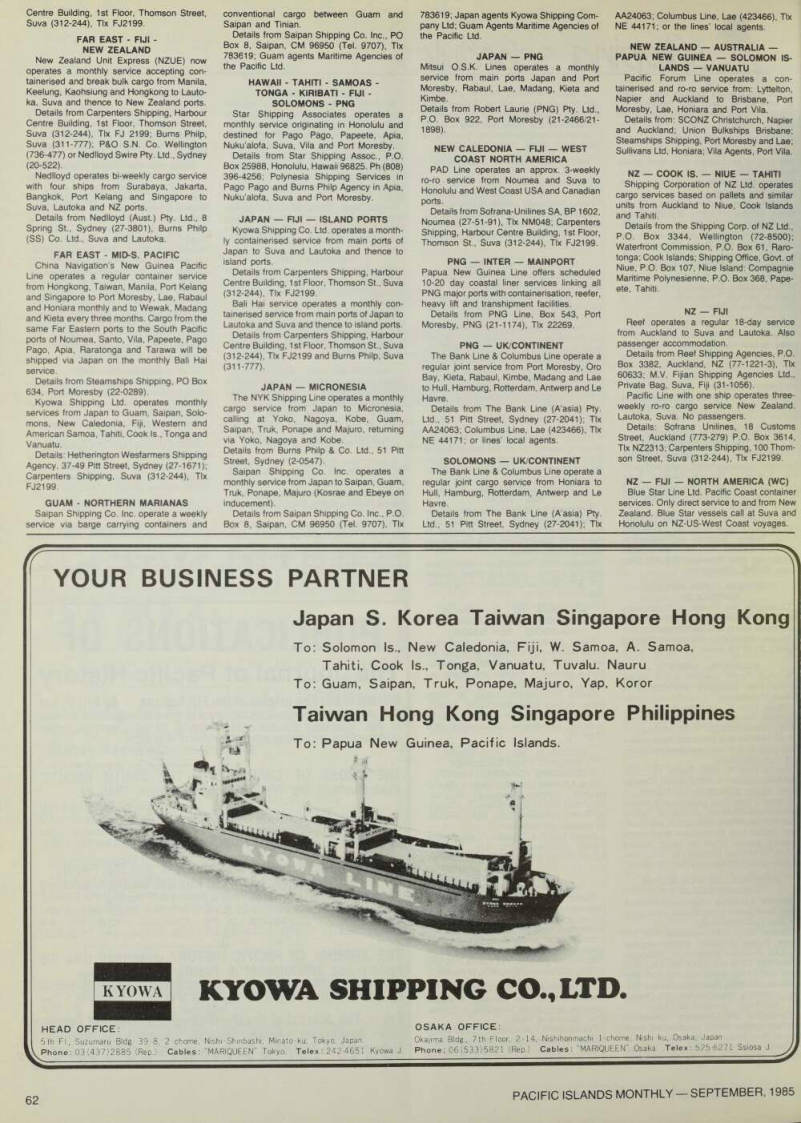
Should any shipping company wish to have its services cargo and passenger included in these listings they should contact
Pim.
Australia - Fiji
Sofrana-Unilines (Fiji Express Line) oper ates to Suva and Lautoka every three weeks from the main ports on the east coast of Australia and monthly to Lautoka from Mel bourne and Sydney.
Details from Sofrana-Unilines, 19 Pitt Street, Sydney (27-9851), Wiltrans Agency Pty. Ltd., 21st Floor, 60 Market St., Mel bourne (614-4788) Tlx 30163. ACTA Pty.
Ltd., Brisbane (221-3116); Elders-ANL Pty.
Ltd. Port Adelaide (47-5688); Newcastle, Sofrana Sydney (27-9851); Websters-ANL, 58 Charles St., Launceston, Tasmania (320- 555) Carpenters Shipping, Harbour Centre Building, Ist Floor, Thomson Street, Suva, Fiji (312-244), Tlx FJ2199.
Australia Samoas Tonga
Warner Pacific Lines operates a regular cargo service from Sydney, Brisbane and Melbourne to Nukualofa, Pago Pago, Apia and Vavau. Feeder service available from Apia to Cook, Christmas, Fanning and Washington Islands.
Details from Hetherington Wesfarmers Shipping Agency, 37-49 Pitt Street, Sydney. (27-1671)
Australia - New Caledonia -
FIJI - SAMOAS - TONGA - NZ Pacific Forum Line operates a fully con tainerised service (general, reefer and ro-ro) from Sydney to Noumea, Lautoka, Suva, Apia, Pago Pago. Nukualofa, Lyttelton, Syd ney, Cargo centralised from Adelaide, Mel bourne, Brisbane.
Details from: Pacific Forum Line, P.O. Box 796 Auckland; Union Bulkships, 333 George Street, Sydney, Brisbane and Melbourne; Union Co., Lautoka, Suva, Nukualofa; Pacific Forum Line Apia; Polynesia Shipping Pago Pago; SCONZ, Christchurch.
Australia - Lord Howe Is.
Norfolk Is.
Compagnie des Chargeurs Caledonians operates fcur-weekly cargo service Sydney- Lord Howe Island and Norfolk Island.
Details Hetherington Wesfarmers Shipping Agency, 37-49 Pitt Street. Sydney (27-1671).
Australia - Kiribati
K. Asia Pacific operates a 5/6 weekly service from Melbourne and Sydney to Kiribati (Tarawa).
Details from K. Asia Pacific Pty. Ltd., Goldfields House, 1 Alfred Street, Circular Quay, Sydney (232-2277), Tlx 122143.
KAP New Guinea Lines call Tarawa after PNG ports on a 35 day basis from Melbourne and Sydney/Brisbane.
Details from K. Asia Pacific Pty. Ltd., Goldfields House, 1 Alfred Street, Circular Quay, Sydney (232-2277), Tlx. 122143.
Warner Pacific Line operates a 6 weekly containerised/breakbulk service to Tarawa from Melbourne/Sydney/Brisbane and Auck land. Details from Hetherington Wesfarmers Shipping Agency, 37-49 Pitt Street, Sydney (27-1671); Mac Kay Shipping Ltd., Downtown House, Queen Street, Auckland (30-229).
Australia - New Caledonia
And/Or Vanuatu
Sofrana - Unilines ships serve Noumea every three weeks from the main ports along the east Australian coast.
Details from Sofrana-Unilines, 19 Pitt Street, Sydney (27-9851). Wiltrtans-Agency Pty. Ltd., 21st Floor 60 Market St., Melbourne (614-4788) Tlx 30163 ACTA Pty. Ltd., Bris bane (221-3116), Elders-ANL Pty. Ltd., Port Adelaide (47-5688), Newcastle, Sofrana Syd ney (27-9851); Websters-ANL, 58 Charles St., Launceston, Tasmania (320-555).
Compagnie des Chargeurs Caledoniens operates a three-weekly containerised cargo service from Sydney to Noumea.
Details Hetherington Wesfarmers Shipping Agency, 37-49 Pitt Street, Sydney (27-1671).
Compagnie Generale Maritime operates a monthly service from Sydney, Melbourne and Brisbane to Noumea, Port Vila and Santo, for containerised and break bulk cargo.
Details Compagnie Generale Maritime, 12 Castlereagh Street, Sydney (231-3700).
Australia - Nauru - Marshall
Is. - Kiribati
Nauru Pacific Line operates regular cargo service from Melbourne to Nauru, Majuro and Tarawa. Passenger service to Nauru only.
Details: Nauru Pacific Line (Aust.) Pty. Ltd.
Nauru House, 80 Collins Street, Melbourne (653-5709). Nedlloyd Swire, 8 Spring Street, Sydney (2-0522).
Australia - New Zealand
The Australian National Line (ANL) and the Shipping Corporation of New Zealand oper ate a 10-day container service between Sydney and Melbourne to Auckland, Welling ton, Lyttelton and Port Chalmers.
Details from ANL, 20 Bond Street, Sydney (232-0444) or P.O. Box 2238 T G.P.O. Mel bourne 3001 (611-2323) or Shipping Corporation of New Zealand, P.O. Box 3344 Wellington (72-8500).
Australia - Marshall Is.
Warner Pacific Line operates a 6 weekly containerised/breakbulk service to Majuro from Melbourne/Sydney/Brisbane and Auck land.
Details from Hetherington Wesfarmers Shipping Agency, 37-49 Pitt Street, Sydney (27-1671); Mac Kay Shipping Ltd. Downtown House, Queen Street, Auckland. (30-229).
Australia - Marianas - Guam
Fsm - Palau
Micronesia Transport Line operate a 55 day containerised/breakbulk service from Mel bourne/Sydney/Brisbane and Auckland to Palau, Yap, Guam, Saipan, Truk, Ponape and on inducement, Kosrae.
Details from Hetherington Wesfarmers Shipping Agency, 37-49 Pitt Street, Sydney (27-1671); Sofrana Unilines Customs Street, Auckland (77-3279).
AUSTRALIA - NZ - FIJI - TONGA
Vanuatu - New Caledonia
Solomons - New Guinea
Sitmar Cruises operates a year-round cruise program from Sydney to include the better known ports in the above countries, plus a number of unspoilt and largely un known, island paradises.
Details from Sitmar Cruises, 39 Martin Place. Sydney (239-9000); NSW, reserva tions and inquiries (008 42-2277); Rest of Australia, reservations and inquiries (008 22-2277).
AUSTRALIA - NZ - FIJI - TONGA
Vanuatu - New Caledonia
Solomons - Samoas - Tahiti
P & O liners call at Auckland, Bay of Islands. Honiara, Lautoka, Noumea.
Nukualofa, Pago Pago, Papeete, Port Mores by, Santo, Savusavu, Suva, Vavau and Vila on cruises from Australia.
Details from P & O Booking Centre, World Travel Headquarters Pty. Ltd., 33 Bligh Street, Sydney (237-0333).
Australia - Png -
Solomons - Vanuatu - Nz
Pacific Forum Line operates a con tainerised and ro-ro from Brisbane to Port Moresby, Lae, Honiara, Port Vila, Lyttelton, Napier and Auckland.
Details from: Union Bulkships, Brisbane Steamships Shipping. Port Moresby and Lae; Sullivans Ltd, Honiara; Vila Agents Port Vila; SCONZ Christchurch, Napier and Auckland.
Australia - Micronesia
Nauru Pacific Line operates a regular container service from Melbourne to Ponape, Truk, Guam and Saipan.
Details: N.P.L. (Australia) Pty. Ltd. Nauru House, 80 Collins Street, Melbourne (653- 5709). Nedlloyd Swire, 8 Spring Street Sydney (2-0522).
Australia - Tuvalu
K. Asia Pacific operates a 3 monthly service from Sydney and Melbourne to Tuvalu (Funafuti). Subject inducement.
Details from K. Asia Pacific Pty. Ltd., Goldfields House, 1 Alfred Street, Circular Quay, Sydney (232-2277), Tlx 122143.
Warner Pacific Line operates a 6 week containersised/breakbulk service to Funafuti from Melbourne/Brisbane/Sydney and Auck land.
Details from Hetherington Wesfarmers Shipping Agency. 37-49 Pitt Street. Sydney
(27-1671); Mac Kay Shipping Ltd., Downtown
House. Queen Street. Auckland (30-229).
Australia - Png
KAP New Guinea Lines cargo vessels call at Melbourne, Sydney, Port Moresby, Lae, Madang, Wewak, Manus, Kimbe, Rabaul, Popondetta.
Details from K. Asia Pacific Pty. Ltd., Goldfields House, 1 Alfred Street, Circular Quay, Sydney (232-2277), Tlx 122143. Dal gety Shipping, World Trade Centre, Mel bourne (616-6700).
Australia - Png - Solomons
Sofrana Unilines (Aust.) P/L operates a 3-4 weekly cargo service to PNG ex-main ports on the east coast of Australia.
Details from Sofrana Unilines, 19 Pitt Street. Sydney (27-9851) Tlx 25327.
Australia - Png - Solomons
Vanuatu
A consortium of NGAUPNGL and CON PAC/NEL have four vessels operating a joint service from east coast Australian ports to Port Moresby, Lae, Alotau, Madang, Wewak, Rabaul, Kavieng-Kimbe, Kieta, Honiara, Vila, Santo.
Details from Burns Philp & Co. Ltd., P.O.
Box R 124, Royal Exchange, Sydney 2000 (2-0547); Nedlloyd Swire, 8 Spring Street, Sydney. (2-0522); New Guinea Express Lines, 37 Pitt Street. Sydney, (241-3991); Vila
Agents, PO Box 27, Port-Vila (2456), Tlx
Nhioii.
New Guinea Express Lines operates a weekly container service from Melbourne, Sydney, Brisbane to Port Moresby, Lae, Alotau, Kimbe, Rabaul, Kieta, Honiara, Kavieng, Madang, Wewak, Santo, Vila.
Details from New Guinea Express Lines, P.O. Box R 73, Royal Exchange, Sydney (241-3991); New Guinea Express Lines, 127 Creek Street, Brisbane (221-9333); New Guinea Express Lines, 327 Collins Street, Melbourne (61-3053); Niugini Express Lines, Port Moresby (21-4572); Lae (42-1536); Nuigini Island Cargo Services Pty. Ltd., Rabaul (922-467); Bougainville Agencies Pty.
Ltd, Kieta (956-089); Robert Laurie (PNG) P/L Madang (82-2157); Garamut Enterprises P/L Wewak (86-2106); Burns Philp (PNG) Ltd.
Kavieng (94-2133); Alotau Stevedoring & Transport, Alotau (61-1318); Ngatia Wholesalers Pty. Ltd., Kimbe (93-5102); and Tradco Shipping, Mendana Avenue, Honiara (22588); Vila Agents Ltd., PO Box 971, Vila, Vanuatu (2490); John Lum & Associates, PO Box 65, Santo, Vanuatu (329).
Australia - Tahiti
Compagnie Generale Maritime operates a monthly service from Sydney, Melbourne and Brisbane to Papeete, for containersised and break bulk cargo.
Details Compagnie Generale Maritime, 12 Castlereagh Street, Sydney (231-3700).
Sofrana Unilines (Aust.) P/L operates a 3/4 weekly cargo service to Papeete ex main ports on the east coast of Australia.
Details from Sofrana Unilines, 19 Pitt Street, Sydney (27-9851) Tlx 25327.
Singapore - Hong Kong - Fiji
Islands Ports
Kyowa Shipping Co. Ltd. operates a month ly containerised and breakbulk cargo service from Singapore, Hongkong to Lautoka, Suva and then to island ports.
Details from Carpenters Shipping, Harbour
Centre Building, Ist Floor, Thomson Street, Suva (312-244), Tlx FJ2199.
Far East - Fiji -
New Zealand
New Zealand Unit Express (NZUE) now operates a monthly service accepting con tainerised and break bulk cargo from Manila, Keelung, Kaohsiung and Hongkong to Lauto ka, Suva and thence to New Zealand ports.
Details from Carpenters Shipping, Harbour Centre Building, Ist Floor, Thomson Street, Suva (312-244), Tlx FJ 2199; Burns Philp.
Suva (311-777); P&O S.N. Co. Wellington (736-477) or Nedlloyd Swire Pty. Ltd., Sydney (20-522).
Nedlloyd operates bi-weekly cargo service with four ships from Surabaya, Jakarta, Bangkok, Port Kelang and Singapore to Suva, Lautoka and NZ ports.
Details from Nedlloyd (Aust.) Pty. Ltd., 8 Spring St., Sydney (27-3801), Burns Philp (SS) Co. Ltd., Suva and Lautoka.
Far East - Mid-S. Pacific
China Navigation's New Guinea Pacific Line operates a regular container service from Hongkong, Taiwan, Manila, Port Kelang and Singapore to Port Moresby, Lae, Rabaul and Honiara monthly and to Wewak, Madang and Kieta every three months. Cargo from the same Far Eastern ports to the South Pacific ports of Noumea, Santo, Vila, Papeete, Pago Pago. Apia, Raratonga and Tarawa will be shipped via Japan on the monthly Bali Hai service.
Details from Steamships Shipping, PO Box 634, Port Moresby (22-0289).
Kyowa Shipping Ltd. operates monthly services from Japan to Guam, Saipan, Solo mons, New Caledonia, Fiji, Western and American Samoa, Tahiti, Cook Is., Tonga and Vanuatu.
Details: Hetherington Wesfarmers Shipping Agency, 37-49 Pitt Street, Sydney (27-1671); Carpenters Shipping, Suva (312-244), Tlx FJ2199.
Guam - Northern Marianas
Saipan Shipping Co. Inc. operate a weekly service via barge carrying containers and
conventional cargo between Guam and Saipan and Tinian.
Details from Saipan Shipping Co. Inc., PO Box 8, Saipan, CM 96950 (Tel. 9707), Tlx 783619; Guam agents Maritime Agencies of the Pacific Ltd.
Hawaii - Tahiti - Samoas -
Tonga - Kiribati - Fiji -
Solomons - Png
Star Shipping Associates operates a monthly service originating in Honolulu and destined for Pago Pago, Papeete, Apia, Nukualofa, Suva, Vila and Port Moresby.
Details from Star Shipping Assoc., P.O.
Box 25988, Honolulu, Hawaii 96825. Ph (808) 396-4256; Polynesia Shipping Services in Pago Pago and Burns Philp Agency in Apia, Nukualofa, Suva and Port Moresby.
Japan Fiji Island Ports
Kyowa Shipping Co. Ltd. operates a month ly containerised service from main ports of Japan to Suva and Lautoka and thence to island ports.
Details from Carpenters Shipping, Harbour Centre Building, Ist Floor, Thomson St., Suva (312-244), Tlx FJ2199.
Bali Hai service operates a monthly con tainerised service from main ports of Japan to Lautoka and Suva and thence to island ports.
Details from Carpenters Shipping, Harbour Centre Building, Ist Floor, Thomson St., Suva (312-244), Tlx FJ2199 and Burns Philp, Suva (311-777).
Japan Micronesia
The NYK Shipping Line operates a monthly cargo service from Japan to Micronesia, calling at Yoko, Nagoya, Kobe, Guam, Saipan, Truk, Ponape and Majuro, returning via Yoko, Nagoya and Kobe.
Details from Burns Philp & Co. Ltd., 51 Pitt Street, Sydney (2-0547).
Saipan Shipping Co. Inc. operates a monthly service from Japan to Saipan, Guam, Truk, Ponape, Majuro (Kosrae and Ebeye on inducement).
Details from Saipan Shipping Co. Inc., P.O.
Box 8, Saipan. CM 96950 (Tel. 9707), Tlx
783619; Japan agents Kyowa Shipping Com pany Ltd; Guam Agents Maritime Agencies of the Pacific Ltd.
Japan Png
Mitsui O.S.K. Lines operates a monthly service from main ports Japan and Port Moresby, Rabaul, Lae, Madang, Kieta and Kimbe.
Details from Robert Laurie (PNG) Pty. Ltd., P.O. Box 922, Port Moresby (21-2466/21- 1898).
New Caledonia Fiji West
Coast North America
PAD Line operates an approx. 3-weekly ro-ro service from Noumea and Suva to Honolulu and West Coast USA and Canadian ports.
Details from Sofrana-Unilines SA, BP 1602, Noumea (27-51-91), Tlx NMO4B; Carpenters Shipping, Harbour Centre Building, Ist Floor, Thomson St.. Suva (312-244), Tlx FJ2199.
Png Inter Mainport
Papua New Guinea Line offers scheduled 10-20 day coastal liner services linking all PNG major ports with containerisation, reefer, heavy lift and transhipment facilities.
Details from PNG Line. Box 543, Port Moresby, PNG (21-1174), Tlx 22269.
Png Uk/Continent
The Bank Line & Columbus Line operate a regular joint service from Port Moresby, Oro Bay, Kieta, Rabaul, Kimbe, Madang and Lae to Hull, Hamburg, Rotterdam, Antwerp and Le Havre.
Details from The Bank Line (A’asia) Pty.
Ltd., 51 Pitt Street, Sydney (27-2041); Tlx AA24063; Columbus Line, Lae (423466), Tlx NE 44171; or lines' local agents.
Solomons Uk/Continent
The Bank Line & Columbus Line operate a regular joint cargo service from Honiara to Hull, Hamburg, Rotterdam, Antwerp and Le Havre.
Details from The Bank Line (A’asia) Pty.
Ltd., 51 Pitt Street, Sydney (27-2041); Tlx
AA24063; Columbus Line, Lae (423466), Tlx NE 44171; or the lines’ local agents.
New Zealand Australia
Papua New Guinea Solomon Is
Lands Vanuatu
Pacific Forum Line operates a con tainerised and ro-ro service from: Lyttelton, Napier and Auckland to Brisbane, Port Moresby, Lae, Honiara and Port Vila.
Details from: SCONZ Christchurch, Napier and Auckland; Union Bulkships Brisbane; Steamships Shipping, Port Moresby and Lae; Sullivans Ltd, Honiara; Vila Agents, Port Vila.
Nz Cook Is. Niue Tahiti
Shipping Corporation of NZ Ltd. operates cargo services based on pallets and similar units from Auckland to Niue, Cook Islands and Tahiti.
Details from the Shipping Corp. of NZ Ltd., P.O. Box 3344, Wellington (72-8500); Waterfront Commission, P.O. Box 61, Raro tonga; Cook Islands; Shipping Office, Govt, of Niue, P.O. Box 107, Niue Island: Compagnie Maritime Polynesienne, P.O. Box 368, Pape ete, Tahiti.
Nz Fiji
Reef operates a regular 18-day service from Auckland to Suva and Lautoka. Also passenger accommodation.
Details from Reef Shipping Agencies, P.O.
Box 3382, Auckland, NZ (77-1221-3), Tlx 60633; M.V. Fijian Shipping Agencies Ltd., Private Bag, Suva, Fiji (31-1056).
Pacific Line with one ship operates three weekly ro-ro cargo service New Zealand.
Lautoka, Suva. No passengers.
Details: Sofrana Unilines, 18 Customs Street. Auckland (773-279) P.O. Box 3614, Tlx NZ2313; Carpenters Shipping, 100 Thom son Street, Suva (312-244), Tlx FJ2199.
Nz Fiji North America (Wc)
Blue Star Line Ltd. Pacific Coast container services. Only direct service to and from New Zealand. Blue Star vessels call at Suva and Honolulu on NZ-US-West Coast voyages.
Details from Blueport ACT (NZ) Ltd., P.O.
Box 192, Wellington (739-029). Burns Philp (SS) Co. Ltd., GPO Box 355, Suva, Fiji (311-777), Tlx FJ2168 Burship.
Nz Fiji Samoas Tonga
Pacific Forum Line operates a con tainerised and ro-ro 21 day service from Auckland to Lautoka, Suva, Apia, Pago Pago and Nukualofa.
Details from; Pacific Forum Line, Auckland and Apia, Union Maritime, Lautoka, Suva and Nukualofa; Polynesian Shipping, Pago Pago.
Nz N. Caledonia Vanuatu
Png Solomons
Sofrana Unilines with three ships operate to Vila and Santo, to Honiara and Papua New Guinea and to Norfolk Island and Noumea (No passengers).
Details from Sofrana Unilines, 18 Customs Street, Auckland (773-279), P.O. Box 3614, Tlx NZ2313.
Nz Tahiti
Compagnie Tahitienne Maritime SA (as CTM-Tahiti Line) operates one ship, MV Bounty 111, monthly Papeete New Zea land. (No passengers).
Details from Sofrana Unilines. P.O. Box 3614, 18 Customs St., Auckland, Tlx NZ2313; CTM-Tahiti Line, P.O. Box 9012, Papeete (39042), Tlx Tahitlin 322 FP Tahiti.
Nz Tonga Samoas
Warner Pacific Line services Auckland, Nukualofa, Vavau, Apia, Pago Pago fort nightly carrying general and freezer cargoes.
Details from McKay Shipping Ltd., Down town House, 21 Queen St., Auckland, P.O Box 1372 (30-299). Cables MACSHIP, Telex NZ2554, Warner Pacific Line. Box 93, Nuku'alofa, Tonga; Mealelei (Western Samoa,) Ltd. Private Bag, Apia, Western Samoa, Kneubuhl Maritime Service, Box 39.
Pago Pago, American Samoa, 96799.
Tahiti New Caledonia Vanuatu
Solomon Is.
New Zealand Png Singapore
Europe
Polish Ocean Lines operate in a semi container type vessel to the following ports,
from Papeete, Noumea, Santo, Vila, Yandina, Honiara, Auckland, Rabaul, Lae, Singapore, Port Kelang, Penang then to Mediterranean ports and Europe via the Suez Canal. (Other New Zealand ports subject to inducement).
Details from Universal Shipping Agencies Ltd., 6th Floor, 38 Fort Street, Auckland 1, New Zealand (30931), Tlx 21517.
Europe Tahiti
New Caledonia
Compagnie Generale Maritime operates services from Europe and Mediterranean ports to Papeete and Noumea using three ro-ro and multi-purpose vessels thus ensuring a bi-monthly sailing to and from.
Details Compagnie Generale Maritime, 12 Castlereagh Street, Sydney (231-3700).
Europe Tahiti
New Caledonia New Zealand
Solomons Png Europe
Polish Ocean Lines offers regular monthly sailings for containerised and break bulk cargo and reefer space, conventional and in reefer containers, from Noumea to Vanuatu (Santo/Vila), Solomon Islands (Honiara), New Zealand (always Auckland, other ports sub ject to inducement), Lae, Rabaul, Singapore, Port Kelang, Penang then Mediterranean to Europe. Other ports in the South Pacific can be served with inducement.
Details from Sotama. BP 9170, Papeete (27805), Tlx 296 SATO; BP C 2. Noumea (272094), Tlx 163 NM SATO; Union Steam ship Co. of NZ, P.O Box 50, Apia, Tlx 25; Williams and Gosling, P.O Box 79, Suva (312633), Tlx 2163; Warner Pacific Line, P.O.
Box 93 Nukualofa (21089), Tlx 66219; Uni versal Shipping Agencies, 6th Floor, 38 Fort Street, Auckland 1, New Zealand (30930), Tlx 21517.
Europe Tahiti W. Samoa
Fiji N. Caledonia
Nedlloyd offers regular cargo services from Continental ports to Papeete, Apia, Fiji and New Caledonia.
Details Nedlloyd (Aust.) Pty. Ltd., 8 Spring Street, Sydney (27-3801); Carpenters Ship ping, Ist Floor, Harbour Centre Bldg., 100 Thomson St., Suva (312-244), Tlx 2199 FJ and Vetari Street, Lautoka (63988), Tlx 5215FJ.
Uk N. Continent W. Samoa
Tonga, Fiji
The Bank Line & Columbus Line operate a regular joint cargo service from Hull. Ham burg, Bremen, Antwerp, Rotterdam and Le Havre to Apia, Nukualofa, Suva and Lautoka.
Details from The Bank Line (A’asia) Pty.
Ltd., 51 Pitt Street, Sydney (27-2041), Tlx AA 24063; Columbus Line. Lae (423-466), Tlx NE 44171; or lines’ local agents.
Uk N. Continent Png
Solomons
The Bank Line & Columbus Line operate a regular joint cargo service from Hull, Ham burg, Bremen, Antwerp, Rotterdam and Le Havre to Port Moresby, Lae, Madang, Kimbe, Rabaul, Kieta and Honiara and on induce ment to Yandina.
Details from The Bank Line (A’asia) Pty.
Ltd., 51 Pitt Street, Sydney (27-2041), Tlx AA 24063; Columbus Line, Lae (42-3466), Tlx NE 44171; or lines' local agents.
Uk/N. Continent Tahiti
N. Caledonia Vanuatu
The Bank Line & Columbus Line operate a regular joint cargo service from Hull, Ham burg, Bremen, Antwerp, Rotterdam and Le Havre to Papeete. Noumea, Port-Vila and Santo.
Details from The Bank Line (A’asia) Pty.
Ltd., 51 Pitt Street, Sydney (27-2041). Tlx AA 24063; Columbus Line. Lae (42-3466), Tlx NE 44171; Ets. A M. Fare UTE, Papeete; Ets.
Ballande, Noumea and other local agents.
Us Hawaii Micronesia
E. Malaysia Brunei Papua New
Guinea Philippines
PM&O Lines operates three fully self-sus tained container vessels on a sailing frequen cy of every 28 days from the San Francisco Bay area, Los Angeles, and Honolulu to Majuro, Ebeye, Kosrae, Ponape, Truk, Saipan, Yap, Koror, Kota Kinabalu, Brunei, Lae, Kieta and Rabaul.
Service is also offered utilising the same vessels on the same 28-day frequency from the Philippine ports of Manila, Cebu, and Davao and General Santos and the Papua New Guinea ports of Rabaul, Lae and Kieta to
Hawaii, San Francisco and Los Angeles.
Finally service is available from Davao, Cebu, Manila, Hong Kong, Keelung and Kaohsiung to Saipan, Guam, Honolulu, Lae, Rabaul and Kieta.
Details from PM&O Lines, 181 Fremont Street, San Francisco, California, 94105, U.S.A. (415) 543-7430, Tlx 278016; Cable PMONAV SFO; PM&O Owner’s representa tive, P.O. Box 803, Saipan, N.M.I. 96950.
Cable Commontime Saipan, Tlx
783605; Anscor Transport and Terminals Inc., P.O. Box 7023-5, Metro Manila, Philip pines (521-8074) Tlx 65021 ATTI PN.
Us Hawaii Samoas
Kiribati Nauru
Nauru Pacific Line operates regular con ventional and container services from San Francisco and Honolulu to Christmas Island, Pago Pago, Apia, Tarawa and Nauru.
Details from N.P.L. (Australia) Pty. Ltd., Nauru House, 80 Collins Street, Melbourne (653-5709); Nauru Air and Shipping Agency, Suite 2803, 185 Berry Street, San Francisco, California 94107 (415-543-4517); Nauru Air and Shipping Agency, Suite 506, 841 Bishop St., Honolulu, HI 96813 (808-523-0441).
Us. Noumea Fiji
PAD Line operates an approx. 3-weekly ro-ro service from west coast USA and Canada to Noumea, Suva and Lautoka.
Details from Sofrana Unilines BP 1602, Noumea (27-51-91), Tlx NMO4B; Carpenters Shipping, Harbour Centre Building, Ist Floor, 100 Thomson Street, Suva (312-244), Tlx FJ2199; Trans-Austral Shipping Pty. Ltd., P.O. Box R 232, Royal Exchange, 2000 (231-8411), Tlx AA21204.
Us Tahiti Samoa
Pacific Islands Transport operates a five weekly cargo service from North America west coast ports to Papeete, Pago Pago, Apia.
Details from Polynesia Shipping Services Inc. P.O. Box 1478, Pago Pago 96799.
Polynesia Line operates container and general cargo service from US west coast ports to Papeete and Pago Pago.
Details from Polynesia Shipping Services Inc., P.O. Box 1478, Pago Pago 96799.
Advertisements & other items, pp. 61-64 (1 item)
Publications Of
The Journal of Pacific History
GIRMITIVAS: The origins of the Fiji Indians by Brij V. Lai The social and economic background of Indians indentured to work in Fiji. Important for the understanding of all overseas Indian communities originating from indentured migration. $A9.75 (SUSII) plus p&p $A1.75 (SUS 2) THE CROSS OF LORRAINE IN THE SOUTH PACIFIC: Australia and the Free French movement 1940-42 by John Lawrey Post-contact history of New Caledonia leading up to the overthrow of the local Vichy administration and the Allied counter-offensive in the Pacific. $A8.50 (SUSII.SO) plus p&p $A1.75 (SUS 2) OUT OF ASIA: Peopling the Americas and the Pacific edited by Robert Kirk and Emoke Szathmary Papers from The Journal of Pacific History’s “Peopling the Pacific” issue (XIX 3-4), plus papers by leading scholars on the origins and movements of populations in the Americas, Japan and the Philippines. SA-U518.50 plus p&p $A1.75 (SUS 2) THE JOURNAL OF PACIFIC HISTORY concerned with the history and development of Pacific Island peoples Published three times a year including the Bibliography and Comment issue. SA2O (SUS2S) annually. Post free.
From: The Journal of Pacific History Inc., Dept, of Pacific and South-east Asian History, Australian National University, G.P.O. Box 4, Canberra, ACT 2601, Australia
YOUR BUSINESS PARTNER
Japan S. Korea Taiwan Singapore Hong Kong To: Solomon Is., New Caledonia, Fiji, W. Samoa, A. Samoa, Tahiti, Cook Is., Tonga, Vanuatu, Tuvalu. Nauru To: Guam, Saipan, Truk, Ponape, Majuro, Yap, Koror
Taiwan Hong Kong Singapore Philippines
To: Papua New Guinea, Pacific Islands.
Jk~of ih r
KYOWA
KYOWA SHIPPING CO., LTD.
HEAD OFFICE: OSAKA OFFICE:
sth FI, Suzumaru Bldg. 39-8, 2-chome, Nishi-Shinbashi, Minato-ku, Tokyo, Japan. Okajima Bldg, 7th Floor, 2-14, Nishihonmachi 1-chome, Nishi-ku, Osaka, Japan Phone: 03(437)2885 (Rep ) Cables: "MARIQUEEN” Tokyo. Telex : 242-4651 Kyowa J Phone; 06(533)5821 (Rep.) Cables: "MARIQUEEN Osaka Telex : 525-6271 Ssiosa J.
POLISH OCEAN UNIS
General Management, 10 Lutego 24,81-364 GDYNIA, POLAND, Phone: 20-19-01, Cables: POLOCEAN Telex; 054-231 Q Q <>■: s & Sttf ■TT &T* i \M IV- -5.* *3 ■?>»! ■m R »!8 si!
SOUTH PACIFIC SERVICE
We offer monthly service to and from: GDYNIA, HAMBURG, ROTTERDAM, MIDDLESBOROUGH/IMMINGHAM, ANTWERP, DUNKIRK, ROUEN, PAPEETE (via PANAMA), NOUMEA, AUCKLAND, HONIARA, RABAUL, LAE, SINGAPORE, by our multipurpose vessels carrying dry and reefer containers, reefer chambers, heavy lifts, breakbulk or palletized, bulk liquids.
All^lAlinil „ POLISH OCEAN LINES Representatives AUCKLAND Mr. A. Sieradzki. Telex 21517 NZ “UNISHIP”. SYDNEY Mr. Walenciak. Telex 20428 AA “SLEIGH”
TAHITI SOTAM A Telex 296 FP “COUTIMEX”. NEWCALEDoSfA SATO Telext63 NM “SATO”. AUCKLAND UNIVERSAL SHIPPING AGENCIES LTD., Telex 21517 NZ “UNISHIP”. SOLOMONS MELAN CHINE SHIPPING CO., LTD Telex 66335 HO “SYMECO”. PNG STEAMSHIPS TRADING CO., LTD Telex 42423 NE “STEAM”.
We’ve just made
the ocean smaller!
Polynesia Line's new MS Polynesia 550-container ship provides regular monthly cargo service between Papeete, Pago Pago and Apia in the South Pacific, and Long Beach and Oakland on the US Pacific Coast.
POLYNESIMINE
Interocean Steamship Corporation General Agent Oh 9 <2 s£ K U.
O. & tk a& * & V 6623 E Pacific Coos?
X Highway, SuSe ICO Long SeoChC A 90803 t213f493-M^ B B 1 Apia C<*te"Mß!CO ■ Pago Pago Papeete * Serving Polynesia is all we do—and we do it better!
deaths
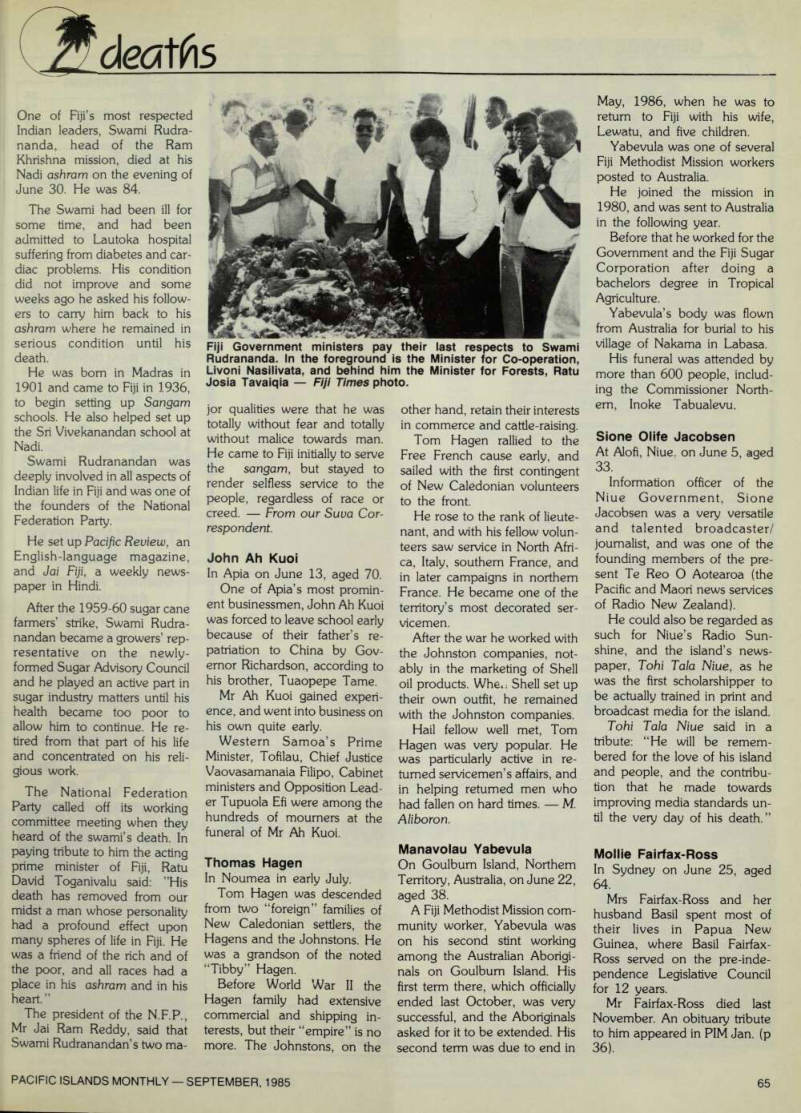
One of Fiji’s most respected Indian leaders, Swami Rudra nanda, head of the Ram Khrishna mission, died at his Nadi ashram on the evening of June 30. He was 84.
The Swami had been ill for some time, and had been admitted to Lautoka hospital suffering from diabetes and car diac problems. His condition did not improve and some weeks ago he asked his follow ers to carry him back to his ashram where he remained in serious condition until his death.
He was bom in Madras in 1901 and came to Fiji in 1936, to begin setting up Sangam schools. He also helped set up the Sri Vivekanandan school at Nadi.
Swami Rudranandan was deeply involved in all aspects of Indian life in Fiji and was one of the founders of the National Federation Party.
He set up Pacific Review , an English-language magazine, and Jai Fiji, a weekly news paper in Hindi.
After the 1959-60 sugar cane farmers’ strike, Swami Rudra nandan became a growers’ rep resentative on the newly formed Sugar Advisory Council and he played an active part in sugar industry matters until his health became too poor to allow him to continue. He re tired from that part of his life and concentrated on his reli gious work.
The National Federation Party called off its working committee meeting when they heard of the swami’s death. In paying tribute to him the acting prime minister of Fiji, Ratu David Toganivalu said: ”His death has removed from our midst a man whose personality had a profound effect upon many spheres of life in Fiji. He was a friend of the rich and of the poor, and all races had a place in his ashram and in his heart.”
The president of the N.F.P., Mr Jai Ram Reddy, said that Swami Rudranandan’s two ma-
jor qualities were that he was totally without fear and totally without malice towards man.
He came to Fiji initially to serve the sangam, but stayed to render selfless service to the people, regardless of race or creed. From our Suva Cor respondent.
John Ah Kuoi In Apia on June 13, aged 70.
One of Apia’s most promin ent businessmen, John Ah Kuoi was forced to leave school early because of their father’s re patriation to China by Gov ernor Richardson, according to his brother, Tuaopepe Tame.
Mr Ah Kuoi gained experi ence, and went into business on his own quite early.
Western Samoa’s Prime Minister, Tofilau, Chief Justice Vaovasamanaia Filipo, Cabinet ministers and Opposition Lead er Tupuola Efi were among the hundreds of mourners at the funeral of Mr Ah Kuoi.
Thomas Hagen In Noumea in early July.
Tom Hagen was descended from two “foreign” families of New Caledonian settlers, the Hagens and the Johnstons. He was a grandson of the noted “Tibby” Hagen.
Before World War II the Hagen family had extensive commercial and shipping in terests, but their “empire” is no more. The Johnstons, on the
other hand, retain their interests in commerce and cattle-raising.
Tom Hagen rallied to the Free French cause early, and sailed with the first contingent of New Caledonian volunteers to the front.
He rose to the rank of lieute nant, and with his fellow volun teers saw service in North Afri ca, Italy, southern France, and in later campaigns in northern France. He became one of the territory’s most decorated ser vicemen.
After the war he worked with the Johnston companies, not ably in the marketing of Shell oil products. Whe.; Shell set up their own outfit, he remained with the Johnston companies.
Hail fellow well met, Tom Hagen was very popular. He was particularly active in re turned servicemen’s affairs, and in helping returned men who had fallen on hard times. M.
Aliboron.
Manavolau Yabevula On Goulbum Island, Northern Territory, Australia, on June 22, aged 38.
A Fiji Methodist Mission com munity worker, Yabevula was on his second stint working among the Australian Aborigi nals on Goulbum Island. His first term there, which officially ended last October, was very successful, and the Aboriginals asked for it to be extended. His second term was due to end in
May, 1986, when he was to return to Fiji with his wife, Lewatu, and five children.
Yabevula was one of several Fiji Methodist Mission workers posted to Australia.
He joined the mission in 1980, and was sent to Australia in the following year.
Before that he worked for the Government and the Fiji Sugar Corporation after doing a bachelors degree in Tropical Agriculture.
Yabevula’s body was flown from Australia for burial to his village of Nakama in Labasa.
His funeral was attended by more than 600 people, includ ing the Commissioner North ern, Inoke Tabualevu.
Sione Olife Jacobsen At Alofi, Niue, on June 5, aged 33.
Information officer of the Niue Government, Sione Jacobsen was a very versatile and talented broadcaster/ journalist, and was one of the founding members of the pre sent Te Reo O Aotearoa (the Pacific and Maori news services of Radio New Zealand).
He could also be regarded as such for Niue’s Radio Sun shine, and the island’s news paper, Tohi Tala Niue, as he was the first scholarshipper to be actually trained in print and broadcast media for the island.
Tohi Tala Niue said in a tribute: “He will be remem bered for the love of his island and people, and the contribu tion that he made towards improving media standards un til the very day of his death.”
Mollie Fairfax-Ross In Sydney on June 25, aged 64.
Mrs Fairfax-Ross and her husband Basil spent most of their lives in Papua New Guinea, where Basil Fairfax- Ross served on the pre-inde pendence Legislative Council for 12 years.
Mr Fairfax-Ross died last November. An obituary tribute to him appeared in PIM Jan. (p 36).
Fiji Government ministers pay their last respects to Swami Rudrananda. In the foreground is the Minister for Co-operation, Livoni Nasilivata, and behind him the Minister for Forests, Ratu Josia Tavaiqia Fiji Times photo.
Advertisements & other items, pp. 66-68 (1 item)
Art For Sale
SERVICE PAGE
ADVERTISING
Aggie Grey 66
AIWA 14
Amatil 68 Bank Line 55 British Aerospace 11 Clarion 36 Columbus Line 55 Commonwealth Secretariat 18 Dept, of Trade 4 Bryan Griffin 66 Hawker Pacific 22 Hawker Siddeley 26 Henry Cumines 60 Hitachi 2 Hudson Homes 50 Japan Air Lines 38
Kyowa 62
Matsushita 6 Nissan 20, 21 Output Media 18 Pacific World Directory ... 46 Papua Hotel 66 Pioneer Electric 32 Polish Shipping 63
Polynesian Shipping Lines
64 Position Wanted 66 Sheaffer Pen Textron 17
Toyota 34,35
Tutt Bryant 28 J. B. Were & Son 58
D mm AUSTRALIA: Distribution: The Herald and Weekly Times Ltd., 44-74 Flinders St., Melbourne, Vic., 3000. Advertising Reps Brisbane D Wood, Anday Agency, CCA Centre. Dayboro Road, Closobum 4520; Box 1918, GPO Brisbane, 4001; telephone (07) 289-4128. Adelaide Hastwell Williamson Rouse Pty. Ltd., PO Box 419, Norwood. SA, 5067; 59 Kensington Road. Norwood; telephone (08) 332-3322, telex 87113; Perth Allen & Associates, Suite 2, 284 Stirling St.. Perth, WA, 6000, telephone (09) 328-9593 or (09) 328-9363 FUJI; Distribution sod subscriptions Desai Bookshops. P.O. Box 160, Suva, Fiji, telephone Suva 23036.
Advertising Fiji Times & Herald Ltd., 20 Gordon St..
Suva, telephone 31-4111, telex FJ2124.
FRENCH POLYNESIA: Distribution Hachette Padfique, 10 Ave Bruat, Papeete, telephone 25610.
HAWAII. UNITED STATES: Distribution PIM, Hawaii, PO Box 22250, Honolulu. Hawaii, 96822 Advertising Brian C Asgill, Apt. 1308, 1676 Ala Moana Blvd., Honolulu, Hawaii, 96815, telephone (808) 955-9718 JAPAN: Advertising and subscriptions Universal Media Corporation, GPO Box 46. Tokyo, telephone 666- 3036, cables UNIMEDIA Tokyo, telex 2524665 KOREA: Advertising and subscriptions World Marketing, Inc, Box 4010, Seoul; phone 776-5291-3, telex K 23232 MALAYSIA: Advertising and subscriptions Worldwide Media Services, 57-B Komplex Damai, Jin Dato Haji Eusoft, Kuala Lumpur, telephone 63-9340, cables WORLDMEDIA Kuala Lumpur, telex 31533.
VANUATU: Distribution Maropa Bookshop, HQ Box 210. Port Vila Advertising Bill Penthand, Norman Bros Bookshop. Port Vila, telephone 2232 NEW CALEDONIA: Distribution Depot Centre de Presse Michel Pentecost, CBP2, Noumea, telephone 27- 2434, 27-4729 NEW ZEALAND: Distribution Gordon & Gotch, PO Box 584, 2 Carr Road. Mt. Roskill, Auckland 4 Advertising International Media Representatives Ltd., PO Box 10259, Balmoral, Auckland 4, telephone 605-909, 792-370, telex NZ21404
PAPUA NEW GUINEA: Distribution Gordon & Goteh, PO Box 3395, Port Moresby, telephone 25-4551,25-4855.
Advertising Ken Head, PNG Post-Courier, PO Box 05, Port Moresby, telephone 21-2577, telex 22120.
SOLOMON ISLANDS: Distribution and Advertising The Bookshop, (Norman Bros.) PO Box 503, Honiara.
PHILIPPINES: Advertising The GF Group, 12 San Ignacio St.. Uroaneta Village, Makati, Metro Manila, telephone 817-7299, telex 45950 and 4233.
UNITED KINGDOM: The Herald & Weekly Times Ltd., No 1 Maitravers Street,London WC2R 3DZ, England, telephone 01 836 5162, telex London 21989 UNITED STATES MAINLAND: Advertising Joshua B Powers Jr., Powers International Inc., 551 Fifth Ave., New York, New York 10 017, telephone 867-9580, telex 236514.
Subscriptions PIM, Hawaii. PO Box 22250, Honolulu, Hawaii, 96822
SUBSCRIPTIONS
American Samoa Australia Canada Cook Islands Fiji French Polynesia Guam Hawaii Japan Kiribati Micronesia Nauru New Caledonia New Zealand Niue Norfolk Island Northern Marianas Papua New Guinea Solomon Islands
Tonga
Tuvalu United Kingdom U. S. Mainland Vanuatu Western Samoa Elsewhere
. SUS2I
AustslB
. SUS 27
. NZ$3O
Austsl9
, SUS 22
. SUS 23
. SUS 23
. SUS 22
Austsl9
. SUS 23
Austs2l
. SUS 22
. NZ$3O
. NZ$3O
AustslB
. SUS 23
Austs23 Austsl9 Austsl9 Austsl9 . Stgsls
SUS 27
Austsl9 Austsl9 Austs2s Payments by personal cheque are only acceptable in Australian (from a branch in Australia), U S. and New Zealand currency. For all other remittances please send an international bank draft in Australian dollars.
Published monthly by Pacific Publications (Aust.) Pty.
Ltd. and printed in Australia by Quadricolor Industries Pty. Ltd., Mulgrave, Vic.
TROUBLESHOOTER
AVAILABLE
Qualified Accountant/ Administrator/ Management Consultant with many yrs. Island experience seeks long and short term assignments.
Please reply Box 437, Townsville 4810, Australia
ART FOR SALE
*Poem in black' 1/15 print (LE), Ham series by Ralph Hotere (NZ); 2 of 70 x 50 cm portraits, acrylic on paper (Ingres) one bi and other polychromatic by Nga TeAriki (Cook Islands). Also large collection (20 pieces) of eastern Polynesian ethnographica. All reasonable offers considered. Works are sold individually or collectively.
Phone Peter Edwards Melbourne (03) 787-1627
Stay at Aggie Grey’s . ..
the South Pacific’s
legendary hotel.
Situated right in the heart of Western Samoa. Enjoy Polynesian style friendliness and service, in cool surroundings, superb entertainment and food.
Magnificent white sand beaches only a short drive away. Airconditioned rooms, swimming jx)ol and full bar facilities.
Bookings through Union Steamship Company of.NZ, Pan Am, Air New Zealand or dire ct to Aggie Grey’s, Apia. Western Samoa. Cable's: ‘AGGIES’ Apia.
«-*• ■ ie business centre lor comfort * P line food AH rooms airconditioned Restaurant • Bars • Banquet hall
H. E. BERGHUSER
General Manager Phone 21 2622 Cable: PAPTEL Telex: NE22353 PAPTEI
FLYING POSITION WANTED
Pilot, aged 46 wishing to settle in Pacific area requires a permanent flying position (full time or casual).
Experience, senior com. with inst. rating 12,000 hours, mostly as first officer on Qantas 707’s and 747’5.
Only ties are a 52 foot yacht requiring a safe harbour.
Reply to: Bryan Griffin P.O. Box 169
GYMEA, NSW 2227
AUSTRALIA. Phone (02) 521-4809
TOYOTA PRESENTS
THE “MORE’ MACHINE.
Toyota believe in giving you more for your money. And that’s just what our new three-wheeled electric forklift does. Look it over closely. Compare. You’ll see that no matter how you measure it, the new Toyota electric forklift challenges the very best of its class. And best of all, it offers you world-famous Toyota reliability. We build more quality in, so you get more value out. rawm
TOYOTAEi
66 (all 48V models)
MORE LOAD HANDLING
POWER A powerful 6.6 kW load handling motor takes on the biggest jobs with ease something that can’t be said for most electrics.
320 mm /sec
(2FBEIO 48V model)
MORE EFFICIENCY -
QUICKER LIFT SPEED
Wasted time is wasted money. So Toyota help you get the job done.
Fast. Its 320 mm/sec. lift speed is among the quickest in this class. (all 48V models) 2x2.7w
MORE DRIVE POWER Twin 2.7 kW
drive motors deliver torque and power that rival even engine-powered forklifts. And overpower most other electrics in this class. area to another at a brisk 12.5 km/h top speed - among the best in this class. 1350 mm (minimum turning radius, 2FBEIO model)
MORi MANOEUVRABILITY
With a remarkably small 1350 mm turning radius, and rugged, compact body, this new Toyota is at home in cramped quarters.
THREE-WHEELER
%(tano)
(5-minute ratings, 2FBEIO 48V model)
MORE GRADEABILITY
With front-wheel drive traction and powerful twin drive motors, it can haul a full load up the steepest of inclines even up to 18% tan 6!
MORE OPERATING EASE
All controls, including power steering, are designed to help the operator do his job quickly and easily.
MORE ECONOMY Toyota build in the kind of reliability and durability that result in long-term economy. • A Toyota forklift. See for yourself one day soon. • Options and standard features differ according to region. • Specifications are subject to change without notice.
TOYOTA
■ AMERICAN SAMOA: BURNS PHILP (S.S.) CO., LTD. TEL: 633-4281 ■ AUSTRALIA: THIESS TOYOTA PTY, LTD. TEL; 526-0333
■ FIJI: AUTOMOTIVE SUPPLIES CO.,
A DIVISION OF BURNS PHILP (S.S.) CO., LTD. TEL; 383444 ■ GUAM: ATKINS, KROLL, INC. TEL: 646-1876 ■ NEW CALEDONIA; SERVICE IMPORTATION AUTOMOBILE DU PACIFIQUE
TEL: 27-41-44
■ NEW ZEALAND: ANDREWS & BEAVEN INDUSTRIAL EQUIPMENT LTD. TEL; 2780940
■ PAPUA NEW GUINEA: ELA MOTORS,
BURNS PHILP (P.N.G.), LTD. AUTOMOTIVE DIVISION TEL: 217036 ■ VANUATU/VANUATU MOTORS, A DIVISION OF BURNS PHILP (VANUATU) LTD.
TEL: VILA 2341
■ WESTERN SAMOA: BURNS PHILP (S.S.) CO., LTD. TEL: 22611 And distributors around the world.
20
Bens on aj Hedges
WARNING-SMOKING IS ft HEALTH HAZARD