Pacific

Islands
Monthly
August, 1985
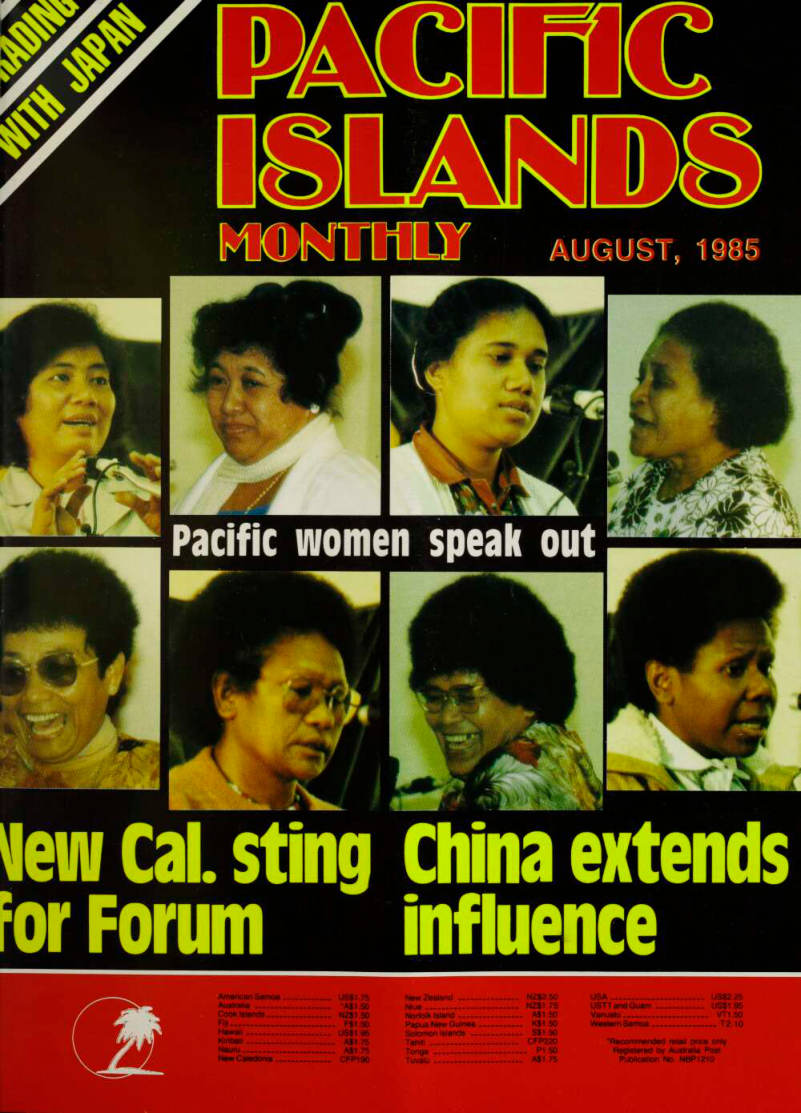
Pacific women speak out
tew CaL sting China extends for Forum influence
American Samoa US$l.75 Australia *A$l.5O Cook Islands NZ$l.5O F'i' F 51.50 Hawaii US$l.95 Kiribati A 51.75 Nauru A 51.75 New Caledonia CFPI9O
New Zealand ... NZ$2.5O Niue NZ$l.75 Norfolk Island A 51.50 Papua New Guinea Ksl 50 Solomon Islands 551.50 Tahiti ...—... CFP22O Tonga PI .50 Tuvalu A 51.75
Usa U 552.25
USTT and Guam US$l.95 Vanuatu . VT1.50 Western Samoa T 2 10 •Recommended retail price only Registered by Australia Post Publication No. NBPI2IO
Islands women In confer ence In Sydney (report p 7). TOP ROW, left to right: Aneuea Eritaia (Kiribati), Vereara Maeva (Cook Islands), Monalisa Tukuafu (Tonga), Flo Kennedy (Torres Strait).
BOTTOM ROW: Papiloa Foliaki (Tonga), Louise Aitsi (Papua New Guinea), Temaletl Vaka sluola (Tonga), Kathy Solomons (Vanuatu).
Photos Bill Coppell.
Advertisements & other items, pp. 2-3 (2 items)
*
i * % m % §m m ihe ren© m Mm ■ . : fn Vi m. tm mt mm s AUSTRALIA: Honda Australia Pty., Ltd. Lot 95 Sharps Road, Tullamarine, Victoria 3043; Bennett Honda Pty., Ltd. 250 Victoria Road, Wethenll Park, N SW 2164/ EW ZEALAND: NZMC Limited Manners Plaza, 57-65 Manners St., Wellington/PAPUA NEW GUINEA: Toba Pty., Ltd. PO Box 503, Port Moresby/TAHITI.
HONDA MOTOR CO., LTD. TOKYO. JAPAN Honda Distribution S.A.R.L. B.P 1665, Papeete/ IBAI : Atoll Motor & Marino Services PO. Box 49, Bairiki Tarawa, Republic of Kiribati/ n United Micronesia Development Association PO. Box 235, CHRB Saipan CM 96950/COOK ISLANDS: Cook Islands Motor Centre LUL B °x 74, Rarotonga/Gl Mark^/f°* or n^ o r J^ n ri?n P 8 Agana / Motor Distributors (Samoa) Ltd. PO Box 576, Apia / IDS: Lee Kwok Kuen & Co. Ltd. PO Bc* Honiarai / NEW CALEDONIA. Soc.*Ji DuChatendageB, Rue de la somme-B.P. 97, Noumea/NAURU: Nauru Cooperation Republic of Nauru/ : Coral Island Motors Ltd. Robertson Road, Suva, Fiji/ AMERICAN SAMOA_ Holiday Mo ors, Parts and Service PO Pago Pago, American Samoa 96799; Heleck's Service Center Ltd. PO. Box 1138, Pago Pago, American Samoa 96799/TONGA: Tonga Industrial Traders PO. Box 1035, Nukualofa, Tonga/NORFOLK ISLAN
Pacific
ISLANDS
MONTHLY
Vol. 56 No.B August 1985
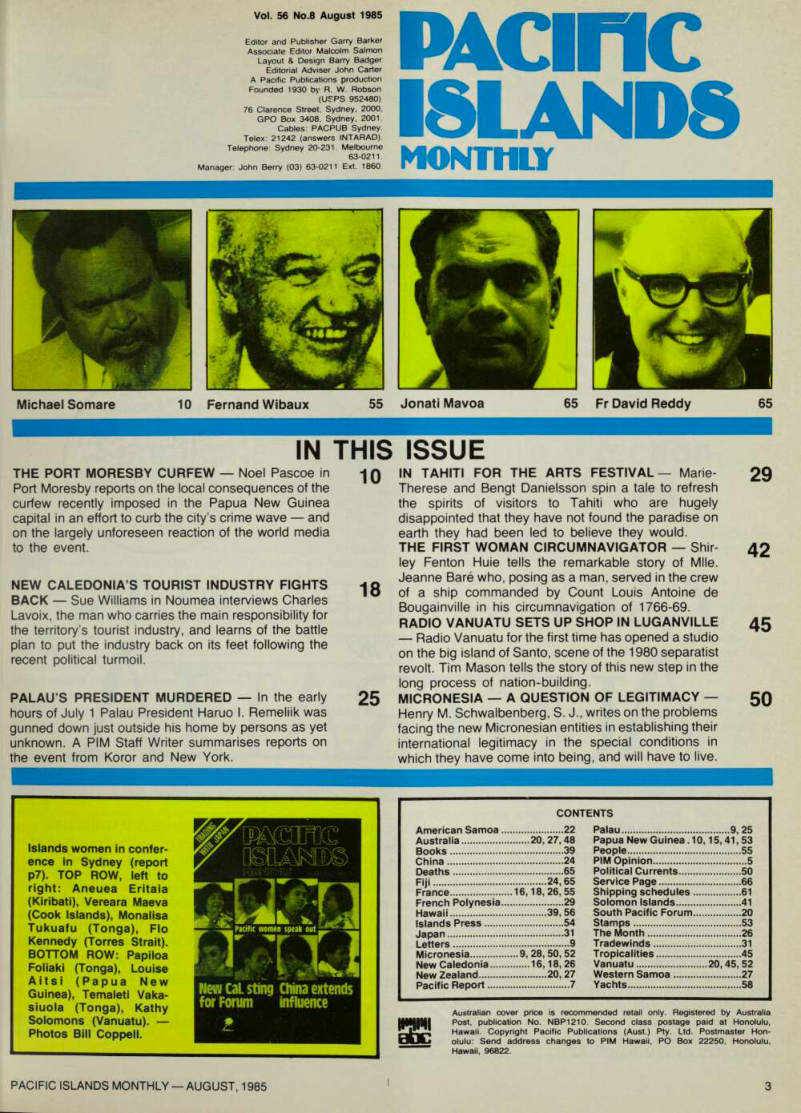
Michael Somare 10
Fernand Wibaux 55
Jonati Mavoa 65
Fr David Reddy 65
onlriflffnlowlnthp
In This Issue
THE PORT MORESBY CURFEW Noel Pascoe in 1Q Port Moresby reports on the local consequences of the curfew recently imposed In the Papua New Guinea capital in an effort to curb the city’s crime wave and on the largely unforeseen reaction of the world media to the event.
NEW CALEDONIA’S TOURIST INDUSTRY FIGHTS -I Q 0 ... .. ... , IO BACK - Sue Williams in Noumea interviews Char es Lavoix, he man who carries the mam responsibility for
onlriflffnlowlnthp
plan to put the industry back on its feet following the mrpnt political ti irmoii recent political turmoil.
PALAU’S PRESIDENT MURDERED In the early 25 hours of July 1 Palau President Haruo I. Remeliik was gunned down just outside his home by persons as yet unknown. A PIM Staff Writer summarises reports on the event from Koror and New York.
,N TAH,TI FOR THE ARTS FESTIVAL Marie- 29 Therese and Bengt Danielsson spin a tale to refresh the spirits of visitors to Tahiti who are hugely disappointed that they have not found the paradise on earth they had been led to believe they would,
The First Woman Circumnavigator Shir- 42
ley Fenton Huie tells the remarkable story of Mile.
9^ 3 r™ m?’ fn^Antnino''Ho
of a ship commanded by Count Louis Antoine de Bougainville in his circumnavigation of 1766-69. * VANUATU SETS UP SHOP IN LUGANVILLE 45 - Radio Vanuatu for the first time has opened a studio 4& ... , , 0 . „ , ° n ,he big island of Santo, scene of the 1980 separatist reV olt. Tjm Mason (e|ls , he story of this new step jn the long process of nation-building.
Micronesia A Question Of Legitimacy 5Q
Henry M. Schwalbenberg, S. J., writes on the problems facing the new Micronesian entities in establishing their international legitimacy in the special conditions in which they have come into being, and will have to live.
Contents
American Samoa 22 Australia 20, 27,48 Books 39 China 24 Deaths 65 Fiji 24,65 France 16,18, 26, 55 French Polynesia 29 Hawaii 39,56 Islands Press 54 Japan 31 Letters 9 Micronesia 9, 28, 50, 52 New Caledonia 16,18, 26 New Zealand 20, 27 Pacific Report 7
Palau 9, 25 Papua New Guinea . 10,15,41, 53 People 55 PIM Opinion 5 Political Currents 50 Service Page 66 Shipping schedules 61 Solomon Islands 41 South Pacific Forum 20 Stamps 53 The Month 26 Tradewinds 31 Tropicalities 45 Vanuatu 20,45, 52 Western Samoa 27 Yachts 58
Australian cover price is recommended retail only. Registered by Australia Post, publication No. NBP1210. Second class postage paid at Honolulu, Hawaii. Copyright Pacific Publications (Aust.) Pty. Ltd. Postmaster Hon olulu: Send address changes to PIM Hawaii, PO Box 22250, Honolulu.
Hawaii, 96822.
Advertisements & other items, pp. 3-4 (2 items)
3
PACIFIC ISLANDS MONTHLY —AUGUST, 1985
Editor and Publisher Garry Barker Associate Editor Malcolm Salmon Layout & Design Barry Badger Editorial Adviser John Carter A Pacific Publications production Founded 1930 by R. W Robson
(USPS 952480)
76 Clarence Street, Sydney, 2000, GPO Box 3408, Sydney, 2001.
Cables: PACPUB Sydney Telex: 21242 (answers INTARAD) Telephone: Sydney 20-231. Melbourne 63-0211.
Manager: John Berry (03) 63-0211 Ext. 1860
Gifj Products
o-'"* • ' -k
mmm.
1#...--."- % & Vb can ran 9e of Wan Pr oc i u cts at
? U .STR
the a lian 80 oth s
?J?play
to T^H 10 to 57 Neal
**kst
Bla 85 Well n ”O No e ntr e
LULU
24 s a ptenih er 1985 :: . . ; V /•
ypo
GIFJ PRODUCTS
gg7 Ask the expert who knows Australia.
For details of suppliers phone or telex the Australian Trade Commissioner at: Fiji P.O. Box 1252, Suva Phone 31 2844. Telex FJ2126 New Caledonia P.O. Box 22, Noumea Phone 27 2414. Telex 087 Papua New Guinea P.O. Box 9129, Hohola Phone 25 9333. Telex NE 22109 Hawaii Australian Consulate, 1000 Bishop Street, Honolulu 96813 Phone (808) 524 5050. Telex 63 3128 If you’re in the market for gifts and souvenirs Australia has some great ideas. A wide and bright range of individual items, all uniquely Australian. Opals and gemstones, jewellery.
Fur and leather goods. Wool floor rugs and rugskins. Dried flowers. Decorative glass. Trays. Plaques. Place mats and coasters. Quality wines, liqueurs and spirits. Scents and fragrances. Souvenirs. Games, puzzles, toys. They all have that kind of appeal we know means sales. So check out what the Australians are offering. It could prove mutually rewarding.
Ask the Australian Trade Commissioner
Pim Opinion
“Simplicate” and add more direction
As the importance of the Pacific region has grown in world affairs the skills of the international conference-makers have come to the fore. Lucrative careers have been built on the talkfest industry and the Pacific Islands are becoming involved in it as surely as all the rest.
But might it not be worth thinking of limiting the number of conferences or, more precisely, being more selective about the collection of organisations which are springing up in response to this burgeoning interest in Pacific affairs?
The South Pacific Forum remains the major means of achieving direct communication between the leaders of the island nations. It has changed, unfortunately by some lights, but probably inevitably, and become much more formal and hag-ridden by bureaucrats. There is less of the relaxed round-table exchange and more of formally prepared and presented papers which have the effect of reducing flexibility and slowing productive discussion. This is an expression of yet another codicil to Parkinson’s Law: that the concentration of bureaucrats, and, therefore, both the formality and the paperwork, increases in proportion to the rise of a country’s significance, multiplied by the number of conferences its politicians attend. It is inevitable, but that does not mean to say it is undilutedly good.
T.O.M.Sopwith, designer of the Sopwith Camel, a famous First World War fighter, is credited with stating the first rule of aircraft design as ’’simplicate and add more lightness. ” Bureaucrats tend to complicate and add more weight, and sometimes their creations either fail to fly or, having been thrust into the air by raw horsepower, succeed in shooting down the politicians who were meant to fly them.
One of the great virtues of the Forum in its early days was its simplicity and its lightness. Something of that atmosphere returned at the meeting in Funafuti, and credit for that notable achievement is rightly given to Tuvalu. One may hope that the Cook Islands will do as well, yet the omens are not good, not through a lack of intent, or even because of the works of the creators of
never-ending paper, but because the issues in the Pacific can now be of world-wide importance. Also, there is now emerging a series of forums seeking to involve the Pacific Islands.
In July there was the ASEAN foreign ministers’ meeting in Kuala Lumpur, which PNG’s foreign minister, Mr John Giheno, used to warn Australia, and some others, that he was not altogether happy about some matters (see report this issue). ASEAN is very interested in extending its influence eastwards into the Pacific, and beyond the immediate, and very delicate, matter of the Irian Jaya border, and is quite vigorously wooing the island countries into its embrace.
The Forum takes place in the first week of August but, in the second week, also in Rarotonga, there is to be held the Pacific Islands Conference, organised by the Pacific Islands Development Program, based at the East-West Center in Hawaii. Some see this conference as a rival to the Forum.
Yet the P.I.C. has the potential to be a valuable vehicle for communication among Pacific leaders, for it extends far beyond the older Forum and brings in all Pacific island countries and non-self governing territories, as well as Australia, New Zealand, the U.S., Japan, Canada, Chile, the United Kingdom and France.
There is even a report that Fiji’s prime minister, Ratu Mara, who was a founder member of the P.I.C. at its first conference last year, suggested that mainland China be invited to send a delegation and become a permanent member.
Washington reports say that, partly because of this rapid growth, the P.I.C. and the P.I.D.P. now must decide their future direction.
Ratu Mara has said publicly that the new organisations do not duplicate or rival the Forum, S.P.E.C. or S.P.C. But that depends upon what P.I.C. decides is to be its role and its areas of interest.
And if they all continue, just think how many bureaucrats they will come to feed, how many politicians they will divert, and how many trees will be chopped down to feed their photostat machines.
More seriously, will there now develop a wasteful race to gain the attention of the islands?
Advertisements & other items, p. 6 (1 item)
National’s VHS Movie
sets you free!
Free from cables, connectors and complications VHS Movie model NV-M1 is a lightweight camera-with-recorder you can grab with one hand and take wherever the action leads you.
It weighs only 2.5 kg excluding battery pack.
There’s nothing to get tangled in—no additional components to carry around.
Free from frequent cassette changes The NV-M1 can record up to 240 minutes on a standard VHS video cassette. Think of all the great moments you can capture without interrupting the action.
Free from troublesome accessories Connects directly to TV for playback with Cue & Review and Still modes; requires no cassette adaptor. All you need is VHS Movie and good times!
Care-free The NV-M1 has a variety of special features that make operation carefree and simple: an electronic viewfinder that displays instant playback, a Date Recording Function, and a Vi" Newvicon pick-up tube for rich colour recording and low light sensitivity to 10 lux.
National’s VHS Movie NV-Ml. Find out how it feels to be free. i/Hsmai/n A Visit our pavilion al the 1985 International Exposition.
EXPOBS Tsukuba, Japan no iv eoooz
VHS
National
National, Panasonic and Technics are the brandnames of Matsushita Electric. n ts drawn to trie tact tt 3 pre-recorded tapes or d
Pacific Report
Pacific Women Foregather In Sydney
The Australian Pacific Women’s Peace Conference was held in Sydney on June 28-30 under the auspices of the Women’s International League for Peace and Freedom, an international non-government organisation which has consultative status with the United Nations’ Economic and Social Council (ECOSOC), and UNESCO. The conference was held as part of the culmination of the UN Decade of Women 1975-85 Equality, Development and Peace. It was also a prelude to the world conference of government representatives due to be held in Nairobi, Kenya, on July 15-26.
Non-government organisations were to hold a parallel forum in Nairobi over the same period. The Sydney conference attracted delegates from Australia and New Zealand, including Aboriginal Australians and Maoris, as well as from Pacific Island countries such as Papua New Guinea, Fiji, Solomon Islands, French Polynesia, New Caledonia, Kiribati, Vanuatu, Tonga, Cook Islands and Palau.
Theme of the conference was the role of women in political, economic and social life in the region, particularly in relation to questions of peace and independence. A significant number of Islands women were prominent in the proceedings both as speakers in the general sessions, and in informal discussions. The conference logo was based on a rubbing from a carved wooden New Guinea bowl and depicted a snake, the creation symbol in many cultures, and almost always female. It was a reflection of the wide spectrum of cultural settings from which participants came that alongside matters of peace, nuclear weapons, and so on, much attention was also given to land rights, freedom of the press, street crime, alcoholism, and the sometimes unwelcome intrusion of governments in matters affecting women. A full report of the conference will appear in PIM, September. Bill Coppell in Sydney.
Heavies Head For Cooks
The South Pacific Forum will hold its 16th meeting August 4 to 6 on Rarotonga when one of the items to be discussed will be the proposal to establish a nuclear-free zone in the Pacific. This meeting will be followed, at the same venue, by the Second Pacific Islands Conference, August 7 to 10, which will discuss the results of research on development conducted by the Pacific Islands Development Program, formed in 1980 in Hawaii to help to meet special development needs of the region through co-operative research, education and training.
Air Nauru Gets The Cuts
Air Nauru has drastically reduced its services. The 15-year-old airline, with an operating budget of S6O million a year, has cut its fleet from seven to two, sacked or retired 26 pilots plus supporting crew, abandoned many services and reduced the remainder. At the peak of its expansion the airline covered more than four million route miles a year, calling at 29 ports in 26 countries, and with a flight deck crew of 60. Air Nauru has retained nine captains and nine first officers and two 737-200 SP aircraft out of its fleet of four 737 s and three 727-100 s. It will fly one service weekly to Hong Kong via Guam and Manila, one to Tarawa, one to Fiji, one to Sydney/Melbourne and two services a week to Auckland via either Honiara and Vila or Pago and Niue. President Hammer deßoburt told the Nauru Parliament that the airline’s losses could no longer be sustained in view of the overall financial constraints facing the republic.
Earthquakes In Png , Vanuatu
Authorities in Papua New Guinea have reported considerable damage after an earthquake shook two provinces on July 3. The earthquake, measuring 7.1 on the Ritcher scale, shook the provinces of New Ireland and East New Britain. Government officials said the earthquake caused landslides, low tides and damage to water tanks in New Ireland, while in East New Britain, the earthquake destroyed water tanks and buildings, caused landslides and broke up roads. No casualties had been reported, and an assessment of damage was still continuing. PNG’s chief vulcanologist, Dr Peter Lowenstein, assured residents in East New Britain that the earthquake would not lead to a volcanic eruption,
despite recent volcanic activity near the provincial capital, Rabaul.
The following day, July 4, a strong earthquake shook the South Pacific near Vanuatu, ihe Hong Kong Royal Observatory said the earthquake measured 6.5 on the Richter scale, and was centred about 1300 kilometres west of Fiji. Police in Port-Vila said residents were woken during the night by the earthquake, but there had been no reports of major damage or casualties.
Top French Official On P.R.Tour
Jean-Michel Baylet, secretary of state at the French Foreign Ministry, spent the latter half of July touring the Pacific to explain his government’s views on the New Caledonian crisis, and other regional issues, apparently in an effort to head off any strongly anti-French initiative at the South Pacific Forum in Rarotonga in the first week of August. He visited Vanuatu, which has been highly critical of French intentions (see stories elsewhere in this issue), then Papua New Guinea, Fiji, Tonga, and Western Samoa. While diplomats say Vanuatu is not likely to win support for its motion on New Caledonia, the Forum is expected to be much more united in its opposition to continued French nuclear testing at Moruroa, although Mr Baylet was believed to have assembled a hopeful brief on that subject, too. A possible indication of Pacific reaction to the Baylet visit was given by PNG foreign minister, John Giheno, speaking in July to a session of the Association of South East Asian nations (ASEAN) in Kuala Lumpur. He said island nations were committed to the quest for a peaceful solution to the Caledonian issue and sought ASEAN support for that cause. He asked for similar help in the Forum effort to bring an end to nuclear testing in the Pacific.
94 Protesters Stranded On French Reef
The fifth International Congress on Reef and Man in Tahiti at the end of May turned out to be an exhausting, week-long talkathon whose main feature was the almost total lack of participaton by anthropologists, sociologists and historians, who alone could have given proceedings the “multi-disciplinary” character promised by the organisers. The only notable exception was that grand old lady of Pacific culture studies, Professor Katharine Luomala of the Bishop Museum and the University of Hawaii, who, however, was officially introduced to a congress seminar on fish-poisoning as “Mrs Luomala from the Gilbert Islands” because her paper happened to deal with Kiribati. As an anthropologist specialising in atoll communities, I personally was particularly looking forward to the three symposia on the protection, conservation and manage ment of coral reefs. But although most of the 141 French scientists who took part had done fieldwork in our islands of French Polynesia, we heard nothing from them about the very special environmental problems in the Tuamotu atolls, resulting from the detonation of 112 atomic bombs at Moruroa since 1966. The only pollution problems they talked about were those in Tahiti, Moorea and Borabora, arising from various aspects of poorly planned “development”. The closest they came to the most important sources of pollution, the military bases at Moruroa, Fangataufa, and Hao, was a brief reference to the terrible ciguatera epidemic at Mangareva, in the southeast corner of the Tuamotus, where all fish have been poisonous since 1968. On the last day of the conference this lack of information on a subject of such great scientific and human concern was sharply criticised by Dr Graham Baines from Solomon Islands, and departmental secretary Tamata Ravo from Vanuatu. Almost all the other participants in these special symposia on environmental protection felt the same way, and a hastily drafted petition addressed through the congress organisers to President Mitterrand was signed by 94 of them. The petition respectfully called upon the president to “direct your government to quickly cease its program of nuclear weapons experiments in coral reef structures, and to make available to the international scientific community data on environmental radioactivity at and about Moruroa Atoll, and scientific details of the effects of underground nuclear weapons tests on the geological structure of the atoll”. In the weeks and months that have elapsed since the congress, nothing has so far been said about this petition in the local newspapers, or on local radio or TV. Nor did the chairman of
the congress organising committee, Professor Bernard Salvat, read it, or mention its existence, in a post-congress radio debate devoted precisely to local reef pollution problems, and lasting an hour and a half. There can no longer be any doubt that the petition, signed by 94 scientists from 28 countries, has simply been suppressed.
Bengt Danielsson in Tahiti.
U.S. Congress Heavily Amends Compacts
The U.S. congress House Interior Sub-committee on Public Lands has approved and sent to its parent committee a resolution approving the Compact of Free Association between the United States and the U.S. Trust Territory states of the Marshall Islands and the Federated States of Micronesia (FSM), but the resolution proposes so many amendments to the original compacts, approved by referendum by the Marshalls and the FSM, that the Reagan administration has said that it did not know whether it would be able to support the resolution. Marshalls President Amata Kabua has already rejected a suggestion by chairman Stephen Solarz of the Congress House of Representatives Foreign Affairs Sub-committee that some amendments might be made by Congress following a U.S. fact-finding mission to the Marshalls.
The amendments proposed by the House Interior Sub-committee are designed to benefit American contractors and fishermen and the economies of U.S. territories in the Pacific, as well as reasserting U.S. congressional authority over compact changes and clarifying U.S. obligations, financial and otherwise, to Trust Territory residents.
Bole For Fui Parliament?
The vacancy in the Lau-Rotuma seat in the Fiji parliament caused by the death of veteran politician, Jonati Mavoa (p 65), seems likely to be filled by Felipe Bole, currently the secretary-general of the Pacific Islands Development Program, in Hawaii. The seat is regarded as solid-gold Fijian Alliance territory. Mr Bole was formerly Fiji’s delegate at the United Nations and was at one time permanent secretary at the Department of Education. Bole’s chances of winning nomination are regarded as good, although some other names have been bandied about. These include Mr Tevita Longa, Mr T. Yaqona, and the two brothers. Solo and James Makasiale. From our Suva Correspondent.
Parliament Officers Meet In Kiribati
THE Commonwealth Parliamentary Association sponsored the 16th conference of parliamentary presiding officers and clerks held in the Kiribati House of Assembly, Tarawa, from June 9-21.
Kiribati President leremia Tabai, opening the conference, said that his country’s independent constitutional history was only a few years old, having begun in 1979. But, he said, the Kiribati parliamentary system was still evolving, finding its own proper and appropriate place in national life. Speaking in reply on behalf of the 40 delegates from Pacific countries, the Speaker of Australia’s House of Representatives, Dr Harry Jenkins, said one of the features of the Pacific region was the relatively large number of newly independent nations, and the peaceful and free way in which they had achieved independence, Dr Jenkins said: “Indeed, independence is the key term, because all countries in the region are striving for independence and self-sufficiency. But this is not always easy for nations such as these because of their small to medium size.” Dr Jenkins said the conference was an example of the firm basis on which countries in the Pacific region operate.
Vianney K. Teabo in Tarawa.
Nz Festival Group Buffeted By Politics
New Zealand’s delegation to the Fourth Pacific Festival of Arts displayed some signs of being makeshift and limited after about a dozen chosen artists and performers decided to boycott the event.
Some others had refused to be chosen when the venue changed from New Caledonia to French Polynesia. A visit to New Zealand in June by the leader of the Polynesian Liberation Front, Oscar Temaru prompted public resignations from about six artists, including the political film maker Meratia Mita, well known for her film Patu on the Springbok rubgy tour of New Zealand, political song writers Linda and Jools Topp, the party’s official photo grapher John Miller, and most of a group of pakeha sculptors. The boycott was taken up by the Maori Artists and Writers’ Society, which picketed the departure of the predominantly Maori delegation from Auckland airport. Mr Temaru was something of an embarrassment for the Lange government, for his visit became a
focus of attention for groups of artists, Maoris and peace movement activists who agreed with his message that attending the festival was in effect to support French colonialism and nuclear testing. New Zealand’s Minister of Arts Peter Tapsell came under fire for officially representing the New Zealand Government at the June 29 opening ceremony in Papeete. Two Maori delegates took part in the boycott activities the unveiling of a monument to Tahitian warriors killed by French soldiers in the annexation wars, and a march of protest on Papeete. Titewhai Harawiia represented the Waitangi Action Committee, and Tuhipo Kereopa represented Kopahaitangi Wairiki. Tahitian independence activists have reg ularly attended protest marches organised by these two groups, and conferences in support of Maori claims to ratify the Treaty of Waitangi and recognise Maori sovereignty. Karen Mangnall in Auckland.
Irian Java Refugees In Australia
Australia’s problems in its relations with Indonesia took on a new dimension on June 26 when five refugees from Irian Jaya arrived in Thursday Island off the tip of Queensland seeking the right to “preach” the cause of Irian Jaya’s independence from Indonesia.
The refugees have nothing to do with the OPM, which seeks Irian Jaya’s independence from Indonesia by means of guerrilla tactics.
Indeed, they denounce the OPM as a “terrorist” organisation.
They belong to an intensely Christian religious organisation called “Musgas”, an English acronym for “Melanesian Union From Gag to Samarai”. Gag Island is in the Birds Head group in Irian Jaya, and Samarai is at the end of the bird’s tail in Papua. They believe in a united New Guinea Island. Peter Hastings of The Sydney Morning Herald wrote on July 2 that the Australian Government was “extremely worried that the five may be tempted by human rights activists on Thursday Island to claim political asylum in Australia, even if they do not genuinely seek it”. If they did claim asylum they would be the first Indonesian citizens to seek it in Australia. Their arrival in Thursday Island coincided with the influx of another 2000 Irian Jayans over the border into Papua New Guinea. About 500 crossed the border near Sekotchia, south of Wutung, in the West Sepik Province, and about 1500 crossed the border near the Yapsie River, about 250 km south of Wutung.
PNG sources said the OPM engineered the new crossings.
Easter Island And The Space Shuttle
Chile’s Foreign Minister Jaime del Valle said in Santiago on July 2 that there was no question of the United States building a military base on Easter Island as part of plans for an emergency landing strip for the space shuttle. The US National Aeronautics and Space Agency (NASA) has been seeking some kind of agreement about Easter Island, and critics of such an accord say it would have military implications and compromise Chilean sovereignty. In a statement issued on the eve of talks with US Ambassador to Chile, James Theberge, who had just returned from consultations in Washington, Mr Del Valle said Chile would not cede sovereignty over the island. His statement made no mention of plans for a port on the island, which diplomatic sources said Chilean officials had mentioned in informal discussions. They said the Chilean navy, taking NASA’s offer to pay for the airport runway extension as a sign that it desperately wants facilities on the island, has suggested demanding that Washington also finance construction of a port there. The sources added that Washington wants to do no more than extend the runway.
Bill Dunlop: Clairvoyants, And Susio,Ooo
Claims by Australian clairvoyants that missing American single handed sailor Bill Dunlop (PIM Aug. ’B4 p 67, Dec. p 7) was alive on Beveridge Reef, about 880 km west of Rarotonga, led to an aerial search of the reef in June. The search, carried out by an Air Rarotonga plane, discovered no sign of Dunlop or his 2.7 m sloop, Wind's Will. The flight, costing SUS2OOO, was paid for by the Bill Dunlop Search Fund Inc., which is headed by American lawyer Edward R. Heath Snr. Mr Heath told Cook Islands News that his fund was willing to pay a reward of SIO,OOO “for information leading to the rescue of Bill Dunlop”. He said the reward could encourage those in the boating community in the Pacific to check those islands on their journeys believed to be uninhabited. Anyone who found Bill Dunlop alive would receive the SIO,OOO. Dunlop was last seen sailing out of Aitutaki, Cook Islands, in June 1984, headed for Australia.
letters
Questioning the IPSECO factor in Palau impasse
I was impressed by how little Palau’s President Remeliik said in his interview with Mr Rampell (PIM Apr. p. 19). His answers to the interviewer’s (leading) questions are difficult to take seriously in their simplicity, while the president’s responses to controversial issues are offered with no substantiation.
How for example will Palau remain “100 per cent nuclear free” under the Compact, given the fact that even U.S. Ambas sador Zeder admits the Com pact is still in conflict with the Palauan Constitution on this issue? The fact is that Remeliik’s assurances mean nothing, which is why the Palauan Sen ate, while affirming the Com pact vote of the September 4, 1984, plebiscite out of one side of its mouth, moved to reconsti tute a Compact negotiating team that the president had disbanded out of the other side of its mouth. As the Palauan Senate Special Report of Feb ruary 1985 stated, the OEK (Parliament) shares the percep tion of Zeder “that the May 23, 1984, Compact will not be approved by the U.S. Govern ment and, therefore, authorises the Status Commission ... to represent the people of Palau in further negotiations on the Compact.” Indeed, the U.S.
Congress is proceeding as warned with the Compact ex cluding Palau. Is Mr Remeliik blissfully oblivous to all this, and how could Mr Rampell allow his interviewee to get by with such patently meaningless re sponses?
As for what Mr Rampell calls the “probably scurrilous theory going around that IPSECO really is a plot to place Palau so deeply in debt that the Com pact will have to be accepted,”
Remeliik again gives no sub stantial rebuttal of this serious charge. Nor for that matter does Rampell in his highlighting of
the issue. There has in fact been no formal study published to refute the Inspector-General’s devastating critiques of the pro ject, and until evidence is given to the contrary we must suspect Remeliik’s (and IPSECO’s) assurances as a further cover up to an already smelly deal. Mr Rampell would be advised to read the I-G’s report itself, not just Associated Press releases about it, and consider the re cent notification of imminent default on the IPSECO loan from Morgan Grenfell and Co., delivered to the Office of Micronesian Status Negotia tions (OMSN) in early May. If IPSECO has nothing to do with the Compact, why does the
letter from the international financiers of the project so readily suggest to Zeder that Palau be bailed out by none other other than Compact monies? To quote the docu ment: “Compact funding for Palau, whilst not approved, has been estimated and will w'hen granted provide a substantially larger sum than Palau’s im mediate obligations. There seems to us to be a number of ways that the U.S. could assist in resolving this problem which would leave present arrange ments intact, preserve existing Lenders and Guarantors, and assure Palau of its future in the international financial markets. ”
Rampell needs to demons trate why this “scurrilous” theory is off the mark, given the fact that Palau is now in fact unable to service its debt with out Compact monies. I enclose herewith an investigative article I wrote on the subject while in Palau for six weeks in March and April, which raises ques tions neither interviewer nor interviewee begin to resolve. It is to be hoped that better coverage of issues which seriously jeopardise the future of a sovereign Palau will be given in PIM henceforth.
Ched Myers
Clifton Hill, Vic., Australia
Shellfire from
Auckland ...
I would like to refer to Dr W. G.
Coppell’s review of the book Shells: A Collectors Colour Guide by J. and R. Senders in the April issue of PIM.
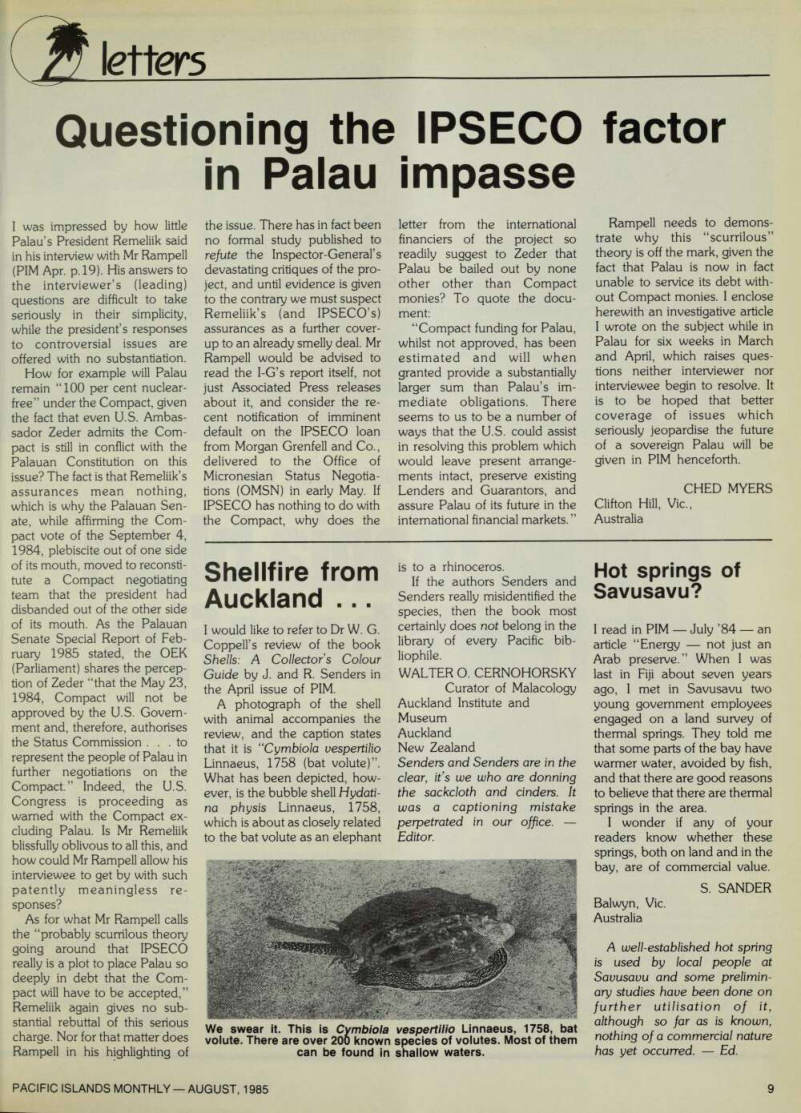
A photograph of the shell with animal accompanies the review, and the caption states that it is “ Cymbiola vespertilio Linnaeus, 1758 (bat volute)”.
What has been depicted, how ever, is the bubble shell Hydati na physis Linnaeus, 1758, which is about as closely related to the bat volute as an elephant
is to a rhinoceros.
If the authors Senders and Senders really misidentified the species, then the book most certainly does not belong in the library of every Pacific bib liophile.
Walter O. Cernohorsky
Curator of Malacology Auckland Institute and Museum Auckland New Zealand Senders and Senders are in the clear, it’s we who are donning the sackcloth and cinders. It was a captioning mistake perpetrated in our office.
Editor.
Hot springs of
Savusavu?
I read in PIM — July ’84 — an article “Energy — not just an Arab preserve.” When I was last in Fiji about seven years ago, I met in Savusavu two young government employees engaged on a land survey of thermal springs. They told me that some parts of the bay have warmer water, avoided by fish, and that there are good reasons to believe that there are thermal springs in the area.
I wonder if any of your readers know whether these springs, both on land and in the bay, are of commercial value.
S. Sander
Balwyn, Vic.
Australia A well-established hot spring is used by local people at Sauusauu and some prelimin ary studies have been done on further utilisation of it, although so far as is known, nothing of a commercial nature
has yet occurred.
Ed.
We swear it. This is Cymbiola vespertilio Linnaeus, 1758, bat volute. There are over 200 known species of volutes. Most of them can be found in shallow waters.
curfew's benefits


Png’S Law And Order Crisis
Media mania blurs curfew's benefits
Papua New Guinea’s biggest crime in tackling the urban law and order crisis was to admit it to the world.
The strife, particularly in the national capital of Port Mores by, was certainly at a serious stage.
But the drastic steps taken to confront the criminals im posing a State of Emergency, with curfew, roadblocks and raids on squatters hit the world’s television screens in a sensational way.
And now the PNG politicians and people are realising that the stigma of short-term curfew will be harder to live down in the long run.
Recruitment of technicians
NOEL PASCOE in Port Moresby reports on the local consequences of the recently imposed state of emergency in the city, and on the largely unforeseen reaction to the event of the world media.
and engineers for the semi government Postal and Tele communications Corporation from traditional sources, Aus tralia and New Zealand, dried up overnight. Panicky friends and relatives of foreigners working in PNG rang and wrote under the impression that it was the nearest thing to civil war.
Many Port Moresby residents are now on the defensive, admitting that the urban jungle is a daily trial of security steps,
but adamant that other world capitals have crime problems of equal or greater danger.
Deputy Opposition Leader, Paul Torato, just back from a visit to Europe, was horrified to hear distorted accounts of his country’s image. Overseas media were blowing it out of proportion and were discourag ing potential investors, he said.
Prime Minister Somare, after relaxing his government’s entry conditions for foreign news
men, complained after the event about the negative por trayal by Australian news crews.
Crime was not unique to PNG, he said, and suggested that PNG should have sent TV cameramen to Victoria to cover the recent violence during the farmers’ picketing of dairy pro duce factories.
He struck a sympathetic chord with many Papua New Guineans.
They point to the mass mur derers of Britain and the United States, the drug-crazed killers, the organised-crime slaughters, bombings of Australian judicial figures, demented siege shoot outs and the sex-slayings of hitch-hikers.
Port Moresby’s crimes of vio-
lence are escalating, but still of comparative crudity in method and result. It’s the lack of modem detection methods, un skilled police prosecutors, and a dismally demoralised corps of jail warders that have combined to set back law enforement.
PM Somare’s critics say the emergency declaration is an other sample of Pangu “crisis management and ad hoc deci sion-making”.
There have been no denials of that, so far, but the govern ment remains firm that the measures were essential, and that, given time and bureaucra tic action, will prove worthwhile in the long run.
The State of Emergency had the twin aims of granting police extra temporary powers to grab the chief trouble-makers and to enable changes in legislation to provide long-lasting remedies.
In the first weeks of the curfew, the police and soldiers combined to nab people, main ly in illegal but tacitly accepted settlements, and to charge people they believed were re sponsible for much of the se rious crime.
Among the first hauled in were people identified from TV interviews by Australian media.
TV film showing young men claiming in simplistic terms that
they had committed crimes as it was their duty angered many residents, Some residents of the low income suburb, Morata, claimed Mike Willesee’s crew had honed in on a pre-arranged compensation meeting, when young men were worked up for a public “confession” to past crimes. The persistent question ing in an unfamiliar way had led to misleading statements, resi dents claimed. Right or wrong, the TV tapes were used by police to grab some people, The first weeks resulted in solemnly quiet nights in the city, Most people feared the com bination of police and army and headed home well before the 10.30 p.m. curfew deadline, Restaurants, hotels and street corner stalls reported a drama tic drop in trading and began laying off workers.
The theatres opened early, cut back to one movie a night, dropped admission fees, and drew only handfuls of custom ers. The discos opened around midday and closed early in the evening. One proprietor, Harry Hoerler, promised to keep his disco going all night with pat rons leaving after lifting of cur
continued on page 14
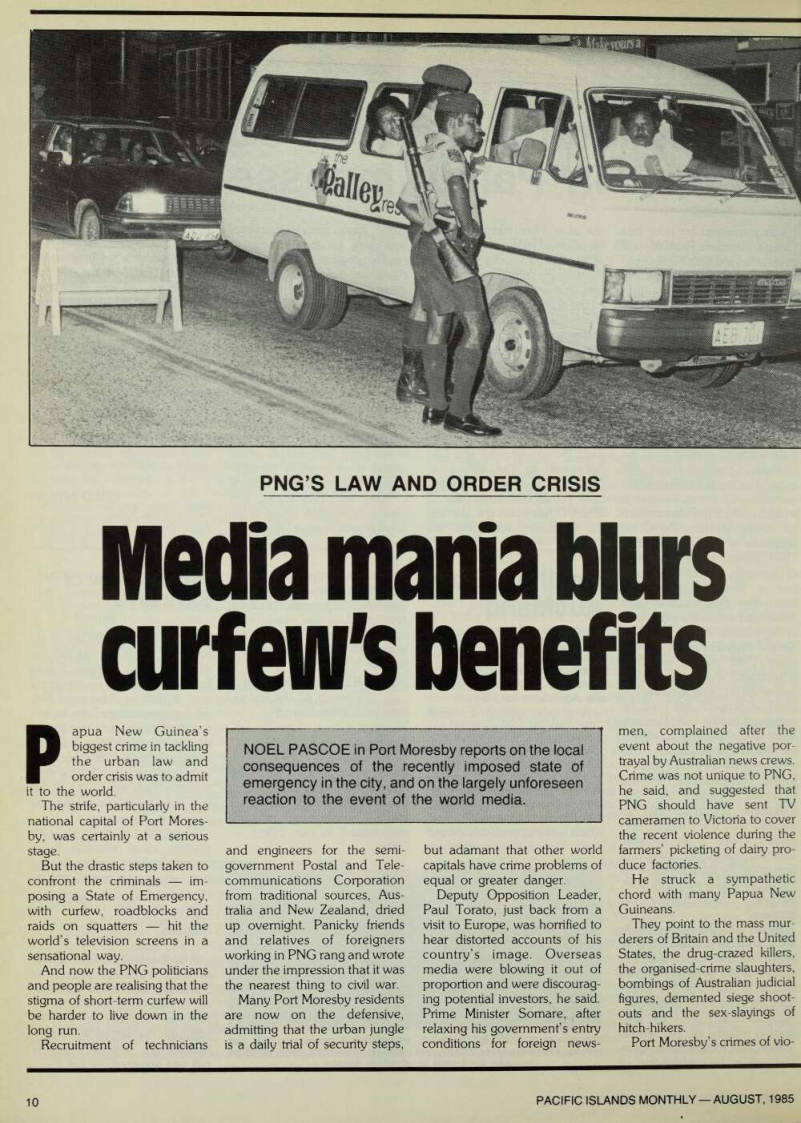
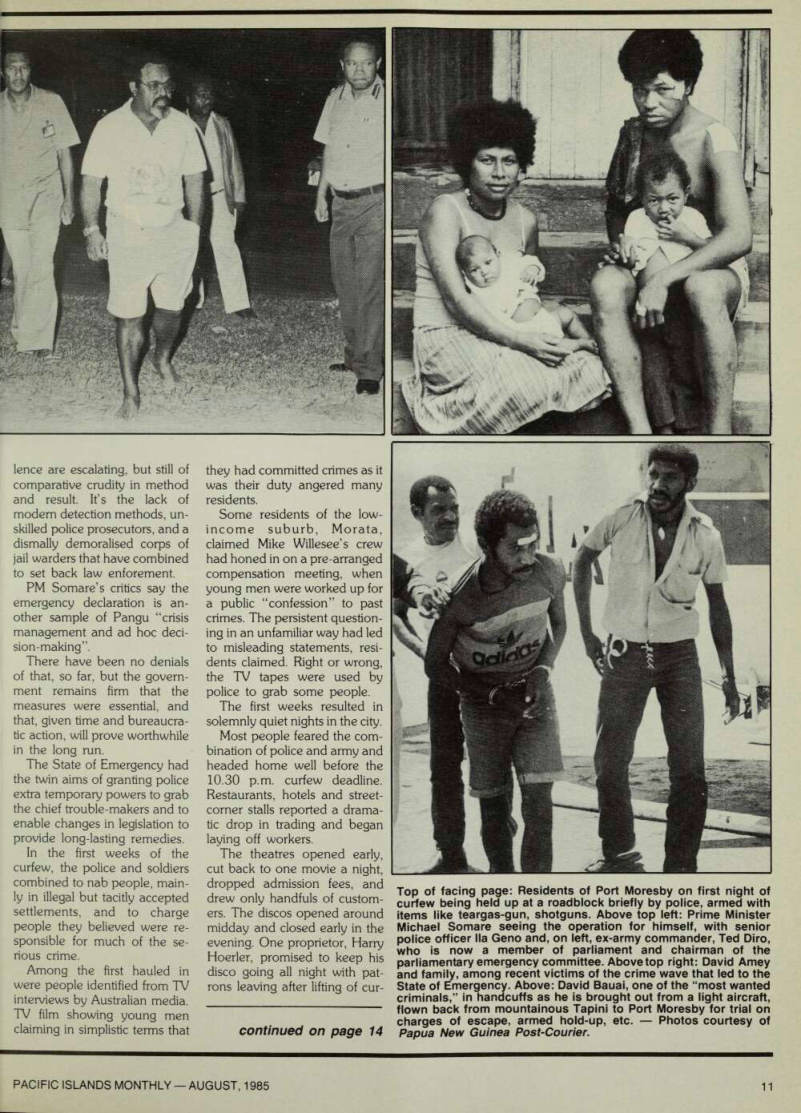
Top of facing page: Residents of Port Moresby on first night of curfew being held up at a roadblock briefly by police, armed with items like teargas-gun, shotguns. Above top left: Prime Minister Michael Somare seeing the operation for himself, with senior police officer Ha Geno and, on left, ex-army commander, Ted Diro, who is now a member of parliament and chairman of the parliamentary emergency committee. Above top right: David Amey and family, among recent victims of the crime wave that led to the State of Emergency. Above: David Bauai, one of the “most wanted criminals,” in handcuffs as he is brought out from a light aircraft, flown back from mountainous Tapini to Port Moresby for trial on charges of escape, armed hold-up, etc. Photos courtesy of Papua New Guinea Post-Courier.
few at 4 a.m. But the emergen cy controller, Police Commis sioner David Tasion, smartly jumped on that idea.
Mr Tasion was joined quickly on patrol at nights by former army commander, Brigadier- General Ted Diro, who is now M.P. for the Central Province and the chairman of a par liamentary committee set up to watch over the emergency.
Gen. Diro confessed to a feeling of nostalgia when he entered the police operations room with people, phones and weapons in sight.
He caused a mild stir with public comments on what he, as an individual, would like to see happen.
Democracy was not being handled well by people, he said, and cautioned that perhaps some rights needed to be taken away. He spoke in favor of ID (identity cards) and the possibilities for further use of the army to help out.
Then Police Minister Dennis Young foreshadowed a number of legislative moves planned for the August sitting of Parliament.
The existing Vagrancy Act would be strengthened to empower courts to repatriate long-term unemployed urban people and those known to associate with “criminal ele ments”. He conceded logistics were against a mass movement of every vagrant or “pasindia” (passenger) in the city and town. ID cards would be com pulsory for employed people, chemical mace would be sold by the police under control for residents’ use from their homes, and short-term prisoners would be sent to their home districts to serve their sentences.
The city’s jail at Bomana, long the leakiest of the coun try’s “sieves”, is being strengthened with higher walls, more watch-towers and provi sion for more top-security cells.
A long-mooted “island pris on” idea inched closer to acceptance, with Mr Somare mentioning an unnamed island off New Ireland as a possibility and then Mr Young citing “swampy, mosquito and croco dile infested” Ningerum as a
Prime Minister Michael So mare wants a new name for Papua New Guinea as befits an independent nation but the initial local reaction to his idea was little short of derisive.
Mr Somare let drop in late June that he thought the name, Papua New Guinea, smacked too much of the colonial era.
It was time for a more fitting name as the nation approached its 10th anniversary celebrations (set for September, when K 1.5 million will be spent to who op it up in patriotism).
Commentators in his own country betrayed a heavy touch of cynicism, perhaps reflecting popular senti ments about politicians in general.
SomariLand or Panguna, suggested the Post-Courier cartoonist Grass Roots.
“Maybe even Corruptany or United States of Hunemployment or silly nems like that,” continued the acerbic pen. Niugini Nius columnist Pama Anio offered Grasrutland, Saiso
land (after a current risque catch-cry) and Crimeland.
The formal name, Papua New Guinea, has never really caught on with other countries. Many in the Aus tralian media still refer to it as New Guinea, in a slight that offends many in PNG.
But the fact remains, some of the national politicians dislike the name on the grounds that it is an amalgamation which re minds all of the country's oddball beginnings, with the southern half under British and Australian auspices, and the northern sphere under the Germans.
Name-changing has been touted before and always dropped as being not worth the effort. Even if the gov ernment goes ahead and picks a new name in time for the September celebrations, you can imagine the possi bilities as sundry VIPs step to the dais for the occasion and stumble over “Citizens of Papua, er, Paradisea. . . or is it Greater Melanesia. . .” Noel Pascoe in Port Moresby.
likely site. Local MP Warren Dutton chortled, saying Ning erum was on a main road near the Ok Tedi mine townships and only a moderate hike from the Indonesian border.
Mr Young plans to have on-the-spot fines for minor off ences to lighten the load on courts and to use non-violent criminals on community service duties. That was a colonial era practice dropped in indepen dent PNG. People found to possess stolen property will be dealt with more severely, he said.
The authorities in Port Moresby and other centres made it plain they would watch for signs of an exodus of criminals from Moresby. First signs were that some of the gangsters eluded the net and picked up some holiday money. Lovely seaside Madang had a rash of hold-ups, attri buted to local prison escapees, and then the second-biggest centre, Lae, had several armed hold-ups in one week.
These were “flash-in-the pan” efforts and the authorities are confident that the scene is set for a real curtailment of serious crime.
As Mr Somare said defen sively, we will only know after the lifting of the emergency in September timed for just over a week before the celebra tions of the nation’s 10th year of independence.
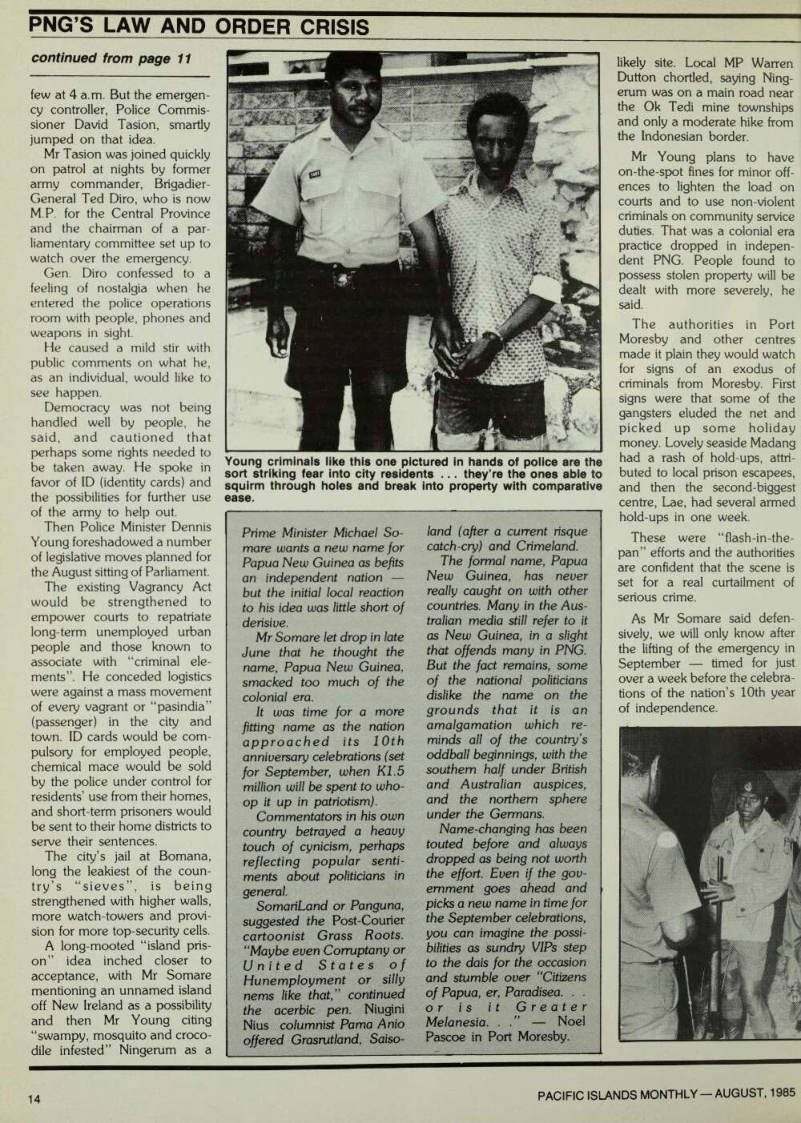
Young criminals like this one pictured in hands of police are the sort striking fear into city residents ... they’re the ones able to squirm through holes and break into property with comparative ease.
Advertisements & other items, pp. 12-14 (2 items)
iiiKi)
m. m in ft a i Mt v ..
mmm i
A..
mu -\m
ft
iWli.
I ml ms
mMw
A % ■ I I I B as ft m h 1M
Sllf
ft: v> ?
I ■■ m V il
ftft.ftlfft ftft-ft
M:'WM :1
M . it
mm--, y s.h«
piMIl
■ ■ I ft.
■ Si > % i
Krab* IftAikhi^
■ft.
VI ft ft. i I ft s ? ft; Mi
fciiili istK «
% ft' - !? ft. ft' ;i ‘ 'ft ft„;
iiiKi)
w $ 1 1 * 4 J ‘ft 1
w«. ft'ft
' KM ftftft ftft :• L mm
r- ~s** Jt r- :v '“ ... m %: $ •» *“•■" :?-%Py|p« &&*•; •-,. mma£. 5: *•»
ilfer
*., *. > . tS *>■
rf-ass .**
•*‘ ~-#»„■ v*. -£< #■' .
r ?’rf' r:
Png’S Law And Order Crisis
14
PACIFIC ISLANDS MONTHLY —AUGUST, 1985
continued from page 11
PNG’S LAW AND ORDER CRISIS
PNG egg
A few good bits in PNG egg
Despite international press coverage which could only be described as awful, the result of Papua New Guinea’s new, tough measures against hoodlumism and other crime in Port Moresby has more than satisfied the government and, indications are, a large part of the law-abiding citizenry.
In the first two weeks of the 10.30 am to dawn curfew, the improvement was little short of astonishing. Not one car theft occurred, in a city where five or six were stolen every day. Two houses were burgled, armed hold-ups were down to one, and there were no rapes.
“It’s so quiet it’s unbeliev able,” said one clearly much relieved expatriate.
How long this much to be desired situation will last is the subject of much debate in the loungerooms and bars of Port Moresby, but the government appears reasonably confident that a new era may have dawned ... even if it does mean, from now on, more expendi ture on policing, the employ-
ment of road blocks, peace officer patrols, and repatriation of miscreants to their own tribal areas, away from the tempta tions of the capital.
To outsiders, and particuarly some of those whom residents of Port Moresby tend to regard as do-gooders issuing advice from the serenity of foreign suburbs and academic institu tions, some of the measures adopted appear pretty Draco nian. Hanuabada village, on the outskirts of the city, from which many of the rascals are believed to swarm about their evil industry, is now virtually blockaded by 40 volunteer peace officers equipped with batons, badges and two-way radios to the police and the army, who check everyone moving in and out.
The use of volunteer police officers has been hailed as a great improvement. A London police superintendent who has charge of training these recruits is reported well pleased with the results and officials have ex tended the method to Lae and Mt Hagen. By the end of June he had trained 102 reserve policemen and was at work recruiting about 50 for Lae and 50 for Mt Hagen.
Word from Port Moresby is that the volunteers have im pressed many citizens with their efficiency. They are generally much better-educated than reg ular constables, and, by virtue of that education, have more confidence in their authority.
“When they check a car, it is properly checked. And they have a better manner with the public,” said one official.
“Some of the stuff seen on Australian television just after the state of emergency was declared was pretty dreadful,” he said. “They only interviewed those who had been hurt or menaced; there wasn’t much attempt to put it into focus across the community.
“But, I would say that, in ternally, this has been the big gest thing the government has achieved in a long time. And, as a result of that, the prime minister’s popularity is well up now. ”
This does not mean the cur few has been implemented without some criticism from within the community but the very broad body of both na tionals and expatriates seems to be totally behind the measure.
Mr Somare’s Pangu Pati held a fund-raising lunch in Port Moresby in the last week of June. Average attendance at one of these SOkina a plate affairs has been about 70. The June meeting attracted 200 applications for 180 seats.
The curfew has slowed the social activities of single pro fessional people, but has made little or no difference to families ... indeed, it seems to have improved their lives.
“Before the curfew we didn’t go out at night, anyway, be cause we wouldn’t leave the children unguarded,” said a businessman. “Or, if we did go out, we had to make arrange ments with other people to come in. So, in effect, we had our own curfew; all the pro fessional people, nationals and expats, did. The improvement now is that we sleep easier because the atmosphere is much less anxious ... we feel a lot more secure. Even the dogs seem quieter they aren’t constantly barking at the people moving around the streets, be cause the traffic stops at 10.30 pm.”
How far the police have so far gone in their campaign to arrest, jail (and keep in jail), the rascal gang leaders is open to debate. The government has taken two-page advertisements in Port Moresby newspapers to publish photographs and de scriptions of the country’s most wanted criminals and jail
escapees. They say they are catching “a few” but, at least, the pressure is increased on the fugitives.
Meantime, the society re mains deeply shaken by the dreadful pack rape of a New Zealand wife and her young daughter which was the final outrage leading to the declara tion of emergency. Several men have been on suspi cion of this crime, including one who is alleged to be suffering from psychological problems, and police are reported to be using all of their now consider able powers of investigation in pursuing the gang.
The curfew is to last three months, and is likely to be extended, perhaps with some minor relaxation, for a further three months.
It has brought a good deal of kudos to the Somare govern ment which, lately, has been under considerable pressure from the Opposition and from dissidents within its own coali tion. But, what will count at the next polls (or at the next, no doubt inevitable, vote of no confidence in the House), is whether, after the curfew is ended, the rascal problem has been brought within bounds.
The most popular remedy advanced by people in Port Moresby is based upon a strengthening of village-based law and discipline, which, many consider, means that some sort of “pass” system will have to be introduced to stem the urban drift and to turn back out of the cities those who have no jobs, or what, in this very genuine emergency, is seen to be insuffi cient reason for being away from the home territory. —
Staff Writer.
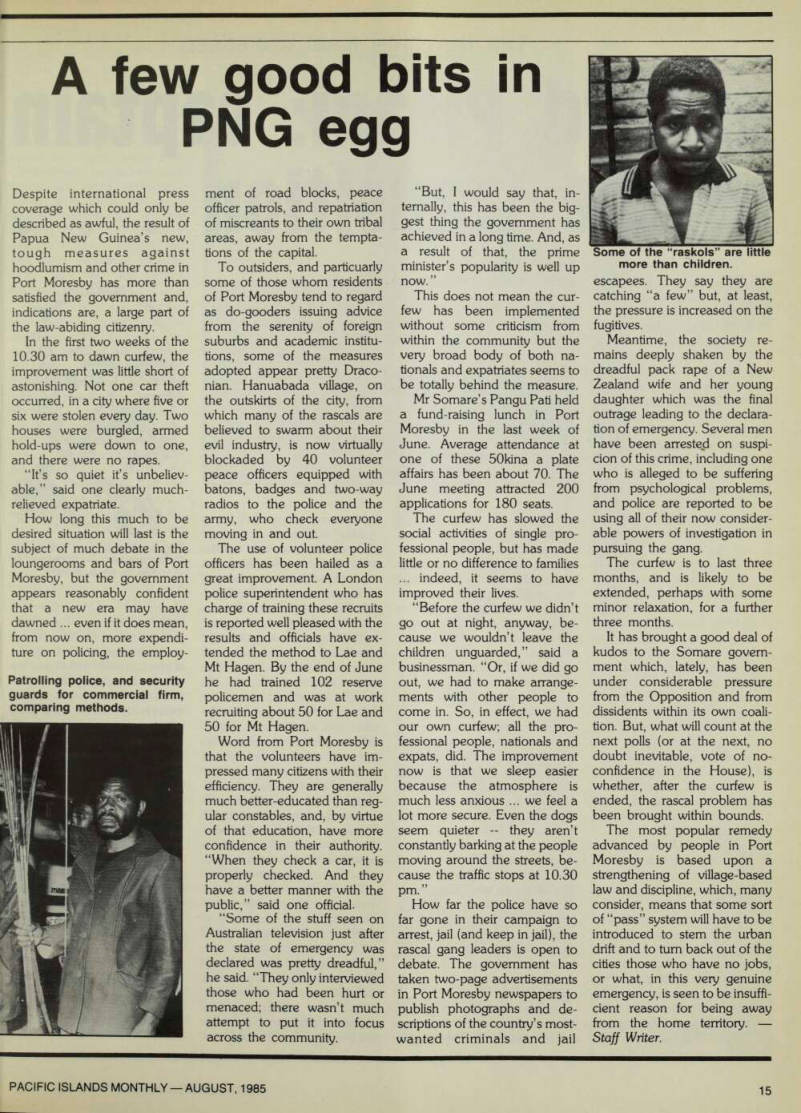
Patrolling police, and security guards for commercial firm, comparing methods.
Some of the “raskols” are little more than children.
Edgard Pisani: captain
The “Hatchet Man” Assessed
Edgard Pisani: captain of the transition . . .
Mr Edgard Pisani re turned, not disgraced, but certainly not co vered in glory, from a “mission impossible”. The gov ernment’s delegate by and large failed to meet the two challenges he set himself when he arrived on December 5, 1984, in New Caledonia, this territory to which he was a stranger: to re-establish order, and launch a dialogue.
Order? Race hatred flared on May 8 last in Noumea, when guns were brought out for the first time by both sides. A bullet killed a 19-year-old Kanak high school student, and the high commissioner had to reimpose the 8 p.m. curfew only a few days after he had lifted it. It is true that the independentist roadblocks which at the time of his arrival were paralysing the territory had been lifted. But more than ever there was the feeling that the fate of the caillou (“pebble” or “stone”, colloquial French expression for New Caledonia) was at the mercy of a single spark. Dia logue? Between Mr Pisani and the anti-independence forces, in particular Mr Dick Ukeiwe, head of the territorial executive, the only dialogue was an ex change of insults.
Certainly Mr Pisani had to foot the bill for the radicalisation fomented in the territory by the metropolitan parliamentary Opposition, especially the neo- Gaullist RPR party, which was spurred on by considerations having precious little to with a concern for the future of the caillou and its inhabitants. Nor did the pigheadedness and bigotry of the local anti-inde pendence forces make his job any easier. But his failure also
Writing in the Paris daily Le Monde of May 23, journalist Daniel Schneidermann appraises the role played by President Mitterrand’s special envoy in New Caledonia, Edgard Pisani. Headlined “A reign’ without infamy, but without glory”, Schneidermann’s report is highly critical of aspects of Mr Pisani’s activity, but concludes that his “real success” was that he was “the man of the transition from stagnation to forward movement” in the territory’s political development.
owed much to some clumsy moves on his own part, and to his considerable inflexibility.
First, he lost out because he was unable effectively to wield the nightstick of repression.
What a wretched mockery it was that this former European commissioner, and former minister of agriculture under General de Gaulle, should have been called upon to act the police superintendent. The Third World visionary juggling with police patrols and armored vehicles! But the fact was that in this field miscalculations were piled upon incomprehensible acts of negligence. The ques tion can never be asked too often as to why, on that fatal evening of January 11, Mr Pisani ordered the elite gen darme unit GIGN to “neutral ise” the independentist leader Eloi Machoro who, with about 30 followers, was occupying a farm in the bush about 100 km from Noumea. Could he poss ibly have been unaware of the hatred felt by the men of this unit for the ringleader of the occupation of Thio?
A little more than a month later, on February 17, there was a further lapse. Mr Pisani began
by refusing permission for a “picnic” at Thio, at a spot about 100 metres from one of the most hardline independentist tribes in the territory, to be held by a movement of the far Right, the Caledonian Front. But the “picnickers”, by cunning and fast talking, still managed to get permission from the gendarmes to proceed to Thio. To protect them from the fury of the Kanaks, the police had to make three violent charges into the tribal area. On the spot, along side the gendarme captain who later copped all the flak for the incident, was a senior member of Mr Pisani’s personal staff.
Shouldn’t this have been suffi cient to avert these “mistakes”?
In a fury, the High Commis sioner issued orders for the expulsion of five of the “pic nickers” from the territory.
The five immediately went underground, and his police have failed to find them.
Couldn’t he have spared him self this fresh blunder?
The events of May 8 finally demonstrated that the presence of 5000 gendarmes and sol diers in the territory was in adequate to prevent confronta tion between Kanaks and Euro-
peans on the streets of Noumea. In any event, the demonstration of May 8 was only the culmination of a series of processions in defiance of the curfew demanding the depar ture of Mr Pisani processions through the streets of a town whose walls were covered with obscene slogans directed agaist him.
In defence of Mr Pisani it can be said that the maintenance of order was not his line of coun try. But, after a few weeks, the negotiator, too, lost his cool, the referee proved unable to resist the temptation to pull on the gloves. Was there any need to threaten, as the government delegate did, that he would “rub the noses” of the leaders of the metropolitan Opposition “in their own piddle”? Was it necessary to load responsibility holus-bolus for the confronta tion of May 8 on the RPR, when on that very morning independentist demonstrators had burnt a French flag in the
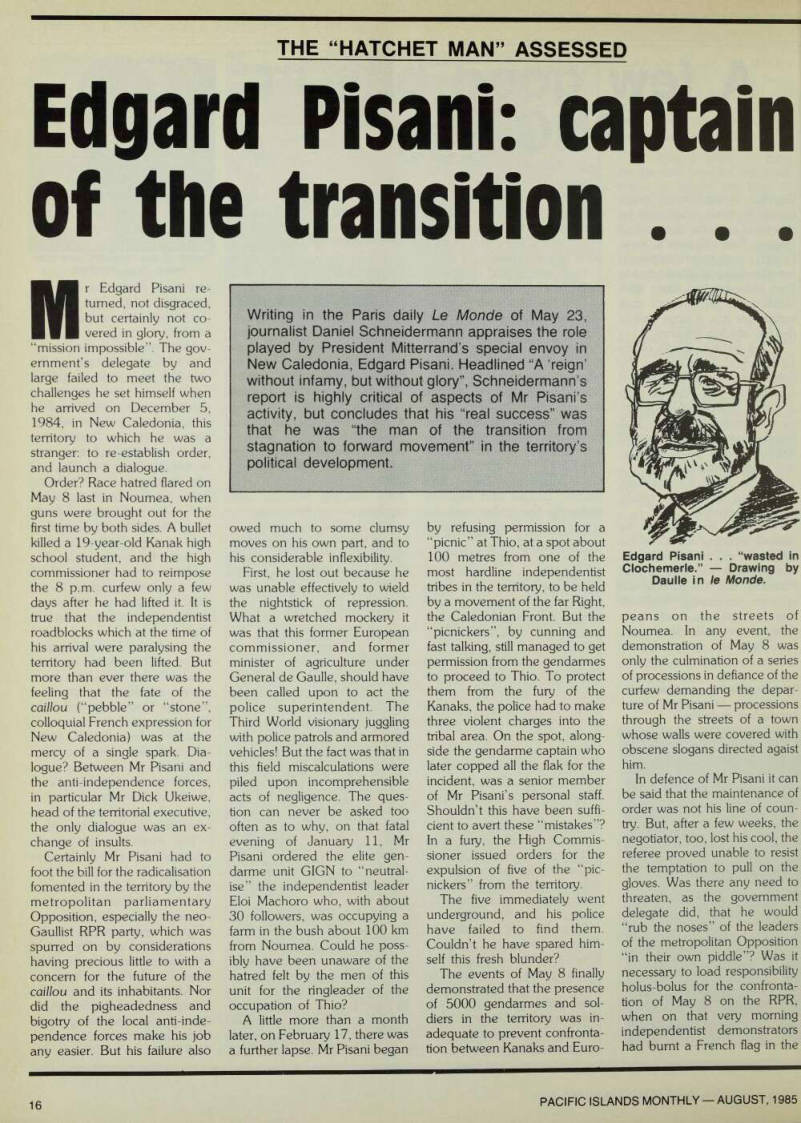
Edgard Pisani . . . “wasted in Clochemerle.” - Drawing by Daulle in le Monde.
Place des Cocotiers?
It was simply not his scene, and he seems never to have realised it. The theoretician of land reform ensnared in stand up comic antics with Mr Ukeiwe! His imposing gestures, his voice with its de Gaulle-like cadences, were wasted in Clochemerle, in dealings with fourth-rate ward politicians.
Those who took part in a security meeting with him one evening observed him for a moment dreamily stroking the kepi of a gendarme general, which had been left behind forgotten on a table.
Certainly Mr Pisani counted too much on the magic of his eloquence, his charisma, to drag a compliant caillou along the path of reason. Even though he had many informal meetings with the Europeans of Noumea, he was never able to win over this complex com munity, which merits the atten tion of ethnologists no less than the Kanaks do. “I know the goal I’m heading for, but not yet the means of getting there,” said he as he stepped off the plane from Paris to the war veterans and senior officials in formal attire who were there to greet him. A number of docu ments digested on the 30-hour flight had been sufficient to convince him it was necessary to race ahead to independence.
Very soon, the murderous ambush at Hienghene, in which two brothers of Jean-Marie Tjibaou were assassinated by colonists, allowed him to establ ish warm and close ties with the independentist leader. Tjibaou, against the will of part of his own movement, and despite his bereavement, honored his pledge to lift the roadblocks.
The two men got on so well that they exchanged copies of their published writings, which they read avidly. Throughout the “Pisani reign” they continued to meet, often outside Noumea, to talk about future independ ence.
On the other side, Mr Ukeiwe, under the chaperon age of Mr Bernard Pons, and then, most particularly, Mr Charles Pasqua these two were the first of a whole succes sion of RPR leaders to visit Noumea over the period
simply refused to meet Mr Pisani “so long as law and order are not re-established”. When this pretext lost its validity, meetings were refused “so long as the cadaver of independence is left lying between us”.
The whole “Pisani question” is there. Was it really necessary to race ahead to independ ence? To take advantage of the traumas of the time to give a forceps-delivered independ ence? Should he, after the presentation of his plan on January 7, have so noisily proc laimed his preference for “inde pendence-association”? Mr Fabius has chosen a quite diffe rent path. True, the objective is still the same; to convice a part of the European electors to vote in favor of independence in the referendum which is constitu tionally unavoidable. But the method has changed. It will be based on facts rather than on oratory. Regionalisation, origin ally suggested by Mr Ukeiwe, and taken up by Mr Pisani at the request of the government, will, it may be hoped, permit independence to be created on the ground, coolly, and without high drama.
Independence? The idea is in everbody’s mind today, where as a mere 10 months ago the RPR and the RPCR were rejec ting the “Lemoine statute” for internal self-government. It is perhaps here, in the long term, that Mr Pisani’s real success lies: that he was the man of the transition from stagnation to forward movement.
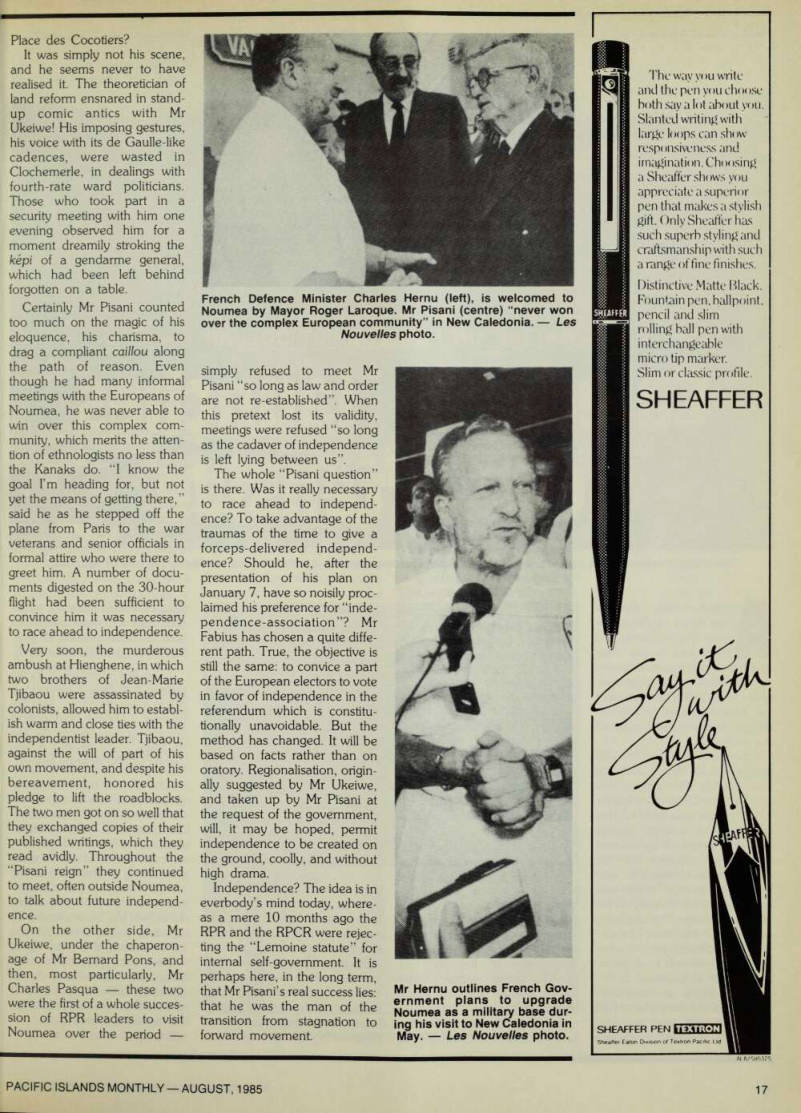
French Defence Minister Charles Hernu (left), is welcomed to Noumea by Mayor Roger Laroque. Mr Pisani (centre) “never won over the complex European community” in New Caledonia. - Les Nouvelles photo.
Mr Hernu outlines French Gov
ernment plans to upgrade
Noumea as a military base dur ing his visit to New Caledonia in
May. - Les Nouvelles photo.
Advertisements & other items, p. 17 (1 item)
Sheaffer
The way you write and the pen you choose both say a lot about you.
Slanted writing with large loops can show responsiveness and imagination. Choosing a Sheaffer shows you appreciate a superior pen that makes a stylish gift. Only Sheaffer has such superb styling and craftsmanship with such a range of fine finishes.
Distinctive Matte Black.
Fountain pen. ballpoint, pencil and slim rolling ball pen with interchangeable micro tip marker.
Slim or classic profile.
SHEAFFER
w
SHEAFFER PEN liMilM:!
Sheaffer Ealon Division of Textron Pacific Lid
Battle On For Tourist Dollar
Caledonia launches new offensive
A major new offensive has been launched in New Caledonia in the past few weeks. Not another confrontation between those for and against independ ence, but a battle to try to save the badly battered tourist in dustry, one of the mainstays of the economy.
Last year more than 92,000 people made New Caledonia their holiday destination. This year the French territory will be lucky to see one-third of that number, the tourists having been frightened off by the vio lence which erupted after the elections of last November, and the nightly curfew which was finally dropped in early June, after six months of forcing lights out in Noumea from 11 pm.
The sudden drop in the num bers of tourists has been catas trophic for all involved in the industry. Many of Noumea’s hotels and restaurants have had to lay off staff, and are now facing the prospect of closure
The sun-tanned, oiled and nubile bodies displayed upon the beaches of New Caledonia are now notable by their absence. The only crowds in the duty-free shops of Noumea are the unsold goods on the shelves. For the tourists who once provided the territory with a major source of its income are staying away in droves, repelled by what they understand, from their cursory study of an even more cursory television coverage of the independ ence movement, to be wholesale revolutionary violence and disorder. The losses have been massive, but the islands are now preparing to fight back, as SUE WILLIAMS, PlM’s resident correspon dent in Noumea, here reports.
unless there is a rapid turn about.
As for the situation inland, those hotels and lodgings which have not been destroyed during the events of the past six months have already been forced to close, the bush being virtually off-limits to tourists, Tourism minister, Charles Lavoix, hopes to change this
grim picture in the next six months. He has already coaxed the French government into subsidising the wages of hotel and restaurant staff to the tune of 35 per cent for the next three months to help keep people in their jobs, and has prised open the doors of the territory’s treas ury to fund a big development program to improve tourist fad
lities as well as launch a major onslaught on New Caledonia’s best overseas markets, Austra lia, Japan, and New Zealand.
“The first objective is to tell people that New Caledonia is not in a war situation,” said the minister. “There is no danger in coming to Noumea or the Isle of Pines, and shortly a few resorts will be opened inland.”
One of the most important groups to be convinced of New Caledonia’s viability as a holi day destination is the tour oper ators, and a big chunk of funds allocated overseas will be spent persuading them to put the territory back on the package tour map. In Australia alone, $243,000 has been allowed for operator support, the printing of brochures, the planning of holiday packages and so forth, something the industry is not prepared to foot the bill for itself in case there is more trouble in the territory which would re nder any investment useless.
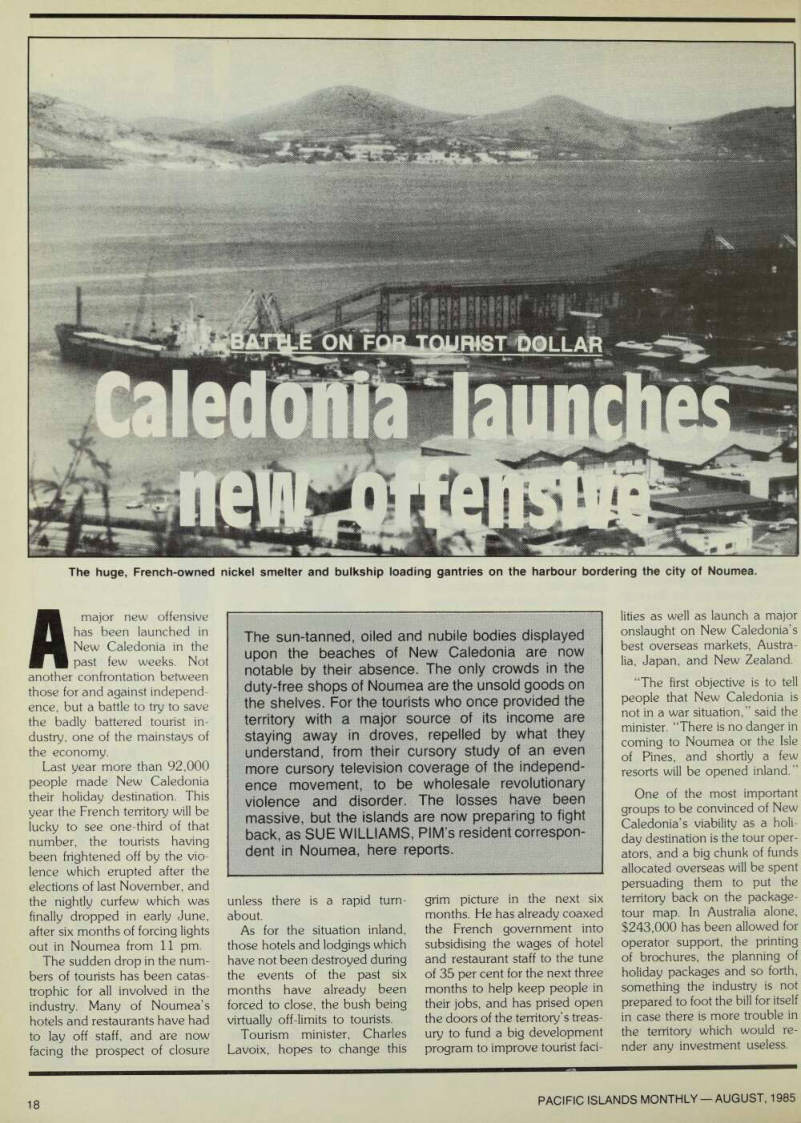
The huge, French-owned nickel smelter and bulkship loading gantries on the harbour bordering the city of Noumea.
There will also be major television campaigns in the three countries in the lead-up to the Christmas holidays. Again, Australia, which provides by far the majority of New Caledo nia’s tourists, has been given priority with $500,000 allo cated for the promotion.
Another $150,000 has been budgeted for a similar promo tion in Japan, which is seen in the territory as the market for the future, both by the sheer size of its population and the enthusiasm of the Japanese for anything French. Indeed, had it not been for the Japanese, many hotels in Noumea would have been forced to close be fore now.
While the Australians and New Zealanders have just about stopped coming altogether, the young Japanese couples looking for a reason ably-priced honeymoon in an exotic port have continued to arrive in much-reduced, but still significant, numbers. About 100 arrive each week for a five or seven day stay at Club Med alone. The resort, which is one of Noumea’s biggest tourist drawcards, has accordingly changed its direction to cater to the Japanese, with Japanese food on the menu at least twice a week, more interpreters to help overcome the language problem, and organised spor ting activities, such as ping pong tournaments, to cater to the visitors’ tastes.
At the same time, the num ber of Australian and New Zealand personnel has been drastically cut. Before the vio lence erupted here there were at least 15 Australian and New Zealand staff to provide assist ance for the 500-odd tourists coming from those countries each week. Now there are two to look after the ten or 15 coming in. General staff, such as cleaners and bar-tenders, have been cut back by half at the resort.
Despite its new orientation to the Japanese, Club Med wants the Aussies back, and has started its own promotions in Australia to tempt them anew.
Despite the financial crisis, Club Med had been advising tourists to steer clear of Noumea while the curfew was in force, and those who came had to sign
forms taking responsibility for their own safety. These restric tions have now been lifted and Noumea has been put back on the map, at least as far as Club Med is concerned.
Club Med, and the hotel industry in general, have warm ly welcomed the commitment by the territorial authorities, and have each promised to do what they can to aid the much hoped-for revival.
The help of the airlines servicing the territory has also been enlisted. All have prom ised their full support, anxious to fill up the empty aircraft they have been flying into Noumea in recent months.
Qantas which, along with UTA, is the main carrier from Australian ports, has been forced to drop one of its twice weekly flights into New Caledo nia and has basically been operating a mail run for the past few months. Qantas reviews the situation from month to month and will re-introduce the Mel bourne flight once tourist traffic starts to pick up again.
The cruise lines have also been approached. P & O, Sit mar and CTC have just re sumed their stopovers in Noumea after steering clear for several months because of the political unrest. However, they have made it clear they would like to see some money spent in
Noumea to improve facilities for the 75,000 tourists they can bring in each year. Two officials from P & O made a special trip to Noumea just recently, basically to tell local authorities to lift their game. They want a better welcome for their passengers, such as a band, or traditional dancers on the quay, to provide some more festive atmosphere for their ships.
Transport was another com plaint. At the moment most cruise ship passengers are easily spotted wandering around Noumea looking like lost sheep after making the long hike from the wharf.
“The criticisms of the cruise ship operators are totally justi fied,” says Charles Lavoix.
“The welcome is very impor tant to tourists who are guests in our country and should be greeted as such. It makes me really mad when I see these people wandering along the quay, lost. Something must be done, and it will be done.”
One of the other difficulties facing New Caledonia’s tourist industry is the fierce competi tion it is getting from its neigh bors. Vanuatu in particular has stolen a big piece of the tourist cake from the territory and is now using the political troubles of the past few months in its promotional campaign to attract even more visitors to its shores. Full-page newspaper
advertisements, painting Vanuatu as the safe tropical holiday destination with the French flavor, compared to strife-torn New Caledonia, and cyclone-ravaged Fiji, has done nothing to repair the damage done to the territory’s image.
Mr Lavoix is unperturbed by the competition. “This cam paign is part of the game,” he said. “However, Vanuatu must remember it also needs us. Not being big enough to support an intemaional standard airport, most of its tourist traffic comes through Noumea, so it is in Vanuatu’s interest that the tour ist industry in New Caledonia stays healthy.
Mr Lavoix is also undisturbed by the prospect that his govern ment is not likely to be in power for very much longer. The regional elections are due in relatively few weeks and will undoubtedly result in a com pletely new-look territorial authority, without the auton omy enjoyed by the present assembly.
“Tourism is at its lowest point. We cannot wait any longer or we will be facing a situation which will take many years to repair, instead of a few months,” said Mr Lavoix. “If there is a change of govern ment, the tourism plans may be changed, with the money being increased or decreased accor ding to the views of whoever holds the reins. However, we have made a start in the hope of preventing a disaster in the industry, for instance, the clo sure of the hotels, which at the moment have an occupancy rate of between 10 and 15 per cent. This is nothing, and they are losing a huge amount of money each day they remain open in this situation.”
Providing all goes well with the campaign, it is hoped that some 14,500 tourists will arrive in New Caledonia between July and December; 6000 from Japan, 6500 from Australia and 2000 New Zealanders.
Even these improved totals will represent less than half of the normal tourist traffic through at this time of the year.
But, says Charles Lavoix, “this is enough for a start, and it will at least enable the hotels to stay open and keep the ailing industry alive.”
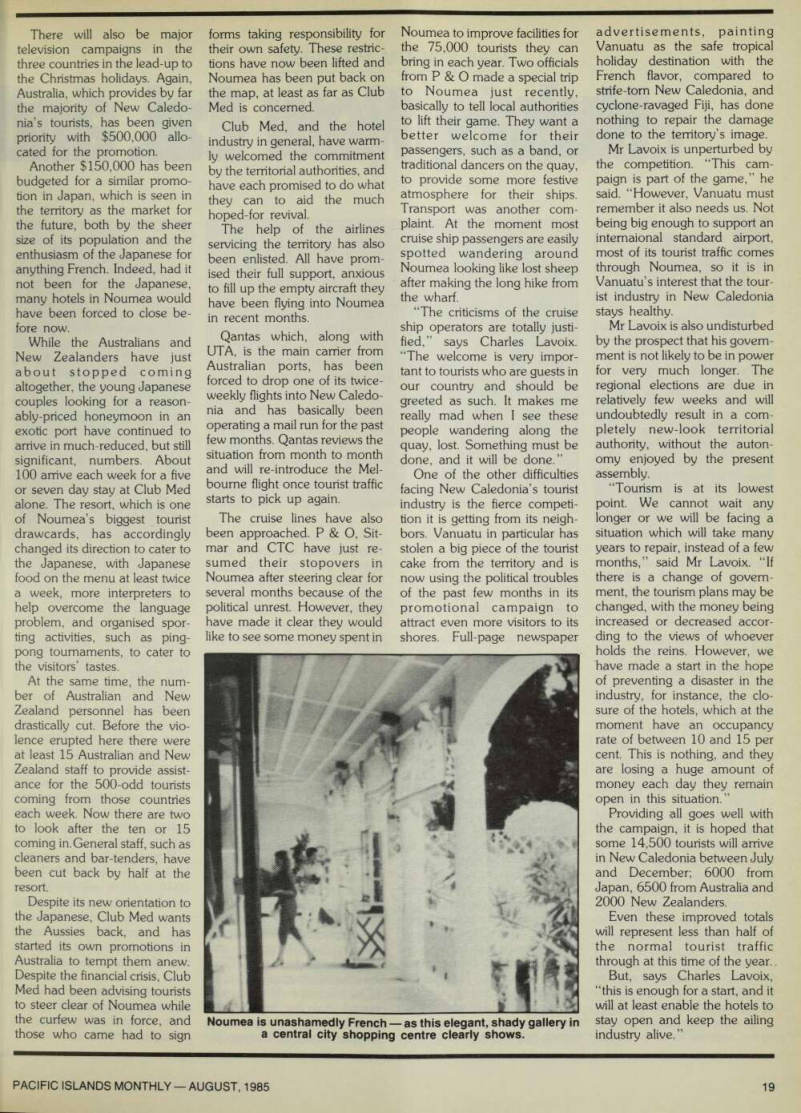
Noumea is unashamedly French as this elegant, shady gallery in a central city shopping centre clearly shows.
Nukes, New Cal. and fish are major issues
1985 Forum Preview
New Zealand’s prime minister, David Lange, slipped out to Queens land’s sunny beaches at the beginning of July to prepare for a potboiler South Pacific Forum.
As convenor of the ministe rial group on New Caledonia, Mr Lange should take a crucial role in the report and debate on progress towards independence for the French territory.
He should find himself in the limelight again during discus sion of the South Pacific nuc lear-free zone treaty draft following his strong public state ments against French nuclear testing and the new strategic base at Noumea.
New Zealand government officials on the drafting commit tee had apparently pushed for a stronger treaty and Mr Lange could find himself at odds with Australia’s Mr Bob Hawke over some aspects of the treaty.
Mr Hawke espoused the nuc lear-free zone idea at the 1984 Forum meeting in Tuvalu.
However, Australia, being a larger nation and much more directly involved in global con sequences than New Zealand, sees a need to tread fairly delicately through the finer print of the treaty. Further, Mr Hawke spent most of June and a good part of July almost wholly enmeshed in a very complicated, and politically dangerous, campaign to reform the national tax system, and, depending upon the outcome of that crucial debate, may have exhausted a good deal of his patience by the time he reaches Rarotonga on August 3. - Ed.
New Zealand has already promised increased maritime surveillance for micro-state fishing zones and will be keen to pursue discussions on a tighter regional focus on trade,
Independence for New Caledonia will be the central issue for discussion at the 1985 conference of regional prime ministers at the South Pacific Forum, due to be held at Rarotonga, Cook Islands, in the first week of this month. Vanuatu is expected to repeat, even more strongly, its 1984 demand that the matter be sent to the United Nations, but Walter Lini does not appear to have the numbers. The Pacific countries seem moderately satisfied with France’s progress so far and wish to avoid what some believe would be very messy international involvement in a regional affair. And they have other concerns closer to home like fishing rights, and nuclear testing, as our Auckland correspondent, KAREN MANGNALL, reports.
economic development and ex ternal relations.
The Forum is likely to wel come the bulk of the Fabius Plan for evolution towards New Caledonia’s independence in association with France. The date of the referendum has been advanced from 1989 to the end of 1987, which con forms to the 1984 Forum re quest for a shorter time-scale for transition to independence.
Mr Lange formed a firm opinion after his visit to New Caledonia in October last year that any timetable for a ’’sub stantial assurance of self-gov ernment, together with pledges of full autonomy, must have a 1986 cut-off point.”
The Forum is likely to be satisfied with the French Social ist government’s intention to set the framework for reforms and referendums in legislation be fore the 1986 French national elections. The New Zealand government is also banking on the referendum taking place within President Mitterrand’s mandate, presumably meaning that he would veto any sabot age legislation proposed by a French right-wing government.
New Zealand officials are convinced that the French gov ernment is sincerely helping the F.L.N.K.S. to create a pro independence majority in New Caledonia by 1987. The Forum will probably welcome the Fabius Plan’s concept of re gions with extended powers and rights to negotiate directly with France.
F.L.N.K.S. leader, Jean- Marie Tjibaou, while rejecting the ”neo-colonial logic” of the plan, has accepted the regions as a useful tool for building Kanak independence from the ground. New Zealand is aware of the F.L.N.K.S. belief that the division of power between the Kanak-controlled regions and those still run by French settlers, would force a working com promise between the racial groups.
The F.L.N.K.S. also has indi cated it intends to work with sympathetic Noumea business interests to destabilise the R.P.C.R.’s traditional support from the commercial sector.
The Forum should be pleased that the regions will allow for the much-emphasised dialogue between all parties to
produce a peaceful transition to independence. New Zealand officials believe a future territo rial congress in New Caledonia would be the most representa tive body to produce successful negotiations with France on the exact content of the independ ence-in-association agreement.
The Forum in the past, having stressed the balance between the Kanaks’ innate rights and the legitimate interests of other ethnic groups, is likely to tactful ly ignore the R.P.C.R.’s rejec tion of the regions. It charges that the territorial congress has been manipulated to produce a false Kanak majority and a definite imbalance of seats allo cated to each region.
The decision by France to directly control New Caledonia until the territorial congress is in place will probably be greeted with mixed feelings: relief that France is taking responsibility for the security and progress of negotiations, but trepidation as to the quality of the custodian ship under a possible right-wing government in Paris.
Although the 1984 Forum resolutions written in Tuvalu bear a strong resemblance to the outcome of the year’s work since then, the Forum will not be allowed to congratulate itself on any influence. Vanuatu’s prime minister, Walter Lini, re mains convinced that the Forum failed in 1984 to take sufficient action to try to pre vent the bloodshed which did occur in New Caledonia.
New Zealand officials admit that while the Forum will prob ably congratulate France for its substantial progress over the last 12 months, the advances have been solely due to the F.L.N..K.S. forceful boycott and steady negotiation.
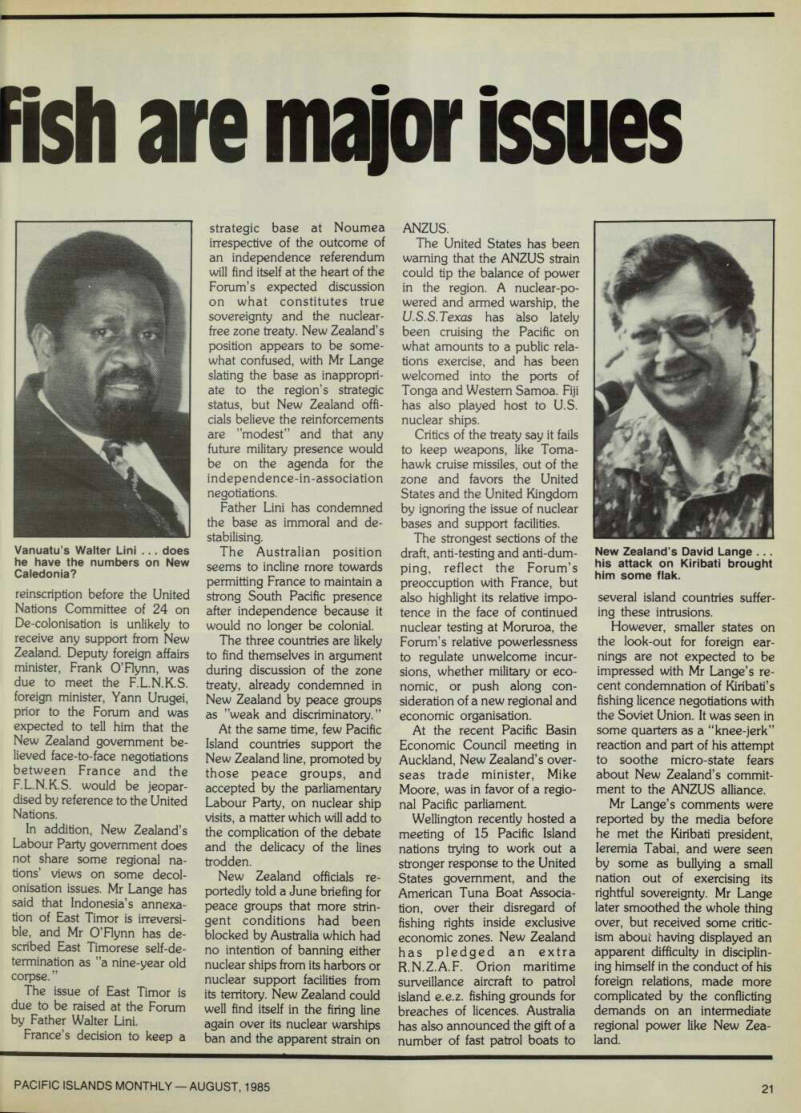
But Father Uni’s intention to call again for New Caledonia’s
reinscription before the United Nations Committee of 24 on De-colonisation is unlikely to receive any support from New Zealand. Deputy foreign affairs minister, Frank O’Flynn, was due to meet the F.L.N.K.S. foreign minister, Yann Urugei, prior to the Forum and was expected to tell him that the New Zealand government be lieved face-to-face negotiations between France and the F.L.N.K.S. would be jeopar dised by reference to the United Nations.
In addition, New Zealand’s Labour Party government does not share some regional na tions’ views on some decol onisation issues. Mr Lange has said that Indonesia’s annexa tion of East Timor is irreversi ble, and Mr O’Flynn has de scribed East Timorese self-de termination as ”a nine-year old corpse. ”
The issue of East Timor is due to be raised at the Forum by Father Walter Lini.
France’s decision to keep a
strategic base at Noumea irrespective of the outcome of an independence referendum will find itself at the heart of the Forum’s expected discussion on what constitutes true sovereignty and the nuclear free zone treaty. New Zealand’s position appears to be some what confused, with Mr Lange slating the base as inappropri ate to the region’s strategic status, but New Zealand offi cials believe the reinforcements are ’’modest” and that any future military presence would be on the agenda for the independence-in-association negotiations.
Father Lini has condemned the base as immoral and de stabilising.
The Australian position seems to incline more towards permitting France to maintain a strong South Pacific presence after independence because it would no longer be colonial.
The three countries are likely to find themselves in argument during discussion of the zone treaty, already condemned in New Zealand by peace groups as ’’weak and discriminatory.”
At the same time, few Pacific Island countries support the New Zealand line, promoted by those peace groups, and accepted by the parliamentary Labour Party, on nuclear ship visits, a matter which will add to the complication of the debate and the delicacy of the lines trodden.
New Zealand officials re portedly told a June briefing for peace groups that more strin gent conditions had been blocked by Australia which had no intention of banning either nuclear ships from its harbors or nuclear support facilities from its territory. New Zealand could well find itself in the firing line again over its nuclear warships ban and the apparent strain on
Anzus.
The United States has been warning that the ANZUS strain could tip the balance of power in the region. A nuclear-po wered and armed warship, the U.S.S.Texas has ialso lately been cruising the Pacific on what amounts to a public rela tions exercise, and has been welcomed into the ports of Tonga and Western Samoa. Fiji has also played host to U.S. nuclear ships.
Critics of the treaty say it fails to keep weapons, like Toma hawk cruise missiles, out of the zone and favors the United States and the United Kingdom by ignoring the issue of nuclear bases and support facilities.
The strongest sections of the draft, anti-testing and anti-dum ping, reflect the Forum’s preoccuption with France, but also highlight its relative impo tence in the face of continued nuclear testing at Moruroa, the Forum’s relative powerlessness to regulate unwelcome incur sions, whether military or eco nomic, or push along con sideration of a new regional and economic organisation.
At the recent Pacific Basin Economic Council meeting in Auckland, New Zealand’s over seas trade minister, Mike Moore, was in favor of a regio nal Pacific parliament.
Wellington recently hosted a meeting of 15 Pacific Island nations trying to work out a stronger response to the United States government, and the American Tuna Boat Associa tion, over their disregard of fishing rights inside exclusive economic zones. New Zealand has pledged an extra R.N.Z.A.F. Orion maritime surveillance aircraft to patrol island e.e.z. fishing grounds for breaches of licences. Australia has also announced the gift of a number of fast patrol boats to
several island countries suffer ing these intrusions.
However, smaller states on the look-out for foreign ear nings are not expected to be impressed with Mr Lange’s re cent condemnation of Kiribati’s fishing licence negotiations with the Soviet Union. It was seen in some quarters as a “knee-jerk” reaction and part of his attempt to soothe micro-state fears about New Zealand’s commit ment to the ANZUS alliance.
Mr Lange’s comments were reported by the media before he met the Kiribati president, leremia Tabai, and were seen by some as bullying a small nation out of exercising its rightful sovereignty. Mr Lange later smoothed the whole thing over, but received some critic ism about having displayed an apparent difficulty in disciplin ing himself in the conduct of his foreign relations, made more complicated by the conflicting demands on an intermediate regional power like New Zea land.
Vanuatu’s Walter Lini ... does he have the numbers on New Caledonia?
New Zealand’s David Lange ... his attack on Kiribati brought him some flak.
in Pago Pago
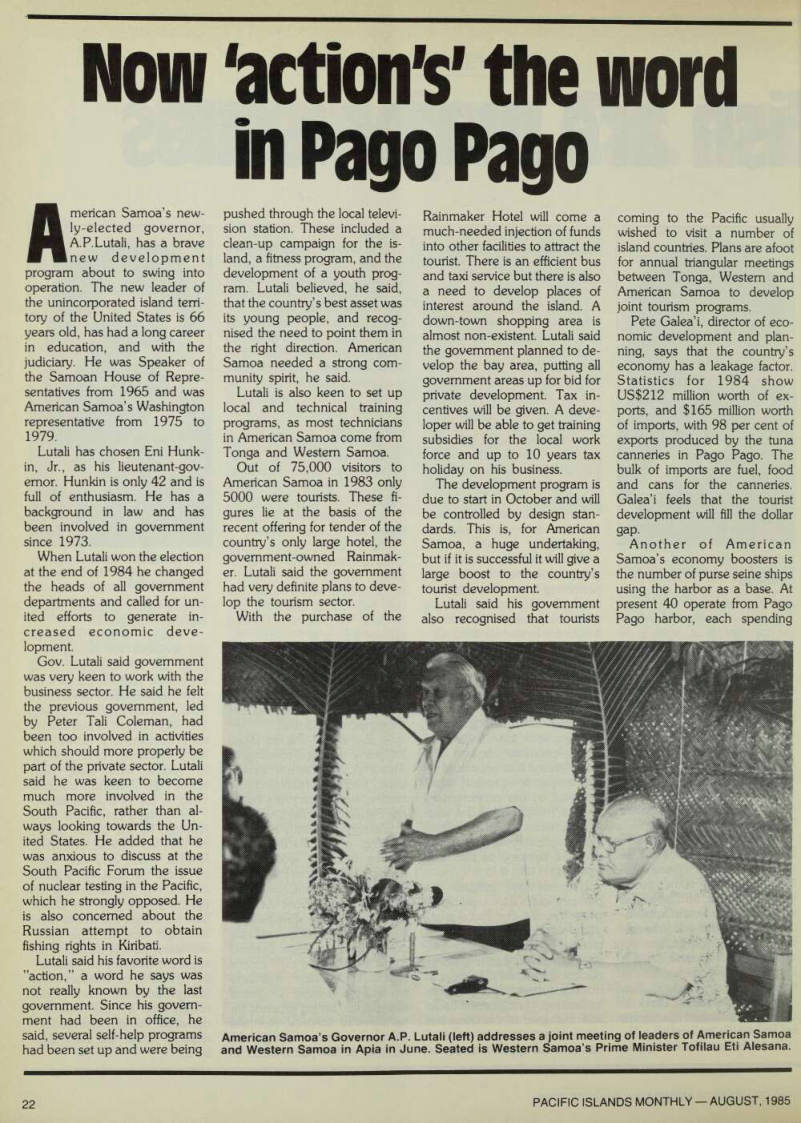

Now 'action's' the word in Pago Pago
American Samoa’s new ly-elected governor, A.P.Lutali, has a brave new development program about to swing into operation. The new leader of the unincorporated island terri tory of the United States is 66 years old, has had a long career in education, and with the judiciary. He was Speaker of the Samoan House of Repre sentatives from 1965 and was American Samoa’s Washington representative from 1975 to 1979.
Lutali has chosen Eni Hunk in, Jr., as his lieutenant-gov ernor. Hunkin is only 42 and is full of enthusiasm. He has a background in law and has been involved in government since 1973.
When Lutali won the election at the end of 1984 he changed the heads of all government departments and called for un ited efforts to generate in creased economic deve lopment.
Gov. Lutali said government was very keen to work with the business sector. He said he felt the previous government, led by Peter Tali Coleman, had been too involved in activities which should more properly be part of the private sector. Lutali said he was keen to become much more involved in the South Pacific, rather than al ways looking towards the Un ited States. He added that he was anxious to discuss at the South Pacific Forum the issue of nuclear testing in the Pacific, which he strongly opposed. He is also concerned about the Russian attempt to obtain fishing rights in Kiribati.
Lutali said his favorite word is ’’action,” a word he says was not really known by the last government. Since his govern ment had been in office, he said, several self-help programs had been set up and were being
pushed through the local televi sion station. These included a clean-up campaign for the is land, a fitness program, and the development of a youth prog ram. Lutali believed, he said, that the country’s best asset was its young people, and recog nised the need to point them in the right direction. American Samoa needed a strong com munity spirit, he said.
Lutali is also keen to set up local and technical training programs, as most technicians in American Samoa come from Tonga and Western Samoa.
Out of 75,000 visitors to American Samoa in 1983 only 5000 were tourists. These fi gures lie at the basis of the recent offering for tender of the country’s only large hotel, the government-owned Rainmak er. Lutali said the government had very definite plans to deve lop the tourism sector.
With the purchase of the
Rainmaker Hotel will come a much-needed injection of funds into other facilities to attract the tourist. There is an efficient bus and taxi service but there is also a need to develop places of interest around the island. A down-town shopping area is almost non-existent, Lutali said the government planned to de velop the bay area, putting all government areas up for bid for private development. Tax in centives will be given. A deve loper will be able to get training subsidies for the local work force and up to 10 years tax holiday on his business.
The development program is due to start in October and will be controlled by design stan dards. This is, for American Samoa, a huge undertaking, but if it is successful it will give a large boost to the country’s tourist development.
Lutali said his government also recognised that tourists
coming to the Pacific usually wished to visit a number of island countries. Plans are afoot for annual triangular meetings between Tonga, Western and American Samoa to develop joint tourism programs.
Pete Galea’i, director of eco nomic development and plan ning, says that the country’s economy has a leakage factor.
Statistics for 1984 show US$2l2 million worth of ex ports, and $165 million worth of imports, with 98 per cent of exports produced by the tuna canneries in Pago Pago. The bulk of imports are fuel, food and cans for the canneries.
Galea’i feels that the tourist development will fill the dollar gap- Another of American Samoa’s economy boosters is the number of purse seine ships using the harbor as a base. At present 40 operate from Pago Pago harbor, each spending
American Samoa’s Governor A.P. Lutali (left) addresses a joint meeting of leaders of American Samoa and Western Samoa in Apia in June. Seated is Western Samoa’s Prime Minister Tofilau Eti Alesana.
about US$l.2 million in the country each year. The number of ships is expected to increase to 60 by the end of 1985.
Galea’i admits his government is hoping to negotiate fishing rights with Tonga and Western Samoa as part of their triangu lar agreement. At present both Kiribati and Solomon Islands supply tuna to the American Samoan canneries and the gov ernment is anxious to head off any possible agreement be tween these two countries and the Russians.
Another attraction of Amer ican Samoa for Tonga and Solomon Islands is the daily flight service to the U.S., as well as export advantages through the territory’s U.S. status.
American Samoa can also pro vide concessions of 30 to 60 days’ free port storage for trans shipment to Pacific Islands, meaning a valuable saving in foreign exchange to importing island countries.
Lieut-Gov. Hunkin is a close adviser to the governor. He is currently paying great attention to the relationship between American Samoa and the U.S.
Hunkin says that an American Samoan under the present con stitution is a U.S. national, a
person who owes allegiance to the United States, but who is not a U.S. citizen. He says that certain fundamental provisions of the U.S. Constitution are not compatibile with the country’s efforts to protect its land and cultural heritage. He feels that as far as the federal constitution is concerned, American Samoa still does not know where it stands.
Hunkin criticised the U.S. saying that it should pay more attention to the South Pacific and start to consider the area as more than just ’’small chips.”
For years Russia had tried to open negotiations with Tonga and Western Samoa. As a result of this, Western Samoa now had a fully-fledged Chinese embassy, but the Americans would still not put an embassy there.
Trade delegations from Saudi Arabia had been looking at Tonga as a centre for a petro-chemical refinery, he said. New Zealand had an enormous amount of trade with Russia, and Australia and New Zealand were providing econo mic assistance for the South Pacific. ’’And yet America still waits like an ostrich with its head buried in the sand.”
Hunkin added that it was time the U.S. showed it was truly interested in the South Pacific.
Both Lutali and Hunkin said
they were interested in increas ing the role of American Samoa in the Pacific and were anxious for further dealings with Austra lia and New Zealand.
The Chamber of Commerce of American Samoa is pleased with the new administration.
Hans Langkilde, the chamber’s president, says the chamber is planning a trade show for Octo ber. They will be promoting north-bound cargo to U.S. mar kets and south-bound cargo, and combining forces with the regional countries to make the most of the advantages to be had in manufacturing products in American Samoa.
Joint ventures mean being able to take advantage of the U.S. flag situation in American Samoa, he said.
The Chamber of Commerce has about 65 members and hopes to see a good growth over the next five years as a result of the projected govern ment programs. Langkilde says the chamber is excited about the bay development program, but is determined to see that the program stays within the bounds of local culture. He believes that this is one of the responsibilities of the chamber.
The chamber also wants annual small business confer ences as a way to identify problems in business in Amer
ican Samoa.
Lee Anderson
in Pago Pago.
Advertisements & other items, p. 23 (1 item)
foamy
Gillette
The right combination for a really
and comfortable shave
If you want a really smooth, close shave every day, then the Gillette GII shaving system the world’s number one twin bladed shaver is the razor for you. Add some Gillette Foamy shaving cream and you have the ideal shaving combination. Gillette Foamy and GII five and ten pack cartridges are available from stores and supermarkets
throughout
Fiji- jnri r
Sole Distributors 1. The first blade shaves you close. 2. The second blade even closer still. vcwu Caxton (South Pacific) Limited Suva and Lautoka.
China's interest in Pacific grows
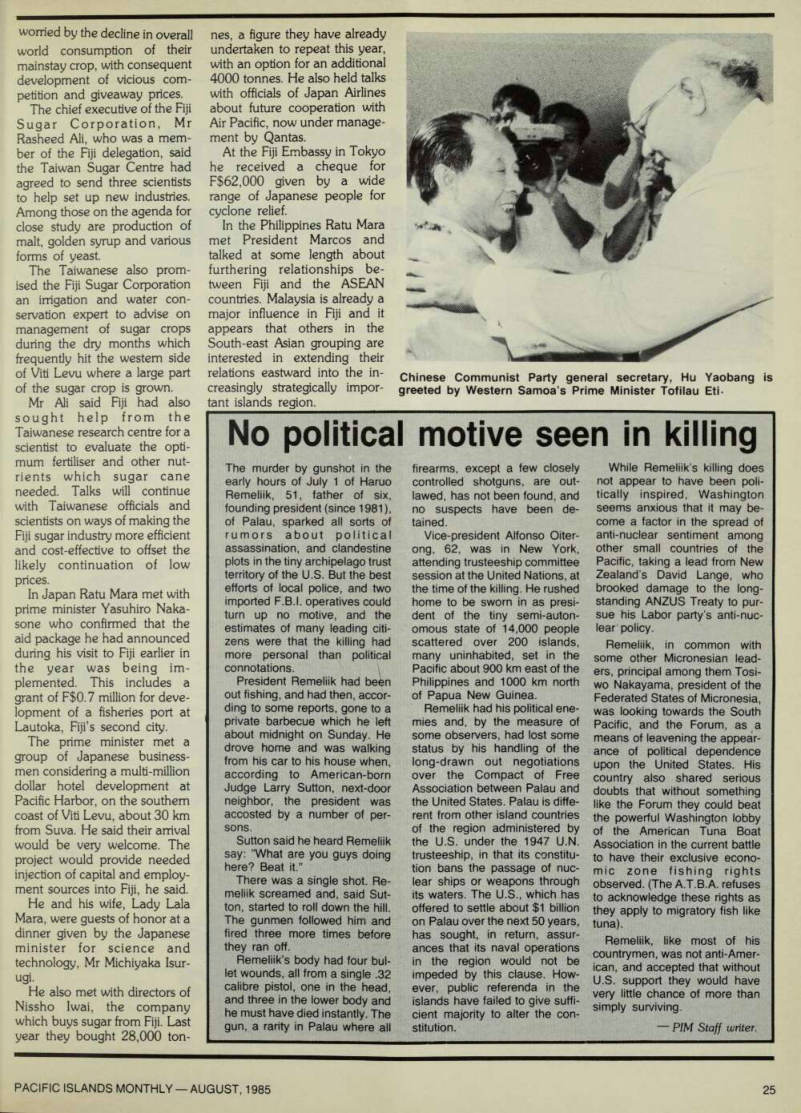
Pacific grows
The growing strategic im portance of the Pacific island nations to the major countries of Asia has been highlighted by the extended, and obviously successful, visits just made by Fiji’s prime minister, Ratu Sir Kamisese Mara, to China, Japan and the Philippines.
Nor are all of the connections simply political. The highlight of
Ratu Mara’s China trip was the signing of a long-term agree ment under which China will buy notable consignments of Fiji sugar at better than world prices.
The shipments will all go to Zhejiang province, which has been appointed a sort of centre for Fiji commercial relations.
The province will open two way trade with Fiji in a number
of items and will also be re sponsible for opening economic and technical cooperation, in cluding joint ventures in Fiji.
Under a five year agreement China will buy a minimum of 40,000 tonnes of Fiji sugar, with an option on 10,000 ton nes more. The premium over world prices is guaranteed for three years and will then be reviewed. The price paid will be
net of freight costs, which China will pick up, presumably by use of its own freight ships. It is the first time Fiji has won that concession in a sugar sale.
China’s designation of Zhe jiang province to spearhead Peking’s new policy of econo mic cooperation with Fiji gives the island country a consider able advantage. Business will be done directly with the pro vincial trading corporation rather than through the national body in Beijing, which is ex pected to make trading much more direct, rapid and satisfac tory.
Ratu Mara also had talks about the grant of $BOO,OOO which the Chinese secretary general, Mr Hu Yaobang, announced during his visit to Fiji in April. China has offered an interest-free loan of 15 mil lion yuan (about F 55.4 million) or a further development grant of 3 million yuan (F$ 1.2 mil lion).
From China Ratu Mara went to Taiwan where he met the premier and the minister for economic affairs, and the chair man of the Taiwan agricultural council. Ratu Mara has always maintained correct and even cordial relations with the gov ernments of both countries, something other statesman have generally been unable to manage, and both nations maintain representative offices in Suva. China has a large and very active embassy and Taiwan has a similarly active, although more low-key, trade office.
While in Taiwan Ratu Mara, who is keen to see economic progress among his Fijian villa gers, visited a number of agricultural projects, including the centre for tropical vegetable culture. He sought Taipei’s help in setting up sugar-related in dustries in Fiji which is deeply
worried by the decline in overall world consumption of their mainstay crop, with consequent development of vicious com petition and giveaway prices.
The chief executive of the Fiji Sugar Corporation, Mr Rasheed Ali, who was a mem ber of the Fiji delegation, said the Taiwan Sugar Centre had agreed to send three scientists to help set up new industries.
Among those on the agenda for close study are production of malt, golden syrup and various forms of yeast.
The Taiwanese also prom ised the Fiji Sugar Corporation an irrigation and water con servation expert to advise on management of sugar crops during the dry months which frequently hit the western side of Viti Levu where a large part of the sugar crop is grown.
Mr Ali said Fiji had also sought help from the Taiwanese research centre for a scientist to evaluate the opti mum fertiliser and other nut rients which sugar cane needed. Talks will continue with Taiwanese officials and scientists on ways of making the Fiji sugar industry more efficient and cost-effective to offset the likely continuation of low prices.
In Japan Ratu Mara met with prime minister Yasuhiro Naka sone who confirmed that the aid package he had announced during his visit to Fiji earlier in the year was being im plemented. This includes a grant of Fso.7 million for deve lopment of a fisheries port at Lautoka, Fiji’s second city.
The prime minister met a group of Japanese business men considering a multi-million dollar hotel development at Pacific Harbor, on the southern coast of Viti Levu, about 30 km from Suva. He said their arrival would be very welcome. The project would provide needed injection of capital and employ ment sources into Fiji, he said.
He and his wife, Lady Lala Mara, were guests of honor at a dinner given by the Japanese minister for science and technology, Mr Michiyaka Isur ugi.
He also met with directors of Nissho Iwai, the company which buys sugar from Fiji. Last year they bought 28,000 ton
nes, a figure they have already undertaken to repeat this year, with an option for an additional 4000 tonnes. He also held talks with officials of Japan Airlines about future cooperation with Air Pacific, now under manage ment by Qantas.
At the Fiji Embassy in Tokyo he received a cheque for F 562,000 given by a wide range of Japanese people for cyclone relief.
In the Philippines Ratu Mara met President Marcos and talked at some length about furthering relationships be tween Fiji and the ASEAN countries. Malaysia is already a major influence in Fiji and it appears that others in the South-east Asian grouping are interested in extending their relations eastward into the in creasingly strategically impor tant islands region.
Chinese Communist Party general secretary, Hu Yaobang is greeted by Western Samoa’s Prime Minister Tofilau Eti.
Advertisements & other items, p. 24 (1 item)
24
PACIFIC ISLANDS MONTHLY AUGUST, 1985
Now action’s’ the word continued from page 22
No political motive seen in killing
The murder by gunshot in the early hours of July 1 of Haruo Remeliik, 51, father of six, founding president (since 1981), of Palau, sparked all sorts of rumors about political assassination, and clandestine plots in the tiny archipelago trust territory of the U.S. But the best efforts of local police, and two imported F. 8.1. operatives could turn up no motive, and the estimates of many leading citi zens were that the killing had more personal than political connotations. \ President Remeliik had been out fishing, and had then, accor ding to some reports, gone to a private barbecue which he left about midnight on Sunday. He drove home and was walking from his car to his house when, according to American-born Judge Larry Sutton, next-door neighbor, the president was accosted by a number of per sons.
Sutton said he heard Remeliik say: ’’What are you guys doing here? Beat it.”
There was a single shot. Re meliik screamed and, said Sut ton, started to roll down the hill.
The gunmen followed him and fired three more times before they ran off.
Remeliik’s body had four bul let wounds, all from a single .32 calibre pistol, one in the head, and three in the lower body and he must have died instantly. The gun, a rarity in Palau where all
firearms, except a few closely controlled shotguns, are out lawed, has not been found, and no suspects have been de tained.
Vice-president Alfonso Oiler ong, 62, was in New York, attending trusteeship committee session at the United Nations, at the time of the killing. He rushed home to be sworn in as presi dent of the tiny semi-auton omous state of 14,000 people scattered over 200 islands, many uninhabited, set in the Pacific about 900 km east of the Philippines and 1000 km north of Papua New Guinea.
Remeliik had his political ene mies and, by the measure of some observers, had lost some status by his handling of the long-drawn out negotiations over the Compact of Free Association between Palau and the United States. Palau is diffe rent from other island countries of the region administered by the U.S. under the 1947 U.N. trusteeship, in that its constitu tion bans the passage of nuc lear ships or weapons through its waters. The U.S., which has offered to settle about $1 billion on Palau over the next 50 years, has sought, in return, assur ances that its naval operations in the region would not be impeded by this clause. How ever, public referenda in the islands have failed to give suffi cient majority to alter the con stitution.
While Remeliik’s killing does not appear to have been poli tically inspired, Washington seems anxious that it may be come a factor in the spread of anti-nuclear sentiment among other small countries of the Pacific, taking a lead from New Zealand’s David Lange, who brooked damage to the long standing ANZUS Treaty to pur sue his Labor party’s anti-nuc lear policy.
Remeliik, in common with some other Micronesian lead ers, principal among them Tosi wo Nakayama, president of the Federated States of Micronesia, was looking towards the South Pacific, and the Forum, as a means of leavening the appear ance of political dependence upon the United States. His country also shared serious doubts that without something like the Forum they could beat the powerful Washington lobby of the American Tuna Boat Association in the current battle to have their exclusive econo mic zone fishing rights observed. (The A.T.B.A. refuses to acknowledge these rights as they apply to migratory fish like tuna).
Remeliik, like most of his countrymen, was not anti-Amer ican, and accepted that without U.S. support they would have very little chance of more than simply surviving.
PIM Staff writer.
Careful start for
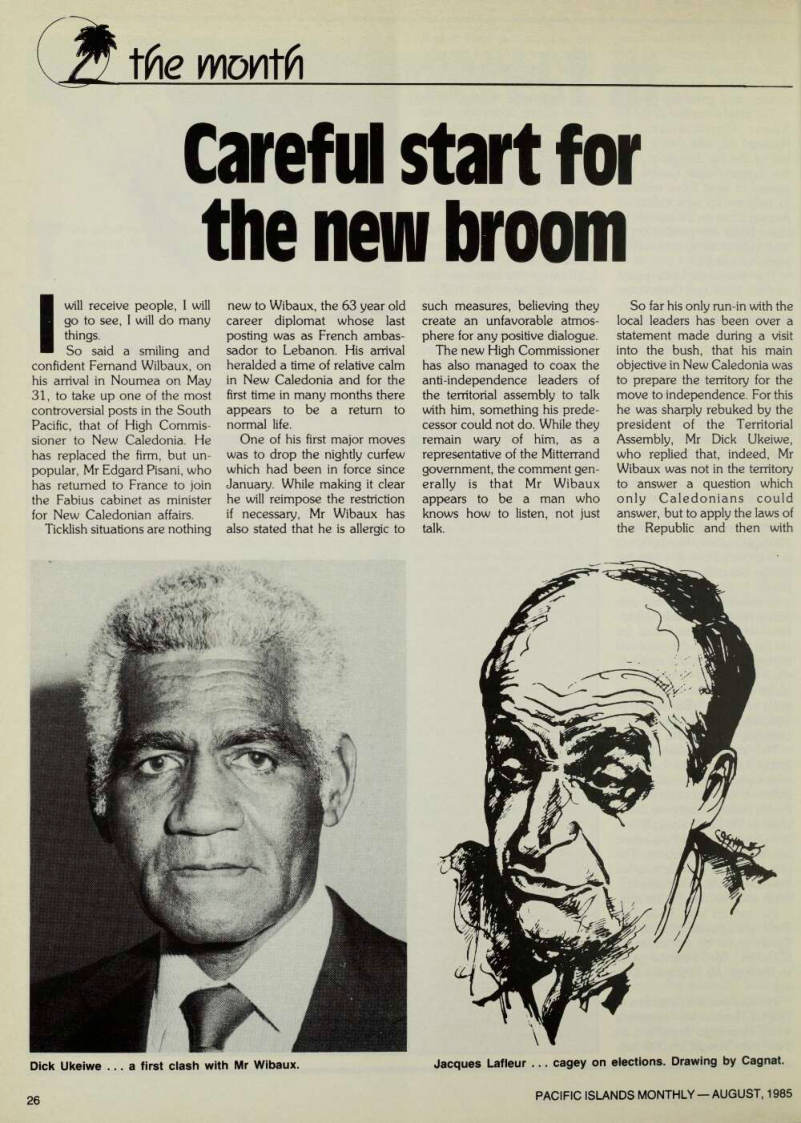
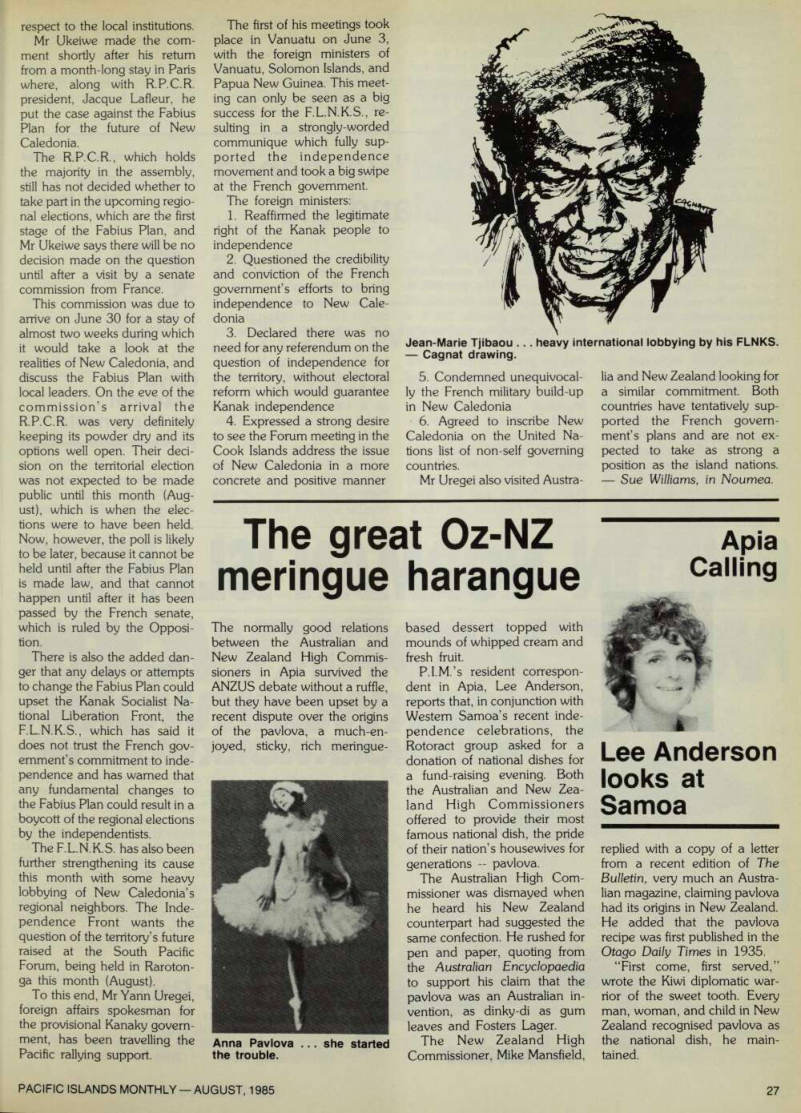
the month
Careful start for the new broom
■ will receive people, I will go to see, I will do many things.
So said a smiling and confident Fernand Wilbaux, on his arrival in Noumea on May 31, to take up one of the most controversial posts in the South Pacific, that of High Commis sioner to New Caledonia. He has replaced the firm, but un popular, Mr Edgard Pisani, who has returned to France to join the Fabius cabinet as minister for New Caledonian affairs.
Ticklish situations are nothing
new to Wibaux, the 63 year old career diplomat whose last posting was as French ambas sador to Lebanon. His arrival heralded a time of relative calm in New Caledonia and for the first time in many months there appears to be a return to normal life.
One of his first major moves was to drop the nightly curfew which had been in force since January. While making it clear he will reimpose the restriction if necessary, Mr Wibaux has also stated that he is allergic to
such measures, believing they create an unfavorable atmosphere for any positive dialogue, The new High Commissioner has also managed to coax the anti-independence leaders of the territorial assembly to talk with him, something his predecessor could not do. While they remain wary of him, as a representative of the Mitterrand government, the comment generally is that Mr Wibaux appears to be a man who knows how to listen, not just talk.
So far his only run-in with the local leaders has been over a statement made during a visit into the bush, that his main objective in New Caledonia was to prepare the territory for the move to independence. For this he was sharply rebuked by the president of the Territorial Assembly, Mr Dick Ukeiwe, who replied that, indeed, Mr Wibaux was not in the territory to answer a question which only Caledonians could answer, but to apply the laws of the Republic and then with
Dick Ukeiwe ... a first clash with Mr Wibaux.
Jacques Lafleur ... cagey on elections. Drawing by Cagnat.
respect to the local institutions.
Mr Ukeiwe made the com ment shortly after his return from a month-long stay in Paris where, along with R.P.C.R. president, Jacque Lafleur, he put the case against the Fabius Plan for the future of New Caledonia.
The R.P.C.R., which holds the majority in the assembly, still has not decided whether to take part in the upcoming regio nal elections, which are the first stage of the Fabius Plan, and Mr Ukeiwe says there will be no decision made on the question until after a visit by a senate commission from France.
This commission was due to arrive on June 30 for a stay of almost two weeks during which it would take a look at the realities of New Caledonia, and discuss the Fabius Plan with local leaders. On the eve of the commission’s arrival the R.P.C.R. was very definitely keeping its powder dry and its options well open. Their deci sion on the territorial election was not expected to be made public until this month (Aug ust), which is when the elec tions were to have been held.
Now, however, the poll is likely to be later, because it cannot be held until after the Fabius Plan is made law, and that cannot happen until after it has been passed by the French senate, which is ruled by the Opposi tion.
There is also the added dan ger that any delays or attempts to change the Fabius Plan could upset the Kanak Socialist Na tional Liberation Front, the F.L.N.K.S., which has said it does not trust the French gov ernment’s commitment to inde pendence and has warned that any fundamental changes to the Fabius Plan could result in a boycott of the regional elections by the independentists.
The F.L.N.K.S. has also been further strengthening its cause this month with some heavy lobbying of New Caledonia’s regional neighbors. The Inde pendence Front wants the question of the territory’s future raised at the South Pacific Forum, being held in Raroton ga this month (August).
To this end, Mr Yann Uregei, foreign affairs spokesman for the provisional Kanaky govern ment, has been travelling the Pacific rallying support.
The first of his meetings took place in Vanuatu on June 3, with the foreign ministers of Vanuatu, Solomon Islands, and Papua New Guinea. This meet ing can only be seen as a big success for the F.L.N.K.S., re sulting in a strongly-worded communique which fully sup ported the independence movement and took a big swipe at the French government.
The foreign ministers; 1. Reaffirmed the legitimate right of the Kanak people to independence 2. Questioned the credibility and conviction of the French government’s efforts to bring independence to New Cale donia 3. Declared there was no need for any referendum on the question of independence for the territory, without electoral reform which would guarantee Kanak independence 4. Expressed a strong desire to see the Forum meeting in the Cook Islands address the issue of New Caledonia in a more concrete and positive manner
5. Condemned unequivocal ly the French military build-up in New Caledonia 6. Agreed to inscribe New Caledonia on the United Na tions list of non-self governing countries.
Mr Uregei also visited Austra
lia and New Zealand looking for a similar commitment. Both countries have tentatively sup ported the French govern ment’s plans and are not ex pected to take as strong a position as the island nations.
Sue Williams, in Noumea.
Jean-Marie Tjibaou ... heavy international lobbying by his FLNKS. - Cagnat drawing.
meringue harangue
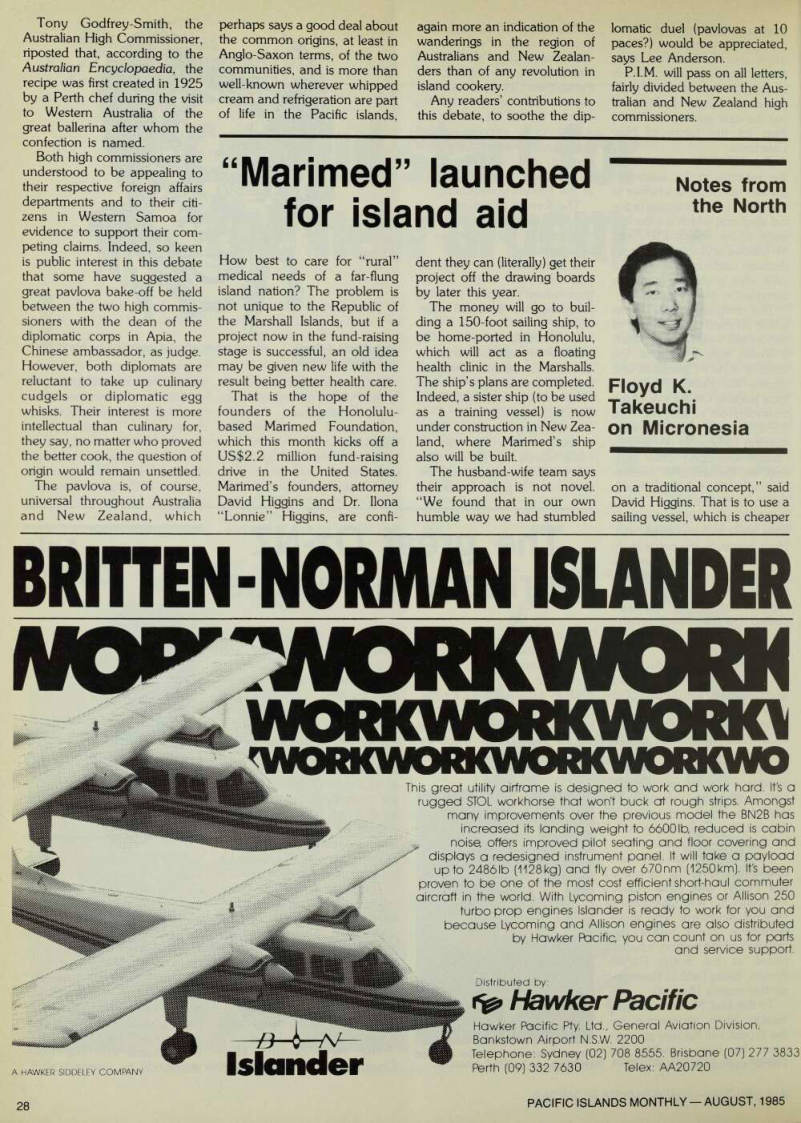
The great Oz-NZ meringue harangue
The normally good relations between the Australian and New Zealand High Commis sioners in Apia survived the ANZUS debate without a ruffle, but they have been upset by a recent dispute over the origins of the pavlova, a much-en joyed, sticky, rich meringue-
based dessert topped with mounds of whipped cream and fresh fruit.
P.I.M.’s resident correspon dent in Apia, Lee Anderson, reports that, in conjunction with Western Samoa’s recent inde pendence celebrations, the Rotoract group asked for a donation of national dishes for a fund-raising evening. Both the Australian and New Zea land High Commissioners offered to provide their most famous national dish, the pride of their nation’s housewives for generations - pavlova.
The Australian High Com missioner was dismayed when he heard his New Zealand counterpart had suggested the same confection. He rushed for pen and paper, quoting from the Australian Encyclopaedia to support his claim that the pavlova was an Australian in vention, as dinky-di as gum leaves and Fosters Lager.
The New Zealand High Commissioner, Mike Mansfield,
Apia Calling
replied with a copy of a letter from a recent edition of The Bulletin , very much an Austra lian magazine, claiming pavlova had its origins in New Zealand.
He added that the pavlova recipe was first published in the Otago Daily; Times in 1935.
“First come, first served,” wrote the Kiwi diplomatic war rior of the sweet tooth. Every man, woman, and child in New Zealand recognised pavlova as the national dish, he main tained.
Anna Pavlova ... she started the trouble.
Lee Anderson looks at Samoa
Tony Godfrey-Smith, the Australian High Commissioner, riposted that, according to the Australian Encyclopaedia, the recipe was first created in 1925 by a Perth chef during the visit to Western Australia of the great ballerina after whom the confection is named.
Both high commissioners are understood to be appealing to their respective foreign affairs departments and to their citi zens in Western Samoa for evidence to support their com peting claims. Indeed, so keen is public interest in this debate that some have suggested a great pavlova bake-off be held between the two high commis sioners with the dean of the diplomatic corps in Apia, the Chinese ambassador, as judge.
However, both diplomats are reluctant to take up culinary cudgels or diplomatic egg whisks. Their interest is more intellectual than culinary for, they say, no matter who proved the better cook, the question of origin would remain unsettled.
The pavlova is, of course, universal throughout Australia and New Zealand, which
perhaps says a good deal about the common origins, at least in Anglo-Saxon terms, of the two communities, and is more than well-known wherever whipped cream and refrigeration are part of life in the Pacific islands,
again more an indication of the wanderings in the region of Australians and New Zealan ders than of any revolution in island cookery.
Any readers’ contributions to this debate, to soothe the dip
lomatic duel (pavlovas at 10 paces?) would be appreciated, says Lee Anderson.
P.I.M. will pass on all letters, fairly divided between the Aus tralian and New Zealand high commissioners.
“Marimed” launched
for island aid
How best to care for “rural” medical needs of a far-flung island nation? The problem is not unique to the Republic of the Marshall Islands, but if a project now in the fund-raising stage is successful, an old idea may be given new life with the result being better health care.
That is the hope of the founders of the Honolulu based Marimed Foundation, which this month kicks off a US$2.2 million fund-raising drive in the United States.
Marimed’s founders, attorney David Higgins and Dr. Ilona “Lonnie” Higgins, are confi
dent they can (literally) get their project off the drawing boards by later this year.
The money will go to buil ding a 150-foot sailing ship, to be home-ported in Honolulu, which will act as a floating health clinic in the Marshalls.
The ship’s plans are completed.
Indeed, a sister ship (to be used as a training vessel) is now under construction in New Zea land, where Marimed’s ship also will be built.
The husband-wife team says their approach is not novel. ‘‘We found that in our own humble way we had stumbled
Notes from the North
on a traditional concept,” said David Higgins. That is to use a sailing vessel, which is cheaper
Floyd K.
Takeuchi on Micronesia
to operate, to travel to remote islands on a regular schedule to bring needed health professio nals.
Higgins, a veteran sailor, said the ship will be a self-contained community. Volunteer expatri ate physicians will conduct cli nics; Marshallese public health officers will carry out training programs and educational acti vities; health ministry officials will also be aboard; and the crew will carry out the mainten ance of the medical equipment aboard ship.
The project, which has the enthusiastic backing of the gov ernment of President Amata Kabua, will be directed by Marshallese. They will set priorities, both Higgins say, and Marimed will supply the ship and professionals. The Mar shalls government will have to also supply the estimated U 55350,000 annual budget to run the ship.
A typical trip will include three doctors and a dentist, a laboratory and X-ray techni cian, a nurse, two public health educators, other medical per sonnel as needed, a representa tive of the Marshalls govern ment, local nurses and a crew of seven.
Dr. Higgins, who has experi ence in outer island health care in other parts of Micronesia, said the idea is not to be a floating hospital. The trips are to establish a network of on island health care practitioners who can count on regular assistance and professional advice from Marimed, she said.
The project is far-along.
Marimed has been working with women’s groups in the Marshalls to establish outer is land needs. It has a close relationship with government officials involved in health care.
About US$4OO,OOO has already been raised, giving the Higgins hope that the remain der will not be too difficult to find. Some large corporations have taken an interest in the project, David Higgins said, particularly those that do busi ness in the Pacific.
Higgins hopes Marimed’s activities in the Marshalls can serve as a model for other Micronesian governments. The advantage of sail power, he said, is that they can carry out their duties for about $lOO a
day (for operations) as opposed to the $2BOO a day costs of running the Marshalls’ diesel powered inter-island ships.
Both Higgins stress that Marimed is a private sector venture. The U.S. government is aware of the foundation’s intentions, and is supportive of them. But funds will come from non-government sources. That will keep the project indepen dent, they said.
The foundation’s address is: Marimed Foundation, 1210 Auahi St, Suite 222, Honolulu, Hawaii, 96814. Telephone:
808-537-5586.
Takeuchi.
Floyd K.
Health care for Micronesians such as this young mother and child is the goal of the new seaborne service, Marimed.
Advertisements & other items, p. 28 (1 item)
Wop'tiorkworm
BRITTEN - NORMAN ISLANDER
L, ► —B ■N— This great utility airframe is designed to work and work hard. It's a rugged STOL workhorse that won't buck at rough strips. Amongst many improvements over the previous model the BN2B has increased its landing weight to 66001 b reduced is cabin noise offers improved pilot seating and floor covering and displays a redesigned instrument panel. It will take a payload up to 24861 b (1128 kg) and fly over 670 nm (1250 km). It's been proven to be one of the most cost efficient short-haul commuter aircraft in the world, With Lycoming piston engines or Allison 250 turbo prop engines Islander is ready to work for you and because Lycoming and Allison engines are also distributed by Hawker Pacific, you can count on us for parts and service support.
Distributed by:
Hawker Pacific
A HAWKER SIDDELEY COMPANY
Islander
Hawker Pacific Pty. Ltd., General Aviation Division, Bankstown Airport N.S.W. 2200 Telephone; Sydney (02) 708 8555. Brisbane (07) 277 3833 Perth (09) 332 7630 Telex: AA20720
Time warp for Tahiti visitor
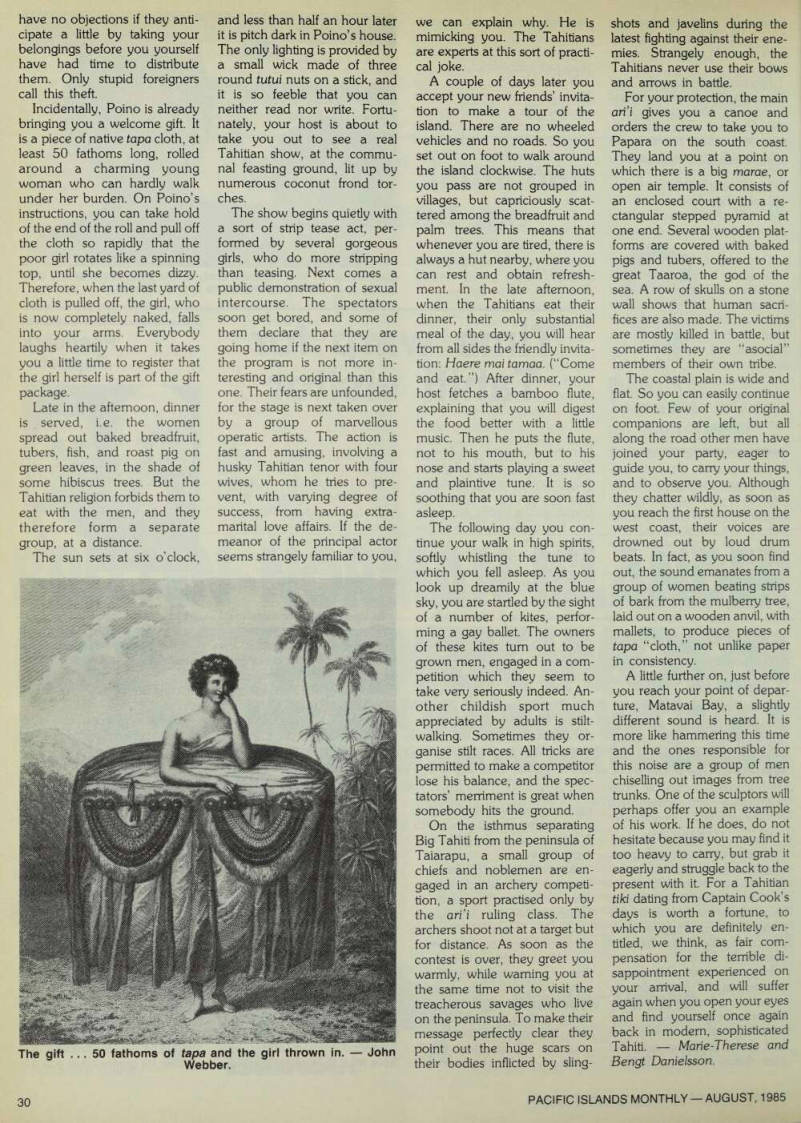
Tahiti visitor
For the thousands of foreign visitors who flocked to Tahiti in July to enjoy the orgy of native singing, dancing and prancing known as the Pacific Arts Festi val, first contact with local na tive customs was as a rule rather disconcerting. For today in Tahiti the roads are teeming with 50,000 motor vehicles whose drivers are engaged in a wild race which often ends in hospital or in the cemetery. The native huts are all made of imported Oregon pine, corru gated iron and concrete, and the only genuine jungle is to be found in Papeete, where imita tors of Mad Max prowl around at night and pounce on starry eyed visitors in search of the sexy hula girls and noble sav ages who have given Tahiti its worldwide reputation as an earthly paradise. Asked to give a welcoming speech to a group of festival visitors, we addressed them thus: We shall give you what you have come for. Just close your eyes and follow us back to Tahiti at the time of Captain Cook. No, don’t start looking for a hotel, because there aren’t any. Your problem is actually that too many hospitable Tahi tians, both male and female, have taken hold of you and are trying to drag you off in diffe rent directions. For this reason you are still standing bewil dered on the beach when a tall
man of commanding counte nance and majestic bearing ar rives. Everybody, including your friendly captors, steps back and uncovers the upper parts of their bodies, as a sign of respect. This makes you realise suddenly that some of the long haired Tahitians whom you have taken to be women are actually men.
In order to save you from making another mistake, we should also tell you that the stately individual who has been shown so much deference is not the King of Tahiti, for there is no such person. The island is divided, by boundaries radiat ing from a central point, into 18 different “kingdoms,” each with its own, independent ruler.
Poino, the one facing you, is simply the chief of Haapape, where historic Matavai Bay and Point Venus are situated.
Poino rubs his nose against yours, takes your hand and leads you to a large oval hut which resembles a Greek tem ple with its high roof resting on rows of round pillars. The only furniture consists of a small stool for the chief and a wooden chest containing valu able feather cloaks and shell jewellery. Poino, his four wives, 20 relatives and six servants all sleep on the floor which is covered with a thick, soft layer of grass. Genuine Tahitian huts have no walls and are therefore
Postmark Papeete
air-conditioned by the trade winds.
All the neighbors, who have by now gathered round the hut, watch you closely and make loud remarks which produce peals of laughter. Keep smiling and stoically accept once and for all this all-pervading lack of privacy. The golden rule in Tahiti is not to try to hide anything, least of all yourself. If you do, it means that you are guilty of some dishonorable act.
Your behavior must be as open as the house you live in.
Also keep smiling when you discover that your luggage has disappeared. As your Tahitian hosts have already demons trated, they are overwhelmingly generous and cheerfully give away all their worldly posses sions. So, naturally, they expect you to be equally prodigal and to take for granted that you will
Marie-Thérèse and Bengt Danielsson
have no objections if they anti cipate a little by taking your belongings before you yourself have had time to distribute them. Only stupid foreigners call this theft.
Incidentally, Poino is already bringing you a welcome gift. It is a piece of native tapa cloth, at least 50 fathoms long, rolled around a charming young woman who can hardly walk under her burden. On Poino’s instructions, you can take hold of the end of the roll and pull off the cloth so rapidly that the poor girl rotates like a spinning top, until she becomes dizzy.
Therefore, when the last yard of cloth is pulled off, the girl, who is now completely naked, falls into your arms. Everybody laughs heartily when it takes you a little time to register that the girl herself is part of the gift package.
Late in the afternoon, dinner is served, i.e. the women spread out baked breadfruit, tubers, fish, and roast pig on green leaves, in the shade of some hibiscus trees. But the Tahitian religion forbids them to eat with the men, and they therefore form a separate group, at a distance.
The sun sets at six o’clock,
and less than half an hour later it is pitch dark in Poino’s house.
The only lighting is provided by a small wick made of three round tutui nuts on a stick, and it is so feeble that you can neither read nor write. Fortu nately, your host is about to take you out to see a real Tahitian show, at the commu nal feasting ground, lit up by numerous coconut frond tor ches.
The show begins quietly with a sort of strip tease act, per formed by several gorgeous girls, who do more stripping than teasing. Next comes a public demonstration of sexual intercourse. The spectators soon get bored, and some of them declare that they are going home if the next item on the program is not more in teresting and original than this one. Their fears are unfounded, for the stage is next taken over by a group of marvellous operatic artists. The action is fast and amusing, involving a husky Tahitian tenor with four wives, whom he tries to pre vent, with varying degree of success, from having extra marital love affairs. If the de meanor of the principal actor seems strangely familiar to you,
we can explain why. He is mimicking you. The Tahitians are experts at this sort of practi cal joke.
A couple of days later you accept your new friends’ invita tion to make a tour of the island. There are no wheeled vehicles and no roads. So you set out on foot to walk around the island clockwise. The huts you pass are not grouped in villages, but capriciously scat tered among the breadfruit and palm trees. This means that whenever you are tired, there is always a hut nearby, where you can rest and obtain refresh ment. In the late afternoon, when the Tahitians eat their dinner, their only substantial meal of the day, you will hear from all sides the friendly invita tion: Haere mai tamaa. (“Come and eat”) After dinner, your host fetches a bamboo flute, explaining that you will digest the food better with a little music. Then he puts the flute, not to his mouth, but to his nose and starts playing a sweet and plaintive tune. It is so soothing that you are soon fast asleep.
The following day you con tinue your walk in high spirits, softly whistling the tune to which you fell asleep. As you look up dreamily at the blue sky, you are startled by the sight of a number of kites, perfor ming a gay ballet. The owners of these kites turn out to be grown men, engaged in a com petition which they seem to take very seriously indeed. An other childish sport much appreciated by adults is stilt walking. Sometimes they or ganise stilt races. All tricks are permitted to make a competitor lose his balance, and the spec tators’ merriment is great when somebody hits the ground.
On the isthmus separating Big Tahiti from the peninsula of Taiarapu, a small group of chiefs and noblemen are en gaged in an archery competi tion, a sport practised only by the ari’i ruling class. The archers shoot not at a target but for distance. As soon as the contest is over, they greet you warmly, while warning you at the same time not to visit the treacherous savages who live on the peninsula. To make their message perfectly clear they point out the huge scars on their bodies inflicted by sling
shots and javelins during the latest fighting against their ene mies. Strangely enough, the Tahitians never use their bows and arrows in battle.
For your protection, the main ari’i gives you a canoe and orders the crew to take you to Papara on the south coast.
They land you at a point on which there is a big marae, or open air temple. It consists of an enclosed court with a re ctangular stepped pyramid at one end. Several wooden plat forms are covered with baked pigs and tubers, offered to the great Taaroa, the god of the sea. A row of skulls on a stone wall shows that human sacri fices are also made. The victims are mostly killed in battle, but sometimes they are “asocial” members of their own tribe.
The coastal plain is wide and flat. So you can easily continue on foot. Few of your original companions are left, but all along the road other men have joined your party, eager to guide you, to carry your things, and to observe you. Although they chatter wildly, as soon as you reach the first house on the west coast, their voices are drowned out by loud drum beats. In fact, as you soon find out, the sound emanates from a group of women beating strips of bark from the mulberry tree, laid out on a wooden anvil, with mallets, to produce pieces of tapa “cloth,” not unlike paper in consistency.
A little further on, just before you reach your point of depar ture, Matavai Bay, a slightly different sound is heard. It is more like hammering this time and the ones responsible for this noise are a group of men chiselling out images from tree trunks. One of the sculptors will perhaps offer you an example of his work. If he does, do not hesitate because you may find it too heavy to carry, but grab it eagerly and struggle back to the present with it. For a Tahitian tiki dating from Captain Cook’s days is worth a fortune, to which you are definitely en titled, we think, as fair com pensation for the terrible di sappointment experienced on your arrival, and will suffer again when you open your eyes and find yourself once again back in modern, sophisticated Tahiti. Marie-Therese and Bengt Danielsson.
The gift ... 50 fathoms of tapa and the girl thrown in. - John Webber.
Devotion to quality
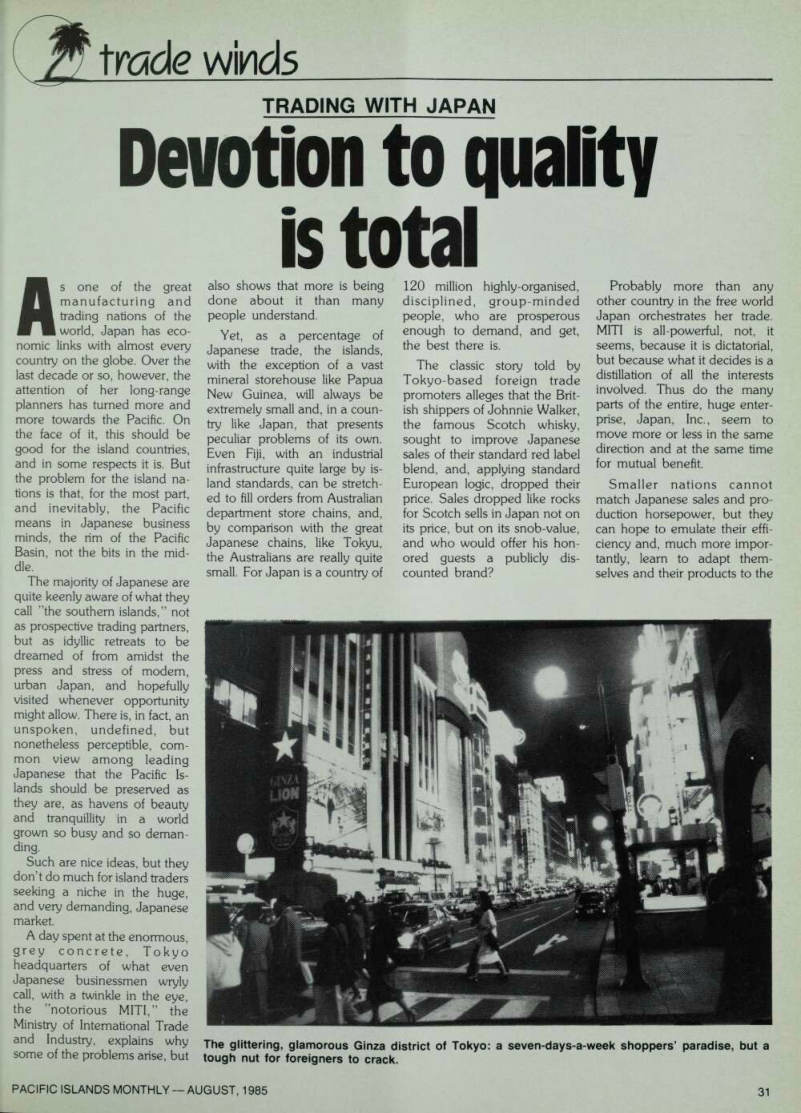
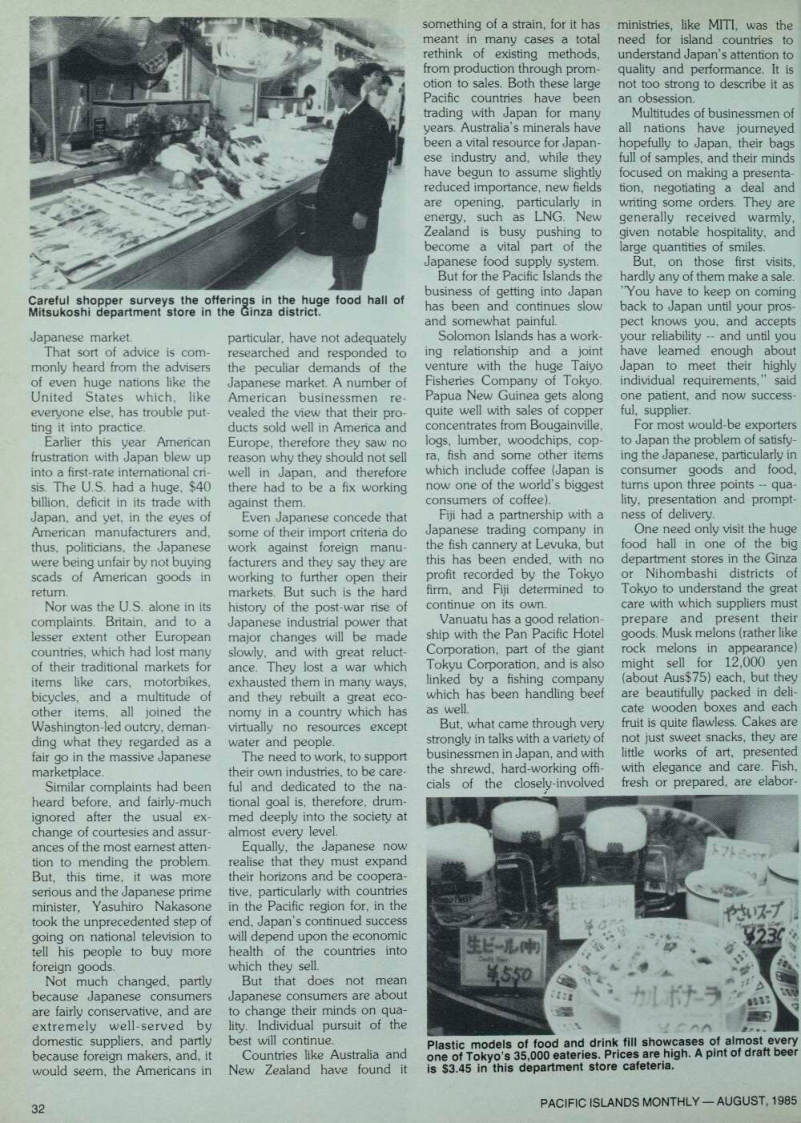
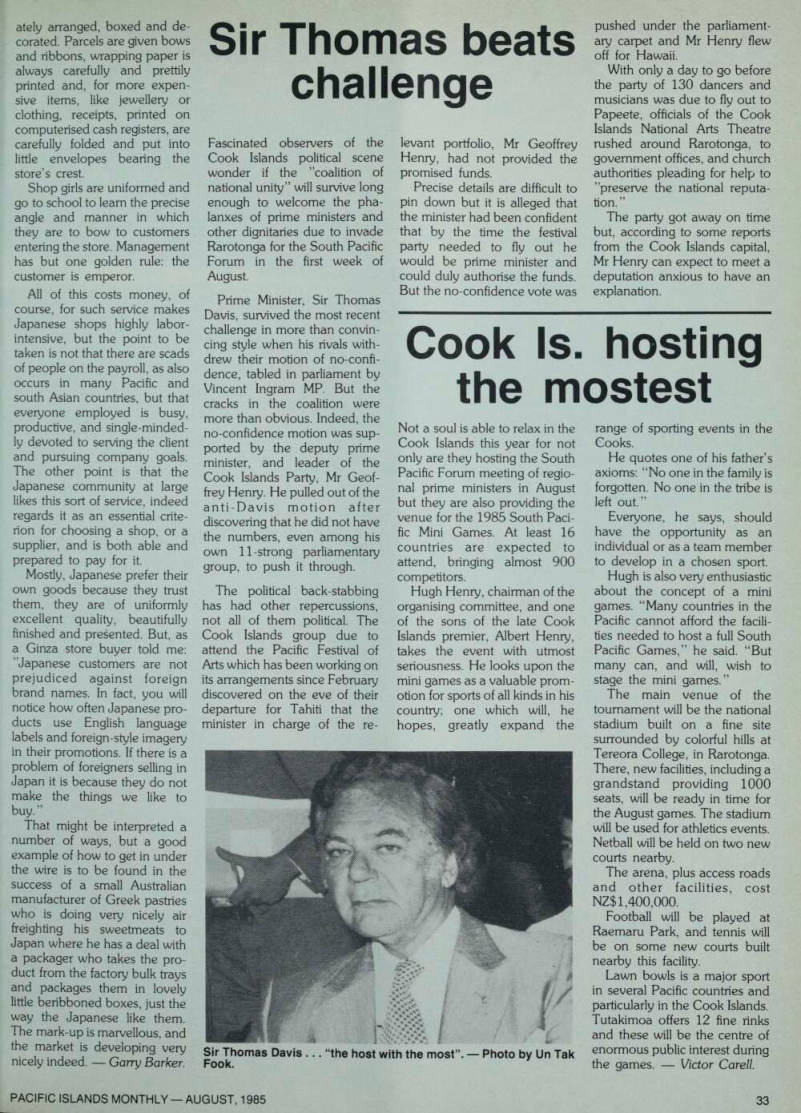
trade winds
Trading With Japan
Devotion to quality is total
As one of the great manufacturing and trading nations of the world, Japan has eco nomic links with almost every country on the globe. Over the last decade or so, however, the attention of her long-range planners has turned more and more towards the Pacific. On the face of it, this should be good for the island countries, and in some respects it is. But the problem for the island na tions is that, for the most part, and inevitably, the Pacific means in Japanese business minds, the rim of the Pacific Basin, not the bits in the mid dle.
The majority of Japanese are quite keenly aware of what they call ’’the southern islands,” not as prospective trading partners, but as idyllic retreats to be dreamed of from amidst the press and stress of modem, urban Japan, and hopefully visited whenever opportunity might allow. There is, in fact, an unspoken, undefined, but nonetheless perceptible, com mon view among leading Japanese that the Pacific Is lands should be preserved as they are, as havens of beauty and tranquillity in a world grown so busy and so deman ding.
Such are nice ideas, but they don’t do much for island traders seeking a niche in the huge, and very demanding, Japanese market.
A day spent at the enormous, grey concrete, Tokyo headquarters of what even Japanese businessmen wryly call, with a twinkle in the eye, the ’’notorious MITI,” the Ministry of International Trade and Industry, explains why some of the problems arise, but
also shows that more is being done about it than many people understand.
Yet, as a percentage of Japanese trade, the islands, with the exception of a vast mineral storehouse like Papua New Guinea, will always be extremely small and, in a coun try like Japan, that presents peculiar problems of its own.
Even Fiji, with an industrial infrastructure quite large by is land standards, can be stretch ed to fill orders from Australian department store chains, and, by comparison with the great Japanese chains, like Tokyu, the Australians are really quite small. For Japan is a country of
120 million highly-organised, disciplined, group-minded people, who are prosperous enough to demand, and get, the best there is.
The classic story told by Tokyo-based foreign trade promoters alleges that the Brit ish shippers of Johnnie Walker, the famous Scotch whisky, sought to improve Japanese sales of their standard red label blend, and, applying standard European logic, dropped their price. Sales dropped like rocks for Scotch sells in Japan not on its price, but on its snob-value, and who would offer his hon ored guests a publicly dis counted brand?
Probably more than any other country in the free world Japan orchestrates her trade.
MITI is all-powerful, not, it seems, because it is dictatorial, but because what it decides is a distillation of all the interests involved. Thus do the many parts of the entire, huge enter prise, Japan, Inc., seem to move more or less in the same direction and at the same time for mutual benefit.
Smaller nations cannot match Japanese sales and pro duction horsepower, but they can hope to emulate their effi ciency and, much more impor tantly, learn to adapt them selves and their products to the
The glittering, glamorous Ginza district of Tokyo: a seven-days-a-week shoppers’ paradise, but a tough nut for foreigners to crack.
Japanese market.
That sort of advice is com monly heard from the advisers of even huge nations like the United States which, like everyone else, has trouble put ting it into practice.
Earlier this year American frustration with Japan blew up into a first-rate international cri sis. The U.S. had a huge, $4O billion, deficit in its trade with Japan, and yet, in the eyes of American manufacturers and. thus, politicians, the Japanese were being unfair by not buying scads of American goods in return.
Nor was the U.S. alone in its complaints. Britain, and to a lesser extent other European countries, which had lost many of their traditional markets for items like cars, motorbikes, bicycles, and a multitude of other items, all joined the Washington-led outcry, deman ding what they regarded as a fair go in the massive Japanese marketplace.
Similar complaints had been heard before, and fairly-much ignored after the usual ex change of courtesies and assur ances of the most earnest atten tion to mending the problem.
But. this time, it was more serious and the Japanese prime minister, Yasuhiro Nakasone took the unprecedented step of going on national television to tell his people to buy more foreign goods.
Not much changed, partly because Japanese consumers are fairly conservative, and are extremely well-served by domestic suppliers, and partly because foreign makers, and, it would seem, the Americans in
particular, have not adequately researched and responded to the peculiar demands of the Japanese market. A number of American businessmen re vealed the view that their pro ducts sold well in America and Europe, therefore they saw no reason why they should not sell well in Japan, and therefore there had to be a fix working against them.
Even Japanese concede that some of their import criteria do work against foreign manu facturers and they say they are working to further open their markets. But such is the hard history of the post-war rise of Japanese industrial power that major changes will be made slowly, and with great reluct ance. They lost a war which exhausted them in many ways, and they rebuilt a great eco nomy in a country which has virtually no resources except water and people.
The need to work, to support their own industries, to be care ful and dedicated to the na tional goal is, therefore, drum med deeply into the society at almost every level.
Equally, the Japanese now realise that they must expand their horizons and be coopera tive, particularly with countries in the Pacific region for, in the end, Japan’s continued success will depend upon the economic health of the countries into which they sell.
But that does not mean Japanese consumers are about to change their minds on qua lity. Individual pursuit of the best will continue.
Countries like Australia and New Zealand have found it
something of a strain, for it has meant in many cases a total rethink of existing methods, from production through prom otion to sales. Both these large Pacific countries have been trading with Japan for many years. Australia’s minerals have been a vital resource for Japan ese industry and, while they have begun to assume slightly reduced importance, new fields are opening, particularly in energy, such as LNG. New Zealand is busy pushing to become a vital part of the Japanese food supply system.
But for the Pacific Islands the business of getting into Japan has been and continues slow and somewhat painful.
Solomon Islands has a work ing relationship and a joint venture with the huge Taiyo Fisheries Company of Tokyo.
Papua New Guinea gets along quite well with sales of copper concentrates from Bougainville, logs, lumber, woodchips, cop ra, fish and some other items which include coffee (Japan is now one of the world’s biggest consumers of coffee).
Fiji had a partnership with a Japanese trading company in the fish cannery at Levuka, but this has been ended, with no profit recorded by the Tokyo firm, and Fiji determined to continue on its own.
Vanuatu has a good relation ship with the Pan Pacific Hotel Corporation, part of the giant Tokyu Corporation, and is also linked by a fishing company which has been handling beef as well.
But, what came through very strongly in talks with a variety of businessmen in Japan, and with the shrewd, hard-working offi cials of the closely-involved
ministries, like MITI. was the need for island countries to understand Japan’s attention to quality and performance. It is not too strong to describe it as an obsession.
Multitudes of businessmen of all nations have journeyed hopefully to Japan, their bags full of samples, and their minds focused on making a presenta tion, negotiating a deal and writing some orders. They are generally received warmly, given notable hospitality, and large quantities of smiles.
But, on those first visits, hardly any of them make a sale. ”You have to keep on coming back to Japan until your pros pect knows you, and accepts your reliability - and until you have learned enough about Japan to meet their highly individual requirements,” said one patient, and now success ful, supplier.
For most would-be exporters to Japan the problem of satisfy ing the Japanese, particularly in consumer goods and food, turns upon three points qua lity, presentation and prompt ness of delivery.
One need only visit the huge food hall in one of the big department stores in the Ginza or Nihombashi districts of Tokyo to understand the great care with which suppliers must prepare and present their goods. Musk melons (rather like rock melons in appearance) might sell for 12,000 yen (about Auss7s) each, but they are beautifully packed in deli cate wooden boxes and each fruit is quite flawless. Cakes are not just sweet snacks, they are little works of art, presented with elegance and care. Fish, fresh or prepared, are elabor-
Careful shopper surveys the offerings in the huge food hall of Mitsukoshi department store in the Ginza district.
Plastic models of food and drink fill showcases of almost every one of Tokyo’s 35,000 eateries. Prices are high. A pint of draft beer is $3.45 in this department store cafeteria.
ately arranged, boxed and de corated. Parcels are given bows and ribbons, wrapping paper is always carefully and prettily printed and, for more expen sive items, like jewellery or clothing, receipts, printed on computerised cash registers, are carefully folded and put into little envelopes bearing the store’s crest.
Shop girls are uniformed and go to school to leam the precise angle and manner in which they are to bow to customers entering the store. Management has but one golden rule: the customer is emperor.
All of this costs money, of course, for such service makes Japanese shops highly labor intensive, but the point to be taken is not that there are scads of people on the payroll, as also occurs in many Pacific and south Asian countries, but that everyone employed is busy, productive, and single-minded ly devoted to serving the client and pursuing company goals.
The other point is that the Japanese community at large likes this sort of service, indeed regards it as an essential crite rion for choosing a shop, or a supplier, and is both able and prepared to pay for it.
Mostly, Japanese prefer their own goods because they trust them, they are of uniformly excellent quality, beautifully finished and presented. But, as a Ginza store buyer told me; ’’Japanese customers are not prejudiced against foreign brand names. In fact, you will notice how often Japanese pro ducts use English language labels and foreign-style imagery in their promotions. If there is a problem of foreigners selling in Japan it is because they do not make the things we like to buy.”
That might be interpreted a number of ways, but a good example of how to get in under the wire is to be found in the success of a small Australian manufacturer of Greek pastries who is doing very nicely air freighting his sweetmeats to Japan where he has a deal with a packager who takes the pro duct from the factory bulk trays and packages them in lovely little beribboned boxes, just the way the Japanese like them.
The mark-up is marvellous, and the market is developing very
nicely indeed.
Garry Barker.
challenge
Sir Thomas beats challenge
Fascinated observers of the Cook Islands political scene wonder if the ’’coalition of national unity” will survive long enough to welcome the pha lanxes of prime ministers and other dignitaries due to invade Rarotonga for the South Pacific Forum in the first week of August.
Prime Minister, Sir Thomas Davis, survived the most recent challenge in more than convin cing style when his rivals with drew their motion of no-confi dence, tabled in parliament by Vincent Ingram MP. But the cracks in the coalition were more than obvious. Indeed, the no-confidence motion was sup ported by the deputy prime minister, and leader of the Cook Islands Party, Mr Geof frey Henry. He pulled out of the anti-Davis motion after discovering that he did not have the numbers, even among his own 11-strong parliamentary group, to push it through.
The political back-stabbing has had other repercussions, not all of them political. The Cook Islands group due to attend the Pacific Festival of Arts which has been working on its arrangements since February discovered on the eve of their departure for Tahiti that the minister in charge of the re-
levant portfolio, Mr Geoffrey Henry, had not provided the promised funds.
Precise details are difficult to pin down but it is alleged that the minister had been confident that by the time the festival party needed to fly out he would be prime minister and could duly authorise the funds.
But the no-confidence vote was
pushed under the parliament ary carpet and Mr Henry flew off for Hawaii.
With only a day to go before the party of 130 dancers and musicians was due to fly out to Papeete, officials of the Cook Islands National Arts Theatre rushed around Rarotonga, to government offices, and church authorities pleading for help to ’’preserve the national reputa tion.”
The party got away on time but, according to some reports from the Cook Islands capital, Mr Henry can expect to meet a deputation anxious to have an explanation.
Sir Thomas Davis ... “the host with the most”. Photo by Un Tak Fook.
Cook Is. hosting
the mostest
Not a soul is able to relax in the Cook Islands this year for not only are they hosting the South Pacific Forum meeting of regio nal prime ministers in August but they are also providing the venue for the 1985 South Paci fic Mini Games. At least 16 countries are expected to attend, bringing almost 900 competitors.
Hugh Henry, chairman of the organising committee, and one of the sons of the late Cook Islands premier, Albert Henry, takes the event with utmost seriousness. He looks upon the mini games as a valuable prom otion for sports of all kinds in his country; one which will, he hopes, greatly expand the
range of sporting events in the Cooks.
He quotes one of his father’s axioms: “No one in the family is forgotten. No one in the tribe is left out.”
Everyone, he says, should have the opportunity as an individual or as a team member to develop in a chosen sport.
Hugh is also very enthusiastic about the concept of a mini games. “Many countries in the Pacific cannot afford the facili ties needed to host a full South Pacific Games,” he said. “But many can, and will, wish to stage the mini games.”
The main venue of the tournament will be the national stadium built on a fine site surrounded by colorful hills at Tereora College, in Rarotonga.
There, new facilities, including a grandstand providing 1000 seats, will be ready in time for the August games. The stadium will be used for athletics events.
Netball will be held on two new courts nearby.
The arena, plus access roads and other facilities, cost NZ51,400,000.
Football will be played at Raemaru Park, and tennis will be on some new courts built nearby this facility.
Lawn bowls is a major sport in several Pacific countries and particularly in the Cook Islands.
Tutakimoa offers 12 fine rinks and these will be the centre of enormous public interest during
the games.
Victor Carell.
Advertisements & other items, pp. 34-35 (1 item)
Quality Service
AMERICAN SAMOA: BURNS PHILP (SOUTH SEA) CO., LTD., P.O. Box 129, Pago Pago.
COOK ISLANDS: COOK ISLANDS TRADING
CORPORATION LTD., Private Bag, Rarotonga.
FIJI: AUTOMOTIVE SUPPLIES COMPANY, A Division of Burns Philp (South Sea) Co., Ltd., G.P.O. Box 355, Suva.
GUAM & MICRONESIA: ATKINS KROLL, INC, 443 South Marine Drive, Tamuning.
NAURU: NAURU COOPERATIVE SOCIETY, Centri
Pacific.
NEW CALEDONIA: SERVICE IMPORTATION
AUTOMOBILE DU PACIFIQUE, Rond-Point du Pad (Station Total) B.P. 438, Noumea.
NORFOLK ISLAND: SORRY’S LIMITED, P.O. Bo>
PAPUA NEW GUINEA: ELA MOTORS, A Divisi.
Burns Philp (PNG) Ltd, P.O. Box 75, Port Moresby
rhe tradition of power and ruggedness goes on.
Pickup
Toyota’s new Land Cruiser has been entirely “designed from the road up. But it still stains the traditional toughness cquired from over thirty years f road experience.
But no matter how rough it gets a roomy new cabin with improved occupant comforts, easy instrumentation and an optional 4-speed automatic transmission add up to passenger car comfort with Land Cruiser ruggedness.
More power in hand and fuel efficiency have been gained with a new brawny 4.0-litre gasoline engine.
And to control all that power a new rigid chassis assures stable driving performance and mobility over the roughest terrain.
And you can choose from a wide variety of models and an array of heavy-duty features.
Take the wheel and feel Toyota quality in Land Cruiser’s styling, power and comfort. A quality that stays with you on or off the road.
Step into a new generation of toughness today.
OLOMON: SOLOMON ISLANDS INVESTMENTS LTD.,
i.P.O. Box 174, Honiara.
AHITI: NIPPON AUTOMOTO, B.P. 342, Papeete.
ONGA: BURNS PHILP (SOUTH SEA) CO., LTD., P.O. ox 55, Nukualofa.
ANUATU: VANUATU MOTORS, A Division of Burns hilp (Vanuatu) Ltd., P.O. Box 18, Port Vila.
WESTERN SAMOA: BURNS PHILP (SOUTH SEA) CO., TD PH RoyIRR Ania
TOYOTA
from Canberra
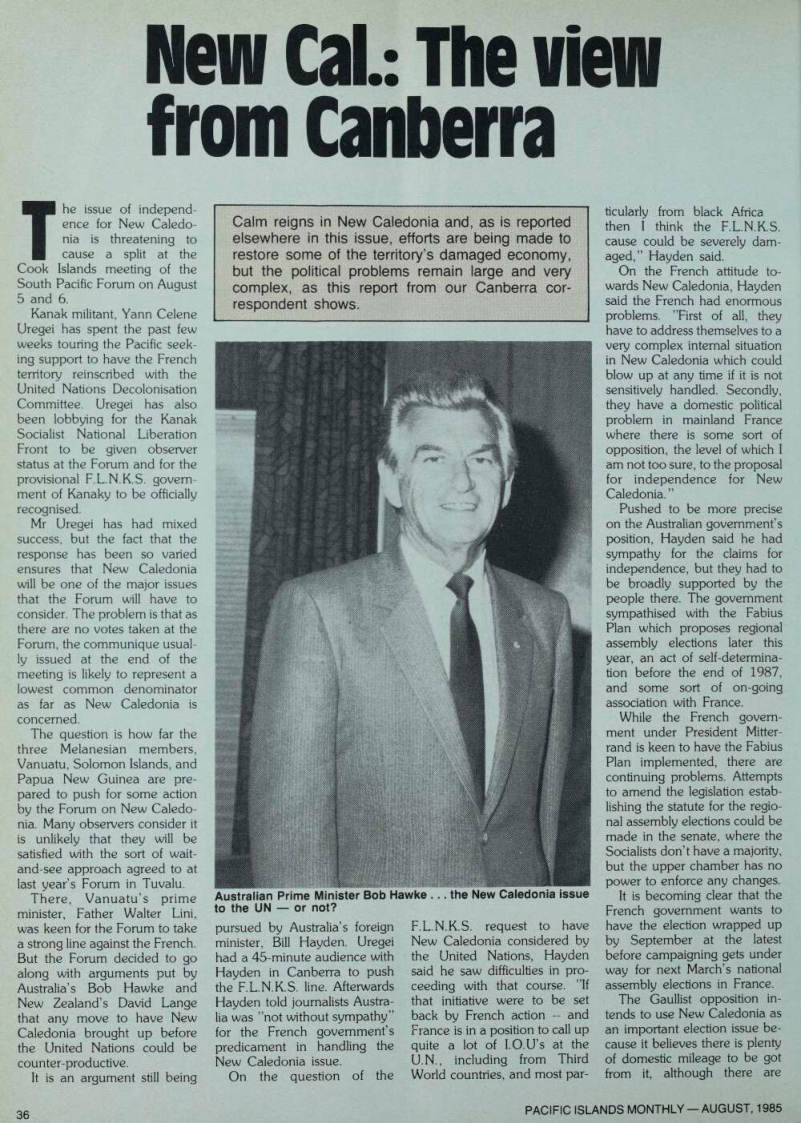
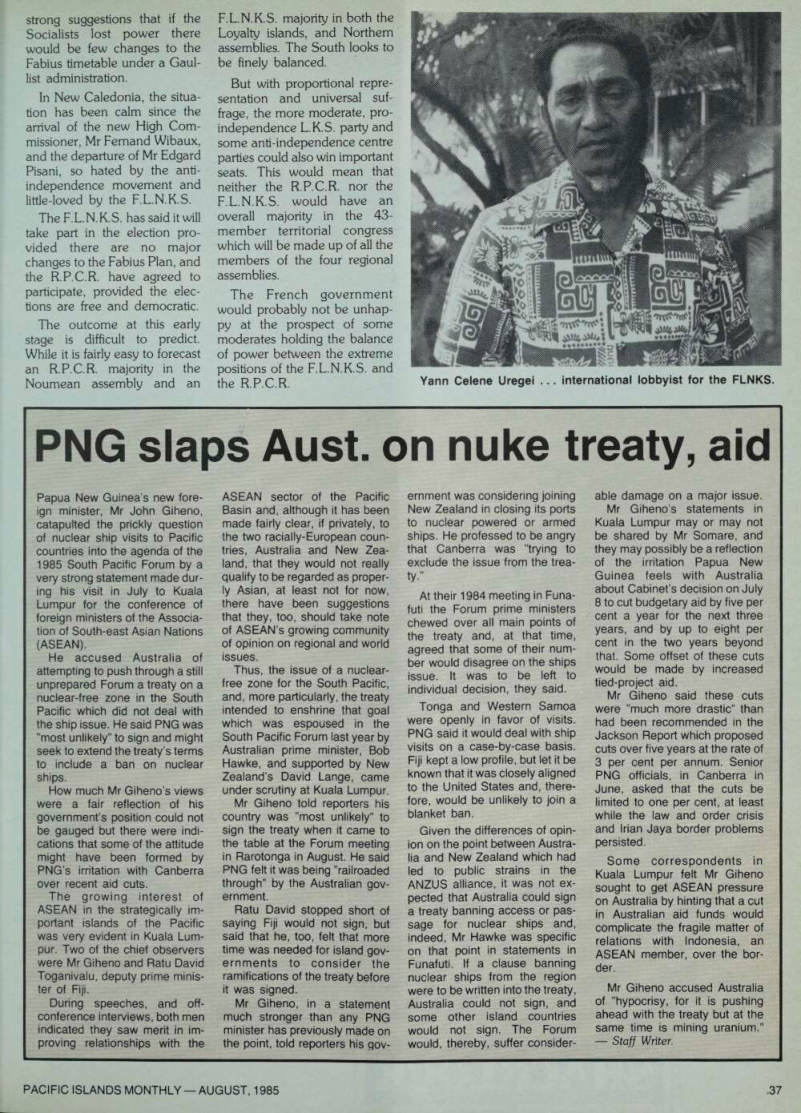
New Cal. The view from Canberra
The issue of independ ence for New Caledo nia is threatening to cause a split at the Cook Islands meeting of the South Pacific Forum on August 5 and 6.
Kanak militant, Yann Celene Uregei has spent the past few weeks touring the Pacific seek ing support to have the French territory reinscribed with the United Nations Decolonisation Committee. Uregei has also been lobbying for the Kanak Socialist National Liberation Front to be given observer status at the Forum and for the provisional F.L.N.K.S. govern ment of Kanaky to be officially recognised.
Mr Uregei has had mixed success, but the fact that the response has been so varied ensures that New Caledonia will be one of the major issues that the Forum will have to consider. The problem is that as there are no votes taken at the Forum, the communique usual ly issued at the end of the meeting is likely to represent a lowest common denominator as far as New Caledonia is concerned.
The question is how far the three Melanesian members, Vanuatu, Solomon Islands, and Papua New Guinea are pre pared to push for some action by the Forum on New Caledo nia. Many observers consider it is unlikely that they will be satisfied with the sort of wait and-see approach agreed to at last year’s Forum in Tuvalu.
There, Vanuatu’s prime minister, Father Walter Lini, was keen for the Forum to take a strong line against the French.
But the Forum decided to go along with arguments put by Australia’s Bob Hawke and New Zealand’s David Lange that any move to have New Caledonia brought up before the United Nations could be counter-productive.
It is an argument still being
Calm reigns in New Caledonia and, as is reported elsewhere in this issue, efforts are being made to restore some of the territory’s damaged economy, but the political problems remain large and very complex, as this report from our Canberra cor respondent shows.
pursued by Australia’s foreign minister, Bill Hayden. Uregei had a 45-minute audience with Hayden in Canberra to push the F.L.N.K.S. line. Afterwards Hayden told journalists Austra lia was ’’not without sympathy” for the French government’s predicament in handling the New Caledonia issue.
On the question of the
F.L.N.K.S. request to have New Caledonia considered by the United Nations, Hayden said he saw difficulties in pro ceeding with that course. ”If that initiative were to be set back by French action and France is in a position to call up quite a lot of I.O.U’s at the U.N., including from Third World countries, and most par
ticularly from black Africa then I think the F.L.N.K.S. cause could be severely dam aged,” Hayden said.
On the French attitude to wards New Caledonia, Hayden said the French had enormous problems. ’’First of all, they have to address themselves to a very complex internal situation in New Caledonia which could blow up at any time if it is not sensitively handled. Secondly, they have a domestic political problem in mainland France where there is some sort of opposition, the level of which I am not too sure, to the proposal for independence for New Caledonia. ”
Pushed to be more precise on the Australian government’s position, Hayden said he had sympathy for the claims for independence, but they had to be broadly supported by the people there. The government sympathised with the Fabius Plan which proposes regional assembly elections later this year, an act of self-determina tion before the end of 1987, and some sort of on-going association with France.
While the French govern ment under President Mitter rand is keen to have the Fabius Plan implemented, there are continuing problems. Attempts to amend the legislation estab lishing the statute for the regio nal assembly elections could be made in the senate, where the Socialists don’t have a majority, but the upper chamber has no power to enforce any changes.
It is becoming clear that the French government wants to have the election wrapped up by September at the latest before campaigning gets under way for next March’s national assembly elections in France.
The Gaullist opposition in tends to use New Caledonia as an important election issue be cause it believes there is plenty of domestic mileage to be got from it, although there are
Australian Prime Minister Bob Hawke ... the New Caledonia issue to the UN - or not?
strong suggestions that if the Socialists lost power there would be few changes to the Fabius timetable under a Gaul list administration.
In New Caledonia, the situa tion has been calm since the arrival of the new High Com missioner, Mr Fernand Wibaux, and the departure of Mr Edgard Pisani, so hated by the anti independence movement and little-loved by the F.L.N.K.S.
The F.L.N.K.S. has said it will take part in the election pro vided there are no major changes to the Fabius Plan, and the R.P.C.R. have agreed to participate, provided the elec tions are free and democratic.
The outcome at this early stage is difficult to predict.
While it is fairly easy to forecast an R.P.C.R. majority in the Noumean assembly and an
F.L.N.K.S. majority in both the Loyalty islands, and Northern assemblies. The South looks to be finely balanced.
But with proportional repre sentation and universal suf frage, the more moderate, pro independence L.K.S. party and some anti-independence centre parties could also win important seats. This would mean that neither the R.P.C.R. nor the F.L.N.K.S. would have an overall majority in the 43member territorial congress which will be made up of all the members of the four regional assemblies.
The French government would probably not be unhap py at the prospect of some moderates holding the balance of power between the extreme positions of the F.L.N.K.S. and the R.P.C.R.
Yann Celene Uregei ... international lobbyist for the FLNKS.
PNG slaps Aust. on nuke treaty, aid
Papua New Guinea’s new fore ign minister, Mr John Giheno, catapulted the prickly question of nuclear ship visits to Pacific countries into the agenda of the 1985 South Pacific Forum by a very strong statement made dur ing his visit in July to Kuala Lumpur for the conference of foreign ministers of the Associa tion of South-east Asian Nations
(Asean).
He accused Australia of attempting to push through a still unprepared Forum a treaty on a nuclear-free zone in the South Pacific which did not deal with the ship issue. He said PNG was "most unlikely" to sign and might seek to extend the treaty’s terms to include a ban on nuclear ships.
How much Mr Giheno’s views were a fair reflection of his government’s position could not be gauged but there were indi cations that some of the attitude might have been formed by PNG’s irritation with Canberra over recent aid cuts.
The growing interest of ASEAN in the strategically im portant islands of the Pacific was very evident in Kuala Lum pur. Two of the chief observers were Mr Giheno and Ratu David Toganivalu, deputy prime minis ter of Fiji.
During speeches, and off conference interviews, both men indicated they saw merit in im proving relationships with the
ASEAN sector of the Pacific Basin and, although it has been made fairly clear, if privately, to the two racially-European coun tries, Australia and New Zea land, that they would not really qualify to be regarded as proper ly Asian, at least not for now, there have been suggestions that they, too, should take note of ASEAN’s growing community of opinion on regional and world issues.
Thus, the issue of a nuclear free zone for the South Pacific, and, more particularly, the treaty intended to enshrine that goal which was espoused in the South Pacific Forum last year by Australian prime minister, Bob Hawke, and supported by New Zealand’s David Lange, came under scrutiny at Kuala Lumpur.
Mr Giheno told reporters his country was "most unlikely” to sign the treaty when it came to the table at the Forum meeting in Rarotonga in August. He said PNG felt it was being "railroaded through” by the Australian gov ernment.
Ratu David stopped short of saying Fiji would not sign, but said that he, too, felt that more time was needed for island gov ernments to consider the ramifications of the treaty before it was signed.
Mr Giheno, in a statement much stronger than any PNG minister has previously made on the point, told reporters his gov
ernment was considering joining New Zealand in closing its ports to nuclear powered or armed ships. He professed to be angry that Canberra was "trying to exclude the issue from the trea ty.”
At their 1984 meeting in Funa futi the Forum prime ministers chewed over all main points of the treaty and, at that time, agreed that some of their num ber would disagree on the ships issue. It was to be left to individual decision, they said.
Tonga and Western Samoa were openly in favor of visits.
PNG said it would deal with ship visits on a case-by-case basis.
Fiji kept a low profile, but let it be known that it was closely aligned to the United States and, there fore, would be unlikely to join a blanket ban.
Given the differences of opin ion on the point between Austra lia and New Zealand which had led to public strains in the ANZUS alliance, it was not ex pected that Australia could sign a treaty banning access or pas sage for nuclear ships and, indeed, Mr Hawke was specific on that point in statements in Funafuti. If a clause banning nuclear ships from the region were to be written into the treaty, Australia could not sign, and some other island countries would not sign. The Forum would, thereby, suffer consider
able damage on a major issue.
Mr Giheno’s statements in Kuala Lumpur may or may not be shared by Mr Somare, and they may possibly be a reflection of the irritation Papua New Guinea feels with Australia about Cabinet's decision on July 8 to cut budgetary aid by five per cent a year for the next three years, and by up to eight per cent in the two years beyond that. Some offset of these cuts would be made by increased
tied-project aid.
Mr Giheno said these cuts were "much more drastic” than had been recommended in the Jackson Report which proposed cuts over five years at the rate of 3 per cent per annum. Senior PNG officials, in Canberra in June, asked that the cuts be limited to one per cent, at least while the law and order crisis and Irian Jaya border problems
persisted.
Some correspondents in Kuala Lumpur felt Mr Giheno sought to get ASEAN pressure on Australia by hinting that a cut in Australian aid funds would complicate the fragile matter of relations with Indonesia, an ASEAN member, over the bor der.
Mr Giheno accused Australia of "hypocrisy, for it is pushing ahead with the treaty but at the same time is mining uranium.”
Staff Writer.
Advertisements & other items, p. 38 (1 item)
discovered
In 1966 Since 1966 Shaddock has gone from exploring a new market to being a major supplier of electrical appliances to the Pacific. Shaddock discovered the Pacific, And the Pacific discovered Shaddock. The Shaddock range of domestic and commercial appliances has established a reputation for dependability and performance throughout the region, Today Shaddock is still exploring. Exploring new ideas, new technology, new products. It is the type of exploration that keeps Fisher and Paykel, the New Zealand manufacturer of Shaddock, the southern hemisphere’s largest exporter of major appliances.
the Fadfic
SHACKLOCK
PACIFIC ISLANDS MONTHLY
Pruning would improve
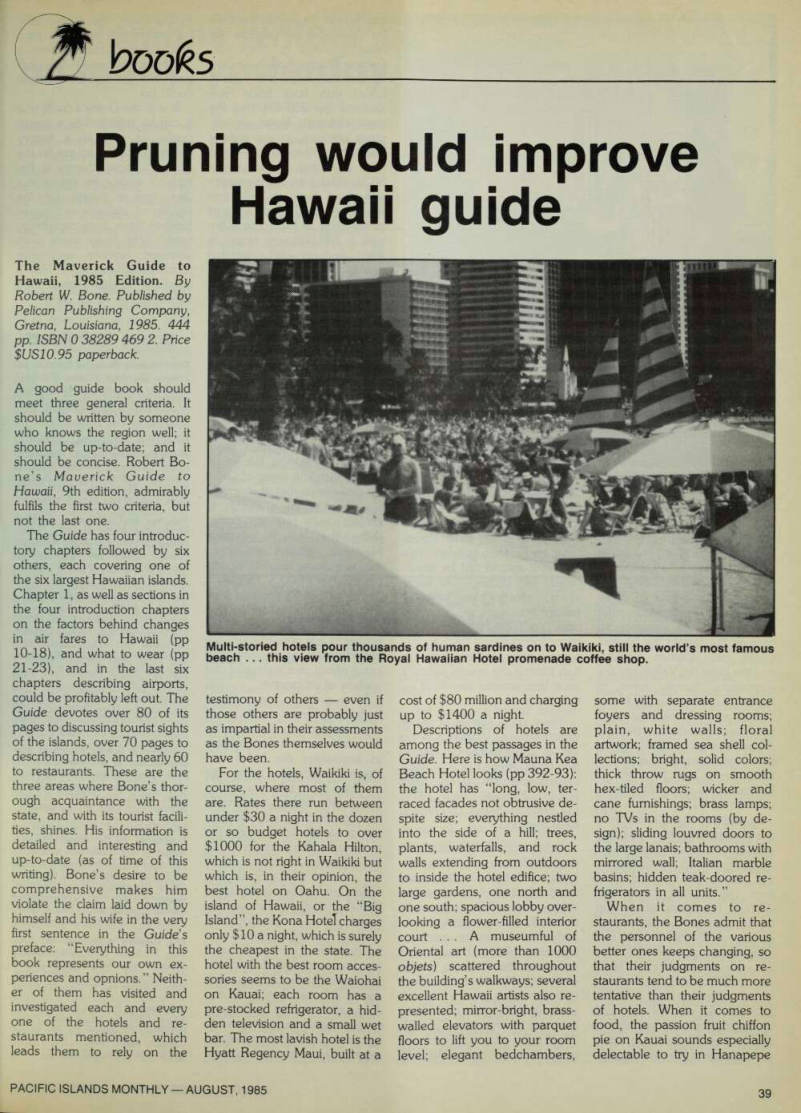
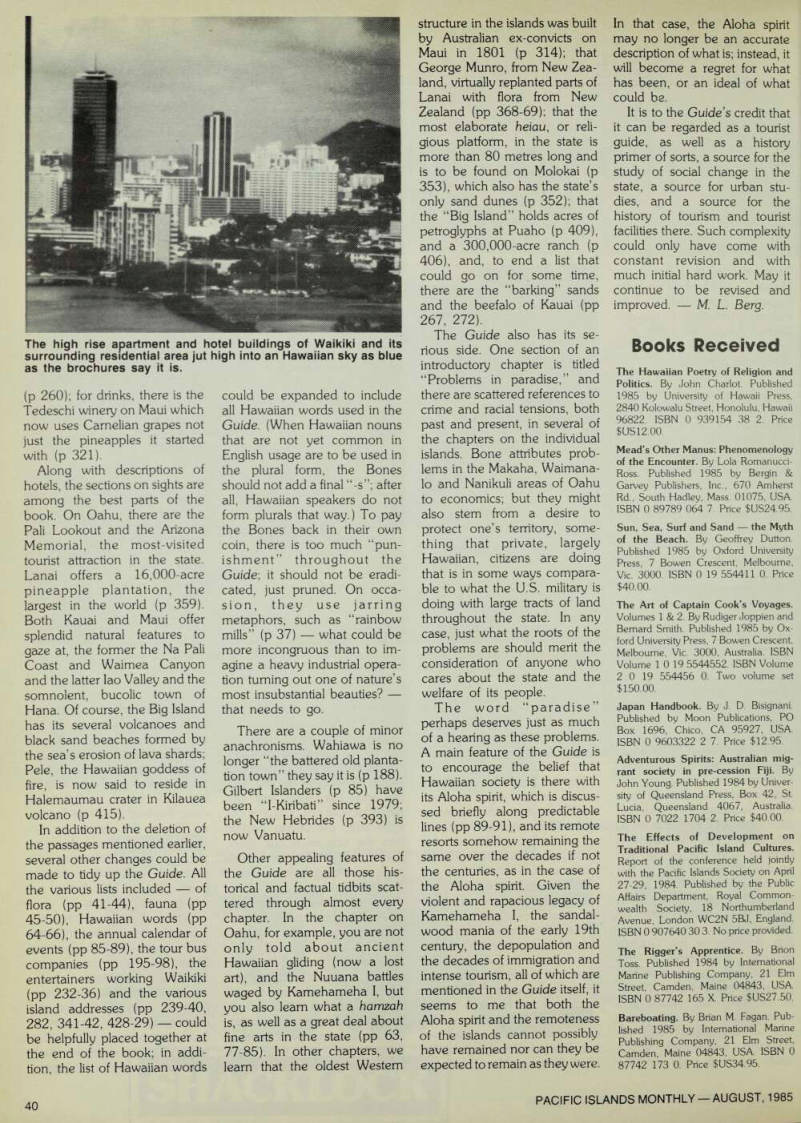
books
Pruning would improve Hawaii guide
The Maverick Guide to Hawaii, 1985 Edition. By Robert IV. Bone. Published by Pelican Publishing Company, Gretna, Louisiana, 1985. 444 pp. ISBN 0 38289 469 2. Price $U510.95 paperback.
A good guide book should meet three general criteria. It should be written by someone who knows the region well; it should be up-to-date; and it should be concise. Robert Bo ne’s Maverick Guide to Hawaii, 9th edition, admirably fulfils the first two criteria, but not the last one.
The Guide has four introduc tory chapters followed by six others, each covering one of the six largest Hawaiian islands.
Chapter 1, as well as sections in the four introduction chapters on the factors behind changes in air fares to Hawaii (pp 10-18), and what to wear (pp 21-23), and in the last six chapters describing airports, could be profitably left out. The Guide devotes over 80 of its pages to discussing tourist sights of the islands, over 70 pages to describing hotels, and nearly 60 to restaurants. These are the three areas where Bone’s thor ough acquaintance with the state, and with its tourist facili ties, shines. His information is detailed and interesting and up-to-date (as of time of this writing). Bone’s desire to be comprehensive makes him violate the claim laid down by himself and his wife in the very first sentence in the Guide's preface: “Everything in this book represents our own ex periences and opnions.” Neith er of them has visited and investigated each and every one of the hotels and re staurants mentioned, which leads them to rely on the
testimony of others even if those others are probably just as impartial in their assessments as the Bones themselves would have been.
For the hotels, Waikiki is, of course, where most of them are. Rates there run between under $3O a night in the dozen or so budget hotels to over $lOOO for the Kahala Hilton, which is not right in Waikiki but which is, in their opinion, the best hotel on Oahu. On the island of Hawaii, or the “Big Island”, the Kona Hotel charges only $lO a night, which is surely the cheapest in the state. The hotel with the best room acces sories seems to be the Waiohai on Kauai; each room has a pre-stocked refrigerator, a hid den television and a small wet bar. The most lavish hotel is the Hyatt Regency Maui, built at a
cost of $BO million and charging up to $l4OO a night.
Descriptions of hotels are among the best passages in the Guide. Here is how Mauna Kea Beach Hotel looks (pp 392-93): the hotel has “long, low, ter raced facades not obtrusive de spite size; everything nestled into the side of a hill; trees, plants, waterfalls, and rock walls extending from outdoors to inside the hotel edifice; two large gardens, one north and one south; spacious lobby over looking a flower-filled interior court ... A museumful of Oriental art (more than 1000 objets) scattered throughout the building’s walkways; several excellent Hawaii artists also re presented; mirror-bright, brass walled elevators with parquet floors to lift you to your room level; elegant bedchambers,
some with separate entrance foyers and dressing rooms; plain, white walls; floral artwork; framed sea shell col lections; bright, solid colors; thick throw rugs on smooth hex-tiled floors; wicker and cane furnishings; brass lamps; no TVs in the rooms (by de sign); sliding louvred doors to the large lanais; bathrooms with mirrored wall; Italian marble basins; hidden teak-doored re frigerators in all units.”
When it comes to re staurants, the Bones admit that the personnel of the various better ones keeps changing, so that their judgments on re staurants tend to be much more tentative than their judgments of hotels. When it comes to food, the passion fruit chiffon pie on Kauai sounds especially delectable to try in Hanapepe
Multi-storied hotels pour thousands of human sardines on to Waikiki, still the world’s most famous beach ... this view from the Royal Hawaiian Hotel promenade coffee shop.
(p 260); for drinks, there is the Tedeschi winery on Maui which now uses Camelian grapes not just the pineapples it started with (p 321).
Along with descriptions of hotels, the sections on sights are among the best parts of the book. On Oahu, there are the Pali Lookout and the Arizona Memorial, the most-visited tourist attraction in the state.
Lanai offers a 16,000-acre pineapple plantation, the largest in the world (p 359).
Both Kauai and Maui offer splendid natural features to gaze at, the former the Na Pali Coast and Waimea Canyon and the latter lao Valley and the somnolent, bucolic town of Hana. Of course, the Big Island has its several volcanoes and black sand beaches formed by the sea’s erosion of lava shards; Pele, the Hawaiian goddess of fire, is now said to reside in Halemaumau crater in Kilauea volcano (p 415).
In addition to the deletion of the passages mentioned earlier, several other changes could be made to tidy up the Guide. All the various lists included of flora (pp 41-44), fauna (pp 45-50), Hawaiian words (pp 64-66), the annual calendar of events (pp 85-89), the tour bus companies (pp 195-98), the entertainers working Waikiki (pp 232-36) and the various island addresses (pp 239-40, 282, 341-42, 428-29) could be helpfully placed together at the end of the book; in addi tion, the list of Hawaiian words
could be expanded to include all Hawaiian words used in the Guide. (When Hawaiian nouns that are not yet common in English usage are to be used in the plural form, the Bones should not add a final “-s”; after all, Hawaiian speakers do not form plurals that way.) To pay the Bones back in their own coin, there is too much “pun ishment” throughout the Guide; it should not be eradi cated, just pruned. On occa sion, they use jarring metaphors, such as “rainbow mills” (p 37) what could be more incongruous than to im agine a heavy industrial opera tion turning out one of nature’s most insubstantial beauties? that needs to go.
There are a couple of minor anachronisms. Wahiawa is no longer “the battered old planta tion town” they say it is (p 188).
Gilbert Islanders (p 85) have been “I-Kiribati” since 1979; the New Hebrides (p 393) is now Vanuatu.
Other appealing features of the Guide are all those his torical and factual tidbits scat tered through almost every chapter. In the chapter on Oahu, for example, you are not only told about ancient Hawaiian gliding (now a lost art), and the Nuuana battles waged by Kamehameha I, but you also learn what a hamzah is, as well as a great deal about fine arts in the state (pp 63, 77-85). In other chapters, we learn that the oldest Western
structure in the islands was built by Australian ex-convicts on Maui in 1801 (p 314); that George Munro, from New Zea land, virtually replanted parts of Lanai with flora from New Zealand (pp 368-69); that the most elaborate heiau, or reli gious platform, in the state is more than 80 metres long and is to be found on Molokai (p 353), which also has the state’s only sand dunes (p 352); that the “Big Island” holds acres of petroglyphs at Puaho (p 409), and a 300,000-acre ranch (p 406), and, to end a list that could go on for some time, there are the “barking” sands and the beefalo of Kauai (pp 267, 272).
The Guide also has its se rious side. One section of an introductory chapter is titled “Problems in paradise,” and there are scattered references to crime and racial tensions, both past and present, in several of the chapters on the individual islands. Bone attributes prob lems in the Makaha, Waimana lo and Nanikuli areas of Oahu to economics; but they might also stem from a desire to protect one’s territory, some thing that private, largely Hawaiian, citizens are doing that is in some ways compara ble to what the U.S. military is doing with large tracts of land throughout the state. In any case, just what the roots of the problems are should merit the consideration of anyone who cares about the state and the welfare of its people.
The word “paradise” perhaps deserves just as much of a hearing as these problems.
A main feature of the Guide is to encourage the belief that Hawaiian society is there with its Aloha spirit, which is discus sed briefly along predictable lines (pp 89-91), and its remote resorts somehow remaining the same over the decades if not the centuries, as in the case of the Aloha spirit. Given the violent and rapacious legacy of Kamehameha I, the sandal wood mania of the early 19th century, the depopulation and the decades of immigration and intense tourism, all of which are mentioned in the Guide itself, it seems to me that both the Aloha spirit and the remoteness of the islands cannot possibly have remained nor can they be expected to remain as they were.
In that case, the Aloha spirit may no longer be an accurate description of what is; instead, it will become a regret for what has been, or an ideal of what could be.
It is to the Guide’s credit that it can be regarded as a tourist guide, as well as a history primer of sorts, a source for the study of social change in the state, a source for urban stu dies, and a source for the history of tourism and tourist facilities there. Such complexity could only have come with constant revision and with much initial hard work. May it continue to be revised and
improved.
M. L. Berg.
Books Received
The Hawaiian Poetry of Religion and Politics. By John Chariot. Published 1985 by University of Hawaii Press, 2840 Kolowalu Street, Honolulu, Hawaii 96822. ISBN 0 939154 38 2. Price $US12.00.
Mead’s Other Manus: Phenomenology of the Encounter. By Lola Romanucci- Ross. Published 1985 by Bergin & Garvey Publishers, Inc., 670 Amherst Rd., South Hadley, Mass. 01075, USA.
ISBN 0 89789 064 7. Price $US24.95.
Sun, Sea, Surf and Sand — the Myth of the Beach. By Geoffrey Dutton.
Published 1985 by Oxford University Press, 7 Bowen Crescent, Melbourne, Vic. 3000. ISBN 0 19 554411 0. Price $40.00.
The Art of Captain Cook’s Voyages.
Volumes 1 & 2. By Rudiger Joppien and Bernard Smith. Published 1985 by Ox ford University Press, 7 Bowen Crescent, Melbourne, Vic. 3000, Australia. ISBN Volume 1 0 19 5544552. ISBN Volume 2 0 19 554456 0. Two volume set $150.00.
Japan Handbook. By J. D. Bisignani.
Published by Moon Publications, PO Box 1696, Chico, CA 95927, USA.
ISBN 0 9603322 2 7. Price $12.95.
Adventurous Spirits: Australian mig rant society in pre-cession Fiji. By John Young. Published 1984 by Univer sity of Queensland Press, Box 42, St.
Lucia, Queensland 4067, Australia.
ISBN 0 7022 1704 2. Price $40.00.
The Effects of Development on Traditional Pacific Island Cultures.
Report of the conference held jointly with the Pacific Islands Society on April 27-29, 1984. Published by the Public Affairs Department, Royal Common wealth Society, 18 Northumberland Avenue, London WC2N 5BJ, England.
ISBN 0 907640 30 3. No price provided.
The Rigger’s Apprentice. By Brion Toss. Published 1984 by International Marine Publishing Company, 21 Elm Street, Camden, Maine 04843, USA.
ISBN 0 87742 165 X. Price $US27.50.
Bareboating. By Brian M. Fagan. Pub lished 1985 by International Marine Publishing Company, 21 Elm Street, Camden, Maine 04843, USA. ISBN 0 87742 173 0. Price $US34.95.
The high rise apartment and hotel buildings of Waikiki and its surrounding residential area jut high into an Hawaiian sky as blue as the brochures say it is.
on today, yesterday
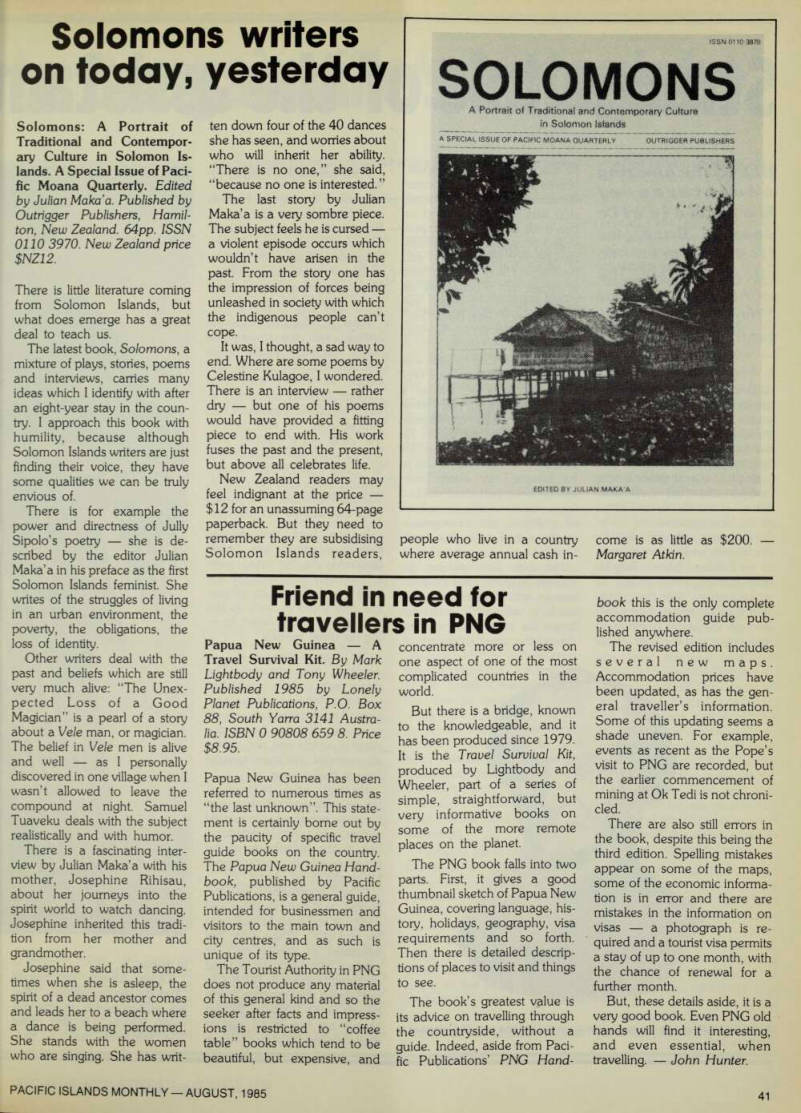
Solomons writers on today, yesterday
Solomons: A Portrait of Traditional and Contempor ary Culture in Solomon Is lands. A Special Issue of Paci fic Moana Quarterly. Edited by Julian Maka’a. Published by Outrigger Publishers, Hamil ton, New Zealand. 64pp. ISSN 0110 3970. New Zealand price
Snzi2.
There is little literature coming from Solomon Islands, but what does emerge has a great deal to teach us.
The latest book, Solomons, a mixture of plays, stories, poems and interviews, carries many ideas which I identify with after an eight-year stay in the coun try. I approach this book with humility, because although Solomon Islands writers are just finding their voice, they have some qualities we can be truly envious of.
There is for example the power and directness of Jully Sipolo’s poetry she is de scribed by the editor Julian Maka’a in his preface as the first Solomon Islands feminist. She writes of the struggles of living in an urban environment, the poverty, the obligations, the loss of identity.
Other writers deal with the past and beliefs which are still very much alive: “The Unex pected Loss of a Good Magician” is a pearl of a story about a Vele man, or magician.
The belief in Vele men is alive and well as I personally discovered in one village when I wasn’t allowed to leave the compound at night. Samuel Tuaveku deals with the subject realistically and with humor.
There is a fascinating inter view by Julian Maka’a with his mother, Josephine Rihisau, about her journeys into the spirit world to watch dancing.
Josephine inherited this tradi tion from her mother and grandmother.
Josephine said that some times when she is asleep, the spirit of a dead ancestor comes and leads her to a beach where a dance is being performed.
She stands with the women who are singing. She has writ
ten down four of the 40 dances she has seen, and worries about who will inherit her ability.
“There is no one,” she said, “because no one is interested.”
The last story by Julian Maka’a is a very sombre piece.
The subject feels he is cursed a violent episode occurs which wouldn’t have arisen in the past. From the story one has the impression of forces being unleashed in society with which the indigenous people can’t cope.
It was, I thought, a sad way to end. Where are some poems by Celestine Kulagoe, I wondered.
There is an interview rather dry but one of his poems would have provided a fitting piece to end with. His work fuses the past and the present, but above all celebrates life.
New Zealand readers may feel indignant at the price $l2 for an unassuming 64-page paperback. But they need to remember they are subsidising Solomon Islands readers,
people who live in a country where average annual cash in
come is as little as $2OO.
Margaret Atkin.
Friend in need for travellers
travellers in PNG
Papua New Guinea A Travel Survival Kit. By Mark Lightbody and Tony Wheeler.
Published 1985 by Lonely Planet Publications, P.O. Box 88, South Yarra 3141 Austra lia. ISBN 0 90808 659 8. Price $8.95.
Papua New Guinea has been referred to numerous times as “the last unknown”. This state ment is certainly borne out by the paucity of specific travel guide books on the country.
The Papua New Guinea Hand book, published by Pacific Publications, is a general guide, intended for businessmen and visitors to the main town and city centres, and as such is unique of its type.
The Tourist Authority in PNG does not produce any material of this general kind and so the seeker after facts and impress ions is restricted to “coffee table” books which tend to be beautiful, but expensive, and
concentrate more or less on one aspect of one of the most complicated countries in the world.
But there is a bridge, known to the knowledgeable, and it has been produced since 1979.
It is the Travel Survival Kit, produced by Lightbody and Wheeler, part of a series of simple, straightforward, but very informative books on some of the more remote places on the planet.
The PNG book falls into two parts. First, it gives a good thumbnail sketch of Papua New Guinea, covering language, his tory, holidays, geography, visa requirements and so forth.
Then there is detailed descrip tions of places to visit and things to see.
The book’s greatest value is its advice on travelling through the countryside, without a guide. Indeed, aside from Paci fic Publications’ PNG Hand
book this is the only complete accommodation guide pub lished anywhere.
The revised edition includes several new maps.
Accommodation prices have been updated, as has the gen eral traveller’s information.
Some of this updating seems a shade uneven. For example, events as recent as the Pope’s visit to PNG are recorded, but the earlier commencement of mining at Ok Tedi is not chroni cled.
There are also still errors in the book, despite this being the third edition. Spelling mistakes appear on some of the maps, some of the economic informa tion is in error and there are mistakes in the information on visas a photograph is re quired and a tourist visa permits a stay of up to one month, with the chance of renewal for a further month.
But, these details aside, it is a very good book. Even PNG old hands will find it interesting, and even essential, when
travelling.
John Hunter.
Strange tale of the assistant to Bougainville's botanist
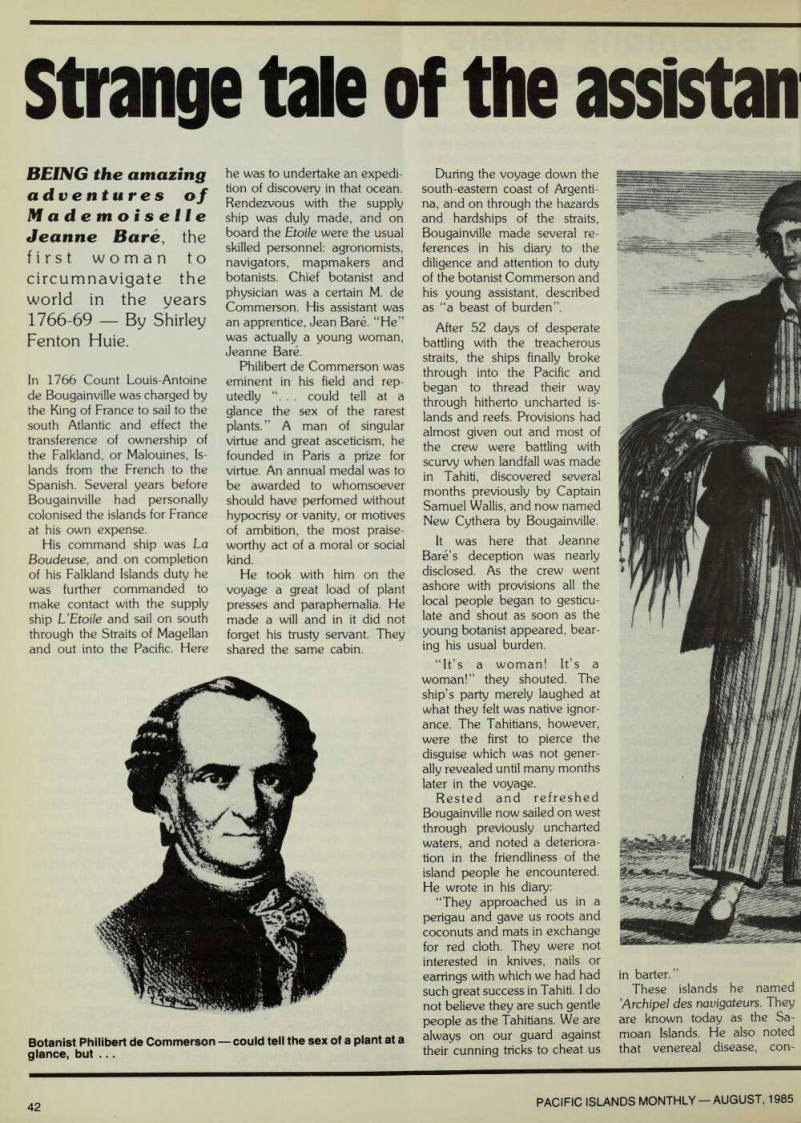
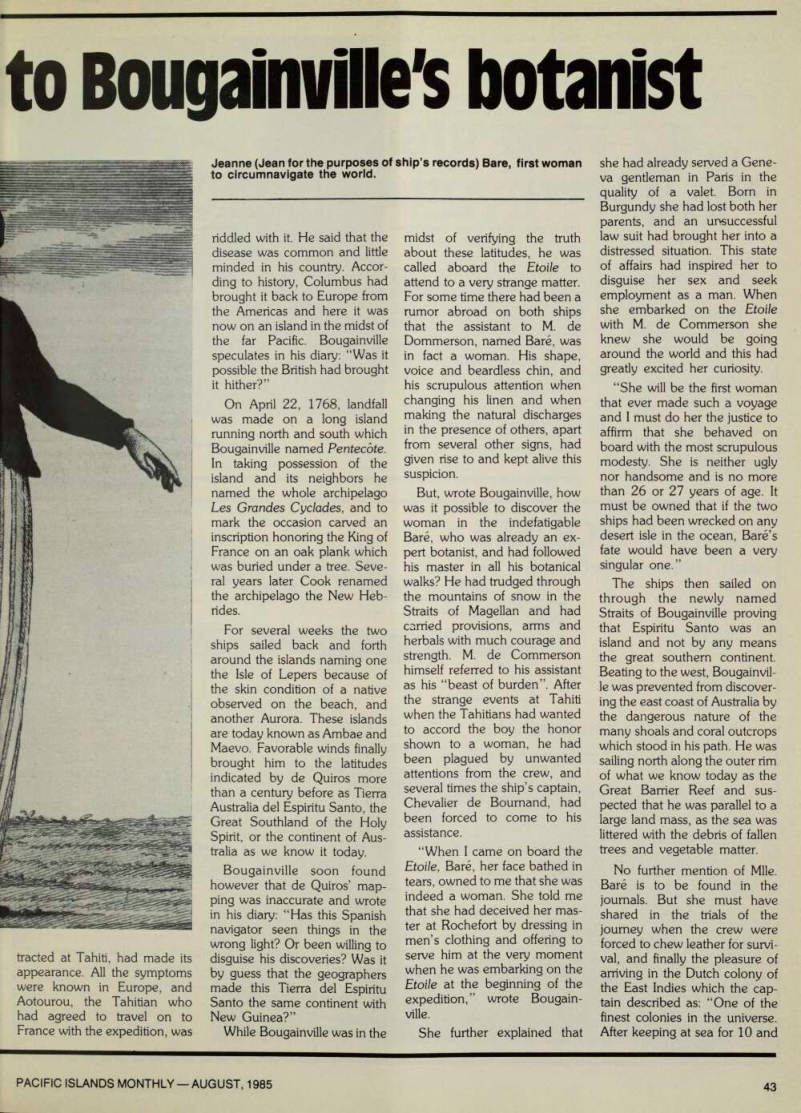
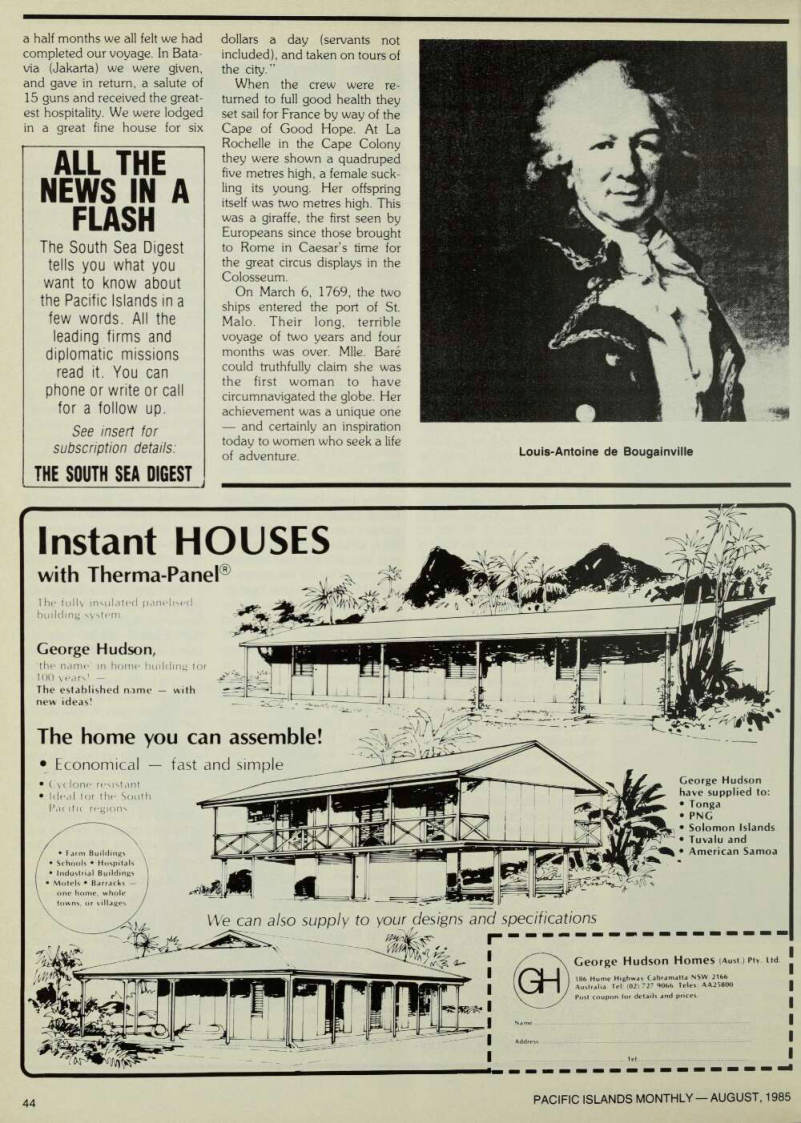
BEING the amazing
adventures of
Mademoiselle Jeanne Bare , the first woman to
circumnavigate the
world in the years
1766-69 By Shirley
Fenton Huie.
In 1766 Count Louis-Antoine de Bougainville was charged by the King of France to sail to the south Atlantic and effect the transference of ownership of the Falkland, or Malouines, Is lands from the French to the Spanish. Several years before Bougainville had personally colonised the islands for France at his own expense.
His command ship was La Boudeuse, and on completion of his Falkland Islands duty he was further commanded to make contact with the supply ship L'Etoile and sail on south through the Straits of Magellan and out into the Pacific. Here
he was to undertake an expedi tion of discovery in that ocean.
Rendezvous with the supply ship was duly made, and on board the Etoile were the usual skilled personnel: agronomists, navigators, mapmakers and botanists. Chief botanist and physician was a certain M. de Commerson. His assistant was an apprentice, Jean Bare. “He” was actually a young woman, Jeanne Bare.
Philibert de Commerson was eminent in his field and rep utedly “. . . could tell at a glance the sex of the rarest plants. ” A man of singular virtue and great asceticism, he founded in Paris a prize for virtue. An annual medal was to be awarded to whomsoever should have perfomed without hypocrisy or vanity, or motives of ambition, the most praise worthy act of a moral or social kind.
He took with him on the voyage a great load of plant presses and paraphernalia. He made a will and in it did not forget his trusty servant. They shared the same cabin.
During the voyage down the south-eastern coast of Argenti na, and on through the hazards and hardships of the straits, Bougainville made several re ferences in his diary to the diligence and attention to duty of the botanist Commerson and his young assistant, described as “a beast of burden”.
After 52 days of desperate battling with the treacherous straits, the ships finally broke through into the Pacific and began to thread their way through hitherto uncharted is lands and reefs. Provisions had almost given out and most of the crew were battling with scurvy when landfall was made in Tahiti, discovered several months previously by Captain Samuel Wallis, and now named New Cythera by Bougainville.
It was here that Jeanne Bare’s deception was nearly disclosed. As the crew went ashore with provisions all the local people began to gesticu late and shout as soon as the young botanist appeared, bear ing his usual burden.
“It’s a woman! It’s a woman!” they shouted. The ship’s party merely laughed at what they felt was native ignor ance. The Tahitians, however, were the first to pierce the disguise which was not gener ally revealed until many months later in the voyage.
Rested and refreshed Bougainville now sailed on west through previously uncharted waters, and noted a deteriora tion in the friendliness of the island people he encountered.
He wrote in his diary; “They approached us in a perigau and gave us roots and coconuts and mats in exchange for red cloth. They were not interested in knives, nails or earrings with which we had had such great success in Tahiti. I do not believe they are such gentle people as the Tahitians. We are always on our guard against their cunning tricks to cheat us
in barter.”
These islands he named ’Archipel des nauigateurs. They are known today as the Sa moan Islands. He also noted that venereal disease, con
Botanist Philibert de Commerson - could tell the sex of a plant at a glance, but ...
tracted at Tahiti, had made its appearance. All the symptoms were known in Europe, and Aotourou, the Tahitian who had agreed to travel on to France with the expedition, was
riddled with it. He said that the disease was common and little minded in his country. Accor ding to history, Columbus had brought it back to Europe from the Americas and here it was now on an island in the midst of the far Pacific. Bougainville speculates in his diary: “Was it possible the British had brought it hither?”
On April 22, 1768, landfall was made on a long island running north and south which Bougainville named Pentecote.
In taking possession of the island and its neighbors he named the whole archipelago Les Grandes Cyclades, and to mark the occasion carved an inscription honoring the King of France on an oak plank which was buried under a tree. Seve ral years later Cook renamed the archipelago the New Heb rides.
For several weeks the two ships sailed back and forth around the islands naming one the Isle of Lepers because of the skin condition of a native observed on the beach, and another Aurora. These islands are today known as Ambae and Maevo. Favorable winds finally brought him to the latitudes indicated by de Quiros more than a century before as Tierra Australia del Espiritu Santo, the Great Southland of the Holy Spirit, or the continent of Aus tralia as we know it today.
Bougainville soon found however that de Quiros’ map ping was inaccurate and wrote in his diary: “Has this Spanish navigator seen things in the wrong light? Or been willing to disguise his discoveries? Was it by guess that the geographers made this Tierra del Espiritu Santo the same continent with New Guinea?”
While Bougainville was in the
midst of verifying the truth about these latitudes, he was called aboard the Etoile to attend to a very strange matter.
For some time there had been a rumor abroad on both ships that the assistant to M. de Dommerson, named Bare, was in fact a woman. His shape, voice and beardless chin, and his scrupulous attention when changing his linen and when making the natural discharges in the presence of others, apart from several other signs, had given rise to and kept alive this suspicion.
But, wrote Bougainville, how was it possible to discover the woman in the indefatigable Bare, who was already an ex pert botanist, and had followed his master in all his botanical walks? He had trudged through the mountains of snow in the Straits of Magellan and had carried provisions, arms and herbals with much courage and strength. M. de Commerson himself referred to his assistant as his “beast of burden”. After the strange events at Tahiti when the Tahitians had wanted to accord the boy the honor shown to a woman, he had been plagued by unwanted attentions from the crew, and several times the ship’s captain, Chevalier de Boumand, had been forced to come to his assistance.
“When I came on board the Etoile, Bare, her face bathed in tears, owned to me that she was indeed a woman. She told me that she had deceived her mas ter at Rochefort by dressing in men’s clothing and offering to serve him at the very moment when he was embarking on the Etoile at the beginning of the expedition,” wrote Bougain ville.
She further explained that
she had already served a Gene va gentleman in Paris in the quality of a valet. Born in Burgundy she had lost both her parents, and an unsuccessful law suit had brought her into a distressed situation. This state of affairs had inspired her to disguise her sex and seek employment as a man. When she embarked on the Etoile with M. de Commerson she knew she would be going around the world and this had greatly excited her curiosity.
“She will be the first woman that ever made such a voyage and I must do her the justice to affirm that she behaved on board with the most scrupulous modesty. She is neither ugly nor handsome and is no more than 26 or 27 years of age. It must be owned that if the two ships had been wrecked on any desert isle in the ocean, Bare’s fate would have been a very singular one.”
The ships then sailed on through the newly named Straits of Bougainville proving that Espiritu Santo was an island and not by any means the great southern continent.
Beating to the west, Bougainvil le was prevented from discover ing the east coast of Australia by the dangerous nature of the many shoals and coral outcrops which stood in his path. He was sailing north along the outer rim of what we know today as the Great Barrier Reef and sus pected that he was parallel to a large land mass, as the sea was littered with the debris of fallen trees and vegetable matter.
No further mention of Mile.
Bare is to be found in the journals. But she must have shared in the trials of the journey when the crew were forced to chew leather for survi val, and finally the pleasure of arriving in the Dutch colony of the East Indies which the cap tain described as: “One of the finest colonies in the universe.
After keeping at sea for 10 and
Jeanne (Jean for the purposes of ship’s records) Bare, first woman to circumnavigate the world.
a half months we all felt we had completed our voyage. In Bata via (Jakarta) we were given, and gave in return, a salute of 15 guns and received the great est hospitality. We were lodged in a great fine house for six
dollars a day (servants not included), and taken on tours of the city.”
When the crew were re turned to full good health they set sail for France by way of the Cape of Good Hope. At La Rochelle in the Cape Colony they were shown a quadruped five metres high, a female suck ling its young. Her offspring itself was two metres high. This was a giraffe, the first seen by Europeans since those brought to Rome in Caesar s time for the great circus displays in the Colosseum.
On March 6, 1769, the two ships entered the port of St.
Malo. Their long, terrible voyage of two years and four months was over. Mile. Bare could truthfully claim she was the first woman to have circumnavigated the globe. Her achievement was a unique one and certainly an inspiration today to women who seek a life of adventure.
Louis-Antoine de Bougainville
Advertisements & other items, p. 44 (1 item)
Instant HOUSES
ALL THE
NEWS IN A
FLASH
The South Sea Digest tells you what you want to know about the Pacific Islands in a few words. All the leading firms and diplomatic missions read it. You can phone or write or call for a follow up.
See insert for subscription details:
THE SOUTH SEA DIGEST
Instant HOUSES
with Therma-Panel®
The fully insulated panelised building system
George Hudson,
the name in home building for TOO \ ears!
The established name with new ideas!
The home you can assemble!
• Economical fast and simple
• (aclone resistant • Ideal for the South Pacific regions • Farm Buildings • Schools • Hospitals • Industrial Buildings • Motels • Barracks one home, whole towns, or villages f it m* £3 L We can also supply to your designs and specifications a*- W HI George Hudson have supplied to: • Tonga
• PNG
• Solomon Islands • Tuvalu and • American Samoa GH George Hudson Homes (Aust.) Pty. 186 Hume Highway Cabramatta NSW 2166 Australia Tel: (02) 727 9066 Telex. AA25800 Post coupon for details and prices.
Ltd
shop in Luganville
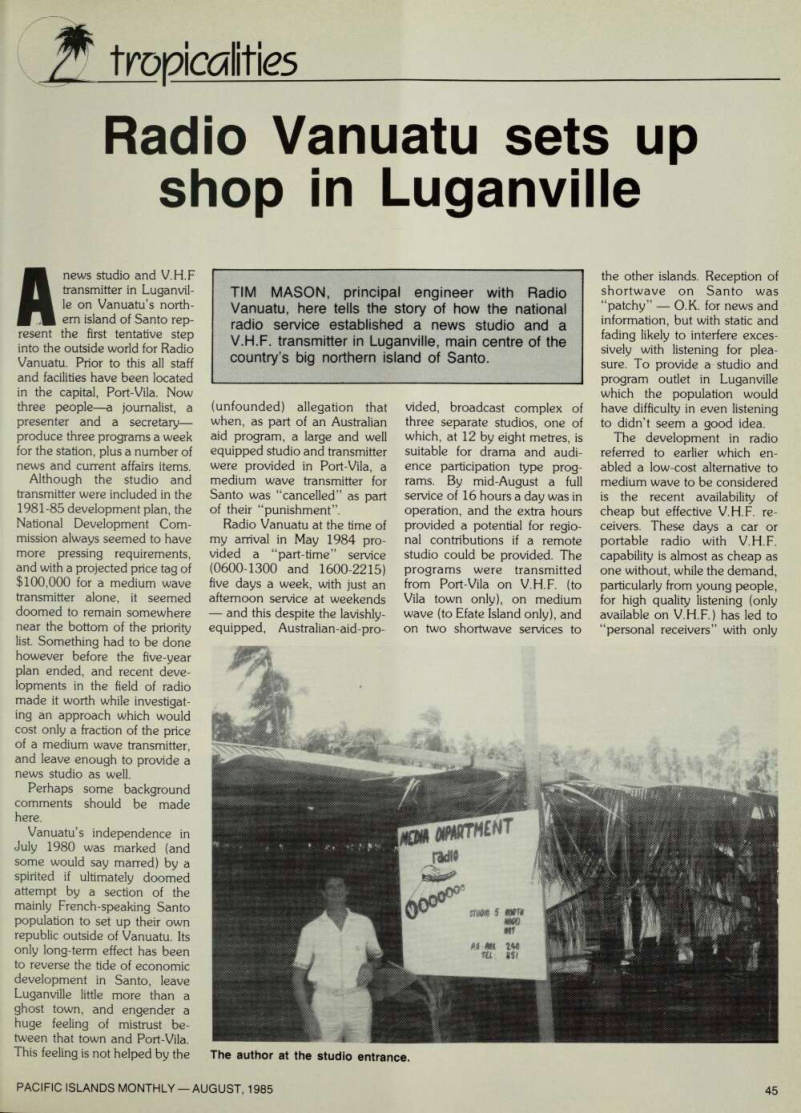
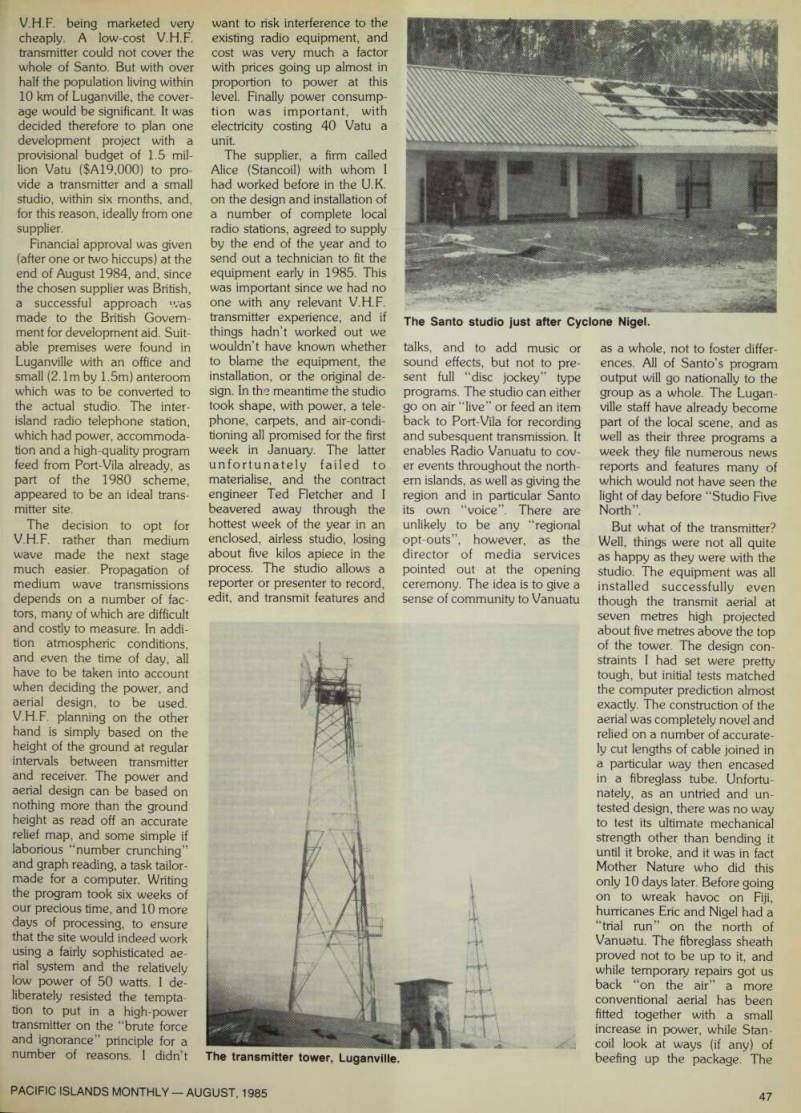
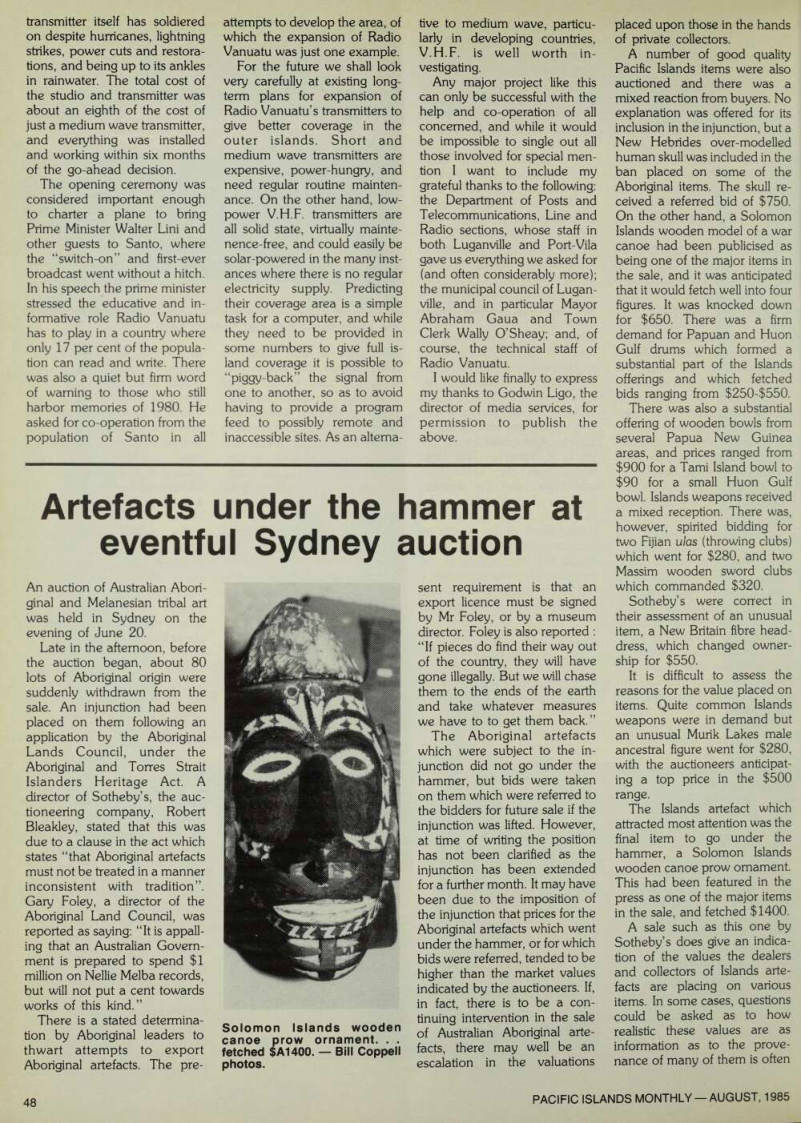
tropicalities
Radio Vanuatu sets up shop in Luganville
Anews studio and V.H.F transmitter in Luganvil le on Vanuatu’s north ern island of Santo rep resent the first tentative step into the outside world for Radio Vanuatu. Prior to this all staff and facilities have been located in the capital, Port-Vila. Now three people—a journalist, a presenter and a secretary— produce three programs a week for the station, plus a number of news and current affairs items.
Although the studio and transmitter were included in the 1981-85 development plan, the National Development Com mission always seemed to have more pressing requirements, and with a projected price tag of $lOO,OOO for a medium wave transmitter alone, it seemed doomed to remain somewhere near the bottom of the priority list. Something had to be done however before the five-year plan ended, and recent deve lopments in the field of radio made it worth while investigat ing an approach which would cost only a fraction of the price of a medium wave transmitter, and leave enough to provide a news studio as well.
Perhaps some background comments should be made here.
Vanuatu’s independence in July 1980 was marked (and some would say marred) by a spirited if ultimately doomed attempt by a section of the mainly French-speaking Santo population to set up their own republic outside of Vanuatu. Its only long-term effect has been to reverse the tide of economic development in Santo, leave Luganville little more than a ghost town, and engender a huge feeling of mistrust be tween that town and Port-Vila.
This feeling is not helped by the
TIM MASON, principal engineer with Radio Vanuatu, here tells the story of how the national radio service established a news studio and a V.H.F. transmitter in Luganville, main centre of the country’s big northern island of Santo.
(unfounded) allegation that when, as part of an Australian aid program, a large and well equipped studio and transmitter were provided in Port-Vila, a medium wave transmitter for Santo was “cancelled” as part of their “punishment”.
Radio Vanuatu at the time of my arrival in May 1984 pro vided a “part-time” service (0600-1300 and 1600-2215) five days a week, with just an afternoon service at weekends and this despite the lavishly equipped, Australian-aid-pro
vided, broadcast complex of three separate studios, one of which, at 12 by eight metres, is suitable for drama and audi ence participation type prog rams. By mid-August a full service of 16 hours a day was in operation, and the extra hours provided a potential for regio nal contributions if a remote studio could be provided. The programs were transmitted from Port-Vila on V.H.F. (to Vila town only), on medium wave (to Efate Island only), and on two shortwave services to
the other islands. Reception of shortwave on Santo was “patchy” O.K. for news and information, but with static and fading likely to interfere exces sively with listening for plea sure. To provide a studio and program outlet in Luganville which the population would have difficulty in even listening to didn’t seem a good idea.
The development in radio referred to earlier which en abled a low-cost alternative to medium wave to be considered is the recent availability of cheap but effective V.H.F. re ceivers. These days a car or portable radio with V.H.F. capability is almost as cheap as one without, while the demand, particularly from young people, for high quality listening (only available on V.H.F.) has led to “personal receivers” with only
The author at the studio entrance.
V.H.F. being marketed very cheaply. A low-cost V.H.F. transmitter could not cover the whole of Santo. But with over half the population living within 10 km of Luganville, the cover age would be significant. It was decided therefore to plan one development project with a provisional budget of 1.5 mil lion Vatu ($A19,000) to pro vide a transmitter and a small studio, within six months, and, for this reason, ideally from one supplier.
Financial approval was given (after one or two hiccups) at the end of August 1984, and, since the chosen supplier was British, a successful approach was made to the British Govern ment for development aid. Suit able premises were found in Luganville with an office and small (2.1 m by 1.5 m) anteroom which was to be converted to the actual studio. The inter island radio telephone station, which had power, accommoda tion and a high-quality program feed from Fort-Vila already, as part of the 1980 scheme, appeared to be an ideal trans mitter site.
The decision to opt for V.H.F. rather than medium wave made the next stage much easier. Propagation of medium wave transmissions depends on a number of fac tors, many of which are difficult and costly to measure. In addi tion atmospheric conditions, and even the time of day, all have to be taken into account when deciding the power, and aerial design, to be used.
V.H.F. planning on the other hand is simply based on the height of the ground at regular intervals between transmitter and receiver. The power and aerial design can be based on nothing more than the ground height as read off an accurate relief map, and some simple if laborious “number crunching” and graph reading, a task tailor made for a computer. Writing the program took six weeks of our precious time, and 10 more days of processing, to ensure that the site would indeed work using a fairly sophisticated ae rial system and the relatively low power of 50 watts. I de liberately resisted the tempta tion to put in a high-power transmitter on the “brute force and ignorance” principle for a number of reasons. I didn’t
want to risk interference to the existing radio equipment, and cost was very much a factor with prices going up almost in proportion to power at this level. Finally power consump tion was important, with electricity costing 40 Vatu a unit.
The supplier, a firm called Alice (Stancoil) with whom I had worked before in the U.K. on the design and installation of a number of complete local radio stations, agreed to supply by the end of the year and to send out a technician to fit the equipment early in 1985. This was important since we had no one with any relevant V.H.F. transmitter experience, and if things hadn’t worked out we wouldn’t have known whether to blame the equipment, the installation, or the original de sign. In the meantime the studio took shape, with power, a tele phone, carpets, and air-condi tioning all promised for the first week in January. The latter unfortunately failed to materialise, and the contract engineer Ted Fletcher and I beavered away through the hottest week of the year in an enclosed, airless studio, losing about five kilos apiece in the process. The studio allows a reporter or presenter to record, edit, and transmit features and
talks, and to add music or sound effects, but not to pre sent full “disc jockey” type programs. The studio can either go on air “live” or feed an item back to Port-Vila for recording and subesquent transmission. It enables Radio Vanuatu to cov er events throughout the north ern islands, as well as giving the region and in particular Santo its own “voice”. There are unlikely to be any “regional opt-outs”, however, as the director of media services pointed out at the opening ceremony. The idea is to give a sense of community to Vanuatu
as a whole, not to foster differ ences. All of Santo’s program output will go nationally to the group as a whole. The Lugan ville staff have already become part of the local scene, and as well as their three programs a week they file numerous news reports and features many of which would not have seen the light of day before “Studio Five North”.
But what of the transmitter?
Well, things were not all quite as happy as they were with the studio. The equipment was all installed successfully even though the transmit aerial at seven metres high projected about five metres above the top of the tower. The design con straints I had set were pretty tough, but initial tests matched the computer prediction almost exactly. The construction of the aerial was completely novel and relied on a number of accurate ly cut lengths of cable joined in a particular way then encased in a fibreglass tube. Unfortu nately, as an untried and un tested design, there was no way to test its ultimate mechanical strength other than bending it until it broke, and it was in fact Mother Nature who did this only 10 days later. Before going on to wreak havoc on Fiji, hurricanes Eric and Nigel had a “trial run” on the north of Vanuatu. The fibreglass sheath proved not to be up to it, and while temporary repairs got us back “on the air” a more conventional aerial has been fitted together with a small increase in power, while Stan coil look at ways (if any) of beefing up the package. The
The transmitter tower, Luganville.
The Santo studio just after Cyclone Nigel.
transmitter itself has soldiered on despite hurricanes, lightning strikes, power cuts and restora tions, and being up to its ankles in rainwater. The total cost of the studio and transmitter was about an eighth of the cost of just a medium wave transmitter, and everything was installed and working within six months of the go-ahead decision.
The opening ceremony was considered important enough to charter a plane to bring Prime Minister Walter Lini and other guests to Santo, where the “switch-on” and first-ever broadcast went without a hitch.
In his speech the prime minister stressed the educative and in formative role Radio Vanuatu has to play in a country where only 17 per cent of the popula tion can read and write. There was also a quiet but firm word of warning to those who still harbor memories of 1980. He asked for co-operation from the population of Santo in all
attempts to develop the area, of which the expansion of Radio Vanuatu was just one example.
For the future we shall look very carefully at existing long term plans for expansion of Radio Vanuatu’s transmitters to give better coverage in the outer islands. Short and medium wave transmitters are expensive, power-hungry, and need regular routine mainten ance. On the other hand, low power V.H.F. transmitters are all solid state, virtually mainte nence-free, and could easily be solar-powered in the many inst ances where there is no regular electricity supply. Predicting their coverage area is a simple task for a computer, and while they need to be provided in some numbers to give full is land coverage it is possible to “piggy-back” the signal from one to another, so as to avoid having to provide a program feed to possibly remote and inaccessible sites. As an altema
tive to medium wave, particu larly in developing countries, V.H.F. is well worth in vestigating.
Any major project like this can only be successful with the help and co-operation of all concerned, and while it would be impossible to single out all those involved for special men tion I want to include my grateful thanks to the following: the Department of Posts and Telecommunications, Line and Radio sections, whose staff in both Luganville and Port-Vila gave us everything we asked for (and often considerably more); the municipal council of Lugan ville, and in particular Mayor Abraham Gaua and Town Clerk Wally O’Sheay; and, of course, the technical staff of Radio Vanuatu.
I would like finally to express my thanks to Godwin Ligo, the director of media services, for permission to publish the above.
Advertisements & other items, p. 46 (1 item)
Bens on md Hedges
7t
TRADITIONALLY THE NAME
ASSOCIATED WITH PERFECTION
IN CIGARETTES
BENSON & HEDGES
mvr
Bens on md Hedges
WftRNiNB-SMOKING IS ft HEftLTH HftZftßD
eventful Sydney auction
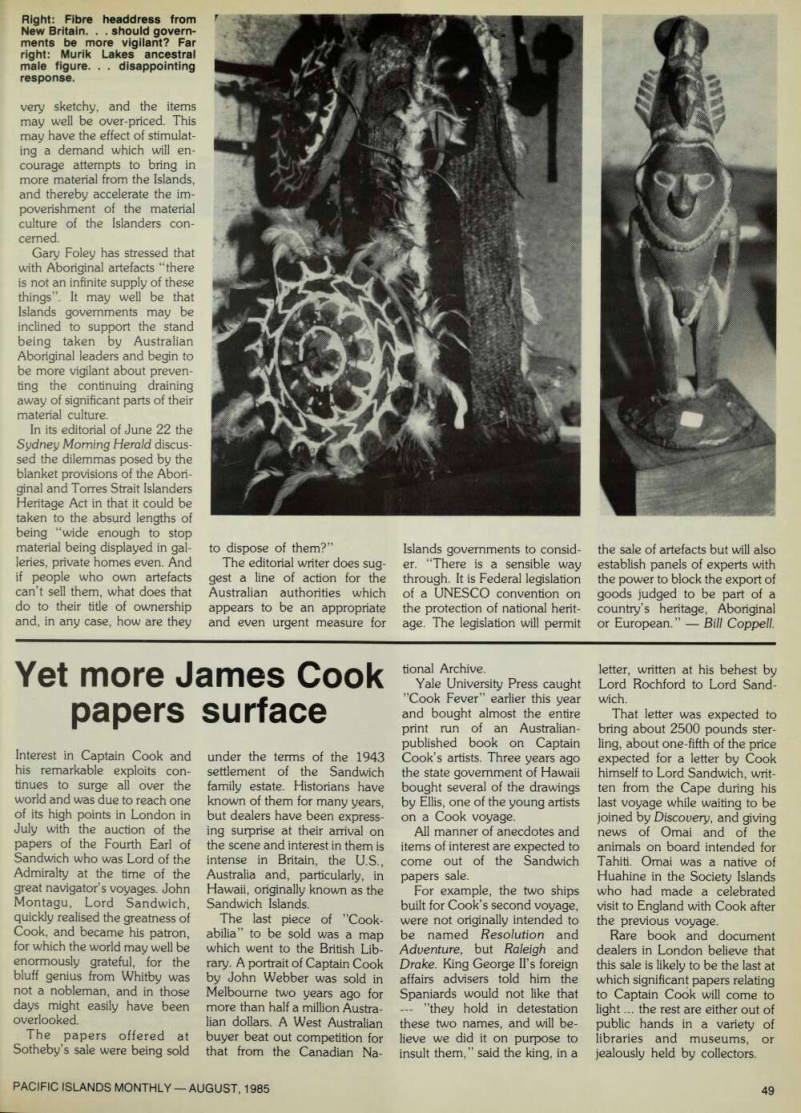
Artefacts under the hammer at eventful Sydney auction
An auction of Australian Abori ginal and Melanesian tribal art was held in Sydney on the evening of June 20.
Late in the afternoon, before the auction began, about 80 lots of Aboriginal origin were suddenly withdrawn from the sale. An injunction had been placed on them following an application by the Aboriginal Lands Council, under the Aboriginal and Torres Strait Islanders Heritage Act. A director of Sotheby’s, the auc tioneering company, Robert Bleakley, stated that this was due to a clause in the act which states “that Aboriginal artefacts must not be treated in a manner inconsistent with tradition”.
Gary Foley, a director of the Aboriginal Land Council, was reported as saying: “It is appall ing that an Australian Govern ment is prepared to spend $1 million on Nellie Melba records, but will not put a cent towards works of this kind.”
There is a stated determina tion by Aboriginal leaders to thwart attempts to export Aboriginal artefacts. The pre-
sent requirement is that an export licence must be signed by Mr Foley, or by a museum director. Foley is also reported : “If pieces do find their way out of the country, they will have gone illegally. But we will chase them to the ends of the earth and take whatever measures we have to to get them back. ’’
The Aboriginal artefacts which were subject to the in junction did not go under the hammer, but bids were taken on them which were referred to the bidders for future sale if the injunction was lifted. However, at time of writing the position has not been clarified as the injunction has been extended for a further month. It may have been due to the imposition of the injunction that prices for the Aboriginal artefacts which went under the hammer, or for which bids were referred, tended to be higher than the market values indicated by the auctioneers. If, in fact, there is to be a con tinuing intervention in the sale of Australian Aboriginal arte facts, there may well be an escalation in the valuations
placed upon those in the hands of private collectors.
A number of good quality Pacific Islands items were also auctioned and there was a mixed reaction from buyers. No explanation was offered for its inclusion in the injunction, but a New Hebrides over-modelled human skull was included in the ban placed on some of the Aboriginal items. The skull re ceived a referred bid of $750.
On the other hand, a Solomon Islands wooden model of a war canoe had been publicised as being one of the major items in the sale, and it was anticipated that it would fetch well into four figures. It was knocked down for $650. There was a firm demand for Papuan and Huon Gulf drums which formed a substantial part of the Islands offerings and which fetched bids ranging from $250-$550.
There was also a substantial offering of wooden bowls from several Papua New Guinea areas, and prices ranged from $9OO for a Tami Island bowl to $9O for a small Huon Gulf bowl. Islands weapons received a mixed reception. There was, however, spirited bidding for two Fijian ulas (throwing clubs) which went for $2BO, and two Massim wooden sword clubs which commanded $320.
Sotheby’s were correct in their assessment of an unusual item, a New Britain fibre head dress, which changed owner ship for $550.
It is difficult to assess the reasons for the value placed on items. Quite common Islands weapons were in demand but an unusual Murik Lakes male ancestral figure went for $2BO, with the auctioneers anticipat ing a top price in the $5OO range.
The Islands artefact which attracted most attention was the final item to go under the hammer, a Solomon Islands wooden canoe prow ornament.
This had been featured in the press as one of the major items in the sale, and fetched $l4OO.
A sale such as this one by Sotheby’s does give an indica tion of the values the dealers and collectors of Islands arte facts are placing on various items. In some cases, questions could be asked as to how realistic these values are as information as to the prove nance of many of them is often
Solomon Islands wooden canoe prow ornament. . . fetched $A1400. - Bill Coppell photos.
very sketchy, and the items may well be over-priced. This may have the effect of stimulat ing a demand which will en courage attempts to bring in more material from the Islands, and thereby accelerate the im poverishment of the material culture of the Islanders con cerned.
Gary Foley has stressed that with Aboriginal artefacts “there is not an infinite supply of these things”. It may well be that Islands governments may be inclined to support the stand being taken by Australian Aboriginal leaders and begin to be more vigilant about preven ting the continuing draining away of significant parts of their material culture.
In its editorial of June 22 the Sydney Morning Herald discus sed the dilemmas posed by the blanket provisions of the Abori ginal and Torres Strait Islanders Heritage Act in that it could be taken to the absurd lengths of being “wide enough to stop material being displayed in gal leries, private homes even. And if people who own artefacts can’t sell them, what does that do to their title of ownership and, in any case, how are they
to dispose of them?”
The editorial writer does sug gest a line of action for the Australian authorities which appears to be an appropriate and even urgent measure for
Islands governments to consider. “There is a sensible way through. It is Federal legislation of a UNESCO convention on the protection of national heritage. The legislation will permit
the sale of artefacts but will also establish panels of experts with the power to block the export of goods judged to be part of a country’s heritage, Aboriginal
or European. ”
Bill Coppell.
Right: Fibre headdress from New Britain. . . should govern ments be more vigilant? Far right: Murik Lakes ancestral male figure. . . disappointing response.
papers surface
Yet more James Cook papers surface
Interest in Captain Cook and his remarkable exploits continues to surge all over the world and was due to reach one of its high points in London in July with the auction of the papers of the Fourth Earl of Sandwich who was Lord of the Admiralty at the time of the great navigator’s voyages. John Montagu, Lord Sandwich, quickly realised the greatness of Cook, and became his patron, for which the world may well be enormously grateful, for the bluff genius from Whitby was not a nobleman, and in those days might easily have been overlooked.
The papers offered at Sotheby’s sale were being sold
under the terms of the 1943 settlement of the Sandwich family estate. Historians have known of them for many years, but dealers have been express ing surprise at their arrival on the scene and interest in them is intense in Britain, the U.S., Australia and, particularly, in Hawaii, originally known as the Sandwich Islands, The last piece of ’’Cook abilia” to be sold was a map which went to the British Lib rary. A portrait of Captain Cook by John Webber was sold in Melbourne two years ago for more than half a million Austra lian dollars. A West Australian buyer beat out competition for that from the Canadian Na
tional Archive.
Yale University Press caught ’’Cook Fever” earlier this year and bought almost the entire print run of an Australian published book on Captain Cook’s artists. Three years ago the state government of Hawaii bought several of the drawings by Ellis, one of the young artists on a Cook voyage.
All manner of anecdotes and items of interest are expected to come out of the Sandwich papers sale.
For example, the two ships built for Cook’s second voyage, were not originally intended to be named Resolution and Adventure, but Raleigh and Drake. King George ll’s foreign affairs advisers told him the Spaniards would not like that ’’they hold in detestation these two names, and will be lieve we did it on purpose to insult them,” said the king, in a
letter, written at his behest by Lord Rochford to Lord Sand wich.
That letter was expected to bring about 2500 pounds ster ling, about one-fifth of the price expected for a letter by Cook himself to Lord Sandwich, writ ten from the Cape during his last voyage while waiting to be joined by Discovery, and giving news of Omai and of the animals on board intended for Tahiti. Omai was a native of Huahine in the Society Islands who had made a celebrated visit to England with Cook after the previous voyage.
Rare book and document dealers in London believe that this sale is likely to be the last at which significant papers relating to Captain Cook will come to light... the rest are either out of public hands in a variety of libraries and museums, or jealously held by collectors.
A question of legitimacy
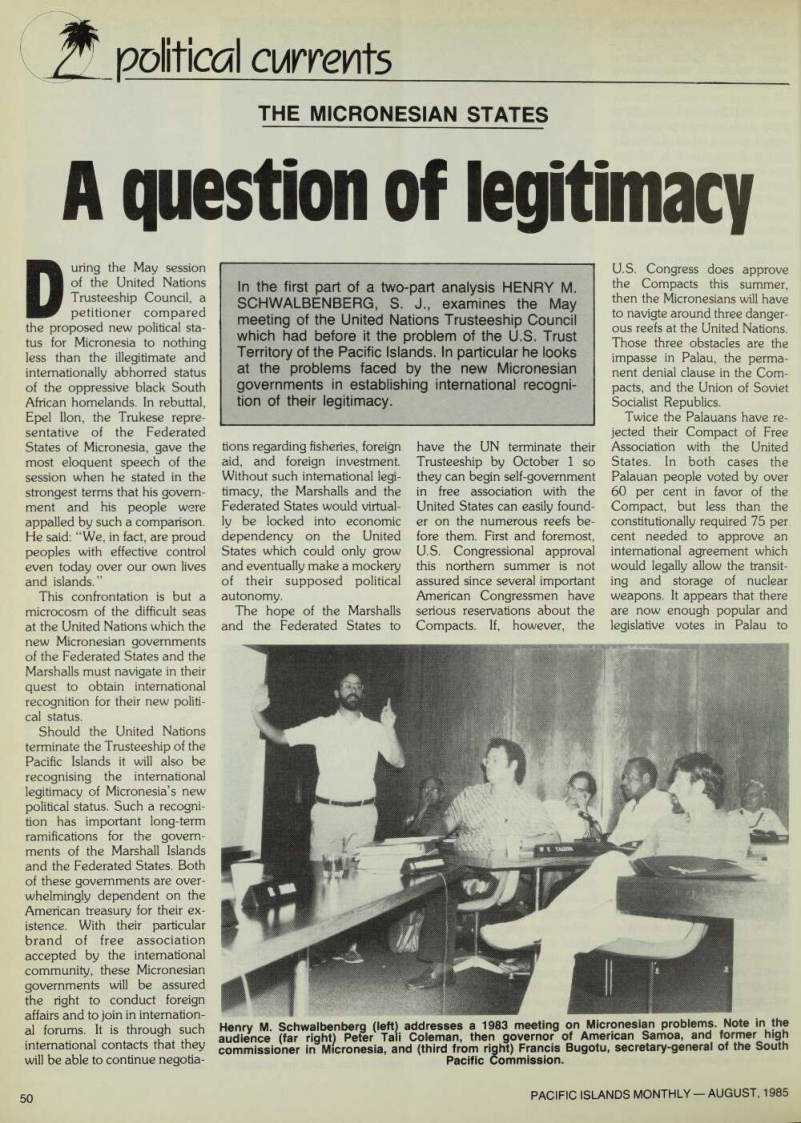
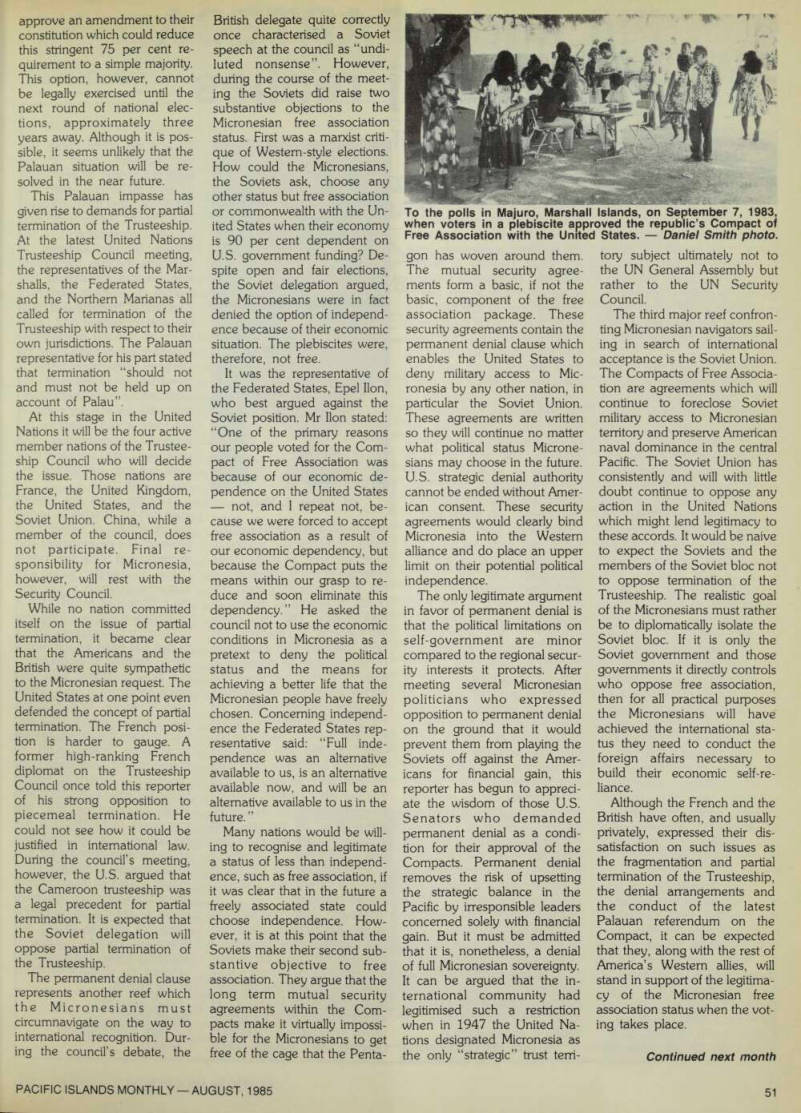
political currents
The Micronesian States
During the May session of the United Nations Trusteeship Council, a petitioner compared the proposed new political sta tus for Micronesia to nothing less than the illegitimate and internationally abhorred status of the oppressive black South African homelands. In rebuttal, Epel lion, the Trukese repre sentative of the Federated States of Micronesia, gave the most eloquent speech of the session when he stated in the strongest terms that his govern ment and his people were appalled by such a comparison.
He said: “We, in fact, are proud peoples with effective control even today over our own lives and islands.”
This confrontation is but a microcosm of the difficult seas at the United Nations which the new Micronesian governments of the Federated States and the Marshalls must navigate in their quest to obtain international recognition for their new politi cal status.
Should the United Nations terminate the Trusteeship of the Pacific Islands it will also be recognising the international legitimacy of Micronesia’s new political status. Such a recogni tion has important long-term ramifications for the govern ments of the Marshall Islands and the Federated States. Both of these governments are over whelmingly dependent on the American treasury for their ex istence. With their particular brand of free association accepted by the international community, these Micronesian governments will be assured the right to conduct foreign affairs and to join in internation al forums. It is through such international contacts that they will be able to continue negotia-
In the first part of a two-part analysis HENRY M.
SCHWALBENBERG, S. J., examines the May meeting of the United Nations Trusteeship Council which had before it the problem of the U.S. Trust Territory of the Pacific Islands. In particular he looks at the problems faced by the new Micronesian governments in establishing international recogni tion of their legitimacy.
tions regardinjg fisheries, foreign aid, and foreign investment.
Without such international legi timacy, the Marshalls and the Federated States would virtual ly be locked into economic dependency on the United States which could only grow and eventually make a mockery of their supposed political autonomy.
The hope of the Marshalls and the Federated States to
have the UN terminate their Trusteeship by October 1 so they can begin self-government in free association with the United States can easily found er on the numerous reefs be fore them. First and foremost, U.S. Congressional approval this northern summer is not assured since several important American Congressmen have serious reservations about the Compacts. If, however, the
U.S. Congress does approve the Compacts this summer, then the Micronesians will have to navigte around three danger ous reefs at the United Nations.
Those three obstacles are the impasse in Palau, the perma nent denial clause in the Com pacts, and the Union of Soviet Socialist Republics.
Twice the Palauans have re jected their Compact of Free Association with the United States. In both cases the Palauan people voted by over 60 per cent in favor of the Compact, but less than the constitutionally required 75 per cent needed to approve an international agreement which would legally allow the transit ing and storage of nuclear weapons. It appears that there are now enough popular and legislative votes in Palau to
Henry M. Schwalbenberg (left) addresses a 1983 meeting on Micronesian problems. Note in the audience (far right) Peter Tali Coleman, then governor of American Samoa, and former high commissioner in Micronesia, and (third from right) Francis Bugotu, secretary-general of the South Pacific Commission.
approve an amendment to their constitution which could reduce this stringent 75 per cent re quirement to a simple majority.
This option, however, cannot be legally exercised until the next round of national elec tions, approximately three years away. Although it is pos sible, it seems unlikely that the Palauan situation will be re solved in the near future.
This Palauan impasse has given rise to demands for partial termination of the Trusteeship.
At the latest United Nations Trusteeship Council meeting, the representatives of the Mar shalls, the Federated States, and the Northern Marianas all called for termination of the Trusteeship with respect to their own jurisdictions. The Palauan representative for his part stated that termination “should not and must not be held up on account of Palau”.
At this stage in the United Nations it will be the four active member nations of the Trustee ship Council who will decide the issue. Those nations are France, the United Kingdom, the United States, and the Soviet Union. China, while a member of the council, does not participate. Final re sponsibility for Micronesia, however, will rest with the Security Council.
While no nation committed itself on the issue of partial termination, it became clear that the Americans and the British were quite sympathetic to the Micronesian request. The United States at one point even defended the concept of partial termination. The French posi tion is harder to gauge. A former high-ranking French diplomat on the Trusteeship Council once told this reporter of his strong opposition to piecemeal termination. He could not see how it could be justified in international law.
During the council’s meeting, however, the U.S. argued that the Cameroon trusteeship was a legal precedent for partial termination. It is expected that the Soviet delegation will oppose partial termination of the Trusteeship.
The permanent denial clause represents another reef which the Micronesians must circumnavigate on the way to international recognition. Dur ing the council’s debate, the
British delegate quite correctly once characterised a Soviet speech at the council as “undi luted nonsense”. However, during the course of the meet ing the Soviets did raise two substantive objections to the Micronesian free association status. First was a marxist criti que of Western-style elections.
How could the Micronesians, the Soviets ask, choose any other status but free association or commonwealth with the Un ited States when their economy is 90 per cent dependent on U.S. government funding? De spite open and fair elections, the Soviet delegation argued, the Micronesians were in fact denied the option of independ ence because of their economic situation. The plebiscites were, therefore, not free.
It was the representative of the Federated States, Epel lion, who best argued against the Soviet position. Mr lion stated: “One of the primary reasons our people voted for the Com pact of Free Association was because of our economic de pendence on the United States not, and I repeat not, be cause we were forced to accept free association as a result of our economic dependency, but because the Compact puts the means within our grasp to re duce and soon eliminate this dependency.” He asked the council not to use the economic conditions in Micronesia as a pretext to deny the political status and the means for achieving a better life that the Micronesian people have freely chosen. Concerning independ ence the Federated States rep resentative said: “Full inde pendence was an alternative available to us, is an alternative available now, and will be an alternative available to us in the future. ”
Many nations would be will ing to recognise and legitimate a status of less than independ ence, such as free association, if it was clear that in the future a freely associated state could choose independence. How ever, it is at this point that the Soviets make their second sub stantive objective to free association. They argue that the long term mutual security agreements within the Com pacts make it virtually impossi ble for the Micronesians to get free of the cage that the Penta-
gon has woven around them.
The mutual security agree ments form a basic, if not the basic, component of the free association package. These security agreements contain the permanent denial clause which enables the United States to deny military access to Mic ronesia by any other nation, in particular the Soviet Union.
These agreements are written so they will continue no matter what political status Micronc sians may choose in the future.
U.S. strategic denial authority cannot be ended without Amer ican consent. These security agreements would clearly bind Micronesia into the Western alliance and do place an upper limit on their potential political independence.
The only legitimate argument in favor of permanent denial is that the political limitations on self-government are minor compared to the regional secur ity interests it protects. After meeting several Micronesian politicians who expressed opposition to permanent denial on the ground that it would prevent them from playing the Soviets off against the Amer icans for financial gain, this reporter has begun to appreci ate the wisdom of those U.S.
Senators who demanded permanent denial as a condi tion for their approval of the Compacts. Permanent denial removes the risk of upsetting the strategic balance in the Pacific by irresponsible leaders concerned solely with financial gain. But it must be admitted that it is, nonetheless, a denial of full Micronesian sovereignty.
It can be argued that the in ternational community had legitimised such a restriction when in 1947 the United Na tions designated Micronesia as the only “strategic” trust terri
tory subject ultimately not to the UN General Assembly but rather to the UN Security Council.
The third major reef confron ting Micronesian navigators sail ing in search of international acceptance is the Soviet Union.
The Compacts of Free Associa tion are agreements which will continue to foreclose Soviet military access to Micronesian territory and preserve American naval dominance in the central Pacific. The Soviet Union has consistently and will with little doubt continue to oppose any action in the United Nations which might lend legitimacy to these accords. It would be naive to expect the Soviets and the members of the Soviet bloc not to oppose termination of the Trusteeship. The realistic goal of the Micronesians must rather be to diplomatically isolate the Soviet bloc. If it is only the Soviet government and those governments it directly controls who oppose free association, then for all practical purposes the Micronesians will have achieved the international sta tus they need to conduct the foreign affairs necessary to build their economic self-re liance.
Although the French and the British have often, and usually privately, expressed their dis satisfaction on such issues as the fragmentation and partial termination of the Trusteeship, the denial arrangements and the conduct of the latest Palauan referendum on the Compact, it can be expected that they, along with the rest of America’s Western allies, will stand in support of the legitima cy of the Micronesian free association status when the vot ing takes place.
Continued next month
To the polls in Majuro, Marshall Islands, on September 7, 1983, when voters in a plebiscite approved the republic’s Compact of Free Association with the United States. - Daniel Smith photo.
Dr Maraj replies
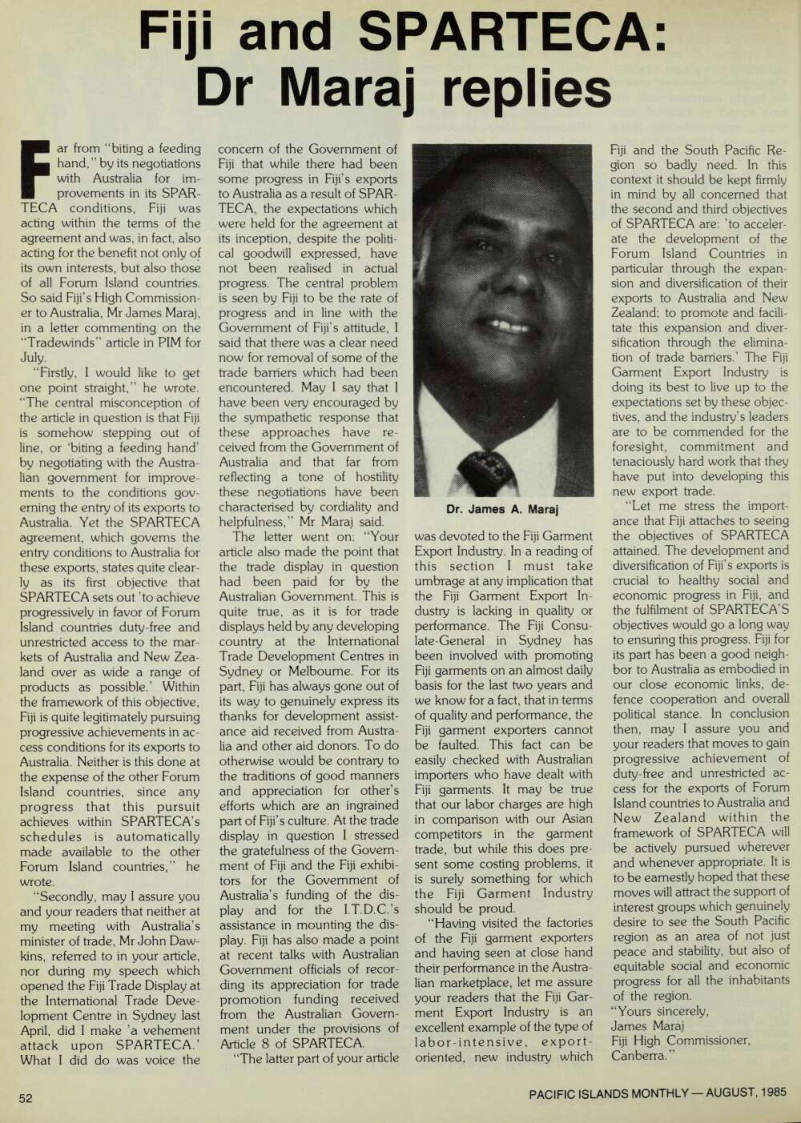
Fiji and SPARTECA: Dr Maraj replies
Far from “biting a feeding hand,” by its negotiations with Australia for im provements in its SPAR TECA conditions, Fiji was acting within the terms of the agreement and was, in fact, also acting for the benefit not only of its own interests, but also those of all Forum Island countries.
So said Fiji’s High Commission er to Australia, Mr James Maraj, in a letter commenting on the “Tradewinds” article in PIM for July.
“Firstly, I would like to get one point straight,” he wrote.
“The central misconception of the article in question is that Fiji is somehow stepping out of line, or ‘biting a feeding hand’ by negotiating with the Austra lian government for improve ments to the conditions gov erning the entry of its exports to Australia. Yet the SPARTECA agreement, which governs the entry conditions to Australia for these exports, states quite clear ly as its first objective that SPARTECA sets out ’to achieve progressively in favor of Forum Island countries duty-free and unrestricted access to the mar kets of Australia and New Zea land over as wide a range of products as possible.’ Within the framework of this objective, Fiji is quite legitimately pursuing progressive achievements in ac cess conditions for its exports to Australia. Neither is this done at the expense of the other Forum Island countries, since any progress that this pursuit achieves within SPARTECA’s schedules is automatically made available to the other Forum Island countries,” he wrote.
“Secondly, may I assure you and your readers that neither at my meeting with Australia’s minister of trade, Mr John Daw kins, referred to in your article, nor during my speech which opened the Fiji Trade Display at the International Trade Deve lopment Centre in Sydney last April, did I make ’a vehement attack upon SPARTECA.’
What I did do was voice the
concern of the Government of Fiji that while there had been some progress in Fiji’s exports to Australia as a result of SPAR TECA, the expectations which were held for the agreement at its inception, despite the politi cal goodwill expressed, have not been realised in actual progress. The central problem is seen by Fiji to be the rate of progress and in line with the Government of Fiji’s attitude, I said that there was a clear need now for removal of some of the trade barriers which had been encountered. May I say that I have been very encouraged by the sympathetic response that these approaches have re ceived from the Government of Australia and that far from reflecting a tone of hostility these negotiations have been characterised by cordiality and helpfulness,” Mr Maraj said.
The letter went on: “Your article also made the point that the trade display in question had been paid for by the Australian Government. This is quite true, as it is for trade displays held by any developing country at the International Trade Development Centres in Sydney or Melbourne. For its part, Fiji has always gone out of its way to genuinely express its thanks for development assist ance aid received from Austra lia and other aid donors. To do otherwise would be contrary to the traditions of good manners and appreciation for other’s efforts which are an ingrained part of Fiji’s culture. At the trade display in question I stressed the gratefulness of the Govern ment of Fiji and the Fiji exhibi tors for the Government of Australia’s funding of the dis play and for the I.T.D.C.’s assistance in mounting the dis play. Fiji has also made a point at recent talks with Australian Government officials of recor ding its appreciation for trade promotion funding received from the Australian Govern ment under the provisions of Article 8 of SPARTECA.
“The latter part of your article
was devoted to the Fiji Garment Export Industry. In a reading of this section I must take umbrage at any implication that the Fiji Garment Export In dustry is lacking in quality or performance. The Fiji Consu late-General in Sydney has been involved with promoting Fiji garments on an almost daily basis for the last two years and we know for a fact, that in terms of quality and performance, the Fiji garment exporters cannot be faulted. This fact can be easily checked with Australian importers who have dealt with Fiji garments. It may be true that our labor charges are high in comparison with our Asian competitors in the garment trade, but while this does pre sent some costing problems, it is surely something for which the Fiji Garment Industry should be proud.
“Having visited the factories of the Fiji garment exporters and having seen at close hand their performance in the Austra lian marketplace, let me assure your readers that the Fiji Gar ment Export Industry is an excellent example of the type of labor-intensive, export oriented, new industry which
Fiji and the South Pacific Re gion so badly need. In this context it should be kept firmly in mind by all concerned that the second and third objectives of SPARTECA are: ’to acceler ate the development of the Forum Island Countries in particular through the expan sion and diversification of their exports to Australia and New Zealand; to promote and facili tate this expansion and diver sification through the elimina tion of trade barriers.’ The Fiji Garment Export Industry is doing its best to live up to the expectations set by these objec tives, and the industry’s leaders are to be commended for the foresight, commitment and tenaciously hard work that they have put into developing this new export trade.
“Let me stress the import ance that Fiji attaches to seeing the objectives of SPARTECA attained. The development and diversification of Fiji’s exports is crucial to healthy social and economic progress in Fiji, and the fulfilment of SPARTECA’S objectives would go a long way to ensuring this progress. Fiji for its part has been a good neigh bor to Australia as embodied in our close economic links, de fence cooperation and overall political stance. In conclusion then, may 1 assure you and your readers that moves to gain progressive achievement of duty-free and unrestricted ac cess for the exports of Forum Island countries to Australia and New Zealand within the framework of SPARTECA will be actively pursued wherever and whenever appropriate. It is to be earnestly hoped that these moves will attract the support of interest groups which genuinely desire to see the South Pacific region as an area of not just peace and stability, but also of equitable social and economic progress for all the inhabitants of the region.
“Yours sincerely,
James Maraj
Fiji High Commissioner, Canberra. ”
Dr. James A. Maraj
Pacific stamp box
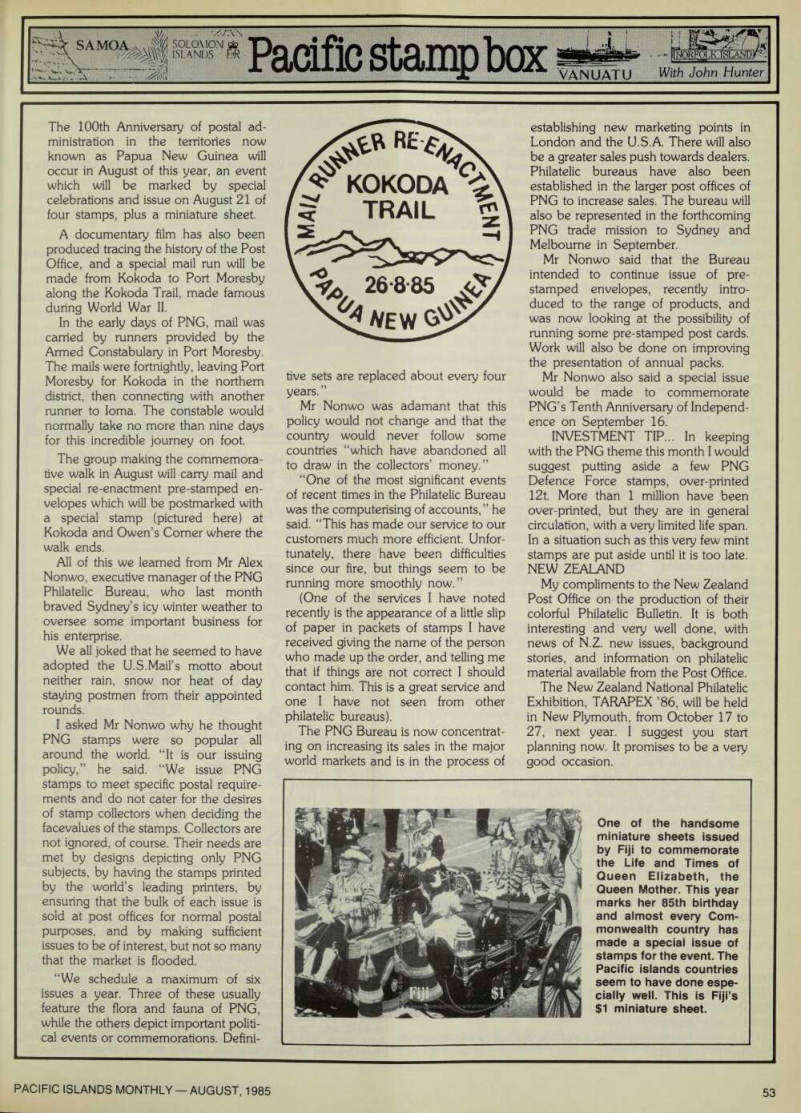
The 100th Anniversary of postal ad ministration in the territories now known as Papua New Guinea will occur in August of this year, an event which will be marked by special celebrations and issue on August 21 of four stamps, plus a miniature sheet.
A documentary film has also been produced tracing the history of the Post Office, and a special mail run will be made from Kokoda to Port Moresby along the Kokoda Trail, made famous during World War 11.
In the early days of PNG, mail was carried by runners provided by the Armed Constabulary in Port Moresby.
The mails were fortnightly, leaving Port Moresby for Kokoda in the northern district, then connecting with another runner to loma. The constable would normally take no more than nine days for this incredible journey on foot.
The group making the commemora tive walk in August will carry mail and special re-enactment pre-stamped en velopes which will be postmarked with a special stamp (pictured here) at Kokoda and Owen’s Corner where the walk ends.
All of this we learned from Mr Alex Nonwo, executive manager of the PNG Philatelic Bureau, who last month braved Sydney’s icy winter weather to oversee some important business for his enterprise.
We all joked that he seemed to have adopted the U.S.Mail’s motto about neither rain, snow nor heat of day staying postmen from their appointed rounds.
I asked Mr Nonwo why he thought PNG stamps were so popular all around the world. “It is our issuing policy,” he said. “We issue PNG stamps to meet specific postal require ments and do not cater for the desires of stamp collectors when deciding the facevalues of the stamps. Collectors are not ignored, of course. Their needs are met by designs depicting only PNG subjects, by having the stamps printed by the world’s leading printers, by ensuring that the bulk of each issue is sold at post offices for normal postal purposes, and by making sufficient issues to be of interest, but not so many that the market is flooded.
“We schedule a maximum of six issues a year. Three of these usually feature the flora and fauna of PNG, while the others depict important politi cal events or commemorations. Defini-
tive sets are replaced about every four years. ”
Mr Nonwo was adamant that this policy would not change and that the country would never follow some countries “which have abandoned all to draw in the collectors’ money.”
“One of the most significant events of recent times in the Philatelic Bureau was the computerising of accounts,” he said. “This has made our service to our customers much more efficient. Unfor tunately, there have been difficulties since our fire, but things seem to be running more smoothly now.” (One of the services I have noted recently is the appearance of a little slip of paper in packets of stamps I have received giving the name of the person who made up the order, and telling me that if things are not correct I should contact him. This is a great service and one I have not seen from other philatelic bureaus).
The PNG Bureau is now concentrat ing on increasing its sales in the major world markets and is in the process of
establishing new marketing points in London and the U.S.A. There will also be a greater sales push towards dealers.
Philatelic bureaus have also been established in the larger post offices of PNG to increase sales. The bureau will also be represented in the forthcoming PNG trade mission to Sydney and Melbourne in September.
Mr Nonwo said that the Bureau intended to continue issue of pre stamped envelopes, recently intro duced to the range of products, and was now looking at the possibility of running some pre-stamped post cards.
Work will also be done on improving the presentation of annual packs.
Mr Nonwo also said a special issue would be made to commemorate PNG’s Tenth Anniversary of Independ ence on September 16.
INVESTMENT TIP... In keeping with the PNG theme this month I would suggest putting aside a few PNG Defence Force stamps, over-printed 12t. More than 1 million have been over-printed, but they are in general circulation, with a very limited life span.
In a situation such as this very few mint stamps are put aside until it is too late.
New Zealand
My compliments to the New Zealand Post Office on the production of their colorful Philatelic Bulletin. It is both interesting and very well done, with news of N.Z. new issues, background stories, and information on philatelic material available from the Post Office.
The New Zealand National Philatelic Exhibition, TARAPEX ’B6, will be held in New Plymouth, from October 17 to 27, next year. I suggest you start planning now. It promises to be a very good occasion.
One of the handsome miniature sheets issued
by Fiji to commemorate
the Life and Times of Queen Elizabeth, the Queen Mother. This year marks her 85th birthday and almost every Com monwealth country has made a special issue of stamps for the event. The Pacific islands countries seem to have done espe cially well. This is Fiji’s $1 miniature sheet.
from the islands press
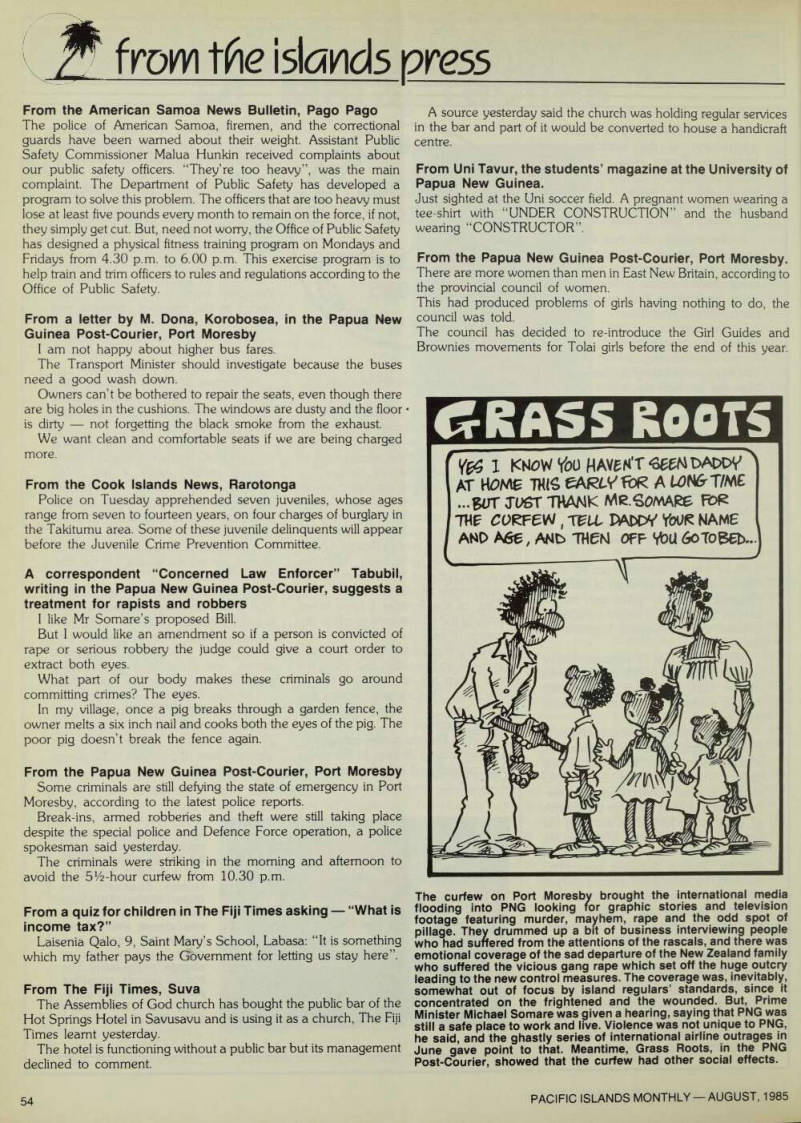
From the American Samoa News Bulletin, Pago Pago The police of American Samoa, firemen, and the correctional guards have been warned about their weight. Assistant Public Safety Commissioner Malua Hunkin received complaints about our public safety officers. “They’re too heavy”, was the main complaint. The Department of Public Safety has developed a program to solve this problem. The officers that are too heavy must lose at least five pounds every month to remain on the force, if not, they simply get cut. But, need not worry, the Office of Public Safety has designed a physical fitness training program on Mondays and Fridays from 4.30 p.m. to 6.00 p.m. This exercise program is to help train and trim officers to rules and regulations according to the Office of Public Safety.
From a letter by M. Dona, Korobosea, in the Papua New Guinea Post-Courier, Port Moresby I am not happy about higher bus fares.
The Transport Minister should investigate because the buses need a good wash down.
Owners can’t be bothered to repair the seats, even though there are big holes in the cushions. The windows are dusty and the floor is dirty not forgetting the black smoke from the exhaust.
We want clean and comfortable seats if we are being charged more.
From the Cook Islands News, Rarotonga Police on Tuesday apprehended seven juveniles, whose ages range from seven to fourteen years, on four charges of burglary in the Takitumu area. Some of these juvenile delinquents will appear before the Juvenile Crime Prevention Committee.
A correspondent “Concerned Law Enforcer” Tabubil, writing in the Papua New Guinea Post-Courier, suggests a treatment for rapists and robbers I like Mr Somare’s proposed Bill.
But I would like an amendment so if a person is convicted of rape or serious robbery the judge could give a court order to extract both eyes.
What part of our body makes these criminals go around committing crimes? The eyes.
In my village, once a pig breaks through a garden fence, the owner melts a six inch nail and cooks both the eyes of the pig. The poor pig doesn’t break the fence again.
From the Papua New Guinea Post-Courier, Port Moresby Some criminals are still defying the state of emergency in Port Moresby, according to the latest police reports.
Break-ins, armed robberies and theft were still taking place despite the special police and Defence Force operation, a police spokesman said yesterday.
The criminals were striking in the morning and afternoon to avoid the SVz-hour curfew from 10.30 p.m.
From a quiz for children in The Fiji Times asking “What is income tax?”
Laisenia Qalo, 9, Saint Mary’s School, Labasa: “It is something which my father pays the Government for letting us stay here”.
From The Fiji Times, Suva The Assemblies of God church has bought the public bar of the Hot Springs Hotel in Savusavu and is using it as a church, The Fiji Times leamt yesterday.
The hotel is functioning without a public bar but its management declined to comment.
A source yesterday said the church was holding regular services in the bar and part of it would be converted to house a handicraft centre.
From Uni Tavur, the students’ magazine at the University of Papua New Guinea.
Just sighted at the Uni soccer field. A pregnant women wearing a tee-shirt with “UNDER CONSTRUCTION” and the husband wearing “CONSTRUCTOR”.
From the Papua New Guinea Post-Courier, Port Moresby.
There are more women than men in East New Britain, according to the provincial council of women.
This had produced problems of girls having nothing to do, the council was told.
The council has decided to re-introduce the Girl Guides and Brownies movements for Tolai girls before the end of this year.
Grass Roots
The curfew on Port Moresby brought the International media flooding into PNG looking for graphic stories and television footage featuring murder, mayhem, rape and the odd spot of pillage. They drummed up a bit of business interviewing people who had suffered from the attentions of the rascals, and there was emotional coverage of the sad departure of the New Zealand family who suffered the vicious gang rape which set off the huge outcry leading to the new control measures. The coverage was, inevitably, somewhat out of focus by island regulars’ standards, since it concentrated on the frightened and the wounded. But, Prime Minister Michael Somare was given a hearing, saying that PNG was still a safe place to work and live. Violence was not unique to PNG, he said, and the ghastly series of international airline outrages in June gave point to that. Meantime, Grass Roots, in the PNG Post-Courier, showed that the curfew had other social effects.
people
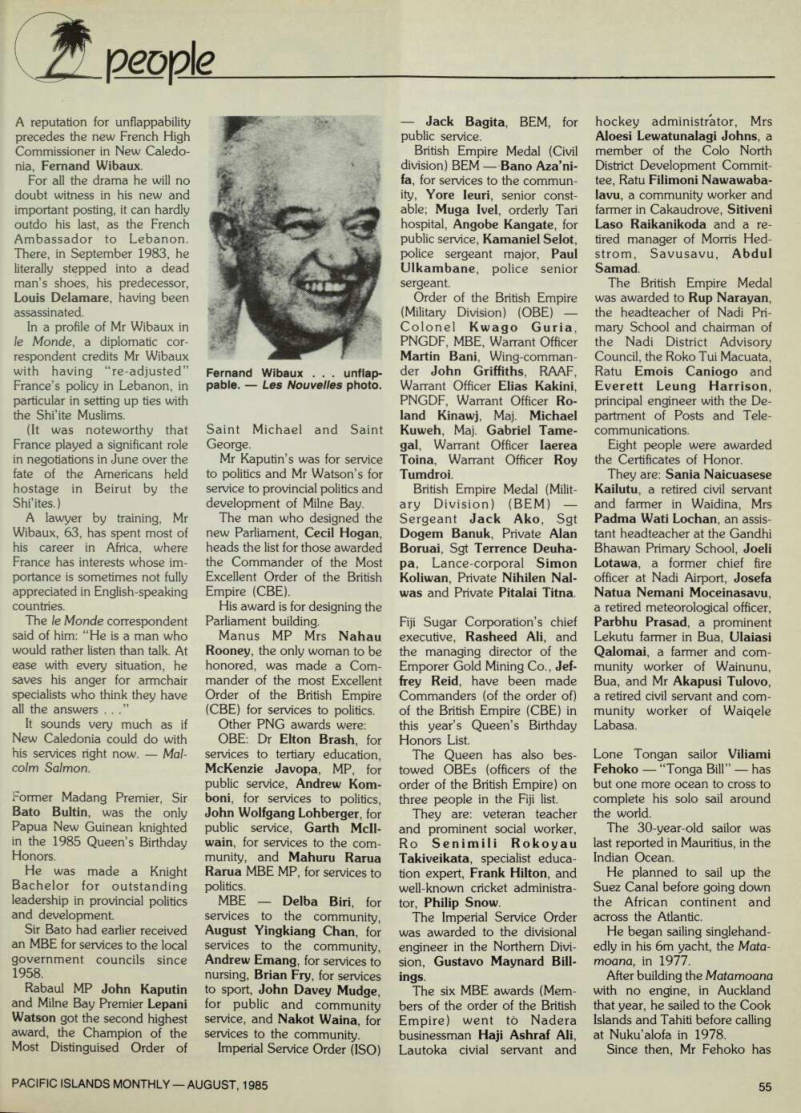
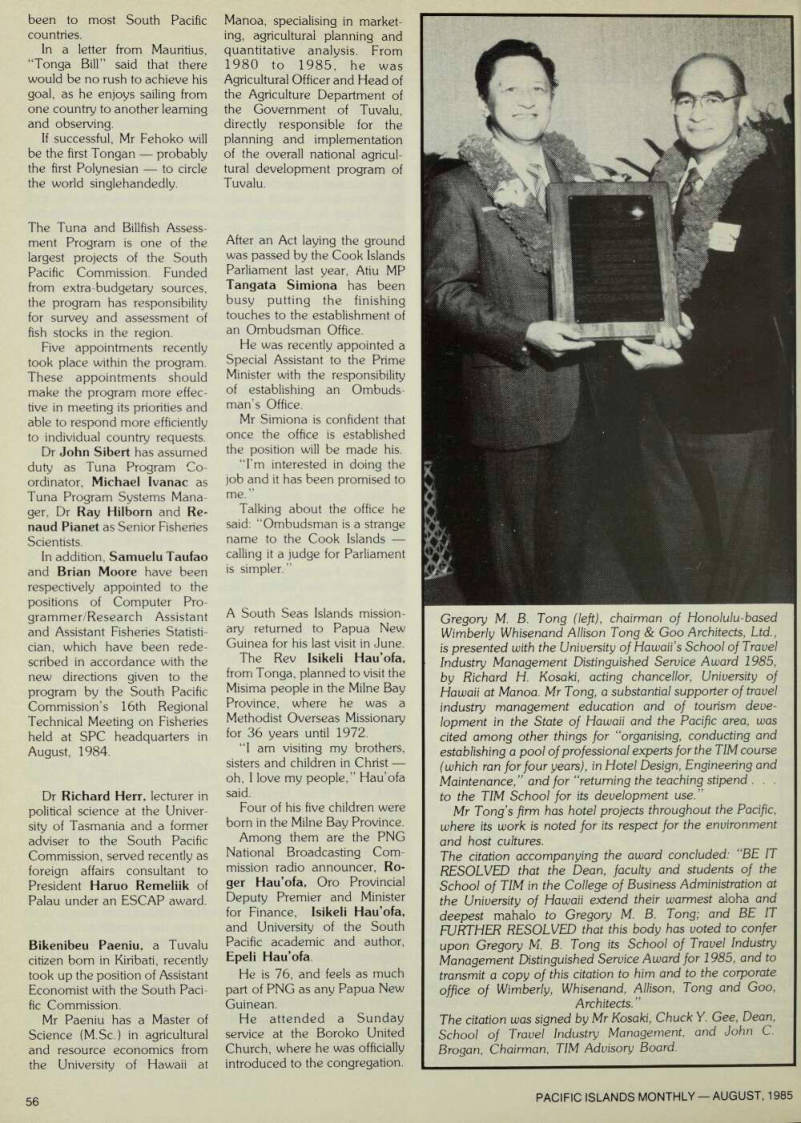
A reputation for unflappability precedes the new French High Commissioner in New Caledo nia, Fernand Wibaux.
For all the drama he will no doubt witness in his new and important posting, it can hardly outdo his last, as the French Ambassador to Lebanon.
There, in September 1983, he literally stepped into a dead man’s shoes, his predecessor, Louis Delamare, having been assassinated.
In a profile of Mr Wibaux in le Monde , a diplomatic cor respondent credits Mr Wibaux with having “re-adjusted”
France’s policy in Lebanon, in particular in setting up ties with the Shi’ite Muslims. (It was noteworthy that France played a significant role in negotiations in June over the fate of the Americans held hostage in Beirut by the Shi’ites.) A lawyer by training, Mr Wibaux, 63, has spent most of his career in Africa, where France has interests whose im portance is sometimes not fully appreciated in English-speaking countries.
The le Monde correspondent said of him: “He is a man who would rather listen than talk. At ease with every situation, he saves his anger for armchair specialists who think they have all the answers ...”
It sounds very much as if New Caledonia could do with his services right now. Mal colm Salmon.
Former Madang Premier, Sir Bato Bultin, was the only Papua New Guinean knighted in the 1985 Queen’s Birthday Honors.
He was made a Knight Bachelor for outstanding leadership in provincial politics and development.
Sir Bato had earlier received an MBE for services to the local government councils since 1958.
Rabaul MP John Kaputin and Milne Bay Premier Lepani Watson got the second highest award, the Champion of the Most Distinguised Order of
Saint Michael and Saint George.
Mr Kaputin’s was for service to politics and Mr Watson’s for service to provincial politics and development of Milne Bay.
The man who designed the new Parliament, Cecil Hogan, heads the list for those awarded the Commander of the Most Excellent Order of the British Empire (CBE).
His award is for designing the Parliament building.
Manus MP Mrs Nahau Rooney, the only woman to be honored, was made a Com mander of the most Excellent Order of the British Empire (CBE) for services to politics.
Other PNG awards were: OBE; Dr Elton Brash, for services to tertiary education, McKenzie Javopa, MP, for public service, Andrew Kom boni, for services to politics, John Wolfgang Lohberger, for public service, Garth Mcll wain, for services to the com munity, and Mahuru Rarua Rama MBE MP, for services to politics.
MBE Delba Biri, for services to the community, August Yingkiang Chan, for services to the community, Andrew Emang, for services to nursing, Brian Fry, for services to sport, John Davey Mudge, for public and community service, and Nakot Waina, for services to the community.
Imperial Service Order (ISO)
Jack Bagita, BEM, for public service.
British Empire Medal (Civil division) BEM Bano Aza’ni fa, for services to the commun ity, Yore leuri, senior const able; Muga Ivel, orderly Tari hospital, Angobe Kangate, for public service, Kamaniel Selot, police sergeant major, Paul Ulkambane, police senior sergeant.
Order of the British Empire (Military Division) (OBE) Colonel Kwago Guria, PNGDF, MBE, Warrant Officer Martin Bani, Wing-comman der John Griffiths, RAAF, Warrant Officer Elias Kakini, PNGDF, Warrant Officer Ro land Kinawj, Maj. Michael Kuweh, Maj. Gabriel Tamc gal, Warrant Officer laerea Toina, Warrant Officer Roy Tumdroi.
British Empire Medal (Milit ary Division) (BEM) Sergeant Jack Ako, Sgt Dogem Banuk, Private Alan Boruai, Sgt Terrence Deuha pa, Lance-corporal Simon Koliwan, Private Nihilen Nal was and Private Pitalai Titna.
Fiji Sugar Corporation’s chief executive, Rasheed Ali, and the managing director of the Emporer Gold Mining Co., Jef frey Reid, have been made Commanders (of the order of) of the British Empire (CBE) in this year’s Queen’s Birthday Honors List.
The Queen has also bes towed OBEs (officers of the order of the British Empire) on three people in the Fiji list.
They are: veteran teacher and prominent social worker, Ro Senimili Rokoyau Takiveikata, specialist educa tion expert, Frank Hilton, and well-known cricket administra tor, Philip Snow.
The Imperial Service Order was awarded to the divisional engineer in the Northern Divi sion, Gustavo Maynard Bill ings The six MBE awards (Mem bers of the order of the British Empire) went to Nadera businessman Haji Ashraf Ali, Lautoka civial servant and
hockey administrator, Mrs Aloesi Lewatunalagi Johns, a member of the Colo North District Development Commit tee, Ratu Filimoni Nawawaba lavu, a community worker and farmer in Cakaudrove, Sitiveni Laso Raikanikoda and a re tired manager of Morris Hed strom, Savusavu, Abdul Samad.
The British Empire Medal was awarded to Rup Narayan, the headteacher of Nadi Pri mary School and chairman of the Nadi District Advisory Council, the Roko Tui Macuata, Ratu Emois Caniogo and Everett Leung Harrison, principal engineer with the De partment of Posts and Tele communications.
Eight people were awarded the Certificates of Honor.
They are: Sania Naicuasese Kailutu, a retired civil servant and farmer in Waidina, Mrs Padma Wati Lochan, an assis tant headteacher at the Gandhi Bhawan Primary School, Joeli Lotawa, a former chief fire officer at Nadi Airport, Josefa Natua Nemani Moceinasavu, a retired meteorological officer, Parbhu Prasad, a prominent Lekutu farmer in Bua, Ulaiasi Qalomai, a farmer and com munity worker of Wainunu, Bua, and Mr Akapusi Tulovo, a retired civil servant and com munity worker of Waiqele Labasa.
Lone Tongan sailor Viliami Fehoko “Tonga Bill” has but one more ocean to cross to complete his solo sail around the world.
The 30-year-old sailor was last reported in Mauritius, in the Indian Ocean.
He planned to sail up the Suez Canal before going down the African continent and across the Atlantic.
He began sailing singlehand edly in his 6m yacht, the Mata moana, in 1977.
After building the Matamoana with no engine, in Auckland that year, he sailed to the Cook Islands and Tahiti before calling at Nuku’alofa in 1978.
Since then, Mr Fehoko has
Fernand Wibaux . . . unflap pable. - Les Nouvelles photo.
been to most South Pacific countries.
In a letter from Mauritius, “Tonga Bill” said that there would be no rush to achieve his goal, as he enjoys sailing from one country to another learning and observing.
If successful, Mr Fehoko will be the first Tongan probably the first Polynesian to circle the world singlehandedly.
The Tuna and Billfish Assess ment Program is one of the largest projects of the South Pacific Commission. Funded from extra-budgetary sources, the program has responsibility for survey and assessment of fish stocks in the region.
Five appointments recently took place within the program.
These appointments should make the program more effec tive in meeting its priorities and able to respond more efficiently to individual country requests.
Dr John Sibert has assumed duty as Tuna Program Co ordinator, Michael Ivanac as Tuna Program Systems Mana ger, Dr Ray Hilborn and Re naud Pianet as Senior Fisheries Scientists.
In addition, Samuelu Taufao and Brian Moore have been respectively appointed to the positions of Computer Pro grammer/Research Assistant and Assistant Fisheries Statisti cian, which have been rede scribed in accordance with the new directions given to the program by the South Pacific Commission’s 16th Regional Technical Meeting on Fisheries held at SPC headquarters in August, 1984.
Dr Richard Herr, lecturer in political science at the Univer sity of Tasmania and a former adviser to the South Pacific Commission, served recently as foreign affairs consultant to President Haruo Remeliik of Palau under an ESCAP award.
Bikenibeu Paeniu, a Tuvalu citizen born in Kiribati, recently took up the position of Assistant Economist with the South Paci fic Commission.
Mr Paeniu has a Master of Science (M.Sc.) in agricultural and resource economics from the University of Hawaii at
Manoa, specialising in market ing, agricultural planning and quantitative analysis. From 1980 to 1985, he was Agricultural Officer and Head of the Agriculture Department of the Government of Tuvalu, directly responsible for the planning and implementation of the overall national agricul tural development program of Tuvalu.
After an Act laying the ground was passed by the Cook Islands Parliament last year, Atiu MP Tangata Simiona has been busy putting the finishing touches to the establishment of an Ombudsman Office.
He was recently appointed a Special Assistant to the Prime Minister with the responsibility of establishing an Ombuds man’s Office.
Mr Simiona is confident that once the office is established the position will be made his.
“I’m interested in doing the job and it has been promised to me.”
Talking about the office he said; “Ombudsman is a strange name to the Cook Islands calling it a judge for Parliament is simpler.”
A South Seas Islands mission ary returned to Papua New Guinea for his last visit in June.
The Rev Isikeli Hau’ofa, from Tonga, planned to visit the Misima people in the Milne Bay Province, where he was a Methodist Overseas Missionary for 36 years until 1972.
“I am visiting my brothers, sisters and children in Christ oh, I love my people,” Hau’ofa said.
Four of his five children were born in the Milne Bay Province.
Among them are the PNG National Broadcasting Com mission radio announcer, Ro ger Hau’ofa, Oro Provincial Deputy Premier and Minister for Finance, Isikeli Hau’ofa, and University of the South Pacific academic and author, Epeli Hau’ofa He is 76, and feels as much part of PNG as any Papua New Guinean.
He attended a Sunday service at the Boroko United Church, where he was officially introduced to the congregation.
Gregory M. B. Tong (left), chairman of Honolulu-based Wimberly Whisenand Allison Tong & Goo Architects, Ltd., is presented with the University of Hawaii’s School of Travel Industry Management Distinguished Service Award 1985, by Richard H. Kosaki, acting chancellor, University of Hawaii at Manoa. Mr Tong, a substantial supporter of travel industry management education and of tourism deve lopment in the State of Hawaii and the Pacific area, was cited among other things for “organising, conducting and establishing a pool of professional experts for the TIM course (which ran for four years), in Hotel Design, Engineering and Maintenance,” and for “returning the teaching stipend . . . to the TIM School for its development use.”
Mr Tong’s firm has hotel projects throughout the Pacific, where its work is noted for its respect for the environment and host cultures.
The citation accompanying the award concluded: “BE IT RESOLVED that the Dean, faculty and students of the School of TIM in the College of Business Administration at the University of Hawaii extend their warmest aloha and deepest mahalo to Gregory M. B. Tong; and BE IT FURTHER RESOLVED that this body has voted to confer upon Gregory M. B. Tong its School of Travel Industry Management Distinguished Service Award for 1985, and to transmit a copy of this citation to him and to the corporate office of Wimberly, Whisenand, Allison, Tong and Goo, Architects.”
The citation was signed by Mr Kosaki, Chuck Y. Gee, Dean, School of Travel Industry Management, and John C.
Brogan, Chairman, TIM Advisory Board.
Advertisements & other items, p. 57 (1 item)
Europe.
BANK LINE and
COLUMBUS LINE
24 day service to
Europe.
Need we say more...
D G The Joint Service Partners offer facilities for shipment of: Containers (FCL/LCL) and Break-bulk Cargo plus reefer space and deeptanks for carriage of vegetable oils and other liquid bulk cargo.
Carriers also accept heavy lifts, overlength and cumbersome parcels.
Ports of Service: Loading: Papeete, Apia, Suva, Lautoka, Noumea, Port Vila, Santo, Honiara, Port Moresby, Lae, Madang, Kimbe, Rabaul, Kieta, Darwin. For; Rotterdam, Antwerp, Hamburg, Hull, Dunkirk, Le Havre.
Additional ports on enquiry.
Please contact our regional offices for further information: The Bank Line (Australasia) Pty Ltd Columbus Line Reederei GmbH Suite 801,51 Pitt St, P.O. Box 1 667, Lae/Papua New Guinea.
Sydney. NSW, Australia 2000 Phone: 423466/423487/AH. 422481 Phone 27 2041 Telex 24063 Telex; Colline NE 441 71 The South Pacific Specialists for over 75 years
Yachts
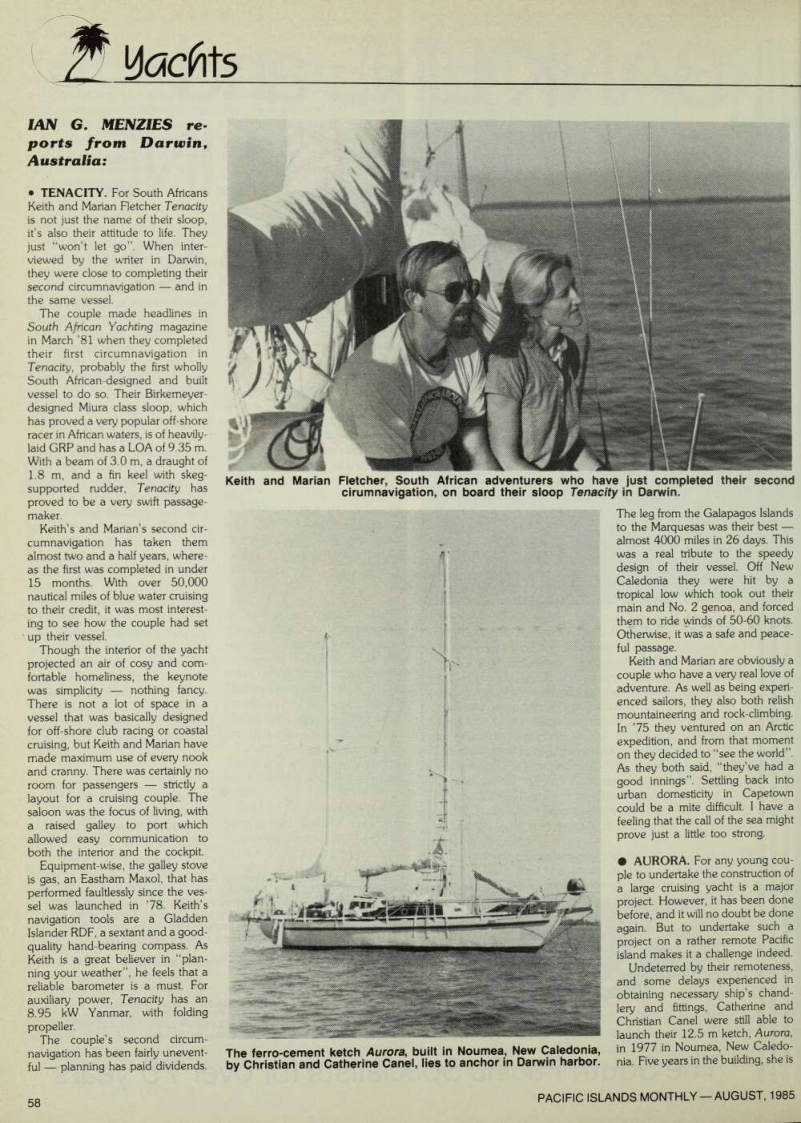
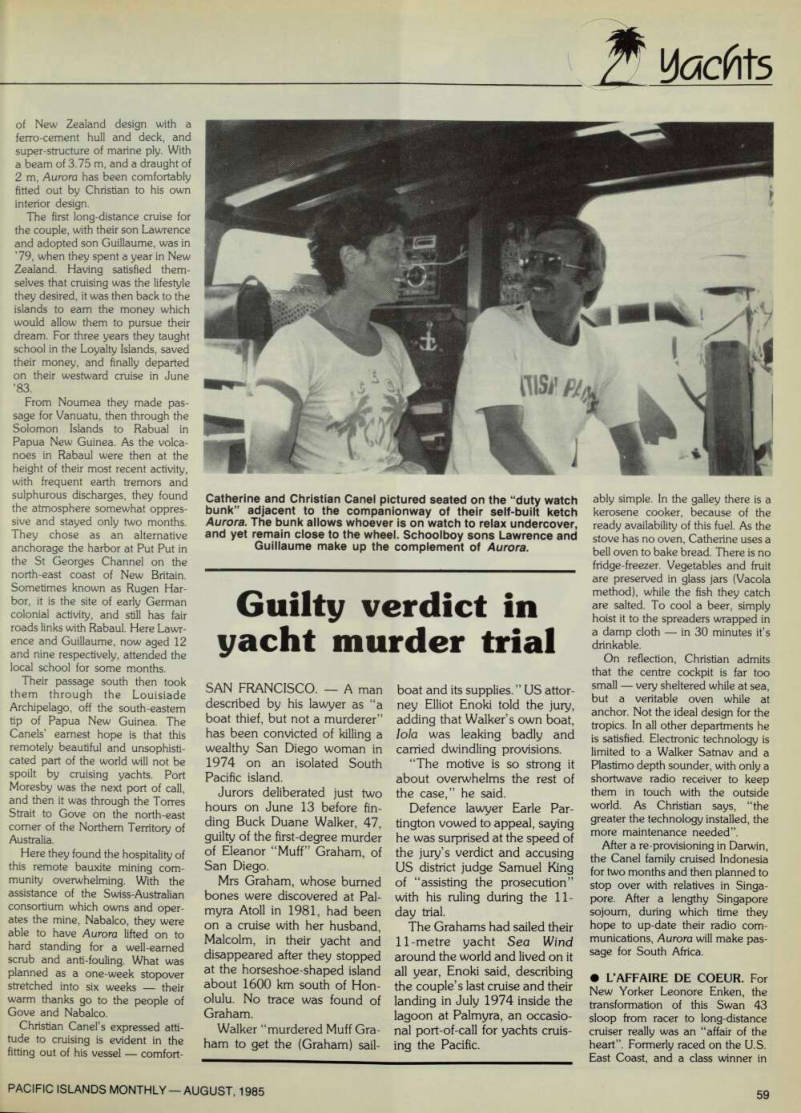

Ian G. Menzies Re
ports from Darwin, Australia:
• TENACITY. For South Africans Keith and Marian Fletcher Tenacity is not just the name of their sloop, it’s also their attitude to life. They just “won’t let go”. When inter viewed by the writer in Darwin, they were close to completing their second circumnavigation and in the same vessel.
The couple made headlines in South African Yachting magazine in March ’Bl when they completed their first circumnavigation in Tenacity, probably the first wholly South African-designed and built vessel to do so. Their Birkemeyer designed Miura class sloop, which has proved a very popular off-shore racer in African waters, is of heavily laid GRP and has a LOA of 9.35 m.
With a beam of 3.0 m, a draught of 1.8 m, and a fin keel with skeg supported rudder, Tenacity has proved to be a very swift passage maker.
Keith’s and Marian’s second cir cumnavigation has taken them almost two and a half years, where as the first was completed in under 15 months. With over 50,000 nautical miles of blue water cruising to their credit, it was most interest ing to sec how the couple had set ' up their vessel.
Though the interior of the yacht projected an air of cosy and com fortable homeliness, the keynote was simplicity nothing fancy.
There is not a lot of space in a vessel that was basically designed for off-shore club racing or coastal cruising, but Keith and Marian have made maximum use of every nook and cranny. There was certainly no room for passengers strictly a layout for a cruising couple. The saloon was the focus of living, with a raised galley to port which allowed easy communication to both the interior and the cockpit.
Equipment-wise, the galley stove is gas, an Eastham Maxol, that has performed faultlessly since the ves sel was launched in ’7B. Keith’s navigation tools are a Gladden Islander RDF, a sextant and a good quality hand-bearing compass. As Keith is a great believer in “plan ning your weather”, he feels that a reliable barometer is a must. For auxiliary power, Tenacity has an 8.95 kW Yanmar, with folding
propeller.
The couple’s second circum navigation has been fairly unevent ful planning has paid dividends.
The leg from the Galapagos Islands to the Marquesas was their best almost 4000 miles in 26 days. This was a real tribute to the speedy design of their vessel. Off New Caledonia they were hit by a tropical low which took out their main and No. 2 genoa, and forced them to ride winds of 50-60 knots.
Otherwise, it was a safe and peace ful passage.
Keith and Marian are obviously a couple who have a very real love of adventure. As well as being experi enced sailors, they also both relish mountaineering and rock-climbing.
In ’75 they ventured on an Arctic expedition, and from that moment on they decided to “see the world”.
As they both said, “they’ve had a good innings”. Settling back into urban domesticity in Capetown could be a mite difficult. I have a feeling that the call of the sea might prove just a little too strong. • AURORA. For any young cou ple to undertake the construction of a large cruising yacht is a major project. However, it has been done before, and it will no doubt be done again. But to undertake such a project on a rather remote Pacific island makes it a challenge indeed.
Undeterred by their remoteness, and some delays experienced in obtaining necessary ship’s chand lery and fittings, Catherine and Christian Canel were still able to launch their 12.5 m ketch, Aurora, in 1977 in Noumea, New Caledo nia. Five years in the building, she is
The ferro-cement ketch Aurora, built in Noumea, New Caledonia, by Christian and Catherine Canel, lies to anchor in Darwin harbor.
Keith and Marian Fletcher, South African adventurers who have just completed their second cirumnavigation, on board their sloop Tenacity in Darwin.
of New Zealand design with a ferro-cement hull and deck, and super-structure of marine ply. With a beam of 3.75 m, and a draught of 2 m, Aurora has been comfortably fitted out by Christian to his own interior design.
The first long-distance cruise for the couple, with their son Lawrence and adopted son Guillaume, was in ’79, when they spent a year in New Zealand. Having satisfied them selves that cruising was the lifestyle they desired, it was then back to the islands to earn the money which would allow them to pursue their dream. For three years they taught school in the Loyalty Islands, saved their money, and finally departed on their westward cruise in June ’B3.
From Noumea they made pas sage for Vanuatu, then through the Solomon Islands to Rabual in Papua New Guinea. As the volca noes in Rabaul were then at the height of their most recent activity, with frequent earth tremors and sulphurous discharges, they found the atmosphere somewhat oppres sive and stayed only two months.
They chose as an alternative anchorage the harbor at Put Put in the St Georges Channel on the north-east coast of New Britain.
Sometimes known as Rugen Har bor, it is the site of early German colonial activity, and still has fair roads links with Rabaul. Here Lawr ence and Guillaume, now aged 12 and nine respectively, attended the local school for some months.
Their passage south then took them through the Louisiade Archipelago, off the south-eastern tip of Papua New Guinea. The Canels’ earnest hope is that this remotely beautiful and unsophisti cated part of the world will not be spoilt by cruising yachts. Port Moresby was the next port of call, and then it was through the Torres Strait to Gove on the north-east comer of the Northern Territory of Australia.
Here they found the hospitality of this remote bauxite mining com munity overwhelming. With the assistance of the Swiss-Australian consortium which owns and oper ates the mine, Nabalco, they were able to have Aurora lifted on to hard standing for a well-earned scrub and anti-fouling. What was planned as a one-week stopover stretched into six weeks their warm thanks go to the people of Gove and Nabalco.
Christian Canel’s expressed atti tude to cruising is evident in the fitting out of his vessel comfort-
ably simple. In the galley there is a kerosene cooker, because of the ready availability of this fuel. As the stove has no oven, Catherine uses a bell oven to bake bread. There is no fridge-freezer. Vegetables and fruit are preserved in glass jars (Vacola method), while the fish they catch are salted. To cool a beer, simply hoist it to the spreaders wrapped in a damp cloth in 30 minutes it’s drinkable.
On reflection, Christian admits that the centre cockpit is far too small very sheltered while at sea, but a veritable oven while at anchor. Not the ideal design for the tropics. In all other departments he is satisfied. Electronic technology is limited to a Walker Satnav and a Plastimo depth sounder, with only a shortwave radio receiver to keep them in touch with the outside world. As Christian says, “the greater the technology installed, the more maintenance needed”.
After a re-provisioning in Darwin, the Canel family cruised Indonesia for two months and then planned to stop over with relatives in Singa pore. After a lengthy Singapore sojourn, during which time they hope to up-date their radio com munications, Aurora will make pas sage for South Africa.
• L’Affaire De Coeur. For
New Yorker Leonore Enken, the transformation of this Swan 43 sloop from racer to long-distance cruiser really was an “affair of the heart”. Formerly raced on the U.S.
East Coast, and a class winner in
Catherine and Christian Canel pictured seated on the “duty watch bunk” adjacent to the companionway of their self-built ketch Aurora. The bunk allows whoever is on watch to relax undercover, and yet remain close to the wheel. Schoolboy sons Lawrence and Guillaume make up the complement of Aurora.
the Newport to Bermuda blue water classic, L’Affaire de Coeur was purchased by Leonore in Jan. ’77 and, with the assistance of her builders, Nautor of Finland, was converted for cruising.
First Mate Mel Jackson sailed L’Affaire . . . south to Antigua in Oct. ’Bl, where Leonore joined him a month later. After passing through the Panama Canal in Feb. ’B2, the couple spent an unheard-of-11 days in the Galapagos Islands, despite the port captain’s demands that they depart after four days.
Tracking south-west, they then made for Easter Island with inten tions of a leisurely cruise westward to Pitcairn Island. It was not to be.
Bad weather plagued their pas sage, and in swift succession they lost the forestay, their rudder, and the engine “went out”. Using only the trim tab on the Sailomat wind vane, they successfully navigated almost 3000 nautical miles across the southern Pacific to Papeete, Tahiti. Along the way they took in Pitcairn and also delightful Gambier Island. There they spent over six weeks, thoroughly enjoying its iso lated beauty.
With the rudder rebuilt in Pape ete, L Affaire . . . sailed for New Zealand where they waited out the cyclone season. Queen Charlotte Sound, on the northern coast of
New Zealand’s south island, was the anchorage that proved to be most memorable.
In ’B3, Leonore and Mel sailed north to Fiji, the Solomon Islands and then cruised Papua New Guinea waters. Like so many be fore them, they found this to be one of the highlights of their cruise to
date. In particular, the ports of Rabaul and Madang proved the most hospitable.
Electronically, L’Affaire ... is extremely well equipped. An all channel VHP is backed up by an Icom 720 A, (Mel’s callsign is NIB KU), with a Furuno radar also installed. Their original SatNav
proved unreliable, and was re placed by a Shipmate while in the Solomon Islands.
Passage to Darwin was unevent ful, and with a permit approved for Indonesia, the couple will cruise those waters before heading west ward once again, to the Seychelles and the Red Sea.
Leonore Enken and Mel Jackson of the Swan 43, L’Affaire de Coeur, prepare to go ashore in Port Darwin. The couple have been cruising the South Pacific for three years.
Guilty verdict in yacht murder trial
yacht murder trial
San Francisco. A Man
described by his lawyer as “a boat thief, but not a murderer” has been convicted of killing a wealthy San Diego woman in 1974 on an isolated South Pacific island.
Jurors deliberated just two hours on June 13 before fin ding Buck Duane Walker, 47, guilty of the first-degree murder of Eleanor “Muff” Graham, of San Diego.
Mrs Graham, whose burned bones were discovered at Pal myra Atoll in 1981, had been on a cruise with her husband, Malcolm, in their yacht and disappeared after they stopped at the horseshoe-shaped island about 1600 km south of Hon olulu. No trace was found of Graham.
Walker “murdered Muff Gra ham to get the (Graham) sail
boat and its supplies. ” US attor ney Elliot Enoki told the jury, adding that Walker’s own boat, lola was leaking badly and carried dwindling provisions.
“The motive is so strong it about overwhelms the rest of the case,” he said.
Defence lawyer Earle Par tington vowed to appeal, saying he was surprised at the speed of the jury’s verdict and accusing US district judge Samuel King of “assisting the prosecution” with his ruling during the 11day trial.
The Grahams had sailed their 11-metre yacht Sea Wind around the world and lived on it all year, Enoki said, describing the couple’s last cruise and their landing in July 1974 inside the lagoon at Palmyra, an occasio nal port-of-call for yachts cruis ing the Pacific.
Advertisements & other items, p. 60 (1 item)
T&cific
4CIFIC
CONSTRUCTION EQUIPMENT CO
introducing the Dynamic Hew Range of
Vibrating 8 Pneumatic Tyred Rollers
T&cific
THE RANGE
• Pacific Self-Propelled Vibrating Rollers • Single and Double Drum Types • 1.5 tonne to 16 tonne • Pacific Self-Propelled Pneumatic Type Compactors • 3 Models 16. 21. 38 tonne Ballast Weights • Pacific Landfill and Sanitary Landfill Compactors • Pacific Pneumatic Earth Borers • Pacific Road Brooms • Pacific Railway Maintenance Vehicles
DISTRIBUTORS REQUIRED
THROUGHOUT THE PACIFIC
Construction Equipment Co. 24 Salisbury Road, Hornsby NSW 2077, Australia. Phone (02) 476 2666
SAL
y-LJTSSE
Shipping schedules
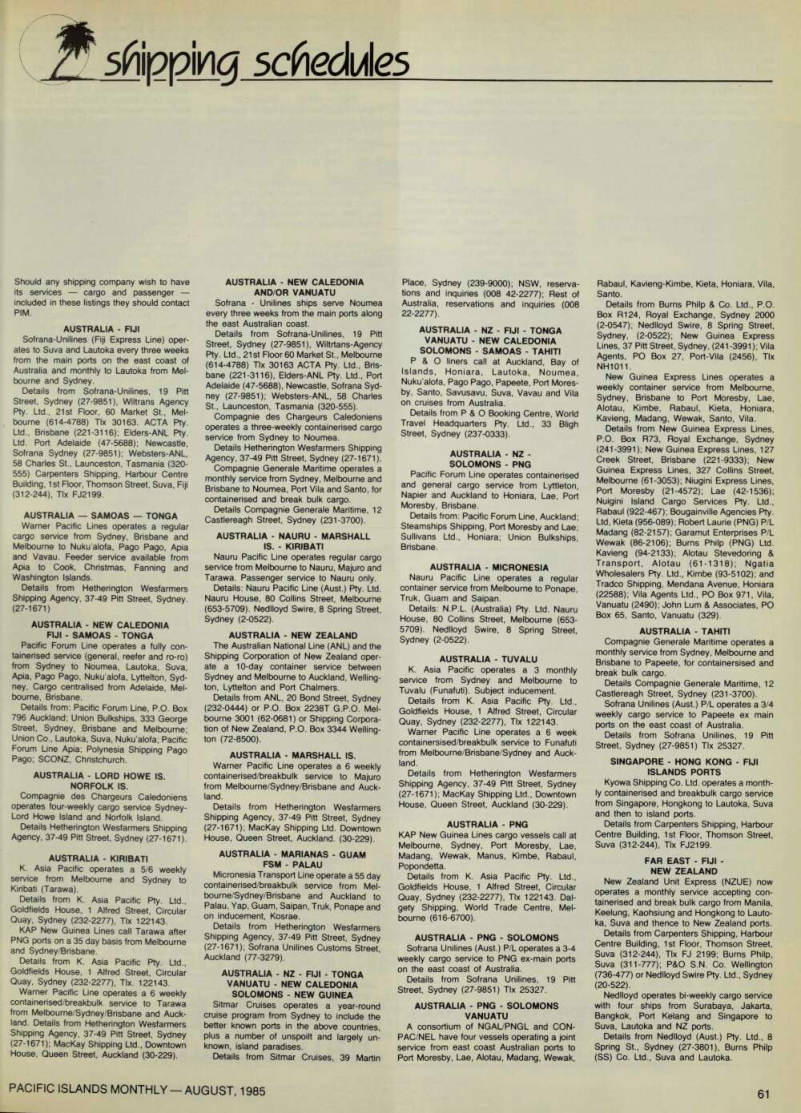
Should any shipping company wish to have its services cargo and passenger included in these listings they should contact
Pim.
Australia - Fiji
Sofrana-Unilines (Fiji Express Line) oper ates to Suva and Lautoka every three weeks from the main ports on the east coast of Australia and monthly to Lautoka from Mel bourne and Sydney.
Details from Sofrana-Unilines, 19 Pitt Street, Sydney (27-9851), Wiltrans Agency Pty. Ltd., 21st Floor, 60 Market St., Mel bourne (614-4788) Tlx 30163. ACTA Pty.
Ltd., Brisbane (221-3116); Elders-ANL Pty.
Ltd. Port Adelaide (47-5688); Newcastle, Sofrana Sydney (27-9851); Websters-ANL, 58 Charles St., Launceston, Tasmania (320- 555) Carpenters Shipping, Harbour Centre Building, Ist Floor, Thomson Street, Suva, Fiji (312-244), Tlx FJ2199.
Australia Samoas Tonga
Warner Pacific Lines operates a regular cargo service from Sydney, Brisbane and Melbourne to Nukualofa, Pago Pago. Apia and Vavau. Feeder service available from Apia to Cook, Christmas, Fanning and
Washington Islands.
Details from Hetherington Wesfarmers Shipping Agency, 37-49 Pitt Street, Sydney. (27-1671)
Australia - New Caledonia
Fiji - Samoas - Tonga
Pacific Forum Line operates a fully con tainerised service (general, reefer and ro-ro) from Sydney to Noumea, Lautoka, Suva, Apia, Pago Pago, Nukualofa, Lyttelton, Syd ney, Cargo centralised from Adelaide, Mel bourne. Brisbane.
Details from: Pacific Forum Line, P.O. Box 796 Auckland: Union Bulkships, 333 George Street, Sydney, Brisbane and Melbourne; Union Co., Lautoka, Suva, Nukualofa; Pacific Forum Line Apia; Polynesia Shipping Pago Pago; SCONZ, Christchurch.
Australia - Lord Howe Is.
Norfolk Is.
Compagnie des Chargeurs Caledoniens
operates four-weekly cargo service Sydney- Lord Howe Island and Norfolk Island.
Details Hetherington Wesfarmers Shipping Agency, 37-49 Pitt Street, Sydney (27-1671).
Australia - Kiribati
K. Asia Pacific operates a 5/6 weekly service from Melbourne and Sydney to Kiribati (Tarawa).
Details from K. Asia Pacific Pty. Ltd., Goldfields House, 1 Alfred Street, Circular Quay, Sydney (232-2277), Tlx 122143.
KAP New Guinea Lines call Tarawa after PNG ports on a 35 day basis from Melbourne and Sydney/Brisbane.
Details from K. Asia Pacific Pty. Ltd., Goldfields House, 1 Alfred Street, Circular Quay, Sydney (232-2277), Tlx. 122143.
Warner Pacific Line operates a 6 weekly containerised/breakbulk service to Tarawa from Melbourne/Sydney/Brisbane and Auck land. Details from Hetherington Wesfarmers Shipping Agency, 37-49 Pitt Street, Sydney (27-1671); Mac Kay Shipping Ltd., Downtown House, Queen Street, Auckland (30-229).
Australia - New Caledonia
And/Or Vanuatu
Sofrana - Unilines ships serve Noumea every three weeks from the main ports along the east Australian coast.
Details from Sofrana-Unilines, 19 Pitt Street, Sydney (27-9851), Wiltrtans-Agency Pty. Ltd., 21st Floor 60 Market St., Melbourne (614-4788) Tlx 30163 ACTA Pty. Ltd., Bris bane (221-3116), Elders-ANL Pty. Ltd., Port Adelaide (47-5688), Newcastle, Sofrana Syd ney (27-9851); Websters-ANL, 58 Charles St., Launceston, Tasmania (320-555).
Compagnie des Chargeurs Caledoniens operates a three-weekly containerised cargo service from Sydney to Noumea.
Details Hetherington Wesfarmers Shipping Agency, 37-49 Pitt Street, Sydney (27-1671).
Compagnie Generate Maritime operates a monthly service from Sydney, Melbourne and Brisbane to Noumea. Port Vila and Santo, for containerised and break bulk cargo.
Details Compagnie Generate Maritime, 12 Castlereagh Street, Sydney (231-3700).
Australia - Nauru - Marshall
Is. - Kiribati
Nauru Pacific Line operates regular cargo service from Melbourne to Nauru, Majuro and Tarawa. Passenger service to Nauru only.
Details: Nauru Pacific Line (Aust.) Pty. Ltd.
Nauru House, 80 Collins Street, Melbourne (653-5709). Nedlloyd Swire, 8 Spring Street, Sydney (2-0522).
Australia - New Zealand
The Australian National Line (ANL) and the Shipping Corporation of New Zealand oper ate a 10-day container service between Sydney and Melbourne to Auckland, Welling ton, Lyttelton and Port Chalmers.
Details from ANL, 20 Bond Street, Sydney (232-0444) or P.O. Box 2238 T G.P.O. Mel bourne 3001 (62-0681) or Shipping Corpora tion of New Zealand, P.O. Box 3344 Welling ton (72-8500).
Australia - Marshall Is.
Warner Pacific Line operates a 6 weekly containerised/breakbulk service to Majuro from Melbourne/Sydney/Brisbane and Auck land.
Details from Hetherington Wesfarmers Shipping Agency, 37-49 Pitt Street, Sydney (27-1671); Mac Kay Shipping Ltd. Downtown House, Queen Street, Auckland. (30-229).
Australia - Marianas - Guam
Fsm - Palau
Micronesia Transport Line operate a 55 day containerised/breakbulk service from Mel bourne/Sydney/Brisbane and Auckland to Palau, Yap, Guam, Saipan, Truk, Ponape and on inducement, Kosrae.
Details from Hetherington Wesfarmers Shipping Agency. 37-49 Pitt Street, Sydney (27-1671); Sofrana Unilines Customs Street, Auckland (77-3279).
AUSTRALIA - NZ - FIJI - TONGA
Vanuatu - New Caledonia
Solomons - New Guinea
Sitmar Cruises operates a year-round cruise program from Sydney to include the better known ports in the above countries, plus a number of unspoilt and largely un known, island paradises.
Details from Sitmar Cruises, 39 Martin
Place, Sydney (239-9000); NSW, reserva tions and inquiries (008 42-2277); Rest of Australia, reservations and inquiries (008 22-2277).
AUSTRALIA - NZ - FIJI - TONGA
Vanuatu - New Caledonia
Solomons - Samoas - Tahiti
P&O liners call at Auckland, Bay of Islands, Honiara, Lautoka, Noumea, Nukualofa, Pago Pago. Papeete, Port Mores by, Santo, Savusavu, Suva, Vavau and Vila on cruises from Australia.
Details from P&O Booking Centre, World Travel Headquarters Pty. Ltd., 33 Bligh Street, Sydney (237-0333).
Australia - Nz -
Solomons - Png
Pacific Forum Line operates containerised and general cargo service from Lyttleton, Napier and Auckland to Honiara, Lae, Port Moresby, Brisbane.
Details from: Pacific Forum Line, Auckland; Steamships Shipping, Port Moresby and Lae; Sullivans Ltd., Honiara: Union Bulkships, Brisbane.
Australia - Micronesia
Nauru Pacific Line operates a regular container service from Melbourne to Ponape, Truk, Guam and Saipan.
Details: N.P.L. (Australia) Pty. Ltd. Nauru House, 80 Collins Street, Melbourne (653- 5709). Nedlloyd Swire, 8 Spring Street, Sydney (2-0522).
Australia - Tuvalu
K. Asia Pacific operates a 3 monthly service from Sydney and Melbourne to Tuvalu (Funafuti). Subject inducement.
Details from K. Asia Pacific Pty. Ltd., Goldfields House, 1 Alfred Street, Circular Quay, Sydney (232-2277), Tlx 122143.
Warner Pacific Line operates a 6 week containersised/breakbulk service to Funafuti from Melbourne/Brisbane/Sydney and Auck land.
Details from Hetherington Wesfarmers Shipping Agency. 37-49 Pitt Street, Sydney (27-1671); Mac Kay Shipping Ltd., Downtown House, Queen Street, Auckland (30-229).
Australia - Png
KAP New Guinea Lines cargo vessels call at Melbourne. Sydney, Port Moresby, Lae, Madang, Wewak, Manus, Kimbe, Rabaul, Popondetta.
Details from K. Asia Pacific Pty. Ltd., Goldfields House, 1 Alfred Street, Circular Quay, Sydney (232-2277), Tlx 122143. Dal gety Shipping, World Trade Centre, Mel bourne (616-6700).
Australia - Png - Solomons
Sofrana Unilines (Aust.) P/L operates a 3-4 weekly cargo service to PNG ex-main ports on the east coast of Australia.
Details from Sofrana Unilines, 19 Pitt Street, Sydney (27-9851) Tlx 25327.
Australia - Png - Solomons
Vanuatu
A consortium of NGAUPNGL and CON PAC/NEL have four vessels operating a joint service from east coast Australian ports to Port Moresby, Lae, Alotau, Madang. Wewak,
Rabaul, Kavieng-Kimbe, Kieta, Honiara, Vila, Santo.
Details from Burns Philp & Co. Ltd., P.O.
Box R 124, Royal Exchange. Sydney 2000 (2-0547); Nedlloyd Swire. 8 Spring Street, Sydney, (2-0522); New Guinea Express Lines, 37 Pitt Street. Sydney. (241-3991); Vila Agents, PO Box 27. Port-Vila (2456), Tlx
Nhioii.
New Guinea Express Lines operates a weekly container service from Melbourne, Sydney, Brisbane to Port Moresby, Lae, Alotau, Kimbe, Rabaul, Kieta, Honiara, Kavieng, Madang, Wewak, Santo, Vila.
Details from New Guinea Express Lines, P.O. Box R 73, Royal Exchange. Sydney (241-3991); New Guinea Express Lines, 127 Creek Street, Brisbane (221-9333); New Guinea Express Lines, 327 Collins Street, Melbourne (61-3053); Niugini Express Lines, Port Moresby (21-4572); Lae (42-1536); Nuigini Island Cargo Services Pty. Ltd., Rabaul (922-467); Bougainville Agencies Pty.
Ltd, Kieta (956-089); Robert Laurie (PNG) P/L Madang (82-2157); Garamut Enterprises P/L Wewak (86-2106); Burns Philp (PNG) Ltd.
Kavieng (94-2133); Alotau Stevedoring & Transport, Alotau (61-1318); Ngatia Wholesalers Pty. Ltd., Kimbe (93-5102); and Tradco Shipping, Mendana Avenue, Honiara (22588); Vila Agents Ltd., PO Box 971, Vila.
Vanuatu (2490); John Lum & Associates, PO Box 65, Santo, Vanuatu (329).
Australia - Tahiti
Compagnie Generate Maritime operates a monthly service from Sydney, Melbourne and Brisbane to Papeete, for containersised and break bulk cargo.
Details Compagnie Generate Maritime, 12 Castlereagh Street, Sydney (231-3700).
Sofrana Unilines (Aust.) P/L operates a 3/4 weekly cargo service to Papeete ex main ports on the east coast of Australia.
Details from Sofrana Unilines, 19 Pitt Street, Sydney (27-9851) Tlx 25327.
Singapore - Hong Kong - Fiji
Islands Ports
Kyowa Shipping Co. Ltd. operates a month ly containerised and breakbulk cargo service from Singapore, Hongkong to Lautoka, Suva and then to island ports.
Details from Carpenters Shipping, Harbour Centre Building, Ist Floor, Thomson Street, Suva (312-244), Tlx FJ2199.
Far East - Fiji -
New Zealand
New Zealand Unit Express (NZUE) now operates a monthly service accepting con tainerised and break bulk cargo from Manila, Keelung, Kaohsiung and Hongkong to Lauto ka, Suva and thence to New Zealand ports.
Details from Carpenters Shipping, Harbour Centre Building, Ist Floor, Thomson Street, Suva (312-244), Tlx FJ 2199; Burns Philp, Suva (311-777); P&O S.N. Co. Wellington (736-477) or Nedlloyd Swire Pty. Ltd., Sydney (20-522).
Nedlloyd operates bi-weekly cargo service with four ships from Surabaya, Jakarta, Bangkok, Port Kelang and Singapore to Suva, Lautoka and NZ ports.
Details from Nedlloyd (Aust.) Pty. Ltd., 8 Spring St., Sydney (27-3801), Burns Philp (SS) Co. Ltd., Suva and Lautoka.
Far East - Mid-S. Pacific
China Navigation's New Guinea Pacific Line operates a regular container service from Hongkong, Taiwan, Manila, Port Kelang and Singapore to Port Moresby, Lae, Rabaul and Honiara monthly and to Wewak, Madang and Kieta every three months. Cargo from the same Far Eastern ports to the South Pacific ports of Noumea, Santo, Vila, Papeete, Pago Pago, Apia, Raratonga and Tarawa will be shipped via Japan on the monthly Bali Hai service.
Details from Steamships Shipping, PO Box 634, Port Moresby (22-0289).
Kyowa Shipping Ltd. operates monthly services from Japan to Guam, Saipan, Solo mons, New Caledonia, Fiji, Western and American Samoa, Tahiti, Cook Is., Tonga and' Vanuatu.
Details: Hetherington Wesfarmers Shipping Agency, 37-49 Pitt Street, Sydney (27-1671); Carpenters Shipping, Suva (312-244), Tlx FJ2199.
Guam - Northern Marianas
Saipan Shipping Co. Inc. operate a weekly' service via barge carrying containers and conventional cargo between Guam and Saipan and Tinian.
Details from Saipan Shipping Co. Inc., PO Box 8. Saipan. CM 96950 (Tel. 9707), Tlx 783619; Guam agents Maritime Agencies of the Pacific Ltd.
Hawaii - Tahiti - Samoas -
Tonga - Kiribati - Fiji -
Solomons - Png
Star Shipping Associates operates a monthly service originating in Honolulu and destined for Pago Pago, Papeete, Apia, Nukualofa, Suva, Vila and Port Moresby.
Details from Star Shipping Assoc., P.O.
Box 25988, Honolulu. Hawaii 96825. Ph (808) 396-4256; Polynesia Shipping Services in Pago Pago and Burns Philp Agency in Apia, Nukualofa, Suva and Port Moresby.
Japan Fiji Island Ports
Kyowa Shipping Co. Ltd. operates a month ly containerised service from main ports of Japan to Suva and Lautoka and thence to island ports.
Details from Carpenters Shipping, Harbour Centre Building, Ist Floor, Thomson St., Suva (312-244), Tlx FJ2199.
Bali Hai service operates a monthly con tainerised service from main ports of Japan to Lautoka and Suva and thence to island ports.
Details from Carpenters Shipping, Harbour Centre Building, Ist Floor, Thomson St., Suva (312-244), Tlx FJ2199 and Burns Philp, Suva (311-777).
Japan Micronesia
The NYK Shipping Line operates a monthly cargo service from Japan to Micronesia, calling at Yoko, Nagoya, Kobe, Guam, Saipan, Truk, Ponape and Majuro, returning via Yoko, Nagoya and Kobe.
Details from Burns Philp & Co. Ltd., 51 Pitt Street, Sydney (2-0547).
Saipan Shipping Co. Inc. operates a monthly service from Japan to Saipan, Guam, Truk, Ponape, Majuro (Kosrae and Ebeye on inducement).
Details from Saipan Shipping Co. Inc., P.O.
Box 8. Saipan. CM 96950 (Tel. 9707), Tlx 783619; Japan agents Kyowa Shipping Com pany Ltd; Guam Agents Maritime Agencies of the Pacific Ltd.
Japan Png
Mitsui O.S.K. Lines operates a monthly service from main ports Japan and Port Moresby. Rabaul. Lae, Madang, Kieta and Kimbe.
Details from Robert Laurie (PNG) Pty. Ltd., P.O. Box 922, Port Moresby (21-2466/21- 1898).
New Caledonia Fiji West
Coast North America
PAD Line operates an approx. 3-weekly
ro-ro service from Noumea and Suva to Honolulu and West Coast USA and Canadian ports.
Details from Sofrana-Unilines SA, BP 1602, Noumea (27-51-91), Tlx NMO4B; Carpenters Shipping, Harbour Centre Building, Ist Floor, Thomson St., Suva (312-244), Tlx FJ2199.
Png Inter Mainport
Papua New Guinea Line offers scheduled 10-20 day coastal liner services linking all PNG major ports with containerisation, reefer, heavy lift and transhipment facilities.
Details from PNG Line, Box 543, Port Moresby, PNG (21-1174), Tlx 22269.
Png Uk/Continent
The Bank Line & Columbus Line operate a regular joint service from Port Moresby, Oro Bay, Kieta, Rabaul, Kimbe, Madang and Lae to Hull, Hamburg, Rotterdam, Antwerp and Le Havre.
Details from The Bank Line (A’asia) Pty.
Ltd., 51 Pitt Street, Sydney (27-2041); Tlx AA24063; Columbus Line, Lae (423466), Tlx NE 44171; or lines' local agents.
Solomons Uk/Continent
The Bank Line & Columbus Line operate a regular joint cargo service from Honiara to Hull, Hamburg, Rotterdam, Antwerp and Le Havre.
Details from The Bank Line (A’asia) Pty, Ltd., 51 Pitt Street, Sydney (27-2041); Tlx AA24063; Columbus Line. Lae (423466), Tlx NE 44171; or the lines' local agents.
New Zealand Vanuatu
Solomon Islands Papua New
Guinea Australia
Pacific Forum Line operates a 28 day cycle container shipping service from New Zealand direct to Vila, then on to Honiara, Lae, Port Moresby, Brisbane, back to Lyttelton, Napier and Auckland.
Details from Pacific Forum Line, P.O. Box 796, Auckland (790-050), Tlx 60460; P.O.
Box 971, Vila. Vanuatu (2490), Tlx 1044.
Nz Cook Is. Niue Tahiti
Shipping Corporation of NZ Ltd. operates cargo services based on pallets and similar units from Auckland to Niue, Cook Islands and Tahiti.
Details from the Shipping Corp. of NZ Ltd., P.O. Box 3344, Wellington (72-8500); Waterfront Commission, P.O. Box 61, Raro tonga; Cook Islands; Shipping Office, Govt, of Niue, P.O. Box 107, Niue Island: Compagnie Maritime Polynesienne, P.O. Box 368, Pape ete, Tahiti.
Nz Fiji
Reef operates a regular 18-day service from Auckland to Suva and Lautoka. Also passenger accomfriodation.
Details from Reef Shipping Agencies, P.O.
Box 3382, Auckland, NZ (77-1221-3), Tlx 60633; M.V. Fijian Shipping Agencies Ltd., Private Bag, Suva, Fiji (31-1056).
Pacific Line with one ship operates three weekly ro-ro cargo service New Zealand.
Lautoka, Suva. No passengers.
Details; Sofrana Unilines, 18 Customs Street, Auckland (773-279) P.O. Box 3614, Tlx NZ2313; Carpenters Shipping, 100 Thom son Street, Suva (312-244), Tlx FJ2199.
Nz Fiji North America (Wc)
Blue Star Line Ltd. Pacific Coast container services. Only direct service to and from New Zealand. Blue Star vessels call at Suva and Honolulu on NZ-US-West Coast voyages.
Details from Blueport ACT (NZ) Ltd., P.O.
Box 192, Wellington (739-029). Burns Philp (SS) Co. Ltd., GPO Box 355, Suva, Fiji (311-777), Tlx FJ2168 Burship.
Nz Fiji Samoas Tonga
Pacific Forum Line operates a fully con tainerised three-weekly service (Gen/Reefer) from Auckland to Lautoka, Suva, Apia, Pago Pago and Nukualofa.
Details from Pacific Forum Line, Auckland; Union Co. Auckland, Lautoka, Suva and Nukualofa; Pacific Forum Line, Apia; Polyne sian Shipping, Pago Pago.
Nz N. Caledonia Vanuatu
Png Solomons
Sofrana Unilines with three ships operate to Vila and Santo, to Honiara and Papua New Guinea and to Norfolk Island and Noumea (No passengers).
Details from Sofrana Unilines, 18 Customs Street, Auckland (773-279), P.O. Box 3614, Tlx NZ2313.
Nz Tahiti
Compagnie Tahitienne Maritime SA (as CTM-Tahiti Line) operates one ship, MV Bounty 111, monthly Papeete New Zea land. (No passengers).
Details from Sofrana Unilines, P.O. Box 3614, 18 Customs St., Auckland, Tlx NZ2313; CTM-Tahiti Line, P.O. Box 9012, Papeete (39042), Tlx Tahitlin 322 FP Tahiti.
Nz Tonga Samoas
Warner Pacific Line services Auckland, Nukualofa, Vavau, Apia, Pago Pago fort nightly carrying general and freezer cargoes.
Details from McKay Shipping Ltd., Down town House, 21 Queen St., Auckland, P.O Box 1372 (30-299). Cables MACSHIP, Telex NZ2554, Warner Pacific Line, Box 93, Nukualofa, Tonga; Mealelei (Western Samoa.) Ltd. Private Bag, Apia, Western Samoa, Kneubuhl Maritime Service, Box 39, Pago Pago, American Samoa, 96799
Tahiti New Caledonia Vanuatu
Solomon Is.
New Zealand Png Singapore
Europe
Polish Ocean Lines operate in a semi container type vessel to the following ports, from Papeete, Noumea, Santo, Vila, Yandina, Honiara, Auckland, Rabaul. Lae, Singapore, Port Kelang, Penang then to Mediterranean ports and Europe via the Suez Canal. (Other New Zealand ports subject to inducement).
Details from Universal Shipping Agencies Ltd., 6th Floor, 38 Fort Street, Auckland 1, New Zealand (30931), Tlx 21517
Europe Tahiti
New Caledonia
Compagnie Generate Maritime operates services from Europe and Mediterranean ports to Papeete and Noumea using three ro-ro and multi-purpose vessels thus ensuring a bi-monthly sailing to and from.
Details Compagnie Generate Maritime, 12 Castlereagh Street, Sydney (231-3700).
Europe Tahiti
New Caledonia New Zealand
Solomons Png Europe
Polish Ocean Lines offers regular monthly sailings for containerised and break bulk cargo and reefer space, conventional and in reefer containers, from Noumea to Vanuatu (Santo/Vila), Solomon Islands (Honiara), New Zealand (always Auckland, other ports sub ject to inducement), Lae. Rabaul, Singapore, Port Kelang, Penang then Mediterranean to Europe. Other ports in the South Pacific can be served with inducement.
Details from Sotama, BP 9170, Papeete (27805), Tlx 296 SATO; BP C 2, Noumea (272094), Tlx 163 NM SATO; Union Steam ship Co. of NZ, P.O Box 50, Apia, Tlx 25; Williams and Gosling, P.O Box 79, Suva (312633), Tlx 2163; Warner Pacific Line. P.O.
Box 93 Nukualofa (21089), Tlx 66219; Uni versal Shipping Agencies, 6th Floor, 38 Fort Street, Auckland 1, New Zealand (30930), Tlx 21517.
Europe Tahiti W. Samoa
Fiji N. Caledonia
Nedlloyd offers regular cargo services from Continental ports to Papeete, Apia, Fiji and New Caledonia.
Details Nedlloyd (Aust.) Pty. Ltd., 8 Spring Street, Sydney (27-3801): Carpenters Ship ping, Ist Floor, Harbour Centre Bldg., 100 Thomson St., Suva (312-244), Tlx 2199 FJ and Vetari Street, Lautoka (63988), Tlx 5215FJ.
Uk N. Continent W. Samoa
Tonga, Fiji
The Bank Line & Columbus Line operate a regular joint cargo service from Hull, Ham burg, Bremen, Antwerp, Rotterdam and Le Havre to Apia, Nukualofa, Suva and Lautoka.
Details from The Bank Line (A’asia) Pty.
Ltd., 51 Pitt Street, Sydney (27-2041), Tlx AA 24063; Columbus Line, Lae (423-466), Tlx NE 44171; or lines’ local agents.
Uk N. Continent Png
Solomons
The Bank Line & Columbus Line operate a regular joint cargo service from Hull, Ham burg, Bremen, Antwerp, Rotterdam and Le Havre to Port Moresby, Lae, Madang, Kimbe, Rabaul, Kieta and Honiara and on induce ment to Yandina.
Details from The Bank Line (A’asia) Pty.
Ltd., 51 Pitt Street, Sydney (27-2041), Tlx AA 24063; Columbus Line, Lae (42-3466), Tlx NE 44171; or lines' local agents.
Uk/N. Continent Tahiti
N. Caledonia Vanuatu
The Bank Line & Columbus Line operate a regular joint cargo service from Hull, Ham burg, Bremen, Antwerp, Rotterdam and Le Havre to Papeete, Noumea, Port-Vila and Santo.
Details from The Bank Line (A’asia) Pty.
Ltd., 51 Pitt Street, Sydney (27-2041), Tlx AA 24063; Columbus Line, Lae (42-3466), Tlx NE 44171; Ets. A M, Fare UTE, Papeete; Ets.
Ballande, Noumea and other local agents.
Us Hawaii Micronesia
E. Malaysia Brunei Papua New
Guinea Philippines
PM&O Lines operates three fully self-sus tained container vessels on a sailing frequen cy of every 28 days from the San Francisco Bay area, Los Angeles, and Honolulu to Majuro, Ebeye, Kosrae, Ponape, Truk, Saipan, Yap, Koror, Kota Kinabalu, Brunei, Lae, Kieta and Rabaul.
Service is also offered utilising the same vessels on the same 28-day frequency from the Philippine ports of Manila, Cebu, and Davao and General Santos and the Papua New Guinea ports of Rabaul, Lae and Kieta to Hawaii, San Francisco and Los Angeles.
Finally service is available from Davao. Cebu, Manila, Hong Kong, Keelung and Kaohsiung
to Saipan, Guam, Honolulu, Lae, Rabaul and Kieta.
Details from PM&O Lines, 181 Fremont Street, San Francisco, California, 94105, U.S.A. (415) 543-7430, Tlx 278016; Cable PMONAV SFO; PM&O Owner's representa tive, P.O. Box 803, Saipan, N.M.I. 96950.
Cable Commontime Saipan, Tlx
783605; Anscor Transport and Terminals Inc., P.O. Box 7023-5, Metro Manila, Philip pines (521-8074) Tlx 65021 ATTI PN.
Us Hawaii Samoas
Kiribati Nauru
Nauru Pacific Line operates regular con ventional and container services from San Francisco and Honolulu to Christmas Island, Pago Pago, Apia, Tarawa and Nauru.
Details from N.P.L. (Australia) Pty. Ltd., Nauru House, 80 Collins Street, Melbourne (653-5709); Nauru Air and Shipping Agency, Suite 2803, 185 Berry Street, San Francisco, California 94107 (415-543-4517); Nauru Air and Shipping Agency, Suite 506, 841 Bishop St., Honolulu, HI 96813 (808-523-0441).
Us. Noumea Fiji
PAD Line operates an approx. 3-weekly ro-ro service from west coast USA and Canada to Noumea, Suva and Lautoka.
Details from Sofrana Unilines BP 1602, Noumea (27-51-91), Tlx NMO4B; Carpenters Shipping, Harbour Centre Building, Ist Floor, 100 Thomson Street, Suva (312-244), Tlx FJ2199; Trans-Austral Shipping Pty. Ltd., P.O. Box R 232, Royal Exchange, 2000 (231-8411), Tlx AA21204.
Us Tahiti Samoa
Pacific Islands Transport operates a five weekly cargo service from North America west coast ports to Papeete. Pago Pago, Apia.
Details from Polynesia Shipping Services Inc. P.O. Box 1478, Pago Pago 96799.
Polynesia Line operates container and general cargo service from US west coast ports to Papeete and Pago Pago.
Details from Polynesia Shipping Services Inc., P.O. Box 1478, Pago Pago 96799.
Advertisements & other items, pp. 62-64 (1 item)
Enrolment Now Open . . .
LOCAL AGENTS AND
REPRESENTATION
428 George St., Sydney.
Cables: Henco Sydney.
G.P.O. Box 3949.
PAPUA NEW GUINEA
RABAUL: M. & C. Seeto, P.O. Box 131, Rabaul.
Telephone 92 2919.
MADANG; W. Double, P.O. Box 22, Madang.
Telephone 82 2696.
Telephone: 232 5377.
FIJI
K. Witherington Ltd., P.O. Box 293, Suva.
Telephone 22 356.
For specialised and
personalised buying
service throughout
the Pacific Islands
and the East.
VANUATU
John Lum & Associates, P.O. Box 65, Santo.
Telephone 329.
SOLOMON ISLANDS
Resident Agents in other Pacific Territories.
Mr. Tom Lo, P.O. Box 327, Honiara.
Telephone 399 • 18
ENROLMENT NOW OPEN . . .
KOORALBYN INTERNATIONAL SCHOOL
THE SCHOOL: The international population living in South East Asia and the Pacific have special needs, which the school attempts to meet.
The School is an international, co-educational boarding and day school accepting students in all grades from 1 to 12.
It is non-denominational. However, Christian morality forms the basis for the conduct of students.
The primary aim is to educate both Australian children and the children of the International Community, in a primary and secondary school, at a level to secure admission to leading colleges, universities and training institutions in the students' countries of origin.
Children may be enrolled throughout the School Year. Boarding facilities are organised in a family style, with the intention that students feel that they are part of another home. Supervision to ensure safety, health and academic progress of each student is close and caring.
The School will cater for; —(a) Day Students (b) Monday to Friday Boarding (c) Full Boarding THE CAMPUS: The Kooralbyn International School is situated on a 6.9 hectare site within the magnificent Kooralbyn Valley in South-East Queensland. The Valley is approximately 75 minutes from Brisbane or the Gold Coast by sealed road.
The Valley’s own airstrip brings these two centres within 15 minutes of Kooralbyn, by air charter.
The School has access to the outstanding sporting and coaching facilities of the Kooralbyn Valley Resort.
THE FACULTY: Mr Terry Riles is the Principal of the School. Mr Riles was the Principal of the Port Moresby International High School prior to his appointment to Kooralbyn.
The School has 8 teachers. All are registered with the Board of Teacher Education Queensland. All staff are specialists in their subject areas.
HOW TO GAIN ALL INFORMATION: There is much information we want you to know about our School, and naturally there are many questions you want answered. All this information is available in the Kooralbyn International School Prospectus.
Write for our Prospectus today, or 'phone us, and we will forward the Prospectus immediately.
THE KOORALBYN INTERNATIONAL SCHOOL
P.O. BOX 385, BEAUDESERT,
QUEENSLAND, 4285, AUSTRALIA
TELEPHONE: (075) 44-6288
POLISH OCEAN LINES
General Management, 10 Lutego 24,81-364 GDYNIA, POLAND, Phone: 20-19-01, Cables: POLOCEAN Telex: 054-231 © © mm % 5$ -:v** CTi SV? i S I*4 V-> *. i & R p ■*» I l '/,;
SOUTH PACIFIC SERVICE
We offer monthly service to and from: GDYNIA, HAMBURG, ROTTERDAM, MIDDLESBOROUGH/IMMINGHAM, ANTWERP, DUNKIRK, ROUEN, PAPEETE (via PANAMA), NOUMEA, AUCKLAND, HONIARA, RABAUL, LAE, SINGAPORE, by our multipurpose vessels carrying dry and reefer containers, reefer chambers, heavy lifts, breakbulk or palletized, bulk liquids.
POLISH OCEAN LINES Representatives AUCKLAND Mr. A. Sieradzki. Telex 21517 NZ “UNISHIP”. SYDNEY Mr. Walenciak. Telex 20428 AA “SLEIGH”
TALJITI POLISH OCEAN LINES Agents
I™ T L S ° TAMA Telex 296 FP “COUTIMEX”. NEW CALEDONIA SATO Telex 163 NM “SATO”. AUCKLAND UNIVERSAL SHIPPING AGENCIES LTD., Telex 21517 NZ “UNISHIP”. SOLOMONS MELAN CHINE SHIPPING CO., LTD Telex 66335 HO “SYMECO". PNG STEAMSHIPS TRADING P.n Irn Tpla* 4?4?3 NF “STFAM"
We’ve just made
the ocean smaller!
Polynesia Line's new MS Polynesia 550-container ship provides regular monthly cargo service between Papeete, Pago Pago and Apia in the South Pacific, and Long Beach and Oakland on the US Pacific Coast.
POLYNESIA LINE
Interocean Steamship Corporation General Agent oL <2 AS K U T® 3* sS * & ,v ■V Papeete Serving Polynesia is all we do—and we do it better!
deaths
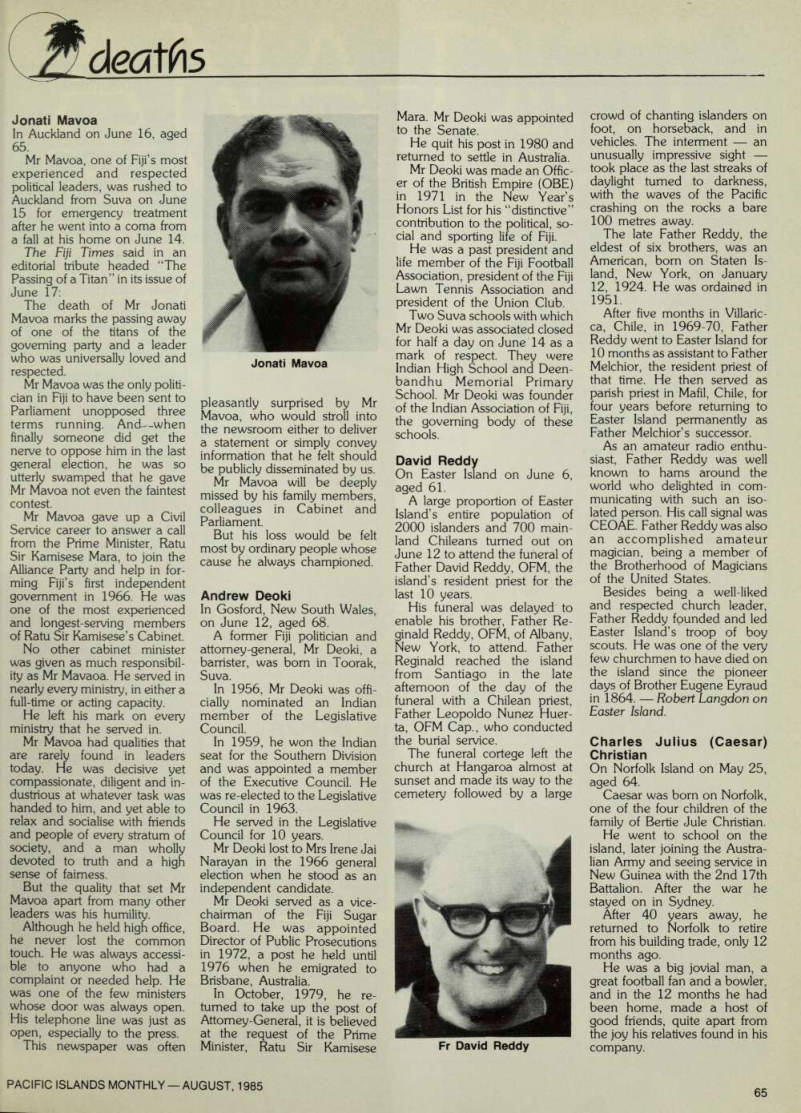
Jonati Mavoa In Auckland on June 16, aged 65.
Mr Mavoa, one of Fiji’s most experienced and respected political leaders, was rushed to Auckland from Suva on June 15 for emergency treatment after he went into a coma from a fall at his home on June 14.
The Fiji Times said in an editorial tribute headed “The Passing of a Titan” in its issue of June 17: The death of Mr Jonati Mavoa marks the passing away of one of the titans of the governing party and a leader who was universally loved and respected.
Mr Mavoa was the only politi cian in Fiji to have been sent to Parliament unopposed three terms running. And--when finally someone did get the nerve to oppose him in the last general election, he was so utterly swamped that he gave Mr Mavoa not even the faintest contest.
Mr Mavoa gave up a Civil Service career to answer a call from the Prime Minister, Ratu Sir Kamisese Mara, to join the Alliance Party and help in for ming Fiji’s first independent government in 1966. He was one of the most experienced and longest-serving members of Ratu Sir Kamisese’s Cabinet.
No other cabinet minister was given as much responsibil ity as Mr Mavaoa. He served in nearly every ministry, in either a full-time or acting capacity.
He left his mark on every ministry that he served in.
Mr Mavoa had qualities that are rarely found in leaders today. He was decisive yet compassionate, diligent and in dustrious at whatever task was handed to him, and yet able to relax and socialise with friends and people of every stratum of society, and a man wholly devoted to truth and a high sense of fairness.
But the quality that set Mr Mavoa apart from many other leaders was his humility.
Although he held high office, he never lost the common touch. He was always accessi ble to anyone who had a complaint or needed help. He was one of the few ministers whose door was always open.
His telephone line was just as open, especially to the press.
This newspaper was often
pleasantly surprised by Mr Mavoa, who would stroll into the newsroom either to deliver a statement or simply convey information that he felt should be publicly disseminated by us.
Mr Mavoa will be deeply missed by his family members, colleagues in Cabinet and Parliament.
But his loss would be felt most by ordinary people whose cause he always championed.
Andrew Deoki In Gosford, New South Wales, on June 12, aged 68.
A former Fiji politician and attorney-general, Mr Deoki, a barrister, was bom in Toorak, Suva.
In 1956, Mr Deoki was offi cially nominated an Indian member of the Legislative Council.
In 1959, he won the Indian seat for the Southern Division and was appointed a member of the Executive Council. He was re-elected to the Legislative Council in 1963.
He served in the Legislative Council for 10 years.
Mr Deoki lost to Mrs Irene Jai Narayan in the 1966 general election when he stood as an independent candidate.
Mr Deoki served as a vice chairman of the Fiji Sugar Board. He was appointed Director of Public Prosecutions in 1972, a post he held until 1976 when he emigrated to Brisbane, Australia.
In October, 1979, he re turned to take up the post of Attorney-General, it is believed at the request of the Prime Minister, Ratu Sir Kamisese
Mara. Mr Deoki was appointed to the Senate.
He quit his post in 1980 and returned to settle in Australia.
Mr Deoki was made an Offic er of the British Empire (OBE) in 1971 in the New Year’s Honors List for his “distinctive” contribution to the political, so cial and sporting life of Fiji.
He was a past president and life member of the Fiji Football Association, president of the Fiji Lawn Tennis Association and president of the Union Club.
Two Suva schools with which Mr Deoki was associated closed for half a day on June 14 as a mark of respect. They were Indian High School and Deen bandhu Memorial Primary School. Mr Deoki was founder of the Indian Association of Fiji, the governing body of these schools.
David Reddy On Easter Island on June 6, aged 61.
A large proportion of Easter Island’s entire population of 2000 islanders and 700 main land Chileans turned out on June 12 to attend the funeral of Father David Reddy, OFM, the island’s resident priest for the last 10 years.
His funeral was delayed to enable his brother, Father Re ginald Reddy, OFM, of Albany, New York, to attend. Father Reginald reached the island from Santiago in the late afternoon of the day of the funeral with a Chilean priest, Father Leopold© Nunez Huer ta, OFM Cap., who conducted the burial service.
The funeral cortege left the church at Hangaroa almost at sunset and made its way to the cemetery followed by a large
crowd of chanting islanders on foot, on horseback, and in vehicles. The interment an unusually impressive sight took place as the last streaks of daylight turned to darkness, with the waves of the Pacific crashing on the rocks a bare 100 metres away.
The late Father Reddy, the eldest of six brothers, was an American, born on Staten Is land, New York, on January 12, 1924. He was ordained in 1951.
After five months in Villaric ca, Chile, in 1969-70, Father Reddy went to Easter Island for 10 months as assistant to Father Melchior, the resident priest of that time. He then served as parish priest in Mafil, Chile, for four years before returning to Easter Island permanently as Father Melchior’s successor.
As an amateur radio enthu siast, Father Reddy was well known to hams around the world who delighted in com municating with such an iso lated person. His call signal was CEOAE. Father Reddy was also an accomplished amateur magician, being a member of the Brotherhood of Magicians of the United States.
Besides being a well-liked and respected church leader, Father Reddy founded and led Easter Island’s troop of boy scouts. He was one of the very few churchmen to have died on the island since the pioneer days of Brother Eugene Eyraud in 1864. Robert Langdon on Easter Island.
Charles Julius (Caesar) Christian On Norfolk Island on May 25, aged 64.
Caesar was born on Norfolk, one of the four children of the family of Bertie Jule Christian.
He went to school on the island, later joining the Austra lian Army and seeing service in New Guinea with the 2nd 17th Battalion. After the war he stayed on in Sydney.
After 40 years away, he returned to Norfolk to retire from his building trade, only 12 months ago.
He was a big jovial man, a great football fan and a bowler, and in the 12 months he had been home, made a host of good friends, quite apart from the joy his relatives found in his company.
Jonati Mavoa
Fr David Reddy
Advertisements & other items, pp. 66-68 (1 item)
[Fmimk
SERVICE PAGE
ADVERTISING
Aggie Grey 66 Amatil 46 Bank Line 57 Citizen Watches 67 Columbus Line 57 Dept, of T rade 4 Fisher & Paykel 38 Gillette 23 Hawker Pacific 28 Henry Cumines 62 Honda Motor 2 Hudson Homes 44 Kooralbyn International School 62 Matsushita Electric 6 Nissan Motor 12,13 Papua Hotel 66 Pioneer Electric 68 Polish Shipping 63 Polynesian Shipping Lines 64 Position Wanted 66 Sheaffer Pen-Textron... 17 K. Swanby 66 Toyota Motor 34,35 Tutt Bryant 60
[FmIMK
AUSTRALIA: Distribution: The Herald and Weekly Times Ltd . 44-74 Flinders St., Melbourne, Vic., 3000. Advertising Rape Brisbane D Wood, Anday Agency, CCA Centre, Dayboro Road, Closebum 4520; Box 1918, GPO Brisbane, 4001; telephone (07) 289-4128 Adatslda Hastwell Williamson Rouse Pty Ltd., PO Box 419 Norwood. SA. 5067; 59 Kensington Road, Norwood, telephone (08) 332-3322, telex 87113; Perth Allen & Associates, Suite 2, 284 Stirling St., Perth, WA, 6000, telephone (09) 328-9593 or (09) 328-9363 FUI: Distribution and subscriptions Desai Bookshops, P O Box 160, Suva, Fiji, telephone Suva 23036.
Advertising Fiji Times & Herald Ltd., 20 Gordon St., Suva, telephone 31-4111, telex FJ2124.
FRENCH POLYNESIA: Distribution Hachette Padfique, 10 Ave Bruat, Papeete, telephone 25610.
HAWAII. UNITED STATES: Distribution PIM, Hawaii, PO Box 22250, Honolulu, Hawaii. 96822 Advertising Bn an C Asgill, Apt 1308, 1676 Ala Moana Blvd , Honolulu, Hawaii 96815, telephone (808) 955-9718 JAPAN: Advertising and subscriptions Universal Media Corporation. GPO Box 46, Tokyo, telephone 666- 3036, cables UNIMEDIA Tokyo, telex 2524665 KOREA: Advertising and subscriptions World Mar keting, Inc, Box 4010, Seoul; phone 776-529T3, telex K 23232 MALAYSIA: Advertising and subscriptions Worldwide Media Services, 57-B Komplex Damai, Jin Dato Haji Eusoff, Kuala Lumpur, telephone 63-9340, cables WORLDMEDIA Kuala Lumpur, telex 31533.
VANUATU: Distribution Maropa Bookshop. HQ Box 210, Port Vila Advertising Bill Penthand, Norman Bros Bookshop, Port Vila, telephone 2232 NEW CALEDONIA; Distribution Depot Centre de Presse Michel Pentecost, CBP2, Noumea, telephone 27- 2434, 27-4729 NEW ZEALAND: Distribution Gordon & Gotch, PO Box 584, 2 Carr Road, Mt Roskill, Auckland 4 Advertising International Media Representatives Ltd., PO Box 10259, Balmoral, Auckland 4, telephone 605-909, 792-370, telex NZ21404
PAPUA NEW GUINEA: Distribution Gordon & Goto*, PO Box 3395, Port Moresby, telephone 25-4551.25-4855.
Advertising Ken Head, PNG Post-Courier, PO Box 85, Port Moresby, telephone 21-2577, telex 22120.
SOLOMON ISLANDS: Distribution and Advertising The Bookshop, (Norman Bros.) PO Box 503, Honiara.
PHILIPPINES: Advertising The GF Group, 12 San Ignado St.. Uroaneta Village. Makati. Metro Manila, telephone 817-7299, telex 45950 and 4233.
UNITED KINGDOM: The Herald & Weekly Times Ltd., No 1 Maltravers Street,London WC2R 3DZ, England, telephone 01 836 5162, telex London 21989 UNITED STATES MAINLAND: Advertising Joshua B Powers Jr., Powers International Inc., 551 Fifth Ave., New York. New York 10 017, telephone 867-9580, telex 236514 Subscriptions PIM, Hawaii. PO Box 22250, i-lonolulu.
Hawaii. 96822
SUBSCRIPTIONS
Payments by personal cheque are only acceptable in Australian (from a branch in Australia), U.S. and New Zealand currency. For all other remittances please send an international bank draft in Australian dollars.
Published monthly by Pacific Publications (Aust.) Pty Ltd. and printed in Australia by Quadricolor Industries Pty. Ltd., Mulgrave, Vic.
ALL THE
NEWS IN A
FLASH
The South Sea Digest tells you what you want to know about the Pacific Islands in a few words. All the leading firms and diplomatic missions read it. You can phone or write or call for a follow up.
See insert for subscription details:
THE SOUTH SEA DIGEST
NOW AVAILABLE! 15th Edition
PACIFIC ISLANDS YEAR BOOK
Contains over 550 pages crammed with all the facts you want to know on all the island groups of the Pacific See insert for further details and price.
Htion far comfort
TROUBLESHOOTER
AVAILABLE
Qualified Accountant/ Administrator/ Management Consultant with many yrs. Island experience seeks long and short term assignments.
Please reply Box 437, Townsville 4810, Australia
Stay at Aggie Grey’s . . . the South Pacific’s
legendary hotel.
Situated right in the heart of Western Samoa. Enjoy Polynesian style friendliness and service, in cool surroundings, superb entertainment and food.
Magnificent white sand beaches only a short drive away. Airconditioned rooms, swimming |xxrl and full bar facilities.
Bookings through Union Steamship Company of NZ, Pan Am, Air New Zealand or direct to Aggie Grey’s, Apia. Western Samoa. Cables: ‘AGGIES’ Apia.
WANTED
American architect with island wife currently living in Japan, will caretake and improve your neglected island property. Need simple house with sandy beach, space to build sailboat. Available early 1986.
Contact: R. K. Swanby, 2-8-14 Goya, Okinawa City, Okinawa, Japan.
Tel. (098) 932-0357.
A-DIGI
WAT TO
TH Multifunc watchwoi inthisinfc Citizen te< the challei revolution watches. mis the
nepieces
n acre. ts m % "O *0 V' \ A /w J
AMA-OIGI
■TEMP
Citizen Quartz Ana-Digi Temp. 59.9° to - 9.9°C temperature readout, one-touch Fahrenheit conversion. Analog/Digital time indication with automatic calendar and dual (one other time zone) time. 24-hour alarm, hourly chime. 1/1000-sec. accurate stopwatch.
Citizen Watches Australia Pty Ltd, 122 Old
AMA-OIGI
ComboFl
Citizen Quartz Ana-Digi Combo FI.
Analog/Digital time indication with 1-sec. and 10-sec. increment LCD trackers. Permanently adjusted monthday-date calendar. 24-hour alarm, 12-hour countdown timer; hourly chime. Dual time. And a 1/100-sec. counter lap-timing stopwatch.
Pittwater Rd, Brookvale. NSW 2100. Telephone; 939 7077. Cable; Citizen Sydney. Telex: AA26633.
CITIZEN
AHEAD OF THEIR TIME
Hid
/V c a N
Shelf Component Systems
♦ ♦ t 900 V 7 r -r y
COMPACT
AUDIO
DIGITAL
Serious about sound? Get Personna
Speaking personally, don’t you prefer good sound over garble, clean design over clutter, easy control over confusion? If so, you’re the sort of person who takes sound (and sound systems) seriously—a PERSONNA sort of person.
Pioneer PERSONNA systems are crafted to suit your personal way of living. Sound quality is rich and clean so you won’t miss a single note or nuance. The compact size is ideal for your personal living space. And because they are designed by people who enjoy music as much as you do, program selection and control are as simple as can be.
At the top of the line is the handsome PERSONNA X-900 —a real “black beauty” with a powerful musical output of 85 watts per channel. That’s more than enough to fill your largest listening room.
The X-900’s one-touch Auto Function and other simple controls give you immediate access to the turntable, tuner, the auto-reverse cassette deck and so on. With the wireless REMOTE CONTROLLER in hand, you can control just about every function the X-900 offers—including those of the optional, matching P-DX7OO Compact Disc Player, pictured above.
If the X-900 is a little too much “music machine” for you, give serious consideration to its “sister systems”—the X-700, X-500, X-300/300S, or X-100/100S. All have the high technology, sophisticated styling and professional craftsmanship that make Pioneer PERSONNA the personal choice of anyone really serious about sound.
(H) PIONEER'
For further information, please contact: Australia: Pioneer Electronics Australia Pty. Ltd. (Incorporated in Victoria), P.O. Box 295, Mordialloc, Victoria, 3195 Tel: 580-9911 Fiji Islands: Brijlal & Company, G.P.O. Box No. 362, Suva, Fiji Islands Tel: 22258 New Zealand: Monaco Distributors Ltd., 2 Poland Road, Glenfield, Auckland, New Zealand Tel: (09) 444-9144 Norfolk Island: Burns Philp (Norfolk Island) Ltd., P.O. Box 21, Norfolk Island Vanuatu: Burns Philo (Vanuatu) Ltd.. Vila. Vanuatu iru Island: Jacob Enterprises, P.O. Box No. 4, Republic of Nauru iti: Tahiti Hi-Fi, P.O. Box 848, Papeete, Tahiti , . v Caledonia: Menard Pacifique Sari, B.P. 3899, Noumea, New Caledonia 27*62*23 erican Samoa: Transpac Corporation, P.O. Box 1477, Pago Pago, American noa 96799 Tel: 633-5224 „ A .. . Tol . otonoa: South Seas International Ltd., P.O. Box 49, Rarotonga, Cook Islands Tel. 2327 ... ki®... Qoli Marrhantc Ptu l trl PO Box 6103. Boroko Tel: 254887