“Increase practical aid
pp. 51-52 · Read in the full issue
to islands” - seminar
The developed nations should increase their economic and technical aid to the tiny Pacific island countries to ward off the possibility of increased Soviet influence in the Pacific region, participants in a regional sym posium in Tokyo said.
The recent Soviet offer of about US$2 million a year to Kiribati for fishing rights, and their concurrent approaches to other island nations, including Vanuatu, Tuvalu, Fiji and Papua New Guinea, could lead eventually to establishment of a land base and the entangle ment of the islands in in
ternational political power plays.
This prospect worried some Australian and New Zealand politicians, diplomats and fore ign affairs specialists, Garry Bar ker, publisher of the long established Pacific Publications group of Australia, and editor of Pacific Islands Monthly , told the annual symposium of Japan’s important Pacific Society. He said that the major nations should not ignore this deve lopment, no matter how mild it might seem in its present very early stages.
“Two million dollars is prob
ably in the petty cash tins of the developed countries; a sum so small it is of quite little mo ment,” he said. ‘The small island countries might have tiny economies, and some of them may never be truly viable, but their position in the Pacific is strategically of great import ance. Kiribati straddles the trade routes between Australia and Japan. If its exclusive eco nomic zone is taken into account, it covers a huge area of the world. ‘‘We should pay closer atten tion to the needs and aspira tions of the islands,” said Mr
Barker. “We should try to pro duce in them the ability to survive and to grow, and we should do that, not only be cause it can be seen as our humanitarian duty to spread prosperity, but also because of that most powerful and relevant of reasons, self-interest.” (Since the symposium Japan and the European Economic Commission have, in fact shown interest in Kiribati's fishing industry, and have pro vided significant aid and sup port, in equipment and capital).
Within this particular facet of a very wide problem lay the difficulties many island coun tries had with the Tuna Boat Association of the United States which refused to recognise na tional rights within e.e.z’s over catches of migratory fish like tuna. This tarnished the good and cooperative relationship which the U.S. had with almost every Pacific island nation.
The islands generally found very little in common with the Soviet Union. None had the slightest desire to become embroiled in the super-power struggle. And yet all had the need to survive and to develop as best they could the small resources available to them, he said.
The panel of speakers, which also included the ambassadors to Japan of Papua New Guinea, and Fiji, as well as Aoyama Gakuin University pro fessor, Shinkichi Eto, agreed that Western nations should increase not only the quantity, but also the quality of their aid.
In many of the countries there was an elite class, edu cated abroad, and a larger class which either worked, or lived at subsistence level in traditional style villages. There was a shor
tage of qualified middle mana gers to organise and supervise workers. Professor Eto said.
“We need people to be trained to be experts.” said PNG Ambassador Joseph Nombri. "We need experts, too. If you do a job and don’t
train somebody to take that job. then the idea of having assist ance is lost to us.”
Western nations should make more effort to study the needs of the island peoples to properly channel aid, said Eto.
“People need to go there and see for themselves what is really needed; not what they think may be effective,” said Fiji ambassador Joseph Gibson.
While the size and remote ness of the countries has made it difficult to attract investment from the developed countries, the islands needed only small investments to achieve quite startling results. Ideas, enthu siasm, and a bit of capital were often of more value than elabo rate projects, he said.
Ambassador Nombri said he worried that efforts such as those of the Pacific Basin Eco
nomic Cooperation Council would develop the Pacific re gion for the sole benefit of the major rim countries.
“1 would like to see Japan, as a leading nation in these discus sions. focus on the Pacific is lands to bring forth the views of the Pacific islanders, so they share resources equally and do not again become colonised peoples.” he said.
All speakers observed that Pacific islanders valued their independence and saw econo mic self-sufficiency as the way to protect it.
“We want to dispel the myth that the islanders are generally well-off and, with just a little help here and there, will con tinue to happily subsist with what they get from the land and the sea.” said ambassador Gib son.
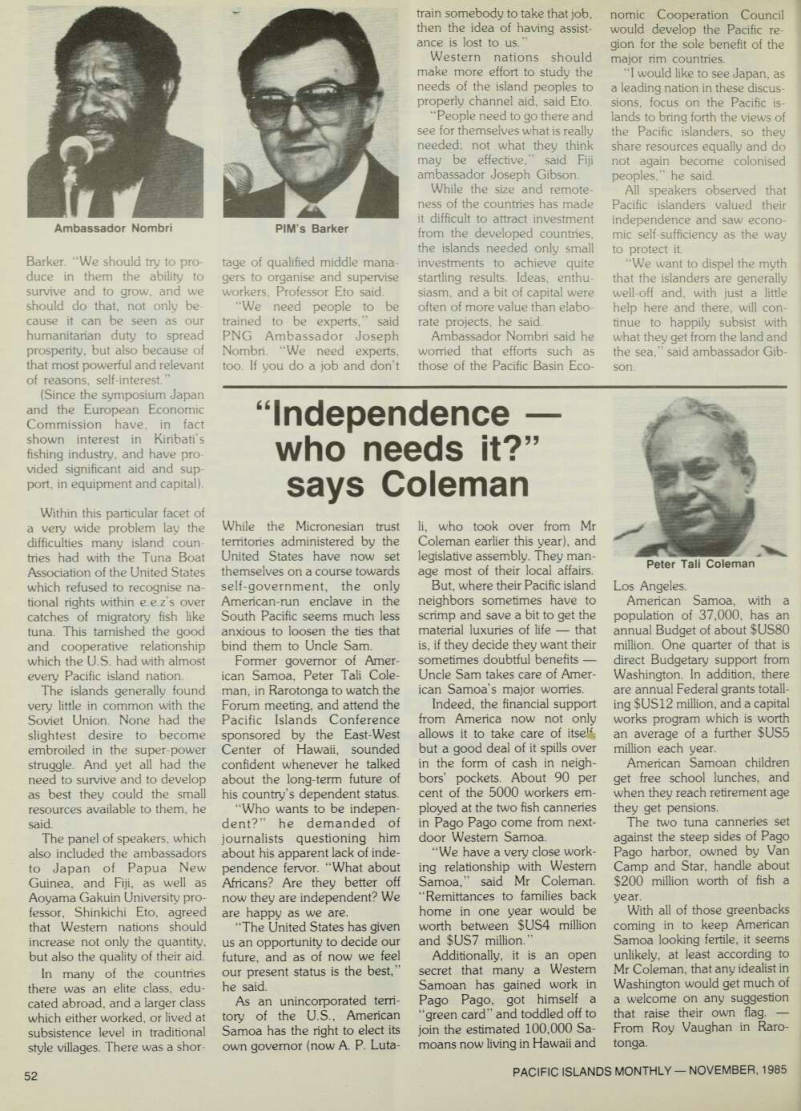
PIM’s Barker
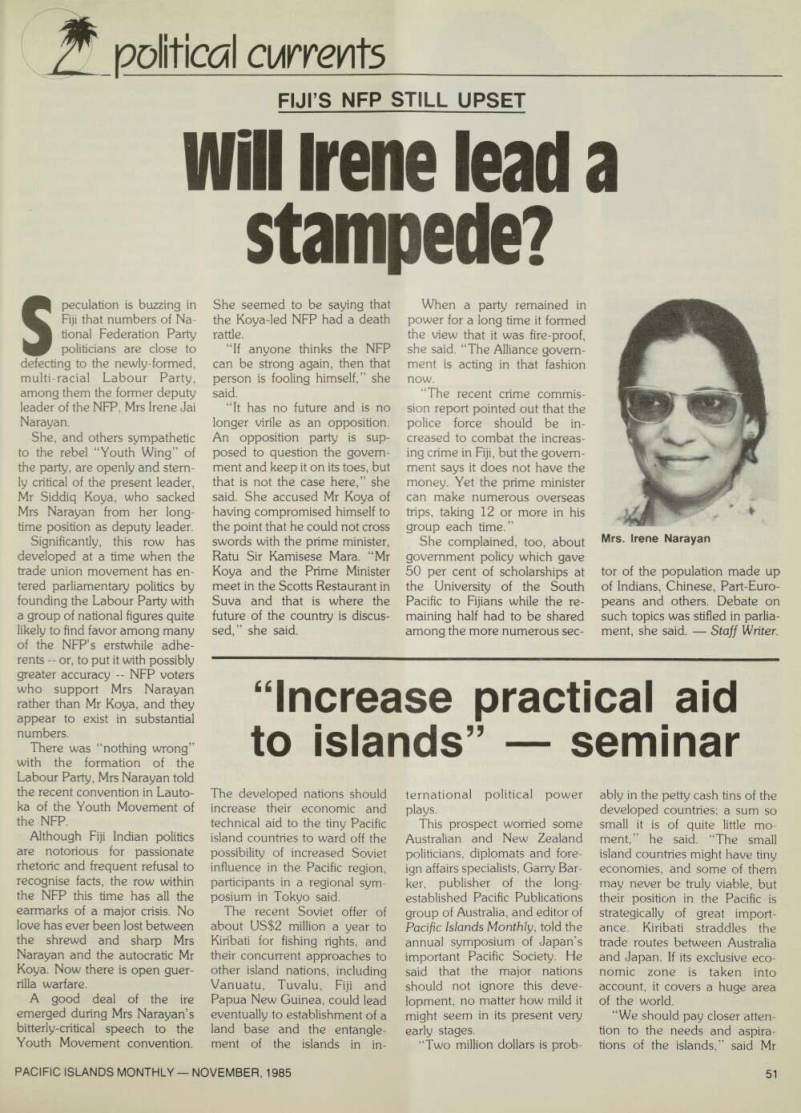
Ambassador Nombri