A bizarre shipwreck sparks
pp. 40-41 · Read in the full issue
a tale of greed
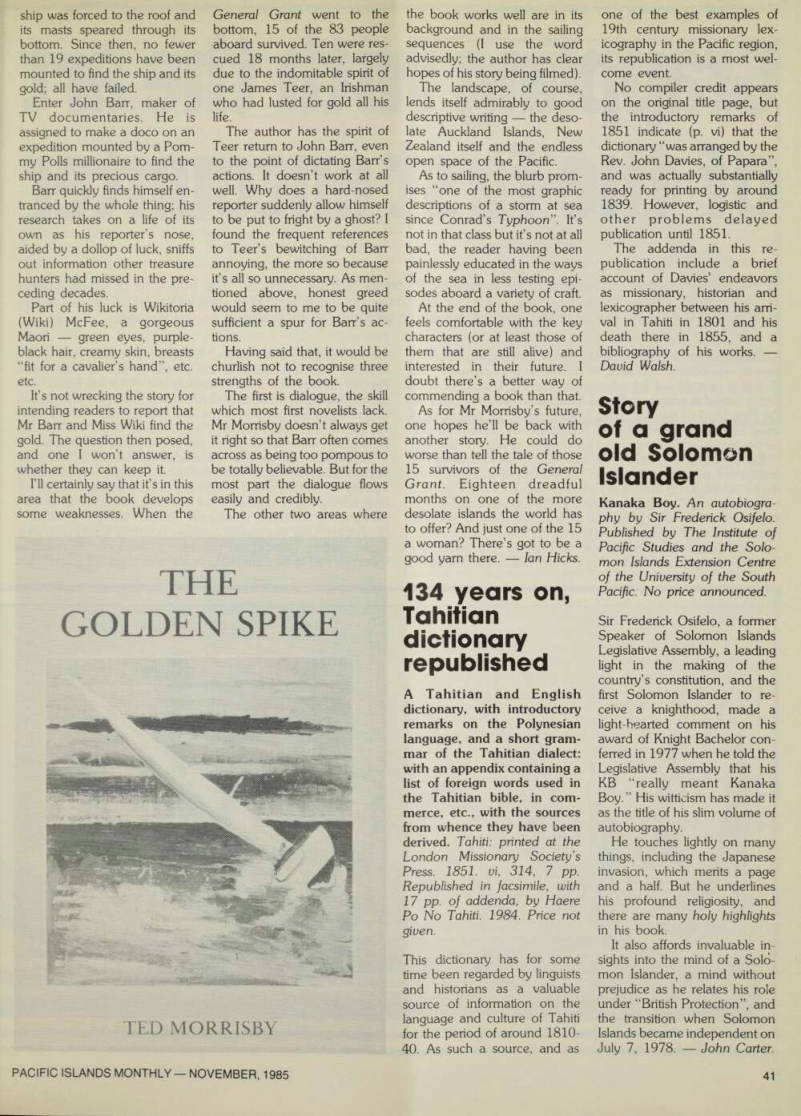
The Golden Spike. By Ted Morrisby. Published 1984 by Brolga Books, 17 Main North Road, Menindie, SA 5081, Australia. ISBN 0 9099 12 12 2. Price $A16.95.
Without being too precious about it, I think one can argue that a good novel is more than merely a good story. It ought to tell readers things they didn’t know, encourage them to speculate about subjects they’d not previously pondered.
On both scores, The Golden Spike works well. It is precisely the sort of book one would expect from its author, and just the style of book every journal ist says he’ll write one day but seldom does.
Morrisby was a journalist for more than 30 years, starting in Sydney before moving to Lon don where he eventually trans ferred from newspapers to tele vision current affairs and documentaries. He’s also a skil led yachtsman.
Wisely, he decided to base his book on that varied experi ence. I suspect his characters are also drawn from it and if that surmise is correct, he’d be a man worth meeting. If his gorgeous heroine is based on Mrs Morrisby, I’d be delighted to meet her, too, with or with out her husband. I might add that if she’s based on someone else Mr Morrisby might have had a spot of explaining to do.
Be that as it may, The Gold
en Spike is rooted firmly in that most vigorous of human char acteristics greed. It’s always had a bad image, but the plain fact is that a lot of things wouldn’t get done without it.
The problems start when it gets out of hand which it does with a will in this story.
As the author explains in a foreword, the tale is based on the bizarre loss in 1866 of the American square-rigger, Gen eral Grant. With 83 people and, more to the point, nine tons of gold aboard, the ship strayed off course while on the South Polar route from Melbourne to London via Cape Horn.
It ran into a cave in the Auckland Islands, south of New Zealand; as the tide rose, the
ship was forced to the roof and its masts speared through its bottom. Since then, no fewer than 19 expeditions have been mounted to find the ship and its gold; all have failed.
Enter John Barr, maker of TV documentaries. He is assigned to make a doco on an expedition mounted by a Pom my Polls millionaire to find the ship and its precious cargo.
Barr quickly finds himself en tranced by the whole thing; his research takes on a life of its own as his reporter’s nose, aided by a dollop of luck, sniffs out information other treasure hunters had missed in the pre ceding decades.
Part of his luck is Wikitoria (Wiki) McFee, a gorgeous Maori green eyes, purple black hair, creamy skin, breasts “fit for a cavalier’s hand”, etc. etc.
It’s not wrecking the story for intending readers to report that Mr Barr and Miss Wiki find the gold. The question then posed, and one I won’t answer, is whether they can keep it.
I’ll certainly say that it’s in this area that the book develops some weaknesses. When the
General Grant went to the bottom, 15 of the 83 people aboard survived. Ten were res cued 18 months later, largely due to the indomitable spirit of one James Teer, an Irishman who had lusted for gold all his life.
The author has the spirit of Teer return to John Barr, even to the point of dictating Barr’s actions. It doesn’t work at all well. Why does a hard-nosed reporter suddenly allow himself to be put to fright by a ghost? I found the frequent references to Teer’s bewitching of Barr annoying, the more so because it’s all so unnecessary. As men tioned above, honest greed would seem to me to be quite sufficient a spur for Barr’s ac tions.
Having said that, it would be churlish not to recognise three strengths of the book.
The first is dialogue, the skill which most first novelists lack.
Mr Morrisby doesn’t always get it right so that Barr often comes across as being too pompous to be totally believable. But for the most part the dialogue flows easily and credibly.
The other two areas where
the book works well are in its background and in the sailing sequences (I use the word advisedly; the author has clear hopes of his story being filmed).
The landscape, of course, lends itself admirably to good descriptive writing the deso late Auckland Islands, New Zealand itself and the endless open space of the Pacific.
As to sailing, the blurb prom ises “one of the most graphic descriptions of a storm at sea since Conrad’s Typhoon”. It’s not in that class but it’s not at all bad, the reader having been painlessly educated in the ways of the sea in less testing epi sodes aboard a variety of craft.
At the end of the book, one feels comfortable with the key characters (or at least those of them that are still alive) and interested in their future. 1 doubt there’s a better way of commending a book than that.
As for Mr Morrisby’s future, one hopes he’ll be back with another story. He could do worse than tell the tale of those 15 survivors of the General Grant. Eighteen dreadful months on one of the more desolate islands the world has to offer? And just one of the 15 a woman? There’s got to be a
good yarn there.
Ian Hicks.
134 years on,
Tahitian
dictionary
republished
A Tahitian and English dictionary, with introductory remarks on the Polynesian language, and a short gram mar of the Tahitian dialect: with an appendix containing a list of foreign words used in the Tahitian bible, in com merce, etc., with the sources from whence they have been derived. Tahiti: printed at the London Missionary Society’s Press. 1851. ui, 314, 7 pp.
Republished in facsimile, with 17 pp. of addenda, by Haere Po No Tahiti. 1984. Price not given.
This dictionary has for some time been regarded by linguists and historians as a valuable source of information on the language and culture of Tahiti for the period of around 1810- 40. As such a source, and as
one of the best examples of 19th century missionary lex icography in the Pacific region, its republication is a most wel come event.
No compiler credit appears on the original title page, but the introductory remarks of 1851 indicate (p. vi) that the dictionary “was arranged by the Rev. John Davies, of Papara”, and was actually substantially ready for printing by around 1839. However, logistic and other problems delayed publication until 1851.
The addenda in this re publication include a brief account of Davies’ endeavors as missionary, historian and lexicographer between his arri val in Tahiti in 1801 and his death there in 1855, and a bibliography of his works.
David Walsh.
Story
of a grand
old Solomon
Islander
Kanaka Boy. An autobiogra phy by Sir Frederick Osifelo.
Published by The Institute of Pacific Studies and the Solo mon Islands Extension Centre of the University of the South Pacific. No price announced.
Sir Frederick Osifelo, a former Speaker of Solomon Islands Legislative Assembly, a leading light in the making of the country’s constitution, and the first Solomon Islander to re ceive a knighthood, made a light-hearted comment on his award of Knight Bachelor con ferred in 1977 when he told the Legislative Assembly that his KB “really meant Kanaka Boy. ” His witticism has made it as the title of his slim volume of autobiography.
He touches lightly on many things, including the Japanese invasion, which merits a page and a half. But he underlines his profound religiosity, and there are many holy highlights in his book.
It also affords invaluable in sights into the mind of a Solo mon Islander, a mind without prejudice as he relates his role under “British Protection”, and the transition when Solomon Islands became independent on
July 7, 1978.
John Carter.