Grappling with the art
pp. 42-44 · Read in the full issue
of the first encounter
In the second of three instalments of the lecture by Professor Bernard Smith on “The Functions of Art on Cook’s Voyages” (The Dulcie Stretton Lecture, 1985) he discusses botanical illustration, the infant art of “ethnographic illustration,” and finally, the aesthetic element present in all forms of art practised on the voyages.
Although Banks’ scientific interests were wide-ranging, his central passion was botany. The study of botany on the Endeavour , and all that it opened out for subsequent scientific field work in the Pacific, was due entirely to Banks’ initiative. When he approached the First Lord of the Admiralty, Lord Egmont, for permission to travel with Cook, Egmont agreed, but added “we cannot find room for people skilled in Botany and the drawers of plants. ” But later, Phillip Stephens, Secretary to the Admiralty, smoothed things over and gained permission for Banks’ party to travel with him. It was Banks’ ambition to continue Linnaeus’ work in the Pacific; to collect and classify plants according to the Linnaean system. But there was also a strong practical bent to his interests. We must remember that he became a member of the Royal Society of Arts, the first organisation in Europe to promote the relationship between science and technology, even before he became a
member of the Royal Society. It was Solander, his professional botanist, who first classified the breadfruit tree of Tahiti, and Parkinson who made the first drawing of it. But it was Banks, with the enthusiasm of his Society of Arts colleagues in the West Indies, who energetically got behind the idea that resulted in the Bounty voyage, in the hope that the African slaves in the West Indian plantations might be taught to prefer breadfruit to banana.
Undoubtedly the greatest artistic achievement of the Endeavour voyage lies in the quality of the botanical illustrations produced by Sydney Parkinson, and it is pleasing to note that this has at last been adequately recognised in the fine book on Parkinson recently published by the British Museum of Natural History and edited by D. J. Carr. Like the coastal profiles, botanical illustrations were drawn within well-defined graphic conventions. A flowering specimen had to be collected in order to be classified according to
Linnaeus’ sexual system. George Ehret, who worked with both Linnaeus and Banks, provided a graphic key for Linnaeus’
Systemae Naturae (1759). Parkinson had to delineate carefully the structure of the flower and the ramification of the leaves, and note the colors before the plant faded.
A specimen was first collected and then described and classified by Solander. Parkinson made a preliminary drawing noting essentials. Later a finished drawing was made, either by Parkinson or a botanical illustrator back in London, then an engraving was cut for publication. Parkinson worked with great skill and assiduity during the vouage and produced over 1000 drawings of plants, many only basic sketches. From these Banks had about 740 plates engraved, but for some reason never fully explained he did not publish the engravings. Perhaps Banks, who became a particularly despotic president of the Royal Society, chose in the end not to publish, preferring that the world of science should beat a way to his house at Soho Square if they were interested in the material he had collected in youth at such hazard to his life. However, the Alecto press has recently published Banks’ engravings at great expense in a magnificent edition, by the time-consuming a la poupe method favored by the famous French 18th-century botanical illustrator, P.-J. Redoute. It is an astoundingly beautiful series, but it is most unlikely that Banks would have ever contemplated publishing his plates in color. That was not the practice among English men of science, and would have been beyond even his means.
The third important category of Cook voyage art is the kind we should now call ethnographic illustration. It is curious that Alexander Buchan, who was taken to draw the figures and dresses of native people, wasn’t at all skilled at drawing the figure. Despite the late Dr Lysaght’s energetic efforts, we still possess no reliable knowledge of Buchan prior to his joining Banks on the Endeavour, and it’s something of a mystery why he was chosen.
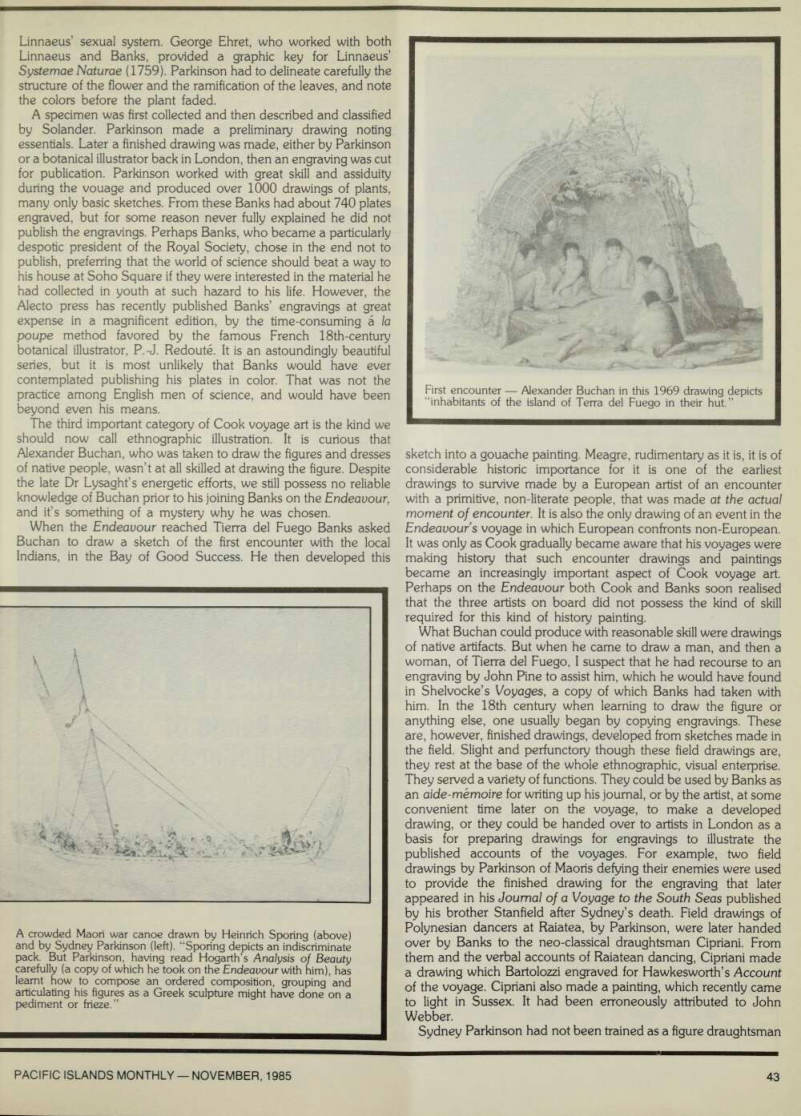
When the Endeavour reached Tierra del Fuego Banks asked Buchan to draw a sketch of the first encounter with the local Indians, in the Bay of Good Success. He then developed this
sketch into a gouache painting. Meagre, rudimentary as it is, it is of considerable historic importance for it is one of the earliest drawings to survive made by a European artist of an encounter with a primitive, non-literate people, that was made at the actual moment of encounter. It is also the only drawing of an event in the Endeavours voyage in which European confronts non-European.
It was only as Cook gradually became aware that his voyages were making history that such encounter drawings and paintings became an increasingly important aspect of Cook voyage art.
Perhaps on the Endeavour both Cook and Banks soon realised that the three artists on board did not possess the kind of skill required for this kind of history painting.
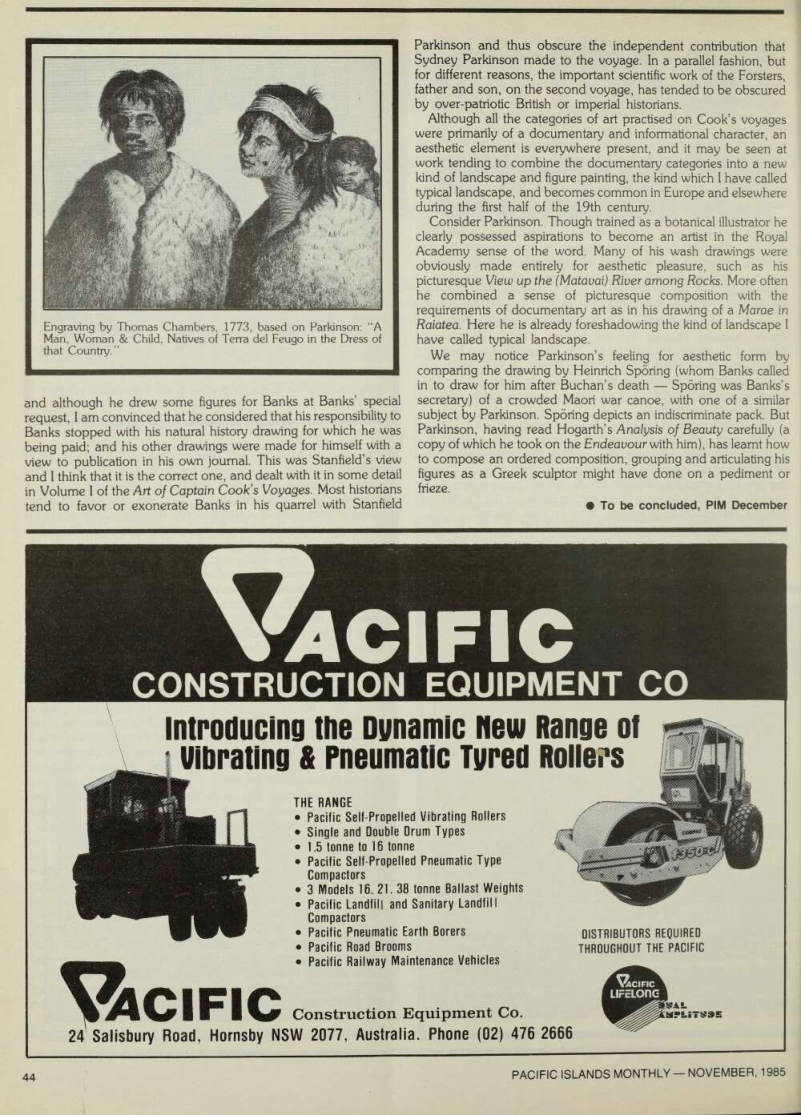
What Buchan could produce with reasonable skill were drawings of native artifacts. But when he came to draw a man, and then a woman, of Tierra del Fuego, I suspect that he had recourse to an engraving by John Pine to assist him, which he would have found in Shelvocke’s Voyages, a copy of which Banks had taken with him. In the 18th century when learning to draw the figure or anything else, one usually began by copying engravings. These are, however, finished drawings, developed from sketches made in the field. Slight and perfunctory though these field drawings are, they rest at the base of the whole ethnographic, visual enterprise.
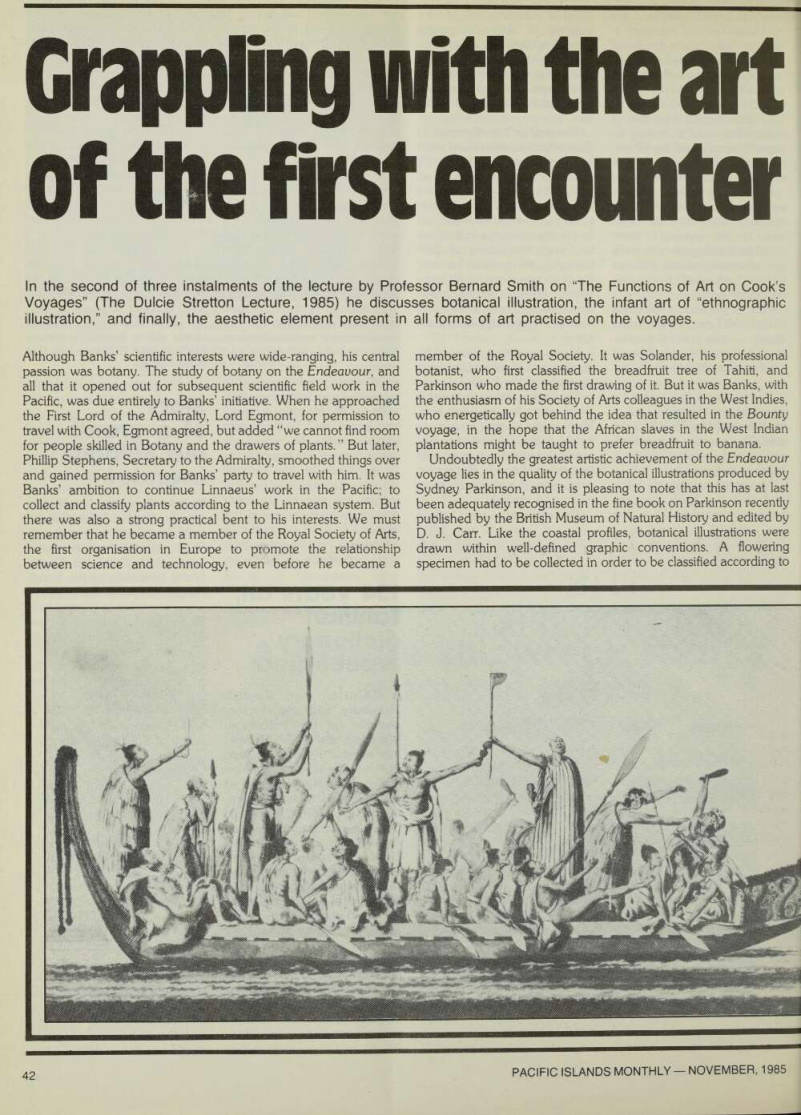
They served a variety of functions. They could be used by Banks as an aide-memoire for writing up his journal, or by the artist, at some convenient time later on the voyage, to make a developed drawing, or they could be handed over to artists in London as a basis for preparing drawings for engravings to illustrate the published accounts of the voyages. For example, two field drawings by Parkinson of Maoris defying their enemies were used to provide the finished drawing for the engraving that later appeared in his Journal of a Voyage to the South Seas published by his brother Stanfield after Sydney’s death. Field drawings of Polynesian dancers at Raiatea, by Parkinson, were later handed over by Banks to the neo-classical draughtsman Cipriani. From them and the verbal accounts of Raiatean dancing, Cipriani made a drawing which Bartolozzi engraved for Hawkesworth’s Account of the voyage. Cipriani also made a painting, which recently came to light in Sussex. It had been erroneously attributed to John Webber.
Sydney Parkinson had not been trained as a figure draughtsman
A crowded Maori war canoe drawn by Heinrich Sporing (above) and by Sydney Parkinson (left). “Sporing depicts an indiscriminate pack. But Parkinson, having read Hogarth’s Analysis of Beauty carefully (a copy of which he took on the Endeavour with him), has learnt how to compose an ordered composition, grouping and articulating his figures as a Greek sculpture might have done on a pediment or frieze.”
First encounter - Alexander Buchan in this 1969 drawing depicts “inhabitants of the island of Terra del Fuego in their hut.”
and although he drew some figures for Banks at Banks’ special request, I am convinced that he considered that his responsibility to Banks stopped with his natural history drawing for which he was being paid; and his other drawings were made for himself with a view to publication in his own journal. This was Stanfield’s view and I think that it is the correct one, and dealt with it in some detail in Volume I of the Art of Captain Cook’s Voyages. Most historians tend to favor or exonerate Banks in his quarrel with Stanfield
Parkinson and thus obscure the independent contribution that Sydney Parkinson made to the voyage. In a parallel fashion, but for different reasons, the important scientific work of the Forsters, father and son, on the second voyage, has tended to be obscured by over-patriotic British or imperial historians.
Although all the categories of art practised on Cook’s voyages were primarily of a documentary and informational character, an aesthetic element is everywhere present, and it may be seen at work tending to combine the documentary categories into a new kind of landscape and figure painting, the kind which I have called typical landscape, and becomes common in Europe and elsewhere during the first half of the 19th century.
Consider Parkinson. Though trained as a botanical illustrator he clearly possessed aspirations to become an artist in the Royal Academy sense of the word. Many of his wash drawings were obviously made entirely for aesthetic pleasure, such as his picturesque View up the (Matauai) River among Rocks. More often he combined a sense of picturesque composition with the requirements of documentary art as in his drawing of a Marae in Raiatea. Here he is already foreshadowing the kind of landscape I have called typical landscape.
We may notice Parkinson’s feeling for aesthetic form by comparing the drawing by Heinrich Sporing (whom Banks called in to draw for him after Buchan’s death Sporing was Banks’s secretary) of a crowded Maori war canoe, with one of a similar subject by Parkinson. Sporing depicts an indiscriminate pack. But Parkinson, having read Hogarth’s Analysis of Beauty carefully (a copy of which he took on the Endeavour with him), has leamt how to compose an ordered composition, grouping and articulating his figures as a Greek sculptor might have done on a pediment or frieze. • To be concluded, PIM December
Engraving by Thomas Chambers, 1773, based on Parkinson: “A Man, Woman & Child, Natives of Terra del Feugo in the Dress of that Country.”