A “first” in the study of
pp. 39-40 · Read in the full issue
books
A “first” in the study of New Caledonia’s politics
Politics in New Caledonia By Myriam Domoy. Published by Sydney University Press, 1984. xvi + 302 pages. ISBN 0 424 00101 2. Price $A32.50.
Readers with an interest in the South Pacific will be indebted to Dr Domoy for her study of post-war politics in New Cale donia, extending from 1945 to 1978 with a postscript cover ing the years 1978-82. This is the first close political analysis, either in English or French, to be made of the territory which, in spite of its small population of 145,000, has in the past year caught the attention of coun tries of the South Pacific and galvanised political circles in France.
Being French, Dr Domoy has an easy grasp of a French colonial system. She has made wide use of printed French sources and personal interviews with a broad cross-section of the Caledonian community.
However, she is also at home in the English-speaking world. At the Sorbonne in Paris she studied the Black Panthers movement in the United States.
The present book was written in Australia at Monash University in Melbourne, while the author was a doctoral student in politi cal science.
Political events are moving so fast in New Caledonia, especial ly since the successful boycott of the elections of November 18 last year, that political com mentators are in great danger of falling behind the times. Dr Dornoy’s study might be thought to be dated because virtually all the Mitterrand re gime, which came to power in 1981, lies outside the scope of her book. Her secret is to concentrate on the underlying structure of present-day New Caledonian society, a summary
of which is set out in a brief and elegantly written introduction.
As a result the book is up-to date in spirit and very readable.
The choice of 1945 as the starting point for the study was well made. This was an impor tant year in New Caledonia, when Melanesians began to take part in the political life of the territory. The author tells the story well. With the aboli tion of their old inferior status under the so-called indigenat, their acquisition of French citi zenship, and their gradual admission to the electoral rolls, Melanesians soon occupied key political positions in opposition to the Noumea establishment.
In 1953, L’Union Caledonien ne, whose slogan was deux couleurs, un seal peuple, won a majority of the 25 seats in the Territorial Assembly elections, and of its 15 seats nine were held by Melanesians. This coali tion of “petits blancs” and Melanesians maintained a majority position in territory politics until the late 19605.
With the prosperity of the nickel boom Europeans began deser ting to the conservative parties.
Melanesian politicians such as Yann Celene Uregei and Andre Gopea left to form specifically Melanesian parties and even tually opted for independence.
Today 1’ Union Caledonienne is almost an entirely Melanesian party. Under the leadership of Rock Pidjot and Jean-Marie Tjibaou, it is the principal politi cal party within the Kanak pro-independence movement.
An extensive social and in stitutional setting for the strictly political analysis is an important feature of the book. This in cludes a chapter on the history of colonisation, which will re main of great value until a comprehensive history of the
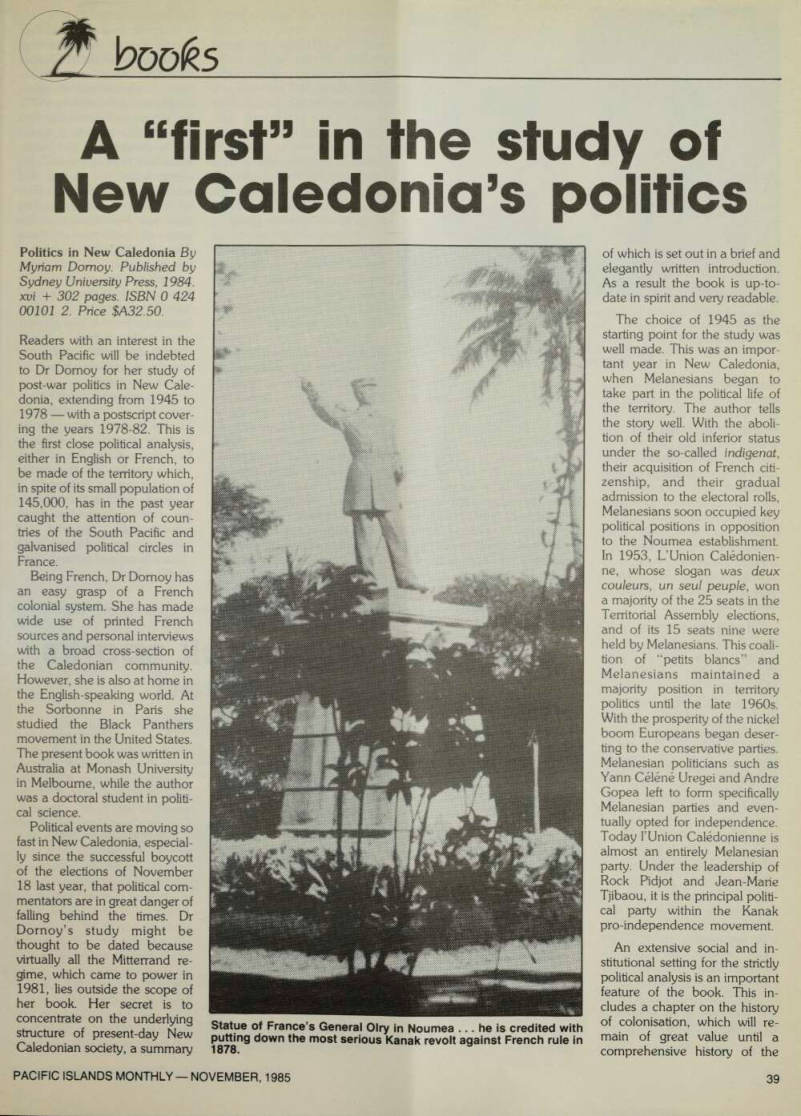
Statue of France’s General Olry in Noumea ... he is credited with putting down the most serious Kanak revolt against French rule in 1878.
island has been written. Chap ters on population structure, the law and institutions, and the land problem and the economy enable the author to fully docu ment her views of New Caledo nian society. A special chapter is devoted to the church and its role in education, the trade unions and the media. As the church and the press have always had considerable influ ence in the colony, their inclu sion is welcome. Since World War II unionism has played an ever-increasing role.
Although the historical chap ter is sound in outline, it can be questioned on many points.
The author is too ready to rely on authors who have only a passing acquaintance with the island, such as Hartley Grattan and Andrew Coates. Her un critical acceptance of historical myths, such as that a British annexation of New Caledonia was nipped in the bud by the French and that, as a result, the British naval commander re sponsible committed suicide he actually lived to become an admiral and died in his bed is a minor blemish. More serious is the uncritical acceptance of a spectacular decline in the Melanesian population shortly after annexation. The author is often careless with dates: for example, those for the founding of the leading Melanesian party, I’Union Caledonienne. This title was first used in the Territorial Assembly elections of 1953.
The polarisation of New
Caledonian society between Noumea and the bush emerges from a study of the 1976 census. Dr Domoy’s conclu sions are thoroughly confirmed by the census of April, 1983.
While some 80 per cent of Europeans and other non- Melanesian immigrant groups congregate in greater Noumea, the bush is predominantly Melanesian. Only about 900 agricultural enterprises in the hands of Europeans were
operative up until 1984.
Educational and work force data illustrate the privileged position of the whites. The present minority position of the Melanesians (42 per cent) is shown to be the outcome of government-promoted im migration from France and the French territories of the South Pacific, especially Wallis and Futuna, in the 1960 s and early 1970 s to provide labor for the nickel boom. The benefits of the boom have gone primarily to the European community of Noumea whose privileged posi tion is bolstered by financial contributions from France, amounting at times to 40 per cent of the gross domestic pro duct of the territory.
Dr Dornoy shows that the French administration keeps a tight hold on key areas, includ ing internal security, external affairs, immigration, justice, fin ance and communications. It also adminsters the municipali ties and Melanesian affairs.
Territorial politics is regulated by a Statute which regularly changes to meet the needs of the French. Except for a brief period between November, 1984, and August of this year, the representative of the Re public, the High Commissioner, has always headed the terrrito
rial administration.
Since the end of World War 11, the French administration has aimed generally at keeping both the Melanesian and Euro pean communities at arm’s length, and since the late 1970 s has looked to the establishment of a multi-racial society, based on the premise that all Caledo nians are French citizens with equal rights and duties. But such an attitude is totally fore ign to Melanesian tradition. The view that Melanesians, as the original occupants, have sovereign rights is at the root of the Melanesian independence movement. It is greatly to Dr Domoy’s credit that she high lights this contrast, several years before the French Government in the Pisani plan recog nised that a stable multi-cultural society could be built around Kanak sovereignty'.
Dr Dornoy’s book will help to break down the isolation of New Caledonia as a French territory in a predominantly English-speaking region of the world an isolation which goes beyond a difference of language, and is bolstered by the maintenance of political, administrative, financial and career systems tied to those of a
distant European nation.
Bar-
ry Shineberg.
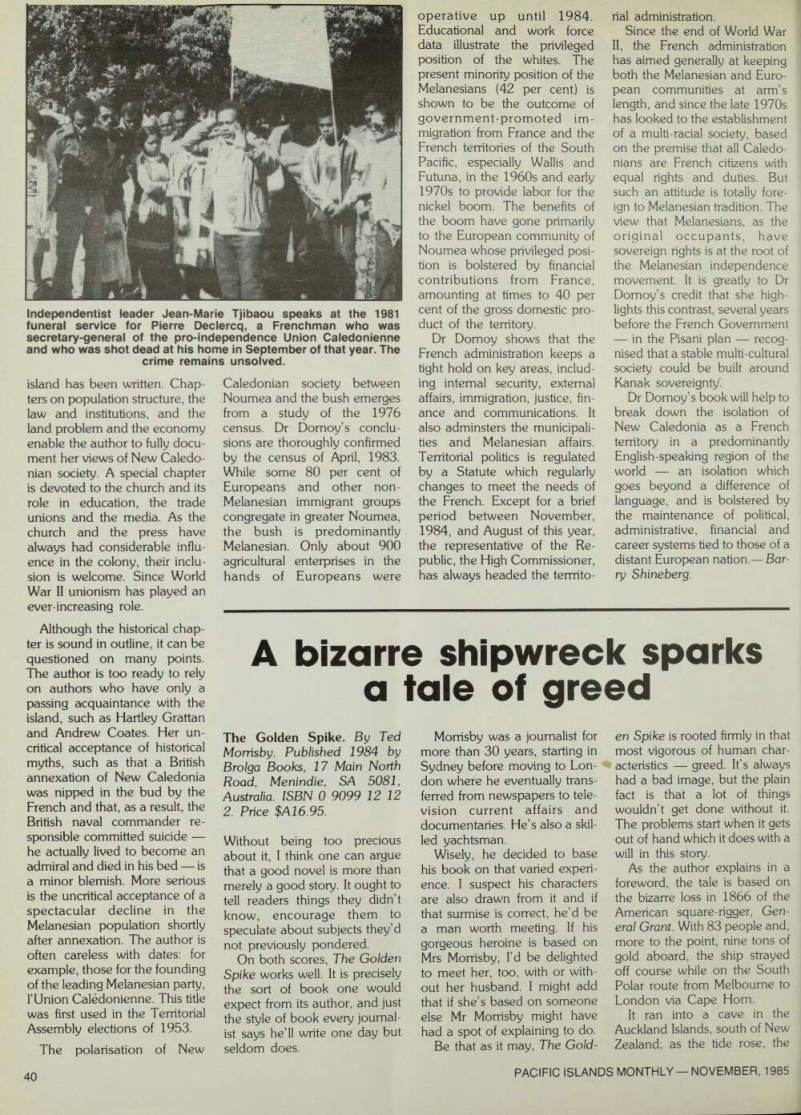
Independentist leader Jean-Marie Tjibaou speaks at the 1981 funeral service for Pierre Declercq, a Frenchman who was secretary-general of the pro-independence Union Caledonienne and who was shot dead at his home in September of that year. The crime remains unsolved.