aviating
p. 37 · Read in the full issue
Cook Is. go aviating
Competition for airline landing rights in the Cook Islands has boiled up with news that the Cook Islands government has taken control of Rarotonga’s international airport under a new agreement signed in Aug ust by the New Zealand prime minister, David Lange, and Sir Thomas Davis, prime minister of the Cooks.
The deal effectively opens Cook Islands skies to all comers and ends what has been a near monopoly for Air New Zealand.
Sir Thomas reports high in terest, particularly from Austra lian airlines, in providing con nections out of Sydney to Raro tonga by way of Melanesia and Polynesia. The Cook Islands lie strategically-placed in the line of islands running due east from the Queensland coast - New Caledonia, Vanuatu, Fiji, the Samoas and Tonga, the Cooks and French Polynesia. Some, like Fiji and French Polynesia, have major tourist industries.
All the others have plans to develop in the industry.
Rarotonga airport was built by the New Zealand govern ment in the 1970 s under an aid package and until now it has been administered by the N.Z.
Department of Civil Aviation.
The runway is capable of taking a Boeing 747, although not at full load, and Air New Zealand has been operating both those airliners, and smaller Boeing 737 twin-jets out of Auckland.
Of Australian airlines vey likely to be interested in the Rarotongan connection, Ansett already has a toe-hold through its interest in Polynesian Air lines, which it runs in conjunc tion with Air Vanuatu. Ansett, which made a very spirited bid to take over Fiji’s Air Pacific (now run by Qantas under a three-year management con tract) is expected to display the greatest enthusiasm for boos ting services from Sydney.
Polynesian Airlines has regu lar services to Apia, Western Samoa, and also flies to Port Vila, in Vanuatu, and it is thus already possible to make an island-hopping trip with Ansett
managed aircraft to Rarotonga by way of those ports.
Sir Thomas Davis has been critical of Air New Zealand, saying the line has neglected good tourism potential out of Australia and North America to the Cook Islands. ’’There is no way Air New Zealand would look after our Australian market because of a conflict with New Zealand’s own tourist industry. ”
On present figures Sir Thomas is picking up a loss making enterprise which until now has been subsidised by the New Zealand taxpayer.
The airport costs about NZ$2 million a year to run and returns about NZ$5OO,OOO in revenue.
Air New Zealand claims it has
been subsidising its services out of Auckland at a cost of several millions a year, but during the last six months the Cooks has become more attractive to holi daying Kiwis, and Air New Zealand aircraft have been flying in fairly much full. Sir Thomas is confident the airport would break even with the addition of only two more in ternational flights. Indeed, he is more interested in boosting tourism, particularly from Aus tralia, than in actually making the airport do much more than meet its costs.
Within this concept is the recent decision to increase tour ist capacity by spending SNZ7 million on extending the Raro tongan Hotel to add another 108 beds.
Of the 33,000 tourists who visit the Cooks each year about 55 per cent now come from New Zealand and 25 per cent from Australia.
The airport takeover will not
cause undue problems to the Cooks because the facility is almost totally localised already.
Only four New Zealanders are still on the staff, and Sir Thomas said the handover agreement provided for New Zealand technical assistance when re quired.
Around Avarua, the Cooks capital, the euphoria of having one’s own airfield has caught on. Local entrepreneurs are talking of building new roads into Rarotonga’s tiny, rugged, interior to develop new hotel sites, just as they have done in nearby Tahiti.
There are definite plans to expand tourism on the tiny beautiful atoll of Aitutaki which has the picture book qualities of an ideal Polynesian atoll. Good landing strips are already estab lished on nearly all of the country’s islands and atolls,and the days of copra boat travel for tourists is now pretty much a
thing of the past.
Roy
Vaughan in Rarotonga.
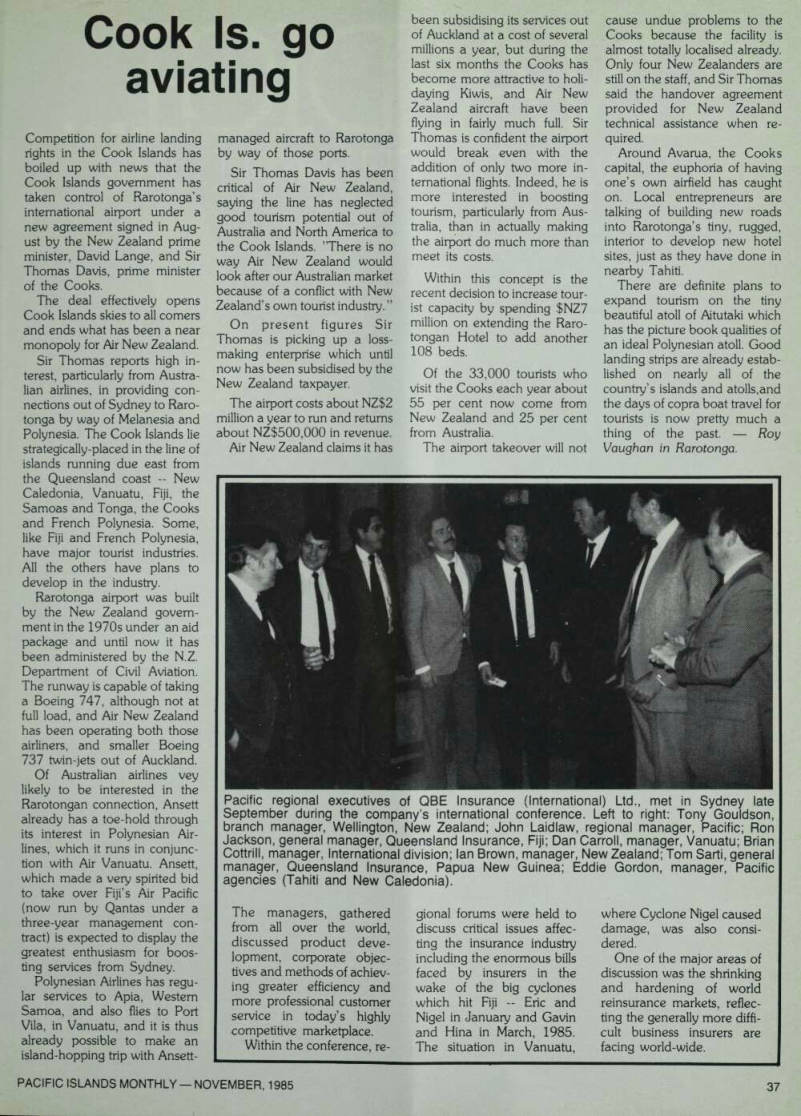
The managers, gathered from all over the world, discussed product deve lopment, corporate objec tives and methods of achiev ing greater efficiency and more professional customer service in today’s highly competitive marketplace.
Within the conference, re
gional forums were held to discuss critical issues affec ting the insurance industry including the enormous bills faced by insurers in the wake of the big cyclones which hit Fiji Eric and Nigel in January and Gavin and Hina in March, 1985.
The situation in Vanuatu,
where Cyclone Nigel caused damage, was also consi dered.
One of the major areas of discussion was the shrinking and hardening of world reinsurance markets, reflec ting the generally more diffi cult business insurers are facing world-wide.
Pacific regional executives of QBE Insurance (International) Ltd., met in Sydney late September during the company’s international conference. Left to right: Tony Gouldson, branch manager, Wellington, New Zealand; John Laidlaw, regional manager, Pacific; Ron Jackson, general manager, Queensland Insurance, Fiji; Dan Carroll, manager, Vanuatu; Brian Cottrill, manager, International division; lan Brown, manager, New Zealand; Tom Sarti, general manager, Queensland Insurance, Papua New Guinea; Eddie Gordon, manager, Pacific agencies (Tahiti and New Caledonia).