Islands ask fishers to
pp. 31-33 · Read in the full issue

trade winds
Worry Over Tuna
Islands ask fishers to 'fess up on catches
As the economic import ance of the South Paci fic tuna industry con tinues to grow Pacific island countries are stepping up the pressure on American, Japanese, and Korean purse seine fishing vessels to put their cards on the table about just what they are catching and where.
As things stand there is more misinformation than truth, and quite a lot of heat under a variety of collars on both sides of the problem.
The fishing boats do not like being constrained, and the is land nations object to what a good many of them see is the rape of their prime, and in some cases only, real economic asset.
They don’t mind the fish being caught; they do object to not making any money out of it.
Some tuna men, and particu larly the American Tunaboat Association, respond by saying that tuna are migratory, that the whole ocean is their territory (and not just the Pacific Ocean
at that), so why should anyone pay simply because the tuna happened to be caught on its way through someone’s exclu sive economic zone? The Japanese, particularly, and also some other major tuna fishing nations, including the Soviet Union, have negotiated licence deals with many island nations within whose 200-mile zones their boats operate. But others, including the Americans, who have stood on what they see as their rights to the freedom of the seas.
It is a long-standing and interminable argument, but it is beginning to have serious politi cal consequences outside the fishing industry, as evidenced by the deal Kiribati has done with the Soviet Union.
At the same time as this row is developing there is parallel concern about tuna stocks. Are they being over-fished? Some say yes, others dismiss the idea.
Scientists charged with fin ding the truth say they lack proper information, partly be
cause tuna boats don’t report accurately or fully what they are doing.
All of this came up for discus sion at the recent fisheries technical conference held by the South Pacific Commission (SPC), at Noumea. Finding more data about tuna popula tions was “a matter of urgen cy,” the conference concluded.
The urgency of the problem was increased, everyone agreed, because the licensing of distant-water fishing fleets was seen as a major new source of revenue for some countries.
Many countries are also plan ning to step up their own exploitation of the tuna re source, with their own small fleets and shore facilities.
Kiribati, which has sold a licence to the Soviets, has also been given a trawler, a wharf and a freezer facility under Japanese and E.E.C. aid prog rams.
Scientists speaking at the Noumea conference said: “The
long-term success of these ven tures depends ultimately on the magnitude of the tuna resource and the extent to which it can sustain exploitation.” But, they confessed, they had insufficient information on either vital aspect of the industry.
The SPC began tuna-tagging in 1977 under its Tuna and Billfish Assessment Program.
“Lured in part by the large stocks estimated by the SPC, large scale purse seining has been introduced with impress ive success, and catches have increased from very low in 1978 to over 350,000 tonnes in 1984,” the scientific report to the conference said.
Initial studies by the SPC concentrated on skipjack tuna, and over 150,000 skipjack in the central and western Pacific were tagged and released to try to understand their migration patterns and the interactions between neighboring fisheries.
Using information from the 6200 skipjack tags returned, scientists concluded that skip-
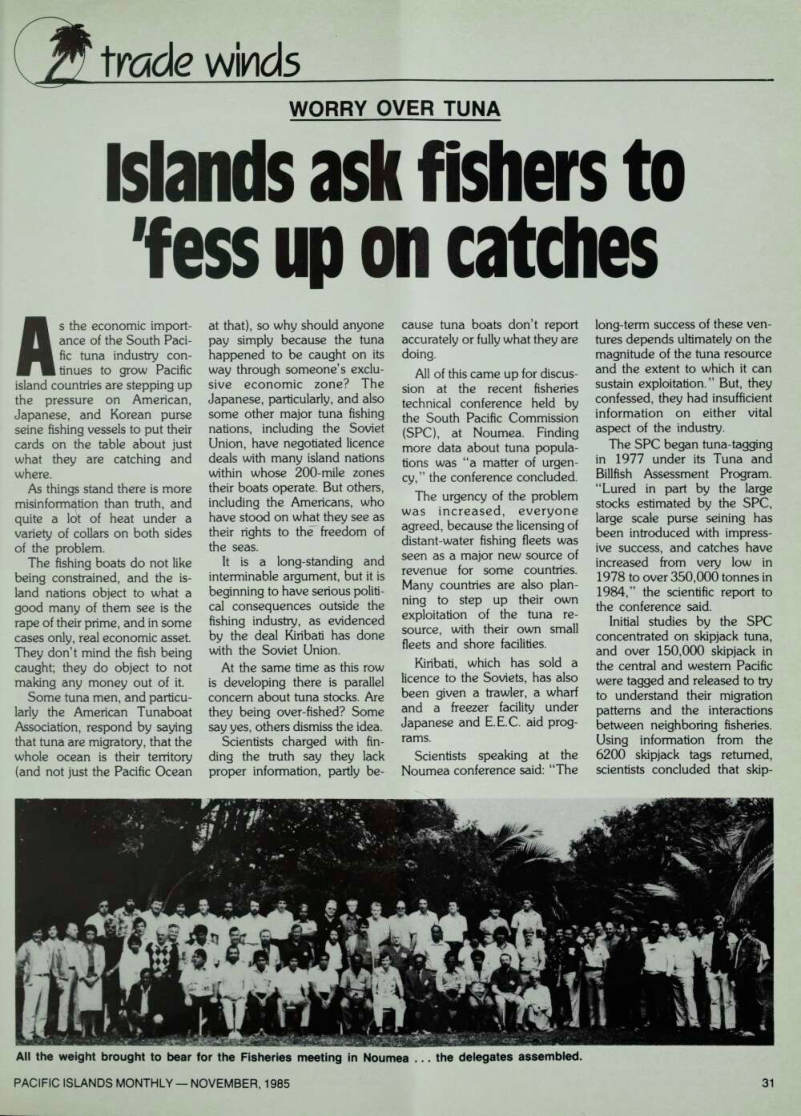
All the weight brought to bear for the Fisheries meeting in Noumea ... the delegates assembled.
jack are capable of extensive migrations, and that there are no clearly differentiated geographical stocks.
The program also concluded that although the skipjack tuna resources of the whole region are very large, in some coun tries the catch was approaching the limits of what could be sustained without affecting local fish populations.
In recent years, the SPC’s tuna program has concentrated on yellowfin. Purse seine catch es of yellowfin tuna in the western Pacific have increased ten-fold from around 10,000 metric tonnes in 1978 to esti mates of around 100,000 met ric tonnes in 1984.
Fisheries scientists with the SPC have been looking at two questions; what is the effect of this increase on the overall stocks of yellowfin in the west ern Pacific, and what is the effect of purse seining on long line fishing? These questions can only be answered accurate ly if both purse-seiners and long-liners report their catches.
But these details are not easy to get.
Several scientific research methods have had to be aban doned because of a lack of data, the scientists say, and the tuna assessment program has made its tentative conclusions based on catch records submit ted by Japanese fishing vessels.
Dr John Sibert, head of the tuna assessment program, says that this data indicates that despite catch rates 10 times higher than in the late 19705, yellowfin tuna stocks have not been severely affected. “There is no evidence that the western Pacific yellowfin surface stocks vulnerable to purse-seining have declined,” he said.
But he added a strong note of caution.
“There is definitely some thing going on with the tuna population. We must monitor the situation closely to see when the fishing effort begins to affect the fishery. These kinds of estimates can be misleading, because people think they can fish at a high effort forever,” he said.
“We have not attempted to calculate the size of the yellow fin tuna resource,” he went on.
“We just don’t have enough data to do that.”
Yellowfin tuna catches in
1984 were worth US$23O mil lion, according to the Forum Fisheries Agency. Purse seiners generally catch tuna which stay closer to the surface, often the younger and smaller fish, while the older, larger, fish, which do much of the breeding, are the target of long-line fishermen.
Long-line fishing is more selective. Last year about two thirds of the yellowfin long-line catch went to the Japanese sashimi and sushi market, rep resenting an economic value about three times greater than the equivalent weight of purse seine-caught fish.
Are the purse seiners affec ting the long-line catches? The available data suggests not, says Dr Sibert, although long line catch rates in the last two years are substantially down compared with 1979, and have in fact been declining for at least a decade.
But there could be a time lag before any impact of purse seining on long lining is shown, because of the difference in the age and size of the fish targeted by the two types of vessels.
Scientists also have several other hypotheses, but these are impossible to check without more information from fishing vessels.
What Dr Sibert terms “the shoot-out at Data Gap” is a regular event faced by the tuna fisheries scientists. The data that are available come from re cords supplied by vessels to island countries in the western Pacific as a condition of access arrangements which allow the vessels to fish within the 200mile exclusive economic zones.
But the available records don’t always cover international waters, and they are incomplete in many other areas.
The American Tunaboat Association has come under fire for failing to provide fishing records prior to 1984. Earlier catch rate information is consi dered important to establish longer-term trends, and to document changes related to the unusual oceanographic phenomenon several years ago, known as El Nino.
“We can’t answer questions about what the tuna assessment program would show if we had all the data from the American vessels,” Dr Sibert told the conference. “I don’t see why we couldn’t ask the A.T.A. to
supply the data prior to 1984 it’s ancient history to them, but it would be of great value to us.”
Australia’s delegate to the Noumea conference, Mr Bill Hughes, recommended that the U.S. be asked to supply in formation for 1982 and 1983.
“Those are two critical years which might give us further information on where we are headed with the tuna fishery,” he said.
New Zealand’s representa tive, Mr John McKoy, agreed, saying, “it is desirable to get the most complete set of data pos sible. But it is not just U.S. vessels for which we have in complete data. We need more also from Korea and Japan.”
American Tunaboat Associa tion president, Mr August Felando, told the conference: “We do have some problems with the confidentiality of the information we might supply.
Of course, there is some con cern about exactly what use the data would be put to. We’re for using it for scientific and con servation purposes, but we are against any use for competitive purposes. ”
Mr Felando was assured by SPC delegates and staff that all information given to the tuna assessment program remained confidential.
In a later interview with Paci
fic Islands Monthly Mr Felando explained: “We have entered into agreements with various people to retain confidentiality.
It is more than a promise within our own membership we have agreements with others.”
He declined to specify which others.
“We’re not concerned that the information might be used for management of the re source,” he said. “We are already subject to that in the Atlantic. We have the greatest concern for the resource.”
The conference sent a re commendation to South Pacific Conference in Solomon Islands at the end of September that the tuna assessment program be extended beyond its sche duled end in September, 1986, to continue study of the re source.
Fisheries scientists want to embark on another major tuna tagging project. Additionally they will use data from Pacific island and foreign fishing ves sels, to provide an assessment of the potential for further ex pansion of tuna fishing in the region.
“But further analysis (of the tuna resource) may be an exer cise in arm-waving, unless we get more complete data from the fishing vessels,” Dr Sibert
warned.
Kathy Johnston in
Noumea, and staff writers.
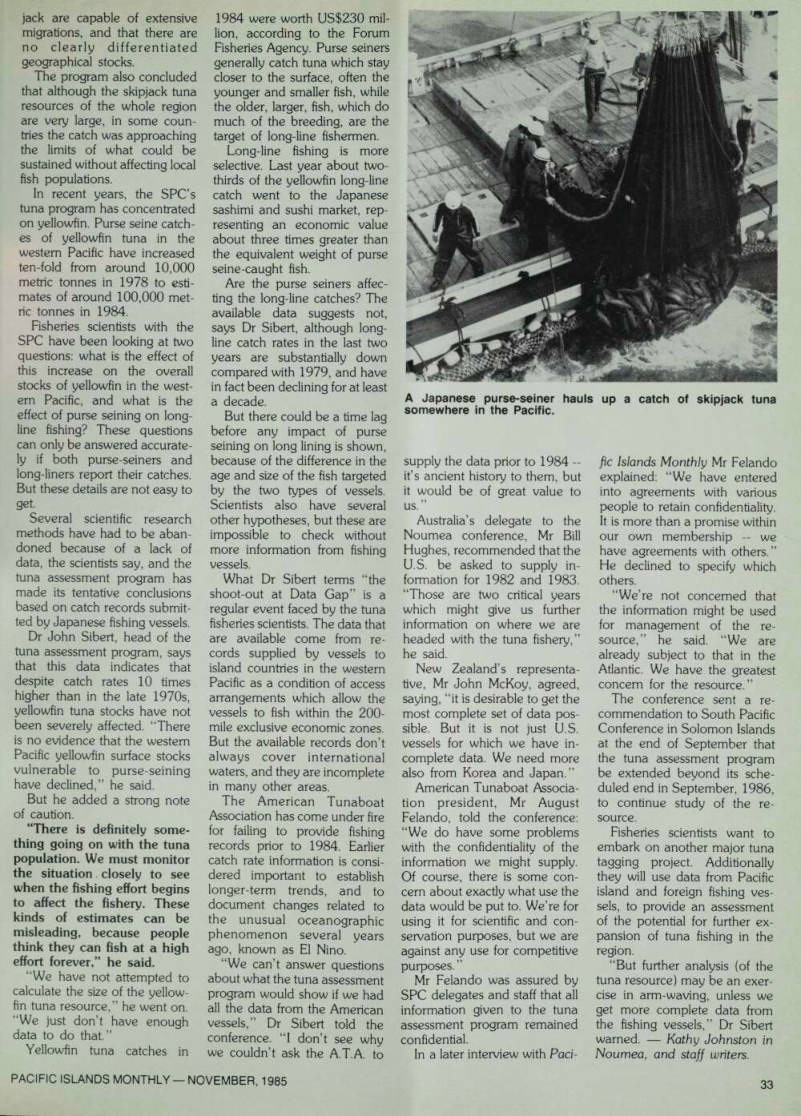
A Japanese purse-seiner hauls up a catch of skipjack tuna somewhere in the Pacific.