Austerity is key at Fiji summit
pp. 26-27 · Read in the full issue
Fiji summit
The Fiji government held its second national eco nomic summit in Suva at the end of Septem ber. The two-day meeting brought together some 300 de legates representing all sectors of the community and the eco nomy.
Like the first summit held in February this year the Septem ber meeting was also boycotted by the opposition National Federation Party and the Fiji Trades Union Congress. How ever several opposition par liamentarians and some top F.T.U.C. officials did attend as observers in other capacities.
The prime minister, Ratu Sir Kamisese Mara, in his opening address, said there was some reason for optimism, but sacri fice and hard work were still required. While Fiji’s economy had performed well, it could have been better if natural disasters had not caused so many setbacks.
Fiji was in its 15th year of independence, an important crossroad. Through enterprise,
hard work and dedication Fiji had made very substantial eco nomic and social progress since 1970. Fiji could have achieved higher rates of economic growth if it was not for natural disasters and an adverse world
economy. In 1984 the eco nomy had recovered very quickly from the cyclones and drought of 1983.
The prime minister said the general assessment was that the country was confronted by eco
nomic difficulties, but these were not insurmountable.
There was reason for optimism for the future, but it would require hard work and dedica tion.
Fiji must now concentrate on
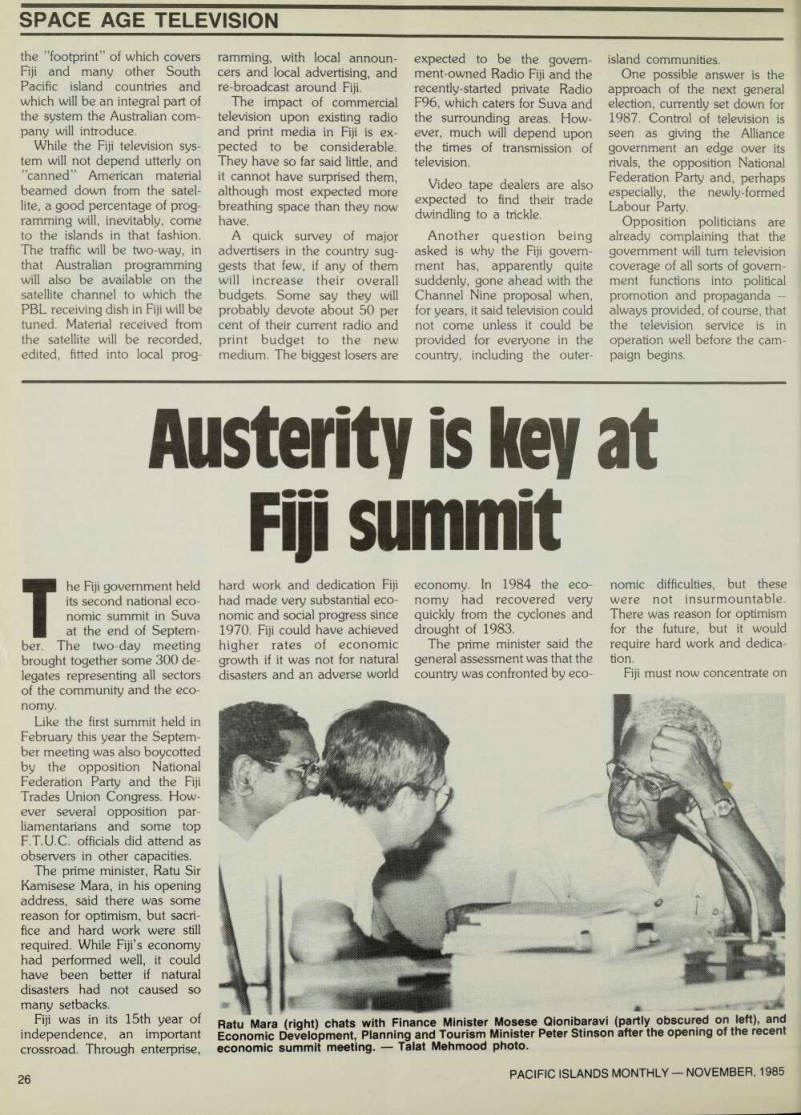
Ratu Mara (right) chats with Finance Minister Mosese Qionibaravi (partly obscured on left), and Economic Development, Planning and Tourism Minister Peter Stinson after the opening of the recent economic summit meeting. - Talat Mehmood photo.
accelerating economic growth, generating more employment opportunities, broadening its economic base through con tinuing efforts to diversify, and maintaining a stable balance of payments position, Ratu Mara said. ”In very simple terms, it means that everyone must work hard, increase productiv ity and continue to share the burden of adjustment a bit longer. ”
Referring to the wage freeze imposed last year the prime minister said it was better to adopt “mild unpleasant poli cies” than to be faced with very unpalatable adjustments later on.
The summit produced a communique listing 41 points sent for discussion by seven special economic task forces set up by the first summit last February to examine Fiji’s financial future.
This communique will form the basis of the next Five-Year Development Plan, to run from 1986 to 1990. Subjects co vered range from agriculture to education,and from youth to the role played by the judiciary.
It noted that the nation could not continue to live with its current budgetary deficit.
It was agreed that the Tri partite Forum, through which government, employers and trades unions negotiate national wage rates, be retained in its present form. However, the Wages Guidelines Committee of the Forum is to have four members and continue to fix the annual wage rise limit (which, lately, has been zero).
The original Tripartite Forum was made up of delegates from the Fiji Trades Union Congress, the Fiji Employers’ Consultative Association, and the govern ment. The new, fourth, delega tion will represent interests out side the main employer-em ployee bodies.
Far from all of Fiji’s businessmen participate in F.E.C.A. Indeed the association has seemed to be supported to any extent only by major com panies, among them such as Burns Philp, Carpenters, Fiji Gas, and Fiji Sugar Corpora tion. Equally, far from all of Fiji’s workers are unionised. In general union organisers are welcomed only in the bigger
firms, again many of them expatriate. Smaller companies have fairly actively discouraged unionism - even to the point of waiting out a strike. And no strike in Fiji has gone longer than about three weeks and in such cases has seldom gone in favor of the workers.
The committee’s main func tion will be to discuss and propose a new national wage guideline. Political imperatives indicate some kind of increase; financial ones dictate that it should be very small.
The prime minister said a national economic council would also be set up under the
chairmanship of deputy prime minister, Mr Mosese Qionibar avi, thus providing direct, high level government contact with the main elements of trade, commerce and industry. This national economic council will be made up of delegates from government, unions, em ployers, rural bodies, women’s organisations, youth and voluntary groups, industrial associations and local govern ments.
By this possibly somewhat unwieldy body the Fiji govern ment hopes to be able to tune its delicate economy rather more accurately and with the
full support of most sectors of the economy. For instance, the national wage guidelines com mittee will be told regularly, by the N.E.C., of the state of the country’s economy, and what wage increases it can (or can not) afford to grant.
But, said Ratu Mara, the government would also submit its own assessment of the eco nomy, in addition to that pro vided by the N.E.C.
Thus, Ratu Mara clearly hopes, the austerity which most believe must continue in Fiji will be supported by general na tional consensus. From Our Suva Correspondent.