of a'rough diamond'
p. 28 · Read in the full issue
Joe Davis: Rise and fall of a'rough diamond'
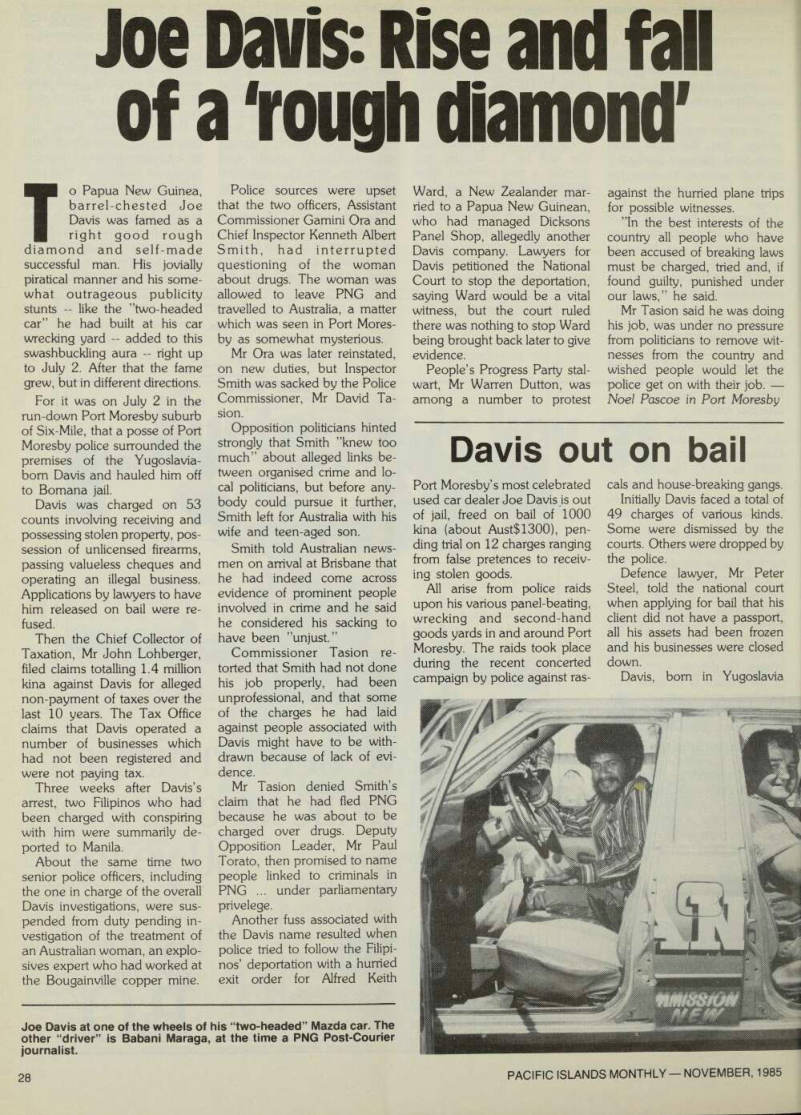
To Papua New Guinea, barrel-chested Joe Davis was famed as a right good rough diamond and self-made successful man. His jovially piratical manner and his some what outrageous publicity stunts like the ’’two-headed car” he had built at his car wrecking yard - added to this swashbucWing aura - right up to July 2. After that the fame grew, but in different directions.
For it was on July 2 in the run-down Port Moresby suburb of Six-Mile, that a posse of Port Moresby police surrounded the premises of the Yugoslavia born Davis and hauled him off to Bomana jail.
Davis was charged on 53 counts involving receiving and possessing stolen property, pos session of unlicensed firearms, passing valueless cheques and operating an illegal business.
Applications by lawyers to have him released on bail were re fused.
Then the Chief Collector of Taxation, Mr John Lohberger, filed claims totalling 1.4 million kina against Davis for alleged non-payment of taxes over the last 10 years. The Tax Office claims that Davis operated a number of businesses which had not been registered and were not paying tax.
Three weeks after Davis’s arrest, two Filipinos who had been charged with conspiring with him were summarily de ported to Manila.
About the same time two senior police officers, including the one in charge of the overall Davis investigations, were sus pended from duty pending in vestigation of the treatment of an Australian woman, an explo sives expert who had worked at the Bougainville copper mine.
Police sources were upset that the two officers, Assistant Commissioner Gamini Ora and Chief Inspector Kenneth Albert Smith, had interrupted questioning of the woman about drugs. The woman was allowed to leave PNG and travelled to Australia, a matter which was seen in Port Mores by as somewhat mysterious.
Mr Ora was later reinstated, on new duties, but Inspector Smith was sacked by the Police Commissioner, Mr David Ta sion.
Opposition politicians hinted strongly that Smith ’’knew too much” about alleged links be tween organised crime and lo cal politicians, but before any body could pursue it further, Smith left for Australia with his wife and teen-aged son.
Smith told Australian news men on arrival at Brisbane that he had indeed come across evidence of prominent people involved in crime and he said he considered his sacking to have been ’’unjust.”
Commissioner Tasion re torted that Smith had not done his job properly, had been unprofessional, and that some of the charges he had laid against people associated with Davis might have to be with drawn because of lack of evi dence.
Mr Tasion denied Smith’s claim that he had fled PNG because he was about to be charged over drugs. Deputy Opposition Leader, Mr Paul Torato, then promised to name people linked to criminals in PNG ... under parliamentary privelege.
Another fuss associated with the Davis name resulted when police tried to follow the Filipi nos’ deportation with a hurried exit order for Alfred Keith
Ward, a New Zealander married to a Papua New Guinean, who had managed Dicksons Panel Shop, allegedly another Davis company. Lawyers for Davis petitioned the National Court to stop the deportation, saying Ward would be a vital witness, but the court ruled there was nothing to stop Ward being brought back later to give evidence.
People’s Progress Party stalwart, Mr Warren Dutton, was among a number to protest
against the hurried plane trips for possible witnesses, ”In the best interests of the country all people who have been accused of breaking laws must be charged, tried and, if found guilty, punished under our laws,” he said, Mr Tasion said he was doing his job, was under no pressure from politicians to remove wit nesses from the country and wished people would let the police get on with their job.
Noel Pascoe in Port Moresby