The battle of the satellites
pp. 24-25 · Read in the full issue
satellites
While the advertising mar kets available to commer cial television in the islands might be quite small, get ting access to them has been a matter of import ance to at least two Austra lian television networks -- Kerry Packer’s Channel Nine and Rupert Murdoch’s Channel Ten.
The men from Ten were therefore astonished and upset when they stepped down from an Air Pacific Boeing 747 at Nadi late in September, to find that Channel Nine’s negotiators were also at the airport but on their way out, with the contract in their hands.
There would appear to be little that Channel Ten, or anyone else, can now do but swing swiftly around and head off to woo such other regional govern ments as Tonga and West ern Samoa. But getting in there will not be easy.
Tonga’s King Taufa’ahau has already rejected an offer from Channel Nine because ’’the cost would be too burdensome.” Whether any other commercial channel has made a better offer is not known, although the prospect of such a bid succeeding has receded into the dim distance now that two fundamentalist Christian churches in the
U.S. have offered a com plete television broadcas ting system to the kingdom.
The offer was made after the king appeared on the churches’ American net work during his last visit to the U.S. He said recently that the system would be established by January, 1986.
With Papua New Guinea’s first commercial television network gone to the Parry organisation based on Newcastle’s NBN, Channel 3, Fiji was the biggest plum left avail able to those who saw opportunity in extending their interests into the South Pacific. For all of them it was an obvious move. All the Australian channels derive program material from the U.S., us ing the Intelsat Pacific satellite. The satellite is within range of receiving dishes which exist, or might be set up, almost anywhere in the Western Pacific.
Beyond that, however, the Channel Nine success in Fiji threatens to bring to a head the whole compli cated diplomatic and com mercial problem faced by the Australian government over regional television.
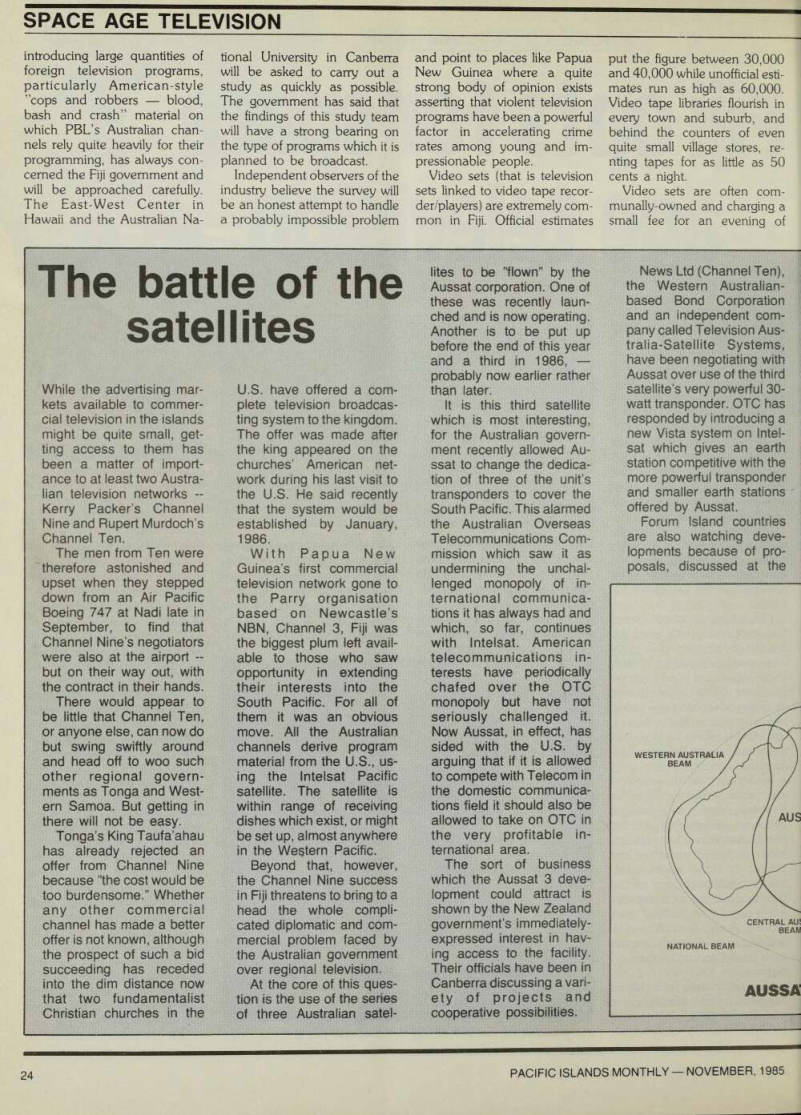
At the core of this ques tion is the use of the series of three Australian satel
lites to be ’’flown” by the Aussat corporation. One of these was recently laun ched and is now operating.
Another is to be put up before the end of this year and a third in 1986, probably now earlier rather than later.
It is this third satellite which is most interesting, for the Australian govern ment recently allowed Au ssat to change the dedica tion of three of the unit’s transponders to cover the South Pacific. This alarmed the Australian Overseas Telecommunications Com mission which saw it as undermining the unchal lenged monopoly of in ternational communica tions it has always had and which, so far, continues with Intelsat. American telecommunications in terests have periodically chafed over the OTC monopoly but have not seriously challenged it.
Now Aussat, in effect, has sided with the U.S. by arguing that if it is allowed to compete with Telecom in the domestic communica tions field it should also be allowed to take on OTC in the very profitable in ternational area.
The sort of business which the Aussat 3 deve lopment could attract is shown by the New Zealand government’s immediately expressed interest in hav ing access to the facility.
Their officials have been in Canberra discussing a vari ety of projects and cooperative possibilities.
News Ltd (Channel Ten), the Western Australian based Bond Corporation and an independent com pany called Television Aus tralia-Satellite Systems, have been negotiating with Aussat over use of the third satellite’s very powerful 30watt transponder. OTC has responded by introducing a new Vista system on Intel sat which gives an earth station competitive with the more powerful transponder and smaller earth stations offered by Aussat.
Forum Island countries are also watching deve lopments because of pro posals, discussed at the
Aussa
recent annual meeting in Rarotonga, to foster a com mon, inter-linked, broad casting system. Aussat 3 would allow them to do this with technical ease and, with expectable Australian government help, relative economy. Thus, they feel, they could hold back at least some of the more violent of American-style programs about the effects of which upon their un sophisticated communities they show considerable worry.
While recognising the Is lands’ desire to do as much of their own thing as pos sible, Aussat also argues
that the Pacific is logically an area for Australian in terest and influence and that their system should be promoted before Japanese and American companies swamped the telecom munications field in the Pacific.
Meantime, Channel Nine has scored a notable coup with its Fiji deal and must now be seen as a conten der to provide the sort of general regional television system with local input which the South Pacific Forum is probably talking about, even if it might not
yet quite realise it.
Staff
Writer