Fiji opts for space
pp. 23-26 · Read in the full issue
Packer’S “T-Team Wins”
Fiji opts for space age television
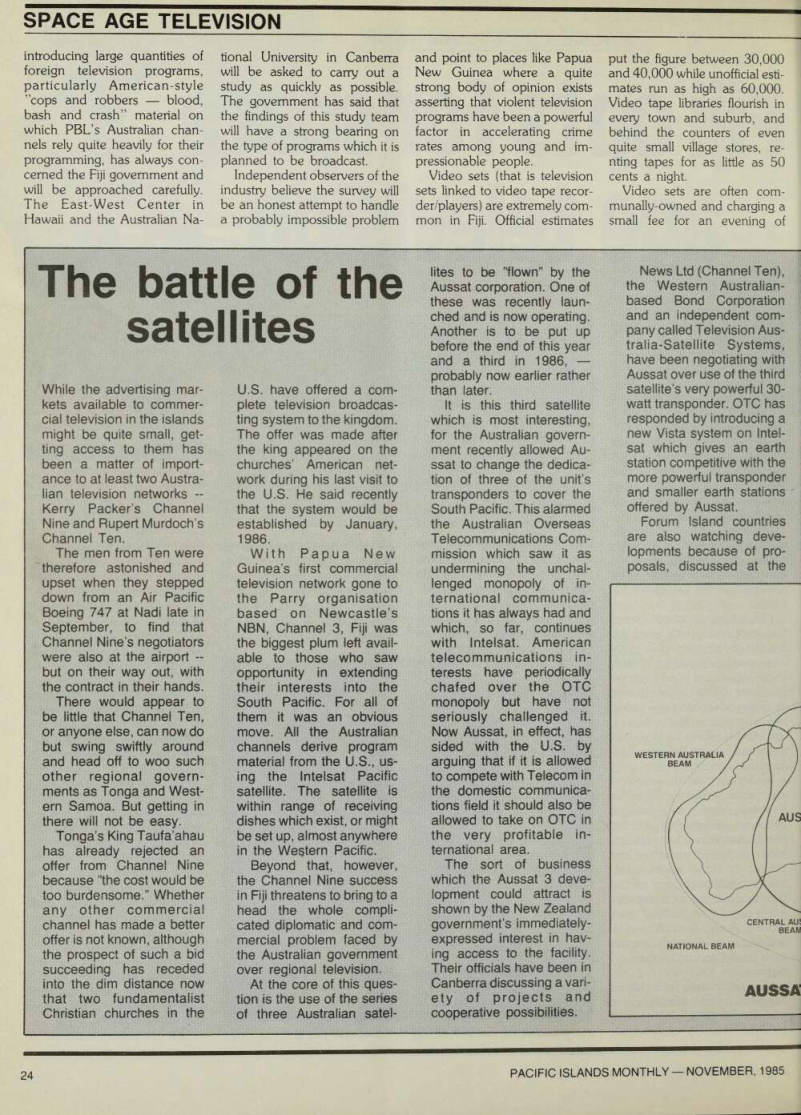
Fiji is to have broadcast television by 1987. It will be set up by Austra lia’s Publishing and Broadcasting, Ltd. (PBL), which runs the Channel Nine Network in Australia. The com pany is headed by Kerry Pack er, who gained controversial international prominence over his espousal of ’’Technicolor show biz” cricket, and other activities designed to boost his television audience.
However, the Fiji govern ment will maintain what is de scribed as ”a strong voice” in the selection of programs to be screened on the local rebroad casts.
PBL’s application was one of two proposals considered by the Fiji government. The other was from Television South Pacific (Fiji), Ltd., put together by three Suva businessmen, including advertising and public relations man, Matt Wilson, with the similarly named, but unrelated, John Savage and Jerry Savage.
In announcing the decision the prime minister, Ratu Sir Kamisese Mara, said a detailed economic assessment of the two proposals had been under taken. PBL will undertake the project in three stages, each covering different parts of the country, starting with the de nsely-populated urban area around Suva, then the other fairly closely populated areas and, finally, the outlying island regions.
PBL will initially invest about Austss.s million. However, the project will be a joint venture between the Fiji government
Fiji has decided, apparently with some suddenness, to sign an agreement with Australia’s Channel Nine for joint-venture television broadcasting system.
The move has taken other suitors by surprise, has heightened competition for rights to broadcast in other Pacific countries, like Tonga and Western Samoa, and has also touched a bureaucratic wrangle currently in train in Canberra over Austra lia’s role in Pacific broadcasting. Our correspon dents in Suva, Sydney and Canberra, examine the scene.
and PBL, with the govern ment’s equity provided in the form of land for the television stations and transmission facili ties around the country.
The prime minister empha sised that the ultimate aim was
to bring television to all parts of the country as soon as possible.
Until now the Fiji government has been reluctant to allow television because of the scat tered nature of the islands.
Their policy was to keep televi-
sion on ice until the outlying islands and remoter rural areas had been supplied with electric ity. The decision to grant a television broadcast licence to PBL appears to represent a considerable shift in what was generally regarded as a major government priority. The gov ernment has reaffirmed its deci sion, though, to allow more funds to speed up electrification of rural and outlying areas.
An inter-departmental com mittee within the Fiji govern ment will be set up to work with FBL in the establishment of the television service. In addition the Fiji government will appoint one director to the five-member board for the new company.
Two other directors will also come from Fiji and will be appointed in consultation with the Fiji government.
Nor will the Fiji government be liable for any losses incurred by the joint venture; PBL has guaranteed to underwrite the financial performance of the enterprise.
PBL says it will be guided by the views of the government in the selection of foreign prog rams and has agreed to give ’’top priority” to the inclusion of local programming. From the beginnning, it says, much emphasis will be given to the local news, weather information and items of local interest.
The company hopes to em ploy about 50 people before the first station goes to air.
Education, health and agricul ture are three areas which will receive program attention as quickly as possible.
The social consequences of
Kerry Packer of Australia’s PBL ... a winner in Fiji.
introducing large quantities of foreign television programs, particularly American-style ’’cops and robbers blood, bash and crash” material on which PBL’s Australian channels rely quite heavily for their programming, has always concemed the Fiji government and will be approached carefully, The East-West Center in Hawaii and the Australian Na-
tional University in Canberra will be asked to carry out a study as quickly as possible, The government has said that the findings of this study team will have a strong bearing on the type of programs which it is planned to be broadcast, Independent observers of the industry believe the survey will be an honest attempt to handle a probably impossible problem
and point to places like Papua New Guinea where a quite strong body of opinion exists asserting that violent television programs have been a powerful factor in accelerating crime rates among young and impressionable people.
Video sets (that is television sets linked to video tape recorder/players) are extremely common in Fiji. Official estimates
put the figure between 30,000 and 40,000 while unofficial esti mates run as high as 60,000.
Video tape libraries flourish in every town and suburb, and behind the counters of even quite small village stores, re nting tapes for as little as 50 cents a night, Video sets are often com munally-owned and charging a small fee for an evening of
Hindi movies, or extended sessions of TheA-Team or Dynasty in someone’s frontroom is a common method of meeting hire-purchase charges.
Almost all the English-language video casettes on hire are pirated from broadcast television in Australia, New Zealand, arid the U.S. Fiji businessmen, mainly Indian and Chinese, have set up quite elaborate
networks, often using relatives living in the Western countries to keep them supplied by air mail with recorded programs, The initial recordings are then copied and sent out to libraries, Quality varies considerably -from quite good to eye-strain ing ’’video blizzard,” but prices are adjusted accordingly by the desperately competitive librar ies.
The same system seems to work with Hindi movies, highly popular with Indian women in Fiji. At least one major Bombay commercial cinema film distri butor is believed to have a flourishing trade with Fiji, sup plying them with video tapes of first-run Hindi films. This has driven Fiji theatre-owners to distraction because it has meant that the video libraries have been able to offer films that are box-office block-busters in In dia (and thus potentially very profitable in Fiji), sometimes well before Fiji cinemas get them.
In the last five years ’’home video-cinemas” have very seriously damaged the pre viously very lucrative business of the movie house operators who have been unable to com pete or manage to stop the video pirates.
Fiji does not have a copyright law and is not a signatory to international copyright conven tions. The film industry’s ’’copyright police” have made repeated visits to Fiji, but have failed to stop the trade and may now quietly have accepted the inevitable.
Indeed, some of the loudest critics of video piracy appear now themselves to be deeply involved in the video piracy trade under another name, of course.
While any move against the libraries would be enormously unpopular with the entire popu lation, the Fiji government has shown concern about the type of programs available, and the fact that they have virtually no control over them. Some efforts have been made to stop por nographic tapes, but the flow of cassettes is now huge, and quite beyond the resources of official dom to supervise. Quite hard core pornography is available within certain very limited cir cles, but, in general, that seamy and worrying side of the video trade in western countries does not intrude generally in Fiji.
Excessive violence in commer cial television programs, like The A-Team, T.J.Hooker, Miami Vice , and all the other trash pumped out by the in ternational industry, is of much more immediate concern to the
Fiji government.
It is possible that this factor was among those influencing the government to amend its previous policy and allow the introduction of broadcast televi sion before full electrification of the rural villages had been achieved. Certainly the govern ment seems anxious to exert some control over television programming. It is also ex pected to tighten laws on copyr ight and censorship, which may have the effect of stunting the business of the video libraries.
Social cynics observe, however, that if all the now very popular (and not very edifying), series are culled out of the country’s broadcast programming, the fast-moving Indian business men of the islands will soon find a way to offer them on cassette.
PBL at present daily receives about 50 hours of program ming from Los Angeles to Syd ney, using the Intelsat satellite,
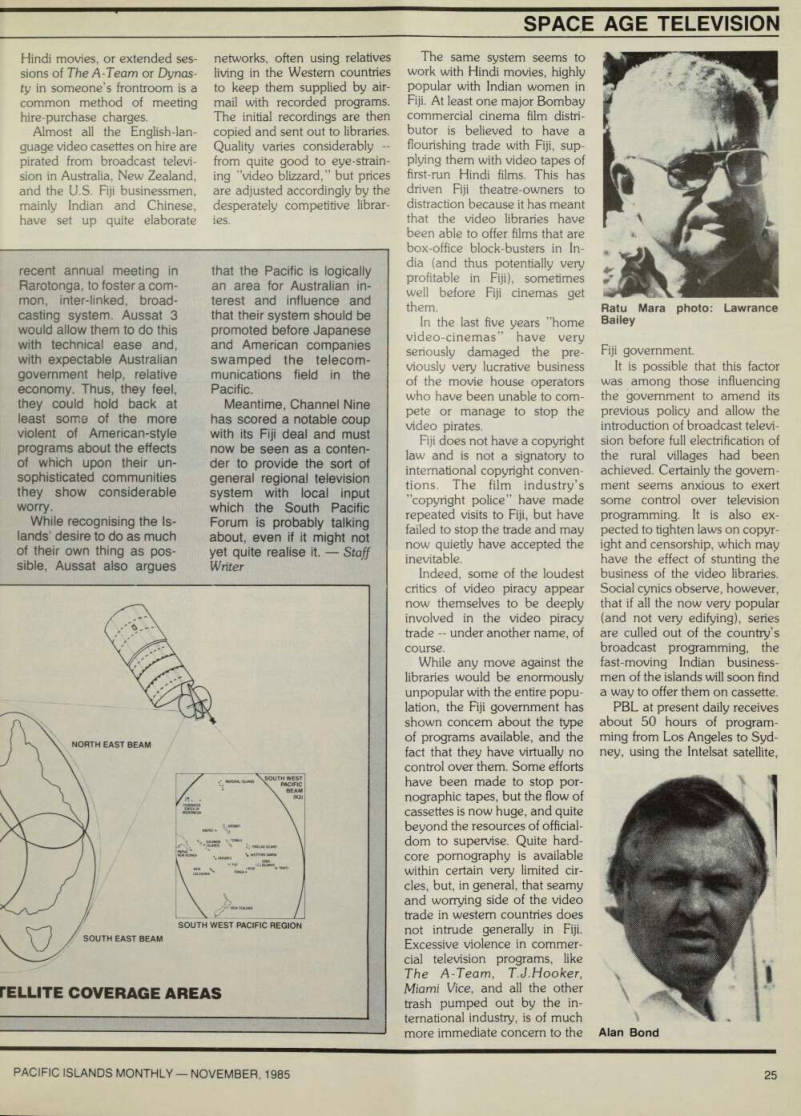
Ratu Mara photo: Lawrance Bailey
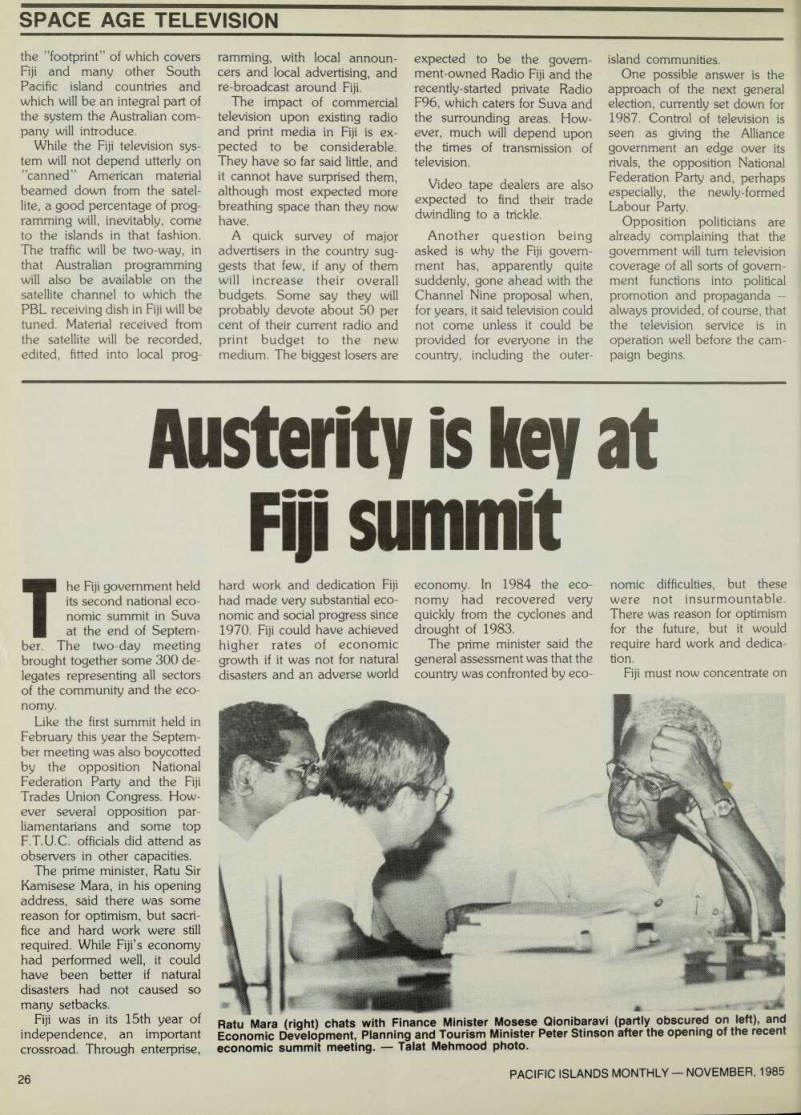
Alan Bond
the ’’footprint” of which covers Fiji and many other South Pacific island countries and which will be an integral part of the system the Australian company will introduce.
While the Fiji television systern will not depend utterly on ’’canned” American material beamed down from the satellite, a good percentage of programming will, inevitably, come to the islands in that fashion.
The traffic will be two-way, in that Australian programming will also be available on the satellite channel to which the PBL receiving dish in Fiji will be tuned. Material received from the satellite will be recorded, edited, fitted into local prog-
ramming, with local announ cers and local advertising, and re-broadcast around Fiji, The impact of commercial television upon existing radio and print media in Fiji is ex pected to be considerable, They have so far said little, and it cannot have surprised them, although most expected more breathing space than they now have.
A quick survey of major advertisers in the country sug gests that few, if any of them will increase their overall budgets. Some say they will probably devote about 50 per cent of their current radio and print budget to the new medium. The biggest losers are
expected to be the government-owned Radio Fiji and the recently-started private Radio F 96, which caters for Suva and the surrounding areas. However, much will depend upon the times of transmission of television.
Video tape dealers are also expected to find their trade , . , win mg o a c e.
Another question being asked is why the Fiji government has, apparently quite suddenly, gone ahead with the Channel Nine proposal when, for years, it said television could not come unless it could be provided for everyone in the country, including the outer-
island communities.
One possible answer is the approach of the next general election, currently set down for 1987. Control of television is seen as giving the Alliance government an edge over its rivals, the opposition National Federation Party and, perhaps especially, the newly-formed Labour Party.
Opposition politicians are already complaining that the government will turn television coverage of all sorts of govern ment functions into political promotion and propaganda always provided, of course, that the television service is in operation well before the cam paign begins.