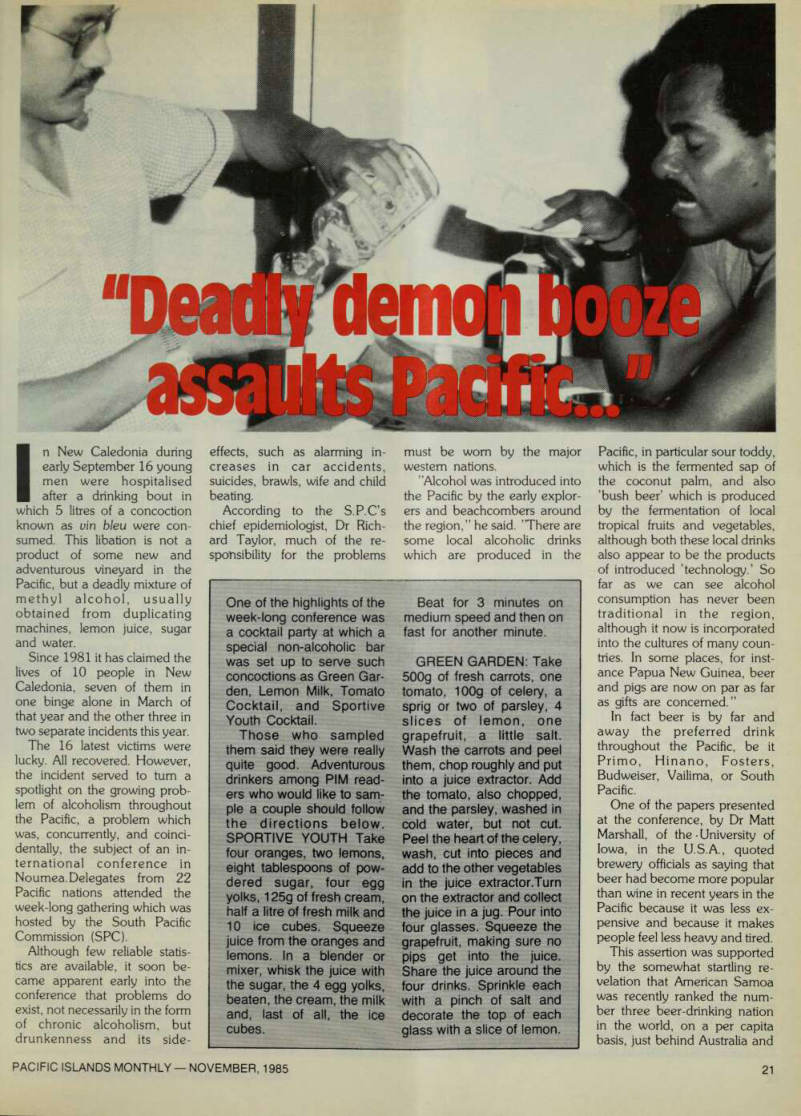
"Deadly demon booze
pp. 21-22 · Read in the full issue
assaults pacific..."
In New Caledonia during early September 16 young men were hospitalised after a drinking bout in which 5 litres of a concoction known as uin bleu were con sumed. This libation is not a product of some new and adventurous vineyard in the Pacific, but a deadly mixture of methyl alcohol, usually obtained from duplicating machines, lemon juice, sugar and water.
Since 1981 it has claimed the lives of 10 people in New Caledonia, seven of them in one binge alone in March of that year and the other three in two separate incidents this year.
The 16 latest victims were lucky. All recovered. However, the incident served to turn a spotlight on the growing prob lem of alcoholism throughout the Pacific, a problem which was, concurrently, and coinci dentally, the subject of an in ternational conference in Noumea. Delegates from 22 Pacific nations attended the week-long gathering which was hosted by the South Pacific Commission (SPC).
Although few reliable statis tics are available, it soon be came apparent early into the conference that problems do exist, not necessarily in the form of chronic alcoholism, but drunkenness and its side
effects, such as alarming in creases in car accidents, suicides, brawls, wife and child beating, According to the S.P.C’s chief epidemiologist, Dr Rich ard Taylor, much of the re sponsibility for the problems
must be worn by the major western nations. ’’Alcohol was introduced into the Pacific by the early explor ers and beachcombers around the region,” he said. ’There are some local alcoholic drinks which are produced in the
Pacific, in particular sour toddy, which is the fermented sap of the coconut palm, and also ’bush beer’ which is produced by the fermentation of local tropical fruits and vegetables, although both these local drinks also appear to be the products of introduced ’technology.’ So far as we can see alcohol consumption has never been traditional in the region, although it now is incorporated into the cultures of many coun tries. In some places, for inst ance Papua New Guinea, beer and pigs are now on par as far as gifts are concerned.”
In fact beer is by far and away the preferred drink throughout the Pacific, be it Prime, Hinano, Fosters, Budweiser, Vailima, or South Pacific.
One of the papers presented at the conference, by Dr Matt Marshall, of the • University of lowa, in the U.S.A., quoted brewery officials as saying that beer had become more popular than wine in recent years in the Pacific because it was less ex pensive and because it makes people feel less heavy and tired.
This assertion was supported by the somewhat startling re velation that American Samoa was recently ranked the num ber three beer-drinking nation in the world, on a per capita basis, just behind Australia and
One of the highlights of the week-long conference was a cocktail party at which a special non-alcoholic bar was set up to serve such concoctions as Green Gar den, Lemon Milk, Tomato Cocktail, and Sportive Youth Cocktail.
Those who sampled them said they were really quite good. Adventurous drinkers among PIM read ers who would like to sam ple a couple should follow the directions below.
Sportive Youth Take
four oranges, two lemons, eight tablespoons of pow dered sugar, four egg yolks, 125 g of fresh cream, half a litre of fresh milk and 10 ice cubes. Squeeze juice from the oranges and lemons. In a blender or mixer, whisk the juice with the sugar, the 4 egg yolks, beaten, the cream, the milk and, last of all, the ice cubes.
Beat for 3 minutes on medium speed and then on fast for another minute.
Green Garden: Take
500 g of fresh carrots, one tomato, 100 g of celery, a sprig or two of parsley, 4 slices of lemon, one grapefruit, a little salt.
Wash the carrots and peel them, chop roughly and put into a juice extractor. Add the tomato, also chopped, and the parsley, washed in cold water, but not cut.
Peel the heart of the celery, wash, cut into pieces and add to the other vegetables in the juice extractor. Turn on the extractor and collect the juice in a jug. Pour into four glasses. Squeeze the grapefruit, making sure no pips get into the juice.
Share the juice around the four drinks. Sprinkle each with a pinch of salt and decorate the top of each glass with a slice of lemon.
West Germany.
There also appears to be quite specific times for drinking ... after work, on weekends and at special occasions. The weekend binge is especially popular, especially on pay weekends and the conference was told that in many places it was common for a whole weekend to be given over to binge drinking and recovery from the bout.
Dr Marshall supports the be lief that Pacific Islanders drink to get drunk ... ’’drunkenness being neither strongly stigma tised, nor viewed as unpleasant.
Instead it is looked upon as a usually pleasurable state when fear and shyness disappear, relaxation and courage in crease, people dance and sing, and they find the boldness to speak about things they would never dare to mention other wise. ”
In fact alcohol has now be come so integrated into island life that according to Dr Anthony Polloi, the chief of public health services in Palau, ”a party is not complete if alcohol is not served. A leader in a community is seen as less
of a leader if he does not provide alcohol during a com munity function or project, such as clearing roads, and the like. ”
Dr Polloi went on to tell the conference that in his home land alcohol was even served at funerals and that most people considered it the best social lubricant.
It also emerged during the discussion that most of the drinking is done by men, alco hol still being either condemned or prohibited for all women.
Indeed, the most vocal dele gates to the conference were women, relating distressing accounts of increased domestic violence and economic hard ships throughout the islands caused, they believed, by alco hol or, as the delegate from Vanuatu dubbed it: ’’the evil power affecting our people in the Pacific.”
Just why drinking is a pre dominantly male activity appears to be culturally and socially rooted. Studies of the region over the last three de cades show that for many islan ders the most popular form of relaxation is ’’having a yarn,”
usually in single-sex groups. In the past these sessions at least for the men’s groups would have been helped along by the odd drop of kava (called ya qona in Fiji where it is at the very core of social behavior, now for many Indians as well as for all Fijians). But today in many islands the preferred lub ricant seems to be alcohol with the yarning sessions turning into simple drinking bouts.
The male and female roles are also very clear-cut in island societies. While it is acceptable and even seen as masculine for a man to be drunk, it is not acceptable that women appear so.
Frustration is another reason put up for the abuse of alcohol frustration caused by the inability to cope with the inevit able problems which arise in communities tom between two worlds the ancient traditional, and the modem, with all its costly material temptations.
Many of the island nations are suddenly discovering what unemployment is and means.
The difficulties of having to adjust to urban life when one is used to a rural setting. Having neighbors living close at hand who come from tribes or clans which are traditional enemies.
In some countries the frustra tion now apparent in the indi genous peoples has been caused by colonisation. New Caledonia provides the perfect example of this. Research car ried out by Georges Zeldine in 1981 discovered that the French territory was the only South Pacific nation where chronic alcoholism was found to be a problem among indi genous people.
Among the reasons Zeldine advances to explain this are the drinking patterns introduced by the French, ”a desire to emu late the European life-style, and the wide gap they perceive between their former status in the territory and their current status in the European-domin ated economy.”
The delegate from Vanuatu backed this up, saying that attitudes in his country had definitely changed since inde pendence with people now showing more responsibility and turning back towards their traditional social drink, kava.
He noted that kava production
had developed into a notable industry in Vanuatu with one Chinese businessman deve loping a process where the drink was mass-produced in liquid form and sold in bottles, ice-cold.
To combat the growing alco hol problem the conference produced 68 recommendations for delegates to take back to their governments. Despite their own enthusiasm for these measures, many delegates said they foresaw difficulties in get ting them implemented. For most governments alcohol is a good revenue-spinner, so good, in fact, that many gov ernments are considering set ting up their own breweries so they can reap the full financial benefit of their people’s drink ing habits instead of handing the money over to Australia and France the major beer exporting nations for the Paci fic.
Apart from the financial gain, these governments also argue that such developments will also help provide jobs and raise living standards for their people. To counter the moralist arguments, they also claim they could help curb the alcohol problem by controlling them selves the alcohol content of the local product.
Dr Taylor suggested that this was not realistic and would result only in people increasing their intake to achieve the same effect. He believed that com mercial practice and the need to capitalise on investment in a brewery would simply persuade governments to encourage con sumption rather than limit it.
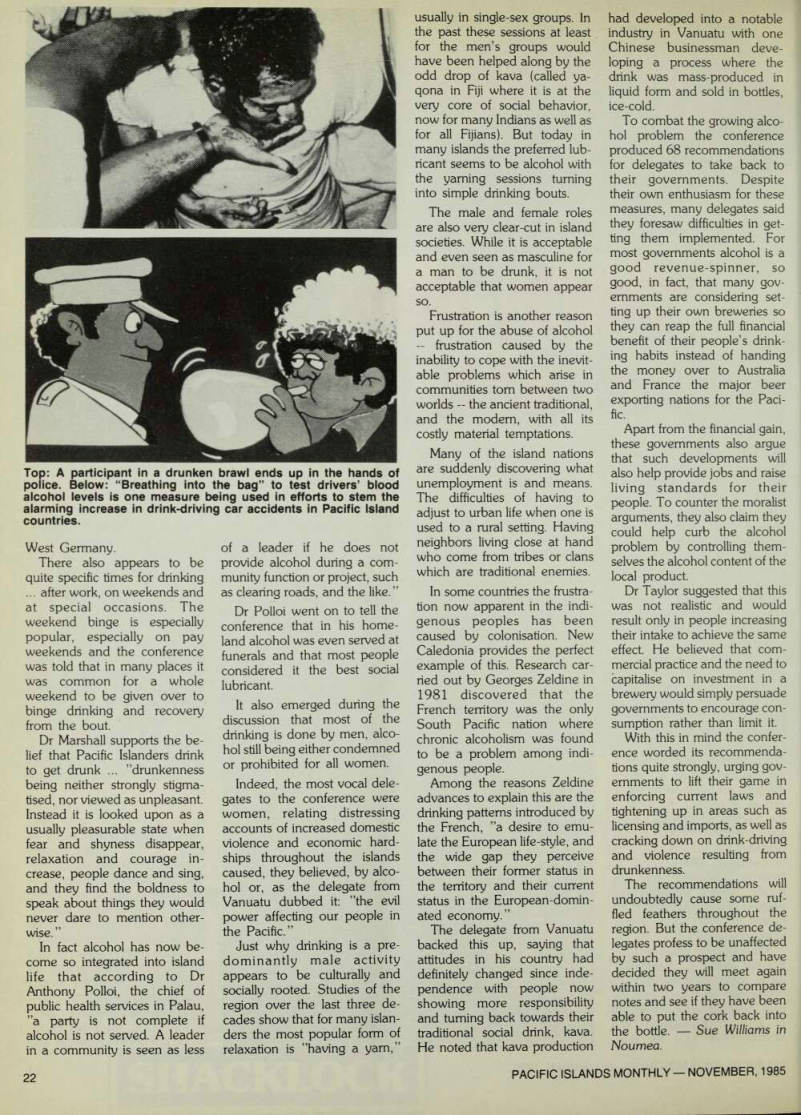
With this in mind the confer ence worded its recommenda tions quite strongly, urging gov ernments to lift their game in enforcing current laws and tightening up in areas such as licensing and imports, as well as cracking down on drink-driving and violence resulting from drunkenness.
The recommendations will undoubtedly cause some ruf fled feathers throughout the region. But the conference de legates profess to be unaffected by such a prospect and have decided they will meet again within two years to compare notes and see if they have been able to put the cork back into
the bottle.
Sue Williams in
Noumea.
Top: A participant in a drunken brawl ends up in the hands of police. Below: “Breathing into the bag” to test drivers’ blood alcohol levels is one measure being used in efforts to stem the alarming increase in drink-driving car accidents in Pacific Island countries.