Does a vital industry need a shake-up?
pp. 16-19 · Read in the full issue
Dr NORMAN DOUGLAS attended the 1985 Fiji Tourism Convention. In this article he takes a hard look at tourism in Fiji, and offers ideas on possible ways out of its present difficulties.
The signs heralding the 1985 Fiji Tourism Con vention were not auspi cious. The week before the event Jonati Mavoa, minis ter for Foreign Affairs, Tourism and Civil Aviation, had died, following injuries in a fall.
Mavoa had been widely re garded as an enthusiastic supporter of tourism in Fiji one of the few enthusiasts in government, it was said. A few days later, the daily Fiji Times and Fiji Sun gave failings in tourism’s consumer relations front-page priority.
“Rip-offs hit tourism; com plaints increasing ...” headlined the Fiji Sun , informing readers that more tourists were being “mistreated” by duty-free dealers and handicraft sellers.
The 49 complainants referred to probably received scant con solation from an assurance by the Fiji National Duty Free Merchants Association that such complaints were “normal”.
“Are we really Friendly Fiji?” wondered the Sun’s brief edito rial.
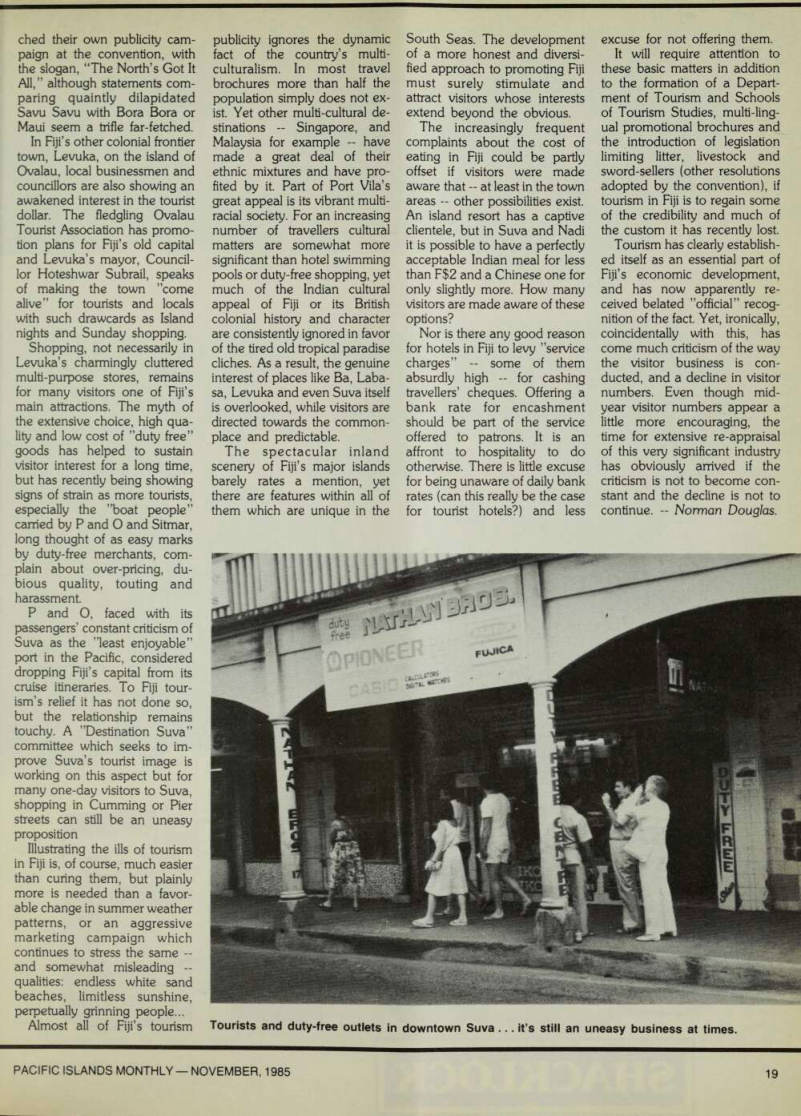
The Fiji Times left its assault for the morning of the conven tion’s opening. “FVB Hears of Profiteering,” it heralded, elevating a report by the bureau’s Sydney marketing manager, Bill Whiting, to head line status. Whiting had in formed a meeting in Suva, with some justification, that visitors to Fiji were complaining about the high cost of food and poor rate of exchange offered by hotels. FVB board members, John Birch, president of the Fiji Hotel Association, and Mahen dra Patel, Fiji’s leading duty free merchant, neither of whom evidently eats or cashes travellers’ cheques at hotels, expressed surprise, even disbe lief.
In the light of these happen ings, the convention’s theme:
’’We’re out to win you over” had more of the sound of struggle than may have been intended, and its location - Suva’s big, but bleak, Civic Auditorium hardly invited the same degree of warm response from delegates as many pre vious convention venues at re sort hotels, where the bar and the pool were only seconds away. Convention regulars were quick to admit that it seemed a much more sober, constrained, serious affair than usual; some went so far as to suggest it was symptomatic of a low point, even a malaise, in Fiji tourism.
If this is so, what is wrong with Fiji’s first (or second, de pending upon whose account you read and what additional arithmetic is required), revenue
earner?
There are some quick and obvious responses to this ques tion: The weather. Fiji, where according to most of its publicity, the sun smiles as habitually as do the people, has experienced nine cyclones in the past five years - four of them in the first few months of 1985.
The shortage, say tourism entrepreneurs, of ’’international standard” hotel rooms an estimated 500 more per year until 1990 are needed to boost declining visitor numbers and enhance the package tour mar ket, they say.
The absence, say some guarded critics, of a real com mitment on the part of the government to tourism and a tourism policy. ’’You know,” one leading hotelier told me, ’’the prime minister has only once mentioned tourism publicly, and that was to criti cise it.”
The dubious value, say some promoters, of recommen ding places like Nadi with its
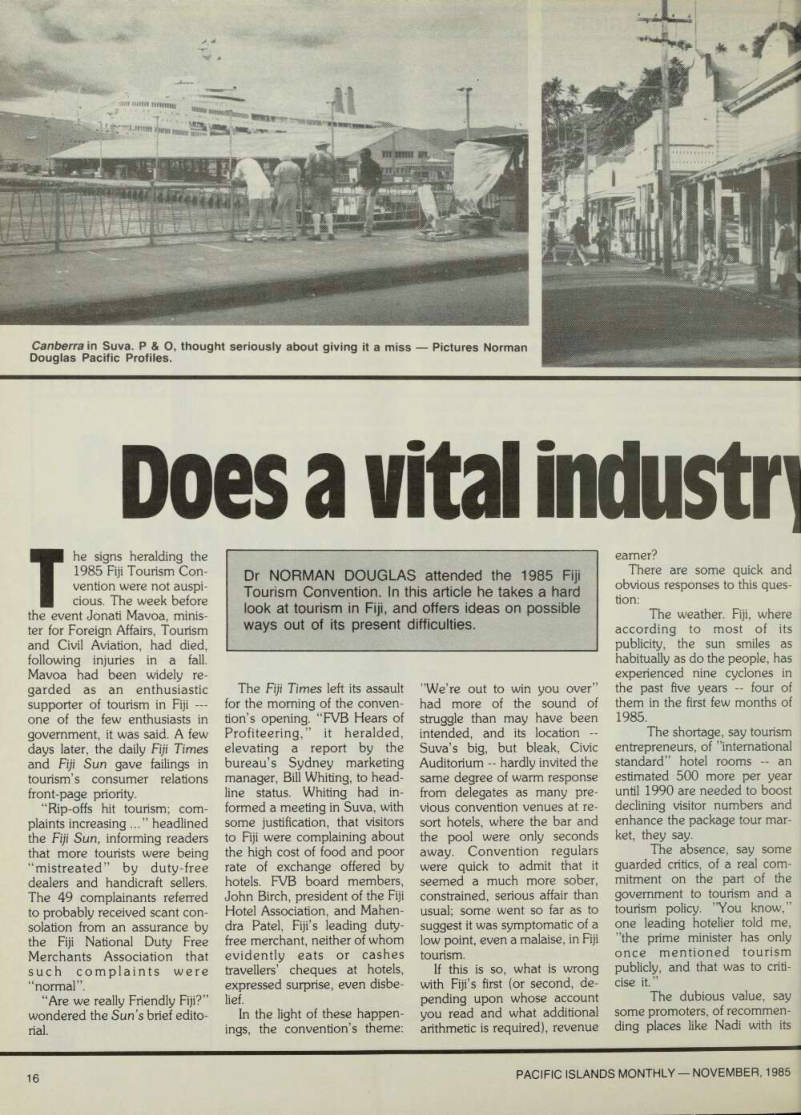
Canberra in Suva. P & O, thought seriously about giving it a miss Pictures Norman Douglas Pacific Profiles.
predatory duty-free salesmen, or Suva with its intimidating sword-sellers (’’what’s your name, mate?”), to tourists seeking a ’’new cultural expertence.”
The decline of the Australian dollar, says everyone, which effectively means (at least in mid-1985), that visitors from Fiji’s largest market are paying between 20 per cent and 30 per cent more for every good or service that they buy, depending, of course, upon both daily fluctuations in the floating Australian currency, and where the luckless tourist cashes his money.
Whatever the reasons, and there are more than these, visitor numbers are down. May and June of this year saw, respectively 2000 and 1786 fewer visitors than those months in 1984 - and 1984 had given much ground for optimism. Visitor figures, over 235,000 for the year, had suggested that the quarter million mark might soon be achieved, Perhaps it might, but not yet: visitor numbers for the first
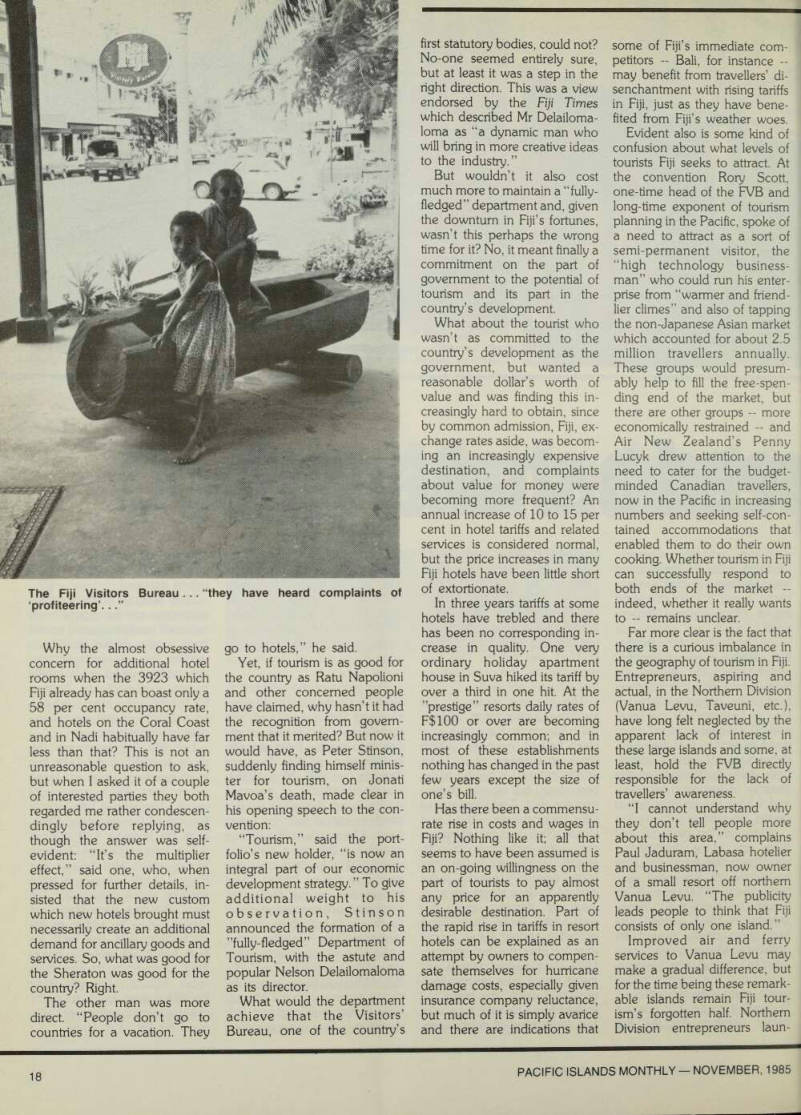
quarter of 1985 were lower than for any period since early 1983 the time of Cyclone Oscar low enough for the usually intractable airlines to introduce a special limited sea son fare of SA3SO from Sydney to Nadi and return. This was probably the best of indications that all was not well, The cyclone factor in Fiji tourism is indisputable, additio nal evidence for the cynics who claim that an economy which gives prominence to such an erratic industry is bound to be precarious, but no less bistres sing for that. The locations of Fiji’s major resorts - the Coral Coast, Nadi and the Mananu cas are both their strength and their weakness. In the latter area several resorts were obliged to close for repairs after extensive damage early this year, and those that didn’t probably should have. Some months after the last cyclone, Hina, had passed over Cast away Island, one resort which remained open, the place still looked like a disaster area, with two large piles of debris iden
tifying the limits of the beach and another greeting visitors at their landing point. Untidiness and wear were evident throughout the resort’s facilities. ’’What a dump,” observed one disappointed tourist. ’’The only thing that’s not run down here is the price.”
The plight of the resorts has been exacerbated by the in creasing reluctance of in ternational insurance com panies to involve themselves in underwriting all too frequent disasters (see PIM, May, 1985), and the tendency of overseas media (read Australian in this case), to report only the worst news. A benevolent Providence would be the most valuable asset to Fiji tourism over the next few years, but industry people are of the view that more vigorous promotion of the ’’look, we’re still going strong” kind should be mounted in the wake of every cyclone to offset the adverse reports. The FVB’s Bill Whiting puts especially strong emphasis on the import ance of such publicity, and with Australia low value currency
or not still providing up to 40 per cent of Fiji’s tourists it’s hard not to agree.
Most sections of the industry also agree on the urgent need for more (and more, and more) hotel rooms. At the Suva con vention this issue was particu larly addressed by the bureau’s research consultant, Alastair Mclntyre, a man whose vocabulary consists almost ex clusively of statistics.
For the “more rooms the more tourists” enthusiasts the most heartening sign for some years was the ceremonial ground-breaking in late June at the site of the proposed Sher aton Fiji hotel, a $3O million, 300-room complex on Denarau Island which also houses the Regent of Fiji. Few people were happier about it than the Tui Nadi, Senator Ratu Napolioni Dawai, who, by virtue of his connection with the land for both hotels has probably bene fited more from tourism than most Fijians, though Ratu Napolioni was quick to point out that such development was good for Fiji as a whole.
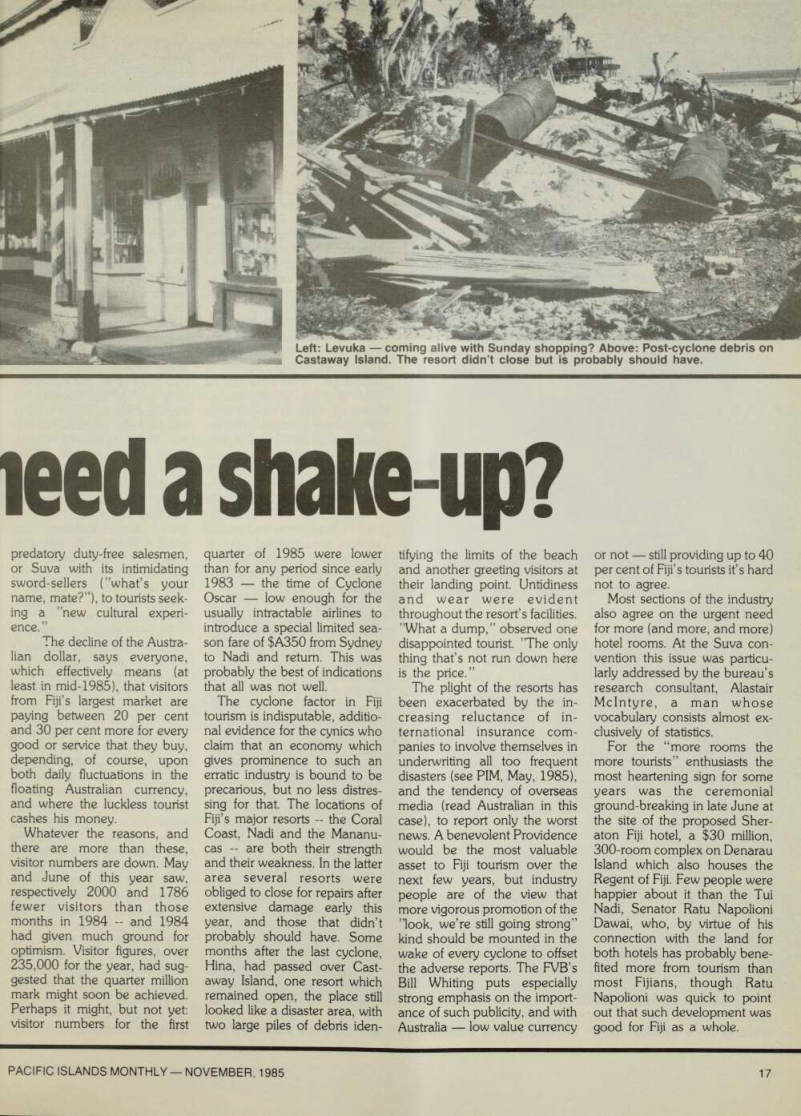
Left: Levuka - coming alive with Sunday shopping? Above: Post-cyclone debris on Castaway Island. The resort didn’t close but is probably should have.
Why the almost obsessive concern for additional hotel rooms when the 3923 which Fiji already has can boast only a 58 per cent occupancy rate, and hotels on the Coral Coast and in Nadi habitually have far less than that? This is not an unreasonable question to ask, but when I asked it of a couple of interested parties they both regarded me rather condescendingly before replying, as though the answer was selfevident: “It’s the multiplier effect,” said one, who, when pressed for further details, insisted that the new custom which new hotels brought must necessarily create an additional demand for ancillary goods and services. So, what was good for the Sheraton was good for the country? Right.
The other man was more direct. “People don’t go to countries for a vacation. They
go to hotels,” he said, Yet, if tourism is as good for the country as Ratu Napolioni and other concerned people have claimed, why hasn’t it had the recognition from govern ment that it merited? But now it would have, as Peter Stinson, suddenly finding himself minis ter for tourism, on Jonati Mavoa’s death, made clear in his opening speech to the con vention: “Tourism,” said the port folio’s new holder, “is now an integral part of our economic development strategy. ” To give additional weight to his observation, Stinson announced the formation of a ’’fully-fledged” Department of Tourism, with the astute and popular Nelson Delailomaloma as its director.
What would the department achieve that the Visitors’
Bureau, one of the country’s
first statutory bodies, could not?
No-one seemed entirely sure, but at least it was a step in the right direction. This was a view endorsed by the Fiji Times which described Mr Delailoma loma as “a dynamic man who will bring in more creative ideas to the industry.”
But wouldn’t it also cost much more to maintain a “fully fledged” department and, given the downturn in Fiji’s fortunes, wasn’t this perhaps the wrong time for it? No, it meant finally a commitment on the part of government to the potential of tourism and its part in the country’s development.
What about the tourist who wasn’t as committed to the country’s development as the government, but wanted a reasonable dollar’s worth of value and was finding this in creasingly hard to obtain, since by common admission, Fiji, ex change rates aside, was becom ing an increasingly expensive destination, and complaints about value for money were becoming more frequent? An annual increase of 10 to 15 per cent in hotel tariffs and related services is considered normal, but the price increases in many Fiji hotels have been little short of extortionate.
In three years tariffs at some hotels have trebled and there has been no corresponding in crease in quality. One very ordinary holiday apartment house in Suva hiked its tariff by over a third in one hit. At the ’’prestige” resorts daily rates of Fsloo or over are becoming increasingly common; and in most of these establishments nothing has changed in the past few years except the size of one’s bill.
Has there been a commensu rate rise in costs and wages in Fiji? Nothing like it; all that seems to have been assumed is an on-going willingness on the part of tourists to pay almost any price for an apparently desirable destination. Part of the rapid rise in tariffs in resort hotels can be explained as an attempt by owners to compen sate themselves for hurricane damage costs, especially given insurance company reluctance, but much of it is simply avarice and there are indications that
some of Fiji’s immediate com petitors - Bali, for instance may benefit from travellers’ di senchantment with rising tariffs in Fiji, just as they have bene fited from Fiji’s weather woes.
Evident also is some kind of confusion about what levels of tourists Fiji seeks to attract. At the convention Rory Scott, one-time head of the FVB and long-time exponent of tourism planning in the Pacific, spoke of a need to attract as a sort of semi-permanent visitor, the “high technology business man” who could run his enter prise from “warmer and friend lier climes” and also of tapping the non-Japanese Asian market which accounted for about 2.5 million travellers annually.
These groups would presum ably help to fill the free-spen ding end of the market, but there are other groups - more economically restrained - and Air New Zealand’s Penny Lucyk drew attention to the need to cater for the budget minded Canadian travellers, now in the Pacific in increasing numbers and seeking self-con tained accommodations that enabled them to do their own cooking. Whether tourism in Fiji can successfully respond to both ends of the market indeed, whether it really wants to - remains unclear.
Far more clear is the fact that there is a curious imbalance in the geography of tourism in Fiji.
Entrepreneurs, aspiring and actual, in the Northern Division (Vanua Levu, Taveuni, etc.), have long felt neglected by the apparent lack of interest in these large islands and some, at least, hold the FVB directly responsible for the lack of travellers’ awareness.
“I cannot understand why they don’t tell people more about this area,” complains Paul Jaduram, Labasa hotelier and businessman, now owner of a small resort off northern Vanua Levu. “The publicity leads people to think that Fiji consists of only one island.”
Improved air and ferry services to Vanua Levu may make a gradual difference, but for the time being these remark able islands remain Fiji tour ism’s forgotten half. Northern Division entrepreneurs laun
The Fiji Visitors Bureau ... “they have heard complaints of 'profiteering’..."
ched their own publicity cam paign at the convention, with the slogan, “The North’s Got It All,” although statements com paring quaintly dilapidated Savu Savu with Bora Bora or Maui seem a trifle far-fetched.
In Fiji’s other colonial frontier town, Levuka, on the island of Ovalau, local businessmen and councillors are also showing an awakened interest in the tourist dollar. The fledgling Ovalau Tourist Association has promo tion plans for Fiji’s old capital and Levuka’s mayor, Council lor Hoteshwar Subrail, speaks of making the town ’’come alive” for tourists and locals with such drawcards as Island nights and Sunday shopping.
Shopping, not necessarily in Levuka’s charmingly cluttered multi-purpose stores, remains for many visitors one of Fiji’s main attractions. The myth of the extensive choice, high qua lity and low cost of ’’duty free” goods has helped to sustain visitor interest for a long time, but has recently being showing signs of strain as more tourists, especially the ’’boat people” carried by F and O and Sitmar, long thought of as easy marks by duty-free merchants, com plain about over-pricing, du bious quality, touting and harassment.
P and O, faced with its passengers’ constant criticism of Suva as the ’’least enjoyable” port in the Pacific, considered dropping Fiji’s capital from its cruise itineraries. To Fiji tour ism’s relief it has not done so, but the relationship remains touchy. A ’’Destination Suva” committee which seeks to im prove Suva’s tourist image is working on this aspect but for many one-day visitors to Suva, shopping in Gumming or Pier streets can still be an uneasy proposition Illustrating the ills of tourism in Fiji is, of course, much easier than curing them, but plainly more is needed than a favor able change in summer weather patterns, or an aggressive marketing campaign which continues to stress the same and somewhat misleading qualities: endless white sand beaches, limitless sunshine, perpetually grinning people...
Almost all of Fiji’s tourism
publicity ignores the dynamic fact of the country’s multi culturalism. In most travel brochures more than half the population simply does not ex ist. Yet other multi-cultural de stinations - Singapore, and Malaysia for example -- have made a great deal of their ethnic mixtures and have pro fited by it. Part of Fort Vila’s great appeal is its vibrant multi racial society. For an increasing number of travellers cultural matters are somewhat more significant than hotel swimming pools or duty-free shopping, yet much of the Indian cultural appeal of Fiji or its British colonial history and character are consistently ignored in favor of the tired old tropical paradise cliches. As a result, the genuine interest of places like Ba, Laba sa, Levuka and even Suva itself is overlooked, while visitors are directed towards the common place and predictable.
The spectacular inland scenery of Fiji’s major islands barely rates a mention, yet there are features within all of them which are unique in the
South Seas. The development of a more honest and diversi fied approach to promoting Fiji must surely stimulate and attract visitors whose interests extend beyond the obvious.
The increasingly frequent complaints about the cost of eating in Fiji could be partly offset if visitors were made aware that - at least in the town areas - other possibilities exist.
An island resort has a captive clientele, but in Suva and Nadi it is possible to have a perfectly acceptable Indian meal for less than Fs2 and a Chinese one for only slightly more. How many visitors are made aware of these options?
Nor is there any good reason for hotels in Fiji to levy ’’service charges” - some of them absurdly high - for cashing travellers’ cheques. Offering a bank rate for encashment should be part of the service offered to patrons. It is an affront to hospitality to do otherwise. There is little excuse for being unaware of daily bank rates (can this really be the case for tourist hotels?) and less
excuse for not offering them.
It will require attention to these basic matters in addition to the formation of a Depart ment of Tourism and Schools of Tourism Studies, multi-ling ual promotional brochures and the introduction of legislation limiting litter, livestock and sword-sellers (other resolutions adopted by the convention), if tourism in Fiji is to regain some of the credibility and much of the custom it has recently lost.
Tourism has clearly establish ed itself as an essential part of Fiji’s economic development, and has now apparently re ceived belated ’’official” recog nition of the fact. Yet, ironically, coincidentally with this, has come much criticism of the way the visitor business is con ducted, and a decline in visitor numbers. Even though mid year visitor numbers appear a little more encouraging, the time for extensive re-appraisal of this very significant industry has obviously arrived if the criticism is not to become con stant and the decline is not to
continue.
Norman Douglas.
Tourists and duty-free outlets In downtown Suva ... it’s still an uneasy business at times.