the 'Rainbow Warrior' onion
pp. 14-30 · Read in the full issue
Peeling more skins from the 'Rainbow Warrior' onion
For the French govern ment of President Fran cois Mitterrand, the Pacific has become a sort of watery equivalent of Napoleon’s Moscow, and may yet be its Waterloo.
On the one hand Paris faces the further ignominy this month of what is bound to become something of an international ’’show trial” of its two secret service agents charged in New Zealand with murder, arson and the sabotage bombing of the Greenpeace ship Rainbow Warrior.
On the other hand there is the festering sore of New Cale donia and the burgeoning cam paign of the Kanaks for their independence from colonial rule. The Mitterrand govern ment had won points for its handling of that problem, but not at home where the votes are.
Few ordinary Frenchmen, berets akimbo, sucking on their
As the judge, jury, lawyers and the world’s press settle for the trial, in Auckland, of two French spies charged with sabotaging the Greenpeace ship Rainbow Warrior speculation grows that the govern ment of President Francois Mitterrand will founder upon a distant, palm-fringed, Pacific shore. For not only is his government on the defensive over the Greenpeace scandal, but it is under siege by French conservative politicians condemning the Socialists’ ’’betrayal of French patriots” in New Caledonia. The first round in Noumea is over, with others still to come. But there is no interim peace for Mitterrand.
French credibility hangs by a thread from the Greenpeace affair.
forthcoming French metropoli tan elections. (See Sue Wil liams’s report, this issue).
Mitterrand is being accused by his Republican party and Front National opponents of having “betrayed” stalwart Frenchmen living in what is legally, if illogically, a part of France.
Gitanes and complaining about the price of uin ordinaire could probably care a jot about New Caledonia. And yet the right wing of French politics, in hot pursuit of what blood has not already leaked from Mitter rand’s sorely-battered govern ment, has gone far towards making it a central issue for the
In fact, and despite the furore stirred by Jacques Chirac and Jean-Marie Le Pen, and their supporters, the result of the territorial assembly election in New Caledonia looked to be one of the few things which had gone right for President Mitter rand in recent months. It was no more than a good start, for opposition would undoubtedly grow, regardless of the true logic on the ground.
But, even with the election successfully, and fairly peacefully, completed, there can be no respite. The Green peace trial looms, and French reputation, in the hands of Mitterrand, is very much on the line.
Confronting this embattled modern-day Napoleon, New Zealand’s prime minister, David Lange, also a socialist, makes an unlikely sort of Iron Duke, although he lives in Wellington.
Yet there is obviously plenty of iron in his soul over the Green peace bombing. Despite attempts, albeit half-hearted, to persuade him that the trial of the individual agents should not go ahead now that the Defence ministry in Paris has admitted ordering the attack, he remains
utterly determined to rub French noses in the merde.
That he aims to do thoroughly, but, of course, with dignity and the full weight of British-type justice. Indeed, it might be that last bit which hurts the French most of all. That, and the fact that the rest of the world seems to agree with Lange, the angry bumble-bee so far away in a land which, up to this point, the French had always viewed with considerable disdain.
Auckland police, whose masterly piece of steady, methodical detective work led to the capture of the hapless agents on July 12, (see PIM, October), say that they have more than 200 witnesses and 1000 pieces of evidence. It should be quite a trial.
Meantime, the damage wrought both inside and out side France is considerable.
The Rainbow Warrior bom bing gave Greenpeace enor mous publicity - far more than it would have managed from the confrontation it originally sought with the French navy at Moruroa and continued to in vite with its enlarged, post bombing, flotilla.
Greenpeace was, of course, only one of several matters over which nations had swung angri ly against the French.
On September 25 Australian prime minister, Bob Hawke, threw his gauntlet into several faces by not only reiterating his government’s displeasure over continued nuclear testing at Moruroa,but challenging the U.S. to join the condemnation of French actions inthe South Pacific. ”It does seem to me to be a matter of logic that, if the U.S. does not express its concern about ... the French, then there will be a reaction of disappoint ment amongst South Pacific countries,” Mr Hawke said.
This statement followed by only a few hours the particularly tough speech in New York by Australian ambassador, Raw don Dalrymple, in which he warned the U.S.: ”If you want the South Pacific to become an
area where the Soviet Union, Cuba and others of that stripe can find fertile ground for anti- United States, anti-West prop aganda and activity and in which they can develop activi ties directly prejudicial to our interest, then continue with a policy of indifference to what the French are doing there.” ’’Continued French use of Moruroa atoll for nuclear testing is absolutely certain to prejudice the South Pacific people against the West against the United States and Australian interests in a way that will quite possibly prove very costly. ”1 would urge you to use your enormous influence to persuade the French to stop nuclear testing in the South Pacific. ”1 think the future of your relationship with France can withstand the pressures of such a policy but I am not sure ...that the future of your relationship with the South Pacific can be assured if you turn a deaf ear to their concerns.”
While the ambassador’s speech was apparently not cleared with Canberra there has been no criticism of it in Austra lia and definite support of it by prime minister Hawke. It all added up to the strongest public criticism Australia has so far made of U.S. policy in the Pacific. So far, the Reagan administration has seemed a good deal less than moved.
Criticism of the French has been weak, and some influen tial people have even defended both the nuclear testing and the sabotage of Rainbow Warrior.
A U.S. State Department spokesman carefully conceded that America was ’’aware” of Australian concern, but said France had an independent nuclear force and the testing was a matter for French deci sion. The U.S. ’’noted” French statements that underground testing was ’’essential to the modernisation of the French nuclear deterrent,” the spokes man said. Australia was official
continued on page 29
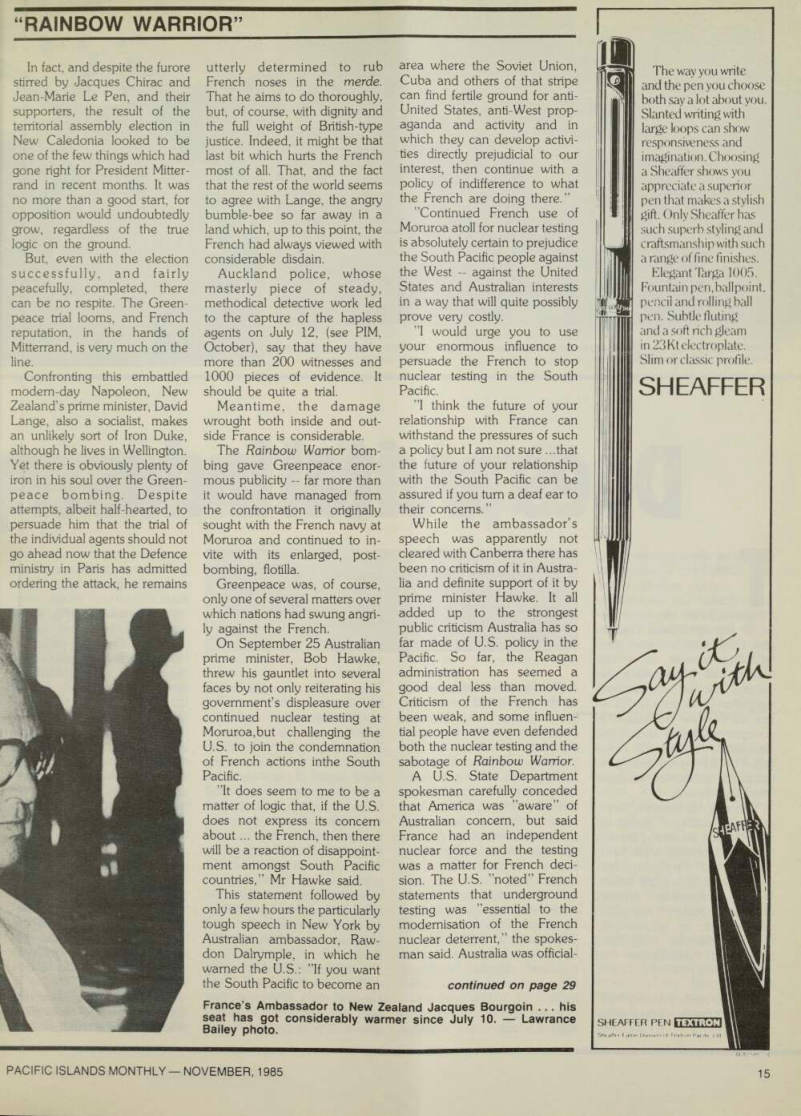
France’s Ambassador to New Zealand Jacques Bourgoin ... his seat has got considerably warmer since July 10. - Lawrance Bailey photo.
ly snubbed.
U.S. reaction on the Green peace affair was also luke warm, possibly because of Washington’s annoyance with New Zealand over the nuclear ships and ANZUS row, but also, it appeared to most observers, because it was determined not to be critical of France, even over a piece of state-sponsored terrorism which, normally, in the case of Europe, Africa, or the Middle East it is swift to condemn.
Former U.S. ambassador to the U.N., Jeane Kirkpatrick, went astonishingly further by asserting in public interviews that there was ”an important difference” between internatio nal terrorism and the sabotage of the Rainbow Warrior.
Thus, nobody seriously ex pects even their present acute embarrassment to persuade the French to give up their nuclear testing program on Moruroa, at least not in the immediate fu ture. Rather, their determina tion is likely to increase, says David Lange. The protests of Australia and New Zealand had simply entrenched the French to the point where ’’they will continue their tests, even if there is no strategic, scientific or military imperative for them,” he said.
Indeed, it is not opposition to the testing which is causing their present embarrassment, but rather the fact that, by the Greenpeace bombing, they have been made to look arro gant, and inept to the point of stupidity. The idiotic Inspector Clouseau is seen to be alive and well and running things in Paris.
France’s allies have been made to wonder about her judgment.
Her enemies have been given comfort.
Even the normally pro-estab lishment Paris newspaper, Le Monde, was moved to warn that the Mitterrand government was losing credibility over the Greenpeace affair. ’’French in fluence is directly at stake,” said the paper.
The big crack in the Mitter rand facade came with the resignation on September 20, of the Minister of Defence, Mr
Charles Hernu, and the sacking of Admiral Pierre Lacoste from his post as director of the French external espionage service, the DGSE. Hernu, who had run French defence affairs since 1981 was replaced by Paul Quiles (pronounced Key less), whose nickname in the Socialist Party is ’’Robespaul,” (piquantly adding to the Napoleonic flavor of it all). This is a reference to the infamous Robespierre, the French re volutionary responsible for the terror of 1793 and 1794 in which thousands of ’’enemies of the people” were executed.
Mr Quiles won his ’’Robes paul” sobriquet when, at the Socialist Party Congress of 1981 he called for ’’heads to roll” in a purge of civil servants who were, in his eyes, impeding implementation of socialist programs.
Quiles is 43, the son of a former artillery officer, was him self a paratrooper and remains a captain in the air force re serve. He is thus believed to have more in common with the military than the bureaucrats and is expected to make a tough defence minister. Green peace should expect firm re sponse to their efforts. ’’When I make a decision I see it through,” he said in a recent interview.
One of his first decisions was to close the Instruction Centre for Underwater Combat Swim mers at Aspretto, Corsica, the school at which the DGSE teams trained for their attack upon Rainbow Warrior.
Heads have also rolled in the DGSE. Admiral Lacoste has been replaced as director by the tough General Rene Imbot, formerly chief of staff of the
French army. He moved swiftly to ’’stop the rot” of political infighting inside the agency.
Within hours of Imbot’s appointment four French sol diers, a colonel, a captain and two senior n.c.o.’s, had been arrested for leaking secrets of the Greenpeace affair to the Paris press.
The colonel, Joseph Fourrier, was deputy head of DGSE counter-espionage. The cap tain, Alain Bourasse, was said to be the man who leaked to Le Monde details of a third team of frogmen in Auckland and the allegation that it was they who planted the limpet mines on Rainbow IVarrior.The Le Monde story led to the resigna tion of defence minister Hemu.
General Imbot is said still to be seeking a fifth man whom he wishes to question about leaks to the press.
This man, Captain Paul Bar ril, was formerly head of the National Gendarmerie In tervention Group (GIGN), a crack anti-terrorist unit. He had become a sort of James Bond figure in the popular French press until he was in effect dismissed in 1983.
Barril had been seconded from the GIGN to a special anti-terrorist co-ordination office at the presidential Elysee Palace in Paris. This unit was dissolved after a series of politi cal scandals and conflicts be tween the Defence and Interior ministries. Barril was caught in the middle of the fight and suspended at his own request.
The GIGN also made the news in the Pacific earlier this year when one of its marksmen shot and killed the militant Kanak leader Eloi Machoro during an F.L.N.K.S. siege in
The victim vessel Rainbow Warrior. .. the name will not go away
New Caledonia.
By implication there is much still to embarrass the French in the Auckland trial, set to begin on November 4, of DGSE agents Captain Dominique Prieur and Major Alain Mafart.
Indeed the flames of French ire have licked even at Presi dent Mitterrand himself, and his prime minister, Laurent Fabius.
At the end of September the French newspaper, Le Figaro said president Mitterrand ’’knew about the involvement of French agents,” knew that his defence minister, Hemu, had ordered the Rainbow War rior to be ’’neutralised,” and knew that the equivalent of US$6OO,OOO had been granted from secret funds administered by the office of prime minister Fabius. All of this was conveyed to the president by the prime minister on July 17, said the newspaper.
This was after the bombing had occurred, but well before
the French government stop ped denying any knowledge of the affair.
As late as September 27 Fabius was saying in television interviews that it was Septem ber 21 before he learned the truth of official French involve ment.
On October 1 the indepen dent French news magazine Le Point ran a story linking senior aides of President Mitterrand with the Rainbow Warrior bom bing. The article said that three of the president’s senior people met with the then DGSE chief, Admiral Lacoste, several weeks before the July 10 bombing in Auckland harbor.
The magazine said the meet ing took place about mid-May in the office in the Elysee Palace of the president’s secretary generakl, Jean-Louis Bianco, and was attended by diplomatic adviser, Hubert Vedrine and military counsellor, General Jean Saulnier. Admiral Lacoste
allegedly told them he had an agent inside the Greenpeace organisation. This operative, Christine Gabon, had described the extent of the confrontation Greenpeace planned. ”It was decided then to study measures appropriate to the new situation,” said Le Point.
Several French, British and other newspapers had run stories linking French official dom with the planning of the sabotage ... indeed several re ported that Defence Minister Hemu had angrily ordered that Rainbow Warrior be ’’neutral ised” and it was this which the over-reacting DGSE had inter preted as a clearance for a bombing.
But Le Point’s story was the first alleging that the presi dential office was in on this planning.
Nobody knows how accurate these stories might be, but there is a growing body of opinion that while some French minis
ters and bureaucrats were un doubtedly guilty of plotting the destruction of Rainbow War rior, much of the continuing furore may be aimed more at undermining President Mitter rand than at digging out the truth.
The French government con tinued to limit official comment on the affair.lt has admitted that DGSE agents planted the bombs which ripped the Rain bow Warrior’s hull and killed the Greenpeace photographer, Fernando Pereira. Prime Minis ter Fabius hoj blamed Charles Hemu and Admiral Lacoste for ordering the attack. But that is as far as the government will go. They say the matter is closed. But, in the intensity of French politics in the lead-up to the next elections, very obvious efforts are being made to keep the debate going, assisted, in evitably, by the spies’ trial in
Auckland this month.
Staff
Writer.