Breadfruit fermentation:
p. 49 · Read in the full issue
Reviving a lost art
A strong cheese-like smell rising from the ground used to be familiar to those living and visiting on Pacific islands. But not any more. With the coming of Western foods the practice of setting aside the breadfruit at the end of the season has fallen away who makes fermented breadfruit any more?
This problem has struck food technologists and those in terested in old traditions so strongly that two quite separate groups took on the task of gaining further understanding of breadfruit fermentation prac tices. Mrs Susan Parkinson, a nutritionist of long standing in the Pacific, has been in strumental in having a bread fruit pit put down in her Suva garden by some Kadavu people. In Papeete, Jean-Marc Pambrun, Director of Traditions at the Musee des lies, has also lad a pit put down in the grounds of the museum. He :alled on a lady named Suzan ie, and her Marquesan rela ives, to provide the expertise.
The Fiji pit of madrai made rom breadfruit is being moni ored by the Institute of Natural Resources at the University of he South Pacific in order to ecord chemical changes. In aarticular, changes in tempera ure in the pit, changes in acidity, and any other record ible changes, are being studied >y Dr Cheryl Lovelace. They ixpect to be able to prepare a letailed account of the com >osition of the fermented >readfruit paste. No such in ormation is available apart rom Mary Murai’s study in the ,950 s on some seeded bread
ruit from Kapingamarangi.
The Papeete pit of fermented ireadfruit, known there as an ipootio’o is part of a larger tudy of breadfruit as a food nd a plant which played a najor part in the way of life of he people of the Society Is ands, and also the Marquesas. well as recording the techni al processes necessary to nake a proper apootio’o the )epartment of Traditions is also
trying to unravel the social and ideological meanings behind the making of fermented bread fruit. To this end they are making a photographic record, as well as talking to old people on Raiatea, Maupiti, Tahiti and
Huahine and Moorea in order not to lose their knowledge.
Rather than understanding the chemical composition, as in the case of the Fiji pit, Jean- Marc Pambrun and his team are more concerned that some
of this knowledge is disappear ing with the older generation, and that unless this knowledge is captured now young people will be poorer for not knowing anything about an important aspect of their cultural heritage.
Thus, when the pit was due to be opened last December, they planned to invite children from a nearby school to share in the opening and cooking of the final product. “There should be enough for 1500 people,” they claimed; and that is from an original 400 breadfruit.
With the high food prices in both Fiji and Tahiti, and the prodigality with which bread fruit produces fruit twice or three times a year, it is a shame to see this food wasted just for lack of knowledge as to what to do with it These two efforts in different parts of the Pacific could make a significant contribution to the problems of trade imbalance, due to the large amounts Pacific nations spend on importing foodstuffs. But in addition, these foodstuffs from pre-Euro pean times arc an important part of local identity and pride.
With these new sources of information, the knowledge may be now captured for the future. Schoolchildren will be able to do projects on foods of former times, and chefs, cuisi nieres, and Cordon Bleu hos tesses can develop recipes us ing the fermented breadfruit of
yesteryear.
Nancy J. Pollock
in Wellington.
View of Tahitian coastal plain. Note the open house and breadfruit tree with baskets at its base on the right, the taro plants in the left foreground, and the canoe shed in the background. Pen-and-wash drawing by Sydney Parkinson (no relation of Mrs Parkinson, he was an artist on Captain Cook’s Endeavour).
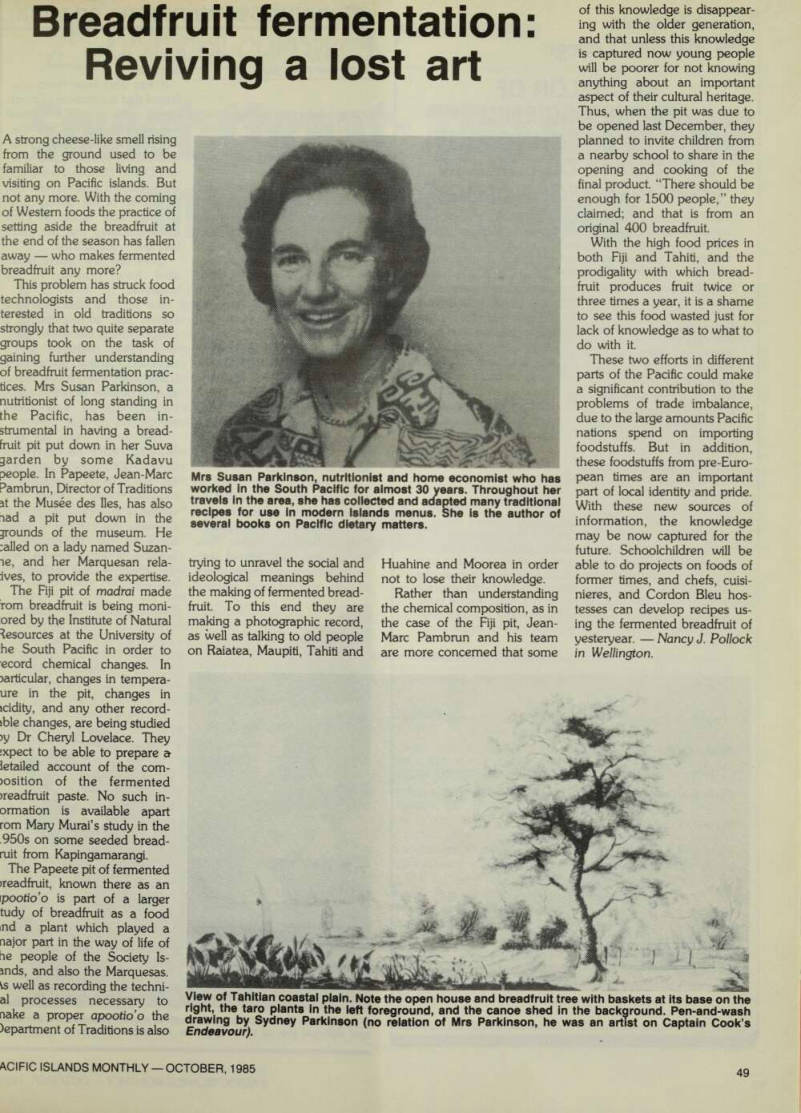
Mrs Susan Parkinson, nutritionist and home economist who has worked in the South Pacific for almost 30 years. Throughout her travels In the area, she has collected and adapted many traditional recipes for use in modern Islands menus. She is the author of several books on Pacific dietary matters.