- and what hasn’t
pp. 47-48 · Read in the full issue
What’s changed in the Cooks - and what hasn’t
After an absence of almost 10 years it was a thrill to fly into Rarotonga again. This time, however, instead of disembar king in a small group to the sounds of a Cook Islands greet ing of throbbing drums and graceful girls extending leis in welcome, we crowded off with 400 other passengers from an Air New Zealand Boeing 747 at the ungodly hour of 2 a.m.
For us, it was not the im personal hotel staff waiting for their customers, but instead a warm greeting from old and loyal friends, a greeting we deeply appreciated.
The 10 years between 1975 (the year of the 10th anniversary of independence in free association with New Zea land) and 1985, the 20th anniversary, are probably the most significant in the modem history of the Cooks. This period saw the change of gov ernment from the patriarchal control of Albert Henry to the urbane style of government of Sir Tom Davis. In 1975, a pride af the Cooks was CINAT (Cook islands National Arts Theatre), significant successes in Australia and New Zealand in 1970, at the first and second South Pacific Festivals of Art in Suva, 1972, and Rotorua, 1976, their special participation n the official Opening Cere nonies of the Sydney Opera House in 1973, and, subse quently, on Australian and New Zealand tours, the company fell /ictim to the strong political divisions in the Cooks and was disbanded. CINAT has now Deen reborn and has again epresented the Cooks, this ime at the Fourth Festival of in Tahiti this year.
There have been changes, dramatic changes on Raroton ga, the main island of the 15 vhich make up the Cook Is ands. These include the buil ding of dozens of motels and lotels. Some, like the new Hotel Rarotonga, fit delightfully nto the Rarotongan landscape, is do some private homes such
VICTOR CARELL and his wife Beth Dean recently visited the Cook Islands after an absence of almost 10 years. Victor Carell writes here on the changes to be observed in Rarotonga since they were last there and of the things that haven’t changed much at all.
as the artist Rick Welland’s marvellous stone house built snuggled into huge black basalt rocks and the ironwood casuarina and large utu trees. It looks out upon the rippling waves of the lagoon as if welcoming the incoming Pacific Ocean to Rarotonga.
But too many of the motels are lacking in imaginative value.
One sees the incongruity of an old Cook Islands house now painted a bright yellow and named “La Cantina” with a sleepy “Mexican under a som brero” as a fresco outside.
Alongside the historic and gra cious pioneer Avarua church and its “Minister’s house” both built of hard-won coral lime and rocks is a most obtrusive new Sunday School hall. It is certainly utilitarian but is most distressing to lovers of history, architecture and art.
One despairs over the loss of the truly unique and charming original Sunday School hall, built of similar materials to the church, but allowed to deterio rate until it is now a roofless ruin with only the shell of its walls standing. This was the centre
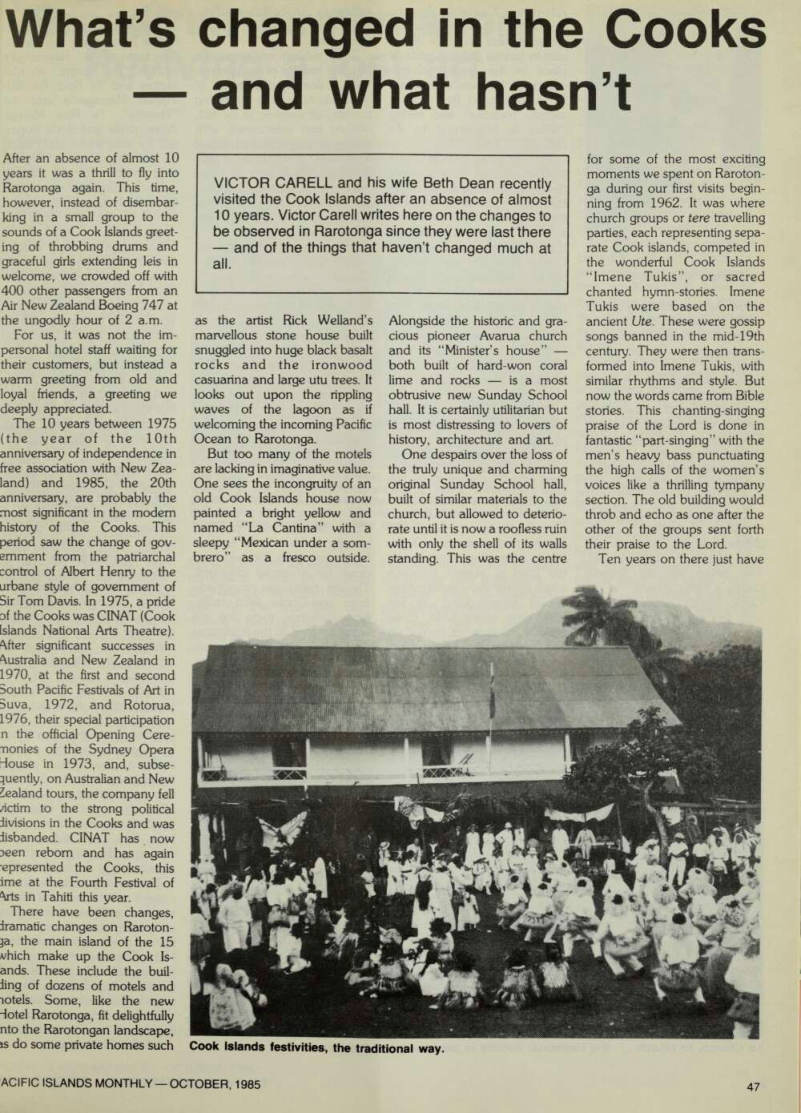
for some of the most exciting moments we spent on Raroton ga during our first visits begin ning from 1962. It was where church groups or tere travelling parties, each representing sepa rate Cook islands, competed in the wonderful Cook Islands “Imene Tukis”, or sacred chanted hymn-stories. Imene Tukis were based on the ancient Ute. These were gossip songs banned in the mid-19th century. They were then trans formed into Imene Tukis, with similar rhythms and style. But now the words came from Bible stories. This chanting-singing praise of the Lord is done in fantastic “part-singing” with the men’s heavy bass punctuating the high calls of the women’s voices like a thrilling tympany section. The old building would throb and echo as one after the other of the groups sent forth their praise to the Lord.
Ten years on there just have
Cook Islands festivities, the traditional way.
to be changes. Sadly, gone are many of the old personalities.
People like the flamboyant and intrepid sailor, Captain Andy Thomson. Sages like Charlie Cowan, Araitia Tepuretu, and, of course, Albert Henry. These were all men of vision. They gave a very special quality to Cook Islands life. They gave it stability, they were a tie to the past great orators as well as creating a sense of adventure and romance.
Today’s commercial world in the town of Avarua is a very different place, but there are now jobs for young and old.
The prime minister proudly claims a “plus growth” in the Cook Islands population last year. For the first time in years more Cook Islanders returned than departed these shores. But old “poppa and mama” Henry,
Albert and Elizabeth, must be wondering. There is now the rather austere image of Albert cast in bronze holding pride of place in the Avarua church cemetery. It almost seems as if he is looking at this modem tourist “paradise” and asking “What is happening to Te Enua?” (“Our Land”).
The old wharf area at Avatiu is different too. No longer are there the bitter-sweet farewells by Rarotongan crowds sending their relations and friends off with ute songs and prayers as they sailed away to the farther Cooks. Now we have the lux ury of small inter-island planes taking tourists and locals to the outer islands and back in a matter of hours. And even in Rakahanga, one of the farthest isles where traditional “grass huts” may still be seen, there is electricity and the übiquitous video sets.
With the passing of the old leaders of great mana, those men of knowledge and respect, living storehouses of the old chants, legends and history such as Araitia and Cowan, we find today some local ministers of the Cook Islands Christian Church trying to have the Cooks parliamentarians legis late to return the country to the old days of austere Sundays when everything was forbidden except church-going. In the early days of the LMS, those zealous missionaries from dour and cold Victorian England for bade all sports, picnics and
gatherings on Sundays, insis ting that all must spend the day in church.
These modem ministers must face the realities of the present.
With a floating population of hundreds of income-producing tourists, all needing to be fed, housed and entertained; with planes arriving and departing at weekends, plus the large per centage of members of other faiths who are not in agreement with those strict Victorian codes, few are left who can afford to agree with them.
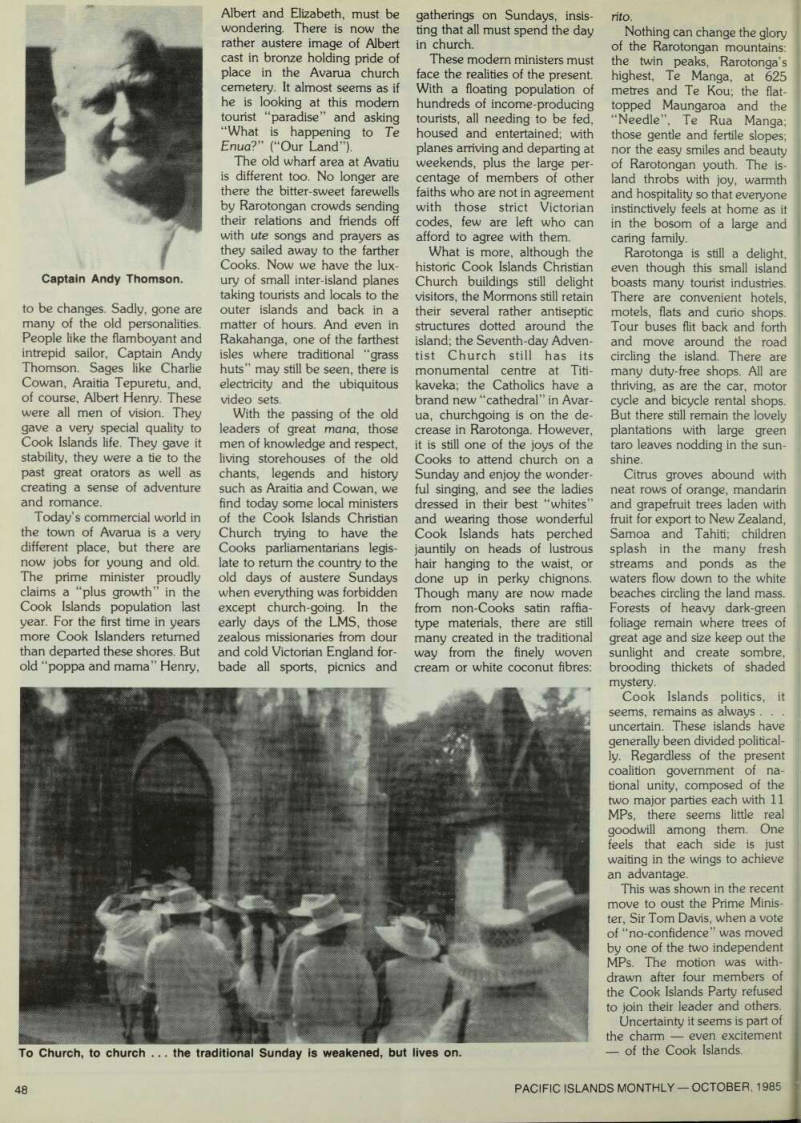
What is more, although the historic Cook Islands Christian Church buildings still delight visitors, the Mormons still retain their several rather antiseptic structures dotted around the island; the Seventh-day Adven tist Church still has its monumental centre at Titi kaveka; the Catholics have a brand new “cathedral” in Avar ua, churchgoing is on the de crease in Rarotonga. However, it is still one of the joys of the Cooks to attend church on a Sunday and enjoy the wonder ful singing, and see the ladies dressed in their best “whites” and wearing those wonderful Cook Islands hats perched jauntily on heads of lustrous hair hanging to the waist, or done up in perky chignons.
Though many are now made from non-Cooks satin raffia type materials, there are still many created in the traditional way from the finely woven cream or white coconut fibres:
rito.
Nothing can change the glory of the Rarotongan mountains; the twin peaks, Rarotonga’s highest, Te Manga, at 625 metres and Te Kou; the flat topped Maungaroa and the “Needle”, Te Rua Manga; those gentle and fertile slopes; nor the easy smiles and beauty of Rarotongan youth. The is land throbs with joy, warmth and hospitality so that everyone instinctively feels at home as it in the bosom of a large and caring family.
Rarotonga is still a delight, even though this small island boasts many tourist industries.
There are convenient hotels, motels, flats and curio shops.
Tour buses flit back and forth and move around the road circling the island. There are many duty-free shops. All are thriving, as are the car, motor cycle and bicycle rental shops.
But there still remain the lovely plantations with large green taro leaves nodding in the sun shine.
Citrus groves abound with neat rows of orange, mandarin and grapefruit trees laden with fruit for export to New Zealand, Samoa and Tahiti; children splash in the many fresh streams and ponds as the waters flow down to the white beaches circling the land mass.
Forests of heavy dark-green foliage remain where trees of great age and size keep out the sunlight and create sombre, brooding thickets of shaded mystery.
Cook Islands politics, it seems, remains as always . . . uncertain. These islands have generally been divided political ly. Regardless of the present coalition government of na tional unity, composed of the two major parties each with 11 MPs, there seems little real goodwill among them. One feels that each side is just waiting in the wings to achieve an advantage.
This was shown in the recent move to oust the Prime Minis ter, Sir Tom Davis, when a vote of “no-confidence” was moved by one of the two independent MPs. The motion was with drawn after four members of the Cook Islands Party refused to join their leader and others.
Uncertainty it seems is part of the charm even excitement of the Cook Islands.
Captain Andy Thomson.
To Church, to church ... the traditional Sunday is weakened, but lives on.