Unhappy echoes
p. 46 · Read in the full issue
in Happy Valley
A tiny, reinforced concrete hut dug in on a hillside up Raroton ga’s Happy Valley records the anything but happy bangs that take place at the French nuclear testing site on Moruroa atoll in French Polynesia.
Every time the scientists there fire an underground shot this spartan little outpost records the shock waves and tells the world.
There have been four tests so far this year, in the now-regular pattern of a small one followed by a big one, then a small one again. Their shock waves hit Rarotonga from three directions in such a familiar sequence that senior technician at the Cook Islands observatory, Mr Roro Taia, can tell immediately that they are from the nuclear tes ting ground, not an earthquake. ’’The last French test was on June 7 and was equivalent to about 10 kilotonnes of TNT,” he said.
Four tests have been fired on Moruroa so far this year, and each one has been easily identifiable; quite distinctly different from the earthquakes which the observatory also re cords at the rate of about one a week.
The nuclear explosions generate shock waves which radiate through the Pacific’s
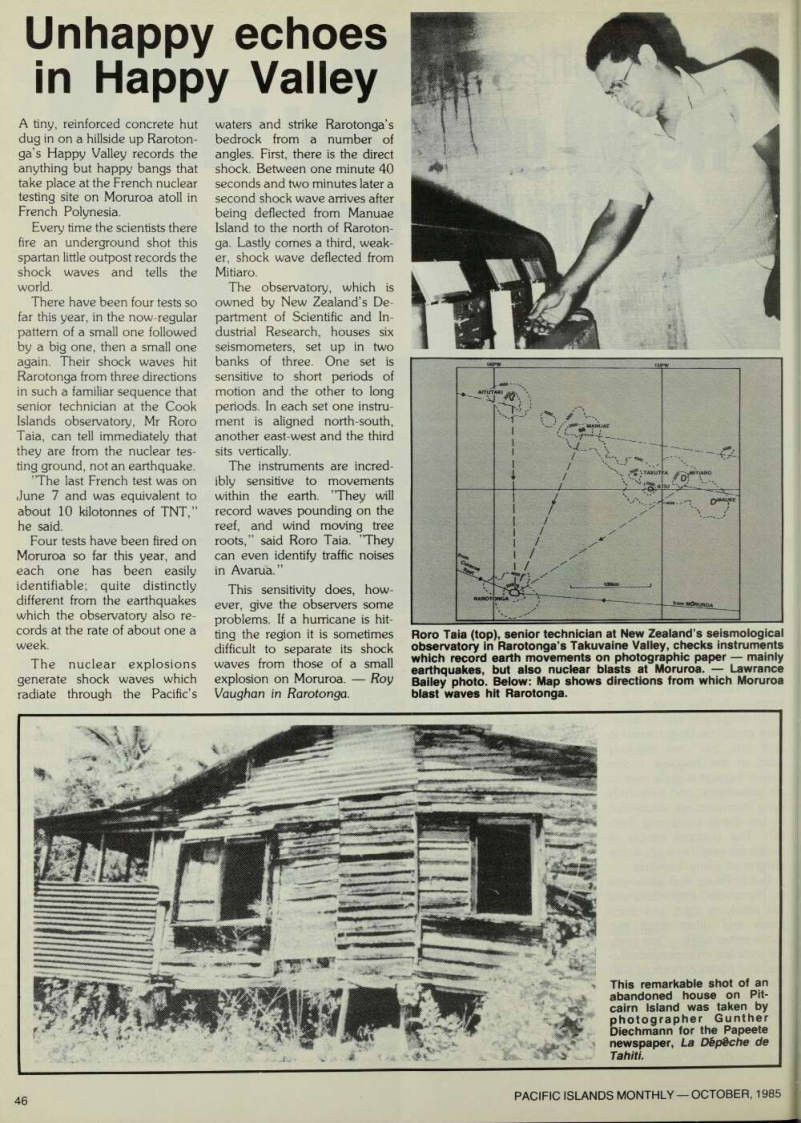
waters and strike Rarotonga’s bedrock from a number of angles. First, there is the direct shock. Between one minute 40 seconds and two minutes later a second shock wave arrives after being deflected from Manuae Island to the north of Raroton ga. Lastly comes a third, weak er, shock wave deflected from Mitiaro.
The observatory, which is owned by New Zealand’s De partment of Scientific and In dustrial Research, houses six seismometers, set up in two banks of three. One set is sensitive to short periods of motion and the other to long periods. In each set one instru ment is aligned north-south, another east-west and the third sits vertically.
The instruments are incred ibly sensitive to movements within the earth. ’’They will record waves pounding on the reef, and wind moving tree roots,” said Roro Taia. ’They can even identify traffic noises in Avarua.”
This sensitivity does, how ever, give the observers some problems. If a hurricane is hit ting the region it is sometimes difficult to separate its shock waves from those of a small explosion on Moruroa. Roy Vaughan in Rarotonga.
Roro Taia (top), senior technician at New Zealand’s seismological observatory in Rarotonga’s Takuvaine Valley, checks instruments which record earth movements on photographic paper — mainly earthquakes, but also nuclear blasts at Moruroa. — Lawrance Bailey photo. Below: Map shows directions from which Moruroa blast waves hit Rarotonga.
This remarkable shot of an abandoned house on Pit cairn Island was taken by
photographer Gunther
Diechmann for the Papeete
newspaper, La Depeche de
Tahiti.