Heavy grass and Yakuza
p. 45 · Read in the full issue
tropicalities
Heavy grass and Yakuza in Micronesia
Boy, that Palau grass is “heavy stuff”, said the young American as he greeted some of his contemporaries at the Guam International Airport just after alighting from a Koror flight. His remark was all too typical of many returning tourists and other visitors to Palau these days, “high-impact” marijuana being one of the islands’ attrac tions along with their many natural beauties.
The situation is becoming one of great concern to many of the American authorities as well as to the Palauan leadership.
Marijuana, of course, is grown throughout the islands, but the Palau version is especially sought after due to its potency.
Some of the “pot” there is grown in the high phosphate content soil of Babelthuap Is land and Peleliu, and these turn out to be healthy plants with very rich leaves.
The Guam airport, being a terminus in Micronesia, gets a lot of drug traffic with its atten dant problems. Dogs trained to sniff out “pot” are regularly used in the baggage rooms before luggage is given over to air passengers, and frequently drug shipments are discovered n ice chests containing fresh ish. The customs people at 3uam are very thorough, to the :hagrin of many travellers.
But in Palau, and elsewhere n Micronesia, inspections are lot nearly as tight, and mari uana and other drugs can nove rather easily too easily or most law enforcement offic es, and others concerned with he growing problem. Palau is )f special concern because lowadays there are two flights i week between Manila and Coror, and hard drugs, includ ng heroin, are coming into
Micronesia from Asia, and thence to the U.S. mainland. It is one of the concerns of those leery about the forthcoming passage of the Compacts of Free Association. First class mail can be sent from any place in the Trust Territory to any place on the mainland. This mail is not inspected. Practically speaking, parcels of “Palauan gold” can be sent easily from Koror to Oshkosh, Wisconsin or anywhere else rather easily.
And Palauans themselves be come victims of hard drugs.
Palau Attorney-General Russell Weller has reported that “in the Koror hospital over a hundred drug-related treatments have been made” in recent times.
This is an increasingly grave matter. The special problem here is that when it comes to hard drugs like heroin, not much money can be made by dealers selling to Palauan
customers; they simply cannot afford it. They get hooked and get very sick. The real money to be made is through the trans shipments to Guam and else where, where there are ready markets and lots of profits to be made.
Nor can it be denied that the Japanese “Yakuza” Mafia is interested in all of this. In recent months a number of Yakuza members have been apprehended at Guam airport and returned directly to Japan.
The Yakuza members, happily, are rather easy to identify in many cases. They sport tattoos and have parts of their fingers amputated as part of their sinis ter code and ritual. Recently, one such unfortunate fellow was immediately apprehended at Guam International Airport.
Reportedly, he was seeking asylum in Guam because he feared for his life in Japan. The Guam authorities promptly re
turned him, and, as far as is known, he has not been heard from again.
But it is likely that people in Guam and Micronesia will be, lamentably, hearing plenty more from the Yakuza in future.
The drug trade is profitable, and regrettably easy, these days in the islands. It is a business which is bound to grow. The many “massage parlors” of Guam, and the recent efforts to promote gambling at Saipan to the north, are said to be Yakuza-supported.
At base, of course, it is for the islanders themselves to put a stop to it all. But as one observer said recently: “You can’t have drug traffic any place without the more important and highly placed citizens of the society being involved. ” Surely, this represents an important and continuing problem for the Guam-Micronesian public.
Dirk Anthony Ba/lendorf.
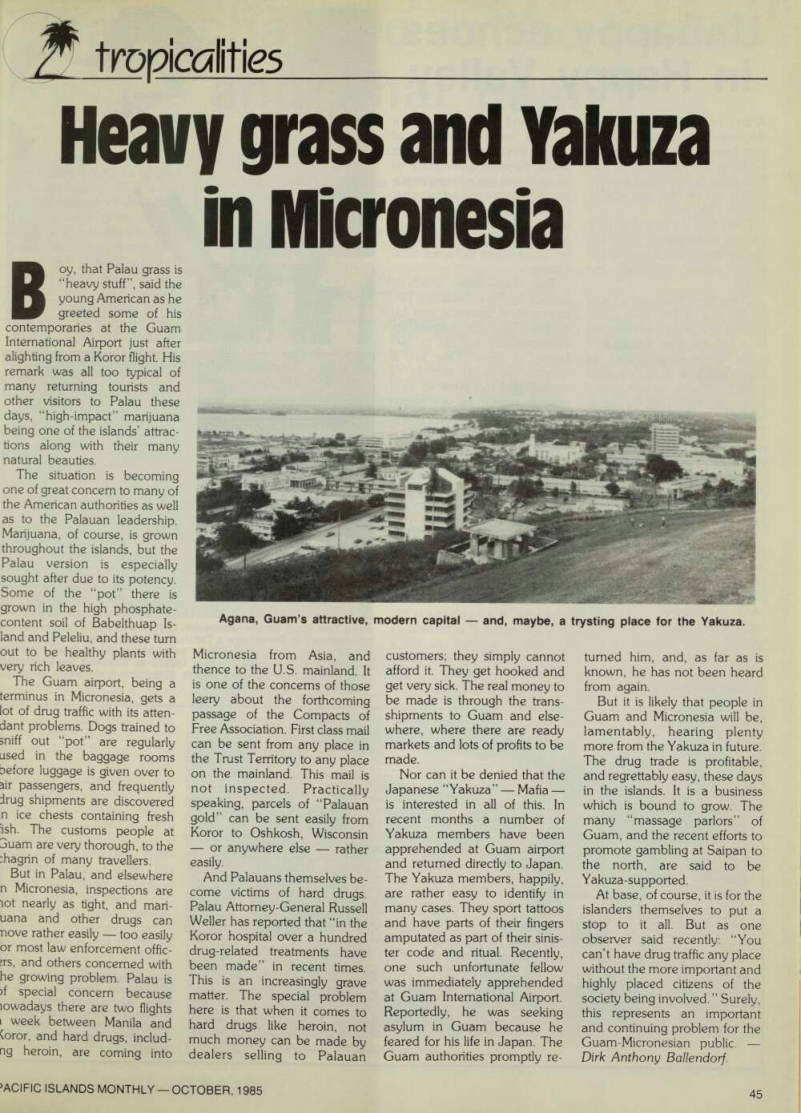
Agana, Guam’s attractive, modern capital - and, maybe, a trysting place for the Yakuza.