and the substance
pp. 51-52 · Read in the full issue
political currents
Soviet threat: The shadow and the substance
It seems to be getting fashionable these days to speak of the “Soviet threat” to the Pacific in the regional news media. It has stemmed of course, from Rus sian interest in fishing rights in the territorial waters of Kiribati coming to light. While it is certainly a good thing to keep up with such developments, I think it is also important to take a hard look at some of the relevant questions which might be posed around this issue.
What are the Soviet interests in the Pacific? What is the present Soviet presence? Is it a threat?
The Soviets have been in terested in the Pacific for many years and have not been consi dered strangers. In the last century the Russian Captain Kotzebue came to Pohnpei (new form of the place name Ponape) and in fact named the islands “Senyavin” after his ship. Today, there are Russian ships all over the Pacific, and they have been there for a number of years. In Micronesia they are quite active because of the significant American military presence at Guam, and the missile testing facilities at Kwajalein in the Marshall Is lands. In fact, the largest Rus sian armada is in the Pacific.
Because we don’t see it much, we tend not to think about it.
Submarine tracking planes fly daily from Guam, and the large Naval Communications Center (NAVCAMS) tracks the Russian activity, among other things through a network of computers and other sophisti cated electronic gear located in the northern part of Guam. The SAC base at Andersen laun ches B-52 bombers which fly regularly to Darwin, Australia,
DIRK ANTHONY BALLENDORF, director of the Micronesian Area Research Center, Guam, takes a considered look at the shadow and the substance of talk about the Soviet threat to Pacific Island countries.
and they have a surveillance mission these days, as well as their primary defence mission.
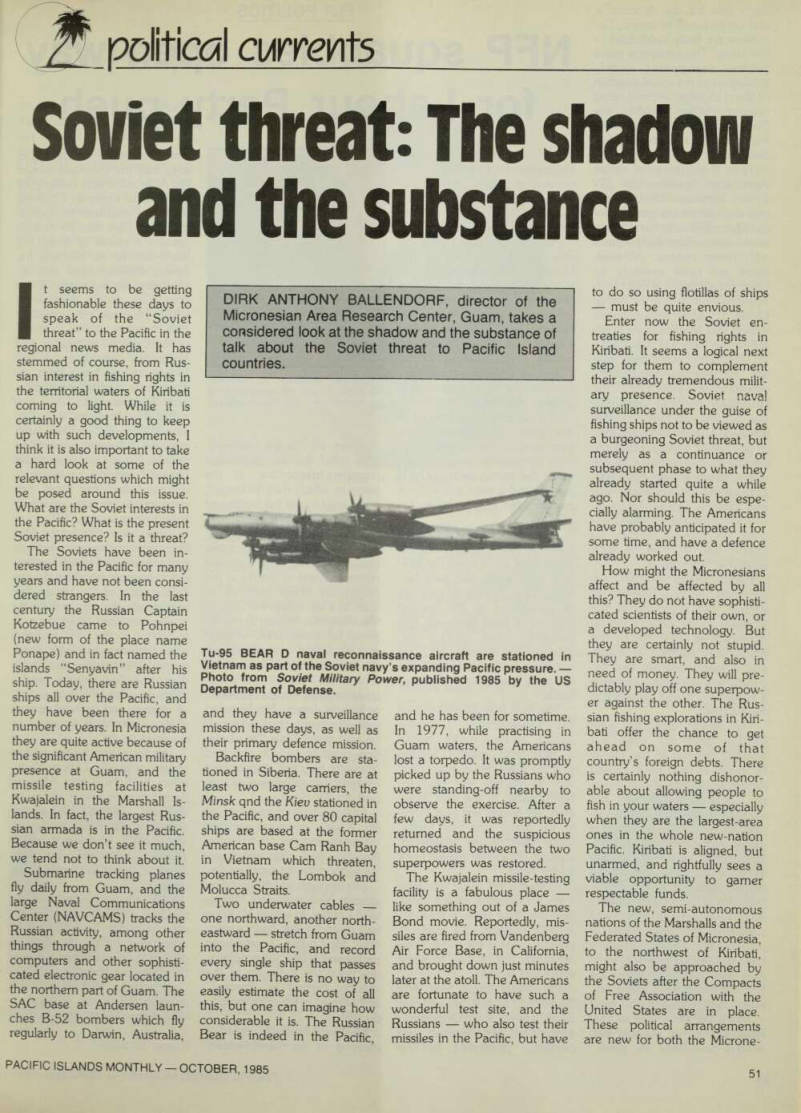
Backfire bombers are sta tioned in Siberia. There are at least two large carriers, the Minsk qnd the Kiev stationed in the Pacific, and over 80 capital ships are based at the former American base Cam Ranh Bay in Vietnam which threaten, potentially, the Lombok and Molucca Straits.
Two underwater cables one northward, another north eastward stretch from Guam into the Pacific, and record every single ship that passes over them. There is no way to easily estimate the cost of all this, but one can imagine how considerable it is. The Russian Bear is indeed in the Pacific,
and he has been for sometime.
In 1977, while practising in Guam waters, the Americans lost a torpedo. It was promptly picked up by the Russians who were standing-off nearby to observe the exercise. After a few days, it was reportedly returned and the suspicious homeostasis between the two superpowers was restored.
The Kwajalein missile-testing facility is a fabulous place like something out of a James Bond movie. Reportedly, mis siles are fired from Vandenberg Air Force Base, in California, and brought down just minutes later at the atoll. The Americans are fortunate to have such a wonderful test site, and the Russians who also test their missiles in the Pacific, but have
to do so using flotillas of ships must be quite envious.
Enter now the Soviet en treaties for fishing rights in Kiribati. It seems a logical next step for them to complement their already tremendous milit ary presence. Soviet naval surveillance under the guise of fishing ships not to be viewed as a burgeoning Soviet threat, but merely as a continuance or subsequent phase to what they already started quite a while ago. Nor should this be espe cially alarming. The Americans have probably anticipated it for some time, and have a defence already worked out.
How might the Micronesians affect and be affected by all this? They do not have sophisti cated scientists of their own, or a developed technology. But they are certainly not stupid.
They are smart, and also in need of money. They will pre dictably play off one superpow er against the other. The Rus sian fishing explorations in Kiri bati offer the chance to get ahead on some of that country’s foreign debts. There is certainly nothing dishonor able about allowing people to fish in your waters especially when they are the largest-area ones in the whole new-nation Pacific. Kiribati is aligned, but unarmed, and rightfully sees a viable opportunity to gamer respectable funds.
The new, semi-autonomous nations of the Marshalls and the Federated States of Micronesia, to the northwest of Kiribati, might also be approached by the Soviets after the Compacts of Free Association with the United States are in place.
These political arrangements are new for both the Microne
Tu-95 BEAR D naval reconnaissance aircraft are stationed in Vietnam as part of the Soviet navy’s expanding Pacific pressure.- Photo from Soviet Military Power, published 1985 by the US Department of Defense.
sians and for the Americans, and certainly will be tested. The Soviets are likely candidates to test them. The compacts are a political arrangement roughly analogous to the social situation of living together without being married. Why wouldn’t the Soviets attempt to be suitors of Micronesians at some point in the future?
The Compacts of Free Association between the UN Trust Territory Micronesians and the Americans provide for the Micronesians to handle their own foreign affairs and relations with other nations. Although there will most certainly be close consultations should such relations ever involve the Soviet Union, it seems reasonable to expect that at some point in the future the Bear will make a try at negotiating something with the Micronesian semi-auton omous states. Greg Fry of the Australian National University has pointed out that a double standard is applied in the case of the Pacific nations which the leaders must be sensitive to; the metropolitan powers have dip lomatic and trade relations with the Soviet Union, so why shouldn’t the Pacific Island na tions do likewise if they so desire, and if it is to their economic advantage?
Pacific island peoples are pro-West, not pro-Russian. In Kiribati, the initiatives of the Russians in the case of fishing rights will be put to the people before any decision is made, and it seems unlikely that the people will vigorously embrace a portended Soviet presence in their islands.
The recent difficulties with ANZUS have not upset the strategic balance in the Pacific as much as they have caused American chagrin. Prime Minis ter Lange is anti-nuclear, but also most assuredly anti-Rus sian as well. Taken on the whole, it appears that the Paci fic islanders have more to gain from a carefully considered Soviet presence in the Pacific than the metropolitan powers do. Throughout a long, and sometimes exploitive, history of colonialism, Pacific islanders have usually managed to act in their own best interests. If the Soviets should “threaten” them, they will parry and react in much the same way as they have when the metropolitan powers have done the same.