Tragic tale of disaster
pp. 42-43 · Read in the full issue
Report On Loss Of Onma Ii
Tragic tale of disaster in cyclone Eric
The report of the Commis sion of Inquiry into the loss of the inter-island motor vessel Onma II in Vanuatu waters on January 16, 1985, has raised the wariness of international insurance com panies working in the Pacific.
Battered by huge losses caused by cyclone damage in Fiji and elsewhere, the insurance in dustry has developed a very cautious attitude towards all types of insurance in the is lands. The report on the loss of the Onma II tells a story of disaster and disorganisation aboard a ship described in the report as having been unsea worthy and manned by a crew unprepared, untrained and in some respects inexperienced and even incompetent.
The Onma II foundered in hurricane conditions, brought by tropical cyclone Eric, off Lamap Point, East Malekula, Vanuatu, with the loss of eight lives, four of them children, from among a crew of 14 and probably 55 passengers. The vessel, owned by Issacher De nnis and Co Ltd., and her cargo of 35 tons of general cargo were completely lost.
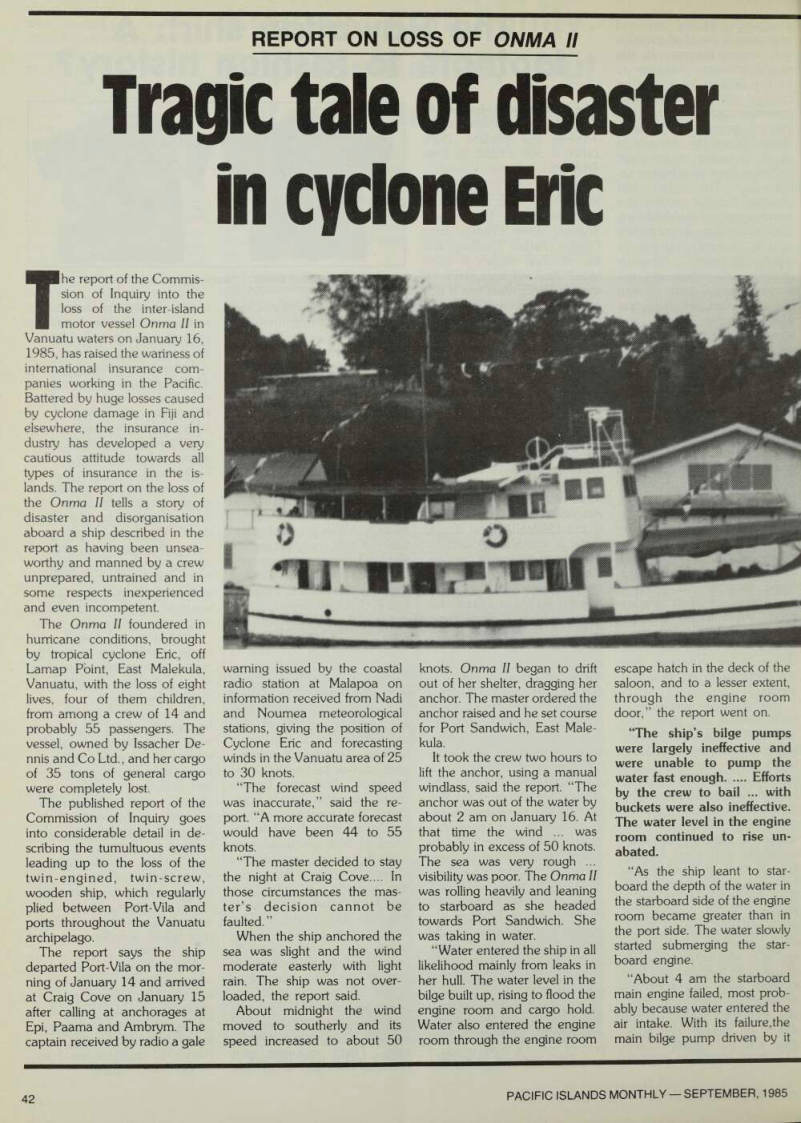
The published report of the Commission of Inquiry goes into considerable detail in de scribing the tumultuous events leading up to the loss of the twin-engined, twin-screw, wooden ship, which regularly plied between Port-Vila and ports throughout the Vanuatu archipelago.
The report says the ship departed Port-Vila on the mor ning of January 14 and arrived at Craig Cove on January 15 after calling at anchorages at Epi, Paama and Ambrym. The captain received by radio a gale
warning issued by the coastal radio station at Malapoa on information received from Nadi and Noumea meteorological stations, giving the position of Cyclone Eric and forecasting winds in the Vanuatu area of 25 to 30 knots.
“The forecast wind speed was inaccurate,” said the re port. “A more accurate forecast would have been 44 to 55 knots.
“The master decided to stay the night at Craig Cove... In those circumstances the mas ter’s decision cannot be faulted. ”
When the ship anchored the sea was slight and the wind moderate easterly with light rain. The ship was not over loaded, the report said.
About midnight the wind moved to southerly and its speed increased to about 50
knots. Onma II began to drift out of her shelter, dragging her anchor. The master ordered the anchor raised and he set course for Port Sandwich, East Male kula.
It took the crew two hours to lift the anchor, using a manual windlass, said the report. “The anchor was out of the water by about 2 am on January 16. At that time the wind ... was probably in excess of 50 knots.
The sea was very rough ... visibility was poor. The Onma II was rolling heavily and leaning to starboard as she headed towards Port Sandwich. She was taking in water.
“Water entered the ship in all likelihood mainly from leaks in her hull. The water level in the bilge built up, rising to flood the engine room and cargo hold.
Water also entered the engine room through the engine room
escape hatch in the deck of the saloon, and to a lesser extent, through the engine room door,” the report went on.
“The ship’s bilge pumps were largely ineffective and were unable to pump the water fast enough Efforts by the crew to bail ... with buckets were also ineffective.
The water level in the engine room continued to rise un abated.
“As the ship leant to star board the depth of the water in the starboard side of the engine room became greater than in the port side. The water slowly started submerging the star board engine.
“About 4 am the starboard main engine failed, most prob ably because water entered the air intake. With its failure,the main bilge pump driven by it
ceased to operate,” the report said.
This left the ship with only a portable bilge pump and the bailing buckets in seas by then mountainous.
“About 5 am the port main engine also failed, whereupon the Onma II was without prop ulsion in heavy seas and strong wind,” the report went on.
“After the starboard engine failed, some of the crew com menced issuing life jackets to passengers. After the port en
gine failed all passengers except some very young children had donned life jackets.
“About 5.30 am, when the Onma II was about two miles from Lamap Point, East Male kula, she listed heavily to star board and her deck started to submerge. This appeared to be a signal for all persons to abandon the ship. Shortly thereafter (the ship) rolled to starboard and sank stern first, becoming a total loss.
“The abandonment of the sinking ship was a confused event and wholly disorga nised. The master and crew were unprepared and un trained for the calamity that befell the ship on that night,” said the report. “The hapless passengers, after being issued with life jackets, were by and large left to their own fate.
Trusting to their life jackets
they jumped into the sea, AH persons left the sinking ship alive. Subsequently five lost their lives by drowning and three are missing, presumed dead. Amongst the dead were four children.”
The report said that the ship was last surveyed on February 27, 1984. Her safety certificate was issued on February 29 and was valid to February 26, 1985.
But, according to the commis sion of inquiry, the safety certifi cate should not have been
awarded.
“Certain defects were re vealed by the survey, including the absence of a panel in the watertight bulkhead between the engine room and the main cargo hold. The surveyor was not informed of any leaks in the hull, and the survey did not reveal any,” said the report.
The owners of the ship were informed of the defects. The safety certificate was neverthe less issued on the understan ding that the defects would be put right at the earliest opportunity. In those circumst ances the safety certificate should not have been awarded to the Onma 11.
“Immediately prior to the
voyage on which she was lost the Onma II was not a sea worthy vessel. She had a seriously leaking hull. On a voyage in calm seas the hull would take in so much water that it would necessitate the operation of her pumps for about four hours in every 24 hours on average,” the report went on.
“In rough seas the rate of water intake would increase. In addition the bulkhead between the engine room and the main
cargo hold was not watertight.
“The Onma II engineers were incompetent and inex perienced and her chief en gineer unqualified,” the report said.
“It should be noted that the safety certificate required as a minimum that the ship be man ned by an engineer holding at least a first class mechanic’s certificate. None of the en gineers held this qualification.
“The life-saving devices and appliances carried on board the Onma II were inadequate.
“The ship did not carry a sufficient number of lifeboats or liferafts as required by regula
tions. She only carried an ade quate number of buoyant apparatus. Some of the lifejack ets ... were defective.
“Although the Onma II was towing a dinghy the master and the crew at no time during the crisis thought of using it to save the passengers. It appeared to have been forgotten. It was only the quick action of a passenger which saved the dinghy from sinking with the ship. About 17 persons who were swimming in the sea when the dinghy drifted close to them clambered into it.
“Neither the master nor the crew informed the passengers that the Onma II carried life rafts.” the report went on.“By the time the rafts were thrown into the water most of the passengers had already been carried by the sea away from the sinking ship. The master did not use the distress flares or fire the parachute distress rockets that were carried on the ship.
“After the port engine failed the master attempted to make contact with the coastal radio station. He was unable to do so because the aerial of the ship’s radio was blown away.
“However, even if the aerial was not blown away he would not have succeeded because the radio station at Malapoa was not manned at the time,” said the report. “The station closed at 10 pm on January 15 and reopened at 6 am on January 16.
“It was not until 11 am on January 16 that the authorities in Vila first became aware of the tragedy,” said the report.
Most of the survivors either swam ashore or were rescued on January 16. The rest of those surviving were rescued the next day after search and rescue aircraft spotted them drifting in the sea and directed ships to pick them up.
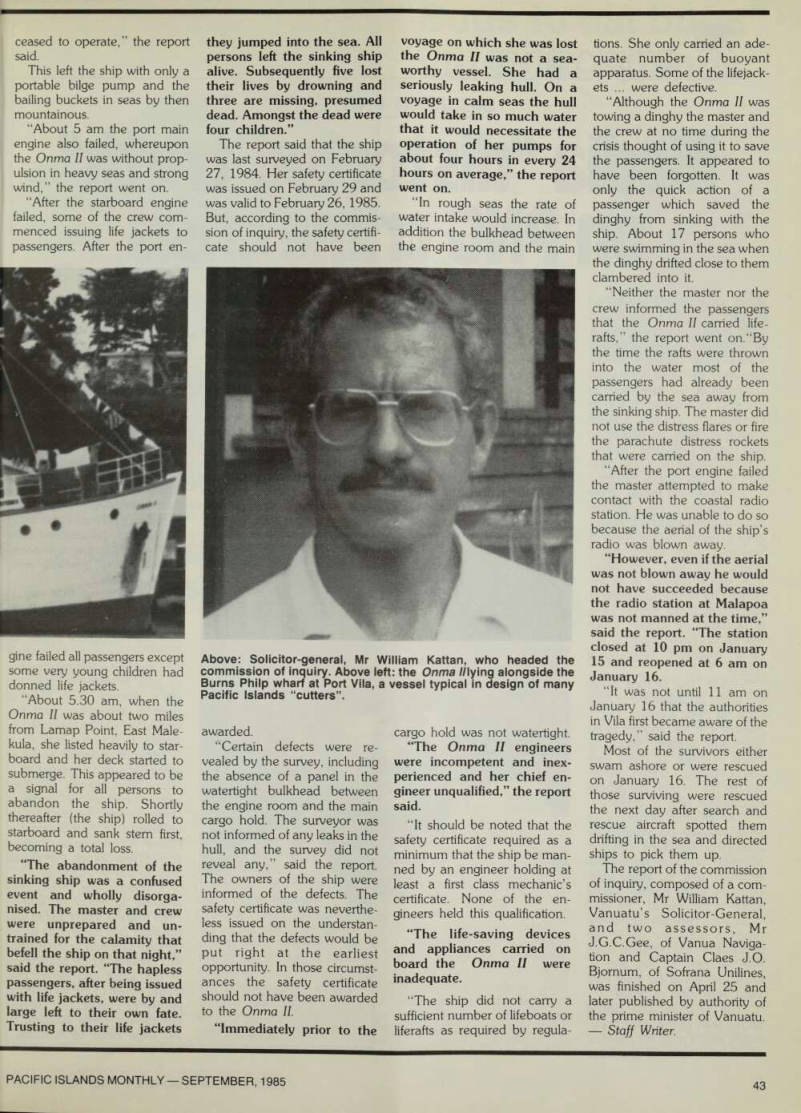
The report of the commission of inquiry, composed of a com missioner, Mr William Kattan, Vanuatu’s Solicitor-General, and two assessors, Mr J.G.C.Gee, of Vanua Naviga tion and Captain Claes J.O.
Bjornum, of Sofrana Unilines, was finished on April 25 and later published by authority of the prime minister of Vanuatu.
Staff Writer.
Above: Solicitor-general, Mr William Kattan, who headed the commission of inquiry. Above left: the Onma //lying alongside the Burns Philp wharf at Port Vila, a vessel typical in design of many Pacific Islands “cutters”.