footnote to fashion history?
p. 41 · Read in the full issue
The Hawaiian shirt: A footnote to fashion history?
The Hawaiian Shirt. By H.
Thomas Steele. Published by Thames and Hudson 1984.
ISBN 0 500 27352 9. Price $A23.95.
What, I ask you, apart from their nationality, have Harry Truman, Elvis Presley, Bing Crosby, Arthur Godfrey and the Mormon church in com mon? No? All right, let’s be more specific: What was it that actor Montgomery Clift died in in From Here To Eternity? No closer? 0.K., let’s make it easy.
On what cultural artefact have the likenesses of three Hawaiian monarchs been dis played simultaneously? Ah! A travel brochure? A Bishop Museum Bulletin? A postage stamp . . .? Uh, uh. The answer to all these and probably other questions that have teased the minds of many pondering the socio-cultural interaction of America and the Pacific Islands is the HAWAIIAN or, if you prefer it, the ALOHA shirt.
There is no longer any ex cuse for scholars of the Pacific to be ignorant of the above matters. H. Thomas Steele has seen to that. H. Thomas Steele is responsible for the text, and presumably the majority of photographs since few other credits are given, of what may well turn out to be the definitive work on the subject of the Hawaiian shirt. For Steele, the shirt is not something one buys in a weak moment, wears once on vacation, and then gives to one’s least favorite charity. The shirt is a sociological signifier.
Embodied in the shapeless gar ment Steele is perceptive enough to realise that while the designs were almost limitless, the cut has remained un changed for over 50 years is a whole complex of processes involving American history and politics, entertainment and popular culture, Pacific geogra phy and agriculture, and Hawaiian lifestyles, both rural and urban.
You don’t believe any of this? But this book provides unassailable evidence in sup port of Steele’s thesis which, if its intellectual complexity can
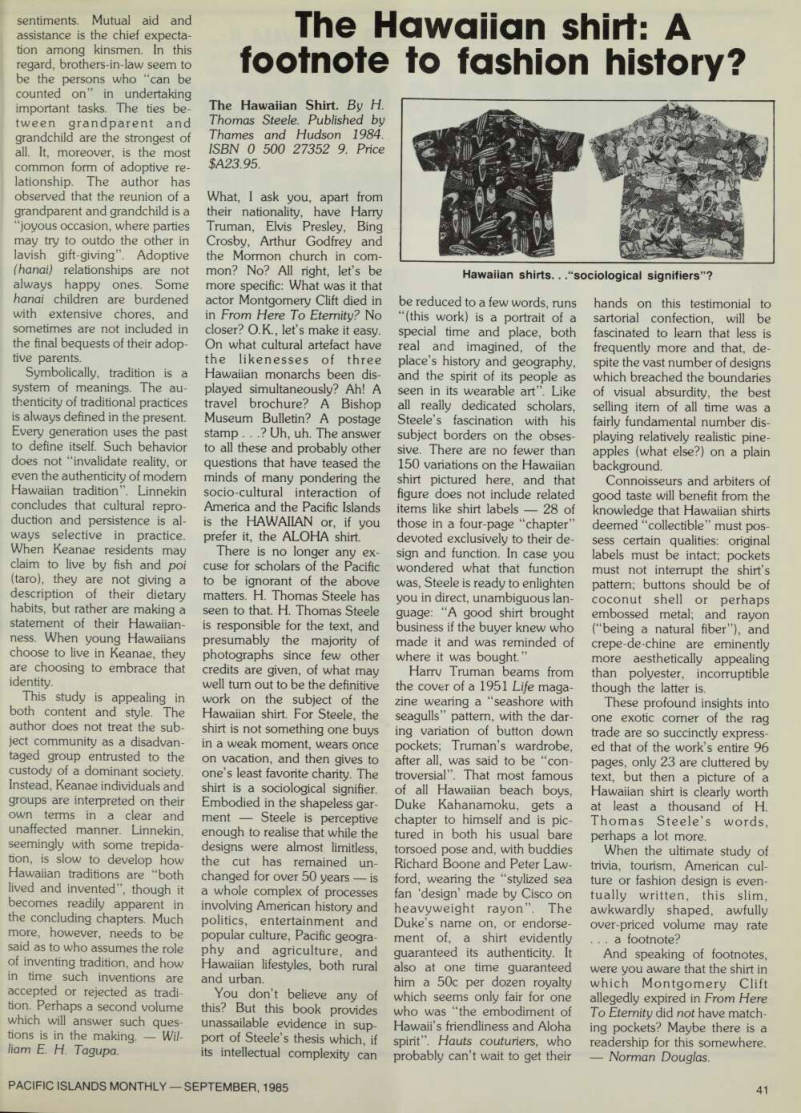
be reduced to a few words, runs “(this work) is a portrait of a special time and place, both real and imagined, of the place’s history and geography, and the spirit of its people as seen in its wearable art”. Like all really dedicated scholars, Steele’s fascination with his subject borders on the obses sive. There are no fewer than 150 variations on the Hawaiian shirt pictured here, and that figure does not include related items like shirt labels 28 of those in a four-page “chapter” devoted exclusively to their de sign and function. In case you wondered what that function was, Steele is ready to enlighten you in direct, unambiguous lan guage: “A good shirt brought business if the buyer knew who made it and was reminded of where it was bought.”
Harrv Truman beams from the cover of a 1951 Life maga zine wearing a “seashore with seagulls” pattern, with the dar ing variation of button down pockets; Truman’s wardrobe, after all, was said to be “con troversial”. That most famous of all Hawaiian beach boys, Duke Kahanamoku, gets a chapter to himself and is pic tured in both his usual bare torsoed pose and, with buddies Richard Boone and Peter Law ford, wearing the “stylized sea fan ‘design’ made by Cisco on heavyweight rayon”. The Duke’s name on, or endorse ment of, a shirt evidently guaranteed its authenticity. It also at one time guaranteed him a 50c per dozen royalty which seems only fair for one who was “the embodiment of Hawaii’s friendliness and Aloha spirit”. Hauts couturiers, who probably can’t wait to get their
hands on this testimonial to sartorial confection, will be fascinated to learn that less is frequently more and that, de spite the vast number of designs which breached the boundaries of visual absurdity, the best selling item of all time was a fairly fundamental number dis playing relatively realistic pine apples (what else?) on a plain background.
Connoisseurs and arbiters of good taste will benefit from the knowledge that Hawaiian shirts deemed “collectible” must pos sess certain qualities: original labels must be intact; pockets must not interrupt the shirt’s pattern; buttons should be of coconut shell or perhaps embossed metal; and rayon (“being a natural fiber”), and crepe-de-chine are eminently more aesthetically appealing than polyester, incorruptible though the latter is.
These profound insights into one exotic comer of the rag trade are so succinctly express ed that of the work’s entire 96 pages, only 23 are cluttered by text, but then a picture of a Hawaiian shirt is clearly worth at least a thousand of H.
Thomas Steele’s words, perhaps a lot more.
When the ultimate study of trivia, tourism, American cul ture or fashion design is even tually written, this slim, awkwardly shaped, awfully over-priced volume may rate ... a footnote?
And speaking of footnotes, were you aware that the shirt in which Montgomery Clift allegedly expired in From Here To Eternity did not have match ing pockets? Maybe there is a readership for this somewhere.
Norman Douglas.
Hawaiian shirts.. .“sociological signifiers”?