Keanae community:
pp. 40-41 · Read in the full issue
Representative, but not naive, unchanging
Children of the Land: Ex change and Status in a Hawaiian Community. By Jocelyn Linnekin. Published 1985 by Rutgers University Press. ISBN O 8135 1052. 264 pp. $U527.00.
The persistence of tradition in an acculturated society is the problem addressed in Jocelyn Linnekin’s study of the native Hawaiian community of Keanae. It was the working assumption that: “Hawaiian culture must possess a certain resilience, even in the face of a devastating history of foreign contact.” Keanae is unique be cause the Hawaiian residents still retained ownership of their taro-producing lands and grow the crop for income as well as for the reinforcement of their social bonds. Though Keanae is
relatively isolated, it is still eco nomically tied into the market economy and interrupted by the occasional tourist wander ing the coastal roads of Maui island. Its people are repre sentative of Hawaiian tradition but not in a “naive or unchan ging manner”. More important, such traditions are “both lived and invented ... as rural Hawaiians conform to their own and others’ expectations of what that tradition comprises”.
If nothing else, today’s “Hawaiian renaissance looks partly to communities such as Keanae for cultural models”.
Linnekin isolates particular activity patterns and social in stitutions for special scrutiny.
Exchange relations among indi viduals and families are espe cially important because re-
lationships are identified and embraced in socially significant ways. Between kinsmen gifts and services pass freely “under the mantle of aloha”, and gen erally consist of taro and other subsistence items. Gifts to non relatives, on the other hand, are generally specialty commodities such as bananas and avocados.
The difference in such strategies are explained in culturally signi ficant terms. Taro has high sentimental value which is appropriately expressed only among relatives. Exchanges among non-relatives are more guarded, and items which have symbolic value are excluded in such relationships.
Generally speaking, there is a pervasive ethic which holds that “overt economic disparities” among community members should be avoided. Therefore, display of wealth and status would invoke social sanctions in the form of community avoi dance. Hawaiian values stress social equivalence and differ ences in material lifestyles are minimised with considerable effort. The value of labor in Hawaiian exchanges is demon strated on special occasions.
The luau (feast) is generally the time when community labor is requisitioned in the spirit of mutual assistance. Acknow ledgement of such contribu tions is usually made in the form of redistribution of food items to those who rendered any service. The luau itself is one of the few times when extensive generosity is demons trated and is today “perhaps the only redistributive event among Hawaiians”.
Acquiring prestige in the community is a matter selec tively pursued in a cautious and tactful manner. Increasing pro ductivity through hard work, rather than through the acquisi tion of material goods, is the most common manner in which prestige is obtained. A person acquires community esteem through personal generosity rather than through mere wealth. It is through such qual ities that a person increases his influence in the community.
Marriage and adoption, in Linnekin’s view, are unique forms of social exchange. It is a means whereby strangers are brought into the community on an intimate basis. There are, however, important governing
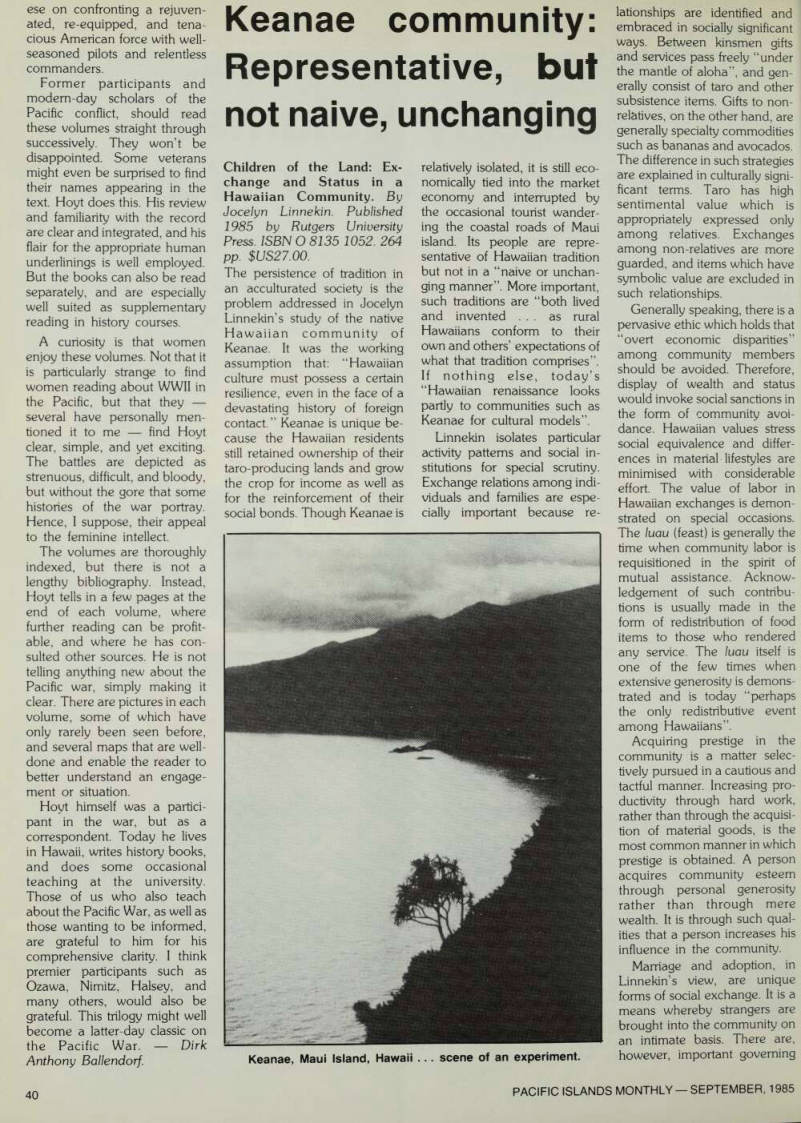
Keanae, Maui Island, Hawaii ... scene of an experiment.
sentiments. Mutual aid and assistance is the chief expecta tion among kinsmen. In this regard, brothers-in-law seem to be the persons who “can be counted on” in undertaking important tasks. The ties be tween grandparent and grandchild are the strongest of all. It, moreover, is the most common form of adoptive re lationship. The author has observed that the reunion of a grandparent and grandchild is a “joyous occasion, where parties may try to outdo the other in lavish gift-giving”. Adoptive (hanai ) relationships are not always happy ones. Some hanai children are burdened with extensive chores, and sometimes are not included in the final bequests of their adop tive parents.
Symbolically, tradition is a system of meanings. The au thenticity of traditional practices is always defined in the present.
Every generation uses the past to define itself. Such behavior does not “invalidate reality, or even the authenticity of modem Hawaiian tradition”. Linnekin concludes that cultural repro duction and persistence is al ways selective in practice.
When Keanae residents may claim to live by fish and poi (taro), they are not giving a description of their dietary habits, but rather are making a statement of their Hawaiian ness. When young Hawaiians choose to live in Keanae, they are choosing to embrace that identity.
This study is appealing in both content and style. The author does not treat the sub ject community as a disadvan taged group entrusted to the custody of a dominant society.
Instead, Keanae individuals and groups are interpreted on their own terms in a clear and unaffected manner. Linnekin, seemingly with some trepida tion, is slow to develop how Hawaiian traditions are “both lived and invented”, though it becomes readily apparent in the concluding chapters. Much more, however, needs to be said as to who assumes the role of inventing tradition, and how in time such inventions are accepted or rejected as tradi tion. Perhaps a second volume which will answer such ques tions is in the making. Wil liam E. H. Tagupa.