Masterly volumes
pp. 39-40 · Read in the full issue
books
Masterly volumes on the Pacific War
A Trilogy on World War II in the Pacific: Storm Over the Gilberts; To the Marianas; Closing the Circle. By Edwin P. Hoyt. Published by Van Nostrand Reinhold, New York.
Wars have a way of becoming romantic the farther they re cede into time. So it is with World War 11. Participants in the great event with whom I’ve spoken in years gone by closer to the thing itself have attested to its unromanticism.
Nowadays the ageing partici pants seem to romanticise it more and more.
On Guam, where I live and work, and in other places in the Pacific, I’m sure, many partici pants in the war are today revisiting their old battlefields.
An occasional few, like William Manchester, write personal memoirs of their experiences.
These activities seem to me to have a certain romanticism about them.
Then too, today, we are seeing writers and historians come forth with new interpreta tions of the war. The Japanese Government recently attemp ted to reinterpret their incursion into Manchuria in 1931 as something of a liberating holi day for the people there. This was too extreme, and after protests from many Asian coun tries, the Japanese have de cided to reconsider.
Finally, we have writers, such as Edwin P. Hoyt in this new trilogy on the Pacific war, who set down historical events with clarity, simplicity, accuracy, and objectivity. Such accounts are especially valuable because they have no axe to grind, no point of view to push. Young school children and old partici pants alike, can read his
account and gain from it. It is true that many of the Pacific war’s participants, both American and Australian, came to fight in the bitter struggles without ever realising exactly where they were. Today, there’s a new generation studying the war who may be a bit better informed geographically, but whose familiarity with the many issues and problems of the struggle is considerably more obscure. For these groups, I heartily recommend the present tr^^0 9V- The Pacific war saw the advent of a new weapon, previously untested in battle the aircraft carrier. Some admirals, like William “Bull” Halsey, saw them as offensive tools which could chase and strike the Japanese close to home and with brutal advantage. Others, such as Raymond Spruance, saw the carriers as guardians of the fleet and troops, and felt
they should be used primarily for support purposes. Com manders like Admiral Chester Nimitz, had the difficult, and sometimes thankless, task of mediating these differing points of view. Hoyt presents all this controversy not only with clar ity, but also with a sensitivity to the human drama involved. For example, he goes into explana tion of Halsey’s instances of stretching points in his orders which took him afield of pre arranged plans and sometimes resulted in disaster, as when some of his ships were caught in a typhoon and needlessly lost.
Nor are the Japanese com manders ignored or down-play ed. Vice Admiral Jasiburo Oza wa’s plight during the Battle of the Philippine Sea the Marianas “turkeyshoot” comes through with all the frustrations, lost hopes, and tragedy which befell the Japan-
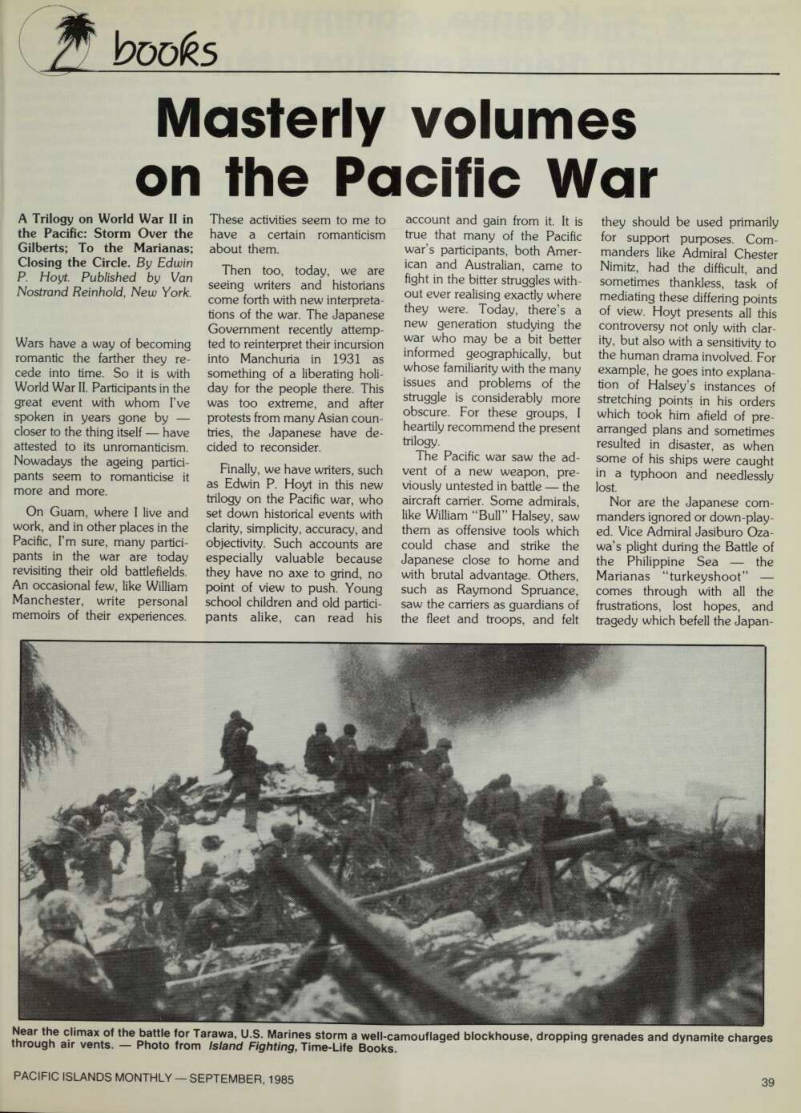
Near the climax of the battle for Tarawa, U.S. Marines storm a well-camouflaged blockhouse, dropping grenades and dynamite charges through air vents. - Photo from Island Fighting, Time-Life Books.
ese on confronting a rejuven ated, re-equipped, and tena cious American force with well seasoned pilots and relentless commanders.
Former participants and modern-day scholars of the Pacific conflict, should read these volumes straight through successively. They won’t be disappointed. Some veterans might even be surprised to find their names appearing in the text. Hoyt does this. His review and familiarity with the record are clear and integrated, and his flair for the appropriate human underlinings is well employed.
But the books can also be read separately, and are especially well suited as supplementary reading in history courses.
A curiosity is that women enjoy these volumes. Not that it is particularly strange to find women reading about WWI1 in the Pacific, but that they — several have personally men tioned it to me — find Hoyt clear, simple, and yet exciting.
The battles are depicted as strenuous, difficult, and bloody, but without the gore that some histories of the war portray.
Hence, I suppose, their appeal to the feminine intellect.
The volumes are thoroughly indexed, but there is not a lengthy bibliography. Instead, Hoyt tells in a few pages at the end of each volume, where further reading can be profit able, and where he has con sulted other sources. He is not telling anything new about the Pacific war, simply making it clear. There are pictures in each volume, some of which have only rarely been seen before, and several maps that are well done and enable the reader to better understand an engage ment or situation.
Hoyt himself was a partici pant in the war, but as a correspondent. Today he lives in Hawaii, writes history books, and does some occasional teaching at the university.
Those of us who also teach about the Pacific War, as well as those wanting to be informed, are grateful to him for his comprehensive clarity. I think premier participants such as Ozawa, Nimitz, Halsey, and many others, would also be grateful. This trilogy might well become a latter-day classic on
the Pacific War.
Dirk
Anthony Ballendorf.