Media “distorted truth”
p. 44 · Read in the full issue
tropicalities
Sir John Protests
Media “distorted truth” on PNG crime crisis
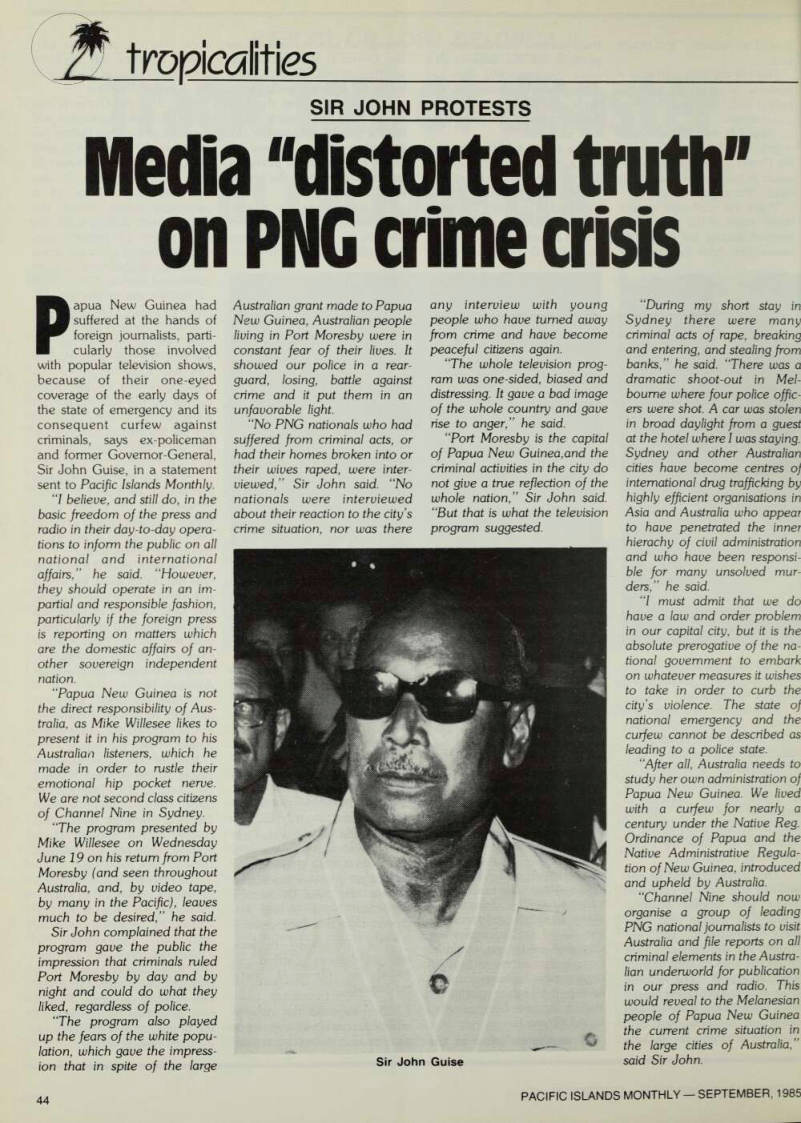
Papua New Guinea had suffered at the hands of foreign journalists, parti cularly those involved with popular television shows, because of their one-eyed coverage of the early days of the state of emergency and its consequent curfew against criminals, says ex-policeman and former Governor-General, Sir John Guise, in a statement sent to Pacific Islands Monthly.
“I believe, and still do, in the basic freedom of the press and radio in their day-to-day opera tions to inform the public on all national and international affairs,” he said. “However, they should operate in an im partial and responsible fashion, particularly if the foreign press is reporting on matters which are the domestic affairs of an other sovereign independent nation.
“Papua New Guinea is not the direct responsibility of Aus tralia, as Mike Willesee likes to present it in his program to his Australian listeners, which he made in order to rustle their emotional hip pocket nerve.
We are not second class citizens of Channel Nine in Sydney.
“The program presented by Mike Willesee on Wednesday June 19 on his return from Port Moresby (and seen throughout Australia, and, by video tape, by many in the Pacific), leaves much to be desired,” he said.
Sir John complained that the program gave the public the impression that criminals ruled Port Moresby by day and by night and could do what they liked, regardless of police.
“The program also played up the fears of the white popu lation, which gave the impress ion that in spite of the large
Australian grant made to Papua New Guinea, Australian people living in Port Moresby were in constant fear of their lives. It showed our police in a rear guard, losing, battle against crime and it put them in an unfavorable light.
“No PNG nationals who had suffered from criminal acts, or had their homes broken into or their wives raped, were inter viewed,” Sir John said. “No nationals were interviewed about their reaction to the city’s crime situation, nor was there
any interview with young people who have turned away from crime and have become peaceful citizens again.
“The whole television prog ram was one-sided, biased and distressing. It gave a bod image of the whole country and gave rise to anger,” he said.
“Port Moresby is the capital of Papua New Guinea,and the criminal activities in the city do not give a true reflection of the whole nation,” Sir John said.
“But that is what the television program suggested.
“During my short sta\; in Sydney there were many criminal acts of rape, breaking and entering, and stealing from banks,” he said. “There was a dramatic shoot-out in Mel bourne where four police offic ers were shot. A car was stolen in broad daylight from a guest at the hotel where I was staying.
Sydney and other Australian cities have become centres oj international drug trafficking by highly efficient organisations in Asia and Australia who appear to have penetrated the inner hierachy of civil administration and who have been responsi ble for many unsolved mur ders,” he said.
“I must admit that we do have a law and order problem in our capital city, but it is the absolute prerogative of the na tional government to embark on whatever measures it wishes to take in order to curb the city’s violence. The state of national emergency and the curfew cannot be described as leading to a police state.
“After all, Australia needs to study her own administration of Papua New Guinea. We lived with a curfew for nearly a century under the Native Reg.
Ordinance of Papua and the Native Administrative Regula tion of New Guinea, introduced and upheld by Australia.
“Channel Nine should now organise a group of leading PNG national journalists to visit Australia and file reports on all criminal elements in the Austra lian underworld for publication in our press and radio. This would reveal to the Melanesian people of Papua New Guinea the current crime situation in the large cities of Australia,” said Sir John.
Sir John Guise