Tahiti carries it off with a successful culturefest
p. 30 · Read in the full issue
successful culturefest
The Fourth Pacific Festival of Arts June 29 to July 15 was launched in the Pater Sta dium, Papeete, Tahiti, by Presi dent Gaston Flosse of the territorial government of French Polynesia before representa tives of the 22 participating countries.
The festival had a difficult beginning, as it had originally been scheduled for Noumea in December 1984, but because of political unrest and some violence in New Caledonia, was cancelled at the last moment.
In February it was decided that the festival should be held in Tahiti, and it is a credit to the organisers that in just four months they managed to en sure that this festival like the previous three was a great success.
Main arena for festival activi ties was the Vaiete Square in the middle of downtown Tahiti.
Other venues included the two OTAC theatres, and the huge
Salle Polyvalente Taaone. Out door performances occurred daily at the Craftsman’s Village, at historic Venus Point, and at the Museum of Tahiti and Her Islands. All national groups en joyed a trip to Moorea, where they each performed.
The craft centre is a large village of thatched buildings where the various countries dis played and sold their own handicraft products and fine art.
In displays every day, men and women demonstrated their skills in carving, plaiting, weav ing, painting and the building of canoes and houses.
The Cook Islands display in cluded a large number of rito plaited hats, and pearl shell fans with wide, rite-plaited edges.
Papua New Guinea showed Scpik wooden “cut-out” silhouette carvings, some classic Sepik masks, and carryall “bil lums” of woven mesh. Austra lian Aboriginals incised emu eggs, and created traditional
bark paintings. New Zealand presented fine carved wooden panels of ancient Maori style, piu piu skirts, taniko woven bands, and most unusual kiwi feathered bags of woven flax.
Truly different were the Easter Island carved images of stone and wood unique and rather stolid, with an earthy, powerful impact.
The festival also embraced displays of Pacific stamps, a week of Pacific films, and a number of special events, such as the traditional ceremony staged by the Maori people of New Zealand as they presented fine carvings to their Tahitian hosts and cousins.
It was interesting to note the vigor and power of the more pristine people’s dancing and song-chants, and to trace through the festival the losses in some of the more “developed” countries where either the slick ness of night club fare, or over-choreographed items, sometimes crept into the performances.
There was no such problem with the Papua New Guinea presentation, for example. At the beginning, the leader leapt to centre stage in full regalia and shouted in true PNG ora tor’s style: “I am proud to be here. I ask you all to come with us to Papua New Guinea to become one with us. Brothers and sisters of the South Pacific, I hope you enjoy our show...”
And enjoy it they did. The impact of the garamut, a huge slit gong drum, the mesmerising sound of the numerous kundu hand-held drums accompany ing the swaying, dipping and rising of the tides of massed dancers held the audience spellbound.
On the same program was the superb presentation by Manoa Rasigatale of the culture of the very diverse races of Fiji.
They showed the Pacific and the world their remarkable achievement in racial harmony.
Performing as a unit, but with each group true to its own tradition, they offered the grace of gentle Chinese girls with their
fans, the classic under-state ment in the dances of the Micronesian Banaban girls from Rabi Island, the joyful group dancing of the Rotuman men and women, the Indian musi cians playing their classic instru ments, and Manoa’s own re nowned Dance Theatre of Fiji, exciting the audience with their superb mime-acting and dan cing. At the end all were drawn together in the lovely Fijian farewell song, Isa Lei, accom panied by the Indian musicians.
The evening had been opened by Hawaii, with a beautifully read and scholarly narration from Gladys Ainoa Brandt on Hawaii’s history and legend. However, the material we saw presented on stage was eclectic.
The evening closed with the very expert, delightfully en tertaining and polished Maori group from the Te Arawa tribe, Rotorua. They presented a program of action songs and poi dances and hakas, concert party style. One could wish they had led us past entertainment into the more traditional paths of classic chants, and perhaps even one of the age-old tangi laments.
There was so much on offer over the two weeks of the festival. There were fine music and dancing from the Solo mons, Tonga, the two Samoas, Micronesia, Tokelau, New Caledonia, Rapanui (Easter Is land), Aboriginal Australia and from the hosts, French Polynesia.
The outstanding success was, without doubt, the tremendous impact made by the Cook Islands National Arts Theatre.
When they erupted on to the giant Vaiete stage everyone knew this was to be a classic performance. The 130 mem bers, magnificently costumed and rehearsed, kept the specta tors awed and excited, thrilled and entertained, with a non stop, smoothly running master piece, which included drama, the re-enactment of legend, dancing and singing.
It is good to see the enlarging of the geographic area of the festival. In 1972 participants included only the South Pacific Commission countries. Since then Hawaii, Micronesia and Rapanui have joined with their own unusual offerings. Vic tor Carell.
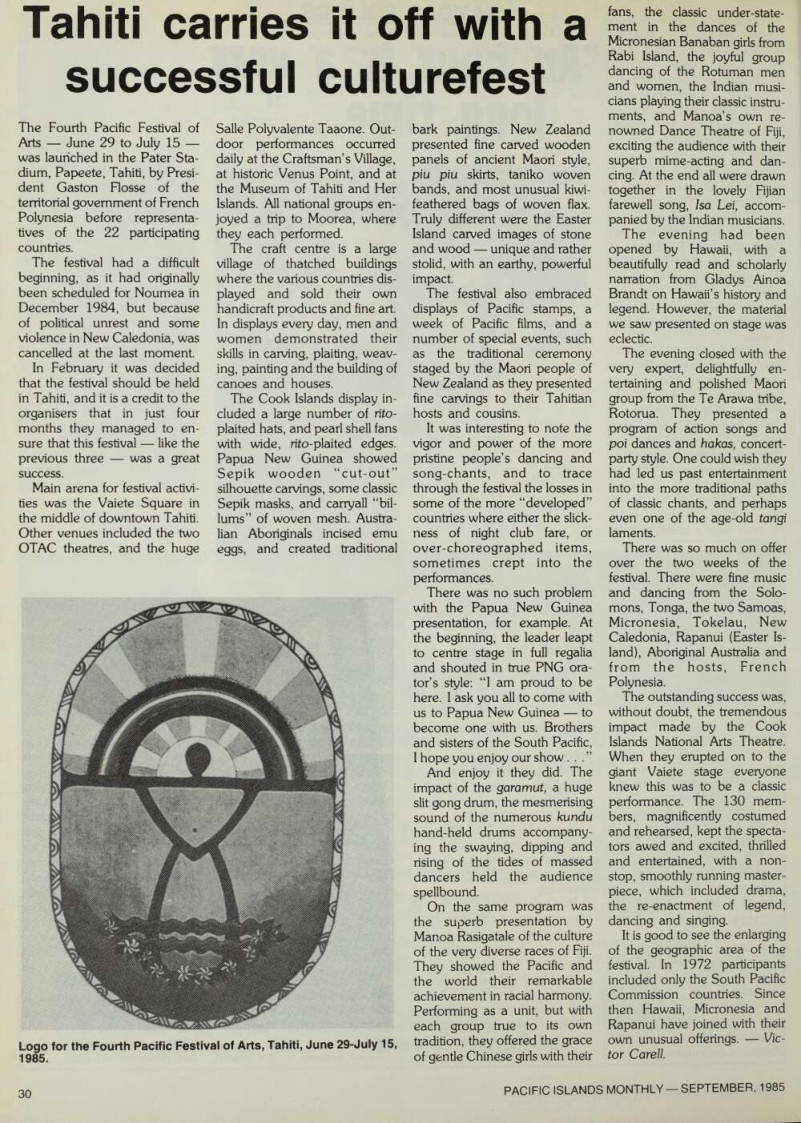
Logo for the Fourth Pacific Festival of Arts, Tahiti, June 29-July 15, 1985.