Financiers see good future
p. 31 · Read in the full issue
trade winds
Financiers see good future for Samoan tourism
With six years’ experi perience in the Pacific region it is easy to talk about investment, but getting big companies in terested is another thing. In 1980 John Boyle formed a company, Pacific Corporate Services, with just this purpose in mind, and his latest major development plan is Western Samoa’s Tusitala Hotel.
Pacific Corporate Services, with Boyle as the managing director, is perhaps best-known for the Polynesian Airlines deal done with Ansett Airlines of Australia.
Boyle’s company has put together a group of Australian public companies, including such names as Allied Mills, Westfield Holdings, Ansett, Wormald, and Evans Deakin Industries, called South Pacific Investment Corporation.
This group will be advised by Pacific Corporate Services and has an initial capital of Ausss million. Its object is to provide funds around the South Pacific region for commercial projects, and its first investment will be the Apia hotel.
Tusitala was originally a joint venture between Western Samoa and Fiji and was man aged under contract by Naviti Investments, Ltd. In 1979 the Tourist Hotel Corporation of New Zealand took Naviti’s place (Naviti at that time was having considerable financial difficulty), however a lack of funds resulted in the continued decline of the hotel. Boyle admits he has had his eye on the Tusitala for some time, and he believes it can be the best tourist facility on the island.
Restructuring of the hotel will involve the injection of Aussl.2
million.
The company which has taken over the hotel is called Tusitala Hotel Investments Ltd., is registered in Western Samoa, and is a joint venture between Australian (75 per cent), and Western Samoan capital, the latter through the involvement of prominent Samoan businesa H.T. (Foni) Ritztaff. This com pany has acquired 65 per cent of the hotel’s capital. The rest is held by the previous sharehol ders, the government of West ern Samoa, plus the govern ment of Nauru, and the Na tional Provident Fund.
Management responsibility is with Resort Management (South Pacific) Ltd., a joint venture between Ritztaff and Pacific Corporate Services.
Boyle also says that over the last 10 years Western Samoa has really lagged behind the rest of the Pacific so far as tourist development is con cerned. Today it is where Fiji was in 1963, with tourist arri vals around 25,000 annually.
The average stay per visit is three and a half days and in Fiji
it is now nine to 10 days.
One of the problems in West ern Samoa is that the industry does not provide enough for the tourist to encourage longer stays. The past form of airline services has also made it diffi cult to build attractive tourist packages. The new Polynesian Airlines schedule will now allow a six-day stay.
Boyle believes that Western Samoa’s greatest opportunity for financial growth lies in tour ism and predicts a growth -rate of seven per cent per annum.
This, he says, will not affect the human resources needed to support the industry and can be achieved without having impact on other Pacific countries re lying on tourism.
Tusitala has 96 rooms and there are plans for 50 more, as a second stage of development.
It is really a town hotel and there is need to develop beach locations, picnic and recreation points where guests can go day by day and be entertained.
Villagers could improve facilities with relatively few dollars, sim ply by providing drinking and
washing water, toilet facilities and barbecue pits.
Plans are underway to re furbish the Tusitala’s rooms, upgrade the swimming pool, the dining room, and main bar and kitchens. Until now cook ing has been done on fuel stoves and these have been supplemented with modern gas cookers. A new shopping arcade, telephone system, and synthetic lawn tennis courts, are all in the pipeline and a staff training program has already been started.
The completion of the airport extension means that the air port will be capable of taking larger aircraft than the Boeing 737s which have so far pro vided service to Apia. This does not mean, however, that West ern Samoa is yet ready to cope with greater numbers of visitors.
Boyle hopes to see tourism increase steadily to around 7000 more tourists per year with a 70 per cent occupancy for Tusitala. He believes that Samoa should aim at the top 10 per cent of tourists, that is, the more affluent traveller, because of the greater cost of air fares to Samoa and because the pro duct here will be better than other South Pacific destina tions.
The investment in the Tusita la expresses a confidence in the development of tourism in Western Samoa and the coun try’s potential as a tourist de stination, Boyle added. The commitment of the government to the airport development was also tangible evidence of this aim, as the country had had to make many sacrifices to direct
funds into the project.
Lee
Anderson, in Apia.
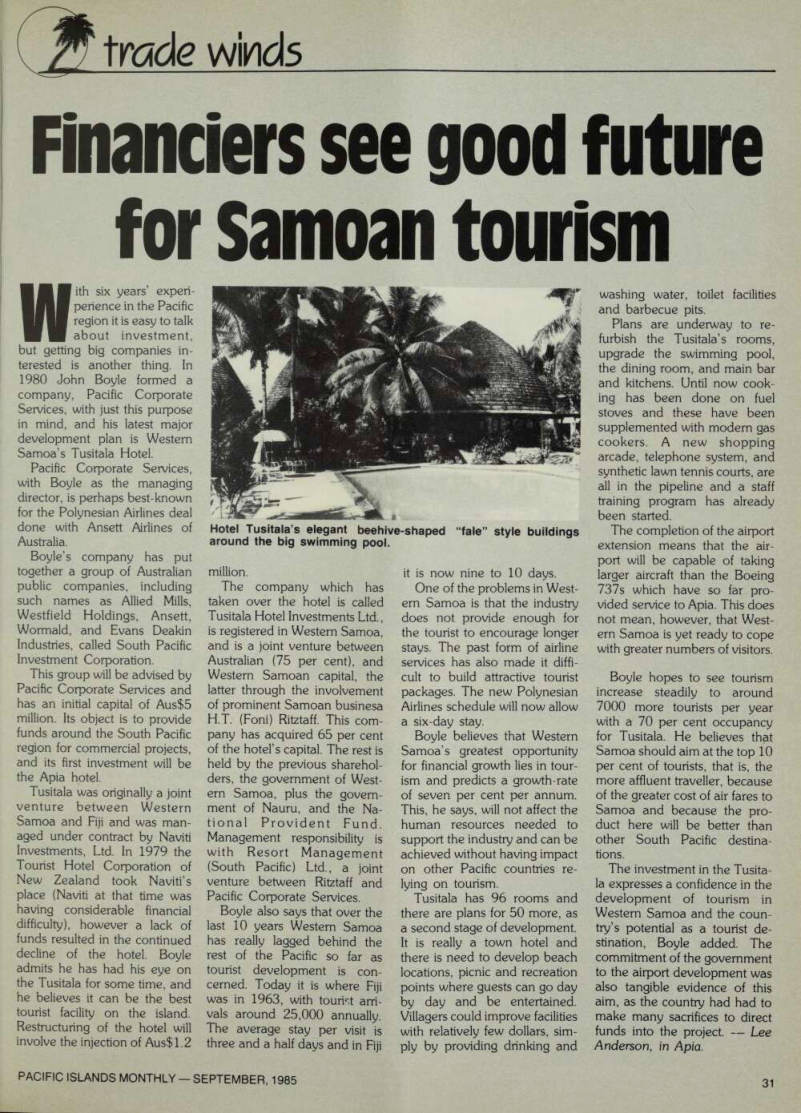
Hotel Tusitala’s elegant beehive-shaped “tale” style buildings around the big swimming pool.