long time..."
p. 29 · Read in the full issue
Samoan Politics
"An hour is a very long time..."
During his recent visit to West ern Samoa New Zealand’s prime minister, David Lange, said: ’’When I returned to New Zealand a few years ago from Western Samoa I reflected on what must be the most famous quip of British politics that a week in politics is a long time.
And I said that in Samoan politics it is an hour, rather than a week.”
Certainly, the political deve lopments in Western Samoa over the last six months have been difficult to follow. The changes which sweep through the country’s political corridors are shown by the fact that when the government of Tofilau Eti Alesana was returned to power on February 27 it was by a landslide win of 31 of the 47 seats in the legislative assembly.
He now faces a coalition of 27 members.
They now claim that Tofilau should resign because he is leader of a minority govern ment.
The developments during this period have focused atten tion on the head of state in an unprecedented way.
A general election was called on February 22 and the ruling Human Rights Protection Party (H.R.P.P.), led by Tofilau was returned in the above-men tioned landslide. It then appeared that the newly formed opposition party, the Christian Democratic Party (C.D.P.), under the leadership of the former prime minister, Tupuola Efi, would not be a significant force in Western Sa moan politics for some time.
However, the immutable rules of Samoan affairs began to work and the position changed within days.
On March 7, Va’ai Kolone, a former prime minister and founder of the H.R.P.P., announced that he had di sassociated himself from the party which he claimed was no longer conscious of its original objectives and ideals. Specula-
tion grew that a coalition with Tupuola Efi might be formed.
In the meantime the H.R.P.P. members were “in camp” with movement in and out of their camp restricted. It was said that Tofilau Eti was trying to shore up support, especially for the vital first meet ing of the legislative assembly when the members would elect the prime minister.
Yet, on March 19 Tofilau was re-elected prime minister, un opposed, in a secret ballot by the members of the Legislative Assembly.
He said he was surprised at his unanimous election and added that a unanimous deci sion would ’’strengthen the country. ”
On March 27 he announced his Cabinet to parliament with only two of his former ministers retaining their posts. Parliament was then adjourned until July.
On July 4 28 members of the
assembly, including Va’ai Kolone and Tupuola Efi, gave the head of state, Malietoa Tanumafili 11, notice that they intended to support a motion of no-confidence in Tofilau and his cabinet, to be tabled in parliament on July 8.
In accordance with Standing Orders the motion had to be tabled three days before it was to be debated.
On July 11 the motion was moved by Le Tagaloa Pita, a former member of the H.R.P.P.
Debate on the motion con tinued for the two hours permit ted by the Standing Orders and during this time one of the original 28 signatories to the motion withdrew his support for it.
The prime minister then announced that all government bills were withdrawn and the Speaker adjourned the parlia ment In an address to the nation
the following Saturday, Tofilau said he intended to call upon the Head of State to dissolve parliament, and call a new election. The Head of State refused his request. Under the Constitution, the Head of State is not obliged to act on such a request if he is satisfied that the prime minister making the re quest enjoys the confidence of a majority of the members of the legislative assembly.
In announcing this decision the prime minister told the country that his government would continue and try to com plete its projects as soon as possible.
Since then the Opposition has continued to apply pressure by boycotting government functions such as those recently held for the New Zealand prime minister, and refusing to serve on the boards of government corporations or travel overseas on government delegations.
Parliament must be recalled by the end of the year to consider the Budget for 1986.
To prevent his government falling then Tofilau will have to entice at least four members back to the H.R.P.P. In the meantime he is ignoring con tinuing demands by opposition members that he resign.
The coalition appears deter mined to maintain what press ure they can on Tofilau, although lack of a parliament ary forum is a disadvantage.
The names of the group opposed to Tofilau have been published in local newspapers.
They include members of Tofi lau’s previous cabinet, Lauofo Meti, who was foreign minister, and former education minister Le Mamea Ropati. These public announcements are seen as serving to maintain solidarity among members of the coali tion against Tofilau.
But, as David Lange said, an hour is a long time in Samoan politics. Almost anything could happen, and very likely will.
Lee Anderson in Apia.
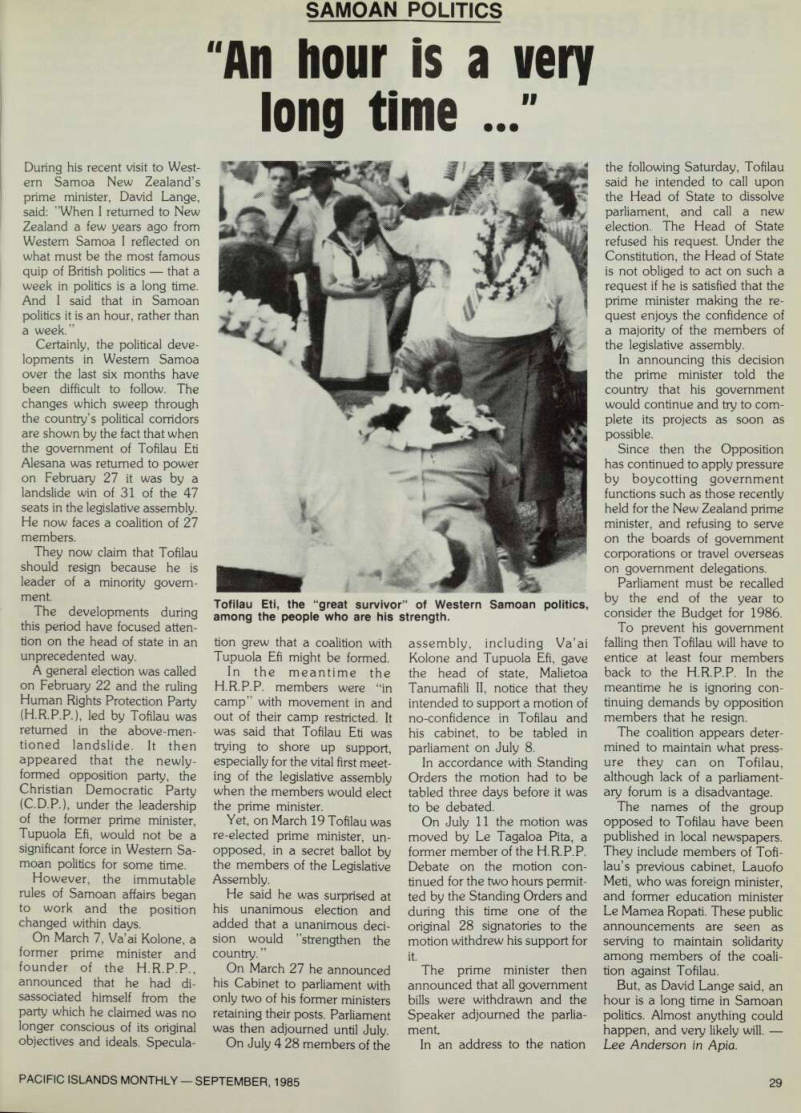
Tofilau Eti, the “great survivor” of Western Samoan politics, among the people who are his strength.