message to governments
pp. 27-28 · Read in the full issue

the month
women in conference send a message to governments
The Sydney gathering was notable for a very large representation of women from almost all Pacific Island countries, New Zealand, the Phillipines, and Japan.
There may have been an expectation that questions of nuclear testing and related mat ters would dominate proceed ings, and the participants cer tainly did adopt a strongly worded “consensus” resolution calling for the “denuclearisation of our lands and waters”, speci fically: “No uranium mining, no nuclear testing, no establish ment of nuclear bases or testing bases, no dumping of nuclear waste, no nuclear-powered or armed warships.”
A paper by PIM Papeete correspondent Marie-Therese Danielsson served as the cor nerstone for discussion of this issue, but strong anti-nuclear statements also came from others, including Bemie Keller man of Palau, Gloria Sibisopere of Solomon Islands, Emelia Rokotiuvuna of Fiji, and Anueua Eritaia of Kiribati.
But the conference only gained in credibility and rele vance as delegates widened the focus of discussion to embrace such problems as land rights, alcoholism, street crime, access to the media, the recognition of women’s rights, the functions of women’s organisations, and the attitudes of governments to women’s problems.
Louise Aitsi of Papua New Guinea, for example, departed from her prepared text to speak movingly of the threatening situation faced by women of all races and ages due to the present high level of street crime in Port Moresby. She saw
More than 300 women attended the Australian Pacific Women’s Peace Conference in Sydney on June 28-30 (PIM Aug p 7), organised by the Australian section of the Women’s International League for Peace and Freedom (WILPF).
WILPF is a non-government organisation holding consultant status with the United Nations. The confer ence was held as a regional prelude to the world meeting in Nairobi, Kenya, in July to mark the end of the UN Decade of Women, and the parallel world forum there of non-government women’s organisations
(Ngos).
the incidence of rape and other forms of sexual abuse as an example of the diminution of peace and freedom, and appealed to the conference for “understanding and help in a period of great stress for PNG women. ”
Ms Aitsi was one of several Pacific Islands representatives who spoke out on the difficul ties experienced with govern ments which do not give high
priority to the funding of women’s organisations. Speak ing on behalf of the PNG National Council of Women, she spoke of the large measure of support given by the national government to the council in its formative years. “The national government and many agen cies, both national and in ternational, showed their recog nition of the council by applying directly to it for information on women and their needs rather
than going through government agencies. Most important, the women themselves began to trust the council and to turn to council staff to assist them with their worries and with their clubs and projects, and council staff were usually able to re spond to the situation.”
According to Aitsi, a change in government attitudes to wards the council took place from 1980 onwards. She attri buted this to a variety of causes at the political level, with both national and provincial govern ments, with public servants who resented the success of the council, and with petty jealousies which began to pre dominate in the council itself.
“The final blow to the NCW came when the national gov ernment withdrew their annual grant which had supported its national office. By late 1983 the council had declined to little more than a name at the national level.
“But”, she went on, “this is not to say that nothing was gained. Some of the provincial women’s councils continue to be active and influential, and even the least active provinces still have a provincial council in existence. More important, a lot of women got a taste of change and power, and from this have emerged some influential indi viduals. While these changes are not nearly adequate to bring about any sort of revolu tion among our women, they did accomplish a shift in atti tudes. And if every woman in the country moved forward a metre, it might bring about a significant change in the equilibrium of our traditional attitudes.”
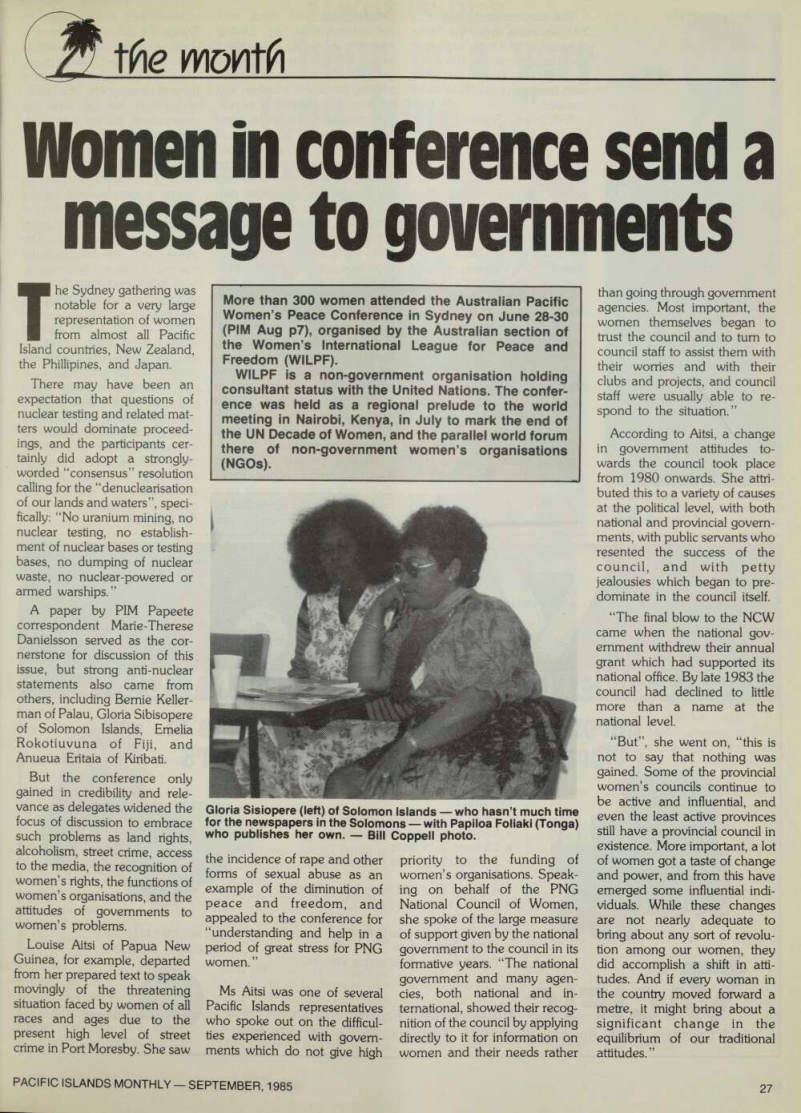
Gloria Sisiopere (left) of Solomon Islands who hasn’t much time for the newspapers in the Solomons with Papiloa Foliaki (Tonga) who publishes her own. Bill Coppell photo.
The conference, in one of its 24 resolutions, urged the Nairo bi forum of NGOs to “urge their governments to let the PNG Government know that they wish funding of the NCW to be restored. ”
Kathleen Solomons of Vanuatu spoke of the establish ment and growth of the Vanuatu National Council of Women, which was “not formed at one sitting of a conference, but was an idea that was accepted and is still being developed very slowly, according to the pace of the majority of Vanuatu women who live very traditional lives.”
Flo Kennedy spoke as a Torres Strait Islander, and illus trated the complexity of the origins of many islanders by referring to her “Torres Strait, Polynesian, and Australian Aboriginal” background. She spoke both as a representative of the Pacific peoples and as a member of a community seek ing redress from Australia by way of the recognition of land rights in the Torres Strait Is lands.
A New Zealand Maori perspective was added to the
debates on land rights and self-determination by Denise Messiter. She told the confer ence: “We, the indigenous people of Aotearoa, stress that striving for peace, freedom and nuclear disarmament is at pre sent only an ideal, for the same system which by its nature and design seeks to exploit our natural resources, locks the Maori people of Aotearoa into the mechanics of possible glo bal destruction. Nuclear dis armament, peace and freedom will only be a reality when we, the indigenous people of Aotearoa, one of the indi genous peoples of Te Moana Nui a Kiwa, have the right to political self-determination. ”
The conference devoted sig nificant time to problems associated with the dissemina tion of information. Problems arising from government or multi-national control of the media were fully canvassed, and the role of grassroots publications analysed.
Papiloa Foliaki, a Tongan businesswoman, spoke about the need to have access to a form of media not controlled by government, although she
stressed that in the case of Tonga she did not encounter a great measure of opposition from the Tongan Government when she set up her tourist and general newspapers. She rather rejoiced in the fact that the government printer was prin ting her publications.
Gloria Sibisopere, represen ting the YWCA and the Na tional Council of Women in Solomon Islands, took up the problems experienced in the Solomons in providing informa tion for women. She said: “The general aim is to help with the sharing of relevant information, both locally and internationally, especially aimed at women, for women, by women. Our local papers display a total lack of interest in anything related to any women’s issues, and are useless as an educational or communication medium. They will occasionally print a letter to the editor from an outraged male who is offended personal ly by some issue for exam ple, the question of women attending overseas training courses, or why there are so many unmarried mothers.”
Bill Coppell
Marie-Therese Danielsson (French Polynesia) a keynote address. Bill Coppell photo.