now possible”
pp. 25-26 · Read in the full issue
French Senate Study
"No change of course now possible”
Three months after it was first proposed in the French parliament, the Fabius Plan for the fu ture of New Caledonia has finally been made law. The bill, allowing for the division of the Pacific territory into four re gions, and a referendum on the independence question no later than the end of 1987, was finally passed by the National Assembly in Paris late in July. It had suffered a lengthy delay caused mainly by the decision of the French Senate to send a special commission to New Caledonia to conduct an on-site investigation of the Plan.
One of the side-effects of this delay was to bring an end to the state of emergency which was declared in the territory in Janu ary and then extended to June
Quiet, if not permanent peace, has now reigned in New Caledonia for several weeks, giving some optimism that the Fabius Plan, now passed by the National Assembly in Paris, will lead to a solution to the independence problem. Meantime, as our cor respondent, SUE WILLIAMS, reports here, even right-wing Paris senators believe the processes now begun cannot now be held back.
30. Under the Fabius Plan it was to have been further ex tended until April, 1986. How ever, because the Fabius Plan had not been passed by June 30, the state of emergency literally ran out.
Not that it made much differ ence; the military presence was as strongly felt as ever, but the territory has been relatively quiet for several weeks, anyway.
However, the calm did not impress the seven-member sen ate commission which arrived from Paris on July 2 for a first-hand survey of whether the Fabius Plan was a fair and equitable proposal for all the people of New Caledonia.
During its week-long stay the commission, made up of five right-wing Opposition senators, and two from the Socialist
government camp, met with representatives from all sides.
First cab off the rank was the anti-independence R.P.C.R. which rules the Territorial Assembly and ’’owns” local government president and New Caledonian representative in the French Senate, Mr Dick Ukeiwe. However, the commis sion also heard from the pro independence L.K.S., and the
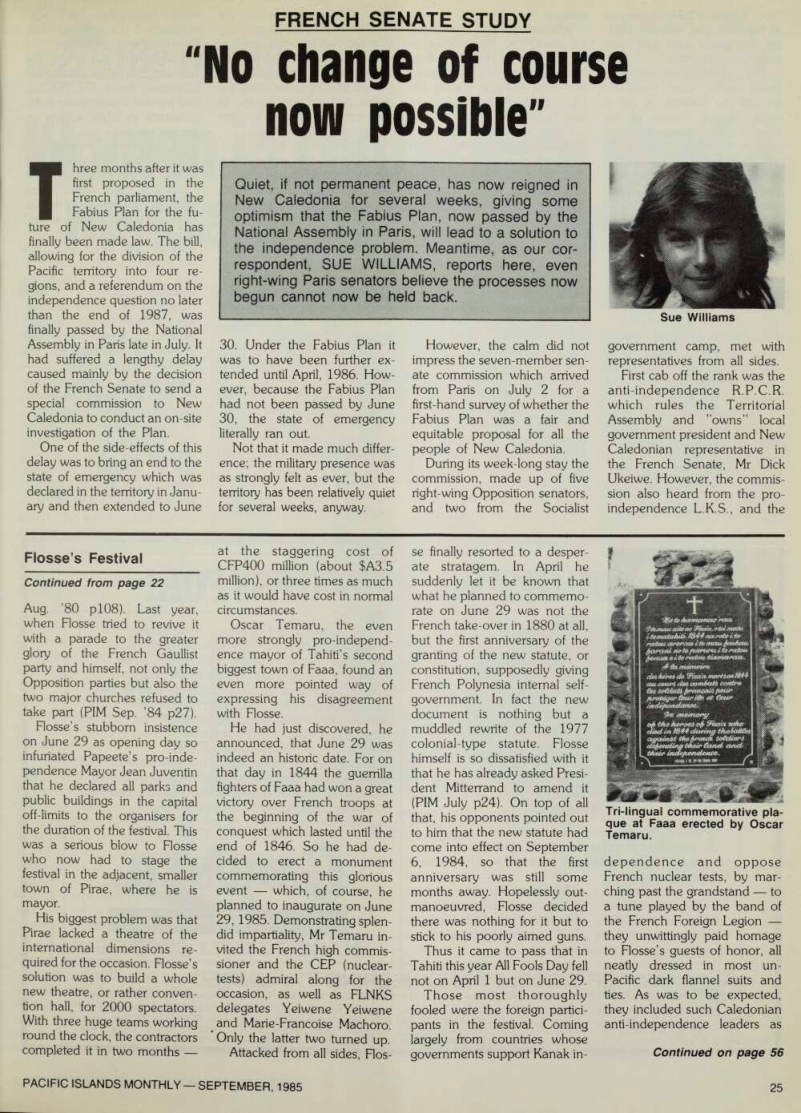
Sue Williams
more militant F.L.N.K.S. as well as business and industry lead ers, the grand chief, and even religious authorities.
The commissioners also spent some time travelling around the territory to get a more graphic picture of the situation, visiting several inland centres, including the east coast mining town of Thio, scene of much trouble earlier in the year, and making the trip out to Lifu, one of the Loyalty Islands, and the birthplace of Mr Ukeiwe, who has since been barred from the island by the
F.L.N.K.S.
In fact, to push the anti independence argument, and “show the commissioners the true colors of the F.L.N.K.S.”, Mr Ukeiwe staged a special show for the commission by attempting a visit to the island on the same day as the senators had been due to arrive.
The presidential visit lasted less than 20 minutes and ended with Mr Ukeiwe being forced back into his plane and off the island after F.L.N.K.S. suppor ters who had ringed the airport became violent and had to be held back by gendarmes using
teargas.
Whether the senators were influenced by the display is difficult to say. However, they certainly distanced themselves from the incident, saying Mr Ukeiwe’s visit had nothing to do with theirs.
While certainly presenting a moderate approach, the sena tors to a man agreed that the calm which has reigned in New Caledonia in recent weeks is certainly very fragile. They showed they were also acutely aware that while the situation had to be handled delicately a decision had to come soon if more violence were to be pre vented.
At a final session with journalists before their depar ture from New Caledonia it became apparent that the com mission would not oppose the Fabius Plan, although it would push for some modifications.
The senators were also not convinced that the upcoming regional elections could be held freely. One commissioner, Senator Francois Collet, said he, at least, believed there was much fear among the Melane sian population of reprisals if
they did not vote for the F.L.N.K.S. He said the commis sion also had to look at ways of ensuring a truly democratic poll and cutting the risks involved in the election by either using the police and military forces, or organising the ballot to prevent pressures on the voters.
The senators have also, clearly, taken into account dur ing their visit next year’s legisla tive elections in France which are expected to give the present Opposition the majority in the National Assembly.
Senator Collet said he had found many of the anti-inde pendence people in New Cale donia believed these elections would resolve the problem in the territory, but, he stressed, this was not the case.
He warned that while there would certainly be a change of policy in New Caledonia if the right took power in Paris, “the actions of the socialist govern ment over the last four years could make it very difficult for any new government to change the course of events.”
Senator Collet also took a swipe at the Australian media.
He said he believed most Aus
tralian journalists had sen sationalised the story of New Caledonia and presented only the arguments put up by the Kanak Socialist National Liberation Front (F.L.N.K.S.), and painted those against inde pendence as white settlers on the rampage.
He admitted, however, that much of this impression had come about because the F.L.N.K.S. had made some effort in Australia, with regular visits and appeals to the federal government for support, whereas the other side, the anti-independence movement, had not put its case at all to the Australian public.
He said that some considera tion had been given to sending territorial assembly president Ukeiwe to Australia for this purpose, but this was even tually decided against because of the aggressive approach taken by the Australian press.
Mr Collet said that Mr Ukeiwe was “a gentle man who speaks from the heart, and to present him to Australian journalists would be like leading a lamb to slaughter.” Sue Williams in Noumea.