shop in Luganville
pp. 45-48 · Read in the full issue
tropicalities
Radio Vanuatu sets up shop in Luganville
Anews studio and V.H.F transmitter in Luganvil le on Vanuatu’s north ern island of Santo rep resent the first tentative step into the outside world for Radio Vanuatu. Prior to this all staff and facilities have been located in the capital, Port-Vila. Now three people—a journalist, a presenter and a secretary— produce three programs a week for the station, plus a number of news and current affairs items.
Although the studio and transmitter were included in the 1981-85 development plan, the National Development Com mission always seemed to have more pressing requirements, and with a projected price tag of $lOO,OOO for a medium wave transmitter alone, it seemed doomed to remain somewhere near the bottom of the priority list. Something had to be done however before the five-year plan ended, and recent deve lopments in the field of radio made it worth while investigat ing an approach which would cost only a fraction of the price of a medium wave transmitter, and leave enough to provide a news studio as well.
Perhaps some background comments should be made here.
Vanuatu’s independence in July 1980 was marked (and some would say marred) by a spirited if ultimately doomed attempt by a section of the mainly French-speaking Santo population to set up their own republic outside of Vanuatu. Its only long-term effect has been to reverse the tide of economic development in Santo, leave Luganville little more than a ghost town, and engender a huge feeling of mistrust be tween that town and Port-Vila.
This feeling is not helped by the
TIM MASON, principal engineer with Radio Vanuatu, here tells the story of how the national radio service established a news studio and a V.H.F. transmitter in Luganville, main centre of the country’s big northern island of Santo.
(unfounded) allegation that when, as part of an Australian aid program, a large and well equipped studio and transmitter were provided in Port-Vila, a medium wave transmitter for Santo was “cancelled” as part of their “punishment”.
Radio Vanuatu at the time of my arrival in May 1984 pro vided a “part-time” service (0600-1300 and 1600-2215) five days a week, with just an afternoon service at weekends and this despite the lavishly equipped, Australian-aid-pro
vided, broadcast complex of three separate studios, one of which, at 12 by eight metres, is suitable for drama and audi ence participation type prog rams. By mid-August a full service of 16 hours a day was in operation, and the extra hours provided a potential for regio nal contributions if a remote studio could be provided. The programs were transmitted from Port-Vila on V.H.F. (to Vila town only), on medium wave (to Efate Island only), and on two shortwave services to
the other islands. Reception of shortwave on Santo was “patchy” O.K. for news and information, but with static and fading likely to interfere exces sively with listening for plea sure. To provide a studio and program outlet in Luganville which the population would have difficulty in even listening to didn’t seem a good idea.
The development in radio referred to earlier which en abled a low-cost alternative to medium wave to be considered is the recent availability of cheap but effective V.H.F. re ceivers. These days a car or portable radio with V.H.F. capability is almost as cheap as one without, while the demand, particularly from young people, for high quality listening (only available on V.H.F.) has led to “personal receivers” with only
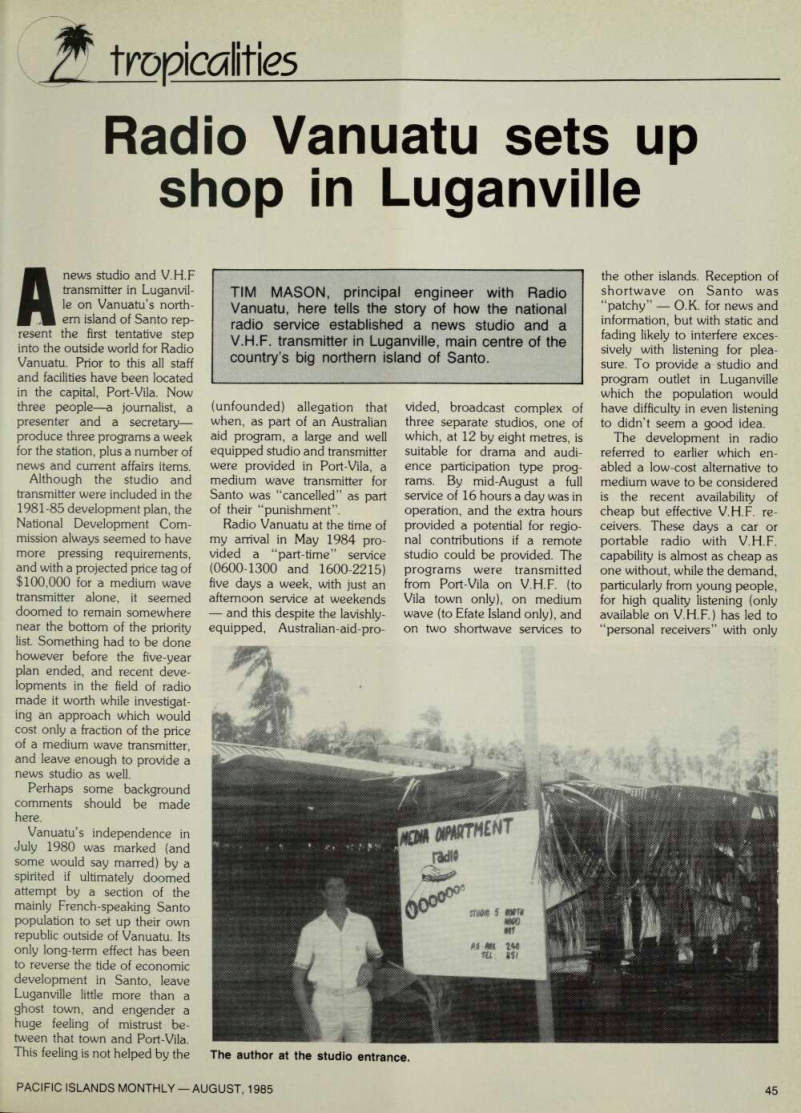
The author at the studio entrance.
V.H.F. being marketed very cheaply. A low-cost V.H.F. transmitter could not cover the whole of Santo. But with over half the population living within 10 km of Luganville, the cover age would be significant. It was decided therefore to plan one development project with a provisional budget of 1.5 mil lion Vatu ($A19,000) to pro vide a transmitter and a small studio, within six months, and, for this reason, ideally from one supplier.
Financial approval was given (after one or two hiccups) at the end of August 1984, and, since the chosen supplier was British, a successful approach was made to the British Govern ment for development aid. Suit able premises were found in Luganville with an office and small (2.1 m by 1.5 m) anteroom which was to be converted to the actual studio. The inter island radio telephone station, which had power, accommoda tion and a high-quality program feed from Fort-Vila already, as part of the 1980 scheme, appeared to be an ideal trans mitter site.
The decision to opt for V.H.F. rather than medium wave made the next stage much easier. Propagation of medium wave transmissions depends on a number of fac tors, many of which are difficult and costly to measure. In addi tion atmospheric conditions, and even the time of day, all have to be taken into account when deciding the power, and aerial design, to be used.
V.H.F. planning on the other hand is simply based on the height of the ground at regular intervals between transmitter and receiver. The power and aerial design can be based on nothing more than the ground height as read off an accurate relief map, and some simple if laborious “number crunching” and graph reading, a task tailor made for a computer. Writing the program took six weeks of our precious time, and 10 more days of processing, to ensure that the site would indeed work using a fairly sophisticated ae rial system and the relatively low power of 50 watts. I de liberately resisted the tempta tion to put in a high-power transmitter on the “brute force and ignorance” principle for a number of reasons. I didn’t
want to risk interference to the existing radio equipment, and cost was very much a factor with prices going up almost in proportion to power at this level. Finally power consump tion was important, with electricity costing 40 Vatu a unit.
The supplier, a firm called Alice (Stancoil) with whom I had worked before in the U.K. on the design and installation of a number of complete local radio stations, agreed to supply by the end of the year and to send out a technician to fit the equipment early in 1985. This was important since we had no one with any relevant V.H.F. transmitter experience, and if things hadn’t worked out we wouldn’t have known whether to blame the equipment, the installation, or the original de sign. In the meantime the studio took shape, with power, a tele phone, carpets, and air-condi tioning all promised for the first week in January. The latter unfortunately failed to materialise, and the contract engineer Ted Fletcher and I beavered away through the hottest week of the year in an enclosed, airless studio, losing about five kilos apiece in the process. The studio allows a reporter or presenter to record, edit, and transmit features and
talks, and to add music or sound effects, but not to pre sent full “disc jockey” type programs. The studio can either go on air “live” or feed an item back to Port-Vila for recording and subesquent transmission. It enables Radio Vanuatu to cov er events throughout the north ern islands, as well as giving the region and in particular Santo its own “voice”. There are unlikely to be any “regional opt-outs”, however, as the director of media services pointed out at the opening ceremony. The idea is to give a sense of community to Vanuatu
as a whole, not to foster differ ences. All of Santo’s program output will go nationally to the group as a whole. The Lugan ville staff have already become part of the local scene, and as well as their three programs a week they file numerous news reports and features many of which would not have seen the light of day before “Studio Five North”.
But what of the transmitter?
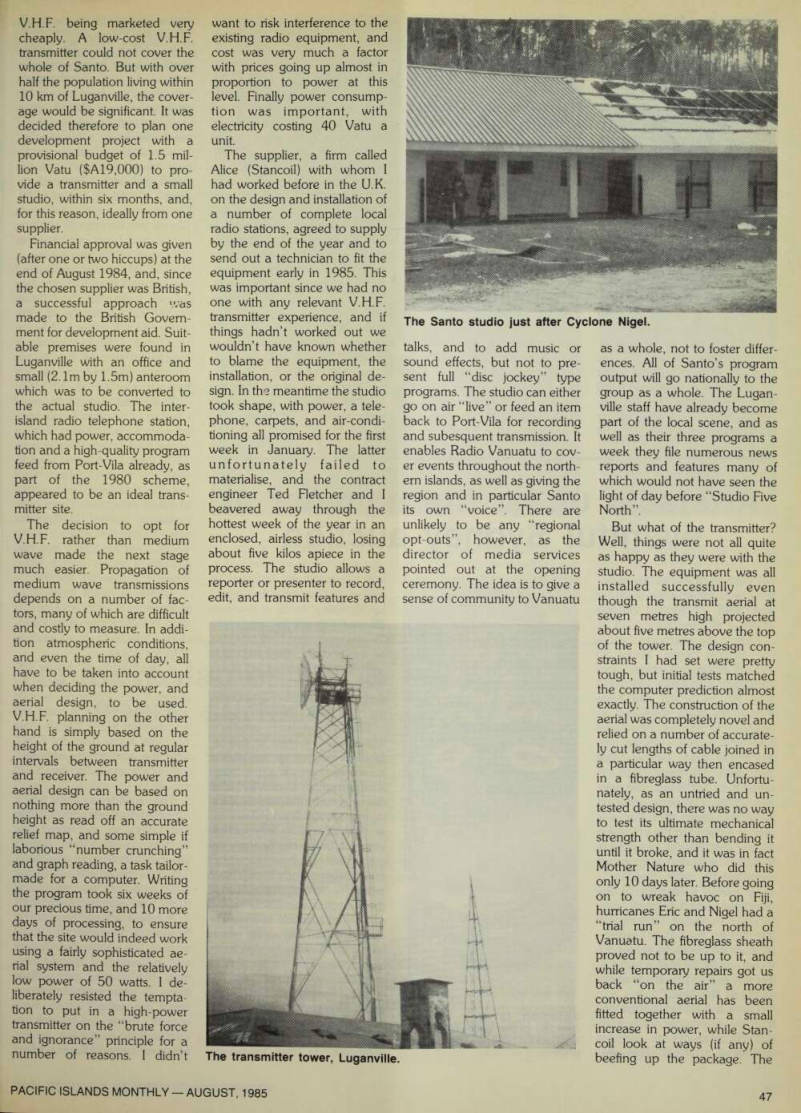
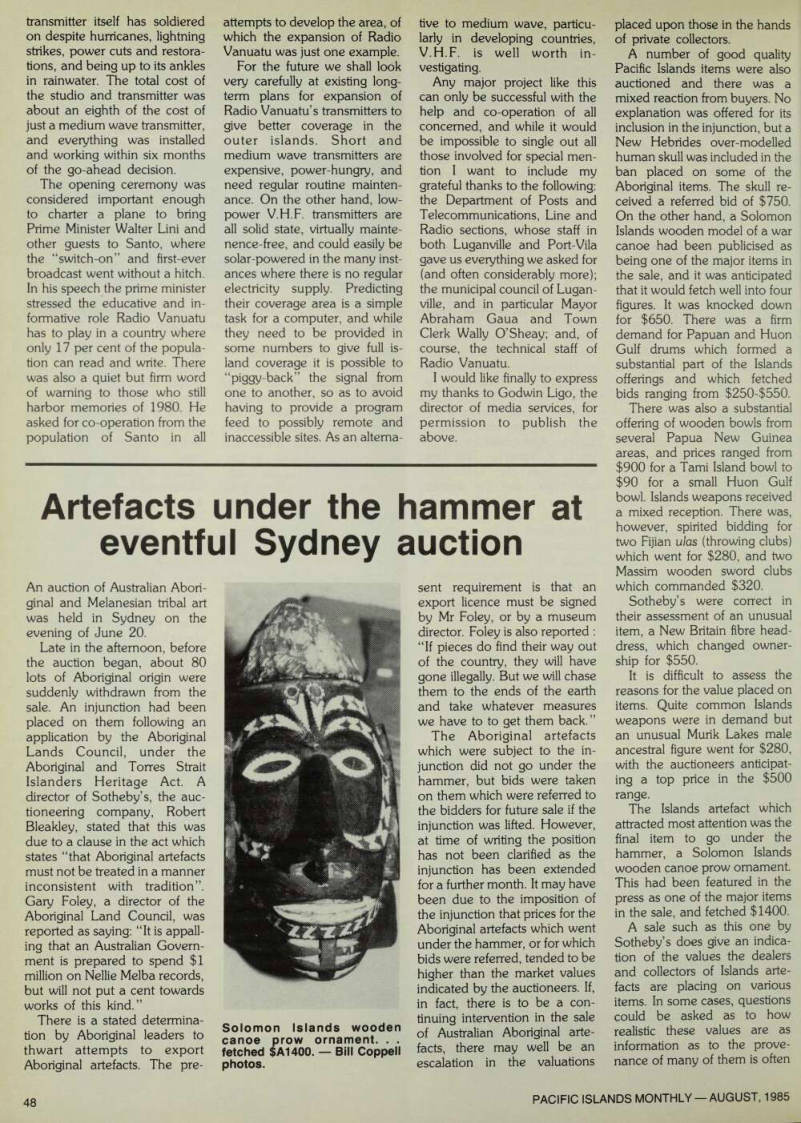
Well, things were not all quite as happy as they were with the studio. The equipment was all installed successfully even though the transmit aerial at seven metres high projected about five metres above the top of the tower. The design con straints I had set were pretty tough, but initial tests matched the computer prediction almost exactly. The construction of the aerial was completely novel and relied on a number of accurate ly cut lengths of cable joined in a particular way then encased in a fibreglass tube. Unfortu nately, as an untried and un tested design, there was no way to test its ultimate mechanical strength other than bending it until it broke, and it was in fact Mother Nature who did this only 10 days later. Before going on to wreak havoc on Fiji, hurricanes Eric and Nigel had a “trial run” on the north of Vanuatu. The fibreglass sheath proved not to be up to it, and while temporary repairs got us back “on the air” a more conventional aerial has been fitted together with a small increase in power, while Stan coil look at ways (if any) of beefing up the package. The
The transmitter tower, Luganville.
The Santo studio just after Cyclone Nigel.
transmitter itself has soldiered on despite hurricanes, lightning strikes, power cuts and restora tions, and being up to its ankles in rainwater. The total cost of the studio and transmitter was about an eighth of the cost of just a medium wave transmitter, and everything was installed and working within six months of the go-ahead decision.
The opening ceremony was considered important enough to charter a plane to bring Prime Minister Walter Lini and other guests to Santo, where the “switch-on” and first-ever broadcast went without a hitch.
In his speech the prime minister stressed the educative and in formative role Radio Vanuatu has to play in a country where only 17 per cent of the popula tion can read and write. There was also a quiet but firm word of warning to those who still harbor memories of 1980. He asked for co-operation from the population of Santo in all
attempts to develop the area, of which the expansion of Radio Vanuatu was just one example.
For the future we shall look very carefully at existing long term plans for expansion of Radio Vanuatu’s transmitters to give better coverage in the outer islands. Short and medium wave transmitters are expensive, power-hungry, and need regular routine mainten ance. On the other hand, low power V.H.F. transmitters are all solid state, virtually mainte nence-free, and could easily be solar-powered in the many inst ances where there is no regular electricity supply. Predicting their coverage area is a simple task for a computer, and while they need to be provided in some numbers to give full is land coverage it is possible to “piggy-back” the signal from one to another, so as to avoid having to provide a program feed to possibly remote and inaccessible sites. As an altema
tive to medium wave, particu larly in developing countries, V.H.F. is well worth in vestigating.
Any major project like this can only be successful with the help and co-operation of all concerned, and while it would be impossible to single out all those involved for special men tion I want to include my grateful thanks to the following: the Department of Posts and Telecommunications, Line and Radio sections, whose staff in both Luganville and Port-Vila gave us everything we asked for (and often considerably more); the municipal council of Lugan ville, and in particular Mayor Abraham Gaua and Town Clerk Wally O’Sheay; and, of course, the technical staff of Radio Vanuatu.
I would like finally to express my thanks to Godwin Ligo, the director of media services, for permission to publish the above.