eventful Sydney auction
pp. 48-49 · Read in the full issue
Artefacts under the hammer at eventful Sydney auction
An auction of Australian Abori ginal and Melanesian tribal art was held in Sydney on the evening of June 20.
Late in the afternoon, before the auction began, about 80 lots of Aboriginal origin were suddenly withdrawn from the sale. An injunction had been placed on them following an application by the Aboriginal Lands Council, under the Aboriginal and Torres Strait Islanders Heritage Act. A director of Sotheby’s, the auc tioneering company, Robert Bleakley, stated that this was due to a clause in the act which states “that Aboriginal artefacts must not be treated in a manner inconsistent with tradition”.
Gary Foley, a director of the Aboriginal Land Council, was reported as saying: “It is appall ing that an Australian Govern ment is prepared to spend $1 million on Nellie Melba records, but will not put a cent towards works of this kind.”
There is a stated determina tion by Aboriginal leaders to thwart attempts to export Aboriginal artefacts. The pre-
sent requirement is that an export licence must be signed by Mr Foley, or by a museum director. Foley is also reported : “If pieces do find their way out of the country, they will have gone illegally. But we will chase them to the ends of the earth and take whatever measures we have to to get them back. ’’
The Aboriginal artefacts which were subject to the in junction did not go under the hammer, but bids were taken on them which were referred to the bidders for future sale if the injunction was lifted. However, at time of writing the position has not been clarified as the injunction has been extended for a further month. It may have been due to the imposition of the injunction that prices for the Aboriginal artefacts which went under the hammer, or for which bids were referred, tended to be higher than the market values indicated by the auctioneers. If, in fact, there is to be a con tinuing intervention in the sale of Australian Aboriginal arte facts, there may well be an escalation in the valuations
placed upon those in the hands of private collectors.
A number of good quality Pacific Islands items were also auctioned and there was a mixed reaction from buyers. No explanation was offered for its inclusion in the injunction, but a New Hebrides over-modelled human skull was included in the ban placed on some of the Aboriginal items. The skull re ceived a referred bid of $750.
On the other hand, a Solomon Islands wooden model of a war canoe had been publicised as being one of the major items in the sale, and it was anticipated that it would fetch well into four figures. It was knocked down for $650. There was a firm demand for Papuan and Huon Gulf drums which formed a substantial part of the Islands offerings and which fetched bids ranging from $250-$550.
There was also a substantial offering of wooden bowls from several Papua New Guinea areas, and prices ranged from $9OO for a Tami Island bowl to $9O for a small Huon Gulf bowl. Islands weapons received a mixed reception. There was, however, spirited bidding for two Fijian ulas (throwing clubs) which went for $2BO, and two Massim wooden sword clubs which commanded $320.
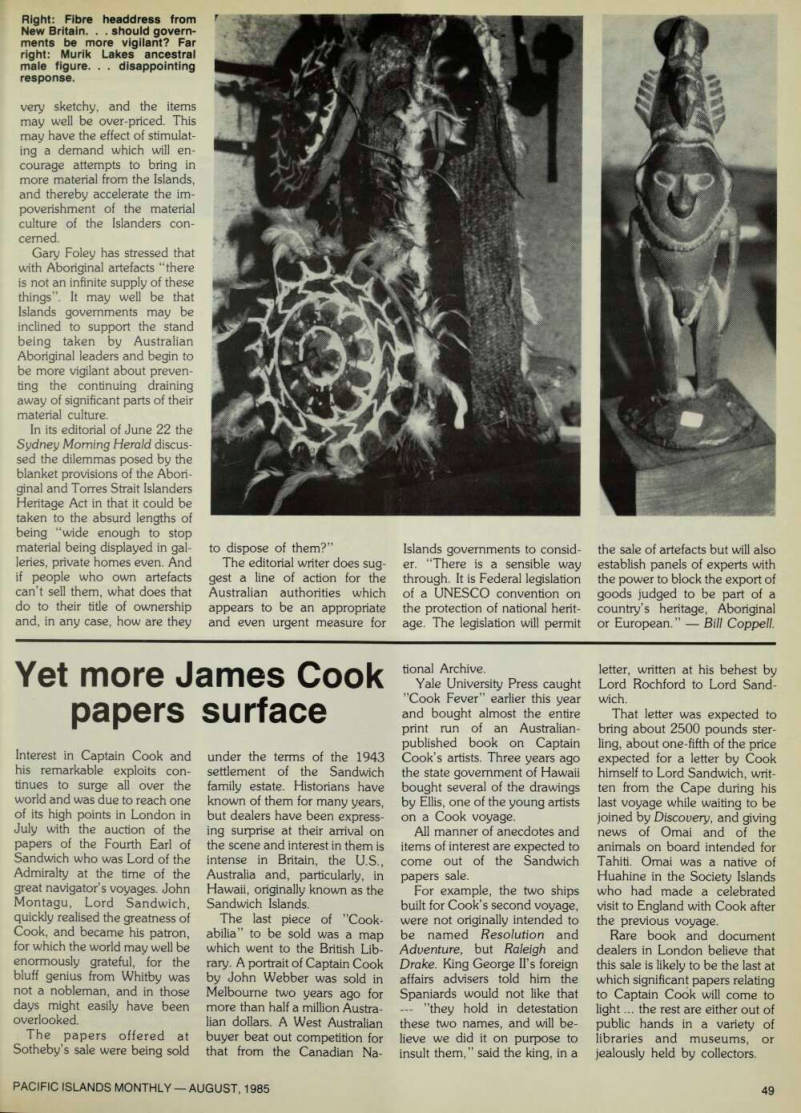
Sotheby’s were correct in their assessment of an unusual item, a New Britain fibre head dress, which changed owner ship for $550.
It is difficult to assess the reasons for the value placed on items. Quite common Islands weapons were in demand but an unusual Murik Lakes male ancestral figure went for $2BO, with the auctioneers anticipat ing a top price in the $5OO range.
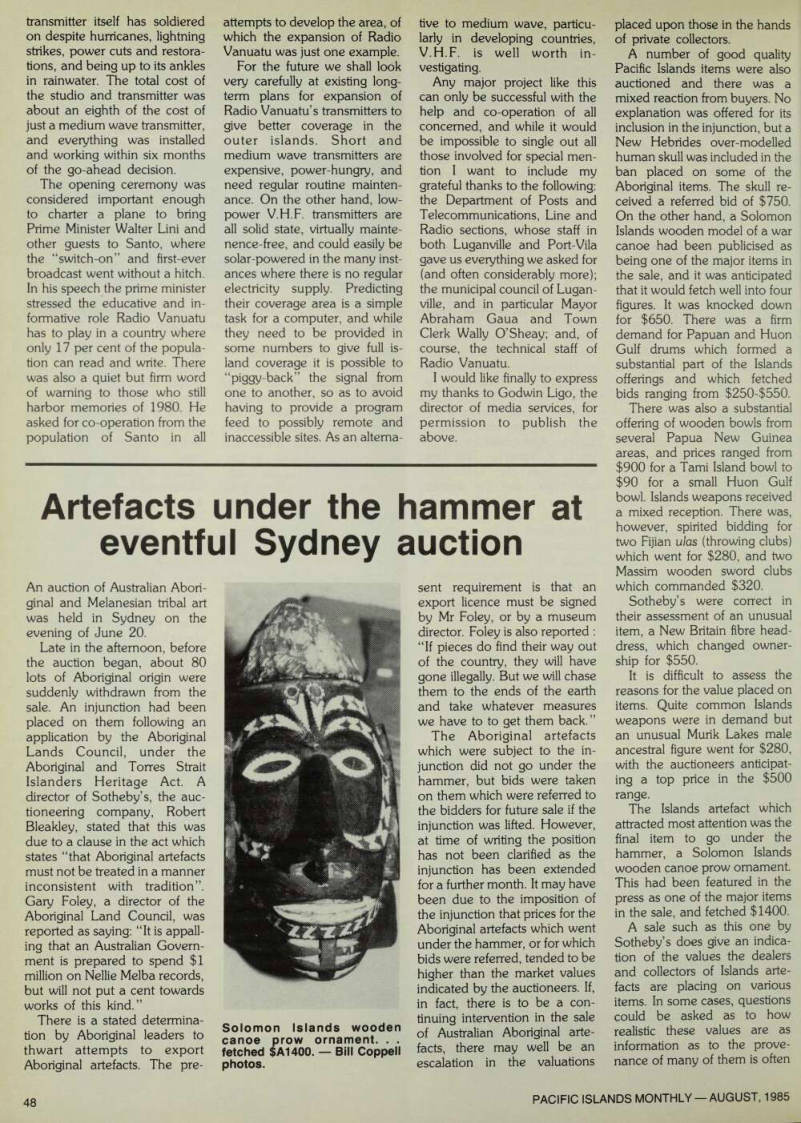
The Islands artefact which attracted most attention was the final item to go under the hammer, a Solomon Islands wooden canoe prow ornament.
This had been featured in the press as one of the major items in the sale, and fetched $l4OO.
A sale such as this one by Sotheby’s does give an indica tion of the values the dealers and collectors of Islands arte facts are placing on various items. In some cases, questions could be asked as to how realistic these values are as information as to the prove nance of many of them is often
Solomon Islands wooden canoe prow ornament. . . fetched $A1400. - Bill Coppell photos.
very sketchy, and the items may well be over-priced. This may have the effect of stimulat ing a demand which will en courage attempts to bring in more material from the Islands, and thereby accelerate the im poverishment of the material culture of the Islanders con cerned.
Gary Foley has stressed that with Aboriginal artefacts “there is not an infinite supply of these things”. It may well be that Islands governments may be inclined to support the stand being taken by Australian Aboriginal leaders and begin to be more vigilant about preven ting the continuing draining away of significant parts of their material culture.
In its editorial of June 22 the Sydney Morning Herald discus sed the dilemmas posed by the blanket provisions of the Abori ginal and Torres Strait Islanders Heritage Act in that it could be taken to the absurd lengths of being “wide enough to stop material being displayed in gal leries, private homes even. And if people who own artefacts can’t sell them, what does that do to their title of ownership and, in any case, how are they
to dispose of them?”
The editorial writer does sug gest a line of action for the Australian authorities which appears to be an appropriate and even urgent measure for
Islands governments to consider. “There is a sensible way through. It is Federal legislation of a UNESCO convention on the protection of national heritage. The legislation will permit
the sale of artefacts but will also establish panels of experts with the power to block the export of goods judged to be part of a country’s heritage, Aboriginal
or European. ”
Bill Coppell.
Right: Fibre headdress from New Britain. . . should govern ments be more vigilant? Far right: Murik Lakes ancestral male figure. . . disappointing response.