Strange tale of the assistant to Bougainville's botanist
pp. 42-44 · Read in the full issue
BEING the amazing
adventures of
Mademoiselle Jeanne Bare , the first woman to
circumnavigate the
world in the years
1766-69 By Shirley
Fenton Huie.
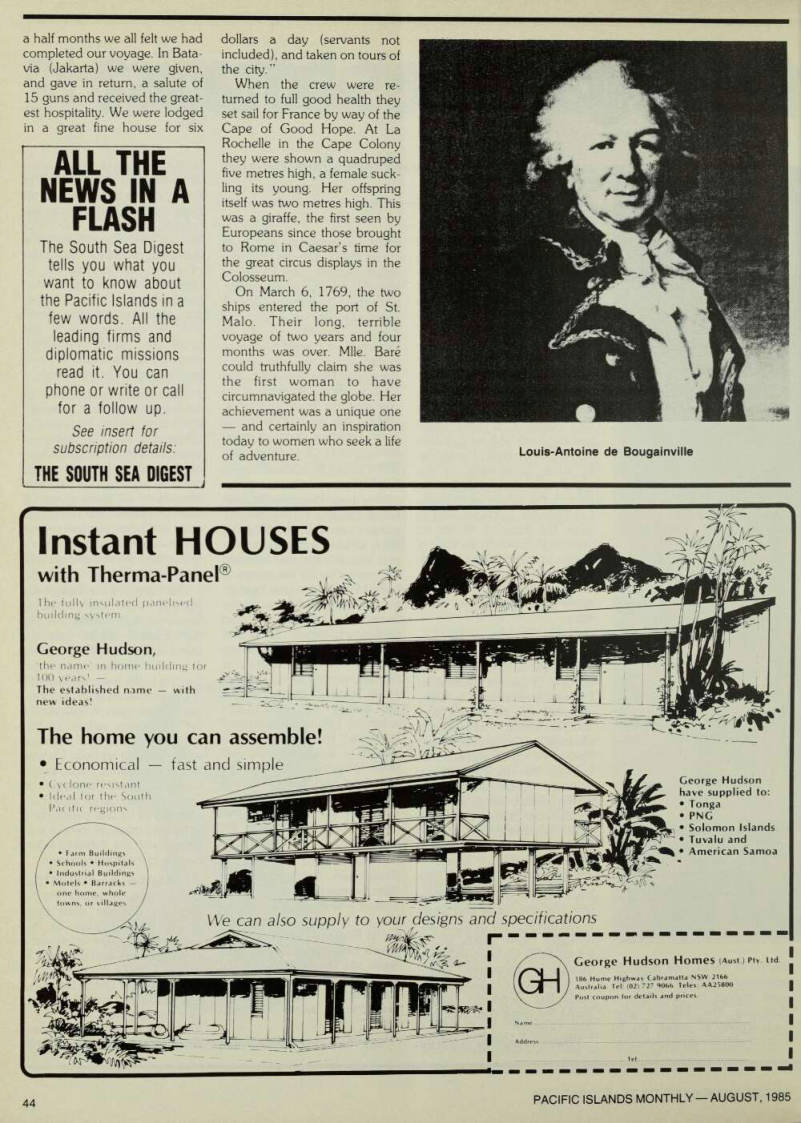
In 1766 Count Louis-Antoine de Bougainville was charged by the King of France to sail to the south Atlantic and effect the transference of ownership of the Falkland, or Malouines, Is lands from the French to the Spanish. Several years before Bougainville had personally colonised the islands for France at his own expense.
His command ship was La Boudeuse, and on completion of his Falkland Islands duty he was further commanded to make contact with the supply ship L'Etoile and sail on south through the Straits of Magellan and out into the Pacific. Here
he was to undertake an expedi tion of discovery in that ocean.
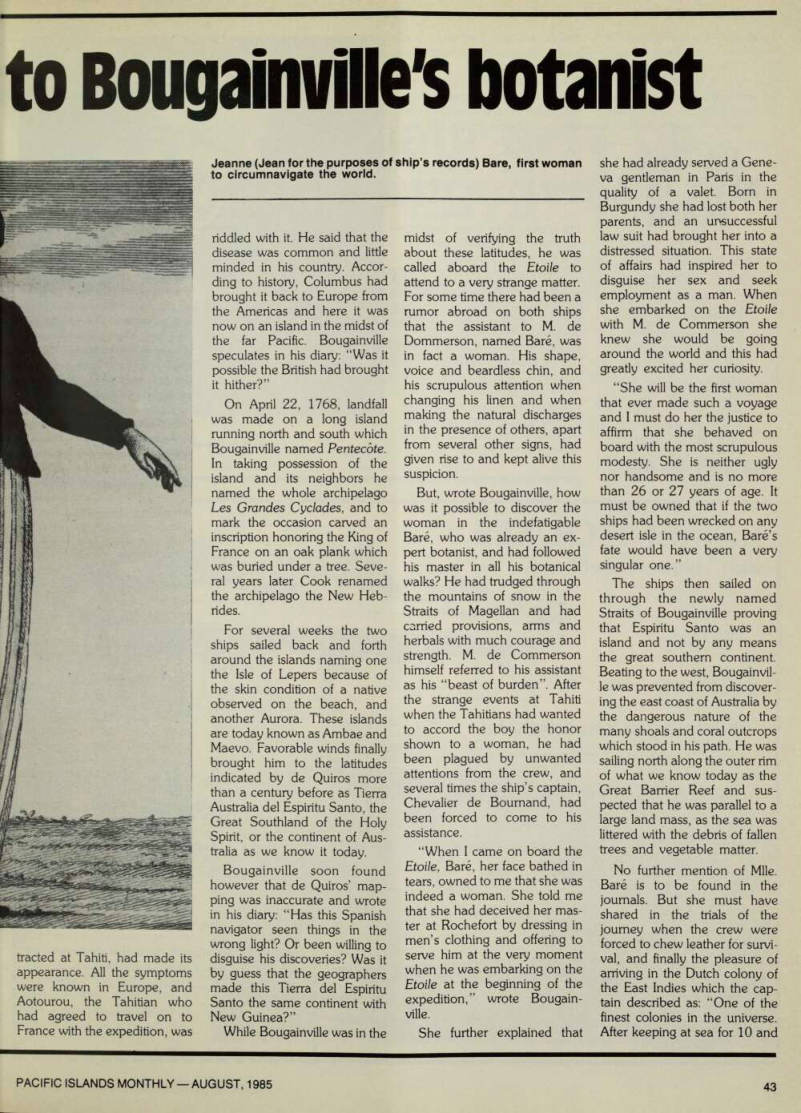
Rendezvous with the supply ship was duly made, and on board the Etoile were the usual skilled personnel: agronomists, navigators, mapmakers and botanists. Chief botanist and physician was a certain M. de Commerson. His assistant was an apprentice, Jean Bare. “He” was actually a young woman, Jeanne Bare.
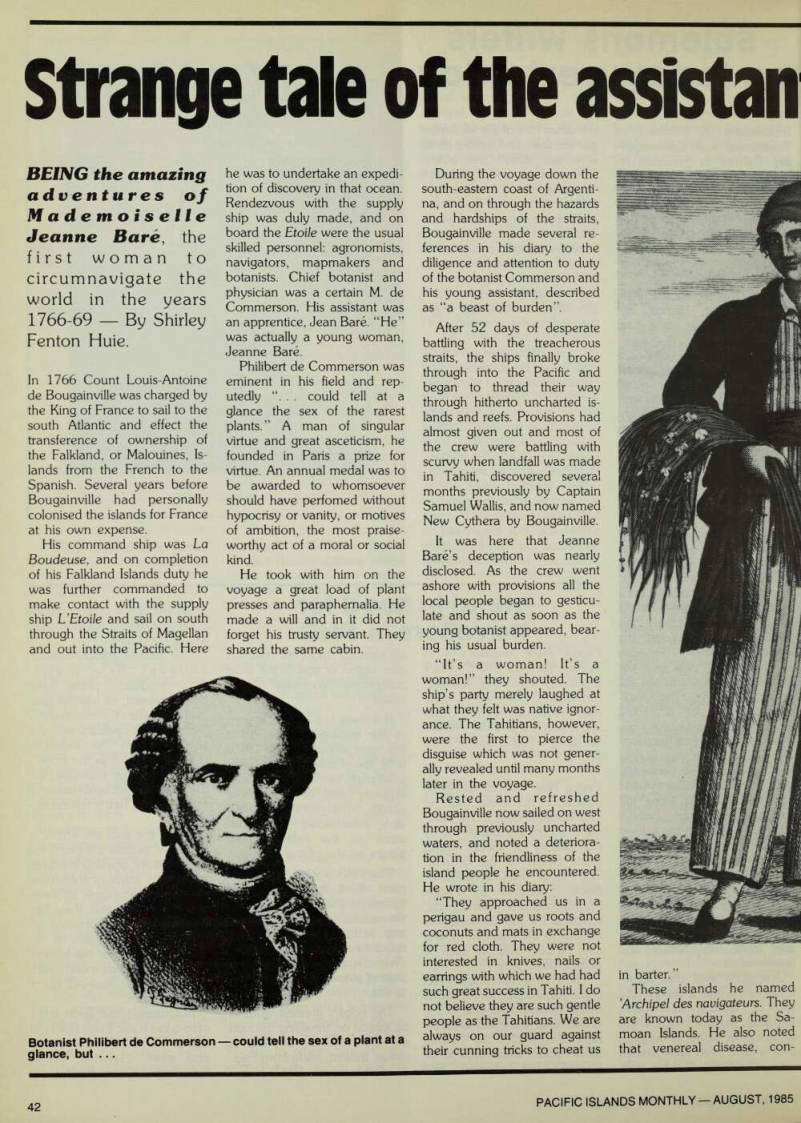
Philibert de Commerson was eminent in his field and rep utedly “. . . could tell at a glance the sex of the rarest plants. ” A man of singular virtue and great asceticism, he founded in Paris a prize for virtue. An annual medal was to be awarded to whomsoever should have perfomed without hypocrisy or vanity, or motives of ambition, the most praise worthy act of a moral or social kind.
He took with him on the voyage a great load of plant presses and paraphernalia. He made a will and in it did not forget his trusty servant. They shared the same cabin.
During the voyage down the south-eastern coast of Argenti na, and on through the hazards and hardships of the straits, Bougainville made several re ferences in his diary to the diligence and attention to duty of the botanist Commerson and his young assistant, described as “a beast of burden”.
After 52 days of desperate battling with the treacherous straits, the ships finally broke through into the Pacific and began to thread their way through hitherto uncharted is lands and reefs. Provisions had almost given out and most of the crew were battling with scurvy when landfall was made in Tahiti, discovered several months previously by Captain Samuel Wallis, and now named New Cythera by Bougainville.
It was here that Jeanne Bare’s deception was nearly disclosed. As the crew went ashore with provisions all the local people began to gesticu late and shout as soon as the young botanist appeared, bear ing his usual burden.
“It’s a woman! It’s a woman!” they shouted. The ship’s party merely laughed at what they felt was native ignor ance. The Tahitians, however, were the first to pierce the disguise which was not gener ally revealed until many months later in the voyage.
Rested and refreshed Bougainville now sailed on west through previously uncharted waters, and noted a deteriora tion in the friendliness of the island people he encountered.
He wrote in his diary; “They approached us in a perigau and gave us roots and coconuts and mats in exchange for red cloth. They were not interested in knives, nails or earrings with which we had had such great success in Tahiti. I do not believe they are such gentle people as the Tahitians. We are always on our guard against their cunning tricks to cheat us
in barter.”
These islands he named ’Archipel des nauigateurs. They are known today as the Sa moan Islands. He also noted that venereal disease, con
Botanist Philibert de Commerson - could tell the sex of a plant at a glance, but ...
tracted at Tahiti, had made its appearance. All the symptoms were known in Europe, and Aotourou, the Tahitian who had agreed to travel on to France with the expedition, was
riddled with it. He said that the disease was common and little minded in his country. Accor ding to history, Columbus had brought it back to Europe from the Americas and here it was now on an island in the midst of the far Pacific. Bougainville speculates in his diary: “Was it possible the British had brought it hither?”
On April 22, 1768, landfall was made on a long island running north and south which Bougainville named Pentecote.
In taking possession of the island and its neighbors he named the whole archipelago Les Grandes Cyclades, and to mark the occasion carved an inscription honoring the King of France on an oak plank which was buried under a tree. Seve ral years later Cook renamed the archipelago the New Heb rides.
For several weeks the two ships sailed back and forth around the islands naming one the Isle of Lepers because of the skin condition of a native observed on the beach, and another Aurora. These islands are today known as Ambae and Maevo. Favorable winds finally brought him to the latitudes indicated by de Quiros more than a century before as Tierra Australia del Espiritu Santo, the Great Southland of the Holy Spirit, or the continent of Aus tralia as we know it today.
Bougainville soon found however that de Quiros’ map ping was inaccurate and wrote in his diary: “Has this Spanish navigator seen things in the wrong light? Or been willing to disguise his discoveries? Was it by guess that the geographers made this Tierra del Espiritu Santo the same continent with New Guinea?”
While Bougainville was in the
midst of verifying the truth about these latitudes, he was called aboard the Etoile to attend to a very strange matter.
For some time there had been a rumor abroad on both ships that the assistant to M. de Dommerson, named Bare, was in fact a woman. His shape, voice and beardless chin, and his scrupulous attention when changing his linen and when making the natural discharges in the presence of others, apart from several other signs, had given rise to and kept alive this suspicion.
But, wrote Bougainville, how was it possible to discover the woman in the indefatigable Bare, who was already an ex pert botanist, and had followed his master in all his botanical walks? He had trudged through the mountains of snow in the Straits of Magellan and had carried provisions, arms and herbals with much courage and strength. M. de Commerson himself referred to his assistant as his “beast of burden”. After the strange events at Tahiti when the Tahitians had wanted to accord the boy the honor shown to a woman, he had been plagued by unwanted attentions from the crew, and several times the ship’s captain, Chevalier de Boumand, had been forced to come to his assistance.
“When I came on board the Etoile, Bare, her face bathed in tears, owned to me that she was indeed a woman. She told me that she had deceived her mas ter at Rochefort by dressing in men’s clothing and offering to serve him at the very moment when he was embarking on the Etoile at the beginning of the expedition,” wrote Bougain ville.
She further explained that
she had already served a Gene va gentleman in Paris in the quality of a valet. Born in Burgundy she had lost both her parents, and an unsuccessful law suit had brought her into a distressed situation. This state of affairs had inspired her to disguise her sex and seek employment as a man. When she embarked on the Etoile with M. de Commerson she knew she would be going around the world and this had greatly excited her curiosity.
“She will be the first woman that ever made such a voyage and I must do her the justice to affirm that she behaved on board with the most scrupulous modesty. She is neither ugly nor handsome and is no more than 26 or 27 years of age. It must be owned that if the two ships had been wrecked on any desert isle in the ocean, Bare’s fate would have been a very singular one.”
The ships then sailed on through the newly named Straits of Bougainville proving that Espiritu Santo was an island and not by any means the great southern continent.
Beating to the west, Bougainvil le was prevented from discover ing the east coast of Australia by the dangerous nature of the many shoals and coral outcrops which stood in his path. He was sailing north along the outer rim of what we know today as the Great Barrier Reef and sus pected that he was parallel to a large land mass, as the sea was littered with the debris of fallen trees and vegetable matter.
No further mention of Mile.
Bare is to be found in the journals. But she must have shared in the trials of the journey when the crew were forced to chew leather for survi val, and finally the pleasure of arriving in the Dutch colony of the East Indies which the cap tain described as: “One of the finest colonies in the universe.
After keeping at sea for 10 and
Jeanne (Jean for the purposes of ship’s records) Bare, first woman to circumnavigate the world.
a half months we all felt we had completed our voyage. In Bata via (Jakarta) we were given, and gave in return, a salute of 15 guns and received the great est hospitality. We were lodged in a great fine house for six
dollars a day (servants not included), and taken on tours of the city.”
When the crew were re turned to full good health they set sail for France by way of the Cape of Good Hope. At La Rochelle in the Cape Colony they were shown a quadruped five metres high, a female suck ling its young. Her offspring itself was two metres high. This was a giraffe, the first seen by Europeans since those brought to Rome in Caesar s time for the great circus displays in the Colosseum.
On March 6, 1769, the two ships entered the port of St.
Malo. Their long, terrible voyage of two years and four months was over. Mile. Bare could truthfully claim she was the first woman to have circumnavigated the globe. Her achievement was a unique one and certainly an inspiration today to women who seek a life of adventure.
Louis-Antoine de Bougainville