Nukes, New Cal. and fish are major issues
pp. 20-21 · Read in the full issue
1985 Forum Preview
New Zealand’s prime minister, David Lange, slipped out to Queens land’s sunny beaches at the beginning of July to prepare for a potboiler South Pacific Forum.
As convenor of the ministe rial group on New Caledonia, Mr Lange should take a crucial role in the report and debate on progress towards independence for the French territory.
He should find himself in the limelight again during discus sion of the South Pacific nuc lear-free zone treaty draft following his strong public state ments against French nuclear testing and the new strategic base at Noumea.
New Zealand government officials on the drafting commit tee had apparently pushed for a stronger treaty and Mr Lange could find himself at odds with Australia’s Mr Bob Hawke over some aspects of the treaty.
Mr Hawke espoused the nuc lear-free zone idea at the 1984 Forum meeting in Tuvalu.
However, Australia, being a larger nation and much more directly involved in global con sequences than New Zealand, sees a need to tread fairly delicately through the finer print of the treaty. Further, Mr Hawke spent most of June and a good part of July almost wholly enmeshed in a very complicated, and politically dangerous, campaign to reform the national tax system, and, depending upon the outcome of that crucial debate, may have exhausted a good deal of his patience by the time he reaches Rarotonga on August 3. - Ed.
New Zealand has already promised increased maritime surveillance for micro-state fishing zones and will be keen to pursue discussions on a tighter regional focus on trade,
Independence for New Caledonia will be the central issue for discussion at the 1985 conference of regional prime ministers at the South Pacific Forum, due to be held at Rarotonga, Cook Islands, in the first week of this month. Vanuatu is expected to repeat, even more strongly, its 1984 demand that the matter be sent to the United Nations, but Walter Lini does not appear to have the numbers. The Pacific countries seem moderately satisfied with France’s progress so far and wish to avoid what some believe would be very messy international involvement in a regional affair. And they have other concerns closer to home like fishing rights, and nuclear testing, as our Auckland correspondent, KAREN MANGNALL, reports.
economic development and ex ternal relations.
The Forum is likely to wel come the bulk of the Fabius Plan for evolution towards New Caledonia’s independence in association with France. The date of the referendum has been advanced from 1989 to the end of 1987, which con forms to the 1984 Forum re quest for a shorter time-scale for transition to independence.
Mr Lange formed a firm opinion after his visit to New Caledonia in October last year that any timetable for a ’’sub stantial assurance of self-gov ernment, together with pledges of full autonomy, must have a 1986 cut-off point.”
The Forum is likely to be satisfied with the French Social ist government’s intention to set the framework for reforms and referendums in legislation be fore the 1986 French national elections. The New Zealand government is also banking on the referendum taking place within President Mitterrand’s mandate, presumably meaning that he would veto any sabot age legislation proposed by a French right-wing government.
New Zealand officials are convinced that the French gov ernment is sincerely helping the F.L.N.K.S. to create a pro independence majority in New Caledonia by 1987. The Forum will probably welcome the Fabius Plan’s concept of re gions with extended powers and rights to negotiate directly with France.
F.L.N.K.S. leader, Jean- Marie Tjibaou, while rejecting the ”neo-colonial logic” of the plan, has accepted the regions as a useful tool for building Kanak independence from the ground. New Zealand is aware of the F.L.N.K.S. belief that the division of power between the Kanak-controlled regions and those still run by French settlers, would force a working com promise between the racial groups.
The F.L.N.K.S. also has indi cated it intends to work with sympathetic Noumea business interests to destabilise the R.P.C.R.’s traditional support from the commercial sector.
The Forum should be pleased that the regions will allow for the much-emphasised dialogue between all parties to
produce a peaceful transition to independence. New Zealand officials believe a future territo rial congress in New Caledonia would be the most representa tive body to produce successful negotiations with France on the exact content of the independ ence-in-association agreement.
The Forum in the past, having stressed the balance between the Kanaks’ innate rights and the legitimate interests of other ethnic groups, is likely to tactful ly ignore the R.P.C.R.’s rejec tion of the regions. It charges that the territorial congress has been manipulated to produce a false Kanak majority and a definite imbalance of seats allo cated to each region.
The decision by France to directly control New Caledonia until the territorial congress is in place will probably be greeted with mixed feelings: relief that France is taking responsibility for the security and progress of negotiations, but trepidation as to the quality of the custodian ship under a possible right-wing government in Paris.
Although the 1984 Forum resolutions written in Tuvalu bear a strong resemblance to the outcome of the year’s work since then, the Forum will not be allowed to congratulate itself on any influence. Vanuatu’s prime minister, Walter Lini, re mains convinced that the Forum failed in 1984 to take sufficient action to try to pre vent the bloodshed which did occur in New Caledonia.
New Zealand officials admit that while the Forum will prob ably congratulate France for its substantial progress over the last 12 months, the advances have been solely due to the F.L.N..K.S. forceful boycott and steady negotiation.
But Father Uni’s intention to call again for New Caledonia’s
reinscription before the United Nations Committee of 24 on De-colonisation is unlikely to receive any support from New Zealand. Deputy foreign affairs minister, Frank O’Flynn, was due to meet the F.L.N.K.S. foreign minister, Yann Urugei, prior to the Forum and was expected to tell him that the New Zealand government be lieved face-to-face negotiations between France and the F.L.N.K.S. would be jeopar dised by reference to the United Nations.
In addition, New Zealand’s Labour Party government does not share some regional na tions’ views on some decol onisation issues. Mr Lange has said that Indonesia’s annexa tion of East Timor is irreversi ble, and Mr O’Flynn has de scribed East Timorese self-de termination as ”a nine-year old corpse. ”
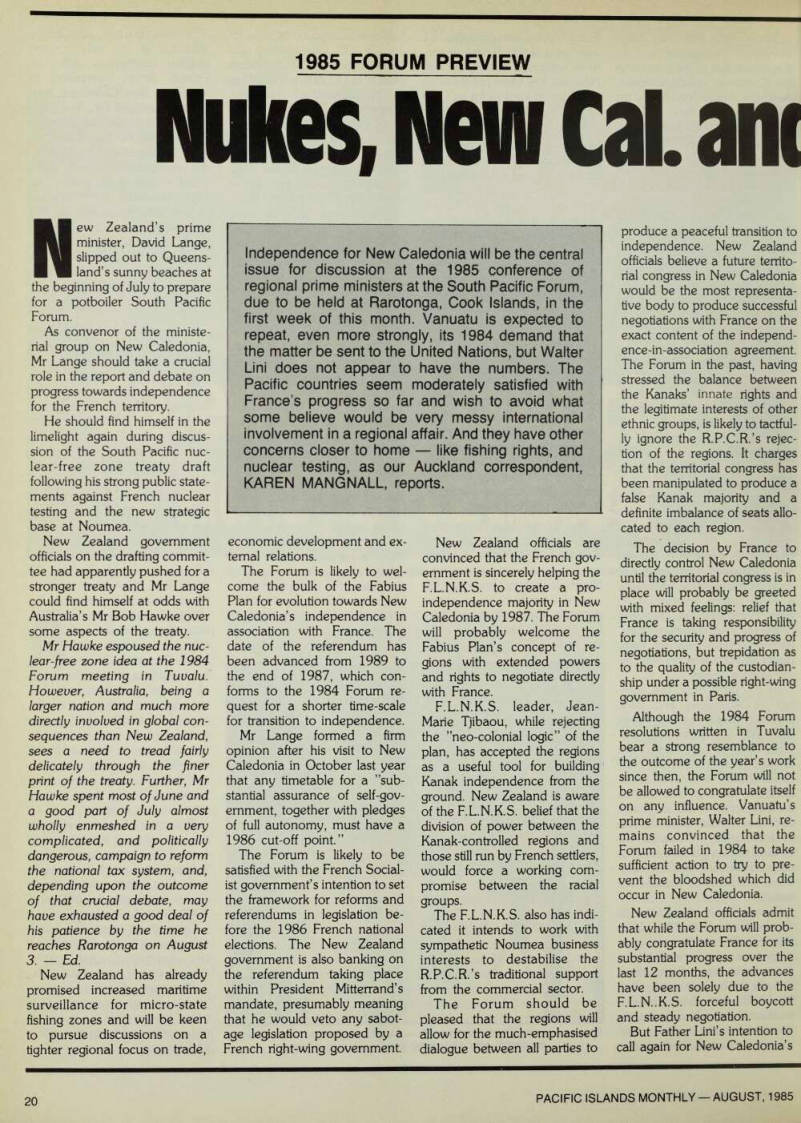
The issue of East Timor is due to be raised at the Forum by Father Walter Lini.
France’s decision to keep a
strategic base at Noumea irrespective of the outcome of an independence referendum will find itself at the heart of the Forum’s expected discussion on what constitutes true sovereignty and the nuclear free zone treaty. New Zealand’s position appears to be some what confused, with Mr Lange slating the base as inappropri ate to the region’s strategic status, but New Zealand offi cials believe the reinforcements are ’’modest” and that any future military presence would be on the agenda for the independence-in-association negotiations.
Father Lini has condemned the base as immoral and de stabilising.
The Australian position seems to incline more towards permitting France to maintain a strong South Pacific presence after independence because it would no longer be colonial.
The three countries are likely to find themselves in argument during discussion of the zone treaty, already condemned in New Zealand by peace groups as ’’weak and discriminatory.”
At the same time, few Pacific Island countries support the New Zealand line, promoted by those peace groups, and accepted by the parliamentary Labour Party, on nuclear ship visits, a matter which will add to the complication of the debate and the delicacy of the lines trodden.
New Zealand officials re portedly told a June briefing for peace groups that more strin gent conditions had been blocked by Australia which had no intention of banning either nuclear ships from its harbors or nuclear support facilities from its territory. New Zealand could well find itself in the firing line again over its nuclear warships ban and the apparent strain on
Anzus.
The United States has been warning that the ANZUS strain could tip the balance of power in the region. A nuclear-po wered and armed warship, the U.S.S.Texas has ialso lately been cruising the Pacific on what amounts to a public rela tions exercise, and has been welcomed into the ports of Tonga and Western Samoa. Fiji has also played host to U.S. nuclear ships.
Critics of the treaty say it fails to keep weapons, like Toma hawk cruise missiles, out of the zone and favors the United States and the United Kingdom by ignoring the issue of nuclear bases and support facilities.
The strongest sections of the draft, anti-testing and anti-dum ping, reflect the Forum’s preoccuption with France, but also highlight its relative impo tence in the face of continued nuclear testing at Moruroa, the Forum’s relative powerlessness to regulate unwelcome incur sions, whether military or eco nomic, or push along con sideration of a new regional and economic organisation.
At the recent Pacific Basin Economic Council meeting in Auckland, New Zealand’s over seas trade minister, Mike Moore, was in favor of a regio nal Pacific parliament.
Wellington recently hosted a meeting of 15 Pacific Island nations trying to work out a stronger response to the United States government, and the American Tuna Boat Associa tion, over their disregard of fishing rights inside exclusive economic zones. New Zealand has pledged an extra R.N.Z.A.F. Orion maritime surveillance aircraft to patrol island e.e.z. fishing grounds for breaches of licences. Australia has also announced the gift of a number of fast patrol boats to
several island countries suffer ing these intrusions.
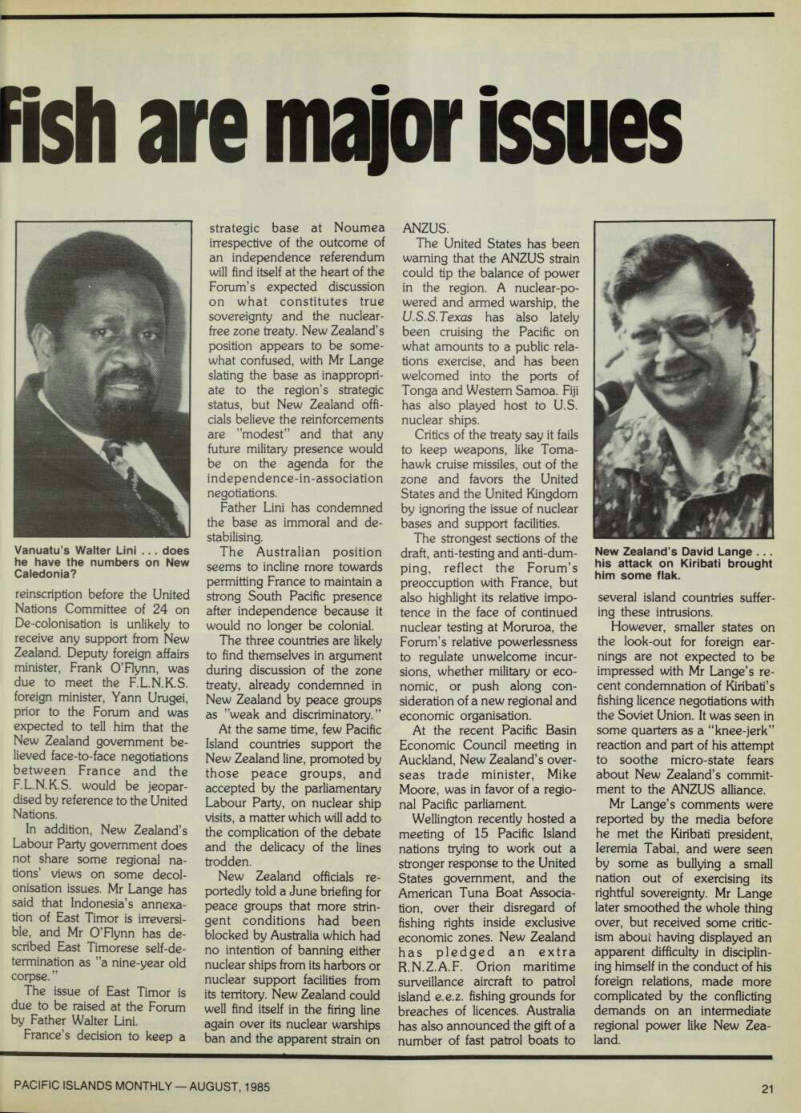
However, smaller states on the look-out for foreign ear nings are not expected to be impressed with Mr Lange’s re cent condemnation of Kiribati’s fishing licence negotiations with the Soviet Union. It was seen in some quarters as a “knee-jerk” reaction and part of his attempt to soothe micro-state fears about New Zealand’s commit ment to the ANZUS alliance.
Mr Lange’s comments were reported by the media before he met the Kiribati president, leremia Tabai, and were seen by some as bullying a small nation out of exercising its rightful sovereignty. Mr Lange later smoothed the whole thing over, but received some critic ism about having displayed an apparent difficulty in disciplin ing himself in the conduct of his foreign relations, made more complicated by the conflicting demands on an intermediate regional power like New Zea land.
Vanuatu’s Walter Lini ... does he have the numbers on New Caledonia?
New Zealand’s David Lange ... his attack on Kiribati brought him some flak.