Battle On For Tourist Dollar
pp. 18-19 · Read in the full issue
Caledonia launches new offensive
A major new offensive has been launched in New Caledonia in the past few weeks. Not another confrontation between those for and against independ ence, but a battle to try to save the badly battered tourist in dustry, one of the mainstays of the economy.
Last year more than 92,000 people made New Caledonia their holiday destination. This year the French territory will be lucky to see one-third of that number, the tourists having been frightened off by the vio lence which erupted after the elections of last November, and the nightly curfew which was finally dropped in early June, after six months of forcing lights out in Noumea from 11 pm.
The sudden drop in the num bers of tourists has been catas trophic for all involved in the industry. Many of Noumea’s hotels and restaurants have had to lay off staff, and are now facing the prospect of closure
The sun-tanned, oiled and nubile bodies displayed upon the beaches of New Caledonia are now notable by their absence. The only crowds in the duty-free shops of Noumea are the unsold goods on the shelves. For the tourists who once provided the territory with a major source of its income are staying away in droves, repelled by what they understand, from their cursory study of an even more cursory television coverage of the independ ence movement, to be wholesale revolutionary violence and disorder. The losses have been massive, but the islands are now preparing to fight back, as SUE WILLIAMS, PlM’s resident correspon dent in Noumea, here reports.
unless there is a rapid turn about.
As for the situation inland, those hotels and lodgings which have not been destroyed during the events of the past six months have already been forced to close, the bush being virtually off-limits to tourists, Tourism minister, Charles Lavoix, hopes to change this
grim picture in the next six months. He has already coaxed the French government into subsidising the wages of hotel and restaurant staff to the tune of 35 per cent for the next three months to help keep people in their jobs, and has prised open the doors of the territory’s treas ury to fund a big development program to improve tourist fad
lities as well as launch a major onslaught on New Caledonia’s best overseas markets, Austra lia, Japan, and New Zealand.
“The first objective is to tell people that New Caledonia is not in a war situation,” said the minister. “There is no danger in coming to Noumea or the Isle of Pines, and shortly a few resorts will be opened inland.”
One of the most important groups to be convinced of New Caledonia’s viability as a holi day destination is the tour oper ators, and a big chunk of funds allocated overseas will be spent persuading them to put the territory back on the package tour map. In Australia alone, $243,000 has been allowed for operator support, the printing of brochures, the planning of holiday packages and so forth, something the industry is not prepared to foot the bill for itself in case there is more trouble in the territory which would re nder any investment useless.
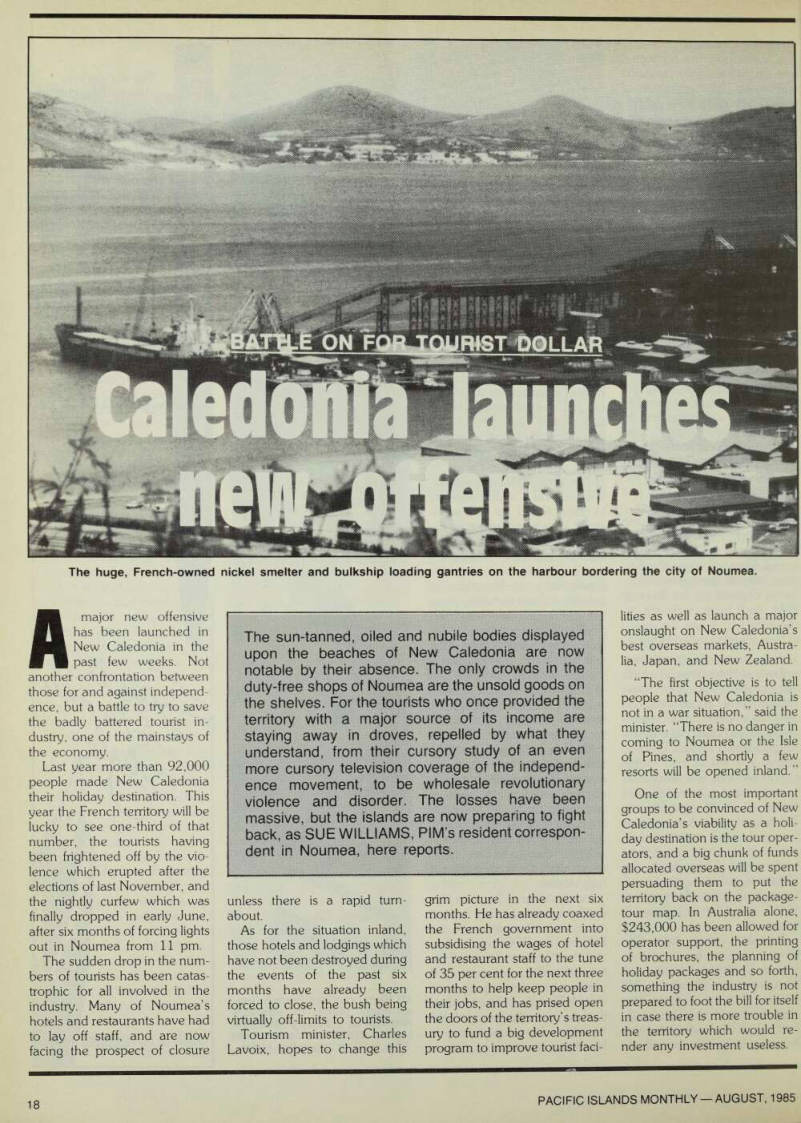
The huge, French-owned nickel smelter and bulkship loading gantries on the harbour bordering the city of Noumea.
There will also be major television campaigns in the three countries in the lead-up to the Christmas holidays. Again, Australia, which provides by far the majority of New Caledo nia’s tourists, has been given priority with $500,000 allo cated for the promotion.
Another $150,000 has been budgeted for a similar promo tion in Japan, which is seen in the territory as the market for the future, both by the sheer size of its population and the enthusiasm of the Japanese for anything French. Indeed, had it not been for the Japanese, many hotels in Noumea would have been forced to close be fore now.
While the Australians and New Zealanders have just about stopped coming altogether, the young Japanese couples looking for a reason ably-priced honeymoon in an exotic port have continued to arrive in much-reduced, but still significant, numbers. About 100 arrive each week for a five or seven day stay at Club Med alone. The resort, which is one of Noumea’s biggest tourist drawcards, has accordingly changed its direction to cater to the Japanese, with Japanese food on the menu at least twice a week, more interpreters to help overcome the language problem, and organised spor ting activities, such as ping pong tournaments, to cater to the visitors’ tastes.
At the same time, the num ber of Australian and New Zealand personnel has been drastically cut. Before the vio lence erupted here there were at least 15 Australian and New Zealand staff to provide assist ance for the 500-odd tourists coming from those countries each week. Now there are two to look after the ten or 15 coming in. General staff, such as cleaners and bar-tenders, have been cut back by half at the resort.
Despite its new orientation to the Japanese, Club Med wants the Aussies back, and has started its own promotions in Australia to tempt them anew.
Despite the financial crisis, Club Med had been advising tourists to steer clear of Noumea while the curfew was in force, and those who came had to sign
forms taking responsibility for their own safety. These restric tions have now been lifted and Noumea has been put back on the map, at least as far as Club Med is concerned.
Club Med, and the hotel industry in general, have warm ly welcomed the commitment by the territorial authorities, and have each promised to do what they can to aid the much hoped-for revival.
The help of the airlines servicing the territory has also been enlisted. All have prom ised their full support, anxious to fill up the empty aircraft they have been flying into Noumea in recent months.
Qantas which, along with UTA, is the main carrier from Australian ports, has been forced to drop one of its twice weekly flights into New Caledo nia and has basically been operating a mail run for the past few months. Qantas reviews the situation from month to month and will re-introduce the Mel bourne flight once tourist traffic starts to pick up again.
The cruise lines have also been approached. P & O, Sit mar and CTC have just re sumed their stopovers in Noumea after steering clear for several months because of the political unrest. However, they have made it clear they would like to see some money spent in
Noumea to improve facilities for the 75,000 tourists they can bring in each year. Two officials from P & O made a special trip to Noumea just recently, basically to tell local authorities to lift their game. They want a better welcome for their passengers, such as a band, or traditional dancers on the quay, to provide some more festive atmosphere for their ships.
Transport was another com plaint. At the moment most cruise ship passengers are easily spotted wandering around Noumea looking like lost sheep after making the long hike from the wharf.
“The criticisms of the cruise ship operators are totally justi fied,” says Charles Lavoix.
“The welcome is very impor tant to tourists who are guests in our country and should be greeted as such. It makes me really mad when I see these people wandering along the quay, lost. Something must be done, and it will be done.”
One of the other difficulties facing New Caledonia’s tourist industry is the fierce competi tion it is getting from its neigh bors. Vanuatu in particular has stolen a big piece of the tourist cake from the territory and is now using the political troubles of the past few months in its promotional campaign to attract even more visitors to its shores. Full-page newspaper
advertisements, painting Vanuatu as the safe tropical holiday destination with the French flavor, compared to strife-torn New Caledonia, and cyclone-ravaged Fiji, has done nothing to repair the damage done to the territory’s image.
Mr Lavoix is unperturbed by the competition. “This cam paign is part of the game,” he said. “However, Vanuatu must remember it also needs us. Not being big enough to support an intemaional standard airport, most of its tourist traffic comes through Noumea, so it is in Vanuatu’s interest that the tour ist industry in New Caledonia stays healthy.
Mr Lavoix is also undisturbed by the prospect that his govern ment is not likely to be in power for very much longer. The regional elections are due in relatively few weeks and will undoubtedly result in a com pletely new-look territorial authority, without the auton omy enjoyed by the present assembly.
“Tourism is at its lowest point. We cannot wait any longer or we will be facing a situation which will take many years to repair, instead of a few months,” said Mr Lavoix. “If there is a change of govern ment, the tourism plans may be changed, with the money being increased or decreased accor ding to the views of whoever holds the reins. However, we have made a start in the hope of preventing a disaster in the industry, for instance, the clo sure of the hotels, which at the moment have an occupancy rate of between 10 and 15 per cent. This is nothing, and they are losing a huge amount of money each day they remain open in this situation.”
Providing all goes well with the campaign, it is hoped that some 14,500 tourists will arrive in New Caledonia between July and December; 6000 from Japan, 6500 from Australia and 2000 New Zealanders.
Even these improved totals will represent less than half of the normal tourist traffic through at this time of the year.
But, says Charles Lavoix, “this is enough for a start, and it will at least enable the hotels to stay open and keep the ailing industry alive.”
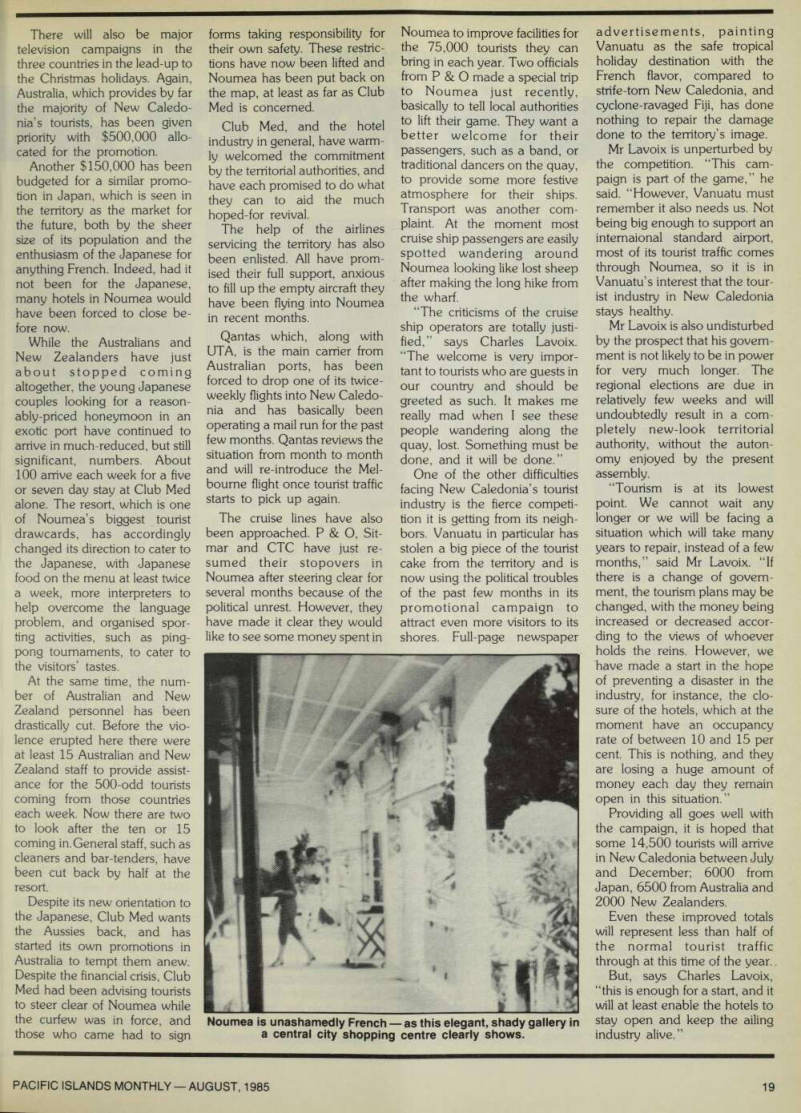
Noumea is unashamedly French as this elegant, shady gallery in a central city shopping centre clearly shows.