Edgard Pisani: captain
pp. 16-17 · Read in the full issue
The “Hatchet Man” Assessed
Edgard Pisani: captain of the transition . . .
Mr Edgard Pisani re turned, not disgraced, but certainly not co vered in glory, from a “mission impossible”. The gov ernment’s delegate by and large failed to meet the two challenges he set himself when he arrived on December 5, 1984, in New Caledonia, this territory to which he was a stranger: to re-establish order, and launch a dialogue.
Order? Race hatred flared on May 8 last in Noumea, when guns were brought out for the first time by both sides. A bullet killed a 19-year-old Kanak high school student, and the high commissioner had to reimpose the 8 p.m. curfew only a few days after he had lifted it. It is true that the independentist roadblocks which at the time of his arrival were paralysing the territory had been lifted. But more than ever there was the feeling that the fate of the caillou (“pebble” or “stone”, colloquial French expression for New Caledonia) was at the mercy of a single spark. Dia logue? Between Mr Pisani and the anti-independence forces, in particular Mr Dick Ukeiwe, head of the territorial executive, the only dialogue was an ex change of insults.
Certainly Mr Pisani had to foot the bill for the radicalisation fomented in the territory by the metropolitan parliamentary Opposition, especially the neo- Gaullist RPR party, which was spurred on by considerations having precious little to with a concern for the future of the caillou and its inhabitants. Nor did the pigheadedness and bigotry of the local anti-inde pendence forces make his job any easier. But his failure also
Writing in the Paris daily Le Monde of May 23, journalist Daniel Schneidermann appraises the role played by President Mitterrand’s special envoy in New Caledonia, Edgard Pisani. Headlined “A reign’ without infamy, but without glory”, Schneidermann’s report is highly critical of aspects of Mr Pisani’s activity, but concludes that his “real success” was that he was “the man of the transition from stagnation to forward movement” in the territory’s political development.
owed much to some clumsy moves on his own part, and to his considerable inflexibility.
First, he lost out because he was unable effectively to wield the nightstick of repression.
What a wretched mockery it was that this former European commissioner, and former minister of agriculture under General de Gaulle, should have been called upon to act the police superintendent. The Third World visionary juggling with police patrols and armored vehicles! But the fact was that in this field miscalculations were piled upon incomprehensible acts of negligence. The ques tion can never be asked too often as to why, on that fatal evening of January 11, Mr Pisani ordered the elite gen darme unit GIGN to “neutral ise” the independentist leader Eloi Machoro who, with about 30 followers, was occupying a farm in the bush about 100 km from Noumea. Could he poss ibly have been unaware of the hatred felt by the men of this unit for the ringleader of the occupation of Thio?
A little more than a month later, on February 17, there was a further lapse. Mr Pisani began
by refusing permission for a “picnic” at Thio, at a spot about 100 metres from one of the most hardline independentist tribes in the territory, to be held by a movement of the far Right, the Caledonian Front. But the “picnickers”, by cunning and fast talking, still managed to get permission from the gendarmes to proceed to Thio. To protect them from the fury of the Kanaks, the police had to make three violent charges into the tribal area. On the spot, along side the gendarme captain who later copped all the flak for the incident, was a senior member of Mr Pisani’s personal staff.
Shouldn’t this have been suffi cient to avert these “mistakes”?
In a fury, the High Commis sioner issued orders for the expulsion of five of the “pic nickers” from the territory.
The five immediately went underground, and his police have failed to find them.
Couldn’t he have spared him self this fresh blunder?
The events of May 8 finally demonstrated that the presence of 5000 gendarmes and sol diers in the territory was in adequate to prevent confronta tion between Kanaks and Euro-
peans on the streets of Noumea. In any event, the demonstration of May 8 was only the culmination of a series of processions in defiance of the curfew demanding the depar ture of Mr Pisani processions through the streets of a town whose walls were covered with obscene slogans directed agaist him.
In defence of Mr Pisani it can be said that the maintenance of order was not his line of coun try. But, after a few weeks, the negotiator, too, lost his cool, the referee proved unable to resist the temptation to pull on the gloves. Was there any need to threaten, as the government delegate did, that he would “rub the noses” of the leaders of the metropolitan Opposition “in their own piddle”? Was it necessary to load responsibility holus-bolus for the confronta tion of May 8 on the RPR, when on that very morning independentist demonstrators had burnt a French flag in the
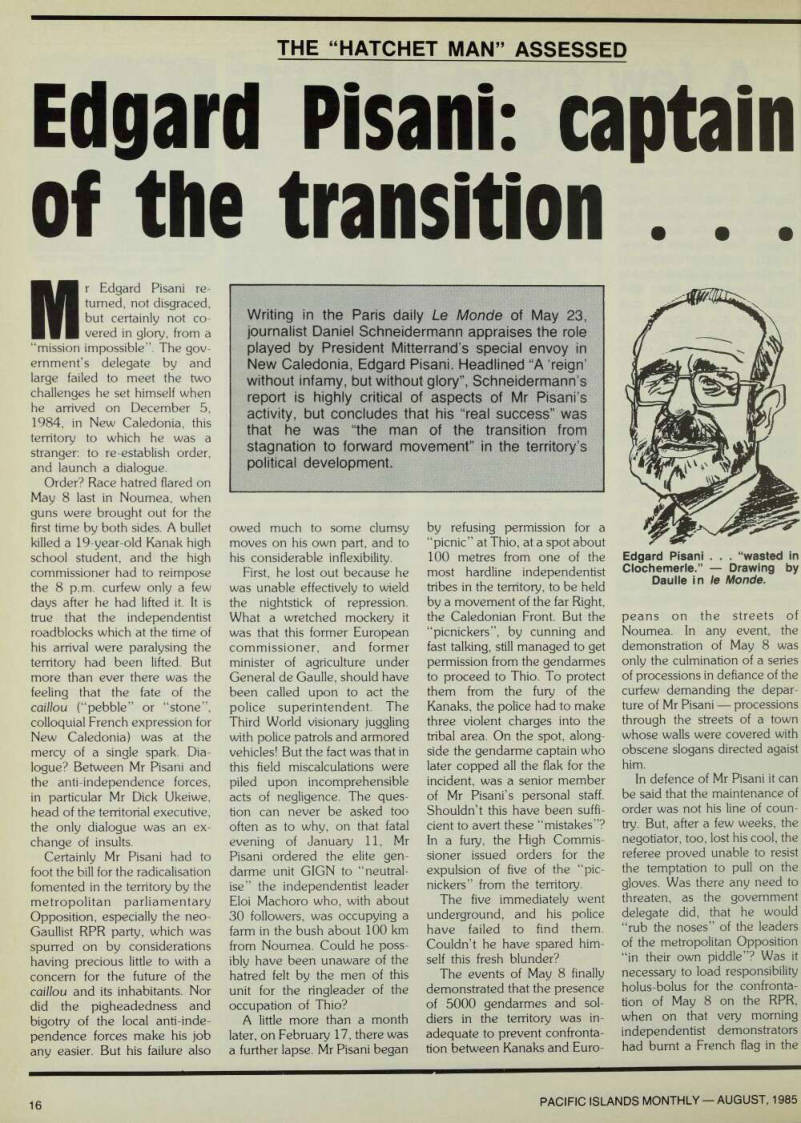
Edgard Pisani . . . “wasted in Clochemerle.” - Drawing by Daulle in le Monde.
Place des Cocotiers?
It was simply not his scene, and he seems never to have realised it. The theoretician of land reform ensnared in stand up comic antics with Mr Ukeiwe! His imposing gestures, his voice with its de Gaulle-like cadences, were wasted in Clochemerle, in dealings with fourth-rate ward politicians.
Those who took part in a security meeting with him one evening observed him for a moment dreamily stroking the kepi of a gendarme general, which had been left behind forgotten on a table.
Certainly Mr Pisani counted too much on the magic of his eloquence, his charisma, to drag a compliant caillou along the path of reason. Even though he had many informal meetings with the Europeans of Noumea, he was never able to win over this complex com munity, which merits the atten tion of ethnologists no less than the Kanaks do. “I know the goal I’m heading for, but not yet the means of getting there,” said he as he stepped off the plane from Paris to the war veterans and senior officials in formal attire who were there to greet him. A number of docu ments digested on the 30-hour flight had been sufficient to convince him it was necessary to race ahead to independence.
Very soon, the murderous ambush at Hienghene, in which two brothers of Jean-Marie Tjibaou were assassinated by colonists, allowed him to establ ish warm and close ties with the independentist leader. Tjibaou, against the will of part of his own movement, and despite his bereavement, honored his pledge to lift the roadblocks.
The two men got on so well that they exchanged copies of their published writings, which they read avidly. Throughout the “Pisani reign” they continued to meet, often outside Noumea, to talk about future independ ence.
On the other side, Mr Ukeiwe, under the chaperon age of Mr Bernard Pons, and then, most particularly, Mr Charles Pasqua these two were the first of a whole succes sion of RPR leaders to visit Noumea over the period
simply refused to meet Mr Pisani “so long as law and order are not re-established”. When this pretext lost its validity, meetings were refused “so long as the cadaver of independence is left lying between us”.
The whole “Pisani question” is there. Was it really necessary to race ahead to independ ence? To take advantage of the traumas of the time to give a forceps-delivered independ ence? Should he, after the presentation of his plan on January 7, have so noisily proc laimed his preference for “inde pendence-association”? Mr Fabius has chosen a quite diffe rent path. True, the objective is still the same; to convice a part of the European electors to vote in favor of independence in the referendum which is constitu tionally unavoidable. But the method has changed. It will be based on facts rather than on oratory. Regionalisation, origin ally suggested by Mr Ukeiwe, and taken up by Mr Pisani at the request of the government, will, it may be hoped, permit independence to be created on the ground, coolly, and without high drama.
Independence? The idea is in everbody’s mind today, where as a mere 10 months ago the RPR and the RPCR were rejec ting the “Lemoine statute” for internal self-government. It is perhaps here, in the long term, that Mr Pisani’s real success lies: that he was the man of the transition from stagnation to forward movement.
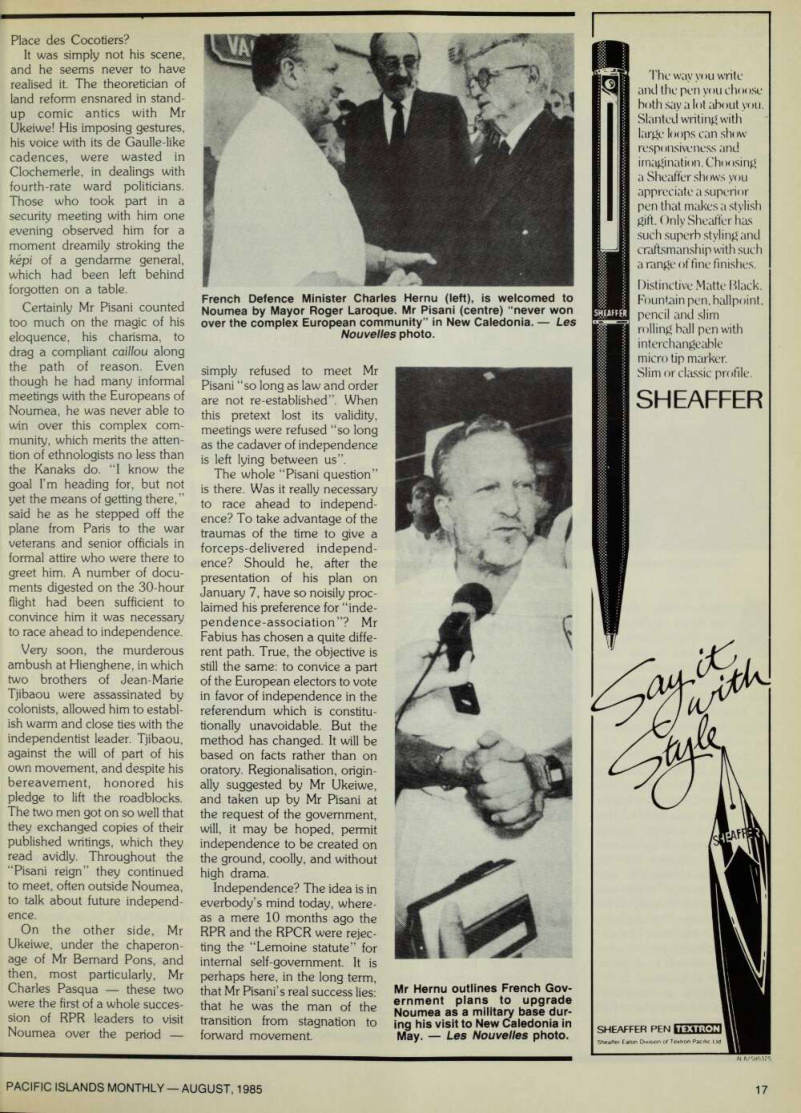
French Defence Minister Charles Hernu (left), is welcomed to Noumea by Mayor Roger Laroque. Mr Pisani (centre) “never won over the complex European community” in New Caledonia. - Les Nouvelles photo.
Mr Hernu outlines French Gov
ernment plans to upgrade
Noumea as a military base dur ing his visit to New Caledonia in
May. - Les Nouvelles photo.